 We dedicate today’s interview with distance runner Amy Chavez to those affected by the Boston marathon bombings. Our hopes and prayers and encouragement are with you.
When it comes to long-distance running, I couldn’t put it better than the American cowboy Will Rogers once did:
We can’t all be heroes because someone has to sit on the curb and clap as they go by.
I simply haven’t got the necessary strength, both physical and mental, for that kind of endurance test.
Is it any wonder, then, that I’m feeling intimidated by the prospect of talking to Japan-based expat Amy Chavez about her 900-mile run around Shikoku Island? We’re talking ultramarathon here.
The redoubtable Amy hails from Ohio but has lived in Japan for many years, where she is a well-known writer and columnist for the leading English-language newspaper, the Japan Times.
In 1998, she spent five weeks during March and April running the traditional pilgrimage on Shikoku Island. In essence she ran a marathon per day (sometimes more). And although the weather and conditions were pleasant enough—it was cherry blossom season—it was cold at night, and there were many mountains, though the roads were the worst part “because pavement is hard on the feet, knees, etc.”
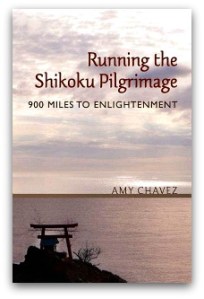
Last month Amy published a book with Volcano Press about her record-breaking adventure (almost needless to say, she was the first person to accomplish this feat), Running the Shikoku Pilgrimage: 900 Miles to Englightenment—a copy of which we are giving away!!! (Details below.)
But first I want to find out more about what motivated her on her epic—and energetic—journey, including any challenges she faced in writing her book.
* * *
 So, Amy, I understand you decided to run the 900-mile-long Shikoku Pilgrimage after being laid off by the university where you were teaching in Japan. What made you think that running vast distances might be the answer?
Physical challenges have a certain appeal. I was interested in the physical journey, as I think most foreigners are when they walk the pilgrimage the first time.
But you didn’t walk it; you ran it!
For some reason I have never discovered the joy of walking. I dreaded the thought of walking 900 miles, the distance from San Diego to Oregon. But running is somehow different. When people go running, it’s not unusual to run 10 km or more, three or four times a week. People hardly ever do that walking. Instead, they walk around the block and come back. Runners don’t do that. We’re in for the long haul.
Did making this journey allow you to see Japan in a new way?
I was able to see Japan much more objectively. I went from being in my own little world where everything was centered around me—thus when my world crashed, so did I—to being an observer of Japanese culture in the framework of the pilgrimage. So there was a fundamental shift from being a part of the university, where the students and the university relied on me, my teaching skills, and my commitment, to being part of the pilgrimage that didn’t really care whether I did those things or not. The pilgrimage doesn’t care whether you show up or not, whether you complete it or not, whether you understand how it works. In other words, it’s not about you at all. So suddenly you’re on the other end, trying to understand what it is that the pilgrimage is trying to give you, on its own terms, and what you can learn and take away from it.
What was your most displaced moment on the journey?
I’d never felt displaced in Japan until I lost my job. It was a very big thing for me because I had put so much time, effort and love into that job. Suddenly, without warning, I was let go, all because I was a foreigner. I just couldn’t get my head around that. So the journey started as a result of this unnatural feeling of being displaced. The people who had treated me like family had suddenly tossed me out on the street. I was searching for ways to deal with my feelings toward Japan and Japanese people.
“The person who starts the race is not the same person who finishes the race.” [Marathon sign]
How did your feelings toward Japan evolve once the journey got underway?
I was able to see the pilgrimage as this microcosm of Japanese culture. If you’re ever wondered why the Japanese do things or act a certain way, you can find out through this historical context of Buddhism, and the Shikoku Pilgrimage which has been walked for over a thousand years. The purpose of the pilgrimage—to reach enlightenment—has never wavered over the centuries.
You became less and less displaced?
Doing the pilgrimage is often referred to as entering a mandala. You have to leave your safe, secure world and cross over into an unknown world where you are no longer in control. Once you accept this, and surrender yourself to the pilgrimage, you will no longer feel displaced.
Wise words! How long did it take before you surrendered?
It happens for different people at various parts of their pilgrimage but for me, this happened about one third of the way through, or two weeks into, the pilgrimage. Suddenly everything fell into place. I had finally learned to go with the flow and let things happen to me rather than trying to control things that happened to me. We are so used to taking control of our lives: we plan our trips down to the finest detail, we budget monthly, weekly and even daily, we get the right job. But life doesn’t care how much you’ve planned. Life continues to throw us curve balls—your car dies, you come down with an illness, you lose your job. Despite our steadfast planning, that’s not how life works.
It’s is not how the pilgrimage works either. Despite your intentions to do something a certain way, the pilgrimage will constantly present you with challenges—things you’d never planned on. Once you surrender to the ways of the pilgrimage, you no longer feel displaced. You no longer struggle with the elements, the terrain or nature. Instead, you become one with them.
Not surprisingly, this is one of Buddhism’s life metaphors as well.
Another ultramarathon—writing the book
I believe you chronicled your Shikoku adventure in the Japan Times?
Actually, I wrote six columns for the Japan Times. I also kept a diary, but that was separate from the columns.
Once you’d decided to write a book about the experience, what was the greatest challenge?
Time. It takes an enormous amount of time to write a good book. It’s all consuming, a full-time job. On top of that, I still had my weekly deadlines for the newspaper and other publications I write for.
Your book is coming out 15 years after you made the pilgrimage. Why the delay?
It’s not unusual to have so many years between a story and a published book. There’s the year (or longer) it takes to write, there’s the year-long (or longer) search for a publisher, the six months negotiation with the publisher(s), and then the two-year process from book contract to published book. So already five years has passed, and that’s with no bumps along the way.
Then there’s also timing. No one was really interested in my story at the time I did it. But things have changed drastically since then. NHK has had a popular TV series about the pilgrimage, previous books about the pilgrimage have run their course and gone out of print (thus creating a demand for something new), and ultra-running has become one of the fastest growing sports in the world.
Did you derive any new insights from revisiting the adventure?
That’s another reason I think you see so many books that are published a decade or so after they happened is because people often need distance before they can really understand their own journey. How can you talk about how an experience has changed you, or changed your life, if you haven’t had time to prove that it really has? Time gives one perspective. And with time comes wisdom. I was just reading a book the other day and couldn’t help but think it would have been so much better if the writer had waited a decade or so tell his story. He, nor his writing, had matured yet; his book had no arc, it offered no wisdom.
So while I wish my book could have been published a long time ago, I know it’s a much better book because I waited.
What audiences do you intend for the book?
There are three: those interested in Japan, those interested in Buddhism, and those interested in running. The book was officially released in March, and the reviews are just beginning to come out, so it’s too early to tell if those are the audiences the book will attract.
How about people who don’t know Japan—would they enjoy it, or would you be running circles around them?
You would have to have some innate interest in other cultures to get the most enjoyment out of the book—which I think most Displaced Nation readers have. But even if you are only interested in people’s amazing feats and accomplishments, you should enjoy the story, too. It is an adventure travel story about a girl who ran 900 miles that happens to take place in Japan.
Running the Shikoku Pilgrimage sounds like a hard act to follow. Are you working on any other ambitious travel projects that will one day be books?
I have an original hand-written diary of my great-great grandfather’s journey through Japan’s Inland Sea to the Philippines on a ship in 1900. In 2004 I decided to trace his journey in a sailboat. Unfortunately, the trip was cut short when we had to be rescued at sea, and we lost the boat. Determined to finish the trip, however, we bought another sailboat and set out again in 2012. This time we finished the trip despite dodging four typhoons, two tropical storms and running into a reef. I haven’t decided whether the title of the book should be Little Titanic or Storm Girl.
What do you think?
Love it! (Hmmm … the limb doesn’t fall far from the tree.)
10 Questions for Amy
Finally, I’d like to ask a series of questions that I’ve asked some of our other featured authors, about your reading and writing habits:
Last truly great book you read: Jules Verne’s Twenty Thousand Leagues Under the Sea. It’s always the last great book I read.
Favorite literary genre: Adventure travel, memoirs.
Reading habits on a plane: E-books only. Whatever is stacked up still waiting to be read. I also read tons of magazines.
The one book you’d require President Obama to read, and why: Any book on the current farming industry and feedlots. Save the cows!
Favorite books as a child: Anything about horses.
Favorite heroine: I admire Nora Ephron.
The writer, alive or dead, you’d most like to meet: I’d like to go fishing with Ernest Hemingway.
Your reading habits: Mostly non-fiction. More and more creative non-fiction. A little bit of fiction.
The book you’d most like to see made as a film: I’ve learned that books and film are completely different genres, so don’t dare compare them.
The book you plan to read next: Right now I’m reading The Annotated Reminiscences of Lafcadio Hearn. Next I’m going to read Strength Training Past 50. (Hey, you asked!) Oh, I might read Waging Heavy Peace, by Neil Young, before the strength training one, but I haven’t decided yet. Oh, I just remembered, my Dad wants me to read A Conflict of Visions: Ideological Origins of Political Struggles, by Thomas Sowell, so I better read that one next.
* * *
Readers, now it’s your chance to ENTER OUR DRAW TO WIN A FREE COPY of Amy Chavez’s book. Please leave a comment telling us about a physical challenge you’ve set for yourself, preferably in an international setting, and what it taught you. Extra points if you’re a Displaced Dispatch subscriber!!!
The winner will be announced in our Displaced Dispatch on May 2, 2013.
Readers lucky enough to live in the LA area: Amy will be signing books and meeting readers at the LA Times Festival of Books April 20 held on the USC campus, Los Angeles. Look for her in the Kinokuniya booth from 12:00 to 1:30 p.m. Copies of her book also available for purchase. April 21, she will be speaking at the Koyasan Buddhist Temple in Little Tokyo from 1:00 p.m. Public welcome.
STAY TUNED for tomorrow’s post and for a post on Friday about our fictional expat heroine, Libby. (What, not keeping up with Libby? Read the first three episodes of her expat adventures.)
If you enjoyed this post, we invite you to register for The Displaced Dispatch, a round up of weekly posts from The Displaced Nation, with seasonal recipes, book giveaways and other extras. Register for The Displaced Dispatch by clicking here!
Related posts:
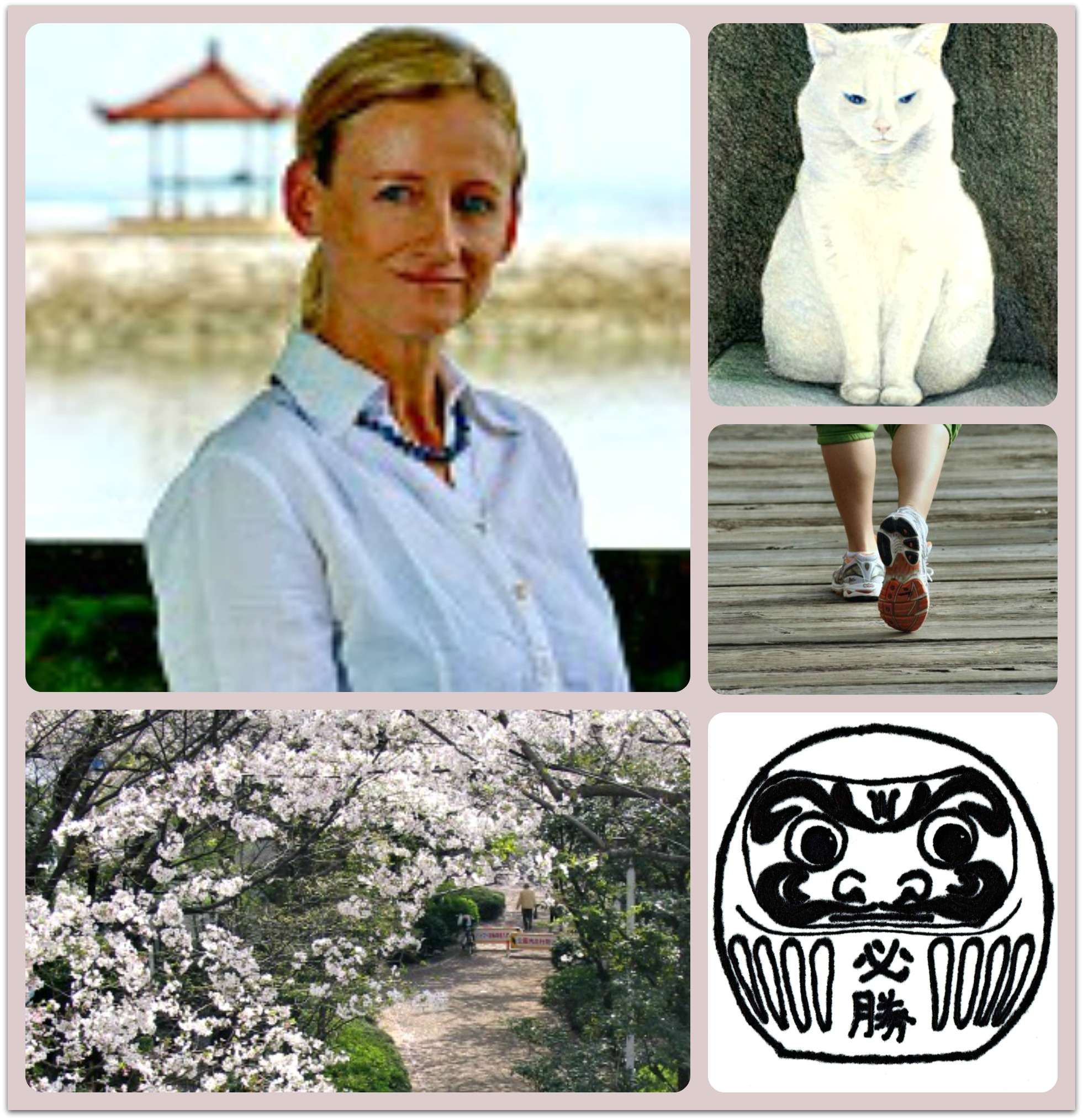
Images: Amy Chavez; Meditating Cat (a character in the book); and Daruma Doll (drawing by Deborah Davidson)—all supplied by Amy Chavez, with permission granted by Davidson. The other two images—of the running feet and the cherry blossoms—are from morguefiles.





 We’re house hunting again.











 The Displaced Nation