The Displaced Nation

A home for international creatives

Eight months into my expat life, two roads diverged and I — I took the one home

Kat Collage_dropshadowToday we welcome back Kat Selvocki to the Displaced Nation. She wrote for us once before: a travel yarn about spending Christmas in Europe with friends. She had just been toiling in the farmlands of Iceland as a volunteer, and was about to head Down Under to begin a new life as a yoga instructor in Sydney. Now, just over a year later, she is back in the United States. What happened? Here is Kat’s repatriation story.

— ML Awanohara

As my year-long working holiday visa for Australia began to wane, I started considering my options.

Or rather, my option.

I teach yoga: a career that doesn’t generally allow for work sponsorship. I also had a rocky relationship with my Australian boyfriend.

The only I way I could feasibly stay in Sydney was to enroll in a course.

I’d heard tales from other expats of reasonably-priced options — reasonably-priced meaning anything under $8,000 a year — but knew in my heart it wasn’t going to work. I no longer had that kind of cash in the bank, and even if I had, you wouldn’t catch me spending it on some ridiculous “business basics” class.

It wasn’t that I necessarily wanted to stay; I just wasn’t sure I wanted to uproot my life after spending just eight months building a new life in Australia. There were places I still wanted to visit in that vast country, things I still wanted to do. And I loved the classes I was teaching.

But then I got glandular fever — commonly known in the US as mono, or the kissing disease. A month into fighting overwhelming exhaustion, all I wanted was for things to be easy again. In the end, it was having a such a debilitating illness that drove me over the edge.

I bought a plane ticket home.

The three emotions of repatriation

First came relief:

  • No more comments about how my tattoos, taste in music, or style were “too American.”
  • No more complicated calculations to figure out when friends or family would be available to Skype.
  • No more job rejections on the basis of not being a citizen.
  • And most importantly: central heating in abundance — finally, I’d stop getting sick so often!

Self-doubt followed. I’d spent years wanting to live as an expat, and when I finally had the opportunity, I’d been utterly miserable.

Had I failed, or not tried hard enough?

Should I have fought to stay longer, or at least until the end of my visa?

Were my reasons for leaving the right ones?

Why hadn’t I applied for that job working at a roadhouse waitress in the Outback, so that I’d at least seen more of the country?

Next up: fear. As I headed off to Oxford, UK, at the end of last year, to spend Christmas with friends before returning to the States to seek work, the wheel had come full circle. As reported on this blog in December 2011, I’d spent my first Christmas away from family, in Europe, on my way to a new life in Australia.

Whereas before I’d been full of excitement and anticipation, this time I was full of worry. I worried about how welcoming people would be when I returned. So many of my relationships had disintegrated while I was away, and I wasn’t sure if that was because of distance or because people were fed up with my use of Aussie slang in our conversations … or was it all my whining about being so bloody tired? (Hm, there’s that slang again!)

I had no idea whether finding work would actually be any easier, especially considering the much higher unemployment rate in the US.

I didn’t know how to talk about my time in Sydney without sounding bitter or depressed — but was also afraid that even if I sounded upbeat, people wouldn’t care to hear about it.

Old habits die hard…

I’d always believed that if something doesn’t work, you can simply head back to the place you were before.

Suddenly, I wasn’t so sure about that.

I had decided to move back to Seattle, a city where I’d lived eight years earlier. But would that be a terrible mistake? I pictured trying — and failing — to recreate the life I’d loved before.

Last time I wrote for the Displaced Nation, I reminisced about the four months I’d spent living in Prague on a study abroad. What I didn’t report was the depression and reverse culture shock I battle against upon returning to the United States.

If that were true after a mere four months, what impact would a year-and-a-half away have? Would I be feeling even more out of place? I dreaded the long readjustment.

I also worried about money, and whether I had enough to get settled again quickly.

…or do they?

As it turned out, I needn’t have worried. (Except for the money concerns. Then again, I’m convinced that no matter how much I’d saved before returning, I still would have worried.)

From the moment I stepped off the plane, it was as if someone had flipped a switch inside of me. Even though things had changed — something that was particularly evident in New York City, which I passed through on the way to the West Coast (I’d lived there after Seattle) — it all felt normal. Easy. Almost as if I’d never left. My internal map and compass worked again; I knew where I was and where I was going.

And I still believe that — even though, two months after returning to the States, I continue to look the wrong way when crossing the street.

* * *

Thanks, Kat, for sharing your story. I found it very moving. Readers, any comments, questions for Kat — any similar stories to share?

Kat Selvocki — badass yoga instructor, photographer, writer and traveler — is currently kicking ass and taking names in Seattle after returning from her expat adventures. Learn more about her on her Web site: KatSelvocki.com. You can also follow her on Twitter: @katselvocki.

STAY TUNED for the final post in our fashion and style series, by the ever-so-stylish Kate Allison! (Well, she certainly has flair!)

If you enjoyed this post, we invite you to register for The Displaced Dispatch, a round up of weekly posts from The Displaced Nation, with seasonal recipes, book giveaways and other extras. Register for The Displaced Dispatch by clicking here!

Related posts:

images: (clockwise, starting top left) Chelsea Market, NYC; Capitol Hill, Seattle; Circular Quay, Sydney; Chelsea Market, NYC; The Rocks, Sydney; in the air when flying from Sydney to Melbourne; Pioneer Square, Seattle. Center shot of Kat Selvocki was taken in Seattle. All photos are Kat’s with the exception of the Circular Quay in Sydney, which came from Morguefiles.

Citizenship limbo: How long-term expat life has impacted my status back home

England-Korea_ValerieAh, the no-man’s land of the expat life — if you don’t know what I’m talking about, then you haven’t been abroad for long enough. Nor would you, I’m afraid, qualify for Displaced Nation citizenship. One person who does know what I’m talking about, and would more than qualify, is Valerie Hamer. She likes to refer to herself “British by birth and a nomad by choice.” Here is her bittersweet tale of where that attitude has taken her…

— ML Awanohara

Having lived in Asia for nearly 13 years, I’ve grown accustomed to the standard opening line: “Where are you from?”

However, as the years have passed, my factual auto response of “England” has made me uneasy.

I consider myself a global nomad: an international citizen, albeit one with a passport identifying my roots in the Commonwealth realm.

Plus, I dislike labels of any kind because they invoke stereotypes: and when it comes to nationality there are only so many questions — do you have afternoon tea at 4:00? do English gentlemen really wear bowler hats? — a person can take!

Not British any more…except at the core!

The truth is, I don’t feel particularly British (whatever that really means) anymore.

In fact, I’m so out of touch I have to spend time online researching current UK news on weather, music, sport fashion and politics — because knowing these things is what is expected of me.

Foreign is what I am all about after all, and that isn’t ever going to change.

The blurring of one’s national identity happens over time. In the first couple of years of the expat life, we crouch on the edge of our host culture, secure in the knowledge that the familiar is only a plane ride away. We make cross-cultural comparisons, some of them invidious; have adventures; reminisce; and sometimes escape for brief periods of intense reunion with the motherland. The possibility is always open for ending the foreign adventure and resuming the life left behind.

Over time, however, the attachment to the homeland fades and in the process, most long-term expats mutate into something closer to the global citizen. Take my case: I am now a quasi-fraudulent impersonation of a bona fide English woman.

But, even though I have lived abroad for over a decade, I have never seriously doubted my citizenship. Great Britain is, after all, the place where I was born and raised. The island I could return to on my terms, without fear of any impositions on my status or freedom.

After all, I continue to be a British citizen, right?

No right to investment

Not quite, as it turns out, for while I have been busy living as a temporary resident of South Korea, times have been a-changing back home in Britain.

A standing joke amongst my family and friends is that I manage to devalue the currency of any country I choose to live in. I have the same effect on UK interest rates, too, which is why I’ve made a habit of checking out the best deals and making the necessary transfers every time I visit.

Suddenly, though, this became impossible! New government rules have outlawed British non-residents from investing their cash in the country. How dare we?!

I chose a Korean bank instead, where thankfully I haven’t confronted similar issues — though it should be no surprise to hear that the interest rate dropped by half during my first year in the scheme!

Little right to health care

I rarely get ill, but sometimes I’ll make a quick trip to the doctors when back in England. Most health care services are free at source, and even temporary visitors can make use of any emergency facility. Those of us with family in England can see a general practitioner as long as a family member is on the books.

It’s never been a problem until now.

Last summer I called the office of the GP my father uses and was interrogated quite fiercely by the receptionist. I won’t bore you with the details: suffice to say, as a non-resident I need to be close to death before the medical profession will give me the time of day.

I can’t complain about being denied access to a system I don’t pay into, but the experience further defined me as an alien in a place where I used to belong.

No right to drive?!

One area that shouldn’t be a problem is driving in the UK, right? Last summer I decided to hire a car for my visit. I hadn’t been behind the wheel for ten years but had kept my license updated, registered to my family’s UK address.

After shelling out for a couple of refresher lessons and an expensive insurance policy, I felt confident that all was good — and it was, that is, until I discovered quite by accident that the insurance had actually been useless.

Who knew that my UK license grants only permanent residents the right to drive? Living outside the country means you forfeit the permission to use, or even renew, the license.

It makes sense when you think about it — but the assumption that we are good to go without an international permit is pretty widespread among us British expats.

* * *

These are just a few examples of show how ignorant I was of the gradual erosion of my rights to access UK services and systems — an ignorance I suspect I share with many other displaced Brits.

Ultimately, those of us who occupy a liminal space between two cultures need to come to terms with the idea that we may truly belong in neither.

* * *

Readers, any comments or questions for Valerie? Can you relate to her “floating world” status?

Valerie Hamer is a global nomad with a severe coffee addiction and a love of the written word. Her first book, Picky, Sticky or Just Plain Icky? A Blind Date Conversation: South Korea, came out last year; we gave it a two thumbs up. Hamer writes a popular blog, Faraway Hammer Writing, which is named for how people in Asia tend to pronounce “Valerie Hamer”. You can also follow her by that moniker on Twitter: @Farawayhammer.

STAY TUNED for another guest post, by Kat Selvocki. Last time we heard from her, she was on her way to start a new life in Australia. And now…

If you enjoyed this post, we invite you to register for The Displaced Dispatch, a round up of weekly posts from The Displaced Nation, with seasonal recipes, book giveaways and other extras. Register for The Displaced Dispatch by clicking here!

Related posts:

images: (clockwise, starting top left) Ploughman’s lunch (courtesy Flickr); traditional Korean meal; Korean marchers; Seoul (courtesy Flickr); Thames view of London; Queen’s Guards marching; Valerie Hamer. (Non-Flickr photos from Morguefiles.)

I’m an explorer — not a traveler

This week, the Displaced Nation is drifting away from March’s initial theme of beauty/fashion tips picked up from world travels. Hardly surprising, given that all of this week’s writers are males! Today’s guest poster, James Murray, a displaced Brit in Boston, is a prime example. The only new fashion he’d like to start would be replacing the word “travel” with “explore.” Sounds pedantic, right? Well, see what you think!

— ML Awanohara

I was never really one for traveling. When all the kids went on their gap years before college, I called them on it: I knew it was a waste of money; a way to delay the inevitable intrusion of the Real World into their lives — in short, I didn’t see the point.

Receiving emails from abroad about how wonderful these experiences were and how life-affirming and eye-opening and incredible the world was, I simply smiled to myself.

How naïve they were, I thought.

Whereas I would be a year ahead; a year closer to a job; a year closer to money, and a year closer to actual freedom.

I did not see work as some black hole into which you pour all of your efforts with no hope of ever getting anything back. On the contrary, I thought it would be pretty good to have a job and a flat and friends and the cash to support a lifestyle I could be comfortable with.

Travel for travel’s sake

I still think that. In fact, I’m not entirely sure I was ever wrong on this point. Sorry to disappoint. And particular apologies to Jeff Jung, whose book on career-break travel was favorably reviewed on this site at the end of last month.

Don’t get me wrong. Yes, I’ve traveled and, yes, I love being “elsewhere,” doing things differently, as much as the next displaced nation resident. In fact I’m a bit of a neophile when it comes to food and culture…

But being enamored of the new doesn’t mean you have to travel.

Travel provides a set of obvious novelties: new tastes; new currencies; new transport; climate; a different view from the window.

But just being somewhere different doesn’t make you an explorer; in order to get that badge, you need to set foot outside your comfort zone, step away from the hotel, the package tour, the guidebook — and look with your own eyes.

Cross that one off the list!

That Facebook app that challenges you to prove you’re a world traveler by listing all the countries you’ve visited irrespective of how long you were there or where exactly you were: what does it really show? It makes a three-day hotel stay in Shanghai look as though you’ve conquered the entirety of mainland China, and it reduces that beautiful holiday in Wales — you know, the one that reminded you what it was like when shops closed on a Sunday — to a complete non-event.

The way we think of travel is all wrong: the political boundaries on the map say that I now live in the USA, but that doesn’t really say anything about where I actually live or the aspects of American culture that I’ve actually experienced.

My life would be completely different if, say, I lived in the desert or the mountains — it would even be different if I lived in New York instead of Boston.

I don’t anticipate ever being able to say that I’ve seen it all.

Explore, for heaven’s sake!

Exploring as opposed to traveling is a question of quality against quantity. I did a lot of exploring in London and Edinburgh that opened my eyes just as much as wandering around Thailand and Romania.

A few curiously exploratory examples:

  • Getting a haircut at a weird little barber’s in Shepherd’s Bush. It was an all-male barber’s, where men could “come along and say what they like in whatever language they like,” as the proprietor put it. I remember being very quiet amid a torrent of very macho conversation. Not a totally unpleasant experience, but I never went back.
  • With my flatmate, laying Russian roulette with the pastries at Vanna Patisserie, a Chinese bakery in Shepherd’s Bush. They were either sugary and delicious or curiously tough with a peculiar secret ingredient. There was no way of telling from the outside.
  • Spotting a Portobello (Edinburgh) art exhibition displayed outside people’s homes that featured, amongst other things, a fat-and-seed bird feeder in the shape of the artist’s head, hung from a tree, where it was gradually and gruesomely pecked to pieces.

These bizarre titbits are the wages of the explorer but not necessarily the traveler, who might see only those accepted “landmarks” to which his eyes are directed.

Avenues for exploration are everywhere. In fact, when I first moved to London, I was so inspired by the tube stops that I wanted to develop a guide to each one.

My idea was that I would use some algorithm to pick a different tube stop each weekend, go there and simply wander around in a roughly spiral shape from that stop, looking carefully at architectural details, stopping in parks and perhaps interviewing the proprietors of particularly interesting local businesses.

I would document these things not so much as a guide for others to visit exactly the same places, but in hopes of inspiring them to look at their own neighborhoods with new eyes.

Exploring the New World

I try to do the same kind of thing in Boston, although I confess I find it a bit harder — there’s the sheer fact that London is 1) massive and 2) very, very old that makes it rather easier to find the gems at the ends of the nooks and crannies.

But I’m not discouraged — I’ve still barely explored the North End with its windy little streets and ample opportunities for getting lost (I don’t have one of those phones that tells me where I’m going).

And just the other day we were introduced to a bar not five minutes down the road, which will make a superb local, with its walls plastered in kitschy tut. I’m sure I’ve passed it before, but, like all the best things, it’s a bit hard to spot.

In amongst these streets are histories, idiosyncrasies and mythologies — of that I have little doubt. Finding them is just a matter of retiring my traveler’s shoes and donning an explorer’s hat.

* * *

So, world travelers — sorry, I meant to say “explorers” — what do you think? Is James right in saying that all of this obsession with the quantity of travel (how many countries, etc.) is misguided? And what do you think of his assertion that Edinburgh can be as fascinating as Bangkok, if you take an explorer’s approach? Please leave your thoughts in the comments…

James Murray is a self-described “itinerant Brit.” After a stint in New Zealand, and some travel in Southeast Asia, he and his American girlfriend — now wife — are practicing “staying put” in Boston, where James is pursing a career as a wordsmith for marketing and fiction, and as a non-professional theatre director. He is also a Utopian idealist and SingStar enthusiast. You can find more about his views by reading his blog, Quaint James, and/or following him on Twitter: @quaintjames.

STAY TUNED for tomorrow’s post by Andy Martin, about a unusual source of beauty in his new home town of São Paulo.

If you enjoyed this post, we invite you to register for The Displaced Dispatch, a round up of weekly posts from The Displaced Nation, with seasonal recipes, book giveaways and other extras. Register for The Displaced Dispatch by clicking here!

Related posts:

img: MorgueFile

CAPITAL IDEA: Singapore: A quick guide

Welcome to another “Capital Ideas” – our somewhat idiosyncratic, ever so slightly tongue-in-cheek guide to various world cities, perfect for the ever discerning readership of this blog. We know our readers are always visitors, never tourists (an important distinction).

Do feel free to contribute your own ideas or suggestions in the comments section, we’d love to hear your thoughts, too.

Capital: Singapore.

Wait a moment, isn’t that an island? Well, it’s actually made up of 63 islands, but Singapore is, in fact, a city state.

Like the Vatican? There’s fewer Cardinals, but yes, the Vatican is an example of another city state.

All I know about Singapore is that chewing gum is illegal. As a confessed chewing gum addict, I think I’ll have to pass on this one. Some forms of therapeutic gum is allowed.

So I can get hold of gum? If a doctor or dentist sells it to you for health purposes, then yes.

What else is banned? Candy? No, in fact, when I was last there I noticed that Singapore immigration put out bowls of hard candy as you went through passport control.

That’s definitely preferable than dealing with Homeland Security.Isn’t it?

This still isn’t quite explaining why I should visit. Well, being a well developed, self-contained city state, it’s easy to get a sense of Singapore quickly and it’s easy to get around.

So I should go because it’s convenient? No . . . Well. . . Yes, I suppose it is. Everything is easy and doable. You won’t have aggressive taxi drivers trying to trick you over fares as you leave the airport. It’s a very well-run state. That’s interesting to see, and it means some of the more stressful elements of travelling, aren’t such a problem here.

Wouldn’t that be primarily due to Singapore’s soft authoratinism? Hey, I thought you only knew about the gum?

I’m smarter than I look. Considering your looks, that’s not too difficult, but to answer your earlier question, yes, Singapore’s laws can be draconian at times, and it’s these laws that make it, on the surface, a well-run state that you’ll feel very safe in for the duration of your visit.

What else do I need to know? Well, being a financial and business center for the region means that there’s a large number of European, American, and Australian expat communities in Singapore. 40% of Singapore’s residents are foreigners. Accordingly, no matter where you’re from, you’ll find something or someone to remind you of home. What’s also useful to remember is that English is one of Singapore’s four official languages. Don’t assume that that means that everyone speak it, but a large number of Singaporeans do, which does make it a more convenient destination in terms of being understood than most other Asian destinations.

Will I be able to understand Singlish? You’ll have better luck understanding a drunk tramp screaming at you on Sauchiehall street. The Singapore government strongly discourages Singlish, but personally we find it charming and a rich part of Singapore’s identity.

Okay, so if I do decide to go, what should I do there? If you’re with young children then you need to make a visit to the Singapore zoo? They do an amazing night safari.

Really? The zoo? I was expecting an answer a little more imaginative than that. It is a nice zoo, though. You can also visit the botanical gardens that houses one of the world’s largest orchid collections.

Orchids? Don’t mock. You can see an orchid dedicated to Princess Di AND one dedicated to Margaret Thatcher.

Umm. . .sounds thrilling. The must-do is checking-out Orchard Road.

What’s that? It’s the main road through Singapore. It’s the social epicenter where people come to…and forgive me for using this phrase…shop til they drop.

Are they that into shopping in Singapore? Yes. Orchard road isn’t shop after shop, it’s high-end mall after high-end mall. It needs to be seen to be believed. For a not quite so high-end retail experience, but just as fascinating, visit the Mustafa Centre in Little India. You’ll be able to find anything in this department

I thought this site had cultural pretensions. All I’m hearing about is shopping, zoos, and flowers dedicated to Maggie bloody Thatcher. One of our favorite museums can be found in Singapore.

What would that be? The National Museum of Singapore. They really do an excellent job of presenting the island’s history. It will you a marvellous grounding in the Singapore. Once you’ve finished there you can head over to Raffles for a Singapore Sling.

Wasn’t Raffles a gentleman thief? You’re thinking of a different chap. This Raffles, is Sir Thomas Stamford Raffles a member of the East India Company who founded the city of Singapore. The Raffles Hotel is named after him. It’s an ornate colonial hotel that is worth a visit. It was also here that the cocktail the Singapore Sling was invented.

What’s in it? Gin, Cherry Heering, Bénédictine, and fresh pineapple juice. It’s a very attractive pink color. Drink it in the Long Bar. Bowls of peanuts are also provided in the bar, you’re expected – nay encouraged – to throw the peanut shells on the bar floor. It’s the only place in Singapore you’re allowed to litter. The Long Bar was a favoured hang-out of Ernest Emmingway and Somerset Maugham.

What other food should I try? Kaya toast is my favorite. Kaya is a fruit curd made from coconut and sugar, spread it on hot buttered toast and at with a runny, soft-boiled egg – it’s heaven. Also, if anything is made with pandan – be it bread or cakes – then gobble it down. Pandanus leaves make the most mundane item delicious. You should also go to Clarke Quay to try Chilli Crab, and Little India for some Fish Head Curry.

Fish Head Curry? Sounds gross. It’s an experience, and one I didn’t find unpleasant, though I don’t think I’d want to make a habit of it. The eyes are the best bit.

Should I eat durian? I would say, yes. It’s an experience, you should try it.

What’s it like? Initially, it tastes rather pleasant. There’s a creamy custard taste. It’s the second taste that may make you retch. I’d describe that second taste as being a mix of raw onions, halitosis, and burnt dog hair. In my experience, you may want to try it first as an ice cream flavor before you build up to the real deal.

What should I read? For fiction, A Many-Splendoured Thing by Han Suyin, King Rat by James Cavell, and Far Eastern Tales by Somerset Maugham. For history, try A history of Singapore, 1819-1988 by C.M. Turnbull.

Thanks, I’m off to try and find some durian ice cream. I’ve had garlic ice cream, can it be any worse? Careful what you wish for.

STAY TUNED for a new Displaced Nation post tomorrow.

If you enjoyed this post, we invite you to register for The Displaced Dispatch, a round up of weekly posts from The Displaced Nation, with seasonal recipes, book giveaways and other extras. Register for The Displaced Dispatch by clicking here!

Related posts:

Image: MorgueFile

Where’s the fairest of them all? Fashion & Style in Brazil vs. Britain

It’s March, a month when residents of the Displaced Nation turn to fashion ideas, beauty tips and other frivolities we’ve gathered from our travels. To kick off the discussion, we’re delighted to have Georgia Campello as today’s guest. She is married to our newest contributor, Andy Martin — and apparently more qualified to comment on such topics than he. A Brazilian (the couple currently live in São Paulo), Georgia has also lived in Britain. How do the beauty and fashion standards compare?

— ML Awanohara

According to my humble observations of my home country (Brazil) and the country where I once lived as an expat (Britain), and trying not to generalize too far, I think it’s fair to say that Brazilian and British women possess somewhat different ideals of fashion and beauty.

Of course they do, I can hear you say. What can women who live in a country known for sunshine and beaches have in common with the female occupants of a rainy, overcast island? It doesn’t snow in Brazil (and in most places it doesn’t get cold at all), so you are not going to see many women in woolly hats, gloves and scarves. Similarly, women in the UK rarely appear in shorts, a t-shirt and flip flops — except on the rare days when the sun suddenly shines.

Yet it’s also true that Britain and Brazil produce many of the world’s most famous beauties: Kate Moss, Naomi Campbell, Lily Cole; Gisele Bündchen, Alessandra Ambrosio and Adriana Lima.

And even on the level of the ordinary commoner in each of these countries — by that I mean, those of us who aren’t tall, size-zero goddesses — in my experience, we have similar everyday beauty routines: shower every day, shampoo/conditioner, moisturizer, some make-up, some sort of hair styling and off we go… (Is that not the case for most women?)

Have you had a Brazilian?

But hey, it is not that simple.

It seems that Brazilians have put a little more thought into it; at least regarding new procedures and technologies. What do you get before wearing a bikini? That’s right, a Brazilian. It’s even in the Oxford Dictionary!

Have you had a Britain? It doesn’t quite have the same ring to it, does it?

A quick Google search starting with “Brazilian” will also get you a Brazilian blow dry and even a Brazilian butt lift.

It’s funny how adding this adjective attaches credibility to such a wide range of treatments. Maybe because Brazilian women are associated with beautiful, half-naked, sun-kissed, beach babes with gorgeous bodies dancing samba.

Well, sorry, guys; that is not the case for most of us.

The fakest of them all?

But I digress.

On the whole, most Brazilian women are indeed more concerned about the way they look and spend much more time/effort/money than most British women do on changing their looks rather than enhancing their natural assets. While women in Britain may flirt with the idea of changing their looks to something other than what they were born with, in my native country they go a little further. Brazil is in the Top Three for plastic surgeries, whereas the UK is 17th.

And you don’t even have to go under the knife. It’s easy to find grown women in Brazil wearing braces to correct their teeth. Likewise, it’s hard to find a woman in Brazil who hasn’t changed her hair color and/or texture with some sort of chemical treatment. As a result, you can see a lot of blonde girls with straight hair all over the place, even when their complexion does little to favor this combination.

A UK equivalent might be the “Oompa Loompas” you see walking around with silly amounts of fake tan on their faces and bodies, or the women with so much make-up they look like they’re wearing masks.

At least we Brazilians have no need for a fake tan, thanks to our relentlessly hot and sunny climate. Indeed, it’s almost impossible to avoid the sun in this part of the world.

Call in the fashion police

For me the biggest difference in style relates to the price/availability of clothes. In the UK you have a choice depending on your budget: designer or High Street. People who don’t have much money can still be stylish as the High Street provides inexpensive knockoffs of the latest looks.

In Brazil, by contrast, clothes tend to be VERY expensive. The so-called popular stores are not cheap, and the quality of the garments they sell is rather poor.

Also, because we’re in the Southern hemisphere, European Fashion Weeks are showing autumn/winter collections while we are boiling at 30+ºC. By the time the latest seasonal styles arrive here, they feel outdated.

There are exceptions, of course, but I do regard British women as more stylish than us Brazilians.

Having said all that, I would caution against making too much of the differences between British and Brazilian women. In the end, most of us women, regardless of nationality, tend to enjoy looking and feeling good. And, as we all know, every woman has her own unique beauty or appeal — which at some level has little to do with her country of origin.

* * *

Thanks, Georgia! Readers, any questions for her? Are you, too, sensitive to beauty and fashion differences between your country of origin and where you are living now (or have lived)? Please share in the comments!

STAY TUNED for tomorrow’s post, also on fashion and beauty.

If you enjoyed this post, we invite you to register for The Displaced Dispatch, a round up of weekly posts from The Displaced Nation, with seasonal recipes, book giveaways and other extras. Register for The Displaced Dispatch by clicking here!

Related posts:


The artichoke of cross-cultural love: Italy calls!

Signora Stella CollageAmore é gioia, amore é gelosia, amore é soffrire, amore é tenerezza, amore é calore. Amore sei tu! Is it any wonder that Italians always make the top-10 list whenever women are asked to rate the world’s best lovers? We are truly fortunate, then, in having the displaced author Estelle Jobson as today’s guest blogger. As you will see, this South African likens falling in love with an Italian man to feasting on a succulent artichoke — a rather curious analogy, to be sure, until one remembers that artichokes are cultivated in the Mediterranean. It is also a rather mysterious vegetable. How exactly do you eat it? As Jobson shows, it’s a matter of  peeling off the outer petals, one at a time… We are also fortunate in that Signora Stella is giving away an autographed copy of the book she wrote on her Roman love story! Grazie mille, Signora! (Details below.)

— ML Awanohara

The first call to write about Italy came when I was ten. With a smudgy HB pencil, I outlined an epic in my lockable, pink diary. It was to be about an extended Italo-American family who would make it big selling tyres. The main character, Pia, was to be my age, torn (theatrically) between her Italian roots and her American life. There would be family dramas (dramatic!), cascades of curls (curly!), Virgin Maries (statues and exclamations), and a stout grandma overseeing boiling pots of pasta. The novel would be shot through with shouting, gesticulating, and emotional-blackmail-meets-amore.

This literary project was soon shelved on the grounds of inadequate content knowledge: I knew nothing of the tyre business and had exhausted my repertoire on Italians. So the plot was filed amongst my many “books to write one day”.

Loving the individual

??????????What I did finish writing, in my thirties, is Finding Rome on the Map of Love, in which travel narrative meets love story. It is an autobiographical account of moving to Rome with an Italian man. It is about love radiating out from the heart of my Italo-South African couple, to love for a family, language, people, culture, and country. Just like the concentric rings within an artichoke. This happens in all relationships, however it is much more pronounced when the language, culture, and people are not those you grew up with. The rings within the artichoke make it very difficult to know which characteristic belongs to whom. Is it your beloved who is prone to interrupting others mid-speech? A family trait? Or that of the whole nation?

Just as Italians are sometimes drawn to the prudish, earnest, and ploddish Protestant way, so are we Anglo-Saxons drawn to their swaggering, flamboyant charm — and sometimes alarmingly cavalier approach to work. It threatens us to the core, yet opposites attract. And how! A part of us secretly longs to become the other. But since we can’t quite pull it off, the next best is to have them close to our hearts. Or better still, right in the bed. We say “Be mine.”

So the beloved in question — termed “the Meterosexual” for his dapper grooming — was in varied and bewitching ways the very opposite of what I grew up with. Unlike the wooden, roughly-hewn South African man, an Italian one may adore you, quite tangibly and vocally (poetically even), from head to toe. Because in his culture, your coiffure and your shoes are crucial. Core-shakingly so. The Meterosexual debated how I should do my hair for a job interview (“Hup? Down? No, hup. More professional!”) and set me straight on shoes that were an insult to an outfit. Certain footwear was actually banned from leaving the cupboard!

For a woman to have her appearance critiqued by a man, even an exquisitely stylish one, demands a certain thickness of skin.

But being South African, I had it.

Loving the family and culture

The next ring of artichoke love is that for your sweetheart’s family and culture. First I had la mamma pressing a hairdryer upon me lest I got a cervicale (the special Italian, wet-hair induced crick in the neck).

And soon thereafter, I was up against what felt like an entire nation (in this case, 60 million citizens) all clucking, fussing, and advising on health, the risk of catching a cold, and what food may be consumed at specific times of day, linked to its digestibility. This counsel was dispatched entirely unsolicited, but with tenderness.

Which is almost the same as love, isn’t it?

Italians regarded me, being Anglo-Saxon, as afflicted with a lumpishly undiscerning cultural palate. I was urged by strangers to read Dante Alighieri, listen to Vivaldi, and, above all, focus on what went into my mouth. The Meterosexual brought home gifts of emerald olive oil, popping with vitality, and parcels of pastries wrapped in a bow, popping with calories. His mother served me the Tuscan carciofini fritti (deep-fried artichokes). And his countryfolk served me regional cuisine, ubiquitous coffees, plus the unloseable gift: an ability to discern the superiority of mozzarella di bufala (female buffalo) over mucca (cow).

Loving a language

Further spirals of love lay in the process of gaining Italian language skills. Italian has delightful suffixes, to make words bigger, smaller, cosier, cuter, or nastier and uglier versions of themselves. This, to an English-speaker, is like playing Lego® with language.

With my ability to converse came a gradual adaptation to local ways. Although, truth be told, it’s easier to learn a foreign language than, for example, to wend your way successfully through the Italian national health system or to fathom the quasi-pagan fetishizing of the modern Catholic saint.

Loving the modus operandi

Living in Rome, I learned to ride a scooter in the city’s hair-raising traffic. This turned out to be a superbly transferable skill, relevant to many other Italian things, such as being honest. Telling the truth, the Italian way, is a flexible, savvy and self-preserving art. People lie with flair. In fact, it isn’t really lying at all, they explain. It’s being diplomatic, being furbo (smart). Banging your head against all this with rigid Protestant morals will only make your cranium ring. The Italians have taught me that blurting out the truth willy-nilly is ill-advised. It is gauche, hurts other people’s feelings, and counter-productive.

Now I know: one good lie deserves another.

Becoming the other

So it is that you start off in love with a foreign person and you end up assimilating their culture. Over time, some of the once-exotic features become yours and you may even lose bits of your cultural DNA, for lack of use (e.g., wearing ugly shoes). When I find myself using an Italian gesture or expression, because nothing else will do, I know I am no longer mimicking.

This is a moment of profound integration: deeper than love, more metaphysical than the first sip of the first cappuccino of the day. It will always be yours. It’s like becoming your own artichoke.

* * *

Readers, I have a confession to make. I’ve always found the artichoke a bit intimidating. I’m not sure I’m any less intimidated after hearing what Estelle has to say — but thanks to her, I’m can now appreciate its succulent taste and tender heart. And I know I prefer it steamy!

I can imagine her dashing Roman metrosexual calling her not just Stella but mia stella polare — his polar star! (And how can I get me a pair of those cool red shoes?)

What about you? Are you eager to hear more about Estelle’s love adventure with an Italian, and with Italy itself?

Listen to what readers of her book had to say:

Liesl Jobson (Estelle’s sister, still in South Africa and also a writer — one who wins awards for her short stories!):

Finding Rome on the Map of Love is an utterly enchanting and fabulously funny journey outwardly, into the city of Rome, but inwardly, Estelle bravely squares up her options in love and life. Her sharp eye investigates the real and the imagined and her inimitable voice always rings true. … [W]hile the focus is Rome, it is as much about being a stranger in a foreign country and the resourcefulness that is required to learn a language, understand the customs and become familiar with the ways of any new place.

Amazon reviewer:

You will adore this book; Estelle and her quirks will delight you, you’ll fall passionately in lust with the Eternal City and its people and be sad when it’s over. … Estelle’s writing skills will astonish you and you will ask, “Where has this writer been and why have I not heard of her?”

Amazon reviewer:

When I started reading Estelle Jobson’s observations on Italian culture, I felt I had run into an old friend on a common wavelength. Yes, me too!

Amazon reviewer:

Estelle Jobson is a very talented writer with a wonderful ear for the nuance and absurdity of language, and for the cross-culturally bizarre. … The book also boasts an extensive glossary that is bound to satisfy even the most pedantic of linguists.

And let’s not forget the back-cover blurb:

Estelle has an admirable career in publishing and a hectic, yet rich life. When her Italian diplomat boyfriend gets posted to Rome, she throws it all up to accompany him. There, she reinvents herself as Signora Stella, a casalinga (housewife) on the city’s highest hill, Monte Mario. Starting in autumn, she muses on life amongst the Italians and cycles through the seasons and sentiments of the Italian psyche. Signora Stella commences and ends at the same place: Follie, the local hairdresser run by Salvatore, a gay Neapolitan. This book captures a year’s worth of quirky, humorous, vivid observations about life amongst the Italians.

Can’t wait to read it? Jobson has published an excerpt on Italian Intrigues, the blog kept by one of our recent Random Nomads, Patricia Winton.

And now it’s your chance to ENTER OUR DRAW TO WIN A FREE AUTOGRAPHED COPY!!! Simply leave a comment in answer to the question:
**What has been your most entertaining experience with a cross-cultural relationship?**
Extra points for likening it to a vegetable; double the points if you’re a Displaced Dispatch subscriber!!!

The winner will be announced in our Displaced Dispatch on March 2, 2013.

NOTE: If you’re not the lucky winner but would still like a print copy, send an e-mail to findingrome@gmail.com.

Estelle Jobson has over a dozen years’ experience in book publishing and a Masters in Publishing from New York University which she attended on a Fulbright. She speaks five languages and has lived in as many countries; three years in Rome. She now lives in Geneva. To find out more about the book and follow its promotion, like the Finding Rome FB page. You can also follow Jobson on Twitter and read her occasional blog posts — for instance, this one on adopting Italian nationality, which she wrote for Novel Adventurers.

STAY TUNED for tomorrow’s post, when we announce the films that have qualified for this year’s Displaced Oscars!

If you enjoyed this post, we invite you to register for The Displaced Dispatch, a round up of weekly posts from The Displaced Nation, with seasonal recipes, book giveaways and other extras. Register for The Displaced Dispatch by clicking here!

Related posts:

Images: All photos supplied by Estelle Jobson.

CAPITAL IDEA: Paris: A quick guide

Welcome to another “Capital Ideas” – our somewhat idiosyncratic, ever so slightly tongue-in-cheek guide to various world cities, perfect for the ever discerning readership of this blog. We know our readers are always visitors, never tourists (an important distinction). As it’s Valentine’s Day we thought it only right to take a look at the world capital of romance – Paris (not very original — ed.).

Do feel free to contribute your own ideas or suggestions in the comments section, we’d love to hear your thoughts, too.

Capital: Paris

Paris, Texas? Um, no.

Don’t be too quick to judge. I hear it’s lovely. I’m sure it is. I liked the movie, if that helps.

Not really. So I guess you’re this is all about the other Paris — the city of love? That’s the one.

Ahh, so this is an easy Valentine’s Day tie-in post? I’m disappointed. Could you have not gone with something a little more left-field for a romantic destination? Such as?

I dunno. Cardiff? Sacramento? Sometimes it’s best to stick with the tried and tested.

Why should I go? I think the British expat writer Lawrence Durrell put it well when he wrote the following about Paris:

The national characteristics … the restless metaphysical curiosity, the tenderness of good living and the passionate individualism. This is the invisible constant in a place with which the ordinary tourist can get in touch just by sitting quite quietly over a glass of wine in a Paris bistro.

But I heard Paris can send a man mad. You’re probably thinking about the likes of Toulouse-Lautrec and the perils of consuming too much absinthe.

No, I mean modern-day tourists. Ah, then you’re probably thinking about Paris Syndrome; it is, in the words of Wikipedia, a transient psychological disorder encountered by some individuals (primarily Japanese tourists) when they visit Paris. It is characterized by a number of psychiatric symptoms such as acute delusional states, hallucinations, feelings of persecution (perceptions of being a victim of prejudice, aggression, or hostility from others), derealization, depersonalization, anxiety, and also psychosomatic manifestations such as dizziness, tachycardia, sweating, and others.

Sounds weird. It is. One of the contributing factors is that many Japanese visitors have an idealized image of Paris as the city of romance and sophistication and trying to reconcile that image with the rude and noisy metropolis they instead encounter is simply overwhelming.

Um, so you’ve written a guide extolling me to go to Paris as it’s Valentine’s Day and Paris is the city of romance and at the very same time you’re also telling me if I go with that expectation I could break down with a psychological disorder? Amazing. You know this would never happen in Sacramento. True, they are no reported cases of Paris Syndrome affecting visitors to Sacramento.

Well, if I go — and I manage not to break down with a psychological disorder — what should I do? The obvious tourist checklist is taking a walk along the Seine, having a wander around Montmartre, making a visit to Notre Dame, climbing the Eiffel Tower, and catching an unsatisfactory glance of the Mona Lisa at the Louvre.

But I thought this site (and this nascent series) prided itself on shying away from the obvious? We do, we do. If you’re looking to uncover the “hidden” Paris you can take that suggestion literally and go to the Catacombs.

I see what you did there. Merci beaucoup! Catacombes de Paris were built following the removal and evacuation of the Saints Innocents Cemetery (Cimetière des Innocents) in the late 18th century as the medieval cemetery was no longer sanitary and was considered the cause of numerous infections in the area. On a related note, you may want to read Pure (2011), by the somewhat displaced English novelist Andrew Miller — about the breaking up of the cemetery.

Thanks for that, but can we move onto a different topic? I don’t think visiting catacombs is a particularly romantic move on my part. Do you have any romantic suggestions? I know a couple who spent the weekend trying to find the best macaroons in the city. If you’ve got a sweet tooth, you may want to give that a try. Laudree is famous for theirs — in fact, they claim to have invented them, so you may want to start there. Another macaroon purveyor definitely worth trying is Pierre Herme. Indeed you’ll do well to resist eating all their pastries and sweets.

You’re going to try and convince me to go on a guided walk, aren’t you? You seem obsessed with them. I do think walking around a city rather than hopping from metro to taxi is a better way of getting to grips with a city, and if you can do that with a knowledgeable guide, so much the better. I’ve heard good things about Paris Walks, so you may want to give them a try. Alternatively, we are living in the age of smart phones. If you don’t want to be with a tourist crowd (and I totally understand why that may be the case), then why not download a walking tour direct to your phone? Invisible Paris offers three walking tours for you to download that are absolutely free. The walks highlight aspects of the city that other guides ignore.

What’s a must-do? Embrace the cliche and go for an evening stroll along the Seine.

Is it easy to get around? Yes, the Metro system makes getting round the city easy. As a visitor it’s well worth purchasing a Paris Visite Pass, which allows you access to all of the city’s public transport

And where’s good to eat? Any recommendations? It’s Paris. You won’t struggle for decent places to eat. You know the drill when it comes to avoiding tourist traps.

What should I read? If you want to brush up on Paris, then you may want to give Graham Robb‘s Parisians: An Adventure History of Paris (2010) a try. Also worth a look for the befuddled foreigner trying to make sense of the city is The Sweet Life in Paris, by displaced American food writer David Lebovitz — it tells the story of his move to Paris. For a solid historical overview of France’s capital city, try The Seven Ages of Paris (2002), by British historian and TCK Alistair Horne. And for a work of fiction sometimes the obvious is the most appropriate — and that’s The Hunchback of Notre-Dame (Notre-Dame de Paris, “Our Lady of Paris”), by Victor Hugo.

What should I watch? You can go all New Wave cool and watch The 400 Blows (1959, dir. François Truffaut), Breathless (1960, dir. by Jean-Luc Godard), or Bande à part (1964, also dir. by Jean-Luc Godard). The antithesis of these is the Old Hollywood glamor of An American in Paris (1951, dir. Vincente Minnelli). Of course, what I’d really advise you to watch is one of my all-time-favourite movies — Les Enfants du Paradis (1945, dir. Marcel Carné). In fact, as it’s Valentine’s Day today, watch it tonight!

But I have reservations at the Sizzler tonight! The Sizzler?

Hey, it’s Valentine’s. I thought, why not splurge? Hmmm, maybe Paris isn’t right for you after all.

STAY TUNED for a new Displaced Nation post on Monday.

If you enjoyed this post, we invite you to register for The Displaced Dispatch, a round up of weekly posts from The Displaced Nation, with seasonal recipes, book giveaways and other extras. Register for The Displaced Dispatch by clicking here!

Related posts:

Baby, it’s cold outside — so why did I choose to become an expat in Boston?!

James_Murray_fireThe Displaced Nation got through January without grousing too much about the winter doldrums. But our monthly guest columnist James Murray, a displaced Brit in Boston, will not let the same be true of February. Enjoy his short post — he was too cold to write more!

Winter seems to me a bloody silly time to start any kind of resolution.

Want to jog? Why not start when you can venture outside without the high-density wool coat?

Want to write every morning? In fingerless gloves I assume?

About the only kind of resolution I can imagine keeping is a commitment to a higher standard of personal cleanliness, because I just feel like taking hour-long hot showers most of the day.

Winter just makes you want to be elsewhere. Anywhere but here — and the problem is that this applies to whichever “here” you happen to be inhabiting.

So it’s nothing personal, Boston, when I tell you each and every balls-contractingly cold morning what you can do with your damn winter.

Just like it was nothing personal when I told New Zealand that it should get its shorts-clad arse in gear and install some insulation because let’s face it, it doesn’t matter how mild it is outside; seeing your breath in the morning is a severe disincentive to removing your head from under the covers.

Winter has the effect of making you wonder if you’ve made some kind of mistake — whether you’d be happier in a far distant land where they don’t have the subtle divisions of “chilly,” “cold” and “freezing”; where their scales start at “mild” and only go upwards.

But the project for this year is, as far as possible, staying put. The tangent-curved graph depicting our rapidly climbing heating bill will not deter us; the face-paralysing wind will not stop us from riding our bikes like the foolish pseudo-hippies we are; the desaturated colours of the lifeless trees will not bring us down to the point where we won’t leave the house, and above all, the lure of foreign climes will not force us to quit the place we’ve worked so hard to get to.

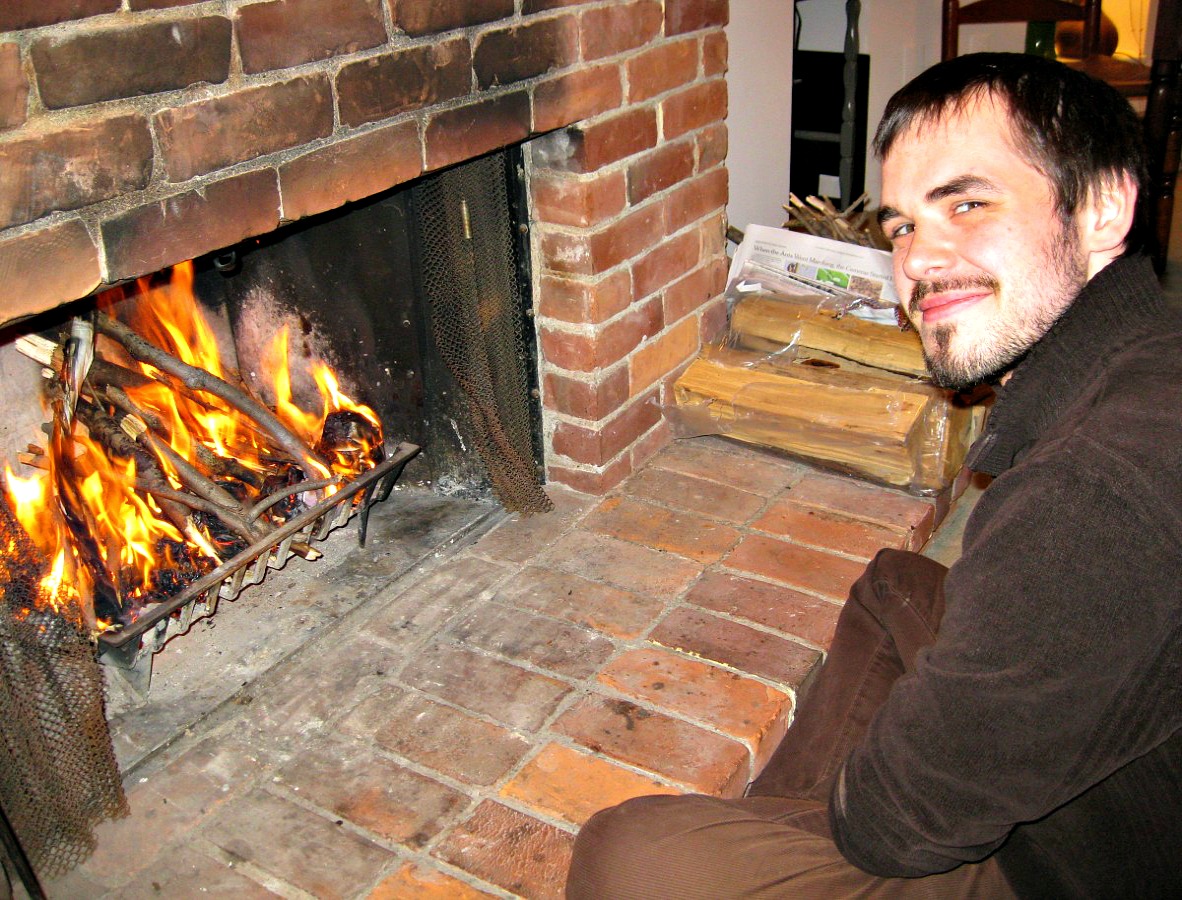
After all, we have a secret weapon: a fireplace; and so we know that no matter how drearily the wind may whistle or how uncomfortably cold the bathroom tiles may get, we can still hunker down, roast our remaining chestnuts and hold out for Spring.

James Murray is a self-described “itinerant Brit.” After a stint in New Zealand, and some travel in Southeast Asia, he and his American girlfriend — now wife — are practicing “staying put” in Boston, where James is pursing a career as a wordsmith for marketing and fiction, and as a non-professional theatre director. He is also a Utopian idealist and SingStar enthusiast. You can find more about his views by reading his blog, Quaint James, and/or following him on Twitter: @quaintjames.

STAY TUNED for another episode in the life of our fictional expat heroine, Libby. (What, not keeping up with Libby? Read the first three episodes of her expat adventures.)

If you enjoyed this post, we invite you to register for The Displaced Dispatch, a round up of weekly posts from The Displaced Nation, with seasonal recipes, book giveaways and other extras. Register for The Displaced Dispatch by clicking here!

Related posts:

img: James Murray stoking the fire (his own).

CAPITAL IDEA: London: A quick guide

LondonWelcome to the first “Capital Ideas”. It is a new feature here at The Displaced Nation. It’s our somewhat idiosyncratic, ever so slightly tongue-in-cheek guide to various world cities, perfect for the ever discerning readership of this blog. We know our readers are always visitors, never tourists (an important distinction).  Do feel free to contribute your own ideas or suggestions in the comments section, we’d love to hear your thoughts, too.

City: London

Where is it? On some damp, mildew-ridden island in the north Atlantic.

Why should I go? Because it’s one of the world’s great cities. An exciting modern city with a diverse population of eight million there’s something for everyone. With hosting the Olympics, 2012 was a great year for the city and infused it with a self-confidence unusual to the British. Quite simply, this is the perfect time to visit London.

So is it true that when a man tires of London he is tired of life? Not if he’s living in Dalston.

I don’t know anything about Dalston. You’re not missing much.

What are the must sees? Well, if you want to be that tourist, you know the one who wears pristine white sneakers and white socks, keeps their passport safe in their fannypack and planned their trip after taking out a Rick Steeves travel book from 1986, then the basic checklist is Big Ben, Buckingham Palace, St Paul’s, Tower of London. You can do all that by popping on one of those tourist trap sightseeing bus tours. You’ll get to sit on the top of a double-decker with other fannypack wearers — it’ll be beautiful.

Hmm, I don’t have a fannypack. Not to worry. You’re a The Displaced Nation reader, you want something a little more “not for tourists,” don’t you?

You know me so well. Tours can be good fun for the visitor limited in time. However, instead of those overpriced bus tours, we recommend London Walks. Brunel’s Thames tunnel, in particular, is one we’d recommend for a fascinating and sadly forgotten part of London’s history — it was once considered the eighth wonder of the world.

What about a walking tour that sounds a bit more “fun”? Well, provided you’re not traveling with kids, you could also do a pub crawl. That fun enough for you?

Absolutely. Any other suggestions? Spend a morning at Lincoln’s Inn Fields. There you’ll be able to visit two fascinating museums that are among our London favorites. There’s the Hunterian Museum (an C18th collection of anatomical specimens including the skeleton of Charles Byrne, known as the “Irish giant”) at the Royal College of Surgeons and across the fields is Sir John Soanes’s Museum (the former home of architect Sir John Soanes, the museum contains his extensive collection of antiquities and paintings). Or, if you’re in the city in the summer then venture to the north of the city and visit Highgate Cemetery. There you’ll be able to get a guided tour of the western cemetery – resting place of Michael Faraday and Christina Rossetti. In the eastern cemetery rests Karl Marx.

What’s a must-do? Spending time on the South Bank. Here you’ll find the National Theatre, the Royal Festival Hall, the Globe and the BFI Southbank (formerly known as the National Film Theatre). So the perfect place to take to showcase the city’s cultural merits.

Is the city easy to get around? Yes, although Londoners like moaning about the public transport, the city is home to one of the world’s best public transport systems. Familiarize yourself with the London Underground (known as “the tube”) and you can travel around the city easily and relatively cheaply. If you are a night owl then you need to remember that the underground stops running trains between 12.00am and 12.30am.

I hear the British cooking is awful. Do I need to pack sandwiches when visiting London? That outdated stereotype. London is home to some of the world’s best restaurants. And don’t forget how I mentioned earlier that London had such a diverse population, that’s reflected in the city’s restaurants. Whatever you fancy, be it Eritrean or Burmese, you can find it in London. Our recommendation is that you take a trip to Brick Lane for a slap-up Indian dinner.

Hmm, my mate John visited London last year and said the food still sucked. Did John stick with the tourist traps? New York is a great city for eating, but if you only go to restaurants at Time’s Square you’re not going to get that impression. One easy tip, never eat in an Angus Steak House.

So the locals don’t all eat jellied eels? No, but if you do want to experience an old cockney-style pie and mash shop, then we recommend Goddard’s at Greenwich. If you’re being really adventurous and want to unleash your inner pearly queen by having some jellied ell then this is the place to do it.

Have you ever tried it? Yes.

Did you like it? Let’s just say it was interesting.

What should I read? If you want to brush up on London, then we’d suggest Peter Ackroyd’s London for a nice, meaty read about the city, as well as his book The Thames. Other books we’d suggest are Iain Sinclair’s London: City of Disappearances, Henry Mayhew’s London and the London Poor and James Boswell’s London Journal. And, of  course, you can’t visit London and not be reminded of Dickens (do make a trip to the Charles Dickens Museum  , at 48 Doughty Street). We think Bleak House and Our Mutual Friend best show off  Dickens’s writing on London.

What should I watch? Notting Hill.

Really? Yes, it’s the most accurate cinematic depiction of the city.

I’m going to say this again, really? It’s so accurate that there’s even now a Notting Hill Carnival. This happens once a year where fans of the film get together and dress up as their favorite characters from the film and reenact their favorite scenes. Our top tip is that if you’re in London at the same time as the carnival, you should dress up as Julie Roberts or Hugh Grant and go up to people and tell them your favorite lines from the movie. They’ll love.

I really don’t think that’s what the Notting Hill Carnival is all about. Hand on heart, it’s true.

Hmmmm . . .

STAY TUNED for tomorrow’s post, a new Random Nomad interview.

If you enjoyed this post, we invite you to register for The Displaced Dispatch, a round up of weekly posts from The Displaced Nation, with seasonal recipes, book giveaways and other extras. Register for The Displaced Dispatch by clicking here!

Related posts:

Image: awindram

A once-displaced author on muses, monkeys & murder — and your chance to win her new book!

EdithmcclintockOur first featured author of the new year, Edith McClintock, is today’s guest. Her post should help to alleviate the January doldrums and this “brass monkey” weather. By way of introduction, I should point out that even though she does write mysteries, she herself is a bit of a mystery. Tee hee-hee ha-ha! On the one hand, she is a former Peace Corps worker, and has worked to preserve rainforests. On the other, she has harbored dreams of killing off her fellow researchers in the Amazon! Indeed, working with Edith sounds about as much fun as a barrel of monkeys! But let’s find out more about her creative muses, shall we, before leaping to any conclusions…

— ML Awanohara


I can’t pinpoint the moment I decided to write a novel. The idea percolated for years starting in my early teens. I did, however, always know — to the extent I even understood book categories, which was not much — that my first book would be a mystery, heavy on romantic suspense, and definitely a touch gothic.

Maybe a modern-day version of M.M. Kaye’s light mysteries (before she wrote The Far Pavilions), each set in an exotic locale.

And maybe a little Barbara Michaels mixed with Elizabeth Peters’ humor.

They were all early muses.

But so was travel. I knew the setting would have to be international, exotic…romantic. I wanted my characters to be trapped in a confined setting — like the best Agatha Christie.

From my first trip to Spain when I was thirteen, across Europe and Central and South America in my twenties, I contemplated castles, ruins, plunging cliffs, and remote islands based on their novelistic setting potential.

We are not aMUSEd: “Writing is hard”

But I needed more than a muse to write a book. I needed an obsession. For me, that’s the only way it could have happened, because writing Monkey Love and Murder was hard. Writing is hard. The rejection was crushing.

I cried. My sister cried. The rewriting and rewriting and rewriting again often felt meaningless. More sacrifice than joy. Sometimes exhilarating. More often tedious and lonely.

The truth is the time lost probably wasn’t worth it. I had demanding, more than full-time jobs. I wrote on weekends and evenings. My friends and family were celebrating, playing, gathering, the sun shining. I was hunched over a computer screen talking to my make-believe world.

It takes a certain arrogance to believe you can even write a book. To believe it will get published. To believe people will actually like it. Maybe love it. I had that in the beginning. For years, really. I had to love the idea, the place, the characters.

The place as muse

Because it took an obsession to keep writing and rewriting, in my case probably much longer than I should have. But it wasn’t a person that grabbed me and wouldn’t let go. My muse, my obsession, was the rainforest and a place called Raleighvallen in the Central Suriname Nature Reserve.

MonkeyLoveAndMurder_dropshadowI think my protagonist, Emma, expresses it best:

Even with all the frustrations, I fell completely and irretrievably in love with the rainforest that week — the deep rich smells of dirt and decay and teeming, thriving life; the warm soft light of the rocky moss-covered paths hidden beneath layers of climbing and tumbling lianas and roots; soaring tree trunks wrapped in colorful bromeliads, orchids, moss, and lichens; and the canopy of leaves of every conceivable size and shape. Each day was a new adventure, new wildlife (some good, some terrifying) and ever changing forest, from the sunlit traveling palm groves to the dense, swampy marshes near the river; to the rocky, open forests with the towering trees the spider monkeys loved. I enjoyed watching the spider monkeys too, but I could have been just as happy watching any number of wildlife. It was simply being in the rainforest I loved most.

Like Emma, I spent two years as a Peace Corps volunteer in Suriname living in the capitol, Paramaribo. Unlike her, I joined a monkey research project post-Peace Corps simply because I wanted to spend more time in the rainforest — and chasing monkeys through the jungle seemed like fun.

It was. Hot, frustrating, itchy and wonderful.

I was there for six months, ideas percolating, but I didn’t begin writing until I came home. That’s when I moved beyond the idea of writing as abstract concept and into deep obsession.

Ignorance plus arrogance — a lethal combo?

I came home to the United States, spent three months working full-time and decided I couldn’t continue. Not yet. I was in the throes of a typical angst-ridden readjustment process combined with the initial bubbling of obsession. So I quit my job and drove cross-country to housesit for my sister and then a friend while I pounded out that first draft. I finished and returned to full-time work again, sure my first draft was destined for the bestseller lists.

I clearly had the arrogance. Unfortunately, I also had heaps of ignorance. I still do. I don’t understand publishing. I may never understand publishing.

Nine years later, following hundreds of rejections, countless rewrites, frequent tears and regular quitting (for months, even a year), my first novel is finally published. People, friends, strangers, will read it. Judge it.

It’s wonderful and scary and it took a passionate, often-painful obsession. But still, I’d do it again. I am doing it — I’ve just finished my second mystery (I hope). I have a plan for the next and the next and the next.

As for Monkey Love and Murder, thankfully, I’m finally over that obsession. And it turns out the best thing about finally being published is that I NEVER have to read or rewrite it again!

But still, I hope you’ll read it. I hope you’ll like it. I certainly did. For years.

* * *

Whoop! Whoop! Thank you, Edith! Readers, to whet your taste even more, here are a couple of reviews for Edith’s debut novel, Monkey Love and Murder:

Kirkus Review:

This debut from McClintock, who served in the Peace Corps and worked on a monkey research project, has the ring of authenticity, along with romance and a mystery that keeps you guessing.

Library Journal Review:

This romantic-suspense debut is perfect for those seeking adventure mixed in with their mystery. McClintock creates a vivid jungle environment, a perfect venue for a closed-room mystery. Her characters run a little larger than life, making the story feel like a reality TV show. With a bit of Scott Smith’s tone, this would work for Hilary Davidson fans too.

And let’s not forget the blurb:

Emma Parks joins a monkey research project deep in the South American rainforest on a whim. She refuses to admit it might have something to do with a close friend’s death from which she hasn’t recovered, but it’s certainly not because she knows anything about spider monkeys, least of all what they look like. She’s barely arrived when International Wildlife Conservation’s renowned director drowns during a party celebrating the group’s controversial takeover of the park. Tension mounts following the machete murder of a researcher, threatening Emma’s budding primatology career, her secret romance with an Australian zoologist, and more importantly — her life.

Can’t wait to read it? Why not download the first chapter?

I know, I know, one chapter isn’t the same as reading the whole book. SO ENTER OUR DRAW TO WIN A FREE COPY — in 3 easy steps:
1) Comment on Edith’s post
2) Like her book’s Facebook page
3) Subscribe to our Displaced Dispatch
Yes, of course you can take just one of these steps, or two — but do all three and you’ll have an even greater chance of winning!!! @(‘_’)@

The winners will be announced in our Displaced Dispatch (and on Edith’s Facebook page) on Feb. 2, 2013. She will contact you for your address and is open to shipping anywhere in the world.

NOTE: If you’re not lucky enough to win one of Edith’s books, you can always order it from Amazon, Barnes and Noble, or The Book Depository.

Born in a school bus in the Tennessee woods on the largest commune to come out of the sixties, Edith McClintock works in the conservation and development field and blogs about travel on Novel Adventurers. Although a lifelong reading addict, she didn’t write fiction until post–Peace Corps, when she joined a monkey research project deep in the Amazon. Trapped in a tiny jungle cabin for six months, there was little to do but imagine creative ways to kill off her fellow researchers (all of whom were too nice to make it into her first novel, despite their begging). To find out more about Edith, visit her author’s blog.

STAY TUNED for tomorrow’s post, also on expat writing.

If you enjoyed this post, we invite you to register for The Displaced Dispatch, a round up of weekly posts from The Displaced Nation, with seasonal recipes, book giveaways and other extras. Register for The Displaced Dispatch by clicking here!

Related posts:

Images: Edith McClintock’s author photo (yes, that’s her — in Chinatown in Seattle, buying mangoes) and book cover.