The Displaced Nation

A home for international creatives

CAPITAL IDEA: Bangkok: A quick guide

bangkokWelcome to another “Capital Ideas”—our somewhat idiosyncratic, ever so slightly tongue-in-cheek guide to various world cities, perfect for the ever discerning readership of this blog. We know our readers are always visitors, never tourists (an important distinction).

Do feel free to contribute your own ideas or suggestions in the comments section, we’d love to hear your thoughts, too.

Capital: Bangkok

That reminds me I saw The Hangover Part 2 recently. Great movie. Um, no, it isn’t.

What are you crazy? A chain-smoking capuchin monkey and that guy who is in The Office wakes up to a Mike Tyson-style face tattoowhat’s not to love? Its content? Anyway, why are you blathering on about The Hangover Part 2?

Because dude, it’s set in Bangkok. As is Bangkok Dangerous. What a surprise!

Anyway, you’ve got my attention. Those films have certainly piqued my interest in visiting Thailand’s capital city. Well, that is good to hear.

Yes, I think I could have a fun, hedonistic vacation. Is it as crazy as it seems in those films? It’s a city of over eight million. I’m sure you can find some craziness if you’re so inclined, but there’s far more to this city than some of your preconceptions.

Oh yeah, I’m sure that is the case, and I’m all ears regarding all that culture nonsense that I know you love, but still, I might want to take in a ping pong show in Soi Cowboy. How can you go to Bangkok and not see its seedy underbelly? Fairly easily. This is not a guide for sex tourists.

Oh, you’re such a square! Okay, what would you have me see? Take a ferry to the Old City. There you’ll be able to visit the ornate Grand Palace built in the 18th century for the Thai king and Wat Phra Kaew, where you can find Emerald Buddha. A trip to Wat Arun is also a must.

The Grand Palace, you say? They’re pretty big on their Royal Family, aren’t they? You can say that again. Indeed, you’ll find portraits of the current King, Bhumibol Adulyadej, as well as some of his predecessors, in most restaurants.

So jokes about the King probably won’t go down too well? No. In fact, lèse majesté, which is the crime of violating majesty, is enshrined in law, so no, probably not the best idea to make a joke about the Thai King as it could lead to a prison sentence.

Blimey! Kind of appreciate that I can make all those jokes about Prince Charles’s ears with impunity. Absolutely!

Anything else I need to know on this? Yes, Thai nationals have to stand for the national anthem by law.

I think I’m going to regret saying this, but what do you recommend? I’ve got one word for you—puppets.

Oh God, I wished I hadn’t asked. No, hear me out. Traditional Thai puppetry is fascinating. The Aksra Theatre in Bangkok puts on a great introductory show for tourists that also showcase traditional Thai music too. The puppets will depict scenes from the Ramakien, Thailand’s national epic. Go, you’ll love it, I promise!

Trust this guide to push some weird recommendation on me. What? Me? The very idea! … I think I might rather try my hand at the ping pong show. No!!!! Go with the puppet show.

I’m guessing I’ll eat well in Bangkok? You guess right. Really, you can’t go wrong. You don’t need to find out who the fanciest, trendiest chefs in town are, just take a wander and keep is simple. You’ll be able to eat very well and by spending very little.

Sounds great, and how do I get around the city? The city has three rapid transit systems: the BTS Skytrain, the underground MRT and the elevated Airport Rail Link. They’re all pretty good if you’re going long distances across the city. For shorter distances just take a taxi. I would, however, give one warning on this, based on personal experience. Bangkok taxi drivers don’t have the best of reputationsdon’t allow yourself to be ripped off. Some unscrupulous taxi drivers will refuse to put on their meters and will quote you outrageous sums when you first step in their cab to get you to your destination, because they see you’re a farang. If they’re not prepared to negotiate to a sum you feel is reasonable, then don’t feel shy about exiting their cab and searching for another taxi.

What should I read to prepare for the journey? More than any other expat destination, Bangkok seems to have inspired cringe-worthy expat books about crime and sin in the capital or “hard man” accounts from Westerners who’ve ended up in Thai prisons for drug smuggling. They’re for the most part best avoiding. If you must have something that touches on the sin and crime of the city, then John Burdett‘s Bangkok 8 is an entertaining read for a flight over to Thailand. If you’re particularly ambitious you could also try reading The Ramakien (in translation).

What should I watch? You could watch the original Thai version of Bangkok Dangerous from 1999 if you were interested by the American remake. Also, in recent years a number of Thai films have gained attention at the Cannes Film Festival. Blissfully Yours and Tropical Malady are worth investigating.

STAY TUNED for next week’s Displaced Nation posts.

If you enjoyed this post, we invite you to register for The Displaced Dispatch, a round up of weekly posts from The Displaced Nation, with seasonal recipes, book giveaways and other extras. Register for The Displaced Dispatch by clicking here!

Related posts:

Image: awindram

JACK THE HACK: How do you know whether you want to write a memoir or a novel, and what’s the difference?

JACK THE HACK _writingtipsJack Scott is back with his monthly column for all of you wannabe authors who are hacking away at travelogues-cum-memoirs (cum-novels?). For those who don’t know, he was a Random Nomad for the Displaced Nation way back when we started this site. After an expat experience that was literally something to write home about, he and his partner, Liam, have traded in the dream for a less pressured existence back home in the UK.

—ML Awanohara

Hmmm… Is it easier to turn expat stories or travel adventures into a memoir or a novel, and how does one decide?

As with all such questions, the answer is a resounding “it depends”.

Let’s look at some definitions:

Memoir (noun) – a historical account or biography written from personal knowledge.
Travelogue (noun) – a film, book, or illustrated lecture about the places visited by or experiences of a traveller.
Novel (noun) – a fictional narrative, typically having a plot that is unfolded by the actions, speech, and thoughts of the characters.

So it seems that travelogues and biographies can’t be novels because, by definition, they’re based on real events by real people in real places.

Does this matter?

I think not.

False dichotomies

For me, writing a memoir is like telling a story and every story, even a real-life one, needs order, pace, plot, a compelling blend of highs and lows and a sense of purpose.

I learned some valuable lessons from David Steddall, the English teacher at my South London grammar school back in the big hair, bell-bottomed Seventies.

“A story should have a beginning, a middle and an end,” Mr Steddall would say.

We’ve all heard the mantra, haven’t we?

Mr Steddall seemed to like my essays, even if they were sometimes a little risqué in a post-pubescent, hormone-raging kind of way. He would often give me top marks and have me recite my work in class. His encouragement gave me confidence—a confidence that lay dormant for thirty-odd years until a little sun-kissed nourishment breathed life into it like rains in a desert.

I’ve stayed faithful to Dave(as I now think of him)’s cause. My own memoir has a beginning, a middle and an end. It’s not a random series of observations like a diary. Who’d want to read that? Let’s face it, I’m not Anne Frank, Kenneth Williams or Samuel Pepys.

Make it work!

Here’s the trick. Just because a memoir can’t be a novel, it doesn’t mean it can’t be written as if it were. The greatest challenge is to give memoir a plot that readers will find convincing and engaging enough to make them turn the page.

For me, that meant very little fat. One of the first tips I picked up from my publisher was to dump storylines and characters that weren’t key to the main event or didn’t add interesting flavour. I tackled this by creating a story board, much like they do in the movies. This meant I could identify gaps in the narrative, ensure continuity and shoot down the flights of fancy.

Does this mean it’s not true?

Well, as I wrote at the top of my first book:

This book is based on actual events. To protect the privacy of the persons involved, and in the interest of narrative clarity, some names, characterizations, locations, conversations and timescales have been changed.

This was necessary to protect the guilty, avoid a brick through my window and keep me out of the courts. The end result is that all the characters are true, if renamed and heavily disguised, and all the events actually happened, though not necessarily as chronologically written. Once I accepted this, I could let my imagination run riot and had enormous fun assembling the pieces of my life abroad like one huge colourful jigsaw.

I admit, though, I may have left some little gems on the cutting-room floor.

It’s the risk you take.

Glossy travelogues and expat classics

Most people are familiar with the lavish and beautifully crafted travel book, heavy enough to stop a burglar or prop open the living room door. Every coffee table should have one.

But I don’t really think of travelogues as memoir as their primary purpose is to inform the reader about foreign places in words and (often) pictures.

As for the kind of expat book that has ended up appealing to a mass audience—Peter Mayle’s A Year in Provence and Chris Stewart’s Driving Over Lemons come to mind—the formula calls for lots of descriptions of majestic landscapes as well as a plot centered around building a dream home out of a hovel in the rolling hills.

Which leads me to …

WRITING TIP FOR EXPATS NO 2:

My advice to the budding expat writer: find your own angle; don’t waste your time reinventing the wheel.

In my case, I wrote about the (sometimes grubby) reality of expat life from the unique perspective of a gay man in a Muslim land. It’s something no one had done before, and why would they? There weren’t many of us there.

* * *

Readers, any comments, further questions for Jack the Hack? He’ll be back next month with some more writing tips…

Jack Scott’s debut book, Perking the Pansies — Jack and Liam move to Turkey, is a bitter-sweet tragi-comedy that recalls the first year of a British gay couple in a Muslim country. For more information on this and Jack’s other titles, go to his author site.

STAY TUNED for tomorrow’s “Capital Ideas” post, by Anthony Windram.

If you enjoyed this post, we invite you to register for The Displaced Dispatch, a round up of weekly posts from The Displaced Nation, with seasonal recipes, book giveaways and other extras. Register for The Displaced Dispatch by clicking here!

Related posts:

Images from top, clockwise: Hand with pen / MorgueFile.com; Boats in King’s Lynn, Norfolk / MorgueFile.com; Jack Scott, used with his permission; Turkish boats / MorgueFile.com

And the April 2013 Alices go to … these 5 international creatives

 © Iamezan | Dreamstime.com Used under license

© Iamezan | Dreamstime.com
Used under license

As subscribers to our weekly newsletter, The Displaced Dispatch, may have noticed, we are now presenting our “Alice Awards” in that esteemed publication. Each week, we give an “Alice” to someone who has a special handle on the the curious and unreal aspects of the displaced life of global residency and travel. Not only that, but they have used their befuddlement as a spur to creativity of all kinds.

Today’s post honors our first five Alice recipients, beginning with the most recent and this time including citations.

So, without further ado: The April 2013 Alices went to …

1) MICHELLE GARRETT, expat blogger

Source:Has Your Expat Life Inspired You To Write A Book?” in Expat Focus (e-zine for anyone moving or living abroad)
Posted on: 19 April 2013
Snippet:

By definition is an “expat novel” about an expat? Or does it need to be more than that—does an expat novel need to be about an expat experiencing expat life? You know, the culture shock, the language differences, the homesickness …

I have always written and always wanted to be a Writer so for me the motivation to write a novel was more about “you want to write? Start by writing what you know’” rather than, “I’m an expat with adventures—I think I’ll write about them!”

Citation: Should we expats write books about the wonderlands we’ve experienced on our travels, or should we write because we enjoy writing (and just so happen to live abroad)? Michelle, you’re sounding a little Mad Hatterish by posing this riddle with no answer, and we feel duty bound to point out that Alice herself felt that her adventures could be worth writing about:

When I used to read fairy-tales, I fancied that kind of thing never happened, and now here I am in the middle of one! There ought to be a book written about me, that there ought!

But listen, if our enjoyment of your blog, The American Resident, is any indication, we’re going to love the novel you’re writing about an expat woman but that isn’t an expat novel. We also look forward to your book of tips for expats with long and sad tales, like the Mouse’s.

2) JUDY LEE DUNN, award-winning blogger on blogging and former humanitarian aid worker

Source:Judy Lee Dunn on words, maps, and inspiration“—an interview with Judy conducted by author Lisa Ahn (notably, Lisa’s own favorite words are “once upon a time”!).
Posted on: 17 April 2013
Snippet:

For as long as I can remember, I have been enchanted by the power of words to transport readers to a world they don’t yet know.

And when I was a child, maps were a metaphor for a world I had not yet seen …

Whenever my two passions intersected, I was truly inspired. As manager of Writing Resources for World Vision, words and maps perfectly converged to send me to West Africa as part of a documentary team to tell the stories of projects helping third world families become self-sufficient. …

Now, I’ve finally reached the point where I am putting together the pieces of my life, word by word, shining a light on one of the recurring themes of my life. Finding just the right words to express a life map of sorts: to understand where I started and where I am going.

Citation: Judy, we feel certain you would approve of our fondness for Lewis Carroll, believing as you do in the power of words to transport us to other worlds (and also having worked as a first-grade teacher!). We’re with you on the map thing, too, as evidenced by our “Here be dragons” banner. And we love the idea of someone who has worked abroad, as you have (in West Africa), writing a “life map.” May we borrow this term?

3) ANN PATCHETT, best-selling American author

Source:What now? Advice on Writing and Life from Ann Patchett“—a post by Maria Popova on her Brain Pickings blog, containing extracts from Patchett’s 2006 commencement address at Sarah Lawrence, which has been published as a book, What Now?
Snippet:

Coming back is the thing that enables you to see how all the dots in your life are connected, how one decision leads you to another, how one twist of fate, good or bad, brings you to a door that later takes you to another door, which aided by several detours—long hallways and unforeseen stairwells—eventually puts you in the place you are now. … But when you look ahead there isn’t a bread crumb in sight—there are just a few shrubs, a bunch of trees, a handful of skittish woodland creatures.

Citation: Ann, we know you intended your words for the ears of graduates from your alma mater, but they could easily apply to us displaced types, who spend a good deal of our time feeling lost and clueless. You go on to say: “Sometimes not having any idea where we’re going works out better than we could possibly have imagined.” What a marvelous assertion! Far more reassuring than the series of unhelpful responses Alice elicits from the Cheshire Cat after asking him: “Would you tell me, please, which way I ought to go from here?” (What’s more, you’ve followed your own advice, booking a trip to the Amazon as soon as you decided to set your sixth novel there.)

4) LAINIE LIBERTI, world traveler and blogger

Source:Reentry Observations—Washington DC,” an entry on her blog, Raising Milo on the Road of Life—a single mom and son’s nomadic adventures as they travel around the world together.
Posted on: 29 March 2013
Snippet:

I imagined this country’s politicians, their assistants, their staff, all rushing away from the Capital, eager to go somewhere else. I imagined this was the group of stressed people who were running the United States of America. … I clearly have a different feeling about the United States now. I feel as if I’m on foreign soil. I don’t perceive the energy as welcoming.

Citation: Lainie, your description of Washington VIPs dashing about reminds us of Alice’s encounters with the White Rabbit. And we join you in wondering: don’t they realize that someday their actions will seems as trivial as some might perceive the ancient cultures of Peru? (Certainly puts it in perspective!)

5) LAURA J. STEPHENS, psychotherapist and author

Source: “Overcoming Isolation,” an entry on her author blog (she is the author of An Inconvenient Posting: an expat wife’s memoir of lost identity).
Posted on: 9 March 2013
Snippet:

For me, there was nothing in my experience quite so isolating as arriving in an unfamiliar country and trying to orientate myself, whilst experiencing the losses of “home” and all the while thinking I should be grateful for my new existence.

Citation: Laura, it’s great to know that someone out there understands the tendency for us expat Alices to declare “I am so very tired of being all alone here!” and then to suffer “pool of tears” moments… Not only that, but you provide practical tips to keep from drowning. What more can we ask?

* * *

So, readers, do you have a favorite from the above, and do you have any posts you’d like to see among May’s Alice Awards? We’d love to hear your suggestions! And don’t miss out on these weekly sources of inspiration. Get on our subscription list now!

STAY TUNED for tomorrow’s post—more writing advice from Jack (the Hack) Scott!

Writers and other international creatives: If you want to know in advance whether you’re one of our Alice Award winners, sign up to receive The Displaced Dispatch, a round up of weekly posts from The Displaced Nation, with news of book giveaways, future posts, and of course, our weekly Alice Award!. Register for The Displaced Dispatch by clicking here!

Related posts:

NEW VS OLDE: The Canadian “R”

Libby Collage New&OldFor just over two years, readers of the Displaced Nation have been following a novel-in-progress by Kate Allison called Libby’s Life. It’s the running diary of Libby Patrick, an Englishwoman who has trailed her spouse to a town just outside Boston. Libby’s Life is rich in Kate’s observations about life in New England vs. England. In the weeks when she doesn’t publish an episode, we plan to feature posts by writers who are sensitive to the often-subtle differences between new and old worlds.

This week: Carolyn Steele, a Brit now living in Canada, whose book, Trucking In English, we reviewed last month.

It’s a useful thing, the Canadian R. There are times that I wish my English way of speaking—my inherent BBC accent—could learn to incorporate it. The technique would have helped a lot with a potentially disastrous spot of linguistic difficulty. The discovery that I am still prone to linguistic difficulty is surprising in itself. I have been through the initial culture shock associated with realizing that no-one in Canada knows that Brits speak a different language. I have come to terms with the fact that old episodes of Are You Being Served on TVO don’t help me when I want to buy petrol, crisps or knickers.

Carolyn Steele, TruckingI came through all that and emerged on the other side the sort of wise and whimsical Brit who uses the language barrier for fun but can turn it off at will when there is serious work to be done. I went native vocabulary-wise and thought I knew it all. Well guess what? Vocabulary isn’t always enough. An inability to produce the Canadian R can get you into just as much trouble as a car with a bonnet.

It all began with an email from a friend; another ex-pat from London, transplanted to Ontario. Another mascot with a quaint accent who entertains all and sundry on a regular basis with jolly misunderstandings of a transatlantic nature. After a few years of gags about putting trunks in the boots and boots in the trunks of our cars, asking for tomatoes that don’t rhyme with potatoes just to confuse people, and clinging doggedly to trousers and torches and lorries, we both considered ourselves adept at mangling the language for pleasure; the deliberate, linguistically delicious cabaret.

Light dawns…or should that be “dorns”?

So, what strange alignment of the planets, which unheard of synchronicity of biorhythms, caused us both to discover in the same week that Canadians pronounce ‘pawn’ and ‘porn’ somewhat differently? Of course, I am very grateful to have received the email. Without it (typed amid tears of glee I understand, after what sounds like a classic cabaret day) I would not have known. And that is the big difference between his story and mine, his listeners put him right. There and then. Embarrassment, laughter, beer, funny anecdote.

Mine were polite. Without the anecdotal email I still might not have known quite how I had managed to horrify a couple of guests at my B&B. I would only have known that they appeared to think me a little strange. If my ex-pat pal had not been among work colleagues who consider it their inalienable right to poke fun, and if he had refrained from kindly sharing the joke with me, I would still be none the wiser.

If you’re not using the Canadian R — be specific.

It might have helped if I had told them I was looking for a TV to upgrade one of our bedrooms but I didn’t. They told me all about their day and I told them all about mine. About finding this great little pawn shop where the people were so friendly and helpful. My guests looked a little nonplussed but smiled encouragingly. They appeared to want me to continue with an explanation, so I did. “They have this great scratch and dent section for electrical goods,” I wittered. “All new stuff, nothing used…and I have a 30 day guarantee too.”

If you are reading this, dear guests, I am truly sorry if you thought I was running a brothel out of the room next to yours. I wasn’t you see; I was a landed immigrant who would have been deported for breaking the law. It was a beautiful little TV and I was delighted with it, I am quite normal really.

I have been practicing my diction ever since. I thought I could be relatively Canadian when I chose, after all I could do a really authentic howarya on the telephone sometimes after a beer or two, so this bothered me. I tried really hard to make ‘pawn’ and ‘porn’ sound different just in case I ever needed to use either word again. Different people thought I was mad but I got there in the end. I run little podcasts on my blog these days and when I listen to them back while editing I can hear the BBC accent plus randomly sprinkled Canadian Rs.

Should I ever frequent a pawn shop again it’ll be ok.

* * *

Readers: what linguistic trouble have you unwittingly landed yourself in?  Please leave your thoughts in the comments!

A Londoner born and bred, Carolyn Steele is now a Canadian citizen and lives in Kitchener, Ontario, where she ran a Bed & Breakfast for five years before trying her hand at negotiating 18-wheelers. Depending on who is asking,  she “maintains that she is either multi-faceted or easily bored”. Confirming this, her résumé states that, in addition to being a lady trucker, she has also been a psychologist and a London Ambulance Service paramedic, while her hobbies include tatting, a form of lace-making. 

Check out her website, Trucking in English, at TruckingTales.com, and/or follow her on Twitter:  @Trucking_Lady

STAY TUNED for next week’s fabulous posts!

If you enjoyed this post, we invite you to register for The Displaced Dispatch, a round up of weekly posts from The Displaced Nation, with seasonal recipes, book giveaways and other extras. Register for The Displaced Dispatch by clicking here!

Related posts:

Images: Picture of Carolyn from herself.

Portrait of woman from MorgueFile; Lighthouse (R) from MorgueFile; Lighthouse (L) from MorgueFile

For author Lana Penrose, expat “curveballs” come in threes

curveballToday we welcome back best-selling Australian author Lana Penrose, who last visited us in December to commiserate with those who were spending the holidays separated from their dearest and no longer nearest. Today’s occasion? The publication of Lana’s third memoir on her life abroad in Europe. Wait, did I just write “third”? Yes, this indefatigable Aussie managed to get a trilogy out of her expat experience, and is here today to explain.

—ML Awanohara

I’ve been asked to explain what motivated me to write my latest mini-memoir Addicted to Love, and it’s a very good question—one that I pose to myself often, particularly while in the throes of insomnia.

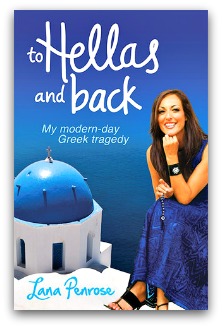
ToHelasandBack_dropshadowFor the uninitiated, I’m the author of To Hellas and Back, which chronicles my true-life tale of following the love of my life to the ends of the Earth (Greece) only to wind up losing my mind.

I then Nutbushed over to the UK to work for a world-renowned pop star and in the process wrote Kickstart My Heart, which details my attempt to negotiate my newly single life à la Bridget Jones—only with an axe through her head. As the book’s subtitle says: “A carnival of dating disasters”.

KickstartmyHeart_dropshadowNow these two books are rife with comedy, tragedy and my own human failings, so why scoop out what’s left of my heart and smear it across my shirtsleeve?

Like I said … a very good question.

More to the story…

The truth is that my story absolutely did not end with me leaving London to re-sample Greece after again being lured by love’s enchantment. In fact what happened next is something that I’ve kept close to my chest because it was downright shocking. I spent considerable time deliberating over whether I should share it at all.

AddictedtoLove_cover_dropshadowBut as many of you displaced writers know, the problem with being an author (one of the many!) is that you can’t seem to stop writing. And life has been more than accommodating in throwing me the odd curveball, the sort of material I feel compelled to purge away with my pen.

And so Addicted to Love was born: a mini-memoir that proves once and for all that truth really is stranger than fiction.

It’s set on the beautiful Greek island of Kythera, where I faced an impossible situation that I can’t go into here without issuing a spoiler alert … but rest assured that it’s gripping and you’ll digest it quite quickly, because it’s been described as “a page turner.”

Finally, an answer (of sorts)

But back to the original question: What motivated me to write this book? Well, thankfully (and unfortunately), experience has shown that there are many people who go through similar triumphs and tragedies to mine, particularly while traversing the globe. I like to connect with such people, and book writing is my way of holding out a hand and saying: “What—you, too?”and “You’re not alone.”

To Hellas and Back, Kickstart My Heart and Addicted to Love form a trilogy of the victories and pitfalls I experienced as an everyday person hurdling life abroad.

Each book can be read as a stand-alone, but I (predictably) suggest that you start at the very beginning to understand the depths of where I wound up.

* * *

Hey, Lana—you wound up here, at the Displaced Nation! That’s not the depths, surely? Readers, any questions for Lana or words of support? If you’re not familiar with Lana’s works, you can find the entire trilogy on Amazon or Smashwords. And don’t forget to follow her advice and begin at the beginning: by going to hellas and back!

Sydney-based (and no longer displaced) author Lana Penrose has had various incarnations, including music journalist, record company promotions gal, music television producer and personal assistant to an iconic pop sensation whose name shall never be revealed unless she’s subjected to Chinese water torture. She also once worked with the now-infamous Simon Cowell, which she today finds really odd. You can read more about her and her works on her author blog and/or follow her on Twitter: @LanaPenrose

STAY TUNED for tomorrow’s post, when we’ll be revisiting one of the earliest themes on this blog, Alice in Wonderland, but from the perspective of an international creative.

If you enjoyed this post, we invite you to register for The Displaced Dispatch, a round up of weekly posts from The Displaced Nation, with seasonal recipes, book giveaways and other extras. Register for The Displaced Dispatch by clicking here!

Related posts:

Image: MorgueFile

Dipika Kohli on world community art, defining a future, and why “wait and see” won’t cut it

tumblr_m7b7kmftdt1qaqyfmToday TDN welcomes Dipika Kohli, author of The Elopement, which we reviewed in September last year. Raised in America by Indian parents, Dipika now lives with her Japanese husband, Akira, in Durham, North Carolina, where the couple run a design company

Together, they are the driving force behind Stitch, a community art project for which they are currently raising funds on Kickstarter in order to take the project around the globe. 

Dipika, who has channeled her own feelings of displacedness into writing and art, joins us today to tell us more about this exciting project, the first in a series.

We begin with an intro to what Stitch is all about…

Stitch 101

Stitch is about supporting local artists and the art scene; it’s about a community defining the fabric of itself and its future. It’s community art, and an exercise in word-driven intention-setting at the same time.

Dipika and Akira say:

Now, we’re bombarded by images we never chose for ourselves—we let brands and labels do the work to define and express who we are. It doesn’t have to be that way. What if we could choose what we see? In simple, uplifting, people-nominated and people-chosen words and images? Would we, as a community, behave differently? Would we know who we are?
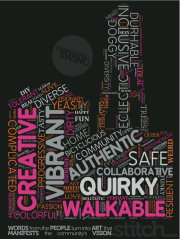
5d4954b68a302fd6081cb8f67e904ad2_large-1

The 276 words representing Durham, NC, in a word-cloud indicating frequency/popularity

For two months, Dipika and Akira talked to hundreds of people in their town of Durham, North Carolina, asking them one question:

What would you like to see Durham become, in one word?

After collecting many words, the residents of Durham voted for those that described their vision of the future Durham — the Durham they would like to be part of.

The resultant 276 words were passed onto two dozen local artists, who created work inspired by these words. Collectively, these pieces create a vision for the town, while money raised from the selling of these pieces will take Stitch to other communities in the world,

“connecting disparate communities with a common thread of art and collective visions.”

And now — over to Dipika:

Insane…or brilliant?

You have to either be insane or brilliant. To do it, I mean. To get up and do the crazy thing that no one believes will ever work. Everyone who says they care about you and your future likes to say, “Just wait, and see.” See if you can save enough. See if you still feel like doing something wild and crazy. Wait. See.

I’m done with that approach.

You see, I’ve been “waiting and seeing” for about a year now. I’ve been wanting to get back on the road, but why? How? What would that accomplish? A little Descartes reincarnation was sitting on my shoulder, niggling.

March, I said, was when I’d pull the trigger. Whether it made “sense” or not to jump ship and move out of my apartment for some unknown adventure ahead.

Taking Flight

March 16. My birthday. The day I launched the book that took me 13 years to get the nerve up to actually publish. So romantic, I thought, to finally upload Flight of Pisces and then move out of my apartment, and “away.” Wherever that might be.

Flight of Pisces was about the time I left Durham, NC, to trek about in India. Footloose and in search of “identity,” I wanted to see the place where my parents originally come from. New Delhi, and Old Delhi. I went solo, and I did it big, culminating in something that all these years later, I shake my head about, thinking, “Did I have some kind of death wish?”

Maybe I did.

Maybe it was survivor’s guilt. Or more, or less. Who knows.

What I do know, and what I can say, is that it had to be the way it was. I had to go and try something that seemed like it was the most absurd and off-the-track kind of thing in the world, in the universe, even, because without having gone and done it, I wouldn’t have ever gotten it. “The glimpse.” A feeling that the world was shifting beneath my feet. And, indeed, it was.

Now, the same feeling is resurfacing.

On the road again

I’m getting lost in the world, again, and on purpose one more time. It’s okay with me that I have a four year-old who’ll be my classmate on this new tour as we go on an educational field trip together to someplace new. I can’t disclose all the details (yet), but I’m trusting it’s going to be okay.

We’ll have just one text with us, in our imaginations. A book that’s got a bunch of blank pages inside, and one image. It’s the cover, and it looks like this:

It’s the drawing I made back in 1994, when I met my husband, Akira Morita. He’s from Japan, and I’m Indian-American, and we eloped to Ireland in 2000. You could say we like to mix it up. Or just trust that we’ll find something wherever we go. One thing’s for sure, we’re always getting to know a bunch of people well, and anyone who’s into the displaced feeling of being elsewhere knows what I mean.

I held a roundtable last year called EXPAT at a place in town called Mad Hatter’s. It’s a little cafe, and about a dozen of us got together to talk about our experiences in places like Ghana, Madagascar, and all parts of Europe, too. Conversations like that made me feel like I was on the road again.

From T-shirt designs to Stitch concept

Now, Akira and I are 18 years older than we were when we met, and we’ve evolved a lot from those days when we thought printing a T-shirt design on a shirt was cool. Our style has gone conceptual, and now we’re doing our biggest art project together yet. It’s called STITCH, and it’s on Kickstarter now through April 28.

Part of the reason we’re doing this is to shape the community for the place where we both have spent the biggest chunks of our life: Durham, North Carolina. But there’s more, too. Lots of things I want to talk about with you in upcoming posts from this new series. I hope you’ll enjoy the journey with me.

Find out more about STITCH here at the Kickstarter website!

* * *

STAY TUNED for tomorrow’s post from our fictional expat heroine, Libby. (What, not keeping up with Libby? Read the first three episodes of her expat adventures.)

If you enjoyed this post, we invite you to register for The Displaced Dispatch, a round up of weekly posts from The Displaced Nation, with seasonal recipes, book giveaways and other extras. Register for The Displaced Dispatch by clicking here!

Related posts:

GLOBAL FOOD GOSSIP: Brigadeiros, the essential element of every Brazilian child’s party

Brazil, Brigadeiros, FoodToday we introduce Global Food Gossip: a new monthly food column by Joanna Masters-Maggs, who was our guest in October 2011 with a two-part post about her culinary observations in Provence.

Joanna was displaced from her native England 16 years ago, and has since attempted to re-place herself and blend into the USA, Holland, Brazil, Malaysia, Venezuela, Saudi Arabia, and now France. She describes herself as a “food gossip”, saying:

“I’ve always enjoyed cooking and trying out new recipes. Overseas, I am curious as to what people buy and from where. What is in the baskets of my fellow shoppers? What do they eat when they go home at night? What sort of kitchen appliances do they use — if any?”

Today, she takes us to Rio for her youngest son’s favourite dessert, Brigadeiros — a dish without which no Brazilian child’s party is complete.

The inner Carioca

“Is there something you want to tell me about Sergio?” my husband teased, in reference to our Brazilian gardener. Our son Patrick [pictured] had just been born in Rio de Janeiro. Nine years later Patrickzinho  — little Patrick — can still pass as a Brazilian. Not only are his eyes as dark as his pupils and his skin the type that tans successfully, but he has the open friendliness typical of the people we came to know and love.

Patrick is a Carioca, the name given to those born in Rio. He wears the name with pride.

More than once have I had to dissuade his friends’ parents that Patrick is not half Brazilian, he just feels it. That feeling has curled itself in and around him like a particularly persistent Virginia creeper.

Patrick’s inner Carioca is why I have spent the morning in the kitchen, surrounded by empty cans of condensed milk, chocolate powder and mini-cake papers. I am making brigadeiros. Brigadeiros are simple truffle-like chocolates as integral to children’s parties as bikinis are to Copacabana Beach. Forgo the birthday clown if you must, but the brigadeiros cannot be skipped.

Perfecting the role of Brazilian mother

Tomorrow, Patrick’s school is throwing a farewell party for a friend who is returning to Japan. The children have been asked to bring a treat from their country of origin. Well, it’s a party, and Brazil is his country of origin, so what else is he to request from the Maggs kitchen?

Over the years I have played the role of Brazilian mother more than once. I have given school presentations on Brazil, sung Brazilian songs and made countless brigadeiros – all with varying degrees of success but always with great deal of enthusiasm.

The brigadeiro was so named for a chocolate loving army officer. Neither his army career nor his sweet tooth were successful enough for his actual name to be remembered. The brigadeiro, however, has gained iconic status.

I have been making these chocolate treats for years, but it is only recently I perfected the technique. Brazilians insist they are very easy to make, but mine always tended to be a little flat. Then, on moving to Saudi Arabia, I discovered my beautiful and charming neighbor, Yamara, was a Brazilian. An afternoon in the kitchen making a countless number of these sticky balls for yet another “My Country” presentation, and I’ve never looked back. The problem was that my consistency was too soft and I had to be braver about cooking the mixture a little longer. My little chocolate balls now have the correct mixture of stickiness and shape, but never a toffee-like chewiness.

So, it is Yamara’s instructions I am sharing with you. I hope you enjoy them as much as Patrick’s class did. Brigadeiro-making is a fun project for all ages and now that Patrick is making his own, I pass the wooden spoon on to you.

To make Brigadeiros you will need:

I can of condensed milk

3 tbsp of chocolate powder (I use Nesquik)

1 tsp of butter.

Put over a gentle flame and heat until the mixture begins to thicken. Don’t stop stirring. Brazilians say you must heat until “you can see the bottom of the pan”. This is when the heat gently lifts the mixture from the pan and you can make a wide “path” in the mixture with a wooden spoon. It takes about 5 minutes.

Let the mixture cool until you can handle it. You will see it will firm up a little, so avoid the temptation to cook too long. If it is too firm the chocolate strands will not stick. If you have got it right you can take small teaspoons of the cooled mixture and it roll into balls between your hands. Finish by rolling the balls in chocolate strands. Cheerful mini paper baking cases add the final touch. Well, let’s be honest, you need the paper cases for authenticity. Really.

Brazilians also like to make a softer version of the this mixture to make a decadent topping and filling for cakes. Just cook for a couple of minutes less so you achieve a rich pouring consistency. On a rich, soft chocolate cake and sprinkled with chocolate strands you have Brigadeiro Cake, another Brazilian staple. I defy anyone to eat two pieces and live to tell the tale.

Fellow Food Gossips, share your own stories with us!

.

STAY TUNED for tomorrow’s author interview and a new giveaway!

If you enjoyed this post, we invite you to register for The Displaced Dispatch, a round up of weekly posts from The Displaced Nation, with seasonal recipes, book giveaways and other extras. Register for The Displaced Dispatch by clicking here!

Related posts:

Image: Joanna’s son Patrick, with his Brigadeiros

ENGLAND VS NEW ENGLAND: The arcane laws of taxing and tipping

Libby New EnglandFor just over two years, readers of the Displaced Nation have had the treat of following a novel-in-progress by Kate Allison called Libby’s Life. It’s the running diary of Libby Patrick, an Englishwoman who has trailed her spouse to a town just outside Boston. Libby’s Life is rich in Kate’s observations about life in New England vs. England. In the weeks when she doesn’t publish an episode (she is now up to #75!), we plan to feature posts by writers who are sensitive to the often-subtle differences between new and old worlds. First up: James Murray, a young Brit now living in Boston.

–ML Awanohara

Hey, where did all my money go?

Apparently it’s all to do with my upbringing — I remember with almost preternatural clarity, learning how to shop in an English supermarket. You had a list. You found the things on the list. Where there was an element of choice — this brand of toothpaste or that one — you looked for the special offers.

Only people with money to throw away would ever buy the branded cereal, unless they were on holiday, because really, how much difference is there in taste?

I learned the arts of thrift in Tesco of a Wednesday morning. My guiding words were “2 for 1” and “Special Offer” — and a treat was especially permitted if it was drawn from the holy well of the Reduced section.

Prices — written numbers — were important in those innocent days. They told you clearly and precisely how much you could expect to pay for the things you put in your trolley. You could even add it up as you went around the shop.

Taxed by state taxes

Not so in New England. Here in Massachusetts a quick turn around the supermarket for say $56.59 worth of groceries will actually cost you $60.12 –and unless you happen to be quick with your percentages, you more than likely won’t know how much you’re spending until it’s totaled on the cash register.

This isn’t new to anyone who’s been to pretty much anywhere in the States. Most states have a sales tax, with varying rates, and it’s hardly ever included on the price tag for whatever you’re buying. So if (God forbid) you only have so much cash and you’ve been carefully estimating the total in your head as you go shopping, you might find that you need to leave an item behind when you check out.

I have a healthy fear of being ripped off or paying over the odds. It took me some time to let go of the expectation that I would know exactly how much I was spending — and as soon as I did, I discovered the much larger grey area: tipping.

Price is not only contingent on the face value of an item; it’s also contingent on culture. In the States, as most people know, there is a culture of not paying bar and restaurant staff a living wage, which means that they rely on tips.

The tipping point

When I was tipped as a barman in the UK, it was a perk — a small one. I would have been floored if anyone had tipped me 20 percent and especially floored if they’d insisted on tipping me an extra 60 pence (or a dollar) for each drink I served them — but such is the expectation in New England.

Okay, there are differences to the working culture of bar staff — table service, for one — which mean that the staff actually earn their tips. But it’s often expected even if you order at the bar and do the walking to fetch the food yourself. In terms of hidden costs, a meal out is pretty pricey, especially when there’s that 6.25 percent tax on meals added in there. You basically pay over 125% of the menu price if you’re being a good citizen.

And if you’re coming from the UK, all that this tipping will buy you is a lot of extra attention that you don’t want. The Brits are a private people when it comes to eating out. In our part of the world, good service is characterized by quiet diligence. If we get asked three times in the course of a meal “How is everything?” it just starts to rub us up the wrong way. We begin to ask ourselves: “Why are you asking? Should there be something wrong with it?” They’re just “earning” that tip, but it can initially feel like solicitation.

Tipping also creates unintended outcomes, one being that if you enter smaller bars at peak times and sit down at a table, you will be expected to eat. If you then reveal that you’re actually just after a drink, you might see some of the rudest service you’ve ever experienced. Tables are prime real-estate, where you can cram in the eating customers, which means higher order value, which means more tips.

I’m generalizing of course, but I never used to even think about buying food in most UK pubs, whereas in Boston it’s sometimes hard not to.

Hey, it’s only money!

With the financial anxiety of living on savings (the default position of a new immigrant), I’ve fought the urge to resent the little extra slices of cash that get siphoned off on a daily basis.

My new mantra is not “2 for 1” or “Look for the offers.” Instead I say to myself:

Just let it go — it’s just the way they do things here.

* * *

So, readers, are you surprised as Murray’s sense of displacedness on money matters? Perhaps some repats to the U.S. can also relate? Please leave your thoughts in the comments…

James Murray is a self-described “itinerant Brit.” After a stint in New Zealand, and some travel in Southeast Asia, he and his American girlfriend — now wife — are practicing “staying put” in Boston, where James is pursing a career as a wordsmith for marketing and fiction, and as a non-professional theatre director. He is also a Utopian idealist and SingStar enthusiast. You can find more about his views by reading his blog, Quaint James, and/or following him on Twitter: @quaintjames.

STAY TUNED for next week’s fabulous posts, including a new giveaway!

If you enjoyed this post, we invite you to register for The Displaced Dispatch, a round up of weekly posts from The Displaced Nation, with seasonal recipes, book giveaways and other extras. Register for The Displaced Dispatch by clicking here!

Related posts:

Images from MorgueFile

JACK THE HACK: You’re thinking about writing a travelogue or memoir. Should you start with a blog?

JACK THE HACK _writingtips

Today we introduce a new monthly column by Jack Scott, who was a Random Nomad for the Displaced Nation way back when we started this site. After an expat experience that was literally something to write home about, he and his partner, Liam, have traded in the dream for a less pressured existence back in their home country. We’re thrilled to have recruited Jack as a writing guru for all of you wannabe authors who are hacking away at travelogues-cum-memoirs — perhaps even as I type this?!

— ML Awanohara

Do you think it helps to write a blog with the purpose of publishing a travelogue or memoir in mind?

It’s a good question — and for me, the short answer would be a simple no.

But the long answer would be a qualified yes.

Let me explain.

When Liam and I first flogged off the family silver, jumped the good ship Blighty and waded ashore to Turkey, we planned to put our feet up and watch the pansies grow. Twelve months into the dream, we began to feel, well, a little bored.

It was a benign type of boredom — not the terminal kind that leads to low self-esteem, heavy drinking, chocolate binges and serial infidelity.

But it was boredom nevertheless.

Life before expat-dom

In the wicked world of the waged, I had been a busy bean counter, mismanaging a large public sector service. Liam had been shackled to a cut-and-thrust slash-and-burn private sector company, with a grueling 12-hour day as his reward.

My boss was off with the fairies, his was Lucifer in lace. Work gave me a routine on auto-pilot, while it nearly drove Liam over the edge.

In quite different ways, we were both fully (if unhappily) occupied.

In our brave new world of idleness and long Anatolian summers, lazy days in Eden turned into one perpetual holiday. Our old life withdrew into the fog of a hazy past.

The trouble is, life isn’t supposed to one long holiday.

Like so many before us, we parachuted into paradise thinking entirely of the destination. We gave very little thought to what we might do once we got there.

Not another beautiful day!

It’s an all too common mistake. For every able-bodied emigrey (well, those with brains and bones still in reasonable working order), the trick is to find a meaningful occupation: something to break up the unending monotony and keep them off the sauce.

It really doesn’t matter what it is: turning water into homemade wine, feeding the five thousand street dogs or raising your sex life from the dead — whatever gets the juices flowing.

For me it was starting a blog to tell an unsuspecting world about our encounters with the mad, the bad, the sad and the glad along the highways and byways of the whitewashed ghetto where we lived.

A book really never entered my mind.

Then, quite by chance, my irrelevant ramblings became one of the most successful English-language blogs in Turkey.

You could have knocked me down with a feather boa, I was that surprised.

It was only then that I began to think there just might be a book in me.

Remarkably, there was.

Re-energized!

It’s quite amazing how the fear of terminal boredom can re-energize a novice expat. In just 12 months, I created the blog, designed and published a Web site, and wrote my debut book. For most of this meandering expedition, I had absolutely no idea what I was doing. A combination of trial and error, intuition, intravenous wine, gentle encouragement from an inspirational publisher and not-so-gentle cajoling from Liam turned an unplanned and uncoordinated series of chess moves into the production of a well-received book that I’m proud to have written.

My probation was illuminating and taught me a great deal — about writing, process, content, plot, characterization, networking, promotion and engagement.

You see, hindsight is a wonderful thing. Looking back, it seems only too obvious that blogging was a great audition for my writing. I had never written before (unless you count a series of unread and unloved business reports rotting away on dusty book-shelves in municipal vaults). Writing my blog was a safe and fun way to experiment and to build up an audience at the same time. Reading through my back catalogue, I can see quite clearly how I evolved as a writer.

WRITING TIP FOR EXPATS NO 1 (aka the long answer to the question at the top of the conversation):

It might be useful to start up a blog if you want to write a travelogue-cum-memoir. It’s not the Law, but blogging can really help.

And what about Liam in all of this? Did he develop suicidal tendencies or did he cope better with the ever-constant Aegean vista and nightly sunset show?

Well, apart from re-discovering a love of composing and tickling the ivories, he acquired a new skill of his own: cracking the editor’s whip, something he did (and still does) with rather too much pleasure than I (or he) would care to admit.

Us writers put up with so much, we really do.

* * *

Readers, any comments for further questions for Jack the Hack? He’ll be back next month with some more writing tips…

Jack Scott’s debut book, Perking the Pansies — Jack and Liam move to Turkey, is a bitter-sweet tragi-comedy that recalls the first year of a British gay couple in a Muslim country. For more information on this and Jack’s other titles, go to his author site.

STAY TUNED for tomorrow’s post, on NEW England…

If you enjoyed this post, we invite you to register for The Displaced Dispatch, a round up of weekly posts from The Displaced Nation, with seasonal recipes, book giveaways and other extras. Register for The Displaced Dispatch by clicking here!

Related posts:

Images: from top, clockwise: Hand with pen / MorgueFile.com; Boats in King’s Lynn, Norfolk / MorgueFile.com; Jack Scott, used with his permission; Turkish boats / MorgueFile.com

CAPITAL IDEA: Reykjavík: A quick guide

20130409-201825.jpg
Welcome to another “Capital Ideas” – our somewhat idiosyncratic, ever so slightly tongue-in-cheek guide to various world cities, perfect for the ever discerning readership of this blog. We know our readers are always visitors, never tourists (an important distinction).

Do feel free to contribute your own ideas or suggestions in the comments section, we’d love to hear your thoughts, too.

Capital: Reykjavík

Oh God, don’t even think about doing it. What?

You know what I mean — I can read you like a book. I’ve no idea what you’re referring to.

You’re going to try and lead off with the “my mum’s gone to Iceland” gag, aren’t you?  Really, you think that little of me?

Yes. Charming. The very idea! My gags are expertly crafted, and besides most of our readers have no idea about Iceland, the British frozen goods store, and their longstanding tagline — so there!!!

Okay, okay, let’s get this over with.  Blimey, you’re a bit glum today.

Isn’t that appropriate if you want to talk me about the land of the midnight sun? I thought most people ended up depressed or mad. Please, let’s leave the ridiculous stereotyping to me.

You’re normally very good at it. Stop trying to distract me. Reykjavík, you may be interested to learn, is the northernmost capital in the world.

So I’d need to pack my thermals? Yes.

Guessing this isn’t a beach holiday? No. At least, not in the conventional sense.

I normally like going somewhere hot for my vacation, somewhere I can relax. Then you’d be missing out if you dismiss this sort of vacation out of hand, you’d be visiting a truly wonderful city. But, hey, if you like relaxing in a hot pool, you could still give Reykjavik a try.

Hardly sounds like Club Tropicana. Think about it. Iceland is only there because it’s a mass of volcanic activity. Remember when Eyjafjallajökull grounded all transatlantic flights a few years ago?

Yes, still struggling with this. You’re suggesting I relax by the side of an active volcano in Iceland rather than my plan to relax by the side of a pool in Hawai’i? No, even though I may at this precise moment be tempted to push you into an active volcano. What Iceland does have is plenty of geothermal springs. You must visit the Blue Lagoon.

Is that the one with the creature or with Brooke Shields? Neither. It’s a geothermal spa located in a lava field outside of the city. Even if it’s a freezing night, the water in the pool averages around 100 °F. And there’s plenty of supposedly healing minerals that you can cover yourself in. It’s quite the experience.

Sounds it. Have you done it? Yes, and very enjoyable it was too. A little bit of wind chafing around the neck though. Your body might be enjoying the pool, but your head is still battered by the elements.

Okay, I’m definitely intrigued, but I think I need a little more than slapping mud all over myself and wandering into a geothermal pool. What else can I do? Well, from the centre of Reykjavík you can get a daylong bus tour to the Golden Circle.

I hear their cashew chicken is wonderful. No, the Golden Circle is a popular tourist route that will allow you to see the Icelandic countryside. You will see the stupendous Gullfoss (Golden Falls); Þingvellir (Thing Fields), a national park that was the site of Iceland’s first parliament in 930AD; and Geysir — the first geysir to be recorded in printed material (if Wikipedia is to be believed). Certainly, when it comes to geysers accept no substitutes. If you’re lucky, you might also see a pack of Icelandic ponies.

Aurora Borealis? I beg your pardon?

The Northern Lights. Will I see that during this bus tour? No, this is a day tour. There are night tours that will take you out in the evening in the hopes of seeing the lights. If you’re away from the city and the light pollution, your chances improve. Of course, nothing is guaranteed that you’ll see anything so don’t get too downhearted if you don’t see the lights. However, if you want to try and stack the cards in your favor then you could stay at The Northern Lights Inn.  One further advantage of this hotel is its convenient location to the Blue Lagoon.

And Reykjavík itself? What should I do there? No pun intended, but it is a really great place just to chill. Wander the streets. Take a walk by Tjörnin, a delightful lake in the center of town. As you wander the city, you’ll notice plenty of public art in the city. Walk down towards the harbor and check out Jón Gunnar Árnason (The Sun Voyager). Visit Hallgrímskirkja, the city’s impressive Lutheran church, and at all times keep yourself caffeinated. So many good coffee shops in the city for you to sample.

But what about the food? I hear fermented shark is popular. You mean hákarl. If you find it, you’re more than welcome to try it. Good luck with that. I think Icelandic cuisine has moved on from the shark and puffin stereotypes. Not surprisingly, you’ll be able to try some amazing seafood. If you really want to dine out, Siggi Hall is the most famous Icelandic chef, so you may want to try and get a reservation at his restaurant inside the Hotel Odinsve.

What should I read before I go? It’s Iceland, you should give some Icelandic sagas a try. They detail the early colonization of the land. Penguin has an anthology if you want to dip your toe in. Halldór Laxness is the only Icelandic winner of the Nobel prize for literature (nothing lax about him there). He won the prize in 1955, and as a result a lot of his work has been translated into English and remains in print. The Fish Can Sing and the two-part epic Independent People are easy enough to find. Mál og Menning is a bookstore in downtown Reykjavík has a good selection of Icelandic literature available in English translations. More recently, Hallgrímur Helgason’s 101 Reykjavík has probably been the most successful novel to come out of the country.

Wasn’t that made into a movie? Yes, back in 2000, so you could check that out if you so wished.

And I should listen to plenty of Björk? And don’t forget Sigur Rós, Of Monsters and Men, and Bjork’s original band, The Sugarcubes. If you happen to be visiting late October, you could go to Iceland Airwaves, the country’s biggest musical festival. It’s certainly a great city to scour record stores.

If only the beer were cheap. Well, you can’t have everything.


STAY TUNED for a new Displaced Nation post tomorrow.

If you enjoyed this post, we invite you to register for The Displaced Dispatch, a round up of weekly posts from The Displaced Nation, with seasonal recipes, book giveaways and other extras. Register for The Displaced Dispatch by clicking here!

Related posts:

Image: awindram