The Displaced Nation

A home for international creatives

Tag Archives: Travel yarn

CHUNKS OF DRAGONFRUIT: A tale of an Australian expat navigating her own way in Japan

Dorcas Cheng-Tozun and Dragonfruit cover, courtesy Shannon Young. Purple dragonfruit by Mike Behnken (CC BY 2.0)

Kathryn Hummel and Dragonfruit cover, courtesy Shannon Young. Purple dragonfruit by Mike Behnken (CC BY 2.0)

How Does One Dress to Buy Dragonfruit? True Stories of Expat Women in Asia is a new anthology edited by columnist Shannon Young. For the benefit of Displaced Nation readers, Shannon has generously carved out a few tasty morsels from the writings of the collection’s 26 female contributors, highlighting their feelings of displacement within Asia. This is the second installment. The first can be read here.

—ML Awanohara

For our October excerpt, I’ve chosen Kathryn Hummel, an accomplished poet whose prose immediately stuck out to me for its lyrical quality. She uses intricate details to make her life as an Australian expat in Japan come alive, and she captures the emotions of displacement beautifully.

Kathryn also uses a unique structure featuring a poem followed by a meditation on the stages of expat life: from arrival to finding community to a mid-life crisis of sorts to acceptance. Kathryn draws the full map of a life abroad.

I hope you’ll enjoy the beginning of Kathryn’s piece, which is titled “Charting Koenji.” (Kōenji, for those unfamiliar with Tokyo’s layout, is a neighborhood on the outer western edges of the city.)

“Charting Koenji,” by Kathryn Hummel

Sometimes there are moments that catch in the flow of the everyday like a taped-up tear in a reel of film. Afterwards, there is an almost imperceptible change in the tension and projection of life, when I feel more than I see that Koenji is not my place. While I am closer than a stranger, I am still at a distance: this I measure from the inside out, since I can’t get far enough away to see it as an onlooker, detached but still interested in how the scene rolls on. For the past two years, the everyday scenes of my life have had Japan as a setting: most of these have been concentrated in the district of Koenji-minami, Suginami Ward, Tokyo. During my first weeks here, I intoned that address so many times it became a mantra, a verbal talisman to guard against losing myself in the city. Although being an expatriate—a collection of syllables I don’t often apply to myself—places me in a position of being both inside and outside, when I hear the wooden heels of my shoes clip the now familiar walkways of my neighbourhood, I am reminded only of this place, my present.

I. Arrival

Arrival is not signified by
the unburdening of suitcases
but the mechanics of realisation.
This is where I am, will be:
I have come now to the place
where before I was going.

Being present in a place means you inevitably paint yourself in the picture, draw the map around you. Slip outside these bounds and you are lost, or so I once thought. In 2004 I had stopped in Japan on my way from China to Australia and was delighted by my weeklong visit. I knew that living and working in Japan would be harder than traveling through, when my only responsibility had been to find the best way to be happy before my set departure date. Still, I had friends in Japan and their phone numbers to call; a Japanese language certificate and alphabet flashcards; a few tatami mats’ worth of rented space and a position, courtesy of an arts-exchange program, to write words for an intimate Koenji gallery wanting to commune with the English-speaking art world. If the present was a leafy bough, my future (as well as my literary imagery) would be heavy with the fruit of my Japanese incarnation.

I arrived in Osaka and rested for a few days at the home of Quentin, a university friend who had spent the last three years of his life traveling back to Japan to teach English, a compulsion he would spend another three years satisfying. At Quentin’s suggestion, I made my way to Tokyo on a journey of acclimatisation and language practice. I took a slow train to Hamamatsu to go on a gyoza (dumpling) hunt and traveled on to Yaizu, where, walking to the beach to see the distant Fuji-san bathed in the light of sunset, I met and later made love to a fish-factory worker from Peru. Yet even this encounter had the day-seizing quality of one made on a transient journey only.

When I reached Tokyo, the city was so miserably wet I thought it would never dry out. As arranged, I was met at Koenji station by my landlord, whose easy graciousness flickered warmth over my arrival, and accompanied to the building where my first studio apartment was waiting. After giving me a tour, which consisted of opening the bathroom door and indicating to the rest of the open-plan space, diminished by a folded futon and my wet bags, my landlord retreated with a bow. I was not delighted by Tokyo so far but wanted to be, so I gave my wool scarf a tighter wind, armed myself with an umbrella and ventured out. During my walk, I found that the compass on my Bleu Bleuet watch was only for show—an incidental discovery, since instinct is the direction I rely on above all. At that particular moment, I had none, and the rain didn’t help clarify my position. It leaked somehow through my umbrella and under my collar, where it remained without guiding me. As it usually happens when I walk the streets of a new place, I got lost.

The houses lost me. Or I lost myself in them. Every grey, dun, or cream-colored structure fit together in a maze of reinforced concrete. Some homes were irregularly shaped to sit correctly on their blocks; others had strange additions that seemed the architectural equivalent to tusks and antlers; oddly shaped, overgrown bonsai sprouting various thicknesses of branch and colors of foliage mingled with low electrical wires; antennas, rubbish bins, sometimes just inexplicable but neatly arranged collections of junk, assembled to give the impression that it was still of use, awaited their purpose. There was an element of seediness that did not feature in my memory of Japan: paint peeled from wooden walls and bald light globes had been left burning after midday. In the alleys behind restaurants, I was met with cardboard boxes, broken brooms and wooden pallets, rusty machinery and empty cans of cooking oil. The rain blurred the scenes without actually softening them, making greyer what was already dismal.

I told myself not to try to make sense of the maze. Tomorrow I would find my way to the gallery where I would be working and meet Kenzo-san, its owner, and all would be well if I believed all would be well. At the same time I thought, with naïveté or impatience, that I had to have a plan, that aimlessness would prevent me connecting to Koenji.

Before I left Osaka, Quentin studied my face as if trying to read its meaning. “You should have a Japanese name,” he told me. “Kat-san isn’t so easy to say.”

To me it didn’t seem as difficult as “Kassorin-san,” but I already had thought of a name that sounded appropriately Japanese. “What about Katsu?” I asked. “It’s a mixture of my first and second names: Kathryn Susannah.”

Quentin shook his head. “No. It will make people think of tonkatsu (deep-fried pork). They’ll think it’s strange. Why not choose something that represents you—a tree, or an animal?”

Quentin’s advice may have worked admirably for him in his various Japanese incarnations, but has never yielded the same results for me. I was then, and remain, “Kassorin-san,” a woman who navigates her own way. On that first afternoon in Koenji, I continued to walk until I at last saw something that indicated my flat was not far off: a secondhand bookshop I never have learned the name of, though I did eventually begin to buy books there that I hope to read, one day, with ease. The bookshop is recognisable during the day by its awning of green-and-white stripes, at night, by its security doors. Each of the three doors is painted with a face: one with running mascara and a Clara Bow hairdo, one with a sweat-beaded forehead and a guilty laugh, the last with an angry eye and an imperious-looking nose.

These faces, which remain guarding the bookshop until 11:00 am each day, signal more than my location—they are signposts for my mood. Depending on whether my mind is full or empty as I walk past on my way to the gallery or language lessons or the house of a friend, I either ignore or sympathize with whatever I can read in their expressions: their moods always change. It seems charmingly whimsical to write that these faces were my first friends, though when I realised this, I knew it was time to stop observing and start finding my community in Koenji.

* * *

Poems From Here KHummelReaders, if you enjoyed that morsel, I hope you will consider downloading a sample of the Dragonfruit anthology from Amazon. (The e-book and paperback of are available at all major online retailers.)

And if this excerpt has made you curious to learn more about Kathryn Hummel, her new collection of poetry called Poems from Here has recently been published by Walleah Press. You can also find out more about Kathryn at her author site: KathrynHummel.com.

I look forward to sharing more excerpts from the Dragonfruit anthology over the next couple of months.

* * *

Thank you so much, Shannon! Displaced Nationers, any comments on what Kathryn had to say in this passage? Having lived in Tokyo myself, I found her description of the city captivating. I was also impressed by her determination to “navigate her own way” in a city that makes many of us Westerners feel we’ve stepped through the looking glass.

STAY TUNED for next week’s fab posts!

If you enjoyed this post, we invite you to register for The Displaced Dispatch, a round up of weekly posts from The Displaced Nation, with snippets of worldly wisdom, exclusive book giveaways and our nominees for the monthly Alice Awards. Register for The Displaced Dispatch by clicking here!

Related posts:

For this global nomad, botany buff and blossoming novelist, a picture says…

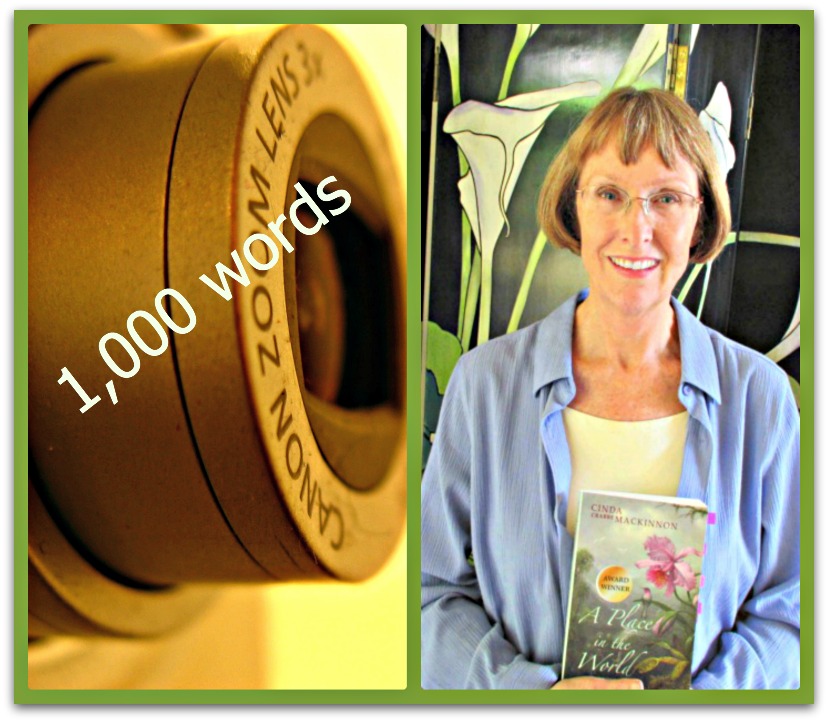
Cinda 1000 Words CollageWelcome to our monthly series “A picture says…”, created to celebrate expats and other global residents for whom photography is a creative outlet. The series host is English expat, blogger, writer, world traveler and photography enthusiast James King, who thinks of a camera as a mirror with memory. If you like what you see here, be sure to check out his blog, Jamoroki.

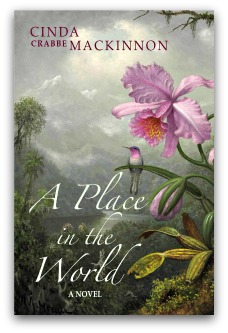
My guest this month is Cinda MacKinnon, an American who grew up overseas and is the author of an award-winning novel set in one of her former homes, Colombia. Called A Place in the World, the book was featured almost exactly a year ago on the Displaced Nation.

Cinda shoots mainly “macro” (extremely close up) pictures, a habit she developed because of her interest in nature and plants—especially wildflowers. A writer, former university lecturer, and environmental scientist, Cinda is trained in geology and has also nurtured a life-long passion for botany. It’s telling that the protagonist of her novel is a botanist!

Cinda enjoys hunting down rare plants and taking photos that show their minute details, such as the number of anthers (the part of the stamen that contains pollen), so that botanists will be able to identify them.

She now lives in northern California, where the California Native Plant Society has become a fan of her photos and sometimes asks her to supply a few of them for their newsletters and exhibits. Who knew?

* * *

Hi, Cinda. Welcome back to the Displaced Nation. I’m pleased to have the opportunity to discuss your photo-travel experiences. When I first started following your blog, I assumed you were a writer—but then was delighted to discover that you’ve also taken some excellent photos. I know you’ve already been over some of this ground in your interview with ML Awanohara, but can you tell me where you were born and when you spread your wings to start traveling on your own?
I was born on an Air Force base in Louisiana, but lived there only a week. My dad was already stationed in Greece, and my mother followed him as soon as she was able to travel. I lived in Greece and Germany as a pre-schooler and then in Colombia when my father changed his job and began working as a military attaché for U.S. embassies. Having fallen in love with Latin America, my parents retired in Costa Rica when I was in seventh grade so, happily, I was able to stay in that part of the world through high school…and beyond. After college in the United States, I moved to New Zealand with my husband (back then, they told us we had to get married to immigrate together!). We came to California when he finished his PhD. And here we’ve been ever since, although I view that move to California—I was in my thirties—as the first time I actually lived in the States. Even though my passport said I was a citizen, it has taken me a while to feel like I belong here.

You have been an expat almost since birth—what is known as a Third Culture Kid. Would you say that your wanderlust comes from your nomadic upbringing?
Once I grew up, I wanted to see more of Latin America and as a young family we could do that cheaply. Next I visited Europe to see some of the places I’d lived with my parents, but like so many others ended up falling in love with Italy and France. I think language had as much to do with it as the culture and people. Growing up speaking Spanish, it was fairly easy for me to be understood in Italian, and I found French so beautiful that I have become a perennial student. Recently, my husband and I explored Central Europe along the Danube River, from southern Germany to Budapest. That splendid trip provided fodder for at least five blog posts.

Mais oui. I have always loved the French language, too. Where exactly do you live in northern California?
We live in a semi-rural area nestled in the hills and yet are only 30 minutes from San Francisco—an unusual situation due to geography, which insures our immediate surroundings will never be developed.

“Are not flowers the stars of the earth…”—A.J. Balfour 

And now let’s have a look at a few of your shots that capture favorite memories. Can you tell us the story behind each of them, what makes them so special?
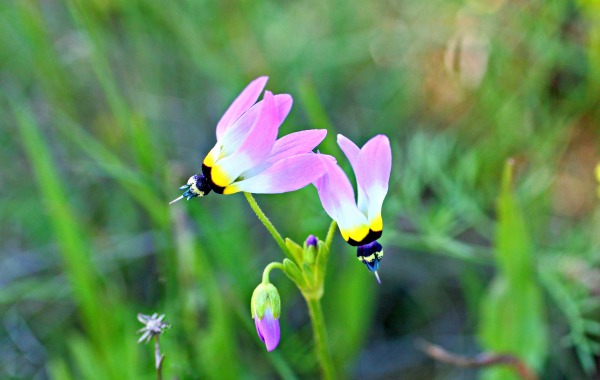
This is one of the first wildflowers I photographed and is still a great favorite of mine: a shooting star, or Dodecatheon clevelandii:

Dodecatheon clevelandii, aka shooting star. Photo credit: Cinda MacKinnonn.

Dodecatheon clevelandii, aka shooting star. Photo credit: Cinda MacKinnonn.

The next photo is of the odd-looking Tiburon Lily, Calochortus tiburonensis, which blooms only a few weeks a year and is quite rare; it evolved on serpentine soils, which gives rise to unusual plants that can tolerate this somewhat toxic chemistry. Indeed, you can find this little lily in only one place: on Ring Mountain (a single hill really), north of San Francisco:

Calochortus tiburonensis. Photo credit: Cinda MacKinnon.

Calochortus tiburonensis, found only on Ring Mountain. Photo credit: Cinda MacKinnon.


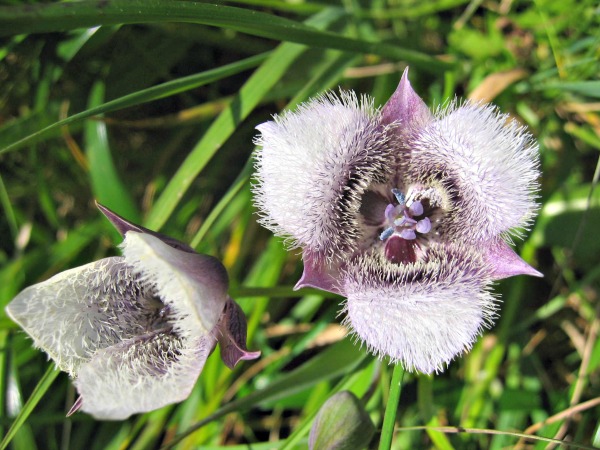
Another peculiar wildflower is C. tolmiei, nicknamed “pussy ears”. It is challenging to capture the tiny hairs and other features as it is barely 2.5 cm across—plus it tends to grow on coastal slopes where the wind wreaks havoc with your focus!
Calochortus tolmiei, aka pussy ears. Photo credit: Cinda MacKinnon.

Calochortus tolmiei, aka pussy ears. Photo credit: Cinda MacKinnon.


I’ve taken quite a few photos of wild flowers without having a clue what their names were. I’m getting a real lesson in flora here. Thank you, Cinda. I can see why they call botany the “science of beauty.”

“I perhaps owe having become a painter to flowers.”—Claude Monet

I know you have photos of scenery, too, and these next four, I believe, have a special significance for you.
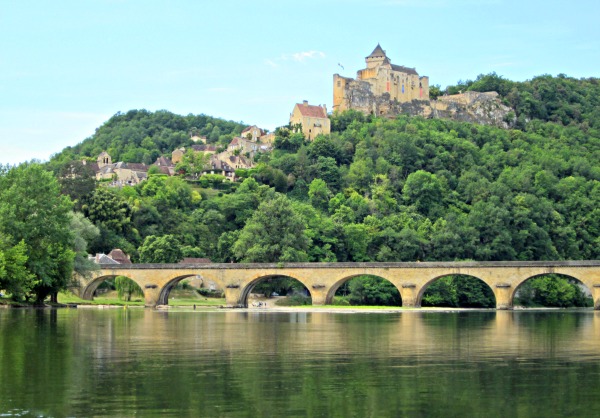
I mentioned I am a bit of a Francophile and a favorite region of mine is the Dordogne Valley. This is a place with history, from Richard the Lionheart to Joan of Arc; pre-history (the Cro-Magnon cave paintings); and beauty. I talked my husband into renting a canoe and we paddled down the Dordogne River, past castles, ancient bridges and towns. This photo with the medieval Château de Castelnaud in the background is a memento of that glorious day:

Canoeing on the Dordogne in glorious weather. Photo credit: Cinda MacKinnon.

Canoe with a view, la rivière Dordogne. Photo credit: Cinda MacKinnon.


Next, I’d like to show you a photo of a very different place, in California. Actually, I can give you a choice of two: would you rather see the California desert before a rain storm or one of Arvin, a city in southern California? Arvin is interesting because it’s set in hilly grassland that half of the year is dry and dormant but explodes into wildflowers in the spring (if the winter is wet). What’s your pleasure?

Can I have both?
Mais oui! Here’s the Sierras:

The stormy Sierras. Photo credit: Cinda MacKinnon.

The stormy Sierras. Photo credit: Cinda MacKinnon.


And now for Arvin in all of its glory:
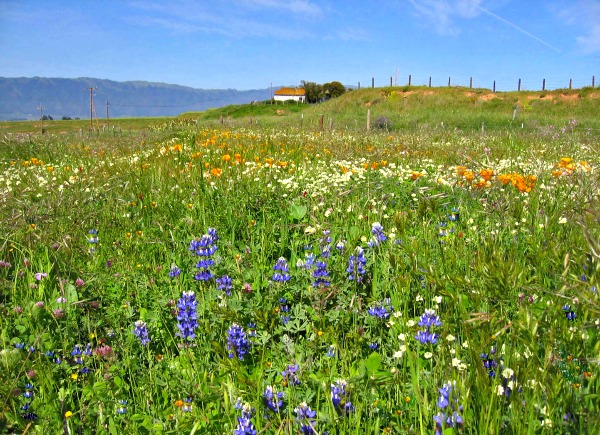
A profusion of wildflowers in Arvin. Photo credit: Cinda MacKinnon.

A profusion of wildflowers in Arvin. Photo credit: Cinda MacKinnon.

Both photos are so lovely! That’s why I decided to give you this bonus. But if I really was forced to choose, the desert before the rain is so dramatic. I think you should turn it into a photo-painting using Topaz Adjust or Impression. What’s your last shot?
Another California landscape I’m fond of is Monterey County. When I was a teenager, I read all of John Steinbeck’s novels, never dreaming I would live in California much less end up working in the Salinas Valley as a hydro-geologist for several years. On arriving I felt as though I’d been there before. The town of Monterey itself has become a tourist attraction, but if you go out into the countryside there are still scenes like this one, with the adobe house on the hill:

An enchanted realm near Monterey, California. Photo credit: Cinda MacKinnon.

An enchanted realm near Monterey, California. Photo credit: Cinda MacKinnon.


Please God, don’t let them turn it into another orchard or development!

Here here! I noticed you haven’t included any photos of people. Do you feel reserved about taking photos of strangers?
Yes , and I don’t like portraits to look overly posed. So first I try to take photos surreptitiously. If that’s not possible, I try to be respectful by asking if it’s okay– preferably in their own language. No matter where I travel, I learn some basic phrases in the language of the country (Hungarian was the hardest so far!), but I’ve found that “okay?” seems to be a universal word.

You are right: “okay” seems to have been adopted by most of the planet, though it’s origins are unclear. One theory is that it was derived from a shorthand way foreign-born Americans in the 1830s developed for writing “all correct”—only they’d spelled it “korrect”!

“I will touch a hundred flowers/And not pick one.”–Edna St. Vincent Millay

What motivates you to record what you see through photographs? Is it the ability to capture something unique, which will never be seen again?
Hmmm… I barely think of myself as a photographer; it is one of several hobbies! But certainly, what you say is true of fleeting blooms, and photos do help to preserve memories of wonderful places, whose beauty could vanish. But I think what really led me to photography was my interest in plant nomenclature. I like to block out weeks of time every year to hike in hills, valleys and deserts and search for rare blooms. It is a bit of a treasure hunt, and my photos of evidence of the riches I uncover.

Your modesty is charming, but I think you definitely have an artist’s eye and many of your photographs could be transformed into beautiful pictures with a little more post processing. Which leads me to the technical stuff. Some of our readers may want to know what kind of camera and lenses you use, and how you handle post-processing.
I use a Canon Digital Rebel XT SLR with a macro lens when I am looking for wildflowers in the spring. But for traveling I’ve started to just put my trusty Canon PowerShot in my pocket. I usually use Photoshop for post-processing, but as you’ve pointed out, I’m not adept at all the advanced features. I use “auto” first, and that is generally all I need, except I often crop a shot and, if needed, adjust the lightning or clean up stray blemishes.

Finally, do you have any advice for wannabe photographers who are traveling or living abroad?
It is not the equipment—it is in the eye. Some of my better pictures were taken with a point and shoot. I asked a professional photographer friend if he thought I should buy some filters or another lens, and he said his best shots are sometimes with his cell phone! I guess the motto is “be prepared” for something that catches your eye—be ready for the special moment when the light is right. Make sure your subject doesn’t appear to have an antenna sprouting out of his head at that moment. Don’t use the “sharpen” feature for portraits as it accentuates flaws (unless you want that for character) and can give a severe look. And don’t make your friends look at 200 mediocre photos of your vacation—please cull out the unappealing or out-of-focus ones! (My rule of thumb for talks is 1 to 1.5 slides per minute—that’s 60 to 90 per hour—nobody wants to see more than that.)

Very succinct and good advice, Cinda—right up my street. I’d like to thank you for taking the time to tell your fascinating story in this interview.

* * *

front-cover-place-in-worldReaders, what do you make of Cinda’s close-up photos of exotic plants and her photography advice? I find it curious that she writes about people looking for their place in the world, yet is obsessed with the kinds of flowers that bloom where they are planted. As Georgia O’Keefe once put it:

“When you take a flower in your hand and really look at it, it’s your world for the moment.”

Please leave any questions or comments for Cinda in the comments!

Meanwhile, I suggest that you check out Cinda’s Pinterest boards for more of her botany photos. You can also get to know her better by visiting her author site and blog, and liking her Facebook page. And don’t forget to read her book if you haven’t done so yet, many glowing reviews for which can be found here.

(If you are a photographer and would like to be interviewed by James for this series, please send your information to ml@thedisplacednation.com.)

STAY TUNED for next week’s fab posts!

If you enjoyed this post, we invite you to register for The Displaced Dispatch, a round up of weekly posts from The Displaced Nation, with Alice nominees, exclusive book giveaways and other extras. Register for The Displaced Dispatch by clicking here!

Related posts:

BOOKLUST, WANDERLUST: Lawrence Osborne’s haunting tale of expats and travel in the Moroccan desert

Booklust Wanderlust Collage

Left: Oleh Slobodeniuk (CC BY-NC-SA 4.0); right: Beth Green (her own photo).

Attention displaced bookworms! Our book review columnist, Beth Green, is back. An American who lives in Prague, Beth mixes booklust with wanderlust in equal measures, which gives her just the right background for reviewing recent book releases on behalf of international creatives.

—ML Awanohara

Thanks, M.L.! And, hello again, Displaced Nationers. With the arrival of fall in the Northern hemisphere, I find myself in the mood to dig into some darker, heavier—more Halloweeny, shall we say?—material.

As a long-term traveler, third-culture kid, current expat, or all of the above in some cases, each of us has at some point or another faced a cultural divide we’ve found it difficult, if not impossible, to cross. Maybe it came down to a clash of religious or political beliefs. Or was it something to do with wealth? There are privileges that come with being an expat—and that, ironically, can cause discomfort.

But perhaps one of the most harrowing breaches of trust occurs when people possess differing concepts of justice.
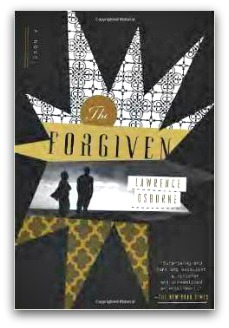
TheForgiven_colorcoverLawrence Osborne’s novel, The Forgiven, wraps all three of these tough-to-tackle subjects into a compelling tale centered around one darkly beautiful “what if”:

What if you accidentally committed a crime in another country?

Every traveler’s worst nightmare

Osborne’s protagonists, David and Jo Henniger, are a wealthy middle-aged London couple who have grown frustrated with each other and jaded about life in general. David is a society doctor in Chelsea who has just lost a malpractice suit and is also beginning to lose patients. Jo is a children’s book writer who hasn’t written a book in some time.

To get a change of scene, and perhaps a new lease on life, the couple sets off to attend a lavish party being thrown by one of David’s school friends, Richard, and his partner, Dally, at their ritzy retreat in the Moroccan desert. It’s a wild weekend-long affair tony enough to have photographers from the New York society pages chronicling it.

Now, that doesn’t sound like my travel scene, but Osborne makes it clear that what happens to Henningers could happen to any of us who dare to venture into unknown lands, where the inhabitants have different religious beliefs to ours, are poorer, and possess an unfamiliar sense of justice.

Jo to David: “I shouldn’t let you, Stumblebum.”

Overriding Jo’s objections, David decides to do the drive from Tangier through the desert in the night even though he has just consumed a bottle of wine.

Jo sulks but lets him drive.

Long after dark, while the Hennigers are trying to navigate the unfamiliar desert terrain, two Moroccan boys leap into the road ostensibly selling fossils though possibly intending to highjack the vehicle. David runs in to one of the young men, killing him. The other boy runs away.

Osborne sets up an unforgettable scene as David and Jo make their entrance to an extravagant expat party with a dead body on the back seat of their car. Not knowing what to do or how the Moroccan police will respond, the Hennigers have taken the corpse with them.

For the hosts, the situation is an embarrassment and a source of annoyance. For their Western guests, it’s a rude interruption and a source of gossip. For Moroccans like Hamid, the head servant of Richard and Dally’s estate, it’s a tragedy that brings out his deep loathing of Western values. For the family of the boy, who arrive the following day to collect the body, it’s both tragedy and crime.

But for David and Jo, it will prove life changing.

Jo to Day (another guest): “It’s like going through the Looking Glass.”

This story, rather than showing how travel erases our differences, puts the notion of “otherness” into high relief. The couple who host the party and many of their friends see Moroccans as as objects of curiosity, wisdom, servitude, and lust. David, less cosmopolitan than his hosts, falls back on traditional colonial values, regarding Morocco and Moroccans as inscrutable and inferior.

By the same token, the Moroccans in the story can’t fathom the Westerners’ lifestyles or motives. They are “unimaginable human beings,” infidels—people who don’t eat with their fingers, who don’t believe in God.

Driss, the young man who is struck and killed by David, wants desperately to break away from the life his father had. He comes from a Berber family that lives in a remote outpost of the Sahara, where children must slave away hacking out Trilobites all day long, with the hope of selling them to Western millionaires.

Driss’s father, Abdellah, more than anything else wants to avenge “the fact that he simply had never known his son at all.”

When Abdellah and his brothers arrive to pick the body up for burial, they demand to meet David. They ask that he travel with them to make atonement. Richard and Dally, keen to get on with the party, assure him that it will be for the best.

Jo to herself: “Who knew what here was artificial and what was indigenous?”

The Forgiven is a tribute to Osborne’s roots as a world-class travel writer and chronicler of the expat life. He takes us behind the scenes and into the inner lives of Moroccans as well as of the expats who choose to live in that part of the world.

Take, for instance, Osborne’s account of Moroccan versus British pessimism:

“The men of the desert know everything,” Hamid said once, like a quote out of Lawrence of Arabia. But they didn’t, really. They were just efficient pessimists, and therefore astute readers of human nature. They always assumed the worst, and that made them correct nine times out of ten. Their pessimism, however, was not like David’s. David was someone who believed that the past was superior to the present, and that was a different sort of pessimist. It was not the entire past that was superior, of course; it was mostly just the British nineteenth to the mid-twentieth century.

Or this passage about how the Moroccan villagers tend to regard Richard and Dally and their wild parties:

It was admitted that they were wealthy and that they spent their money in an exceedingly unwise and profligate way, and that this was much to the advantage of the people.

Jo to Richard: “I dare say I won’t be the same again…”

The story maintains momentum by swinging between Western and Moroccan cultures, leaving the reader almost breathless, not always sure of their footing.

As readers, we guess but aren’t sure if the lumpish David, who is clearly an alcoholic, is still drunk on his midnight drive. Did he mean to hit the young man? And, the victim of the accident—can we say he’s a victim? Flashbacks to the youth’s bravado-filled conversations with a younger, impressionable friend paint him as an unstable character, full of hatred, with a shady past…

Jo, David’s long-suffering wife, is also an enigma. An aging beauty, she feels isolated from the young, frivolous women at the party. Does she love David, or want to leave him? Does she care if justice is exacted? Or does she care only that she be, as the title suggests, forgiven?

* * *

Not wishing to give away any more of the plot, I’ll end by reiterating: Displaced Nationers, in your own experience, which topics tend to open up the widest cultural divides?

Let me also leave you with the epigraph from the novel:

“Many roads do not lead to the heart.” —Moroccan Proverb

Until next time—oh and please drive safely!

* * *

Thanks, Beth! I’ve read The Forgiven and am still haunted by it. Lawrence Osborne is a contemporary writer with a deep understanding of what it means to feel “displaced” by one’s travels. Reading the book gave me thrills and chills, not just for the story but for the beauty and precision of his prose. Readers, does this sound like a book for you?

Beth Green is an American writer and English teacher living in Prague, Czech Republic. She grew up on a sailboat and, though now a landlubber, continues to lead a peripatetic life, having lived in Asia as well as Europe. Her personal Web site is Beth Green Writes, and she is about to launch a new site called Everyday Travel Stories. To keep in touch with her in between columns, try following her on Facebook and Twitter. She’s a social media nut!

STAY TUNED for next week’s fab posts!

If you enjoyed this post, we invite you to register for The Displaced Dispatch, a round up of weekly posts from The Displaced Nation, with Alice nominations, exclusive book giveaways and other extras. Register for The Displaced Dispatch by clicking here!

Related posts:

And the September 2014 Alices go to … these 2 international creatives

 © Iamezan | Dreamstime.com Used under license

© Iamezan | Dreamstime.com
Used under license

If you are a subscriber to our weekly newsletter, the Displaced Dispatch, you’re already in the know. But if you’re not, listen up. (Hey, why aren’t you? Off with your head!)

Every week, when that esteemed publication comes out, we present contenders for a monthly “Alice Award,” most of whom are writers or other kinds of international creatives who appear to have a special handle on the curious and unreal aspects of being a global resident or voyager.

Not only that, but this person tries to use this state of befuddlement as a spur to greater creative heights.

Today’s post hono(u)rs September’s two Alice recipients. They are (drumroll…):

1) DANIEL ROUSE, Shropshire-born expat living in Toronto, Canada, and Telegraph Expat blogger

For his post: “Class doesn’t matter in Toronto,” for Telegraph Expat
Posted on: 19 September 2014
Snippet:

Back in Shropshire…it wasn’t uncommon to have friends with nicknames deriving from their occupation; that’s how they are identified. It can be to the extent where a job is married with a first name without pause for breath: “you know my mate Ronnie-the-plumber.” I am guilty of this….

Over here it doesn’t matter what people do for a living, so people from all walks of life socialise together. Being worth a decent conversation is all that matters.

Citation: Daniel, we had rather assumed that the British class obsession would be fading by now. It’s been quite a few years since Maggie-the-Grocer’s-Daughter assumed power, followed by John-the-Circus-Performer’s-Son. Then there was Tony-the-Grandson-of-Actors-&-Grocers. And let’s not forget Kate-the-Party-Planners’-Daughter. But it seems that with the ascendance of David-the-Descendant-of-William IV (albeit via an illegitimate line), class considerations are permeating the land again—having now reached Shropshire. Some may say it’s a good thing—long may class distinctions flourish! A society can’t function if people don’t know their place. And besides, as Downtown Abbey has taught us, upper and lower classes have always been the best of friends. We must confess, however, that we do not find this very sensible. Rather, we think that names, rather than being associated with professions or parents’ professions (and therefore educations, incomes, and class profiles), should be reminders of what a person looks like. The source of our wisdom is the redoubtable Humpty Dumpty, in this exchange with Alice:

“MUST a name mean something?” Alice asked doubtfully.

“Of course it must,” Humpty Dumpty said with a short laugh: “MY name means the shape I am—and a good handsome shape it is, too. With a name like yours, you might be any shape, almost.”

Now some may think Humpty Dumpty has prosopagnosia, but surely he’s just being practical? We also believe that expats would do well to employ this kind of mnemonic device when they first go abroad and are immersed in a phantasmagoria of new faces, body shapes, clothing, hair styles… In your part of the world, for instance, we could imagine epithets like “Big-Boots-xxx” or “Bushy-Beard-xxx” coming in handy. (Listen, you say you know your Canadian friends really well, but we still don’t advise using these nicknames to their faces, just in case…) Congrats on this fine post, Daniel, and we look forward to re-encountering some of this material in your short stories!

2) LINDA RUBRIGHT, former expat in Europe and the Caribbean, and founder of the travel and lifestyle blog the delicious day

For her post: “8 Secrets No One Tells You about Being an Expat,” for Sherry Ott’s new career break site, Meet Plan Go
Posted on: 25 September 2014
Snippet:

Secret #4: You are the punch line to a lot of jokes.
…The tiny differences are enormous differences, and what can you do about it? Expect a lot of laughs—in your direction.

Citation: Linda, you are so right, and have such a good way of putting it: how truly strange a culture can look when you are stuck in its “deep catacombs” (see Secret #2). For sure, “catacombs” are a telltale sign of having fallen down a rabbit hole. And we agree with your premise that exploring said catacombs without a compass can induce “profound loneliness and feelings of complete incompetence” (#2 again) not to mention homesickness (#8). We’d further like to point out that even on Alice’s through-the-looking glass adventure, when she stays above ground, such feelings of discombobulation continue, especially when she repeatedly tries to climb the hill near the house to the beautiful garden—only to find herself back at the house. Did an encounter with the Red Queen shed light on her frustrations? Hardly:

“Well, in OUR country,” said Alice, still panting a little, “you’d generally get to somewhere else—if you ran very fast for a long time, as we’ve been doing.”

“A slow sort of country!” said the Queen. “Now, HERE, you see, it takes all the running YOU can do, to keep in the same place. If you want to get somewhere else, you must run at least twice as fast as that!”

Still, at least the Red Queen was kind enough to attempt an explanation of basic cultural differences. She didn’t laugh at Alice. Which is more than we can say for you that time when you witnessed your Spanish boyfriend’s first attempt to pump gas in the United States and apparently found it uncontrollably funny that, being from Spain, which is 100% full service, he was also not used to gallons, credit cards, or zip codes, and kept fumbling with the machine. But we have news for you, Linda: the joke may be on you in the end. Little did you realize that the most successful expats are gluttons for punishment, and the eight points you list as drawbacks to the expat life in fact don’t perturb us all that much. Why do you think your BF is now your husband, living with you in Colorado? He loves being the object of your humor! In any case, thanks for this great post, and good luck to the pair of you with your travel advice site.

*  *  *

So, readers, do you have a favorite from the above, or have you read any recent posts you think deserve an Alice Award? We’d love to hear your suggestions! And don’t miss out on the shortlist of Alice contenders we provide in each week’s Dispatch, which are sources of creative thought if nothing else! Get on our subscription list now!

STAY TUNED for more fab posts.

Writers and other international creatives: If you want to know in advance the contenders for our monthly Alice Award winners, sign up to receive The Displaced Dispatch, a round up of weekly posts from The Displaced Nation, with news of book giveaways, future posts, and of course, our weekly Alice Award!. Register for The Displaced Dispatch by clicking here!

Related posts:

TCK TALENT: Even without slide projector, projection of life as a Third Culture Kid engages Reykjavík audiences

TCK in Iceland Collage

Elizabeth Liang in front of Tjarnarbíó, in downtown Reykjavík, where she performed her one-woman autobiographical show, Citizen Alien, on growing up as a TCK of mixed heritage. Photo courtesy Elizabeth Liang.

This month Elizabeth (Lisa) Liang updates us on her own creative life, which this past summer veered in the direction of an island situated at the confluence of the North Atlantic and Arctic Oceans!

Halló, vinir mínir! Hello, my friends! I’m addressing you in Icelandic because in this month’s column I’ll be re-creating my journey to Reykjavík, where I traveled in August to perform ALIEN CITIZEN: An Earth Odyssey, my one-woman show about growing up as a Third Culture Kid, or TCK, of mixed heritage.

How did I end up performing my show in Iceland? I have a friend in that part of the world who put me in touch with the artistic director of Tjarnarbíó, a creative center for professional live art in Reykjavík, who enthusiastically offered to host the show if I could cover my travel and lodging. Presented with a chance to combine three of my favorite activities—acting, writing and travel—how could I resist?

Engum flýgur sofanda steikt gæs i munn (“One cannot expect to benefit without making some effort”)—Icelandic proverb

My husband, Dan, agreed to work as my stage manager, which was perfect because he knows the show so well. I launched a successful Kickstarter campaign to raise the requisite funds for our trip, found a cozy house in Reykjavík on AirBnB for us to rent, bought our flights, started promoting the show on social media—and then off we went to the Land of Fire and Ice.

We arrived in ideal weather, cool and dry, which many Icelanders told us was lucky because it had been raining all summer. We were relieved to find that our lodgings were in a quiet, pleasant residential area that was a seven-minute walk to downtown and a 15-minute walk to Tjarnarbíó.

Tjarnarbíó is a beautiful venue with state-of-the-art technology. At the technical rehearsal, the two “techies” who adjusted the lights and projector were friendly and professional. (Incidentally, we never met anyone in Iceland who was unfriendly, and the Icelanders we encountered all spoke perfect English, some with gorgeous British accents.)

That said, we had an unexpected snafu at the tech rehearsal. There are two kinds of projections in the show:

  1. Pictures and videos that are projected onto a screen via my laptop, and
  2. Words that I project onto my torso using an old-fashioned slide projector.

During the tech rehearsal, the slide projector I’d used in the show for over a year konked out. The stage hand and I stared at the plume of smoke rising from the top and said: “It’s smoking.”

No, the problem was not the power converter. We had the right one. Nor was it the bulb. We replaced it but the projector still didn’t revive. So my Icelandic friend’s father-in-law generously loaned us his. More on this later…

Citizen Alien Photo Strip

(top to bottom) At the tech rehearsal, the lights were lowered from the ceiling–fancy!; opening night; closing night; post-show celebratory drink; with Dan in front of Hallgrímskirkja Church; with Dan in Þingvellir National Park. All photos courtesy Elizabeth Liang.

August 20, 2014: Opening Night

We had an audience! I only knew of five people who were planning to attend (of whom I’d actually met only one—my Icelandic friend). What a pleasant surprise to see twenty or so people in the house!

And they laughed! I guess the show’s humor translates.

Dan stage managed wonderfully and the light board operator did a great job, too. The only hitch was that when it came time to project slides onto my torso, the borrowed projector didn’t work, even though we’d tested it earlier. I improvised and the audience went right along with this. (Afterward, a very kind audience member offered to loan us his projector, but when we met later, he realized it had a part missing. So Iceland never got to see words projected onto my torso. Ah, well.)

The best part of opening night was the fact that I enjoyed myself on stage, which hadn’t happened in a while. There were two curtain calls and people stayed afterward to shake my hand, thank me, and say lovely things. It was such a pleasure. About half were Icelandic and the other half internationals—once again, the right people had found me and my show. Several said they would spread the word for the next performance.

A few people from Spain, France, the Czech Republic, and Iceland hung out with us at Tjarnarbíó’s cafe afterwards. They all mentioned different parts of the show that resonated for them, and one said she felt that the show does a service for nomadic and non-nomadic people—it’s like a bridge between them. They thought it should be filmed, which I’m planning to do in December.

All hail my director, Sofie Calderon, for making this show such a dynamic experience for the audience! People from far and wide have enjoyed the production, and that’s Sofie’s doing. If it had been up to me, I would have found ways to hide onstage, because performing a solo show is super scary.

August 22, 2014: Closing Night

More people in the audience, which was very moving, because I knew none of them. The word of mouth from opening night must have been good. And maybe all those promos I sent to the international school and Facebook groups helped…?

The performance didn’t feel as good—I was having less fun and getting fewer laughs—but I forged ahead. Afterward Dan and the light board operator said “No way, it was TIGHT, really good show!” Yet more proof that we actors have no idea how well we’re doing. We only know if the audience is responsive or quiet.

Just like on opening night, a bunch of people waited to speak to me afterward. One was a young adult TCK who was very moved by the show. Another was a professor at the University of Rekjavík whose field of study is TCKs. Their compliments, along with all the words of support from other audience members, was tremendously encouraging.

Because the truth is: before embarking on this Northern European adventure, I had no idea how audiences would react, or if there would be any audiences at all. I had girded myself to perform for a handful of kindly people on opening night and then possibly cancel closing night because who knew if there would be enough interest?

Reykjavík may be a small capital, but as it turns out, it has plenty of residents who are international or international in outlook, and open to trying new things.

Kleina & coffee, Björks in boots, Lutherans & lava…

Beyond the show, Dan and I had a glorious time exploring small but pretty Reykjavík; the Blue Lagoon, a thermal spa located in a lava field in Grindavík; and the Golden Circle, a route the loops from Reykjavík to central Iceland and back. Other highlights included:

  • snacking on kleina, a donut-like pastry in the shape of a trapezoid;
  • visiting Hallgrímskirkja, the Lutheran cathedral designed to resemble the lava flows of Iceland’s landscape, and Settlement House;
  • hanging out at the Boston, said to be one of the world’s best bars, and at several coffee houses; and
  • last but not least, watching singers and dancers all over town on Culture Day/Night, a day and night-long program of cultural events that takes place in August every year and is one of the country’s largest festivals.

I also got a kick out of Icelandic fashion—bright colors, unusual cuts—and, as I love boots, was pleased to see practically every woman sporting boots of some kind: ankle, knee-high, sexy, hiking, and everything in between. (Did I buy a pair? Nope. Iceland is expensive.)

On our last night, we stepped out onto our little street to see fireworks, which felt like a final burst of congratulations. I got teary-eyed!

Overall, it was a delightful trip. Dan and I left thinking we’d like to go back someday. We want to see more of the island (puffins! volcanoes!), enjoy the friendly vibe…and hopefully bring another solo show for Icelanders’ entertainment—but without any cantankerous 1980s equipment.

* * *

Thank you, Lisa! Having only been to the Blue Lagoon as a round trip from Keflavík International Airport, I really appreciated this vicarious journey into the heart of the city’s cultural scene. And, as always, I’m impressed that you were contributing to the culture as well as taking something from it! Readers, please leave questions or comments for Lisa below.

STAY TUNED for next week’s fab posts!

If you enjoyed this post, we invite you to register for The Displaced Dispatch, a round up of weekly posts from The Displaced Nation, with news, book giveaways and other extras. Register for The Displaced Dispatch by clicking here!

Related posts:

For this TEFL teacher with a strong Cornish identity but a compulsion for travel and the expat life, a picture says…

Cornish Kylie Collage

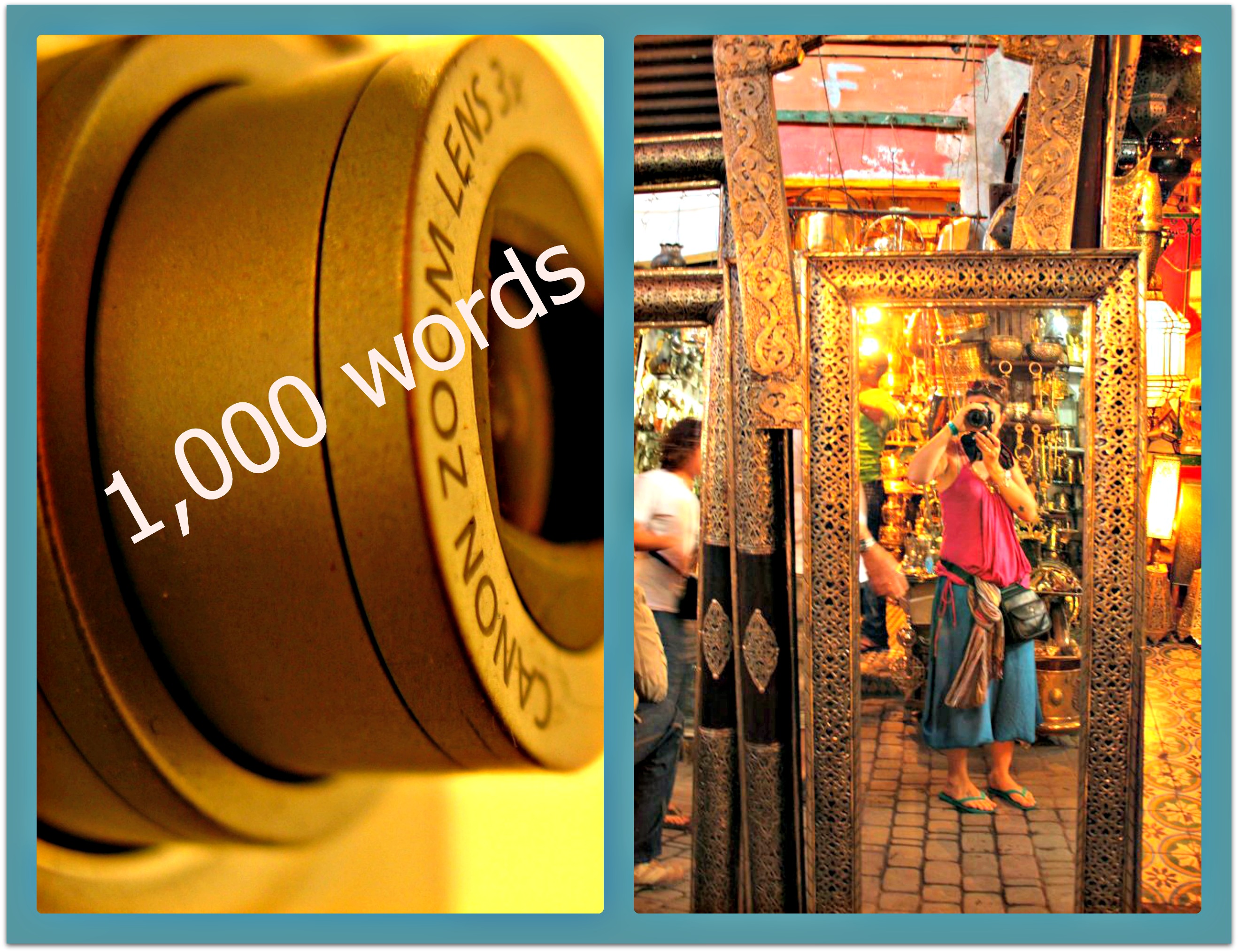
Canon zoom lens; photo credit: Morguefiles. Kylie Millar (self portrait).

Welcome to our monthly series “A picture says…”, created to celebrate expats and other global residents for whom photography is a creative outlet. The series host is English expat, blogger, writer, world traveler and photography enthusiast James King, who thinks of a camera as a mirror with memory. If you like what you see here, be sure to check out his blog, Jamoroki.

My guest this month is 27-year-old Kylie Millar who was born and bred in Cornwall, England, and, though she now finds herself in Thailand, just like me, she remains proud of her Cornish heritage, having branded herself on her travel blog as Cornish Kylie.

Not only that but Kylie informs me that the Cornish were granted official minority status earlier this year. Being born and bred in Cornwall now means, technically, that a person is identified as Cornish first, British secondwith the latter identity being confined largely to one’s passport. Well, it is true that Cornwall was its own Celtic nation before the Norman Conquest, and they have their own language, Kernewek, which is distinct from Welsh.

After the Scottish vote for independence, can a bid by the Independent Republic of Kernow be far behind?

How times have changed!

* * *

Hi Kylie. It’s good to see you at the Displaced Nation. As the name of your blog implies, you are a proud Cornish lass—rightly so! You have also travelled a fair bit. But since Cornwall is a place close to my heart, can you reminisce for a bit about your childhood in that part of the world?
I was born in Truro, the main hub of Cornwall, which has a cathedral and is therefore designated a city as opposed to a town. But I was raised in the hilly seaside town of Falmouth, known for its lovely beaches, fishing port and docks. To some, it may seem like an aging coastal town, but the recent influx of art students to its expanding university has given it a new lease on life and a nice arty vibe. My dad is a fisherman so I grew up living a typical Cornish life: summers on the beaches, the smell of a crab being boiled on the stove top (which to this day I cannot abide—the curse of being a fisherman’s daughter and not liking fish or seafood!). But I really do appreciate how lucky I am to have grown up in such a wonderful place and fully intend to return one day.

Gwrys yn Kernow (made in Cornwall)

As you know I spent my last year in the UK before emigrating to South Africa (1994/5) in Falmouth, so it’s interesting to hear about the changes. How long after I left did you spread your wings and start travelling abroad?
I actually didn’t spread my wings all that much growing up. Family holidays consisted of trips to Butlin’s holiday camps and a few package holidays to Tenerife, in the Canary Islands. I didn’t even move away from Cornwall to go to university, I just commuted the 75 miles east to Plymouth. Why would I want to move away from somewhere like Cornwall?

I agree. It’s a magnetic place even for those of who weren’t born there. Carry on, please.
As part of my degree I had the opportunity to go to China for a few weeks to do a little bit of English teaching and a cultural exchange with Chinese university students. This was my first time to experience a culture completely different from my own. I was only 19 and in a constant state of “culture shock”. It wasn’t until after I completed my degree and had a few years’ work under my belt that the urge to explore really kicked in.

Please tell me a little more about your travels.
Aside from the trip to China, I have holidayed in Egypt and Morocco. Then my next big trip was a month backpacking around Thailand with one of my best friends. That’s how I first caught the Thailand bug.

You certainly don’t intend to let the grass grow under your feet, Kylie. I foresee you becoming a seasoned traveller before long. I know there is a lot more to your story, but let’s start with the reasons that drove you to travel.
I’m not a fan of people traveling purely to “find themselves” or even to “make the world a better place”. Actually, I have changed a lot since coming to Thailand, and I’m sure that, as a TEFL teacher, I’m contributing in some small way to the education of Thailand’s future leaders. But that’s not the sole reason I came here. I had a job in the UK that I loved, but I sensed I was stagnating. So I followed my instincts (very scary but it felt right) and quit, upped sticks and came to Thailand, got a TEFL certificate and started teaching English to Thais.

“Life is so short, you must move very slowly” – Thai proverb

You say you’ve got the Thailand bug, which in my experience can be difficult to explain to anyone who hasn’t lived here. So let’s leave it at that and talk about where, precisely, are you right now and what are you up to.
I spent my first 18 months living in the city of Hat Yai, in southern Thailand, near the Malaysian border. I was teaching English at a government high school, with classes of fifty students and few resources apart from those I conjured up myself. Later I went to Phuket, Thailand’s largest island, to work as a teaching assistant in an international school. The two posts and their locations were poles apart.

Can you say a little about that for the sake of readers who don’t know Thailand?
In Hat Yai I was one of a handful of farangs (Caucasian foreigners) living in a village on the outskirts of the city. On my daily commute to the school, I would meander through rubber plantations, passing water buffalo. At first people would stare, but their stares quickly turned into smiles and shouts of “hello!”. Nobody spoke English beyond that one word, so I had to learn to speak Thai very quickly to be able to order food. In Phuket, by contrast, I am one of thousands of farangs and when Thai people see me they assume that I am a tourist and treat me accordingly. It’s harder to win over the locals here because tourists are their meal ticket. You have to convince them that you aren’t a tourist; you live here like they do. That said, life in Phuket is a lot easier. It has familiar things like pizza and sandwiches (I haven’t got used to eating rice three times a day yet). And of course the island’s beaches are stunning, which reminds me of Cornwall and makes me feel at home.

Ah, I think I detect something of the home bird in you, alongside the intrepid traveller… And now let’s see some of your favorite photos and hear the stories behind them.
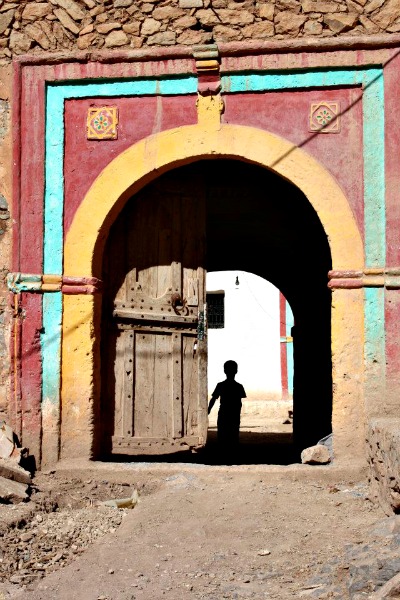
When I was in the Atlas Mountains of Morocco, I couldn’t resist taking pictures of the many beautifully decorated doorways. This picture was accidental as the boy emerged from the doorway just as I pressed the shutter release. Then I realised how people can add an extra dimension and started to include people in more of my photographs. This trip to Morocco was special: it opened my eyes to a very different part of the world.
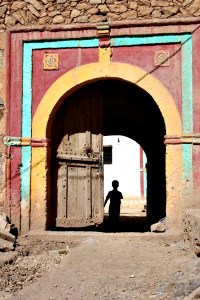
Kylie_BoyinMoroccanDoor

A boy in a Moorish door; photo credit: Kylie Millar.

I love this. Dirty, dusty, old and full of intrigue. A great shot. What else do you have for us?
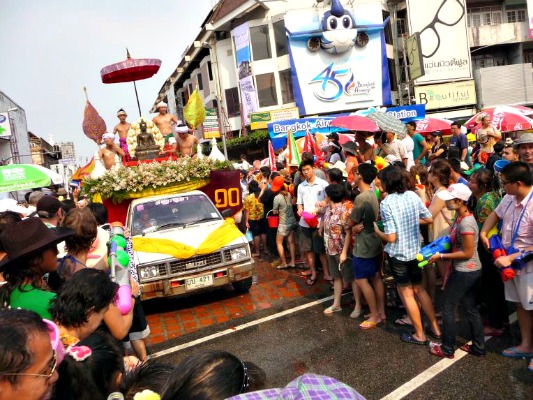
Songkran is the festival held in mid-April to celebrate traditional Thai new year’s. It’s probably the most famous of all the Thai festivals because it’s the scene of the world’s biggest water fight. Determined to join the festivities, I locked away my main camera and went out to the streets. I got this shot when the water fighting stopped to let a convoy of vehicles, carrying Buddha statues, pass to the temple. Songkran is absolutely insane, and if you ever find yourself in Thailand at this time of year, prepare to get wet—or hide!
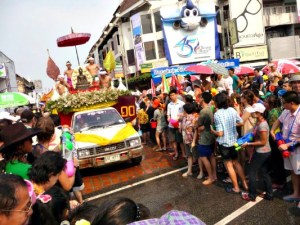
Kylie_ThaiNewYear

Happy New Year, Chiang Mai style; photo credit: Kylie Millar.

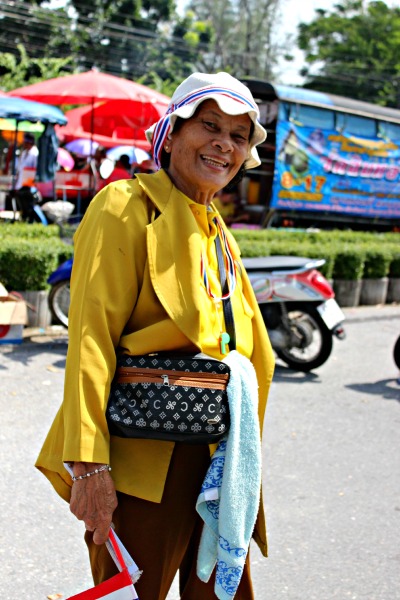
And here’s one more of Thailand. As you know, anti-government protests took place from November 2013 through May of this year. I live close enough to Bangkok that I was able to come in and take photos. Having a big camera was useful as it made it obvious I was an observer, not a participant. Foreign involvement in the protests was a big no-no. On the day I took this shot, anti-government protesters had made progress, spirits were high and the atmosphere was unlike any other I have experienced. People were happy to have their picture taken, and this lady was my favourite, standing proudly in traditional yellow to signal her support for the King. For some reason, the scene made me think of the crowd around the Pyramid Stage at the Glastonbury music festival in England—not what you’d expect at an anti-governmental protest. I’m glad I was able to see it all firsthand.
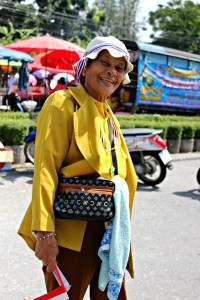
Kylie_yellowlady

A sunny presence at the Bangkok protests; photo credit: Kylie Millar.

Getting to the zuggans (Cornish for “the essence”)

Now could you show us the kinds of places that tend to bring out your shutterbug instincts?
One of those places was Jemaa el-Fnaa, a bustling square in Marrakesh that offends all of the senses. Said to be the busiest square in Africa, it is hot and dusty, and the air is full of the smell of tagine spices and roasting meats. The sounds of hawkers and snake charmers mix with the buzz of the crowd, punctuated by the call to prayer that reaches every corner of the souks—it’s the largest traditional market in Morocco. Rugs, lamps, cushions and fabrics in deep oranges, luscious reds and striking purple line the narrow lanes of the souks. Rusty tin roofs let in shards of light that make this a photographer’s dream. But cameras can only capture so much…

Kylie_souk

The wonders of the Marrakesh souks; photo credit: Kylie Millar.

You captured the smells as well as the intrigue. Well done. What’s next?
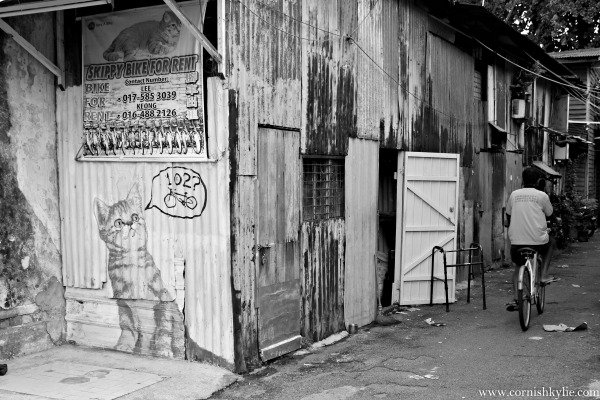
I visited George Town, in the northeast corner of Penang island, twice recently. It’s famous for being one of the main destinations for visa runners and backpackers alike. I was drawn to its hodgepodge of cultures: mosques, churches, Hindu and Buddhist temples all sandwiched together. Ethnic Chinese and Indian communities live alongside each other, and traditional clan families can still be found living on stilt houses on the jetties. In this photo I tried to capture some of that:
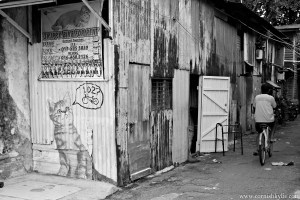
Kylie_bikeforrent

The back streets of George Town, Penang; photo credit: Kylie Millar.

I’m not generally a fan of black-and-white photos but this subject lends itself so well. And finally?
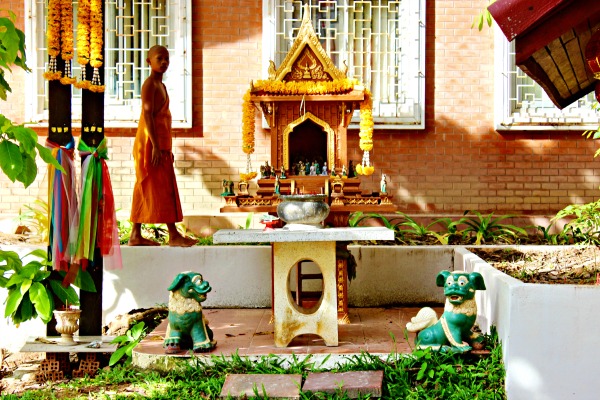
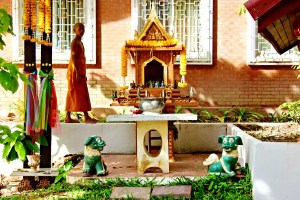
Many of the things that make Thailand unusual are seeming more normal the longer I live here—like the bright orange monk’s robes in this picture, the turquoise sea, the towering Buddha statues, multicolored long boats, the outrageously decorated temples and colourful tuk tuks. It’s home now but, as I think this photo shows, I still like to play the tourist and explore:
Kyli_ThaiOfferings

A novice Thai monk and spirit house; photo credit: Kylie Millar.

I like the way you captured Thailand’s vibrancy. Tell me, do you feel reserved about taking photos of people, particularly when they are conscious that you are doing so?
Actually, I like to try and get natural photographs without the person knowing at all. I want to capture moments and events not someone posing. People generally enjoy having their picture taken, so if they spot a camera they will smile or pull a face and the obligatory peace signs come out. Not quite what I’m looking for… Driving an old banger of a car helps because Thais will sometimes take our picture—because we farangs are assumed to be rich and usually drive smart cars.

“Today I’m going to shoot someone…and they will love me for it!”

It can be annoying, this Asian misconception that all Westerners are rich, but I guess we all get used to it in time. So you don’t ask permission unless you need to before taking people’s photographs—but how do you get around any problem of language?
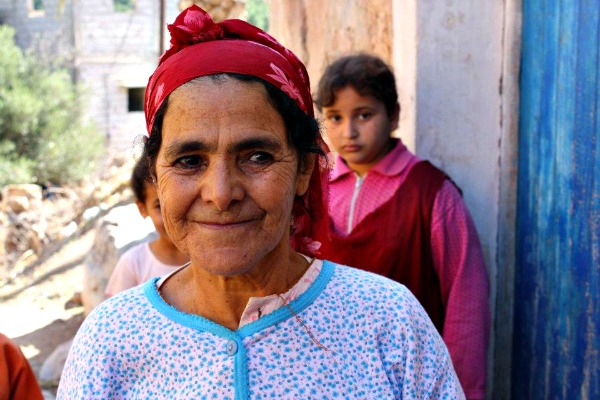
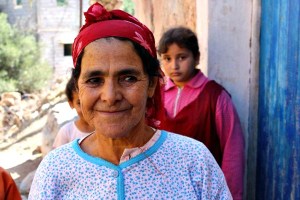
If I am unable to be stealthy, then I use the universal “can I take a picture?” sign consisting of pointing to my camera. I have learned how to ask in Thai but the words sometimes escape me. The big camera is usually a clue! When I was in a mountain village in Morocco, getting some shots of the decorative doors as mentioned above, an old lady smiled at me and gestured that she’d like to have her photograph taken. As I released the shutter button, she held out her hand, demanding payment. Not wanting to cause a scene, I forked out some change. Although not too happy with my offering she took it—if only she knew I only wanted a picture of her back door, not her face!
Kylie_Atlas Mountain lady

People shots for a price; photo credit: Kylie Millar.

Would you say that photography and the ability to be able to capture something unique that will never be seen again is a powerful force for you?
My mum always says that I take so many photographs but I am hardly ever in them. And that is very true. I know that when I am older I will wish I had more pictures of myself having adventures. But for now photography is a means of capturing what I see and feel. If I think the photos are worth sharing, they will end up on my blog. Photography is changing with the times, though. When I studied A-level photography we used film, processed by hand after spending hours in the darkroom. Filters had to be slotted into the machine; now they are just options on an iPhone app. When my mum was younger she went on a trip to Israel and Jerusalem, and she has two rolls of film from that trip—around fifty photographs. Nowadays people will take more than fifty photographs on a single night out. The technology has evolved so much that nearly everyone has a camera in their pocket on their phone, which is great. It makes photography more accessible to all, with no wasted film. But it does mean that photos are not so special and precious as they once were.

Some of our readers may want to know what kind of camera and lenses you use, as well as any post-processing software.
I’ve got a Canon 600D with standard lens, and a 75-300mm telephoto lens (perfect for those stealthy pictures of people, and for animal shots). I’ve also got a Panasonic Lumix point and shoot for the days when a bigger camera isn’t practical. If I am going to edit, I use Adobe Lightroom, which I am still finding my way around. Having never been taught how to use digital post-production software, I have to rely on trial and error—but that was also what it was like in the darkroom. It’s more fun that way!

Finally, do you have any advice for wannabe photographers who are traveling or living abroad?
Take more pictures than you think you need. Bring spare SD cards and back them up—you will lose one or one will break. Don’t keep your camera locked away in a bag, keep it to hand, it needs to become a natural extension of yourself, not this big cumbersome thing you have to get out every time you want to take a picture.

Even though we are more than 40 years apart, we both left Falmouth and ended up in Phuket with the same camera (Canon T3i 600D). No wonder your pics are so good! Thank you for taking the time to tell your fascinating story.

* * *

Readers, what do you make of Kylie’s experiences and her photography advice? And do you have any questions for her about her photos or her travels? Please leave them in the comments! And don’t forget you can follow Kylie on her blog, Cornish Kylie. You can contact her by email at info@cornishkylie.com, and you can also find her on social media: Twitter, Facebook, and Instagram.

(If you are a photographer and would like to be interviewed by James for this series, please send your information to ml@thedisplacednation.com.)

STAY TUNED for next week’s fab posts!

If you enjoyed this post, we invite you to register for The Displaced Dispatch, a round up of weekly posts from The Displaced Nation, with Alice nominees, exclusive book giveaways and other extras. Register for The Displaced Dispatch by clicking here!

Related posts:

https://d3ijcis4e2ziok.cloudfront.net/tpc-check.html

BOOKLUST, WANDERLUST: Curiosity leads Elizabeth Gilbert’s Victorian heroine to international travel

Booklust Wanderlust Collage

Left: Oleh Slobodeniuk (CC BY-NC-SA 4.0); right: Beth Green (her own photo).

Attention displaced bookworms! Our book review columnist, Beth Green, is back. An American who lives in Prague, Beth mixes booklust with wanderlust in equal measures, which gives her just the right background for reviewing book releases on behalf of international creatives.

—ML Awanohara

Hello again, Displaced Nationers! Since I last wrote, summer has slipped by us. The gradual wicking away of days and weeks puts me in mind of the protagonist of the book I have chosen to review this month: The Signature of All Things, a scientific and historical novel by Elizabeth Gilbert (she of Eat, Pray, Love fame).

The story’s heroine, Alma Whittaker, an early Victorian botanist living in North America, thinks of time as running on three concurrent tracks:
1) Human Time, which goes by as quickly and flittingly as a summer’s day.
2) Geological Time, in which the Earth moves.
3) Moss Time, which reflects the events of both Human and Geological time but moves at its own pace, expanding rapidly.

signature_coverAlma regrets that her life is stuck on the track of Human Time in an era that doesn’t favor women of character, intelligence and strength (but not looks). I found her fascinating and think that you international creatives will find her that way as well for these three reasons:

1) She is a Third Culture Kid and a polyglot.

As the daughter of English and Dutch botanists who eloped to start an empire on stolen seeds in the New World, Alma is a delightful fictional example of a Third Culture Kid. She has an unconventional upbringing at a time when most young ladies of her class were strictly bound by convention.

Gilbert writes:

She learned that walking carefully in the mud to save one’s boots or the hems of one’s skirts never rewarded one’s search. She was never scolded for returning home with muddied boots and hems.

At home, Alma speaks English with her British-born father, an old rascal who sailed with Captain Cook and turned himself into a rare plants and pharmaceuticals baron, one of the richest and most powerful men in Philadelphia; and a mix of classical languages with her highly educated mother. As for her nurse:

[The nurse] always spoke Dutch to Alma, and Dutch, to Alma’s ears would forever be the language of comfort and bank vaults and salted ham and safety.

Alma spends her childhood wandering in the breathtaking gardens and fields of her father’s estate, working on French and Latin, and being regaled with tales of far-flung expeditions at her parents’ dinner parties. She grows into a young woman with a wide breadth of knowledge but a constricted life experience.

2) Alma chooses to expand her horizons through international travel, rather like Gilbert herself.

Many novelists would slow down the narrative at this point, bring in a love interest (and a rival or two), and make the story all about the broadening of Alma’s horizons through a courtship followed by marriage. But Gilbert, who first made herself known to the world through the memoir of her solo travels to Italy (to eat), India (to pray) and Bali (where she found love), isn’t the right author for such conventions.

True, Alma’s youth, measured in Human Time, speeds by, but in the world Gilbert creates, one need not be young to have adventures. Indeed, Alma’s true adventures begin only after she believes she’s past her prime, when she enters Moss Time.

The spark that ignites those adventures is a surprise even to her. While contemplating the passage of her middle years, Alma discovers her passion for researching moss and its evolution. Moss, of course, knows no national boundaries. As Gilbert writes:

Moss grows where nothing else can grow. It grows on bricks. It grows on tree bark and roofing slate. It grows in the Arctic Circle and in the balmiest tropics; it also grows on the fur of sloths, on the backs of snails, on decaying human bones.

After Alma’s marriage fails, she sets sail for Tahiti.

As she takes off, so does the book—at least for me: Alma’s voyage across the Atlantic and Pacific was one of my favorite parts of the novel. Experiencing the long, slow sea voyage through the eyes of someone educated but who, at age 48, had barely left the confines of the family estate made for a compelling read.

“The ocean both stunned and disturbed her. Nothing had ever put more of an impression upon her being,” writes Gilbert. “It seemed to her the very distillation of matter, the very masterpiece of mysteries.”

There are also moments when her innocence clashes with her surroundings, as we see in this passage:

Alma offered payment in American coins, but the man attempted to make change for her from a handful of dirty Spanish piastres and Bolivian pesos. Alma could not figure out how he was possibly calculating his currency exchange, until she realized hew as trading in his dull old coins for her shiny new ones.

3) Alma’s insatiable curiosity is the driving force behind her travels.

It is tempting to see Alma as an extension of Gilbert: abandoning a marriage to travel recalls Gilbert’s break-out memoir Eat, Pray, Love. But in that book, along with its sequel Committed: A Love Story, Gilbert’s primary concern is with her ongoing personal evolution as writer, person, friend and romantic partner. In Signature, by contrast, Gilbert has created a character who as a young girl has already surpassed society’s expectations of what she can become. Alma is an intellectual whiz—fluent in languages, adept at math and strategy, precise in science and research—and a sensitive, caring friend. She’s strong. She’s healthy. But most of all, she’s curious—something I think she has in common with those of us who’ve chosen to live in other cultures.

When Alma reaches 16, she is faced with the decision to throw away a pornographic book or hide it. Gilbert writes:

But what about the cankerworm of curiosity that lived within Alma’s belly? What about its desire to feed daily upon the novel, the extraordinary, the true?

Then when Alma is approaching 60, she finally meets the special someone she has been searching for for years and says:

Allow me to tell you something about myself, for it might help you to speak more freely. Implanted in my very disposition—though I do not always consider it either a virtue or a blessing—is a desire to understand the nature of things.

Interestingly, curiosity seems to have become a mantra for Gilbert these days. On recent speaking tours (with Oprah, for example), she has been offering writers this advice:

Foster your curiosity even more than your passion.

To sum up: The Signature of All Things is not always a page-turner and Alma is not always a likable character, but the book held my attention to the end, in large part because I wanted to find out what happened to Alma. Gilbert’s writing, too, is impressive. Certain scenes in the book—the docks and a moss cave in Tahiti, the Spartan kitchen Alma’s abolitionist sister keeps, the crude sea tales of Alma’s father—are portrayed with such cinematic clarity I will never forget them.

Those who have read the book may know that readers have criticized Gilbert for focusing too much attention on Alma’s (mostly unfulfilled) sexual desires. I did not feel that way. Through the force of her sheer intelligence, Alma takes us closer to a period of our history that wasn’t so long ago, at least in Geological Time, when scientific findings were beginning to challenge traditional beliefs. As the English philosopher Thomas Hobbes once said:

Curiosity is the lust of the mind.

What say you, Displaced Nationers? Are you curious about Gilbert’s latest? Until we meet again, may Human Time roll by slowly for a change. (And if it doesn’t, plant some moss on it!)

* * *

Thanks, Beth! Until I read this review, I hadn’t realized that Elizabeth Gilbert, a member of our Displaced Hall of Fame for her travel memoir, had moved on to fiction. Readers, are you familiar with Signature and Alma Whittaker? If so, were you just as smitten as Beth was?

Beth Green is an American writer and English teacher living in Prague, Czech Republic. She grew up on a sailboat and, though now a landlubber, continues to lead a peripatetic life, having lived in Asia as well as Europe. Her personal Web site is Beth Green Writes, and she is about to launch a new site called Everyday Travel Stories. To keep in touch with her in between columns, try following her on Facebook and Twitter. She’s a social media nut!

STAY TUNED for the next fab post!

If you enjoyed this post, we invite you to register for The Displaced Dispatch, a round up of weekly posts from The Displaced Nation, with Alice nominations, exclusive book giveaways and other extras. Register for The Displaced Dispatch by clicking here!

Related posts:

And the August 2014 Alices go to … these 3 international creatives

 © Iamezan | Dreamstime.com Used under license

© Iamezan | Dreamstime.com
Used under license

If you are a subscriber to our weekly newsletter, the Displaced Dispatch, you’re already in the know. But if you’re not, listen up. (Hey, why aren’t you? Off with your head!)

Every week, when that esteemed publication comes out, we present contenders for a monthly “Alice Award,” most of whom are writers or other kinds of international creatives who appear to have a special handle on the curious and unreal aspects of being a global resident or voyager.

Not only that, but this person tries to use this state of befuddlement as a spur to greater creative heights.

Today’s post honours August’s three Alice recipients. They are (drumroll…):

1) JESSICA WRAY, overthinking Californian, serial expat (currently in Madrid), and blogger

For her post: Seven Reasons Why English Food Doesn’t Actually Suck on her blog, Curiosity Travels
Posted on: 13 August 2014
Snippet:

3. Yorkshire Pudding
Not the pudding we are used to, this version doesn’t come from a powdered Jello packet. Instead, the Yorkshire pudding is actually referring to the pastry-like cooked dough which holds an assortment of heart attack inducing savory foods.

This specific Yorkshire pudding came with mashed potatoes, sausage and smothered in gravy. Accompanied by an ale, it was great for my soul but horrible for my waistline.

Citation: Jessica, the title of your post goes down in the annals. If that isn’t damning with faint praise, we don’t know what is. Your British hosts would be impressed. And it’s rather too literally gutsy of you to champion the cause of as many as 10 stogy foods merely because of “having dated a Brit for an extended period of time” and after having visited the country only twice. And while we don’t wish to stop you from acquiring a taste for stodge (British victuals need all the support they can get!), we worry you’ve become too focused on the gravy that’s smothering the Yorkshire pud and what it’s doing to your waistline to take in the protocol surrounding the British Sunday roast tradition. Alice, too, forgot her manners after stepping through the looking glass. We refer to the faux pas she committed when attempting to carve the leg of mutton just after having been introduced to it—only to be informed by the Red Queen:

“It isn’t etiquette to cut any one you’ve been introduced to. Remove the joint!”

Should you be possessed by a similar urge to seize the carving knife, don’t be surprised if your hosts are less than appreciative. You may wish to say something cheeky just as Alice did, i.e.:

“I won’t be introduced to the pudding, please, or we shall get no dinner at all.”

Then again, you could always utter an Americanism like: “Don’t get your panties in a bunch.” After all, the Brits have a comparable expression about getting their knickers in a twist. (What’s the worst that can happen—you don’t get invited back and have to make do with the food in Madrid?)

2) KEN SEEROI, American expat in Japan and professional writer, photographer and blogger

For his post: How to Stop Learning Japanese on his blog, Japanese Rule of 7
Posted on: 2 August 2014
Snippet:

Who knew languages had so many components? It’s all those words—that’s the real problem. First, I only wanted to know enough Japanese to order a beer. I figured I’d be happy with one word. But then I wanted another beer, so I needed another word. See, I told you I don’t think about the future.

Citation: We can empathize, Ken. How beautiful life in Japan would be if we foreigners didn’t have to grapple with the “devil’s tongue”. One minute you’re ordering a beer, and the next you find you’ve been captured and hooked: condemned to the life of an eternal student. And the struggle to learn vocabulary that doesn’t resemble Latin in any way is only the half of it. You also have to get into the mode of thinking that what isn’t said is usually far more important than what is said—the (in)famous wa factor. Indeed, if you have wa going, then your listeners should be able to finish your sentences for you—which is great if you’ve forgotten the verb, but not so great if they fill in the blank in the wrong way and you find you’ve agreed to something like tutoring their child in English for the rest of his born days when you were actually trying to say you’re giving up tutoring because you’re writing a book. Another challenging aspect of wa is the tendency to allow emotion to take over in favor of clarity. After all, stating something clearly may mean that that the speaker commits to something and thus would get the blame if the situation goes awry. Should you become the victim of this, you could always do a Humpty Dumpty—we refer to the (in)famous exchange between Alice and Humpty Dumpty over semantics, in Through the Looking Glass:

“When I use a word,” Humpty Dumpty said in rather a scornful tone, “it means just what I choose it to mean—neither more nor less.”

“The question is,” said Alice, “whether you CAN make words mean so many different things.”

“The question is,” said Humpty Dumpty, “which is to be master—that’s all.”

All things considered, though, you may be better off floating in a sea of vagueness. You had the right instincts, Ken, when ordering that beer and realizing one might not be enough. Well done!

3) DR. KATE EVANS, British zoologist, founder of Elephants for Africa (based in Botswana), and expat in Germany

For her remarks in an interview, The Expat that African Elephants Will Never Forget, with Claire Bolden McGill in Global Living Magazine (July/August 2014)
Posted on: 18 August 2014
Snippet:

The sounds we wake up to at night are very different. In Botswana my nights are disturbed by the roaring of a lion, the cackle of hyena or the rumble of an elephant, and I wake up to the sounds of the local franklin (a small chicken-like bird that is common throughout Southern Africa and very funny to watch running).

Citation: Dr. Kate, first of all we must congratulate you on heading up an organization that is doing one of the most noble deeds on the planet—attempting to save the African elephant from extinction. And although we know you have a list of degrees as long as an arm for doing such important work, we also suspect it’s your Alice-like curiosity that makes you so suited to the task. It is not at all surprising to us when you tell Claire (who btw was an Alice winner back in June and has also guest posted for our “New vs. Olde Worlds” series), that you feel more at home in the bush than you do in “hectic lifestyle of the West”. Your comfort level among African wildlife brings to mind this passage from Through the Looking-Glass:

…[Alice] found herself sitting quietly under a tree—while the Gnat (for that was the insect she had been talking to) was balancing itself on a twig just over her head, and fanning her with its wings.

It certainly was a VERY large Gnat: “about the size of a chicken,” Alice thought. Still, she couldn’t feel nervous with it, after they had been talking together so long.

You go on to tell Claire that your expat life owes to a promise you made to an elephant at the age of seven. Were you aware you were channeling Alice?!

*  *  *

So, readers, do you have a favorite from the above, or have you read any recent posts you think deserve an Alice Award? We’d love to hear your suggestions! And don’t miss out on the shortlist of Alice contenders we provide in each week’s Dispatch, which are sources of creative thought if nothing else! Get on our subscription list now!

STAY TUNED for more fab posts.

Writers and other international creatives: If you want to know in advance the contenders for our monthly Alice Award winners, sign up to receive The Displaced Dispatch, a round up of weekly posts from The Displaced Nation, with news of book giveaways, future posts, and of course, our weekly Alice Award!. Register for The Displaced Dispatch by clicking here!

Related posts:

BOOKLUST, WANDERLUST: Jane Fletcher Geniesse’s biography of the passionate nomad (but displaced expat) Freya Stark

Booklust Wanderlust Collage

Left: Oleh Slobodeniuk (CC BY-NC-SA 4.0); right: Beth Green (her own photo).

Attention displaced bookworms! Our book review columnist, Beth Green, is back. An American who lives in Prague, Beth mixes booklust with wanderlust in equal measures, which gives her just the right background for reviewing book releases on behalf of international creatives.

—ML Awanohara

Hello again, Displaced Nationers! Hasn’t the summer gone by fast? How’s your progress on that reading list you made back in the day when it seemed like the dog days would go on forever?

Well, if you abide by the rule that summer ends with the equinox, then you still have a few more weeks. And if you’re searching for one last read to feed your wanderlust, I would recommend the volume I just now finished: a biography of Dame Freya Stark, one of the most amazing travelers and travel writers of the last century. Called Passionate Nomad: The Life of Freya Stark, it’s by former New York Times journalist Jane Fletcher Geniesse.

Passionate_Nomad_coverDays after reading, I’m still in a daze (so to speak), transported by Geniesse’s tale of this intrepid British war-time adventurer.

Stark is one of those people—we’ve all met them on our travels, haven’t we?—who seems to have crammed many lives’ worth of living into one single walk on Earth.

Born to Anglo-Italian-German parents who made their living painting, growing flowers, and managing textile factories (among other pursuits) across Europe, Stark was the original Third Culture Kid. As she traipsed with her parents across Britain, France and Italy, she had no real place to call home. She was further burdened by her parents’ separation and an emotionally manipulative mother, along with numerous illnesses and financial troubles.

A late bloomer

Though she would eventually achieve renown as a witty speaker who could always be counted on to liven up a party, as a young woman Stark despaired of being able to have her own life. She did not make her first trip to the Orient (as it was known in those days) until age 33.

Perhaps because Stark herself told the stories of her travels in the 25 books she published, Geniesse gives most of her attention to the adventures Stark had before being lionized for her travel exploits and writings. (Geniesse covers the last 40 years of Stark’s life—Stark lived to age 100!—in just one chapter.)

For me, Geniesse’s portrait is most brilliant when recreating the straitened times that preceded the period when Stark became fluent in Arabic, gained a reputation for bravery abroad and published her first articles and books on her Middle Eastern travels.

Geniesse relies on her intuition as well as meticulous research to highlight the details of Stark’s upbringing that help to explain her transformation from a penny-pinching flower farmer in Italy to a voracious student of classical literature, a free-spirited wanderer (she was one of the first non-Arabians to travel through the southern Arabian Deserts), and an internationally respected author, speaker, ethnologist and political consultant.

A misfit in the expat community

In tracing Stark’s life journey, Geniesse provides some sense of her struggle to find a place in the expat communities of the interwar years. On the one hand, she had trouble relating to the other Europeans she encountered on her travels, writing in one of her letters:

[The British missionaries in Lebanon] suffer from stagnation of the brain, and that surely produces stagnation of the soul in time. To feel, and think, and learn—learn always: surely that is being alive and young and the real sense. And most people seem to want to stagnate when they reach middle age. I hope I shall not become so, resenting ideas that are not my ideas, and seeing the world with all its changes and growth as a series of congealed formulas.

But during the period she spent within the expat community in Baghdad while researching her next trip, it was clear her fellow expats weren’t clear what to make of her either. As Geniesse writes:

Freya, now 37, was feeling her earlier despair give way to expanding hope. She could change her life; she had watched herself do it—although precisely to what purpose remained as much a mystery to her as the question of what Miss Stark was doing in their midst intrigued the Baghdad community. Freya enjoyed being directionless, learning purely for learning’s sake—and adjusting, if that was her fate, to a spinster’s life.

Geniesse concludes it may have been easier for Stark to explain herself to the tribes and villagers she encountered during her travels as they had no expectations of how she should be behaving. As a European, Christian woman traveling in remote areas of Yemen, Lebanon, Syria, Persia, Iraq and Iran, she was accepted as a foreigner, while in the expatriate communities there was some expectation that she should conduct herself as a proper unmarried lady.

(In fact she did eventually marry, in her fifties, to a good friend—but the couple separated soon afterwards, when her husband told her he was gay.)

Warts and all

Like all good biographers, Geniesse also highlights Stark’s less flattering qualities. From Stark’s petty rivalry with archaeologist Gertrude Caton-Thompson, to her sharp attitude toward women she felt were prettier than herself, to her irresponsible attitude to money and certain friends, Geniesse shows us the other side of this larger-than-life character. I liked Stark all the more for this mix of traits.

As I got to the end of Genisse’s work, I felt a little bereft. I missed Freya. There is something irresistible about a woman who not only writes her own script for her life but also gives herself a series of challenging parts. As Geniesse says, at the end of her life

Freya had followed her own genius. She had imagined herself as the star in many roles over the years—explorer in Persia and Luristan, Mata Hari at the imam’s court, English plenipotentiary during the war, and humble pilgrim, wandering through Turkey’s ancient ruins.

Next up on my reading list will have to be one of Stark’s own stories, several of which are still in print.

And now, I’ll leave you with a quote from Freya Stark herself, excerpted from a letter to her mother, listing the “7 cardinal virtues for a traveller”:
1. To admit standards that are not one’s own standards and discriminate the values that are not one’s own values.
2. To know how to use stupid men and inadequate tools with equanimity.
3. To be able to disassociate oneself from one’s bodily sensations.
4. To be able to take rest and nourishment as and when they come.
5. To love not only nature but human nature also.
6. To have an unpreoccupied, observant and uncensorious mind—in other words, to be unselfish.
7. To be as calmly good-tempered at the end of the day as at the beginning.”

* * *

Thanks, Beth, for bringing Dame Freya Stark to our attention! And now I would like to offically nominate her for our Displaced Hall of Fame. Readers, had you heard of Freya Stark before reading Beth’s column? What do you make of her? Have you encountered an eccentric like her on your own travels, or does she seem like a product of a previous age?

Beth Green is an American writer and English teacher living in Prague, Czech Republic. She grew up on a sailboat and, though now a landlubber, continues to lead a peripatetic life, having lived in Asia as well as Europe. Her personal Web site is Beth Green Writes, and she is about to launch a new site called Everyday Travel Stories. To keep in touch with her in between columns, try following her on Facebook and Twitter. She’s a social media nut!

STAY TUNED for the next fab post!

If you enjoyed this post, we invite you to register for The Displaced Dispatch, a round up of weekly posts from The Displaced Nation, with seasonal recipes, book giveaways and other extras. Register for The Displaced Dispatch by clicking here!

Related posts:

For this adult TCK writer with an ocean-loving soul and a passion for travel, a picture says…

Canon zoom lens; photo credit: Morguefiles. Rita Gardner at home in California.

Canon zoom lens; photo credit: Morguefiles. Rita Gardner at home in California.

Welcome to our monthly series “A picture says…”, created to celebrate expats and other global residents for whom photography is a creative outlet. The series host is English expat, blogger, writer, world traveler and photography enthusiast James King, who thinks of a camera as a mirror with memory. If you like what you see here, be sure to check out his blog, Jamoroki.

My guest this month is 67-year-old Rita Gardner, who grew up on her expatriate family’s coconut farm in a remote seaside village in the Dominican Republic. Her father declared them to be the luckiest people on earth. In reality, the family was in the path of hurricanes and in the grip of a brutal dictator, Rafael Trujillo.

But if life was far from the Eden her father had envisioned, Rita developed a set of childhood passions that sustains her to this day: writing, traveling, hiking—and photography.

TheCoconutLatitudes_cover_dropshadowShe may no longer live in the Dominican Republic but she continues to dream in Spanish, dance the merengue, and gather inspiration from nature and the ocean. Her favorite color is Caribbean blue.

And now Rita has written a memoir about her life as a Third Culture Kid in República Dominicana. Due out from She Writes Press in September, the book is evocatively titled The Coconut Latitudes: Secrets, Storms and Survival in the Caribbean.

Rita contacted me because she is enjoying “A Picture Says…” I am pleased that she can be this month’s featured guest.

* * *

Hi, Rita, and welcome to the Displaced Nation. I’m delighted to hear you’re enjoying “A Picture Says…” and to have the opportunity to do this interview. Before we get down to the nitty gritty, can you tell me a little more about how your family ended up living in the Caribbean?
My father was an electrical engineer and traveled all over the world installing hydro-electric dams. I think my travel wings must have sprouted in the womb since my parents were in Uruguay on a job site when my mother got pregnant. They flew back to the U.S. so I could be born, and six weeks later we were on another plane, this time to an engineering job in the Dominican Republic. My parents fell in love with that Caribbean island nation, and my father quit his engineering job and “went off the grid” to become a coconut farmer on an isolated beach on the country’s northern coast. It became our permanent home for the next 19 years, and, as you already mentioned, our Caribbean life is the subject of my forthcoming memoir, The Coconut Latitudes.

I guess that being born into an expat family was a passport, so to speak, to a life of travel?
That’s true. It influenced me in other ways as well. I tend to travel “close to the ground,” getting to know the people where I’m visiting. I also travel light as I want to be free to immerse myself (to the extent possible) in other cultures, exploring commonalities as well as differences. Most of my travels have been within Latin America, where I’ve been able to put my Spanish-language skills to use.

And I gather that growing up where you did, on a Caribbean island, you sometimes encountered real adventurers? Did they inspire you as well?
Yes. Those who made it as far as our isolated coconut farm were pretty intrepid and would have stories to tell. Because they were so rare, these visitors made a big impression on me, and their stories made me thirst for the day when I could venture out into the wider world myself. In my new memoir I chronicle one such encounter with a group of strangers who shipwrecked near our farm, and turned out to be not who they appeared to be. Someone else who inspired me was my older sister. By the time she was in her fifties, she’d traveled to over seventy countries.

Wow, she does sound adventuresome. How about you—which countries have you visited?
Most of the islands in the Caribbean, several of them by sailboat, plus Mexico, Costa Rica, Argentina, and Uruguay. In Europe I’ve been to Italy (where I attempted to speak Italian but it came out Spanish), France, and Greece (island-hopping by small boat plus a side trip to Athens).

A day at the beach restores the soul…

South America is a part of the world I have never been but the three weeks I spent in Trinidad more than thirty years ago gave me an idea of what it may be like. I’m sure you have some wonderful memories and I look forward to reading them soon in The Coconut Latitudes. I see you now live in North America. Can you tell us where?
I’m in northern California, right on San Francisco Bay. I found my way here a few decades ago. I’ve always chosen to live near the ocean. Like most people, I had to earn a living, so travel was only an option during vacations. Luckily, I’ve recently retired so have more to time to travel, take pictures, and write.

RG1 Smoking Bride

The smoking bride; photo credit: Rita M. Gardner.


Photo credit: Rita M. Gardner.

Wading chairs; photo credit: Rita M. Gardner.


Photo credit: Rita M. Gardner.

A sitting duck; photo credit: Rita M. Gardner.

Speaking of taking pictures, let’s have a look at a few in your collection that capture favorite memories. Can you describe the story behind each one and what makes them so special?
I visited France for the first time last year with a dear friend, and one of our favorite things to do was meander about. We saw this bridal couple in Monmartre. The bride’s leg-baring gown and the cigarette struck me as being improper yet fun.

She obviously stepped out of the part for a while, which makes for a lovely scene—almost like an actor taking a break on a film set. What else do you have for us?
The next one is from Boca Chica Beach, in the Dominican Republic, whose pastel turquoise waters I had loved since the time I was a small child. I recently went back to the Dominican Republic to attend a friend’s mother’s 100th birthday party. A group of us decided to pay a visit to this beach. I liked the whimsy of the chairs in the shallows, as if they were bathing.

So you didn’t put the chairs there yourself?
No—it was un-staged! The third photo won “Best of Show” earlier this year in a camera club I belong to. If you look closely, you’ll see a small duck in the foreground, which I didn’t notice when I got the shot. The ship itself is one of the last Liberty ships that had been built for action in World War II by the Kaiser Shipyards, near where I now live. At the peak of the war, ships were being turned out at the rate of one almost every week! It’s now “mothballed”, and volunteers, some of whom saw action in that war, maintain it. They’re getting pretty old…

“Seas” the day!

That may not be such a small duck but it certainly is a big ship. And now can you share some examples of your favorite places to take photographs? What is it about these places that inspires you?
It’s a bit of a mixture really. One of my favorite subjects is nature. Growing up on a Caribbean island, I saw the entire range, from watching in awe as thundering waves destroyed our pier and pitch-poled fishing boats, to contemplating sunsets that painted calm seas with exuberant color, to enjoying the deep chorus of frogs announcing rain. To this day, I love to take pictures out of doors. I enjoy finding unusual patterns in nature and looking for images that are “hidden in plain sight.” My other favorite subject is people: I am endlessly curious. Sometimes I plunge into crowds in hopes of getting opportunities for candid people shots.

This photo was taken in the midst of a parade in Santo Domingo, where the child’s attention was riveted to the action beyond the scene.

Photo credit: Rita M. Gardner.

Out of this displaced world; photo credit: Rita M. Gardner.

I took the next photo, of leaf patterns, at nearby Phoenix Lake during a hike with friends. I love the variety of colors and shapes.

Photo credit: Rita M. Gardner.

Leaf patterns; photo credit: Rita M. Gardner.

This third photo, taking in Mykonos, combines my love of nature and people. It feels meditative to me; clearly the fisherman is at one with his environment.

Photo credit: Rita M. Gardner.

Fishing for serenity of mind; photo credit: Rita M. Gardner.

I particularly love the fisherman shot because I have had many wonderful holidays in Mykonos, where I’ve taken photos—but never witnessed a scene like this one. In fact it is one that most people would not associate with Mykonos. Moving on, I know some people feel reserved about taking photos of people, particularly when they are conscious that they are doing so. What’s your feeling about this?
I feel respect more than reserve, and if it seems that taking pictures would not be a welcome experience, I back away from doing it.

In that case, do you ask permission before taking people’s photographs? And how do you get around any problem of language?
I’m a pretty friendly person, so if I’ve caught someone’s eye,I might engage them in a brief conversation and ask if it’s OK if I take their picture. I find smiles break through a lot of language barriers. Also, most people I meet like to practice their English, so language is not usually a problem. That said, some of the best photos are candid ones. Sometimes I try to capture a shot without the subject being aware—I don’t engage in conversation in those instances.

Would you say that photography and the ability to be able to capture something unique which will never be seen again is a powerful force for you and has changed the way you look at life?
I consider myself extremely lucky when I’ve managed to capture an image that is unusual and unlikely to be photographed again. I don’t think the experience changes me. My chief emotion is to feel grateful that I have an eye for images that others may lack.

Sea-ing the light

Photographers never tire of discussing cameras and lenses. What kind of equipment do you use?
I gave up my SLR and its array of lenses for the convenience of a small digital camera. I use a Canon PowerShot and my i-Phone. Both fit in pockets, so I can travel light. Also, I prefer to shoot in natural light rather than use a flash (unless it’s absolutely necessary). So I guess I could say I travel light, and I shoot “light.” How’s that for a quick summary of my style?

Well said! I see nothing wrong with using smaller cameras. Their power and versatility is improving all the time, so unless you need big images for printing they do a great job, sufficient for posting on websites and social media. What is your take on post-processing?
I don’t manipulate my photos other than with the standard tools for cropping, adjusting exposure, etc. I don’t use Photoshop or any the other software products available. Okay, I have to confess I just discovered some apps for the i-Phone camera which I’m having fun with, but mostly “what I see is what I get.” That said, I’m not a purist; I may get into photo software at some point in the future.

The results are good so don’t tell anyone!!! Finally, do you have any advice from your experiences for wannabe photographers who are traveling or living abroad?
Given the ability to erase unwanted images on digital cameras, just shoot away, assuming you get a photo card with enough memory that it doesn’t fill up quickly. Always carry an extra battery and extra film card, because it does you no good to have those items tucked away in your suitcase, or wherever you are lodging! Oh, and do have a battery charger if you are on a long trip so you don’t have to worry about running out of juice. So to speak.

Thanks so much for all these practical tips and for sharing these photos, Rita, and may I take this opportunity to wish you the very best when you launch The Coconut Latitudes this coming month.

* * *

Readers, what do you make of Rita’s experiences and her photography advice? And do you have any questions for her on her photos and/or travels? Please leave them in the comments!

And if you want to know more about Rita, don’t forget to visit her author site and like her author page on Facebook. You can also follow her on Twitter and Pinterest.

Last but not least, I would highly recommend that you pre-order a copy of Rita’s Dominican memoir, The Coconut Latitudes, from Amazon.

(If you are a photographer and would like to be interviewed by James for this series, please send your information to ml@thedisplacednation.com.)

STAY TUNED for next week’s fab posts!

If you enjoyed this post, we invite you to register for The Displaced Dispatch, a round up of weekly posts from The Displaced Nation, with seasonal recipes, book giveaways and other extras. Register for The Displaced Dispatch by clicking here!

Related posts: