The Displaced Nation

A home for international creatives

Tag Archives: Strange sightings

How foreign is Fez? A travel yarn in two parts (Part 1)

We welcome Joy Richards to The Displaced Nation as a guest blogger. Though she lives and works in the town of Harrogate in North Yorkshire, UK, Richards seizes the opportunity to travel whenever she can. In May, she journeyed to Fez, Morocco, to visit an English friend who lives in that city. It was her first foray into North Africa and her first time in an Arab country. Richards found herself thinking deeply about one of the topics raised in our blog this month: the challenge of bridging two cultures that have developed separately over thousands of years and therefore do not share the same basic beliefs and values.

My trip to Morocco was full of uncertainties. I was traveling with two friends I had worked with in the past but had very little contact with in the last three years. God bless Facebook for bringing us together again — but I was unsure how holidaying together would work.

We were staying with another ex-work colleague who lives as a single parent with her little girl in the ancient medina (walled city) of Fez. She has lived here for about three years earning an income by arranging tours for visitors to experience the food of Fez. I knew nothing about her home and again had not had any regular contact in three years.

But most worrying of all, we were traveling not long after the major events of the Arab Spring and only a few weeks after the suicide bomb in the main square of the Moroccan city of Marrakesh. Would our short time together be safe and enjoyable?

As the plane landed in Morocco, I immediately noticed the sun was unlike the British sun. It had “photo-shopped” the scenery around me to the maximum color intensity, contrast and brightness.

The black glove treatment

Screwing up my eyes in the late afternoon light, I walked into the small and crowded airport and began queuing for immigration. Ability to queue is clearly a skill shared by Brits and Moroccans.

By the time I got to the baggage area, I could see that that the Moroccan women from our flight were all more covered than when they had left England. (My female friend and I had taken advice from our host in Fez and had traveled in trousers and loose tops with sleeves.)

One lady was totally covered — including her hands, which were in black gloves. As she chatted to her small son in Arabic and he replied in English, with a slight northern accent, it was not the veil or the long black gown that looked strange to me, but the gloves.

Black gloves on a hot May afternoon in an airport in Morocco — and yet I’m old enough to remember summer gloves. Lacy or nylon with a frill, they were worn for church and weddings, even for parties. Polite British gloves worn by polite, fashion-conscious British women in the 1950s and 1960s.

But soon my travel companions and I would be slipping back in time much further than the 50s or 60s, as our taxi dropped us at the entrance to the world’s most intact Islamic medieval city, the Fez medina.

The winding mysteries of the medina

Our friend and her little girl, Francesca, met our little threesome at the gate. We plunged head on into narrow, crowded alleyways full of donkeys, skinny cats, open fronted shops, chickens, vegetables… There were children playing, men selling — and so many smells.

Fez’s medina is said to be the world’s largest contiguous car-free area, and no wonder. Cars couldn’t have squeezed through even if allowed.

I was excited, confused, aware of being female and English and of not knowing this place.

I had read my guidebook, which warned of unwanted and persistent attention from shopkeepers and “faux guides,” and walked on purposefully, not making eye contact with any of the locals. I determinedly ignored every greeting whether in Arabic, French or (occasionally) in English.

My friend and her daughter had clearly not read the same guidebook as they stopped and chatted to several men on the way to their house.

As we turned up a narrow, dusty alley which was to take us to my friend’s house, there was another greeting shouted by a man on the street: “Welcome to Fez.” And then: “Welcome to Fez, family of Francesca.”

I turned, smiled and said hello. Suddenly it had dawned on me that intense, close living in this way required constant greeting. Relationships must be established and confirmed for everyone to feel safe and comfortable.

My friend’s home, at the end of a dark alley, was deceptively unappealing. Inside, it turned out to be a beautiful traditional house decorated with carved wood and traditional Moroccan tiles. That evening, we talked and ate and drank wine as friends do.

Our hostess had bought the wine in one of the large modern supermarkets in the Ville Nouvelle — the modern and rapidly developing part of Fez that has spread out around the Medina.

Alcohol is not illegal in the Medina but is disapproved of. Or, to put it in the Moroccan Arabic dialect (Dirja), alcohol is hshuma (pronounced h’shoo-mah). A very useful phrase, it’s equivalent to a very loud British “Tch, tut, tut” (or the American tsk-tsk) — but, unlike our expressions, hshuma carries the further connotation of being shamed by one’s peers. It’s used when someone has been drinking, smoking, hanging out at a café (women, mainly in small towns), wearing shorts (men or women), dancing with the opposite sex, or engaging in other forbidden acts.

My friend had been heard “clinking” as she tried to get a taxi back to the medina and was evicted from the cab as she had alcohol with her — hshuma.

I work as a psychotherapist and much of my work includes challenging personal shame and its destructive effects, but here in this intense and exotic environment the social control of hshuma in some ways made sense, as a way of navigating the social structure.

Thank goodness for my mum and her directives

The following day my friends and I set out into the Medina, shoulders and legs covered so as not to offend and not to attract unwanted attention.

As foreigners we would not be expected to wear the djellaba (traditional long, hooded outer robe) and headscarf of the local women. Nevertheless, we were expected to be discreet. Skimpy clothes would be hshuma.

My mother brought me up with a good understanding of what was “common” as well as a clear directive that I was not to be “common.” The list of “common” characteristics and behaviours could fill several pages but included: dyed hair, bright lipstick, exposed cleavage, short skirts, a “lot of thigh,” swearing, smoking in public, bare shoulders (unless at the seaside or a dinner dance).

Any woman being common is this way was “no better than she ought to be” and would probably “get into trouble” (some sort of sexual misadventure).

So, stepping out into the medina, I was able to apply my mother’s rule about not looking “common” so as not to be socially ostracized.

A throwback or a step forward?

I wrestled with trying to decide if I minded applying these guidelines to myself in this traditional, Muslim city. Was I being respected or controlled?

I have been, in my youth, a dedicated follower of fashion and have worn mini-skirts, hot pants and many other items of clothing that exposed my body to the casual view of all.

Even now, as a woman of a certain age, I know that I can attract male attention with a bit of cleavage. That is, of course, my choice — but what is the message the Western media delivers to women of all ages? We must be young, slim and, above all, sexy. Boobs, booty and thighs…get them displayed.

So what was the message in the Fez medina? Women’s bodies are private, respected, not to be displayed.

I don’t like being told what to wear, but I realized that I — and I can only speak for myself — felt more comfortable and relaxed with less of my flesh exposed.

As a Western woman, I am glad that I am free to be divorced (as I am) and to have a career (as I do). But does that mean I want my granddaughters to be free to put their bodies on display when they are pubescent, as so many British girls do?

As I hear the call to prayer echoing over the medina, I am being prompted to challenge my assumptions about, my expectations of, this society.

I am an outsider, and as a non-Muslim I can only peer through the entrances into any of the mosques in the city, catching glimpses of beauty and faith, unquestioning perhaps — Inshallah (as God wills it).

My will, society’s will, God’s will — that requires a lot of untangling.

Images (clockwise from top left): The gateway into the Fez medina; a chick-pea salesman inside the medina; Richards’s mother, Thelma Browett, in headscarf while on holiday in Scotland (taken by Ron Browett); and the inner courtyard of the home where Richards stayed in Fez.

STAY TUNED for next week’s installment of Joy Richards’s travel yarn, and on Monday, for Part 2 of “Marriage, cross-cultural style: Two veterans tell all.”

If you enjoyed this post, we invite you to subscribe for email delivery of The Displaced Nation. That way, you won’t miss a single issue. SPECIAL OFFER: New subscribers receive a FREE copy of “A Royally Displaced Tea.”

Related posts:

“Zuzu in Prahaland”: A departing expat takes inventory of strange, Lovecraftian Prague

For much of June, The Displaced Nation has been looking at what the story of Alice in Wonderland can tell us about displacement of the curious, unreal kind — as anchored by Kate Allison’s 5 Lessons Wonderland taught me about the expat life, by Lewis Carroll’s Alice. Today we welcome guest blogger Sezin Koehler, who received one of our Alice Awards for writing about her current home, Prague, in this vein. Koehler and her husband plan to leave the Czech Republic on August 2. Here, she credits their four-year stay in its capital city for bringing out the Alice in Wonderland, or Zuzu*, in her character.

When I first moved to Prague I had no idea I’d be entering a living snow globe rather than going down the proverbial rabbit hole. Not just any old snow globe, but one incessantly shaken by a petulant child, refusing to let but a glimmer of sunlight through the gray haze. I also had no idea that Prague was not so much a city, but rather some kind of unpronounceable Lovecraftian entity with a mind of its own.

The old mother with claws

Kafka called Prague “the old mother with claws,” and he struggled his whole life to escape from her clutches. He never managed.

After four years in her grasp, I myself feared I would never get out from her cruel and cold embrace. My suspicion is that if you die in Prague, your soul is trapped here forever, unable to move on or away, locked in a limbo that the entity within feeds upon, like a relentless vampire queen.

Since the Velvet Revolution that ended the reign of Communism in 1989, Prague has welcomed fresh blood in the form of expats with open arms. There is an entire community of American, Australian, British, Canadian and other expats who have lived here since the 1990s, and they make up their own insulated subculture within greater Prague. The mother claws have them, and good.

These long-term expats joke that Prague is a city that draws you in, makes you comfortable — and then, in the snap of a bony hand, chews you up and spits you out.

In my brief tenure I have witnessed this phenomenon several times: expats, happy as pie, loving the beer and the high life Prague affords — only to find themselves unceremoniously booted out of the country with no friends, no money and only a drinking problem to show for their life here.

Many of those who remain in the clutches for too long have, in the process, become a mutant strain of Czech: wary of outsiders, unwelcoming and generally cold people unless surrounded by their own.

The mother claws are a fickle bunch, taking what they need and discarding of you when there is nothing left.

Prague isn’t just a city, but an entity of some kind. My creativity in Its abode has come with often hefty prices. Two years into my stint here, I developed tendinitis in both wrists simultaneously from a combination of overwork and the extreme cold. I spent three months with both wrists in braces, unable to wash or clothe myself; it took steroid shots and brutal physiotherapy to finally get my hands back in working order.

Now I have the uncanny knack of predicting rain and cold snaps.

Looking back at this strange, sometimes nightmarish interlude, I offer up 20 stream-of-consciousness memories:

1. The place where my husband and I went from being just a couple to being a team.

2. A fairytale land on this side of the rainbow where my dreams started to come true — published in print for the first time, wrote my first screenplay, published my first novel and began work on its three sequels, started building my own platform as a writer. I can call myself what I wanted to be ever since I can remember.

3. Neo-Nazis and being screamed at by a racist Czech granny on the 18 tram.

4. Getting caught in the blizzard of 2010 and finally understanding that it’s not only people that can threaten you — the very elements themselves are forces of their own will and we live at their whim.

5. The phenomenal view of the University Botanical Garden from our living room window, as well as the original 6th century settlement of Prague, right smack in the middle of the city.

6. Chapeau Rouge, the friendliest bar in Prague — but only if you are there with me. I’ll make sure you pay homage to what I call Our Lady of the Music: an art installation featuring a Mary with a disco ball above her head and a record between her praying hands.

7. Discovering Afghan cuisine and vegetarian restaurants; also remembering South Indian cuisine and ordering Indian delivery online — useful especially when the streets were knee-deep in snow.

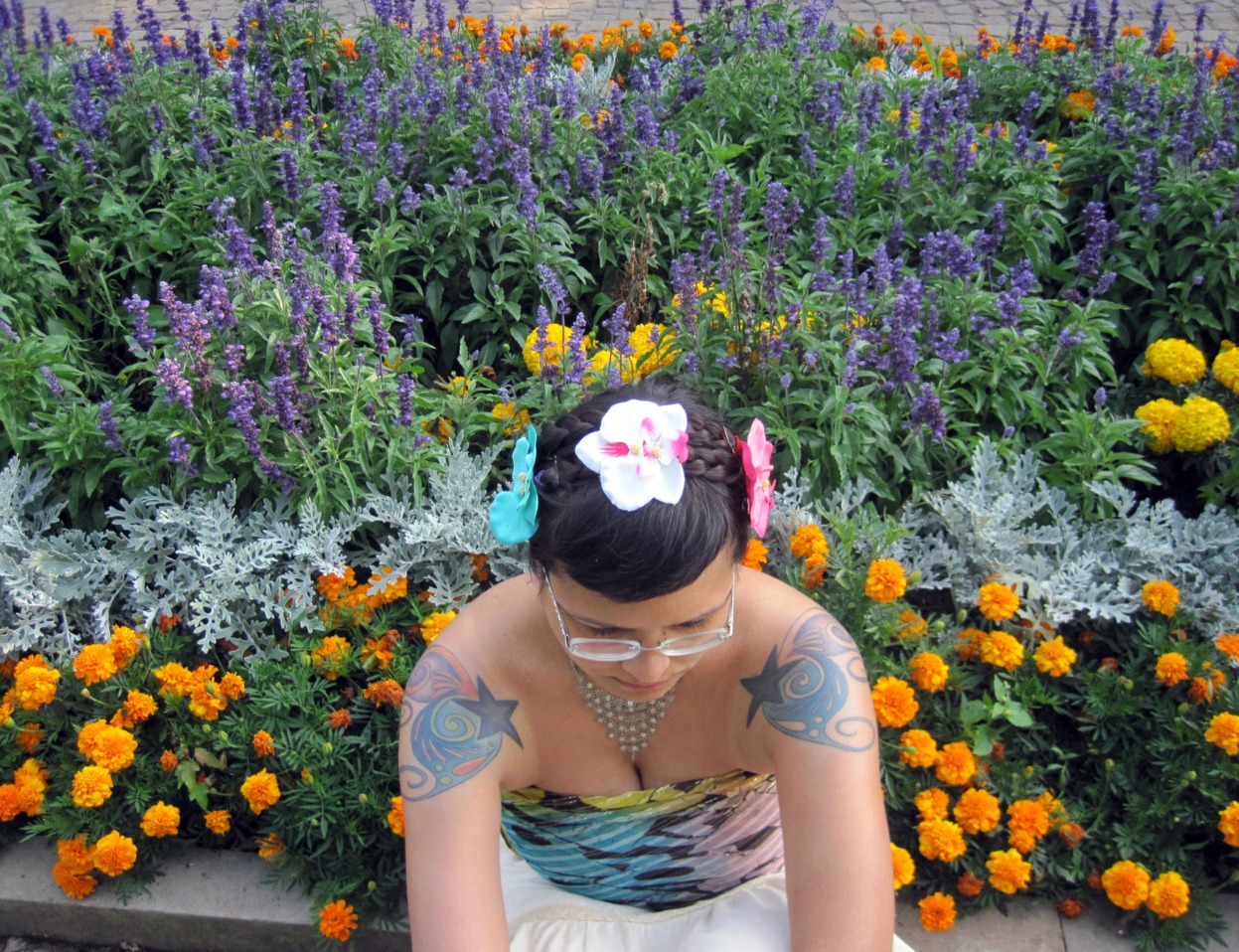
8. Bara, the world’s most talented tattoo artist: she gave me wings, stars, Falcor and Edward Scissorhands.

9. Cold that sinks right into your bones, feet aching and joints swelling from trudging through it across treacherous cobblestones and hidden patches of ice.

10. Bonsai and carnivorous plant exhibits at the Botanical Garden.

11. Sitting in our apartment, feeling my ears pop like I’m on an airplane from the rising and falling air pressure.

12. Lady Gaga’s monster brawl at the O2 arena: the Czechs marked the 21-year anniversary of the Velvet Revolution by punching people who wanted to dance; MGMT at Divadlo Archa; free passes to the Irish-American funk band Flogging Molly at Retro Music Hall — and hanging out with them afterwards.

13. Dancing in what was then Klub Kostel (literally, Church Club) on Hallowe’en, dressed as a witch.

14. Yearly fireworks and light shows over Vyšehrad (castle on a hill over the Vitava River), with a stage front view right from our window.

15. Mourning the deaths of, from a distance, Heath Ledger, Michael Jackson, Patrick Swayze, Corey Haim, Ryan Dunn … and close up, Curtis Jones, an American expat performance artist who’d been living in Prague since 1989 — a dear friend to many dear friends of mine in this city.

16. Cleaning up my first ever poop-drenched child, at an international pre-school where I worked. (I don’t and never will have kids.)

17. The vista of Prague from the tram on the way up to the castle, skyline scraped with spires and a cloud of fog overhead, feeling like I had somehow escaped the evil snow globeness if only for a moment.

18. Working for a newspaper, a mentally unbalanced artist, a shady off-shore investment banking firm, an international relocation company, a British school, and the largest university in central and eastern Europe.

19. The stench of Prague’s walking dead — homeless people with rotting parts of their bodies or insides, including one fellow with a black foot, the gangrene working its way up his leg. The worst thing I have ever smelled in my life, and I’ve lived in India and Africa; impossible to describe how awful and sad it is.

20. Seeing open graves for the first time ever, in Olšanské hřbitovy (Prague’s largest cemetery) — and imagining an imminent zombie invasion.

Na shledanou, Prahaland

I have made a tenuous peace with Prague.

This has been a place of great pain and great inspiration. The Entity is letting me go without a struggle: It knows that I will be telling stories about It for years to come.

It doesn’t even care if I paint Its portrait with darkness and horror — It wants to be seen, It wants to scare, It wants to fascinate so it can feed.

It knows the things I write, good and bad, will help bring many more people into Its icy embrace.

Prague is always hungry for fresh blood. Will yours be next?

*Sezin Koehler owes her nickname “Zuzu” to Rebi and Tereza, two Czech girls she took care of in an after-school program she organized. “Good afternoon, Miss Zuzu,” they would say. “Zuzu” is a common Czech nickname, short for “Zuzana.” This tickled Koehler’s fancy as one of her favorite films of all time — It’s a Wonderful Life — features a character named Zuzu Bailey. She has even named her blog Zuzu’s Petals — which, she says, “signify the most beautiful turning point in the film.”

Sezin Koehler is a half-American, half-Sri Lankan global nomad, horror novelist, writer and editor. Her first novel, American Monsters, was released last year. It has since been picked up by Ghostwoods Books, and an illustrated 2nd edition will be released by Fall 2011. Koehler’s Twitter moniker is @SezinKoehler.

img: “NO REST FOR THE WINGÉD — Zuzu Kahlo,” by Steven Koehler.

STAY TUNED for tomorrow’s post consisting of quotes attesting to the curious, unreal nature of Wimbledon tennis — which, to the more discerning observer, can seem disturbingly akin to the Queen of Hearts’ game of croquet.

If you enjoyed this post, we invite you to subscribe for email delivery of The Displaced Nation. That way, you won’t miss a single issue. SPECIAL OFFER: New subscribers receive a FREE copy of “A Royally Displaced Tea.”

Related posts:

DISPLACED Q: How many of these 5 expat Alice characters do you recognize?

After two weeks of total immersion in all things Alice, we’re finding that even normal people look like Wonderland characters.

Here are a few we’ve noticed:

1. The Red Queen

The Red Queen, as her title suggests, queens it over the less experienced and the newly-arrived in Wonderland (or Looking-glass country, if you would like to be pedantic.)

We all knew her in school. She’s the bossy one who made a beeline for The New Girl recently arrived from out-of-town, made a big deal about showing her around, and kindly explained the school rules in a manner guaranteed to confuse and subtly terrify the newcomer – which, of course, was the intention.

Now fully grown rather than three inches high, she reigns supreme over the expat coffee morning posse and sends out Tupperware party invitations which no one dares refuse for fear of excommunication from the International School’s PTA.

Her self-proclaimed superiority is based on her many years in Wonderland, and her familiarity with the country. She knows the place forwards, backwards, sideways, and diagonally.

2. The White Rabbit.

The Red Queen’s (or Duchess’s) sidekick. Always busy, always rushing somewhere, always checking her watch or BlackBerry, always worrying that she will be late for something – although no one cares whether she is there or not, and most would prefer that she isn’t.

She organizes coffee mornings, school bake sales, and garden fetes, and is never happier than when she is chairing a committee. She loves giving orders, which are generally followed but with much resentful muttering from the minions.

Her favorite expression, apart from “Oh my fur and whiskers!” is “If you want something doing properly, do it yourself”, followed by a heavy sigh at the bumbling incompetents with whom she is forced to associate by dint of a common nationality.

3. The Cheshire Cat.

The Cheshire Cat holds himself slightly aloof from the madness that is the expat enclave, accepts Wonderland’s eccentricities with smiling resignation, but has a tendency to disappear when the going gets tough.

Although he is friendly and happy to chat, don’t expect more than a superficial friendship from this one.

4. The Hatter.

Here is someone who should have left Wonderland years ago. Time no longer has any true meaning to The Hatter, who calculates it in days rather than hours, and in months until visa expiration rather than weeks since the beginning of  tea time. He makes jokes that aren’t funny, then gets offended when no one laughs.

The Hatter is a  great fan of the traditional expat gin and tonic, however, and it is always six o’clock in his house.

5. Alice.

The homesick newcomer, desperately trying to make sense of a new country and managing to offend people every time she opens her mouth.

She soon discovers that the beautiful, magic place she tried so many times to enter is full of faults, just like home, and the people in it of whom she was once  in awe are “nothing but a pack of cards.”

At this point she often leaves the country, as she has found the grass on the other croquet lawn isn’t any greener after all. Ironically, if she stays just a little longer, she will find that she has gone through the most difficult time of adjustment, and life in Wonderland can – probably – only get easier.

So – Do you know one of these Alice characters, or – dare you admit it – are you one yourself?

Img: — Many thanks to Emily Cannell at Hey From Japan for the photograph of waxwork Alice at the Tokyo  Tower!

STAY TUNED for tomorrow’s interview with Random Nomad Helena Halme. She appeals for citizenship in The Displaced Nation — and answers an Alice question!

If you enjoyed this post, we invite you to subscribe for email delivery of The Displaced Nation. That way, you won’t miss a single issue. SPECIAL OFFER: New subscribers receive a FREE copy of “A Royally Displaced Tea.”

Related posts:

For curious and unreal travel, Tokyo sure beats Wonderland

Today we welcome Carole Hallett Mobbs to The Displaced Nation as a guest blogger. During June, TDN is looking at what the story of Alice in Wonderland can tell us about displacement of the curious, unreal kind — as anchored by Kate Allison’s “5 Lessons Wonderland taught me about the expat life, by Lewis Carroll’s Alice.” Hallet Mobbs can identify, having just left Japan — a country that Western travelers have long regarded as the ultimate topsy-turvy destination — after four-and-a-half years of living with her family in Tokyo.

“I’ve believed seen as many as six impossible things before breakfast”: this seems the most logical place to begin my account of life in Wonderland Japan.

In Tokyo, you can see a minimum of six impossible or incredible things before breakfast.

And then another six after breakfast.

In fact, I can safely say that a day spent in Tokyo will guarantee you a double-take moment approximately every ten minutes.

I know this, because I timed myself one day, using an oversized pocket watch.

Jaw-dropping sights abound — and I never failed to be delighted and amazed every single day during my four-and-a-half-year stay.

And if,  like me, you prefer seeing to believing, then Tokyo is the place to be.

Curiouser…

Whilst driving my young daughter, Rhiannon, to school one day, I absentmindedly pointed out a Routemaster bus.

Double take! A red double-decker is a London inhabitant, not normally seen outside the Big Smoke. What on earth was one doing trundling its way around Tokyo?

These beasts are not known for their flying abilities but it had obviously migrated somehow. I discovered that a Japanese diplomat who’d been posted to Britain persuaded London Transport to donate one of these wonderful buses to Japan. It’s now a cruising restaurant.

People, too, arrest your attention. With their unique, carefully honed fashion sense, Tokyoites take style to a whole new dimension.

Real Alice in Wonderlands trip along the fashionable Harajuku, mixing with other young people dressed in adult-sized furry romper suits complete with ears. (Rabbits and bears are favorites.)

A particularly memorable vision in that section of town was a fully decked-out Stormtrooper from Star Wars, casually walking up the road.

Then there are those whom I thought of as “dormice folk.” Due to their heavy workloads, many so-called salarymen need to catch forty winks whenever and wherever they can. Favorite snoozing spots include crashing out across a table in Starbucks or on a bench. And they’ve even been known to take advantage of armchair displays in department stores.

Nobody dreams of waking them; that would show a deep lack of respect.

…and curiouser

Look! That’s a baby in a sling. Oh, my mistake, it’s a white rabbit.

Stuff and nonsense… Or is it?

As well as people watching, I can highly recommend pet-watching as a surreal Tokyo pastime.

Peer into a buggy expecting to see a cute, chubby baby with spiky black hair and instead see — no, not a pig, but more than likely a dog or two.

Yes, canines are cosseted creatures in Tokyo. More often than not, they are the size of guinea pigs, and almost all wear fashionable outfits.

Is that a giant caterpillar? No, it’s a dressed-up dog. Dogs in kimono. Dogs wearing tutus with real diamond necklaces. Dogs in leather jackets and sunglasses. Dogs in boots…

More than once I had a curious conversation with fellow dog owners. I have a Japanese Shiba-Inu (unclothed). This caused much admiration — a gaijin with this special Japanese dog was a big hit — as well as some puzzlement. “But that’s a Japanese dog. How did you teach her to understand English?”

And it’s not just pets that are dreamlike.

Crows are as big as ravens, woodpeckers as small as wrens.

Saucer-sized butterflies flit by like vibrant handkerchiefs, and hornets are so large they need their own air traffic control center.

Drink me! Eat me!

Japanese interpretations of Western food can be a trifle bizarre. Experimentation is rife, and experiments include drinks such as iced Earl Grey lattes and cucumber Pepsi.

Being taken by surprise during a snack is commonplace.

Thrilled by finding some doughnuts that appeared to have jam inside, I took a huge bite. The “jam” was azuki bean paste. Not my favorite.

Another shock was a Wasabi Kit Kat. I still haven’t recovered from that one.

Some time in recent history, the sandwich reached Japan. I imagine the conversation went a little like this.

“What is a sandwich?”

“Well, it’s two slices of bread with a filling between the slices.”

“What filling goes into this sandwich?”

“Oh, anything really…”

One day a friend bought a sandwich with a lumpy filling. A gentle squeeze sent a whole cooked potato shooting across the room.

Through the looking-glass

Beckoning looks like waving goodbye.

Keys turn the wrong way.

Books and magazines are read from back to front.

Writing follows its own rules. The elegantly beautiful yet complex Chinese characters, known as kanji, are written vertically in columns and read from top to bottom and right to left.

Tell me, please, which way I should go from here?

Notably, as an Englishwoman in Europe, I can usually work out rough meanings by utilizing my limited knowledge of Latinate and Germanic languages.

In Japan, though, I was suddenly completely illiterate.

Imagine the fun my husband and I had on our car journeys. Trying to decipher the name of our destination on the map, he would say: “Look out for a sitting man, a picnic table, noughts and crosses, a ‘7”and a jellyfish.” Predictably, we got lost rather a lot.

Going somewhere on foot was no easier. Streets are not well labeled, or labeled at all. In fact, being lost in Tokyo is so common — even for Tokyoites — that everyone carries their own little maps with landmarks.

If you stand around looking pathetic for a while, a stranger will miraculously appear and guide you to your destination — and then disappear, leaving only a grin behind…

English words are considered interesting and “cool,” so are often used for shop names and slogans. But a love of English isn’t always correlated with an understanding of how our words link together — leaving us foreigners as clueless as ever.

“Tokyo Teleport Station” is just outside the city. Sadly, it’s just a train station, not a link to other worlds.

One that still puzzles me is a sign declaring “SLOB! Oxidised Sophistication.” I just have no idea.

The “Hotel Yesterday” has the tagline “Welcome to Yesterday.” I often feel like that.

Is Tokyo really a wonderland?

Goodness, what a long sleep I’ve had! Such a curious dream!

Though I’ve enjoyed using “Alice” allusions to describe my Tokyo adventures, I’m not sure if it’s of much use in helping other expats adjust to this very real yet extraordinary city.

The key to living in and enjoying Japan is to keep an open mind, embrace eccentricity and expect the unexpected at all times.

And if that’s too tall an order on any given day — rather like Alice’s serpent neck — then I suggest you follow her sister’s advice and “run in to your tea.” But if I were you, I’d give the “jam” doughnuts a miss!

Question: Can you think of any other cities that merit a “through the looking glass” reputation, or is Tokyo an extreme, as Carole Hallett Mobbs suggests?

Carole Hallett Mobbs is a trailing spouse and freelance writer. Her blog on life in Tokyo is called Japanory. After moving to Berlin with her family in April, she started up another blog, Berlinfusion, and is writing a book on expat children. Her Twitter moniker is @TallOracle.

img: Carole and her daughter, Rhiannon, caught in an Alice-like pose by 37 Frames (Tokyo).

STAY TUNED for tomorrow’s Displaced Q having to do with one of our — and Alice’s — favorite topics: food!

If you enjoyed this post, we invite you to subscribe for email delivery of The Displaced Nation. That way, you won’t miss a single issue. SPECIAL OFFER: New subscribers receive a FREE copy of “A Royally Displaced Tea.”

Related posts:

RANDOM NOMAD: Charlotte Day, High School Student (Sixth Former)

Born in: Sydney, Australia
Passports: Australia, UK and US Green Card
Countries lived in: Australia (Sydney): 1994-2001; United States (New York, New York): 2001-2010; England (Sevenoaks, Kent): 2010-present

What made you leave your homeland in the first place?
My father is Australian and my mother English. They split up when I was two. When I was six, my mother met and married an Australian who had been living in New York for thirty years. I was rather disgruntled about moving to the United States and for two or three years, remained determined never to accept it as “home.” At that time, I was deeply patriotic to my native country — though this sentiment has dissipated since.

Is anyone else in your immediate family a “displaced” person?
My mother’s family, originally from England, has long been displaced. My mother herself was born in Kenya, in 1961. Following the Mau Mau Uprising, her parents were forced to relocate, and my grandfather, presented with a choice between Australia and Canada, chose the warmer of the two countries. My mother spent her childhood bouncing between schools in England and Australia. She eventually grew so fed up with packing and unpacking, she decided to leave school at the age of 16. Her father agreed to the plan provided she spend a final year at the school in Switzerland his own mother had attended as a girl. My mother moved on from Swiss finishing school to work in London, Paris and Sydney. But she appears to have made New York her last port of call. Indeed, we had a fairly solid life in the city until I decided to take myself off to boarding school in England.

Describe the moment when you felt most displaced over the course of your many displacements.
It must have been when I first arrived in New York as a six-year-old. I stepped out of the JFK arrivals terminal into a snowy March night. My stepfather was wearing a leather coat, the interior of his car smelled of leather — and the world outside the car window seemed an undulating stream of black and silver. Though it was the end of 2001’s warm winter, my Australian blood froze beneath my first-ever coat. And their apartment — that was all leather as well. It smelled of musk and cologne. Since that time, I have felt similar pangs of displacement, some of which lasted for considerable periods. But those first few moments in New York stand out as the most acute concentration of “displacedness” I have ever known.

Describe the moment when you felt least displaced.
For the last five or so years in New York, I have felt more at home than I ever did in Sydney. I ascribe this to growing up: at a certain age, one can take possession of a city, know its streets, bridges, tunnels and transportation system. I was too young when I lived in Sydney to reach that kind of comfort level. But when have I felt the most like a New Yorker? Perhaps it was the last time I came home for the holidays, and took the 4 train uptown for the first time in months. At that moment I realized how much this train had been a part of my life — conveying me home from school every day for two years. My old life would always be waiting for me on the subway, ready for me to pick it up again. That’s something only a New Yorker could say!

You may bring one curiosity you’ve collected from each of the countries where you’ve lived into the Displaced Nation. What’s in your suitcase?
From Australia: A miniature wooden wombat figurine — a gift from my grandfather. It conjures memories of a childhood spent beating about the bush (literally) and fishing for yabbies at the dam in the company of audacious dogs who stuck their heads down wombat holes, to no good end.
From New York: A pair of fake Harry Potter glasses. These defined my first six months in New York — I even wore them to my first day of school. I think it is telling that even at the age of six, I was unwilling to give all of my real self to this new home.
From England: My school tie — representative of the alternative universe I seem to have entered. At boarding school, the sense of removal from reality can be disconcerting — especially after having spent a decade in the city I regard as the world’s capital.

You’re invited to prepare one meal based on your travels for other Displaced Nation members. What’s on your menu?
I’d like to make you a Sydney breakfast: scrambled eggs, made with cream, salt and pepper and served on a bed of Turkish toast, with avocado and stewed tomato on the side (is this being greedy?). Our meal will be accompanied by a large “flat white”: what we call perfectly strong, milky coffee without excessive froth. I suggest we consume it overlooking a beach on a Sunday morning. At least, I assume The Displaced Nation has beaches?

You may add one word or expression from each of the countries you’ve lived in to The Displaced Nation argot. What words do you loan us?
From Australia: Daggy. I use this word all the time — and did not realize it was exclusively Australian until I was informed of the etymology. Apparently, it comes from trimming the soiled wool around a sheep’s bottom. Which part of this repugnant whole is actually the “dag,” I do not remember. (No, I’m not a proper Australian!) But as I understand it, “daggy” means sloppy in appearance or badly put together.
From New York: There are so many words, and most are second nature by now. However, I will choose grande-soy-chai-tea-latte because I still shudder to think of myself as the kind of person who can utter such a phrase, at great speed, with great insistence. In fact, I’m still in denial about my love for Starbucks: having known Sydney coffee, my standards should be higher.
From England: Banter. I still do not know the precise meaning of this word, but it seems to encapsulate everything that makes someone my age feel socially acceptable — and, of course, I have no banter whatsoever. I think it means the capacity for combining wit with meaningless conversation. But there are other components, too, which seem to me unfathomable.

Question: Readers, tell us what you think: should we welcome Charlotte Day to The Displaced Nation and if so, why? (Note: It’s fine to vote “no” as long as you couch your reasoning in terms you think we all — Charlotte included — will find amusing.)

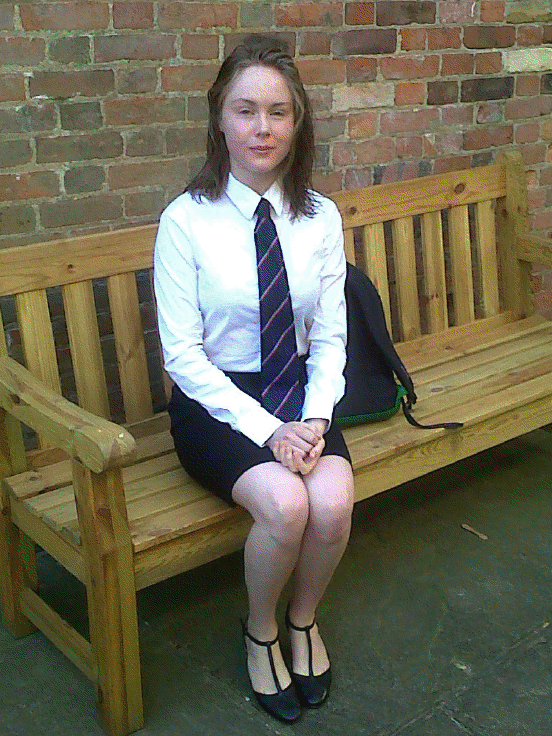
img: Charlotte Day at her boarding school in southeast England

If you enjoyed this post, we invite you to subscribe for email delivery of The Displaced Nation. That way, you won’t miss a single issue. SPECIAL OFFER: New subscribers receive a FREE copy of “A Royally Displaced Tea.”

Related posts:

In sum, here’s how three displaced people “saw” Britain’s pomp

Once upon a time there lived Three Stooges in a kingdom ruled by a queen, otherwise known as a queendom. But eventually, each of them moved away to a republic that had renounced that very same monarchy hundreds of years ago (but which still retained a certain fascination for their descendents).

Now these Three Stooges just so happen to be the authors of this blog — ML Awanohara, Kate Allison, and Anthony Windram. When news of an impending Royal Wedding reached them at The Displaced Nation, one of them, ML, hatched a rather zany scheme of covering the event from their displaced perspectives. Thanks to the new technology, they could do this by tweeting like birds, she said.

So the three of them rose at ungodly hours on April 29, 2011, and recorded their impressions: Kate and Anthony from the point of view as displaced citizens of said queendom, ML as a displaced resident (born in the republic, she had lived in the queendom as a student and retains an inordinate nostalgia for those days).

What follows are some edited highlights from their Dawn Chorus. NOTE: All three would like to offer special thanks to Princess Bea for attempting a Cthulhu imitation. The possibility of perching on her antlers helped to sustain them during the lengthy bits, of which there were several.

I. PRE-CEREMONY

ML Awanohara: I can hear many excited voices outside my window here in the East Village. It’s a global event! Kate Allison, what are you wearing?

Kate Allison: What I slept in. Duh. But have contacts in. The contacts not needed to see the size of some of these hats. Sheesh.

ML: You aren’t wearing a hat? I have on my Chinese PJs and a cute little fascinator…

KA: Probably got a NY Yankees hat somewhere. Would that be ok?

ML: So we both watched Charles & Diana 30 years ago, in UK. And now we’re both “displaced,” on US East Coast, watching on TV. Strange!

Anthony Windram: Why on earth am I up at this time? No semblance of sense.

ML: Isn’t it cool that we are all connected like this, watching a quintessential British event?

AW: On CBS, Beth from New York and Jody from Philly came over especially for this. That’s just silly.

KA: Eugenie, or is it Beatrice, is wearing antlers! You cannot look cute in antlers unless you have a glowing nose as well.

ML: Camilla is being criticized for wearing white. I actually think she looks stunning.

KA: Camilla would be criticized whatever she wore. Take no notice, Camilla. Lovely outfit.

AW: Credit where it’s due, this is one of the few events where children cheer an 85-year-old woman.

ML: I have to say, primrose doesn’t suit the Queen. Though I suppose she does match the clergy in that color.

KA: Some bishop’s done a Scarlett O’Hara and nicked the curtains for his dress.

ML: Shut the front door! Kate is on her way!

KA: Little bridesmaids. Utterly cute.

ML: Fashionistas are calling the dress very Gracy Kellyish.

KA: ….ooohhhhh. Gorgeous.

AW: Will Rowan Williams also be wearing Alexander McQueen?

II. CEREMONY

ML: I do like the aerial view. Train looks just the right length for the Abbey.

AW: At what point in the proceedings do they replace Kate Middleton with a shape-shifting lizard?

KA: Not a meringue in sight, to quote Hugh Grant.

AW: Sod the wedding dress, that’s the most beautiful sight: Westminster Abbey.

KA: Poor girl looks terrified!

AW: Why no Rowan Williams? Boo. Oh, wait, here he is. Love a bit of Rowan.

ML: Catty alert, but Kate looks older than Wills, which she is. Too much makeup?

AW: Rowan Williams should narrate audio books. Think he’d be a good fit with some Trollope.

ML: Oh, no! Wills could barely get ring over Kate’s knuckle! Not a good omen…

AW: I always think the Royal Family jumped the shark with the Glorious Revolution.

ML: Must be the aging process, but I don’t find this nearly as moving as 1981.

KA: I think I’m a lapsed royalist coming back to the fold!

ML: Kate, are you serious? We seem to be switching places. I knew that was going to happen.

KA: I am totally serious and today totally British.

ML: Who is representing us Americans btw? Obamas weren’t invited…

KA: Posh and Becks are representing the Americans, obviously.

AW: James Middleton has the eyes of a killer.

ML: The Londonist is keeping a “not the royal wedding” blog: everything happening in the world except for the royal wedding. For instance, there are these dangerous headache-inducing caterpillars in Bournemouth, and the horror flick Insidious opens today.

AW: Those two nuns got great seats — all thanks to Ticketmaster.com.

ML: Fun fact: Today is the “feast” day of St. Catherine of Siena, a famous 14th-century bulimic.

AW: I got up at 2:30 a.m. to listen to a religious service, a Protestant religious service no less. I may crawl back to bed.

ML: No, don’t leave us! Your jokes are keeping me awake!

AW: Oh annoying CBS, don’t start talking as soon as “Jerusalem” starts.

KA: Ah, “Jerusalem.” But of course: can’t beat it if you’re English. Guaranteed to bring anyone back to the fold. … And now the national anthem. ML, this is the original version of that song you guys sing in grade school.

ML: “My country ’tis of thee, sweet land of liberty…”

KA: What, Queen not singing her own tune?

ML: Someone at the New Yorker just tweeted that Westminster is full of bodies (bones?) of kings. Rather macabre.

KA: ML, at the Chapel Royal of St Peter ad Vincula in the Tower of London, they found about 1,800 skeletons underneath. Now that’s macabre.

AW: Nothing more British than the bureaucracy of everyone going to sign the wedding register in the middle of the ceremony.

ML: Just saw the antler hat. Truly bizarre. … Is Princess Anne wearing purple?

III. POST-CEREMONY

AW: So many Union flags. It’s like Rangers at a Scottish Cup final. …

ML: Okay, someone please tell me: it is distance or aging, but I feel like it’s a little flat this time around.

AW: On the basis of that crowd, the world must think the British are a collection of plastic hat wearing morons. In fairness, most of the crowd are Americans. Anglophiles, I’ll never understand you. Give me five minutes with an Anglophile — I’ll soon dampen their enthusiasm for all things English.

ML: They’re showing a pair of older Brits singing “God save the Queen” off key.

AW: Am I meant to feel national pride because a slightly dim, over-privileged couple got hitched? Really? Some mediocre St Andrews grads get to be Duke and Duchess of Cambridge. Hurry up and kiss and then I can get back to bed.

ML: What’s going on behind the net curtains on the windows facing out on the famous balcony?

AW: The balcony scenes are always disappointing. They never fall off.

ML: Was that it?!?!?!?!?

AW: No tongue. Duke of Edinburgh seems to making the moves on Pippa. He’s muscling out Harry there.

KA: Someone’s going to drop a small child off that balcony if they’re not careful.

AW: Balcony would be enlivened with some Michael Jackson-style children dangling. I’m thinking the annoying little blonde page.

ML: Well, this has certainly been a stimulating three hours. Time to say cheerio for now? That kiss was such an anticlimax.

KA: Anticlimax? What did you have in mind for them? Royal weddings are G rated.

AW: BBC really are insisting on talking to every nutter they meet.

ML: So, my dears, any parting impressions? Was it worth losing sleep over?

AW: So we’ve learned (or relearned) nobody does annoying and wacky quite like the British. We’ve learned that the Duke of Edinburgh still has it. Pippa needs to watch out at the disco.That CBS felt the need to make half a dozen references to Meet the Fockers. And we learned you can be born into a dim family that lacks intellectual curiosity, be unremarkable, and one day you’ll be king. But the biggest takeaway was the baby Cthulhu that has hatched itself to Princess Beatrice’s forehead.

ML: Beatrice and Eugenie look like how I always imagined Cinderella’s wicked stepsisters.

KA: LOLOL

ML: On TLC just now, American commentators are saying they were disappointed by the kiss. But the crowds in Times Square cheered anyway.

KA: Disappointed by the kiss? What do they want? Video on YouTube a la Pamela Anderson? Puh-leese.

If you enjoyed this post, we invite you to subscribe for email delivery of The Displaced Nation. That way, you won’t miss a single issue.

Related posts:

Burglars alarmed

Canine vigilantes were too much for two burglars who tried to break into expat Gerard Carroll’s house in Pruna, Spain.

When pinned to the ground by the homeowner’s specially trained guard dogs, the thieves had no option but to call the police to help them out of their predicament.

Gerard Carroll told The Olive Press that he had bought the dogs after his house was robbed a year ago. He considered the police action at the time to be less than satisfactory, and burglaries in the area had continued.

But taking the matter into his own hands seemed to have worked, he said.

At the time of the article in The Olive Press, one of the burglars was still receiving hospital treatment.

Source: The Olive Press


Mobile in America

Today we welcome Mandy Rogers to The Displaced Nation as a guest blogger. She wrote this post in response to Kate Allison’s “The Domestic Expat.”

I don’t always understand what people are saying. I’m temperamentally unsuited to the noise and lack of personal space. I don’t think I’ll ever completely fit in. What am I?

A Mississippian in Manhattan!

My husband, Kary, and I moved to New York City two-and-a-half years ago, when we were in our early thirties. Until then, we had spent our entire lives in Mississippi. We loved it and had a great community of friends, whom we still miss.

Making the move

What possessed us to pick up stakes and try out life somewhere else?

Kary and I met in the marching band at Mississippi State. I played the flute and he the trumpet. We both landed jobs at the university immediately upon graduation. But there was something in each of us, a kind of restlessness. We knew we couldn’t be content with staying in Starkville forever. Was it a passion for travel or a fear of growing too complacent? Perhaps a bit of both…

There was also a practical reason for making the move. I’d gone back to school in my late twenties to do a masters in landscape architecture. I discovered I really enjoyed doing projects involving public spaces, such as parks, gardens, and streetscapes. Public green space isn’t a priority in Mississippi, where most people have their own land.

During my graduate studies, I’d taken a road trip with Kary and my sister to New York City, visiting Central Park, Paley Park, and Bryant Park. The amount of green space was a surprise to me. It’s something my mother, another garden lover, noticed during her first visit to the city, too.

In the end, it all happened rather quickly. Kary was offered the first job in New York he applied for. He actually got it via Twitter!

We packed up our belongings in a rental car — our cocker spaniel, Callie, in her seat belt harness and our three cats in their carriers — and traveled over three days to our new home in the Big Apple, staying in pet-friendly hotels along the way. (We’d flown out to find an apartment just beforehand, signing a lease for one in Brooklyn, which several of our friends had recommended as a great place to live.)

When we first moved, I didn’t have a job so spent the time exploring gardens and parks in Brooklyn, the Bronx and Staten Island. Even now that I’m working for a landscape architecture firm in Manhattan, I escape to the Brooklyn Botanic Garden whenever I can to see what’s in bloom. My dad gave me a membership there just before he died. We had a complicated relationship so it’s a nice reminder of him and our common love of gardens.

The adjustment process

People still ask me: where are you from? They usually guess North Carolina or Georgia; no one has guessed Mississippi yet.

I’m still picking up new vocabulary and pronunciations. “House-ton” instead of “Hue-ston” Street; standing “on line” at the grocery store (in the South we say “in line”).

And I continue to be amazed that the number of people living in Brooklyn equals the entire population of Mississippi (2.5 million). No wonder one of our most difficult adjustments has been to the noise and (by our standards) overcrowding.

Still, there are lots of things we love in this part of the world, beginning with the climate. Thunder and tornadoes are much less frequent here. And believe it or not, even after this rough winter, we still can’t get enough of snow.

We’ve adjusted very quickly to living without a car. You can see and experience so much more on foot than behind the wheel. That said, I usually did most of my singing in the car, and I miss that! (I don’t sing around my apartment too much, as the neighbors could hear me.)

And, although the South is renowned for its hospitality, I am often surprised by how much nicer, friendlier, and helpful New Yorkers are than they are given credit for being.

Moving right along…

Despite these many “likes,” I don’t think we’ll ever be true New Yorkers. To this day, I always relish running into other Southerners. The past two years, Kary and I have attended the annual picnic held in Central Park for folks from Mississippi. There’s always a blues band and plenty of fried catfish, sweet tea, and other Southern delicacies.

Not all Mississippians have exactly the same values, but each of us knows what it was like growing up in that neck of the woods, and it gives us a powerful bond.

During the year, Kary and I congregate with fellow Mississippi State alumni at a local bar to watch our alma mater compete in football or basketball. We’ve made some new acquaintances that way, such as a native New Yorker who went to MSU in the 1970s to run track.

Like most expats, Kary and I debate about the right moment to move on and where to go next. Will we try the West Coast, or consider moving back south? Every time I visit Mississippi these days — I’ve been back three times since we left — I realize how much I’ve missed its hospitality, beautiful forests, and tranquility. Plus it’s been nice catching up with family and friends over hearty Southern meals.

Still, the hot, humid summer would take some getting used to again. And now that we’ve been bitten by the travel bug, we’re contemplating our wish list again. We visited San Francisco last year and liked what we saw.

Being mobile in America — it’s a trip, in more ways than one. Tell me, why do so many Americans seek adventure overseas when it’s perfectly possible to be an expat here?

Question: Can being an “expat” within your own borders be just as enriching as becoming one by crossing borders?

Mandy doesn’t have a blog but you can follow her on Twitter: @mandyluvsplants

img: Mandy (right) and a friend she ran into at a Central Park picnic for Mississippians in New York. Mandy’s comment: “My friend still lives in Mississippi but was here with her daughter, who was attending the picnic as part of her duties as Mississippi’s Miss Hospitality. My mom says I can’t go anywhere without running into someone I know — I guess she’s right!”

If you enjoyed this post, we invite you to subscribe for email delivery of The Displaced Nation. That way, you won’t miss a single issue.

A week in tartan

Scotland Flag from PhotoEverywhere.co.uk – CC license

It’s time to celebrate all things Scottish. Dunk Walker’s shortbread in your tea, deep-fry a Mars Bar, eat chicken tikka masala. Read Robert Burns, watch Billy Connolly.  Drop into conversation that your great-great-grandmother came from Dundee (actually, she did). Whatever you do, though, make sure you do it in tartan.

In 1982, New York City Mayor Ed Koch declared July 1 as Tartan Day, a one-off celebration of the 200th anniversary of the repeal of the Act of Proscription — the law forbidding Scots to wear tartan. Following this, Scottish-Americans lobbied the Senate for official recognition of Tartan Day, until eventually, in 2008, President George W. Bush signed a Presidential Proclamation making April 6th a day to

“celebrate the spirit and character of Scottish Americans and recognize their many contributions to our culture and our way of life.”

— which, naturally, entails a long parade through the streets of New York in an attempt to out-do the other Celts’ celebrations on March 17.

Not just New York, either. Tartan festivities are held throughout the rest of the USA, plus Canada, Australia, and New Zealand, although the last two stick to July 1 for their day of plaid fabric observance. Even Scotland joins in the fun.

However, do the U.S celebrations really “celebrate the spirit and character of Scottish Americans” as President Bush said? The key word in that phrase is, perhaps,  “Americans.”

As Scottish expat and travel writer/blogger Aefa Mulholland says in her interview with Scotland’s Daily Record:

“People [in America] have very different views of Scottishness from what most people in Scotland would have today. Scottish-Americans tend to remember and celebrate Scotland the way it was when they left it.”

But that’s simply the way of the expat world: homesick for a place which doesn’t quite exist any more — only in memory.

On another note — it’s strange that a law banning an item of clothing should have such far-reaching celebrations. Certain U.S. towns currently making the wearing of saggy pants a criminal offense should perhaps ponder this point, for the benefit of future generations.

Question: Which style of dress would you like to see commemorated every year?

image: Scotts_flag by www.photoeverywhere.co.uk
If you enjoyed this post, we invite you to subscribe for email delivery of The Displaced Nation. That way, you won’t miss a single issue.

Miracle Whip as the new Marmite? It would take an act of God…

News has just reached the Displaced Nation — via a dog-eared copy of the Village Voice dated March 7 — about a new commercial for Miracle Whip that is in fact a rip-off of Marmite’s “love it or hate it” ad campaign. (Marmite of course being the savory spread made from waste yeast from the brewing industry, on which millions of Brits are weaned at an early age.)

Like Marmite before it, Miracle Whip is asking: do you love the not-quite-mayonnaise or hate it?


Kraft, the citizens of the Displaced Nation would like you to know: we are aware of your craftiness and we think it’s pretty cheesy of you to produce such a blatant imitation of Unilever’s brilliant Marmite campaign.

We also think it’s too bad that your marketing people didn’t consult with any Brits who are living in the United States, or they’d have set you straight on where Marmite belongs in the pantheon of branded foods: i.e., far above Miracle Whip.

Take, for instance, Kate Allison, a member of the Displaced Nation team. She chose to call her personal blog Marmite & Fluff. Marmite stands for Kate’s British heritage, while Fluff represents the past fifteen years she has spent living in the United States.

Notably, Kate decided to elevate Durkee-Mower’s Marshmallow Fluff — not Kraft’s Miracle Whip — to the level of her beloved Marmite because she believes the Fluffernutter sandwich has the same iconic status for American children as Marmite on toast does for their counterparts in Britain.

Another example is Lucy Sisman, a British resident of Manhattan who edits WWWORD.com, a site for anyone who uses, abuses, loves and hates the English Language.

Lucy includes the Marmite jar in her recent post listing objects from her kitchen cupboard that belong to the leave-us-as-we-are-hall-of-fame for their genius packaging. (Traditionally, Marmite was supplied in an earthenware pot, on which its glass, and now plastic, jars are modeled.)

Hmmm….when was the last time any of us heard an American wax nostalgic about a Miracle Whip jar?

Of Kraft’s many food products, only the Oreo comes anywhere near to arousing the kinds of passions that Marmite does, if expat blogs are anything to go by. But one doesn’t sense that Oreo lovers sit up and take umbrage whenever Kraft introduces a new variety, such as mini Oreos, chocolate creme Oreos, golden Oreos… Not so with the Marmite minions. Kate, for instance, had this to say of some new-fangled Marmite combos:

I thought Marmite and Fluff sandwiches were bad. Now I’ve discovered you can buy Marmite chocolate. And champagne Marmite, anyone? Or Marmite with Marston’s Pedigree?

Besides Oreos, Americans abroad also say they miss Kraft’s macaroni-and-cheese mix — though a surprising number go on to say that their nostalgia dissipates with each successive bite.

Robyn Lee, a foodie who lived in Taiwan as a kid, described her first experience with Kraft’s mac-cheese in a post for Serious Eats last October:

The first time I tried the iconic American foodstuff was in middle school when I was living in Taipei, out of some desperate longing to eat something American. It was an exciting experience, until I ate it.

Compare this to what Kate says about her favorite yeast sludge: “Isn’t the point of Marmite that it overrides all other flavours?”

Love it, hate it, or find it insipid? Kraft should have included a third option when tweaking the Marmite ads for Miracle Whip.


Question: Does Marmite stand alone, or are there other branded foods that inspire intense nationalistic feelings, which in no way diminish upon becoming displaced? (On the contrary, absence can make the palate grow even fonder…)

If you enjoyed this post, we invite you to subscribe for email delivery of The Displaced Nation. That way, you won’t miss a single issue.