The Displaced Nation

A home for international creatives

Tag Archives: Moveable feasts

THE DISPLACED Q: What’s the cheapest — yet tastiest — meal you’ve discovered on your world travels?

So what is the tastiest cheap-eat I’ve come across whilst traversing the globe? Not being much of a foodie, and being a writer, cheap — yet tasty — is what I’m all about.

Well, I hate to be boring and predictable — so I won’t be. Yeah, the street food you get in Thai markets is to die for when you’re hungry. Not only that but you can eat three full meals back to back for the price of a loaf of bread in Australia.

But that’s not what I’m going for. No, for sheer cheapness compared with mouth-watering deliciousness, I’m going to have to go with an old favorite: Indo Mi goreng, an instant-noodle brand produced by the world’s largest instant noodle manufacturer, located in Indonesia.

Not just any old noodles!

Now you could be forgiven for thinking I’ve gone off my rocker here. There are countless brands of instant noodles floating around out there, and they’re pretty much all unified by one thing: being rubbish.

Nutritionally rubbish. Tasteless. Processed. Crap.

But not these noodles! I ate them almost every day on my rejuvenating hike across Western Australia — mostly because they were light enough to carry in a full rucksack and impossible to mess up in terms of cooking. These ones are nice, super nice even. And when I went back to England recently and discovered I couldn’t buy them there, the wife made me order them wholesale! I think they came directly from Indonesia. Forty packet… Oh, yes, this is how much we love these noodles.

Even though we buy them in bulk, they still cost less than the postage!

All the Asians in my area of Australia buy them — either in ten-packs, or in the same giant box I had delivered to me in England. That’s how you know they’re good noodles — when your Malaysian housemates fill their shelves with them!

But I can’t devote this entire post to one brand of instant noodles, can I? Um…no. But I’m hard pressed to think of anything else that’s so delicious for less than 50 cents.

A case of “you get what you pay for”?

Well, Canadian athlete Joe Sakic spoke true when he said:

Any free meal is a good meal, you know?

Or did he? I’ve come across a few ways of getting free food in my time — from famous vegan soup kitchens in a hippie commune in Margaret River (Western Australia) to the delightful food they served me in hospital when I was selling my body to medical science (also know as being a guinea pig for medical testing). And none of these meals were especially delicious.

You know, they would shoot me full of weird, untested drugs, imprison me in a hospital for weeks at a time, make me sleep on rubber sheets and wake me every morning at 4:00 a.m. to take my blood.

But still, the worst thing about the whole experience was the food.

Free is only good if you don’t have to have it; being forced to eat isn’t great no matter the quality of the food. Which, unsurprisingly, wasn’t great.

Tastes that refuse to be acquired

Then, of course, there are the meals in foreign lands that people treat you to. In my experience, that can be risky.

On my last morning in South America, my Ecuadorian girlfriend took me for a surprise breakfast she’d been planning for some time.

She led me all through the suburbs of Quito, to a restaurant which was famous for one dish in particular: ceviche.

Now, I’m not a fan of seafood. I can just about choke down a fish-finger — as long as I can’t see the insides of it. Ugh!

Of course, this topic had never come up; one of the myriad disadvantages to starting a relationship when you don’t share even one common language. We communicated mostly in sign language, and the half-assed version of Spanish I was picking up.

So naturally, I’d never mentioned my intense dislike of seafood, in much the same way as she thought it would be too much effort to explain what her surprise was. As a result, neither of us knew what to expect until I lifted the lid on my service and saw what it was: namely, half the cast of Finding Nemo, after being put in a blender with some brown sauce and chillies…

I tried to eat it, honestly I did!

I didn’t succeed though.

At least, the bit I did eat came back up so rapidly we have to make our excuses and leave the restaurant at top speed…

So remember that, whilst free food is irresistible, you should always season your desire for a cheap eat with a little caution, especially when traveling. The old adage is true: there is no such thing as a free lunch (or breakfast).

There are few things worse than being violently ill in the middle of a country where no one speaks your language. Far from home. Far from healthcare you trust… And wearing most of your raw-seafood breakfast.

That is almost never a good look. :0)

* * *

So, that’s all from me on this particular displaced Q! Now it’s your turn! What experiences have you had in your search for cheap eats around the world? Any tasty morsels? Anything we should avoid? Any scrumptious stories…? We’d love to hear from you! You can also hit us up on Twitter: @TonyJamesSlater +/or @displacednation.

STAY TUNED for Tuesday’s post, the second part of a two-part travel yarn about two madcap Indonesian ladies who are taking Japan by storm!

If you enjoyed this post, we invite you to register for The Displaced Dispatch, a round up of weekly posts from The Displaced Nation, with seasonal recipes, book giveaways and other extras. Register for The Displaced Dispatch by clicking here!

Related posts:

Img: The contents of Tony James Slater’s shopping bag, taken on 9 September 2012 in his current home of Perth, Australia.

TRAVEL YARN: Two madcap Indonesian ladies in weird & wonderful Japan (1/2)

Japan — the country that many Westerners have likened to Lewis Carroll’s “wonderland” for its quality of wacky unpredictability. But what about for other Asians — do they feel as displaced and disoriented there as we do? Our very first Random Nomad, Anita McKay, ventured into the Land of the Rising Sun for the first time this summer, in the company of another Indonesian, P, who had been there once before as a student. McKay reports on the pair’s adventures in this two-part travel yarn.

The message exchange between my travel buddy, P, and me, in May, went like this:

Me: “So have we decided where we want to go this July?”

P: “How about Japan?

Me: “Okay.”

P had lived in Japan decades ago for a student exchange program. She hadn’t been back since, and thought this year would be a good time.

I, on the other hand, didn’t really have any specific destination in mind — just so long as I could go somewhere I hadn’t been to. As I explained in my interview with the Displaced Nation, although I am from Indonesia originally, I have lived for extended periods in Aberdeen, Scotland, and in Australia. But I still hadn’t made it to Japan.

P suggested Tokyo, Kyoto, and Kobe. I added Yokohama to the list because there’s a blog buddy I wanted to meet up with. She and I had been trying to catch up forever and everywhere — UK, Singapore, and Indonesia — but kept missing each other. If I went to Yokohoma, where she is now based, surely we would finally get together?

I prepared myself for the trip by scanning some pages in Trip Advisor and the Lonely Planet guidebook. At least I would have an idea of what to do and where to go — and wouldn’t be entirely dependent on P, who speaks and reads Japanese and has lived there before so presumably knew how to get around.

Madcap traveler’s motto: Be unprepared!

When we landed at Narita Airport, I suggested that we take a taxi because it was 9:00 a.m., and I had taken the notion of a red-eye quite literally — my eyes looked red as I was still recovering from flu. I desperately wanted to have a quick nap before exploring the city.

We crossed the road, dragging our gigantic suitcases with us, and I let P speak with the men at the taxi rank. When she showed them the address of the hotel, one guy frowned and looked at us. “Tokyo?” he asked in disbelief.

We nodded eagerly. The drivers exchanged glances and apparently decided we weren’t crazy. One of them spoke in Japanese to P, who translated: “It’s 23,000 yen.”

I did a quick calculation, and almost fainted when I found out it will cost us almost 300 AUD [around the same in US$] for a taxi to our hotel.

“300 bucks??” I asked P. She nodded calmly, but her eyes couldn’t lie. She was just as shocked as I was.

“No! Cancel!” I shook my head furiously, while P apologized to the drivers. The men just laughed and pointed us back to the airport. “Take the train instead,” I think they said. “Like normal people.” Maybe they said that, too!!

Now we know why there was no one queuing for a taxi, whereas there was a long queue at the train ticket window. And we thought we were being smart!

Everyone had warned us that Japan — Tokyo in particular — is “very expensive!” The city ranks number 1 in the list of the most expensive cities in the world, while Perth, where I now live, is number 19. But really, if the taxi would cost us almost 300 bucks, what kinds of prices could we expect to find in Tokyo?

P had no memory of taxis from the airport. Years ago when she landed in Tokyo, she was picked up by a shuttle bus.

She’d also paid no attention to the length of the journey — she’d been too busy meeting and getting to know the other students. Both of us were surprised when it took almost an hour for the Narita Express to reach Tokyo Station. P had assumed it would be like Jakarta airport to the city centre (just because), and I must have skipped that page in the guidebook…

Well, at least we now knew why it was so expensive to take a taxi: the distance is more like Heathrow to London.

We just kept laughing at our silliness.

It’s food?!?!?

By the time we’d reached our hotel in Chiyoda, a quiet area near the Imperial Palace, we were both rather hungry and decided food would come first on the agenda, before tackling the first sight on our list: Sensō-ji, Tokyo’s oldest temple, in Asakusa.

Food is important to us Indonesians. We eat all the time. In Japan for the first time, I wanted to try something new: not sushi, yakiniku, donburri (rice bowl), soba, or ramen.

“Let’s try this!” I excitedly pointed at one restaurant name in the guidebook. “It’s in Asakusa and it looks…exotic enough.”

P agreed, and under the glare of the July sun we made our way to a restaurant called Komagata Dojo, only to be greeted by the sight of a rather long queue. If there is a queue, then the food must be good, we assured each other. Plus it seems as though most of the people in the queue are locals, so the taste must be authentic.

As it turned out, the restaurant is in its sixth generation of owners, and is famous for its dojo: a tiny freshwater fish like an eel or sardine, cooked in a cast iron pot.

We ordered what seemed to be everyone’s favorite, dojo nabe (hot pot), and also asked for two bowls of rice.

The waitress lit the charcoal burner in front of us, set the pot down on top of it, and told us to sprinkle the spring onions, or negi, on top of the fish.

We looked at each other after the first gulp.

“What do you think?” I asked P.

“What do you think?” she replied back.

“Well…it’s…all right. Weird.”

She nodded. “The rice is very good though.”

I can’t describe the taste. It’s rather bland for my liking, as I grew up in Indonesia, which is famous for its spicy dishes. Not just hot spicy, but lots of flavors in every dish. But dojo nabe isn’t tasteless either. Lots of soft flavors, like soy and spring onions.

When we were about to finish our lunch, I asked P how come Japanese people look so slim if, like the rest of us Asians, they enjoy eating all the time. We were thinking that their diet of raw seafood might be the answer.

“But this isn’t raw,” I pointed at the dojo. “It’s cooked. Plus the size of the rice is rather big.”

We looked around at the other patrons — and, to our horror, we were the only ones who’d seemed to have ordered a bowl of rice each! The rest of the customers were adding the spring onions to their fish but had no rice bowls.

“That’s the only thing they eat for lunch!” I hissed to P. “Spring onions and tiny fish! No wonder they’re slim!”

“No wonder the waiter asked if we wanted one or two bowls of rice,” P admitted when we were at the cashier. “I thought it was because of my rusty Japanese, but now I know because she didn’t believe two small girls can eat that much!”

Hanging our heads in shame, we slipped out of the restaurant and determined we would burn away the calories by walking to Sensō-ji temple. The temple, however, was only a few minutes’ walk away. Still, we had fun taking photos of ourselves under the gigantic red lantern at the temple gate, and looking at the stalls lining the 200-metre-long Nakamise-dōri, the street approaching the temple — selling every manner of Japanese trinket and souvenir, including yukata robes (cotton kimono), tenugui (hand towel, often used as a headband), furoshiki (rectangular cloth for gift wrapping) and folding fans. There were also local snacks for sale, of a kind I’d never seen before in my life, in every shape and color possible, in beautiful packaging.

Kyoto and the Indonesian connection

After two days in Tokyo, we took the shinkansen to Kyoto and stayed in a ryokan — a traditional Japanese guesthouse where you sleep on tatami mats. Being shoppers at heart (another trait of Indonesian tourists!), we were pleased to see that the ryokan was just two minutes away from Nishiki Market, which we saved for our last day.

At first I was skeptical. How “weird and wonderful” can the Nishiki market wares be? I’m an Asian, I’ve seen lots of weird and wonderful things, I don’t think that the Japanese can produce anything that would shock me. Well, I was wrong. From pickled eggplants to live turtles, from grilled sea-eels to rakugan (tea-ceremony sweets) shaped as sushi — every single stall was full of wonders that had me alternatively oohing and ahing, or eek-ing and yuck-ing (along with a few WOWs and OMGs).

But I’m getting ahead of myself. We ended up having a better experience in Kyoto because of making an Indonesian connection on our very first day. After encountering the tail end of the Gion Matsuri, one of Japan’s most famous festivals, named for Kyoto’s Gion district, we stopped in one of the shops in Gion, where the owner happily chatted with us in English. He knew about Indonesia’s first president (I guess because the third of Soekarno’s nine wives was a Japanese woman), and explained to me that the stuff I was buying wasn’t candy but rakugan, made of sugar and starchy powder and often served in Japanese tea ceremony to offset the bitterness of the green tea.

Arranged in a pretty box, the rakugan have the most beautiful soft colors, from baby pink to green. Each was in a floral shape, with delicate carvings on the surface — yet each was only as big as my smallest fingernail. How they could make such detailed coverings in such a small space, I had no idea.

We told the shop owner we were hoping to eat a good soba for dinner. He said to go straight ahead until we reached the kabuki theatre. Next door to that theatre is a famous soba place called Matsuba, he said.

We found the place easily (thanks to P’s ability to read the restaurant sign!), and had fantastic soba with smoked herring.

Our luck didn’t stop there. The next day, after wandering around Kiyomizu-dera, a famously beautiful temple in Eastern Kyoto, and spending a fortune buying souvenirs, cookies and ice cream from virtually every shop along the temple street, we made a quick stop at a proper store to buy sunglasses for P. One of the staff turned out to be an Indonesian. He recommended a bar not far from our hotel for a drink, where the owners are Japanese sisters but can speak Indonesian. Thanks to this advice, we ended up spending our last night in Kyoto befriending a set of Indonesian-speaking Japanese twins.

IT’S FOOD!!!

I queried the twins about where to have lunch on our last morning. They booked us into Gion Nishikawa — 2 stars in the Japanese Michelin Guide and the first restaurant in Japan that made me appreciate how wonderful Japanese food can be. The eight-course, kaiseki-style lunch cost only around 70 AUD and was served directly by the cute chef (whom P rather fancied!) from across the counter. No other Japanese food I’d had before in my life could compare to this.

The chef would tell us (in Japanese, of course) what type of dish he was putting on our plates, and which food goes with which sauce. By the fourth course, which featured three types of fish, even we were starting to feel rather full, and P decided not to finish it — she wanted to save some space for course No. 8. When the chef cleared her dish, he saw that there was still some fish left, put it back in front of her and told her to finish it! I assumed he did that because it was such a costly delicacy.

Meanwhile, I was amazed that one of the fish in the bowl was koi (carp or goldfish) — yes, koi, what people normally keep as a pet! I looked at the chef in disbelief and he only laughed at me and said (as translated by P) that of course they eat koi.

Hahaha — I still felt as though I was eating my own cat…

By the eighth course both P and I swore we wouldn’t eat again until tomorrow. Famous last words! 🙂 We’re Indonesians, remember?

* * *

Readers, do you have any questions or comments for Anita? Stay tuned for the second part of her travel yarn, when the madcap duo move on to Kobe and Yokohama, and then back to Tokyo, to be posted within the next two weeks.

Anita McKay is a property consultant, travel junkie, cat lover, food enthusiast. She resides in Perth with her Scottish husband but is still searching for a place called home. To learn more about her, check out her blog, Finally Woken, and/or follow her on Twitter: @finallywoken.

STAY TUNED for tomorrow’s interview with a hilariously funny British expat author.

If you enjoyed this post, we invite you to register for The Displaced Dispatch, a round up of weekly posts from The Displaced Nation, with seasonal recipes, book giveaways and other extras. Register for The Displaced Dispatch by clicking here!

Related posts:

Images (clockwise from top left): Japanese trinkets for sale at the famed Nakamise-dori in Asakusa, Tokyo; Anita McKay deciding that dojo nabe may be an acquired taste (at a famous Tokyo restaurant); one of the many fabulous lunch courses at Gion Nishikawa in Kyoto; one half of the dynamic duo (A) outside of the JR Station in Kyoto; the other half of the dynamic duo (P) at Nishiki Tenmangu Shrine, just outside Nishiki Market, Kyoto. All photos from Anita McKay’s personal collection.

Displace Yourself…to Tuscany

Welcome back to another in our occasional series, “Displace Yourself,” where we look at books by expats and travelers focusing on particular countries or regions, in hopes of displacing ourselves through their experiences. (One lifetime isn’t long enough to sample it all!)

This month, a place that’s on many of our wish lists: Tuscany, Italy.

Tuscany: Facts and figures

Capital: Florence
Area: 8,878 square miles
Population: 3,750,000
Language: Standard Italian/Tuscan Dialect
Demographic: 93% Italian; immigrants from Britain, America, and China.

*  *  *

To Tuscany from England:

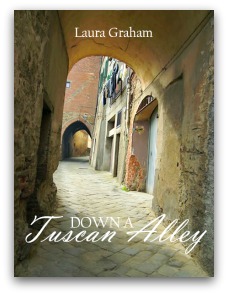
Down A Tuscan Alley (Fiction/memoir)
by Laura Graham
 Published June 2011

The Displaced Nation first met Laura Graham in May this year. Click here to read our interview with her.

About the author:
After the breakdown of a longterm relationship, Laura left England in search for a new life in Italy. With a distinguished acting career behind her, she now runs her own holiday property agency in Sinalunga, where the Tuscan tranquility inspires her writing.

Cyber coordinates:
Website: www.lauragraham.co.uk
Twitter: @LauraGraham7

Overview of book:
A long relationship ends. At 48, house taken by the bank, Lorri has little money. What can she do? And where can she go? Gathering her meager savings and her two beloved cats, she escapes England for a new life in a remote Italian village, never imagining the intrigue, passion and adventure she will find.

One reader’s review:
“The author’s use of dialogue enables the reader to form their own images of the characters to whom we are introduced. The reader is invited to share with [protagonist] Lorri as she develops her confidence, her new language, a knowledge of a different culture and her love for Ronaldo. The juxtaposition of romance and intrigue helps the book to flow to its end, and keeps the reader’s interest. The author brings her story to its conclusion using one of her characters to inform both the reader, and the protagonist herself.” (Amazon.co.uk reviewer)

To Tuscany from New York:

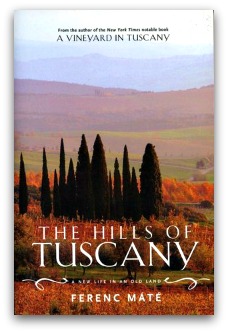
The Hills of Tuscany: A New Life in an Old Land (Autobiography)
by Ferenc Máté
Published November 1998

About the author:
Ferenc Máté  escaped Hungary after the 1956 revolution, and went with his mother to Vancouver, British Columbia. He now lives on a wine estate in Tuscany with his wife (painter and winemaker Candace Máté) and their son, Peter.

Cyber coordinates:
Website: www.ferencmate.com

Overview of book:
This hilarious, international bestseller is a true-life adventure of a New York City couple moving to Tuscany.  Ferenc Máté’s enthusiastic prose is infectious. He brings to life the real Tuscany: the contadini neighbors, country life—the harvest, grape, and olive picking, wine making, mushroom hunting, woodcutting—the holidays, and of course the never-ending, mouthwatering meals. (Amazon.com book description)

One reader’s review:
“As a second-generation Italian-American, I’m getting tired of the subtle patronizing attitudes that some prosperous expatriates to Italy emit via their memoirs. Reading this book, I felt that Ferenc Mate truly felt a genuine empathy with Italians. His ability to laugh at himself, and with his Italian neighbors — not at them — was a superb aspect of this work. He seemed to understand that being at home in Italy requires more than merely hobnobbing with other expatriates, and absorbing their prejudices.” (Amazon.com reviewer)

To Tuscany from California:

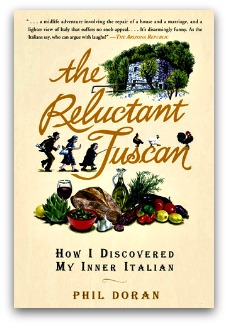
The Reluctant Tuscan: How I Discovered My Inner Italian (Humor/Autobiography)
by Phil Doran
Published March 2006

About the author:
Phil Doran worked in TV production for 25 years, as writer-producer for TV shows such as Sanford and Son, as a writer for The Wonder Years, and writing episodes of The Bob Newhart Show. He divides his time between California and Tuscany.

Cyber coordinates:
Website: www.reluctanttuscan.com

Overview of book:
After twenty-five years of losing her husband to Hollywood, Doran’s wife decided it was finally time for a change—so on one of her many solo trips to Italy she surprised her husband by purchasing a broken-down 300-year-old farmhouse for them to restore. The Reluctant Tuscan is about the author’s transition from being a successful but overworked writer-producer in Hollywood to rediscovering himself and his wife while in Italy, and finding happiness in the last place he expected. (Amazon.com book description)

Readers reviews:
Note: “The Reluctant Tuscan” appears to provoke a “Marmite” response from readers — they either love the book or hate it (or at least, are marginally lukewarm about it.) Here are two fairly typical reviews from both sides of the spectrum, from Amazon.com reviewers.

Love it:
“This is such a fresh, enjoyable book. Phil Doran is so honest & matter of fact about himself & his wife. I picked this book up to glance through & found I could not nor did I want to put it down. So I sat & read it non-stop, from cover to cover….My sides hurt from so much laughing. This is a must read book for anyone & any age….Enjoy!!!”

Lukewarm:
“The book recounts the period of time when the writer moved to a rural town in Tuscany and undertakes renovating a dilapidated farm house, mostly to appease his wife, who has bought the property without consulting him…There were some amusing bits but none that made me laugh out loud. Stereotypes and caricatures of Italians abound and there are multiple references to the Germans and WWII. Maybe it’s a generational thing, but I found these annoying.”

To Tuscany from Jerusalem:

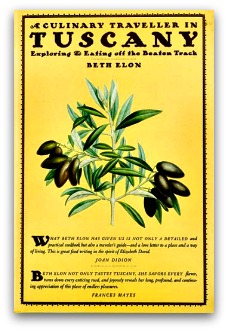
A Culinary Traveller in Tuscany: Exploring and Eating Off  the Beaten Track  (Travel guide/cookbook)
by Beth Elon
Published March 2009

About the author:
Former literary agent and her journalist husband Amos bought a neglected manor house in Tuscany in the late 1970s, long before the region became a desirable destination. Every summer, they would travel with their young family from their home in Jerusalem to spend two months in their Tuscan home, gradually renovating it as they were able. Eventually, the couple made Tuscany their permanent residence.

Overview of book:
“One might think that everything that can be written about Tuscany has been written. But here is a gem of a book in the tradition of M.F.K. Fisher that takes readers down Italian back roads and into private kitchens. There are 10 chapters that represent 10 itineraries into 10 different Tuscan regions. Included are more than 100 recipes and contact information and descriptions from private kitchens and restaurants, trattorias, gourmet shops, bakeries, wineries, and olive oil producers. Also included are days and dates when food festivals are held that celebrate chocolate, truffles, chestnuts and mushrooms. Warning: this book may contribute to an expanding waistline.” (Book Passage Bookstore review)

One reader’s review:
Beth Elton’s title isn’t just a cookbook – it takes a culinary tour of Tuscany into regions largely uncovered in other titles – and surveys the special kitchens and products of over fifty restaurants whose cooks produce original recipes revealed just for this title. All dishes have been adapted for home cooks but retain the authenticity of generations of development, so cooks seeking a blend of travelogue and new dishes to try will find delightful the blend of travel insights and easy dishes.” (Amazon.com reviewer)
.

STAY TUNED for Monday’s travel yarn from our very first Random Nomad, Anita McKay.

If you enjoyed this post, we invite you to subscribe for email delivery of The Displaced Dispatch, a round up of the week’s posts from The Displaced Nation. Sign up for The Displaced Dispatch by clicking here!

Related posts:

Image: MorgueFile

RANDOM NOMAD: Liv Gaunt, Accidental Serial Expat and Feeder of Sharks

Place of birth: Luxembourg
Passport: UK
Overseas history: England (Sevenoaks, Kent): 1981–98); Turkey (Fethiye, Ölüdeniz, Fethiye again): 1998–99, 2001–02, 2004; Kenya (Watamu): 1999–2000; Egypt (Dahab): 2000-01, Bahamas (Nassau and Family Islands): 2002–03; Barbados (Bridgetown): 2004–05; England (London): 2006–10; Australia (Cairns, Brisbane, Esperance): 2011 – present. (Gosh, I feel like a serial expat listing so many places!)
Occupation: Journalist and scuba instructor
Cyberspace coordinates: The World is Waiting — Expat humour, travel tips, handy hints, photos and inspiration for travellers (site); @worldswaiting (Twitter handle); The World is Waiting (Facebook); WorldsWaiting (Pinterest); and Liv G (foursquare).

What made you leave your homeland in the first place?
Though I am fond of Britain, I left because I was seeking work as a scuba diving instructor and underwater photographer. The jobs available overseas offered a better diving experience and a better lifestyle. Photographing sharks, filming turtles, and teaching people to dive in an island paradise conditions are not things you can do in Britain.

Is anyone else in your immediate family “displaced”?
My parents were expats in Luxembourg, which is where I was born. For a few years my father was based in Barbados for work, so I guess it runs in the family — but nobody other than me is displaced at this moment.

Your chosen profession of diving and underwater photography has led you to settling, at least for a time, in quite a few different countries. Tell me about the moment when you felt the most displaced.
I believe it is the people who make the place. I feel most displaced when I am surrounded by people who do not treat others with what I consider to be the most basic level of respect — basically, as they would wish to be treated. Discovering cultural differences can be fascinating; but living with discrimination day in day out is frustrating and awful. Living in Egypt I found it really frustrating that men would not take me seriously simply because I am female. They completely disregarded the fact that I had more experience and was more qualified than they were. Of course I understand there are significant differences between Arab and Western culture. But being in a male-dominated industry (scuba diving) in a paternal society (Egypt) was simply not for me.

Was there one specific moment during your time in Egypt that catalyzed this feeling for you?
No, I think it was more the growing realization that I would never be taken seriously.

Describe the moment when you felt your least displaced — i.e., when you felt more or less at home in one of your adopted countries.
The first time I lived somewhere other than with my parents, was in Turkey in my late teens. I took on the responsibility of earning enough to pay rent, bills and to feed myself — and it was all in Turkish. It was a classic example of me diving in at the deep end, so to speak. As a result, I quickly gained a working knowledge of the Turkish language as well as an understanding of the country, culture and its people. Initially I thought that my Turkish friends would be horrified by my near constant butchering of their language. But they only ever encouraged me — and even nicknamed me “the Turkish-English girl.” Nowadays, whenever I visit Turkey I feel very at home there. I don’t have the normal visitor’s questioning of things. I still have quite a few Turkish habits like always removing my shoes indoors, being quick to hit the horn whilst driving, and showing hospitality to visitors.

You may bring one curiosity you’ve collected from each of your adopted countries into The Displaced Nation. What’s in your suitcase?
From Turkey: An evil eye. Evil eyes are so-called, rather misleadingly, as they are believed to ward off evil. They are usually made from glass or ceramics and are often seen hanging over entrances to offices and people’s homes.
From Kenya: Some beaded sandals made from leather and old car tyres. They are the most comfortable sandals I ever had.
From Egypt: Egyptian hibiscus tea. They serve it warm with a classy piece of foil over the top of the glass!
From the Bahamas: Pink sand from Harbour Island. All Bahamian sand is silky soft and impressive frankly but on Harbour Island it is even more beautiful for being a dusky pink.
From Barbados: An amazing reggae soundtrack.
From Australia: Can I bring a quokka? They are small marsupials, a bit like a large-bottomed mini-kangaroo. I find them endlessly amusing.

And now you are invited to prepare one meal based on your travels for other members of The Displaced Nation. What’s on your menu?

Starters: A huge plate of Turkish meze including filled filo pastries, various dips, Turkish bread, olives, cheese and some köfte.
Main: Bahamian conch fritters — the conch will be fresh from the sea and delicately fried — served with lime coconut dip and salad.
Dessert: An Australian pavlova, covered in fresh fruit.
Drinks: To include Caribbean piña coladas and mojitos, and Turkish cherry juice.

It would be a strange meal perhaps, but very tasty!

I wonder if you could also add a word or expression from one of the countries you’ve lived in to The Displaced Nation argot.
Ubuntu, which is an African ethical philosophy. Nelson Mandela explained it thus:

A traveller through a country would stop at a village and he didn’t have to ask for food or for water. Once he stops, the people give him food, entertain him. That is one aspect of Ubuntu, but it will have various aspects. Ubuntu does not mean that people should not enrich themselves. The question therefore is: Are you going to do so in order to enable the community around you to be able to improve?

Your life thus far has been quite an odyssey. You’ve traveled to 42 countries and lived in six. Do you think of yourself as a travel pro?
I don’t consider myself a professional traveler. To me, that term implies that I am paid to travel, which is certainly not the case. I am inspired to continue traveling to new places because I enjoy learning about people’s lives and cultures, and seeing the world through their eyes. I find the different foods interesting as well. Travel also allows you to see where you have come from in a whole new light.

What’s still on your bucket list?
Oh, it’s endlessly growing! Top of the list currently are the Philippines and the Galápagos.

But you are a professional scuba diver. Did you watch the diving events in the London Olympics?
I wasn’t able to watch most of the Olympics because of the time difference between Australia and Britain and a recent spate of overtime at my job. However, to answer your question, no, I have little interest in competition diving. I am not a competitive person generally and rather believe that at the end of the day the only person you ever truly compete with is yourself.

What made you so certain you wanted to be a scuba diver?
I enjoy interacting with the creatures of the deep. Watching as a shark cruises out of the blue towards you, having a curious manta ray investigate you, or sharing a moment with a cheeky turtle is far more fun to me than being faster or more coordinated than someone else. I also enjoy the challenge of capturing the underwater critters on camera.

As it happens, this week marks the 25th anniversary of Shark Week, the Discovery Channel’s longest-running programming event. The purpose is to draw the attention to the shark species, one third of which is at risk for extinction. (We must all stop eating shark fin soup — up to 73 million sharks are killed each year for their fins!) I understand that you love to video and photograph sharks. Is that the riskiest thing you’ve done under water?
Most people would say the riskiest thing I have done underwater is feed sharks. It’s not about thrill-seeking, though, but about providing divers with an up-close encounter, which I think is the best way to educate people about and ultimately protect the sharks.

But while you are a shark lover, you have an aversion for sea urchins. Why is that?
If you ask me that question, I have to assume you have never accidentally brushed past one and received an ankle full of their bloody painful spines?!

But have you ever eaten uni in a Japanese restaurant?
No. I love sushi but haven’t managed any sea urchin yet. Have you, is it good?!

Readers — yay or nay for letting Liv Gaunt into The Displaced Nation? Is she above water or is there something fishy about her application? (Note: It’s fine to vote “nay” as long as you couch your reasoning in terms we all — including Liv — find amusing!)

STAY TUNED for tomorrow’s compendium of books on travel to Tuscany.

If you enjoyed this post, we invite you to register for The Displaced Dispatch, a round up of weekly posts from The Displaced Nation, with seasonal recipes, book giveaways and other extras. Register for The Displaced Dispatch by clicking here!

Related posts:

img: Liv Gaunt videoing a shark feed in the Bahamas.

LESSONS FROM TWO SMALL ISLANDS — 3) Keep calm and eat curry

Mid-July in Manhattan, and I’m thinking that New York deserves its reputation as The City That Never Sleeps. Not because we’re all out partying — far from it. We’re lying there tossing and turning because we can’t regulate our air-conditioning units.

“High” puts you in Siberia; “Low” sends you down into the Tropics. There are no in-betweens, except for the brief period just after you’ve gotten out of bed to adjust the setting. But by then you’re awake again…

It has always surprised me that New Yorkers are willing to put up with such primitive cooling methods. It’s not like them to suffer silently. My theory is that they simply don’t know any better. As the world begins and ends in New York (isn’t Times Square supposed to be the center of the universe?), this must be the best of all possible air conditioning systems.

Regardless. The point is that I am finding summer a terrible trial now that I’ve repatriated — one that at times requires Olympic strength and endurance.

As summer wears on, I wear out. Not only do I never sleep but I never eat — or eat only minimally. My appetite dwindles at the thought of passing yet another uncomfortable night at the mercy of Simon-Aire products.

All of that changed, however, a few nights ago. Actually, the night had started normally enough: I had gone to bed and was freezing cold so couldn’t sleep. But just as I was lying there thinking about getting up to turn the air con down or else searching the closet for another blanket, I had a sudden, heartwarming thought: “I could kill for a curry!”

How did I go from cursing Dr. Cool, whose workers had installed a supposedly upgraded Simon-Aire unit in the bedroom at considerable cost, to a happy craving for curry? I can only surmise that my subconscious mind was trying to restore my spirits by reminding me of my curry-eating days in the two small islands where I’d lived as an expat, England and Japan. I felt calm again, and my appetite returned…

America — a nation that has deprived itself of a serious curry experience

When I first moved to New York, I was beyond thrilled to discover that the Indian actress and cookbook author Madhur Jaffrey lived here, too. To my utter surprise (and delight) — I had always assumed she lived in London — she has been residing in an apartment on the Upper East Side for the past several decades. (She also has a farmhouse in the Hudson Valley.)

Surprised in a good way, yes — but also somewhat mystified. Why would Jaffrey choose to live in America for so long, given the sorry state of Indian cuisine in this part of the world?

I guess it has to do with husbands — she came to the city with her first husband, the Indian actor, Saeed Jaffrey, and then after their divorce, married an American.

Or perhaps she just likes a challenge? In Jaffrey’s very first cookbook, An Invitation to Indian Cooking, written not long after her arrival on American soil, she says she is writing the book because

there is no place in New York or anywhere in America where top-quality Indian food could be found, except, of course, in private Indian homes.

That was nearly forty years ago, and I have to say, her efforts to improve the situation, beginning with that book, have yet to pay off. Manhattan now has a couple of Indian restaurant neighborhoods, and then there’s Jackson Heights in Queens — but in general curry hasn’t caught on in a big way with Americans. If we want to eat spicy food, we usually turn to Mexican or Thai, not Indian.

As Jaffrey herself put it in an interview with an American reporter last year:

America as a whole has not embraced Indian food like they have with Chinese, or with sushi. It’s beginning to change, but only in big cities. Something is needed, something real. I have waited for this revolution, but it hasn’t happened yet.

This is in stark contrast to England and Japan — both of which embraced the curry cause on first exposure and now behave as though they’d invented certain dishes. Indeed, chicken tikka is considered to be a national dish in the UK, while “curry rice” (pronounced karē raisu) rapidly achieved the status of a national dish in Japan.

Nostalgia: Going out for a curry in England

England, my England — where Madhur Jaffrey is a household name, and curry houses abound!

Britain got the hots for curry during the 19th century, when there was an enthusiasm for all things Indian. And I got the hots for the Brits’ late-20th-century version of curry when living in an English town as an expat. My friends and I would spice up our evenings by going out for curries. We always ordered a biriani, chicken tikka masala, and a couple of vegetable dishes (one was usually sag paneer, which remains a favorite to this day).

Our starters would be onion bhaji and papadums, and drinks would be pints of lager. If we had the space for dessert, it was usually chocolate ice cream — none of us ever acquired the taste for Indian desserts (dessert of course being an area where the British excel!).

But even more special were the times when friends invited me to their homes for meals they’d concocted using Madhur Jaffrey’s recipes. One memory that stands out for me is an occasion when my former husband, a Brit, and I joined four other couples for a friend’s 40th birthday party. The hostess, the birthday-boy’s wife, presented a dazzling array of Madhur Jaffrey dishes that looked like something out of a food magazine. I’ve been to much ritzier birthday parties before and since, but none have struck me as being as elegant as this one — partly because of the splendid display and partly because by then I knew how much chopping and dicing of garlic, ginger and onion, how much grinding of spices must have been involved. What a labor of love!

Yes, by then I’d begun experimenting with Indian cookery myself thanks to the influence of a very good friend, who’d given me the classic Madhur Jaffrey work, Indian Cookery (which had been a BBC series), along with all the spices I would need for making the recipes: nutmeg, cinnamon, cardamon, mustard seeds, coriander, cumin turmeric, cloves… To this day, I always keep an array of Indian spices in my pantry so that I can make my own garam masala at the drop of a hat. Now if only I could find some friends who would drop their hats! (Hey, I even have the old coffee grinder ready for grinding the spices, just as Jaffrey instructs.)

Nostalgia: Curry rice & curry lunches in Japan

Eventually, I moved away from England to another small island, Japan — where I was relieved to discover I would not need to give up my new-found passion for Indian food (though I would be foregoing my beloved basmati rice unless I smuggled it in at customs).

Thankfully, the Brits had gotten there about a hundred years before me and had introduced curry to the Japanese, with great success.

Because of “r” being pronounced like an “l” in the Japanese language, we foreigners couldn’t resist making many tasteless jokes about eating curried lice, but that didn’t stop us from having our fill of the tasty national dish, curry rice.

As in the UK, I found it a nice contrast to the traditional fare, which, though healthy, can be rather bland.

At this point, I’d like to loop back to Madhur Jaffrey and note that she disapproves of the word “curry” being used to describe India’s great cuisine — says it’s as degrading as the term “chop suey” was to Chinese cuisine. But I wonder if she might make an exception to the Japanese usage? Apparently, Indians themselves when speaking in English use “curry” to to distinguish stew-like dishes. And Japanese curry rice is the richest of stews, made from a “roux” that can be bought in a box if you do it yourself.

My first box of curry roux was a gift from a Japanese friend. It was accompanied by her recipe for enriching the stew with fresh shrimp and scallops. Oishii!

Still, the curry I crave most often from Japan isn’t curry rice at all, which I find on the heavy side. No, my deepest nostalgia is reserved for the set lunches in Tokyo’s Indian restaurants, which I used to partake in with office colleagues.

The (mostly Indian) chefs have tweaked the ingredients to appeal to the Japanese palate: little dishes of curry that are artistically arranged on a platter, accompanied by naan. freshly baked (fresh is very important to the Japanese) and a side of Japanese pickles: pickled onions, or rakkyōzuke (a tiny, whole, sweet onion); and pickled vegetables, or fukujinzuke.

(The addition of Japanese pickles, by the way, is genius! Try it — you’ll love it!)

All of this is capped by coffee or masala tea, both of which are so well executed they can fill in as desserts.

My takeaways (I wish!)

I fear there may not be many takeaways for my fellow Americans from Lesson #3. After all, the world’s leading authority on Indian cuisine has tried to convert us and failed.

Nevertheless I’ll suggest a few scenarios, with pointers on how you might attempt to introduce a curry-eating tradition into your circle:

1 — Summer is getting to you, so you suggest to a group of friends that you all go out for a curry. When they stare at you blankly, do a little head bobble, smile charmingly and say: “Why ever not?”

2 — Summer is getting to you, and you decide to build a shrine to Madhur Jaffrey in your home by buying as many of her books as you can — including her children’s book on the Indian elephant, Robi Dobi, and her memoir of her childhood, Climbing Mango Trees. You arrange them around a screen that is playing Shakespeare Wallah, a film she appeared in in the 1960s (directed by James Ivory and starring Felicity Kendal). Invite some friends over and when they ask you about the shrine, start talking about the joys of Indian cookery and see if you can make some converts. Perhaps offer to lend out a book or two. (I might start with her newest work, which emphasizes “quick and easy” methods — bless the 78-year-old Jaffrey, she’s indefatigable!) And you can always dip into the books yourself if the heat is making you sleepless. Jaffrey writes beautifully.

3 — Summer is getting to you, but you decide that when the heat breaks, you will start up a Curry Club with a few of your friends, encouraging everyone to contribute one Madhur Jaffrey dish or a Japanese curry made from roux. Even if most of them drop out and you end up cooking a dish for yourself, perhaps this exercise will satisfy your craving until winter. (I find I get these cravings roughly every six months, usually in summer and winter.)

* * *

Well, I’m off to see if I can resume my sweetly fragrant dreams of my expat culinary adventures — just hope it does the trick of distracting me from my ancient “aircon” (popular Japanese contraction) units!

In the meantime, let me know what you think of this lesson. Are you a curry lover? And if so, could you live in a nation that doesn’t share your craving? How would you put some spice into your life under such sorry circumstances? Do tell!

STAY TUNED for Thursday’s post, another in our “Expat Moments” series, by Anthony Windram.

If you enjoyed this post, we invite you to register for The Displaced Dispatch, a round up of weekly posts from The Displaced Nation, with seasonal recipes, book giveaways and other extras. Register for The Displaced Dispatch by clicking here!

Related posts:

Image: MorgueFile

RANDOM NOMAD: Antrese Wood, American Expat in Argentina and Artist on an Epic Expedition

Place of birth: Pomona Valley Hospital. I grew up in Claremont, California — in fact, my mother still lives in the house she brought me home to.
Passport: USA
Overseas history: Honduras (San Pedro Sula): 1986; Argentina (San Antonio de Arredondo + Villa Carlos Paz), 2010-11 + 2011 – present.
Occupation: Artist (painter).
Cyberspace coordinates: Antrese.com (art site + blog); @antresewood (Twitter handle);  Antrese Wood Artist Page (Facebook); and Antrese Wood (Pinterest) — see “A Portrait of Argentina” board.

What made you leave your homeland in the first place?
A friend of mine in high school asked me to go with her to an American Field Service (AFS) meeting. I went because she didn’t want to go alone. I had no idea what it was, but after the meeting I thought, “Awesome! I’m in!!” I ended up going to San Pedro Sula, Honduras, for six months. I didn’t speak a word of Spanish when I left. I memorized the three questions I thought I would get asked most: What is your name, where are you from & how old are you? Unfortunately, I got them mixed up. When someone asked “What is your name?,” with a huge smile I would answer: “I’m 15 years old!” By the time I left, my Spanish was pretty good.

I didn’t travel much until after college, and I didn’t practice my Spanish, so I lost most of it. After college, I got bit by the travel bug again. I would go anywhere if I had the chance. I worked in the video game department at Disney for years, and got to travel a lot with them — all over the US, Vancouver, Montreal, London, Paris, even to the South of France. On my own, I went to South Korea. I also lived in Alaska for a short while (not a foreign country but compared to the Los Angeles culture, it might as well be). At one point I decided I wanted to do a semester with NOLS (the National Outdoor Leadership School). I choose their semester in Patagonia, and thinking this was my last chance to see South America, I spent a few months exploring Chile, Argentina, Peru, and Ecuador.

Indirectly, that is how I met my husband. A friend was worried about my traveling alone, so she introduced me to her friend from Argentina (“even though she doesn’t live there, she can at least give you a few phone numbers just in case…”). Years later, my new Argentine friend introduced me to my future husband.

Which brings me to why I left Los Angeles to live in Argentina: I fell in love.

Wow — that’s some wanderlust! So is anyone else in your immediate family “displaced”?
No one else in my family is displaced. My mother and I both travel as much as possible, but my brothers and sisters are happy where they are.

Can you describe the moment in your Argentinian life when you felt the most displaced?
My husband and I first lived in a tiny town called San Antonio de Arredondo. It’s in el campo — literally, the countryside. But when you move from Los Angeles to a town of barely 5,000…you call it the boondocks. Some friends rented us their quincho (guest house) while they were out of the country. It was in a new neighborhood with few other houses and lots of empty lots. Green and beautiful, but no natural gas, no phone lines…and worst of all, no Internet!

I was used to 24-hour access to everything. The Internet, grocery stores, restaurants…everything. Another thing: San Antonio and Carlos Paz (where we currently live), both honor the siesta. Everything closes between 1:30 and 5:00 p.m.

It was quaint and beautiful at first, but I got tired of riding my bike to the next town to check my email. I’m completely dependent on the Internet. It was in those moments when I admittedly thought “Oh my god, what have I done!?” When we moved to Carlos Paz, the first question I had about the apartment was: “Does it have high-speed Internet?”

And does it?
YES IT DOES!!!….yay!

Now that you have Internet access and are feeling more at home, is there any particular moment that stands out as your least displaced?
As I contemplate this question, a series of images and moments flashes through my head: our house filled with friends for an impromptu dinner; the huge smile on my husband’s face when he cooks for a crowd (he loves it!); looking at the clock and being surprised that it’s already 4:00 a.m…. A big cultural difference is that you can call friends for a dinner, and within an hour or two, your house is filled with all your friends and all their kids. There is always room for just one more.

If I had to pick one event where I didn’t feel displaced, it would definitely be our wedding. It was the best of both worlds. Friends and family from the US, along with about 200 of our “closest” friends from Argentina, came to celebrate. We had a huge asado (barbecue), lots of wine, dancing until 6:30 a.m.

Sounds amazing. And now you may bring one curiosity you’ve collected from your adopted country into The Displaced Nation. What’s in your suitcase?
Really? only one!?

I’m tempted to pack some fernet, but I’ll bring my mate instead.

Drinking mate is a national pastime in Argentina. The mate is a hollowed out gourd that you fill with tea leaves called yerba. You add hot water and drink the tea from a bombilla (a kind of straw with a filter at the bottom). Typically, it’s shared with other people — one person serves the mate to the circle. Drinking mate plays an important social role; it’s the preferred excuse to get together and hang out. “Let’s have a mate” really means “Let’s hang out and chat for a while.” Most gas stations have a hot water dispenser at exactly the right temperature, and almost any restaurant will fill your thermos regardless of whether you eat there. They understand the importance.

There are various subtleties to preparing mate (sugar, no sugar, with mint, water temperature, etc.), and the opinions on how to properly prepare mate are strong and sometimes fiercely debated. When a person drinks mate alone for the first time, its like a right of passage into adulthood. When my husband came home and found me drinking mate by myself, he said: “AHA!! now you are an Argentine!!”

Let’s move on to food. You are invited to prepare one meal based on your travels for other members of The Displaced Nation. What’s on your menu?

Now we’re talking! This one is pretty easy:

Appetizer: Empanadas — dough filled with just about anything and then baked or fried. They’re a staple here. A common filling is ground beef, olives, hard boiled egg, paprika, cumin and salt. My favorite is the árabes, which is ground beef “cooked” with lemon and aromatic spices.

Main: Definitely an asado: various cuts of Argentine beef, and lamb. The meat here is so good, people are surprised how much flavor it has. Typically the only condiment used is salt. (Argentina would be a difficult place for vegetarians!)

Dessert: We could have ice cream — call and have it delivered (yes, they do!!); but I think I’d prefer to introduce you to alfajores from Las delicias de Mamushka. An alfajor is like a cookie sandwich: two cookies made from cornmeal, filled with dulce de leche. I never liked them until I tried Mamushka’s. Now I’m addicted.

Wine & after-dinner drinks: A nice Malbec wine. I like Trapiche. A few hours later, after dessert and coffee, an ice-cold Fernet con Coka.

And now you may add a word or expression from the country you live in to The Displaced Nation argot. What will you loan us?
There are so many — again, hard to choose.

Che and “más vale!” are among my favorites.

Che is used all the time here, especially in the province of Córdoba. Depending on the context, it means “hey…” or “umm…” Sometimes, it seems to be used in the same way we Californians use the word “like.” Che Guevara is from this area. He is actually called Che because when he went to Cuba, he used the word so frequently, people just started calling him “Che.”

Más vale is equivalent to “Hell, yeah!!” — and also has a bit of “Let’s do this!!”

This summer we’ve been doing some posts with an Olympics theme. Are you planning to watch the Summer Olympics in London? If so, who will you be rooting for: Americans, Argentines, both, or neither?
I’ll be rooting for them both. In the event that the U.S. squares off against Argentina in a soccer match, I will be wearing a helmet and full body armor — and cheering for the US!

Are Agentines excited about the Games?
In general, Argentines are fanatical about sports. Especially soccer. Messi is a God. During the World Cup, It seemed like every man, woman and child in this country was wearing a blue-and-white striped #10 jersey. We went to a  friend’s house to watch a game. Normally busy streets were completely deserted. The city had literally shut down. There was an eerie silence occasionally broken by simultaneous cheers erupting from the houses and (closed) shops. During national playoffs, you see grown men sobbing uncontrollably after their local team has lost. The first time I saw this, I was flipping channels on TV. As the camera switched from one sobbing man to another, I thought there had been a national disaster. So, yes, I think it’s safe to say that there will be plenty of excitement about the Games!

The Olympics gives me a segue way into your 8-month project to paint Argentina. That strikes me as being an Olympian feat. Can you say a little bit more about it?
Now that you mention it, it is an Olympian feat! The project is called “A Portrait of Argentina.” I will spend eight months visiting the country’s 23 provinces, traversing something like 15,600 miles, painting portraits of the people I meet. I’ll listen to their stories and then paint en plein-aire, the scenes from their daily life. I’m hoping to deliver a cultural portrait of my adopted home.

When did you first conceive of the project?
The idea came out of a period of misery after I left Los Angeles to live in Argentina. The first year I lived here, I saw everything from a touristic point of view. It was quaint, beautiful and…a little quirky. But the second year was more difficult. It was no longer cute and quirky; the honeymoon was over. I made unfair comparisons and was judging everything. My normally optimistic and upbeat attitude shifted to “This sucks.”

I had two obvious choices: go back to California — or change my outlook, appreciate all that is good, and stay. My husband (fiancé at the time) left it up to me (no pressure, eh?). We could pack everything up and head back to Los Angeles, or I could give Argentina another try.

I realized that much of my misery was self imposed. It came from the fact that I had not integrated and was spending the majority of my time alone, working out of the house. You can’t love anything until you take the time to develop a relationship with, and really get to know, it. Here I was, on an adventure of living in another country, and I wasn’t even willing to give it the time of day. What a wasted opportunity!

As I integrated myself more and became determined to learn as much as I could about Argentina, I started taking classes at the university and began developing this idea about painting my way across the country. Painting has always been my way of making sense out of the world. It forces me to pause and really look at my subject.

Is the project having the effect that you’d hoped — is it improving your attitude?
Just by researching the project, looking for “known” and “unknown” people and places, I have a new-found appreciation for this country. I’m realizing how easy it would be to say I know Argentina because I’ve lived here for two years. The fact is, I know a lot about one region in one province of a very large country, and a little bit about a dozen other places. A native New Yorker and a native Alaskan may live in the same country, but they are culturally worlds apart. The same can be said for a Porteño (a person from Buenos Aires) and a person from La Quiaca near the Bolivian border. Same country, worlds apart.

I’m also overjoyed that so many people here seem excited about my project. Obviously, I’m super excited about it (it’s my baby, after all), but when I share my vision with Argentines and their response is equally enthusiastic, it’s just amazing.

I’ve barely started, and already my outlook has changed. I’m owning the project in a way I didn’t at the start.

What do you hope the project will ultimately accomplish?
“A Portrait of Argentina” is both a personal and a professional journey. I expect to be surprised, challenged, and profoundly affected by it. I’ll be seeking out people from diverse backgrounds, looking to honor those who have dedicated their lives to their passion and whose work positively impacts others: scientists, athletes, artists, musicians, teachers, even the abuelita (little old lady) on the street corner. It’s a collaborative project, and I hope to involve as many people as possible. Luckily, the people I’m meeting are quick to offer help and introduce me to others who might want to participate.

Do you ever feel daunted by the scale of the project?
Argentina is a huge country so I’ve set myself a very ambitious goal to cover this much ground in just eight months. When I break it down into small chunks, it feels manageable. When I think about its entirety, it’s overwhelming.

Finance was another daunting prospect. When I first thought about the funds it would take to get me to and from so many places, it seemed completely insane and impossible. I decided to launch a Kickstarter campaign with a $25k goal. Kickstarter is all or nothing, so if I didn’t hit the goal, my five-week campaign would end with $0.

There were days when I did let the campaign get to me and was sure it would fail. To keep going, I would sometimes just think, okay, how can I raise just $100?

In addition to a herculean effort by family and friends, I was fortunate to have some key influencers get excited about the project and promote it. In the end, with just 17 hours to spare, I made my goal!

I’m sure I will have some of these same feelings on the road, but I’ve developed a number of tactics to deal with it. I don’t give up easily. Besides, there are too many people supporting me and cheering me on. I know it will be hard, but am I ready for it? Más vale!!

Readers — yay or nay for letting Antrese Wood into The Displaced Nation once she’s finished her travels for her project? Tell us your reasons. (Note: It’s fine to vote “nay” as long as you couch your reasoning in terms we all — including Antrese — find amusing!)

STAY TUNED for tomorrow’s episode in Libby’s Life, our fictional expat series set in small town New England. (What, not keeping up with Libby? Read the first three episodes of her expat adventures and/or check out “Who’s Who in Libby’s Life.”)

If you enjoyed this post, we invite you to register for The Displaced Dispatch, a round up of weekly posts from The Displaced Nation, with seasonal recipes, book giveaways and other extras. Register for The Displaced Dispatch by clicking here!

Related posts:

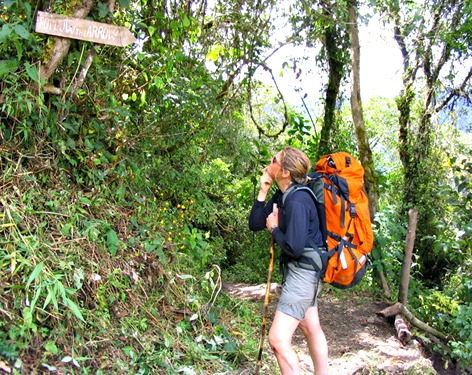
img: Antrese Wood displaying her intrepid travel skills on the Machu Picchu trail in Peru. Her comment: “I thought the Follow the Arrow sign was hilarious because 1) the trail is so well marked I cant imagine anyone getting lost; and 2) this was the one and only sign on the trail and it was near the end of the four-day hike. The other hilarious thing about the photo, at least to me, is that if you look closely, you can see my knee is bleeding. I had just spent 80 days carrying a backpack two-three times as heavy in seriously remote back country, no trails, no markers, nothing. We had to sign a waiver acknowledging the understanding that if something should happen, it could take a helicopter up to a week to arrive. I made it through without a scratch. Here, on this comparative cake-walk, on a perfectly even trail, I fell for no apparent reason and totally skinned up my knee.”

Dear Mary-Sue: Should expatriates do patriotism, even if it is July?

Mary-Sue Wallace, The Displaced Nation’s agony aunt, is back. Her thoughtful advice eases and soothes any cross-cultural quandary or travel-related confusion you may have. Submit your questions and comments here, or else by emailing her at thedisplacednation@gmail.com.

I hope you’re having a better July than I am, Mary-Suers. Ol’ Mary-Sue is not a happy bunny, let me tell you that, NOT A HAPPY BUNNY AT ALL. Some neighbor of mine — let’s for the sake of argument call him Gary Geshke, and while we’re at, let’s assume that this Gary Geshke was the most incompetent realtor in town, and let’s also assume that most of the women in the neighborhood wonder how Linda Geshke can stomach staying with him.

Whoops, I never finished my sentence. Anyway, this “Gary Geshke”  was struggling — as usual — to do the most basic tasks with just the tiniest of competency. This is the sort of guy you worry is going to chop off a toe when mowing his lawn. Well, he was having a fireworks party for the 4th and instead of blowing an arm off, as would be more in line with his reputation, he managed to have one of his fireworks land on my roof nearly causing the whole thing to burn down. Thankfully hubby Jake was quick on the scene before we nearly had a disaster on our hands the likes of which we haven’t seen since The Towering Inferno.

Gee, I could skin that guy alive. I know his wife sometimes visits The Displaced Nation, so if you have are reading this post, Linda, Gary is an ingrate.

Anyhow, I’m in a FOUL mood so let’s get the July questions over with quickly so I can get back to watching some soap operas as well as the marvelous summer barbecue that I am going to organize and pointedly not invite Gary and Linda to.

Yeah, you read that right, Linda!

*****************************************************************************************

Dear Mary-Sue,

I grew up Catholic in Northern Ireland, I was only too happy to get out of Belfast when the opportunity arose to take off for Canada came along.  I’d never have to deal with nonsense like The Glorious Twelfth.

That was before I realized Canadians are mad about Canada Day on July 1.

I know, I know, it could be worse. I could be in the heartland of American watching people wave flags on July 4, or in Paris on July 14, not able to cross the streets because of the Bastille Day pomp and circumstance. But what is it about July that makes people embrace their motherlands? I just don’t get it…

Brendan, Nova Scotia

Dear Brendan,

April is the wettest month. July is the most patriotic. November is the most miserable, but June is the sexiest. March is chaste while September is outrageous. May oftentimes pretends to be coy, while October smells like an old man’s pipe. January is nice-looking, but her acting in Mad Men was wooden.

*****************************************************************************************

Dear Mary-Sue,

As an Englishman in the United States on July 4th, I thought I should hide my accent. I made a few jokes about this to my American friends, but they didn’t seem to get it. They told me July 4 was for barbecues, so just have a hamburger and enjoy myself.

I ask you, did we fight a war or didn’t we?

Henry, Houston, Texas

Henry,

I normally have time for Limeys, but I’m not in a great mood at the moment. Who does an agony aunt write to? That’s what I really want to know.

Anyway, on your minor case, I would say, “let it go.” People invited you into their homes. They were nice to you. They watered and fed you. Yes, they didn’t laugh at your jokes. Do people often laugh at your jokes? Seems like you were going for a way-too-obvious topic, so I would wager no. Hubby Jake makes me laugh because he does an amazing John McCain impression that’s always a hit at parties. Perhaps you could work on something similar. Or you could just be really clumsy and knock over a jug of Sangria — as seems to be Gary Geshke’s party trick.

Also, if you want everyone to start bringing up that time their country had a war with England, pretty soon the only people you’ll be able to speak to will be the Portuguese.

********************************************************************************************************

Dear Mary-Sue,

I’ve heard it said that you make the best 4th of July potato salad in the world. What is the recipe and method? Would love to try it. *hint,  hint, hint.*

Susie-May, Arizona

Aw shoot!

Susie-May!

And you were doing so well in following the restraining order in not making any contact with me. First, there was the incident in Krogers on Tuesday — and now this! Also, don’t think I don’t know it wasn’t you who sent me some hair clippings in the post. That’s just weird Susie-May. Get a grip!

Anyhoo, it is true that my potato salad is the best. Secret is never use mayo. Mayo is the devil’s work. Or Paula Deen’s — one of the two.

Also don’t parboil the potatoes — that’s a rookie’s mistake. You just want to steam them. After steaming, crush them a bit, not too much. Then season them with salt and pepper. To that, add a dash of olive oil, a dash of cider vinegar, and a tablespoon of Dijon mustard. Then throw chopped up green onions and some fresh cilantro. Mix it all together and then squeeze some lemon juice over it before serving. (Gary and Linda Geshke wish they could have some of that!)
___________________________________________

Anyhoo, that’s all from me readers. I’m so keen to hear about your cultural issues and all your juicy problems. Do drop me a line with any problems you have, or if you want to talk smack about Delilah Rene.

Mary-Sue is a retired travel agent who lives in Tulsa with her husband Jake. She is the best-selling author of Traveling Made Easy, Low-Fat Chicken Soup for the Traveler’s Soul, The Art of War: The Authorized Biography of Samantha Brown, and William Shatner’s TekWar: An Unofficial Guide. If you have any questions that you would like Mary-Sue to answer, you can contact her at thedisplacednation@gmail.com, or by adding to the comments below.

STAY TUNED for tomorrow’s Random Nomad, who is attempting an epic expedition…

If you enjoyed this post, we invite you to register for The Displaced Dispatch, a round up of weekly posts from The Displaced Nation, with seasonal recipes, book giveaways and other extras. Register for The Displaced Dispatch by clicking here!

Related posts:


5 reasons why American aviatrix Amelia Earhart could be an expat heroine

The American aviatrix Amelia Earhart has been propelling her way into the news headlines this week. Yesterday marked the 75th anniversary of her Lockheed Electra disappearing over the Pacific Ocean.

And today marked the beginning of an expedition, led by an American nonprofit group, to locate the wreckage from her plane. The group plans to scan the depths of the Pacific Ocean near a remote island where they believe Earhart and her navigator, Fred Noonan, died as castaways.

With America’s most famous aviatrix back on our horizons, it seems a timely moment to nominate her for our Displaced Hall of Fame, where we put all of our expat heroes and heroines.

What, was she an expat, too? I can hear you asking. In fact, she was an expat briefly — during World War I, when she went to visit her sister in Toronto and ended up staying on as a nurse’s aide in a military hospital.

But I’ll admit that Earhart seems more of a domestic heroine — as American as apple pie, you might say. Born in Atchison, Kansas, in America’s heartland, Amelia grew up tall and willowy like the corn in the fields. As the Reigning Queen of the Air, she became the nation’s sweetheart and to this day retains a special place in the hearts of young American women.

What’s more, recruiting her to serve as a heroine for global nomads, many of whom have hybrid nationalities, might not fly with my fellow Americans. Secretary of State Hillary Clinton has endorsed the expedition to hunt for Earhart’s plane, saying that Earhart embodies the “spirit of America coming of age and increasingly confident, ready to lead in a quite uncertain and dangerous world…”

But in reviewing the main facts of Earhart’s life, I have found plenty of aspects that show how “displaced” she actually was — “displaced” in the sense of being “removed from the usual or proper place” (see definition on our About page) — and hence belongs in our orbit. Here are five of my top reasons:

1) She was born with wings.

Veteran expats and long-term travelers cannot afford to have fear, or dislike of, flying. Should we incline at all in this direction, it may help to lie back in your airplane seat (or pretend you have a seat where it’s possible to lie back) and think of Earhart, who took to the skies without hesitation, as though the airplane wings were her own. Legend has it that she first caught the aviation bug while an expat in Canada. She went to see an exhibition of stunt flying at a fair in Toronto and later wrote about the sensation she’d felt as a pilot began diving at her and her friend:

I remember the mingled fear and pleasure which surged over me as I watched that small plane at the top of its earthward swoop. I did not understand it at the time, but I believe that little red airplane said something to me as it swished by.

From then on, it was all she could do to keep her feet on the earth. Of her first airplane flight she said: “As soon as we left the ground, I knew I had to fly.” In 1921 she took her first flying lesson, and soon saved enough money to buy a second-hand plane.

Of course it helped that in the early days, flying was a romantic sport for the lucky few, not a form of transport where everyone from pilot to passenger feels as though they’re herding or being treated like cattle. Earhart named her first plane “Canary” because of its bright yellow color. Perhaps she felt like a canary when setting her first women’s record: rising to an altitude of 14,000 feet.

By the time she became the first female pilot to cross the Atlantic solo (Charles Lindbergh was first to do so), she had her own little red airplane — a cherry-colored Lockheed Vega, reputed to be the world’s fastest aircraft and therefore favored by pioneering aviators. Hmmm… Did it make her feel like a cardinal?

2) Always restless with the status quo, she let it drive her adventures.

What’s the litmus test for being a travel or expat type? A person who is always upping the ante. We’re a gang of permanent malcontents!

No sooner had Earhart become the first woman to cross the Atlantic (as a passenger) — a flight that made headlines because three women had died within the same year in trying to achieve it — but she sought to become the first woman to fly solo across the Atlantic (1932) and the first person to fly solo across the Pacific, from Honolulu to Oakland (1935), among other achievements.

At that point, there was nothing for it but to make a bid to become the first person to fly around the world (1937).

One wonders what Earhart might have done next, had she not gone down in her plane on the very last leg of the journey. Perhaps she would she have concluded that she’d peaked out too early? (No doubt many of you serial expats and repats can relate…)

3) She had no qualms whatsoever about the risks involved in an adventuresome life.

In the lore surrounding Earhart, great emphasis is placed on her early feminism. Much of it is said to be due to her mother, who had very little interest in bringing up Amelia and her younger sister as “nice little girls” — she even allowed them to wear bloomers!

Clad in this comfortable attire (Amelia would later design a clothing line for women who wanted comfort), the Earhart sisters climbed trees, hunted rats with a rifle, and “belly-slammed” their sleds downhill.

The young Amelia also kept a scrapbook of newspaper clippings about successful women in predominantly male fields, including film direction and production, law, advertising, management, and mechanical engineering.

Although she did marry eventually — to the publisher George Putnam — she always referred to the marriage as a “partnership” with “dual control,” and did not change her last name.

When she became the first woman to fly solo across the Atlantic, Earhart said it proved that men and women were equal in “jobs requiring intelligence, coordination, speed, coolness and willpower.”

(No doubt she would be knocked out to learn that women’s boxing will be included in the London 2012 Olympics for the very first time.)

But to me, what’s even more impressive about Earhart’s life is that she knew about the risks involved in her chosen occupation — but decided not to let them hold her back. That same kind of risk-taking is at the heart of the overseas travel enterprise, which goes against the grain of most people’s common sense. (“You want to go THERE? And FOR HOW LONG?” Expats and global nomads know the drill of fielding constant questions and doubts from the people back home.)

When Earhart set out on her second attempt to circumnavigate the world (the first had ended in a crash when a tire blew out on take-off), she wrote to her husband: “Please know I am quite aware of the hazards.” And then she went ahead and packed a jar of freckle cream. (I say that because a jar of freckle cream was found on the Pacific Island that’s now being searched.)

4) She was never more in her element than when out of her element (quite literally).

There is something that draws all of us to the displaced life. Since it’s a life of challenges, I have to assume that for most of us, it’s that feeling of being a pioneer, of going the way no one else in our circles has gone before…

In Earhart’s case, the displacement was quite literal: she loved being in the empty sky and facing the unknown. In that sense she was like a character out of Greek myth — a female Icarus. As she once said of an early flight:

The stars seemed near enough to touch and never before have I seen so many. I always believed the lure of flying is the lure of beauty…

Jane Mendelsohn was inspired to write her first novel, I Was Amelia Earhart, after reading that a piece of what may have been Earhart’s plane had been recovered on an atoll in the Pacific. Imagining the life that Earhart and Noonan might have led as castaways, Mendelsohn shows Earhart coming into her own in the desert-island setting, and finding peace of mind.

Random House editor Kristin Fritz commends Mendelsohn for creating a whole new iteration of Earhart as

a woman who had perhaps “taken this journey in order to escape the madness of the world,” a woman who “didn’t give a damn if she was alone” and finally a woman who would “live the rest of her long and brilliant life on this wild and desolate island.”

Now that’s displaced! And if Fritz is right and Medelsohn captured the essence of Earhart in her novel, then we should not feel too bad that she perished on an island out in the middle of nowhere. That’s how she would have wanted it…

5) Last but not least, she appears to have known the value of chocolate.

Here we come to the true test of an expat or international traveler: do they like chocolate? Are they addicted to that sudden charge of energy, the little lift, one gets from the sugar and the caffeine? Most seasoned expats and international travelers know that we could never have prevailed during the inevitable moments of loneliness and displacement the life entails without a chocolate supply of some sort.

When Earhart embarked on her 2,408-mile solo flight across the Pacific in 1935, she packed a thermos of hot chocolate in case she felt chilled. As she later observed:

Indeed, that was the most interesting cup of chocolate I have ever had sitting up eight thousand feet over the middle of the Pacific Ocean, quite alone.

* * *

Now that we’re touching down, I feel the need to quote from Mendelsohn’s recent op-ed for the New York Times:

We still wonder what happened to Amelia Earhart — perhaps soon we may even find out — but do we know what to do with her? Do we know how to make not just her mysterious disappearance but also her miraculous life relevant and inspiring to our global society? And could she matter across the globe, that ball around which she tried to fly that feels so much smaller today but is in fact exactly the same size as it was then?

For me there’s an easy answer to all three of Mendelsohn’s questions: YESSSSSSS!!! It’s time Amelia Earhart went global, and not just literally…don’t you agree?

STAY TUNED for Wednesday’s post, another in our Expat Moments series by Anthony Windram — and yes, it does have to do with the 4th of July!

If you enjoyed this post, we invite you to register for The Displaced Dispatch, a round up of weekly posts from The Displaced Nation, with seasonal recipes, book giveaways and other extras. Register for The Displaced Dispatch by clicking here!

Related posts:


RANDOM NOMAD: Melissa Stoey, Former Expat in UK and Incurable Britophile

Place of birth: Northern Virginia, USA
Passports: USA
Overseas history: England (Huntingdon, Cambridgeshire + Shefford, Bedfordshire): 1988-91.
Occupation: Research technician (basically I do data analysis) and part-time professional blogger.
Cyberspace coordinates: Smitten by Britain: Home of the Britophile (blog); @SmittnbyBritain (Twitter handle); Facebook page; and Pinterest.

What made you leave your homeland in the first place?
I’m intrigued by other cultures and more specifically by the British culture. I have been fascinated by Britain since I was a young teen. I have always had the itch for travel and I knew I definitely wanted to visit the UK, if not live there. My love for travel one of the reasons I joined the military. I put England down as my first choice for duty station and I got it!

Where were you stationed?
At Chicksands air base (Chicks for shorts). It’s now Royal Air Force (RAF) Chicksands. Britain’s Ministry of Defense has since taken it over.

You ended up marrying a Brit, right?
Yes. My first husband, and the father of my son, was stationed at what was then RAF Brampton, which is in Cambridgeshire. At first we lived in Huntingdon, but then he got transferred to a base in Hitchin, which is closer to Chicks, so we moved to Shefford.

Is anyone else in your immediate family “displaced”?
Ironically, my brother was stationed at Chicks three years before, so it sort of felt like I was meant to go there. Right now, I don’t have any displaced relatives, but my son is a dual national between the U.S. and U.K. I suspect at some point he may move to the U.K. after he fulfills his dream of living and teaching in Japan for a year. We’ll see! It may be a case of like mother, like son.

So you and your son now live in the United States?
Yes. His father and I are divorced. We came back and lived in Texas for a year, then West Virginia. We now live in Pennsylvania. Meanwhile, his father has gone back to Scotland, where he is from.

How often do you return to the U.K.?
My son and I, and my second husband — I am now married to an American! — try to go every year or at least once very two years, depending on funds and time off.

Can you describe the moment in your association with Britain when you felt the most displaced?
The first night I was in England the culture shock was horrible. I lived around sixty miles north of London in a small village where there were no street lights, and when I looked out the window there was complete and utter darkness. It felt as if I’d landed on a different planet with no signs of life. This was 1988 when almost everything closed much earlier than it does now and wasn’t open on Sundays. If you switched on the radio you might pick up two or three stations, the television had only four channels and of course there was no Internet. It felt much more isolating than if you moved to England today; it has changed by leaps and bounds in the last 25 years as far as conveniences go. I envy current expats who have so many wonderful resources available to help limit the culture shock and make the transition easier.

Is there any particular moment that stands out as your “least displaced”?
We had a great night back in July of 2010 when we met a Glaswegian couple at a curry house in the west end of Glasgow. They invited us to the pub for drinks where we spent the night taste testing different whiskies. I felt totally at home, like I had known this couple my whole life. The Scots have a way — similar to Americans — of making one feel welcomed and accepted. I can say this because of having once been married to a Scot and having spent a lot of time there. My ex-husband was, and still is, one of the friendliest people I know.

You may bring one curiosity you’ve collected from your adopted country into The Displaced Nation. What’s in your suitcase?
My bag is always full of tea and sweets from England. I never return without them. I always pack a few British newspapers as well because my parents are Anglophiles, have been to England many times and enjoy reading them. Rumor has it that some of you Displaced Nation citizens are avid tea drinkers and readers, and that you rarely turn down sweets.

You are invited to prepare one meal based on your travels for other members of The Displaced Nation. What’s on your menu?

I will fix my favorite meal which is a nice Sunday roast that includes roast beef, roasted potatoes, carrots, peas, and Yorkshire pudding (I don’t do sprouts, thank you.) We’ll finish it off with a nice pot of tea and a slice of Victoria sponge, with jam and whipped cream.

And now you may add a word or expression from each of the countries where you’ve lived to The Displaced Nation argot. What will you loan us?
I’m feeling peckish. I say that quite often and it always results in the odd look or two. It’s just not used here, at least where I live. To feel “peckish” means to feel slightly hungry.

Earlier this month, we did a series of posts on Queen Elizabeth’s Diamond Jubilee. Incurable Britophile that you are, I presume you celebrated from a distance?
I watched the River Pageant, which was on early in the morning East Coast time, and then hosted my own Diamond Jubilee lunch (see photos on my blog). The food was great — we nibbled on leftovers for days! Even though I didn’t have a big party (it was just for my family), I was glad to do it to show my blog readers that you don’t have to be in Britain to celebrate properly. You can still enjoy yourself and take part in your own little way.

A couple of us on The Displaced Nation team thinks that the Queen deserves an Olympic medal for having survived almost being displaced by Princess Diana. Do you agree?
I don’t agree that the Queen was almost displaced by Diana; if she was going to be displaced it would have been due to her actions (or lack of) that left the British public feeling as if she was heartless and out of touch. However, I still don’t think she would have been displaced. Time heals and I think many of us now understand the dilemma she faced as a grandmother trying to protect her grandchildren who just lost their mother. However, as Head of State I do wish she had at least made a televised message to the public within the first 24 hours. Waiting five days was a bit much.

Americans seem to love the Royal Family. Do you think the United States might benefit from having one?
The idea of the United States having a royal family at this point is a silly one. It doesn’t fit our history or where we are headed as a country. Let’s leave that to the nation that does Monarchy the best.

Readers — yay or nay for letting Melissa Stoey into The Displaced Nation? Tell us your reasons. (Note: It’s fine to vote “nay” as long as you couch your reasoning in terms we all — including Melissa — find amusing!)

STAY TUNED for tomorrow’s episode in Libby’s Life, our fictional expat series set in small town New England. (What, not keeping up with Libby? Read the first three episodes of her expat adventures and/or check out “Who’s Who in Libby’s Life.”)

If you enjoyed this post, we invite you to register for The Displaced Dispatch, a round up of weekly posts from The Displaced Nation, with seasonal recipes, book giveaways and other extras. Register for The Displaced Dispatch by clicking here!

Related posts:

img: Melissa Stoey at Stirling Castle, Scotland, then and now — in 1989, when she was displaced (and cold!), and in 2010, when she was visiting (and warmer!).

RANDOM NOMAD: Lynne Murphy, American Expat in UK & Champion Linguist

Place of birth: Western New York State, USA
Passports: USA + UK
Overseas history: South Africa (Johannesburg): 1993-97; Texas, USA (Waco): 1997-99 — definitely a different country!; England, UK (Brighton): 2000 – present.
Occupation: Senior Lecturer in Linguistics, University of Sussex
Cyberspace coordinates: Separated by a Common Language — observations on British and American English by an American linguist in the UK (blog); @LynneGuist (Twitter handle).

What made you leave your homeland in the first place?
What made me move were jobs. I am a theoretical lexicologist. Not many places want a theoretical lexicologist, so I applied far and wide and have been rewarded with some very interesting jobs and living experiences.

Is anyone else in your immediate family “displaced”?
I was the first person in my immediate family-of-birth to own a passport.

Can you describe the moment when you felt the most displaced?
The night after the American student Amy Biehl was killed in South Africa, in August 1993. At that point, I lived in a granny flat — an outbuilding behind a house in a Johannesburg suburb. I came home to find my neighbours in the main house packing up and leaving for a safe place to stay, as they’d been robbed during the day. As they left, they told me the thieves had taken the spare keys to my flat — and had already come back to steal the bicycles from the garage. At that point, I had no car, no telephone (setting one up there took FOREVER), nowhere to go and no way to get there. I stayed up all night with the lights on and with a newspaper with the story of Biehl’s murder on the front page, feeling very alone and very scared.

Is there any particular moment that stands out as your “least displaced”?
Sometimes it’s funny to reflect on the fact that my own child speaks with an English accent, and I feel most absolutely at home with her. But I also often feel really divorced from the US when I read the news. When the hullabaloo about “Obamacare” was going on, I just couldn’t believe that I came from a place where many people seem not to see good medical care as a basic right for all. And it especially galled when I saw some Americans spreading lies about how British healthcare works and others willing to believe those lies. The National Health Service isn’t perfect, but it has saved my life, and I have more confidence in its care for me than I had in the insurance-industry-driven care I had in the US.

You may bring one curiosity you’ve collected from your adopted country into The Displaced Nation. What’s in your suitcase?
From South Africa: It’s the art that’s lasted! Two pieces by Ezekiel Madiba, a print and one of his printing blocks — which is nice because it’s sturdy enough to put in a suitcase and to hug every once in a while.
From Texas: My doctor’s instructions on what to do the next time I’m stung by a fire ant (to try to avoid being bed-ridden for a week, like the first time).
From England: My wedding ring. It’s a one-off, made by a Brighton goldsmith, and it’s a curiosity, because I hadn’t thought I was the marrying type.

You are invited to prepare one meal based on your travels for other members of The Displaced Nation. What’s on your menu?

Starter/Appetizer: South African biltong. A nice peppery one—but I don’t mind if it’s beef or game. Maybe a selection.
Main course: For this, I’ll bring together the British and the American — not fancy but delicious. I haven’t given it a name, but here’s the recipe: Toast crumpets. cover with cheddar cheese and put under the broiler/grill. Slather on A1 Steak Sauce. Eat with knife and fork.
Dessert: Eton mess with raspberries instead of strawberries.
Drinks: South African wine (I never had a South African wine I didn’t like while I was in South Africa– the exported stuff is of more variable quality, in my experience); Castle Lager (a South African beer); and Schweppes Bitter Lemon (a popular soft drink in South Africa, no longer being produced in this part of the world as far as I know).

And now you may add a word or expression from each of the countries where you’ve lived to The Displaced Nation argot. What will you loan us?
From South Africa: Putting hey? on the ends of sentences. It was so easy to start doing, since I’d grown up using the “Canadian” eh? (Though I hadn’t realized I said it till I moved from upstate New York to Massachusetts, where they don’t say it.) It’s been a while since I lived in South Africa, but I still find myself doing it.
From the UK: There are so many great expressions, but the thing that’s invaded my language most is lovely. When I write emails, I have to go back at the end and take out half of the lovelies because I say it so terrifically much.

This month we have been doing some posts on Queen Elizabeth’s Diamond Jubilee. How did you spend the Bank Holiday weekend? Did you celebrate?
We’re not much into the monarchy in my house, so we just enjoyed the extra time off. But we did go to a friend’s house and eat red-white-and-blue cupcakes — which we should probably have called “fairy cakes” if we wanted to take the whole Rule Britannia thing seriously.

A couple of us on The Displaced Nation team thinks that the Queen deserves an Olympic medal for being on the throne for so long. Do you agree?
I respect the queen for handling many awkward situations with grace, but all she has done to be on the throne so long is not die yet. She got a national holiday for the occasion—I think that’s sufficient!

Readers — yay or nay for letting Lynne Murphy into The Displaced Nation? Tell us your reasons. (Note: It’s fine to vote “nay” as long as you couch your reasoning in terms we all — including Lynne — find amusing!)

STAY TUNED for tomorrow’s episode in Libby’s Life, our fictional expat series set in small town New England. (What, not keeping up with Libby? Read the first three episodes of her expat adventures and/or check out “Who’s Who in Libby’s Life.”)

If you enjoyed this post, we invite you to register for The Displaced Dispatch, a round up of weekly posts from The Displaced Nation, with seasonal recipes, book giveaways and other extras. Register for The Displaced Dispatch by clicking here!

Related posts:

img: Lynne Murphy looking rather other-worldly — or  “out of this displaced world,” as we like to say — in a Brighton pub.