The Displaced Nation

A home for international creatives

Tag Archives: Memoir | Travel | Food Writers

Travel for excitement, not enlightenment


As I write this I am in a well-known brand of coffee shop. When I stop and think about it, it is all busy, a regular footpath of traffic. Office workers stream in and out for a shot of caffeine to get them through their Monday morning. In between customers the two baristas discuss the smaller one’s mother-in-law (she looks so young that I am surprised to discover that she’s already married); the two open top buttons on the shirt of the man at the table next to mine reveals an interesting chest tattoo of an eagle; a policeman walks in — he carries two guns. All this takes place over a minute or two to the unlikely soundtrack of Tony Bennett’s recording of “A Nightingale Sang in Berkeley Square,” which the well-known brand of coffee shop is piping into its store.

The reason that I mention all of this is that I need to actively stop and think to notice the interesting things around me, those moments of local color. As an expat if this had happened a year or two previously I would have been fascinated by this scene. I would have been alarmed, even repulsed by my close proximity to two firearms.  Now it has all become quotidian. I have lived in cities on three continents and it is remarkable how quickly the exotic turns into the mundane.

For most of us we sleepwalk through life, it is one of quiet monotony — and that isn’t necessarily a bad thing. For many of us we have a life of traffic jams, of unpleasant bosses, of evenings in the grocery store and weekends in the mall. You may be in a city of six million or a town of two hundred thousand, live alone or with your wife and 2.4 children but for many points it may feel as if one existence of mundane solitude.

Last week on this blog ML Awanohara posted her top 10 expat and travel posts on spiritual escapes, about the need many people feel to search for some “me” time. One of the articles that she linked to was “The Joy of Quiet” by Pico Iyer that was from the New York Times.

ML had previously mentioned this article to me and thought that I might enjoy it, or at least find something of interest to it. And, in fairness to her, I did.

Admittedly on reading the opening sentence, which drips with name-dropping, knowingness and smugness  —

About a year ago, I flew to Singapore to join the writer Malcolm Gladwell, the fashion designer Marco Ecko and the graphic designer Stefan Sagmesiter in addressing a group of advertising people on “Marketing to the Child of Tomorrow”…

— I was ready to throw the article across my living room. In fact, I almost did throw it across the room at full force until I remembered that this wasn’t the dead tree edition of the NYT that I was reading, but a digital subscription read via my iPad.

(As someone who has always taken to heart Dorothy Parker‘s adage that this is a book that “should be thrown with great force,” I’m still not entirely happy with reading in the digital age as throwing a kindle or an iPad with great force will only serve to void you of your warranty.)

So not wishing to break my iPad, I kept reading. Iyer is concerned that technology is bombarding us and with that comes an increasing need for us to seek quiet, to try and mediate, to seek some form of solace from the “noise” of the modern world.

There’s nothing particularly original, per se, about this idea nor does Iyer claim so. Perhaps the greatest work in American literature (though other opinions are available) is Thoreau’s Walden. There has always been a desire to escape. We can go way further back than Walden– Christ and the Buddha both headed out to the wilderness. When we couple this desire as Iyer does with the tech writer Nicholas Carr‘s hypothesis that the Internet is shortening our attention spans, altering the very way in which we think, there is a desire to be a modern Canute and try to stop the advancing waves of technology.

That brings us to this month’s theme which concerns itself with the search for solitude or for a transforming experience, which some may class as being spiritual. Often this, as seen with the likes of Elizabeth Gilbert, means taking a rather patronizing view of the country that you are visiting that I find entirely unpalatable.

To me it seems that Iyer is in the Gilbert new-agey BS camp. Returning to the “Joy of Quiet” he writes:

For more than 20 years, therefore, I’ve been going several times a year — often for no longer than three days — to a Benedictine hermitage, 40 minutes down the road, as it happens, from the Post Ranch Inn. I don’t attend services when I’m there, and I’ve never meditated, there or anywhere; I just take walks and read and lose myself in the stillness, recalling that it’s only by stepping briefly away from my wife and bosses and friends that I’ll have anything useful to bring to them. The last time I was in the hermitage, three months ago, I happened to pass, on the monastery road, a youngish-looking man with a 3-year-old around his shoulders. . . .

Now most of us can’t be as amazing as Pico Iyer — that’s just the burden we have to carry through our lives. We can’t just move to rural Japan and fetishize solitude. We will still spend our evenings in the grocery store, our weekends in the mall, they will still be those 2.4 children and those bloody traffic jams — as David Byrne sang,“same as it ever was.”

What I am going to do try and do in 2012 (and yes even though it’s mid-January I still feel it is early enough to mention resolutions in a post) is to take advantage of technology to find some solitude. I’m not going to posture by lighting an incense stick as if the path to personal enlightenment lies in sniffing in something called Egyptian Musk. What I am going to do is take advantage of the quiet moments that my everyday life provides by sitting and concentrating at a task and deriving satisfaction from that. It may be by learning programming, a foreign language, or taking advantage of the sheer, vast number of books that are now available for free on Google books. In this well-known brand of coffee shop while Tony Bennett plays to me and the tattooed man and the policeman and the baristas return to talking about the smaller one’s mother-in-law, I have on my iPad access to a library of books greater than the Bodleian — reason enough not to throw the iPad across the room when I’m annoyed by Iyer.

So, I’ll be making a greater effort to sit and read. Return to my first love. I do read a lot, but my attention span has suffered in the Internet age to what it was before. But when I listen to David Foster Wallace in the embedded video (2 minute 14 seconds in is the pertinent part in my opinion), I am inspired to make a greater effort. That will be my act of meditation. My escape from the mall and the grocery shopping.

Travel will not be an escape from the noise, from the barrage of imagery. It will remain a escape from the quotidian, a retreat from the banal. It will be where I go to barraged by sound, sight, people, history, culture — thank God for that.

Hmm… Readers, do you agree that travel writer Pico Iyer belongs in the Gilbert new-agey BS camp? And do you travel for excitement or escape from excitement? Where are you on the continuum?

STAY TUNED for Tuesday’s post, a Displaced Q on healthy food by new TDN writer Tony James Slater.

If you enjoyed this post, we invite you to register for The Displaced Dispatch, a round up of weekly posts from The Displaced Nation, with seasonal recipes, book giveaways and other extras. Register for The Displaced Dispatch by clicking here!

Related posts:

Top 10 expat & travel posts on spiritual escapes

As the holidays draw to a close and a new calendar year commences, many of us find ourselves desperately in need of some “me” time — a chance to reassess our “to do” lists and decide which of our life goals deserves top priority.

Gah?? Did I just write that? Talk about understatements! If you’re like me, you are lucky if you can remember that you used to have personal goals at one point. (My only aims for the past few weeks have been writing x many cards, wrapping x many gifts, hosting/visiting x many relations…)

That could be why Kate Allison’s post on Monday — announcing that The Displaced Nation has dedicated this month to spiritual escapes — was a goad to such debate. Does the quest for spiritual enlightenment require geographical displacement, away from the demands of family and everyday life? And what about those who are already living far away from “home” — do they need to displace themselves even further, to the most obscure corners of the globe? (Wait, aren’t some of them already living there?!)

Having tracked this topic on social media for several weeks, I would like to share my top 10 findings as further food for meditation, so to speak… My hope is that these writers can help us disentangle our thoughts — which might otherwise come to resemble advanced yoga positions — on the best techniques for getting in touch with the innermost core of our beings.

As usual, and as befits our blog’s slightly irreverent tone, they’re from a mix of indie and conventional publications.

1) Meditation vacation
Author: Matthew Green (@MattGreenAfPak), a reporter covering Pakistan and Afghanistan and author of The Wizard of the Nile
Publication: Financial Times, Life & Arts (@FTlifeandarts)
Why it’s helpful: Spending so much time in war zones, Green desperately needed the kind of retreat where alcohol, email — and talking — are all banned. During his 10-day “Buddhist boot camp” at the Himachal Vipassana Centre in the Himalayas, he ended up weeping harder than he could remember, for a reason he couldn’t fathom — but he also had to bite his lip to stifle the kind of giggles he hadn’t felt since school!

2) The Joy of Quiet
Author: Pico Iyer, British essayist, novelist, travel writer, and Third Culture Kid (born in Britain to Indian parents, he grew up in California), who once said: “And if nowhere is quite home, we can be optimists everywhere.”
Publication: New York Times Week in Review (@nytopinion)
Why it’s helpful: Iyer suggests that there’s something in the zeitgeist to make us all in need of stillness at this particular moment — that the more ways we have to connect, the more desperate we become to unplug, and would pay almost anything for the privilege. (Hmmm… Perhaps I should end this post right here?) I also found it interesting that as a writer, he prefers to live in rural Japan,

“in part so I could more easily survive for long stretches entirely on foot, and every trip to the movies would be an event.”

(Presumably the other part, which he doesn’t mention, is that his wife is Japanese.) Almost needless to say, Iyer has never tweeted or gone on Facebook.

3) The Threshold
Author: Catherine Yiğit (@Yarzac), a writer who was born, bred and buttered in Ireland but who now lives as an expat (also mother and wife) in northwestern Turkey near the mythical city of Troy.
Publication: The Skaian Gates: Notes from an Online Wanderer (Yiğit’s personal blog)
Why it’s helpful: If you’re serious about bringing change to your life, sometimes it helps to take a “tough love” approach. Yiğit found the kick she needed for empowering herself after stumbling upon a program for women writers called “A Year with Myself.” The approach, she says, is gentler than that taken by the unmercifully profane Chuck Wendig (@ChuckWendig), he of the author-advice blog Terrible Minds. (Ironically, Yiğit cites a post by Wendig that I’d shortlisted for this top-ten list: 25 Things Writers Should Stop Doing Right F****** Now. But then I found Yiğit’s post — and could relate to her yearning for some blend of toughness and forgiveness to help her cross the threshold…)

4) A year in awe over the fabulously mundane
Author: Lauren Alissa Hunter (@SankofaMeLately ), world traveler, former expat in China, and blogger (SankofaMe Lately), currently in search of a publisher for her WIP.
Publication: She Writes (@shewritesdotcom), a virtual workplace for women who write from all 50 states and more than 30 countries.
Why it’s helpful: Wannabe novelists, before making any major changes to your life this year, take heed of this rather cautionary tale. A year ago, Hunter upped and quit her job and booked a one-way flight to China in hopes it would spark her creativity as a writer. But instead of finding serenity, she found “intense loneliness, terrifying introspection, emotional vulnerability.” Still, at least she discovered where “home” is — her native United States. What’s more, she currently finds the mundane simply fabulous.

5) The (hateful) ties that bind: Expats and cultural criticism
Author: Camden Luxford (@camdenluxford), an Australian traveler and freelance writer who is now an expat in Argentina. Note: Luxford has been one of TDN’s Random Nomads.
Publication: The Brink of Something Else (Luxford’s blog)
Why it’s helpful: In her inimitable style, Luxford raises the vexed issue of why some expats can’t resist slagging off the countries where they live. Though she didn’t design the post as a contemplation on the January blahs, it dovetails neatly with TDN’s current theme. Are some of us feeling low simply because we can’t stand the thought of starting a new calendar year in the same old same old country? Or because we’re no longer that thrilled about being a world traveler? Burn-out is a serious condition. If you think you might be a victim, I would suggest adding to the comments on Luxford’s post as a first step to recovery… (In this connection, it’s also worth taking a look at the post Struggling in Seville by Ayngelina on her Bacon is magic blog. Ayngelina was traveling solo through Latin America, ended up in Spain — and then decided she was done with being a nomad and would return to Canada. Her post attracted a whopping 168 comments!)

6) 10 of the world’s best yoga retreats 2012
Author: Susan Greenwood (@Pedalfeet) — Guardian writer, bike rider & blogger (Pedalfeet)
Publication: Guardian Travel (@GuardianTravel)
Why it’s helpful: One of the things that always puts me off considering a yoga retreat is the cost — for which you’ll need some controlled breathing even before you’ve learned the proper technique! Greenwood claims that the retreats on her list qualify not only as inspirational but also affordable. I’m not sure if that’s true, especially if you had to add the cost of airplane travel to the cost of the retreat (most of these places aren’t exactly offering bargain-basement prices). Still, the Yoga Barn in Bali seems surprisingly unpretentious and good value — eat-pray-love, anyone?
Worth noting: This Saturday’s Guardian Travel has a special issue on healthy holidays and “courses that will change your life.”

7) 5 magical places in China to disconnect from the world and recharge
Author: “travelingman” Troy on GotSaga (From California, he is now planning a trip to Peru.)
Publication: GotSaga (@GotSaga), an online community for sharing travel sagas, tips, and destinations.
Why it’s helpful: Having been to Mainland China several times, I wouldn’t put it first on my destination list for spiritual escapes, though it’s such a large country it’s bound to have a few spots that are conducive to contemplation — especially if you’re willing to venture to the back of Outer Mongolia. Though Troy doesn’t completely persuade me — some of his proposed retreats sound rather touristy — I do like the idea of glimpsing rural life amid the bamboo forests of Huzhou, which also boasts the distinction of having the world’s only museum devoted to bamboo. As I rather like things that are in bad taste, I might even be tempted to take home some kitsch bamboo products along with my white tea, for the memories. (Listen, if you can find peace of mind in today’s China, you can find it anywhere! No need for fancy yoga retreats…)

8) Happy New Year and the Clutter-free Home
Author: Jennifer L. Scott (@jenlyneva), author of Lessons from Madame Chic, a how-to book based on her experience of living in posh apartment in Paris for a semester while a student at the University of Southern California. (NOTE: The book was featured on our 2011 expat book list.)
Publication: The Daily Connoisseur (Scott’s popular lifestyle blog)
Why it’s helpful: I love the idea of someone deriving powerful life lessons from a study-abroad experience and then distilling them into a “Top 20” list for the benefit of wider humanity. (I’m also rather jealous — have always wanted to do something like that with my years in Japan…) And what better time to contemplate such life lessons than in January — beginning with the need to declutter. Because they understand the pleasure of only using the best things you own, the French apparently excel at getting rid of excess belongings (or not buying them in the first place). Les gens extraordinaires!

9) Quick and Dirty Japanese: It’s What’s for Dinner
Author: Larissa Reinhart Hoffman (@RisWrites), a former expat in various parts of Japan, with a WIP entitled “Portrait of a Dead Guy.”
Publication: The ExPat Returneth: A place to express what you miss about living abroad (a new blog just started up by Hoffman — she hopes to recruit other writers eventually).
Why it’s helpful: Have you included healthier eating in your New Year’s resolutions? Then you ought to be eating Japanese food, Hoffman states. She also gives short shrift to complaints that it’s too hard to tackle their cooking, insisting that if she can handle making Japanese food (she was a late bloomer to cooking), anyone can. While living in Japan as an expat with her (American) husband and their two girls, Hoffman developed a repertoire of what she likes to call “quick and dirty” recipes (the Japanese might be horrified by the latter adjective!). Her main message:

You don’t have to be Martha Stewart to make home-style Japanese food.

Thank God.

10) The Buzz in Mexico
Author: Melina Gerosa Bellows, editor-in-chief of National Geographic Kids and Huffington Post blogger
Publication: Jan/Feb 2012 issue of National Geographic Traveler (@NatGeoTraveler)
Why it’s helpful: Bellows spins the yarn of her recent trip to Tulum, Mexico. She was on a mission to follow the path of the stingless Melipona beecheii bee, which is now endangered — a cause of concern to all those who value traditional Mayan culture. As she explains:

At risk of dying along with the insect is a beekeeping tradition that for centuries has been sacred to the Maya for its spiritual benefits.

In the process, she slows down and learns to value the art of “just being” (pun intended?). Her story is a reminder of how peace of mind can hit you over the head when you least expect it — in Bellows’ case, while on a work assignment (albeit to a very agreeable part of the world, where even bees behave in a civilized manner).

* * *

Question: Can you suggest any other works that should have made the list?

STAY TUNED for Monday’s post, a contrarian perspective on spiritual escapes from TDN contributor Anthony Windram.

If you enjoyed this post, we invite you to register for The Displaced Dispatch, a round up of weekly posts from The Displaced Nation, with seasonal recipes, book giveaways and other extras. Register for The Displaced Dispatch by clicking here!

Related posts:

Image: MorgueFile

I traveled in search of adventure — and ended up embracing a simpler life

Today we welcome Tony James Slater to The Displaced Nation as the newest addition to our team. He makes his debut with a post about his trip to Ecuador for the purposes of volunteering at an animal sanctuary in the Andean Mountains — an experience that led to some deep (as well as humorous) reflections.

My first real trip abroad was to Ecuador. (I made a trip to France once, but since I’m from England, that doesn’t really count.)

I went there in search of adventure. I sure wasn’t going to “find myself.” If I had any deeper motive, it was to reinvent myself — ideally as Indiana Jones.

(NB. If you’re going to Ecuador — take cheese. The stuff they have there has the same taste and consistency as soggy toilet-roll.)

I’d planned to volunteer in an animal refuge; it was my way of doing something more meaningful with my life, of giving a little bit back to nature.

And I was absolutely terrified.

There were reasons for this:

  1. I’d never really traveled. (As mentioned, France doesn’t really count.)
  2. I spoke no Spanish.
  3. I had no experience with animals, other than owning a pet rabbit when I was nine.
  4. I was, it has to be said, a pretty weedy human being.

But nobody in Ecuador knew me. I could cast off the bits I didn’t like — and that would start with the fear.

It helped that the setting was gorgeous. The refuge, called Santa Martha Animal Rescue Center, was surrounded by cloud-forest, halfway up a mountain in the Avenue of Volcanoes.

Talk with the animals…

I felt an immediate connection with the animals, who were in the sanctuary because they’d been victims of animal trafficking. I even connected with the monkeys, who escaped so often I spent more time chasing them than feeding them.

But you can’t have an adventure inside your comfort zone. That’s like nipping next-door for a cup of tea and calling it a night out.

First I had to strip everything back. My computer couldn’t make the trip as it was the size of a small building. My phone survived for less than a day before committing suicide from the top bunk-bed, but it was only good as an alarm clock anyway.

(I didn’t even need an alarm clock; I had a rooster for that. Which was great, except it went off an hour early every morning.)

Before I knew it I’d slipped into a much simpler pattern. Get up. Feed the animals. Clean the animals. Tend the wounds I’d received whilst feeding and cleaning the animals. Then chop, dig, carry, nail…

The boss would show me a task that needed doing, give me the tools and then leave me to it. Build a cage. Fix a cage. Build a parrot perch…

Generally the tasks were simple, manual, and I got better each day at handling them. (Except one Saturday morning when he tried to teach me welding; I made the mistake of looking at the torch at the exact moment it flared up, like a miniature sun. In fact I did this every time it flared up. As a result, not a lot of welding got done, and I was blind for the rest of the weekend!)

At the end of a long day I could feel how hard I’d worked; tired in body and nothing in mind to concern me beyond wondering what crazy job they’d get me doing tomorrow. I could just kick back in the hammock and day-dream…

As Albert Camus once philosophized:

But what is happiness except the simple harmony between a man and the life he leads?

Swingin’ in a hammock

Ever notice how when people think of “paradise,” there’s almost always hammocks? No corner offices or Mercedes Benzes. Even shoe shops rarely make an appearance.

It’s that idea of “getting away from it all” that holds the allure, I think; relaxing on a beach wouldn’t be the same if you were doing your tax return while you were at it.

Hence the hammocks. Symbolic of the chance to do — and think of — absolutely nothing; at least for as long as your sojourn lasts.

Perhaps I was in fact searching for a simpler life? Perhaps we all are?

In any event, I loved it.

I was getting stronger, more confident, with every week that passed.

(I was also getting bitten, clawed and mauled by everything that could bite, claw and maul, from monkeys to crocodiles — but that’s another story.)

I was learning to focus, to take my time looking for a solution to a problem and to work at it until it was right. I owned less and less each day as my clothes got shredded through work, but it didn’t matter. I wasn’t out to impress anyone, at least not with my fashion sense.

Best of all I had an identity. It didn’t need explaining — I was “that guy from the animal place.” It was a good job to be defined by. It felt positive and honest.

Reality bites as well

Returning to the “real” world back in the UK was like a wet fish in the face — all of a sudden people had places to be and a time-limit for getting there; everyone seemed so busy, so stressed out about it and so worried that something, somewhere was going wrong.

I don’t think a single one of them was about to be eaten alive, but a lot of them acted like it.

I hadn’t even realized what I’d been a part of until I saw it from the outside — and frankly it scared me more than removing the remnants of a jaguar’s breakfast.

I had two choices at that point. I’d gone “back to basics” and knew how rewarding that kind of lifestyle could be. Or I could rejoin my native society, get a real job, get a career even — go corporate.

It wasn’t too hard a choice to make.

Another Albert — Einstein — famously had

Three Rules of Work: Out of clutter find simplicity; From discord find harmony; In the middle of difficulty lies opportunity.

In Ecuador I’d found simplicity and harmony, wrapped up in the most difficulty I’d ever faced, and it had indeed led to opportunity.

I sold my body to medical science (and that’s not even a joke!), bought a one-way ticket to Thailand and spent the next nine months working in an animal clinic that really was in paradise. I didn’t wear shoes for the better part of a year.

I had found myself after all. I’d made my decision not to rejoin the rat race and I’ve been traveling ever since.

Which is probably why I’m broke.

But I couldn’t be happier!

TONY JAMES SLATER is a self-confessed adventureholic. For the last six years he’s been traveling nonstop around the world, working at a variety of jobs including yacht deliverer in the Mediterranean, professional diver in Thailand and snow boarder in New Zealand. He even deprived the world of sandalwood one tree at a time in Australia (though he still maintains it was an accident). Last year, Slater published his first book, That Bear Ate My Pants!, an account of his misadventures while volunteering at the animal refuge in Ecuador. (The book was featured in The Displaced Nation’s list of 2011 expat books.) He is currently working on a second book set in Thailand, while exploring his new home in Perth, Australia.

STAY TUNED for tomorrow’s episode from Libby’s Life. Did the absence of her mother-in-law at Christmas compensate for the absence of Libby’s own mother — and, come to that, the Mother Country? (What, not keeping up with Libby? Read the first three episodes of her expat adventures.)

If you enjoyed this post, we invite you to register for The Displaced Dispatch, a round up of weekly posts from The Displaced Nation, with seasonal recipes, book giveaways and other extras. Register for The Displaced Dispatch by clicking here!

Related posts:

Image: “Hammocks are not just for humans” — Slater took this photo of Machita, the dog he befriended at Santa Martha, the Ecuadorian animal sanctuary.

The displaced life and the quest for spiritual enlightenment — welcome to January

Back in 1996, when I handed in my notice at work and announced my intention to become a trailing spouse by moving with my husband to America, my boss first gave me a disappointed look, and then some advice.

“Make sure you do something for yourself while you’re there,” he said.

At the time, it was enough that I would no longer have to get up before the sun to take our toddler to childcare, or that checking my watch as a meeting ran into costly overtime with the childminder would soon be a thing of the past. Become a full time 1950s housewife instead of career mom? Yes, please.

As time went by, however, and my husband and I added to our collection of toddlers, I thought more about my boss’s advice and realized that what he had been talking about was not just the practical side of life but, in effect, the topic for this month’s theme: spiritual enlightenment.

In other words, finding another dimension to oneself — something that might not be easy if you’re a 1950s housewife attending to the needs of your family.

You don’t have to live on a kibbutz to be enlightened — a little

As it turned out, I was lucky. I have a sympathetic husband who has supported my writing addiction, which manifested itself shortly after the birth of our second child. I suspect this manifestation wouldn’t have happened in my former, British life. Being in a new country, among different people, gives you a different perspective on life, which in turn taps into another seam of your psyche – one that you perhaps didn’t know was there.

OK, so maybe my weekly epistle of “Libby’s Life” isn’t exactly enlightened. It’s never going to be up there with the homilies of Mother Teresa and the Dalai Lama. But I’m absolutely positive that Libby would not exist if my husband, daughter and I hadn’t displaced ourselves fifteen years ago – and by writing about her, and by writing posts for this site, I learn more about myself and others each week.

Even though I’m no Elizabeth Gilbert, who traveled to Italy, India, and Indonesia to discover herself, but coincidentally hails from the US state where I now live — I think it’s fair to call that a form of enlightenment.

Looking forward…

Still, this being January and a time when most people are making resolutions for a better life and lower number on the bathroom scales, we will try to inspire your good intentions.

During the next three weeks, you can look forward to interviews with more authors from our “Best of 2011” lists; lively debates on whether travel can lead to a healthier lifestyle; and discover which are the destinations and — naturally — footwear most likely to inspire a gap-year student.

First, though, STAY TUNED, for tough love and spiritual advice from our Tulsa Agony Aunt, Mary-Sue Wallace.

If you enjoyed this post, we invite you to register for The Displaced Dispatch, a round up of weekly posts from The Displaced Nation, with seasonal recipes, book giveaways and other extras. Register for The Displaced Dispatch by clicking here!


12 NOMADS OF CHRISTMAS: Lyn Fuchs, American expat in Mexico (5/12)

Current home: Oaxaca, Mexico
Past overseas locations: India, Japan, Kenya, Canada
Cyberspace coordinates: Sacred Ground Travel Magazine (blog) and @LynFuchs (Twitter handle)
Most recent post: “Spice Girl Caravan to Srisailam India” [guest post by Evelyn Hills, author of Ivana and the Secret Lake Adventures: Magic vs. Love] (December 26, 2011)

Where are you spending the holidays this year?
I’ll be spending half the time at home in the jungle lowlands of Oaxaca and half the time climbing Mount Pico de Orizaba to gather material for my next book, Fresh Wind and Strange Fire.

What do you most like doing during the holidays?
Experiencing fresh snow, warm fires, soulful music and the goodness of family.

Will you be on or offline?
Online, drunk and probably naked.

What’s the thing you most look forward to eating?
Mashed yams with cashew sprinkles, steamed kale with olive oil/balsamic vinegar dressing, turkey with cranberry relish…

If you could travel anywhere for Christmas, where would it be?
Now that political-correctness has shown us how to rid the world of evil and suffering, I’d like to go back in time to when the cartoon Rudolph The Red-Nosed Reindeer was first broadcast, and fix a few things:

  1. I’d encourage Rudolph to walk off the job on Christmas Eve, find a lawyer and file a suit against Donner and Blitzen for bullying,
  2. I’d tell off Ms. Claus for turning a blind knitting eye to the hostile work environment and that fat cat Santa for sexual harassment in his constant ill-defined references to the North Pole.
  3. I’d rename the Abominable Snow Monster as the Indominable-spirited Snow Person of White Color.
  4. I’d dub the Island of Misfit Toys as the Differently-enabled Toy Cooperative and organize a special sports competition to which Barbie, Ken, and that machismo G.I. Joe are not invited.

Then we’d all live happily ever after — in a fairy-tale sense.

What famous person do you think it would be fun to spend New Year’s Eve with?
I’d like to be in a smoky cafe in Argentina with sultry music, steak, pasta and red wine, sharing literary conversation and long glances with Jane Austen.

Can you recommend any good books you’ve read this year?
Santa’s book of whose been naughty and nice in the expat and travel worlds.

What’s been your most displaced holiday experience?
On December 24th 2008, I was displaced from the palace of an elegant and voluptuous Saudi princess, after I attempted to demonstrate a “traditional Christmas goose.” I still fantasize about returning and showing her how to do a “traditional Christmas stuffing.”

How about the least displaced experience — when you’ve felt the true joy of the season?
When Displaced Nation contacted me about doing this, I immediately got misty-eyed and felt a part of this family of nomads, Bedouins, and international drug mules (hahahahaha). I fondly imagined the big cash payment Displaced Nation will send me so that my son Tiny Tim will finally have the operation he needs. Merry Christmas and God bless us every one.

On the first day of Christmas, my true love said to me:
FIVE GOOOOOOOFY EXPATS.
FOUR ENGLISH CHEESES,
THREE DECENT WHISKIES,
TWO CANDY BOXES,
& AN IRISHMAN IN A PALM TREE!

STAY TUNED for tomorrow’s featured nomad (6/12) in our 12 Nomads of Christmas series.

If you enjoyed this post, we invite you to register for The Displaced Dispatch, a round up of weekly posts from The Displaced Nation, with seasonal recipes, book giveaways and other extras. Register for The Displaced Dispatch by clicking here!

Related posts:

I may be a Third Culture Kid, but bring me the (gluten-free) figgy pudding!

We welcome back our Third Culture Kid columnist, Charlotte Day, for her final post of 2011. Melding together an interest in food with philosophical musings, she has crafted an ornament of love to what she calls her “triply displaced” Christmas.

Within the context of celebrating a displaced Christmas, my family offers an interesting case study.

In Australia, where I spent my first six years, my maternal grandparents always valiantly brought out a hot ham oozing brown sugar glaze, at a time of year when most Australians took to the beaches, celebrating over seafood and chilled beer.

In our vapor-filled family stronghold, we gathered about the fireplace, though no winter’s cold threatened outside, listening to carols from King’s College Cambridge.

Fired up by dreams of a white Christmas

My mother and I were forbidden from leaving the United States in December 2002, while our green card applications were being processed. So we settled on Jackson Hole, Wyoming, as a place sure to bring us the then unfamiliar Christmas apparition: snow.

Snow it did, forcing my stepfather on to the ski slopes for the first time — a foray into the unknown he hopes never to repeat.

In our hotel room kitchen, we managed to melt the plastic mould around the Christmas pudding, setting off the hotel fire alarms. Yet even this misadventure did not chasten our efforts to bring English tradition with us, wherever we found ourselves celebrating.

This year’s family cook-fest

Now ensconced at an English boarding school, I have come “home” for Christmas to New York City, where my mother and stepfather live.

What fresh culinary (mis)adventures await? The ham lies in its canvas bag, in anticipation of that most keenly felt indignity: pineapple and toothpicks. My mother has produced two gluten-dairy free Christmas puddings, determined that I should not feel shortchanged in a season that can be unkind to those with restricted diets.

Her mince pies, however, were a failure, after the dairy free butter and shortening could not be pummeled into a shapely dough.

My stepfather’s choice of fowl has diverged from tradition: he settled on a pair of Cornish hens and a duck after months of deliberation, spurning turkey early on but then toying with chicken and goose. My mother and I forbade him from using the barbecue, barring all vestiges of Australia from our emphatically English pageantry.

The “true” meaning of Christmas — the wrong question?

When considering my family’s triple displacement — an English Christmas, celebrated by Australians in America — I sometimes wonder: is there some kernel of truth we are missing out on, by not being true to the home traditions of the cultures we live in? And are we missing out on the true meaning of Christmas anyway, amid the holiday’s surface distractions?

Taking the second question first, my answer is no. For me, the sensuality of Christmas is one of the best things about it. Before we can seek truth and integrity, we must first acknowledge that the vast majority of us revel in the commerciality, the gluttony, the clichés and platitudes, no matter how much we may condemn them.

John Betjeman does an excellent job of stripping back the excess in his poem “Christmas.” It is not the holiday’s religious significance alone, but the disparity between this significance (regardless of whether or not this resonates with us) and our concerns with triviality, that should give pause.


And is it true,
This most tremendous tale of all,
Seen in a stained-glass window’s hue,
A Baby in an ox’s stall?
The Maker of the stars and sea
Become a Child on earth for me?

And is it true? For if it is,
No loving fingers tying strings
Around those tissued fripperies,
The sweet and silly Christmas things,
Bath salts and inexpensive scent
And hideous tie so kindly meant,

No love that in a family dwells,
No carolling in frosty air,
Nor all the steeple-shaking bells
Can with this single Truth compare —
That God was man in Palestine
And lives today in Bread and Wine.

But whereas Betjeman emphasizes the inadequacy of mankind’s efforts to celebrate the wonder of Christmas, I think we should not be so hard on ourselves. Is it not enough that there is a time of year when we all seem to bear a little more good will towards each other than usual, when we couple shameless self-indulgence with generosity?

Trivial, exuberant, voluptuous — why ever not?

The Christmas truce of 1914, when unofficial ceasefires took place along the Western Front, involved no burdensome reflections on the holiday’s true meaning. Rather, simple gestures like sharing tobacco transformed these few days into a symbol of fraternity, exemplifying the best of humanity.

As it happens, exchanging things, often trivial things, is a very potent expression of human feeling. The medium is, without a doubt, inadequate, but it is one with which we are comfortable — and is therefore as profoundly human as any Truth, spiritual, cultural, universal or otherwise.

Returning, then, to my family’s Christmas mishmash: my family associates English stodge with the best of human sentiment, and indulge in it to the full. We do not attempt to deny our weaknesses and are shamelessly gluttonous and commercial. We may not be faithful to the holiday traditions of the cultures that host us, but we have at least remained true to our innermost desires, and to what seems natural to us.

For what would a celebration of the best of human sentiment be, untempered by these most exuberant and voluptuous of our follies? In asserting this, I do not mean to glorify the self-indulgent: we would do well to become less so. I simply feel that our self-indulgence is as deeply human — and reflects as pertinent a truth — as any more outwardly meaningful way of celebrating this oft-contentious season.

Readers, any responses to Charlotte Day’s thoughts on her triply displaced Christmas and the holiday’s true meaning?

STAY TUNED for tomorrow’s post, the first of our 12 Nomads of Christmas.

If you enjoyed this post, we invite you to subscribe to The Displaced Dispatch, a weekly round up of posts from The Displaced Nation, plus some extras such as seasonal recipes and occasional book giveaways. Sign up for The Displaced Dispatch by clicking here!

Related posts by or about Charlotte Day:

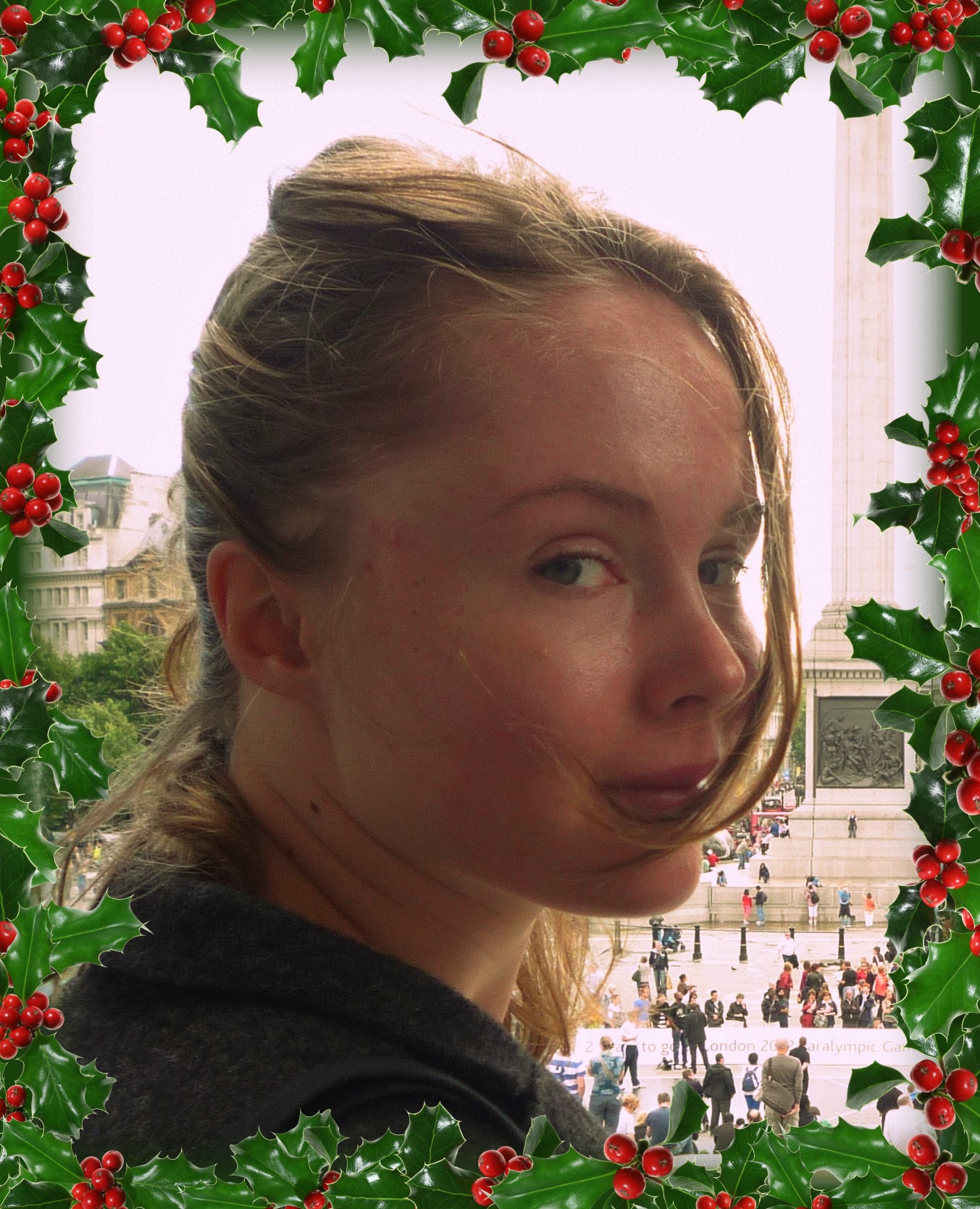
img: Charlotte Day surveying Trafalgar Square in London, this time with a jolly holly border (no ivy, though — that’s for next year!).

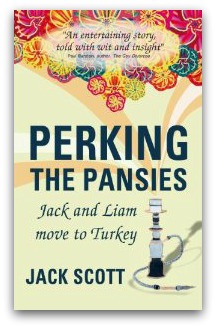
BOOK REVIEW: “Perking the Pansies — Jack and Liam move to Turkey,” by Jack Scott

For some months, I’ve been a big fan of Jack Scott and his blog, Perking the Pansies. Judging by the readership numbers, I’m not the only one, but that’s unsurprising.  Apart from the fact that Jack is one of the nicest bloggers on the block, how could anyone not be enticed by his introduction?

“Imagine the absurdity of two openly gay, recently “married”, middle-aged, middle class men escaping the liberal sanctuary of anonymous London to relocate to a Muslim country.”

Imagine, indeed. Even when it transpires that the Muslim country is Turkey and not Iran —

“We had no desire to be lynched from the nearest olive tree by the Revolutionary Guard”

— newcomers to the blog can be forgiven for wondering, “Guys – what were you thinking?”

Finding Paradise

Thankfully, the imminent publication of Jack Scott’s memoir, Perking the PansiesThe Book, means that readers will no longer have to scroll through months of blog posts for the answer to that question. While the blog’s first post gives a brief account of how Jack and his husband Liam left London for Turkey, the book fleshes out the logistics in a far more satisfactory manner.

Most people “of a certain age” will identify with the events leading up to this dramatic change in lifestyle. A midlife crisis, a middle-aged realization that personal happiness and mental health are worth infinitely more than a big number in the bank account, plus a couple of pieces of golden luck to make it all happen – how many of us have dreamed of just this, to leave the rat race behind and live in our own little Paradise?

Paradise Lost

Naturally, it’s not as simple as that. In leaving the corporate rat race behind, Jack and Liam encountered a new one – the expat rat race. It doesn’t matter where you are an expat – if you’ve ever lived abroad among fellow countrymen with whom you have nothing in common except nationality, you will recognize the competitors in this race. Jack describes them in detail enough to make the reader wince in sympathy.

The truly awful landlady, Chrissy, would be one reason for many people to put their suitcases back in the taxi and return to the airport. A member of The Ignorati  —

“Those who live in utter ignorance of the history and culture of their foster land, shout loudly in English, and see the world at large through the narrow-minded pages of the Daily Mail”

— Chrissy, for me, conjured up the image of a younger Alison Steadman in full-on Mrs Bennet mode. (Later, when Jack likened a hideous expat soiree to “Abigail’s Party without Demis Roussos” I was thrilled to have my impressions confirmed.)

Another memorable character, Clement, I imagined as the likely product of a coupling between a James Bond villain and Noel Coward. Jack deliciously described him as:

“The dotty but loveable old maiden aunt who always pitched up at Christmas and drank all the sherry.”

While I could continue to reminisce about other people I met between the pages of PTP, I won’t. Suffice it to say that Perking The Pansies is not so much about Jack’s Adventures Through The Looking Glass, but more about Who He Found There – a refreshing change from the many memoirs whose authors are constantly center-stage.

Compromise in Paradise

Many readers will also recognize the doubts Jack had about his new life:

“Sad people, bad people, expats-in-a-bubble people. They hate the country they came from; they hate the country they’ve come to. This was my social life. This is what I gave everything up for. This was Liam’s bloody Nirvana. We were the mad ones, not them.”

But eventually, when rid of the expat posse, Jack has this to say of Turkey and its own people:

“Turkey is a magical land graced by a rich culture, gorgeous people and an intrinsic love of the family. A respect for difference won’t destroy that. It’s okay to be queer….At times I think we’re floundering about like idiots, but now and then I think we’re making a real difference.”

Oh Jack — if only all your expat acquaintances could say the same thing.

I’m looking forward to your next book already.

Perking The Pansies by Jack Scott is available from Amazon.co,uk

STAY TUNED for tomorrow’s installment from our displaced fictional heroine, Libby, who is celebrating her mother-in-law’s departure before the holidays. (What, not keeping up with Libby? Read the first three episodes of her expat adventures.)

If you enjoyed this post, we invite you to subscribe to The Displaced Dispatch, a weekly round up of posts from The Displaced Nation, plus some extras such as seasonal recipes and occasional book giveaways. Sign up for The Displaced Dispatch by clicking here!

Related post:

CONTEMPORARY DISPLACED WRITING: Marías — The Man of Feeling

NOTE: Our review of Wendy Williams’ The Globalization of Love has been postponed until this Friday, December 16. In the meantime we’d like to share with you one of our favorite displaced writers, Javier Marías.

At school, an English teacher told my class that good writing should be like a scalpel. Quite what he meant by this was not entirely clear to me, but he said it with such intensity and with an accompanying, ever so disturbing stabbing gesture that I felt I should really take note of what he said. However, on first reading the work of Javier Marías, I finally understand something of what my teacher was trying to explain to my doltish teenage self. Marías’s ability to expertly set up a scene and then dissect the thought processes of his protaganists is a joy.

If you haven’t read any of Marías’s work you really should. Without a doubt he is one of the finest writers currently living and though he has a loyal readership in the English-speaking world, it should be much larger than it is.

When reading his novella The Man of Feeling , I came across one passage that struck me as being perfectly appropriate for featuring as a Contemporary Displaced Writing post. The narrator of The Man of Feeling is a young opera star who is constantly traveling as he tours the world. For the most part, this is not a glamorous life; it is, in fact, a stultifying life spent in rehearsal rooms and hotel bars — they are all different but yet they are all the same, too.

The extract I want to share has our opera star narrator relating his feelings when he first visits a new city:

… I enjoy the feeling that I am in a new and unfamiliar city; getting into public places and being aware that the people there speak a language I know only imperfectly or not at all; studying the clothes and hats (though nowadays one sees fewer of the latter) that the good citizens choose to wear in the streets; finding out if shops are full or empty during office hours; seeing how the news is treated in the newspapers; looking at certain examples of domestic architecture that one can only find in that particular part of the world; noting the typefaces that predominate in shop signs (and reading these like a savage, understanding nothing); scrutinizing the faces in the metro and on the buses which I frequent for that very reason; picking out particular faces and wondering whether I might or might not meet them elsewhere; deliberately getting lost in parts of the city where I have already learned to find my way, that is, with map in hand if I need it; observing the inimitable passing of each languishing day at each point on the globe and the uncertain and variable instant when the lights are lit; setting foot in places where our feet leave no trace, on the luminous asphalt of the morning or on some dusty, ancient stone pavement illuminated by a single street lamp as evening falls; visiting bars full of indistinguishable, blithely insignificant murmurings that cover and erase everything; mingling with the people in the white streets of the south or in the grey avenues of the north at the declining hour when people are going out for a stroll or coming home from work, that brief respite, seeing how the women go out in the evening or perhaps at night, all dressed up, and seeing the cars in their many colors waiting for them; imagining the parties they are going to; wasting time.

And in each city I visit I would like to meet people, to meet those smartly dressed women, who are perhaps climbing into their glossy, impleccable cars to drive to the opera to hear Leon de Napoles: to go and see me.

Extract from Margaret Jull Costa’s translation published by New Directions, available here. You should read it, you know. You really should.

STAY TUNED for tomorrow’s post, a review of the new expat autobiography Perking the Pansies, by Jack Scott.

If you enjoyed this post, we invite you to subscribe to The Displaced Dispatch, a weekly round up of posts from The Displaced Nation, plus some extras such as seasonal recipes and occasional book giveaways. Sign up for The Displaced Dispatch by clicking here!

Related posts:

Image: MorgueFile

Best of 2011: Books for, by and about expats

One of our Random Nomads in November, Aaron Ausland, had this to say about those of us who venture across borders:

Travel to a new place for three weeks and you can write a book, travel for three months and you can write an article, travel for three years and you’ll likely have nothing to say.

While that may be true, I’m afraid it hasn’t stopped many of us who’ve spent large chunks of our lives gallivanting around the globe trying out life in different countries, from taking up the pen.

As with any other group, some are born writers (and thrive on new surroundings), while others have become writers (attempting to make sense of their adventures), while still others have had writing thrust upon them (responding to invitations to share their experiences).

At the Displaced Nation, we revere people who publish books, fiction or non, that in some way assist those of us who are (or have been) engaged in overseas travel and residency. We feature — and do giveaways of — their works. And, for established writers with a global following, we’ve created a unique “category” called the Displaced Hall of Fame.

In this spirit — and in the December tradition of looking back at the past year’s highlights — I present the following (admittedly incomplete) list of books for, by, and about expats that were published in 2011, in these five sections (click on the title to go to each section):

  1. NOVELS ABOUT EXPATS
  2. NOVELS ABOUT “HOME”
  3. EXPAT MEMOIRS
  4. SELF-HELP, CROSS-CULTURAL & OTHER NONFICTION WORKS
  5. INSPIRATIONAL ANTHOLOGIES

A few more points to note:

  • Books in each category are arranged from most to least recent.
  • I’ve mixed indie books with those by conventional publishers (it suits our site’s somewhat irreverent tone).
  • To qualify for the list, authors must have been expats for at least six months at some point.

* * *

NOVELS ABOUT EXPATS

Three Questions: Because a quarter-life crisis needs answers (CreateSpace, October 2011)
Author: Meagan Adele Lopez
Genre: Women’s fiction
Synposis: A love story based loosely on the author’s own romance with a lad from Bristol, the action traverses continents through letters and features a quarter-life crisis, a road trip to Vegas, and two crazy BFFs.
Expat credentials: An American, Lopez lived as an expat in the UK for a while (she is now back in Chicago).
How we heard about it: Melissa of Smitten by Britain was a fan of Lopez’s blog (originally titled The Lady Who Lunches). The pair met her London in the summer of 2010, when Lopez was still living in England. Recently, Melissa has been supporting Lopez’s attempt to gain sponsorship for turning the novel into a screenplay.
Sunshine Soup: Nourishing the Global Soul (Summertime, October 2011)
Author: Jo Parfitt
Genre: Women’s fiction
Synopsis: Six expat women from the UK, US, Thailand, Ireland, Norway and Holland converge in Dubai in 2008. The action centers on a Brit, who is on her first posting, and an American, who is on her 25th. The Brit learns the ropes and settles in, while the American woman’s world begins to crumble.
Expat credentials: A prolific author, publisher and pioneer in addressing the issues of accompanying spouses and aspiring expat writers worldwide, Parfitt has been an expat for nearly a quarter of a century. Born British, she now lives in the Hague.
How we heard about it: We noticed a couple of interviews with Parfitt — one by expat coach Meg Fitzgerald and another by Expat Women.

The Beautiful One Has Come: Stories (Wyatt-MacKenzie Publishing, July 2011)
Author: Suzanne Kamata
Genre: Cross-cultural romance
Synopsis: Twelve short stories reveal the pains and the pleasures experienced by expat women, most of whom live in Japan.
Expat credentials: Kamata is an American who has lived in Japan for 20 years.
How we heard about it: Kamata and her book were featured on Kristin Bair O’Keeffe’s Writerhead Wednesday in July of this year.

Hidden in Paris (Carpenter Hill Publishing, April 2011)
Author: Corine Gantz
Genre: Women’s fiction
Synopsis: Three strangers — all American women — have reached the point of terminal discomfort with their lives so run away to Paris to begin anew.
Expat credentials: Gantz is a French expat living near Los Angeles. She is getting her own back by writing about American expats in Paris.
How we heard about it: We are long-time fans of Gantz’s blog, Hidden in France — in fact, we promoted one of her posts (about falling into her swimming pool) with the launch of TDN in April. We also interviewed her about her first novel as part of our “gothic tales” theme this past May.

Exiled (Quartet Books, April 2011)
Author: Shireen Jilla
Genre: Psychological thriller
Synopsis: The wife of an ambitious British diplomat, whose first posting brings them to New York, looks forward to escaping from Kent and leading the high-profile life of a successful expat — only to find her world being threatened by dark psychological forces on a par with those depicted in Rosemary’s Baby.
Expat credentials: A Third Culture Kid (she is half English, half Persian, and grew up in Germany, Holland and England), Jilla has also been an expat in Paris, Rome, and New York.
How we heard about it: TDN writer ML Awanohara read a review of Jilla’s novel by Kate Saunders in the Sunday Times. She approached Jilla in May about having an exchange with our readers about the gothic themes in her novel, in line with our site’s own delvings into the gothic aspects of expat life. Our readers loved her!

NOVELS ABOUT “HOME”

Lady Luck (Colorado Mountain Series)
Author: Kristen Ashley
Genre: Romance
Synopsis: Ex-con hero, wrongly imprisoned, gets mixed up with unlucky heroine, who will stop at nothing to help him get revenge.
Expat credentials: Born in Gary, Indiana, Ashley grew up in Brownburg and then moved to Denver, where she lived for 12 years. She now lives with her husband in a small seaside town in Britain’s West Country, where she has produced more than twenty books featuring rock-chick, Rocky Mountain, and other all-American heroines.
How we heard about it: Ashley is the friend of an old schoolfriend of TDN writer Kate Allison, who invited her to do a guest post for us on Britain’s (lack of) Royal Wedding preparations  for our Royal Wedding coverage.

Queen by Right: A Novel (Touchstone, May 2011)
Author: Anne Easter Smith
Genre: Historical romance
Synopsis: This is the fictional story of Cecily of York, mother of two kings and said to be one of the most intelligent and courageous women in English history.
Expat credentials: The daughter of an English army colonel, Easter Smith spent her childhood in England, Germany and Egypt. She came to New York City at age 24, and as she puts it:

Many years, two marriages, two children and five cross-country moves later I’m very definitely a permanent resident of the U.S. — but my love for English history remains.

(She now lives in Plattsburgh, New York.)
How we heard about it: Easter Smith and her book were featured on Kristin Bair O’Keeffe’s Writerhead Wednesday in October.

Dance Lessons (Syracuse University Press, March 2011)
Author: Áine Greaney
Genre: Irish Studies, Women’s Fiction
Synopsis: The action centers on a woman of French-Canadian background who marries an Irish emigrant who is working illegally in a bar in Boston. After his death by drowning, she visits Ireland for the first time and finds out what a shattered man he actually was.
Expat credentials: She may be a resident of Boston’s North Shore, but Greaney continues to identify herself as an Irish writer (County Mayo).
How we heard about it: Greaney and her book were featured on Kristin Bair O’Keeffe’s Writerhead Wednesday in October.
Pentecost: A Thriller (The Creative Penn, January 2011)
Author: Joanna Penn
Genre: Thriller
Synopsis: The Keepers of the stones from Jesus’s tomb — which enabled the Apostles to perform miracles — are being murdered. The stones have been stolen by those who would use them for evil in a world. An Oxford University psychologist spearheads a search for them in a race against time…
Expat credentials: English by birth, Penn grew up as a third-culture-kid and at the time of producing her first novel, was living in Australia.
How we heard about it: We are avid followers of Penn’s blog, The Creative Penn. Several months ago, TDN writer ML Awanohara deconstructed Penn’s post about what “home” means for writers for what it might teach expats and others who struggle with this issue as well. For Penn, home means some sort of spiritual kinship, which she has with two places: Oxford, where she went to university and near where her father now lives, and Jerusalem, which she’s visited at least ten times because she loves it there so much. Not surprisingly, she chose to set much of the action for her debut novel in these two cities.

EXPAT MEMOIRS
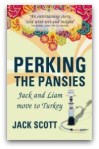
Perking the Pansies: Jack and Liam move to Turkey (Summertime Publishing, December 2011)
Author: Jack Scott
Synopsis: Dissatisfied with suburban life and middle management, Scott and his civil partner, Liam, abandon the sanctuary of liberal London for an uncertain future in Bodrum, Turkey. The book is based on Scott’s irreverent blog of the same name, which after its launch in 2010, quickly became one of the most popular English language blogs in Turkey.
How it came to our attention: Scott was featured as one of our Random Nomads in May of this year and since then, has done us the favor of commenting on and liking several of our posts. **Kate Allison will be reviewing his book for our site on Wednesday.**

Ramblings of a Deluded Soul (CreateSpace, September 2011)
Author: Jake Barton
Synopsis: In his inimitable style, the British-born Barton strings together snippets from new novels and try-outs with reminiscences and, for the first time, insight into his own remarkable experiences as a traveler and expat in Europe (he once owned a small French vineyard and had another job he’s not supposed to talk about). NOTE: Barton’s first novel, Burn, Baby, Burn, burned its way into the Top Ten of the Amazon All Books list.
How it came to our attention: Barton is an online acquaintance of TDN writer Kate Allison. We celebrated him in the early days of our blog for his insights on foreign-language learning in Spain.

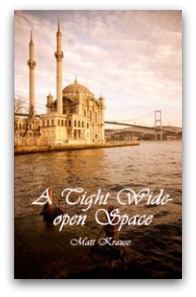
A Tight Wide-open Space: Finding Love in a Muslim Land (Delridge Press, August 2011)
Author: Matt Krause
Synopsis: A Californian who is now a Seattle-ite recounts how he became an Istanbullu, all for the love of a beautiful Turkish woman he met on a airplane. The year is 2003, and he can still hear the echoes of 9/11 as well as being acutely conscious of America’s engagement in two wars in Muslim countries. Eventually, he comes to love his new home more deeply than he might have expected.
How we heard about it: Linda Janssen, who writes the blog Adventures in Expatland, interviewed Krause about his book in October.

Planting Dandelions: Field Notes from a Semi-Domesticated Life (Penguin, April 2011)
Author: Kyran Pittman
Synopsis: A native of Newfoundland (her father was a well-known Newfoundler poet), Pittman writes about co-parenting with her charming Southern U.S. hubbie (they have three rambunctious boys); keeping the fiscal wolf from the door of their home in Little Rock, Arkansas; and honoring her marriage vows despite her refusal to give up her party-girl persona.
How we heard about it: Pittman came to our notice when she was a guest on Kelly Ryan Keegan‘s Bibliochat in late September.

Big in China: My Unlikely Adventures Raising a Family, Playing the Blues, and Becoming a Star in Beijing (Harper, March 2011)
Author: Alan Paul
Synopsis: Paul tells the story of trailing his journalist-wife to China and unwittingly becoming a rock star. His Chinese American blues rock band, called Woodie Alan, even earned the title of Beijing’s best band.
How we heard about it: We were early fans of Alan Paul’s back in the days of his Wall Street Journal online column, “The Expat Life.” Also, Paul and his book were featured on Kristin Bair O’Keeffe’s Writerhead Wednesday this past April.

The Foremost Good Fortune (Knopf, February 2011)
Author: Susan Conley
Synopsis: Conley, her husband, and their two young sons say good-bye to their friends, family, and house in Maine for a two-year stint in a high-rise apartment in Beijing. All goes well until Conley learns she has cancer. She goes home to Boston for treatment and then returns to Beijing, again as a foreigner — to her own body as well.
How we heard about it: Conley and her book were featured on Kristin Bair O’Keeffe’s Writerhead Wednesday in early October.

SELF-HELP, CROSS-CULTURAL AND OTHER NONFICTION WORKS

The Globalisation of Love (Summertime, November 2011)
Author: Wendy Williams
Genre: Relationships, self-help, humor
Synopsis: Williams interviews multicultural, interfaith and biracial partners from all over the world on what it feels like to “marry out” of one’s culture, religion and/or race. She also talks to experts on the topic and coins a term for it: “GloLo.”
Expat credentials: From a British-Ukrainian-Canadian family, Williams has been married to an Austrian for 13 years and lives in Vienna.
How we heard about it: TDN writer ML Awanohara listened to Jo Parfitt’s interview with Williams on her Writers Abroad show (Women’s International Network) and was attracted to the ideas of a book that treats this topic with humor. **TDN writer Anthony Windram will review the book for our site tomorrow (Tuesday).**

Modern Arab Women — The New Generation of the United Arab Emirates (Molden Verlag, November 2011)
Author: Judith Hornok
Genre: Women’s studies
Synopsis: The book consists of 20 chapters, each a stand-alone interview with an Emirati woman from disciplines as varied as business, film, medicine and politics. The women talk to Hornok about their careers, philosophies of life and plans for the future. The book, which is published in German and English, aims to dispel some of the Western myths surrounding Arab women.
Expat credentials: While not quite an expat, Hornok has been moving between the UAE and her home in Vienna, Austria, for eight years.
How we heard about it: TDN writer ML Awanohara read an article on the book in The National (UAE English-language publication) and became intrigued.

Expat Women: Confessions — 50 Answers to Your Real-life Questions about Living Abroad (Expat Women Enterprises Pty Ltd ATF Expat Women Trust, May 2011)
Authors: Andrea Martins and Victoria Hepworth (foreword by Robin Pascoe)
Genre: Women’s self-help, family, relationships
Synopsis: Experienced expats share wisdom and tips on topics that most expat women face, such as the trauma of leaving family back home, the challenges of transitioning quickly, intercultural relationships, parenting bilingual children and work-life balance. They also tackle more difficult issues such as expat infidelity, divorce, alcoholism and reverse culture shock. The book is based on the “confessions” page of Expat Women, the largest global Web site helping women living overseas.
Expat credentials: Andrea Martins is the director and co-founder of Expat Women. An Australian who has spent many years abroad, she began dreaming of connecting expat women worldwide when an expat in Mexico City. Victoria Hepworth is a New Zealander who has lived in Japan, China, Russia, Sweden, India and is currently living in Dubai, UAE. She is a trained psychologist who specializes in expat issues.
How we heard about it: Andrea Martins announced the publication of the book to much fanfare on Twitter and in other social media venues. It has been widely reviewed on expat blogs.

Marriage in Translation: Foreign Wife, Japanese Husband (CultureWave Press, April 2011)
Author: Wendy Nelson Tokunaga
Genre: Relationships, self-help
Synopsis: Tokunaga conducts a series of candid conversations with 14 Western women about the challenges in making cross-cultural marriages work both inside and outside Japan. She quizzes them about the frustrations, as well as the joys, of adapting to a different culture within married life.
Expat credentials: Born in San Francisco, Tokunaga has spent numerous years studying, living, working and playing in Japan. She is the author of two Japan-related novels, published by St. Martins Griffin. Oh, and did we mention her Japanese “surfer-dude” husband?
How we heard about it: Sometimes one tweet is all it takes! (We follow Wendy Tokunaga on Twitter.)

A Modern Fairytale: William, Kate and Three Generations of Royal Love (Hyperion/ABC Video Book, April 2011)
Author: Jane Green
Genre: Romance, royalty
Synopsis: In this video book for ABC News, produced just in time for the Royal Wedding in March, best-selling chick-lit novelist Jane Green follows the stories of three generations of royal love from their meeting up to and after their respective wedding days. She concludes that Kate and William have a much better chance than William’s parents of enjoying a relationship on their own terms.
Expat credentials: Born in London, Green worked as a feature writer for The Daily Express before trying her hand at writing novels. She now lives in Westport, Connecticut, with her second husband and their blended family.
How we heard about it: One of us noticed that Jane Green had been tapped to provide coverage of the Royal Wedding for ABC News. We then invited her to talk about her e-book and engage with our readers in a debate on whether women should still aspire to be “princesses” in the 21st century — a post that received a record number of comments.

INSPIRATIONAL ANTHOLOGIES

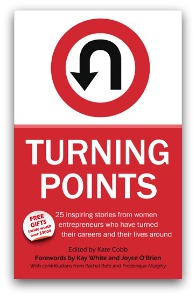
Turning Points: 25 inspiring stories from women entrepreneurs who have turned their careers and their lives around (Summertime Publishing, November 2011)
Editor: Kate Cobb
Synopsis: In this collection of stories from women all over the world, the focus is on the moments, or short passages of time, when a woman was facing something challenging and came out the other side smiling.
Expat credentials: Cobb is a British woman living in France, and about a third of the contributors — including Jo Parfitt and Linda Janssen — are expats who now run their own businesses.
How we heard about it: Linda Janssen promoted the book on her blog, Adventures in Expatland.

Indie Chicks: 25 Women 25 Personal Stories (Still Waters Publishing, October 2011)
Compiler: Cheryl Shireman
Synopsis: 25 indie novelists share personal stories in hopes of inspiring other women to live the life they were meant to live. (All proceeds go to the Susan G. Komen Foundation for breast cancer research.)
Expat credentials: Close to half of these indie authors are expats or have done significant overseas travel. To take a few examples: After living in Portland, Oregon, for most of her life, Shéa MacLeod now makes her home in an Edwardian town house in London just a stone’s throw from the local cemetery. Linda Welch was born in a country cottage in England, but then married a dashing young American airman, left her homeland, raised a family, and now lives in the mountains of Utah. Julia Crane is from the United States but recently moved to Dubai with her huband and family (her personal story concerns the adjustment process).
How we heard about it: Again, sometimes all it takes it a tweet (we picked up one of Linda Welch’s).

* * *

Questions: Have you read any of the above works and if so, what did you think of them? And can you suggest other works to add to the list? My colleagues and I look forward to reading your comments below!

STAY TUNED for tomorrow’s post, a review of The Globalisation of Love, by Wendy Williams, and for Wednesday’s post, a review of Perking the Pansies, by Jack Scott.

If you enjoyed this post, we invite you to subscribe to The Displaced Dispatch, a weekly round up of posts from The Displaced Nation, plus some extras such as seasonal recipes and occasional book giveaways. Sign up for The Displaced Dispatch by clicking here!

Related posts:

Same lyrics, different melodies: On not coping with an expat Christmas

“Drink now the strong beer,
Cut the white loaf here,
The while the meat is a-shredding;
For the rare mince-pie,
And the plums stand by,
To fill the paste that’s a kneading.”
“Ceremonies for Christmas,” by Robert Herrick

Despite at times being a rather ornery young man, I do enjoy Christmas. However, when I really stop and I’m honest with myself I don’t particularly enjoy Christmas in my new “home”.

Minor differences, those little differences that makes being a relatively new expat interesting, irritate the life out of me at Christmas. For a few weeks I turn into one of those skin-peeled British expats living on the Costa del Sol. You know the sort, Richard Littlejohn readers who won’t eat any of that “foreign” muck and find themselves in a constant state of exasperation when the waiters fail to understand their English. Come Yuletide, I transmogrify into them, into something I hate. No longer do I find myself charmed by the local traditions, because they are not my traditions and at Christmas that is precisely what I seem to be desperately grasping for.

To damnation with this “home is where you make it” tosh. Come Christmas there is a specific time and place I find myself in. It turns out that this season brings out the inner conservative in me. Yes, there is still an abundance of tinsel and Christmas trees everywhere, but somehow it all feels slightly off. The problem is that my notion of Christmas is a peculiarly English one.

I try listening to Christmas carols but they often end up striking a discordant note to me. I try singing along to them, but I get lost in the music — by which I don’t mean I get so moved I have a transformative experience, I mean I get tripped up by an unexpected rhythm or tune. The American version of Away in a Manager differs significantly from the British counterpart — same lyrics, different melodies. It is all too culturally discombobulating (that would be a good name for a blog).

On television I watch the old Rankin/Bass TV special, Rudolph the Red-Nosed Reindeer, but why? I think I’m hoping that my mind will be tricked into falling for the illusion of nostalgia, the warm memories of a childhood I didn’t have. So each year I force myself to watch that show, hoping I’ll like it. As it happens, I just find myself irritated by Hermey the elf and his dentistry obsession. By the time the King Moonracer, a cross-eyed lion with wings, is introduced into the narrative I decide that Nancy Reagan was right and everyone should “just say no” to drugs (something Rankin and Bass appeared to have found difficult) and turn off the TV.

I try to make the best of a bad thing. I try to educate the natives. I roll down the windows of my car and drive around town with Slade‘s Merry Xmas Everybody convinced that once they hear it they will inately know of its festive superiority over their own efforts. I correct small children when they call Father Christmas, Santa Claus. And like a right old Fanny Cradock (imagine if Julia Child were British — and looked liked Baby Jane), I make mincemeat and force everyone I know to eat mince pies against their own will. Of course, buying mincemeat is a near impossibility here. Even buying all the necessary ingredients is a problem though it can be amusing trying to find them all. I’d advise you to find the most gormless person working at your local supermarket and ask them if they stock suet.

Once I have all my ingredients, I go about making my mincemeat and the heady rich smells of spices and fruit take over the house and at that moment, though it is usually a week before Christmas itself I feel the most Christmassy that I will for the whole season. The next night I make mince pies with the mincemeat along with mulled wine and I have friends over. I put on Carols from King’s and make everyone else put on a ridiculous fake English accent. It’s not quite home, but it’s the best that I can do.

For those at all interested in making mince pies, recipe follows:

—————————————————————————————–

MINCE PIE RECIPE

Mincemeat Mix Recipe:
I coarsely chop (though that’s optional) 12oz raisins, 8oz golden raisins and 4oz cranberries (feel free to mix and match the amounts to suit your own taste)
Place all that into a bowl and add a handful (I”m not a great one for measurements) of slivered almonds.
I grate the rind of 2 lemons and 2 oranges into the bowl and then add their juice to the mix.
Add 1/2 tsp of grated nutmeg
Add 1/2 tsp of ground cinnamon
Add 2 tsp of ground all spice
I peel an apple and grate it into the mix
Add 8oz of soft brown sugar
Add 2oz (or about half a stick) of unsalted butter. This is in place of suet, so if you can get hold of some then feel free to use that rather than butter.
Mix it all together.
Put it in the oven, covered at 200F for three hours.
After three hours take it out of the oven. Stir the contents and add to it six table spoons of brandy.
Put in the fridge for at least 12 hours to allow the flavours to meld together.

With the pastry, it’s just a basic short crust. I use a flour to butter ratio of 2:1 and add a pinch of salt. I also add grated orange rind and then bind with water.

The rest you can probably work out. Roll out your pastry, cut into circles large enough for your muffin baking tray. Place into baking tray and put a tablespoon of mincemeat. Cover with a smaller pastry circle as a lid for the pie. Bake until before you can smell burning. Sprinkle with icing sugar.

Best served warm with a glass of mulled wine.

STAY TUNED for tomorrow’s post, our first canine random nomad!

If you enjoyed this post, we invite you to subscribe to The Displaced Dispatch, a weekly round up of posts from The Displaced Nation, plus some extras such as seasonal recipes and occasional book giveaways. Sign up for The Displaced Dispatch by clicking here!

Related post: