The Displaced Nation

A home for international creatives

Tag Archives: Memoir | Travel | Food Writers

JACK THE HACK: Expat authors, let’s review the reviewer situation

JACK THE HACK _writingtipsAfter an expat experience in Bodrum, Turkey, that was literally something to write home about (as in a book!), Jack Scott traded in the dream for a less pressured existence back in the UK, than the one he was originally escaping from. In his monthly column for the Displaced Nation, he attempts to give back something to the poor souls out there who are still displaced and hacking away at travelogues-cum-memoirs or, in some cases, autobiographical novels. Jack the Hack has been there and done that and can lend a helping hand. Warning to non-Brits: Don’t be put off by his wry sense of humo(u)r!

—ML Awanohara

There’s no doubt that a sparkling set of reviews is one of the most potent ways to market a book (or anything else for that matter). Conversely, bad reviews (or no reviews at all) are poison.

So, how difficult is it to elicit those five gold stars everyone’s chasing?

Apart from emotionally blackmailing your nearest and dearest (something I assume you’ve already done), there are a number of little tricks you can try when it comes to beefing up your scrapbook.

Tricks of the trade

Here are three basics:
1) Whenever someone writes something positive about your masterpiece on social media or on your blog, do the right thing and thank them. While you’re at it, ask if they wouldn’t mind posting a review on Amazon or Goodreads. Some won’t but some will.

2) Search out book review sites online. Some review for free, some for a small fee—and all will expect a freebie. Many of these sites will post their review on the major bookselling sites as well as their own website.

3) Raise your game even further by approaching the Amazon top reviewers. Click on a reviewer, check out their interests and if they have listed their contact details, drop them a begging letter. This won’t guarantee you a good review (or one at all)—and be careful to select someone who is interested in your type of book. Someone into soft porn vampire romps is unlikely to rave about your expat escapades, however worthy and well written they are.

Damning with faint praise

There’s a downside to all this. Reviewing can be a rum business. Amateur hacks, often anonymous and sometimes with an axe to grind or with lofty literary pretensions, can damn with faint praise or go nuclear with their toxic pen.

Naturally, no book appeals to everyone. Literature, as with art, is in the eye of the beholder.

Even writers at the top of the heap get mixed critiques. Someone once wrote that Captain Corelli’s Mandolin was “…the worst book I’ve ever read.” Sure, it’s not everyone’s cup of tea—but the worst book ever?

Was the author, Louis de Bernières, much bothered? Not with a fat cheque for the film rights in his back pocket, he wasn’t.

Should a review like that count? Well, here’s the rub. Mass appeal retailers who positively encourage reviews as part of their business model are far too egalitarian. There’s very little discernment and no filter. Generally speaking, every comment carries equal weight. (A notable exception is something written by one of Amazon’s top reviewers, as mentioned earlier. These guys do have clout).

Hoisted by their own petard? If only…

Have you ever read a book review that’s so badly written, it’s barely readable? I know I have. Talk about irony. It’s like a playground brat screaming “I don’t like you so there!” just because he can.

For my part, if I don’t have anything good to say, I tend not to say it at all. It’s bad karma.

Like it or lump it, mixed reviews are an occupational hazard. People are entitled to express their view about something they’ve paid hard cash to read. Good, bad or indifferent, as long as it’s honest and not gratuitously offensive, it’s fair comment even when you think it’s unfair. Just hope the good drowns out the bad.

As for me, I’ve gotten off lightly. Reviews for my book have been very positive, but I’ve had the odd wobbly moment, too. Someone once joined Goodreads just to trash my book and make sure it dropped down a reading list by voting up every other title. Who was the literary troll? I will never know. Was I hurt? Sure was.

Rogue reviewers? It reminds me of why dogs lick themselves—because they can.

Which leads to—

WRITING TIP FOR EXPATS NO 6:

The best you can do is rise above the din, turn the other cheek and keep you own counsel. It doesn’t do to spit back even when sorely provoked.

* * *

Readers, any comments, further questions for Jack the Hack? He’ll be back next month with some more writing tips…

Jack Scott’s debut book, Perking the Pansies—Jack and Liam move to Turkey, is a bitter-sweet tragi-comedy that recalls the first year of a British gay couple in a Muslim country. For more information on this and Jack’s other titles, go to his author site.

STAY TUNED for next week’s fab posts!

If you enjoyed this post, we invite you to register for The Displaced Dispatch, a round up of weekly posts from The Displaced Nation, with seasonal recipes, book giveaways and other extras. Register for The Displaced Dispatch by clicking here!

Related posts:

Images: from top, clockwise: Hand with pen / MorgueFile.com; Boats in King’s Lynn, Norfolk / MorgueFile.com; Jack Scott, used with his permission; Turkish boats / MorgueFile.com

And the August 2013 Alices go to … these 3 international creatives

 © Iamezan | Dreamstime.com Used under license

© Iamezan | Dreamstime.com
Used under license

As subscribers to our weekly newsletter know, our Displaced Dispatch presents a weekly “Alice Award” to a writer or other kind of creative person who we think has a special handle on the curious and unreal aspects of the displaced life of global residency and travel. Not only that, but this person likes to use their befuddlement as a spur to creativity.

Today’s post honors August’s three Alice recipients. Beginning with the most recent, they are (drumroll…):

1) CALLISTA FOX, TCK blogger and author of the serial novel Suite Dubai

Source: “Friday Night Lights vs. The Eurotrash Girl on CallistaFox.com
Posted on: 26 June 2013
Snippet:

Our boarding school offered cheer leading as an afternoon activity… I signed up because it sounded better than typing or drafting and my parents wouldn’t pay for dressage. We knew only a handful of cheers. None of us could name a proper jump, let alone do one. We wore white tennis skirts and blue sweatshirts and any color of hightop Reebok we owned. When we ran out onto the field to do our pathetic cartwheels the audience was quiet, a few laughed. True, the grass was wet and my roommate Samantha slipped and skidded on her chin. We didn’t have our routine perfected.

Citation: Who stole the tarts, Callista? Who stole the tarts? Your account of your bout with cheer leading at a boarding school in Austria suggests that you were in a classic Alice-in-Wonderland situation, perhaps without even realizing it. Because no young American woman in her right mind would cheer an Austrian team playing Australia in American-style football on a field marked for soccer, unless they’d stepped through the looking glass. Indeed, your description is missing some crucial details, for instance:

  1. Were the teams using a koala bear as the ball? Koalas being to Austria what flamingos are to England—namely, more New World than Old. (Notably, koalas like to eat the leaves of the eucalyptus tree, which doesn’t exactly thrive in The Land of Long-needled Pines.)
  2. Did anyone propose a trial for all of those unruly fans in the half-filled stands who were throwing things at you and the other cheerleaders?

All of which brings us back to our original question: was it an Aussie or an Ausie, the Knave who stole the tarts? That’s what we (and presumably your all-American Texan husband) would most like to know.

Still, we did find amusing the tales of ThirdCultureKid-land that you told to your better half. Clearly your quintessentially TCK life had its moments, including the time you watched a guy eat glass in a bar in Nicosia, Cyprus, when you were only 14.

Is it any wonder that when your parents moved you back to Norman, Oklahoma, when you were 20, you felt exactly like Alice, who told her sister: “Oh, I’ve had such a curious dream!” (You did make a lot of it up, right?)

2) CHRIS ALDEN, British expat; author and journalist

For his book: “101 Reasons to Live Abroad…and 100 Reasons Not To”
Published: March 2013
From the book description:

Do you dream of living abroad? If so, you’re in good company. Tens of thousands of people every year emigrate from the UK—leaving behind the security of work, family and friends for the promise of better weather (hopefully), better prospects (sometimes) and a carefree existence (keep dreaming).

So is now the time to leave Britain and start life as an expat? Or have you already started planning the big move overseas?

101 Reasons to Live Abroad … & 100 Reasons Not To helps you discover if living abroad is right for you. It’s an uplifting guide to the positive sides of life as an expatriate—and a reality check about the challenges that relocation brings.

Citation: Chris, we understand that you’re also the author of 250 Things to Do in Cyprus on a Sunny Day, so would encourage you at some point to compare notes with your fellow Alice awardee, Callista Fox. In the post cited above, Callista reports that, when attending boarding school in Nicosia, she and her friends particularly enjoyed hanging out in a bar drinking Carlsberg with UN soldiers (they were there to keep the peace between Cypriots and Turks). We’re genuinely curious: does this particular activity rank in your Top 250? Or perhaps you think it’s better left for a rainy day? (Actually, does Cyprus even have rainy days? Oh, that’s right: it’s only semi-arid.)

Anyway, we’re awarding you an Alice because, like Lewis Carroll’s little heroine, you appear to appreciate both the positive and negative aspects of turning one’s life upside down, with the balance tipped every so slightly towards the positive. We believe Alice would be impressed that you offer a final, 101st reason to live abroad for those who, having been offered as many as a hundred reasons both for and against, still find themselves dithering. After all, when Alice’s sister urges her to run inside to get her tea, she obliges her “thinking while she ran, as well she might, what a wonderful dream it had been.”

3) LINDA JANSSEN, writer, speaker, consultant, global adventurer and cultural enthusiast

For her book: “The Emotionally Resilient Expat”
Published: 22 June 2013
From the book description:

Linda A. Janssen combines candid personal stories from experienced expats and cross-culturals, with a wealth of practical tools, techniques and best practices from emotional, social and cultural intelligence, positive psychology, mindfulness, stress management, self-care and related areas.”

Citation: Linda, as you know, we’ve been an avid follower of yours on Adventures in Expatland, which has helped to stimulate many of our own “through the looking glass” insights. And now we see you’ve contributed a tome to the discourse on what to do when you fall through the rabbit hole and feel culturally discombobulated. According to your book, which is sprinkled with expat stories and anecdotes, the answer lies in calling on (or developing) reserves of emotional resilience—a quality Alice had in spades, so to speak. Upon hearing of the Queen of Heart’s intention to have her decapitated, she retorted thus:

You’re nothing but a pack of cards!

At which point

the whole pack rose up into the air, and came flying down upon her: she gave a little scream, half of fright and half of anger, and tried to beat them off, and found herself lying on the bank, with her head in the lap of her sister, who was gently brushing away some dead leaves that had fluttered down from the trees upon her face.

Now if that isn’t resilience, what is?

From now on, we look forward to reading about your Adventures in Repatland, which as we noticed from your last post, are only just beginning:

At long last I’m beginning to surface, coming up for air in a new stage in a new place in a country and culture which seem familiar yet I don’t always recognize.

Hey, if it helps to know, we’ve got your back on this one!

* * *

So, readers, do you have a favorite from the above, or have you read any recent posts you think deserve an Alice Award?  We’d love to hear your suggestions! And don’t miss out on these weekly sources of inspiration. Get on our subscription list now!

STAY TUNED for our next post!

Writers and other international creatives: If you want to know in advance whether you’re one of our Alice Award winners, sign up to receive The Displaced Dispatch, a round up of weekly posts from The Displaced Nation, with news of book giveaways, future posts, and of course, our weekly Alice Award!. Register for The Displaced Dispatch by clicking here!

Related posts:

NEW VS OLDE WORLDS: The “expat ten” can work both ways!

Libby Collage New&OldEvery two weeks, the Displaced Nation publishes an episode in the life of fictional expat Libby Patrick, a 30-something British woman who has relocated with her spouse to a town outside Boston. Her diary, Libby’s Life, by Kate Allison, is replete with observations about life in New England vs. England. In the weeks when Libby isn’t published, we are featuring posts by writers who are sensitive to the subtle yet powerful differences between new and “olde” worlds. Today Bobbi Leder, an American trailing spouse, responds to Claire Bolden’s post of two weeks ago, in which she claimed that a tour in the United States inevitably entails a ten-pound weight gain. Turns out, it goes both ways!

—ML Awanohara

* * *

Bobbi with sausage and friesMexico has just surpassed the United States as the fattest country in the world, according to new UN figures released last month.

It’s an honor another country can have as far as I’m concerned, but when America was the fattest in the land I was truly perplexed.

Yes, you heard that right: perplexed. Now I know there’s a lot of unhealthy food in the States (e.g., BBQ ribs, deep-fried everything-you-can-possibly-think-of, junk food galore) and many Americans are addicted to their sugar, fat and salt. But conversely there’s also a lot of very healthy food available in the States.

At the end of the day, it’s about making a choice.

When I expatriated to the UK over a decade ago—I moved from the Washington, D.C., metro area to Southampton, on the south coast of England—I didn’t have many healthy choices. Over a decade ago, that part of England simply didn’t have health food stores, nor were there restaurants catering to those of us who sought out low-fat, low-salt meals. As for vegetarian dishes, these were practically non-existent.

It was impossible to find a sandwich where the bread wasn’t smothered in butter or the fillings weren’t loaded with fatty meats or (full fat) mayonnaise. I found it very difficult to eat well because the food options I was used to simply weren’t available.

Cheery bye to Size 2!

Before moving to England I was thin, some would even say skinny at a size 2 (an American size 2 that is); but after living in Southampton for a few months, my weight crept up on me like a burglar in the night, and before I knew it, I was two sizes heavier.

And if you think I was binging on fish and chips, think again. I never touched any of the stereotypical British foods because they loaded with saturated fat. I still remember never being able to eat breakfast at the Southampton airport because all they served was the greasy English breakfast. The sight of a full English breakfast made me nauseous: back bacon, sausages, beans, two fried eggs, mushrooms, and fried bread, all cooked in grease—and they say America is the capital of fried food?

There was a reason why we went out for Thai food every Friday. It was the only place we could find that didn’t serve fatty meals and they’d alter any dish to suit their customers. Forget about trying to find a healthy item on the typical pub menu or in the food court of the local mall.

Even in the supermarkets I couldn’t find the healthy choices I was used to, like veggie burgers, soy cheese, and low-calorie bread.

Before moving to Southampton, I’d eaten a mostly ovo-vegetarian diet, with the occasional lean poultry and fish. When I wanted “junk food,” I would buy lower calorie options like baked potato chips.

After the move, I felt as if I had no choice but to start eating ingredients I never would have eaten otherwise including pork, beef and cheese. And food prices were higher compared to the States, which made grocery shopping a challenge—even at Asda, a British supermarket chain owned by Walmart. The produce was often not up to par, and grocery costs were higher than we’d budgeted for.

So I found myself eating things that made me gain weight—despite going to the gym four times a week, and either walking or biking to most places—and I wasn’t happy about it.

New diet, new regimen

After receiving an invitation to my cousin’s wedding in the States, I knew I had to lose weight in just a few months, so I did something I never had the time to do before: I learned how to cook.

I looked for low-fat recipes online that included ingredients I could realistically obtain. I took charge of what I was eating despite my location and its limitations.

Eventually, the weight came off, and after living in Southampton for a year and a half, we moved to London, where healthier food choices were more readily available.

I even took my cooking to the next level after watching British culinary shows—I knew the Brits could make healthy food—and began to make gourmet meals that were not only tasty but low in calories and fat.

After London we moved to Wales and wound up being in the United Kingdom for six years. Not once during that time did I have:

I did, however, have one British staple: the Sunday roast, which consists of roasted vegetables, potatoes and lean beef or chicken.

It was actually one of my favorite meals.

My cup of tea

Today, after moving a few more times (ah, the life of a trailing spouse!), I live in St. John’s, Newfoundland, where I’m fortunate that the times have changed and health food as well as vegetarian options are the norm in most supermarkets and restaurants.

I have no idea if Southampton now offers healthier choices in their restaurants and supermarkets—one can only hope so for the sake of the university students who make up a large population of its city.

The moral of my story is that even though you might move to a country (or an area of that country) where fatty food is the staple, it doesn’t mean you have to eat it.

Looking back, I’m grateful for my experience in Southampton because even though I saw beef and cheese as the enemy when I first moved there, I still eat both today (just in moderation alongside my usual healthy diet), which makes life so much easier when dining out and moving around the globe as an expat.

* * *

Thanks, Bobbi, for making us realize that America is not the only country that fosters weight gain. Readers, what do you make of her observations? Are we global nomads destined to balloon in size as we move around the globe—has that been your experience? Do tell! (A good thing Bobbi hasn’t ended up in Mexico yet, that’s all I can say…)

Bobbi Leder, 43, is originally from New York and grew up in New Jersey. She has moved at least 11 times (she lost count after the fifth move) in the last 18 years thanks to her husband’s job in the oil and gas industry. Leder is a freelance writer and the author of the children’s book, The Secret Police-Dog, but her most important roles are those of cocker mom (to her very high maintenance English cocker spaniel or just cocker spaniel to everyone outside of North America) and wife to her workaholic husband. Leder still exercises several times a week, eats well most of the time—hey, a gal has to treat herself every now and then—and does something British daily: she drinks tea.

STAY TUNED for next week’s fab posts!

If you enjoyed this post, we invite you to register for The Displaced Dispatch, a round up of weekly posts from The Displaced Nation, with seasonal recipes, book giveaways and other extras. Register for The Displaced Dispatch by clicking here!

Related posts:

img: Bobbi Leder enjoying(?!) a sausage and fries during a trip to Germany while living in the UK.

Portrait of woman from MorgueFile; Lighthouse (R) from MorgueFile; Lighthouse (L) from MorgueFile

GLOBAL FOOD GOSSIP: Winning the war of Global Food One-upmanship

JoannaJoanna Masters-Maggs, our resident Food Gossip, is back with her column for like-minded food gossips.

This month: The war of foodie one-upmanship, or “Who’s travelled the most?”

* * *

“I’m doing it the Malaysian way” said my friend with satisfaction as she poured her too hot tea from one cup to another and back again to cool it.

It was my cue to ask “How do you mean?” thus allowing her to launch into (yet another) story of how things are done in some place or other she had visited.

It was hot, I was grumpy, and my friend’s tone was just a touch too self-satisfied.

The pause grew as I busied myself with milk and sugar.  It extended into a grim silence as I resolutely avoided asking.  Not generous of me, I know, but in my defense I have never pretended to be Pollyanna, and sometimes those “we found this marvelous place just off the beaten track” stories just get on your nerves.

It would be another 5 years before I lived in Malaysia and discovered Teh Tarik for myself.  The pouring trick was not to do with cooling, but with the mixing and frothing of a sort of tea made with condensed milk.  An environmentally friendly cuppotino, I suppose.

Look where I’ve been — and you have not!

All expats have probably found themselves on one side or another, or both, of this conversation.  Expats and serious travellers are all engaged in an endless war of covert operations.  We maneuver for superiority by exposing snippets of our discoveries and being impressed, or not, by those of others.  We certainly don’t like to admit to this unedifying trait of One-upmanship, preferring instead to see ourselves as laid back free spirits and survivors of alien situations.  Yet, the truth is, it is our Achilles heel.

Expat tales of unusual foods, which hopefully Waitrose will not discover before we get home, allow us to say “look where I’ve been, and you have not”. While appearing to share generously of our experience, we want to show what we know and what those who stayed at home do not.

Calling bluff on Bi Bim Bap

“You’ll never go hungry in a Korean restaurant if you can just remember to ask for Bi Bim Bap.  After all, who could forget a word like Bi Bim Bap?”

My friend’s hands spread out, palms up.  Her shoulders and eyebrows rose in perfect synchronicity.  The gesture suggested that not only was it impossible to forget such a word once heard, but that not knowing about Bi Bim Bap was unimaginable in itself.  We had reached the point that expats will recognise from the cold war of One-upmanship.

I faced a difficult choice.  Was I going to expose my lack of knowledge over “Bi Bim Bap” and lose a little position in the “most well travelled”, or was I going to take the dangerous but potentially game-winning risk of pretending that I knew what it was and indeed had been taught to produce one by a well-known Korean chef whom I had just happened to bump into?

The advantage of the first approach is  the warm glow of generosity of giving another a moment to shine. That and the fact you might actually learn something interesting.  The second approach means you avoid having to listen to a long-winded boast.

Does she actually think she invented the Bi Bim Bap? you mutter darkly to yourself.

Of course, in not asking, you remain in frustrating ignorance, especially if you forget to Google it upon returning home.  More seriously, you risk exposure as a fraud.  That is enough to chill the heart.

You might be thinking that the example of Bi Bim Bap was a little repetitive, following so quickly as it does on the heels of Teh Tarek.  I’m afraid I couldn’t resist the opportunity to show off – again.  As I say, it is a hazard of being an expat with an unfortunate interest in food.

Expats 1, Tourists 0

Hari Raya Aidilfitri:  outlying suburb of KL far from the Tourist Zone.  These stalls offer traditional foods for  to locals and a wealth of boasting opportunities for the lucky expat passerby.

Hari Raya Aidilfitri: outlying suburb of KL far from the Tourist Zone. These stalls offer traditional foods for to locals and a wealth of boasting opportunities for the lucky expat passerby.

Expats like to think that living overseas gives you a window on a world that tourists or those who remain at home will never see.  Tourists will never have to face the problems of daily life in a strange language or culture.  They will never have to get the electricity turned on, find a plumber, or do the weekly family shop.  A tourist’s world in many respects doesn’t differ hugely from place to place.   Pre-booked hotels, transport from airports, organized trips on air-conditioned buses.  Even backpackers travels follow a familiar path.

The wonderful Nasi Lemak (coconut rice to you) of a tourist hotel was doubtless an experience, just not the same as the hawker stall the expat discovers in the backstreet to which they have been directed to find a furniture repair store.

That, we believe is the uniqueness of living overseas.

Expats trump tourists.

How naughtily satisfying.  One-upmanship indeed.

A Tower of Babel for the food industry

As the globalization of food companies and supermarkets continues to homogenise world food experiences, the expats’ territory is further threatened.  The same products appear the world over and are marketed similarly in the name of brand identity.

Take the confectionary market.  An advert for Maynards Sour Patch Kids is currently airing on UK television.  It has been voiced over in an American accent and uses American vocabulary such as “soda”. It upsets me. Maynards was bought by Cadbury, which in turn was bought by American Kraft, but why did a company with a uniquely English Quaker social and economic philosophy have to be marketed in England in much the same way as it is probably marketed in America?  How could this happen to the company of a man who had invented the wine gum to help wean the impoverished working class off the demon drink?

Sour Patch Kids should be sold in America to American kids.  Maynards should be selling wine gums to English kids, using an English accent.  Kids should be allowed the thrill of receiving a unique item from granny or auntie when she returns from her travels.   They should be asking friends visiting those countries to “bring us back a packet”.  They should be learning at an early age the delicate game of Travellers’ One-upmanship.

The joy unbounded of discovering a packet of a long remembered treat is equal to the joy of a pig that unearths a truffle.  These are the experiences of travel and expatness that must not be lost.  They will be lost, mark my words, if Haribo takes over the world as it threatens to do so, with their gummy bears and fizzy cola.  Brands unique to different countries must be guarded jealously, much as France guards the name “champagne”.  Mexican Chili sweets, English Trebor mints and American Peanut Butter Cups can then keep their allure and remain in production.  The thrill of the chase and the discovery of the new should not be lost.  A world of confectionary should there for us all.

Expat living: A licence to boast

Expats have a sneaky feeling that knowledge of and access to certain foods is our earned right.  It is cheating if the supermarkets bring them to homebodies and tourists collect them at the airport on the way out.

I feel I have earned the right to drone on about wonderful Venezuelan coffee and why it is so difficult to find because I survived Caracas’ toilet roll shortage of 2009.  Really, every day for weeks I drove around all the supermarkets of the city searching out any flushable paper products.  Like the natives of the city, I bought my one allocated packet in one supermarket, got in the car and drove to the next.  If there was none, I bought none.   Expat and local as one in a shared quest.  It was while diligently scouring the shelves of every aisle in one that I found the white shrink-wrapped bricks of Venezuelan coffee nirvana.  They represented the ideal pick-me-up after shopping, the ideal gift for home, the ideal story to tell.   I had earned my licence to boast.

As I say, I’m far from perfect, but I’m not alone.  Global Food One-upmanship is not a truly bad fault in the great scheme of things and we combatants do ameliorate our annoyingness with gifts of the delicious foods we have found whenever we can.

Be gentle when you judge us.

P.S.  Bi bim bap is a Korean dish meaning “mixed rice”.  Rice is topped with vegetables and raw or fried egg and different meats.  The sauce is chilli based.

* * *

Joanna was displaced from her native England 16 years ago, and has since attempted to re-place herself and blend into the USA, Holland, Brazil, Malaysia, Venezuela, Saudi Arabia, and now France. She describes herself as a “food gossip”, saying: “I’ve always enjoyed cooking and trying out new recipes. Overseas, I am curious as to what people buy and from where. What is in the baskets of my fellow shoppers? What do they eat when they go home at night?”

Fellow Food Gossips, share your own stories with us!

Image:

STAY TUNED for tomorrow’s post!

If you enjoyed this post, we invite you to register for The Displaced Dispatch, a round up of weekly posts from The Displaced Nation, with seasonal recipes, book giveaways and other extras. Register for The Displaced Dispatch by clicking here!

Related posts:

JACK THE HACK: Expat writers, now to deal with fame and fortune … or the lack

JACK THE HACK _writingtipsJack Scott is back with his monthly column for all of you wannabe authors who are hacking away at travelogues-cum-memoirs, or autobiographical novels. After an expat experience in Bodrum, Turkey, that was literally something to write home about, Jack and his partner, Liam, traded in the dream for a less pressured existence back in the UK.

—ML Awanohara

So your labour of love is out there on the virtual shelves (and a few actual shelves with a fair wind and a bit of luck). After an initial flurry, it’s all gone a bit quiet on the sales front and you’re dropping down the Amazon rankings like a stone.

It can be disheartening, depressing even.

We all want a little recognition for our art and a few shillings for our trouble—but don’t let the dream carry you off with the fairies. Let’s face it, very few authors make a decent living from writing and even fewer reach the premier league (if only I had that idea about a boy wizard called Harry).

So don’t expect literary agents to vie for your attention or film moguls to beat a path to your door. Hell might freeze over before that invite to the daytime TV sofa drops on the mat. Nor will you be batting off the paparazzi with a stick—even well-known writers aren’t photo-fodder for the Sunday rags. Instant celebrity is generally reserved for the young and fresh faced.

Writing’s just not that sexy.

Will it even pay the rent?

Sure, writing can provide a useful extra income stream but it’s unlikely to pay the rent.

Unless you’re tapping into that trust-fund set up my your dearly departed maiden aunt (the one everyone knew was a lesbian but no one mentioned it) or have a partner who doesn’t mind indulging you (that’ll be me, then), don’t give up the day job just yet.

Even a book that does well won’t buy you that Maserati. If you’re lucky enough to get a publishing deal, expect a royalty rate of between 10 and 50 percent. This sounds a lot (particularly at the upper end) but remember, that’s a percentage of net sales after pretty much everyone else has taken their cut.

You will be last to be fed.

But, not to despair!

All is not lost. You might be able to supplement your royalties by writing for Websites and magazines because, as a published author, your street cred will improve and you’ll be seen as someone with something interesting to say.

Not to mention the chance to promote your book.

Trouble is, most don’t pay very much or don’t pay at all. Another option is to sell your soul to the Devil by writing general copy for a huge range of internet sites desperate for content. Again, they pay a poor return and you may not get any credit for your words.

Whatever you earn, whether you’re a minnow of a big fish, remember to declare your income to the nasty taxman. You don’t want a stink in the clink, do you?

What’s it all about, Jack?

I don’t know about you, but this isn’t the reason I got into this writing lark. Cherish your writing for what it is, something you enjoy and have a passion for.

Be careful though. It’s very easy to get lost in the scribbling moment (I know, I’ve done it). It’s intoxicating. Suddenly you snap out of it only to realize that you’ve sat by the computer all day long in your nightie, haven’t washed, haven’t brushed your teeth—and you’ve forgotten to pick the kids up from school.

Quick, stick that ready meal in the microwave and get to the kids before social services do.

So, savour the unique voice writing gives you but remember to look up occasionally. A little ambition and self-belief is a good thing. There’s no need to lower you expectations, just keep them in check.

Which leads to—

WRITING TIP FOR EXPATS NO 5:

Be realistic. You never know, you might hit the jackpot. But, until that day comes, write for the right reasons.

* * *

Readers, any comments, further questions for Jack the Hack? He’ll be back next month with some more writing tips…

Jack Scott’s debut book, Perking the Pansies—Jack and Liam move to Turkey, is a bitter-sweet tragi-comedy that recalls the first year of a British gay couple in a Muslim country. For more information on this and Jack’s other titles, go to his author site.

STAY TUNED for next week’s fab posts!

If you enjoyed this post, we invite you to register for The Displaced Dispatch, a round up of weekly posts from The Displaced Nation, with seasonal recipes, book giveaways and other extras. Register for The Displaced Dispatch by clicking here!

Related posts:

Images: from top, clockwise: Hand with pen / MorgueFile.com; Boats in King’s Lynn, Norfolk / MorgueFile.com; Jack Scott, used with his permission; Turkish boats / MorgueFile.com

And the July 2013 Alices go to … these 4 international creatives

 © Iamezan | Dreamstime.com Used under license

© Iamezan | Dreamstime.com
Used under license

As subscribers to our weekly newsletter know, each week our Displaced Dispatch presents an “Alice Award” to a writer who we think has a special handle on the curious and unreal aspects of the displaced life of global residency and travel. Not only that, but this person likes to use their befuddlement as a spur to creativity.

Today’s post honors July’s four Alice recipients, beginning with the most recent and this time including citations.

So, without further ado: The July 2013 Alices go to (drumroll…):

1) HELENA HALME, author and Finnish expat in London

For her latest novel: The Red King of Helsinki
Published: March 2013
From the book description:

Nordic Noir meets Cold War Espionage.

Pia’s ambitions to win a gymnastics competition between her Helsinki college and a school from Moscow trigger a set of dangerous events when her best friend disappears and a violent KGB spy, The Red King of Helsinki, threatens her. Will a friendly British ex-navy officer, Iain, be able to save Pia before its too late?

This fast-moving novel set in Finland has everything—a young, feisty protagonist, Nordic Noir and old-fashioned chivalry.

Citation: Helena, how could we not award you an Alice once we heard you’d written a story revolving around a Red King? While we do not know whether you purposely modeled your Red King of Helsinki on the Red King of Lewis Carroll’s Through the Looking Glass, it almost doesn’t matter. The point is, you present us with a classic through-the-looking-glass situation, having set the action during the Cold War and made your Red King into a Soviet spy. Will Pia/Alice checkmate the Red King with the help of that kindly British military gentleman? Or will she go out—bang—like a candle? No need for Tweedledum/dee to explicate. What’s more, you are the perfect person to take us on this particular fictional journey. With your thick blonde locks and acute appreciation for the curious and unreal in your adopted country, it’s not much of a stretch to dub you the Finnish Alice!

2) TRACEY CROKE, Manchester-born, Australia-based freelance journalist and blogger

Source: “A Pom versus the pests” in Telegraph‘s Expat Life
Posted on: 12 June 2013
Snippet:

Small self-amputating lizards dart out of my fruit bowl. Ants march in to weightlift a few missed crumbs off my floor. Possums push their cute limits with roof-dancing antics.

While the elusive ghost bug remains a mystery, large “harmless” spiders, innocent-sounding paper wasps and alien insects get the boot or get spiked by my neighbour’s stilettoes.

It’s just a few of the ways to deal with uninvited houseguests in the subtropics.

Citation: Tracey, your description of the critters of Aussie-land is almost as fascinating as Alice’s account of Wonderland’s inhabitants. In fact, in many ways it sounds as though you have it worse than Alice, who at least didn’t have lizards and hairy hunstman spiders to contend with, though she did have the Caterpillar. Still, on the plus side, you’re lucky that these various creatures do not interact, apart from the Hunstman spiders, that is, who like to eat cockroaches and geckos. Poor Alice, in watching a large plate come out of the door of the Duchess’s house and graze the nose of her footman, couldn’t help but mutter to herself: “It’s really dreadful, the way all the creatures argue. It’s enough to drive one crazy!”

3) STEPHEN CLARKE, an Englishman who grew up in Bournemouth and now lives in Paris; author and Telegraph Expat blogger

Source: “If you listen carefully, you can hear French cheese breathing,” in his Telegraph Expat blog
Posted on: 6 July 2013
Snippet:

A friend sent me the link to a BBC report about American food officials declaring French cheese “filthy” and inedible. The funniest thing was that it was Mimolette, a hard Edam-like cheese that even I as a Brit find a bit bland. It’s usually sold in small semi-circular slices with a curve of rind, or the kind of rectangular rindless blocks that you would think the Americans might enjoy. It’s the last cheese you would expect to get an import ban.

Citation: Stephen, we agree with you that anything bland does not deserve an import ban. For Alice, the most objectionable food in Wonderland was the Duchess’s soup, which had so much pepper that she, the Duchess, and the Duchess’s baby couldn’t stop sneezing. That would hardly do for a roomful of customs officials! Also, since you did such a good job in writing about cheese, we hope you will write about mushrooms next—a food close to Alice’s heart, and also, we believe, very important to the French. Only, do they have any varieties that can alter one’s size? (As long as they don’t alter speed, Americans may not object…)

4) TORRE DE ROCHE, Australian-American TCK and author

Source: “Blogger to Watch: Torre de Roche talks about her journey to big publishing deal”: interview by Jade Craven on ProBlogger.net
Posted on: 22 June 2013
Snippet:

Art is uncertain. Sometimes, in order to feel the delicious comfort of certainty, you might try to make art while grasping onto some idea or technique that seems safe. If you do that, your writing will come out stiff and contrived because you’re not creating, you’re imitating.

Loosen your grip. Let go of control. Embrace the freefalling sensation of having no idea where you’re going with something.

Good art comes from risk, experimentation, and play.

Citation: Torre, we love the way you took your own advice and embraced the free-falling sensation of having no idea where you were going when you fell for a handsome Argentinean man with a humble sailboat and agreed to join him in pursuing the dream of setting off to explore the world, this despite your morbid fear of water. You’ve had a series of adventures to rival Alice’s. Also like her, you’ve lived to tell the story for subsequent generations of wannabe free-falling adventurers, via both your highly successful blog, which you aptly refer to as a “literary potluck party, Mad Hatter style,” and now memoir, Love with a Chance of Drowning. Kudos!

* * *

So, readers, do you have a favorite from the above, and do you have any posts you’d like to see among August’s Alice Awards? We’d love to hear your suggestions! And don’t miss out on these weekly sources of inspiration. Get on our subscription list now!

STAY TUNED for tomorrow’s post!

Writers and other international creatives: If you want to know in advance whether you’re one of our Alice Award winners, sign up to receive The Displaced Dispatch, a round up of weekly posts from The Displaced Nation, with news of book giveaways, future posts, and of course, our weekly Alice Award!. Register for The Displaced Dispatch by clicking here!

Related posts:

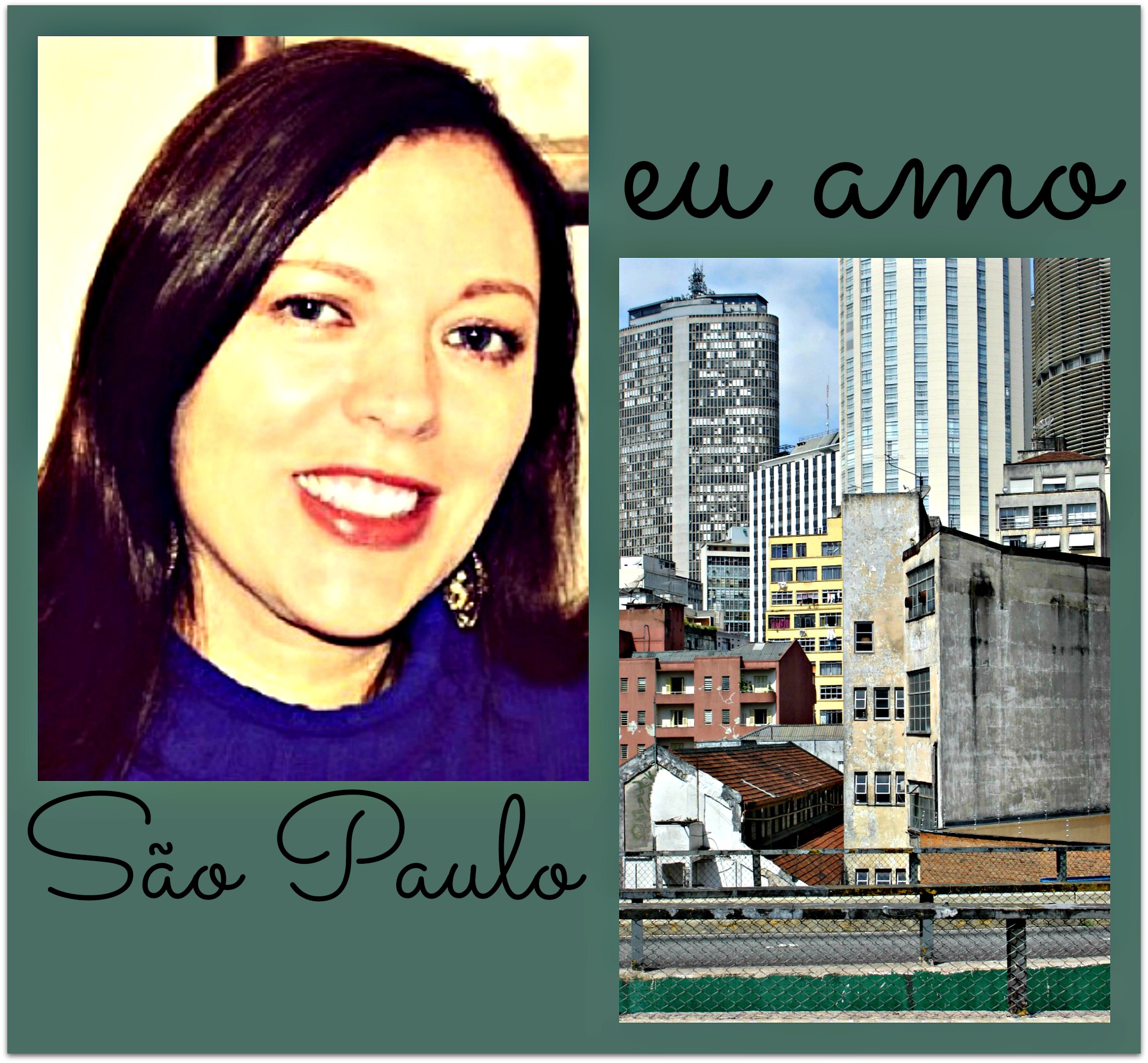
Why “exbrats” in São Paulo need their own book to appreciate life in Brazil’s largest city

MeganFarrell CollageThis week’s guest interviewee is Megan Farrell, who like myself is an estrangeiro (foreigner) in São Paulo and married to a Brazilianalthough unlike my good British self, Megan is American and also has a young daughter (sounds like far too much responsibility if you ask me!).

Megan and her family previously lived in New York, but she took a sabbatical from her job on Wall Street in 2009 to become a full-time mum. Then, when her husband was offered a job opportunity here in São Paulo in 2010, they decided it would be a perfect opportunity for Megan and their daughter to learn Portuguese, experience life in a different culture, and learn more about Dad’s home country.

I first came to know of Megan when I moved to São Paulo myself at the start of 2012 and found her blog Born Again Brazilian whilst doing some research for my own blog. Ever since, I’ve kept up-to-date with her tales and travails, and was pleasantly surprisedif not a little enviouswhen she announced earlier this year that she would be releasing a step-by-step guide for foreigners who are living (or planning to) in São Paulo: American Exbrat in São Paulo: Advice, Stories, Tips and Tricks for Surviving South America’s Largest City.

I say envious because a similar idea had occasionally cropped up in my mind, but having read Megan’s book, I’m actually rather glad I didn’t attempt it myselfthere’s no way I could have had done the topic justice to the same extent. Megan has done her research, even offering advice on visas, taxes and other mundanebut extremely importantdetails that a move to São Paulo can entail. She includes things I would definitely not have thought of or, to be honest, had the patience to cover.

My only quibble—which perhaps tells you more about me than it does about the book, which is excellent—is that it reflects the experiences of a small minority in Brazil: exbrats. As someone who loves history as well as current affairs, I tend to prefer books that provide a holistic overview of life in a particular country. What’s more, the life of the exbrat seems completely outside my realm of experience. Though a cynic might suggest that I’m on an extended holiday, I didn’t move to Brazil on an all-expenses paid work package.

And to be fair, Megan doesn’t fall into the “exbrat” category either: her husband is Brazilian so didn’t qualify for the relocation package that makes countries like Brazil so enticing to non-Brazilians.

So, who exactly are these exbrats? And why write a book for them? Megan and I had the pleasure of meeting up I person a few days ago and talking about the audience she had in mind for her book. The following are some highlights from our conversation.

* * *

AmericanExbratinSaoPaulo_cover_pmHi, Megan. Tudo bem? Why did you decide to write a guidebook for non-Brazilians who come to live in Sao Paulo?
If you are making a move to a country such as Brazil, you need to have your expectations managed appropriately. Much of the pain my fellow expats have experienced has been because they were unprepared to deal with some of the idiosyncrasies of life in São Paulo.

What do you mean by an “exbrat”? Was the book specifically aimed at them?
I used “exbrat” because it feels rather fitting of the collection of people I’ve come across here. Expats, including myself, often stomp their feet over inconveniences they’ve encountered here, yet still expect and enjoy all the benefits of being in Brazil. Not necessarily in a pejorative way, but it felt very bratty to me. You also meet people who were previously army brats and were never able to shake their nomadic waysso “exbrat” is also an adult term for these foreigners.

So exbrats are primarily the foreigners who move to Brazil because of job opportunities?
Yes, the target audience is largely people who are moving to São Paulo or have recently arrived in the city for work, as well as human resource managers at companies who send employees to Brazil.

You included yourself just now in the “exbrat” category. But you are married to a Brazilian who didn’t get an expat package.
Believe me, some aspects of the things I’ve experienced here in Brazil have been a shock, as they probably were to you as well. So, while the book is definitely aimed at exbrats, I don’t think it’s too “exclusive.” There is an element of the “exbrat” in all of us. Some people are never able to get out of the exbrat cycle and as a result, fail to take advantage of the opportunities living in this country offers. My hope is that my book will give them a clearer picture of what to expect, and how they can prepare for that reality, so that they can get over the culture shock and go exploring. One of the world’s most fascinating countries awaits.

I think I know what you mean. I particularly remember reading in the book about your shock of attending an officially organized children’s “play-date” and there being seven paid staff to run it, as well as each child returning home afterwards with a crystal tea set as a parting gift!
Yes, exactly! That is far removed from my experiences in New York but is not so uncommon if you and your family start to mix in the same social circles with people towards the very top end of society in Brazilwhether that be through expat communities, your child’s school, or spouse’s workplace.

Has the book reached other audiences besides those who are moving to São Paulo? Perhaps people moving to other South American countries or those where English is not the first language?
Thus far the audience has been very specific to people moving to São Paulo, as opposed to other countries in South America—or even other cities in Brazil. It’s also attracted a few readers who work with Brazilians but in other countries.

Injecting her own anecdotes, and photos, into the book

Which section of the book are readers enjoying the most?
People tell me that they really enjoy the humorous stories I’ve included, which are based on some of my most painful and awkward experiences. For example, I tell the story of how I visited the same bakery for over a year before someone explained that because I wasn’t emphasizing the appropriate accent in the word pão (bread), to a Brazilian ear it sounded like I was asking for pau (penis)! Living in a non-English-speaking country provides plenty of opportunities for embarrassment or frustration, but when something goes wrong, I’m the kind of person who chooses to laugh, not cry.

Did you connect with the city in any new ways in the process of writing the book?
Definitely. I wanted the book to be as complete as possible (without taking ten years to write) and so I did more exploring on some of the subjects I wanted to include. Also, the photos in the book, minus a few I purchased the rights to, are ones I took. Much of the photography I already had in my collection. But there were gaps, so I had to get out and take pictures, which always gives you a second perspective on what you are seeingmore removed and analytical.

The topic of domestic servants

What was your most displaced moment when doing the research for the book, when you wondered why you’d embarked on this mission?
Trying to explain the culture of the people who might work in your homethe culture of the working poor in Brazil.

What do you mean when you say “culture of the working poor”? In your book you seem to suggest that household workers, who are of a far less lower rung on the lady in Brazilian society, are just taking advantage of the situation that they are in. Do you think this is cultural, or the impact of their socio-economic circumstances?
Half and half. I think it is definitely a Brazilian thing to try to take advantage of different situationsand this exists at all levels of society. For example, there’s the term jeitinho Brasileiro, which Brazilians use for situations in which they “creatively” try to get round complications in life.

However, yes, there is also a socio-economic component. If you are from a poor neighborhood and are working in the home of a rich family or person, it’s probably not too surprising that you might want to take advantage of your situation by asking for a loan or a raise.

From blogging to book-writing (she hasn’t looked back!)

Why a book instead of a series of blog posts?
Believe it or not, people still like reading books! HA. Over the past three years, since I’ve written my blog, I’ve received a number of questions about moving to São Paulo and life here. Most of the answers were already within the posts of my blog. I wanted to create a document that was more comprehensive, arranged by topic and easier to navigate. I also did a survey of my expat friends, and almost all of them said they would have purchased at least three books about moving to São Paulo before they camehad any actually existed. So I decided there was at least a bit of demand. Blogs are great, but sometimes you want to read a story from beginning to end. Plus, I’ve always just wanted to write a book.

What was the most challenging part of the book-writing process?
Editing. The editing process was a collaboration with my awesome friends, as well as my mother. It’s difficult to edit yourself. Actually, it is impossible to edit yourself. And when you have a pile of people helping you sort through the stories and facts, you get lots of opinions. But it was all good. However, I don’t think I can advantage of my friends again, so I’ll probably hire an editor for the next one.

Why did you self-publish the book?
A few of my writer friends encouraged me to try and find a publisher. But I just couldn’t figure out what a publisher was going to do for me that I couldn’t do for myself. I have a strong network and a background that includes marketing. I also don’t have the patience to go through a bureaucratic publishing process with an extended timeline. I knew that even if I did manage to find a publisher, I would not be their priority. The market for this is not on the level that would make a publisher move fast.

What’s next? Are you working on any other writing projects?
I am. I’ll probably update this book sometime in the next year. I also plan to write one for Rio. My husband is from Rio, and most of my experiences in Brazil (prior to moving to São Paulo) were in that city, so I know it pretty well.

You mentioned at the outset that you like broader books. I’d love to write something about Brazil as a wholeto counter the focus I put in this one on the expat life. It won’t be another step-by-step guide but a more of a general analysis, including politics, culture and so forth.

Finally, I’m working on some fiction stories that take place in Brazil. When living in New York, I did a screenplay course so have some experience in writing fiction. Currently, my idea is to write two series of short stories. The first will be based around Brazilian folklore, and the second, around some real-life episodes I’ve witnessed that are difficult to record in a blog or non-fiction format.

Ten Questions for Megan Farrell

Finally, we’d like to ask a series of questions that I’ve asked some of our other featured authors, about your reading and writing habits:

1. Last truly great book you read: Don’t Let the Pigeon Drive the Bus, by Mo Willems. I have a five-year-old. But we’ve read it more than a hundred times and it still makes me laugh. Okay, Don’t Let the Pigeon Stay Up Late is another contender. Mo Willems is a genius.
2. Favorite literary genre: I’d love to lie and offer up a more intellectual answer, but my favorite genre has always been horror. I enjoy a good creepy tale. After that, humorous memoirs from people who have overcome great obstacles, like Jeannette Walls‘s The Glass Castle.
3. Reading habits on a plane: I’m most happy if I have a copy of The Economist with me on a plane
4. The one book you’d require President Obama to read, and why: I wish Michael Bloomberg would write a book that Obama could read, because I think the USA would benefit by being run more like a business. But since Bloomberg has yet to put pen to paper, I’d have to say Getting to Yes: Negotiating Agreement Without Giving In.
5. Favorite books as a child: I loved any book that involved a child in a new world. James and the Giant Peach. Charlie and the Chocolate Factory. The Little Prince. The Little House series by Laura Ingalls Wilder. Pippi Longstocking.
6. Favorite heroine: Wonder Woman. I think if Brazil had a Wonder Woman, or the collection of super heroes that we have in the States as—albeit fictional—role models, people would emulate change for the good of the people. Brazil needs to believe in something other than futebol—but that seems to be in the process of changing, as Andy and I discussed last month on this blog.
7. The writer, alive or dead, you’d most like to meet: Hands down, Stephen King. I hope he doesn’t die before I get to meet him. I just need to figure out a way to do it that doesn’t involve stalking.
8. Your reading habits: I used to spend the weekends (sometimes all weekend) reading. But now that I have a child, I usually read right before I go to bed—in bed.
9. The book you’d most like to see made as a film: American Exbrat in São Paulo, of course!
10. The book you plan to read next: I suppose I should say Fifty Shades of Grey, because I haven’t read much of it and people keep bugging me about it. But if you’ve read Anne Rice’s Sleeping Beauty Trilogy (I only read the first), Fifty Shades is like reading Judy Blume. Yawn. I think I’ll wait for Stephen King’s Doctor Sleep. How could anyone resist a sequel to The Shining?

* * *

Readers, as I said, Megan was a delight to meet in person, a sense of which I hope I’ve conveyed above. Any further questions? Have I pressed her too hard on the “exbrat” point?

STAY TUNED for tomorrow’s post, a new episode in our “Location, Locution” series, by JJ Marsh.

If you enjoyed this post, we invite you to register for The Displaced Dispatch, a round up of weekly posts from The Displaced Nation, with seasonal recipes, book giveaways and other extras. Register for The Displaced Dispatch by clicking here!

Related posts:

images: Megan Farrell’s author image and book cover; photo of Sao Paulo from MorgueFile.

NEW VS OLDE WORLDS: How not to be a victim of the 10-pound Tour, aka the Expat 10

Libby Collage New&OldRegular readers of the Displaced Nation are treated every other week to a new episode in the life of fictional expat Libby Patrick, a 30-something British woman who has relocated with her spouse to a town outside Boston. Her diary, Libby’s Life, by Kate Allison, is replete with observations about life in New England vs. England. In the weeks when Libby isn’t published, we are featuring posts by writers who are sensitive to the subtle yet powerful differences between new and “olde” worlds. Today we hear from a new contributor, Claire Bolden, a Brit who lives in the Washington, D.C., area and blogs regularly on such matters. She is also a fitness expert, which, as you will see, explains a lot!

—ML Awanohara

* * *

We Brits call it the “Ten Pound Tour.” You’re here in the United States for three years; expect to gain ten pounds, that’s what they say.

I’m in the USA for three years; how is this possible? Well, let me tell you…pull up a chair and grab a cup of tea (hot is preferable—none of that iced nonsense) and a biscuit (that is a BISCUIT, not a cookie or any other sweet treat, which will be pumped full of sugar and additives).

Firstly, I’m British, so our culinary delights are much to be sniffed at. Especially boiled cabbage, I find. We’re partial to fish and chips, but it has to be soaked in vinegar and wrapped in yesterday’s news (not fake newspaper, like a fake British pub in the USA deigned to provide me with recently) and curries.

Yes, yes, I know curries are not traditional British fare, but they’ve become so ingrained in our eating out and eating in culture, that I think they are now a fully-fledged, ghee-butter-infused part of the British diet.

Claire B CollageJust thinking of growing fat…

In the USA…hmm, what culinary delights was I to chance upon? Pulled pork. I’ll have some of that.

Corn dogs…sigh, this batter-wrapped-sausage-thing-on-a-stick filled me first with joy, then dread, then Zantac.

Less a feast on a stick; more a beast on a stick. A beast of untold gastronomic consequences.

But the real devil in disguise is hidden away, tucked and folded and processed beyond belief into many, many of the foods in the Land of the Free. High Fructose Corn Syrup (HFCS).

This is not, as I understand it, part of the UK diet. Then what on earth is it doing being fed to millions of Americans? And how did I chance upon it?

The American version of “sweetbread”

Here’s the tale:

“There is sugar in bread,” a friend told me whilst I was chomping on a sandwich.

“Surely not,” I replied.

“There bloody well is,” she confirmed with vigour (she’s British, hence the “bloody” and the “u” in “vigour”).

She’s right, don’t you know. I looked more closely at the contents…

In a normal UK loaf there is stuff and nonsense, of course there is. But no sugar.

By comparison, an American grocery store’s loaf of bread ingredients will wrack up a whole host on unpronounceable allsorts, with the dearly beloved HFCS topping out as Ingredient No. 3!

And the blighter is everywhere!

HFCS has reared its nasty, cavity-making, gut-increasing syrupy head since I’ve been in the USA, and I’m not liking it too much…

What is it? Basically, HFCS goes in processed foods and is said to rot your teeth. It causes many health and obesity issues in the USA.

And so, to the cupboard to see what’s what in the food I have obtained since being in the USA. Yes, it is true, this sweetener is in all sorts of stuff.

“Out, damn HFCS. Be gone!” I’ve gone all Lady Macbeth about it

So, I see now why an expat stint in the USA has been christened the “Ten Pound Tour”—Americans might like to think of it as the “Expat 10,” after their expression the “Freshman 10” (actually it’s now the Freshman 15 as most freshmen put on at least 15 pounds during their first year of college).

Food glorious food: don’t care what it looks like!

Add to this the food porn issue. When I first heard of “food porn,” I thought it might refer to food that:
a) is so big it would make your eyes water,
b) is difficult to swallow, and/or
c) is indecent to look at, let alone put in one’s mouth.

But as my first encounter with The Cheesecake Factory (this place tops the list for calorie content) proved—it is all about the size, and, to set the record straight, size does matter.

We all know American portions are large, but in this restaurant chain, they are HUGE. My Asian chicken salad was the size of my husband’s head AND his sideburns AND his fluffy hair after he’s been swimming. That is V V V large.

Everyone eats as much as they can stuff their faces with and then takes the rest home in take-out boxes, because there is enough left for three more meals and you could potentially invite the neighbors, if they’re not already drowning in their own quagmire of take-out food porn and HFCS-infused products themselves.

So, take the food porn home. Indulge in the privacy of your own home—go on, no one’s watching…

Our senses go reeling…

As already mentioned, we’re no angels in the UK with our food and eating habits. On the healthier side, I crave a roast dinner now and then…roast lamb with all the trimmings.

Food is so much an inherent part of our cultures. It helps define us, but as expats we have to sample and pig out on what’s available in the country in which we reside.

That’s only right, is it not?

If I were in China, I’d certainly want to take advantage of the cuisine on offer there. Now, I wonder if they call it “Ten Pound Tour” in Bejing…?

American food and the custom of eating out makes the previous fortnightly little treat in the UK of a Value Meal curry for two from Tesco’s seem a right measly affair.

But maybe one day, when I return to my homeland, I will savour stabbing that plastic cover of the curry before I microwave it and pouring the egg cup-sized portion of “meat” into a dish and spooning in some hard-as-nails rice and enjoy every mouthful.

Just maybe…

* * *

Thanks, Claire, for reminding us about the dangers of high fructose corn syrup, which is lurking inside so many American foods! Readers, do you have anything to add to Claire’s observations? Also, is 10 pounds really enoughisn’t it more like 20 these days?

Claire, 38, left the UK shores a year ago in August and is living with her husband and son near Washington, D.C. They will be there for three years and have a bucket list of things to do and see in the USA during that time. Though a Brit, Claire is a flip-flop-wearing, cowboy-hat-totin’ sun worshipper who has already sampled a lot of US cuisine, including corn dogs and crab, but she still enjoys a Rich Tea biscuit with a cuppa. She spends her time talking to Americans and confusing them with her British colloquialisms, as well as writing her blog ukdesperatehousewifeusa, which takes a light-hearted look at the cultural differences between the USA and the UK.

STAY TUNED for next week’s series of posts!

If you enjoyed this post, we invite you to register for The Displaced Dispatch, a round up of weekly posts from The Displaced Nation, with seasonal recipes, book giveaways and other extras. Register for The Displaced Dispatch by clicking here!

Related posts:

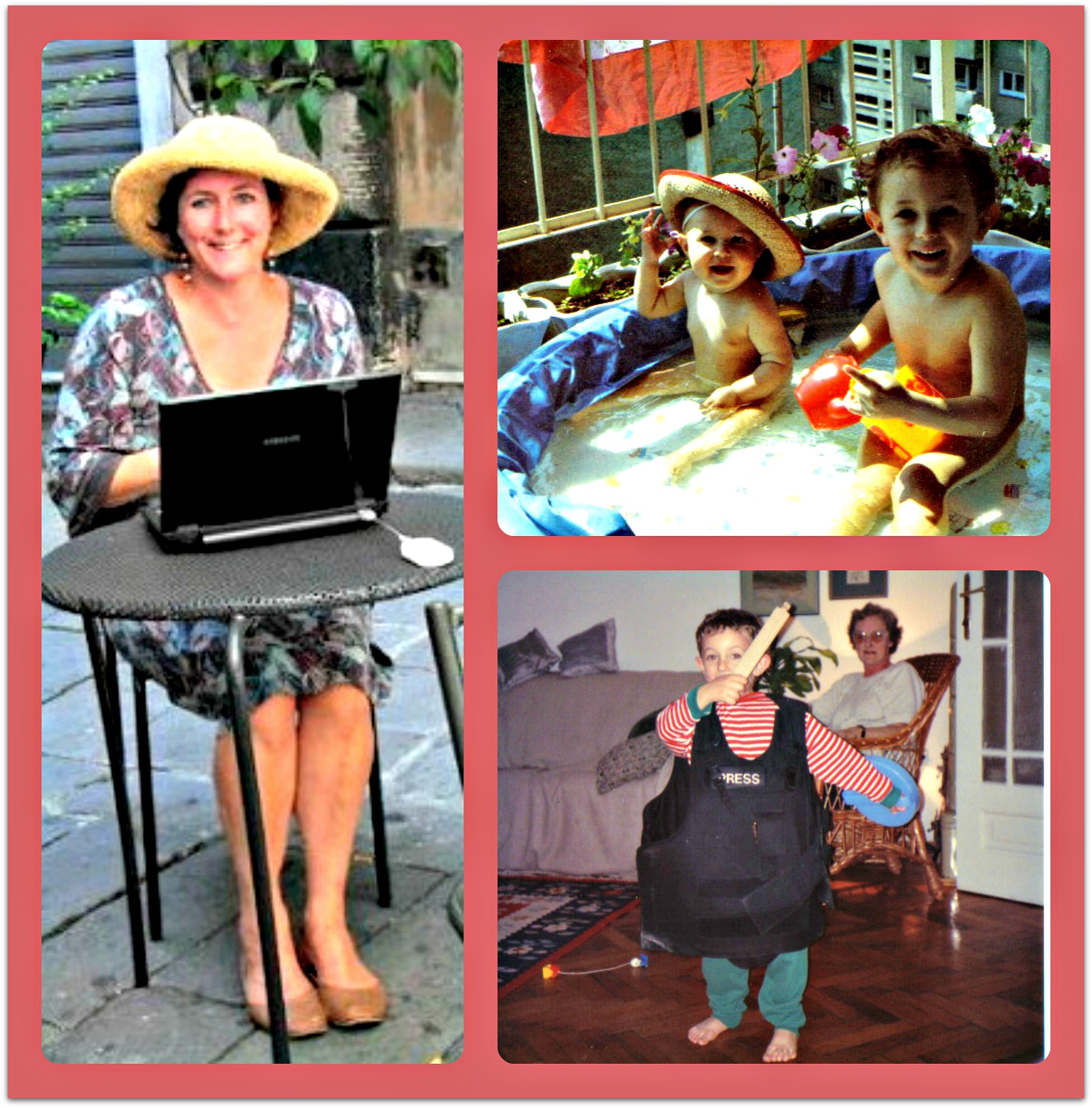
Images (from left): Claire enjoying a corn dog; an all-American breakfast of pancakes and grits; a sinful dessert at The Cheesecake Factory.

Portrait of woman from MorgueFile; Lighthouse (R) from MorgueFile; Lighthouse (L) from MorgueFile

Meet author Rosie Whitehouse, who trailed her spouse into a war zone (and enter to win her book!)

Rosie Whitehouse CollageOne of the expressions I picked up from living in England for many years is “Keep the home fires burning.” For some reason, that expression, along with the WWI song from which it comes, is running through my head as I contemplate talking to today’s featured author, Rosie Whitehouse (click here to hear it being sung):

Keep the Home Fires Burning,
While your hearts are yearning.
Though your lads are far away
They dream of home.
There’s a silver lining
Through the dark clouds shining,
Turn the dark cloud inside out
Till the boys come home.

For me, Rosie is an up-to-date version of what the songwriters had in mind. Educated at the University at London, with a career as a BBC journalist, she chose to stay at home with her children and keep the house warm and welcoming, and the family’s spirits up, while her husband, the journalist Tim Judah, went off to report on various wars for The Economist and other newspapers.

Rosie even went the further step of moving the family home to be closer to Tim for a time. Ironically, she kept the home fires burning in the very place where World War I began, the Balkans. She flew out to a crumbling Bucharest—it had been knocked down by the notorious Ceaușescu, whose secret police killed hundreds during Romania’s 1989 revolution—with one child in tow and another one on the way.

Then, when it seemed possible that her own home could go up in flames as war spread across the former Yugoslavia, Rosie did not give up. She stayed for a total of five years before returning to London, by which time “keeping the home fires burning” was second nature both for her and the couple’s five kids (Tim carried on covering wars in Iraq, Afghanistan, and the Congo).

Having revived her career as a freelance journalist, she decided to write her first book: Are We There Yet? Travels with my Frontline Family—a copy of which we’ll be giving away! (See details below). The book is a tribute to families who have been “burners of the home fires,” whose emotional pain tends to go unheralded. It is also, in her words, “quite funny.” (Hey, growing up in Bucharest, Belgrade, Croatia and Bosnia can be fun!)

By now you must be as curious as I am to meet the intrepid Rosie Whitehouse and learn more about what motivated her to seek out such an unusually displaced (at least by most of our standards!) life. I note that she has an Irish mother—perhaps that explains it?! (I’m thinking Queen Boudicea…)

* * *
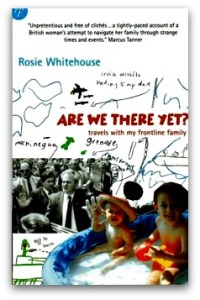
AreWeThereYet_cover_dropshadowHi, Rosie. In your book you say that your husband’s journalist colleagues in Romania, all of whom were single, were shocked to hear he had a two-year-old son and another child on the way. Did people often tell you you were crazy?
Yes, lots of people thought I was crazy.

As a former journalist with a background in Russian studies, do you think you felt a tinge of envy for Tim’s opportunities—which made you want to be on the scene?
Not really, as I would not have been able to cope with going to morgues and so on.

I know you’re going to challenge our definition of “displacement,” but I’ll go ahead and ask: what was your most displaced moment during your stay in the Balkans—when you had to explain Daddy’s muddy boots (he’d been walking in a mass grave), when you visited empty supermarkets, or when you heard the first shots of the conflict in Bosnia while strolling around Sarajevo with the kids?
Those things were reality so in that one doesn’t feel displacement. Quite the opposite in fact. I was intimately plugged into life and death at those moments.

How did you keep yourself sane?
I coped with stressful moments by bunkering down. I wouldn’t send the kids to school and cuddled up with them instead. As long as I shut my front door, where ever I am and whatever is going on, and it is just us, I am able to feel at home.

But getting back to your question about displacement: My best moment in a foreign country was when I saw my mother drive off in a taxi in Bucharest and realizing that apart from my two year old son I didn’t know a soul in the country (my husband was away in Albania for weeks). Wow, at last no one to tell me what to do! Freedom!

More seriously, most displacements do not happen by choice, and my most displaced moments have been as a result of this. I recount a story in the book when I took the kids to Berlin ten years ago. My mother-in-law was born there but fled in 1933 as she was Jewish. The family settled in Paris. As a result I have half French children who speak fluent French and we don’t speak a word of German.

It was a rather stressful visit as we searched for old family homes, one of which the family were still trying to reclaim. My daughter Esti got a headache. I pointed to the department store and suggested that we go in to buy an aspirin. It was Wertheims. My mother in law’s mother was a Wertheim and was murdered in Aushwitz. Esti said:

What, first they give me a headache by stealing the department store and murdering my great granny–and now I am expected to go in and buy an aspirin to make it better? You have to be kidding!

That’s displacement.

Child-rearing on the frontlines

What was the biggest challenge about having children with you on the frontlines?
The biggest challenge was often the simplest thing such as getting them something to eat and getting hold of baby milk.

Did anything surprise you?
Life never ceases to surprise me where ever I am and what ever is going on. The terrible things and the good things always amaze me.

What do you think the kids got out of the experience?
The kids learnt a lot. My eldest son, Ben, would ask about why there was no food in Romania. For me it was a matter of telling simple tales of communism and 1917. For him it began a life-long interest in Russia. He is following in his father’s footsteps.

My eldest daughter, Esti, would like to work for an NGO like Human Rights Watch.

For all of us, it drew us closer together. We are a tight-knit family.

I’ve heard of war reporters feeling bored when they come back to “reality” in their home countries. Did your family experience any of that after five years in the Balkans? What was it like to go “home” again?
Going home is just as difficult as moving to a new country. By the way, the wars didn’t stop either after we got back. My husband has since covered lots of wars and famines including Afghanistan, Iraq and the Congo.

Writing a book, but from the backlines

After you left the Balkans, it took quite a few years before you decided to write the book. What was the catalyst?
It was during the invasion of Iraq in 2003. I was standing in the supermarket and they had just installed a TV with a live feed from Iraq by the checkout. Some soldiers were running across a street in Basra, where some of the heaviest fighting took place, followed by a reporter and camera man. All of their faces were clearly visible. My husband was in Baghdad covering the story for The Economist. I had actually popped out for five minutes of fresh air before the bombers took off from the UK and the countdown to the blitz on Baghdad began.

I realized, to my horror, you could be buying a packet of frozen peas and watch your husband killed in front of your eyes. I know this thought had never entered the mind of the supermarket manager who had simply installed the TV to attract customers.

That evening I found my ten-year-old glued to a grainy grey screen showing an image of Baghdad as the cruise missiles were expected. What do you say? I had to make dinner and she had to do her homework. The UK had a huge debate about the war and the way it was covered, and I felt nobody knew what it was really like to be part of it and a kid to boot.

I also found that very quickly after the Berlin Wall came down that people forgot in Western Europe just how hard life had been under communism, especially in Romania and Albania. No surprise in that, really, as since 1945 most people in Western Europe just forgot the East existed.

I also found people in the UK quick to judge and condemn people in Southeastern Europe as being violent and prone to war. I wanted them to realize we are no different. That is why I’ve also included a chapter on Ireland in the book.

And I wanted to describe the multicultural experience of bringing up half-French, half-Jewish, part-Irish children in various countries, something I found fascinating.

Was it also part of your mission to show others what it is like to be married to, the child of, a war reporter?
Yes, not just to a war reporter but also those who are married to soldiers—especially those who are part-time soldiers and live in the community.

Did you have any personal motives in writing the book, to help you process what you’d been through and to provide your children with a record of where they’d lived?
No, not really. I didn’t write it for us but to make people think about what was going on. I am sure that the kids will appreciate it when they are older.

What was the most difficult part of the book-writing process?
Getting time to do it. I often wrote with my computer on the kitchen side as I was cooking dinner, which was good as I could hear kids talking; and as I was writing about them, it helped to have them there doing their thing.

Did you find it easy to find a publisher for the book?
No it was hard. publishing is a tough business. I started my own publishing company, Reportage Press, which closed a few years ago. Are We There Yet? is on Amazon as a self-published download these days. We also have a number of journalist friends who are taking the self-publishing route quite successfully.

What audience did you intend for the book? Did you think it would also appeal to other kinds of expats, who don’t go to war-torn countries?
Yes, there is a large expat element to the readership, and I know the book has touched the hearts of women feeling lonely and bewildered in a new country. I have been hugged and kissed by quite a few of them. One lady said reading the book had saved her marriage. I’m not sure it was me, but I hope I helped her realize it wasn’t so bad being lonely in London. It is hard being in a strange country with children. It is you who have to interpret it for them and as you are far from the family support group and friends, it is inevitably all up to you to be their world. It’s a tough job. That said, the book is far from serious. It’s actually quite funny.

Can you give us some examples of humorous moments in the book?
The kids are a laugh a minute, so whatever was going on they would often say or do something funny. For example:

For me the market in Piaţă Amzei is the focal point of life in the city centre [of Bucharest]…

“Let’s see the old ladies with the cheese. Come on!” shouts Ben as he darts out of the pushchair and into a smelly covered hall, where they sell heaps of yellowy looking curds, which are akin to feta.They are covered in flies.

The old women with their long black skirts and headscarves beckon him over and offer him little crumbs. He watches their lips and toothy grins with fascination. They look unnerving, like witches with crunched up dirty teeth, but he doesn’t run away. He has come deliberately to stare at them. He studies an old lady’s face carefully as she says something he can’t possibly understand. He is like his father, never frightened of anything and intrigued by the smallest thing. He loves the bizarre and the quirky.

* * *

“Where’s Mr Parking? Why doesn’t he find us a space?” asks Ben as we drive up and down the street outside our flat. Ben loves Mr Parking. I can’t see him anywhere.

Mr Parking is the man who organises the parking lots outside Belgrade town hall. It’s an elegant 1880s building that was once the royal palace and is right next to our block of flats. For a tip, he lets us park in the lots reserved for local officials. I haven’t seen him for weeks and have to be careful where I put the car, or we’ll be towed.

“I think he has gone back to Bosnia to fight, Ben.”

“What!” Ben is horrified.

“Why? I want to park the car. Doesn’t he want to stay here?”

“No, I expect he wanted to go home and defend his village.”

“Where is his village?”

“He’s from eastern Bosnia, the bit between here and Sarajevo [Bosnia’s capital city]. He told Dad he comes from Kamenica. It’s in one of the last bits there that’s still under Muslim control.” It’s a village close to the town of Srebrenica [the town where a massacre took place in 1995, said to be a crime of genocide].

“What! He’s a Muslim?” Ben is amazed: “But he looks like everyone else!”

“Of course, he does! You don’t look different if you’re Muslim. Bosnians look the same whether they are Muslims or not.” My mother has just sent him a book about the Crusades.

“I thought Muslims looked like Arabs.”

Are you working on any other ambitious writing projects?
I would like to write an expat guide to Britain. I spend a lot of time explaining Britain to people as I live in an expat world in the UK to a certain extent as my children have been or go to the French Lycée, and we have a lot of foreign friends who live in London.

Ten Questions for Rosie Whitehouse

Finally, I’d like to ask a series of questions that I’ve asked some of our other featured authors, about your reading and writing habits:
1. Last truly great book you read: Malaparte is on my mind as I am driving to Ukraine. His book on the 1941 invasion of Russia is unforgettable.
2. Favorite literary genre: Novels
3. Reading habits on a plane: Nothing. I am too tense on a plane as I hate flying. If I am calm enough I love to look out of the window.
4. The one book you’d require President Obama to read, and why: My son Ben’s book on Russia: Fragile Empire: How Russia fell in and out of love with Vladimir Putin. It’s a great portrait of contemporary Russia. I am his mum—what else am I supposed to say to this one?
5. Favorite books as a child: I loved Little House on the Prairie but above all I loved the stories my dad used to tell me.
6. Favorite heroine: She doesn’t have a name. She is one of the millions of women who have struggled to keep their families together against the odds. These are the mums who keep the world turning.
7. The writer, alive or dead, you’d most like to meet: I always wanted to meet William Shirer. He must have had an extraordinary experience living in Berlin at the start of World War II. Perhaps the ultimate expat experience! I suggested an interview programme with him to BBC World Service in the 80s but they didn’t have the cash to send me to America to do it. A pity as he died after that.
8. Your reading habits: I read a lot. If you want to write you have to read. I also have to read a lot for work.
9. The book you’d most like to see made as a film: None, really. If you love a book, the last thing you want is for it to become a film as you have the pictures in your head and they are your pictures not someone else’s.
10. The book you plan to read next: Vasily Grossman‘s An Armenian Sketchbook is in my suitcase. I love Grossman. He is a fantastic writer. If you haven’t read Life and Fate, you have really missed out.

* * *

Thanks so much, Rosie! Personally, I found your story very moving and think we should confer on you a “home fires” medal for all you’ve achieved!

Readers, it’s time for you to ENTER OUR DRAW TO WIN A FREE COPY of Rosie Whitehouse’s book. Rosie is giving away ONE COPY and will favor comments that tell her why you’d like to read the book.

Extra points, as always, if you’re a Displaced Dispatch subscriber!

The winner will be announced in our Displaced Dispatch on August 2, 2013.

Rosie Whitehouse is a parenting journalist and mother of five. She is one of the UK’s leading experts on family travel. She has written widely on family matters and traveling with children for The Sunday Telegraph, The Independent, The Guardian, The Daily Mail, Sunday Express, Family Circle, The Economist, and others, as well as for the Web sites B4Baby.com and Raisingkids.co.uk. She has also spoken at events and on television and radio on parenting matters, promoting her travel books and her autobiography, Are We There Yet? Travels with my Frontline Family. You can follow her latest adventures at http://www.rosiewhitehouse.co.uk/.

STAY TUNED for tomorrow’s post in our Olde vs New World series, by guest blogger Claire Bolden.

If you enjoyed this post, we invite you to register for The Displaced Dispatch, a round up of weekly posts from The Displaced Nation, with seasonal recipes, book giveaways and other extras. Register for The Displaced Dispatch by clicking here!

Related posts:

Images (clockwise from left): Rosie Whitehouse at “home” in London; Ben and his baby sister, Esti, living it up on the balcony in Bucharest (July 1991); Ben trying on his dad’s new bulletproof jacket, with Rosie’s mother in background (Belgrade, May 1992).

JACK THE HACK: Expat writers, time to crank up the PR machine!

JACK THE HACK _writingtipsJack Scott is back with his monthly column for all of you wannabe authors who are hacking away at travelogues-cum-memoirs (or cum-novels?). For those who don’t know, he was a Random Nomad for the Displaced Nation way back when we started this site. After an expat experience in Bodrum, Turkey, that was literally something to write home about, he and his partner, Liam, have traded in the dream for a less pressured existence back home in the UK.

—ML Awanohara

There’s a firm knock at your door and a postman in a tight uniform (well, we can hope!) hands you a box. You rip open the carton like an over-wrought five-year-old on Christmas morning, pull out a copy of your book, lift it to your nose and smell the pages. It’s intoxicating, better than recreational drugs. You’ve done it. For the very first time, you feel like a proper author.

Savour the moment. It may not last.

Unless you want to be stuck with a stack of books propping open a door or languishing unloved and unread in the attic, you’ll need to start phase two of your cunning marketing plan: making sure people know about your minor masterpiece.

But how do you get the message out there these days? Just what are the rules of engagement?

1) Start a blog.

As I have said many times before, blogging is a great auditioning process for writing, and the best way to experiment and grow your fan-base. In the crowded blogosphere, content is king and the best content is fresh, new and frequently updated. Aim to blog at least once a week and break up your words with interesting and relevant images. Keep your page clean and uncluttered. Fussy, multi-colored scripts and busy designs can hurt the eyes and put the reader off. Fans can be fickle and lazy. Make it easy for them to follow you by adding your social network links and the chance to subscribe to your pearls of wisdom by email.

2) Engage with social media.

Plaster the good news everywhere. Join social networks and make friends. Facebook and Twitter are the most popular and influential, although Pinterest is starting to give both of them a run for their money. Create a Facebook page and solicit “likes.” Give Linkedin a go. After all, you are a professional author now. If social forums exist for your area of interest, join them and participate meaningfully. A word of warning: Engage gently and be careful not to over-promote; otherwise, people will switch off.

3) Join book sites.

There are hundreds of book sites out there and most of them allow you to add your book. Goodreads is the biggie and most respected, Join their author programme and add your profile and book. There’s also AuthorsDen, LibraryThing and WritersNet. Make friends and become an active member of the groups you join. Reviewing the work of other new authors will help garner support and build a “bookie” network.

4) Solicit Amazon reviews.

If you’re selling your books through Amazon—an organization set on a path to either a) world domination or b) break-up by the Monopolies Commission—make sure the selling page is attractive, accurate and informative. Add an author profile, encourage people to submit positive reviews and if you do get the odd bad review (and you will) don’t spit back, it’s really not worth it.

5) Think about search engine optimisation.

Don’t be spooked by this. Search engine optimization (SEO) is just how a page is ranked on search engines and by this I mostly mean Google (another monolith on the path to world domination). If your blog doesn’t appear in the first few pages of Google then you might as well not be on the internet at all. There are many companies that claim they will increase your ranking for a fee. Don’t waste your money. Follow a few simple steps and you’ll soon by up there with the pros:

  • Reply to comments left on your blog. It’s the polite thing to do.
  • Engage with your blogging peers with comments and guest posts.
  • Add share buttons to your posts so your readers can spread the word effortlessly.
  • Create reciprocal links by listing your favorite blogs and Websites on your blog.
  • Join blog directories. Most are free and some specialize (women bloggers, expat bloggers, for example).
  • Post to Facebook and Twitter (at the very least).
  • While you’re at it, you may as well post to Google+, Pinterest and Linkedin (and any other social network you join). All that activity will help you clamber up the rankings and increase your visibility.

6) Get yourself interviewed.

Online interviews are a great way to increase your profile. Expat and book sites (notably, The Displaced Nation!) are always looking for interesting people to chat to. It provides them with content and you with exposure—a perfect double whammy.

7) Create a personal Website.

Creating a personal Website isn’t the expensive faff it used to be and the days of paying top dollar for large-brained web-designers to give birth to your labor of love are over. These days, get the right help and you can end up with a fully functional and integrated site for a fraction of what it used to cost. (PLUG ALERT: You could do worse than checking out author2author, my new low cost Website, blogging and social media service for authors.)

8) And finally…keep chipping away at it!

Exhausted? You will be. This PR lark takes a lot of graft. I know. I’ve never worked so hard. The good news is that once you’ve set the wheels in motion, you just need to keep a light touch on the tiller. Then before you know it, you’ll start getting that exposure you’ve always dreamed of and, who knows, the agents and distributors knocking at your door instead of the pretty postman.

Until then, I’m afraid there’s no substitute for
WRITING TIP FOR EXPATS NO 4:

Master the rules of engagement!

* * *

Readers, any comments, further questions for Jack the Hack? He’ll be back next month with some more writing tips…

Jack Scott’s debut book, Perking the Pansies—Jack and Liam move to Turkey, is a bitter-sweet tragi-comedy that recalls the first year of a British gay couple in a Muslim country. For more information on this and Jack’s other titles, go to his author site.

STAY TUNED for tomorrow’s post, another installment in the life of our fictional expat heroine, Libby. (What, not keeping up with Libby? Read the first three episodes of her expat adventures.)

If you enjoyed this post, we invite you to register for The Displaced Dispatch, a round up of weekly posts from The Displaced Nation, with seasonal recipes, book giveaways and other extras. Register for The Displaced Dispatch by clicking here!

Related posts:

Images: from top, clockwise: Hand with pen / MorgueFile.com; Boats in King’s Lynn, Norfolk / MorgueFile.com; Jack Scott, used with his permission; Turkish boats / MorgueFile.com