The Displaced Nation

A home for international creatives

Tag Archives: London

NEW VS OLDE WORLDS: British husband and Brazilian wife swap cultural allegiances

Libby Collage New&OldThanks to Kate Allison, regular readers of the Displaced Nation are treated every other week to a new episode in the life of fictional expat Libby Patrick, a 30-something British woman who has relocated with her spouse to a town outside Boston. Her diary, Libby’s Life, is replete with rich observations about life in New England vs. England. In the weeks when Libby isn’t published, we are featuring posts by writers who are sensitive to the often subtle, yet powerful, differences between new and “olde” worlds. Today we hear from one of our regular contributors, Andy Martin. Those who caught Andy’s Random Nomad interview at the start of the year will remember that he’s a British social worker and football geek who followed his Brazilian spouse back to her native São Paulo.

—ML Awanohara

AndyMartininUK_pmA few weeks ago I made my first trip home to the UK since moving to São Paulo, Brazil’s largest city, in February 2012.

Prior to leaving I started to ponder how I’d feel once I touched down in London.

After such an extended period of time, I guess it’s only natural to feel this somewhat apprehensive. Yet another reason for my intrigue was the number of times over the past year a Brazilian had asked:

Você tem saudades de Londres?

There is no direct translation for “saudades“—which probably says a lot about how us English speakers struggle to express our feelings. Broadly it translates as something like:

having a deep sense of nostalgia or longing for something or someone*

To such beautifully expressed enquiries of my sentiments about home, my typical response has been some muttered utterance like “Na verdade, não,” which basically means: “No, not really.”

What did I say above about us English speakers being expressive?

Or perhaps that’s just me.

Delighted to be in the new world…

Yet, on the whole those two words do sum up my thoughts about home. Sure, I miss friends and family—but the place? As I said, “Na verdade, não.”

I’ve lived in London, walked its streets and drank in its pubs for most of my life, so why would I be so desperate to go back?

Perhaps it is because I know that we’re likely go back to settle there eventually.

Alternatively, perhaps it’s not that I don’t miss London, more that I am happy with my lot here in São Paulo.

Which I am.

…while my wife is attached to the old one!

Ironically, it is actually my wife who is the one who most wants to return “home” to London after she finishes her degree at the end of this year**. This surprises most people, who assume that my Brazilian wife is the one who wants us to stay in Brazil, when it’s actually the opposite.

Why?

Part of it, I guess, can be put down to the opportunity each of us has to explore the unknown.

When I traveled around South America in 2007, I had never before left Europe. Likewise, until she went to Buenos Aires in 2008 (where we met), she had never left Brazil.

Both of us had only really ever known one way of life.

Now, with my wife having spent three years in London and us now having spent almost 18 months in São Paulo, we both seem to have come to appreciate and adore the things about each other’s countries that the other takes for granted or even dislikes.

The predictability, and quaintness, of London

For my wife São Paulo is a stressful city, with its inadequate infrastructure having a tendency to make life more complicated than it needs to be.

On top of this it’s a place that for her, because of the fear of crime, constantly leaves her feeling on edge.

Conversely, London is a place where she says she feels safe and where life is made easier by things working as they should—even if it that isn’t always the case.

For example, it still amazes her that a train can be scheduled to arrive at, say, 10:27 a.m. and then on the whole it actually arrives and departs at 10:27 a.m.

Additionally, coming from a land that was “discovered” as recently as 1500 by the Portuguese, she finds Europe’s long history fascinating—the fact that there are buildings in London older than the country of Brazil itself being a prime example.

I’ll be honest, in some ways I probably felt the same when I first arrived in Brazil. My initial posts on my own blog, The Book is on the table, whilst written with my tongue firmly in cheek, could possibly also be seen as me just being another gringo moaning about stuff—the subtext being that “everything back home is much better.”

As time went on, I realized that I didn’t want to be or become one of those moaning expats. Of course, it is natural to compare things when you move or go abroad. Likewise, there’s nothing wrong being critical if it’s fair and balanced.

But to make a habit of it isn’t good for one’s mental health. It ends up making you bitter and unhappy with your new environment. It’s also the quickest way to feeling homesick.

Even worse, such comparisons can easily drift into self-righteous rants asserting one’s cultural superiority—a throwback to the attitudes of our colonialist ancestors that did no one any good back then and will do no one any good now.

The unpredictability, and beauty, of Brazil

Around the time I realized that moaning and comparing are pointless enterprises, I started to feel a genuine affection for Brazil, something that has been reflected in my blog posts over the past 6-9 months.

Firstly, it would be hard not adore a country and continent that shares my passion for futebol.

Additionally, I found it easy to get used to a relaxed, slower pace of life in this part of world, which is not hard to complain about when it’s touching 30°C (86°F) for most of the year.

We have a swimming pool in our apartment block, something that is unthinkable in the UK, and there’s 4,500 miles of stunning coastline to pick from to go to on holiday.

Then, there’s the fact that if I want to go out for a beer or meal I know the bar or restaurant won’t be shut by midnight, as they so often are in London. If I want to stay out sipping a beer until 4:00 a.m., I can.

I’m also enjoying, although also a little frustrated by, the challenge of learning Portuguese, and as someone who studied Sociology and Social Anthropology and then later worked with migrants as a social worker, living in Brazil provides the perfect opportunity to explore South America, its indigenous history and the legacy of immigration after its colonization.

Additionally, the continent’s history of revolution and resistance against oppression also matches my own rebellious tendencies and political values—something I didn’t always have an outlet for in the UK.

Finally, it might sound a little condescending but I’ve now come to embrace some of the things I once moaned about. Living in London is great, and I appreciate my wife’s perception of the quality of life, but all the things I mentioned above provide an alternative quality of life. In other words, there’s more to life than just functioning public services.

Brazil may be frustrating sometimes, but it certainly makes life just a little bit more interesting—though my wife is yet to be convinced by that argument.

Maybe at some point I’ll change my mind and the novelty of life in Brazil will wear off—there is certainly enough evidence to suggest that might be the case. However, for the time being, whenever a Brazilian affectionately ask about my longing for home, I’ll continue to mutter: “Na verdade, não.”

*It’s extremely convenient in these situations having a translator as your wife.
**As a compromise I’ve so far managed to negotiate us staying until at least the end of the World Cup next year, using these two strong arguments: 1) I love football; and 2) Living in São Paulo meant we missed the Olympics in London.

* * *

Speaking of the Olympics, the handing over of the torch to Brazil at the end of the London Olympics certainly showed you the contrast between old and new worlds! Readers, can you relate to this couple’s frequent twists and turns in their cultural allegiances?

STAY TUNED for next week’s series of posts!

If you enjoyed this post, we invite you to register for The Displaced Dispatch, a round up of weekly posts from The Displaced Nation, with seasonal recipes, book giveaways and other extras. Register for The Displaced Dispatch by clicking here!

Related posts:

Img: Photo of Andy Martin taken during his recent trip to the UK, at a wedding.

Portrait of woman from MorgueFile; Lighthouse (R) from MorgueFile; Lighthouse (L) from MorgueFile

And the May 2013 Alices go to … these 4 international creatives

 © Iamezan | Dreamstime.com Used under license

© Iamezan | Dreamstime.com
Used under license

As subscribers to our weekly newsletter will hopefully have noticed by now, each week our Displaced Dispatch presents an “Alice Award” to a writer who we think has a special handle on the curious and unreal aspects of the displaced life of global residency and travel. Not only that, but this person has used their befuddlement as a spur to creativity. He or she qualifies as an “international creative.”

Today’s post honors May’s four Alice recipients, beginning with the most recent and this time including citations.

So, without further ado: The May 2013 Alices go to (drumroll…):

1) ADAM GROFFMAN, travel blogger and expat

Source: “How a children’s book inspired my wanderlust” in Travels of Adam
Posted on: 13 April 2013
Snippet:

You see, what I loved about this book as a kid is the focus on architecture and food in this utopian society. Each family is responsible for bringing a country’s culture to the island nation.

Citation: Many of us at the Displaced Nation attribute our abilities to tolerate and even embrace life abroad (the strange foods and drinks, the loneliness, the largely incomprehensible rules) from having taken to heart Alice’s Adventures in Wonderland and its sequel, Through the Looking Glass, as kids. A good dose of literary nonsense has taken us a long way, and even to this day, we appreciate having recourse to Lewis Carroll’s great works to make sense of our rather curious lifestyles in countries other than those in which we were born.

Adam, we understand that you quit your job in Boston to travel the world and that you trace your own wanderlust to the 1947 American children’s book The Twenty-One Balloons, by William Pène du Bois, a story that in some ways is even more fanciful than Alice’s.

For those who don’t know it: The book begins when a schoolteacher, Professor William Waterman Sherman, becomes bored with his life and sets off on a journey in a hot air balloon called The Globe. He hopes the wind will blow him and his balloon all around the world. But instead he has a crash landing on the mysterious island of Krakatoa (Indonesia), where he discovers a utopian society started up by a group of wealthy families. Each family owns a restaurant of different types of foreign foods and all members of the island eat together at a different house, full of fantastic inventions, every night. Krakatoa being a volcanic island, the families are aware of the danger that the volcano could erupt at any moment (in fact its volcanoes erupted in 1883). Their escape plan consists of a platform made of balloons…

Adam, we love the idea of emulating a fictional character who favors balloon travel—the kind that begins without regard to speed and without a destination in mind. It’s also romantic to think that you expect to find, at best, utopianism, at worst, good food, in the course of your world wanderings. Perhaps it accounts for why you’ve landed your own “balloon” in Berlin, Germany’s creative capital and a city renowned for its architecture (only, how is the food there?).

2) TRACY SLATER, expat writer, author and blogger

Source: “What Does Home Mean When You Live Abroad?” in The Good Shufu
Posted on: 8 May 2013
Snippet:

I know how easy it is, when we live overseas, to lose our gimlet eye about home: to romanticize it, to see it as a kind of lost Eden, a place where we wouldn’t suffer the same disappointments or lonelinesses or defeats that we suffer in our expat lives.

Citation: Tracy, we would add to that something we learned from Alice, which is that part of the reason for cherishing the memory of home so much is that you can’t easily share what you love about it with the people you encounter in your new place. Alice experiences this when trying to talk about her beloved cat, Dinah, with the Wonderland creatures:

“I wish I hadn’t mentioned Dinah!” she said to herself in a melancholy tone. “Nobody seems to like her, down here, and I’m sure she’s the best cat in the world! Oh, my dear Dinah! I wonder if I shall ever see you any more!” And here poor Alice began to cry again, for she felt very lonely and low-spirited.

We also find inspiring your quote from the Egyptian writer and thinker André Aciman, that all exiles impulsively look for their homeland abroad. Even poor Alice suffered from that affliction—recall her trying to make herself at home at the Mad Hatter’s tea party, only to discover it is a less than civil gathering to what she is used to. First she is told there is no room for her at the table; then when she sits anyway, that her hair needs cutting. She is offered wine even though there isn’t any, and told to take more tea even though she hasn’t had any.

In fact, some of us can relate quite directly to this need to feel at home via a good cup of tea. TDN writer Kate Allison, for instance, has lived in the United States for many years but to this day fails to understand why Americans give her a cup of lukewarm water and a tea bag when she orders tea. And ML Awanohara, who lived in England before becoming an expat in Japan, often longed for English tea while sitting through the Japanese tea ceremony.

Tracy, we very much look forward to your forthcoming book, The Good Shufu: A Wife in Search of a Life Between East and West (Putnam, 2015), to help us make sense of such classic expat predicaments.

3) DANIELLA ZALCMAN, photojournalist

Source: “London + New York: A double exposure project”—an interview with Daniella by Austin Yoder on Matador Network
Posted on: 22 April, 2013
Snippet:

When [Daniella] moved from New York to London, she decided to create a series of double exposures to marry the spirit of both cities based on a combination of negative space, color, and contrast. Daniella’s double exposures create beautiful imaginary landscapes, and are captured entirely with her iPhone 4s.

“When I got to London, I knew that I wanted to capture not just the sensation of leaving NYC, but also of exploring a new city and making that environment feel like home.”

Citation: Daniella, we are enchanted by your idea of creating a composite of your beloved home city (New York) with your adopted city (London) to come up with an imaginary landscape. Indeed, we think it must be akin to the process Lewis Carroll used when creating Alice’s Wonderland—blending the bucolic English countryside surrounding Alice (she is sitting on the river bank considering making a daisy chain when the White Rabbit first appears) with the curious world that exists at the bottom of the rabbit hole, the familiar with the unfamiliar. When Alice awakens and reports her dream to her sister, the sister “half-believes” herself to be in Wonderland—if only she can suspend her disbelief for long enough to the sheep-bells tinkling in the distance as rattling teacups, the voice of the shepherd boy as the Queen’s shrill cries, and the lowing of the cattle in the distance as the Mock Turtle’s heavy sobs…

4) “SARAH SOMEWHERE”, world traveler and blogger

Source:On Freedom” in Sarah Somewhere blog
Posted on: 29 April 2013
Snippet:

I am not, by nature, a free spirit. I’m a worrier, a control freak and a chronic people pleaser. Letting go and trusting in the universe’s plan for me is not my default setting, nor is being content with what I have rather than continually striving for more. I still need some practice.

Citation: Sarah, your struggle with living life in the moment in Mexico puts us in mind of Alice, who, is constantly worrying about the impression she is leaving on the Wonderland residents, and finds it a challenge to enjoy the moment in a place as curious as Wonderland. We wish you luck in finding that sweet spot between total personal freedom and societal obligations. And, taking our cue from Alice’s sister, we envision a day when you’ll be telling stories about your adventures in Southeast Asia, China, Mexico and India to a group of children and inspiring them to follow their unique destinies:

she pictured to herself how this same little sister of hers would, in the after-time, be herself a grown woman; and how she would keep, through all her riper years, the simple and loving heart of her childhood: and how she would gather about her other little children, and make their eyes bright and eager with many a strange tale, perhaps even with the dream of Wonderland of long ago: and how she would feel with all their simple sorrows, and find a pleasure in all their simple joys, remembering her own child-life, and the happy summer days.

* * *

So, readers, do you have a favorite from the above, and do you have any posts you’d like to see among June’s Alice Awards? We’d love to hear your suggestions! And don’t miss out on these weekly sources of inspiration. Get on our subscription list now!

STAY TUNED for tomorrow’s post, another Jack the Hack column…

Writers and other international creatives: If you want to know in advance whether you’re one of our Alice Award winners, sign up to receive The Displaced Dispatch, a round up of weekly posts from The Displaced Nation, with news of book giveaways, future posts, and of course, our weekly Alice Award!. Register for The Displaced Dispatch by clicking here!

Related posts:

Entrepreneur Daniel Abrahams: From London to Israel, start-up nation of the world

Daniel Abrahams CollageToday we welcome Suzi Dixon to the Displaced Nation. Though it is her first time guest posting for us, Suzi is well known among expats and other internationals for her articles and blogs in The Telegraph and Huffington Post. Here she tells the story of British entrepreneur Daniel Abrahams, who decided to move his Internet start-up from London to Tel Aviv. Suzi has also kindly agreed to allow us to pose a few questions of our own to Daniel, from our “displaced” perspective.

Kate Allison & ML Awanohara

Brits looking to move abroad face a decisiondo they look for work or start their own business? But what if you’ve already got a business back home in Blighty? Times are tough globally and, particularly for those with a business still in the start-up stage, a move throws up all sort of added pressure.

I spoke to Daniel Abrahams, co-founder of MyCurrencyTransfer.com, who recently relocated this thriving internet start-up from the Google @ Campus in London to TechLoft in Tel Aviv.

Their business is expanding rapidly. MyCurrencyTransfer.com and its sister site, MyTravelMoney.co.uk, have already helped more than 1.2 million visitors find a fairer and cheaper deal on both travel money and international payments.

However, the opportunity to move their headquarters to Israel, known as the “start-up nation,” for three months was hard to resist.

“We want to be immersed in one of the most dynamic and successful startup hubs in the world,” Daniel said. “During our stay in Tel Aviv, we will meet face-to face with other high impact startups, entrepreneurs, and investors. In the first week of being here, we’ve spontaneously met literally dozens of high impact, high potential companies that are only too happy to knowledge share.”

When it came to making the decision, Daniel turned to a good old-fashioned list of pros and cons. The pros won out and, now, he wants to inspire other Brits with a business big or small to take the plunge.

“You’ve got to focus on the pros,” he said. “Think of the Serendipity Factorif the opportunity arises to move overseas, perhaps that’s happened for a reason? It’s an opportunity to build your company culture and widen your network. And, with advances in technology, there’s no reason why you can’t have your PR firm, accountant and admin in London while you relocate. That’s where cloud computing excels!”

Moving also keeps you on your toes. “Getting too comfortable in one environment can be your own worst enemy,” Daniel said. “I want to see the world and new business environments. There’s also a good chance that you may be able to find and nurture local talent you might not otherwise come across.”

*  *  *

Thanks, Suzi! And now, our curiosity aroused, we have some questions of our own for Daniel.

Daniel, thank you so much for joining us! As we’re not all finance types here, can you please explain in a nutshell what your business is all about?
Launched in September 2010, MyCurrencyTransfer.com and MyTravelMoney.co.uk are award-winning comparison Web sites for foreign exchange. Every day, we help thousands of expats, overseas property buyers, students, businesses and holidaymakers find a fairer deal on travel money and international payments.

How does your startup compare to businesses offering similar services?
We help our visitors access the sharpest currency rates on the market via our proprietary comparison platform. The rates quoted are wholesale exchange rates provided by FCA-regulated currency companies. We’re trying to make awesome currency deals accessible to the everyday consumers and not just reserved for big institutions transacting in the billions.

How did you get the idea for the business?
My co-founder, Stevan Litobac, and I launched the business after being ripped off on foreign exchange. I was travelling in Australia, and Stevan was holidaying around Europe. We couldn’t believe the somewhat ludicrous exchange rate markups banks and airport bureaus were adding to the “real” rate of exchange. After doing some research, we found this was a $400 billion dollar per year market that was in desperate need of innovation.

Our USP is the custom-built technology that our tech teams have built. We are neither a bank nor a broker, and can therefore be truly independent and impartial when finding our visitors the best-value currency deals.

At the moment, our business has eight staff members, pretty much split down the middle between tech and marketing talent.

You say that the opportunity to move your headquarters to Israel, known as the start-up nation, for three months was “hard to resist.” Can you say a little more about that: did you seek out the opportunity, or did it come your way?
Absolutely. Israel has the largest proportion of startups per capita in the world. It is a thriving country that is home of some of the most exciting technological innovation the world has seen. In Tel Aviv, there are thousands of startups and many accelerators. Every day there is another type of meetup happening, from marketing to development. The buzz was a great draw for us.

We did seek out the opportunity. We saw some other startups do similar temporary HQ relocations and this inspired us. Israel is also a great fit in terms of location, being only five hours from London and not too far at all from our partners.

In making your decision, you made a list of pros and cons. What were the main items on each list, and how close was the contest?
Here’s the very shorthand version of the list:

Pros:

  • Amazing tech community
  • Great startup ecosystem
  • Only 5 hours from London, and much closer than the Silicon Valley (another strong contender)
  • Great for team bonding
  • Good place to freshen up the working environment to stimulate creativity (serendipity factor, experience of living in another country, minor time difference, stunning weather, beach).
  • Other startups have succeeded in doing similar relocations.

Cons:

  • Leaving parts of the team back home.
  • Uncertainty about how our partners would react to the move.
  • Delay in taking new office space.
  • Slowdown in growing the team back in London.

With such a big move, we obviously took a long time to consider whether to do it. I think the biggest “pro” that swung our decision was the sheer excitement at immersing ourselves in such a dynamic “startup nation.” We’re so glad we did it. In our first month of being in Israel, we celebrated a record month revenue wise. This was definitely validation we’d made the right choice!

Now that you’re settled in Tel Aviv, what would you say are the main differences between working at Google @ Campus in London to TechLoft in Tel Aviv? Are there any similarities?
TechLoft is a much smaller co-working space than Campus. However, they share the same principles. There is lots of collaboration between the companies during and after work hours. I’d say there are definitely more on-site events at Google Campus whereas in Tel Aviv you normally need to travel to the relevant meetups. Also, the more intimate size at Techloft means you really get to know everyone on the floor, whereas at Campus you are constantly meeting new people.

What do you love the most about living and working in Israel?
First of all, I love being able to wake up, put a pair of shorts on and run on the beach or ride my bike on the promenade before work. It’s such an incredible feeling living in a city that has such an outdoor culture! The food is sensational and the people are nothing but warm, charming and friendly.

The tech community here is so switched on, and the entrepreneurs are a lot more mature than those back in the UK. As most have already been through their military service plus graduated from uni, would-be entrepreneurs can often be starting their careers in their late twenties. Every day, we’re meeting fascinating potential service providers or being introduced to relevant people who can help us build our business. I love the “culture of introductions” out here, with entrepreneurs and investors willing to open up their Rolodex.

Do you ever feel “displaced” in Tel Avivwishing you were in London instead?
Great question! There are definitely cross-cultural differences between London and Tel Aviv. In Israel, we have a saying about people talking dugriwhich means no holds barred, to the point, straight. The culture is FAR more direct, and people are pretty aggressive when airing their thoughts. This shouldn’t be mistaken for being rude. Israelis call a spade a spade!

In both a business and social settings in London, it seems people are far more formal and polite compared to Israel. Meetings are actually held on time (something we miss), and there is a lot more structure to the meetings themselves.

Still, I have never really felt displaced. My co-founder Stevan and I, together with the wider team, have quickly adapted to the pace of life in Tel Aviv, and the community has welcomed us with open arms.

Can you give us a concrete example of how your business has been enriched by taking it abroad, and would you say that working abroad has made you more creative?
By taking MyCurrencyTransfer and MyTravelMoney away from the safe harbours of home, we’ve become travellers ourselves, and as such have started experiencing a lot of what we previously only half absent-mindedly tweeted, retweeted, liked, blogged or quoted on our social channels. Travel challenges and settling-in challenges have taken us out of our comfort zones, whereas before we were taking the tube to work and back mindlessly. We’ve also started using our own personal travel pictures and journals as inspiration for our community discussions, so we’re way more authentic as a brand now, I believe.

Another way that it has made us creative is in search of local experts. Israel has some of the smartest tech and marketing people in the world, and we feel a sense of urgency in meeting them before our time here runs out! We have identified two or three key individuals whom we’ll be hiring in Israel to assist with our digital marketing activity across both MyTravelMoney and MyCurrencyTransfer. They are experienced hires and will have a direct impact on the growth of our business. Having two thriving offices in both London and Tel Aviv is a medium to long-term goal of ours.

It was always important for us to establish a legacy, and not just simply be here for three months, go back to London and not leave anything behind in Tel Aviv. The talent here is too rich to waste.

You say that “getting too comfortable in one environment can be your own worst enemy.” Are you definitely going back to Britain? Where else would you like to go?
Staying in an all too comfortable place might not be your worst enemy, but it certainly limits your experience and potential for serendipity. As they say: to be lucky, you need to go outside. And outside can mean going to a new meet-up or going to an altogether new country. We will be back in Britain, we see it as our base, as a lot of our target market are based there, so having a stable office there for the business makes sense for us. Where next? Who knows! We like Israel for its people, warm weather, nearby beaches and its rich history. San Francisco might not be so dissimilar to that perhaps?

With the knowledge of hindsight, would you do anything differently? What were your biggest challenges?
I don’t think we would have done much differently to be honest. We organised all of the logistics before leaving the UK, which also happens to have been our biggest challenge: office and apartment rental, things like that. Once we arrived here, however, it really wasn’t too far apart from what we were used to back at home. There are slight differentiating nuances between Britain and Israel. For example, there aren’t such huge supermarkets here, and there’s no chip and pin, just sign the receipt (if they even ask for that!)—all the little things that are fun to learn about a new place!

What piece of advice would can give someone who’s thinking of moving to Israel and starting up (or relocating) a business abroad?
If you have the desire to do it, I’m sure you will find a way. If you’re not sure or a bit “iffy” about it, then chances are you won’t regret doing it at the end of the day, so skip all the thinking and start planning. The only disclaimer I’d put here is that we were quite mobile before we even moved; we’re essentially three guys with three laptops, and you could put us anywhere with a WiFi connection. If we had an expensive office lease, then we may have weighed up the pros and cons of the costs of keeping the lease/cancelling it early, but that’s about it. We’re a much bigger company now in terms of staffso we’ll give some tips next time around when planning a bigger company relocation!

* * *

Thank you, Daniel! Readers, what about you? Do you have any more questions for Daniel Abrahams? And how do you think you’d feel about being a “trailing entrepreneur”?

STAY TUNED for some more great posts next week!

If you enjoyed this post, we invite you to register for The Displaced Dispatch, a round up of weekly posts from The Displaced Nation, with seasonal recipes, book giveaways and other extras. Register for The Displaced Dispatch by clicking here!

Related posts:

Images (clockwise from top left): View of London and the Thames (morguefiles); ice cream bicycle, Google London campus, courtesy Clive Darra on Flickr; presentation on Israel’s start up culture, courtesy Frank Boyd on Flickr; view of Tel Aviv from Old Jaffa (morguefiles); Stevan Litobac (L) and Daniel Abrahams (R).

For travel & shutter bug Ildrim Valley, a picture says …

Collage_1000words_Ildrim_dssWelcome to our new series: “A picture says …”, featuring interviews with displaced creatives for whom a camera is a mode of artistic expression for the sights and people they encounter in their nomadic wanderings.

To kick off the series, I have the pleasure of conversing with Ildrim Valley, an intrepid adventurer who is also an economist(!) and travel photographer. It is, of course, this last point we’ll be focusing on, so to speak…

But first a few of Ildrim’s vital statistics:

Place of birth: Baku, Azerbaijan
Passports: Canada; Azerbaijan
Overseas history: From least to most recent: Azerbaijan (Baku); Switzerland (Geneva); Kenya (Nairobi); Canada (Vancouver, British Columbia); Hungary (Budapest); France (Toulouse)—2012 to present.
Occupations: Graduate student of economics; travel photographer; amateur snowboarder; adventurer!
Cyberspace coordinates: Curious Lines (photography blog)

Without further ado, let’s find out more about Ildrim and the way he uses photography as a creative outlet for his international adventures.

Peripatetic from an early age

Hello there, Ildrim. Welcome to the Displaced Nation. Let’s begin by having you tell us a bit about your travels. What inspired you to set off and what has motivated you to keep on going?
My first travel experiences come from traveling with my mom and brother. My mom is eager to change her surroundings, so thanks to her I was lucky to move around and travel early in life. At an early age I’ve been amazed at how life can be so different for people elsewhere than my hometown.

I think that this early fascination developed into a strong curiosity about lifestyles. Now that my mom no longer takes me on adventures (she gets herself into trouble without me!), I try to find my own means of traveling and satisfying my curiosity about places around the world.

You are a self-described adventurer. Do you prefer going and going, or do you sometimes settle in one place for a time?
As I travel more, I realize that it’s not just about seeing a new place that excites me the most. As fun as it is to keep going and going, simply being somewhere new isn’t always satisfying. Settling somewhere for a time gives me an opportunity to live through something different and possibly understand it.

I understand you recently moved to Toulouse, France?
Yes, I moved to Toulouse in September 2012 for graduate school. I felt like grad school would open a few doors to pursue some of my other interests, and it presented a fairly easy way to move to another country. So I set out to look for good schools around the world that fit my background as well as academic interests. At the time I was interested in southern Europe, and Toulouse offers the right kind of balance: it’s a great school with welcoming people and fine landscapes to be explored. Plus an opportunity to finally master French was very appealing—though I have to say I’m not doing a very satisfactory job so far.

On your photography blog, Curious Lines, you say:

Photography for me isn’t just an art form, it’s a way to share experiences.

When and why did you start using DSLR cameras?
I got my first DSLR in 2010, shortly before moving to Budapest. I got it in order to document the move.

Does the process itself of capturing a place or moment affect the relationship you have with that place? For example, does capturing a good set of photos increase the fondness you have for that place?
The process of capturing a moment does affect the way I experience a place, which in turn affects my relationship with it. But how I feel about a place has a lot to do with how I feel about the people from that place. So when I spend enough time in one spot, I get to meet people and build relationships. However, when the stays are short, the camera has a more significant role as it facilitates a connection with others. It helps me get a reaction, an emotional response—a smile or maybe a conversation.

But it’s important to point out that in some places around the world, carrying a camera can have a negative affect. People are fast to judge you on how you look. In Kenya, for example, I have a lighter skin tone, which results in the locals treating me differently, not necessarily in a positive way.

Likewise, having a large camera around your neck or in your hand will send a different signal and will be interpreted in a different way depending on where you are in the world.

I would just like to add that one way in which camera affects my experiences is that it taught me how to look at things differently without a lens. It helps me appreciate things differently and it’s important to know when to put the camera away and enjoy things with your own eyes. It’s easy for me to get sucked into continuous photo taking when I’m in a new place. Though I enjoy it, there are still other things to be enjoyed behind the lens, which is even more true when you’re traveling with someone else. But it doesn’t have to be one or the other; with time I’ve been learning how to balance the two.

For me, the camera has to be an extension of the adventure and not the purpose for it.

Looking back on all the places where you’ve taken photos, which have been your top three favorite places to shoot?
Although my opinion changes with time, my top spot for now is Mongolia. Last year I spent about a month there. The people and their lifestyles around the country fascinate me. The landscapes are pure and surreal. When you have such a keen interest and curiosity about your subject, shooting becomes that much more enjoyable. I’m actually redesigning my Website to present more content via other channels than a blog. One of the new sections will be about my experiences in Mongolia. The other two places that I love for photography are coastal British Columbia and Croatia.

An eye for the London Eye

On your blog you also say:

Once I started using a DSLR I’ve realized that scenes that come out on my computer screen don’t reflect the whole beauty of the moment. They don’t transmit the same type of emotion I felt standing behind the lens. So I tried and am still experimenting with different techniques to bring myself and others closer to how it actually was, at least in my mind. I don’t always try to achieve the most “realistic” looking photos, but rather try to transmit the feeling of the scene.

the-london-eye_dropshadowI notice that one of the techniques you’ve used is High Dynamic Range Imaging (HDR), an example of which can be seen in this striking image of my hometown London (original here)—by the way, you’ve now made me feel a little homesick! Tell me a little about HDR and how a novice photographer like myself can go about trying to achieve similar effects with a DSLR camera.
I have a very basic example of what High Dynamic Range (HDR) does in one of my blog posts. In a nutshell, cameras don’t capture the range of light the same way our eyes do. Our eyes adjust to both bright and dark spots in the same scene while for cameras it’s always a trade off.

HDR photography allows you to capture more light by taking multiple shots of different exposures. I take three: one normal, one overexposed bright photo, and one underexposed dark photo. By combining these three shots together you get a higher range of light information available to play with. Some people take five or even seven photos, but three is enough in most situations.

To achieve this HDR effect, I take my three shots bearing these points in mind:

  • The auto-bracketing option on modern-day cameras helps you take three photos with a single click.
  • Set the camera on Aperture priority mode (“AV” or “A” on most cameras) to have the same aperture and depth of field in all three shots.
  • Ensure that the three shots are as identical in composition as possible. A tripod could be useful. (The surroundings or simply holding your breath will do in many cases.)
  • Use software* to combine all three shots together and then let your imagination take charge.

*Some of the most popular softwares are Photomatix Pro, HDR EFEX PRO and HDR Darkroom. Then there are options like Luminance HDR, which is free (open source) but will take some time getting used to. Whichever software you choose, it will help you combine all this light information into one image. Then it’s almost always a good idea to take it into your preferred photo editing software and continue working as you would with any other photo.

People pix

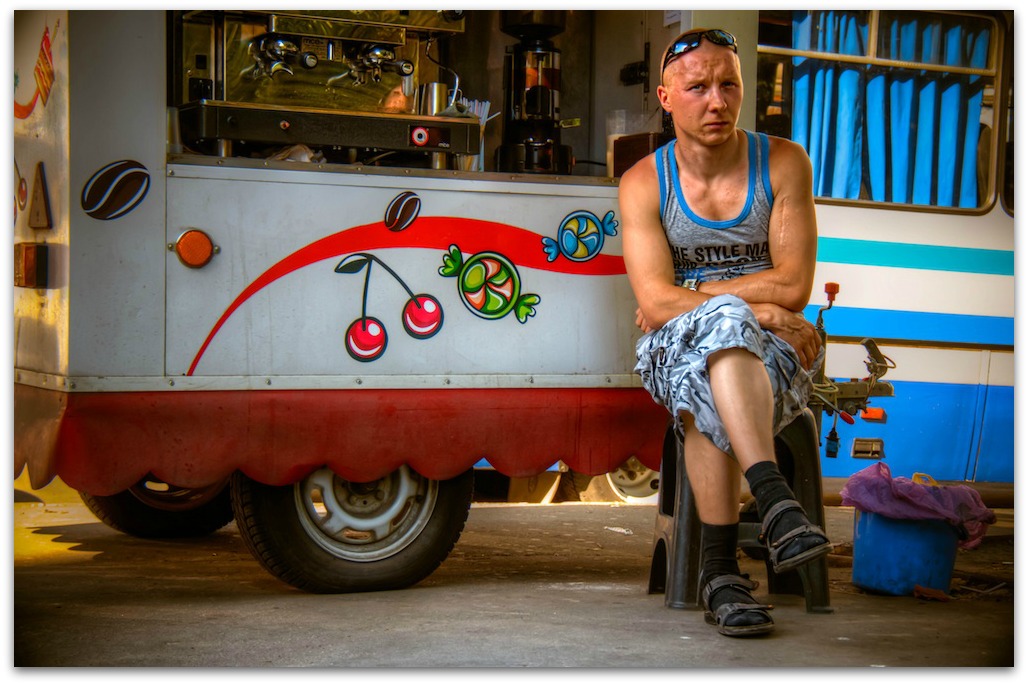
Streetvendor_drop shadowTell me about this recent photo you took of a street vendor in Kiev (original here). How did you find yourself in Kiev?
I was on a long earthbound trip in 2012 from Budapest to Hong Kong, which took me through Kiev.

How did you come across this street vendor? Did you converse with him before taking his photo?
There was no verbal communication. Rather, I nodded at the guy while moving the camera in my hand slowly, indicating that I wanted to take his photo. His face was blank in acceptance so I went ahead and snapped the photo.

Do you always try to try get permission from people when trying to take a photo?
I prefer to ask for permission, but sometimes it’s the spontaneity that makes the photo and asking would yield a different result when they prepare themselves for the photo. Either way, I make sure the subject knows I’m taking their photo.

Is it difficult to obtain permission when facing a language barrier?
It’s important to learn how to communicate with your facial expressions and your body as well as being able to read others. In my experience, regardless of whether your communications are verbal or non-verbal, the more confident and subtle you are, the more likely you are to get approval.

One thing about the street vendor picture that really stands out for me is the boldness of the colors. Can you tell me why and how you set up the shot like this?
Initially, I tried to achieve an effect that would provoke an emotional response akin to the one I had in that moment. A new environment can be emotionally overwhelming—a feeling that can be difficult to capture. First impressions are special. So when I first started editing it was the exaggeration of colors that made me feel the closest to “re-experiencing” the place. Although you can never really re-live the moment, you can come up with something that reminds you of it.

In a way it’s like when a friend tells you a “you really had to be there” story—and exaggerates the details to make the point. It’s not that the true story needs any exaggeration to be interesting, but you need to have the exaggeration to translate the feeling.

Many of these aspects of photography are, of course, a matter of experience and taste. Believe it or not, my earlier photos were even more color crazy. With more experience I’m leaning away from it and trying to express the moment in other ways. I really like black-and-white photography and the subtlety of its expression. I find it trickier and am experimenting with it more at the moment.

Parting shots…

When you take a look at the two photos mentioned above, what’s the first thing you remember?
The London photo reminds me of my host, a friend I haven’t seen in years.

The photo of the Ukrainian street vendor reminds me of a young violinist I met on the train and spent the day with. It also reminds me of how hot the day was and my craving for kvass (a fermented drink made from rye bread). Believe me, a hot day in Ukraine can make you crave kvass as a refreshment.

Are you hoping that these photos will evoke similar emotions in other viewers?
The intent is not always to prompt the same reaction I had. The same photo can prompt many different reactions. I like it when visitors to my site send messages expressing how my photos reminded them of their own experiences.

Finally, do you have any advice for wannabe photographers who are traveling or living abroad, on getting started?
I’d say to take photos for yourself first and not to think about what others would want to see or to try to meet their expectations. The first person your photos should move is yourself.

Thank you, Ildrim! Readers, what do you make of our first photographer post? Some wise words here, and who knew that autobracketing could be so useful? So, any further questions for Ildrim? Please leave them in the comments!

STAY TUNED for tomorrow’s post from expat author, Helena Halme, who is giving away THREE COPIES of her latest novel! 🙂

If you enjoyed this post, we invite you to register for The Displaced Dispatch, a round up of weekly posts from The Displaced Nation, with seasonal recipes, book giveaways and other extras. Register for The Displaced Dispatch by clicking here!

Related post:

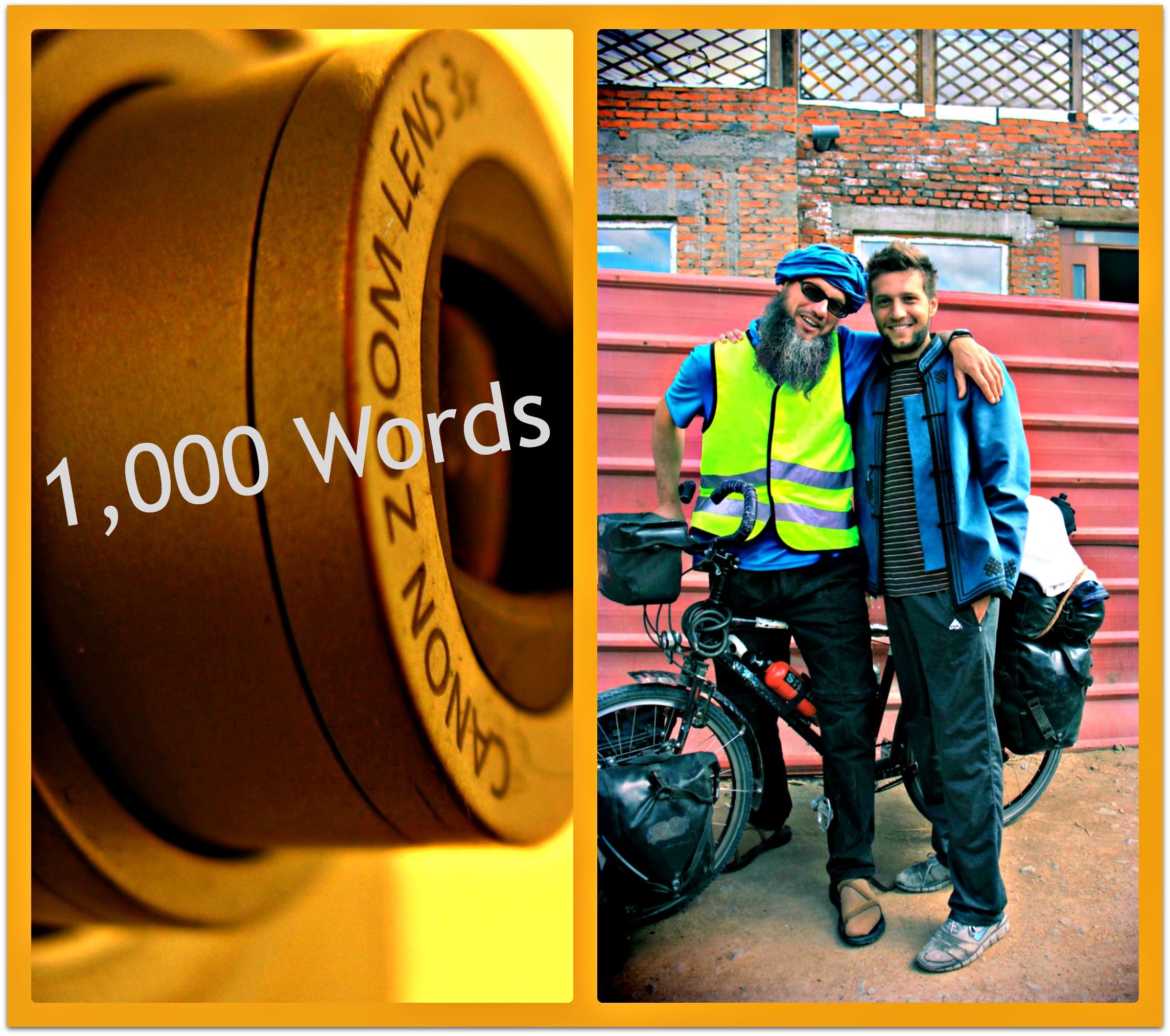
Images (from left): Camera lens from MorgueFile; Ildrim Valley (on right) with a traveler he met last summer in Ulaanbaatar in Mongolia. Says Ildrim: “He was originally from Slovenia but didn’t like being associated with any particular place. He’d been traveling on his bicycle for about four years at that point.”

For author Lana Penrose, expat “curveballs” come in threes

curveballToday we welcome back best-selling Australian author Lana Penrose, who last visited us in December to commiserate with those who were spending the holidays separated from their dearest and no longer nearest. Today’s occasion? The publication of Lana’s third memoir on her life abroad in Europe. Wait, did I just write “third”? Yes, this indefatigable Aussie managed to get a trilogy out of her expat experience, and is here today to explain.

—ML Awanohara

I’ve been asked to explain what motivated me to write my latest mini-memoir Addicted to Love, and it’s a very good question—one that I pose to myself often, particularly while in the throes of insomnia.

ToHelasandBack_dropshadowFor the uninitiated, I’m the author of To Hellas and Back, which chronicles my true-life tale of following the love of my life to the ends of the Earth (Greece) only to wind up losing my mind.

I then Nutbushed over to the UK to work for a world-renowned pop star and in the process wrote Kickstart My Heart, which details my attempt to negotiate my newly single life à la Bridget Jones—only with an axe through her head. As the book’s subtitle says: “A carnival of dating disasters”.

KickstartmyHeart_dropshadowNow these two books are rife with comedy, tragedy and my own human failings, so why scoop out what’s left of my heart and smear it across my shirtsleeve?

Like I said … a very good question.

More to the story…

The truth is that my story absolutely did not end with me leaving London to re-sample Greece after again being lured by love’s enchantment. In fact what happened next is something that I’ve kept close to my chest because it was downright shocking. I spent considerable time deliberating over whether I should share it at all.

AddictedtoLove_cover_dropshadowBut as many of you displaced writers know, the problem with being an author (one of the many!) is that you can’t seem to stop writing. And life has been more than accommodating in throwing me the odd curveball, the sort of material I feel compelled to purge away with my pen.

And so Addicted to Love was born: a mini-memoir that proves once and for all that truth really is stranger than fiction.

It’s set on the beautiful Greek island of Kythera, where I faced an impossible situation that I can’t go into here without issuing a spoiler alert … but rest assured that it’s gripping and you’ll digest it quite quickly, because it’s been described as “a page turner.”

Finally, an answer (of sorts)

But back to the original question: What motivated me to write this book? Well, thankfully (and unfortunately), experience has shown that there are many people who go through similar triumphs and tragedies to mine, particularly while traversing the globe. I like to connect with such people, and book writing is my way of holding out a hand and saying: “What—you, too?”and “You’re not alone.”

To Hellas and Back, Kickstart My Heart and Addicted to Love form a trilogy of the victories and pitfalls I experienced as an everyday person hurdling life abroad.

Each book can be read as a stand-alone, but I (predictably) suggest that you start at the very beginning to understand the depths of where I wound up.

* * *

Hey, Lana—you wound up here, at the Displaced Nation! That’s not the depths, surely? Readers, any questions for Lana or words of support? If you’re not familiar with Lana’s works, you can find the entire trilogy on Amazon or Smashwords. And don’t forget to follow her advice and begin at the beginning: by going to hellas and back!

Sydney-based (and no longer displaced) author Lana Penrose has had various incarnations, including music journalist, record company promotions gal, music television producer and personal assistant to an iconic pop sensation whose name shall never be revealed unless she’s subjected to Chinese water torture. She also once worked with the now-infamous Simon Cowell, which she today finds really odd. You can read more about her and her works on her author blog and/or follow her on Twitter: @LanaPenrose

STAY TUNED for tomorrow’s post, when we’ll be revisiting one of the earliest themes on this blog, Alice in Wonderland, but from the perspective of an international creative.

If you enjoyed this post, we invite you to register for The Displaced Dispatch, a round up of weekly posts from The Displaced Nation, with seasonal recipes, book giveaways and other extras. Register for The Displaced Dispatch by clicking here!

Related posts:

Image: MorgueFile

Pay no mind to the travel experts — beauty is in the eye of the beholder!

Matador Network published an article last month bemoaning “travel pornography” — in other words, the kinds of photos one often sees in polished travel guides, making an exotic place look so much better than it does in reality.

This is significant because many of us make our decisions about where or where not to go on the basis of travel Web sites, guidebooks and even Pinterest boards — with their slick photography and accompanying reviews.

As the Swiss-born British philosopher Alain de Botton noted in his book The Art of Travel:

Where guidebooks praised a site, they pressured a visitor to match their authoritative enthusiasm, and where they were silent, pleasure or interest seemed unwarranted.

Case-in-point: São Paulo vs Rio

In Brazil the travel experts have influenced and help perpetuate contrasting perceptions about the country’s two biggest cities: São Paulo (where I live with my Brazilian wife) and Rio de Janeiro.

In most instances you’ll read that Rio is the jewel in the nation’s metaphorical crown, the princess; whereas São Paulo is the ugly stepsister that is best avoided at all costs.

To be honest, when I moved to São Paulo just over a year ago, my own first impressions were not much different. It struck me as a place with ugly skylines, overwhelming traffic and polluted rivers. However, as time went by and I got to know the city better, those impressions changed.

And when I recently went traveling around Brazil with a visiting friend from London, I discovered something quite interesting — I was actually becoming as defensive of São Paulo as the natives.

The bad rap on SP

I started to notice this shift when my friend and I encountered other travelers. Anyone who has traveled recently will know that it’s common to meet all sorts. Typically, your first interactions — long before you decide to become best friends and end up downing shots of tequila in some godforsaken bar (even though you’ll probably never see each other again) — consist of small talk along the lines of:

“Where do you come from?”
“What do you do?”
“How long will you be in [insert city, town, country, etc]?”
“Which football team do you support?”
“Who the hell are Gillingham?”

On this trip, when the mundanities came my way, I had to explain why I resided in São Paulo rather than in London. Then I would get the inevitable “Why the hell are you there?” along with repeated denouncements of São Paulo and how it is a city of doom and gloom, a modern day Sodom and Gomorrah:

“I couldn’t live there” | “I don’t like the sound of living there” [delete phrase depending upon whether you’ve actually been to São Paulo].
“There’s too much/many…. [insert one of the following: traffic|pollution|cars|people].”
“It’s not a tourist city, there’s nothing to do or see.”
“It’s just a big, ugly city.”
“It’s too dangerous.”

There is, of course, an element of truth to most of these points. However, don’t these criticisms (apart from the lack of tourist sights) reflect the reality of 21st-century urban life the world over? I mean, isn’t the debate a matter of degrees?

I blame the travel pornography/travel guidebooks. Cities like São Paulo are constantly maligned because no one has taken the time to dig beneath the surface, or because they are not as immediately captivating as their outwardly attractive neighbors (namely, Rio).

Is beauty an illusion?

But whilst anyone can see that Rio is beautiful, it takes a keener to eye to observe beauty or virtue where it is embodied in less obvious forms. You need to become an explorer of the sort James Murray described in his post of yesterday.

Besides, as is the case of many places that are subject to so-called travel porn, Rio may not actually be as stunning as you first thought. It’s often said of that much-visited city that it is beautiful from afar but rather less so when you get up close.

Copacabana, for example, with its world-famous beach, may have once been the home of the glamorous, but today it’s tatty and parts of it, especially at night, are seedy and not massively safe.

And São Paulo?

Well, if Rio is beautiful from afar but less so up close, then I’d say SP is the opposite. As you approach Brazil’s largest city, its skyline advances towards and then engulfs you in its beige blandness, overwhelming and unending — an effect made more noticeable due to the city’s ban on outdoor advertising.

That said, once you get used to it, SP’s vastness actually becomes one of its marvels.

SP at its most splendid

When I moved here just over a year ago, I vividly remember my sister-in-law saying that living and working in São Paulo makes her feel like a “citizen of the world” — like a small part of something big and important.

What she said is true. Whilst I love venturing into the wild, I am more fascinated by cities — mainly because they are man-made and hence symbolize the complexity of the human condition (I’m a typical sociology graduate!).

Returning to our friend de Botton: he introduces the notion of the sublime in his book on travel, pointing out that certain landscapes can provoke sublime thoughts. Places, he says, can “gently move us to acknowledge limitations that we might otherwise encounter with anxiety or anger in the ordinary flow of events.” (He sees this as a kind of substitute for traditional religious worship.)

For most people, the sight of a desert, canyon or rainforest is enough to elevate them to the sublime, helping to put their daily woes into perspective. But for me it has taken an encounter with a mega-city like São Paulo.

And then there’s that street art!

Whenever I start feeling this way — that SP has put me in touch with something sublime — I begin to appreciate the beauty in the things around me. (I’d missed those things before because of feeling overwhelmed.)

For example, I became acutely aware of the quantity and quality of São Paulo’s street art, which I think must rank amongst the finest, if not the finest, anywhere in the world. You can find fascinating street art everywhere and if you exclude pichação (wall writings done in angry protest), then on the whole it enhances one’s enjoyment of the city’s neighborhoods.

In my view, the street art alone is a good enough reason to visit São Paulo.

But if street art doesn’t take your fancy, rest assured the city also offers plenty of good food, culture and entertainment. Indeed, I cannot think of a place I’ve been to in the continent with as wide a range of quality museums and art galleries.

At weekends you can go for a walk in Parque Ibiraquera (SP’s Central Park), watch a top South American football team, catch a film at an IMAX or, if culture is more your thing, go to a play, opera or ballet. And if you’re a music fan, you’re in luck. Artists who tour South America usually have São Paulo as one of the first dates on their itinerary.

The thing about São Paulo is that whilst it can be intimidating and is perennially frustrating, it’s also pretty cool. As displaced actress Marlene Dietrich once said:

Rio is a beauty — but São Paulo, ah … São Paulo is a city.

And for me, there’s something rather exciting, not to mention awe-inspiring, about that.

STAY TUNED for Tuesday’s post.

If you enjoyed this post, we invite you to register for The Displaced Dispatch, a round up of weekly posts from The Displaced Nation, with seasonal recipes, book giveaways and other extras. Register for The Displaced Dispatch by clicking here!

Related posts:


I’m an explorer — not a traveler

This week, the Displaced Nation is drifting away from March’s initial theme of beauty/fashion tips picked up from world travels. Hardly surprising, given that all of this week’s writers are males! Today’s guest poster, James Murray, a displaced Brit in Boston, is a prime example. The only new fashion he’d like to start would be replacing the word “travel” with “explore.” Sounds pedantic, right? Well, see what you think!

— ML Awanohara

I was never really one for traveling. When all the kids went on their gap years before college, I called them on it: I knew it was a waste of money; a way to delay the inevitable intrusion of the Real World into their lives — in short, I didn’t see the point.

Receiving emails from abroad about how wonderful these experiences were and how life-affirming and eye-opening and incredible the world was, I simply smiled to myself.

How naïve they were, I thought.

Whereas I would be a year ahead; a year closer to a job; a year closer to money, and a year closer to actual freedom.

I did not see work as some black hole into which you pour all of your efforts with no hope of ever getting anything back. On the contrary, I thought it would be pretty good to have a job and a flat and friends and the cash to support a lifestyle I could be comfortable with.

Travel for travel’s sake

I still think that. In fact, I’m not entirely sure I was ever wrong on this point. Sorry to disappoint. And particular apologies to Jeff Jung, whose book on career-break travel was favorably reviewed on this site at the end of last month.

Don’t get me wrong. Yes, I’ve traveled and, yes, I love being “elsewhere,” doing things differently, as much as the next displaced nation resident. In fact I’m a bit of a neophile when it comes to food and culture…

But being enamored of the new doesn’t mean you have to travel.

Travel provides a set of obvious novelties: new tastes; new currencies; new transport; climate; a different view from the window.

But just being somewhere different doesn’t make you an explorer; in order to get that badge, you need to set foot outside your comfort zone, step away from the hotel, the package tour, the guidebook — and look with your own eyes.

Cross that one off the list!

That Facebook app that challenges you to prove you’re a world traveler by listing all the countries you’ve visited irrespective of how long you were there or where exactly you were: what does it really show? It makes a three-day hotel stay in Shanghai look as though you’ve conquered the entirety of mainland China, and it reduces that beautiful holiday in Wales — you know, the one that reminded you what it was like when shops closed on a Sunday — to a complete non-event.

The way we think of travel is all wrong: the political boundaries on the map say that I now live in the USA, but that doesn’t really say anything about where I actually live or the aspects of American culture that I’ve actually experienced.

My life would be completely different if, say, I lived in the desert or the mountains — it would even be different if I lived in New York instead of Boston.

I don’t anticipate ever being able to say that I’ve seen it all.

Explore, for heaven’s sake!

Exploring as opposed to traveling is a question of quality against quantity. I did a lot of exploring in London and Edinburgh that opened my eyes just as much as wandering around Thailand and Romania.

A few curiously exploratory examples:

  • Getting a haircut at a weird little barber’s in Shepherd’s Bush. It was an all-male barber’s, where men could “come along and say what they like in whatever language they like,” as the proprietor put it. I remember being very quiet amid a torrent of very macho conversation. Not a totally unpleasant experience, but I never went back.
  • With my flatmate, laying Russian roulette with the pastries at Vanna Patisserie, a Chinese bakery in Shepherd’s Bush. They were either sugary and delicious or curiously tough with a peculiar secret ingredient. There was no way of telling from the outside.
  • Spotting a Portobello (Edinburgh) art exhibition displayed outside people’s homes that featured, amongst other things, a fat-and-seed bird feeder in the shape of the artist’s head, hung from a tree, where it was gradually and gruesomely pecked to pieces.

These bizarre titbits are the wages of the explorer but not necessarily the traveler, who might see only those accepted “landmarks” to which his eyes are directed.

Avenues for exploration are everywhere. In fact, when I first moved to London, I was so inspired by the tube stops that I wanted to develop a guide to each one.

My idea was that I would use some algorithm to pick a different tube stop each weekend, go there and simply wander around in a roughly spiral shape from that stop, looking carefully at architectural details, stopping in parks and perhaps interviewing the proprietors of particularly interesting local businesses.

I would document these things not so much as a guide for others to visit exactly the same places, but in hopes of inspiring them to look at their own neighborhoods with new eyes.

Exploring the New World

I try to do the same kind of thing in Boston, although I confess I find it a bit harder — there’s the sheer fact that London is 1) massive and 2) very, very old that makes it rather easier to find the gems at the ends of the nooks and crannies.

But I’m not discouraged — I’ve still barely explored the North End with its windy little streets and ample opportunities for getting lost (I don’t have one of those phones that tells me where I’m going).

And just the other day we were introduced to a bar not five minutes down the road, which will make a superb local, with its walls plastered in kitschy tut. I’m sure I’ve passed it before, but, like all the best things, it’s a bit hard to spot.

In amongst these streets are histories, idiosyncrasies and mythologies — of that I have little doubt. Finding them is just a matter of retiring my traveler’s shoes and donning an explorer’s hat.

* * *

So, world travelers — sorry, I meant to say “explorers” — what do you think? Is James right in saying that all of this obsession with the quantity of travel (how many countries, etc.) is misguided? And what do you think of his assertion that Edinburgh can be as fascinating as Bangkok, if you take an explorer’s approach? Please leave your thoughts in the comments…

James Murray is a self-described “itinerant Brit.” After a stint in New Zealand, and some travel in Southeast Asia, he and his American girlfriend — now wife — are practicing “staying put” in Boston, where James is pursing a career as a wordsmith for marketing and fiction, and as a non-professional theatre director. He is also a Utopian idealist and SingStar enthusiast. You can find more about his views by reading his blog, Quaint James, and/or following him on Twitter: @quaintjames.

STAY TUNED for tomorrow’s post by Andy Martin, about a unusual source of beauty in his new home town of São Paulo.

If you enjoyed this post, we invite you to register for The Displaced Dispatch, a round up of weekly posts from The Displaced Nation, with seasonal recipes, book giveaways and other extras. Register for The Displaced Dispatch by clicking here!

Related posts:

img: MorgueFile

LESSONS FROM TWO SMALL ISLANDS — 6) Keep Calm and Run a Bath

I didn’t think seriously about fashion and beauty until I, an American East Coaster, became a resident of two small islands: Britain and then Japan.

Both London and Tokyo are fashion capitals, and living in each of these cities, I found that every so often I really enjoy thinking about striking clothing combinations, make-up, and self-pampering.

Would I have discovered this love of what America’s Puritan founders would call frivolity had I stayed in this country? It’s conceivable, especially if I’d moved to New York City, where I now live as a repatriate. (NOTE: While I do not have Puritan ancestry, I was raised to be a bluestocking, not a girl in rhinestone-studded pantyhose.)

But in the event, I discovered fashion and beauty through my travels — and from learning about how women in other countries clothe and groom themselves.

So what, you may ask, were my key take-aways from this relatively speaking decadent period of my life? No specific beauty products or fashions, but these five guiding principles:

1) To get an English rose (or any other perfect) complexion, you have to be born with it. Nevertheless, skin care is worth it.

As a Caucasian woman, one of my beauty ideals was that of the English rose: a woman with flawless porcelain skin and rosy cheeks that look as though they’ve been produced by good bracing walks in the countryside wearing sensible shoes and tweed skirts.

When I first moved to England and encountered some actual English Roses, I wondered: is it because of the climate, the cosmetics from Boots the Chemist, the diet? (How do I get me one of those?)

My research soon revealed that diet has nothing to do with it. Not in a country where people grow up eating chips and crisps.

And as nice as the No7 products are, they can’t work miracles.

So maybe a glowing appearance is the result of England’s unique climatic conditions: a paucity of direct sunlight and the moisturizing drizzle that almost always seems to be in the air?

I hardly think that can be the case, as there are plenty of Britons with problem skin…

Trying not to turn pea green with envy (hardly a flattering shade!), I could come to only one conclusion: you have to be born with it.

But, not to despair! Once I reached Japan, where women are obsessed with their skin — some even use whitening lotions to obtain a creamier complexion — I learned that of all the things you can do for beauty, skin care is the most worthwhile.

Ladies, if you protect your skin, you might find yourself turning into an English Rose when you get a bit older — the Last Rose of Summer, so to speak.  While some may swear by Crème de la Mer, I go with the regime I picked up in Japan: sunscreen, a hat and a parasol.

I’d also recommend befriending your dermatologist, who knows a lot more about skin care and sun protection than the woman behind the cosmetics counter…

2) Don’t be afraid of experimenting with your hair: it can add some spice and life to your image.

In the UK one of my English rose-complexioned friends favored a chic bob — but with a streak of blue, green or red in it.

As an American fresh off the boat, I was rather scandalized. Why was she ruining a perfectly good hairstyle?

Over time, however, I came to realize that when you live in a country where skies are often the color of lead, adding a bright color to a strand of hair can brighten up your day.

By the time I left England, I could no longer understand why any woman, once she reached maturity, wouldn’t dye or highlight her hair. She doesn’t know the fun she’s missing out on! And, even though I have yet to streak my hair in an outrageous color, it’s definitely on my bucket list.

In Japan, too, I got some kicks from playing with my hair — this time, by adorning it with the kinds of hair ornaments that have been popular since the times when women wore kimono and kanzashi: combs, hair sticks and pins, hair bands, and fancy barrettes.

I did not have particularly long hair when I first reached Japan, but as long hair is the signature of Japanese ladies — and they were my new role models — I soon had locks long enough to make the most of such accessories. My favorite was the snood — I had one that was attached to a barrette covered with a bow. What a great way to keep long hair out of one’s face.

3) Gemstones and pearls are a girl’s best friend.

Sorry, Marilyn dear, but after living in the UK and Japan, my BFFs are gemstones and pearls. Is this because I went to England in the era of Princess Diana, with her (now Kate Middleton’s) 18-carat sapphire ring?

My relationship with colored gemstones only deepened after I moved to Japan and went on several sojourns into Southeast Asia, land of rubies and sapphires, among others.

My engagement ring is a ruby (purchased by my hubby in Tokyo!).

In Japan itself, I fell for pearls and now have quite the collection of necklaces, earrings, rings, and bracelets, mostly from Wally Yonamine’s in the Roppongi area of Tokyo. The owner, Jane, wife of  Wally (a professional baseball player who played with the Yomiuri Giants) is a displaced Japanese Hawaiian.

4) Youth is the time to have fun with fashion.

In the UK, I was taken in by the spectacle of punk and post-punk kids and their strange fashions, while in Japan I found it mesmerizing to watch the Lolita fashions of the Harajuku kids, on a Sunday afternoon.

Eventually, instead of thinking they were weird, I regretted never having had my own equivalent of wearing Doc Martens with a Laura Ashley dresses … sporting long, back-combed hair, pale skin, dark eyeshadow, eyeliner, and lipstick, black nail varnish, along with a spiked bracelet and dog-collar … dressing up like a Victorian boy …

It just wasn’t the done thing, in my stiff, conservative American circles, to wear outlandish garb. And now it’s too late, of course. Youth is the time when you can get away with it. After that, you have to wait for Halloween. (Unless, of course, you want to come across as “mutton dressed as lamb,” as the English say…)

5) Last but not least, my top beauty tip, reinforced by both of these countries: A bath is much preferable to a shower.

At the beginning of living in England, I missed the American shower so much. I was convinced I would never be clean again. But then one day I woke up and realized I’d been brainwashed into believing I needed to have a shower every day. In fact, daily showers dry out the skin. As one dermatologist puts it:

Most people wash far too much. Using piping-hot water combined with harsh soaps can strip the skin of its oils, resulting in dryness, cracking and even infection.

That was around the same time I opened my mind to the possibility that baths — which tend to be favored over showers in the UK (at least in my day) — might actually be preferable. Nothing like a long hot bath with a glass of wine and a book, my English friends would say. Or, as one British beauty site puts it:

A nice bubble bath is the closest you can come to having a spa-like relaxing experience in your own home, without much effort or without spending a lot of money.

Too true! Plus the English shops sell such wonderful bubble bath creams. My favorite was the Perlier Honey Miel (actually from Italy).

Still, I didn’t mind giving all of that up once I reached Tokyo — not the bathing but the bubbles. In the land of the communal bath, you scrub the skin first and then have a long soak in clean hot water, in a tub (ofuro) that is deep rather than long.

Indeed, Japan was where I learned the benefits of exfoliation: I ended up sloughing off dry skin from parts of my body I didn’t know existed. And then the immersion in clean hot water: bliss! Like returning to the womb…

For a Japanese who works long hours, bathing is a sacred time, a ritual. While I haven’t quite converted that far, I have a Pavlovian reaction every time I hear bath water running. Time to go into Total Relax Mode!

I even have a Japanese bath here in my apartment in NYC, and the thought of sitting in it is what keeps me going … That said, I must confess that I sometimes put bubbles in. What can I say? I’m displaced.

* * *

So, readers, what do you make of my five beauty principles? Have you picked up any of your own in the countries where you live? I’m all ears — only please excuse me for a minute while I make sure the bath water isn’t running over. (I don’t want my downstairs neighbors knocking on my door at 3:00 a.m.!)

STAY TUNED for tomorrow’s post, another installment in the life of our fictional expat heroine, Libby. (What, not keeping up with Libby? Read the first three episodes of her expat adventures.)

If you enjoyed this post, we invite you to register for The Displaced Dispatch, a round up of weekly posts from The Displaced Nation, with seasonal recipes, book giveaways and other extras. Register for The Displaced Dispatch by clicking here!

Related posts:

Image: MorgueFile

RANDOM NOMAD: Andy Martin, UK-qualified Social Worker, Football Geek & Now a São Paulo Resident

Andy_MartinPlace of birth: Chatham, Kent, United Kingdom
Passport: UK
Overseas history: Brasil (São Paulo): February 2012 – present. I also had a period of travel around South America between 2007 and 2008.
Occupation: NGO Volunteer, English teacher, blogger
Cyberspace coordinates: The book is on the table: An Englishman’s guide to living in São Paulo (blog) and @andyhpmartin (Twitter handle).

What made you give up London for São Paulo?
For some reason — probably because I’m a massive football geek — I had always wanted to go to South America, and so when I found out that one of my best friends was planning to travel there, it took very little persuasion for me to tag along. Then whilst there I met my future wife, who is Brazilian, and it all got a bit more complicated.

First she moved to live with me in the UK. We got married and stayed in London for three years. However, she had deferred her degree in Brazil to move to London, where I had a job as a social worker. I am a qualified social worker and spent almost nine years working in various social or community work roles. For most of that time I specialized in supporting refugees and asylum seekers. But when my job became uncertain due to government cuts (due to the economic crisis), it seemed like the perfect opportunity to move to Brazil so that my wife could finally get everything finished.

So now you’re a trailing spouse. Does anyone in your immediate family share that fate, or do they all live in the UK?
When I first traveled to South America in 2007, I was pretty much the first person in my entire family who had ever traveled outside of Europe, so I can’t really say there’s any significant history or influence of having the urge to want to explore or become “displaced.”

You haven’t been in São Paulo for long, but can you pinpoint a moment when you have felt displaced?
I had been to São Paulo twice before I moved here and I was already quite familiar with South America as a whole, so was pretty well prepared for what to expect — although there’s no doubting that living somewhere and just visiting are entirely different things.

But if I had to pick one thing, it wouldn’t be a moment but more the constant challenge of living somewhere where you are unable to speak your mother tongue. We Brits are notoriously bad at learning languages, and I can barely remember any of the French or German I learned at school. I did learn some Spanish whilst traveling in 2007, and in some ways this helped because of its similarities with Portuguese, although on the other hand it was also a hindrance because of their very many differences.

Not being able to fully communicate your thoughts is obviously very frustrating and when you’re having a bad day, it just intensifies your sense of displacement and dislocation. Fortunately, Brazilians are pretty intrigued by people (especially those from the “West”) who have moved to Brazil and are trying to learn Portuguese. They’re often very forgiving when you make mistakes. It also helps that many Brazilians themselves tend not to speak grammatically correct Portuguese, so in effect your own mistakes are just contributing towards the evolution of the language (that’s what I like to convince myself, anyway!).

When have you felt the least displaced?
One of the things I love about Brazilians is their general informality. As someone who’s never worked in an office or a suit, I feel right at home. For example, people are often referred to by their nicknames (even the former President was) and rarely, if ever, by their surnames. Also, Brazilians tend not to make a big deal out of social occasions — it’s more about making sure you’re surrounded by the people who matter to you. As long as there’s cold beer, everyone’s happy.

How could you not feel at ease?

You may bring one curiosity you’ve collected from the country where you’ve lived into The Displaced Nation. What’s in your suitcase?
Again, as a self-confessed football nerd, I think it would have to be my collection of football shirts. I have one from pretty much every country I’ve been to, and I’ve lost count of how many I’ve acquired in South America.

You are invited to prepare a meal for the Displaced Nation, based on your travels. What’s on the menu?

Starter: Salgadinhos (savoury snacks) are fantastic so a platter of these, including:

Main: It’d have to be a churrasco (Brazilian BBQ). That may sound pretty unimaginative, but once you’ve had a Brazilian BBQ, especially those from the south, you’ll forever wonder why it took you so long to do so.
Dessert: A selection of some of Brazil’s finest (and weirdest looking) fruits. Believe me, I’ve seen fruits in the markets here which look like they have been imported from Mars. They taste great, though.
Drinks: Brazil’s most famous cocktail, a caipirinha, which is a hangover-inducing concoction of cachaça (sugar cane rum), lime, sugar and ice. Refreshing, tasty and deceptively lethal.

Now that you are hard at work learning the language, can you donate a Brazilian Portuguese word or expression to the Displaced Nation’s argot?
Tudo bem? This is pretty much said every time you greet someone in Brazil and literally translates as “Is everything okay?” It reflects quite nicely, as I mentioned previously, how Brazilians prefer to keep things simple and informal.

This month, we’ve been focusing on the need for mentors: people who teach us what we need to know, or remind us of things we have buried deep. Have you found discovered any new mentors, whether physically present or not, in your life abroad?
As mentioned in my guest post this month for the Displaced Nation, when I’m going through a period where I’m missing home or things get tough, I often think about some of the kids I worked with back home in London (in my last job I worked with unaccompanied minors from countries such as Afghanistan).

Thinking about the challenges they as young kids faced after fleeing their home countries — but then still being able, on the whole, to go on and make the most of their new lives — always helps me to put into perspective the things I tend to moan or stress about here, in what is fortunately a much easier experience of displacement.

Apart from that, I read as widely as possible. For instance, I recently really enjoyed Alain de Botton’s The Art of Travel.

If you had all the money and time in the world, what topic(s) would you choose to study in your adopted country?
I guess, given my pre-existing interest and work experiences with migration, I’d like to study the history of migration to Brazil. Brazil is a country defined by (im)migration — for example, my wife has indigenous, Spanish, Italian and Portuguese heritage, a mix that is is pretty normal for Brazilians. It would be fascinating to piece it all together in order to get a more holistic understanding of who Brazilians really are.

I’ve always wanted to do a PhD, so who knows, maybe this might be my research proposal one day!

Readers — yay or nay for letting Andy Martin into The Displaced Nation? A social worker who is taking lessons from the Brazilians on how to be more social? Who is used to helping the displaced and is now displaced himself — so may be in need of our help? (Note: It’s fine to vote “nay” as long as you couch your reasoning in terms we all — including Andy — find amusing!)

STAY TUNED for tomorrow’s post, an expat take on the muses of Classical Antiquity.

If you enjoyed this post, we invite you to register for The Displaced Dispatch, a round up of weekly posts from The Displaced Nation, with seasonal recipes, book giveaways and other extras. Register for The Displaced Dispatch by clicking here!

Related posts:

Img: Andy Martin travels within his native land (the Norfolk Broads, 2010), a couple of years before his expatriation.

CAPITAL IDEA: London: A quick guide

LondonWelcome to the first “Capital Ideas”. It is a new feature here at The Displaced Nation. It’s our somewhat idiosyncratic, ever so slightly tongue-in-cheek guide to various world cities, perfect for the ever discerning readership of this blog. We know our readers are always visitors, never tourists (an important distinction).  Do feel free to contribute your own ideas or suggestions in the comments section, we’d love to hear your thoughts, too.

City: London

Where is it? On some damp, mildew-ridden island in the north Atlantic.

Why should I go? Because it’s one of the world’s great cities. An exciting modern city with a diverse population of eight million there’s something for everyone. With hosting the Olympics, 2012 was a great year for the city and infused it with a self-confidence unusual to the British. Quite simply, this is the perfect time to visit London.

So is it true that when a man tires of London he is tired of life? Not if he’s living in Dalston.

I don’t know anything about Dalston. You’re not missing much.

What are the must sees? Well, if you want to be that tourist, you know the one who wears pristine white sneakers and white socks, keeps their passport safe in their fannypack and planned their trip after taking out a Rick Steeves travel book from 1986, then the basic checklist is Big Ben, Buckingham Palace, St Paul’s, Tower of London. You can do all that by popping on one of those tourist trap sightseeing bus tours. You’ll get to sit on the top of a double-decker with other fannypack wearers — it’ll be beautiful.

Hmm, I don’t have a fannypack. Not to worry. You’re a The Displaced Nation reader, you want something a little more “not for tourists,” don’t you?

You know me so well. Tours can be good fun for the visitor limited in time. However, instead of those overpriced bus tours, we recommend London Walks. Brunel’s Thames tunnel, in particular, is one we’d recommend for a fascinating and sadly forgotten part of London’s history — it was once considered the eighth wonder of the world.

What about a walking tour that sounds a bit more “fun”? Well, provided you’re not traveling with kids, you could also do a pub crawl. That fun enough for you?

Absolutely. Any other suggestions? Spend a morning at Lincoln’s Inn Fields. There you’ll be able to visit two fascinating museums that are among our London favorites. There’s the Hunterian Museum (an C18th collection of anatomical specimens including the skeleton of Charles Byrne, known as the “Irish giant”) at the Royal College of Surgeons and across the fields is Sir John Soanes’s Museum (the former home of architect Sir John Soanes, the museum contains his extensive collection of antiquities and paintings). Or, if you’re in the city in the summer then venture to the north of the city and visit Highgate Cemetery. There you’ll be able to get a guided tour of the western cemetery – resting place of Michael Faraday and Christina Rossetti. In the eastern cemetery rests Karl Marx.

What’s a must-do? Spending time on the South Bank. Here you’ll find the National Theatre, the Royal Festival Hall, the Globe and the BFI Southbank (formerly known as the National Film Theatre). So the perfect place to take to showcase the city’s cultural merits.

Is the city easy to get around? Yes, although Londoners like moaning about the public transport, the city is home to one of the world’s best public transport systems. Familiarize yourself with the London Underground (known as “the tube”) and you can travel around the city easily and relatively cheaply. If you are a night owl then you need to remember that the underground stops running trains between 12.00am and 12.30am.

I hear the British cooking is awful. Do I need to pack sandwiches when visiting London? That outdated stereotype. London is home to some of the world’s best restaurants. And don’t forget how I mentioned earlier that London had such a diverse population, that’s reflected in the city’s restaurants. Whatever you fancy, be it Eritrean or Burmese, you can find it in London. Our recommendation is that you take a trip to Brick Lane for a slap-up Indian dinner.

Hmm, my mate John visited London last year and said the food still sucked. Did John stick with the tourist traps? New York is a great city for eating, but if you only go to restaurants at Time’s Square you’re not going to get that impression. One easy tip, never eat in an Angus Steak House.

So the locals don’t all eat jellied eels? No, but if you do want to experience an old cockney-style pie and mash shop, then we recommend Goddard’s at Greenwich. If you’re being really adventurous and want to unleash your inner pearly queen by having some jellied ell then this is the place to do it.

Have you ever tried it? Yes.

Did you like it? Let’s just say it was interesting.

What should I read? If you want to brush up on London, then we’d suggest Peter Ackroyd’s London for a nice, meaty read about the city, as well as his book The Thames. Other books we’d suggest are Iain Sinclair’s London: City of Disappearances, Henry Mayhew’s London and the London Poor and James Boswell’s London Journal. And, of  course, you can’t visit London and not be reminded of Dickens (do make a trip to the Charles Dickens Museum  , at 48 Doughty Street). We think Bleak House and Our Mutual Friend best show off  Dickens’s writing on London.

What should I watch? Notting Hill.

Really? Yes, it’s the most accurate cinematic depiction of the city.

I’m going to say this again, really? It’s so accurate that there’s even now a Notting Hill Carnival. This happens once a year where fans of the film get together and dress up as their favorite characters from the film and reenact their favorite scenes. Our top tip is that if you’re in London at the same time as the carnival, you should dress up as Julie Roberts or Hugh Grant and go up to people and tell them your favorite lines from the movie. They’ll love.

I really don’t think that’s what the Notting Hill Carnival is all about. Hand on heart, it’s true.

Hmmmm . . .

STAY TUNED for tomorrow’s post, a new Random Nomad interview.

If you enjoyed this post, we invite you to register for The Displaced Dispatch, a round up of weekly posts from The Displaced Nation, with seasonal recipes, book giveaways and other extras. Register for The Displaced Dispatch by clicking here!

Related posts:

Image: awindram