The Displaced Nation

A home for international creatives

Tag Archives: It’s Food!

Some funny things happened on the way to paradise, as recorded in this brilliant new expat memoir

Paradise Imperfect Collage

Clockwise from top left, surrounding Margot Page’s author photo (center): Monteverde waterfall; the family’s front yard; Margot, her husband,and their three kids; sunset; their youngest child, Ivy, on the vine outside their house; first day of school. All photos courtesy of Margot Page.

Before introducing today’s guest, Margot Page, I’d like to make one thing clear. When I first read of her decision to uproot herself, her husband and three young kids from their comfortable life in Seattle to spend a year in Costa Rica, I thought it made perfect sense.

In fact, it reminded me of my initial decision to try living abroad. While I wasn’t married with kids, nor was I looking to land in paradise, I sensed that I needed to get a wider perspective on my own country. It was before the era of the dot com boom and crazy Wall Street wealth, but even then, we Americans were becoming a pretty spoiled and entitled lot. I almost couldn’t bear to watch it and wondered: would my life be enriched if I tried living with less?

Now that I’ve made that clear, let’s return to Margot’s story. As she notes toward the beginning of her wonderful memoir, Paradise Imperfect, Seattle in 2003 could drive a person crazy:

It was an environment that made a person constantly aware of how rich other people are.

Thanks to all the overnight Microsoft millionaires, her family often felt “downright poor,” she says, despite enjoying a high standard of living and a reasonable amount of money.

Margot missed out on her opportunity to go abroad while still single—to “confront her privilege,” as she might say. But she is feisty enough to think that she need not forgo the expat experience of her dreams. A dozen years into her marriage, she finagles it so that she and her husband, Anthony, could quit their jobs, rent out their house, and head off with their three children, 4, 9 and 12, into the mountains of Central America, for a year.

The family settles down in the cloud forest of Monteverde, where the kids attend a “school in the clouds” with many Tico classmates and the entire family works hard on mastering Spanish. While it is enjoyable to read about their adventures in that part of the world—which at one point include a trip to Nicaragua, where they received a “full-on truth assault” about what poverty really is and hence their “own, unimaginable wealth”—there are plenty of other reasons to read the book as well, not least of which is that Margot is a gifted writer possessed of a self-deprecating sense of humor (always a huge plus at the Displaced Nation). She is, in short, jolly good company, as we shall see in the interview that follows. NOTE: Margot has generously offered to GIVE AWAY ONE FREE COPY to the person who leaves the most compelling comment about why they’d like to read her book.

* * *

PI_FrontCoverMargot, pura vida! Welcome to the Displaced Nation. Many people may not realize that you waited ten years before writing a memoir about the year you and your family spent in Costa Rica. Why was that?
Actually, I did try to write the book when we first got back—I just couldn’t get it done! But the great thing about that initial effort is that I wrote down a lot of the events when they were still fresh. Then, when I was actually ready to write the book, I was able take those stories and stand back from them, and see the picture they formed. You might liken it to an impressionist painting. Up close, I could have looked at an event from that year and said “Hmm, nice dot.” But with the distance of time, I could see that all the dots made a picture, with form and theme and sense. Had I managed to get it written right away, Paradise Imperfect would have been a completely different book.

Did you ever think of writing a novel instead?
More than one publisher suggested I turn Paradise Imperfect into a novel. Fictionalizing your story really lets you pile on the crises. Memoir only has a chance with the big publishing houses these days if you’re either already a celebrity (Tina Fey, Hillary), or if something truly hideous happened to you. If I’d had to saw off my arm or a couple of the kids were on meth, the big houses would have been all over me. As it was, they were very “Ooooh, we love your writing! Can you turn it into a novel?” Because then of course I could introduce some addictions or incest or something—you know, the stuff that really makes a story pop.

You went from a harried existence with very little work-life balance in Seattle, to a carefree, pura vida existence in Monteverde. Looking back, what do you think was your strongest impetus for packing it all in like that?
I think my impetus was about the same as anyone’s who’s living a busy, full life and has one of those days where you just feel like you’re running the whole time. The only difference is that a lot of people take a bubble bath at the end of that day, maybe pour a glass of wine—whereas I rented out the house and bought airplane tickets. It’s still not entirely clear to me what made that night different from a bubble bath night. Although clearly, the bubbles weren’t doing it for me anymore.

From reading the book, I know that even though you didn’t work in Costa Rica, you were far from idle. You applied yourself to learning Spanish and also did some volunteering—which had the added benefit of helping you practice your Spanish.
Yes, I went from working more than full time to volunteering a few hours each week at an amazing art gallery/studio; one of the owners painted me the piece of a woman in a hammock, stretching her toes to heaven, which became the cover of Paradise Imperfect. So while the kids did their homework, I would work on my Spanish, or practice painting assignments.

“The mind is its own place, and in itself can make a heaven of hell, a hell of heaven…”

No doubt you’re familiar with the expression “Be careful what you wish for”. Was all the family togetherness as wonderful as you were hoping?
The initial period, when it was just the five of us, on top of each other all the time—that was a real challenge. It’s a good thing to have done, but it wasn’t so delightful in the doing. Of course, as we grew into our lives there, other people got incorporated, which was great. Kids would go off with friends, people would come over. And, as time passed and we adjusted to the conditions, we found all kinds of goofy things to do with ourselves. We had dance parties in the living room, just the five of us. We’d walk several kilometers just to get a milkshake and go to the library. There was much flopping around in hammocks with books and conversation. And with no sports practices to work around, dinner was a nightly togetherness event, with kids helping cook and clean the kitchen.

When I saw the title to your book, I was thinking of Milton’s Paradise Lost. In your case, paradise was imperfect. Why is that?
Paradise is imperfect because people are. We just ARE, and putting us in front of a really pretty waterfall just means you have flawed, funny people in front of a really pretty waterfall. In Costa Rica, we were strangers in a strange land together, and that made us incredibly close—which was wonderful, but you know, the closer you are, the more blemishes you can see. Wherever we go in the world, we take our human frailties with us.

You were the one with the original idea to take your family to Costa Rica. Were there any moments for you personally when you could say that you felt displaced and had made a mistake? 
Honestly, I never had that moment. At Christmas during our Costa Rica year—I put this in the book—the kids were lonely, and the possibility hit me hard that maybe the whole escapade was just a tremendously selfish act, bringing the kids on this adventure that was really for ME. But I never once felt like it was the wrong thing for me.

Here at the Displaced Nation, we call that your “pool of tears” moment.

“Sweet is the breath of morn…/With charm of earliest birds…/fragrant the fertile earth/After soft showers”

Was there a particular moment when you felt you were born to be Costa Rican rather than American? Having read the book, I can think of quite a few: when visiting your children’s “school in the sky,” when coming across new flora & fauna, or when tasting the fried chicken from El Super Pollo in Monteverde.
I had those moments almost every day, that Costa Rica was exactly where I belonged. But I think it was usually tinged with “I am exactly where I belong right now.” And although it was hard to leave, coming back to the States felt right, too. One of the fun things about that year, paradoxically, was that it gave me the chance to fall back in love with being an American. Back home, I’d been pretty upset with the political landscape. But when you travel, you get a different perspective on what truly corrupt government can look like, and you think “You know, we all wish Congress would do their jobs, but it appears that not having your shit together is not, in fact, the very worst crime a government can perpetrate on its people.”

You say you were happy to get back to Seattle, but did you miss Costa Rica once you returned? 
We definitely missed Costa Rica, and the way we got to live there. My son, Harry, spent a semester in Monteverde a few years after our family returned. When he got home, he smelled fried chicken and had this super strong sense memory of Super Pollo in Monteverde. He said:

I love it there so much. And I love Seattle so much. And it’s great, having two places to love. But it also means that, no matter where I am, I’m always just a little bit homesick.

Unlike many of our readers who are long-term expats, you stayed abroad only for a year. But the impact appears to have been lasting.
All our kids are travelers, now. And I can’t see a freighter without wanting to jump on it. My husband, Anthony, seems to have the travel bug the least, but that is not surprising. As I mention in the book, he’s a congenitally satisfied person 🙂

“Thou shalt possess a Paradise within thee, happier far.”

When you got back to Seattle, was it back to the grind for you and your husband, or was your outlook somehow different?
The hours went back to being a similar breakdown to what we had before, though there was much less parental shuttling as our kids had become brilliant walkers and public-transit-takers. 
But the most important change was internal: We knew in a much clearer way that we had made a choice to live in this way. And our family also had a core togetherness as a result of that year in Costa Rica. Even when we’re geographically scattered, we feel together in a way I didn’t feel before. I attribute it to our common challenge of spending a year figuring out a new language and culture. Think about it: When do parents and kids ever have the opportunity to learn something so fundamental as how to speak, all at the same time?

And one more repat question: Did your family retain its social conscience, developed over the course of that year of learning to live with less?
I think we’ve kept an in-our-bones awareness of the fact of our own, sheer luck. I used to tell myself “I’ve worked really hard for what we have,” which is true! But you know what else is true? A lot of people work just as hard, and don’t have any cushion, and never will. That year in Costa Rica also developed us as people who will keep getting out there. Our son, Harry, was recently in South America, and while many of his peers tend to backpack and look at things until their parents’ money gives out, he got a job waiting tables. Our older daughter, Hannah, recently graduated college and moved to a new city; she hasn’t asked for a dime to help get started, and the housing she can afford is frankly a little appalling—but she is so spunky and awesome about it! And Ivy, the youngest, is currently back in Costa Rica, where she goes to school and helps out in the small hotel that her family runs.

Treading the publishing path

Moving back to the book: what was the most difficult part of the writing process?
Finding the discipline to cut was just excruciating. There are so many fun little stories that didn’t make it into the book. Stories I slaved over! Sentences I loved! But the difference between writing a legit book and just publishing your journal all cleaned up is that you really do have to kill your darlings, as Faulkner or whoever said. At the time I was finalizing, I thought I had cut absolutely down to the bone. But now, looking back—I think I could have killed more darlings.

Why did you publish with a small press?
That decision was made on the advice of my agent. As already mentioned, the big publishing houses told me I needed more crisis, but my agent loved the book and wanted me to be true to my experience. I simply don’t grant that there isn’t interest and beauty in true stories of normal people. You have to tell them well, of course.

What audience did you have in mind for the book?
My ideas about audience went from something pretty specific to something much more general. People always think we’re this crazy alt family that’s always up to wild shenanigans. Or else they think we’re obscenely wealthy, and had no economic issue in quitting our jobs. But we’re actually so mainstream! So I wanted to show regular people: “If we could do this, you totally could.”

But it quickly became clear the audience is basically everyone who likes a good story. Men, women, people with kids, people without kids, people with grown kids—the different populations that have responded has been really lovely. Some people are planning a big adventure and are actively looking for inspiration, but the vast majority just love the people they meet and the events that unfold in the book.

The most fun for me is when women say “I got your book but I haven’t read it yet, because my husband is totally hogging it!” I can’t say why it’s so rewarding for me that Paradise isn’t just a chick book, but it really, really is.

What’s next for the indefatigable Margot—more books? Other creative projects?
I write for magazines about topics that interest me. Although I’m not Catholic, I’m nuts about the head of their church—I call him Pope Frantastic. And in the next year, I’m going to seriously embark on the novel that’s been in my head. I’m trying very hard to be a Twitter user, but really? I find the whole idea enormously intimidating.

How’s your Spanish these days, your art?
My Spanish and art—ack. Let’s just say I really hit my zenith during that year away.

10 Questions for Margot Page

Finally, I’d like to ask a series of questions that I’ve asked some of our other featured authors, about your reading and writing habits:
1. Last truly great book you read: Wow, that is a hard question! It’s the “truly” that’s stressing me out. I’m going with Fidelity, a five-story collection by Wendell Berry. It is the most beautiful arrangement of sentences ever organized about how to be a person.
2. Favorite literary genre: Any book that someone in my family read and then gave it to me saying: “You HAVE to read this; you will love it so much.”
3. Reading habits on a plane: I’m actually really smug about what a light traveler I am, so my reading usually tends to be any book I’ve been meaning to read that I won’t mind leaving behind. Or airport magazines (Harper’s, The Atlantic). I try to read trashy magazines because it seems like that’s what you’re supposed to do, but honestly I just can’t bring myself to give money to the people who are putting this crap in the world.
4. The one book you’d require President Obama to read, and why: The Complete Calvin and Hobbes, by Bill Watterson. I just don’t trust anyone to run the country who doesn’t love Calvin. That’s my litmus test, right there.
5. Favorite books as a child: Mandy, by Julie Edwards. I must have read that book a hundred times. It’s about a girl who finds a garden and makes it hers. It’s like The Secret Garden but has a lot more soul and a lot fewer sideshows. It’s just a beautiful story of a lonely girl who sets out to heal her own little heart, and in the process finds people to help. And Julie Edwards (who, amazingly enough, is also the actress Julie Andrews) wrote it because she lost a bet about swearing to her daughter. I have a lot of respect for that whole situation.
6. Favorite heroine: Claudia from From the Mixed-up Files of Mrs. Basil E. Frankweiler, by E.L. Konigsburg. I love Claudia. I never was her, as a kid—I was much more like her reckless little brother, Jamie. But as an adult and a parent, I relate to Claudia much more. She went to the museum for reasons not unlike the ones that took me to Costa Rica. She had to go get a piece of her self back, a piece she had lost to her role as responsible big sister. Mine was as responsible mama and breadwinner, but those roles are not so dissimilar. Claudia’s cooler than I am, though, just by nature of being 12. And in New York.
7. The writer, alive or dead, you’d most like to meet: The thing is, my fantasies around meeting writers all revolve around how incredible it will be that this amazing, brilliant human is interested in ME. But writers are total crazed narcissists! Have you noticed? So my scenario is unlikely. That said, I think Donald Barthelme and I could have a pretty good time, if he’d just stop being dead for a minute. He wouldn’t be interested in what I had to say and I wouldn’t really care. I’d just listen to what he said and then we’d have pie.
8. Your reading habits: I read every single day on the bus to and from the office. This makes going to an office infinitely more tolerable.
9. The book you’d most like to see made as a film: I gotta be honest here. Paradise Imperfect.
10. The book you plan to read next: Mr. Penumbra’s 24-Hour Bookstore, by Robin Sloan. I’m traveling right now, and it’s next to me on the seat.

* * *

So, readers, any COMMENTS or QUESTIONS for Margot? Do you admire her decision to trade in her family’s packed schedules for a life of monkeys and footpaths, which is almost paradise? Or do you think she was crazy? Do you identify with any of her motives or epiphanies, thinking (as I do) that extended trips overseas should be encouraged for Americans?

Don’t forget, there’s a FREE digital copy on offer that will go to the best commenter…

And if you can’t wait to read the book or don’t win, Paradise Imperfect is available from Amazon (among other venues). Peruse the many five-star reviews, and be sure to grab a copy! You can also visit the book’s companion site (where you can read about Margot’s other writings, including a Modern Love column for the New York Times), like its Facebook page +/or follow Margot on Twitter, where she’s now testing her wings.

STAY TUNED for more fab posts!

If you enjoyed this post, we invite you to register for The Displaced Dispatch, a round up of weekly posts from The Displaced Nation, with seasonal recipes, book giveaways and other extras. Register for The Displaced Dispatch by clicking here!

Related posts:

Why did the chicken cross an international border? Because this expat told it to!

sharon lorimer chicken hat

Sharon Lorimer graces the cover of Coop du Monde sporting a chicken hat; photo credit: Kim Khan.

Sharon Lorimer is joining us again today. Last time she and I met, she had on her entrepreneurial hat to tell me about the ingredients she used to start up her company, doshebu. We discussed the company’s mission of helping overseas employees become versed in the “art” of being an expat—her knowledge of which is based, in no small part, on her own experience of being a Scottish expat in New York City and of her husband’s experience as an American ATCK (he has lived in London and Singapore).

This time around, however, Sharon is sporting a chicken hat. Why is that, you may wonder? For the simple reason that she has her eggs in more than one basket. She may be a businesswoman but she also loves cooking. She self-published a photo cookbook named Coop Du Monde at the end of last year, which offers suggestions for jazzing up your basic roast chicken recipe ranging from Pilgrim’s Fowl to Nippon Coop to Mi Amore Coop.

And just now she put out The Seasoner’s Handbook, a companion to her very first cookbook, From the Global Scottish Kitchen, in which she reinvented dishes from her native Scotland by adding flavors picked up from her “gastronomic journey.”

Cock a’ Leekie Udon, anyone?

Sharon’s culinary creativity will be our topic today. She tells me that she has always enjoyed experimenting with food, but by now it should be clear that flying the Scottish coop has pushed her in some new directions.

* * *

CoopduMonde_cover_dropshadowHi, Sharon. Welcome back to the Displaced Nation! Tell me, why did you decide to write a book about roast chicken?
I think it grew out of my fondness for the Sunday Roast ritual in the UK. Even when I was growing up in Scotland, I always preferred to spice it up. But since coming to the United States and leading a more international life, I’ve taken these experiments up a level.

But why chicken? When I lived in Britain, I remember having a lot of lamb and beef.
Well, chicken is probably the most popular for the home cook and besides, it’s eaten all over the world.

I’ve had a look at your book and I’m impressed that it offers a step-by-step guide to roasting a chicken and then suggesting a number of variations.
In fact, the point of the book is not so much to give people recipes as to help them be creative when they cook. I explain the process of blending spices and herbs together and choosing vegetables so that you can invent your own Coop du Monde.
TheSeasoner'sHandbook_cover_dropshadow

Which came first, spices or travels?

You seem to be obsessed with spices. In your newest book, The Seasoner’s Handbook, you explain how to use chili peppers, pomegranate seeds, saffron, mole, truffles…
These are some of the flavors I’ve picked up on my gastronomic journey. Take the pomegranate seed, for instance. I first had a dish seasoned with this fruit in London. As I explain in the book, I hadn’t tasted it before but it made the meal so enjoyable that I thought about how I could use it in other dishes. It has a mellow flavor that combines well with stronger and more subtle flavors.

Your Scottish cookbook, to which this book is a companion, reinterprets your native cuisine in light of what you have learned about the cuisines of the US, Mexico, France, Japan and Greece. In a post discussing the book on your blog, you say:

If I had created a cookbook that represented my travels, the contents would be traditional dishes made authentically. Thinking globally about taste lets you use different aspects of cuisines to develop new ideas.

It sounds as though you’re making a case for fusion cuisine, but is that right?
Cuisines are identified by nationality, and fusion means blending two national cuisines. I want people to understand that it’s less about replicating other people’s cuisines, or competing to be the best at a style of cuisine, and more about exploring what you like. Lots of us expats want to find ways of expressing all the influences we’ve picked up on our travels. What better way to blend them than in cooking?

“Ain’t nobody here but us chickens” – Louis Jordan

How big a role does cooking play in your everyday life?
My husband and I make very simple food during the week. He is a good cook, too, and we take turns cooking for each other. One thing that makes it on to the table every month is Anthony Bourdain’s recipe for whole roasted fish Tuscan style, which essentially means baking it in salt. Bourdain just talks about it in his book Kitchen Confidential. We tried replicating it from the description. It’s really easy. You just stuff herbs, garlic and lemon it to the belly of the fish. Pour olive oil on the fish and encrust in lots of Kosher salt and bake for 45-60 minutes at 375°F.

Mmmm…sounds good. Fish has been one of my staples ever since I lived in Japan.
Well, don’t overlook the beauty of chicken. My new favorite easy meal is a Cook Yourself Thin recipe for butterflied chicken breast marinated in olive oil, rosemary and lemon juice. It only takes 30 minutes to marinate and 10 minutes on the grill. Delicious.

Struttin’ her stuff on Blurb

Moving back to the two books: Why did you choose to publish them on Blurb?
Blurb makes self-publishing easy, and it’s ideal for coffee-table-style books that feature photography.

Yes, I know you’re a keen photographer, but was there a learning curve for taking photos of food?
I’m a professional photographer, but there’s a learning curve with any new project. The most important thing to remember when you start to make books is that printers need higher-resolution shots than websites. You have to print a hard copy with Blurb, even if you don’t want to sell it. Make the shots good enough so that you can display it in your home or give it to family and friends. The other thing I had to learn is that I have to shoot with the book in mind. I had some old chicken shots I wanted to use for the Coop du Monde, but the resolution was wrong and they looked out of place. In the end we had to work from the concept to create a cohesive book. In fact, my husband shot the front and back covers.

I see you’re getting into video more and more these days, and that Coop du Monde includes a teaching video.
I always find it easier to replicate a recipe if I have watched someone else do it first, don’t you? Yes, the video is embedded in the ebook.

What’s the biggest challenge in putting together a cookbook?
My biggest challenge is writing down recipes. I cooked for years without documenting any of it and even today, I still forget to write down what I’ve done. I have an app but it hasn’t really helped me solve the problem. I never cook to a recipe and I don’t really want to. It spoils the experience for me.

What audience do you have in mind for your photo cookbooks, and are they reaching those people?
The most popular post ever on the Art of the Expat blog is “Indian Meat and Potatoes” (it centers on a keema recipe that’s from From the Global Scottish Kitchen, which, believe it or not given that keema is Indian, includes pomegranates!). Food tends to be more accessible than other topics. People are always looking for ways to incorporate and understand other nations’ cuisines, especially ones they usually can’t have unless they eat out. I thought the Brits would like Coop du Monde because of their love of roast chicken, but most visitors to my blog are Americans. More recently, we’ve had a lot of Swedish visitors…but presumably they are also fans of chicken.

What’s next—more cookbooks? Other creative projects?
My husband and I are planning lots more live broadcasts at doshebu.tv focusing on news events and expat topics. On the creative side, I’ve started to write another screenplay. I think this will give me the outlet for creativity that I need when I get depressed about troubleshooting code!

* * *

Thank you, Sharon! Readers, don’t be too chicken to leave questions or comments for Sharon. Or perhaps you’d like to suggest a roast chicken recipe that you’ve enhanced with spices or other exotic ingredients? Just think, if Sharon were to include it in her next Blurb book, what a coup it would be…

STAY TUNED for next week’s fab posts!

If you enjoyed this post, we invite you to register for The Displaced Dispatch, a round up of weekly posts from The Displaced Nation, with seasonal recipes, book giveaways and other extras. Register for The Displaced Dispatch by clicking here!

Related posts:

And the April 2014 Alices go to … these 4 international creatives

 © Iamezan | Dreamstime.com Used under license

© Iamezan | Dreamstime.com
Used under license

If you are a subscriber to our weekly newsletter, Displaced Dispatch, you’re already in the know. But if you’re not, listen up. (Hey, why aren’t you? Off with your head!)

Every week, when that esteemed publication comes out, we present contenders for a monthly “Alice Award,” most of whom are writers or other kinds of international creatives who appear to have a special handle on the curious and unreal aspects of being a global resident or voyager.

Not only that, but this person tries to use this state of befuddlement as a spur to greater creative heights.

Today’s post honors April’s four Alice recipients. They are (drumroll…):

1) TONI HARGIS, author, blogger, and British expat in Chicago

For her post:  “Learn to Take a Compliment, Brits in America” in Mind the Gap, a resource blog for British expats in America on BBCAmerica.com
Posted on: 18 April 2014
Snippet:

Many British teachers admitted that they and their students found it very hard to fill in applications for American colleges because they were asked for “accomplishments and strengths” as well as academic achievements. As one contributor put it, U.K. teachers “are not very good at waxing lyrical about [their] students other than in academic terms.”

Citation: Toni, what an absolutely marvelous post! Only don’t you think you should have promoted your credentials a little more? After all, you’ve written a book called The Stress-Free Guide to Studying in the States, the contents of which we expect could be useful to Bashful Brits. Actually, you do refer to the book in passing—but don’t provide the title or a link. Hey, never miss an opportunity to blow your own trumpet! But listen, as you insist upon being so self-effacing, we feel justified in presenting you with this inspirational passage from Through the Looking Glass, where a banquet is being held in honor of the diffident Queen Alice, who can’t quite believe she’s been made a queen:

[Alice] didn’t see why the Red Queen should be the only one to give orders; so, as an experiment, she called out “Waiter! Bring back the pudding!” and there it was again in a moment, like a conjuring trick. It was so large that she couldn’t help feeling a little shy with it…; however, she conquered her shyness by a great effort, and cut a slice and handed it to the Red Queen.

“What impertinence!” said the Pudding. “I wonder how you’d like it, if I were to cut a slice out of you, you creature!”

It spoke in a thick, suety sort of voice, and Alice hadn’t a word to say in reply: she could only sit and look at it and gasp.

“Make a remark,” said the Red Queen: “it’s ridiculous to leave all the conversation to the pudding!”

One last word of advice, if we may: Should you feel at all embarrassed about accepting an Alice, rest assured, a simple “thanks” will do. No need to curtsey… Notably, this last accords with what the point you make at the end of your excellent (as well as thought-provoking!) post:

…when someone praises you, your spouse, your children, your dog or your house, a simple “Thank you” will both suffice and move the conversation swiftly along without too much excruciation on your part.

Again, as the Red Queen puts it to Alice: “You ought to return thanks in a neat speech.”

2) Anthony The Travel Tart, Australian travel addict and blogger

For his post: “You Know That You’ve Been Living in Japan Too Long When…,” on The Travel Tart
Posted on: 18 March 2014
Snippet:

You know that you’ve been living in Japan too long when…

  • A room the size of a cubic metre feels rather large.
  • Capsule hotels feel quite spacious.
  • Wide open spaces freak you out.

Citation: Anthony, we assume you met quite a few expats during your time in Japan. Because your inference that the longer a foreigner stays in Japan the stranger he or she becomes is spot on (and one of us speaks from a too-long experience of having lived in that small-island nation). Picture for a moment what happens to Alice after she enters the White Rabbit’s house and downs the contents of the “Drink Me” bottle:

She went on growing, and growing, and very soon had to kneel down on the floor: in another minute there was not even room for this, and she tried the effect of lying down with one elbow against the door, and the other arm curled round her head. Still she went on growing, and, as a last resource, she put one arm out of the window, and one foot up the chimney.

This is actually a case where one might prefer to be Alice rather than an expat. She at least has the ability to drink potions or eat pieces of mushroom to change her body size. But many gaijin remain permanently stuck in the White Rabbit’s house (not for nothing has Japan achieved notoriety as the “rabbit-hutch nation”). Downing the contents of a bottle of Suntory whisky or taking a bite of a matsutake (pine mushroom, prized for its spicy aroma) won’t make the blindest bit of difference. Oh, and incidentally, it’s arigato, not origato, but that’s okay as it means you didn’t stay too long—though you may want to add “correcting other foreigners’ Japanese” to the list.

3) MATT HERSHBERGER, writer and blogger at A Man Without a Country, and 4) British dialect coach ANDREW JACK

For the post: “A quick video guide to the accents of the British Isles”, by Matt Hershberger on Matador Network, which features Andrew Jack’s brilliant video (produced by Philip Barker).
Posted on: 20 April 2014
Snippet: Matt, who once lived in England, says:

As an American, I can’t even replicate the accents properly, so if I tried to ask for help distinguishing an accent from a British friend later, the best I could hope would be that I’d sound sort of like Stewie Griffin, and nothing like the accent I’d heard.

Citation: Matt, we take your point that when venturing abroad to a country where they speak the same language, it is most disconcerting when you can’t understand what people are saying because of their heavy accents—a true “through the looking glass” moment. (We fear that Brits may have some of the same troubles in the U.S., but let’s face it, you’d expect that in a country of this size, not of one as tiny as Britain.) We appreciate that you highlighted the video of Andrew providing 14 regional accents from the British Isles in 84 seconds: how awesome is that? As one of the YouTube commenters says, “good for ignorant North Americans”—some of whom, me might add, may plan to be (or have already been) expats in the UK. And we appreciate it even more when recalling that Poor Alice had no interpreter for the White Queen’s methods of communication:

“My finger’s bleeding! Oh, oh, oh, oh!”

Her screams were so exactly like the whistle of a steam-engine, that Alice had to hold both her hands over her ears.

“Oh, much better!” cried the Queen, her voice rising to a squeak as she went on. “Much be-etter! Be-etter! Be-e-e-etter! Be-e-ehh!”

The last word ended in a long bleat, so like a sheep that Alice quite started.

*  *  *

So, readers, do you have a favorite from the above, or have you read any recent posts you think deserve an Alice Award? We’d love to hear your suggestions! And don’t miss out on the shortlist of Alice contenders we provide in each week’s Dispatch, which are sources of creative thought if nothing else! Get on our subscription list now!

STAY TUNED for more fab posts.

Writers and other international creatives: If you want to know in advance the contenders for our monthly Alice Award winners, sign up to receive The Displaced Dispatch, a round up of weekly posts from The Displaced Nation, with news of book giveaways, future posts, and of course, our weekly Alice Award!. Register for The Displaced Dispatch by clicking here!

Related posts:

GLOBAL FOOD GOSSIP: Home is where the hearty food is

global food gossipJoanna Masters-Maggs, our resident repeat-expat Food Gossip and Creative Chef, is back with her column for like-minded food lovers.

This month: Joanna despairs over the modern inability to enjoy the simple foods in expat life.

UPDATE: Due to popular request after this post first went live, Joanna has included her recipe for the Beef and Guinness Pie she made for her St. Patrick’s Day party. Read on!

* * *

“It’s a bit samey,” said The Husband as he cast his eye over this latest piece. “Just you telling everyone how we ex-pats are up our own arses over food.”

Fair point — but I can’t help grinding the same old axe.  I think that there is a lot of up-arseness the world over when it comes to food.  Am I alone in being so irritated by people who call themselves “foodies” as though there is some sort of originality in their love of eating?

The truth is everyone loves good food, but not everyone is lucky enough to get it that often. Have you ever met someone who smugly tells you that they have expensive tastes, as though no one else has ever wanted an Aston Martin or a Chanel suit? The very reason these things are desirable is because they are expensive and out of the reach of most. “Foodyism” isn’t much different. “Foodies” are just a bunch of people trying hard to be special, but they’re no different from anyone else.

The sad result is that we have lost the confidence to love regular everyday food that speaks, truly speaks, of the place where we find ourselves.

Drizzle with pomegranate coulis. Post photo to Facebook. Serve immediately.

It’s the same the world over. No one cooks simple food for one another anymore. If we cook, it has to be restaurant worthy, or at least it has to look it. Those who can’t cook that way get hopelessly behind and become the kind of people who never invite back for a reciprocal dinner at their place.

The more cookery programmes there are on our screens, the less we cook. These shows present cooking in a way that sets us up for failure. Recipes and presentation are so dauntingly complicated that often we don’t bother at all. When we do successfully follow a complicated recipe, we are so proud of ourselves that we post photos of it on Facebook (along with other irritating posts charting our kids’ successful routes to medical school.)  We know it annoys others but we just can’t help it. “Look at me! look at me!”

The expat is particularly prone to Food Narcissism. It’s just too easy and too tempting to show off unusual items we have seen in far-flung places. Or the exotic meals eaten in little places we have found in some unfashionable part of town. No one back home is going to know that the food stall we just happened upon has been featured in KL Expat Today, or Foreign Workers in Caracas, or some such publication.

Gosh, I even irritate myself and it takes an intolerable level of smugness to be able to annoy yourself.

Comfort food shouldn’t be a source of discomfort

A few weeks ago I decided to get in touch with my Irish side and host a St Patrick’s day party. I agonized for a long time over what to serve. Many of my guests surprised me by not knowing what St Patrick’s Day celebrations entail. There was even a soupçon of concern over where to find green cocktail frocks, which only served to intensify my preoccupation with the menu. Although I reassured my guests that they were to wear anything green that they could find at home and were absolutely not to go out and buy a fancy frock, I realized I too was complicating what should be a fun and easy supper. It was horrible to realize that I was afraid to serve Irish food in case it was too simple and that my cooking might be seen as a bit dull, basic even. There I was, actually trying to tart up the Irish recipes to a degree where they would be indistinguishable from French ones. Little piles of salmon on delicate rounds of soda and individual servings of boxty (a sort of Irish rosti) piled up and garnished with drizzles of sauce.

It was in dealing with the matter of the emerald-green silk dress hunt that I realized where my own lack of confidence in real food was landing me. How ridiculous. Instead of serving simple and comfortable food, I was trying to turn it into something fancy.

The question hung in my mind in Green, Orange and White letters: “Why?”

Why indeed?

Giving myself a metaphorical slap around the chops, I got a grip, squared my shoulders, and returned to basics. I would serve the food I grew up with. Irish Stew, Soda bread with salmon, and Beef and Guinness pie.

Oh all right, not the pie. My mother wasn’t keen on making pastry at all, citing hot hands as her excuse, but actually we all knew she would rather settle down to a glass of Guinness and watch a simple stew take shape than hand-make pastry. But the rest, you get my meaning. The memories flooded back. The stew in a big, cream enamel pan on the hob, the warm soft “stocklike” aroma of cooking lamb on its bone with plain old carrots and potato punched up with plenty of pepper, white pepper, and of course the resulting condensation on the kitchen windows.

Culinary childhood in a bowl.

When in Rio, shop and cook as the Cariocas do

We expats often live behind a two-way glass where we do not socialize with the people around us. Barriers — language, cultural, time, work —  impede us. Yet the rare glimpses into the everyday life of the places where we live create the most special and evocative moments. Food produces some of the strongest memories. Memories of great restaurants are one thing, but home cooking is another thing altogether, being a part of the fabric of everyday life.

I was lucky enough to have a maid when I lived in Brazil. At the time I thought I was lucky to have someone to help with the housework and kids, but in retrospect, I realize that she represented so much more than that. She made a Maria-shaped hole in the glass I lived behind, bringing some of the everyday world of a Carioca (someone born in Rio) into my kitchen. Every Monday, Maria would arrive ready to cook up a few days’ supply of black beans. These shiny black nuggets were blasted soft in a pressure cooker, then cooked with onions, a large pile of garlic and a few bay leaves then cooked long and slowly into rich and satisfying stew.

The secret to getting a great flavor into these beans is the addition of salted pork extremities to the mix. Ears, trotters, tails, you name it, are all used. As they break down in the cooking they have a thickening effect too. I had seen great piles of waxy, white and vaguely familiar items in the meat sections of supermarkets, but had given them a wide berth. Under Maria’s tutelage, I got over my silliness and grew to appreciate their value as they became an intrinsic part of my shopping list.

The best times were when couve was available. Couve, or collard greens, deep green palm-like leaves, which she would roll up and finely slice and stir fry with garlic and seasoning and nothing else. A pharmacist once told me that folic acid isn’t really needed for expectant mums in Brazil. The combination of the beans with the couve produces a cocktail of minerals easily absorbable by the body and priceless in reducing the risk of spin bifida. Is there anything not to love in Brazil’s national dish?

The black bean memory doesn’t include a fancy restaurant to boast of. No little food stall tucked away in the back of a very “local” area of town. Here was just a woman producing basic home food with the intention of filling an empty belly until the next day. These memories are more evocative of life in Rio to me know than my endless photos of Christ the Redeemer or Sugar Loaf Mountain. Maria made my experience of the place.

Cooking is for life, not just for Instagram

So, despite all my talk, I haven’t been able to circumvent the curse of expat “showing offness”. For what I seem to be saying is that anyone can book a couple of weeks in Rio and see the sights on a safe and comfortable air-conditioned bus tour, but to have really experienced the place you need memories akin to the memories of childhood. Maybe; or perhaps the truth is a little kinder? Simple home cooking is an everyday experience. There is no need to photograph it or put it on Facebook because it happens all the time. It’s as common as teeth-cleaning or walking the kids to school. Because of that, we experience it directly and fully, since we are not watching from behind the tiny lens of a camera, video, or smartphone. Instead, it is the comfortable and expansive background of life which seeps into us, unnoticed, to become a collection of memories; memories that can be triggered by a kitchen aroma, or by the way a woman holds a knife to crush a bulb of garlic.

After all, if a plate of madeleines inspired seven volumes of Remembrance of Things Past, perhaps I can be forgiven for the sameness of my own little bits of writing.

Epilogue

“So,” I expect you are asking, “how did the Irish food go down?”

Well — since you ask — rather well, actually. All eaten and, I hope, enjoyed, particularly the beef and Guinness pie. It a good thing that hot-hands skipped a generation. So I raise my glass of black velvet (Guinness and Champagne – a disaster for both drinks, but much fun) to simple home cooking. Slap a pan of stew on your tables, and put out a couple of bumper size pies and let everyone dig in.

I, for one, will be repeating the experience.

* * *

Beef and Guinness Pie My Way

(“My Way” includes metric measures — if you prefer to measure in cups or ounces, this conversion website will be useful.)

First make a beef and Guinness stew. This needs to be done a day in advance.

  • 1kg grams stewing beef
  • 30 grams flour
  • 2 tbsp oil
  • 2 large chopped onion
  • 2 large chopped carrot
  • 500 ml of Guinness
  • 300 ml of stock – a good homemade beef stock will pay you dividends
  • but water will do if needs must.
  • Handful of stoned prunes, chopped finely (finely) these will add depth of flavor but, ideally, not change the texture of the stew.
  • 2 bay leaves
  • Salt and pepper
  1. Cut meat into 2.5cm cubes and roll in seasoned flour.
  2. Heat oil and quickly sear the meat in batches putting the sealed meat on a plate to one side.
  3. Heat a little more oil and add onion to pan. Cook slowly and gently until the onions almost caramelize
  4. Return the meat to the pan and add any left over flour with the carrots, Guinness, stock and bay leaves.
  5. Bring the whole to a boil then cover and simmer for two hours. Traditionally this would have been cooked on the hob, but I think it is easier to pop the stew into a casserole with the lid firmly in place and cook at 140°C or 275°F for at two hours. At this point add the prunes, stir well, recover and cook for a further half hour or until the stew is thick.
  6. When the stew is ready, remove from the oven and wait until it is cool enough to place in the refrigerator overnight.

The Pastry

I used to make a puff pastry for this pie, but I recently tried a Nigella Lawson recipe for pastry, which she gives for her chicken pot pie. It is a firm textured, but buttery pastry, which is ideal for a robust beef pie.

  • 375 grams of plain flour (all-purpose)
  • 226 grams of cold butter
  • 3 eggs (one will be used for gluing and glazing purposes only)

(This mixture will make two medium size pies or one large one. I like to make a double quantity and freeze for another time.)

  1. Put the flour and cubed butter into a metal tray and shake to evenly distribute it over the metal surface. Place in the freezer to chill for 10 minutes (Nigella exhorts us not to skip this stage since this is the step that makes the pastry so easy to handle and so delicate. She’s so right!
  2. While the pastry is chilling, beat two of the eggs with two tablespoons of cold water and place in the fridge.
  3. Next, place the flour and butter into a processor and pulse until you have a fine mixture. Do this quickly, don’t be tempted to overwork the mixture as the texture will suffer. Add the eggs while the processor works until the mixture starts forming a ball, then stop.
  4. Now you can divide the dough into two, press flat, cover with cling film and chill.

This mixture will make two medium size pies or one large one. I like to make a double quantity and freeze for another time.

Putting it Together

This is the part I like most, putting my homespun stew between two sheets of the Divine Ms Lawson’s pastry. I have yet to become bored by the idea.

  1. So, roll out the pastry to line whichever tins you wish to use. Please do use metal dishes, as you will neatly side-step the problem of a soggy bottom.
  2. Fill with the cold stew.
  3. Use the remaining egg to seal together the bottom and top of the pie and to brush the top.
  4. Place on a metal tray in an oven pre-heated to 200°C (400°F) for 20 minutes. You can protect your pie from burning, until the last minute, with foil, or you can pop it in naked and white-knuckle it.

I really hope you enjoy it!

* * *

Joanna was displaced from her native England 16 years ago, and has since attempted to re-place herself and blend into the USA, Holland, Brazil, Malaysia, Venezuela, Saudi Arabia, and now France. She describes herself as a “food gossip”, saying: “I’ve always enjoyed cooking and trying out new recipes. Overseas, I am curious as to what people buy and from where. What is in the baskets of my fellow shoppers? What do they eat when they go home at night?”

Fellow Food Gossips, share your own stories with us!

STAY TUNED for tomorrow’s post!

If you enjoyed this post, we invite you to register for The Displaced Dispatch, a round up of weekly posts from The Displaced Nation, with seasonal recipes, book giveaways and other extras. Register for The Displaced Dispatch by clicking here!

Related posts:

Images: All images from Joanna’s personal photo albums, and used here with her permission

And the March 2014 Alices go to … these 3 international creatives

 © Iamezan | Dreamstime.com Used under license

© Iamezan | Dreamstime.com
Used under license

If you are a subscriber to our weekly newsletter, Displaced Dispatch, you’re already in the know. But if you’re not (and why aren’t you? off with your head!), listen up.

Every week, when that esteemed publication comes out, we present contenders for a monthly “Alice Award,” most of whom are writers or other kinds of international creatives who appear to have a special handle on the curious and unreal aspects of being a global resident or voyager.

Not only that, but this person tries to use this state of befuddlement as a spur to greater creative heights.

Today’s post honors March’s three Alice recipients. Starting with the most recent, they are (drumroll…):

1) CANDACE ROSE RARDON, travel writer and sketch artist

For her interview:  “Watercolouring Her Way Around the World,” on Linda Fairbairn‘s Journey Jottings blog
Posted on: 14 March 2014
Snippet:

“In a way, my sketchbook also helps create the moments I record in it. I might head to a café to draw a street-scape, start talking with the man next to me, and then jot down a line or two from our dialogue on the sketch itself. Sketching has become both my muse and medium on the road—it creates the very stories I love to tell, stories of connection and serendipity, and I now can’t imagine ever travelling without my sketchbook.”

Citation: Candace, we think we should invent a new award for you: a “Poppins.” Your watercolors look so inviting that we want to jump right into them and share in your adventures, just as Mary Poppins jumps into Burt’s chalk drawings. (Incidentally, we refer to the animated sequence in the movie, of which P.L. Travers did not approve, only to be overruled by Walt Disney.) Poor Alice doesn’t go down the rabbit hole because of its visual stimulation; quite the opposite! She goes down the hole due to boredom with her sister’s book “without pictures or conversations.” Our sense is that, were you to receive an “Alice,” it would need to be presented by the Mock Turtle, art lessons having played a role in his superior education:

“Well, there was Mystery,” the Mock Turtle replied, counting off the subjects on his flappers, “—Mystery, ancient and modern, with Seaography: then Drawling—the Drawling-master was an old conger-eel, that used to come once a week: HE taught us Drawling, Stretching, and Fainting in Coils.”

Though he doesn’t mention “water” art, it seems likely he would sanction it. Definitely he would not be a fan of our alternative suggestion unless we agreed to call the prize a “Puffins” instead of a Poppins. But enough of these qualifications; suffice it to say, we are in awe of your ambition to “watercolour” your way around the world. You paint, girl!

2)”The Expat” in Korea

For his post: “The Reincarnation Lottery,” on ExpatHell.com
Posted on: 18 March 2014
Snippet:

We may be dogs, but we are dogs with memories. Memories of where we came from. Memories of hot summer days, clear blue skies, people smiling, people laughing, wind slicing through large trees with leaves whisking and shimmering in the sun like waves washing over a million shiny round stones. We are four dogs with memories of home, and somehow, we are all going back. This is what we wail about during the pitch black nights and all we dream about during the hazy grey days.

Citation: The Expat, we have been around the world a few times so are well aware of South Korea’s proclivity for dog meat consumption. This may be why we find your description of yourself and your three mates as a pack of four large wailing dogs on a dog farm “in the lonely cold mountains and valleys of the Korean countryside” alarming. But no more alarming, we suppose, than Alice’s own sense of transformation as she progresses through Wonderland:

Alice took up the fan and gloves, and, as the hall was very hot, she kept fanning herself all the time she went on talking: “Dear, dear! How queer everything is to-day! And yesterday things went on just as usual. I wonder if I’ve been changed in the night? Let me think: was I the same when I got up this morning? I almost think I can remember feeling a little different. But if I’m not the same, the next question is, Who in the world am I? Ah, THAT’S the great puzzle!” 

A good thing she doesn’t prolong her stay in Wonderland, that’s all we can say. Can she be far off from imagining herself as a caged rabbit that is about to be thrown into the cauldron of pepper soup being stirred by the Duchess’s cook? In any case, we really appreciate your honesty in telling the story, in such a creative way, of four American men arriving in Korea in hopes of a fresh start as English teachers, only to end up “starting over and starting lower.” We can certainly see why you aspire to returning to our “dog eat dog” society here in the West. Only please promise that between now and then, you won’t land in a bowl of Korean soup, which, needless to say, will be a great deal more firey than the Duchess’s.

3) ALEX BAACKES (aka Alex in Wanderland), freelance writer and New York native on the move

For her post: “My Top 8 Animal Encounters Around the World,” on Michael Hodson‘s Go, See, Write blog
Posted on: 20 February 2014
Snippet:

Today, I seek out encounters with animals that are willing participants in sharing their space with me; one where everyone walks—or swims—away happy. . . . While I’m still not quite sure how sailors once mistook manatees for mermaids, I can now attest to the fact that these bulbous creatures move with a surprising amount of grace. Braving the chilly winter waters? Worth every shiver to share a swim with these beauties.

Citation: Alex, we are struck by how quickly you have come to the realization that, while it can be fine, even fun, to encounter other human beings on your travels, you should not miss out on the opportunity to interact with new kinds of mammals—relationships with whom could end up being much more therapeutic, especially if they’re the kind you can swim with. Alice, of course, had no qualms about swimming with the Wonderland creatures:

It was high time to go, for the pool was getting quite crowded with the birds and animals that had fallen into it: there were a Duck and a Dodo, a Lory and an Eaglet, and several other curious creatures. Alice led the way, and the whole party swam to the shore.

But in Alice’s case, she was swimming in a pool made of her own tears. We congratulate you on being much more sensible in heading Crystal River, near Orlando, which plays host to the migrating manatees from October to March.

*  *  *

So, readers, do you have a favorite from the above, or have you read any recent posts you think deserve an Alice Award?  We’d love to hear your suggestions! And don’t miss out on the shortlist of Alice contenders we provide in each week’s Dispatch, which are sources of creative thought if nothing else! Get on our subscription list now!

STAY TUNED for next week’s fab posts.

Writers and other international creatives: If you want to know in advance the contenders for our monthly Alice Award winners, sign up to receive The Displaced Dispatch, a round up of weekly posts from The Displaced Nation, with news of book giveaways, future posts, and of course, our weekly Alice Award!. Register for The Displaced Dispatch by clicking here!

Related posts:

THE LADY WHO WRITES: Even before you write the last word of your novel, start rehearsing the book trailer!

LadyWhoWrites_brandApril blossoms (and showers) are here, which means it’s time to welcome Meagan Adele Lopez, aka The Lady Who Writes, back to the Displaced Nation. Meagan is a repeat expat in the UK (last time Bristol, this time London). Besides writing, her talents include acting, blogging, and crafting ads for social media. In this monthly column, she is doling out advice to international creatives who are contemplating writing a novel about their novel, shall we say, life experiences.

—ML Awanohara

Hello again, Displaced Nationers. I wonder, how many of you caught ML’s interview with British screenwriter Tim John, posted at the end of last week? Tim spent seven years as an expat in LA chasing the dream of selling scripts to Hollywood studio executives and producers. Reading about his (mis)adventures got me thinking about my own Hollywood days—as well as about book trailers, a pet topic of mine.

Like Tim, I tried to make it in Hollywood for a time: first as an actress and then as a casting agent. I poured what I learned from this experience into creating Dell, the heroine of my first novel, Three Questions: Because a quarter-life crisis needs answers. As anyone who has read it will know, the novel is about the developing love between two young people who have only met each other once, by chance, on a night out in Las Vegas. The love interest, Guy, is from England, while Dell is from America. And the complication is that neither are willing to give up their life plans. Dell is on route to Hollywood to seek her fame and fortune, while Guy is heading to Africa in search of adventure.

Perhaps this portion of my background also explains why, the first time I saw a book trailer, I knew I had to have one for my novel. The trailer was for One Day, by English novelist and screenwriter David Nicholls. By my count, Nicholls actually created a total of four “One Day” book trailers. Here is one of them:

I had never seen a book trailer before, and this one made a strong impression on me. I thought: Gosh, this book I’m about to read is going to be turned into a film—and I’m one of the lucky few who gets to read it before the movie comes out.

In fact, when the movie did come out—with Anne Hathaway playing the female lead—it was a flop, even though Nicholls had also written the screenplay. (The consensus among critics on Rotten Tomatoes is that the movie “lacks the emotion, depth, or insight of its bestselling source material.”)

What the *&%$ is a book trailer?

Good question. A book trailer is akin to a movie trailer. It’s an advertisement for the book in visual form. I saw it as another way to reach my audience—another way to inspire and motivate potential readers to buy the book.

But now that I’m in the position to hand out advice to wannabe novelists, I recommend you start thinking about your book trailer even before you finish writing.

Many writing coaches will tell you to read your book aloud before submitting it to an editor for review. It gives you a sense of where you need to improve the dialogue, shorten sentences, change words, and so on. (See Joanna Penn’s post: “7 Reasons Why You Should Read Your Book Out Loud.”)

But I would add that acting out your book trailer in advance can also be helpful. Book trailers are generally scenes, or splices of scenes acted out from the novel. Preferably, the book trailer will end on a cliff hanger. If no one wants to know more, then what’s the point?

By the way, should you feel a tad peculiar acting out scenes from your novel, be sure to remind yourself that Charles Dickens, who was drawn to the theatre and dabbled in acting, had no qualms about acting out the characters he was writing in the mirror and then describing what he saw in his novels.

Should you actually make a book trailer?

Some of you may be nearly finished with your Great Work and wondering: what’s the ROI (return on investment) for a book trailer? “Investment” is exactly the right word. Your trailer will need to be high quality. If it looks like a cheaply made home video, no one will care to learn more. What’s more, they won’t share it with their friends, which is the way to best way to clock up more sales.

I did a lot of research but never found any studies that make the ROI case for book trailers. Similar to billboard advertisements or TV commercials, there is no solid way to measure why people bought your product or how many took action after seeing an ad. As one of my favorite author bloggers, Allison Winn Scotch, has written:

No one knows what the hell sells books.

In fact, I can’t see any demographic data (besides the country they are from) on the purchases made on my novel. (I wish Amazon would change that.)

In the end, though, I decided to spend $1,500 on my book trailer (used from the money that I raised on Kickstarter for turning my book into a film). I researched how much the big companies were charging compared with the indie companies, and got my number.

Perhaps because of my background in film, I knew that I wanted a book trailer as a marketing tool in addition to everything else I was doing: guest blogging (including on this site!), email marketing, social media marketing, book signings, giveaways (including on this site!), PR, etc.

I had a secondary reason for making one as well—I figured it would be a great way to get the eye of a publishing house or agent. All they have to do is click “Play” and watch for two minutes to see if the story intrigues them.

If I were measuring purely on book sales, I can tell you that my book trailer currently has 921 views so far. If every single person who watched the trailer bought my paperback book, I would have made my money back.

Perhaps it’s just another tool for making a book stand out from the crowd. Or maybe I just really enjoyed making it… But I should let you judge for yourself:

And now, without further ado, here’s Novel Writing Tip No 3 for International Creatives:

While in the process of writing your novel, ask yourself: Which scenes would go into my book trailer? And don’t be afraid to act them out, even if you have to play all the parts.

* * *

Readers, what do you make of this book trailer idea of Meagan’s? Do you see the value in having one, or at least in rehearsing as though you might have one someday? And do you have any further questions for Meagan, THE LADY WHO WRITES, any topics you wish she would cover in future columns? Please share in the comments…

Meagan Adele Lopez grew up in the U.S. with a Cuban-born father and American mother, and at one time enjoyed an acting/casting career in Hollywood, something you can detect in the beautiful trailer for her novel, Three Questions. Her day job these days is in social media advertising. To learn more about Meagan, go to her Web site.

STAY TUNED for tomorrow’s announcement of our March “Alice” winners!

If you enjoyed this post, we invite you to register for The Displaced Dispatch, a round up of weekly posts from The Displaced Nation, with seasonal recipes, book giveaways and other extras. Register for The Displaced Dispatch by clicking here!

Related posts:

THE LADY WHO WRITES: Wannabe novelists, prepare to dine with your characters daily

LadyWhoWrites_brandToday we welcome back Meagan Adele Lopez, aka The Lady Who Writes—a repeat expat in the UK (she now lives in London). Besides writing, her talents include acting, blogging (during her first UK stint, she kept the blog “The Lady Who Lunches”), and crafting ads for social media. In this monthly column, Meagan is doling out advice to international creatives who are contemplating writing a novel about their novel, shall we say, life experiences.

—ML Awanohara

Hello again, Displaced Nationers—especially those of you who identify as wannabe novelists, similar to my own situation several years ago.

Maybe you recognize the following scenario. You are sitting down to write the novel that you’ve been dreaming about writing for years, which will in some way be based on the exotic life you have lived as an expat or overseas adventurer. You know, the one that will win you the Pulitzer Prize, make you famous, and have some currently unknown actor playing a part that will change his life forever in the film version of your book. You know this because you’ve played it all out a gazillion times in your head.

I’m not here to tell you that won’t happen. Because it could, and dreams are extremely important to have. There are too many nay sayers out there, and I will not be one of them. If E.L. James, Stephenie Meyer and J.K. Rowling can do it, then why the heck can’t you?

What I am here to say is that you better love your idea.

No. Actually, you better be close to obsessed with your idea, and the world you’re about to paint, and the characters you are about to give oxygen to—because they will take over your life.

Hey, you’re planning on having sequels and a huge following? Then loving this idea is almost an understatement.

“Fill your paper with the breathings of your heart.”—William Wordsworth

I know too many authors who write what they think will make them famous; or what they think is really popular on the market right now; or about this newspaper article that seemed like it would make a good detective story.

And there are plenty of writers who make a living out of writing trendy stories.

In my opinion, it’s a waste of time. I don’t want to read from an author who isn’t interested in his own story, and why would you want to commit the next year of your life to something you’re only half-interested in?

If anything, it will slow you down, weigh you down, and potentially turn you off from the whole novel-writing exercise, never to return again.

Writing is laborious. Creativity is maybe 20 percent of the craft (and I am probably being generous here). The rest is hours upon hours of digging through your writing for discrepancies in the storyline, editing, and finding inconsistencies in character developments.

If this is your first novel, you would be lucky to have an editor who will do all of that for you (and I do recommend you hire one for the final cuts).

This will be your baby that you will need to make perfect before you send it off to any agencies, publishing houses, or even to your beta readers (if you decide to self-publish).

“If I were invited to a dinner party with my characters, I wouldn’t show up.”—Dr. Seuss

Displaced Nationers, I know how much you enjoy seeking out new food experiences on your travels, but how do you feel about your characters sitting with you at the table? You will be hard pressed to find a successful fiction writer who doesn’t eat breakfast, lunch and dinner with their characters, and then dream about them.

To sum up, here’s Novel Writing Tip No 2 for International Creatives:

Before you start writing your novel, ask yourself: Do I want to spend the next year eating breakfast, lunch, dinner and dreaming about these people’s lives you’re about to create?

* * *

Readers, how do you feel about Meagan’s notion of your characters accompanying you to daily meals? Do you relish the idea, or does it give you indigestion? And do you have any questions for Meagan, THE LADY WHO WRITES, any topics you wish she would cover in future columns? Please share in the comments…

Meagan Adele Lopez grew up in the U.S. with a Cuban-born father and American mother, and at one time enjoyed an acting/casting career in Hollywood, something you can detect in the beautiful trailer for her novel, Three Questions. Her day job these days is in social media advertising. To learn more about Meagan, go to her personal site.

STAY TUNED for next week’s fab posts!

If you enjoyed this post, we invite you to register for The Displaced Dispatch, a round up of weekly posts from The Displaced Nation, with seasonal recipes, book giveaways and other extras. Register for The Displaced Dispatch by clicking here!

Related posts:

And the February 2014 Alices go to … these 3 international creatives

 © Iamezan | Dreamstime.com Used under license

© Iamezan | Dreamstime.com
Used under license

If you are a subscriber to our weekly newsletter, Displaced Dispatch, you’re already in the know. But if you’re not (and why aren’t you? off with your head!), listen up.

Every week, when that esteemed publication comes out, we present contenders for a monthly “Alice Award,” most of whom are writers or other kinds of international creatives who appear to have a special handle on the curious and unreal aspects of being a global resident or voyager.

Not only that, but this person tries to use this state of befuddlement as a spur to greater creative heights.

Today’s post honours February’s three Alice recipients. Starting with the most recent, they are (drumroll…):

1) MICHELLE WELSCH, writer, traveler, founder of Project Exponential

For her post: “Quitting everything to go to Nepal was the best thing I’ve done” on Medium.com
Posted on: 27 December 2013
Snippet:

And everywhere I went, there were EYES. Always eyes. Constant staring, asking the same questions: Where are you from? What are you doing in Nepal? How long have you been here? How old are you? Are you married? Why not?

Sometimes I just wanted to “blend in” and not be reminded of my whiteness and the privileges that come with being an American…

So no, not every day was perfect. But even the imperfect days added to the experience.

One of the monks asked me, “If there is no night, how can there be day?”

Citation: Michelle, the monk’s line of questioning puts us in mind of the cross-examination to which Alice is subjected upon encountering the Caterpillar:

“You!” said the Caterpillar contemptuously. “Who are YOU?”

Which brought them back again to the beginning of the conversation. Alice felt a little irritated at the Caterpillar’s making such VERY short remarks, and she drew herself up and said, very gravely, “I think, you ought to tell me who YOU are, first.”

“Why?” said the Caterpillar.

Also, if you were bothered by all the eyes staring at you, imagine how poor Alice felt when being scrutinized by a creature with twelve eyes. Yes, that’s what caterpillars have, a dozen eyes. That said, the Caterpillar, whose one and only job is to eat (it increases its body mass by 1,000 times or more), would undoubtedly admire your fortitude in being able to drink tea with sugar and consume lots of carbs without obsessing about food or weight or calories. All told, while your post helps us to understand the charms of this South Asian land, we are still shaking our heads at the notion of monks enjoying water balloons. As the Caterpillar will tell you, water balloons don’t rate, their potential to become psychedelic hallucinogens being rather too limited.

2) AMY R., blogger and British serial expat

For her post: “Expat Life: Love Lessons Learned” on her blog, The Tide That Left
Posted on: 14 February 2014
Snippet:

We ended 2013 by moving to Tanzania. It was the year of learning to be flexible; most importantly to be flexible with each other. I used to be the kind of girl who needed her life mapped out, but since we started our expat life together we’ve both had to find a way to go with the flow. We’ve chosen a lifestyle that throws up the unexpected, and we wouldn’t be able to cope if we didn’t roll with the changes.

Citation: “Roll with the changes”—Amy, that’s exactly what Alice decided to do when her eye fell on a little glass box that was lying under the table, which turned out to contain a very small cake, on which the words “EAT ME: were beautifully marked in currants:

“Well, I’ll eat it,” said Alice, “and if it makes me grow larger, I can reach the key; and if it makes me grow smaller, I can creep under the door; so either way I’ll get into the garden, and I don’t care which happens!”

As you can see, in a land where cakes can make you grow larger or smaller, there is little point in mapping out one’s life, especially when you have reasonable hope of getting into the garden eventually. We’re ever so glad you realized that, and just in time for entering your own Garden of Love! (Hope you and your hubby had a happy Valentine’s Day!)

3) MANAL KHAN, journalist, poet, essayist, photographer, and storyteller

For her post: How to Make Friends in a New City—Tip #5, on her blog, Windswept Words
Posted on: 28 January 2014
Snippet

So, if you ever find yourself lost, alone and friendless in a new city, wondering why on God’s earth you ever transplanted yourself in the first place: don’t worry! It takes time for a plant to adjust to new soil, a new atmosphere. But once it gets over the wilting, drooping, moping period—”transplant shock” in botanical terms—it thrives.

Citation: Manal, imagine yourself, like Alice, having landed in a garden where the flowers can talk “very nicely,” for no apparent reason:

“Put your hand down, and feel the ground,” said the Tiger-lily. “Then you’ll know why.”

Alice did so. “It’s very hard,” she said, “but I don’t see what that has to do with it.”

“In most gardens,” the Tiger-lily said, “they make the beds too soft—so that the flowers are always asleep.”

That’s some transplant shock, don’t you think? In any event, we agree entirely that the botanical analogy goes a long way towards explaining why some of us feel displaced when attempting to put down a few roots in our new culture. Until the process is complete, there is little else we can do but indulge in the occasional wilt/droop/mope, as you say. And just think, if the soil proves sustaining, we may one day flower to the point of talking “very nicely” in the native tongue…

*  *  *

So, readers, do you have a favorite from the above, or have you read any recent posts you think deserve an Alice Award?  We’d love to hear your suggestions! And don’t miss out on the shortlist of Alice contenders we provide in each week’s Dispatch, which are sources of creative thought if nothing else! Get on our subscription list now!

STAY TUNED for tomorrow’s fab post.

Writers and other international creatives: If you want to know in advance the contenders for our monthly Alice Award winners, sign up to receive The Displaced Dispatch, a round up of weekly posts from The Displaced Nation, with news of book giveaways, future posts, and of course, our weekly Alice Award!. Register for The Displaced Dispatch by clicking here!

Related posts:

GLOBAL FOOD GOSSIP: Gourmet coffee vs The Pod — France’s answer to England’s “Lapsang Souchong vs PG Tips”

global food gossipJoanna Masters-Maggs, our resident repeat-expat Food Gossip and Creative Chef, is back with her column for like-minded food lovers. This month: Coffee, the Achilles heel of French cuisine.

* * *

“I wouldn’t mind French coffee being quite so terrible, if they would just admit it,”  my English friend said in exasperation as she clicked her cup back into its saucer.  “It’s the equivalent of British tea, from an urn, at a railway station in 1930s Huddersfield.”  There was a pause as she picked up her croissant for my inspection. “But I suppose there are compensations.”

If you have spent any significant time in France, you will have noticed that it is very difficult to find a really good cup of coffee.  If you have never visited, I’m sure you will find that difficult to believe, such is France’s reputation for wonderful food, wine and coffee.  So, take a breath, retrieve your eyebrows from your hairline and trust me on this one:

If you’re not a fan of Starbucks, France might just be the place to drive you there.  If you can find one, that is.

Why is French coffee in so unpalatable?  It has the power to cause involuntary facial spasms and to make my stomach roil.  At first I put these symptoms down to my taste buds being insufficiently sophisticated to appreciate its forceful nature.  After two and half years, my friend’s comment helped me to recover some self-esteem and quit making a victim of myself.

Maybejust maybeit’s not only me.

Tea: A Brit’s second language

IMG_2742

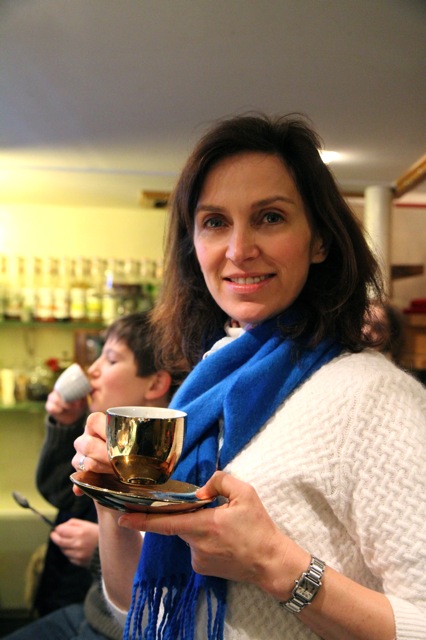
Joanna, apparently mildly surprised at her enjoyment of French coffee

I drink the tea this way, because that’s how I was brought up drinking it.  We drink it for comfort, to stay awake, to go to sleep, or to get over a nasty shock.  It comes with its own social language.  Offering tea to an upset friend shows concern when we cannot find words.  Failing to offer it to an unexpected guest says they should not expect to stay long.  Giving some to a workman is a way to show your respect for them and to ensure a good job.  Thus, overseas, tea is a rock of sameness I cannot let go of.  In fact, it is the only overseas product I really must have if I must have something from home.  It works for me.

Coffee: A rough guide

The coffee in France, therefore, should appeal to my rough taste in beverages.  It is largely made from robusta beans which are recklessly roasted until the flavor verges on the acridity of all things cremated.  It is drunk black, the addition of milk or cream deemed unsophisticated; ironic, given the rough, bad manners of the coffee itself.  The tiny cups are instead dangerously laced with extreme amounts of sugar or sweetener and then downed rapidly in a way Mary Poppins would have approved of.  And why not?  Sometimes even the French should be allowed a break from tasting and judging good food and drink.  My tea gives me the comfort and hit I demand, so why can’t I accept that the French should also be allowed, sometimes, to demand substance over style?

With coffee, the French give themselves a break from the world’s demand for them to be so effortlessly chic.  Coffee is not approached as is, say, wine, with a sort of intellectual or artistic mindset.   The routines of coffee tasting are not observed.  Whereas wine is lifted to the light, swirled, inhaled luxuriously and sucked over the tongue, coffee is knocked back as if by a Russian soldier engaged in long evening of vodka toasting. Coffee is not cupped with the hand to prevent the aroma escaping prematurely before the nose is lowered to inhale the intensified aromas.  It is not sucked over the tongue to seek the full range of flavor.

I must admit, it does the heart good to see the French behaving so badly.

Coffee climate change in Montpellier

IMG_2736

Coffee in Montpellier

I understand, though, that this is changing.  There are increasing numbers of little cafés which roast their own beans and grind to order.  Little places where robusta beans are eschewed for the more subtle delights of arabicas.  It’s been a while since I have had the time to hunt down these places in Paris.  However, last week I was in Montpellier and had the great good fortune to find two of these hallowed places.

Café Solo is an adorable place where the smell of coffee can be enjoyed a considerable distance from the front door even on a rainy February day.  I had forgotten this smell.  You don’t get it in a Starbucks or a Costa or any of the many similar establishments.  The tiny interior is crammed with drawers of beans, a counter of homemade delights in little covered cake stands and, in a corner, a large roasting machine.   My family and I discovered it quite by chance while exploring the streets of Montpellier.

Here we enjoyed what can only be described as a consultation with the artiste who would make our drinks.  She listened to what we like and do not like, and pronounced her judgement on what would suit.  Describing the flavours of each of the beans in that day’s selection, she guided our choice.   Then we waited and watched while our coffee was made.  It arrived in charming mismatched espresso cups and, thoughtfully, with little jugs of frothed milk– just in case.  Hmmmthere was me thinking I am a coffee hooligan who needs the milky stuff, just like a kid, but I absolutely did not need a drop of it.  My mocha bean from Ethiopia was soft and smooth with a tumble of flavours which lasted in the most pleasant way.   It was a delightful surprise.  I am so accustomed to a punch in the back of the throat from a tough one-dimensional over-roast.  Not so here.

“You see,” explained the artiste behind our coffees, “we French make terrible coffee.  We just don’t know how to make it.”    She smiled broadly, knowing full well that we could not agree with her.

We found a similar place a few streets later and just had to go in to try another.  Would it be possible to find two great coffees in one day?  Yes, it was. This time Columbian for me; a bit more acidity, but absolutely no acridity. Lovely.  Again, intoxicating smell of roasting coffee beans.

As we returned to our hotel, nursing the residual flavor of our coffees, we saw a Nespresso shop and just had to go in.  We knew that the chic, modern interior with its rows geometrically displayed and pristine pods as well as the absolute absence of the smell of real coffee would round off our day perfectly.  Today that clinical chicness, instead of depressing us, would only intensify the memory of the delightful little stores we had just left.  How deliciously wonderful it is to confirm how right I was.  Clutching my bags of beans from Café Solo to my nose, I knew in that moment I would never succumb to the clinical pod.  May my work surfaces be forever stained by the work of my little espresso machine and my walls stained by the periodic explosions to which the enthusiastic amateur is prone.

I thought I had no sophistication when it comes to coffee, but, perhaps because I don’t drink tea for the tea itself, I do drink coffee for the coffee itself.  I am much more open to trying different flavours and I am very willing to drink a lot of bad coffee until I find it.  Since I can manage without coffee, I am not lured by the siren call of Nespresso machines, Starbucks, or any of the lesser places.  I found absolute delight in those two shops which sell the stuff the way it should be sold.  I am willing to keep trying everywhere, until I next hit coffee gold.

Perhaps the next big discovery I will make is that the French acceptance of routinely bad coffee has freed them to become gourmet tea drinkers.  It would be fun to think so.

* * *

Joanna was displaced from her native England 16 years ago, and has since attempted to re-place herself and blend into the USA, Holland, Brazil, Malaysia, Venezuela, Saudi Arabia, and now France. She describes herself as a “food gossip”, saying: “I’ve always enjoyed cooking and trying out new recipes. Overseas, I am curious as to what people buy and from where. What is in the baskets of my fellow shoppers? What do they eat when they go home at night?”

Fellow Food Gossips, share your own stories with us!

STAY TUNED for tomorrow’s post!

If you enjoyed this post, we invite you to register for The Displaced Dispatch, a round up of weekly posts from The Displaced Nation, with seasonal recipes, book giveaways and other extras. Register for The Displaced Dispatch by clicking here!

Related posts:

Images: All images from Joanna’s personal photo albums, and used here with her permission

And the January 2014 Alices go to … these 3 international creatives

 © Iamezan | Dreamstime.com Used under license

© Iamezan | Dreamstime.com
Used under license

If you are a subscriber to our weekly newsletter, Displaced Dispatch, you’re already in the know. But if you’re not (and why aren’t you? off with your head!), listen up.

Every week, when that esteemed publication comes out, we present contenders for a monthly “Alice Award,” most of whom are writers or other kinds of international creatives who appear to have a special handle on the curious and unreal aspects of being a global resident or voyager.

Not only that, but this person tries to use this state of befuddlement as a spur to greater creative heights.

Today’s post honors January’s three Alice recipients. Starting with the most recent, they are (drumroll…):

1) AMBER PAULEN, American freelance writer and copyeditor based in Rome, and blogger at Descriptedlines

For her post: “Paesaggio Interiore” (Interior Passages)
Posted on: 17 January 2014
Snippet:

Dreamers are thought to be opposite of the practical, yet I see no difference. Imagining is a practicality that we use in order to survive—an imagined outcome may prevent us from a certain action—but it also makes our lives better. Imagination is the begetter of empathy and the foundation of utopias. It is also, on a minute basis, a way of interpreting the world—the wider these interpretations span, the farther the imagination sees, the more adaptable we are, one of the human race’s single best attributes. Try to find an intelligent mind with a small imagination.

Citation: Amber, we could not agree more with you about the practicality of dreaming, and about the need to put greater value on the life of the mind. Scrolling through the endless photos of man-made and natural scenery that occupy so many travel blogs and Pinterest boards these days can have a numbing effect, reducing life to a set of exterior images—in denial of the fact that each of us possesses some pretty vivid, not to say revealing, internal scenery. What’s more, we believe that the imagination is an extremely powerful, as well as much under-rated, survival tool for expats—the key to our adaptability, as you might put it. On the days when your new life in X country is looking rather grim or mundane, you can always slip into a fantasy land, pretending you’re a royal or a hungry hyena, just as Lewis Carroll’s Alice was wont to do:

And here I wish I could tell you half the things Alice used to say, beginning with her favourite phrase “Let’s pretend.”

She had had quite a long argument with her sister only the day before—all because Alice had begun with “Let’s pretend we’re kings and queens;” and her sister, who liked being very exact, had argued that they couldn’t, because there were only two of them, and Alice had been reduced at last to say, “Well, YOU can be one of them then, and I’LL be all the rest.”

And once she had really frightened her old nurse by shouting suddenly in her ear, “Nurse! Do let’s pretend that I’m a hungry hyaena, and you’re a bone.”

2) DRAKE BAER, contributing writer at Fast Company and co-author of Everything Connects

For his post: “Why weird people are often more creative,” in Fast Company
Posted on: 10 January 2014
Snippet:

In a 2003 study, Carson found that eminent creative achievers were seven times more likely to to have low rather than high latent intelligence scores. That insight prompted her to form a hypothesis: that cognitive disinhibiting allows for way more info to enter into your conscious mind–which you can then tinker with and recombine. The result: creative ideas.

Citation: Drake, we commend you for marshalling the evidence to support something that Lewis Carroll knew intuitively, without the benefit of Carson’s (or anyone else’s) study. Indeed, the world Alice discovers when she steps through the looking glass is teeming with flaming weirdos who, while they may seem rather dim witted at times, let’s face it, are super creative. Take this encounter with Humpty Dumpty, for example, in Through the Looking Glass:

“You seem very clever at explaining words, Sir,” said Alice. “Would you kindly tell me the meaning of the poem called ‘Jabberwocky'”?’

“Let’s hear it,” said Humpty Dumpty. “I can explain all the poems that were ever invented—and a good many that haven’t been invented just yet.”

3) MILDA RATKELYTE, writer, photographer and a budding filmmaker based in Singapore

For her post: “Lessons from 2013,” in her blog, Milda Ratkelyte Photography
Posted on: 1 January 2014
Snippet:

This year I am starting with one simple resolution—slow down and find the time every single day to smell the roses. Although 2013 was probably the hardest year in my life, I am grateful to all the strength it gave me and all the invaluable lessons I’ve learnt along the way…Never take your loved ones for granted, because life is so fragile that you never know if you will get a chance to see them again. Pick up the phone, tell them you love them NOW, not tomorrow or next week. Trust me it will make a huge difference.

Citation: Milda, we have appreciated your lens on the wider world ever since we featured you and some of your photographs in our monthly column “A Picture Says…” And now that you are learning the price of a peripatetic life—living far away from your loved ones, who may be suffering—we appreciate your emotional honesty. As Alice herself discovered when parted from her beloved cat, Dinah:

Down, down, down. There was nothing else to do, so Alice soon began talking again. “Dinah’ll miss me very much to-night, I should think!” (Dinah was the cat.) “I hope they’ll remember her saucer of milk at tea-time. Dinah my dear! I wish you were down here with me! There are no mice in the air, I’m afraid, but you might catch a bat, and that’s very like a mouse, you know.”

While Alice’s concerns are trivial compared to those currently confronting you, we wish that like her, you discover a garden of red roses (only in your case, may they not smell of fresh paint!).
 

*  *  *

So, readers, do you have a favorite from the above, or have you read any recent posts you think deserve an Alice Award?  We’d love to hear your suggestions! And don’t miss out on the shortlist of Alice contenders we provide in each week’s Dispatch, which are sources of creative thought if nothing else! Get on our subscription list now!

STAY TUNED for tomorrow’s post, an interview with some American entrepreneurs in Senegal.

Writers and other international creatives: If you want to know in advance the contenders for our monthly Alice Award winners, sign up to receive The Displaced Dispatch, a round up of weekly posts from The Displaced Nation, with news of book giveaways, future posts, and of course, our weekly Alice Award!. Register for The Displaced Dispatch by clicking here!

Related posts: