The Displaced Nation

A home for international creatives

Tag Archives: France

12 NOMADS OF CHRISTMAS: Santi Dharmaputra, Indonesian expat in Australia (6/12)

Current home: Sydney, Australia
Past overseas locations: Germany, USA, The Netherlands, Syria
Cyberspace coordinates: Trilingual: Indonesian, French, English | world trotters raising two multilingual kids (blog)
Most recent post: “”A Woman’s Work” (my article in The Jakarta Globe)” (December 23, 2011)

Where are you spending the holidays this year?
At my parents’ house in Indonesia.

What will you do when you first arrive?
Hugging and kissing my parents.

What do you most like doing during the holidays?
Spending time with family and old friends.

Will you be on or offline?
Online.

Are you sending any cards?
I usually write greetings on my FB wall or my blog.

What’s the thing you most look forward to eating?
Any kind of Indonesian food. Pineapple tarts (a festive Indonesian cookie) and kastengel (Indonesian cheese sticks) are among my favorite guilty-pleasures.

Can you recommend any good books other expats or “internationals” might enjoy?
Trailing wives — regardless of whether they are sojourners or seasoned expats — might appreciate:
1. A Broad Abroad: The Expat Wife’s Guide to Successful Living Abroad, by Robin Pascoe (The Expatriate Press, 2009)
2. A History of the Wife, by Marilyn Yalom (Harper, 2001)
These are two among many books that have made me feel more empowered. By reading widely, I’ve come to understand that (trailing) wives everywhere and in every era have struggled to find happiness, just as I have. 🙂

What’s been your most displaced holiday experience?
I spent part of my childhood in The Netherlands. I loved it when Sinterklaas visited our school and gave us presents. When my family moved to Syria, I was disappointed: no Sinterklaas! By the time I returned to Indonesia at age 11, I didn’t believe in Santa. To this day, though, I believe that Sinterklaas is the only real Santa (LOL).

How about the least displaced experience — when you’ve felt the true joy of the season?
Tricky. I’m an adult TCK married to another adult TCK, and we’ve continued moving around the globe in our adulthood. I can feel both displaced and part of a place at the same time. But if I had to pick one occasion, it would be when I witnessed my trilingual children celebrating the holidays with their paternal relations in Alsace, France. Their granny and great-granny spoiled them, and it was lovely to see my kids so happy. I felt very at home in my husband’s French family. At the same time, though, I felt displaced — I was missing my own family in Indonesia.

How do you feel when the holidays are over?
Also tricky, as it depends on where we happen to be. Last year we spent the holidays on our own, just the four of us. My husband was too busy working and had only two days off. I was left to entertain the kids during their six-week school break (in Australia, Xmas break is the equivalent of the long summer break in the Northern Hemisphere). At that time, we’d been living in Sydney for less than a year, so we spent most of the time exploring the beach.

When we were living in Munich, we spent two Christmases with my husband’s family in Alsace, and it was sad each time we left. As adult TCKs ourselves, my husband and I are used to living with our nuclear families, so it was a novelty to spend those two Xmases with the extended family, including my husband’s siblings and their kids. Our kids were even happier with their grannies and cousins around, and the same was also true of us (at least during holiday seasons ;)).

When living in Chicago, we tended to use the time between Xmas and New Year for road trips. Sometimes we were traveling in snowstorms — so were happy and relieved to arrive back home safely.

While we were in Holland, I worked as a lawyer and used to enjoy the Xmas dinner held by the office along with the generous Xmas bonus. But when I had to return to the office after the New Year, I did so rather reluctantly — LOL.

The last time I spent New Years in Jakarta was in 2001. My brothers, husband and I (we didn’t have kids yet) stayed at a hotel to celebrate New Year’s Eve. It was kind of sad to leave Jakarta to return to the winter season in Europe (we were in Holland then).

This year, we traded in Australian summer for the Indonesian rainy season. Temperature wise, though, there’s almost no difference. I guess our kids will be sad to leave their Indonesian grandparents and cousins when we go back to Sydney.

On the first day of Christmas, my true love said to me:
SIX SPOUSES TRAILING,
FIVE GOOOOOOOFY EXPATS.
FOUR ENGLISH CHEESES,
THREE DECENT WHISKIES,
TWO CANDY BOXES,
& AN IRISHMAN IN A PALM TREE!

STAY TUNED for tomorrow’s featured nomad (7/12) in our 12 Nomads of Christmas series.

If you enjoyed this post, we invite you to register for The Displaced Dispatch, a round up of weekly posts from The Displaced Nation, with seasonal recipes, book giveaways and other extras. Register for The Displaced Dispatch by clicking here!

Related posts:

Best of 2011: Books for, by and about expats

One of our Random Nomads in November, Aaron Ausland, had this to say about those of us who venture across borders:

Travel to a new place for three weeks and you can write a book, travel for three months and you can write an article, travel for three years and you’ll likely have nothing to say.

While that may be true, I’m afraid it hasn’t stopped many of us who’ve spent large chunks of our lives gallivanting around the globe trying out life in different countries, from taking up the pen.

As with any other group, some are born writers (and thrive on new surroundings), while others have become writers (attempting to make sense of their adventures), while still others have had writing thrust upon them (responding to invitations to share their experiences).

At the Displaced Nation, we revere people who publish books, fiction or non, that in some way assist those of us who are (or have been) engaged in overseas travel and residency. We feature — and do giveaways of — their works. And, for established writers with a global following, we’ve created a unique “category” called the Displaced Hall of Fame.

In this spirit — and in the December tradition of looking back at the past year’s highlights — I present the following (admittedly incomplete) list of books for, by, and about expats that were published in 2011, in these five sections (click on the title to go to each section):

  1. NOVELS ABOUT EXPATS
  2. NOVELS ABOUT “HOME”
  3. EXPAT MEMOIRS
  4. SELF-HELP, CROSS-CULTURAL & OTHER NONFICTION WORKS
  5. INSPIRATIONAL ANTHOLOGIES

A few more points to note:

  • Books in each category are arranged from most to least recent.
  • I’ve mixed indie books with those by conventional publishers (it suits our site’s somewhat irreverent tone).
  • To qualify for the list, authors must have been expats for at least six months at some point.

* * *

NOVELS ABOUT EXPATS

Three Questions: Because a quarter-life crisis needs answers (CreateSpace, October 2011)
Author: Meagan Adele Lopez
Genre: Women’s fiction
Synposis: A love story based loosely on the author’s own romance with a lad from Bristol, the action traverses continents through letters and features a quarter-life crisis, a road trip to Vegas, and two crazy BFFs.
Expat credentials: An American, Lopez lived as an expat in the UK for a while (she is now back in Chicago).
How we heard about it: Melissa of Smitten by Britain was a fan of Lopez’s blog (originally titled The Lady Who Lunches). The pair met her London in the summer of 2010, when Lopez was still living in England. Recently, Melissa has been supporting Lopez’s attempt to gain sponsorship for turning the novel into a screenplay.
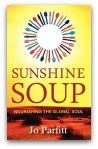
Sunshine Soup: Nourishing the Global Soul (Summertime, October 2011)
Author: Jo Parfitt
Genre: Women’s fiction
Synopsis: Six expat women from the UK, US, Thailand, Ireland, Norway and Holland converge in Dubai in 2008. The action centers on a Brit, who is on her first posting, and an American, who is on her 25th. The Brit learns the ropes and settles in, while the American woman’s world begins to crumble.
Expat credentials: A prolific author, publisher and pioneer in addressing the issues of accompanying spouses and aspiring expat writers worldwide, Parfitt has been an expat for nearly a quarter of a century. Born British, she now lives in the Hague.
How we heard about it: We noticed a couple of interviews with Parfitt — one by expat coach Meg Fitzgerald and another by Expat Women.

The Beautiful One Has Come: Stories (Wyatt-MacKenzie Publishing, July 2011)
Author: Suzanne Kamata
Genre: Cross-cultural romance
Synopsis: Twelve short stories reveal the pains and the pleasures experienced by expat women, most of whom live in Japan.
Expat credentials: Kamata is an American who has lived in Japan for 20 years.
How we heard about it: Kamata and her book were featured on Kristin Bair O’Keeffe’s Writerhead Wednesday in July of this year.

Hidden in Paris (Carpenter Hill Publishing, April 2011)
Author: Corine Gantz
Genre: Women’s fiction
Synopsis: Three strangers — all American women — have reached the point of terminal discomfort with their lives so run away to Paris to begin anew.
Expat credentials: Gantz is a French expat living near Los Angeles. She is getting her own back by writing about American expats in Paris.
How we heard about it: We are long-time fans of Gantz’s blog, Hidden in France — in fact, we promoted one of her posts (about falling into her swimming pool) with the launch of TDN in April. We also interviewed her about her first novel as part of our “gothic tales” theme this past May.

Exiled (Quartet Books, April 2011)
Author: Shireen Jilla
Genre: Psychological thriller
Synopsis: The wife of an ambitious British diplomat, whose first posting brings them to New York, looks forward to escaping from Kent and leading the high-profile life of a successful expat — only to find her world being threatened by dark psychological forces on a par with those depicted in Rosemary’s Baby.
Expat credentials: A Third Culture Kid (she is half English, half Persian, and grew up in Germany, Holland and England), Jilla has also been an expat in Paris, Rome, and New York.
How we heard about it: TDN writer ML Awanohara read a review of Jilla’s novel by Kate Saunders in the Sunday Times. She approached Jilla in May about having an exchange with our readers about the gothic themes in her novel, in line with our site’s own delvings into the gothic aspects of expat life. Our readers loved her!

NOVELS ABOUT “HOME”

Lady Luck (Colorado Mountain Series)
Author: Kristen Ashley
Genre: Romance
Synopsis: Ex-con hero, wrongly imprisoned, gets mixed up with unlucky heroine, who will stop at nothing to help him get revenge.
Expat credentials: Born in Gary, Indiana, Ashley grew up in Brownburg and then moved to Denver, where she lived for 12 years. She now lives with her husband in a small seaside town in Britain’s West Country, where she has produced more than twenty books featuring rock-chick, Rocky Mountain, and other all-American heroines.
How we heard about it: Ashley is the friend of an old schoolfriend of TDN writer Kate Allison, who invited her to do a guest post for us on Britain’s (lack of) Royal Wedding preparations  for our Royal Wedding coverage.

Queen by Right: A Novel (Touchstone, May 2011)
Author: Anne Easter Smith
Genre: Historical romance
Synopsis: This is the fictional story of Cecily of York, mother of two kings and said to be one of the most intelligent and courageous women in English history.
Expat credentials: The daughter of an English army colonel, Easter Smith spent her childhood in England, Germany and Egypt. She came to New York City at age 24, and as she puts it:

Many years, two marriages, two children and five cross-country moves later I’m very definitely a permanent resident of the U.S. — but my love for English history remains.

(She now lives in Plattsburgh, New York.)
How we heard about it: Easter Smith and her book were featured on Kristin Bair O’Keeffe’s Writerhead Wednesday in October.

Dance Lessons (Syracuse University Press, March 2011)
Author: Áine Greaney
Genre: Irish Studies, Women’s Fiction
Synopsis: The action centers on a woman of French-Canadian background who marries an Irish emigrant who is working illegally in a bar in Boston. After his death by drowning, she visits Ireland for the first time and finds out what a shattered man he actually was.
Expat credentials: She may be a resident of Boston’s North Shore, but Greaney continues to identify herself as an Irish writer (County Mayo).
How we heard about it: Greaney and her book were featured on Kristin Bair O’Keeffe’s Writerhead Wednesday in October.

Pentecost: A Thriller (The Creative Penn, January 2011)
Author: Joanna Penn
Genre: Thriller
Synopsis: The Keepers of the stones from Jesus’s tomb — which enabled the Apostles to perform miracles — are being murdered. The stones have been stolen by those who would use them for evil in a world. An Oxford University psychologist spearheads a search for them in a race against time…
Expat credentials: English by birth, Penn grew up as a third-culture-kid and at the time of producing her first novel, was living in Australia.
How we heard about it: We are avid followers of Penn’s blog, The Creative Penn. Several months ago, TDN writer ML Awanohara deconstructed Penn’s post about what “home” means for writers for what it might teach expats and others who struggle with this issue as well. For Penn, home means some sort of spiritual kinship, which she has with two places: Oxford, where she went to university and near where her father now lives, and Jerusalem, which she’s visited at least ten times because she loves it there so much. Not surprisingly, she chose to set much of the action for her debut novel in these two cities.

EXPAT MEMOIRS
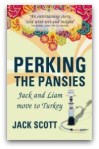
Perking the Pansies: Jack and Liam move to Turkey (Summertime Publishing, December 2011)
Author: Jack Scott
Synopsis: Dissatisfied with suburban life and middle management, Scott and his civil partner, Liam, abandon the sanctuary of liberal London for an uncertain future in Bodrum, Turkey. The book is based on Scott’s irreverent blog of the same name, which after its launch in 2010, quickly became one of the most popular English language blogs in Turkey.
How it came to our attention: Scott was featured as one of our Random Nomads in May of this year and since then, has done us the favor of commenting on and liking several of our posts. **Kate Allison will be reviewing his book for our site on Wednesday.**

Ramblings of a Deluded Soul (CreateSpace, September 2011)
Author: Jake Barton
Synopsis: In his inimitable style, the British-born Barton strings together snippets from new novels and try-outs with reminiscences and, for the first time, insight into his own remarkable experiences as a traveler and expat in Europe (he once owned a small French vineyard and had another job he’s not supposed to talk about). NOTE: Barton’s first novel, Burn, Baby, Burn, burned its way into the Top Ten of the Amazon All Books list.
How it came to our attention: Barton is an online acquaintance of TDN writer Kate Allison. We celebrated him in the early days of our blog for his insights on foreign-language learning in Spain.

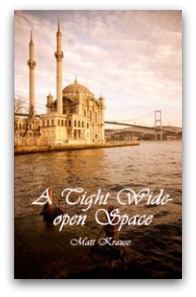
A Tight Wide-open Space: Finding Love in a Muslim Land (Delridge Press, August 2011)
Author: Matt Krause
Synopsis: A Californian who is now a Seattle-ite recounts how he became an Istanbullu, all for the love of a beautiful Turkish woman he met on a airplane. The year is 2003, and he can still hear the echoes of 9/11 as well as being acutely conscious of America’s engagement in two wars in Muslim countries. Eventually, he comes to love his new home more deeply than he might have expected.
How we heard about it: Linda Janssen, who writes the blog Adventures in Expatland, interviewed Krause about his book in October.

Planting Dandelions: Field Notes from a Semi-Domesticated Life (Penguin, April 2011)
Author: Kyran Pittman
Synopsis: A native of Newfoundland (her father was a well-known Newfoundler poet), Pittman writes about co-parenting with her charming Southern U.S. hubbie (they have three rambunctious boys); keeping the fiscal wolf from the door of their home in Little Rock, Arkansas; and honoring her marriage vows despite her refusal to give up her party-girl persona.
How we heard about it: Pittman came to our notice when she was a guest on Kelly Ryan Keegan‘s Bibliochat in late September.

Big in China: My Unlikely Adventures Raising a Family, Playing the Blues, and Becoming a Star in Beijing (Harper, March 2011)
Author: Alan Paul
Synopsis: Paul tells the story of trailing his journalist-wife to China and unwittingly becoming a rock star. His Chinese American blues rock band, called Woodie Alan, even earned the title of Beijing’s best band.
How we heard about it: We were early fans of Alan Paul’s back in the days of his Wall Street Journal online column, “The Expat Life.” Also, Paul and his book were featured on Kristin Bair O’Keeffe’s Writerhead Wednesday this past April.

The Foremost Good Fortune (Knopf, February 2011)
Author: Susan Conley
Synopsis: Conley, her husband, and their two young sons say good-bye to their friends, family, and house in Maine for a two-year stint in a high-rise apartment in Beijing. All goes well until Conley learns she has cancer. She goes home to Boston for treatment and then returns to Beijing, again as a foreigner — to her own body as well.
How we heard about it: Conley and her book were featured on Kristin Bair O’Keeffe’s Writerhead Wednesday in early October.

SELF-HELP, CROSS-CULTURAL AND OTHER NONFICTION WORKS

The Globalisation of Love (Summertime, November 2011)
Author: Wendy Williams
Genre: Relationships, self-help, humor
Synopsis: Williams interviews multicultural, interfaith and biracial partners from all over the world on what it feels like to “marry out” of one’s culture, religion and/or race. She also talks to experts on the topic and coins a term for it: “GloLo.”
Expat credentials: From a British-Ukrainian-Canadian family, Williams has been married to an Austrian for 13 years and lives in Vienna.
How we heard about it: TDN writer ML Awanohara listened to Jo Parfitt’s interview with Williams on her Writers Abroad show (Women’s International Network) and was attracted to the ideas of a book that treats this topic with humor. **TDN writer Anthony Windram will review the book for our site tomorrow (Tuesday).**

Modern Arab Women — The New Generation of the United Arab Emirates (Molden Verlag, November 2011)
Author: Judith Hornok
Genre: Women’s studies
Synopsis: The book consists of 20 chapters, each a stand-alone interview with an Emirati woman from disciplines as varied as business, film, medicine and politics. The women talk to Hornok about their careers, philosophies of life and plans for the future. The book, which is published in German and English, aims to dispel some of the Western myths surrounding Arab women.
Expat credentials: While not quite an expat, Hornok has been moving between the UAE and her home in Vienna, Austria, for eight years.
How we heard about it: TDN writer ML Awanohara read an article on the book in The National (UAE English-language publication) and became intrigued.

Expat Women: Confessions — 50 Answers to Your Real-life Questions about Living Abroad (Expat Women Enterprises Pty Ltd ATF Expat Women Trust, May 2011)
Authors: Andrea Martins and Victoria Hepworth (foreword by Robin Pascoe)
Genre: Women’s self-help, family, relationships
Synopsis: Experienced expats share wisdom and tips on topics that most expat women face, such as the trauma of leaving family back home, the challenges of transitioning quickly, intercultural relationships, parenting bilingual children and work-life balance. They also tackle more difficult issues such as expat infidelity, divorce, alcoholism and reverse culture shock. The book is based on the “confessions” page of Expat Women, the largest global Web site helping women living overseas.
Expat credentials: Andrea Martins is the director and co-founder of Expat Women. An Australian who has spent many years abroad, she began dreaming of connecting expat women worldwide when an expat in Mexico City. Victoria Hepworth is a New Zealander who has lived in Japan, China, Russia, Sweden, India and is currently living in Dubai, UAE. She is a trained psychologist who specializes in expat issues.
How we heard about it: Andrea Martins announced the publication of the book to much fanfare on Twitter and in other social media venues. It has been widely reviewed on expat blogs.

Marriage in Translation: Foreign Wife, Japanese Husband (CultureWave Press, April 2011)
Author: Wendy Nelson Tokunaga
Genre: Relationships, self-help
Synopsis: Tokunaga conducts a series of candid conversations with 14 Western women about the challenges in making cross-cultural marriages work both inside and outside Japan. She quizzes them about the frustrations, as well as the joys, of adapting to a different culture within married life.
Expat credentials: Born in San Francisco, Tokunaga has spent numerous years studying, living, working and playing in Japan. She is the author of two Japan-related novels, published by St. Martins Griffin. Oh, and did we mention her Japanese “surfer-dude” husband?
How we heard about it: Sometimes one tweet is all it takes! (We follow Wendy Tokunaga on Twitter.)

A Modern Fairytale: William, Kate and Three Generations of Royal Love (Hyperion/ABC Video Book, April 2011)
Author: Jane Green
Genre: Romance, royalty
Synopsis: In this video book for ABC News, produced just in time for the Royal Wedding in March, best-selling chick-lit novelist Jane Green follows the stories of three generations of royal love from their meeting up to and after their respective wedding days. She concludes that Kate and William have a much better chance than William’s parents of enjoying a relationship on their own terms.
Expat credentials: Born in London, Green worked as a feature writer for The Daily Express before trying her hand at writing novels. She now lives in Westport, Connecticut, with her second husband and their blended family.
How we heard about it: One of us noticed that Jane Green had been tapped to provide coverage of the Royal Wedding for ABC News. We then invited her to talk about her e-book and engage with our readers in a debate on whether women should still aspire to be “princesses” in the 21st century — a post that received a record number of comments.

INSPIRATIONAL ANTHOLOGIES

Turning Points: 25 inspiring stories from women entrepreneurs who have turned their careers and their lives around (Summertime Publishing, November 2011)
Editor: Kate Cobb
Synopsis: In this collection of stories from women all over the world, the focus is on the moments, or short passages of time, when a woman was facing something challenging and came out the other side smiling.
Expat credentials: Cobb is a British woman living in France, and about a third of the contributors — including Jo Parfitt and Linda Janssen — are expats who now run their own businesses.
How we heard about it: Linda Janssen promoted the book on her blog, Adventures in Expatland.

Indie Chicks: 25 Women 25 Personal Stories (Still Waters Publishing, October 2011)
Compiler: Cheryl Shireman
Synopsis: 25 indie novelists share personal stories in hopes of inspiring other women to live the life they were meant to live. (All proceeds go to the Susan G. Komen Foundation for breast cancer research.)
Expat credentials: Close to half of these indie authors are expats or have done significant overseas travel. To take a few examples: After living in Portland, Oregon, for most of her life, Shéa MacLeod now makes her home in an Edwardian town house in London just a stone’s throw from the local cemetery. Linda Welch was born in a country cottage in England, but then married a dashing young American airman, left her homeland, raised a family, and now lives in the mountains of Utah. Julia Crane is from the United States but recently moved to Dubai with her huband and family (her personal story concerns the adjustment process).
How we heard about it: Again, sometimes all it takes it a tweet (we picked up one of Linda Welch’s).

* * *

Questions: Have you read any of the above works and if so, what did you think of them? And can you suggest other works to add to the list? My colleagues and I look forward to reading your comments below!

STAY TUNED for tomorrow’s post, a review of The Globalisation of Love, by Wendy Williams, and for Wednesday’s post, a review of Perking the Pansies, by Jack Scott.

If you enjoyed this post, we invite you to subscribe to The Displaced Dispatch, a weekly round up of posts from The Displaced Nation, plus some extras such as seasonal recipes and occasional book giveaways. Sign up for The Displaced Dispatch by clicking here!

Related posts:

CLASSIC DISPLACED WRITING: Albert Schweitzer, early humanitarian & medic without borders

Fifty years ago, “Albert Schweitzer” was a household name. Nowadays it is hard to find anyone who knows who he is. But given our current theme of looking at those who’ve displaced themselves on behalf of humanitarian causes, today I would like to resurrect this great man for the purpose of honoring him with a membership in our Displaced Hall of Fame.

Were he still alive, Schweitzer, a brilliant theologian and musical genius who received the 1952 Nobel Peace Prize for his philosophy known as Reverence for Life, might not be all that flattered.

Then again, considering that he chose to spend much of his time living simply and without pretension in Africa, is it too far fetched to think he’d “get” what the Displaced Nation is all about? He might even have a good wheeze at learning of his elevated status among our citizenry…

A displaced early life

Schweitzer was born in 1875 in Alsace, which at that time belonged to the German Reich (it would change hands four times between France and Germany over the next 75 years).

According to Professor J. Rufus Fears who has lectured on Schweitzer for the Teaching Company:

Alsatians are their own people — neither French nor German, though they like to say they eat as much as the Germans and as well as the French.

Did being born an Alsatian give Schweitzer a head start on leading a displaced life? It’s tempting to think so. Curiously, although he spoke two languages — actually, three: Alsatian (a dialect of German), German and French — he professed not to believe that anyone was ever truly bilingual. He maintained that a person’s true native tongue could be discovered by asking:

What language do you count your change in when you give someone a dollar bill?

A displaced career

For our ceremony inducting Schweitzer into the Displaced Hall of Fame, we would do well to choose one of Bach’s organ works. While still in his twenties, Schweitzer distinguished himself not only in his chosen field of theology, but also as an organist and musicologist who specialized in Bach.

He wrote two early works that established his reputation in both of these fields: The Quest for the Historical Jesus (German, 1906; English translation, 1910), arguing that Jesus was human, not divine; and J.S. Bach (enlarged German edition 1908; English translation, 1911), a study of the life and art of Johann Sebastian Bach.

As if being an accomplished theologian and notable organist weren’t displaced enough, while still in his twenties, Schweitzer decided he would go out into the world and devote his life to humanity rather than remaining locked up in the cloisters of academe.

Upon turning 30, he shocked and horrified his parents and friends by declaring his intention to become a medical student in preparation for the life of a physician in French Equatorial Africa.

While studying medicine, he married Helene Bresslau, who although a scholar herself, became a trained nurse in order to share her husband’s life in Africa.

In 1913 the couple set sail from Bordeaux for what today is Lambaréné, Gabon.

The conditions the Schweitzers faced were desolate in the extreme. The climate — characterized by fiercely hot days, clammy nights and seasonal torrents of rain — was appalling. Besides the usual diseases, the natives were suffering from leprosy, dysentery, elephantiasis, sleeping sickness, malaria, yellow fever and animal wounds.

But the couple persisted through thick and thin (including a period of being interned during World War I), setting out to build a hospital on the grounds of the Lambaréné station of the Paris Missionary Society (they would later move the hospital to an even more remote spot).

Eventually, Schweitzer’s wife went back to Europe to raise their daughter, while Schweitzer himself carried on working in, and on behalf of, this remarkable medical facility until his own death in 1965. By then the compound had grown to more than 70 buildings, 350 beds and a leper village of 200, and the hospital was staffed by 3 unpaid physicians, 7 nurses and 13 volunteer helpers.

(It still exists today as the Albert Schweitzer Hospital, one of the leading research centers in sub-Saharan Africa training African doctors in the treatment of diseases such as HIV/AIDS, malaria and tuberculosis.)

Schweitzer, who passed away in the hospital itself, was buried next to the Ogooué River in a ceremony attended by hospital workers, lepers, cripples and other patients.

An epiphany of hippopotaman proportions

Schweitzer considered his work as a medical missionary in Africa to be a small recompense for the injustices committed by the African Continent’s European colonizers. In a sermon preached in 1905, he proclaimed:

Oh, this “noble” culture of ours! It speaks so piously of human dignity and human rights and then disregards this dignity and these rights of countless millions and treads them underfoot, only because they live overseas or because their skins are of different color or because they cannot help themselves.

By the time he dedicated his life to serving the natives of Africa, Schweitzer could no longer make the intellectual case for Jesus’s divinity. The French had recruited him to work in their mission as a physician not a pastor (somehow a Lutheran who didn’t believe in Christ was just a little too displaced!). Yet Schweitzer remained deeply spiritual. He wanted to find a philosophy that would persuade others to displace themselves to the most desolate places on earth, just as he had done — separate and apart from a proselytizing mission.

While on a boat trip on the Ogooué, Schweitzer noticed a herd of hippopotamuses swimming in the water, and thought to himself: what purpose does the hippo serve? He decided that the spirit of the universe had made this creature — and that this was reason enough to treat it with respect.

From that point on, he promoted the idea that man, in his quest for dominance, should never forget the need to show reverence and awe for all living creatures.

For Schweitzer, such a belief should suffice as motivation to reach out and help others who are less fortunate than oneself. You can almost sense his relief at discovering this philosophy from the epilogue he attached to his major autobiographical volume, Out of My Life and Thought:

Two observations have cast their shadows over my life. One is the realization that the world is inexplicably mysterious and full of suffering, the other that I have been born in a period of spiritual decline for mankind.

I myself found the basis and the direction for my life at the moment I discovered the principle of Reverence for Life, which contains life’s ethical affirmation.

His Reverence of Life philosophy further led him to warn against man destroying animals (what we know today as “animal rights”) as well as his environment — he was an early environmentalist, who predicted that man “will end by destroying the Earth” (Rachel Carson dedicated Silent Spring to him).

Schweitzer tried to put these principles in practice in all sorts of ways, but the two examples I like best are his refusal to teach his pet parrot how to talk (talking would lower its dignity), and his decline of an offer by a foundation to replace his dug-out canoe with a motorboat for fear it would pollute the Ogooué River.

Schweitzer’s relevance for today’s global nomads

In his lecture on Albert Schweitzer, Professor Fears insists that this early humanitarian still speaks to us. I agree and would add that he positively shouts to those of us who’ve chosen to live much of our lives abroad. For a start, we can find inspiration in his refusal to follow a conventional career path (a quality that, by the way, drove the bureaucrats in charge of French Equatorial Africa crazy).

But the really impressive thing about Schweitzer, of course, is his unconquerable spirit, his desire to do good. Despite living through two world wars, he carried on believing in mankind’s potential to treat life, in all its forms, with the reverence it deserves.

Even after World War II, when Albert Einstein called on him to speak out against the atom bomb, he did so despite his better instinct to get involved in politics (and suffered the fall-out of having funds withdrawn from his hospital when the FBI and CIA began persecuting him for his anti-nuclear-arms-race position).

The way I see it, we expats and “internationals” are perfectly positioned to understand where Schweitzer was coming from. Our travels have taught us that life, whether human or animal, deserves respect no matter where one is on the globe.

But how do we share this knowledge? What do we actually do with it?

As mentioned in my post on Richard Branson at the start of November, for some of us it’s challenge enough to cultivate our own gardens and hope that in doing so, some of our attitudes will rub off on others.

But Schweitzer, whom Fears calls a “living testimony to goodness,” clearly believed in the need to do more. And after a month of celebrating those who’ve done more — see our profiles of Adria Schmidt, Jennifer Lentfer, Matt Collin, and Vilma Ilic — I’m prepared to concede he is right.

To give the redoubtable Albert Schweitzer the final word:

I have always held firmly to the thought that each one of us can do a little to bring some portion of misery to an end.

STAY TUNED for Monday’s reflections on global philanthropy by third-culture-kid columnist Charlotte Day.

If you enjoyed this post, we invite you to subscribe to The Displaced Dispatch, a weekly round up of posts from The Displaced Nation, plus seasonal recipes, book giveaways and other extras. Sign up for The Displaced Dispatch by clicking here!

Related posts:


Bon appétit, really? A TCK’s encounter with French cuisine — and culture

Our Third Culture Kid columnist, Charlotte Day, regales us with stories of encounters with France and French cuisine that piqued her curiosity somewhat more than her palate.

My experience of France and of French food consists of a miserable trip to Paris and the Loire Valley with my mother and stepfather in cold, drizzly March, and an even more miserable language exchange to Lyon last February.

The first experience saw us through innumerable cafés au lait, pains au chocolat and frothy miracles of haute cuisine in the Loire Valley. Afterwards, my mother went on her first raw food diet.

The second was a mandatory school trip for all French-language students at my boarding school in England, which I faced with more optimism than most. Two weeks in Lyon, two weeks back in England, dramatic language improvement and cultural interchange — why ever not?

From the moment we boarded the Eurostar, however, things did not look promising. Two boys arrived sporting Union Jacks and carrying paper cut-outs of Wills and Kate. The rest had already scoured their exchange partners’ Facebook pages and resolved to dislike them.

I suppose I ought to have anticipated this Anglo-French clash, given the historical precedents. Yet the English contingent’s narrow-mindedness unsettled me.

Yes, we were sacrificing a holiday to spend two weeks with a stranger. But their genuine unwillingness to learn, Anglo-supremacist attitude and lack of curiosity were a little disturbing.

As we descended into the arrivals hall of Lyon Part-Dieu station, the smiles of expectant correspondents ought to have rebuffed the querulous English students. Yet each went through his or her initial greeting with as pronounced an English accent as possible.

You are what you eat

My exchange partner and her mother drove me back to their beautiful old farmhouse, in a village known for horse breeding. My bedroom was large and warm, my French not as bad as I’d feared it to be.

And yet one anxiety still plagued me: sustaining a gluten-and-dairy-free diet in England was sufficiently difficult, but in France, I imagined, next to impossible. I sat in my room, weighing the relative merits of two weeks’ stomach cramps against starvation — and how to explain in French the effects of wheat, barley and rye on the small intestine?

What I found in the dining room occasioned raw joy: steamed vegetables, fish and salad. Likewise in the kitchen: a refrigerator shelf full of yahourt au soja. To their question “Ça marche?” I would have poured forth encomiums had I mastered a suitable vocabulary set. But I could not move beyond “Oui, c’est fantastique” before we sat down to eat.

This first meal was to be the most talkative of my two-week sojourn. As the breakfasts and dinners succeeded one another in an endless cortège of fresh fruit, perfectly steamed broccoli and silence, I felt that either starvation or stomach cramps around a more convivial table would have been preferable.

My exchange partner was kind, but icy. Her fastidious and sparing eating habits made me feel a glutton in comparison. Her mother ate protein powder in yoghurt more often than a solid meal. Eventually, my mornings were characterized by a solitary repast of fruit salad — no one else seemed to be eating.

Ghosts at the feast

The occasional apparition flitted around the dinner table — some closer to human form than others. The first was Pierre, the former lover of my exchange’s mother, with whom she was still sharing living expenses. He was tall and corpulent with a thunderous voice. She had cast him from her life — but only driven him out as far as the other end of the house, where he entrenched himself in a study strewn with half-smoked cigars.

At least he ate like a Frenchman — belonged to the cult of taste, before that of health. Yet he vanished soon after his first appearance, driving off to see his mother in a neighboring town. He returned after five days, at two o’clock one morning, and left again the next day.

The second apparition was my exchange partner’s boyfriend, Samson — a thin, pale young man with an unruly mass of curls; a maths prodigy who’d set his sights on attending one of the grandes écoles.

Samson, too, was slightly less given to subsist on lettuce and pumpkin seeds. My exchange partner lovingly provided him with a baguette and chocolate — which he would munch while explaining to me the superiority of the French educational system.

He cross-examined me on my plans for the future. I had got as far as a spectral PhD in Russian Literature, when he stopped me with a shocking rejoinder:

Il faut réfléchir, Charlotte! La vie est sérieuse. (In essence: “Life will pass you by before you have accomplished anything.”)

I refrained from pointing out that he had not planned beyond the classes préparatoires, or prépas — two hellishly difficult years spent preparing for university entrance tests. Instinctively, I commended his ambition and drive — yet felt him ill qualified to condemn my lack of perspective given his own determination to sacrifice two years of his youth to a virtually unattainable goal.

My tryst with moules frites

Midway through my stay, our funereal meals were interrupted by my exchange’s mother taking us on her weekend-long tryst in Brussels. She’d discovered that a childhood sweetheart was living in Belgium’s capital, and over the past months, they’d re-cultivated their relations. My exchange and I were invited along as third and fourth wheels.

José, the new lover, was almost as much the gourmand as Pierre, his predecessor.

Yet of his guests, I was the only one who ate at all.

Our meals together included lunch in a traditional Belgian restaurant, where I unadvisedly ordered moules-frites without the butter, causing a scandal in the kitchen.

We had Thai for dinner — a first for my partner and her mother — after which I turned around to see the latter and José kissing passionately on the curb.

Resolving to see something of Brussels at all costs, I accompanied the couple on a walk to the markets, while my partner sat sullenly in José’s penthouse apartment. There, I stared mournfully at beautifully packaged jams, cheeses and Breton biscuits — knowing that we were to leave for Lyon that evening, where another week of salad and silence awaited.

I returned to England appreciably thinner, with an improved French accent and a block of Belgian chocolate for my mother.

Though my experience of France did not come floating in butter, it was more French than I could ever have anticipated.

Readers, any questions or suggestions for Charlotte, should she have any future encounters with France?

img: Charlotte Day surveying Trafalgar Square in London.

STAY TUNED for Monday’s post, offering a few last-minute Halloween costume suggestions for Displaced Nation citizens.

If you enjoyed this post, we invite you to subscribe to The Displaced Dispatch, a weekly round up of posts from The Displaced Nation, plus some extras such as seasonal recipes and occasional book giveaways. Sign up for The Displaced Dispatch by clicking here!

Related posts:

A Julia Child for our times: Expat author & French cookery expert Elizabeth Bard

Et voila. In a little less than a month, The Displaced Nation has gone from reminiscing over American expat in France Julia Child to engaging with American expat in France Elizabeth Bard.

Move over Julie Powell. At a pace rather like a simmering le Creuset pot of Child’s signature boeuf bourguignon, Bard is on the way to becoming the 21st-century’s answer to that towering figure of 20th-century cuisine Française.

The similarities between the two women are intriguing. Child went to France as a trailing spouse for an American diplomat. Bard went to France trailing a Frenchman.

Child was seduced by France. She found herself through French cuisine. Bard was seduced by France (after being seduced by a Frenchman). She found a way into French culture through the markets and cooking — and found herself in the process.

On this point, the line between the two women gets a little blurry. Which one, Child or Bard, said the following:

More than the museums, more than the ancient streets, these stalls of fruits and vegetables and spices were the Paris that inspired me.

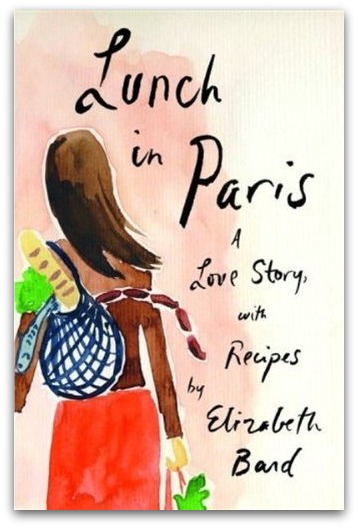
As everyone knows, Child returned to the United States to launch a career in television. Whereas Bard has become a long-term resident of France — and has launched a brilliant writing career with the publication of Lunch in Paris: A Love Story, with Recipes, a New York Times and international bestseller, a Barnes & Noble “Discover Great New Writers” pick, and the recipient of the 2010 Gourmand World Cookbook Award for Best First Cookbook. NOTE: We are giving away copies to two lucky DISPLACED DISPATCH subscribers. Sign up today!

Child inspired Julie Powell to make all of her recipes. Bard has inspired, among others, two Displaced Nation writers — myself and Anthony Windram — to try out her recipes.

But here the comparison ends. A key difference is that Bard’s recipes are nowhere near as difficult as Child’s — which is exactly what makes Bard so perfect for our times. She’s approachable, and her cooking suggestions are doable. She also has a rich life outside cooking — the life of a woman who has displaced herself into another culture — and enjoys sharing that part of her story as well.

Mesdames et Messieurs, I would now like to offer you the fruits (not to mention veggies) of my exchange with expat author, chef and lifestyle muse Elizabeth Bard.

Tell me a little more about your background.
I grew up in Northern New Jersey and spent weekends with my father in New York City. I studied English Lit as an undergrad at Cornell, then art history at Christie’s and the Courtauld Institute in London. My dream was to be the chief curator of the Pierpont Morgan Library in Manhattan. I was always convinced I’d been born in the wrong century. I love old objects, lost worlds, so, of course, I was instantly seduced by Paris (and of course, my French husband).

Over the years, I’ve written on art, travel and food, and digital culture for the New York Times, International Herald Tribune, Harper’s Bazaar, Wired, Time Out and Huffington Post, among others. Lunch in Paris was my first book.

In July 2010, my husband and I and our baby son Augustin moved to a small village in Provence, to live in the wartime home of the famous poet and WWII Resistance leader René Char. At the time, we had no plans to leave Paris — it was a date with destiny. You can find the complete (completely crazy?) story of how we found the house on my blog.

How are you finding life in Provence as compared to Paris?
As a city girl, village life is a discovery for me. I’m still adjusting to hanging my undies in the sun, and learning the names of the local birds (they can’t all be pigeons…). I’m surrounded by wonderful cooks and gardeners; last week, I went on my first saffron harvest. The move has been a wonderful transition for us as a family — it has made me question many of the things I believe about work/life balance, health, and being close to nature. All things I hope to share (along with my neighbor’s recipe for Provençal soupe au pistou) in my next book.

Turning to Lunch in Paris: What made you decide to write a book telling the story of your transition to living in France?
I hope Lunch in Paris captures something real about what it means to build a life in another culture. As an American, I follow generations of women who all came from somewhere else. They learned to cook with new ingredients, speak a new language, manage in a new world. My Jewish grandmother learned to make spaghetti sauce with pork ribs from the Italian ladies she met on line at the butcher shop during the war; I’m simply another in a long line.

Did you ever think of writing a novel instead? I ask because in reading the book, I kept noticing your facility with dialogue and description.
It never occurred to me to write Lunch in Paris as a novel. Fantasy lives in France are easy to imagine — but I wanted to express some of the things I’d learned personally, about what it means to take risks, to put happiness first on your checklist. That’s not a fictional decision — that’s something we struggle with every day.

Why did you decide to include recipes in your book?
Almost as soon as I arrived in Paris, I knew that I wanted to write about the roller coaster of international living, and the richness of intercultural marriage. When I sat down to think about the moments that really helped me discover French life, I kept coming back to the dinner table, the markets, the recipes — so it seemed natural to structure Lunch in Paris around those experiences.

Do you still use the recipes from the book and which one is your favorite?
I’m always trying new recipes, which I share on the blog or Facebook page, but I do use my copy of Lunch in Paris as a cookbook — I keep it handy in the cabinet with the pasta. The recipes I go back to again and again: for summer, it’s the haricot verts with walnut oil, for winter, the lentils. The tagines are great for a party — and the molten chocolate cakes work anytime.

Which portion of your book — Paris, the love story, the recipes — have readers responded to most?
I’m so surprised, humbled, gratified by the fact that Lunch in Paris has found such a wide audience. I’m so pleased that the book has been a vivid piece of armchair (or bathtub) travel for those who love Paris — and a temptation for those who’d like to go. I’ve had many young readers say it inspired them hold on to their dream of living abroad, or simply doing something a bit outside the box with love or career.

I’m also thrilled that people are getting their books all greasy, using the recipes — and posting photos of their creations on the Lunch in Paris Facebook page. I’m a home cook; I tested all the recipes myself. I was determined that readers take as much pleasure (and as little stress) in preparing them as I did. Maybe the nicest thing anyone has said came from a friend in London:

“It’s nice for Augustin to have such a wonderful record of his parent’s romance.”

I’m proud to be passing that on.

The thing that has surprised me the most is the wonderful online community. Though the readers are all over the world, it really feels warm and personal to me. I love that social media allows people to share recipes and stories from all over the world. A few months ago, I got an email from a New Zealander living in Crete. I now follow her blog to learn about traditional Cretean cooking.

As I mentioned in my intro, Julia Child was the inspiration for TDN’s October theme — and you remind me of a 21st century version of her in some ways. I’m curious, do you have her Mastering the Art of French Cooking — and do you actually use it?
I have my mom’s copy of Mastering the Art, but at the moment – I’m too busy trying recipes from my French neighbors to actually use it!

What did you think of Julie Powell’s blogging about making all the recipes from that encyclopedic book?
I love a good project — especially one that gets a girl out of a rut — it was fun to read about how the random adventures we set for ourselves can change everything.

How about the film, Julie & Julia?
The film — well, it just proves that Meryl Streep can do ANYTHING.

We’ve been asking our Random Nomad interviewees this month if they identify with any of the following Julia Child quotes and why. Can we ask you as well?
I agree with the choice that both Mardi and Jennifer made:

The only real stumbling block is fear of failure. In cooking, you’ve got to have a what-the-hell attitude.

I’d say this goes for goes for life in general — not just cooking. With all of our “Just-do-it” attitude, Americans are particularly prone to fear of failure: everything is possible, so everything we don’t accomplish is our fault. Fear is paralyzing. I work every day to get the hell out of my own way.

Quite a few of our readers are long-term expats who’ve entered cross-cultural marriages. What do you think is the biggest challenge about marrying someone of another culture?
The Franco-American combination is a very powerful one. I gave my husband a bit of the American can-do spirit, permission to pursue his dreams based on his own qualities, instead of family or class. He gave me a bit of the French joie de vivre — permission to live in the moment, to consider happiness, rather than some abstract (and culturally relative) notion of “success”, as my ultimate goal.

Was language an obstacle at all?
I speak fluent French now. It was a struggle at the beginning — you feel a bit invisible. That’s one reason cooking became so important to me. During the early days of our marriage, I used food to welcome people. My husband’s friends didn’t know if I was intelligent, charming, witty, or warm. What they did know is that I made a mean sweet potato puree. There were times when I used the kitchen to hide. French dinner parties are marathons of cuisine and conversation — 4 or 5 hours minimum. With the rapid-fire French buzzing in my ears, and my brain foggy from the wine, it was just easier to say, “I’m just going to check the roast” than “Dear God, I’m so bored and exhausted I’m considering sticking my head in the oven.”

Do you think you could fit back into living in American culture after a decade of living in France?
I’ve been away for a long time — and like many expats, I find myself in a no-man’s land, not quite one or the other. Honestly, I think the hardest thing about moving back to the States would be the portions — even with a great farmer’s market nearby I think it would be a struggle to maintain our very healthy French eating habits. That and the hyper-competitive attitude about raising kids. I’m not sure I’m ready for preschool applications.

As it happens, on October 13 Travelers Night In (#TNI) was French inspired, and everyone tweeted their answers to 10 questions about the best of the best in France. Could you do us — and the traveling community at large — the honor of providing your own short answers?
Q1. The best thing about French people is…
Food is not fuel.
Q2. France is famous for food, what dish is your favorite? Best food city?
Give me a perfect, flaky, buttery croissant.
Q3. Favorite French countryside escape?
The rolling hills of Burgundy — with a stop at the cathedral in Vézelay.
Q4. What is the most overrated thing about France?
April in Paris (it rains)
Q5. What defines Paris?
PDA (does that still mean public display of affection?)
Q6. French museum or monument that shouldn’t be missed?
Musée Jacquemart-André, Paris
Q7. Perfect place to enjoy a glass of French wine? What varietal, region, winery?
People watching along the Canal Saint-Martin, any glass recommended at the Verre Vole (rue de Lancry)
Q8. Top way to spend a night out in Paris?
Walking along the banks of the Île Saint-Louis with a double scoop of Berthillon sorbet.
Q9. Best things to do on the French Riviera?
We avoid the French Riviera — over-crowded, over-priced, over.
Q10. Biggest misconception about the French?
French cooking is complicated.

Thank you so much for engaging in this tête-à-tête! Readers, do you have your own questions for this 21st-century answer to Julia Child? Hurry up, before she disappears into her kitchen or heads out to another saffron field!

Images: Head shot of Elizabeth Bard by Cindi de Channes (2008); book cover.

STAY TUNED for tomorrow’s installment from our displaced fictional heroine, Libby, who is taking seriously her friend’s advice to make time for herself, and enjoying her freedom while Jack is in nursery school. Someone had better remind her that small babies tend to put a damper on such wanton activities. (Speaking of which, Libs — isn’t it time you saw a doctor?) What, not keeping up with Libby? Read the first three episodes of her expat adventures.

If you enjoyed this post, we invite you to subscribe for email delivery of The Displaced Dispatch, a round up of the week’s posts from The Displaced Nation, including seasonal recipes and book giveaways. Sign up for The Displaced Dispatch by clicking here!

Related posts:

A further Parisian lunch, à la displaced author Elizabeth Bard

As we’re continuing this month’s theme where we celebrate all culinary things Frenchie (well, you’ve got to really, the French are such a retiring lot — they’d never dream of singing their own praises), it seems like now is the time to let you into my shameful, dark secret. There is something in my past that I cannot escape from, no matter how much I may wish to. That secret, dear reader, is that I am, in fact, a quarter-French. Yes, some of my genetic make-up is Frenchie. Being a proud Englishman, this obviously churns me up inside.

Now my Gran, or Bonne-Maman as I called her, like many a Frenchie, thought of herself a good cook. Unfortunately for her she moved to England shortly after the end of the First World War. She left the bucolic center of France and found herself in the industrial paradise that is Teesside. It is somewhat redundant to note, but I will anyway, that England in the 1920s and 1930s was very different from the England of now. This is a time pre-Ainsley Harriot. Look at what passed for cookery films — not a single mention of Sally Salt or Percy Pepper. Even in the leafy climes of Islington you would be hard pressed to find a sun-dried tomato or a tub of hummus. These were dark, Ainsley Harriot-less times indeed.

So when I was instructed that as part of this blog I would be making a Parisian lunch using Elizabeth Bard recipes here in the Dennys-loving part of California that I call home, I thought back on my Bonne-Maman. Living in another country now is so easy. On my phone I can read English papers, I can, for the most part, try and approximate dishes that I’ve eaten in other countries. I can go into a supermarket in your average suburban strip-mall and I can guarantee I can find some exotic fruit or vegetable that it would have been unthinkable for this supermarket to stock 15 or 20 years ago. So when I received my recipes for an Omelette with Goat Cheese and Artichoke Hearts and for what Elizabeth Bard titles Better than French Onion Soup (after today’s Rugby World Cup Final, I’m guessing she means it should be called New Zealand Onion Soup), I’m struck by how easy it is to find all these ingredients and how easy it would be to find them in my hometown, where my Bonne-Maman spent the next 60 years of her life after moving there from France as a young adult.

But, for the most part, Bonne-Maman wasn’t able to get everything that she needed and so would make do with local alternatives. As a child in the early 80s when Bonne-Maman was still able to live in her own house and do her own cooking, I saw the end product of all of her years living in the north-east of England (hardly the gourmet capital of the world) and the compromises she had to make to recreate dishes from her French background. There was a whole repertoire that she had. One, in particular, that I recall was that when she would make a roast she would have a little side-dish to go alongside it that consisted of sliced onion doused in malt vinegar. It seems curious, though the way she made it, not at all unpleasant, and I am sure it has some French classic as its antecedents and for years could probably only buy malt vinegar in Hartlepool. The other thing I remember is steaks. Her steaks were bloody, which I think the neighbors rationalized as her being French (and they are such an odd sort). I seem to recall this being a source of contention in my parents’ relationship as my Dad favored the bloody steaks he had been brought up on, but my Mum insisted that they had to be cooked well-done. It was a debate that was only ended when the crisis over British beef in the late 80s saw my family dramatically reduce its beef consumption.

So as I follow Elizabeth’s recipes, I am just struck by how easy it is to buy and prepare all the ingredients that I need to recreate a delicious Parisian lunch, but my poor grandmother had to make do with malt vinegar, pease pudding and her own ingenuity.

STAY TUNED for tomorrow’s post on classic displaced writing.

If you enjoyed this post, we invite you to subscribe for email delivery of The Displaced Dispatch, a round up of the week’s posts from The Displaced Nation, including seasonal recipes and book giveaways. Sign up for The Displaced Dispatch by clicking here!

Related posts:

RANDOM NOMAD: Jennifer Greco, Writer & French Cheese Specialist

Born in: Spokane, Washington, USA
Passports: USA and France
Cities/States/Countries lived in: Washington (Seattle): 1987-99; Louisiana (New Orleans): 1999-2003; France (Cesseras*): 2003-present
Cyberspace coordinates: Chez Loulou | A taste of life in the south of France (blog)
* A tiny village in the Languedoc-Roussillon region

What made you leave your homeland in the first place?
I’ve been a devoted Francophile ever since I was a teenager and knew that one day I would live in France. My husband and I bought a small holiday house in the south of France in 2001 and decided to move here permanently in 2003.

Is anyone else in your immediate family “displaced”?
I have no immediate family members who are “displaced”; however, my grandfather moved to America from Italy with his family at the age of 10.

How about your husband?
My husband was born and raised in New York City. He wasn’t a Francophile when we met, but as soon as I introduced him to Paris, he was hooked.

Describe the moment when you felt most displaced.
It wasn’t just a moment, but every single frustrating minute I had to spend in the the sous-préfecture, arguing with the woman behind the desk who didn’t want to do her job by helping me with my carte de séjour paperwork [visa for staying in France longer than a year].

Describe the moment when you felt least displaced.
The summer night that my husband and I sat at a long table in the center of the village with our neighbors, sharing wine, food, stories and laughter.

You may bring one curiosity you’ve collected from each of your adopted countries into the Displaced Nation. What’s in your suitcase?
From Seattle, Washington: If it wouldn’t spill, a caffè macchiato from Caffe Ladro.
From New Orleans: Mardi Gras throws and Crystal Hot Sauce.
From France: An olive wood Laguiole corkscrew.

You’re invited to prepare one meal based on your travels for other Displaced Nation members. What’s on the menu?
We’ll start out with a specialty of the Pacific Northwest: cracked Dungeness crab and clarified butter. Then we’ll each have half a Charentais melon filled with Muscat de Saint Jean de Minervois — a wonderful dessert wine from Narbonne, close to where I live in the south of France. For the main course, I’ll serve a jambalaya from New Orleans. Then we’ll have (mais oui) a Languedoc cheese course — including Roquefort, Pélardon and Tomette des Corbières. Dessert will be a New Orleans classic: bread pudding with Bourbon sauce.

You may add one word or expression from the country you’re living in to The Displaced Nation argot. What will you loan us?
From New Orleans: Makin’ groceries — meaning going grocery shopping. It’s one of the many colorful expressions that’s part of the local vernacular. I simply love it!
From France: Oh la vache! (Oh my gosh!) This one cracks me up — the literal translation is “Oh the cow!” I can’t say it without smiling.

It’s French Cuisine month at The Displaced Nation. Who is your favorite French chef of all time?
I love Jacques Pépin. He is an honest, down to earth chef, writer and instructor, and his recipes are always delicious. One of my favorites of his is the Skillet Apple Charlotte, a melange of Tarte Tatin and French toast. C’est délicieux!

Like you, Julia Child was an American who moved to France and fell in love with the food. (We have just now inducted her into our Displaced Hall of Fame.) Of the following three Julia Child quotes, which do you most identify with?

1) The only time to eat diet food is when you’re waiting for the steak to cook.

2) The only real stumbling block is fear of failure. In cooking, you’ve got to have a what-the-hell attitude.

3) Until I discovered cooking, I was never really interested in anything.

I most identify with: “The only real stumbling block is fear of failure. In cooking, you’ve got to have a what-the-hell attitude.” I believe in living life to its fullest and sometimes that means taking risks and ignoring the fear, whether it be in the kitchen or in life. Our decision to move to France meant leaving our comfort zone and embracing the challenge of learning a new culture. It hasn’t always been easy, but it’s definitely been worth it! As for the kitchen — readers of my blog will know that I’m now on a mission to taste every single French cheese. I’ve now tasted 205 (there are 600-1,000, depending on who’s counting).

Readers — yay or nay for letting Jennifer Greco into The Displaced Nation? Tell us your reasons. (Note: It’s fine to vote “nay” as long as you couch your reasoning in terms we all — including Jennifer — find amusing.)

img: Jennifer Greco in Paris, in front of the Louvre (April 2010).

STAY TUNED for tomorrow’s installment from our displaced fictional heroine, Libby, who is taking last week’s advice from Maggie to heart and discovering that Woodhaven is her oyster. (A good thing she’s not allergic to shellfish like her husband, Oliver!) What, not keeping up with Libby? Read the first three episodes of her expat adventures.

If you enjoyed this post, we invite you to register for The Displaced Dispatch, a round up of weekly posts from The Displaced Nation. Includes seasonal recipes and book giveaways. Register for The Displaced Dispatch by clicking here!

Related posts:

CLASSIC DISPLACED WRITING: Proust — The Way by Swann’s

There is a  discernible whiff of Frenchiness to the blog this month. Doubtless you can smell it too, it’s that heady scent of garlic, Gauloises and ennui. Like any true-blooded Englishman it has certainly got my nostrils flaring and my back up too, but don’t worry, I’ll contest it as best I can with pig-headed jingoism and outrageous displays of xenophobia.

However, we did have a specific request to bring back this rather irregular series on Classic Displaced Writing with a post on Proust, and specifically (as French food is a topic this month) one featuring “the incident with the madeleine.”

Some of you may, however, may recall that this series has touched upon France, or more specifically Paris, previously. We looked at an esssay by Saul Bellow and a New York Times article on James Joyce’s Paris.  Now there’s no prizes for noticing that both of those posts are concerned with France as seen and lived by a foreigner. Indeed, considering the nature of this series of Classic Displaced Writing and its semi-regular appearance on an expat-centric blog this is pretty much what you would expect.

The question is, is Proust displaced enough to merit an appearance? While not displaced by geography, as most of our featured writers have been, Proust is displaced by time, by the present. A sickly child who grew into a man who always suffered with his health (the last years of his life were spent mostly confined to cork-lined bedroom), a closeted homosexual, at heart a nineteenth century aristocrat struggling with the France of the twentieth century, there’s plenty to Proust’s life that sets him at odds with his present time and announces him as a stranger to his homeland, and so it isn’t surprising that he retreats into the past.

The famous “incident with the madeleine” is one of many moments In Search of Lost Time where the Narrator of the novel has an incident of “involuntary memory.” It is based on an experience Proust had in his own life, though more prosacially it involved the dipping of a piece of dry toast rather than a madeleine. Up until the dipping of  the cake into his tea, the only memory that the Narrator has of his family’s country home in Combray is of his parent’s friend, Charles Swann, visiting. Due to the visit of Charles, the Narrator is denied of his usual goodnight kiss from his mother. It is only years later when he dips his madeleine cake into his tea that he remembers doing the same as a child at Combray with his Aunt Leonie — and from this, other memories return:

… It is the same with our past. It is a waste of effort for us to try to summon it, all the exertions of our intelligence are useless. The past is hidden outside the realm of our intelligence and beyond its reach, in some material object (in the sensation that this material object would give us) which we do not suspect. It depends on chance whether we encounter this object before we die, or do not encounter it.

For many years already, everything about Combray that was not the theatre and drama of my bedtime had ceased to exist for me, when one day in winter, as I came home, my mother, seeing that I was cold, suggested that, contrary to my habit, I have a little tea. I refused at first and then I do not know why, changed my mind. She sent for one of those squat, plump cakes called petites madeleines that look as though they have been moulded in the grooved valve of a scallop-shell. And soon, mechanically, oppressed by the gloomy day and the prospect of a sad future, I carried to my lips a spoonful of the tea in which I had let soften a piece of madeleine. But at that very instant when the mouthful of tea mixed with cake-crumbs touched my palate, I quivered, attentive to the extraordinary thing that was happening in me. A delicious pleasure had invaded me, isolated me, without my having any notion to its cause. It had immediately made the vicissitudes of life unimportant to me, its disasters innocuous, its brevity illusory, acting in the same way that love acts, by filling me with a precious essence: or rather this essence was not in me, it was me. I had ceased to feel I was mediocre, contingent, mortal. Where could it have come to me from — this powerful joy? I sensed that it was connected to the taste of the tea and the cake, but that it went infinitely far beyond it, could not be of the same nature. Where did it come from? What did it mean? How could I grasp it? I drink a second mouthful, in which I find nothing more than in the first, a third that gives me a little less than the second. It is time for me to stop, the virtue of the drink seems to be diminishing. It is clear that the truth I am seeking is not in the drink, but in me. The drink has awoken in me, but it does not know that truth, and cannot do more than repeat indefinitely, with less and less force, this same testimony which I do not know how to interpret and which I want at least to be able to ask of it again and find intact, available to me, soon, for a decisive clarification. I put down the cup and turn to my mind. It is up to my mind to find the truth…

And suddenly the memory appeared. The taste was the taste of the little piece of madeleine which on Sunday mornings at Combray (because that day I did not go out before it was time for Mass), when I went to say good morning to her in the bathroom, my Aunt Leonie would give me after dipping it in her infusion of tea or lime-blossom. The sight of the little madeleine had not recalled anything to me before I tasted it; perhaps because I had often seen them since, without eating them, on the pastry-cooks’ shelves, and their image had therefore left those days of Combray and attached itself to others more recent; perhaps because of these recollections abandoned so long outside my memory, nothing survived, everything had come apart; the forms — and the form, too, of the little shell made of cake, so fatly sensual within its severe and pious pleating — had been destroyed, or, still half asleep, had lost the force of expansion that would have allowed them to rejoin my consciousness. But when nothing subsists of an old past, after the death of people, after the destruction of things, alone, frailer but more endearing, more immaterial, more persistent, more faithful, smell and taste still remain for a long time, like souls remembering, waiting, hoping, on the ruin of all the rest, bearing without giving way, on their almost impalpable droplet, the immense edifice of memory.

And as soon as I had recognized the taste of the piece of madeleine dipped in lime-blossom tea that my aunt used to give me … the good people of the village and their little dwellings and the church and all of Combray and its surroundings, all of this which is assuming form and substance, emerged, towns and gardens alike, from my cup of tea.

Extract from Lydia Davis’ translation of The Way By Swann’s from Penguin’s In Search of Lost Time, edited by Christopher Prendergast. This is a fairly new translation of A la recherche du temps  perdu, and it’s one I’ve had more success with than Scott Moncrieff’s more famous translation. You can buy it here. And you should, you know.

STAY TUNED for Wednesday’s RANDOM NOMAD interview with an expat in France.

If you enjoyed this post, we invite you to subscribe for email delivery of The Displaced Dispatch, a round up of the week’s posts from The Displaced Nation, including seasonal recipes and book giveaways. Sign up for The Displaced Dispatch by clicking here!

Related posts:

Image: MorgueFile

A Parisian lunch in Manhattan, à la displaced author Elizabeth Bard

I have a confession to make. I have a bit of fluff on the side. I’ve had it for many years now — and the flame of my passion never diminishes. The love burns in my soul, aches in my flesh, and ignites my nerves.

Why am I revealing this now, and in such a public way? As you may know, the Displaced Nation is dedicating many of its October posts to the joys of moving to France and learning French cooking.

I take this as a sign that the time has arrived for me to own up to my own rather torrid relationship with La Belle Cuisine Française — she of infinite variety, who makes hungry where she most satisfies.

Admittedly, I do feel a little guilty talking so openly about our affair while my husband, who is Japanese, is away on a business trip. (Because I’m so practiced at hiding it, I think he assumes that, like him, I would always choose Asian food over Western, Italian over French.)

But there you have it, my little secret. And now that it’s out in the open, allow me to report on my most recent tryst — a Parisian lunch I hosted in Manhattan yesterday using the recipes of Elizabeth Bard, who will be featured on this blog next week. A former New Yorker who now lives in Provence with her French husband, Bard is the author of Lunch in Paris: A Love Story, with Recipes.

Friday, Oct 7 — plotting my assignation

I download Bard’s book to my Kindle and retreat to bed — mais oui! — for a read.

I am instantly enchanted. Bard is a woman after my own heart: she went to Europe to study and then fell head over heels for the culture, a man, the food…

I’m having a hard time choosing among Bard’s recipes, though.

The guest list is easy: my sister (who will go into the hospital on Wednesday for an operation, after which she won’t be able to enjoy food for a while) and two foodie friends, a couple, with whom I’ve collaborated on some lovely meals.

Except this time I’ll be going solo, especially as my husband is away (though maybe that’s just as well as he tends to dismiss French food out of hand, and therefore out of kitchen, for being too rich and creamy).

Actually, it’s the main course I’m dithering about — not the starter or the dessert.

I know I want to do mussels for the opening course as that’s one of my sister’s favorites, and Bard has a classic recipe for Mussels with White Wine and Fennel (and fennel is now in season).

I see that on her Web site, Bard has a recipe for Spicy Chocolate Pots with Fresh Figs — and quickly decide to make that my dessert. Like most sane people, I consider chocolate (along with champagne and oysters) to be the perfect food for revving up the libido.

And figs — Bard says that every autumn, around this time, she stages her own mini Figapalooza. I like the sound of that orgy. The more I think about it, the more convinced I become that the Bible got it wrong: Eve must have seduced Adam with a fig, not an apple. Didn’t he cover himself up with a fig leaf afterwards?

Speaking of apples, the recipe of Bard’s I’m most attracted to for the main course is her Pork Tenderloin with Four Kinds of Apples. The only thing holding me back is that my sister has a pet pig. For a moment, I imagine being able to persuade her to partake of this forbidden meat. “Oh, go on, just one little taste…” But then I realize how offended I’d be, as a dog owner and lover, if I were invited to lunch at a Korean household and they were serving dog.

No, not a good idea. So I opt for Bard’s Pasta with Fresh Peas, Arugula, and Goat Cheese for my main. To be honest, I feel a little sheepish about it. Surely my infatuation with La Belle Cuisine should drive me to my boldest feats of exploration and invention?

But then I remember Bard’s story about her husband-to-be inviting her to lunch at a Parisian restaurant that specializes in du porc noir de Bigorre. She refuses to indulge, even (especially?) when the waitress tells her he’s a happy pig, ordering the cassoulet instead.

Pasta it is, even though the only thing French about it involves topping the pasta with extravagantly big gobs of goat cheese.

Saturday, Oct 8 — shopping for just the right ingredients

I head to the green market in Union Square very early, my two dogs in tow. Just before I reach the Patches of Star Dairy stand, which sells fresh goat cheeses and goat cheese ice cream, one of them, my cocker spaniel, scavenges a brussels sprout and someone asks me if he is a vegetarian. (I wonder if his English springer spaniel heritage is kicking in, and he’s registering his disapproval of my love affair with France?)

Other green market finds include freshly picked arugula (also for the pasta), onions and fennel (for the mussels), and heavy cream (for the dessert).

I see some blue salvia at the flower stall that remind me of postcards I’ve seen of Provence, and appropriate these for the table decor.

I still need to get peas (they aren’t in season), so leave the dogs at home and go out again. Bard makes a curious observation at the start of her pasta recipe:

Five years ago, if someone told me I would take this much satisfaction in shelling my own peas, I would have laughed out loud. How times have changed.

I guess I’m not quite there yet (or perhaps I was there when I was younger — am I getting too old for these affairs?), as I find myself heading to the Trader Joe’s on 14th Street for a bag of freshly shelled English peas (yes, English — apparently there are limits to my love).

Actually, waiting on the line at Trader Joe’s on a Saturday is almost as tedious as shelling peas, and I almost laugh out loud — but then console myself by noting that I’ve also managed to score the bow tie pasta. It’s not whole wheat, though, as Bard recommends. I’m not sure if I’ve ever seen whole wheat farfalle, TBH. (I wonder where Bard gets hers?)

It still remains to get fresh pesto (from the Italian specialty store on E 11th St), Green & Black’s 70% organic chocolate and ras el hanout for the dessert. I find both of these items at the Indian grocery around the corner from Little India. The ras el hanout is labeled “couscous spice” and smells appropriately exotic.

I stay up late infusing the ras el hanout in the heavy cream and melting the chocolate in that mixture for the dessert. Heaven!

Sunday, Oct 9 (morning) — final mad preparations

Another early start. I swing by the East Village Cheese store for a fresh whole wheat baguette, and then it’s off to the green market at Tompkins Square Park, to buy fresh mussels at the fishmonger’s.

There’s a spring in my step as I approach his stall. I am a woman in love, a woman possessed. Little do I know that disaster is about to strike — he had only a small supply of mussels and sold them all first thing.

Aïe. I stumble away from his stall trying to hide my tears. But then, American ingenuity kicks in: why don’t I try using Bard’s recipe but for little neck clams, which are in large supply? I go back and discuss with the fishmonger, who’s a friendly sort, très sympathique. He ends up giving me 40 clams for the price of three dozen.

But I’m not out of the woods yet. I have forgotten the figs — those delectable little fruits that ooze with flesh and seeds when you cut them open. Despite trying three grocery stores, I can’t find a single fig in the East Village — and this is fig season. Go figure!

On this ingredient, I cannot compromise. I text my foodie friends who are coming to the lunch (they live in the West Village) and ask them to scour the shops for the fleshiest, freshest figs they can find. They come through for me, confirming my long-held belief that West Village is the city’s epicurean center.

Sunday Oct 9 (1 p.m. onwards) — ah, quel plaisir!

My sister and friends arrive, the wine (initially the Muscadet I’m cooking the clams in) flows, and conversation does as well, ranging from tales of our misspent youths to the Wall Street protests.

I produce the first course, and it’s judged a big success. Does anyone mind that it’s clams and not mussels, I ask? All agree that it’s the broth that counts — and the broth, a mix of fennel, onions, garlic and white wine, is divine.

Despite being a little tipsy on the wine — we have now progressed to a bottle of red from the family domaine of Robert Sérol, au cœur de la Côte Roannaise — I manage to make the bow tie pasta al dente. I stir in the peas and the pesto, divide among four plates and then dollop on the lightly salted chevre. My guests and I gorge ourselves on this latest creation, exclaiming as several nuances emerge and caress our taste-buds — oh là là!

I suggest that we take a short break before the dessert. My cocker spaniel is nipping at my pant legs — signaling that it’s time for the guests to go home as he needs my full attention (and some treat toys with the leftovers).

But my other dog, who is mostly poodle, is having the time of her life (bien sûr), making several rounds with the guests for extended petting sessions.

Enfin, it’s back to the table for my chocolate dessert, which, I’m sorry to say, falls a little flat because — absolument incroyable! — it’s too chocolatey. Is that our fault (we don’t know chocolate from chocolate) or could the recipe use some sugar?

But the purplish-brown figs, which are ripe and ever-so-sweet, save the day.

Over little cups of coffee we all agree that my Parisian lunch at the hands of Elizabeth Bard has been an affair to remember.

Monday, Oct 10 — the morning after

My husband calls in the wee hours of the morning. He is now in Tokyo, with another week to go on his business trip.

“How was your Sunday?” he asks.

“Well, I had some my sister and some friends over for a little lunch,” I reply, thinking to myself: what he doesn’t know won’t hurt him.

I go back to bed and awaken several hours later, at around 8:00 a.m. I lie there for a few minutes, basking in the afterglow of yesterday’s tryst.

When I at last rouse myself and face the mounds of dishes still to be done, I realize that this little flirtation of mine has its costs (not to mention my exhaustion at having to clean the apartment).

At least the hole in my pocketbook isn’t too bad. I reckon this particular fling has cost me around $80, including the wine — not bad considering what it would cost for four people to go out for a proper French lunch in Manhattan.

Hmmm… I wonder if I can fit in one more quickie meal before my husband gets home on Friday?

As Mario Cuomo, former New York State governor and father of our current governor, once said:

When you’ve parked the second car in the garage, and installed the hot tub, and skied in Colorado, and wind-surfed in the Caribbean, when you’ve had your first love affair and your second and your third, the question will remain, where does the dream end for me?

Touché — only I don’t think he’s ever been seduced by French cuisine à la Elizabeth Bard?

Images (top to bottom): Friendly fishmonger at Tompkins Square Park; little neck clams in fennel; an enthusiastic canine participant; chocolate pot with figs.

STAY TUNED for Tuesday’s post on classic displaced writing.

If you enjoyed this post, we invite you to subscribe for email delivery of The Displaced Dispatch, a round up of the week’s posts from The Displaced Nation, including seasonal recipes and book giveaways. Sign up for The Displaced Dispatch by clicking here!

Related posts:

12 French cooking terms — a glossary for kitchen dummies, or anyone not lucky enough to be an expat in France

Although Julia Child made a career out of teaching French cuisine to the masses, not all of us have had the opportunity to practice our culinary skills to the extent that good lady may have envisioned.

Still, the good news is, sometimes we use French cooking methods without even realizing it.

For those not lucky enough to live in France or to have studied French cooking for a dedicated period, here is a short glossary of common terms — as defined by culinary experts (Master Chefs) and dummies (whose experience tends toward Gordan Ramsey’s Kitchen Nightmares).

1. BEIGNETS
Master Chef Definition: Small lumps of fried dough.
Kitchen Nightmare Definition: Donut holes. (See: Dunkin Donut, Krispy Kremes, Fairground stands, etc.)

2. BEURRE NOISETTE –
MC Definition: Browned butter.
KN Definition: The realistic result of squabbling children and the following recipe direction: “Gently melt 1 ounce of butter over a low heat.”

3. CANAPE –
MC Definition: An appetizer consisting of a piece of bread or toast or a cracker topped with a savory spread (such as caviar or cheese.)
KN Definition: Ritz crackers and Marmite.

4. CHAPELUX –
MC Definition: Browned bread crumbs.
KN Definition: The contents of the toaster’s crumb-catcher.

5. CROUTONS –
MC Definition: Small cubes of toasted or crisply fried bread
KN Definition: The best part of a salad.

 6. DARIOLE –
MC Definition: A small cup-shaped mold used for making individual dishes.
KN Definition: A small cup-shaped mold in a set of six, bought in a fit of retail therapy enthusiasm in specialist kitchen shop. Used once for packet Jell-O. Now gathering dust at back of pantry, possibly with the addition of dead wasp or similar.

7. DEGLACER – 
MC Definition: To dissolve cooking juices attached to the sides of a pot or pan with a little hot liquid to create a sauce. 
KN Definition: A way of cleaning the burnt bits off a pan without using a Brillo pad.

8. ESCALOPE –
MC Definition: A piece of boneless meat, thinned out by using a mallet.
KN Definition: 1) A method of making the dregs of the freezer go further; 2) Friday night stress-reliever after aggravating week.

9. FLAMBE
MC Definition: Covered with liquor and set alight briefly.
KN Definition: A sinful waste of good alcohol.

10. MARMITE
MC Definition: An earthenware container for soup.
KN Definition:  Oh come on. Everyone knows what Marmite really is. (See “Canape”)

11. RECHAUFEE –
MC Definition: Reheated food.
KN Definition:  A fancy word to disguise the fact you’re giving the family leftovers for the third day in a row.

12. TERRINE –
MC Definition: A mixture of chopped ingredients baked in a loaf-shaped container, served at room temperature.
KN Definition: Day-old meat loaf

STAY TUNED for Monday’s Recipe Review – A Parisian Lunch in Manhattan.

Related posts:

If you enjoyed this post, we invite you to subscribe for email delivery of The Displaced Dispatch, a round up of the week’s posts from The Displaced Nation. Sign up for The Displaced Dispatch by clicking here!

Image: MorgueFile