The Displaced Nation

A home for international creatives

Tag Archives: Fiction Writers

LIBBY’S LIFE #68 – Puppy fat

The paediatrician pinches a wad of baby flesh and plunges her syringe into the right thigh of an unsuspecting George.

A couple of seconds of silence while George’s bottom lip sticks out and he fixes me with a reproachful stare. Then, tears squirting from his eyes, he opens his mouth wide and lets rip a bellow that echoes around the small consulting room, the corridor outside, and probably the waiting room as well.

Undeterred, Dr. Lowell picks up another syringe and sticks it in George’s left thigh. The bellows treble.

“I can give Elizabeth her shots now, as well,” she says, as she presses a small, circular Band-Aid over each pinprick. “She also should have had them several weeks ago.”

The last time I fell for this trick and had both twins vaccinated on the same day, I didn’t sleep for three nights, while I paced around the bedroom with one or the other feverish, grizzling baby. Our usual doctor, the lovely Dr. Wong, who is out sick today with a nasty dose of flu, learned from this. She would never make such a silly suggestion.

“I’d rather deal with just one at a time, thanks. We’ll come back next week. I doubt Beth’s going to catch hepatitis B by then.”

Dr. Lowell reaches for another vial and needle as if she hasn’t heard me. “Best to get it over with,” she says. “If you could just take Elizabeth out of the stroller and undress her—”

Dr. Lowell doesn’t have children. She has a chihuahua. I’ve seen her on Main Street, carrying it around in a wicker shopping basket, dressed in a little pink doggie sweater — pooch, that is, not paediatrician. The Coffee Posse warned me long ago that I should avoid this doctor if possible.

Today, thanks to Dr. Wong’s flu, it wasn’t possible.

“No,” I say, more firmly. Instead of unbuckling Beth from the pushchair, I strap George in beside her.

George’s roars have diminished to hiccuping whimpers. I stroke his head and tell him he’s a brave boy and that he can have some ice cream when we get home.

“He’s fat enough already.” The doctor throws the needles in the sharps bin, and snaps off her blue latex gloves.

I’m not sure I’ve heard right. “Excuse me?”

“Childhood obesity is a real problem. He’s already at the 95th percentile for weight. And you need to watch the weight of your older son, too. Neither of them need ice cream.”

Enough. This doctor visit is over. I wheel the pushchair through the doorway, grazing the paint on the door jamb in my rage.

“And I don’t need a chihuahua fashion expert pretending to be Jillian Michaels,” I tell her. “Come on, Jack. Let’s you and me and the twins go to Baskin Robbins and pig out.”

* * *

“And then, the old witch says my boys are fat and they don’t need any ice cream,” I say to Maggie. “So here we are with a gallon of full fat chocolate brownie ice cream to share with you while you tell me all about your holiday.”

We didn’t go to Baskin Robbins, in the end. We went to the supermarket to buy Maggie’s favourite flavour to share with her. She came back from the Seychelles yesterday and I was dying to hear all about it.

Maggie scoops the ice cream into three dishes, and gives the small one to Jack. The largest one she gives to me, because I have to share mine with the twins. Then she pulls a dog bowl out from under the kitchen sink, fills it with a can of premium dog meat, and gives it to Fergus, who is watching her every move with an adoring expression.

He never looks at me like that. Perhaps this would be a good time to approach the subject of her keeping Fergus indefinitely.

“Nothing like ice cream for de-stressing, I find,” Maggie says, shovelling in a mouthful and closing her eyes.

I’m guessing she’s not talking about my own post-doctor stress levels. I’ll mention Fergus another time.

“Was it so hard, spending five days on a tropical island?” I ask.

Another spoonful. Maggie nods.

“I was there as a witness.”

Blimey. I didn’t expect that. Witness to what, I wonder? Drug deals? I’ve heard rumours of Maggie’s hippie past, and there’s sometimes a suspicious whiff of ‘herbal cigarettes’ on her back porch, but this was different. Dangerous, even. You hear about people giving evidence then ending up in neat little dismembered parcels in the bowels of New York’s sewers.

“Will you have to move, or change your identity, or anything like that?” I’d hate to lose my friend just because some drug cartel had it in for her.

Maggie wrinkles her nose and squints at me. “What do you mean?”

“You know — like witness protection.”

Maggie puts her spoon down in her dish. She laughs, and laughs some more. She picks the spoon up, but has to put it down again because she’s still laughing.

On one hand, I’m pleased because I’ve amused Maggie and made her laugh. Laughter is better than ice cream for stress busting. On the other hand, I’m really offended.

“What did I say?” I ask, when she’s quiet at last.

“I wasn’t a witness to a crime,” she says. “I was a witness to a wedding. One of those barefoot beach weddings. My daughter’s.”

And that’s all she would say about it.

But I surmised that, for Maggie at least, it wasn’t a happy occasion.

* * *

As I zip Jack and the twins up into their coats to walk the couple of hundred yards to our house, Maggie says, “You know — don’t take this the wrong way, but that miserable doctor might not have been entirely wrong. You’re struggling to fasten Jack’s zip.”

Et tu, Maggie?

“The zip is stiff, and Jack is not obese. Thank you.” I’d like to say more, but I need to ask her soon if she will take Fergus off my hands. It wouldn’t do to ruin a beautiful friendship at this point.

“No, I didn’t say he was.” She hesitates. “But he’s…hefty, isn’t he? Heftier than he used to be.”

Maggie shouldn’t go on tropical vacations if it makes her this argumentative. I have a perfectly good mother-in-law available if I want to be insulted.

“Even if he is–” I say “— and he’s not — children need it for their growth spurts. They can’t be expected to follow the standard growth charts all the time.”

Maggie holds up her hands, palms outwards, in a “peace” gesture. “Of course not. Anyway, it’s none of my business. Do forgive me, my dear. Tell me, did they like my Christmas presents?”

“They loved them,” I say, stalling for time. They had so many presents from fond grandparents that I can’t instantly recall what Maggie gave them.

“Handpainted, those boxes are. A relic from the time I owned the craft store in Main Street.”

A-ha! Exquisite little wooden boxes with hinged lids, painted with trains and cars for the boys, and fairies and toadstools for Beth. No wonder I couldn’t remember them instantly — I hadn’t seen them since Boxing Day.

“They’re absolutely beautiful,” I say, quite sincerely. “The children loved them. I’ve put them away safely for now, of course,” I add, crossing my fingers behind my back.

Maggie nods. “A good idea.” She opens the front door and looks outside at the descending clouds. “You’d better go before this mist turns to rain. Where’s Fergus…I might have known, in the kitchen, asking for more food! I don’t know where he puts it. Anyone would think he was never fed. Don’t forget to take the rest of your ice cream with you.”

“You keep it,” I say, having just caught sight of my post-Christmas reflection in Maggie’s full-length hallway mirror.

As children, dog, and I hurry home through the rain, I reflect sourly that one member of the family won’t have to diet this January, and can eat as much as his canine heart desires.

Another reason — the final straw, even — why Fergus has to go.

*  *  *

Next post: LIBBY’S LIFE #69 – This dog’s life takes the biscuit

Previous post: LIBBY’S LIFE #67 – Lights in the rearview mirror

A note for Libby addicts: Check out Woodhaven Happenings, where from time to time you will find more posts from other characters.  Want to remind yourself of Who’s Who in Woodhaven? Click here for the cast list!

Read Libby’s Life from the first episode.

STAY TUNED for Tuesday’s post!

If you enjoyed this post, we invite you to subscribe for email delivery of The Displaced Dispatch, a round up of the week’s posts from The Displaced Nation. Sign up for The Displaced Dispatch by clicking here!

Image: Travel – Map of the World by Salvatore Vuono / FreeDigitalPhotos.net

LIBBY’S LIFE #64 – Shades of red (2, not 50)

“Do I look OK?” I ask, fastening the clasp on my necklace, and turning to face Oliver.

After a desperate couple of hours yesterday in Macy’s, I’d bought a lipstick red, off-the-shoulder dress to wear to tonight’s torturous party. Now I’m zipped into it, I’m pleasantly surprised at how I look. You know, considering I’ve had twins and everything this year.

And while red isn’t normally my colour, I’m damned if I’m going to a party where Melissa will be acting like a tramp and flirting with Oliver while her real clandestine lover makes speeches about “proactively engaging interdependent results” or some such corporate-speak nonsense, and the other wives whisper and point and stock up on gossip for their next coffee morning.

No. If anyone’s going to play the tramp around Oliver, it’s me.

Oliver looks me up and down, apparently agreeing that this dress is an improvement on my usual uniform of jeans and T-shirt, and gives me a leer that suggests our evening won’t be over when the party finishes.

“You look fabulous,” he says. “You never get any older, did you know that?”

No, I didn’t. Inside, I feel ancient; withered beyond my years after the ups and downs of the last eighteen months, and the last six in particular, but nevertheless, it’s good to hear that I carry Life’s burden well on the outside. Even if it means a heart attack from built-up stress farther down the road, at least I will die looking good.

Downstairs, I hand a fussy, teething George to Maggie, who is babysitting tonight.

“You go off and have fun, both of you,” she says. “It’s pleasure and not business, isn’t it?”

Oliver pulls a face.

“Depends how you look at it. I’d rather go and see the new Bond film, to be honest.”

You and me both, Oliver. In fact, I’d rather lie down in the road and be run over by a slow-moving truck.

“We know everyone there, though,” Oliver goes on. “That makes it less of an ordeal. And it’s at the Golf Club, so the food should be good.”

Yes, I know everyone. Let’s see…Anita, Julia. Caroline. Caroline’s husband Terry, the boss, who’s offered Oliver a job (the one I’m not supposed to know about) as a bribe because, if my womanly intuition is correct, Oliver knows something about Terry’s antics with Melissa, who is also coming to the party.

No, Oliver’s right. It won’t be an ordeal. It will be a minefield. No matter how good the food is, I’d better not drink too much and tread on any mines.

“Take no notice of him,” I say to Maggie. “We’ll have a lot of fun.”

She looks at me, a little frown on her face.

Maggie always knows when I’m lying.

*  *  *

“You stayed near Bath, right?” Anita asks me. “How was it?”

We’re at the Golf Club just outside Woodhaven, the posh one where Oliver takes his customers when they visit. This function room is trying to be Upper Class Olde English and failing miserably.They’ve got the horse prints right, but the carpet would look more at home in a cinema foyer. Also, Upper Class Olde English would never, ever fix fake beams on a popcorn ceiling.

I hold a glass of Pinot Grigio in one hand and a paper plate of appetizers in the other, feeling light-headed already, despite my earlier vow not to drink too much. It’s so much easier to take a sip of wine than it is to gracefully negotiate dim sum towards my mouth.

There’s definitely a gap in the market for quality liquidized hors d’oeuvres. Baby food shots for adults. Pureed Peas and Sun-Dried Tomatoes with Pernod.  Avocado and Duck Coulis with Cointreau. That kind of thing. Come on — it’s no worse than pineapple and cheese on a stick, is it?

“Oh, you know.” I shrug. “English. Cold, wet. Full of people with fixed opinions of life in the USA because they once spent a week in Florida.”

After a few days of our English vacation, I realised I was no longer quite one of “them”. “Home” wasn’t where I used to think it was. I’m not sure when it happened, exactly. Perhaps it was the evening when I had to concentrate on the accents on TV, used as I was to a nasal New England voice reading the news. Or perhaps it was when someone in the pub started to criticise “the bloody Yanks” and I couldn’t stop my rage rising, or myself from rushing to America’s defence. It’s the nearest I’ve ever got to being in a bar fight.

But, somewhere, I’d changed. That much I knew.

“And how about–” Anita moves in closer so that our plates of dim sum overlap. “How about you and Oliver?”

I deliberately misunderstand her.

“Oh, Oliver had a great time in England. We’ve never been to that part of the world before. It was spoilt a bit because his mother turned up early, but then mine couldn’t make it because she and my dad caught flu, and –”

I look around the room. Where is Oliver? He’d been nearby when Anita first started talking to me.

Anita leans in even closer.

“Don’t look now,” she whispers. “But Melissa Harvey Connor just arrived. She’s wearing a dress exactly like yours.”

*  *  *

Due to various factors involving turkeys and pumpkins, this post is shorter than usual. Kate apologizes for this, and hopes to get an extra episode onto TDN before the next scheduled Libby’s Life, which is on November 29.

Next post: LIBBY’S LIFE #65 – All about a dress (by Melissa)

Previous post: A post from Melissa – LIBBY’S LIFE #63

A note for Libby addicts: Check out Woodhaven Happenings, where from time to time you will find more posts from other characters.  Want to remind yourself of Who’s Who in Woodhaven? Click here for the cast list!

Read Libby’s Life from the first episode.

STAY TUNED for Monday’s post!

If you enjoyed this post, we invite you to subscribe for email delivery of The Displaced Dispatch, a round up of the week’s posts from The Displaced Nation. Sign up for The Displaced Dispatch by clicking here!

Image: Travel – Map of the World by Salvatore Vuono / FreeDigitalPhotos.net

An expat author on what it’s like to write “controversial” books — and your chance to win one!

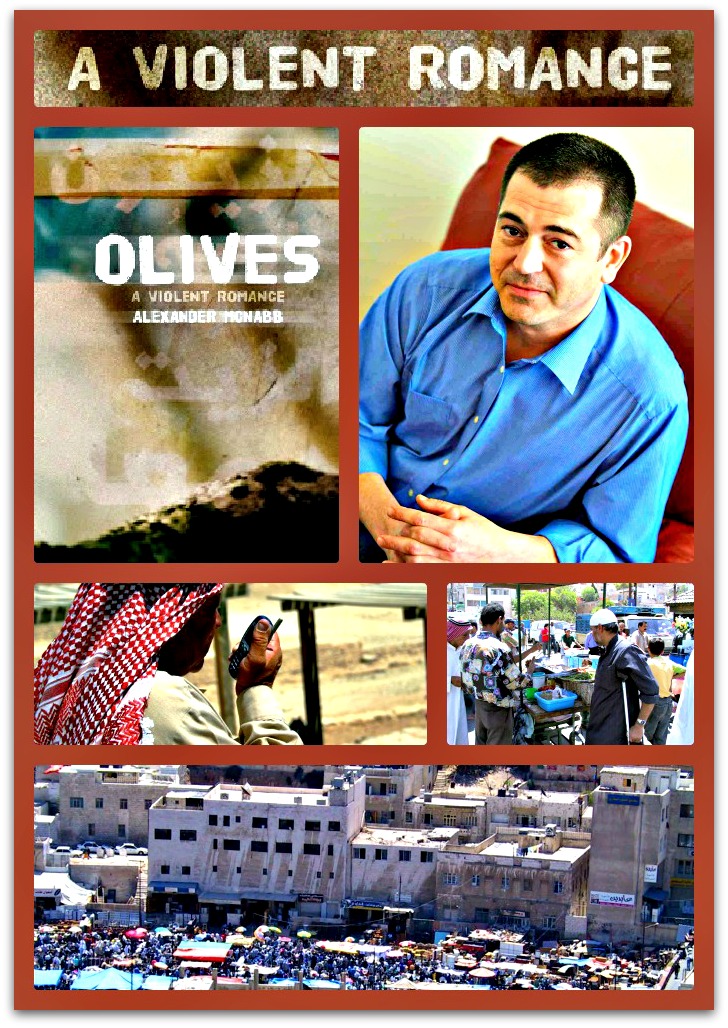
The London-born Alexander McNabb has spent nearly half of his life in the United Arab Emerites. Last month we interviewed him about his series of books on Middle Eastern themes, the first of which, Olives — A Violent Romance, has been sparking some controversy. (“Bring it on!” he told us.) Alexander is back at the Displaced Nation to share some good news: He is giving away several copies of Olives to our readers!! (See details below.) He is also here to discuss: does the book deserve its notoriety?

The Jordanian Web site Albawaba did a lovely interview with me in which they played up the “controversial novelist” angle quite nicely — I am, apparently, “scandalous.” Now, as any fule kno, if you want to sell books a whiff of scandal is quite handy.

That said, I have always shied away from that sales strategy — at least in part born of my dislike of the way the British author Geraldine Bedell’s publisher attempted to hijack the first Emirates Airline Festival of Literature (which I usually attend) to promote her mediocre book, The Gulf Between Us. Penguin claimed the festival organizers had tried to ban the book for its inclusion of a homosexual sheikh. (For more details, go to my post on this story.)

And yet bucketloads of controversy have dogged me since Olives — A Violent Romance was published a year ago. It’s much easier to be a “controversial author” in the Middle East than it is in the West these days.

Where is speech truly free?

We tend to forget how the film Monty Python’s Life of Brian (1979) was picketed by Christian groups, and how in 1988 Scorsese’s Last Temptation of Christ an adaption of a 1953 novel, was picketed and banned in some countries.

Let alone Lady Chatterley’s Lover (an unexpurgated edition could not be published in the UK until 1960), Frankie Goes to Hollywood (their controversial single, “Relax”) or many other shameful bans on music and literature in my own country in my own lifetime.

We think of ourselves as secular, tolerant and free-minded — yet our recent history has been filled with our failing to come to terms with free speech and literature that brings up topics we find uncomfortable.

Imagine how it is, then, in the Middle East, a region not only more sensitive to discussion of religious, cultural and social issues but with many more taboos to play with.

Some inconvenient truths

In Olives, my first book, a Muslim family is depicted drinking alcohol. This caused considerable comment online and from reviewers in the region, some of whom thought this was unnecessary and meretricious. A few tried to portray this scenario as unrealistic, but that didn’t really wash. Alcohol and the Arab world have a fraught — and frequently secretive — relationship.

Even more controversy followed with the fact that a Muslim woman sleeps with a British, Christian, man in the book. This was a humdinger that sparked debate about my motivations, the possibility this could happen and, once again, why I had to include such unsavory behavior.

Talk about inconvenient truth.

But the money shot was my decision to use real names in the book: real Jordanian and Palestinian family names. It wasn’t much of a decision, really, more of a no-brainer — you wouldn’t set a novel in the Highlands of Scotland and call characters MacShuggy or MacSquarepants because you were afraid of the clans, would you? And yet that expectation very much exists in Jordan today!

One member of a family with the same name as the female protagonist, Dajani, posted a comment on the Olives blog on behalf of the whole family demanding that the name be changed:

It would have been entirely feasible for you as an author to have contrived/fabricated a fictional name which does not infringe or violate our good family’s history and reputation and [we] do not believe that you have exercised good judgement in this choice.

The row spilled over to Facebook and other platforms and quickly got out of hand. One commenter on Jordanian blog 7iber (pronounced “hiber”) noted:

…this would be worth some honor killings if these names were abused.

Umm, that’s a death threat. (No matter that it’s probably something silly typed by an anonymous pimply onanist showing off, it does tend to stop one in the old tracks when you first read it.)

Worse, distributors in Jordan had refused to carry the print edition, citing concerns over the book’s use of that prominent Palestinian family name. Olives wasn’t banned in Jordan by government censors — but it was blocked by what a sympathetic commentator quite rightly called “a more insidious form of censorship.”

Fact vs fiction

Why has this been happening — because people in the Middle East can’t separate fact from fiction? Absolutely! It’s a real issue in the region. There is all too little fiction produced in and about the region: people simply don’t read very much in the main. A bestselling Arabic novel might sell a few thousand copies at most — the vast majority of Arabic writers pay to have their books printed.

So quite a few people, not unsurprisingly, find it hard to separate fiction from fact. Strangely enough, another branch of the Dajani family (which is very large and widespread, part of the reason I used the name) is passionately pro Olives — and I have to say the same thing to them: “Guys, it’s fiction!”

But the fact remains, my book set in Jordan can’t be sold in the country it’s set in.

As I said, it’s all too easy to be scandalous in the Middle East. Mind you, wait ‘till they see Beirut – An Explosive Thriller

*  *  *

Now it’s time for the freebies! Displaced Nation readers, you can get your very own copy of the book that’s been making waves in my part of the world. Here are 3 ways to do so:

1) For TDN readers with an iPad or ePub compatible reader (Nook, Sony, Kobo, Android etc): Get your copy of Olives — A Violent Romance free of charge (and save $4.99) on Smashwords. But first, you’ll need to sign up for the DISPLACED DISPATCH to get the code (it will come in the issue delivered this Saturday). NOTE: The code is valid until 1st December — and then, pfft, it’ll disappear. Dear readers, you are MORE than welcome to share that code with family, friends, strangers, dogs in the street — even lawyers.

2) For TDN readers with Kindles: Leave a comment on this post with your e-mail, and I will send a Kindle file and instructions how to install it. Best I can do, I’m afraid — Amazon doesn’t let me do freebies! Do remember to use name dot name at domain dot com so the spambots don’t find you! Or you can hit me up directly at @alexandermcnabb on Twitter…

3) For TDN readers who still like shiny PRINT books: If anyone would like to win Olives — A Violent Romance in print, delivered to their doorsteps anywhere in the world, just leave a comment and let us know where, if you could move to live anywhere on earth tomorrow, you’d go — and why!

TO ALL READERS: Olives — A Violent Romance has (wonderfully) met with considerable critical acclaim — if anyone wants to add their voice (whichever way it leans) on Amazon or Goodreads, that’s welcome feedback. The more people know the book exists, the merrier! 🙂

STAY TUNED for tomorrow’s post, the first in a two-part series on an expatriate’s love life.

If you enjoyed this post, we invite you to register for The Displaced Dispatch, a round up of weekly posts from The Displaced Nation, with seasonal recipes, book giveaways and other extras. Register for The Displaced Dispatch by clicking here!

Related post:

Images: All from Alexander McNabb.

LIBBY’S LIFE #63: A post from Melissa

Kate:  We’ve heard a lot about Libby and Oliver’s landlady, but only from Libby’s biased point of view. In today’s episode, the woman herself, Melissa Harvey Connor, takes the stage. 

Can she redeem her reputation after everything Libby’s told us about her? 

Melissa:  Life has a way of sorting itself out. It doesn’t matter what happens, or what kind of bad shit goes down, it’ll all work out in the end. If it’s not worked out, it’s not the end, and the fat lady hasn’t done her number yet.

I read that somewhere on Pinterest, but it’s a good philosophy, right? I’ve always thought so, anyway. Even now, at the age of 44 — I mean 32 — whenever things aren’t going to plan, I try to hang on to the idea that good things happen to those who wait.

Like, within reason. I can’t stay 32 forever, irregardless* of what that doctor who shoots me up with Botox says. A girl can wait only so long for the good times to roll around, especially if she’s being driven insane by her husband Jeffrey.

Jeffrey Connor. How in God’s name did someone like me wind up with someone like him, you ask?

I’ll tell you how. It was his cute British accent. Like Sean Connery’s James Bond. Very English. I’m a sucker for guys with British accents. They’re so much classier than your average Joe’s accent round here.

Jeffrey and his wife at the time, Shelley, ended up renting my house after I moved to a new condo. One thing led to another — I’d collect the rent check from Jeffrey on evenings when Shelley was out at book group, and pretty soon we were making jokes about me being the highest paid call girl in Woodhaven. Or rather, he’d be making jokes about call girls in that classy accent of his — he said it was an Essex accent, but whatever, he sounded like Sean Connery to me — and I’d be all, “Say something else! Talk to me some more!”

After four years of it, though, I had to call timeout.  By that stage I’d realized his accent was more like Russell Brand’s than Sean Connery’s, and the jokes about call girls were so not funny any more.  Four years is a long time  for anyone — Patsy Traynor said I deserved a medal — though I guess it was less if you don’t count the year he was still living with that boring wife of his.

The weird thing is, I hated Shelley at the time, but now I just think, you poor woman. I’d had Jeffrey for four years, but she’d had him for ten, and he’s gone back for more. Jeffrey, I discovered, is boring, and boring is contagious, so no wonder Shelley bored the pants off of everyone she met. I might have found out Jeffrey was boring too, if I’d listened to what he was saying instead of drooling over the accent he was saying it in.

I found out soon enough when we were married, though.Twenty-four hours after we stood in front of the minister in that Vegas chapel — getting a five-minute wedding in Vegas was probably the most exciting thing Jeffrey had ever done — he suggested that we drive to see the Grand Canyon.

What the hell? Drive 300 miles to see a big ditch, when we could have been playing blackjack in the Bellagio? Or even, dare I suggest it, having sex in our hotel room? This weekend away had turned into a honeymoon, after all, and that’s what you’re supposed to do on honeymoon. What you’re not supposed to do is drive 300 miles in a beige Ford Taurus to see a hole in the ground. It wouldn’t have been so bad if we’d rented the Porsche or the Corvette at the airport’s Avis place, or hell, even the Mustang, and we could have driven those 300 miles in a little style. But no, Jeffrey was all “Oh no, honey, I can’t afford that. Not with maintenance payments for the kids as well.” And I was like, “Well, Jeffrey, you should have thought of that yesterday before you got yourself a trophy wife!”

I know. Trophy wives are usually younger than the husbands, and  technically Jeffrey is nine years younger than me. But at the time I said I was 28, so that makes me a trophy in my book. Plus I was a successful realtor with two houses and no kids — well, I have two of those as well, actually, but they’re with their father in North Dakota. They never come here, and obviously I never go there, because who in their right mind visits North Dakota?

Anyway, as I stood on the south rim of this big ditch in the middle of Noplace, Arizona, while Jeffrey took gazillions of photos of sky and rocks and things, I thought, Oh. My. God. What have I done?

Then I thought, Come on Melissa. You know things usually turn out good in the end. This happened for a reason.

So I waited for the reason and for things to turn out good, but you know what? They kept on getting worse. I was just dying of boredom, and I got to thinking that if it didn’t kill me soon, I’d help it along some with some Prozac and a few Jack Daniels chasers.

But then, this time last year, everything changed.

We’d had a big winter storm that cut the power to all the houses in town, and I was worried about my tenants, Libby and Oliver, so I went to see if they were all right. There was no reply when I rang the doorbell, so I let myself in with the spare key. You hear bad stuff about people dying of carbon dioxide poisoning** and landlords getting sued, and I thought I’d better check no one was lying dead in the bath tub or anything.

So there I am, walking around upstairs with a flashlight, and I trip over a sweater on the floor and nearly fall over the railings to the floor below. At this point, Mrs Libby High-Horse Patrick walks in the house as if she owns the place — which she doesn’t, because I do — and orders me out of my house because, she says, I’m invading her privacy and sniffing her husband’s sweatshirt.

Sniffing her husband’s sweatshirt? Puh-leese! Oliver’s cute and all, and I don’t mind admitting I used to have a little crush on him when he and Libby first moved in, but she made me sound like I was a bunny-boiling stalker. Which I’m not. But I was prepared to forget what she said, so I went round a few days later, and you know what? The bitch had gotten the locks changed so my key didn’t work.

Of course, I went to complain to the HR department where Oliver and Jeffrey work, because they’re the people who pay me Oliver’s rent. I told them I wanted the Patricks out of my house because they’d changed the locks and brought a dog to live in the place without permission. And the snotty guy in HR read over the lease and said they were perfectly within their rights to do both those things, and maybe I should have a proper lawyer draw up a lease next time if I didn’t like it, because as long as I was getting my rent on time, I didn’t have a leg to stand on.

So we had a yelling match right there in the office, and I guess I must have been too loud, because another guy walks in and wants to know what it’s all about. I tell him, at length and in detail, and halfway through, the guy from the HR department rolls his eyes and leaves the room. These Brits are so rude. But I keep on ranting at the second guy, because he seems to be listening carefully, and I think I may get somewhere. Besides, he’s kinda cute.

“And let me tell you,” I say at the end, when I’ve run out of things to say, “no one messes with Melissa Harvey Connor in this town!”

“You’re Jeffrey Connor’s wife?” he says. He’s got this awesome accent. Hugh Grant! I think. Older than Hugh Grant, though. Think George Clooney before he went gray.

I nod. “Technically,” I say, as he takes me by the elbow and leads me into a very classy office with a window and a view over the River.  He closes the door behind him, pulls out a chair at his desk for me to sit on.

On his desk there’s a brass nameplate. Terry Michaels, President, American Operations.

I’ve heard Jeffrey talk about him. The boss of the company on this side of the Atlantic, no less. And let’s face it, who cares about the other side anyway?

“Why don’t we talk about it some more?” he asks. “Are you free for lunch? I’m sure we can sort things out to everyone’s satisfaction.”

*  *  *

And that was how I met the real love of my life, Terry. His wife Caroline is a nut job and he’s thinking of divorcing her, so no one must know about us, he told me. If she knew about us, she could get very nasty, and Terry has no intention of living in poverty so that Caroline can max out her cards at Tiffany.

So we were careful, and for a long time, no one suspected a thing. Then the housing market plummeted, Jeffrey finally got the message that I wasn’t that into him so he went back to his ex-wife, but not before he got me a job in his office, working for Oliver of all people. It was a great cover story — I flirted nonstop with Oliver, and let the rumors fly. Terry said he’d heard from Caroline that the gossip among the English wives was that Oliver and I were having a passionate fling. Too funny, right? I hoped it would get back to Libby. Serve her right for changing my goddamn locks.

Then in August, Oliver queried some overtime I’d done. Nine hours in one week. “Of course I did it,” I said. “Ask Mr. Michaels. He asked me to stay behind to help him.” And so he did, although of course it wasn’t filing he’d had in mind.

Oliver stared at me for a long time. “I’m sure he did,” he said, and walked away.

“He knows,” I told Terry later.

Terry told me not to worry, that he could sort Oliver out. “He’s due for a pay rise,” he said. “Now that Jeffrey’s left, we could do some restructuring. I’ll have a chat, man to man. If the job offer is good enough, he’ll see sense.”

But that was nearly a month ago, and Oliver still hasn’t taken any promotion.

*  *  *

 * Kate (and everyone else) knows ‘irregardless’ is not a word. Melissa, however, back in the day, paid less attention to her high school English teacher than was advisable, and doesn’t take kindly to helpful editing suggestions. Sorry.

** She didn’t pay much attention in Chemistry, either.

.

Next post: LIBBY’S LIFE #64 – Shades of red (2, not 50)

Previous post: LIBBY’S LIFE #62 – Private investigations

A note for Libby addicts: Check out Woodhaven Happenings, where from time to time you will find more posts from other characters.  Want to remind yourself of Who’s Who in Woodhaven? Click here for the cast list!

Read Libby’s Life from the first episode.

.

Stay tuned for our next post!

If you enjoyed this post, we invite you to subscribe for email delivery of The Displaced Dispatch, a round up of the week’s posts from The Displaced Nation. Sign up for The Displaced Dispatch by clicking here!

Img: Map of the World – Salvatore Vuono/FreeDigitalPhotos.net

RANDOM NOMAD: Patricia Winton, Crime Writer, Expat in Rome & Lover of La Dolce Vita

Place of birth: In a farmhouse belonging to my paternal grandparents near Pelham, Tennessee, on a snowy December night
Passport: USA
Overseas history: Italy (Marina di Pisa, Livorno, Rome): 1969-70; 1970-71; 2002 – present.
Occupation: Crime Writer. My protag is an Italian American journalist rebuilding a career as a food writer in Italy. She first appeared in “Feeding Frenzy,” one of the mystery stories in Fish Tales: The Guppy Anthology, edited by Ramona DeFelice Long (Wildside Press, 2011). She’s waiting in the wings in an as yet unsold manuscript, set in Rome. She will solve another crime in the novel I’m beginning next week (for National Novel Writing Month), set in Florence.
Cyberspace coordinates: Italian Intrigues — Notes about life in Italy, food and wine, mysteries and crime (blog); Novel Adventurers — Seven writers blog about their passion for culture, travel, and storytelling (collaborative blog); @patriciawinton (Twitter handle); and Novel Adventurers (FB page).

What made you abandon your homeland for Italy?
I had the opportunity to come live in Italy when I was quite a young woman, and I lost my heart to the land, the people, and the cuisine — not to mention the wine. I talked about coming back to live for years, but life intervened. Following 9/11 (I worked a block from the White House at the time), I really felt my mortality and decided it was time to make the move. Or to stop talking about it.

Was anyone else in your immediate family displaced?
One of my sisters lived in Panama for three years. Another lives in New Mexico, a state that many people think is a foreign country. One classic example: New Mexicans had trouble trying to get tickets to the Atlanta Olympics and were told to go the the Mexican consulate. The situation is so ridiculous that New Mexico Magazine runs a monthly column called “One of Our 50 Is Missing.”

Tell me about the moment during your various stays in Italy when you felt the most displaced.
“Bureaucracy” may be a French word, but the Italians invented it. If you don’t believe me, I invite you to consider the Biblical story of Christmas: a decree went out from Caesar Augustus that all the world should be taxed, each to his own city.

Getting together the paperwork to file for permanent residency was a nightmare. After almost a year of compiling documents, it all came down to what the Italians saw as a discrepancy: my passport lists my place of birth as Tennessee while my birth certificate, issued by the state of Tennessee, listed my place of birth as Pelham. Getting that sorted out took six months. During the interregnum, every document including my permission to stay expired. I couldn’t renew anything until the residency question was settled.

When did you feel the least displaced?
It’s always at table. On the edge of a Tuscan vineyard enjoying homemade pasta and good wine, sharing laughter with friends. Before a roaring fire in a chilly stately home with simple chicken and salad, but more laughter and wine. With a group of strangers in at a local market luncheonette, querying a table-mate about her meal and being offered a share.

You may bring one curiosity you’ve collected from each of the countries where you’ve traveled or lived into The Displaced Nation. What’s in your suitcase?
A morsa di prosciutto (prosciutto holder). While most prosciutto crudo sold in Italy as elsewhere is machine-sliced, traditional purists want it cut by hand. To hold the ham steady, it’s placed in the morsa, a large clamp that hold it, while a knife is used to slice.

Hmmm… I hope it won’t be deployed by the murderer in one of your crime novels as an instrument of torture! I understand that when you first went to Italy, you learned to make pasta by hand, and then took a pasta machine back to the United States, where you taught many others how to make it, while also writing a food column for a newspaper. We are therefore looking forward to the meal you are invited to prepare for Displaced Nation members, based on your travels. What’s on the menu?

Indeed, I’ll be serving a traditional Italian meal:
Antipasto (appetizer): Fiori di zucca faraciti (zucchini blossoms stuffed with mozzarella and anchovies, dipped in batter and fried)
Primo piatto (first plate — traditionally the pasta, rice, or soup course): Gnocchi di Zucca alla Gorgonzola (pumpkin dumplings with gorgonzola sauce)
Secondo piatto (main course): Grigliata Mista di Pesce (mixed fish grill)
Contorni (vegetable accompaniment): Finocchio (fennel)
Frutta: Pesca (peach)
Dolce (dessert): Tiramisù
Bevande (drinks): Acqua minerale frizzante (fizzy mineral water); and Falanghina (white wine made from one of the oldest grapes grown in Italy)
.

And now can you please suggest an Italian word or expression for the Displaced Nation’s argot?
One that I’m currently enjoying is in gamba, meaning “in the leg.” In general, it means “to be an expert” or “to be good at what you do.” But it means so much more. I wrote an extensive piece about the phrase at Novel Adventurers recently.

Halloween is nearly upon us, and many of our posts of late have been about horror and that sort of thing. Tell me, do you keep up American Halloween celebrations in Rome?
I haven’t really celebrated Halloween since I was a child. I spent much of my adult life working on political campaigns. With Halloween falling days before the election, I never seemed to get organized for it. Here in Italy, it’s a relatively new holiday and more for adults than children, really. Children dress up for carnival, wearing their costumes to school for days before Martedì Grasso (Italian for Mardi Gras).

There are Halloween-related items for sale (plastic Jack O’ Lanterns and such), but no pumpkins for making Jack O’ Lanterns. Those are reserved for cooking. If I do anything to celebrate, I cook pumpkin, either as a vegetable or as part of the primo piatto.

Also in keeping with the season, we’ve started exchanging expat horror stories on the site. What’s the creepiest situation you’ve encountered on your travels?
The creepiest thing that ever happened to me occurred many years ago on a train from Munich to Florence. It started off pleasantly enough. I shared a compartment with five or six other people. A couple of them spoke only German. One woman spoke Italian and German, a man spoke German and English, and I spoke English and Italian. We had a polyglot conversation, with people translating for others and listening to see how much of the foreign tongues we could decipher. It was lots of fun. They all left the train before I did, and each warned me to be careful on my long journey as they descended one by one.

Alone, I moved near the window, and the rocking of the train lulled me to sleep. Quite some time later, I was awakened by the conductor turning on the lights to check tickets. I discovered that I had been joined in the compartment by a man who was in the act of pleasuring himself in the dark while I slept.

Now THAT’s creepy! Readers — yay or nay for letting Patricia Winton into The Displaced Nation? Not only can she cook, but she can tell a shocking story! (Note: It’s fine to vote “nay” as long as you couch your reasoning in terms we all — including Patricia — find amusing!)

STAY TUNED for tomorrow’s post, another horrifying Displaced Q by Tony James Slater!

If you enjoyed this post, we invite you to register for The Displaced Dispatch, a round up of weekly posts from The Displaced Nation, with seasonal recipes, book giveaways and other extras. Register for The Displaced Dispatch by clicking here!

Related posts:

Img: Patricia Winton (author photo)

LIBBY’S LIFE #62 – Private investigations

It looks much easier in movies. Being a private detective, I mean.

If this were a movie, for example. I’d have taken Oliver’s phone with us to the park and, while Jack played nicely on the slide, I’d have scrolled through a couple of texts and emails until — ta-da! — I discovered irrefutable evidence that proved Oliver wasn’t getting any extra-curricular entertainment from our landlady. Then next week I could have returned in triumph to the Coffee Morning Posse, demanding an apology for them spreading untrue rumours.

This isn’t a movie, however, so what happens instead is this:

While Oliver trundles his mother off to see the sights of Bath, the children and I walk to the park. Jack insists on jumping on every fallen leaf he sees, so a ten-minute walk becomes a thirty-minute loiter. When we arrive at the park, he leaps into a big pile of leaves, twisting his ankle on a tree root beneath, and falls over and skins his hands. This makes not only him cry but George and Beth cry too, and while I’m all for sibling bonding, I wish they’d find another way to do it. Fortunately, no one else is at the park that early, so I’m spared the disapproving stares and visits from social services. Hugs, cuddles, pats on the back and “there-there”s have no effect, and all three kids bellow in unison until an ice cream van comes along, tinkling “Greensleeves”.

Motherly love is all very well, but it’s no match for a Flake wedged in an ice cream cornet.

So what with adorning Jack’s hands with Spiderman plasters, decorating the twins’ faces with ice cream, and discovering, too late, that the baby wipes are back at the house, it’s no wonder that playing Nancy Drew falls down the pecking order of my to-do list.

When I do get round to perusing the contents of Oliver’s phone, I’m first nervous about what I might see, then disappointed at the dull reality.

Oliver’s inbox consists of emails from customers complaining about this, that, and the other; automated reminders for finance meetings and business development brainstorming sessions; an email in September from Terry Michaels, Caroline’s husband, asking Oliver out for a drink after work (I didn’t know Oliver was that pally with the boss); and a bunch of joke emails from Oliver’s colleagues that probably wouldn’t pass any political correctness tests. The only messages from Melissa were a couple in which Oliver had queried the overtime she’d claimed in August, and she was fighting back, saying she had indeed been in the office until 8pm on August 21, 23, and 24.

There was nothing interesting in his inbox, in fact, until I got to one from HR, dated three weeks ago. It certainly made up for the rest of the inbox contents.

Oliver, it seems, has been offered a new job.

Correct me if I’m wrong, but life partners normally share this kind of information, don’t they? It’s the first I’ve heard about this job, though.

It would still be in Massachusetts so we wouldn’t have to move, so that’s good. But get this: the letter states that the position would come with a company car up to the value of $35,000, first class travel while on company business, and two weeks extra paid vacation. The salary, the email says, would be commensurate with the grade, plus a bonus percentage based on past performance, to be evaluated by Assistant Head Honcho Terry Michaels. (A-ha! Hence the invitation of a drink after work, a few days later.)

I’m not familiar with the ins and outs of the grading system in Oliver’s company, but I do know that at present there is no company car, he gets four weeks holiday like everyone else in Milton Keynes, and if he wants to travel even business class he has to be flying long-haul, like to Australia. This job would be a big career leap for him.

Why wouldn’t Oliver want to share the possibility of good news with me? I suppose he could argue that he didn’t want to get my hopes up in case nothing came of it.

Or maybe he turned it down.

But why would he do that?

Having raised more questions than I’ve answered, I take the children home, and carefully replace the phone on the window seat in our bedroom.

*  *  *

“How did you like Bath?” I ask Sandra later, when she and Oliver return to our little cottage. Oliver, I sense, has run out of patience already — not a good thing when Sandra is here for another five days.

She wrinkles her nose.  “Those Georgian houses all look the same. I can’t see the difference between them and  the new Barratt estate in Milton Keynes.”

“Philistinism” doesn’t begin to describe the attitude of my mother-in-law towards architectural aesthetics.

“A bit more expensive than your average Barratt house,” I say. “We could never afford to live there, anyway.”

“Not even with what Oliver makes in America?”

“Nope,” Oliver says.

“I thought that was the whole point of you going out there, to get a promotion,” Sandra says, pouting.

We didn’t tell her that. She assumed it. Heaven forbid that we should leave Milton Keynes to expand our horizons and get away from family irritants.

“Yes. Well. Sometimes these things don’t happen as planned. There’s no promotion in the immediate future, I assure you, and we won’t be buying a house in the Royal Crescent anytime soon.”

I bet we could afford it if he took that job in the email. I’m dying to say this, but of course that would mean admitting I’d been snooping through his phone.

“You should try sleeping with your boss!” Sandra laughs, and splutters all over Jack who has come to her for a hug. He steps away quickly.

“Not my style, Mum,” Oliver says. “I leave that sort of thing to other people. Me, I’ve got principles.”

He walks into the living room, where I can hear him talking softly to the twins, who gurgle back.

“What’s his problem?” Sandra asks, jerking her head in Oliver’s direction.

I shrug. “Hormones?”

But not his.  Someone else’s hormones are causing him trouble.

I leave that sort of thing to other people, he said.

His query about Melissa’s overtime. His boss’s request for a man-to-man chat over a beer, and an offer of  a job he could have only dreamed about six months ago.

Me, I’ve got principles, he said.

Like everyone, Oliver has his faults.

But I know that taking bribes isn’t one of them.

*  *  *

Next post: LIBBY’S LIFE #63 – A post from Melissa

Previous post: LIBBY’S LIFE #61 – A voice in the dark

A note for Libby addicts: Check out Woodhaven Happenings, where from time to time you will find more posts from other characters.  Want to remind yourself of Who’s Who in Woodhaven? Click here for the cast list!

Read Libby’s Life from the first episode.

STAY TUNED for Monday’s post!

If you enjoyed this post, we invite you to subscribe for email delivery of The Displaced Dispatch, a round up of the week’s posts from The Displaced Nation. Sign up for The Displaced Dispatch by clicking here!

Image: Travel – Map of the World by Salvatore Vuono / FreeDigitalPhotos.net

Oblivious to controversy, this expat author stirs up tales of violence, romance and tragedy in the Middle East

Alexander McNabb isn’t afraid of ghoulies, ghosties, long-leggedy beasties, and things that go bump in the night — which, as Kate Allison announced the week before last, is this month’s theme at the Displaced Nation.

How do I know he isn’t afraid? Because he is too busy tuning into other sources of thrills, chills and excitement for his books — namely, Middle Eastern politics and intrigue.

Though he doesn’t seek controversy, he doesn’t shy away from it either. His books are violent, explosive, and deadly. One has actually been banned in Jordan.

I now have the pleasure of giving Mr McNabb the floor to tell us more about his affinity for such dastardly topics. Don’t worry, he doesn’t have fangs but is a gentle sort with a great sense of humo(u)r… He is also a lively conversationalist, with his own radio show in Dubai, and a cook.

Welcome, Alexander. Shall we start out with what should be a basic question (though it rarely is for us displaced types): where are you from?
I was born in London, in Edgware General Hospital, which they have since knocked down, presumably to stop lightning striking twice. I grew up in various countryside areas north of London and was unwillingly educated at The Haberdashers’ Aske’s Boys’ School in Elstree.

When did you first go to the Middle East?
In 1986. I was selling an insanely visionary software package put together by a directory publisher that had the wonderful idea of selling its information as an integrated database. I presented this to a number of puzzled Saudis who lost no time in introducing me to their most junior members of staff and leaving me there. It taught me an important lesson — Gulf Arabs never say “no,” it’s considered rude. And “not no” doesn’t mean “yes”!

How did you end up living in Dubai?
When that project and, ultimately, the company failed I got involved in the publishing side of things. And so in 1993 I moved out to Dubai to start a subsidiary of the publishing company I worked for. And got myself shut down by the Ministry of Information. But that’s another story…

We will talk about your trio of books set in the Middle East shortly. But first: do you have any other published works?
The first book I wrote was a spoof of international spy thrillers, called just Space. I re-read the manuscript a couple of months ago and it made me laugh a lot, so I published that as a $2.99 Kindle-only book. I worked for ten years as an editor and publisher and for longer than that as a writer and journalist, so there are millions of my words out there — lost and crying out plaintively…

No need for them to mourn as you’ve just now published Beirut — An Explosive Thriller, which is the second in three books you are writing that are set in the Middle East, called The Levant Cycle. The first was Olives — A Violent Romance and the third will be Shemlan — A Deadly Tragedy. Could you say a little more about the Levant Cycle?
The Levant Cycle was never meant to be — the three books just happen to be set in the same region, contain some of the same characters and be roughly contiguous. But they are very different. Olives is really a novel — the story follows young British journalist, Paul Stokes as he arrives in Jordan and quickly falls afoul of the law — while Beirut is a hardcore international spy thriller. And they’re independent works in themselves. I had always thought of a book that would form an interlinear to Olives, a telling of that story from another perspective, possibly that of Gerald Lynch, the British Secret Intelligence Service officer that Paul encounters. Beirut wasn’t meant to follow on from Olives and then it just did, sort of taking up from when Paul moves to Beirut. And of course Beirut shows a very different Gerald Lynch, because in Olives you only see Lynch from Paul’s somewhat jaundiced perspective. So the books can be grouped, but I didn’t want a trilogy — a cycle seemed more appropriate.

Are you now working on the third book?
Yes, I’m about halfway through Shemlan and loving it. It’s a great deal darker than the other two books. It’s about a retired diplomat who’s dying of cancer going back to his past and finding that past is likely to kill him before the disease does.

What does “shemlan” mean?
Shemlan is a tiny village high in the hills above Beirut. It’s a little-known fact that Shemlan was for many years home to the Middle East Centre for Arabic Studies, where the British government taught its diplomats — and its spies — Arabic. A lot of my research for the book has consisted of taking friends and colleagues up there for lunch at Al Sakhra (The Cliff House), the lovely Arabic restaurant in the village. I know, it’s hard…

What made you decide to center the action of your books around the politics of the Middle East?
No one else was writing fiction centered on this region. There hasn’t been an interesting Middle Eastern spy thriller since Eric Ambler’s The Levanter. Olives was intended to introduce a Western audience that doesn’t care very much to some of the more complicated aspects of life in that part of the world — to some of the human issues that lie behind the glib headlines.

I presume you aren’t afraid of controversy?
Bring it on! Actually, I was amazed at the “controversy” that Olives provoked because of my having depicted Muslims drinking alcohol and Arab women having sex with foreigners. These things never happen in the Arab World! And then the Great Naming Scandal, when my use of a real Palestinian name (Dajani, for the Palestinian family Paul gets involved with) was deemed by distributors in Jordan to make the book too hot for them to handle. It still can’t be sold there!

How about Beirut?
I was truly blown away when the UAE’s National Media Council granted the necessary “Permission to Print” for Beirut. I’m sure someone, somewhere will find some aspect of the book controversial, but I think that’s more a product of the lack of narrative literature in the region than it is any quest for controversy on my part. And yes, you do actually have to get permission to print a book here — and government clearance to import books into any country in the region.

What audience did you have in mind for Olives?
Olives was written for a British audience but has appealed broadly across Europe and the US as well as in the Arab World. I’ve been more than pleased at Western readers who have enjoyed Olives and said, “I didn’t know about all that stuff.” And, because I thought I might lose Arab friends, I have been truly overjoyed that so many Palestinian and Arab readers have loved it.

At one point in Olives, Paul, the British journalist, becomes romantically involved with his Palestinian coworker, Aisha Dajani. Do you think Westerners can have successful relationships with Arabs and live happily ever after?
I really don’t see it as a “Westerner/Arab” thing at all – it’s an awful cliché, but love transcends nationality, culture and, yes, religion. I have seen relationships founder on that particular rock, where the partners can’t clear the hurdle of converting to or from Islam, but I have also seen couples deal with that. And, of course, there are still a great number of Christians in the Arab world and Muslims in the West. East and West doesn’t have to be about Islam, even if it often is.

Did you base the hero, Paul, on anyone in particular?
Paul Stokes is modeled on a number of callow Brits I have encountered arriving in the Middle East over the years, most of them journalists. You get a lot of credit in the Arab World for having tried to understand things, for actually bothering to learn something about the region and its people before you go leaping in blindly, as Paul does. I have often been highly amused at the way Arab friends have reacted to the behavior of British people new to the region — funny little things like different approaches to generosity, family, children and manners. I remember once walking into the office to be met by horrified glares from the girls, all trying to catch my attention and draw it to the new Brit who was happily — and loudly — clipping his nails at his desk. Or the British staffer who labelled her things in the office fridge. To the Arabs, you just share and if we’re out of something, you get it — someone labeling a bottle of milk was a source of appalled amusement.

Paul becomes “localized,” even becomes a smoker, which is why he is so torn between “home,” represented by his girlfriend Anne, and “away,” which of course is Aisha. And she, of course, is the hero of the book. You’re not actually supposed to like Paul, really. Perhaps sympathize with him…

You characterize Olives as a “violent romance.” What does that mean exactly?
The book’s working title for years was just “Olives.” The problem with that is that when you google “Olives,” you get Crespo, cookbooks or restaurants. So I decided on a defining subtitle — and nothing else seemed to suit other than “violent romance.” Olives is both a romance and a spy thriller. Thriller readers would find it too slow or romantic, romance readers would find it a little rough was the general concern. I hate how publishing brackets and pigeonholes us like that. The love story part of it has been popular, for sure — but a lot of people didn’t know about the region’s water crisis and learned about it from Olives, which has been cool.

Will Beirut attract the same readers?
Beirut is a totally different book and I was perhaps a little gleeful at how Olives readers would react to its much more hardcore spy thriller nature, particularly female readers. I was also a little scared, because I was setting out to kill what little fan base Olives has won for me. Readers, including females, have loved Beirut so far, which has me slack-jawed to be honest. But then it shows how wrong those traditional publishing preconceptions are — women actually reading a thriller? Oh, the shock of it all!

Is that why you are self-publishing The Levant Cycle — because the books do not fit in traditional publishing categories? I ask because quite a few expat authors we’ve featured on The Displaced Nation have self-published their works.
Let’s start with 250 rejections from agents for, respectively, Space, Olives and Beirut. When London agent Robin Wade signed me, it was for Beirut. I thought I was made, I really did. 250 rejections — and then an agent comes along and makes like a scrooch owl! Robin shopped Beirut around to 14 top publishers (there’s an image of the list I had of them, one after another struck off as the news came in, posted up on the Beirut site) and they, to a man, rejected it.

Why do you think that happened?
The ignorance about the Middle East from agents and editors alike has been shocking: “We have terrorism here at home, I don’t think people want to read about that” and “This novel, set in war-torn city Beirut” were two low points. But the worst was the editor who praised Beirut’s pace, setting, style and dialogue, compared it to Le Carré — but said he didn’t think it would fly in supermarkets. After that, I decided to see what readers thought without waiting for the gatekeepers. I am so glad I did.

Funnily enough, I discovered your books last month, when the Displaced Nation was dedicating itself to a series of food posts and I happened upon your collective blog about food, The Fat Expat.
Blogging became an outlet for me between frustrated bouts of writing. My partner in foodie crime, Simon “HalfManHalfBeer” McCrum, and I tried bringing others on board — but in the end The Fat Expat was doomed to tempus fugit failure. Still, I loved it while it lasted. I used to run a food magazine so am quite experienced in food preparation, photography and so on — and I love cooking.

Last month we were asking all of our interviewees: would you travel for food?
Damn right I would! Sweden this year, stunning food at stunningly high prices but you haven’t lived until you’ve eaten sour cream and crayfish on toast for breakfast. Estonia last year, a gorgeous holiday of art, museums and culture interspersed with the world’s largest, cheapest Martinis and top class cuisine — pelmeni in chicken stock, venison in red wine! But you want to really eat? There are stunning restaurants in Jordan — puffed up flatbreads fresh from the brick oven, potato pan-fried with egg and Mediterranean herbs. And, of course, Beirut — French food that makes Parisians blush alongside mountains of mezze, splashes of Armenian spice and of course Lebanese wines. I had to edit out my descriptions of Château Musar from Beirut because they crossed that threshold between what matters in a book and what readers need to know. But Musar is one of the world’s great wines. And the rosé from Château Ksara? Barmy, quite barmy. Do not, if you have the chance, neglect Massaya — a lovely wine from the achingly beautiful Bekaa Valley.

Next month’s Displaced Nation theme will be expats and politics — in honor of the U.S. elections. Do you have a horse in that particular race?
Obama. I don’t think anyone should forget that the people behind Romney are the people who took America to war against Iraq for no reason other than profit and dominance. There were never any WMDs and there was no link whatever between the murderously secular Saddam and the New Caliphate of Al Qaeda. Over a million people have died, the Middle East is lurching from crisis to crisis — and those old men are still doing three-martini lunches and planning their next move to make the world a safer place. At least Obama represents a hope of inclusion and reason.

Do you think expats should stay in touch with their home country’s politics? Do you?
Living in the Middle East, US politics are something you tend to follow because it pretty much shapes the region. I follow British politics to a degree, but it’s hard to be passionate about a system that has become so centrist and messaged. It’s something of a sitcom really.

What’s next, after the Cycle is finished?
I can’t even begin to think about what’s next, but there are plenty of contenders for next project, including a book set in Ireland and one about a traumatized teacher coming back from Iraq. Neither feature Mr. Lynch.

Readers, why not give those witches, ghosts, zombies, werewolves and vampires of yours a break and try Alexander McNabb’s wonderful cocktails of romance, intrigue, and high-stakes international politics instead?

STAY TUNED for tomorrow’s episode in the life of our fictional expat heroine, Libby. (What, not keeping up with Libby? Read the first three episodes of her expat adventures.)

If you enjoyed this post, we invite you to register for The Displaced Dispatch, a round up of weekly posts from The Displaced Nation, with seasonal recipes, book giveaways and other extras. Register for The Displaced Dispatch by clicking here!

Related posts:

Images: Alexander McNabb author image and book covers.

Expats, do you play with your identities? Are you an imposter or a chameleon?

Pretending to be a dead child is the cruelest trick you could play on a family.

Insinuating yourself into their lives, claiming falsely the intimacy and bonds that only exists between immediate family — mother and son; brother and sister — and to convince them that that son, that brother, that they feared murdered, has returned. There was, it transpires, nothing to worry about all along. You were fine. You are alive.

To succeed in such a deception scarcely seems possible. It sounds like the plot of a mystery novel, but it is, in fact, chillingly true. We have ourselves a real-life Talented Mr Ripley.

This post is concerned with the case of Frédéric Bourdin, a 23-year-old brown-eyed Frenchman who convinced a Texan family, the Barclays, that he was Nicholas, their missing blue-eyed teenage son and brother.

A conman, a fantasist, a sociopath, Bourdin already had a history of impersonating destitute children when in 1997 he convinced authorities in France and the US that he was the unruly child who at aged thirteen had disappeared from the Barclay family in San Antonio, Texas. The police presumed Nicholas was dead until Bourdin concocted a tale that the child had been snatched by a pedophile ring and brought to Europe. Bourdin lived with the Barclay family for three months before a private investigator revealed the truth.

With the release of the documentary film, The Imposter, directed by Bart Layton, the story of Bourdin has returned to the news. The film, a success at Sundance, is now in limited release in the US. Bourdin’s masquerade is so hard to believe, and so stranger than fiction, that it is of little surprise that is perfect material for a documentary.

This is not, however, the first time that the story of Bourdin has been depicted on the cinema screens. In 2010 a fictionalized account entitled The Chameleon was released, directed by Jean-Paul Salomé.

To be honest, The Chameleon is a disappointing film that despite being based on the most compelling of true-life tales is never itself compelling. (For anyone in the US who might be interested, it is available for streaming on Netflix.)

A better use of your time may be spent reading about Bourdin in David Grann’s essay “The Chameleon,” which belongs to his essay collection The Devil & Sherlock Holmes. This is where I first came across the story. The essay is actually available on The New Yorker Web site and I can’t recommend it enough.

Why, however, have we chosen this topic for The Displaced Nation? Well, we think that The Imposter is a film that you may be fascinated by, but we also think that there’s something about Bourdin’s tale, undeniably horrific and callous as it, that resonates with an expat audience. How did this man with his French accent convince others that he was an American teenager? In an interview with The Daily Telegraph, Bourdin stated that there was an unspoken collusion on the part of Nicholas Barclay’s mother, Beverly Dollarhide — that she knew damn well that this was not her son:

Most people who go to church don’t believe in God, very few of them really believe, but somewhere deep inside they try to convince themselves there is a God. It’s the same thing for the Dollarhide family. It happened exactly the same way.

Bourdin throughout his life has cruelly taken playing roles to an extremity. Despite being jailed for identity fraud after it is was revealed that he was not Nicholas Barclay, he continued to pass himself off as teenagers. In 2004 he claimed to be a Spanish adolescent whose mother had been killed in that year’s Madrid train bombings. The next year he again pretended to be a Spanish orphan, this time claiming that he lost his parents in a car accident.

While none of us play roles to that extent, this imposter and chameleon aspect of Bourdain’s personality is — though I am aware that I over-reaching here somewhat to make a point — reflected in many of our lives as expats.

I know that I find myself occupying roles I had previously not thought I would before. Sometimes I am the imposter. I play a role that isn’t me. In my case, it may be exaggerating national characteristics and language that I feel people expect of me, but that I would never use back home. At other times, I find myself trying to be the chameleon. Trying to scrub away my otherness so that no attention is drawn to me because I sound different, or behave differently.

What about you? What sort of an expat do you find yourself to be. In your adopted home, do you find yourself, at time, to be a chameleon? Or are you more an imposter?

STAY TUNED for Tuesday’s post, a list of travel situations that spell H-O-R-R-O-R!

If you enjoyed this post, we invite you to register for The Displaced Dispatch, a round up of weekly posts from The Displaced Nation, with seasonal recipes, book giveaways and other extras. Register for The Displaced Dispatch by clicking here!

Related posts:

Image: MorgueFile 

RANDOM NOMAD: Larissa Reinhart, Former Expat, Midwestern Southern Belle & Crime Novelist

Place of birth: Silvis, Illinois USA (I’m actually from nearby Andover, but it’s too small to have a hospital!)
Passport: USA only — but I’m on my third edition!
Overseas history: Japan (Yokohama, Kameoka, Nagoya): 1995-96; 1998-99; 2008-10.
Occupation: Mother and author of the Cherry Tucker Mystery Series. I’m also working on a mystery series set in contemporary Japan.
Cyberspace coordinates: The Expat Returneth — Sharing my life overseas, my life at home, and the other world that lives between my head and paper (blog); Larissa Reinhart: Writing mysteries and romance south of the sweet tea line (author site) @riswrites (Twitter handle); Larissa Reinhart (FB page); and Larissa Reinhart (Good Reads).

What made you leave the United States to live in a faraway land?
I’ve always wanted to live overseas. Before I got the chance to do it physically, I traveled through books — for instance, The Crane Maiden, by Miyoko Matsutani, and The Laughing Dragon, by Kenneth Mahood (I have passed them to my children). When I got older, I loved Elizabeth Peters mysteries, which are set in Egypt.

Was anyone else in your immediate family displaced?
My family is firmly rooted in Illinois, but was always interested in other cultures. My father was a history teacher, and I had a good understanding of geography and world history from him. I also had a grandfather who loved to travel. As a kid, I read his National Geographic collection and was fascinated by the countries he visited, particularly Egypt. He probably would have loved to have been displaced, but had to wait until retirement to travel.

Tell me about the moment during your various stays in Japan when you felt the most displaced.
My husband had a scholarship from the Monbu-shō to study at Keio University, so I applied to the JET (Japan Exchange and Teaching) Programme — and ended up getting to Japan a few weeks before he did. I lived with a homestay family. They spoke no English. I spoke no Japanese. They were very sweet, but they swung between helicopter-parent smothering and leaving me for long periods of time alone in a tatami room. I had horrible jet lag and felt so isolated and helpless. Once I moved into an apartment, my jet lag abated and I began enjoying myself. I had traveled to Egypt previously — but hadn’t experienced that kind of debilitating jet lag that comes with a 13-hour time difference. It’s a killer!

When did you feel the least displaced?
We have two young daughters from China. Four years ago, we took them to Nagoya to live for a couple of years. We saw it as a chance for them to experience life in Asia at a time in their lives when it was still easy to move around and adjust. They loved Japan. By the end of our two years, we all wanted to stay, but unfortunately couldn’t. There is no one particular instance, but lots of little, everyday moments we hark back to and can’t seem to reproduce back here — our family living comfortably in our tiny house, walking to shops and restaurants in the neighborhood, my children riding their bikes with the local kids to play at the neighborhood park…

You may bring one curiosity you’ve collected from each of the countries where you’ve traveled or lived into The Displaced Nation. What’s in your suitcase?
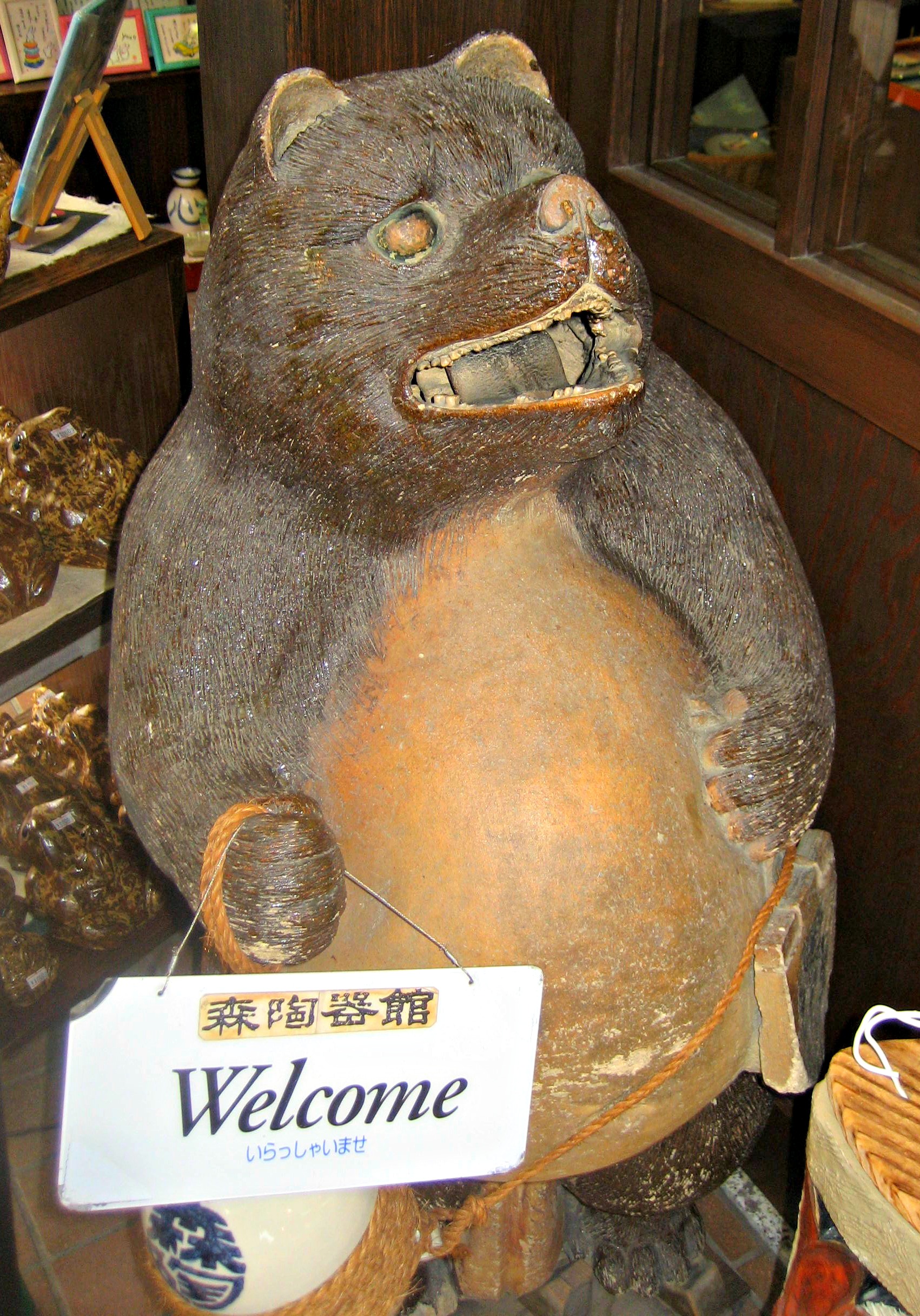
A ceramic tanuki (Japanese raccoon-dog). Japanese families and businesses keep them in front of their doors to welcome guests. It’s similar to the Maneki-neko (beckoning cat), but more fun because of their sake bottle and large kintama (golden testicles), which are meant to bring good fortune.

Hmmm…moving right along: You are also invited to prepare one meal based on your travels for other members of The Displaced Nation. What’s on the menu?

I like Japanese bar food, so we’ll have a meal based on that.
Appetizer: Edamame (boiled & salted green soy beans) and a Grapefruit Sour to drink. My favorite bars in Japan will give you a glass of ice, seltzer, and shōchū (grain alcohol) and a half-grapefruit with a strainer for you to squeeze the juice into the glass. Really refreshing.
Main: A bunch of Japanese tapas dishes — yaki-gyōza (fried potstickers), tebasaki (grilled wings), pari pari renkon chips (spicy, deep fried lotus root), tsukune (grilled chicken meatballs), and yakitori (skewered grilled chicken)
Dessert: Japan isn’t big into dessert, so we’ll have a savory bowl of ramen instead. And maybe another Grapefruit Sour. Or two.

Yum, you’ve brought me back to my own izakaya days… And now can you please suggest a Japanese word or expression for the Displaced Nation’s argot?
Chuto-hanpa. It literally means half-measure, but is used to describe doing something half-assed. I love this word.

We’re getting into a bit of a Halloweeny mood at the Displaced Nation. Tell me, did you keep the American Halloween tradition alive while living in Japan?
We did celebrate Halloween in Japan with our children. It’s becoming popular there in terms of decorations and parties (we even found an American-type pumpkin for $20), but trick-or-treating is an oddity. You don’t request gifts from people — certainly not door-to-door. Our neighbors would deliver snacks in a plastic jack-o-lanterns to our house instead. One expat friend arranged a trick-or-treating excursion for the children as part of a Halloween party. But first we mothers delivered bowls of candy to the businesses and homes in the area so that, when we brought the children round to trick-or-treat, they would have something to give them. People probably thought we were crazy, but at least they found the children in costume adorable.

Also in keeping with the season, we’ve started exchanging expat horror stories on the site. What’s the creepiest situation you’ve encountered on your travels?
It was on a trip to Thailand. My husband and I hung out on a beach at Koh Samui for a few days. To get back to the mainland, we had to hike across the island to catch a boat. We were proceeding along the dirt road, chatting…when I felt something grab my arm. Without breaking stride, I glanced down and saw a monkey, teeth bared, ready to bite me. Suddenly it flew off my arm, and I screamed. It had been chained to the side of the road, and was ripped away as it reached the end of its tether. Its vicious eyes and sharp teeth will forever be burned in my memory. That nasty monkey must have been someone’s pet. My husband saw it standing next to its stake before it jumped on my arm. Too busy talking, I totally missed it and walked within its perimeter. You can bet I have remained vigilant for monkeys ever since. I had a close call with some snow monkeys in Nagano, as well. I am not a fan.

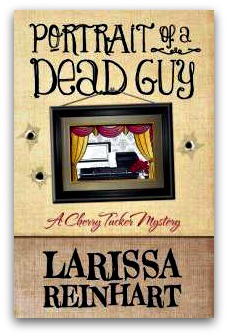
The first book in your Cherry Tucker mystery series is called Portrait of a Dead Guy. That sounds a little creepy. Is it?
It’s actually a humorous mystery, but the idea of painting a coffin portrait is creepy even for my heroine, a sassy Southern artist named Cherry Tucker. However, she’s desperate for a commission, which is why she offers her services. The dead guy has been murdered, and his stepmother felt that a final portrait would be a fitting commemoration. Cherry ends up as another potential victim of the murderer because of her proximity to the corpse. That said, she does have one spooky scene at night in a funeral home, alone with the dead body, which ends badly.

Painting a portrait of a dead man — how did you think that one up?
In truth, coffin portraits are not all that unusual, depending on your culture. Many cultures use a portrait of the deceased with their memorialization. I know a family friend who was asked to photograph a coffin portrait to send to the deceased’s family in Asia. They would probably place the photo in a family shrine and burn incense for a specific number of days along with other rites.

Tell me about your plans for the Japanese mystery series.
I’m a humorous mystery writer, so I look at the lighter side of crime. Did you know that the Japanese love mysteries? I think it’s because they have so little crime. I have another Southern heroine for the Japanese series, which will bring an interesting cross-cultural twist. I love the interplay of cultures.

Say, what is this thing about you and Southern ladies? Aren’t you an Illinois girl? Is this another displacement?
It is another displacement! We moved to Georgia between trips to Japan, about fifteen years ago. Small town South is very similar to small town Midwest, except for the Southerner’s extravagant use of hyperbole and simile in conversation. I can’t imagine living anywhere else in the U.S. now, although I can place myself in some foreign spots quite easily. 🙂

Readers — yay or nay for letting Larissa Reinhart into The Displaced Nation? She has an affinity for dead bodies, true — but in a humorous sense! And she doesn’t monkey around… (Note: It’s fine to vote “nay” as long as you couch your reasoning in terms we all — including Larissa — find amusing!)

STAY TUNED for tomorrow’s post, an interview with another former expat author.

If you enjoyed this post, we invite you to register for The Displaced Dispatch, a round up of weekly posts from The Displaced Nation, with seasonal recipes, book giveaways and other extras. Register for The Displaced Dispatch by clicking here!

Related posts:

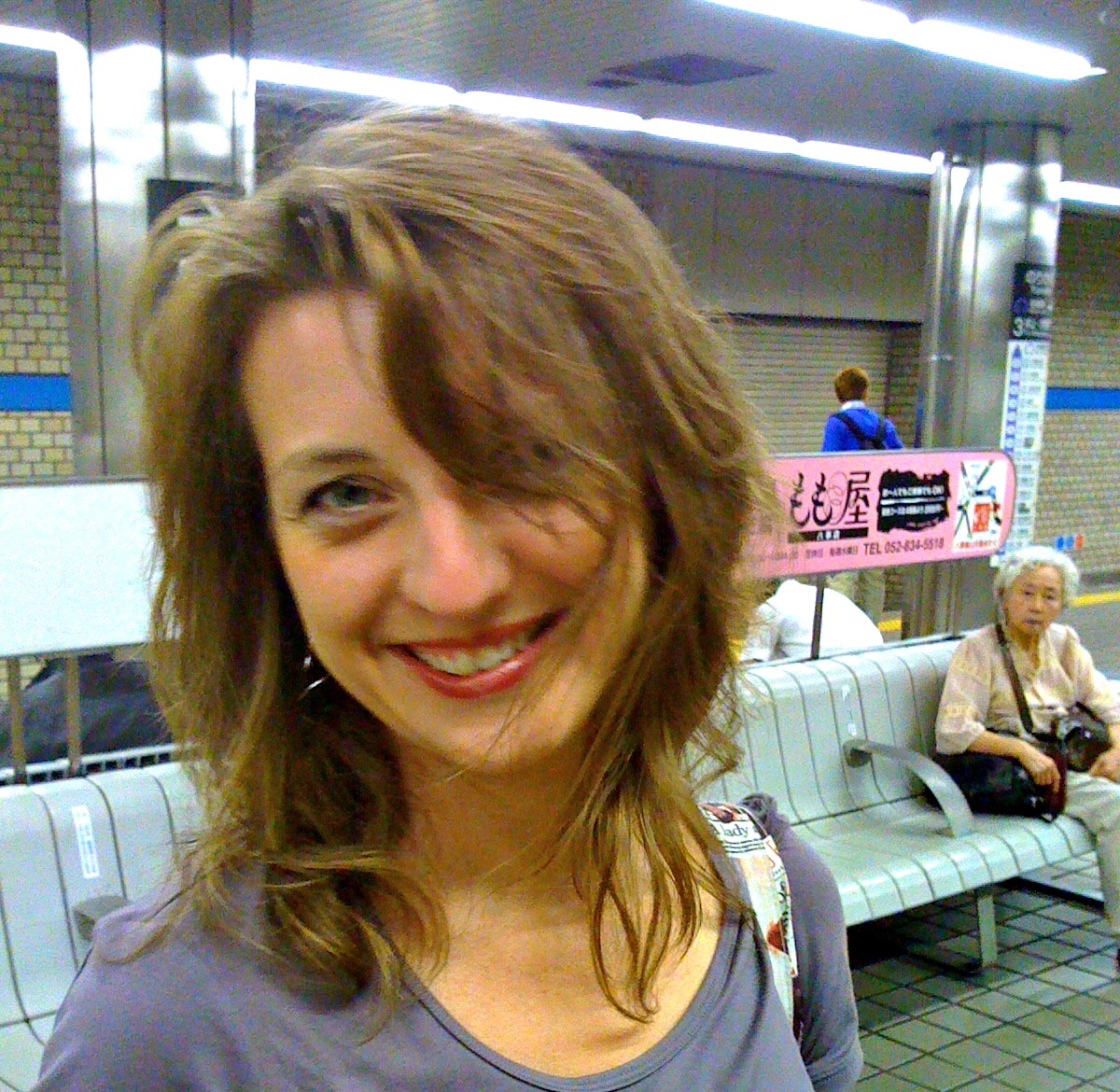
Images: Larissa Reinhart inside a subway station in Nagoya; her favorite tanuki (cute or creepy?); her book cover.

BOOK REVIEW: “The Englishman” by Helena Halme

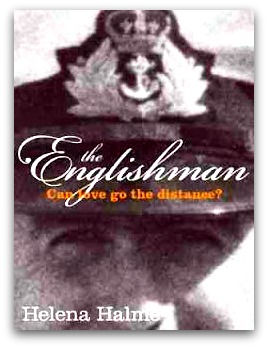
Today we are delighted to review Helena Halme’s book, The Englishman. Helena is a regular visitor to The Displaced Nation, where she has been featured both as a Random Nomad, and as Cleopatra For The Day. The Englishman is available from Amazon (UK and US) and for a limited time this week, is free to download as a Kindle ebook!

TITLE: The Englishman
AUTHOR: Helena Halme
AUTHOR’S CYBER COORDINATES:
Blog: Helena’s London Life
Twitter: @HelenaHalme
PUBLICATION DATE: August 2012
FORMAT: Ebook (Kindle)
GENRE: Fiction
SOURCE: Review copy from author

Author Bio:

Helena Halme grew up in Finland and Sweden, and left Finland for good when she married her English husband. She now lives in London. The Englishman is her first book.

Summary:

At the age of twenty, Kaisa has her life mapped out. After university in Helsinki, she’s going to marry her well-to-do fiancé, Matti, and live happily ever after. But in October 1980, she’s invited to a British Embassy cocktail party, and meets a dashing Naval officer. In the chilly Esplanade Park the Englishman and Kaisa share passionate, secret kisses and promise to meet up again. But they live thousands of miles apart – and Kaisa is engaged to be married.

At the height of the Cold War the Englishman chases Russian submarines whilst Kaisa’s stuck in a country friendly with the Soviet Union. Will their love go the distance?

(Source: Amazon.com book description)

Review:

The Englishman is semi-autobiographical, based on the author’s blog posts on How I came to be in England, which, after an enthusiastic response from readers, she was inspired to turn into a fully fledged novel.

It is a love story: the account of the long-distance romance between English Naval officer Peter and Finnish student Kaisa, as this star-crossed couple discovers that Shakespeare’s words are still true, even in the 1980s, and the course of true love never runs smooth. Together, they contend with a broken engagement, long separations, the Falklands War, inevitable cultural differences, and the small matter of a member of the British armed forces wanting to marry a citizen of a country bordering the Soviet Union.

No matter where you are from, or even if you and your partner are from the same cultural background – if you’ve ever been in a long-distance relationship, The Englishman will strike a chord. Loving from afar in the early 1980s was a different matter than it is now: no Skype, no Facebook, no texting, but instead the sweet agony of waiting for letters in the mail and for the landline telephone to ring. Kaisa and her Englishman remind us of the forgotten pleasures of delayed, rather than immediate, gratification.

TDN verdict:

Especially recommended for romantics who grew up listening to Chrissie Hynde and wearing leg warmers the first time they were in fashion.

“The Englishman” can be purchased from Amazon.co.uk and Amazon.com, and from October 8 – 12 is available to download free of charge.

STAY TUNED for tomorrow’s ghosty posty, a spooky Displaced Q from Tony James Slater!

Image: Book cover — “The Englishman”

If you enjoyed this post, we invite you to register for The Displaced Dispatch, a round up of weekly posts from The Displaced Nation, with seasonal recipes, book giveaways and other extras. Register for The Displaced Dispatch by clicking here!

Related posts: