The Displaced Nation

A home for international creatives

I’ll (not) be home for Christmas: A holiday travel yarn

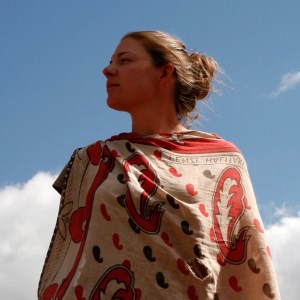
Today we welcome Kat Selvocki to The Displaced Nation as a guest blogger. A retired roller derby skater and yogini who has lived in New York City for the past six years, Selvocki is en route to Sydney, Australia, to start a new chapter in her life as a yoga teacher. In this travel yarn, she contemplates being in Europe for the holidays, without any family.

When I left Brooklyn on September 27, I had every intention of arriving in Australia by December 23. That way, even though I was away from my parents and brother for the first time ever on Christmas, I would at least be able to spend the holiday with my cousins on the other side of the globe.

One of the first rules of travel is that things never go exactly as planned. It’s no surprise, then, that I’ve been in Europe for two months with no sign of purchasing a plane ticket to Australia.

By the time I finished the first leg of my travels — two weeks in Iceland volunteering on farms — I had a feeling I’d be in Europe longer than initially expected. My one hesitation was that, after spending thirty some years celebrating Christmas with my family, the idea of spending it alone scared the hell out of me.

I spent a solo New Year’s Eve in my Queens apartment in 2007; I’d decided I didn’t feel like venturing out and about into the craziness of New York that night. Though I don’t especially enjoy that particular holiday, there was something upsetting about wishing myself a happy new year. I didn’t want to repeat that mistake.

Central Europe works its charm

I arrived in Prague the day before Thanksgiving and was greeted by friends who immediately invited me to spend Christmas with them in Austria.

Prague is one of my favorite cities in the world, and the holiday season is one of the best times to be there, its Christkindlmarkts being among the best in Europe. Mugs of glühwein (mulled wine), tubes of bread coated with cinnamon, palačinky (Czech crêpes) dripping with lemon and sugar, the glimmer of fairy lights, handicrafts for sale, Christmas trees, live concerts — what’s not to like?

Though I didn’t have the space in my bags this time around to purchase any gifts at the markets, I was happy to return for some of my favorite Czech treats. As I perused the stands one chilly Saturday, I happily munched on lázeňské oplatky, large round spa wafers served with chocolate filling sandwiched in between.

The flavor brought back memories of Christmas Eve dinners of my youth, spent with my paternal grandparents. Though my grandmother and grandfather were both born in the United States, they continued some traditions passed down from their Polish parents. On December 24, my grandmother would serve a meatless meal at their house: fish that my grandfather had caught that fall, homemade pierogi (the Polish equivalent of ravioli, stuffed with potato and cheese), and vegetables from their friend’s farm.

We began the meal with those wafers, breaking pieces from each other’s opłatek as a symbol of forgiveness and the spirit of Christmas, as well as a reminder of the importance of family.

The ghost of holidays past

Prague was also where I spent my first Thanksgiving away from home, in 2002. I was on a study abroad program with American University, and all of us had gathered to celebrate at one of our favorite pubs, where our program director had reserved several long tables for us, piled with food — mostly Czech versions of traditional Thanksgiving dishes like stuffing, mashed potatoes, and green bean casserole. The American ideas were there, but the execution and seasonings were distinctly Czech.

(At least this was an improvement over a Thanksgiving dinner that a friend of mine had during her Parisian semester abroad, where bowls of peanut butter were served alongside the turkey and roasted vegetables.)

At my table, my tall anarchist friend with a mohawk carved the turkey. After we’d feasted, several classmates took over the restaurant’s upright bass and piano as the rest of us cheered and clapped.

Most of us had met only three months earlier, but there was a tight bond between us that day.

I called home later in the evening. My cousin’s husband answered the phone, and at first he couldn’t believe it was me, all the way from Europe. He yelled to the rest of my family to get on the phone. Though I probably used up my phone card, it was worth it.

My mother came to visit me in Prague not long afterwards. She, too, couldn’t resist the siren song of all the beautiful handmade items at the holiday markets. She settled on a blown glass ornament covered with simple stars made out of straw. It still hangs on my parents’ tree today, an annual reminder of when she and I traveled together.

Holidays are all about the 3 Fs: Family, Friends & (especially!) Food

My family and I have always enjoyed the culinary traditions associated with each of the holidays, be it Thanksgiving, Christmas or Easter. While Christmas was always tops for me as a kid, over the years my allegiance has shifted, and I now look forward the most to sharing the Thanksgiving meal with my nearest and dearest. (This may have been triggered by extended Christmas vacations in college, which so often seemed to end in ridiculous battles with my parents.)

Last month, I was lucky enough to celebrate Thanksgiving twice — each time with a mix of American travelers/expats and international friends.

At the first of these dinners, which took place in Prague, my Belgian friend asked the Americans in the room about the significance of Thanksgiving. While I think he might have meant historically, I replied with the answer that is truest to me: Thanksgiving is about eating lots of food and spending time with people you love.

On that occasion, friends new and old shared their talents in the kitchen. One friend made a traditional Austrian stuffing, while another roasted three Cornish hens and taught us how to make mulled wine. We mashed potatoes together — both white spuds and sweet — and roasted a colorful array of vegetables. I offered my baking talents with a pear-plum pie, inspired by a drink I’d had the night before.

The small kitchen of our rented apartment quickly filled with the mingling scents of cinnamon and cloves, parsley and chives.

I couldn’t have asked for anything better.

The lingering fairy tale of New York

Some of my holiday nostalgia also relates to my recent past — to the six years I’ve just spent living and working as a volunteer manager in New York City. There may be no place more magical than Central Europe, but there’s also something I’ll always miss about being in Manhattan during the holidays.

During each of the six years that I lived in New York, I would have periods of doubt over whether I wanted to stay. But then December would come along and I’d fall in love with the city all over again.

Some of my fondest memories are of walking around late at night gazing at the major Christmas displays in the shop windows. I preferred viewing the windows at that time, with fewer tourists around and the street lamps casting an atmospheric glow.

My favorites were always Bergdorf Goodman’s windows; I could stand and stare at those for hours and never quite take in all of the perfectly arranged details.

And, while my friends are currently lamenting the unseasonably warm weather in New York, I’m cherishing the memories of December nights when I would get off the subway in Brooklyn or Queens and walk home through a fresh layer of snow, surrounded by silent streets.

Volunteerism, burning bright

Still, the náměstís of Prague and plätze of Graz have proved to be a pretty good distraction, as has the volunteer work that I did in Iceland, when I first arrived in Europe.

After visiting Iceland in November of last year, I wanted to go back again and, after a bit of research, learned that there were a few Icelandic farms looking for volunteer labor.

Assisting with the end-of-season harvest — a time of year when farms need all the hands they can get: it seemed like the perfect way to experience one of the most beautiful countries I’ve ever seen, along with learning new skills.

At the organic farm I went to near Egilsstaðir in northeastern Iceland, called Vallanes, there were 11 of us volunteering (4 Americans, 3 Germans, 1 Italian, 1 Tasmanian, 1 Singaporean, and 1 Belgian), plus two paid workers (1 German and 1 Icelander, in case you’re curious).

The friendships we all formed in the turnip fields and the kitchen were an unexpected bonus.

Though it was sad to leave when the season ended, the spirit of Vallanes remains with me as I contemplate the next chapter of my life, the adventure of setting up as a yoga instructor in Sydney.

The saying that your friends are the family you choose becomes more true for me every year. This year, the holidays might not be the same as they were when I was young, and while I miss my family and it’s hard to be away, I’m enjoying the opportunity to soak up — and create — new traditions of my own while sharing the ones with which I was raised. Traveling alone has opened my heart to a variety of new people and experiences.

All of it feels right somehow, at this current crossroads — which led me to leave the familiarity of my old job, New York, and the United States to pursue a new career halfway around the world.

This New Year’s Eve will see me in Vienna. I will not be alone but with a mix of expats and native Austrians, drinking red wine and watching fireworks — concluding a year of transitions and ringing in what I hope will be an exciting new life overseas in 2012.

NOTE: You can read more about Kat Selvocki’s travel adventures on her blog, Pierced Hearts and True Love, and sample some of her gluten-free baking recipes at Kat of All Trades. You can also hire her to give you personalized yoga lessons over Skype; details on KatSelvocki.com

STAY TUNED for Monday’s post, a list of 2011 books for, by, and about expats.

If you enjoyed this post, we invite you to subscribe to The Displaced Dispatch, a weekly round up of posts from The Displaced Nation, with seasonal recipes and occasional book giveaways. Sign up for The Displaced Dispatch by clicking here!

Related posts:

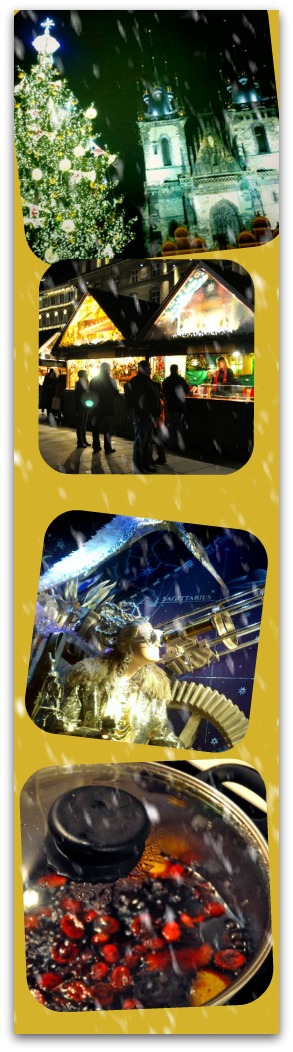
Images (top to bottom): Staromestske namesti (Old Town Square in Prague) decked out for the holidays; waffle stall at the Christkindlmarkt in Graz; Bergdorf Goodman’s window, 2010; mulled wine in preparation for an Austrian Thanksgiving dinner. All photos by the multi-talented (yes, she does photography, too!) Kat Selvocki.

RANDOM NOMAD: Turner Jansen, American Canine in Holland

Date & place of birth: November 2004, probably West Virginia*
Countries, states, cities lived in: West Virginia (Berkeley): 2004-05; Maryland (Knoxville): 2005-08; The Netherlands (Utrecht): 2008-11; (Amersfoort): 2011 – present.
Canine parentage: Boxer, Chinese Shar-Pei, Great Pyrenees, Retriever, Italian Spinone, English Springer Spaniel…any other guesses?!
Human parentage: Tiffany & Bram Jansen
Cyberspace coordinates: Clogs and Tulips | An American in Holland and @clogsandtulips (mother’s blog** and Twitter handle) ; @turnerinNL (my Twitter handle)
*I was dumped at a shelter when I was only a baby.
**She even has a post about me: “Expat’s Best Friend”

Tell us, how did you get the name Turner?
My brother and I were dropped off at the shelter in West Virginia together, and our two-legged caretakers named us Turner and Hooch after the Tom Hanks movie by the same name (for those who don’t know it, it’s a comedy!). Hooch was adopted before I was, so my mother, Tiffany, never got to meet him. She thought about changing my name, but in the end she decided that Turner was a unique name for a dog — and that it fit me somehow. /(^.^)\

What made you leave your homeland in the first place?
My dad is from the Netherlands, so after my parents got married, Mommy and I moved to be with him.

Describe for us the moment when you felt most displaced — when you asked yourself the question: what’s a nice dog like me doing in a place like this?
The first time I walked around the city of Utrecht. I came from the countryside in the US, and wasn’t used to all the people and cars. And there are so many bicycles here — bikes are scary!

Describe for us the moment when you felt least displaced — when you felt more at home in an adopted homeland than you had in the land of your birth.
We recently moved from an apartment in busy Utrecht to a house in quiet Amersfoort — with a backyard! Our house is a nice size — not too big, not too small. I love when we have friends or family over to visit, and I can show them my backyard and all my toys. Amersfoort is all the things I loved about living in Maryland plus all the things I loved about living in Utrecht.

You may bring one curiosity you’ve collected from each of your adopted countries into the Displaced Nation. What’s in your suitcase?
I have a squeaky toy that looks like the Dutch birthday cake tompouce that I love to play with. I would also bring my doggie musical chairs trophies from the US. They don’t have games like that for dogs here and I am very proud of the fact that I have so many of them!

The Displaced Nation will fix you a welcome meal. What would you like us to serve you?
I LOVE bread (croissants, krentenbollen, bagels, whole wheat bread) and French and Dutch cheeses. Here in the Netherlands, dishes where you boil and mash together vegetables with potatoes are very popular and I love them! The only one I can’t have is zuurkool stamppot (sauerkraut-and-potato mash with bacon) because sauerkraut makes dogs very very sick (my parents and I found that out the hard way!).

Have you learned any commands in other languages since going abroad, and if so can you give us an example?
Daddy talks to me in Dutch only if I’m being bad, so I don’t really care for the language. I have learned how to “shake” on both the English and Dutch commands of “paw” and “poot.” But for some reason, I only sit when given the command in English, even though the Dutch zit sounds almost the same. Mommy says I have a disease called Selective Hearing.

Have you made any new friends with canines or other creatures in your adopted land?
I don’t really play much with other dogs. I prefer being with humans and cats. I have seen my first hedgehogs since coming here and I love them! I just wish they weren’t so afraid of me. They always curl up so I can’t talk to them.

I see you’re already kitted out for the holidays. Where will you be celebrating?
I’m getting a (human) little sister in December, so we’re staying at home in the Netherlands.

That’s very exciting! I presume you’re looking forward to spending the holidays in your new home?
I love when friends and family come to visit, and I love getting presents and treats. We just now celebrated Sinterklaas, and I feasted on those special little ginger/spice cookies called pepernoten. My Dutch grandparents always get me my own bag! I also like seeing my Christmas stocking hung up next to Mommy’s and Daddy’s and listening to Christmas carols once Sinterklaas is over. And on Christmas morning, Mommy always makes waffles and even gives me a small waffle or two of my own mixed with milk and syrup! <:@)

Readers — yay or nay for letting Turner into The Displaced Nation? Tell us your reasons. (Note: It’s fine to vote “nay” as long as you couch your reasoning in terms we all — including Turner and his parents — find amusing.)

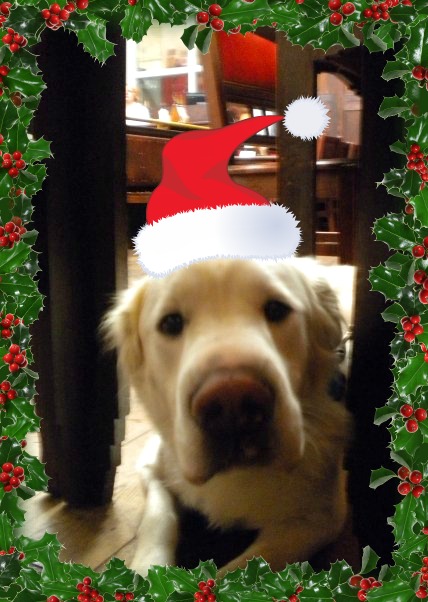
img: Turner Jansen under the table at Café Olivier Utrecht — taken in September 2009 but jazzed up for this post. (Turner’s comment: “Not sure I like this hat. Woof!”)

STAY TUNED for tomorrow’s installment from our displaced fictional heroine, Libby, who is still recovering from the shock of her mother-in-law’s body piercing. (What, not keeping up with Libby? Read the first three episodes of her expat adventures.)

If you enjoyed this post, we invite you to register for The Displaced Dispatch, a round up of weekly posts from The Displaced Nation, with seasonal recipes, book giveaways and other extras. Register for The Displaced Dispatch by clicking here!

Related posts:

Same lyrics, different melodies: On not coping with an expat Christmas

“Drink now the strong beer,
Cut the white loaf here,
The while the meat is a-shredding;
For the rare mince-pie,
And the plums stand by,
To fill the paste that’s a kneading.”
“Ceremonies for Christmas,” by Robert Herrick

Despite at times being a rather ornery young man, I do enjoy Christmas. However, when I really stop and I’m honest with myself I don’t particularly enjoy Christmas in my new “home”.

Minor differences, those little differences that makes being a relatively new expat interesting, irritate the life out of me at Christmas. For a few weeks I turn into one of those skin-peeled British expats living on the Costa del Sol. You know the sort, Richard Littlejohn readers who won’t eat any of that “foreign” muck and find themselves in a constant state of exasperation when the waiters fail to understand their English. Come Yuletide, I transmogrify into them, into something I hate. No longer do I find myself charmed by the local traditions, because they are not my traditions and at Christmas that is precisely what I seem to be desperately grasping for.

To damnation with this “home is where you make it” tosh. Come Christmas there is a specific time and place I find myself in. It turns out that this season brings out the inner conservative in me. Yes, there is still an abundance of tinsel and Christmas trees everywhere, but somehow it all feels slightly off. The problem is that my notion of Christmas is a peculiarly English one.

I try listening to Christmas carols but they often end up striking a discordant note to me. I try singing along to them, but I get lost in the music — by which I don’t mean I get so moved I have a transformative experience, I mean I get tripped up by an unexpected rhythm or tune. The American version of Away in a Manager differs significantly from the British counterpart — same lyrics, different melodies. It is all too culturally discombobulating (that would be a good name for a blog).

On television I watch the old Rankin/Bass TV special, Rudolph the Red-Nosed Reindeer, but why? I think I’m hoping that my mind will be tricked into falling for the illusion of nostalgia, the warm memories of a childhood I didn’t have. So each year I force myself to watch that show, hoping I’ll like it. As it happens, I just find myself irritated by Hermey the elf and his dentistry obsession. By the time the King Moonracer, a cross-eyed lion with wings, is introduced into the narrative I decide that Nancy Reagan was right and everyone should “just say no” to drugs (something Rankin and Bass appeared to have found difficult) and turn off the TV.

I try to make the best of a bad thing. I try to educate the natives. I roll down the windows of my car and drive around town with Slade‘s Merry Xmas Everybody convinced that once they hear it they will inately know of its festive superiority over their own efforts. I correct small children when they call Father Christmas, Santa Claus. And like a right old Fanny Cradock (imagine if Julia Child were British — and looked liked Baby Jane), I make mincemeat and force everyone I know to eat mince pies against their own will. Of course, buying mincemeat is a near impossibility here. Even buying all the necessary ingredients is a problem though it can be amusing trying to find them all. I’d advise you to find the most gormless person working at your local supermarket and ask them if they stock suet.

Once I have all my ingredients, I go about making my mincemeat and the heady rich smells of spices and fruit take over the house and at that moment, though it is usually a week before Christmas itself I feel the most Christmassy that I will for the whole season. The next night I make mince pies with the mincemeat along with mulled wine and I have friends over. I put on Carols from King’s and make everyone else put on a ridiculous fake English accent. It’s not quite home, but it’s the best that I can do.

For those at all interested in making mince pies, recipe follows:

—————————————————————————————–

MINCE PIE RECIPE

Mincemeat Mix Recipe:
I coarsely chop (though that’s optional) 12oz raisins, 8oz golden raisins and 4oz cranberries (feel free to mix and match the amounts to suit your own taste)
Place all that into a bowl and add a handful (I”m not a great one for measurements) of slivered almonds.
I grate the rind of 2 lemons and 2 oranges into the bowl and then add their juice to the mix.
Add 1/2 tsp of grated nutmeg
Add 1/2 tsp of ground cinnamon
Add 2 tsp of ground all spice
I peel an apple and grate it into the mix
Add 8oz of soft brown sugar
Add 2oz (or about half a stick) of unsalted butter. This is in place of suet, so if you can get hold of some then feel free to use that rather than butter.
Mix it all together.
Put it in the oven, covered at 200F for three hours.
After three hours take it out of the oven. Stir the contents and add to it six table spoons of brandy.
Put in the fridge for at least 12 hours to allow the flavours to meld together.

With the pastry, it’s just a basic short crust. I use a flour to butter ratio of 2:1 and add a pinch of salt. I also add grated orange rind and then bind with water.

The rest you can probably work out. Roll out your pastry, cut into circles large enough for your muffin baking tray. Place into baking tray and put a tablespoon of mincemeat. Cover with a smaller pastry circle as a lid for the pie. Bake until before you can smell burning. Sprinkle with icing sugar.

Best served warm with a glass of mulled wine.

STAY TUNED for tomorrow’s post, our first canine random nomad!

If you enjoyed this post, we invite you to subscribe to The Displaced Dispatch, a weekly round up of posts from The Displaced Nation, plus some extras such as seasonal recipes and occasional book giveaways. Sign up for The Displaced Dispatch by clicking here!

Related post:

An interview with Robin Wiszowaty: Kenya Program Director for Free The Children

Last week I had the privilege of speaking with a young woman called Robin Wiszowaty. She isn’t a household name. You won’t find her in newspaper gossip columns, or on celebrity chat shows, or sashaying down the red carpet at the Oscars.

Yet I came away from our 45-minute conversation quite star-struck – not even my treasured chance meeting with Paul McCartney could compete – and more inspired than I can say.

A brief bio: From Suburbia to Savannah

Robin Wiszowaty was born in 1981 and grew up in Schaumburg, Illinois: a predominantly white, middle-class suburb outside Chicago. Although on paper Schaumburg appears an ideal place to spend childhood, with its summer block parties and strong sense of neighborliness, Robin says she never quite fit in.

“From an early age, I was unsatisfied with my ordinary life….I could never find my niche or any comfortable sense of self.” [My Maasai Life]

This feeling of discontent followed her through her teen years and into college at the University of Illinois where she studied speech communications. Only after a two-week trip to Israel in December 2001, to explore her Jewish heritage, did Robin begin to understand what she wanted from life.

“It [reminded] me how fiercely I longed to break out of this Western mindset and find something else.” [My Maasai Life]

While her concerned and long-suffering parents assumed the trip would rid her system of dissatisfaction and wanderlust, those two weeks in Israel were, in fact, only the beginning of a lifetime of traveling.

To the dismay of her parents a few months later, through a program run by the University of Minnesota, Robin was on her way to Kenya. After two months with a host family in Nairobi, where she learned basic Swahili and took classes on Kenyan culture, she went to live for a year in rural Nkoyet-naiborr, a Maasai community in the Great Rift Valley – a community and lifestyle as far removed from her Illinois home as anyone can imagine.

Nevertheless, Nkoyet-naiborr became her second home, in the truest sense. Here she forged deep, lasting friendships with her host family and members of the community, and was bestowed with a Maasai name: Naserian, meaning “peaceful person.” Mama, the mother in her host family, became her Kenyan mother, and Robin refers to the children of the family to as her brothers and sisters.

Today, nearly a decade after first arriving in Nairobi, Robin divides her time between Toronto and Kenya, working as Kenya Program Director with the charity Free The Children, implementing long-term development projects in partnership with local communities.

* * *

I spoke to Robin while she was in Canada, a few hours before she made the long trip back to Kenya. Her voice is soft, gentle, diffident, and not exactly what I’d expected; she’s had to overcome a lot of hurdles to be where she is today and, after reading her autobiography, I’m aware that I’m talking to one very determined person.

On Free The Children…

Kate Allison: Tell us a little more about what you do for Free The Children.
Robin Wiszowaty: As Kenya Program Director, I oversee the Alternative Income projects for Kenyan women. We teach the women leadership, financial literacy, how to access loans; and by being able to earn their own money, the women can invest that extra income in their families, their homes and, importantly, their children’s education. They work in groups — there are around 120 women’s groups now — and one example of how they earn income is doing quality beadwork. The bracelets and necklaces they make are sold at the Me to We store in Toronto, and also at the online store. My own Mama, by the way, is one of the beaders — she’s a fantastic beader.

Craig and Marc Kielburger, the founders of Free The Children and Me to We, have more to say about Robin’s role:

We’ve seen her sitting in hushed, intimate conversation with village elders, whose trust she earned through empathy and understanding. We’ve seen her astonish visiting students and volunteers with stories of her adventures. And we’ve seen her embraced by the teary-eyed mamas who are eternally grateful for her hard work in her role as Free The Children’s Kenya Program Director.

On writing…

Eighteen months ago, Robin’s autobiography “My Maasai Life” was published by Me to We Books — publishing division of Me to We, the for-profit social enterprise that supports Free The Children — and having read the book, I wanted to know more about it.

KA: Your book, “My Maasai Life”, tells the story of your transition from the American suburbs to life in a Kenyan village. What made you decide to write it?
RW: Lots of people have said to me that I should write a book about my experiences, but it was at the prompting of Craig Kielburger that I eventually wrote it. Craig was looking for books with a social message to be published by Me To We. “My Maasai Life” was the result, and was actually one of the first books in the Me to We publishing stable.

KA: What audience did you have in mind for the book when you wrote it?
RW: I originally intended it for high-school-aged girls who wanted to see the world — and also for their mothers, to help them understand this.

KA: Yes…in your book, you say your relationship with your own mother was somewhat rocky when you were that age.
RW: It was. But I look at myself now, and I think I’ve become the kind of person my parents always wanted me to be – albeit on my own terms.

(In fact, Robin’s parents long ago accepted, and proudly support, their daughter’s unconventional life choices.)

KA: What other kinds of readers have been attracted to the book?
RW: Young adults, in their 20s and 30s, who want to find a deeper meaning from life than they find in the corporate world where they are at present. And teachers; they read my book in World Issues classes, and discuss it with their students.

KA: Have you written any other books, or are you intending to do so?
RW: “My Maasai Life” has been adapted into a children’s book, subtitled “A Child’s Adventure in Africa”, and I’m currently working on another book, which I hope to have published in another couple of years or so. I’m about halfway through writing it — I don’t know what it will be called, and it doesn’t have a working title — and although it’s also about Kenya, this book is from the perspective of the women there, focusing on the universal concepts of motherhood and womanhood.

On fitting in…

KA: Can you think of a particular occasion in Kenya when you wondered, “What’s a nice girl like me doing in a place like this?”
RW: [laughs] I can tell you exactly when that was. It was on my first night in Nkoyet-naiborr, when I was sleeping in the bed I shared with my sister, Faith, and I heard a wild animal howling outside…

“Faith! ” I whispered.
“Naserian . . . ?”
“What is that sound?”
Faith rolled over, annoyed at being woken. “Hyenas.”
Hyenas? Now sleep was even more impossible. I tried to block out those echoing wails, but my mind flooded with questions. Was I doing the right thing? Was I just substituting one set of frustrations for another? Had I made a terrible mistake?

KA: And what about the other way round — can you think of a moment when you felt more at home in Africa than in the United States?
RW: Oh yes…I’m “taken” by Kenya. There, I feel comfortable within my own soul, that I’m in the right spot. You could say that it’s a calling. The time I feel it most is when I’m sitting with the women, making tea over the fire, just talking…there’s so much soul, such a feeling of family and community.

When I first went to Kenya, I felt at home on the first occasion my Mama let me fetch the water on my own. It felt good to be a provider for the family who were hosting me.

Fetching the water is much easier said than done:

Transporting water, I saw from the women, is an art unto itself. The mitungi must be carefully balanced on two rocks beneath the spout and then held in place while the trickling water slowly fills it all the way to the top. And with water always in scarce supply, we could never afford to waste or spill a drop. When the cylindrical twenty litre container was full, it weighed more than twenty kilos.

More recently, I can think of an occasion at the Kisaruni High School, which is Free The Children’s first all-girls secondary school, and has 41 students who board there. When it first opened last spring, these girls came to the school and we all had a big sleepover party. It was such a lot of fun, and for many of these girls it was the first time they’d slept on a mattress.

It’s the feeling of true community in Kenya that I love. It seems to me that when people come together for the benefit of others, that’s when you get the most profound sense of community.

KA: What about repatriation? Do you find it difficult to adjust between living in your two different worlds?
RW: The first transition from Kenya back to Chicago was most difficult. I felt like a lost 8-year-old, trying to get used to life in America again after a year away. I found it hard to wear shoes, having been barefoot for so long. And I was full of anger, of judgment for the way things were done — for example, at people who ran the water for so long, at the extravagant amounts of food.

Huge wasteful, overpriced family dinners. Thoughtless waste of water, flushing the toilet so many times every day.

But I don’t feel that way now. Then, I was going through that time of life when everyone tries to work out who they are and feels a certain amount of anger. Now I accept that it’s not about everyone having the same; it’s about everyone having enough.

Today, whichever direction I travel in, I always feel that I’m going home to family.

On our November theme of Global Philanthropy…

KA: Over the last month, we’ve discussed — fairly heatedly — the growing trend towards volun-tourism. As part of your work with Free The Children and Me to We, you lead groups of people on international volunteer experience each year. Can the people who go on these trips, who lack language and cultural training, really accomplish much in such a short time?
RW: Volun-tourism can play a great part when it’s done responsibly. Our youth volunteer trips last three weeks, while our family and corporate trips are shorter at ten days. We regularly have employees of large companies like KPMG and Virgin Atlantic on our corporate trips.

After some orientation, our volunteers hit the ground running — they help with building schools, with clean water projects, they go into the community’s homes to help, they learn Swahili. For many of them, it is literally a life-changing experience. It gives them a different perspective on life and on their careers. It’s very positive for both the volunteers and for the communities they are helping.

Volun-tourism skeptics should maybe note that Robin herself first came to Kenya with an attitude of “What can Kenya do for me?” rather than “What can I do for Kenya?”, as can be seen in this extract from her book, describing an incident during her initial two months in Nairobi:

One street man nearby…said in Swahili, “What are you doing in Kenya, if you can’t help us?”

Despite my halting comprehension of the language, I understood his question. What was I doing here? Was I here to help Kenyans? I couldn’t remember any sort of altruistic impulse as my reason for being me here. I only pictured myself three months earlier, curled up on my family room couch reading books on cultural sensitivity, or shopping in neighbourhood department stores for appropriate clothing, thinking this was a chance for me to enlarge my experience and pick up others’ points of view. I’d been driven simply by a desire to escape, not to improve the lives of these poor people.

KA: Which person or people, dead or alive, do you look up to most in your work?
RW:
I would have to say the other team members of Free The Children and Me to We, both in Kenya and Toronto. They all work for the children, not the paycheck. The world may never know their names, but they work so hard and achieve so much for others.

KA: Are there any inspirational stories of theirs you can share with us?
RW: Spencer West, a speaker on the Me to We team, was born with a genetic disease, and lost both his legs at the hips when he was a child. We met in Kenya when he was on an international volunteer trip, helping to build a school there.

Next June, he is going to “Redefine Possible” and climb Mount Kilimanjaro in his wheelchair, in order to raise $500,000 to bring clean water programming to 12,500 people in East Africa.

You can’t get any more inspirational than that.

KA: And lastly — it’s the holiday season. We’re inundated with requests for giving. In your opinion, what’s the best way to spend our dollars (or pounds, or euros, or yen, or whatever) to help those in other parts of the world who have so much less than we do?
RW:
Well — you could sponsor Spencer West on his climb and help those affected by the drought in East Africa, which is the worst in 60 years. Or you could buy your holiday gifts from the Me to We store, either in Toronto or online at www.metowe.com/shop.

Epilogue

The interview ends, and I thank Robin for giving her time, even when she has a hundred other things she could probably be doing, since in a few hours she will be flying back to her Kenyan home. I am awed by our conversation, by how much she has achieved in her short life — she is only 30 — and I feel humbled.

I tell her this. “People like you, who do so much with your lives, make me feel very small.”

There’s a slight pause at the end of the phone, then Robin says, “But… you’re a mother.”

I can’t count the number of times over the last fifteen years when, in answer to the question “What do you do?” I’ve said, “I’m just a stay-at-home mom.” Emphasis on the “just” — an apology for the mundanity of my existence. The counter-reaction, so often, is “But that’s a very important job!” in a slightly condescending tone that makes me feel, even more, that motherhood is merely a consolation prize for missing out on life’s other, more important achievements.

Robin’s tone holds none of this condescension. “You’re a mother,” she says, and it’s a statement of the obvious, that being a mother is an achievement in itself.

It occurs to me that her years with the mamas in Kenya have taught Robin the value of motherhood — a lesson that maybe passes by the young women growing up in our “developed” culture. It’s an irony, perhaps, that in our Western pursuit of progress and women’s rights, we have devalued the most important women’s right of all — that of pride in raising a strong next generation.

Robin, thank you. It was wonderful to talk to you. I hope we meet in person one day.

.

Quotations from “My Maasai Life: From Suburbia to Savannah.” Wiszowaty, Robin (2010-07-01), Perseus Books Group.

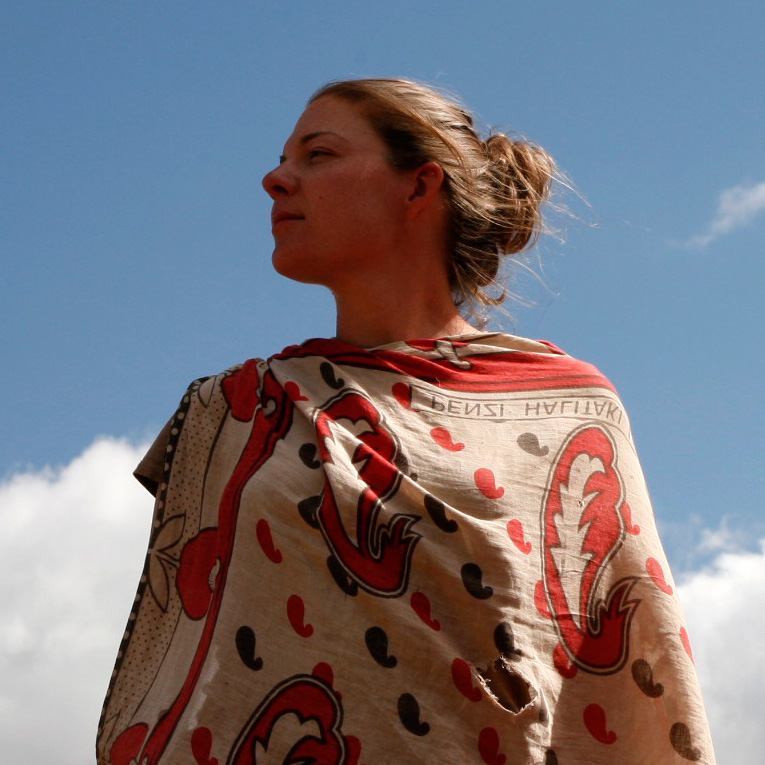
Img: Robin Wiszowaty — photo courtesy of www.metowe.com

Related posts:
RANDOM NOMAD: Aaron Ausland, NGO Research Director & Development Practitioner
RANDOM NOMAD: Adria Schmidt, Career Consultant at Violence Intervention Program & Former Peace Corps Volunteer

If you enjoyed this post, we invite you to subscribe for email delivery of The Displaced Dispatch, a round up of the week’s posts from The Displaced Nation. Sign up for The Displaced Dispatch by clicking here!
Welcome to December: No place like home for the holidays (depending on where you call ‘home’)

Every year around this time, I dust off a CD of Christmas songs and play it – pretty much non-stop – in the car. Yesterday, after hearing Mud’s “Lonely This Christmas” once too often, my teenaged son rolled his eyes and asked, “Why are such a lot of Christmas songs so depressing?”

It’s not something I’ve really thought about before, but he’s right. “Blue Christmas”,“All alone on Christmas”, “Last Christmas” – they all tell the same sad story of being forlorn and loveless while everyone else is whooping it up at parties and wearing plastic antlers around the office.

And although I’m not forlorn and loveless, I admit that these are not the songs an expat should be listening to when family and best friends are on the other side of the ocean. No wonder I’ve found Christmas less than inspiring for the last few years, if this has been my playlist of choice.

It’s a fact of expat life that you’re not always able to be with loved ones at the moments when you should be with them. but at least there are plenty of ways to stay in touch, with email, Facebook, Skype, and so on. So many options, in fact, that sending holiday cards in early December seems almost superfluous.

Nevertheless, many of you reading this today will be staying put in your adopted countries, wishing you could be with the folks for Christmas or Hanukkah.

I’ll Be Home For Christmas (if only in my dreams)

We are here to reassure you that spending time away from the relatives isn’t such a bad thing.

For one thing, it’s impossible to argue with relatives when they’re not there. Instead, you can fondly imagine the scene at home – chestnuts roasting, carol singers outside – and ignore the probability that what is actually occurring is a fight over the remote control, a mountain of dishes piling up in the sink, and Uncle Earnest asleep in the comfiest chair, his false teeth slowly obeying the force of gravity and sliding from his gaping mouth.

Keep that picture in mind next time you feel homesick this month.

Chestnuts Roasting On An Open Fire – or, Home Is Where The Hearth Is

But if you’re still feeling homesick, we at TDN are here to help.

Our December theme revolves around the winter holidays, plus a look back at the year that’s gone by. You can look forward to a recap of our favorite expat books of the year (plus some new ones), our favorite TDN moments, and, during the critical time at the end of the month, The Twelve Nomads of Christmas.

We hope that you enjoy this special month with us!

And now, if you will excuse me, I’m off to make a more cheerful Christmas mix tape.

.

STAY TUNED…for Monday’s interview with Free The Children’s Robin Wiszowaty


RANDOM NOMAD: Aaron Ausland, NGO Research Director & Development Practitioner

Born in: Eugene, Oregon (but raised in Plains, Montana, a town of 1,200)
Passport: USA*
Countries, states, cities lived in: Washington (Yakima, Tacoma, Spokane): 1989-95; Alaska (Anchorage): 1995-97; Bolivia (Bañado de la Cruz & Santa Cruz): 1997; 1998 – 2002; Washington (Seattle): 2002-03; Massachusetts (Cambridge): 2003-05; Guatemala (Guatemala City): 2004; California (Duarte): 2006-10; Colombia (Bogotá): 2010 – present.
Cyberspace coordinates: Staying for Tea | Good Principles and Practice of Community-based International Development (blog); @AaronAusland (Twitter handle); Aaron Ausland at Huffington Post (column)
*My passport is only three years old, but multiple entries to about 40 countries filled it right up and I’ve had to add more pages. By the end of this year, I will have slept somewhere other than home about 190 of the 365 nights.

What made you leave your homeland in the first place?
My late first wife and I wanted to make a difference in the world and were particularly passionate about issues of justice, peace, and poverty. After graduating from university, we decided that maybe the best place to match our greatest gifts with the world’s greatest needs was in the public policy arena. We thought it would be good to represent a view on behalf of the marginalized — those uninvited to the table where policy decisions are made that nevertheless affect their lives in profound ways. In particular, we were thinking of illiterate poor persons living in underdeveloped countries ruled by bad or incompetent leaders and subjected to all the crap that comes with weak institutions of governance.

But we realized it would be pretty lame to run off to graduate school straight out of undergrad and then find some job in a policy think tank or as a Congressional aide in the hopes of working our way up to having a place at the table with a mind to represent these unrepresented views when we really hadn’t a clue what they were.

So we made a three-year commitment with the Mennonite Central Committee to go live and serve in a Bolivian village with people who fit this description.

We were young, hopeful, idealistic, earnest, and naïve. I can say that I’m not so young anymore.

Is anyone else in your family a “displaced” person?
I have a brother who served in Iraq for a couple of years, but he now lives about a hundred meters from our dad’s house in Yakima, Washington. I’m really the only one in my family who has chosen a lifestyle for which the question “Where are you from?” generates a confusing jumble of explanation rather than a simple city-state combo. 

Unless you count my son, Thiago. He’s six and is definitely more “displaced” than me. He literally speaks of living in two different “worlds.” In one “world” he speaks Spanish, has a home and school in Colombia, where his sister was born, and has family in Bolivia (his mother is Bolivian). In the other world” — where he says he is really from — he speaks English and has friends in California and a large family on my side including a whole set from my late first wife. Yesterday he told his mother: “My brain is confused, I don’t know where I should live. All my friends are in California, but my cousins are in Bolivia, and I go to school in Colombia and have friends there, too.” Poor little nomad.

Describe the moment when you felt most displaced.
For me the question was “How the hell did a small town boy from Montana end up here?” Physically, at that moment, “here” was a stainless steel operating table in a dark and empty hospital room in Santa Cruz, Bolivia. But more profoundly, “here” was a situation so far from my expectations, I was literally struggling to connect the dots and figure out how I had gotten myself there. I was 25 years old. Somewhere in a ravine a hundred miles away lay the broken body of my wife. A few hours earlier, the public bus in which we were riding had missed a turn on the narrow, winding road that passes through the Andean foothills and tumbled 1,000 feet into the dark.

She and I had gone to Bolivia with a long-term vision of our lives together, and now I was here, in a foreign land, alone, the slate of the future wiped clean. It was so profoundly disorientating, I just kept coming back to the question: “How did I get here?” Maybe it was a way to push off the searing emotional pain that would come with facing into my new reality, but the question wouldn’t go away. What sequence of events and decisions led me here? Did I make a mistake?

I remembered scenes from my idyllic boyhood in small-town Montana when my whole world was contained in a 100- mile radius and a handful of friends and family members. How had the world gotten so big, so uncertain, so complicated? And what was I doing wandering around in it like a lost child? How had I gotten here?

Much later, I would decide that I hadn’t made any mistakes. My first wife and I had made decisions based on a set of values that we held in earnest and I continue to hold. The fact that those decisions led to tragedy does not diminish the certainty of those values — it just means that those who hold them are not exempt from catastrophic loss that come to all who live.

I know you were probably hoping for a funny anecdote about crazy food or wacky cultural misunderstanding, but this is my one true displacement story.

Describe the moment when you felt least displaced.
Nowadays, I feel a sort of indifference about the whole location thing, to be honest. Whether I’m living in Cambridge attending the Kennedy School of Government, or setting up a new home in Colombia, or sitting where I am at this moment at an outdoor bar in a hotel in Bamako, Mali, I feel neither particularly at home nor particularly displaced. Feeling at home has a lot less to do with place than it used to, and it’s often unpredictable. I can feel more at home in Albania when I have a good macchiato and an Internet connection to video Skype with my children than I might in a hotel in Atlanta after a missed flight, with a dead computer battery. I can feel more at home when I’m sharing a beer with a fellow expat I’ve just met in rural Cambodia than I might sharing a beer with an old friend I grew up with who never left Montana.

I’ve experienced profound moments in my adopted homelands — from becoming a widower, to getting married, to rejoicing at the birth of my daughter, to undergoing major medical treatment. In each of these, it was the people who surrounded me that made me feel at home, and the uniqueness of the event that made me feel displaced. The location or culture has ceased to hold much power over my perception of self at particular moments.

You may bring one curiosity you’ve collected from each of your adopted countries into the Displaced Nation. What’s in your suitcase?
I’ll bring my wife from Bolivia, my son from the USA, and my daughter from Colombia. They are certainly a curious bunch, but I can’t live without them.

You’re invited to prepare one meal based on your travels for other Displaced Nation members. What’s on the menu?
Well, the cuisines of places like India, Thailand, Ethiopia, and Mexico are always worth sharing. The rich complexities that have come from centuries of experimentation with combinations of local flavors as well as some exotic additions from old trade routes are heritage gifts to the world. But, I’m sure someone will bring a few dishes from these parts into the Displaced Nation, so maybe I’ll bring some less likely ones such as the rich Malian sauce made in part from the boiled fruit of the baobab tree; the surprisingly filling chicken hearts strung on a kabob, flavored with soy sauce and charcoal smoke, sold on the streets of Bolivia; or maybe a lesser known dish from Mexico — the corn smut omelet made with cuitlacoche, a purplish fungus that grows on corn; or maybe I’ll just bring the beer…

You may add one word or expression from the countries you’ve lived in to The Displaced Nation argot. What will you loan us?
I think I’ll pass on this one. Pole sana (so sorry!) as we say in Swahili. Actually, maybe that’s a good one. Pole (pronounced POH-lay) doesn’t have an exact English equivalent — it’s used to say you empathize and understand someone’s problems, without the connotation of inferiority that “I pity you” might have.

This month we are looking into “philanthropic displacement” — when people travel or become expats on behalf of helping others less fortunate than themselves. Do you have a role model you look up to when engaged in this kind of travel — whose words of advice you cherish?
I’ve never really had a specific role model for philanthropic displacement. That said, I’ve always been impressed with people who make long-term commitments to live among the people they wish to serve and voluntarily forego access to comforts and safety they might otherwise enjoy.

There are some famous examples like Mother Theresa, but the ones that have had the biggest personal impact on me are unknowns — volunteers and professionals I’ve met and worked with along the way. Such people taught me how to live with a kitchen stocked with just 12 items — that’s counting the spices. They taught me how to bring my water up from the river in the morning and hang it in a tree from a bucket painted black so that the sun would heat the water throughout the day, in preparation for a warm evening bucket shower. I learned how to capture rain water, how to build dry latrines, how to trust local medicinal practices, how to enjoy silence, how to walk the equivalent of a marathon a day to visit local families, how to sit and unhurriedly share tea over conversations that circle around rather than cut to the chase, how to embrace simplicity as a virtue… I also forgot how to complain and remembered to be grateful in the midst of scarcity.

Most of my role models didn’t do anything spectacular — they didn’t invent microfinance or the treadle pump, they didn’t negotiate peace accords or write a best seller. But the way they displaced themselves so thoroughly, the way they embraced their local communities with such authenticity — this had a big impact on how the communities valued their presence and their contribution, and on me.

Voluntourism is said to be the fastest growing segment of the travel industry (itself one of the world’s fastest growing industries). Do you think this kind of travel can help the uninitiated understand the problems our planet is facing?
No, not really. It’s not that I think voluntourism is unequivocally a bad thing, but I just don’t think you can expect people to gain a very accurate understanding of complex problems under such circumstances. In fact, I think it’s more likely to leave them with a distorted understanding. There is a saying I picked up somewhere that goes something like this:

Travel to a new place for three weeks and you can write a book, travel for three months and you can write an article, travel for three years and you’ll likely have nothing to say.

There’s just something about a short and intense exposure that seems to set very strong ideas into the minds of those who’ve experienced it. But their ideas are biased by the specificity, narrowness, and brevity of that experience.

For example, someone who has had a high-impact experience volunteering in an orphanage for a week may feel they know more about the issue than people who haven’t had that experience. In fact, they may actually know less due to the biases they have picked up. It’s like believing you know something about the average person in a country from a single observation.

Sometimes, people know just enough to be dangerous; they mistake their shallow knowledge for an actual understanding of some enormously complex problem, and they act on it in ways that are ultimately irresponsible.

The truth is, the problems facing our planet are complex and we should all be grateful for the specialists who have dedicated their lives to understanding and addressing them. Doing something serious about addressing these problems will require professionals, not hobbyists; lifers, not tourists.

Again, it’s not necessarily a bad thing to pass through as a tourist, but with regards to your question here, we need to guard against self-deception. I’ve taken a few tours of a number of hydro-electric projects across the Western USA. I think they are really interesting. But, I know better than to believe I know the first thing about harnessing the power of water to generate electricity while balancing the ecological, economic, legal, social and political interests of farmers, consumers, industry, and the environment.

Likewise, you can’t take a two-day tour of an urban slum in Kenya and think you understand poverty, urban migration, economic development, or whatever other angle one might give such a tour.

For a broader scope of my thoughts on voluntourism, I encourage you to see my blog posts:

Readers — yay or nay for letting Aaron Ausland into The Displaced Nation? Tell us your reasons. (Note: It’s fine to vote “nay” as long as you couch your reasoning in terms we all — including Aaron — find amusing.)

img: Aaron Ausland in Mexico City (he’s the suit!). While on a lunch break from her work conducting a month-long operations audit of an NGO office, Aaron happened upon a lucha libre wrestling match putting on an outdoor show, and decided it would be amusing to pose with the star luchadore.

STAY TUNED for tomorrow’s installment from our displaced fictional heroine, Libby, when we get to find out whether she’s recovered from eating her mother-in-law’s undercooked Thanksgiving turkey. (Not keeping up with Libby? Read the first three episodes of her expat adventures.)

If you enjoyed this post, we invite you to register for The Displaced Dispatch, a round up of weekly posts from The Displaced Nation, with seasonal recipes, book giveaways and other extras. Register for The Displaced Dispatch by clicking here!
Related posts:

Dear Mary-Sue: Holiday travel plans & profound epiphanies

Mary-Sue Wallace, The Displaced Nation’s agony aunt is back. Her thoughtful advice eases and soothes any cross-cultural quandary or travel-related confusion you may have. Submit your questions and comments here, or else by emailing her at thedisplacednation@gmail.com.

Dear Mary-Sue,

Would love some great travel tips for this holiday season. 

Anon, Vermont.

Dear Anon,

I love this time of year. Admittedly for a traveler it can be a very expensive and chaotic time so I try and strike a balance between travel and being at home. The Wallace household, like many families across the fine, fertile land, has its own holiday traditions that we like to observe at this time. For me, it’s about spending some time with little John, the intelligent one of my two grandkids, he comes over to stay  the weekend before Christmas. We make sure to make chex mix and drink hot mulled cider. We head on over to St Michael’s where we go to the annual Handel’s Messiah sing-in. My soprano leaves a little to be desired, but it’s always great fun nonetheless. John will then help me decorate the Christmas tree and then we’ll go and see all the wonderful lights that my neighbors who haven’t foreclosed have covered their houses in.

On Christmas Eve it’s time for John to go back to his parents, that’s when me and hubby Jake things up and it becomes all about just the two of us. We pack all of our warmest, snuggliest clothing and get on a plane to Reykjavik. Once there we also stay at  our favorite hotel near the Hallgrimskirkja. Once we’ve slept off our jet lag and had a lovely cup of hot chocolate, we then give it large until New Year’s Eve. There’s one club, in particular, we hang out in called the Birch Tree. Now hubby Jake likes his trance to be fairly chilled, but I’m more about old skool Acid trance. When Gunnar is DJing at the Birch Tree he always manages to give a set that balances hubby Jake’s tastes with mine. We then might hit the sauna and do some shots of Brennivin with this South African couple we always meet up with at Christmas, because that’s what the season is about for ol’ Mary-Sue – celebrating your own traditions.

Mary-Sue

——————————————————————————————————————

Dear Mary-Sue,

Earlier this month, as I was trekking through the Kilimanjaro National Park, which is in Tanzania, with these local guys who I knew, I was struck by — and the readership of my blog The Wistful Traveler all agreed — a beautifully profound thought.  It was about how fortunate I was to be there at that moment, to be alive in the now. I blogged about it, you should check it out on my blog. There’s some pretty amazing pictures there too. Now my question to you Mary-Sue is this, do you have any profound thoughts like I do?

The Wistful Traveler, Everywhere and nowhere.

Only when drinking Brennivin.

——————————————————————————————————————

Dear Mary-Sue,

Thank you so much for responding to my question in last month’s “Ask Mary-Sue.” I was so pleased to be featured that I’m sending an early Christmas present of chocolate-covered macadamia nuts for you. Anyhoo, I was wondering if you might want to reconsider your response that you can’t meet up for coffee. I’ve tried calling your office, but they keep saying that you’re out. Such a shame as I really would love to pick your brains over coffee – not literally, ha, ha, ha. That would just be disturbing. You’re my inspiration.

Susie-May, Arizona

Dear Susie May,

Thanks for the present. My unpaid intern tells me that they were delicious. Unfortunately, my calendar is really full at the moment.

Mary-Sue

p.s. You really should stop calling my office.

——————————————————————————————————————

Anyhoo, that’s all from me readers. I’m so keen to hear about your cultural issues and all your juicy problems. Do drop me a line with any problems you have, or if you want to share your fave meatloaf recipe with me (yum! yum!). As they say in Italy, “ciao!”

Mary-Sue is a retired travel agent who lives in Tulsa with her husband Jake. She has taken a credited course in therapy from Tulsa Community College and is the best-selling author of Traveling Made Easy, Low-Fat Chicken Soup for the Traveler’s Soul, The Art of War: The Authorized Biography of Samantha Brown, and William Shatner’s TekWar: An Unofficial Guide. If you have any questions that you would like Mary-Sue to answer, you can contact her at thedisplacednation@gmail.com, or by adding to the comments below.

STAY TUNED for Wednesday’s post — another Random Nomad in our global philanthropy series.

If you enjoyed this post, we invite you to subscribe to The Displaced Dispatch, a weekly round up of posts from The Displaced Nation, plus some extras such as seasonal recipes and occasional book giveaways. Sign up for The Displaced Dispatch by clicking here!

Related posts:

My grandfather tried saving the world long before it became trendy — with mixed results

Our Third Culture Kid columnist, Charlotte Day, upon reading this month’s posts about those who displace themselves on behalf of those less fortunate, felt moved to contact her grandfather in Sydney, Australia, for a chat about his own experiences with international aid work, which began in the 1950s.

These days, it is a rare teenager who has not shown some evidence of civic engagement by a certain age: spending their summers beneath foreign suns in search of that fabled sensation, that fulfillment born of “helping others.”

Of course, no altruistic act is truly pure, but I would argue that it is better than nothing.

Nothing, however, is the word that best qualifies my own civic engagement. I have reached the age of 17 tacitly scorning the moral and spiritual quests of British gap-year students, as well as American Ivy-League hopefuls, from my comfortable desk chair.

I read Dostoevsky’s portraits of tormented youths, striving in vain and misguidedly to effect a change in society…and decide that changing the world is futile.

Yet a chastening thought sometimes breaks through this complacency: there are many who do valuable work. There are many who displace themselves — not only from their comfortable desk chairs, but from comfortable world-views and notions — to serve others, outside the framework of self.

My grandfather’s first foray into global philanthropy

One such person is my maternal grandfather, Robert Ayre-Smith. He entered the field of international aid before the idea of a “third world” even existed. As he informed me in our recent email exchange:

In the middle of the last century, there were the tropics, the Empire, the Americas, the colonies, etc. But they were not rated economically as is now the case.

Paradoxically, he chose animals over humans when he initially diverged from the family profession, medicine, and entered London’s Royal Veterinary College. His first appointment as a livestock specialist came in 1952, shortly after his marriage to my grandmother, Carol. The newlyweds set off for Kenya’s Rift Valley, where Robert set up a research station by Lake Naivasha, working with cattle, sheep and pigs. As motivation, he cites scientific interests in “tropical animal production” — a topic he’d investigated while doing graduate work at Louisiana State University.

As is often true of those who move from the halls of academe to real-life applications, Robert soon found that what he calls his “enthusiasm for science itself, and then for the benefits bestowed by scientific advances,” matured into “some feeling of disillusionment.” His focus shifted away from books to people — and looking at what small-scale farmers in Kenya’s villages were realistically capable of accomplishing.

But while he found fulfillment in these human interactions, he remained bothered by the tension between his “lofty agricultural scientist’s perspective” and the perspective taken by the farmers whose cares he was attempting to alleviate.

Some thirty years later, an “Aha!” moment

Fast forward to 1989, by which time my grandfather was working in Indonesia. During a roadside breakdown, Robert experienced an epiphany. Watching a nearby farmstead owner and his family tending their crops and livestock, he “started to question the appropriateness of much [then] current agricultural research for increasing crop and livestock productivity.”

His own knowledge, “derived from vastly different circumstances,” seemed markedly out of place. Until then, he’d been seeing agricultural development in the Third World through the lens of First World research, where commercial farms are relatively large-scale operations, and where farmers are literate and can therefore study results and adopt them to increase their productivity.

Yet most Third World farmers are fighting an altogether different battle. Their farms are small in scale, with “only two acres for the house, food crops and animals and virtually no machinery except hoe and sickle.”

From that time on, my grandfather thought it would be unreasonable — and betrayed a lack of empathy on the part of the professed do-gooder — to expect farmers in Indonesia and other developing countries to make changes according to developed-world research. He became a founding member of the Asian Farming Systems Association in 1991, which aimed to “undertake research of relevance to the farmer that it was hoped to benefit.”

As he concludes in his message to me:

So you see, Charlotte, it took time to mature my thoughts and approaches — a lot of time.

The world as one’s oyster — whatever that means

This being the Displaced Nation, I felt obliged to ask to what extent my grandfather ever felt himself displaced in the course of his work. “NEVER!” came his emphatic reply. He traces the desire to live and work abroad to his mother, “a great traveler in body and soul.”

Born and raised in India “at the height of the Raj,” my great-grandmother was educated in England and Switzerland before traveling widely in the United States and then working in France as a Voluntary Aid Detachment nurse during World War I.

Even after marrying, she continued to travel the Continent.

As Robert puts it: “I believe I may have learned from her that the world was my oyster — whatever that means. Certainly I have never had fear of the world.”

The only environment in which he recalls being ill at ease was Bogotá, Colombia, in 1980, where he was conscious of an underlying malaise about a possible recurrence of La Violencia, the nation’s horrifying period of civil conflict that had taken place from 1948 to 1958. He remembers being “hoicked out of a bus” between the Amazonian Basin and Bogotá by “some roadside gang — or was it the police?” It did not help matters that he found himself “doing an impossible job that no one really wanted [him] to do.”

Even in the presence of immense danger, my grandfather appears to have taken things in his stride. Here’s how he described being in Baghdad in late 1956, when the city revolted as a result of the British and French invasion of Egypt during the Suez Crisis:

I remember no fear although there was one moment when I was in the street of gold and silver smiths when a big and noisy mob rushed down a street parallel to it and all the merchants pulled down their corrugated metal shutters. Machine gun fire ensued.

A plethora of lessons learned

When I asked what he considered the most effective form of international aid, my grandfather’s immediate answer was “the health and welfare of under-privileged people, maybe I should say village people.” Yet this, he added, is not a form of aid, it’s an aim of aid. He went on: “Moreover, it sounds very pompous — as there are plenty of under-privileged people in all parts of the world, not just in villages.”

On the matter of food aid, Robert had this to say:

I could make a good case against food aid, and against some of the inappropriate advice that I gave in the past to small and large landholders. But what I can say with some confidence is that people in the front line of providing development aid must have empathy with those towards whom the aid is directed.

Empathy formed the heart of his approach — coupled with a saying of his father’s, borrowed from Hamlet (Act I, Scene iii):

To thine own self be true, and it must follow, as the night the day, thou canst not thence be false to any man.

Robert and Carol now live in Sydney, Australia — the last in a long series of displacements. Though he contentedly remembers his work in developing countries, and those with whom he worked, Robert prefers to focus on the present. Yet from time to time, he allows those close to him glimpses of the past — cuttings from the swathes of his memory.

His experiences have persuaded me that it does not pay to be defeatist about “changing the world” — and that the world, even amid current extremes of xenophobic paranoia, is nothing to be afraid of.

Readers, questions for Charlotte — or responses to her grandfather’s insights?

STAY TUNED for tomorrow’s post by the Displaced Nation’s agony aunt, Mary-Sue Wallace.

If you enjoyed this post, we invite you to subscribe to The Displaced Dispatch, a weekly round up of posts from The Displaced Nation, plus some extras such as seasonal recipes and occasional book giveaways. Sign up for The Displaced Dispatch by clicking here!
Related posts:

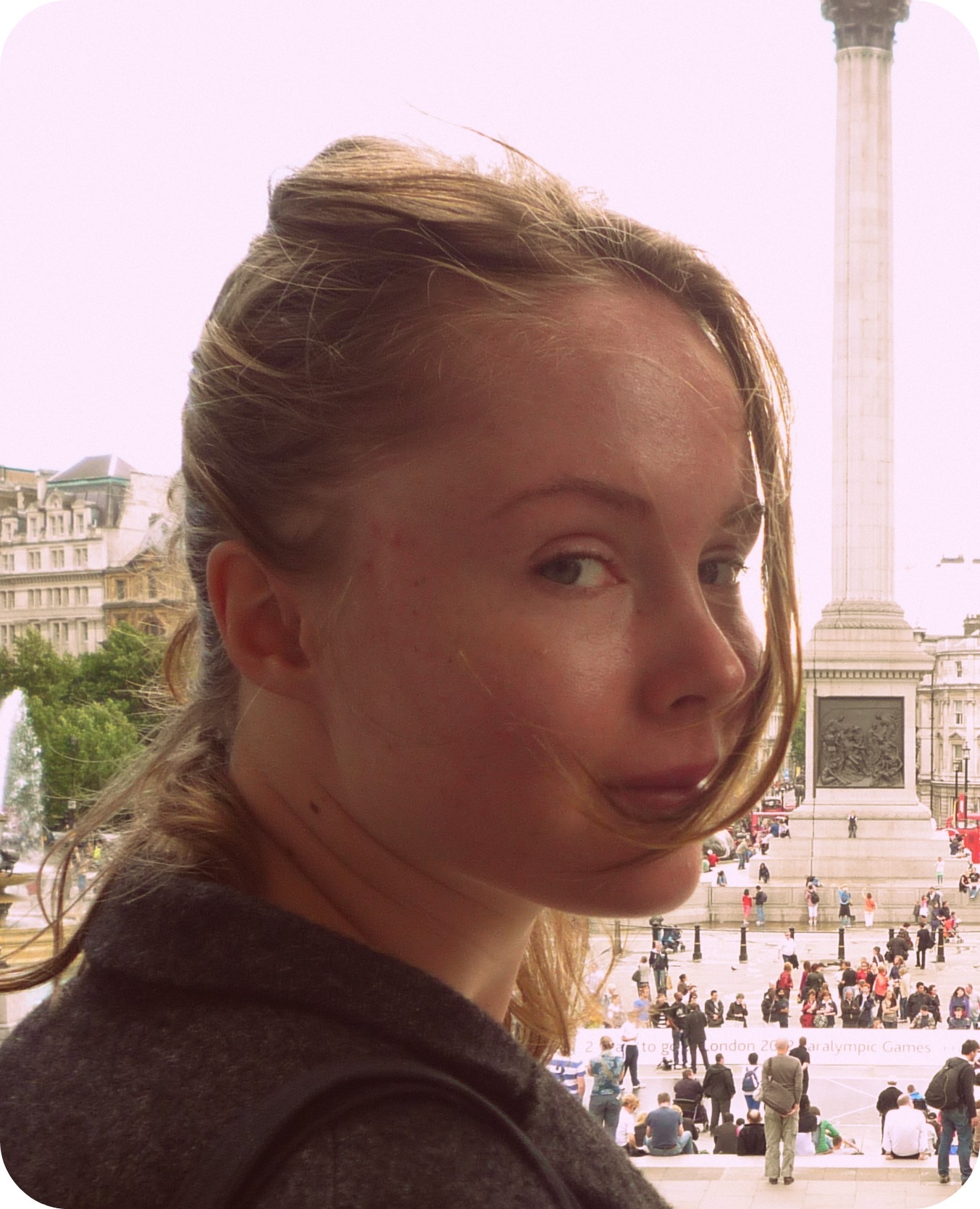
img: Charlotte Day surveying Trafalgar Square in London

CLASSIC DISPLACED WRITING: Albert Schweitzer, early humanitarian & medic without borders

Fifty years ago, “Albert Schweitzer” was a household name. Nowadays it is hard to find anyone who knows who he is. But given our current theme of looking at those who’ve displaced themselves on behalf of humanitarian causes, today I would like to resurrect this great man for the purpose of honoring him with a membership in our Displaced Hall of Fame.

Were he still alive, Schweitzer, a brilliant theologian and musical genius who received the 1952 Nobel Peace Prize for his philosophy known as Reverence for Life, might not be all that flattered.

Then again, considering that he chose to spend much of his time living simply and without pretension in Africa, is it too far fetched to think he’d “get” what the Displaced Nation is all about? He might even have a good wheeze at learning of his elevated status among our citizenry…

A displaced early life

Schweitzer was born in 1875 in Alsace, which at that time belonged to the German Reich (it would change hands four times between France and Germany over the next 75 years).

According to Professor J. Rufus Fears who has lectured on Schweitzer for the Teaching Company:

Alsatians are their own people — neither French nor German, though they like to say they eat as much as the Germans and as well as the French.

Did being born an Alsatian give Schweitzer a head start on leading a displaced life? It’s tempting to think so. Curiously, although he spoke two languages — actually, three: Alsatian (a dialect of German), German and French — he professed not to believe that anyone was ever truly bilingual. He maintained that a person’s true native tongue could be discovered by asking:

What language do you count your change in when you give someone a dollar bill?

A displaced career

For our ceremony inducting Schweitzer into the Displaced Hall of Fame, we would do well to choose one of Bach’s organ works. While still in his twenties, Schweitzer distinguished himself not only in his chosen field of theology, but also as an organist and musicologist who specialized in Bach.

He wrote two early works that established his reputation in both of these fields: The Quest for the Historical Jesus (German, 1906; English translation, 1910), arguing that Jesus was human, not divine; and J.S. Bach (enlarged German edition 1908; English translation, 1911), a study of the life and art of Johann Sebastian Bach.

As if being an accomplished theologian and notable organist weren’t displaced enough, while still in his twenties, Schweitzer decided he would go out into the world and devote his life to humanity rather than remaining locked up in the cloisters of academe.

Upon turning 30, he shocked and horrified his parents and friends by declaring his intention to become a medical student in preparation for the life of a physician in French Equatorial Africa.

While studying medicine, he married Helene Bresslau, who although a scholar herself, became a trained nurse in order to share her husband’s life in Africa.

In 1913 the couple set sail from Bordeaux for what today is Lambaréné, Gabon.

The conditions the Schweitzers faced were desolate in the extreme. The climate — characterized by fiercely hot days, clammy nights and seasonal torrents of rain — was appalling. Besides the usual diseases, the natives were suffering from leprosy, dysentery, elephantiasis, sleeping sickness, malaria, yellow fever and animal wounds.

But the couple persisted through thick and thin (including a period of being interned during World War I), setting out to build a hospital on the grounds of the Lambaréné station of the Paris Missionary Society (they would later move the hospital to an even more remote spot).

Eventually, Schweitzer’s wife went back to Europe to raise their daughter, while Schweitzer himself carried on working in, and on behalf of, this remarkable medical facility until his own death in 1965. By then the compound had grown to more than 70 buildings, 350 beds and a leper village of 200, and the hospital was staffed by 3 unpaid physicians, 7 nurses and 13 volunteer helpers.

(It still exists today as the Albert Schweitzer Hospital, one of the leading research centers in sub-Saharan Africa training African doctors in the treatment of diseases such as HIV/AIDS, malaria and tuberculosis.)

Schweitzer, who passed away in the hospital itself, was buried next to the Ogooué River in a ceremony attended by hospital workers, lepers, cripples and other patients.

An epiphany of hippopotaman proportions

Schweitzer considered his work as a medical missionary in Africa to be a small recompense for the injustices committed by the African Continent’s European colonizers. In a sermon preached in 1905, he proclaimed:

Oh, this “noble” culture of ours! It speaks so piously of human dignity and human rights and then disregards this dignity and these rights of countless millions and treads them underfoot, only because they live overseas or because their skins are of different color or because they cannot help themselves.

By the time he dedicated his life to serving the natives of Africa, Schweitzer could no longer make the intellectual case for Jesus’s divinity. The French had recruited him to work in their mission as a physician not a pastor (somehow a Lutheran who didn’t believe in Christ was just a little too displaced!). Yet Schweitzer remained deeply spiritual. He wanted to find a philosophy that would persuade others to displace themselves to the most desolate places on earth, just as he had done — separate and apart from a proselytizing mission.

While on a boat trip on the Ogooué, Schweitzer noticed a herd of hippopotamuses swimming in the water, and thought to himself: what purpose does the hippo serve? He decided that the spirit of the universe had made this creature — and that this was reason enough to treat it with respect.

From that point on, he promoted the idea that man, in his quest for dominance, should never forget the need to show reverence and awe for all living creatures.

For Schweitzer, such a belief should suffice as motivation to reach out and help others who are less fortunate than oneself. You can almost sense his relief at discovering this philosophy from the epilogue he attached to his major autobiographical volume, Out of My Life and Thought:

Two observations have cast their shadows over my life. One is the realization that the world is inexplicably mysterious and full of suffering, the other that I have been born in a period of spiritual decline for mankind.

I myself found the basis and the direction for my life at the moment I discovered the principle of Reverence for Life, which contains life’s ethical affirmation.

His Reverence of Life philosophy further led him to warn against man destroying animals (what we know today as “animal rights”) as well as his environment — he was an early environmentalist, who predicted that man “will end by destroying the Earth” (Rachel Carson dedicated Silent Spring to him).

Schweitzer tried to put these principles in practice in all sorts of ways, but the two examples I like best are his refusal to teach his pet parrot how to talk (talking would lower its dignity), and his decline of an offer by a foundation to replace his dug-out canoe with a motorboat for fear it would pollute the Ogooué River.

Schweitzer’s relevance for today’s global nomads

In his lecture on Albert Schweitzer, Professor Fears insists that this early humanitarian still speaks to us. I agree and would add that he positively shouts to those of us who’ve chosen to live much of our lives abroad. For a start, we can find inspiration in his refusal to follow a conventional career path (a quality that, by the way, drove the bureaucrats in charge of French Equatorial Africa crazy).

But the really impressive thing about Schweitzer, of course, is his unconquerable spirit, his desire to do good. Despite living through two world wars, he carried on believing in mankind’s potential to treat life, in all its forms, with the reverence it deserves.

Even after World War II, when Albert Einstein called on him to speak out against the atom bomb, he did so despite his better instinct to get involved in politics (and suffered the fall-out of having funds withdrawn from his hospital when the FBI and CIA began persecuting him for his anti-nuclear-arms-race position).

The way I see it, we expats and “internationals” are perfectly positioned to understand where Schweitzer was coming from. Our travels have taught us that life, whether human or animal, deserves respect no matter where one is on the globe.

But how do we share this knowledge? What do we actually do with it?

As mentioned in my post on Richard Branson at the start of November, for some of us it’s challenge enough to cultivate our own gardens and hope that in doing so, some of our attitudes will rub off on others.

But Schweitzer, whom Fears calls a “living testimony to goodness,” clearly believed in the need to do more. And after a month of celebrating those who’ve done more — see our profiles of Adria Schmidt, Jennifer Lentfer, Matt Collin, and Vilma Ilic — I’m prepared to concede he is right.

To give the redoubtable Albert Schweitzer the final word:

I have always held firmly to the thought that each one of us can do a little to bring some portion of misery to an end.

STAY TUNED for Monday’s reflections on global philanthropy by third-culture-kid columnist Charlotte Day.

If you enjoyed this post, we invite you to subscribe to The Displaced Dispatch, a weekly round up of posts from The Displaced Nation, plus seasonal recipes, book giveaways and other extras. Sign up for The Displaced Dispatch by clicking here!

Related posts:


RANDOM NOMAD: Adria Schmidt, Career Consultant at Violence Intervention Program & Former Peace Corps Volunteer

Born in: Phoenixville, Pennsylvania USA
Passport: USA
Countries, states, cities lived in: Pennsylvania (Collegeville & Landenberg): 1985-87 & 1996 – 2004; Ohio (Cincinnati): 1987-96; Massachusetts (Boston): 2004-06, 2008-09; Argentina (Buenos Aires): 2007-08; Dominican Republic (Cambita Garabitos, San Cristóbal province): 2009-11; New York (New York): June 2011 – present.

What made you leave your homeland in the first place?
I guess you can say I left my homeland in search of a home. I never felt very “at home” as a teenager in Pennsylvania, so when the opportunity came to travel to Spain on a class trip I went eagerly. On this short trip I found that I felt more comfortable with some parts of the Spanish culture than with my own. The seed of wanderlust was planted.

When I went to school in Boston at Northeastern University, I decided to study the Spanish language, partly because of my interest in the language and the culture of Ibero-America, and partly because of my wish to study abroad.

Under Northeastern’s “Dialogue of Civilizations” program, I worked in Puebla, Mexico in a women’s prison, as well as in a small indigenous village in the mountains of Cuetzalan, where the people spoke only Nahuati. Both were amazing experiences.

And under Northeastern’s study abroad program, I lived in Argentina for nearly a year — during which I decided I wanted to help impoverished people in developing countries so would try joining the Peace Corps. Two years and one Master’s degree later, I was finally accepted and sent off to the Dominican Republic.

So did I ever find that “home” I was looking for? To be honest, my travels have only nurtured that original seed of restlessness. The more I travel the more I discover about myself and others — and the more I realize how much I still have to learn. For now, at least, home is wherever I want it to be.

Is anyone else in your family a “displaced” person?
As far as my immediate family goes, no one is or has ever been “displaced” — although I do like to think that my travels have inspired family members to explore other countries. My father was always one of those people who felt it would never be necessary to leave the United States as he had everything he wanted or needed right here. But when I went to Argentina, my parents decided to visit, and my dad absolutely fell in love with the country. To this day, he tells people that Argentina has the best pastries in the world. Now when I tell my parents I’m going overseas, they no longer respond by saying: “Why do you want to go there?” Instead it’s “When can we visit?”

Describe the moment when you felt most displaced.
One night in Cambita my host sister’s husband brought me a guayaba (guava). He was really excited for me to try one for the first time, and I didn’t have the heart to tell him I had eaten this fruit before in Mexico. After I ate it I started to feel nauseous and dizzy. Soon my lips began to swell and my whole face was itchy. I was having an allergic reaction to a chemical (a fertilizer or pesticide) that had been used on the fruit. I called the Peace Corps doctor, who told me to take two Benadryl and then a shower to wash the chemicals off.

When I got to the shower — an outdoor zinc and cement block latrine with a drain in the middle — I hung my towel on the cement blocks and poured cold water from a bucket over my head. It was already dark and I couldn’t see anything.

As soon as I finished, I wrapped the towel around myself and as I was heading back to the house, I felt a small sting on my stomach, then another one on my back, and another one on my chest. Soon my whole body was burning with these sharp little stings. Inside my towel was a colony of fire ants! I ran to my room, only to find it occupied. My host parents, Doña Romita and Don Rafael, were busy adjusting a new table the latter had constructed from an old cabinet. All I wanted to do was rip off my towel, but I could not get naked in front of my 70-year-old hosts!

By that time, the ants were all over my body. I was jumping up and down, shaking my towel and yelling for them to get out of the room. In all the commotion the oil lamp was knocked over and shattered on the floor. Doña Romita refused to let me in the room with the glass on the floor. Still unsure of what was wrong with me, she rushed me to her room. I quickly closed the door and whipped the towel off, slapping the ants off my body.

Just when I thought the nightmare was over I looked up and realized the shades were wide open and everyone outside the house had seen me naked and jumping around. At that moment, Doña Romita knocked on the door to tell me that my project partner and his wife were there to see me.

Describe the moment when you felt least displaced.
After being in the Dominican Republic for more than a year, I came back to the States to visit my friends and family. One night, while out with some friends all the girls couldn’t stop talking about their weight. They were commenting about how beautiful one of our friends was because they had never seen her so skinny before. All I could think of was how sickly she looked and how much I wanted to feed her. I couldn’t understand why being skinny was considered better while in the Dominican Republic being called “fat” or (my favorite) “fatty” was a compliment. My view of what was healthy and beautiful had been altered from my time in the Peace Corps.

You may bring one curiosity you’ve collected from each of your adopted countries into the Displaced Nation. What’s in your suitcase?
From Argentina: All the ingredients and utensils for brewing maté, a drink made from the leaves of the yerba maté plant, containing caffeine and related compounds. (This is sadly ironic since I accidentally left behind my maté in my apartment in Buenos Aires.) The yerba is packed into a hallowed-out gourd, which is then filled with boiling water. You drink the mixture directly from the gourd using a metallic straw with a filter at the bottom, called a bombilla. Some people walk around with a thermos of hot water and the gourd to drink maté whenever they have the urge. It has a very strong, bitter taste, but you can add liquid sugar.

From the Dominican Republic: Some large jugs of the tree bark, sticks and herbs that can be used for making the classic Dominican drink mamajuana. I assume the Displaced Nation has honey and rum we can add to it? After filling with rum and honey, you let the jug sit for a few days. You can also add cinnamon sticks soaked in red wine and honey, or raw squid and seafood soaked in rum. Men use the seafood mamajuana to boost their virility. Regular mamajuana supposedly cleans the blood, provides a tonic for liver and kidneys, relieves menstruation pains, and cures many other ailments (depending on who you talk to).

You’re invited to prepare one meal based on your travels for other Displaced Nation members. What’s on the menu?
I would make the meal I ate the most of in the Dominican Republic: rice, beans, plantains, and overcooked spaghetti with carnation milk, canned tomatoes, and corn. It’s the perfect carb overload — are any of you marathon runners?

You may add one word or expression from the countries you’ve lived in to The Displaced Nation argot. What will you loan us?
From Argentina: Che, boludo. Che is similar to the American word “dude.” I love che because it means that whenever I’m talking to someone and can’t remember their name, I can just call them che. Boludo technically means “jerk” (or worse), but it can also be used in an endearing way. My Argentinian friends and I always used to greet each other with a “Che, boludo!”
From the Dominican Republic: Vaina — though it technically means the pod around pigeon peas (gandules), everyone uses it to mean a thing or object. If I ever got stuck and couldn’t think of the Spanish word for something, I would just call it vaina while pointing to the object with my lips. It’s a great word for anyone learning Spanish.

This month we are looking into “philanthropic displacement” — when people travel or become expats on behalf of helping others less fortunate than themselves. Do you have a role model you look up to when engaged in this kind of travel — whose words of advice you cherish?
Strangely, I have never had a role model for this kind of travel. I was always drawn to it — but for some reason never felt the need to seek out others who had done it before me. My family were against my joining the Peace Corps because of fears for my health and safety. A psychic I met at a Renaissance fair right before leaving for Argentina told me I was going to do the Peace Corps. I don’t really believe in psychics but everything she told me that day has come true. So perhaps it was simply a matter of fate?

Voluntourism is said to be the fastest growing segment of the travel industry (itself one of the world’s fastest growing industries). Do you think this kind of travel can help the uninitiated understand the problems our planet is facing?
Voluntourism is a tricky subject for me personally. On one hand I feel that it is ridiculous to pay someone’s plane ticket, lodging, food, and transportation at a more luxurious level than any host country national has ever experienced to have them “volunteer” and do a job that a local person would probably be more than willing and capable of doing had all that money been spent on their salary. On the other hand, I do realize the value of cross-cultural communications for both parties and that, on the occasions when it’s done correctly, the volunteer might actually be able to transfer a valuable skill to the host country nationals. In short, it all depends on how the voluntourism is being executed.

While in the Dominican Republic, I observed many volunteers who were asked to do jobs that could have been, and in some cases even were once done by Dominicans. It wasn’t that the local population didn’t have the knowledge or training to do some of these jobs; it was that they didn’t have the money to pay a salaried person and wanted a “free” volunteer instead.

Luckily, most Peace Corps volunteers were successfully trained to avoid taking jobs away from Dominicans, and instead focus on areas where they and their community felt the need was greatest.

Readers — yay or nay for letting Adria Schmidt into The Displaced Nation? Tell us your reasons. (Note: It’s fine to vote “nay” as long as you couch your reasoning in terms we all — including Adria — find amusing.)

img: Hair washing ritual in Constanza, a mountainous area of the Dominican Republic, in spring of this year. Adria Schmidt is the one getting her hair washed — the one doing the washing is Rebecca, a fellow Peace Corps volunteer, and they are in the home of another Peace Corps volunteer, Malia (not pictured). Due to the primitive plumbing conditions, hair washing has to be done in the kitchen, by heating water up on the stove.

STAY TUNED for tomorrow’s installment from our displaced fictional heroine, Libby, who finds herself celebrating her first Thanksgiving under less-than-ideal circumstances. (What, not keeping up with Libby? Read the first three episodes of her expat adventures.)

If you enjoyed this post, we invite you to register for The Displaced Dispatch, a round up of weekly posts from The Displaced Nation, with seasonal recipes, book giveaways and other extras. Register for The Displaced Dispatch by clicking here!

Related posts:

