The Displaced Nation

A home for international creatives

THE DISPLACED POLL: Which of these 4 travel champions deserves an Olympic gold medal?

Hi there, folks! In keeping with our summer theme — we’ve been talking up the Olympics, in case you haven’t noticed — today I’ll be taking a look at some travely-types who have performed what can only be described as Herculean endeavors.

Which one of these travel worthies would you vote onto the gold medal podium for their efforts? Register your choice in our poll below.

1) THE SPRINTER: Gunnar Garfors

The 30-something Norwegian Gunnar Garfors (he’s a tech and new media guy as well as an avid traveler and former footballer) will never forget where he was on June 18th, 2012. Because he was in Istanbul (Asia), Casablanca (Africa), Paris (Europe), Punta Cana (North America) and Caracas (South America). Yup — all of ’em! He managed to create a new world record by visiting five different continents in one day!

Although the “day” was quite a long one, as Gunnar used the advancing dateline to squeeze a few more hours into his schedule.

It’s hard to believe that something like this is possible… I’m guessing he didn’t use Qantas for any of the flights. (Okay, that little dig was meant for Australians!)

Seriously, he makes me tired just thinking about it! Can you remember what you did on Monday? I think I got a hair cut…

Definitely an Olympian achievement.

2) THE MARATHONER: Jean Béliveau (no, not the ice hockey icon; we’re talking summer Olympics!)

Montrealer Jean Béliveau took a little longer to accomplish his feat than Gunnar Garfors — because Jean walked all the way around the word. No, really! 47,000 miles… It took him 11 years — and 53 pairs of shoes!

At 45, Jean went through a mid-life crisis with the failure of his neon sign business. In his own words:

“I played the game. It left me empty.”

Jean liked the idea of sailing around the world, but ocean-going yachts cost too much. Instead, he began to imagine running away as far as he could.  He started jogging and working out but told no one of his plans — not even his life partner, Luce Archambault. When he finally told Luce, she gave him her blessing — but insisted that he do it for a cause. Jean chose world peace and the safety of children, something no one could disagree with (at that point, he was after some peace of mind).

He began by running south, but by the time he’d reached Atlanta, his knees had started bothering him, so he switched to walking. He waked through the rest of America, Mexico, Latin America, Africa, Europe and Asia — six continents and 64 countries.

His interest in promoting peace didn’t stop him from being mugged, as well as imprisoned (the latter in Ethiopia). But he carried on and eventually even came to embrace his cause, telling people that to achieve peace, we must see the world through “eyes of love.”

It’s an achievement so staggering it begs the question: what can he possibly do next? Where do you go from there?

“Hey honey, let’s celebrate with a holiday…”

“NO! Already been there.”

Another record, of course, belongs to Luce, who has remained loyal to Jean despite his absence of 11 years from their home in Montreal and his falling for a woman in Mexico. Once a year, she would come to him and they would spend three weeks together, in one place.

Jean walked back into Montreal in October of last year. How does the couple find it being under one roof again? Rumor has it, they’re writing a book together! Talk about Olympian challenges…

3) THE PREPOSTEROUS POLYGLOT: Benny Lewis

Brendan (Benny) Lewis is a polyglot who hails from Cavan County in Ireland. (No, “polyglot” isn’t a type of glue; it’s a person who speaks four or more languages fluently.) Benny earned this title — he is also a vegetarian and a teetotaler — after nine years on the road, during which he taught himself to speak eight languages fluently (with more than a smattering of half a dozen more).

I know nothing about Benny’s musculature, but it’s clear his tongue has gotten plenty of exercise.

Benny now considers himself to be a “technomad” — a full-time technology-enabled globe-trotter. His Web site, Fluent in Three Months, is a treasure trove of tips and tricks for picking up languages (called “language hacks”), as well as a tribute to his mind-boggling achievement. (I’m actually surprised that his head hasn’t exploded from the pressure of all that knowledge.)

According to him, it is no big deal — anyone can do what he has done. All they need is dedication, hard work…and more of the same. (Times a million!)

You know, I have to hand it to Benny, he’s the very essence of — sorry, I can’t resist — a cunning linguist. (Well, I said I was sorry! Please stop throwing things at me.)

4) THE MASTER OF EXTREME ENDURANCE: Ben Hatch

The British novelist and travel writer Ben Hatch is the author of a hugely popular (and very entertaining) book about a recent adventure of his: driving 8,000 miles around Britain in a cramped Vauxhall Astra, while researching a guidebook for Frommers.

“But why is that worthy of an Olympics gold medal?” I hear you ask. “Novelists usually aren’t athletes. And he only traveled around his own neck of the woods, Britain.”

Well, there are lots of reasons I could pick: because he practically lived in his car for five months, because he purposefully inflicted dozens of tourist attractions on himself every week, because he had a car crash en route, or because he stayed in a haunted Scottish castle.

But the one I like best is the fact that he did all this with his wife and two children — aged four and two! — in tow.

Can you imagine? While the family was attempting fine dining in a posh hotel restaurant, his children engaged in food fights and eating mashed potatoes with their bare hands. There were tears and tantrums in the car — every single day. For months. It sounds like my worst nightmare! And I don’t even have kids…

The resulting trauma became his best-selling book Are We Nearly There Yet? 8,000 Misguided Miles Round Britain in a Vauxhall Astra — which I can only assume was written cathartically, in a desperate attempt to cling on to what remained of his sanity after such a grueling experience. I think he deserves a medal just for surviving the first week. And of course, once the kids are old enough to read what he’s written about them, he’ll be in for a whole new world of trouble…

* * *

Right! There’s my suggestions. What do think. folks? I just know there are loads of people out there making epic journeys, achieving the unachievable, and generally making the rest of us look like couch potatoes in comparison. Do you know of any? (Olympians, I mean, not couch potatoes — I’ve got enough of the latter in my house.) BTW, I toyed with the idea of including an older traveler, as unlike sport, there seems to be no real age limit on world travel, especially with all the recent growth in the international cruise-ship industry (see photo above).

In any event, I’d love to hear from you — let me know in the comments, or hit us up on Twitter: @DisplacedNation and/or @TonyJamesSlater

And don’t forget to vote in our poll!

STAY TUNED for Tuesday’s post on a historical traveler worthy of a gold medal or two.

If you enjoyed this post, we invite you to register for The Displaced Dispatch, a round up of weekly posts from The Displaced Nation, with seasonal recipes, book giveaways and other extras. Register for The Displaced Dispatch by clicking here!

Related posts:

Image: MorgueFile

LIBBY’S LIFE #55 – Dark secrets

A note before Libby begins her journal entry: If you’re a Libby addict, check out Woodhaven Happenings, where from time to time you will find more posts from other characters. The latest is a post from Maggie, describing her side of the story of last week’s meeting with Libby. Want to remind yourself of Who’s Who in Woodhaven? Click here for the cast list!

*  *  *

The babies are in bed. They have been bathed, fed, patted, soothed, and tucked up for the night. After protesting at similar treatment at a too-early hour, Jack is also away for the night.

I sit in the gradually darkening den, watching the sun set behind the trees in the back yard, and wait for Oliver. This is the room he usually heads for when he comes through the door. The temptation to turn on the TV is great, but I resist, knowing I need to channel my thoughts and energy into the inevitable scene that lies ahead tonight, not into another episode of How I Met Your Mother. Also, if I am quiet, I will be able to hear him arrive home.

Oliver’s evening arrivals have been getting later and later. When I comment, mildly, upon this — I never question — he replies in a tone that indicates it’s hardly worth him opening his mouth. “Work,” he says. “Overtime.” “Customer with a problem.”

“What about a wife with a problem?” I want to scream. “Don’t I deserve some of your overtime too?”

But I never do. I’m my mother’s daughter, after all. After the brief interlude here when she abandoned her role as Dutiful Wife To Keith in favour of Fun-Loving Single Woman For Now, she’s back to tiptoeing around the house and fetching Dad his warmed slippers. She gave me the hint about Oliver’s parentage, but I can’t work out what I was supposed to do with the information. Silently store it and sympathise with Oliver, I think she meant.

Thankfully, I have another mother who is not afraid of sticking an oar in when necessary, even if it means breaking a promise to not interfere.

“I used to interfere,” Maggie said, after she had hauled me, the children, and Fergus back to her house earlier today. “All the time. Making that promise to your mother not to get involved nearly killed me.”

“But you decided to go ahead and get involved anyway.”

“You’re like a daughter,” Maggie said, “the daughter I haven’t had for twenty-five years. I could no more stand by and watch you fall to pieces than I was able to watch Sara.”

Maggie sat in her wooden rocking chair, gazing out of the window at the maple tree in the yard. Her eyes were open very wide, as people’s are when they are trying to make tears disobey gravity. Half of me wanted to ask more about the mysterious daughter, but the other half didn’t want to rake over old memories for Maggie.

Also — I have to be honest — I was more intent on getting my own life straightened out. Whatever happened to Maggie and her daughter twenty-five years ago has little to do with what is going on now between me and Oliver.

“What shall I do?” I asked her instead. “How do I talk to a man who won’t talk back?”

Maggie turned slightly, blinking.

“I can’t tell you that,” she said. “You know your own husband. At least, you thought you did. But however you do it, you have to keep telling yourself that you deserve better than this.”

I didn’t dare ask her what she meant by that.

* * *

The sun has been below the horizon for fifteen minutes now, and an occasional firefly flickers among the rhododendrons. The den is completely dark. Oliver is still not home. I curl up on the sofa without bothering to turn on the lamp beside me, and rehearse tonight’s conversation in my head. It’s difficult, of course, because in this imaginary exchange Oliver answers the way I would like him to. We have a reasoned, adult conversation, resulting in a reasoned, adult compromise. He does not mutter monosyllables, or stomp upstairs to the guest bedroom where he has taken to sleeping under the pretext of not getting enough sleep in the same room as the twins, who supposedly wake him up every time they murmur in the night.

I hear the rattle of the garage door and the hum of the car engine as it pulls into the parking bay. The back door opens, then closes again. Oliver’s uncertain footsteps into the unlit kitchen, heading into the hall, then back into the kitchen. Apart from a nightlight glowing on the landing upstairs, the house is in darkness.

Oliver’s footsteps stop. I hear the fridge door open, and the faint light from the fridge interior illuminates the hallway outside the den. Funny how a small light can make such a difference in a dark house. I am reminded of my grandfather’s stories of German air raids and belligerent blackout wardens.

The fridge door closes, the light goes off.

The pop and hiss of a Coke can top, some glugs. A stifled belch.

Another noise. Beeps — ten of them.

I stiffen, listening hard.

Then a quiet voice from the kitchen, speaking into a cellphone.

“Hey. It’s Oliver.” Silence, broken by the tossing of an empty Coke can into the recycling bin. “Change of plan. I can see you now…Yeah, no problem. She’s in bed. I’ll be there in fifteen minutes.”

The back door opens and closes, the garage door rattles open, and the car engine hums again as Oliver reverses onto the driveway.

I stay where I am, motionless, and watch the fireflies for a long time.

.

Next post: LIBBY’S LIFE: Oliver’s side of the story

Previous post: LIBBY’S LIFE #54 – Opening the cocoon 

Need the 411 on characters in Libby’s Life? Click here for  Kate’s page  of Who’s Who in Woodhaven.

Click here to read Libby’s Life from the first episode.


STAY TUNED for Monday’s post.

If you enjoyed this post, we invite you to subscribe for email delivery of The Displaced Dispatch, a round up of the week’s posts from The Displaced Nation. Sign up for The Displaced Dispatch by clicking here!

Image: Travel – Map of the World by Salvatore Vuono / FreeDigit
RANDOM NOMAD: Melissa Stoey, Former Expat in UK and Incurable Britophile

Place of birth: Northern Virginia, USA
Passports: USA
Overseas history: England (Huntingdon, Cambridgeshire + Shefford, Bedfordshire): 1988-91.
Occupation: Research technician (basically I do data analysis) and part-time professional blogger.
Cyberspace coordinates: Smitten by Britain: Home of the Britophile (blog); @SmittnbyBritain (Twitter handle); Facebook page; and Pinterest.

What made you leave your homeland in the first place?
I’m intrigued by other cultures and more specifically by the British culture. I have been fascinated by Britain since I was a young teen. I have always had the itch for travel and I knew I definitely wanted to visit the UK, if not live there. My love for travel one of the reasons I joined the military. I put England down as my first choice for duty station and I got it!

Where were you stationed?
At Chicksands air base (Chicks for shorts). It’s now Royal Air Force (RAF) Chicksands. Britain’s Ministry of Defense has since taken it over.

You ended up marrying a Brit, right?
Yes. My first husband, and the father of my son, was stationed at what was then RAF Brampton, which is in Cambridgeshire. At first we lived in Huntingdon, but then he got transferred to a base in Hitchin, which is closer to Chicks, so we moved to Shefford.

Is anyone else in your immediate family “displaced”?
Ironically, my brother was stationed at Chicks three years before, so it sort of felt like I was meant to go there. Right now, I don’t have any displaced relatives, but my son is a dual national between the U.S. and U.K. I suspect at some point he may move to the U.K. after he fulfills his dream of living and teaching in Japan for a year. We’ll see! It may be a case of like mother, like son.

So you and your son now live in the United States?
Yes. His father and I are divorced. We came back and lived in Texas for a year, then West Virginia. We now live in Pennsylvania. Meanwhile, his father has gone back to Scotland, where he is from.

How often do you return to the U.K.?
My son and I, and my second husband — I am now married to an American! — try to go every year or at least once very two years, depending on funds and time off.

Can you describe the moment in your association with Britain when you felt the most displaced?
The first night I was in England the culture shock was horrible. I lived around sixty miles north of London in a small village where there were no street lights, and when I looked out the window there was complete and utter darkness. It felt as if I’d landed on a different planet with no signs of life. This was 1988 when almost everything closed much earlier than it does now and wasn’t open on Sundays. If you switched on the radio you might pick up two or three stations, the television had only four channels and of course there was no Internet. It felt much more isolating than if you moved to England today; it has changed by leaps and bounds in the last 25 years as far as conveniences go. I envy current expats who have so many wonderful resources available to help limit the culture shock and make the transition easier.

Is there any particular moment that stands out as your “least displaced”?
We had a great night back in July of 2010 when we met a Glaswegian couple at a curry house in the west end of Glasgow. They invited us to the pub for drinks where we spent the night taste testing different whiskies. I felt totally at home, like I had known this couple my whole life. The Scots have a way — similar to Americans — of making one feel welcomed and accepted. I can say this because of having once been married to a Scot and having spent a lot of time there. My ex-husband was, and still is, one of the friendliest people I know.

You may bring one curiosity you’ve collected from your adopted country into The Displaced Nation. What’s in your suitcase?
My bag is always full of tea and sweets from England. I never return without them. I always pack a few British newspapers as well because my parents are Anglophiles, have been to England many times and enjoy reading them. Rumor has it that some of you Displaced Nation citizens are avid tea drinkers and readers, and that you rarely turn down sweets.

You are invited to prepare one meal based on your travels for other members of The Displaced Nation. What’s on your menu?

I will fix my favorite meal which is a nice Sunday roast that includes roast beef, roasted potatoes, carrots, peas, and Yorkshire pudding (I don’t do sprouts, thank you.) We’ll finish it off with a nice pot of tea and a slice of Victoria sponge, with jam and whipped cream.

And now you may add a word or expression from each of the countries where you’ve lived to The Displaced Nation argot. What will you loan us?
I’m feeling peckish. I say that quite often and it always results in the odd look or two. It’s just not used here, at least where I live. To feel “peckish” means to feel slightly hungry.

Earlier this month, we did a series of posts on Queen Elizabeth’s Diamond Jubilee. Incurable Britophile that you are, I presume you celebrated from a distance?
I watched the River Pageant, which was on early in the morning East Coast time, and then hosted my own Diamond Jubilee lunch (see photos on my blog). The food was great — we nibbled on leftovers for days! Even though I didn’t have a big party (it was just for my family), I was glad to do it to show my blog readers that you don’t have to be in Britain to celebrate properly. You can still enjoy yourself and take part in your own little way.

A couple of us on The Displaced Nation team thinks that the Queen deserves an Olympic medal for having survived almost being displaced by Princess Diana. Do you agree?
I don’t agree that the Queen was almost displaced by Diana; if she was going to be displaced it would have been due to her actions (or lack of) that left the British public feeling as if she was heartless and out of touch. However, I still don’t think she would have been displaced. Time heals and I think many of us now understand the dilemma she faced as a grandmother trying to protect her grandchildren who just lost their mother. However, as Head of State I do wish she had at least made a televised message to the public within the first 24 hours. Waiting five days was a bit much.

Americans seem to love the Royal Family. Do you think the United States might benefit from having one?
The idea of the United States having a royal family at this point is a silly one. It doesn’t fit our history or where we are headed as a country. Let’s leave that to the nation that does Monarchy the best.

Readers — yay or nay for letting Melissa Stoey into The Displaced Nation? Tell us your reasons. (Note: It’s fine to vote “nay” as long as you couch your reasoning in terms we all — including Melissa — find amusing!)

STAY TUNED for tomorrow’s episode in Libby’s Life, our fictional expat series set in small town New England. (What, not keeping up with Libby? Read the first three episodes of her expat adventures and/or check out “Who’s Who in Libby’s Life.”)

If you enjoyed this post, we invite you to register for The Displaced Dispatch, a round up of weekly posts from The Displaced Nation, with seasonal recipes, book giveaways and other extras. Register for The Displaced Dispatch by clicking here!

Related posts:

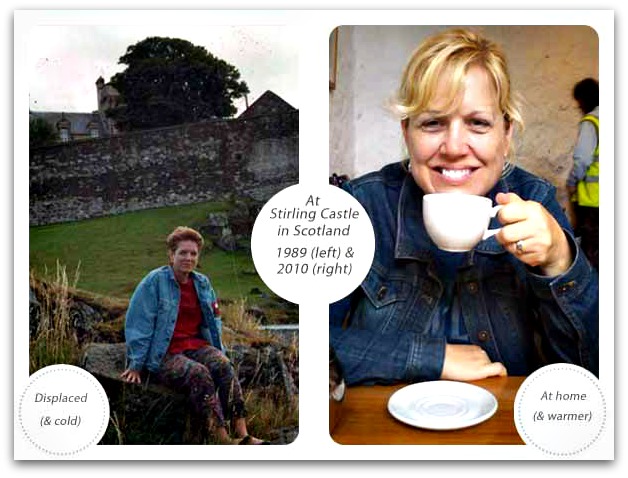
img: Melissa Stoey at Stirling Castle, Scotland, then and now — in 1989, when she was displaced (and cold!), and in 2010, when she was visiting (and warmer!).

TRAVEL YARN: A second date with Rome

Kym Hamer, an Australian expat in London, joins us today as guest blogger to share her version of a Roman Holiday — one of several trips she has made since having the continent of Europe and all of its history on her doorstep. Notably, for Kym, Rome doesn’t need Gregory Peck to be irresistible!

After 12 years away, I recently went back to Rome.

My only previous dalliance with the Eternal City was part of a “12 cities in 20 days” type tour that at the time, seemed to be the best option for getting a taste of Europe in the three weeks of holiday I had available from my job in Australia. You see, when you’re coming from the other side of the world, the flights are long and expensive, so there needs to be a pretty high rate of return for the time and money invested.

It was an amazing holiday. I visited a whole range of places — some hotly anticipated, some moving me unexpectedly, some not quite what I had hoped for. Each got 1-2 days with an experienced tour guide who made the queues disappear, added humour to the gruelling schedule and brought each city to life with her own blend of historic narrative and personal storytelling.

But each stop allowed no more than a brief and flirtatious encounter, the faint ripples disappearing almost as quickly as they were made by the time I’d left. Each major European city, Rome included, made its impression but was quickly over-run by the next.

Living the dream in London

When I moved to London from Melbourne more than eight years ago, it was the third time I travelled to the UK’s capital in four years. The first time I had been drawn for a week and the second time for four days — both times before a longer “whistlestop” tour of the sort just described. And on both of these visits, I split my time between “tourist” and “traveller,” between the seeing what I wanted to see and the aimless wandering: immersing myself in the city streets, using the local transport and chatting with the natives. One way and another, I got the true taste of the city that was to become my home just a few years later.

I love history and I’ve read it — beginning in the guise of historical fiction (by the likes of Jean Plaidy) through to Simon Schama, Alison Weir and several others — since my very early teens, always trying to imagine what those real worlds, leaping off the pages in front of me, were actually like.

Once I’d moved to London, suddenly I felt I was living the dream (albeit one never particularly aligned to that city). I still stand on Waterloo Bridge at night, gazing at all that history along the riverbank reflected in the Thames, pinching myself and wondering: “Wow, how did I get here?”

Was it a love of history that had tempted me across the world? Not really…there were other candidate cities, but the “right” circumstances conspired with a passionate fling to bring me here. And just as you never know where things might lead in life, the fling came and went, yet London had captured my heart.

The grass still looks green(er)

But my yen to explore means there’s always a sense of looking over the fence (so to speak) with curiosity. What’s it like over there? Would I like it? Be disappointed or even worse, nonplussed?

Which leads me to Rome and some of the other cities I’ve visited since living in London. Being able to hop on a plane (or train — the Eurostar is a pretty fabulous way to travel) and, in just a couple of hours, walk the historic cobbled laneways of a completely different place is an extraordinary experience for any Antipodean. Only a few short hours is required to separate oneself from the familiar and the habitual.

European travel has an especially strong hold on my bucket list. For the most part, Australia’s history is both inextricably linked to and considerably newer than anywhere on the Continent, even though some of the names and boundaries may have changed since I first learned of these faraway lands in the schoolroom.

Of course, nothing can ever take you back in time to know truly what it was like standing at The Green at the Tower of London or inside Newgrange passage tomb in Ireland’s Boyne Valley or atop Hadrian’s Mausoleum — now known as Castel Sant’Angelo — in Rome.

But in the Eternal City, there’s a deep sense of generations past, not just battles won and lost and the rise and fall of the empires that at one time or another shaped “the world” — but also everyday trifles, evidence of the “day-to-day” living of previous generations (take, for instance, Trajan’s market, the “shopping” centre where people went to buy their fresh produce). Both strands of history — the extraordinary and the quotidian — are accessible and visible everywhere.

Second-date nerves

There’s always a part of me that feels a little nervous when I first arrive somewhere new — a piece of me that says, “You could stay in the hotel room tonight, read your guidebook a bit more and be really sure when you set out tomorrow morning.” And it takes some mustering of courage to stop dawdling and plunge right in.

I’m always glad, invigorated actually, once I set off but I guess that essential human-ness in us wants to avoid the risks and keep ourselves safe and sound.

The Rome I had encountered on our first date, before moving to London, had grown faint and unfamiliar. But on this second Roman Holiday, I surprised myself by diving right in to its sights, sounds and smells. I was out the door just an hour after checking in to my hotel. Not for me the lolling about to “recover” from my travels. No way. I had only four days and I wanted to fill it with…well, Rome. It was an immersive experience I was after.

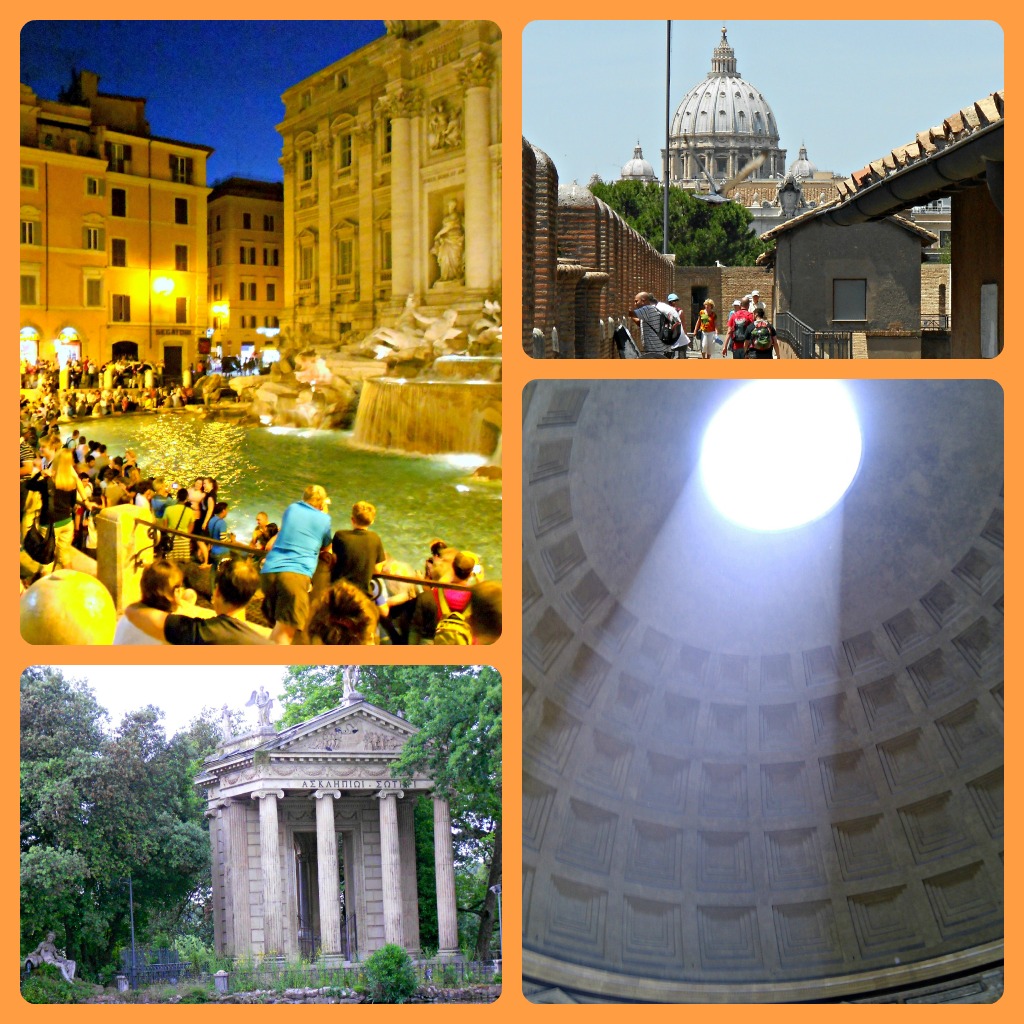
So I walked down from Quirinale in the darkening streets as night fell, map in one hand, camera in the other, my eyes filled with wonder and excitement. A stranger in the night if you will: with no local knowledge, limited lingo (si and grazie get you only so far) and quite frankly no idea where I was going. Tingling and a little breathless with the thrill of discovery somehow I found my way through the warren of streets to the Fontana di Trevi.

And the four days flew by. I walked and bus-sed and walked and Metro-ed and walked and cruised and walked some more. Compact and exuberant, Rome spreads its charm around every corner. The noise and busy-ness were energising although the traffic in some of the piazzas less so.

(I always imagined piazzas to be intimate and bustling, even green, rather than spacious, concrete or filled with litter. So the Piazza Navona and Campo de’ Fiori — the latter translates into “field of flowers” — were amongst the few “oh, is that it?” moments.)

A piece of my heart

From my coin toss into the Trevi on that first night to my final morning meandering in the warm rain through the gardens of the Villa Borghese, my second encounter with Rome has moved us beyond the acknowledgement of two passing strangers. But while we are not yet close friends, there’s a piece of my heart that’s indelibly stamped with a sense of delightful possibility.

Will I return to the Italian capital for a gentle kiss, for one more embrace perhaps? I don’t know but it’s exciting, exhilarating, a little self-conscious and filled with promise.

Just like Rome.

Born and raised in Melbourne, Kym Hamer has worked in London in sales and marketing for the past eight-and-a-half years. She writes the popular blog Gidday from the UK. Also follow Kym on Twitter: @giddayfromtheuk.

STAY TUNED for tomorrow’s Random Nomad interview with an American who has taken the “phile” in Anglophile to an extreme.

If you enjoyed this post, we invite you to register for The Displaced Dispatch, a round up of weekly posts from The Displaced Nation, with seasonal recipes, book giveaways and other extras. Register for The Displaced Dispatch by clicking here!

Related posts:

Images: Some enchanted moments from Kym’s second date with Rome. Clockwise from top left: Off peak at the Trevi Fountain (“busy, yes, but somehow still magical”); the Vatican from the battements of the Castel Sant’Angelo; sunlight pouring into the Pantheon; the Giardino del Lago at the Villa Borghese.

THE DISPLACED POLL: Who will win the Ladies’ Grunt Championship at Wimbledon?

Ah, the start of Wimbledon Fortnight. Two weeks of tennis whites, polite applause, Royalty, and strawberries and cream.

And grunts. Don’t forget the grunts. Especially the ladies’ grunts.

If some of the newspapers this week are to believed, that’s what modern tennis is all about.

The history of the grunt

Men’s tennis grunts started back in the 1970s with Jimmy Connors, and the popularity soon spread among the guys. In the 1988 US Open, Ivan Lendl complained about opponent Andre Agassi‘s grunts, saying they threw him, Lendl, off his timing.

Women’s tennis took a little longer to catch on, starting with Monica Seles‘s guttural shrieks in the 1990s. Once started, though, the women soon raised grunting to an art form, or at least another sport, putting the men’s feeble efforts to shame.

Serve in silence

Fans and media, however, are not amused by Centre Court’s soundtrack, and Martina Navratilova, a champion when women’s tennis was played in dignified silence, also disapproves. Her view is that the grunt masks the sound of the ball leaving the grunter’s racquet, putting the non-grunting opponent at a disadvantage.

“The grunting has reached an unacceptable level. It is cheating, pure and simple. It is time for something to be done.”

World Tennis Association chairman and chief executive, Stacey Allaster, agrees:

“It’s time for us to drive excessive grunting out of the game for future generations.”

Quite how this will be achieved, though, is rather vague. A fine for noisy players. perhaps? It would have to be a big one to have any effect. Michelle Larcher de Brito, the Portuguese player, and rumoured to be the next Maria Sharapova as far as grunt volume goes, reportedly said:

 “I’d rather get fined than lose a match because I had to stop grunting.”

The WTA is quick to point out that current players will not have to curb their on-court vocal emissions. The ban on grunts will be phased in after a period of educating up-and-coming players in grunt etiquette.

In the mean time, however, perhaps the solution would be to make Grunting an official Olympic sport, permissible only at Olympics (i.e. every four years) and not at Grand Slam tournaments.

With grunt decibel readings at similar levels to pneumatic drills, that would be music to everyone’s ears.

Judge for yourself:

Serena Williams and Victoria Azarenka

Maria Sharapova – Russia

And vote for the Gold Medal Winner in our poll!

Image: MorgueFile

EXPAT MOMENTS: American Dentata

Following last month’s post on expat moments, we start a new series focusing on little moments of expat experience — moments that at the time seemed pifflingly insignificant.

The dentist I went to as a child was located in a Victorian terrace which had been converted into a practice. What must have once been a gloomy living room where the family of the house had sat in sullen silence had now become a gloomy waiting room where the patients of the current occupant sat on musty couches until called for their appointment. When it was finally your turn, you would make your way up a staircase just off from the waiting room; a staircase that always seemed too steep, too narrow, too dark.

There at the top of the stairs were three rooms; two always had their doors shut, but the third would always be open. This was the examination room; no threadbare carpet or peeling plaster here. The smell of must from downstairs replaced with the sweet smell of eugenol. Clean and white with foreboding looking machinery, the centrepiece being that chair, it all felt futuristic and at odds with the rest of the house, and to my imagination it was as if I had stepped through the wardrobe or into the TARDIS. I was in the unknown.

Not so now; there is no peeling plaster, musty smells or dark Gormenghast shadows to navigate at my current dentist’s. I am in a box within a box; that is, like nearly every business in this part of California, the practice is to be found in a strip mall and the examination room is in a perfectly square room that reminds me of the prefab annexes I was sometimes taught in at Secondary school. My mouth is in the painful process of being “Americanized”. A molar is ground down in order to be crowned and slowly a childhood’s worth of NHS fillings, the colour of slate, will be extracted and the teeth will be capped gleaming white.

Bereft of a crumbling Victorian house my nightmarish fears of the dentist may have gone, but they have simply been replaced with a fear of humiliation and mockery. Opening my mouth in a dental surgery here I feel self-conscious. When my dentist starts scraping around in there I feel a whole nation’s health system being judged rather than my own admittedly poor choices.

British teeth and their perceived awfulness have become an established American comic meme popularized by The Simpsons and personified by Mike Myer’s Austin Powers. It’s an entrenched stereotype and always good for a cheap laugh.

When I open my still predominantly British mouth (it’s only partly been Americanized, the vowels and consonants it forms are still resolutely British) it inspires my American dentist to grandiose plans of what she should do with it – rip out those British pegs and start from scratch and craf me an all-American smile.

My understanding is that a teeth whitening course will be a compulsory part of the American citizenship test.

This post was first featured on Culturally Discombobulated

STAY TUNED for Monday’s post, a poll on Wimbledon by Kate Allison.

If you enjoyed this post, we invite you to register for The Displaced Dispatch, a round up of weekly posts from The Displaced Nation, with seasonal recipes, book giveaways and other extras. Register for The Displaced Dispatch by clicking here!

Related posts:

img courtesy morguefile

LESSONS FROM TWO SMALL ISLANDS — 2) Keep calm and learn to enjoy imperfection

I must have been born with a melancholy nature, because it didn’t take me long to work out that we live in an imperfect world.

Imagine my discomfort, then, when I realized that many of the people who surrounded me in my nation of birth — my fellow Americans — were obsessed with having perfect teeth, perfect bodies and a perfect appearance during their brief time on this earth.

“What’s that about?” I thought to myself at a relatively early age (I was around 6, already on the way to driving my mother, an eternal optimist, crazy). “We’re all going to grow old and die regardless.”

By the time I reached adolescence, I decided that the need to be flawless was my birth nation’s fatal flaw. It was our best feature — hey, no one can deny how good we look flashing those orthodontically-enhanced smiles — but also our worst. The list is long of fabulously talented Americans who have perished in the pursuit of physical perfection.

That lists always begins with Marilyn Monroe — a pretty and bright young thing who ruthlessly remade herself into a sex symbol, and died at age 36. (Among other things, she got work done on her nose and chin to create her classic, timeless look.) And culminates in Michael Jackson, for whom it apparently wasn’t enough to be blessed with good looks and an extraordinary musical talent. No, the King of Pop felt compelled to have lots of plastic surgery — even if it meant destroying his career and himself.

Endearing little imperfections (England)

It’s a pity Marilyn and Michael were never offered the chance to study abroad in England, that’s all I can say. My prolonged stint as a graduate student at a British university soon cured me of any lingering fixations on fixing my looks.

Why bother when the people around you seem so oblivious? None of the Brits I knew seemed to mind that the politicians who were gracing their TV screens had funny eyebrows (cue Michael Heseltine), dowdy outfits (cue Shirley Williams) or speech impediments like rhotacism, pronouncing the sound r as w (cue the now-departed Roy Jenkins).

And not just politicians but also British actresses seemed much less interested than their American counterparts in their looks. On the contrary, such glamorous types appear to thrive on their imperfections — Kate Winslet proudly flaunting her curves, Helen Mirren daring to be sexy despite having wrinkles.

And now we have the English singer Adele (Laurie Blue Adkins), who is fond of saying things like: “Fans are encouraged that I’m not a size 0 — that you don’t have to look a certain way to do well.”

Have I mentioned teeth yet? An American journalist once complimented the comedian Ricky Gervais on being prepared to wear unflattering false teeth for his role as an English dentist in the film Ghost Town — only those were his real chompers! As Gervais told a BBC reporter:

He was horrified that I could have such horrible real teeth. It’s like the biggest difference between the Brits and the Americans, they are obsessed with perfect teeth.

Imperfection is perfection (Japan)

And then I reached my second small island, Japan, which I soon came to see as the Land of Melancholy — and hence as a kind of spiritual home for someone of my proclivities. I instantly appreciated the fact that Japanese revere the cherry blossom not so much for its beauty as for the brevity of that beauty. The blossom lasts just a few days before its petals scatter to the wind.

The Japanese aesthetic that attracts so many of us in the West is based on this notion of flawed beauty. We’re talking wabi-sabi here — the value derived from the Buddhist teaching on life’s impermanence. Wabi-sabi stands in stark contrast to the Greek ideals of beauty and perfection found in many Western countries. (Hey, those Greeks have a lot to answer for, besides their spendthrift ways!)

A good example is the tea ceremony bowl: not quite symmetrical, rough in texture, and often deliberately chipped or nicked at the bottom. You turn it around slowly to appreciate its hidden beauty, a kind of diamond in the rough…

And did I mention teeth yet? Japan is the land of REALLY crooked teeth. Even some young girls who don’t have crooked teeth apparently are asking their dentists to give them a fang-like yaeba (snaggletooth) as they think it’s charming to be imperfect. Japanese celebrities too, are imperfectly perfect.

Don’t overcultivate your garden

On the face of it, the English cottage garden has very little in common with the Japanese garden — the former full of flowers and exuberance, the latter much more subdued and restrained.

But I think they are alike in one important respect: both embrace imperfection. As California horticulturalist and lover of English gardens Mary Lou Heard once said:

The thing about a cottage garden is that it is not perfect. It is not a sterile place; there is always a lot happening and changing.

Not sterile — I like that. It means that something is breathing, growing, alive…and probably imperfect. To my way of thinking, as informed by my long expat life, a row of perfect brilliant white teeth looks a bit like a row of tomb stones, and a facelifted face, like a death mask.

A Japanese garden celebrates imperfection as well — but by using elements that have a natural, rough finish. If the garden features a wooden bridge, for example, it will be made of planks of different sizes, and the wood itself will have crooked edges or knobs.

For the Japanese, the point is not to restructure reality but to embrace its quirks. That’s why they’d rather see pile of rocks in different colors and sizes than a statue surrounded by carefully landscaped bushes.

My takeaways

As I mentioned in my first post in the series, “Keep Calm and Carry On,” repatriating to the United States has been a feat of Olympian proportions. Clearly I left it a little too long! But at least I stayed away for long enough that, upon coming home again, I have conquered the part of me that says I must always be striving for physical perfection. I no longer fear looking imperfect.

Thus, while my countrymen and women engage in excessive exercising, crash dieting, and surgical enhancements, I am free to sit back and enjoy the beautiful — precisely because it is imperfect — world we live in.

This means I’m not keeping up with the Kardashians. And for a long time, I assumed Mitt Romney was from central casting, not an actual presidential candidate. (I understand he has a problem of coming across as real enough, even among mainstream Americans, which is saying a lot. If I were his image consultant, I’d suggest growing his eyebrows to look more like those of the Archbishop of Canterbury, Rowan Williams. Now that would give him some character.)

If you are a fellow American and are reading this, I suggest that you, too, try weaning yourself off our nation’s physical-perfection kick. Here are a few scenarios close to some I’ve experienced, with pointers on appropriate responses:

1 — The dentist says that in his opinion, you’d look a lot better with straight teeth. Keep calm and inform him that you’ve learned to enjoy nature’s little imperfections. If he persists, then say you were actually thinking of getting a snaggletooth, and does he happen to have any expertise in that area? If not, then whip out a photo of Ricky Gervais’s fangs to show him. (Notably, I did not take my own advice on this. Shortly I returned to the Land of the Straight Teeth, I succumbed to my dentist’s suggestion that I get braces again!)

2 — A woman stops you on the subway to point out you have a run in your stockings, or a work colleague comes up to you to tuck in the label hanging out the back of your blouse. Keep calm and tell them you’ve learned to appreciate life’s little imperfections, and they, too, may wish to get some wabi-sabi in their lives.

3 — You’re picking a mini-labradoodle puppy, and your husband wants to get the one that looks “normal,” but you like the one whose markings have asymmetry, because of her parti-colored poodle father. Keep calm and instruct your husband that the one with the strange spots is much more beautiful, and that one day people will make offers to take her away from you. (True story — my imperfect dog is perfection itself! And no, that is not her in the photo…)

* * *

So, tell me: does any of this make sense, or has living abroad for so long rendered me totally bonkers?!

STAY TUNED for Thursday’s post, another in our new “Expat Moments” series, by Anthony Windram.

If you enjoyed this post, we invite you to register for The Displaced Dispatch, a round up of weekly posts from The Displaced Nation, with seasonal recipes, book giveaways and other extras. Register for The Displaced Dispatch by clicking here!

Related posts:

Image: MorgueFile

Displace Yourself…to Dubai

Welcome to the first in a new occasional series, “Displace Yourself”, where we look at different countries popular among expats, and find background reading for those who might be contemplating a move.

This month: Dubai, UAE.

Dubai: Facts and figures

Population : 2.2 million and rising fast
Area : 3,900 square kilometers
Official Language : Arabic
Major Religion : Islam
Government Type: Constitutional Monarchy
Legal System : Federal court system
Main Exports : Crude oil, natural gas, dried fish, and dates
Working week (public sector) : Sunday through Thursday
Time Zone : + 4GMT
Local Currency : UAE Dirham
(Source: http://www.dwtc.com

Inside Scoop  —  on practicalities

@home in Dubai – getting connected online and on the ground
by Anne O’Connell
Published December 2011

About the author:
A native of Halifax, Nova Scotia, Anne has been an expat since 1993, when she swapped central heating in Canada for air-conditioning in Florida, Dubai and Thailand.

Cyber coordinates:
Website: http://www.globalwritingsolutionsonline.com
Twitter: @annethewriter
Facebook: http://www.facebook.com/annethewriter or http://www.facebook.com/globalwritingsolutionsonline.com

Overview of book:
“From getting a work permit to finding a WiFi hotspot… or even connecting with a fun sport or social group, @Home in Dubai has the inside scoop on how to get it done. Knowing the drill is half the battle and O’Connell, and other expats who weigh in with their advice and experiences, are happy to share a few ‘how tos’. ” (Amazon product description)

One reader’s review:
“It was Anne’s wealth of information that let me slip into life in Dubai with relative ease. How thoughtful of her to have put it all down in writing so that others can benefit from her experience and avoid some of the pitfalls of not exact or missing information or the ever present uninterested, ill-informed clerk.” (Katie Foster, at Arabian Tales And Other Amazing Adventures.)

Inside Scoop — from one who returned

One Year in Wonderland: A True Tale of Expat Life in Dubai
by Christopher Combe
Published July 2011

About the author:
Christopher Combe lives near York, England, and through his work has traveled to the USA, the Middle East, Far East, and much of Europe. “One Year in Wonderland” was his first book, published in July 2011. His second, “You Are My Boro: The Unlikely Adventures of a Small Town in Europe” was released in December 2011.

Cyber coordinates:
Blogs:  http://fatandfurious.blogspot.com/ and http://beerandbloating.blogspot.com/
Twitter: @BigHippyChris

Overview of book:
“Based on the popular blog “Beer And Bloating in Dubai“, this is the story of one British family’s year in Dubai, presenting a forthright, funny and poignant outlook on their experiences. Written between the summers of 2006 and 2007, it offers a peek at what the city is like through the eyes of one mad fool who took the plunge.” (Goodreads)

One reader’s review:
‘It is accurate and straight talking, and very amusing in parts too, and it does paint a very realistic picture of the good and bad of expat life, or rather, what life is like for some expats in DXB. As a book, it still reads very much like a blog and perhaps a bit more content and context could have been added to fill it out some to make a better book, but as it is, it makes for a succinct and funny report on Dubai life.” (Amazon.co.uk review)

Inside Scoop — the good, the bad, and the not so pretty

City of Gold: Dubai and the Dream of Capitalism
(Published in UK as Dubai: The Story of the World’s Fastest City)
by Jim Krane
Published September 2009

About the author:
Journalist Jim Krane has had a long and varied career as reporter for the Associated Press in Dubai, Baghdad, and Afghanistan, and as an AP business writer in New York, focusing on technology news. He is the winner of several journalism awards, including the 2003 AP Managing Editors Deadline Reporting Award, for coverage of Saddam Hussein’s capture in Iraq. Jim Krane lives in Cambridge, England.

Cyber coordinates:
Website: http://www.jimkrane.com

Overview of book:
“Jim Krane charts the history of Dubai from its earliest days, considers the influence of the Maktoum family which has ruled since the early nineteenth century, and looks at the effect of the global economic downturn on a place that many tout as a blueprint for a more stable Middle East.” (Author’s website)

One reader’s review:
“Krane rightly highlights Dubai’s dark side. Indeed, local UAE bookstores are not selling it because there is sensitivity to what he writes. He doesn’t pull punches–either about human rights and labor abuses, prostitution, or Dubai’s difficult balancing act between the US and Iran, or about the short-sighted Arab-bashing in the US Congress that characterized the Dubai World ports deal. Krane calls ’em like he sees ’em. “City of Gold” is an enjoyable and eye-opening read.” (Amazon.com review)

Inside Scoop — behind closed doors

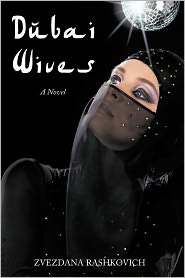
Dubai Wives (Fiction)
by Zvezdana Rashkovich
Published January 2011

About the author:
Born in Croatia and raised in Sudan, Zvezdana Rashkovich has since lived in Egypt, Iraq, USA, and Qatar. She currently lives in Dubai, where she is writing a novel based on her life in the Sudan.

Cyber coordinates:
Website: http://zvezdanarashkovich.webs.com
Blog: Sleepless in Dubai
Twitter: @SleeplesinDubai

Overview of book:
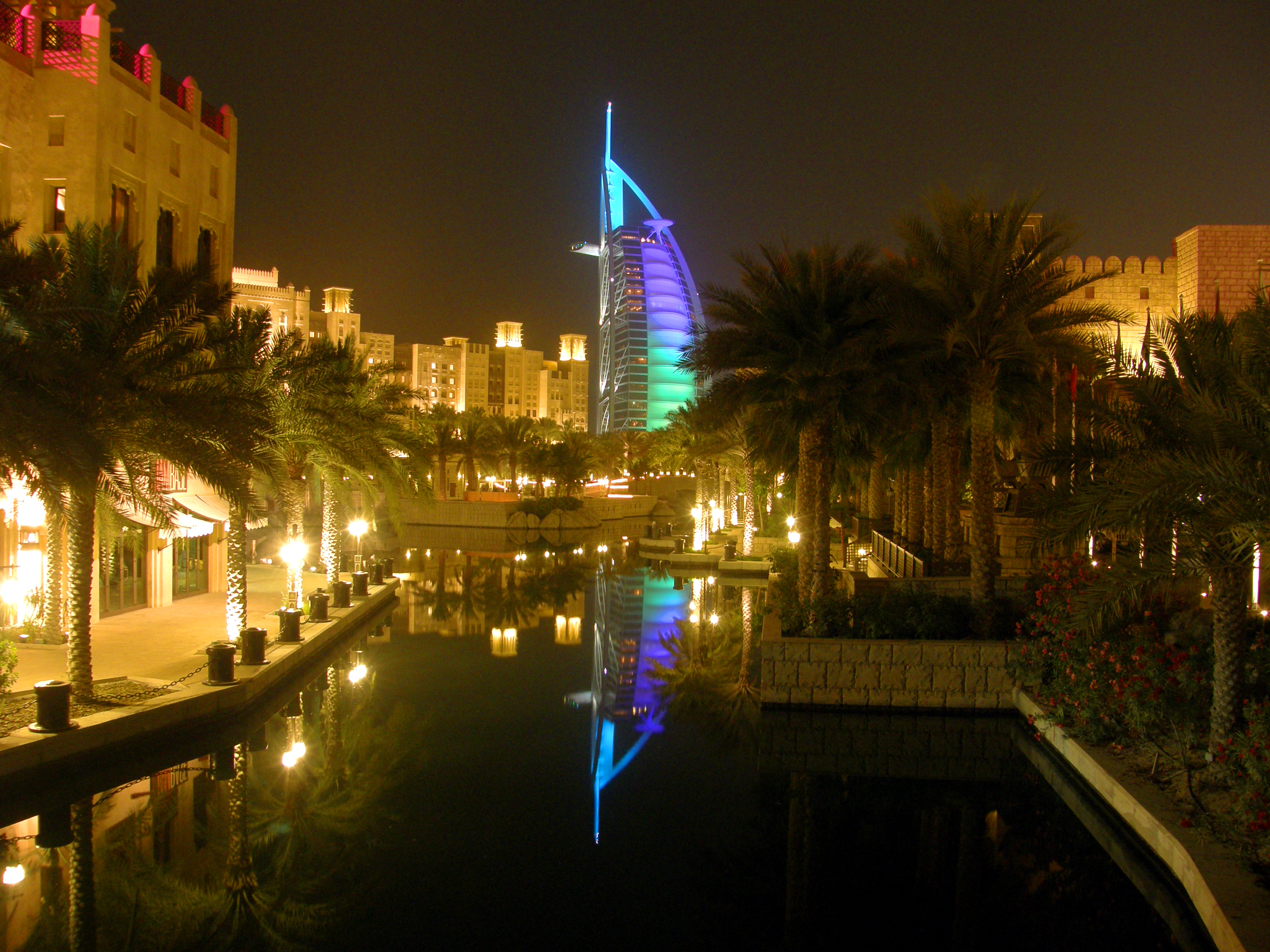
“A stirring tale encompassing tradition, identity, and faith, Dubai Wives takes the reader into a hidden world behind the walls of lavish mansions and into the desperate back alleys of Dubai; from the hills of Morocco to the gloomy English countryside and from the slums of India to the glittering lights of the Burj Al Arab.”
(From author’s website)

One reader’s review:
“The author’s greatest strength lies in showcasing the ethnic and cultural diversity of the city. There is Jewel in her Swarovski embroidered abaya, humiliated by her husband’s infidelity, the Romanian Liliana dancing in a seedy nightclub, Cora the Filipino maid desperate to rid herself of an unwanted pregnancy and plain English Jane whose Dubai make-over includes plastic surgery and belly dancing lessons as she relentlessly pursues a transformation into glamour.” (Amazon.com review)
.

STAY TUNED for Wednesday’s post, another in our new series where we investigate if you really can “go home again.”

If you enjoyed this post, we invite you to subscribe for email delivery of The Displaced Dispatch, a round up of the week’s posts from The Displaced Nation. Sign up for The Displaced Dispatch by clicking here!

Image: MorgueFile

Which country produces the people who travel the farthest, the longest — and with the most credit cards?

The Displaced Nation was contacted about doing a post on a recent survey by Travelex on “How the World Vacations” — the results of which are summed up in a cool infographic (see bottom of this post).

Since Travelex helps travelers with their foreign currency needs, they were particularly interested in finding out not only where people are traveling internationally but also how they are financing their vacations.

I thought I’d go over some of their findings and see if it helps me to understand this Big Wide World of Travel.

Really? Did I? Or did I do something altogether more irresponsible, and just pull it apart for my own amusement? Well, you all know me by now. You decide…

What’s up with international travel?

More people are doing it now than ever before. Even in the most parochial parts of England, folk are pulling the ferrets out of their trousers, staring at glossy magazine adverts and dreaming of something more glamorous than a weekend caravanning in Skegness.

Rumor has it that almost ten percent of Americans now own a passport; even more significantly, some of them have actually used them!

Yes, travel beyond one’s borders is growing — but so is the human race. So it’s only to be expected, right? (The numbers of people going abroad did decline, however, in 2008 due to the global recession, but in 2009 the upwards trend resumed.)

And now for some stereotype-busting!?

I’m not sure how much the survey tells us that we didn’t already know, to be honest — but I’m willing to be persuaded otherwise, if one of you is a better statistician than I am.

Where do the Brits go on holiday? Hmm. Tough one.

If you guessed Spain, you can give yourself a pat on the back. It is Spain. For two weeks. The survey doesn’t tell us this, but most of them spend the entire fortnight lying lobster-red on the beach before heading for the nearest bar. Had the survey asked what they ate, the finding would have been 85 percent fish and chips, of which most would have been washed down with beer — the local variety of course, because it’s so staggeringly cheap.

The destination that comes in second for the Brits? Right again! France. The main surprise is how few are going to the United States nowadays: just nine percent (versus over fifty percent to Spain and France).

The Americans? They head to Mexico and Canada. Goodness, that’s a revelation! And if they venture any further, it’s usually to Europe, especially the UK and Italy, or to the Caribbean. That said, there are a few brave American souls visiting China these days.

The survey doesn’t report this, but most Americans when they go abroad eat burgers and fries, even when sitting in an Italian restaurant. They drink beer, too — but the good stuff, because it’s still cheap, and imported, which makes everything taste better!

Noticed any Chinese tourists lately?

Thanks to its booming economy, China gets pride of place in this survey. (The Japanese used to be the most well-traveled of all Asians, but I’m afraid they’ve been displaced!)

Interestingly, the 1.3 billion Chinese are represented by a sample of 20,000; anyway, for most of them the average length of holiday is six days. Perhaps it’s not surprising, then, that they end up going to Hong Kong — which I’m not sure counts as foreign these days. (Didn’t my country transfer sovereignty to China in 1997, or have I misremembered something?)

Chinese mostly use credit cards to pay their way, despite almost a third of those being refused. Which is a shame, though I can’t say it surprises me. Would you take a Chinese credit card? Be honest.

And a surprising number, about a third, travel by boat. Still trying to puzzle that one out, given how short their vacations are. Fear of flying, perhaps? I’ve heard some nightmare stories about China Airlines.

How about Brazilians?

Another booming emerging economy is Brazil, which is the fourth country to be featured in a big way in the survey. Guess where most Brazilians go? You got it, their wealthy neighbor to the North, the United States!

But what I’d really like to know is whether the five percent of Brazilians who had their bank cards stolen were the same ones that said they traveled by rail — in which case, it serves ’em right. Everyone knows that if you take a train in Brazil, you get robbed — it’s, like, common knowledge.

International holiday central

Australia, my adopted and much beloved homeland, makes a brief appearance in the statistics for “how long they stay.” We’re at the top of the charts. Did you know that Aussies having the longest holidays IN THE WORLD, by almost a week?

The survey doesn’t tell you how often we go abroad and where we go, however.  Because if you knew that every man, woman, child and most of the sheep here take a foreign holiday every single year — and that the vast majority spend it in Bali — you’d have perished of jealousy by now (or else looking into emigrating!).

As it is, I’m worried that if the Chinese see that Aussie vacations are almost three times longer than theirs, it will trigger a revolt, for which Australia will somehow be blamed! 🙂

Herzlichen Glückwunsch!

In their write-up of the survey findings, Travelex said:

We were surprised to find that the most consistent destination for international travel seems to be Germany. That’s right! Germany. We guess lederhosen and lagers hold a certain amount of appeal no matter what native language you speak.

It’s a fair point — who’da thunk it? Even the Chinese went to Germany. Well, 1.9 percent of them did. (Which, out of the 20,000 vacationers surveyed, means at least 382 out of a country of 1.3 billion.) Germany must be thrilled at this news of its new-found popularity across cultures.

I suppose another surprising finding is that while Chinese are busy having their credit cards turned down, Brits tend to err on the side of caution, doing their money exchanges before they leave, while many Americans are still getting away with using dollars — despite the recent talk of abandoning the U.S. dollar as the single major reserve currency.

* * *

It’s often said that statistics can be made to say whatever you want them to say. And then of course, there’s the old truism that 97.6 percent of statistics are made up on the spot…

Not that I’m saying Travelex did any of this, of course. Far be it from me to cast aspersions on their information-gathering tactics. I’m just wondering if something like this can tell us much. Still, it’s a pretty infographic — the designer of which has certainly earned a vacation overseas, in my opinion!

Please talk to me in the comments. Are you into travel surveys? Have I missed something earthshaking in this one? Am I being too flippant? I’d love to know your thoughts!

Additionally, you can hit us up on Twitter: @DisplacedNation and/or @TonyJamesSlater

And now for that fabuloso infographic:

STAY TUNED for Tuesday’s post reviewing some books by expats in Dubai.

If you enjoyed this post, we invite you to register for The Displaced Dispatch, a round up of weekly posts from The Displaced Nation, with seasonal recipes, book giveaways and other extras. Register for The Displaced Dispatch by clicking here!

Related posts:

Infographic courtesy of Adria Saracino, Distilled Creative.

LIBBY’S LIFE #54 – Opening the cocoon

There’s probably a word for it in the Complete Oxford English Dictionary. An obscure word that only makes an appearance on Radio 4 intellectual game shows. Something like:

Tri-gami-matri-taci-filial (noun, Old English) — the silence of a son regarding his mother’s marriage to a serial bigamist after the father’s third marriage.

Then people like Stephen Fry and Paul Merton would make clever, rude jokes about this word, and you’d wonder why the English language possessed such an item, because such a situation was unlikely to exist.

Except the situation does exist, and consequently I’d like to know the word that has this definition:

“The pissed-off feeling after realising that your husband of nearly seven years has accidentally-on-purpose forgotten to tell you that his estranged father was a serial bigamist and didn’t run off with a local librarian like he and your mother-in-law had always led you to believe.”

I mean, it’s not as if it would have mattered, is it? If Oliver had told me on our second date, “Oh, by the way, Libs, I didn’t grow up with a father because my mum found out that he was married to a couple of other women at the same time” — I would hardly have stomped out of the restaurant before he could ask me out on a third date.

Did he really think I would have said, “God, Oliver, I’m glad you came clean with me now because obviously, there is no way I could marry the spawn of such pond slime”?

I know what you’re thinking. If it wouldn’t have been such a big deal on our second date, why am I making a fuss now?

Because it’s gone past the point of being an unfortunate fact about Oliver’s ancestry. Ten years ago, before our engagement, I could have processed the knowledge and said, “Poor Oliver. Your poor mum. What a terrible thing to happen.”

Now, although I still think that way, pity has been overtaken by hurt that Oliver couldn’t see fit to tell me.

I am being treated like the criminal, but why? The real criminal is Oliver. He has known about this all along, and in the ten years we have known each other, has never told me this story, although it’s obvious that he knew. Why did he not feel he could tell me, his girlfriend, his fiancé, his wife, his soulmate? Has he so little faith in me? I feel bereft, my faith in Oliver plundered.

But self-pity inevitably mutates into anger.

Today, I am angry, and everyone knows it.

Well, nearly everyone. Jack knows it, George knows it, and Beth knows it. The only person who is oblivious is Oliver himself, the object of my anger, and as usual he’s out, avoiding the issue. Avoiding me.

Meanwhile, rage swirls around my head and seeps out through my ears, filling the house with noxious atmosphere.

I’ve been passive too long.

I gather up the twins and strap them into the double stroller. Jack peeps cautiously at me from behind the sofa where he is quietly playing with Lego bricks.

“Put your sneakers on,” I say. “We’re going out.”

*  *  *

It’s a long time since we’ve been out.  Nursery school has finished for the summer. After the first couple of weeks when the Coffee Morning Posse delivered freezer casserole after freezer casserole, no one has been to visit — not even Maggie. I suppose they think I’ve got enough to do without catering to visitors. Even my mother has been quiet, phoning only once since she got back home. For the last few weeks, I’ve holed myself up in the house, seeing no one, ordering groceries online, too depressed and timid to put a foot outside.

But today is a beautiful, sunny day, my anger is invigorating, and I’m tired of being a hermit. I make Jack hold the handle of the stroller, loop Fergus’s leash round my wrist, and off we set, along Juniper Close.  We are walking to Main Street, to a place of busy-ness, to be with other people who will only coo at my babies and won’t see the rage and hurt in the back story.

Fergus, however, has other ideas. He crosses the street docilely enough, but as we turn right towards the road that leads to Main Street, however, he lags behind and his leash pulls on my wrist. He wants to go the other way.

I tug on the leash. He sits. I tug again. He lies down.

It’s an impasse. Fergus and I stare at each other. He usually wins these stare-down contests, but I’m in no mood for defeat. Today, I’m determined to win, so I don’t break my gaze, not even when I hear footsteps on the sidewalk behind me. Whoever it is can step onto the road and walk around us.

The footsteps slow, then stop.

“We first met,” I hear Maggie say, “when there was another drama going on between you and this dog. I haven’t seen you out with these children for weeks. Were you coming to see me?”

I continue to stare at Fergus so I don’t have to meet Maggie’s eyes. She’s right. I haven’t seen her since the twins were a couple of weeks old. How time flies when you’re having fun.

“If I hadn’t seen you today,” she goes on, “I’d have come to visit. I don’t like to intrude, but…”

“It’s been difficult,” I mutter. “The twins — they’re a lot of work.”

“I’m sure they are,” she says. “And from what I hear, so is your husband.”

She has my attention now.

“How do you know?” I demand. “What do you know?”

Maggie places a hand on my forearm and takes Fergus’s leash from my wrist. She gives the leash a gentle shake, and he gets up to stand by her, as docile as you please.

“Your mother and I became pretty good friends while she was here, you know. We made an agreement. I would be there for her daughter in America, and if the need ever arises, she will be there for mine in England.”

Mums’ Army. The Maternal Foreign Legion.

“Come on, Jack,” Maggie says, taking his hand. “Back to Granny Maggie’s house.”

With difficulty, I turn the wide stroller around to face the other direction.

“‘Granny Maggie’?” I ask. “Does that make you my mother, then?”

Maggie smiles, just a little.

“The next best thing on this side of the ocean,” she says.

.

Next post: LIBBY’S LIFE # 55 – Dark secrets

Previous post: LIBBY’S LIFE #53 – Preserved on tape 

Need the 411 on characters in Libby’s Life? Click here for  Kate’s page  of Who’s Who in Woodhaven.

Click here to read Libby’s Life from the first episode.


STAY TUNED for Monday’s post — a Dolce Vita Slideshow!

If you enjoyed this post, we invite you to subscribe for email delivery of The Displaced Dispatch, a round up of the week’s posts from The Displaced Nation. Sign up for The Displaced Dispatch by clicking here!

Image: Travel – Map of the World by Salvatore Vuono / FreeDigit