The Displaced Nation

A home for international creatives

Category Archives: Golden Oldies

Baby, it’s cold outside — so why did I choose to become an expat in Boston?!

James_Murray_fireThe Displaced Nation got through January without grousing too much about the winter doldrums. But our monthly guest columnist James Murray, a displaced Brit in Boston, will not let the same be true of February. Enjoy his short post — he was too cold to write more!

Winter seems to me a bloody silly time to start any kind of resolution.

Want to jog? Why not start when you can venture outside without the high-density wool coat?

Want to write every morning? In fingerless gloves I assume?

About the only kind of resolution I can imagine keeping is a commitment to a higher standard of personal cleanliness, because I just feel like taking hour-long hot showers most of the day.

Winter just makes you want to be elsewhere. Anywhere but here — and the problem is that this applies to whichever “here” you happen to be inhabiting.

So it’s nothing personal, Boston, when I tell you each and every balls-contractingly cold morning what you can do with your damn winter.

Just like it was nothing personal when I told New Zealand that it should get its shorts-clad arse in gear and install some insulation because let’s face it, it doesn’t matter how mild it is outside; seeing your breath in the morning is a severe disincentive to removing your head from under the covers.

Winter has the effect of making you wonder if you’ve made some kind of mistake — whether you’d be happier in a far distant land where they don’t have the subtle divisions of “chilly,” “cold” and “freezing”; where their scales start at “mild” and only go upwards.

But the project for this year is, as far as possible, staying put. The tangent-curved graph depicting our rapidly climbing heating bill will not deter us; the face-paralysing wind will not stop us from riding our bikes like the foolish pseudo-hippies we are; the desaturated colours of the lifeless trees will not bring us down to the point where we won’t leave the house, and above all, the lure of foreign climes will not force us to quit the place we’ve worked so hard to get to.

After all, we have a secret weapon: a fireplace; and so we know that no matter how drearily the wind may whistle or how uncomfortably cold the bathroom tiles may get, we can still hunker down, roast our remaining chestnuts and hold out for Spring.

James Murray is a self-described “itinerant Brit.” After a stint in New Zealand, and some travel in Southeast Asia, he and his American girlfriend — now wife — are practicing “staying put” in Boston, where James is pursing a career as a wordsmith for marketing and fiction, and as a non-professional theatre director. He is also a Utopian idealist and SingStar enthusiast. You can find more about his views by reading his blog, Quaint James, and/or following him on Twitter: @quaintjames.

STAY TUNED for another episode in the life of our fictional expat heroine, Libby. (What, not keeping up with Libby? Read the first three episodes of her expat adventures.)

If you enjoyed this post, we invite you to register for The Displaced Dispatch, a round up of weekly posts from The Displaced Nation, with seasonal recipes, book giveaways and other extras. Register for The Displaced Dispatch by clicking here!

Related posts:

img: James Murray stoking the fire (his own).

5 movies for expats and world travelers looking to stir up romance this Valentine’s Day

Editor’s note: Today we are happy to welcome a new member to the Displaced Nation team, Andy Martin. His debut post introduces our two favorite February’s themes: Valentine’s Day (aka expat love) and displaced movies (in honor of Oscar season). For those who haven’t read Andy’s Random Nomad interview with us, it’s worth knowing that he’s a UK-qualified social worker who now lives in Brazil with his Brazilian wife, and a self-professed football geek.

One of the things I discovered when I moved to Brazil is that Valentine’s Day is not actually celebrated here until 12th June, where it is instead known as Dia dos Namorados (Boyfriend’s/Girlfriend’s Day). The reasoning for this is that 12th June is the eve of St. Anthony’s Day, the saint otherwise known as “the marriage saint.”

Additionally, what the rest of us know as Valentine’s Day (14th February) typically falls during or around the time of Carnaval, and anyone who knows anything about the excesses of Carnaval knows that a holiday to celebrate fidelity may probably be best left until later in the year — say, June time.

Anyhow, seeing as my wife has lived in the UK and now openly embraces British culture she’s suggested that it would only be proper to celebrate both the British and Brazilian holidays — she’s a clever one! And what more traditional way to celebrate than a trip to the cinema?

Bearing this in mind, I’ve made a list of 5 films that couples like us — multicultural, expat, glolo and/or nomadic — might like to watch this coming Valentine’s Day, to stir up the romance of travel that brought you together in the first place…

The one about adventure

IndianaJones_small1) Indiana Jones and the Raiders of the Lost Ark (1981), dir. Steven Spielberg
An action-adventure drama that pits Indiana Jones (played by Harrison Ford) against a group of Nazis who are searching for the Ark of the Covenant because Adolf Hitler believes it will make their army invincible.

Why I like it: The original Indiana Jones trilogy was released between 1981 and 1989, and despite the pointless release of Indiana Jones and the Kingdom of the Crystal Skull in 2008, it will forever remain, for my generation at least, what introduced us to the potential excitement of exploring the unknown.

Personal note: I love my in-laws but they neglected their parenting duties in one pretty big way: their failure to introduce my wife to Indiana Jones (a situation that has, thankfully, now been rectified).

Most stunning aspect: Let’s face it, any film that can make archaeology seem like the coolest profession in the world has got to be doing something right hasn’t it?

The ones with the romantic clichés

The traveler is often accused of being a romantic, an idealist and of someone who is running away from life and all the problems and commitments that go with it. The alternative argument is that the traveler is actually taking life by the scruff of the neck and living it to the full.

Either way, two films that best capture this dialectic are the two that often most lionized by today’s generation of travelers:

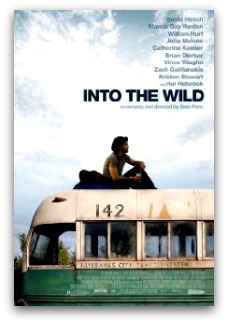
IntotheWild_small2) Into the Wild (2007), dir. Sean Penn
An adaptation (also by Penn) of the book of the same name, by Jon Krakauer, depicting the true story of Chris McCandless, a 24 year-old American and persistent wanderer whom believed that there was more to life than settling for the 9-5 grind in an office.

Why I like it: My wife introduced me to it (her riposte to my Indiana Jones exasperation). She had watched it early on in our relationship, when she was in Brazil and I was in London — a genuinely long distance relationship.

Personal note: She said that the film’s protagonist, Chris McCandless, reminded her of me — although fortunately our story has had a bit of a happier ending than his (I’ll say no more in order not to ruin it for you).

No half-measures: Boy did McCandless walk the walk, giving away his $24,000 college fund to charity before hitchhiking to Alaska and plunging into the wilderness, gradually seeking the means to remove himself from the “real world. ”

TheMotorcyleDiaries_small3) The Motorcycle Diaries (Spanish: Diarios de motocicleta) (2004), dir. Walter Salles
A biopic of Ernesto “Che” Guevara as a young man, representing an adaptation of Che’s memoir of the same name, recounting the trip he made around South America with his best friend, Alberto Granado.

Why I like it: Whatever you view of Che is, there is actually relatively little politics in the film, although one is introduced to some of the experiences that started to inform what he later became in life. Instead, for the most part, this is a film which perfectly captures what is to be young and curious of the world outside your own town or city. Che and Alberto chase beautiful landscapes and beautiful people, but also volunteer their time to those less fortunate than themselves.

Personal note: This film was the tipping point in inspiring me to travel around South America.

Memorable scene: There’s a great scene that highlights the dichotomy between the travel romanticized by “travelers” and that which is driven by the needs of most other migrants around the world — the topic of my guest post last month for The Displaced Nation. In it Che and Alberto meet an indigenous couple who have been forced from their lands and who are traveling in order to find work. When the couple ask Alberto and Che why they are traveling, they reply: “We travel just to travel.” Confused, the wife replies: “God bless you.”

The one about being displaced

Lost_in_Translation_small4) Lost in Translation (2003), dir. Sofia Coppola
The story of the unlikely bond between an aging movie star, played by the awesome Bill Murray, and a trailing spouse (Scarlett Johansson), after they meet in the bar of their five star hotel in Tokyo.

Why I like it: Life as a nomad is not all about romantic adventures and life-changing experiences — there are also just as many challenges and struggles: homesickness, culture shock and loss being just some of them. Lost in Translation is, perhaps, one of the films that best explores some of these issues.

Additional benefits: The story is poignant, and the film is beautifully shot.

The one that’s not actually about travel or expats

Blood_into_Wine_small5) Blood Into Wine (2010), dirs. Ryan Page & Christopher Pomerenke
A documentary about the Northern Arizona wine industry focusing on the musician Maynard James Keenan and Eric Glomski and their winery, Caduceus Cellers.

Why I like it: This film doesn’t really have anything to do with either travel or expat life, but I’m including it here because it’s about one of my favorite artists: Maynard James Keenan. A slightly biased choice perhaps, but I think it deserves a merit for the way it encapsulates the spirit of those people who have dreams and then act upon them to make them happen — a spirit which, I think, drives many of us travelers and expats.

Maynard’s dream: Maynard dreams of starting a vineyard in Arizona. Yes, Arizona. Despite the doubts and concerns of the experts he consulted Maynard invested almost his entire fortune, made from working with the bands Tool and A Perfect Circle, to start a vineyard in Arizona — a state entirely unknown for growing wine.

Does he succeed? You’ll have to watch it, I guess… And don’t forget to invite a date!

* * *

Readers, what do you think of Andy’s suggestions? Are these the sorts of films that make you feel romantic, or do you think he’s bonkers? We’re open to any and all comments…as well as to further recommendations of films likely to bring out the romantic side in us glomads!

STAY TUNED for tomorrow’s post from our monthly columnist, James Murray, who right now can be found in front of his fireplace in Boston — and not because he’s in a romantic mood! Far from it…

If you enjoyed this post, we invite you to register for The Displaced Dispatch, a round up of weekly posts from The Displaced Nation, with seasonal recipes, book giveaways and other extras. Register for The Displaced Dispatch by clicking here!

Related posts:

RANDOM NOMAD: Andy Martin, UK-qualified Social Worker, Football Geek & Now a São Paulo Resident

Andy_MartinPlace of birth: Chatham, Kent, United Kingdom
Passport: UK
Overseas history: Brasil (São Paulo): February 2012 – present. I also had a period of travel around South America between 2007 and 2008.
Occupation: NGO Volunteer, English teacher, blogger
Cyberspace coordinates: The book is on the table: An Englishman’s guide to living in São Paulo (blog) and @andyhpmartin (Twitter handle).

What made you give up London for São Paulo?
For some reason — probably because I’m a massive football geek — I had always wanted to go to South America, and so when I found out that one of my best friends was planning to travel there, it took very little persuasion for me to tag along. Then whilst there I met my future wife, who is Brazilian, and it all got a bit more complicated.

First she moved to live with me in the UK. We got married and stayed in London for three years. However, she had deferred her degree in Brazil to move to London, where I had a job as a social worker. I am a qualified social worker and spent almost nine years working in various social or community work roles. For most of that time I specialized in supporting refugees and asylum seekers. But when my job became uncertain due to government cuts (due to the economic crisis), it seemed like the perfect opportunity to move to Brazil so that my wife could finally get everything finished.

So now you’re a trailing spouse. Does anyone in your immediate family share that fate, or do they all live in the UK?
When I first traveled to South America in 2007, I was pretty much the first person in my entire family who had ever traveled outside of Europe, so I can’t really say there’s any significant history or influence of having the urge to want to explore or become “displaced.”

You haven’t been in São Paulo for long, but can you pinpoint a moment when you have felt displaced?
I had been to São Paulo twice before I moved here and I was already quite familiar with South America as a whole, so was pretty well prepared for what to expect — although there’s no doubting that living somewhere and just visiting are entirely different things.

But if I had to pick one thing, it wouldn’t be a moment but more the constant challenge of living somewhere where you are unable to speak your mother tongue. We Brits are notoriously bad at learning languages, and I can barely remember any of the French or German I learned at school. I did learn some Spanish whilst traveling in 2007, and in some ways this helped because of its similarities with Portuguese, although on the other hand it was also a hindrance because of their very many differences.

Not being able to fully communicate your thoughts is obviously very frustrating and when you’re having a bad day, it just intensifies your sense of displacement and dislocation. Fortunately, Brazilians are pretty intrigued by people (especially those from the “West”) who have moved to Brazil and are trying to learn Portuguese. They’re often very forgiving when you make mistakes. It also helps that many Brazilians themselves tend not to speak grammatically correct Portuguese, so in effect your own mistakes are just contributing towards the evolution of the language (that’s what I like to convince myself, anyway!).

When have you felt the least displaced?
One of the things I love about Brazilians is their general informality. As someone who’s never worked in an office or a suit, I feel right at home. For example, people are often referred to by their nicknames (even the former President was) and rarely, if ever, by their surnames. Also, Brazilians tend not to make a big deal out of social occasions — it’s more about making sure you’re surrounded by the people who matter to you. As long as there’s cold beer, everyone’s happy.

How could you not feel at ease?

You may bring one curiosity you’ve collected from the country where you’ve lived into The Displaced Nation. What’s in your suitcase?
Again, as a self-confessed football nerd, I think it would have to be my collection of football shirts. I have one from pretty much every country I’ve been to, and I’ve lost count of how many I’ve acquired in South America.

You are invited to prepare a meal for the Displaced Nation, based on your travels. What’s on the menu?

Starter: Salgadinhos (savoury snacks) are fantastic so a platter of these, including:

Main: It’d have to be a churrasco (Brazilian BBQ). That may sound pretty unimaginative, but once you’ve had a Brazilian BBQ, especially those from the south, you’ll forever wonder why it took you so long to do so.
Dessert: A selection of some of Brazil’s finest (and weirdest looking) fruits. Believe me, I’ve seen fruits in the markets here which look like they have been imported from Mars. They taste great, though.
Drinks: Brazil’s most famous cocktail, a caipirinha, which is a hangover-inducing concoction of cachaça (sugar cane rum), lime, sugar and ice. Refreshing, tasty and deceptively lethal.

Now that you are hard at work learning the language, can you donate a Brazilian Portuguese word or expression to the Displaced Nation’s argot?
Tudo bem? This is pretty much said every time you greet someone in Brazil and literally translates as “Is everything okay?” It reflects quite nicely, as I mentioned previously, how Brazilians prefer to keep things simple and informal.

This month, we’ve been focusing on the need for mentors: people who teach us what we need to know, or remind us of things we have buried deep. Have you found discovered any new mentors, whether physically present or not, in your life abroad?
As mentioned in my guest post this month for the Displaced Nation, when I’m going through a period where I’m missing home or things get tough, I often think about some of the kids I worked with back home in London (in my last job I worked with unaccompanied minors from countries such as Afghanistan).

Thinking about the challenges they as young kids faced after fleeing their home countries — but then still being able, on the whole, to go on and make the most of their new lives — always helps me to put into perspective the things I tend to moan or stress about here, in what is fortunately a much easier experience of displacement.

Apart from that, I read as widely as possible. For instance, I recently really enjoyed Alain de Botton’s The Art of Travel.

If you had all the money and time in the world, what topic(s) would you choose to study in your adopted country?
I guess, given my pre-existing interest and work experiences with migration, I’d like to study the history of migration to Brazil. Brazil is a country defined by (im)migration — for example, my wife has indigenous, Spanish, Italian and Portuguese heritage, a mix that is is pretty normal for Brazilians. It would be fascinating to piece it all together in order to get a more holistic understanding of who Brazilians really are.

I’ve always wanted to do a PhD, so who knows, maybe this might be my research proposal one day!

Readers — yay or nay for letting Andy Martin into The Displaced Nation? A social worker who is taking lessons from the Brazilians on how to be more social? Who is used to helping the displaced and is now displaced himself — so may be in need of our help? (Note: It’s fine to vote “nay” as long as you couch your reasoning in terms we all — including Andy — find amusing!)

STAY TUNED for tomorrow’s post, an expat take on the muses of Classical Antiquity.

If you enjoyed this post, we invite you to register for The Displaced Dispatch, a round up of weekly posts from The Displaced Nation, with seasonal recipes, book giveaways and other extras. Register for The Displaced Dispatch by clicking here!

Related posts:

Img: Andy Martin travels within his native land (the Norfolk Broads, 2010), a couple of years before his expatriation.

CAPITAL IDEA: London: A quick guide

LondonWelcome to the first “Capital Ideas”. It is a new feature here at The Displaced Nation. It’s our somewhat idiosyncratic, ever so slightly tongue-in-cheek guide to various world cities, perfect for the ever discerning readership of this blog. We know our readers are always visitors, never tourists (an important distinction).  Do feel free to contribute your own ideas or suggestions in the comments section, we’d love to hear your thoughts, too.

City: London

Where is it? On some damp, mildew-ridden island in the north Atlantic.

Why should I go? Because it’s one of the world’s great cities. An exciting modern city with a diverse population of eight million there’s something for everyone. With hosting the Olympics, 2012 was a great year for the city and infused it with a self-confidence unusual to the British. Quite simply, this is the perfect time to visit London.

So is it true that when a man tires of London he is tired of life? Not if he’s living in Dalston.

I don’t know anything about Dalston. You’re not missing much.

What are the must sees? Well, if you want to be that tourist, you know the one who wears pristine white sneakers and white socks, keeps their passport safe in their fannypack and planned their trip after taking out a Rick Steeves travel book from 1986, then the basic checklist is Big Ben, Buckingham Palace, St Paul’s, Tower of London. You can do all that by popping on one of those tourist trap sightseeing bus tours. You’ll get to sit on the top of a double-decker with other fannypack wearers — it’ll be beautiful.

Hmm, I don’t have a fannypack. Not to worry. You’re a The Displaced Nation reader, you want something a little more “not for tourists,” don’t you?

You know me so well. Tours can be good fun for the visitor limited in time. However, instead of those overpriced bus tours, we recommend London Walks. Brunel’s Thames tunnel, in particular, is one we’d recommend for a fascinating and sadly forgotten part of London’s history — it was once considered the eighth wonder of the world.

What about a walking tour that sounds a bit more “fun”? Well, provided you’re not traveling with kids, you could also do a pub crawl. That fun enough for you?

Absolutely. Any other suggestions? Spend a morning at Lincoln’s Inn Fields. There you’ll be able to visit two fascinating museums that are among our London favorites. There’s the Hunterian Museum (an C18th collection of anatomical specimens including the skeleton of Charles Byrne, known as the “Irish giant”) at the Royal College of Surgeons and across the fields is Sir John Soanes’s Museum (the former home of architect Sir John Soanes, the museum contains his extensive collection of antiquities and paintings). Or, if you’re in the city in the summer then venture to the north of the city and visit Highgate Cemetery. There you’ll be able to get a guided tour of the western cemetery – resting place of Michael Faraday and Christina Rossetti. In the eastern cemetery rests Karl Marx.

What’s a must-do? Spending time on the South Bank. Here you’ll find the National Theatre, the Royal Festival Hall, the Globe and the BFI Southbank (formerly known as the National Film Theatre). So the perfect place to take to showcase the city’s cultural merits.

Is the city easy to get around? Yes, although Londoners like moaning about the public transport, the city is home to one of the world’s best public transport systems. Familiarize yourself with the London Underground (known as “the tube”) and you can travel around the city easily and relatively cheaply. If you are a night owl then you need to remember that the underground stops running trains between 12.00am and 12.30am.

I hear the British cooking is awful. Do I need to pack sandwiches when visiting London? That outdated stereotype. London is home to some of the world’s best restaurants. And don’t forget how I mentioned earlier that London had such a diverse population, that’s reflected in the city’s restaurants. Whatever you fancy, be it Eritrean or Burmese, you can find it in London. Our recommendation is that you take a trip to Brick Lane for a slap-up Indian dinner.

Hmm, my mate John visited London last year and said the food still sucked. Did John stick with the tourist traps? New York is a great city for eating, but if you only go to restaurants at Time’s Square you’re not going to get that impression. One easy tip, never eat in an Angus Steak House.

So the locals don’t all eat jellied eels? No, but if you do want to experience an old cockney-style pie and mash shop, then we recommend Goddard’s at Greenwich. If you’re being really adventurous and want to unleash your inner pearly queen by having some jellied ell then this is the place to do it.

Have you ever tried it? Yes.

Did you like it? Let’s just say it was interesting.

What should I read? If you want to brush up on London, then we’d suggest Peter Ackroyd’s London for a nice, meaty read about the city, as well as his book The Thames. Other books we’d suggest are Iain Sinclair’s London: City of Disappearances, Henry Mayhew’s London and the London Poor and James Boswell’s London Journal. And, of  course, you can’t visit London and not be reminded of Dickens (do make a trip to the Charles Dickens Museum  , at 48 Doughty Street). We think Bleak House and Our Mutual Friend best show off  Dickens’s writing on London.

What should I watch? Notting Hill.

Really? Yes, it’s the most accurate cinematic depiction of the city.

I’m going to say this again, really? It’s so accurate that there’s even now a Notting Hill Carnival. This happens once a year where fans of the film get together and dress up as their favorite characters from the film and reenact their favorite scenes. Our top tip is that if you’re in London at the same time as the carnival, you should dress up as Julie Roberts or Hugh Grant and go up to people and tell them your favorite lines from the movie. They’ll love.

I really don’t think that’s what the Notting Hill Carnival is all about. Hand on heart, it’s true.

Hmmmm . . .

STAY TUNED for tomorrow’s post, a new Random Nomad interview.

If you enjoyed this post, we invite you to register for The Displaced Dispatch, a round up of weekly posts from The Displaced Nation, with seasonal recipes, book giveaways and other extras. Register for The Displaced Dispatch by clicking here!

Related posts:

Image: awindram

Do refugees and migrants have anything in common with us expats? No, and yes…

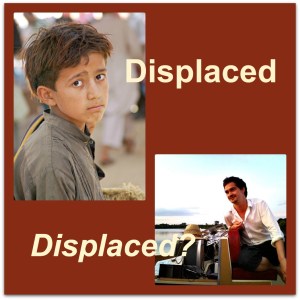
displacedvdisplacedBelieve it or not, the Displaced Nation has occasional qualms about whether “displaced” is the right word to describe a group of expats and internationalists. What does a group of privileged travelers have in common with refugees or migrants who’ve had no choice but to leave their homelands? We thought we’d begin the new year by touching on this vexed question, this time with the help of a mentor, Andy Martin. Andy is now an expat in Brazil, but he previously worked with refugees in London.

— ML Awanohara

Before moving to Brazil in February 2012 I worked with refugees as a social worker in the UK, and my last job entailed supporting unaccompanied minors: children as young as 11 who flee conflicts and persecution in countries such as Afghanistan — on their own.

And it is of them that I remind myself when I reflect upon my own struggles and anxieties at being “displaced” from my own country. Suddenly, my tongue-in-cheek British moans about uncomfortable buses and lopsided pavements (yes, pavements), or my frustrations with struggling to learn Portuguese, seem trivial when contrasted with the experiences of the young people I worked with.

Given this, it would seem bizarre for a rich (relatively) migrant like myself to even contemplate comparing my experiences of displacement with those who flee poverty, persecution or some other unimaginably unfortunate situation that most of us will thankfully never have to experience.

Or is it?

Well, I guess the differences are probably easier to distinguish — for example:

1) The reasons for the migration

Whilst refugees are forcibly displaced through circumstances outside of their control, more fortunate gringos like myself possess far greater agency when it comes to the motives for our movements: love, jobs, travel, etc.

2) The journey itself

Forcibly displaced people often leave their homes unexpectedly with no belongings, or else hurriedly sell whatever possessions and land they have in order to fund their flight, whilst my wife and I had carefully planned our move for over two years (well, we read a few books and, to be fair, she is Brazilian herself — which helps).

What’s more, the route a refugee takes is often perilous, taking months or even years, and in turn may comprise many different means of movement: on foot, by car, on overcrowded boats, airtight lorries or refrigerated trucks. On top of that, their destinies also usually lie in the hands of people smugglers.

My wife and I, though, as middle-earners in the UK, booked our flight with a click of our laptop, and the path from our flat in London to our new life in São Paulo was no more than a day’s inconvenience — and a relatively smooth and comfortable one at that.

I had the cabin crew to serve me unlimited amounts of Cabernet Sauvignon and my biggest anxiety was which of the in-flight films to watch: Moneyball or Midnight in Paris?

3) The arrival at the new destination

Refugees are typically at the complete mercy of the host countries they successfully manage to reach. Most likely, they are from countries for which there are strict immigration controls and they are typically confronted not with empathy but with a culture of disbelief — yes, 11-year-old kids from Afghanistan with no family.

A British citizen like myself meanwhile, merely through my place of birth, possesses a passport that requires one of the fewest number of visas to travel around the world. Even when there is a requirement, particularly to live or work, it’s often pretty straightforward.

Refugees, though, even if they are granted some form of status, will by the nature of their former lives typically have to start from scratch, their qualifications often meaningless (that’s if they can even prove them) — and thus with access to only menial jobs and bottom-of-the-rung housing.

And then, once they’re settled, the mental scars from the trauma they’ve experienced will slowly emerge.

Fortunately for me — with the education I’ve received, the qualifications I’ve gained and the work experience I’ve accumulated — I’ll be in a far better position to start my dream life abroad.

Just take me to the beach already!

* * *

So far, so different then.

Is it really possible then that the experiences of forcibly displaced people can ever be compared to those whose displacement is chosen?

Well, yes, I think they can. Here’s a couple of ways we are similar:

1) The requisite adjustments to a new culture

One of the fascinating things about my job back in London was listening to people describe their reactions and adjustments to their strange new worlds. And, as you can imagine, the youthful frankness of the kids I worked with often made these accounts hilarious and, perhaps, more honest.

For example, I remember one young person seemed bemused as to why on one particularly hot day (well, relatively anyway) in London, so many people were stripping off their clothes and heading to the local park to sunbathe. He only realized why when by the next time I had seen him, there had been subsequently been 20 successive days of rain in London.

“Welcome to the UK,” I joked.

2) The occasional bouts of homesickness

It wasn’t, of course, just the things they were discovering which were intriguing, it was also what they were missing. For some it was their homelands, for others it was speaking their language, whilst often it was specific things like their mother’s home cooking, although most commonly it was the weather — of course.

However, a common and I guess obvious sadness amongst all of them was missing people — whether that be their friends, family or both.

* * *

In sum, writing my blog over the past year has made me realize that despite our very many differences all migrants share some common behaviors: that of exploring, adjusting and, inevitably, comparing (in my case moaning), as well as reflecting upon the losses we have to make in order to get to where we are.

At the same time, I’ve also acknowledged that my own anxieties are not trivial just because they might seem so in comparison. They are real and probably shared by many people. However, thinking about those kids back in the UK just gives me the motivation to try even harder.

Thank you, Andy, for that reality check! Readers, what did you think of Andy’s analysis?

British by birth and slowly becoming a little more Brazilian each day after moving to São Paulo a year ago with his Brazilian wife, Andy Martin is also a qualified social worker in the UK, who specialized in supporting refugees in negotiating the process of displacement. Now, as a migrant himself, he is finding out whether any of the advice he gave them was of any use in the first place. Andy is also known to drink tea, warm beer and play cricket, none of which Brazilians seem to be massively convinced by. You can learn more about him by following his blog, The book is on the table, and/or following him on Twitter: @andyhpmartin.

STAY TUNED for next week’s posts.

If you enjoyed this post, we invite you to register for The Displaced Dispatch, a round up of weekly posts from The Displaced Nation, with seasonal recipes, book giveaways and other extras. Register for The Displaced Dispatch by clicking here!

Related posts:

Images: The photo of the boy is from Morguefiles; the other photo is of Andy Martin (his own).
RANDOM NOMAD: Maggie Eriksson, Displaced Californian in Sweden and Student of Swedish

Maggie_pmPlace of birth: Arcadia, California, USA
Passport: USA & Sweden
Overseas history: Sweden (Landskrona, Malmö): 2005 – present.
Occupation: Unemployed and looking for a job. Meanwhile, I’m studying more Swedish since I’m far from fluent.
Cyberspace coordinates: Mag Wheels (Posterous) and @magsinsweden (Twitter handle).

What made you give up California for Sweden?
My husband is Swedish. After working for five years at the California lab for a small pharmaceutical company, he really wanted to go back home. We started the process in 2003, and a couple of years later, in spring 2005, we finally made the move.

How did the pair of you meet?
He was working as a chemist in Sweden and the company transferred him to their lab in California. We met on a Yahoo message board — he was looking for people to meet in California before he moved. I had been online dating a bit, and when I saw his message I replied. We started to exchange e-mails, then letters and phone calls. After six months we met in real life. 🙂 We dated for a few months and got engaged soon after. We have been married for 12 years. We have no children but share of life with our seven-year-old border terrier named Jake.

What things about Sweden did he miss when living in your part of the world?
Besides his family and friends, he missed Swedish Christmas, Swedish candy, the country’s socialized health care, and its four seasons.

So now you’re displaced. Do you share that fate with anyone else in your immediate family?
No! I’m the only one in my family that lives between cultures.

You’re also job searching in a foreign land. Are jobs hard to come by in Sweden?
Without fluent Swedish, finding work is very hard, especially if you want something more than a temp job. I worked in the retail industry in the States. It took me six years to find a job in that field — and then I was laid off last spring.

Since so many Swedes speak better English than us native English speakers, companies will hire the Swede over the expat. That said, even without Swedish, expats who have good IT skills, a university education and are young may find more doors open to them in this market than someone of my background.

Since we live in Malmö, I’ve now extended my search across the Øresund Bridge, to Copenhagen, Denmark. The job market is better over there.

In March of this year you’ll have been in Sweden for eight years. When have you felt the most displaced?
When I first started learning Swedish — and was facing all the challenges that come with learning a new language. For a long time, I didn’t understand anything people were saying around me. And even now, after almost eight years of living here, I don’t feel like myself when attempting to speak the language.

When have you felt the least displaced?
When I became a citizen and went to the lunch for new immigrants, where I was given an official certificate saying that I’m SWEDISH!

You may bring one curiosity you’ve collected from the country where you’ve lived into The Displaced Nation. What’s in your suitcase?
Difficult… From Sweden I think I would bring this little book of Swedish verbs that I carry around since I always get the verb form wrong! 😉 From California — well, it’s impossible to pick just one thing as there’s so much of everything!

You are invited to prepare a meal for the Displaced Nation, based on your travels. What’s on the menu?

I’ll make you a casual dinner of pyttipanna, similar to bubble and squeak in the UK. It’s a dish made with fried potatoes, onions, and bell peppers. Sometimes you eat it with a fried egg. Most people put ketchup on it.

As you’re such a diligent student of the Swedish language, can you donate a Swedish word or expression to the Displaced Nation’s argot?
Actually, I’ll lend you two:
1) Fika — it refers to a taking a break with a coffee and an open-face sandwich or pastry. Most Swedish people have it once or twice a day. I think you would enjoy it.
2) Farthinder — that means speed bump. I love this word. It makes me laugh every time I see a signpost for one.

This month, we’ve been focusing on the need for mentors: people who teach us what we need to know, or remind us of things we have buried deep. Have you found discovered any new mentors, whether physically present or not, in your life abroad?
I have met people along the way that I would never have been friendly with in my old life in California. Living abroad has given me a new appreciation for people from other cultures whom I’ve gotten to know by having dinner with their families or joining in their celebrations. For instance, I have a friend from Iraq who has been wonderful to me when I was really struggling to fit in and get Sweden. She moved to Sweden with her kids in the 1990s.

If you had all the money and time in the world, what topic(s) would you choose to study in your adopted country?
Well, I’m already studying Swedish, but assuming I were fluent, I would study the history of Scandinavia. I would particularly like to learn more about the people who have come from other places to live in Sweden. How do they adjust to the life here? I love my adopted country but still find it a culture shock in many ways!

Which part of the culture is still shocking?
To be honest, I think it’s the Swedes themselves. Most Swedes are very reserved and it’s hard to befriend them. People don’t talk to each other on the bus or in shops. As a American I have always been very friendly and will chat up a stranger. But now I very rarely do it.

Readers — yay or nay for letting Maggie Eriksson into The Displaced Nation? True, she and her Swedish hubbie have a special chemistry, which must help to alleviate the symptoms of displacement — but could she have picked a more different place to live from California? Doubtful… (Note: It’s fine to vote “nay” as long as you couch your reasoning in terms we all — including Maggie — find amusing!)

STAY TUNED for tomorrow’s thought-provoking guest post by Andy Martin, comparing the forcibly displaced to those of us who’ve made the choice to be displaced.

If you enjoyed this post, we invite you to register for The Displaced Dispatch, a round up of weekly posts from The Displaced Nation, with seasonal recipes, book giveaways and other extras. Register for The Displaced Dispatch by clicking here!

Related posts:

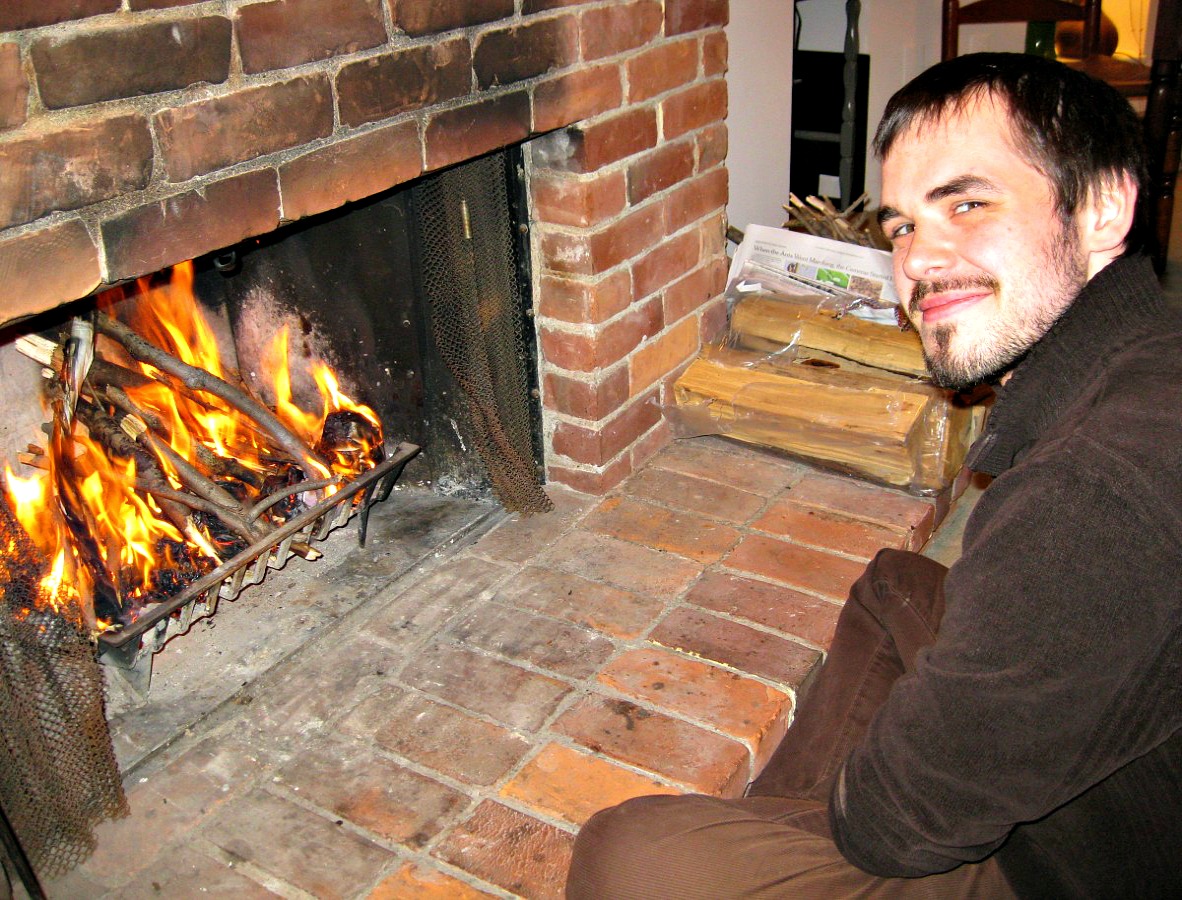
Img: Maggie Eriksson outside her flat in Malmö, Sweden (October 2012).

THE DISPLACED Q: With enough time and resources, what would you most like to learn in your adopted culture?


file0001883482933A long time ago, in a country far, far away, my nine-year-old self visited a museum in England. The American Museum in Bath was my first experience of anything American that wasn’t viewed on a black-and-white TV, and, while I recall finding the museum interesting, there was one particular exhibition that is still lodged in my long-term memory: the extensive collection of antique quilts.  Exquisite, detailed, and painstakingly hand-sewn by American women hundreds of years ago, these quilts and the stories behind them fascinated me.

How difficult can it be?

Fast forward a couple of decades, and there I was, newly arrived in New England. I’d worked out the day-to-day details of where to shop, where to bank, and how to order a pizza in a fake American(ish) accent so that it got delivered to the right address. Perhaps it was the amount of free time suddenly on my hands, or the impending arrival of another baby that put me in a domesticated mood, but when I received in the mail a brochure for adult education courses at the local high school, I signed up for Quilting For Beginners. I was in the heart of quilting territory, and I was going to make one of those big quilts. How difficult could it be, if women two hundred years ago made them by hand, by candlelight?

A newfound respect…

The course lasted for eight weeks. If I’d previously admired the Old American quilters whose handiwork graced the museum in Bath, at the end of those eight weeks they had achieved god-like status in my mind. It’s not as if I was a novice at sewing. My mother, an expert needlewoman and daughter of a tailoress herself, had taught me the basics long ago. But whereas I was making a small lap-quilt on an electric sewing machine, many of the much larger quilts I’d seen in Bath would have been made by hand;  the first American patent for a two-thread machine wasn’t issued until 1846.

…and an appreciation for our foremothers

In the same way I am in awe of Austen and Dickens writing without the help of even a typewriter, let alone a Mac, I am humbled to think of the hours these women spent in creating a textile legacy for their country’s future generations. The two month process of learning a craft associated with the part of the world where I was living made me appreciate aspects of the region’s history and early life, perhaps more than visits to American museums on this side of the Atlantic did.

The quilt I made is still here, draped neatly over a chair in the spare bedroom, a reminder of eight weeks  of cutting, pinning, sewing, and then unpicking when it all went wrong — but eventually finishing. Eight weeks of learning a new craft…and so much more.

Readers, what about you? What would you like to learn in your adopted country, and what else would it teach you?

.
STAY TUNED for Wednesday’s post!

If you enjoyed this post, we invite you to register for The Displaced Dispatch, a round up of weekly posts from The Displaced Nation, with seasonal recipes, book giveaways and other extras. Register for The Displaced Dispatch by clicking here!

Related posts:

Image: Morguefile

5 things de Tocqueville can teach expats to US

LibertyI imagine that over the last two or so years the rapid rise of the iPad and other tablet devices has led to a decline in the use of toilet libraries, by which I mean those little collections of books many people keep in their bathrooms for those leisurely times when they have a particularly challenging movement to sit through (perhaps you have your own toilet library. Feel free to share your favorite reads in the comments below).

My own toilet library shows me to be a rather self-righteous, aspiring autodidact. Among my little pile can be found Empires of the World by Nicholas Ostler, The Oxford Book of English Poetry, and Bertrand Russell’s History of Western Philosophy. The books are all left there in the rather grand belief that in the privacy of the privy I might finally learn something. That’s all gone to pot since I got an iPad as I now simply read twitter or play Football Manager on there instead. The books are, sadly, left mostly unread.

One book that should be added to the above trinity – and one that I have fitfully gone through in the last few years – is de Tocqueville’s Democracy in America. When I moved to the US it seemed, unsurprising enough, a cornerstone text that I should familiarize myself with.

For those who don’t already know, Democracy in America  is a study in American society by an aristocrat from Normandy, Alexis de Tocqueville. He journeyed to America in 1831 when he was sent, along with Gustave de Beaumont, to look into the American penal system, although natural curiosity led to both men investigating a lot more than just prisons.

Book II of Democracy in America, in particular, can move me away from reading twitter and reading an actual book. Its short chapters mark it as perfect for inclusion in any toilet library, and it is extremely perceptive into America and Americans. With that in mind, here’s 5 thing that de Tocqueville can teach expats to the US

Warning: de Tocqueville scholars should look away now. No insightful analysis will be found here.

5. An outsider can bring an interesting perspective to US society

Yesterday two of my least favorite people met on CNN, Piers Morgan and Alex Jones (what incidentally is the collective noun for gits?). Jones, a conspiracy theorist firebrand, was behind the recent campaign to have Piers Morgan in light of his views on gun control. Jones screamed “1776!” over and over again at Morgan as well as calling him a “redcoat”. Morgan’s views on gun control aren’t particularly out-of-the-ordinary within the mainstream media, but his foreignness means that, for some, it is doubly offensive when he attacks a text (the second amendment) that they consider sacrosanct.

Morgan clearly is not a modern de Tocqueville, but it is worth remembering that your own outsider status allows you to see US society with fresh eyes and that you can, respectfully and tactfully, challenge certain assumptions.

4. Regardless of how irritating it is when misused, theoretically American exceptionalism is a fascinating, even wonderful, thing.

Most non-Americans understandably roll their eyes when US politicians, particularly when seeking election, proclaim the US as the greatest country in the world, a country unlike any other that is innately superior. That most US political rallies don’t end with a rousing chorus of “America, f#@k yeah!” from Team America is surprising.

However, the first person to describe America as exceptional was de Tocqueville, and in his writings you’ll find that there is much talk of America as a democratic society as opposed to those Monarchic, aristocratic societies of the Old World. It serves as a reminder that America, for all its faults, is founded upon impressive ideals. The main idea underpinning exceptionalism is not American superiority, but that it is qualitatively different from other nations, the first to build an identity based upon its independence. We can certainly debate that this exceptionalism is no longer the case, but in de Tocqueville’s period I do not think it a contentious claim – indeed, it’s an exciting and invigorating thought.

3. Cynicism need not be the default mode for the Western European dealing with America.

It’s easy to be weary when dealing with American life and Americans. They can be unabashed, earnest, loud. The default mode, of which I am very much guilty of, is to mock and sneer and snark about many aspects of American life. The phrase “only in America” is often invoked for some of the worst aspects of American life, de Tocqueville shows that “only in America” can also be positive.

2. “Never mind the quality, feel the length.” A reminder of the sheer size of America.

The America that6 de Tocqueville visited is half the size that the country is now. But the America of the 1830s was a still a vast land and Democracy in America is, in its own dry way, a travelogue to a new land of strange sights. New expats to the US would do well to remember that they don’t just have a country to discover, but a continent.

1. The gift that keeps giving.

The first thing that you many notice about Democracy in America is that it is a hefty tome. For those expats blogging about life in US, you need never worry that you’ll be short of material. The US really is the gift that keeps giving. Look at dear departed Alistair Cooke, he managed to keep ploughing this particular field for over 60 years. You may never fully understand this country, but you can have an interesting time coming to terms with it.

STAY TUNED for tomorrow’s post on reads to tickle the expat’s imagination and intellect.

If you enjoyed this post, we invite you to register for The Displaced Dispatch, a round up of weekly posts from The Displaced Nation, with seasonal recipes, book giveaways and other extras. Register for The Displaced Dispatch by clicking here!

Related posts:

Image: Awindram

A newly arrived expat in Boston asks: Is distance really the antidote to romance?

James_Murray_DisplacedToday, we welcome guest blogger James Murray to The Displaced Nation. Originally from East Sussex, UK, James “recently arrived in Boston, Massachusetts, with a half-written book, a smattering of web design skills and a utopian vision that will probably never change the world.” He’s here for his partner, Ash, who is American (although few people think of her that way). Though he doesn’t really label himself a traveler, his displacement is “likely to verge on the permanent.”

I’m finally here in America. After the best part of a year living in separate countries, my partner and I are finally married — which I suppose makes her my wife. The word doesn’t sit well — we have a pretty equal relationship, where the terms ‘husband’ and ‘wife’ seem to imply a structure; a certain assignment of roles. In a husband-and-wife relationship, you can make a guess as to who does the cooking and cleaning; but in a relationship of two partners there are no preconceptions (apart from the one that you might be gay).

But the labels of husband and wife are just one of a number of areas where the typical encapsulation of a relationship differs from the reality.

For around eight months I’d been sitting in limbo over the other side of the Atlantic, fidgeting around with various projects and living in various temporary places — it’s been okay, but I’ve just wanted to get settled for a bit. My partner, Ash, visited a few times, but those occasions weren’t what you would think.

The old airport reunion kiss

In particular, there’s a fault with the ‘airport reunion kiss’ — that little run-up, the unseen orchestra with its musical swell and the big hug and the big kiss between two people who have spent so much time apart. I want to blame Hollywood, but I simply couldn’t find an example of this happening in a movie, so I think it must just be hard-wired into the human mind — that this is simply how it happens, a tempestuous embrace with no doubts and no awkwardness.

It doesn’t work like that. Certainly we kissed at the airport, but after months apart, living our separate lives, we couldn’t quite get our heads around who this other person was. Logically, you know, you could recite details about this person — their likes and dislikes; their beliefs; their habits; but there are memories that are harder to keep.

For instance, how do you remember what it feels like to kiss your partner? How do you remember their smell or a particular look they might give you? There are things that, once they’re not physically there in front of you, just disappear, so when you finally see them again after a long separation, it’s a shock. Not a bad shock, but it’s not comfortable yet — you have to re-acclimatise.

Ash and I found that meeting again after our first three months apart, it actually took about a week for this to happen. Which means that when your partner comes to stay with you for ten days, you’re finally re-discovering your groove when you’re just about to say good-bye again.

Doubt — nothing wrong with that!

Lots of expats know what it’s like to have a long distance relationship — for many that’s the reason they’re expats; but I think we’re badly served by the standard story of long-distance romance and reunion. Who’s talking about the difficulties of keeping the faith throughout doubts and the regular tribulations of a normal life?

It’s hard to discuss doubt sometimes — it’s seen as a sign of weakness, a sign that you don’t love the person you’ve committed yourself to. It’s not — it’s perfectly normal (and it’s normal even if your partner is actually in the same country).

Everyone has doubts and it’s really the failure to acknowledge them that leads to problems. About the least supportive thing I ever said on the phone to Ash was that I had ‘absolute faith’ in our relationship. I wasn’t saying it meanly, but I had essentially raised the bar for our relationship impossibly high — nobody has absolute faith, especially when faced with the unknowns of long distance.

If you have doubts and the other person has absolute faith, who do you turn to? It makes it hard to discuss or even acknowledge those doubts — and you should discuss them if you want to resolve them. Absolute faith is the trump card that ends the conversation, and potentially the relationship, but it’s so often just assumed.

Creatures of the moment?

The funny thing is that now that I’m here and we’ve got used to each other again, it’s as hard to remember the separated life of the past year as it once was to picture living here with Ash.

I think that more than we’d care to admit it, we really are creatures of the moment — what matters is now. Committing to the future is vague and riddled with doubt; the past is foggy and easily forgotten. What carries us through is faith rather than emotion — a faith based on the knowledge that at some point in the past you felt strongly enough to say ‘let’s get married’. You have to trust that knowledge long after you’ve forgotten how exactly you felt at the time.

If what I’m describing sounds peculiar, that’s only because these aren’t the terms we’re usually given to describe our relationships — because the language of romance is a language of absolutes; because to question the titles of ‘husband’ and ‘wife’ seems tantamount to saying you aren’t ready to be one.

There isn’t just one experience of a relationship — no single narrative that applies to everybody; but that’s how it often feels.

So for all the people with doubts — the people who aren’t in a Hollywood romance, but are in love just the same; the people for whom the happiest day of their lives will probably not be the day they got married (or even the birth of their first child) — I think we can still count ourselves as romantics — especially after moving continents (twice in my case) to be with our loved ones.

* * *

Readers, what are your thoughts on long-distance relationships? Does distance lend enchantment to the view, or is it a case of “out of sight, out of mind”?

Check out James’s own blog at quaintjames.com

.

Image: James looking vaguely itinerant in his bike helmet.

STAY TUNED for Thursday’s post!

If you enjoyed this post, we invite you to register for The Displaced Dispatch, a round up of weekly posts from The Displaced Nation, with seasonal recipes, book giveaways and other extras. Register for The Displaced Dispatch by clicking here!

Related posts:

An expat in America’s thoughts on Boxing Day

BoxingDayinBritain_collage_3You can never satisfactorily explain Boxing Day to an American. The day sounds comical to them; just another ridiculous Commonwealth quainitism, like fortnights and elevenses.

The true origin’s of the holiday’s curious sounding name are decidedly murky. Over the years various origins have been asserted, the most popular being that this was the day the lord of the manor gifted boxes of money to servants on his estate. If you are interested these origins are detailed in this article from Snopes.

There is nothing, in particular, you need to do on Boxing Day. No unusual traditions to be observed. Stores (similar to the American Black Friday) open early for the sales, and sport also seems to be a familiar theme in Boxing Day throughout the world. In the UK a full fixture list is played by the football league, in Australia the boxing day Test is a modern cricketing tradition, and in Canada they watch hockey (although they seem to do that the other 364 days of the year, too).

There may, however, be some local eccentricities. In my hometown, there is such a thing as the Boxing Day dip. A frankly ludicrous tradition, it involves some peculiar people (possibly with deep-seeded psychological issues) in fancy dress who run into the freezing north sea for the aforementioned “dip”. It’s not something that ever appealed to me, hypothermia never has, but it was always fun — of a sort — watching those foolhardy enough to try it.

One of the joys of Christmas is the build-up, the sense of anticipation, and yet it is over so soon. Boxing Day plays the important role of stretching out the holiday. Give the day a name, you make it something different, you set it apart from the ordinary, even if the name you give it is a silly one. Boxing Day acts as the downer, the Christmas Xanax, for the previous day’s frenetic, festive high. It’s a day for the post-bacchanalian slumber, of leftover turkey transformed into a curry or made into sandwiches, of bad Christmas TV, of lingering on the end of the holiday, of easing back into the mundane.

I am reminded of W.H. Auden‘s Christmas poem, For The Time Being (Auden, btw, was born in England but later took out American citizenship):

Well, so that is that.  Now we must dismantle the tree,
Putting the decorations back into their cardboard boxes —
Some have got broken — and carrying them up to the attic.
The holly and the mistletoe must be taken down and burnt,
And the children got ready for school.  There are enough
Left-overs to do, warmed-up, for the rest of the week —
Not that we have much appetite, having drunk such a lot,
Stayed up so late, attempted — quite unsuccessfully —
To love all of our relatives, and in general
Grossly overestimated our powers.  Once again
As in previous years we have seen the actual Vision and failed
To do more than entertain it as an agreeable
Possibility, once again we have sent Him away,
Begging though to remain His disobedient servant,
The promising child who cannot keep His word for long.
The Christmas Feast is already a fading memory,
And already the mind begins to be vaguely aware
Of an unpleasant whiff of apprehension at the thought
Of Lent and Good Friday which cannot, after all, now
Be very far off.  But, for the time being, here we all are,
Back in the moderate Aristotelian city
Of darning and the Eight-Fifteen, where Euclid’s geometry
And Newton’s mechanics would account for our experience,
And the kitchen table exists because I scrub it.
It seems to have shrunk during the holidays.  The streets
Are much narrower than we remembered; we had forgotten
The office was as depressing as this.  To those who have seen
The Child, however dimly, however incredulously,
The Time Being is, in a sense, the most trying time of all.

STAY TUNED for an installment from our displaced fictional heroine, Libby.

If you enjoyed this post, we invite you to register for The Displaced Dispatch, a round up of weekly posts from The Displaced Nation, with seasonal recipes, book giveaways and other extras. Register for The Displaced Dispatch by clicking here!

Related posts:

Images by Awindram