The Displaced Nation

A home for international creatives

Category Archives: Golden Oldies

A week in tartan

Scotland Flag from PhotoEverywhere.co.uk – CC license

It’s time to celebrate all things Scottish. Dunk Walker’s shortbread in your tea, deep-fry a Mars Bar, eat chicken tikka masala. Read Robert Burns, watch Billy Connolly.  Drop into conversation that your great-great-grandmother came from Dundee (actually, she did). Whatever you do, though, make sure you do it in tartan.

In 1982, New York City Mayor Ed Koch declared July 1 as Tartan Day, a one-off celebration of the 200th anniversary of the repeal of the Act of Proscription — the law forbidding Scots to wear tartan. Following this, Scottish-Americans lobbied the Senate for official recognition of Tartan Day, until eventually, in 2008, President George W. Bush signed a Presidential Proclamation making April 6th a day to

“celebrate the spirit and character of Scottish Americans and recognize their many contributions to our culture and our way of life.”

— which, naturally, entails a long parade through the streets of New York in an attempt to out-do the other Celts’ celebrations on March 17.

Not just New York, either. Tartan festivities are held throughout the rest of the USA, plus Canada, Australia, and New Zealand, although the last two stick to July 1 for their day of plaid fabric observance. Even Scotland joins in the fun.

However, do the U.S celebrations really “celebrate the spirit and character of Scottish Americans” as President Bush said? The key word in that phrase is, perhaps,  “Americans.”

As Scottish expat and travel writer/blogger Aefa Mulholland says in her interview with Scotland’s Daily Record:

“People [in America] have very different views of Scottishness from what most people in Scotland would have today. Scottish-Americans tend to remember and celebrate Scotland the way it was when they left it.”

But that’s simply the way of the expat world: homesick for a place which doesn’t quite exist any more — only in memory.

On another note — it’s strange that a law banning an item of clothing should have such far-reaching celebrations. Certain U.S. towns currently making the wearing of saggy pants a criminal offense should perhaps ponder this point, for the benefit of future generations.

Question: Which style of dress would you like to see commemorated every year?

image: Scotts_flag by www.photoeverywhere.co.uk
If you enjoyed this post, we invite you to subscribe for email delivery of The Displaced Nation. That way, you won’t miss a single issue.

How many years should an expat stay? The answer is blowin’ in the wind…

Most human beings feel disconcerted when they lose the self-validating “mirror” that tells them who they are. That’s what we hear from the relocation experts — as cited by Kate Allison in her article exploring how even people who move within the same country can have something akin to an expat experience.

But in my own experience of being displaced, first in England and then in Japan, trying to live in a country where you share a great deal — ethnically, culturally, linguistically — with the natives is easier to sustain for lengthy periods. Under those conditions, it’s possible to maintain the illusion of the mirror still being in place.

After all, quite a few Americans — comedians like Ruby Wax and Reginald D. Hunter, writers like Bill Buford and Bill Bryson — have made it in England. In Japan, by contrast, although foreigners can become talento, they will never achieve the same level of belonging.

Thus when I first learned the news that Junichi Kinoshita had won this year’s Taipei Literature Award, the first non-native writer to do so in 13 years, I thought, well, no wonder. On the face of it, Taiwan should be a relatively easy adjustment for a Japanese person.

But does Kinoshita actually feel that way? Yes and no. His first impression of the Taiwanese was how similar they looked to the Japanese, and though he found learning Mandarin a challenge, he eventually mastered it to the point where he was able to write his debut novel in Chinese, and at a level that garnered it a prestigious award.

On the other hand, life in Taiwan posed a considerable culture shock as people there tend to be much more hospitable than the Japanese. In Kinoshita’s book, the title of which can be roughly translated as Dandelion Floss, five Japanese expatriates in Taipei struggle to adjust to the local culture — and when they finally get the hang of it, must grapple with the question of when (and whether) to go home to Japan.

At the end of the novel, one of them says:

I think every expatriate is following some kind of mysterious calling from their heart. There is some predestined relationship between a person and a city. One leaves the city when the affinity ends, be it a few months or 10 years, it just happens.

Kinoshita intended his book as a swan song to his life in Taipei. After submitting it to the contest, he planned to return to Japan with his wife, who is also Japanese. Now, however, they are rethinking their next step: perhaps the prize is a signal that Kinoshita isn’t finished with the city yet? Besides, he has already decided on a theme for his next work of fiction, as well as a language: Chinese again.

If you enjoyed this post, we invite you to subscribe for email delivery of The Displaced Nation. That way, you won’t miss a single issue.
The domestic expat

A photograph on a Minnesota news website showing a street in Brooklyn, NY, has the caption:

A long line of Minnesota expats wait to enter the “Minnesota State Fair Affair.”

Meanwhile, on a classified ads website, someone from Wales is looking for other Welsh expats to meet in a pub – in Winchester, England.

While convention and Wikipedia define an expatriate as:

any person living in a different country from where he or she is a citizen

it seems that this definition is being gradually challenged, as shown by these two examples. You no longer need to cross borders to be an expat. You can be a domestic expat. A fish out of water in your own country.

Leaving aside the touchy debate of whether Wales and England are separate countries – for the purposes of passport control and this article, they both come under the umbrella of the United Kingdom – this challenge, upon consideration, is perfectly reasonable.

An intrinsic part of expat life is culture shock, which is, says the University of Northern Iowa College of Business Administration,

the trauma you experience when you move into a culture different from your home culture.

It has several stages:

Excitement/fascination – ignoring small problems; a sense of being on extended vacation;

Crisis period – when difficulties arise, the new country turns out to have feet of clay, and you realize you can’t go home;

Adjustment – a change from negative attitude to positive; rediscovery of sense of humor;

Acceptance/adaptation – a sense of belonging in, and adapting to the new culture;

Re-entry shock – upon return to the original country, when the whole process starts again.

In her 2002 article, What To Expect When You Relocate, Achievement Coach Nancy Morris says:

Surprisingly to many, culture shock can show up even when relocating from one region to another within our own country – we assume ‘culture shock’ only occurs when moving to a completely different country.

If you’ve ever moved from London to Newcastle, or from New York to Alabama, or from Toulouse to Paris, you’ll know she’s right. All the symptoms above can be yours, and you don’t need the inconvenience of an international flight to get them. A domestic flight will do it – or, in the case of our Welsh example, a short trip along the M4.

Nancy Morris goes on to say that

moving to a new cultural environment can turn from culture shock to “self-shock”.

During most of life’s transitions – changing jobs, divorce, bereavement – we have a tendency to question ourselves, and who we are. Surrounded by familiar family, friends, environment, we are usually able to make sense of this question and find an answer, even as we struggle to accept the change in our lives. When the change is cultural, however, acceptance is more difficult. As Morris puts it:

At home we have a mirror which helps to validate and re-affirm us. Within a new environment, the mirror no longer exists. So, at a time when you are seeking the answer to the “who am I” question, your surroundings are asking “who are you?”

Surrounding yourself with culturally familiar people – those with the same accent as you, those who feel as displaced as you; in other words, expat communities – is just one way of putting that mirror back in its place.

And it doesn’t matter you’re an Englishman in New York, or a Welshman in Winchester.

If you enjoyed this post, we invite you to subscribe for email delivery of The Displaced Nation. That way, you won’t miss a single issue.

RANDOM NOMAD: Anita McKay, Property Manager

Born in: Indonesia
Passport(s): Indonesian and British Permanent Resident
Countries lived in: Australia (Sydney): 1999-2001; Scotland (Aberdeen): 2007-2009; Western Australia (Perth): 2009-2013
Cyberspace coordinates: Finally Woken (blog)

What made you leave your homeland in the first place?
I left in 2000 to study for a master’s degree in Sydney. I left again in 2007 because my then fiance (now husband) got a job in the UK. Philosophically, I have never really felt at “home” in my own home country of Indonesia. Lots of its values don’t match with mine. From the time I was a child, I felt like an alien and longed to go away.

Is anyone else in your immediate family a “displaced” person?
No. My brother doesn’t like to travel and still lives at home with my parents. But three of my father’s sisters are married to Germans: two still in Germany and one in Indonesia. And I have four cousins living in the Netherlands and Germany.

Describe the moment when you felt the most displaced over the course of your various travels.
It was in Sydney. I was working as a casual staff at an ice cream shop while doing my postgraduate study. It was winter, around 10:00 or 11:00 p.m. I had just closed the shop and was waiting for the bus. It was rainy and cold, and then all of a sudden, there was a hailstorm. I almost cried, I felt so sorry for myself. I was thinking about how if I’d stayed put in Indonesia, I could have been working for a big company and earning a nice salary by then, living with maids and a chauffeur. I wouldn’t have to mop floors or clean windows to pay the rent. In the Indonesian island where I come from, everyone knows me and my family, but here in Sydney, no one cares who I am or whose daughter I am…

Describe the moment when you felt least displaced.
Weirdly, I almost always feel more at home in anywhere but my own country.

You may bring one curiosity you’ve collected from your travels into the Displaced Nation. What’s in your suitcase?
A flash disk containing thousands of photos.

You’re invited to prepare one meal based on your travels for other Displaced Nation members. What’s on your menu?
Chicken tikka masala — it’s originally from Glasgow, most people don’t know that — and cranachan for dessert.

You may add one word or expression you’ve picked up from the countries you’ve lived in to The Displaced Nation argot. What word(s) do you loan us?
“Bollocks.” My hubby, who is Scottish, says it sounds cute when I say it. I try to use a Scottish intonation. He would let me say it whenever I wanted — until I said it in front of his 95-year-old grandmother, and then he explained it was actually a very very rude word.

img: Anita McKay (left) with a good Indonesian friend who was visiting her in Scotland, in front of Balmoral Castle, the only royal residence outside England.

If you enjoyed this post, we invite you to subscribe for email delivery of The Displaced Nation. That way, you won’t miss a single issue.

Free at last of the media bubble: The FT’s Simon Kuper on the expat life

Every once in a while, I come across an article on the expat life that is so brilliant, I cannot refrain from screaming “yes!” aloud — thereby disturbing my two dogs, who don’t like being aroused from their naps unless it’s food.

That’s how I felt when reading Simon Kuper’s “Why expats don’t get tinnitus,” which appeared in the March 25 FT Magazine.

Kuper had me with the opening sentence:

I’ve lived in Paris for nine years now, but I’m still often not sure what goes on here.

Yes, I can relate, after my nine years in England and my seven in Japan!

He then goes one to say that he doesn’t actually mind living in ignorance, if it means being immune to the daily news cycle —  who’s up and who’s down — as well as the “status dance.”

Yes, I get that, too! Particularly in Japan, where I soon reached the point of not really knowing or caring whether I was meeting VIPs (the exception being when I met Prince Charles). I could decide whether I liked a person for who they were, not for the “status hat” they were wearing. (Not sure he could have worn a hat, with those ears.)

For Kuper, living in the media bubble can be likened to having a “constant dreadful ringing sound in your ears,” or tinnitus. He says he loves his tinnitus-free life, recognizing he’s not the first expat to feel this way. (No, he’s not!) He quotes the writer James Baldwin saying he was grateful to Paris for treating him with “utter indifference,” notes that Gertrude Stein appreciated Paris for a similar reason, and acknowledges Pico Iyer for capturing the liberation-through-alienation sentiment so well in his book The Global Soul.

The only thing I can’t concur with is Kuper’s conclusion, that if the Internet could be shut down, he’d be completely cured of his tinnitus. Were it not for the Web and my Google alerts, I may never have discovered this article of his, and would be the poorer for it.

If you enjoyed this post, we invite you to subscribe for email delivery of The Displaced Nation. That way, you won’t miss a single issue.

China — just TV, fantasy

When I was an expat in Japan, I enjoyed going to talks at various expat clubs. It made me feel more in touch with thinkers and trends from my former world.

Sometimes, however, this “old reality” dose can highlight just how displaced you are.

Nancy Lewis, who teaches English in Shanghai, furnishes a brilliant example of this in a March 9 post on her blog, Wandering Solo, about a book talk hosted by Shanghai Dolls Book Club. The speaker was Emma Donoghue, an Irish writer who lives in Canada. Her most recent novel, Room, was shortlisted for last year’s Man Booker Prize. It tells the story of a woman who is trapped in a close, sustained relationship with her captor-rapist from the point of view of the five-year-old child, Jack, who is the offspring of their union. Jack has lived in the 11-by-11-foot room of the title with his mother since the day he was born.

Donoghue acknowledges that she was inspired to write the book by the Elisabeth Fritzle case.

Lewis enjoyed Donoghue’s talk so much — she found her “warm and engaging, with a great sense of humor” — that she went home and downloaded the book on her Kindle, spending the rest of the evening engrossed in the story.

What’s more, Lewis concluded that the boy’s view — he sees everything inside the Room as real, and everything outside as TV, fantasy — has something in common with how she views her own life in Shanghai:

When I’m at home, I’m alone in my 10-foot by 10-foot bedroom, reading or studying or chatting with friends on Skype. When I’m at work, I’m surrounded by Westerners – people like me. (Since we’re writing English language learning materials, we’re all native speakers of English.)

My contact with Chinese life is short & intermittent – the morning commute on the subway, a 10-second conversation with a shop keeper, giving directions to the taxi driver. …

Every once in a while, I have to remind myself that I live in China. China! CHINA?! How did that happen? It’s not an altogether real part of my life. My job is real, my room is real, my Western friends are real. But China? China is just TV. Fantasy.


If you enjoyed this post, we invite you to subscribe for email delivery of The Displaced Nation. That way, you won’t miss a single issue.

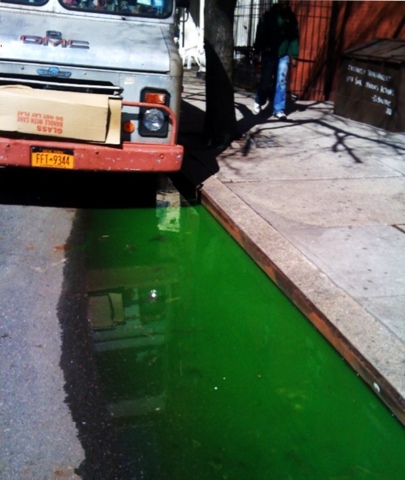
PHOTO: Sea of green

For the past 43 years, the Chicago River has turned green on March 17. So the residents of New York City’s East Village didn’t blink an eye when the water in the street near an Irish bar turned green this year as well. It seemed plausible to many of us that a leprechaun had been crying a river wondering why Irish Americans are more Irish than the Irish. (His eyes had not been smiling…)

“Is it a case of far away hills being greener?” he lamented with a keen.

You see, Dublin is quiet on St. Patrick’s Day, but American cities are anything but…

UPDATE: By the following morning, the green water had magically evaporated, proving we’d been right to give short shrift to the skeptic who insisted it was an antifreeze leak.

image: E. 10th St., NYC, by mlawanohara

If you enjoyed this post, we invite you to subscribe for email delivery of The Displaced Nation. That way, you won’t miss a single issue.

Some tart comments on the sweetness of American food

The two-year-old blogging relationship between UK-based American Mike Harling and US-based Brit Toni Summers Hargis has entered a sweet phase. Mike wrote on Pond Parleys the other day:

I was surprised, on our recent visit, at how sweet America was: the beer, the bread, the pretzels (sugar-coated pretzels—honest to God) and even, oddly enough, the candy. And if it wasn’t infused with sugar, it was too salty and/or covered in cinnamon. After nearly ten years in UK, I found it all a bit too cloying.

Toni agreed, throwing in a recipe for marshmallow fruit salad, while also defending British food against its reputation for being too bland.

Most commentators agreed that American food is too sweet but less because of sugar as of additives like high fructose corn syrup and trans fats. One US-based Brit opined:

The epitome of American sugary ‘candy’ … has to be the easter ‘peeps’ that my dear mother-in-law is guaranteed to give us and which will stay in the cupboard in all their food-colouring sugariness until I throw them out next year to make space for the more recent offering.

Another British expat to the U.S., however, noted that she can’t tolerate canned baked beans in either country because of their over-sweetness. She went on to say she’d developed a liking for America’s apple pretzels as well as cinnamon flavoring. “I may have to make apple crumble tomorrow,” she wrote.

If you enjoyed this post, we invite you to subscribe for email delivery of The Displaced Nation. That way, you won’t miss a single issue.

When tragedy strikes, should you listen to the home government?

Not if it’s Japan, apparently. More and more foreigners are opting to leave in the wake of the nuclear radiation threat — even those who aren’t being relocated by their companies.

A 22-year-old Aussie explained his decision to abandon his home in Fukushima and get on the next Qantas flight, as follows:

My message is don’t listen to the Japanese media, don’t listen to the Japanese Government because they’re trying to keep Japanese people calm, which I completely understand, but I don’t think that they’re giving the full truth. I think that by not telling people the complete truth, people aren’t able to make rational decisions, and the only rational decision at the moment is to get out.

If you enjoyed this post, we invite you to subscribe for email delivery of The Displaced Nation. That way, you won’t miss a single issue.

Bye for now, world!

Detail of Chinese Ship by Fra Mauro, public domainAND A WARM HELLO to all international travelers, be they backpackers, globetrotters, expats, rexpats, repats, or armchair dreamers. We have created a country for those of you who have traveled for so long and crossed so many cultures that you don’t seem to belong anywhere else.

The best way to gain entry is to subscribe to our posts!

Perhaps you are a little anxious as we aren’t in the guidebooks. Let us reassure you. While not a storybook paradise, the Displaced Nation is beguilingly otherwordly and exotic, full of twisting vines, golden cobwebs, and silky-haired monkeys. It is the kind of place that entices you to stay because of all the wonders and sources of inspiration you find within.

But before we get carried away with the pleasantness of it all, a few ground rules. While we haven’t got a constitution or a bill of rights, we expect our citizens to behave with the sort of decorum that has earned them a place in other people’s cultures for so long.

Also, please don’t be affronted if you find some of our instincts counterintuitive. For instance, we are great believers in navigating the new world with old maps. Our generation may have big dreams, but let’s face it, many of our forbears were great adventurers, too. Are we any less clueless than they were? A dose of humility is in order.

Cheers,

The Displaced Nation Team

image: Detail of map made around 1450 by the Venetian monk Fra Mauro, courtesy Wikimedia

If you enjoyed this post, we invite you to subscribe for email delivery of The Displaced Nation. That way, you won’t miss a single issue.
