The Displaced Nation

A home for international creatives

Category Archives: Golden Oldies

Marriage, cross-cultural style: Two veterans tell all (Part 1)

In the life of the global traveler, one of the most thrilling escapades you can have is a romantic encounter with someone you meet in a far-flung land.

But should your story involve going the further step and hitching your wagon to a person from a completely different culture — well, that’s another level of adventure altogether.

For marriage, you will need the ability to stand by the courage of your convictions.

Or, as one of our Random Nomads, Helena Halme put it in her comment on last week’s post covering this topic, cross-cultural marriage tends to be “for the mad bad and young — or foolish.”

Today and next Monday, one half of each of two cross-cultural couples have agreed to take the floor and answer my questions about what made them take the plunge:


GABRIELA SMITH has been married to Daniel for eight years. She was born in Venezuela to Spanish parents, but ended up in the UK, where she met Daniel and they currently live.


JEFFREY HUFFMAN has been married to Naoko for 19 years. They met in Nagoya, Japan, where Jeffrey, an American, had journeyed for his work. They now live in Seattle.

How did you meet your spouse-to-be?


GABRIELA: We were working for the same company in the UK; we met on my first day at work.


JEFFREY: We’re something of a cliché couple. She was a student in the summer Teaching English as a Foreign Language (TOEFL) prep course I was teaching in Nagoya. She had just graduated from college and wanted to pursue a second degree at a university in the U.S. and needed to pass the TOEFL to do so.

What made you think that this is the person for me? Did culture have anything to do with it?


JEFFREY: Definitely, Naoko represented a tie to the Japanese culture that I wanted to have. Seattle has a pretty large Asian community, I had taken Japanese at university with dozens of nikkei-jin, and I had been to Japan on visits twice before. But it wasn’t until I went to live there that it all fell in place.


GABRIELA: I arrived in the UK at 23 — marriage was not even in my mind. Additionally, I had no wish to stay in the UK so wasn’t looking for an Englishman to marry. I was going to travel more. I actually had a one way ticket to Italy when I fell in love with my husband.

Did you have any reservations before deciding to tie the knot, having to do with the other person being a different nationality?


JEFFREY: No reservations on my side, probably because Naoko had lived in the States for a year as an undergrad by the time I met her, and because her English was so good.


GABRIELA: Not at all. I thought — and I still think — that culture has very little effect on the “amount of risk” in a relationship. Values are important, of course, and I considered my husband’s values as an individual — not by placing him within a category ruled by his nationality.

How long were you together before you decided to get married?


JEFFREY: A point of no small contention with my wife. We’d been together for four years, two in Japan and two in the States, before I finally got around to asking her formally. Naoko was just about to graduate from Seattle University, and I’d been accepted at Columbia for grad school when I finally woke up and realized the time had come…


GABRIELA: Exactly 12 months after the day we met for the first time. Daniel asked me.

Where were your weddings held? Did you have cross-cultural ceremonies?

GABRIELA: The civil wedding was held in England; from my side there was just me. The religious ceremony was held in Venezuela a week after; from my husband’s side there was just him. The ceremony was in Spanish, a language that he does not speak! We held the reception party three weeks later when we were back in England — again, just me from my side. I even looked for a wedding dress on my own, and was on my own at the hairdressers on my wedding day. People may have thought it was strange, but I never minded. I thought it was all very exciting.


JEFFREY: We were married in my parent’s living room by a family friend who was a county judge. He wrote the ceremony for us, and it was very nice – just family and a few friends. We did a recommitment ceremony a few years later in Hawaii. Naoko didn’t want any kind of ceremony in Japan. She comes from Aichi-ken, where weddings tend to be an extravaganza. (Of course the real reason is that she was embarrassed to be marrying me — just kidding.)

Which makes me think of another question… What was it like meeting your in-laws for the first time? Did you have any awkward moments?


GABRIELA: Of course we’ve had some communication barriers, but mainly been due to my accent. I just have to repeat several times a word, or get my husband to “translate” for me. Ah, and the fact that I never drink tea or eat Christmas pudding seems to surprise his family each time!


JEFFREY: I think her parents and older brother initially took a dim view of our relationship, because I didn’t speak Japanese very well. To this day, my wife is my conduit with her parents (their Aichi-ben still leaves me lost a lot of the time). Overall, though, I think they are comfortable with me as I’m pretty comfortable with the culture.

How much of your married life has been spent in each other’s countries? And have you also lived in countries that are foreign to both of you?


GABRIELA: I don’t exactly have a country as my parents are originally from Spain but I grew up in Venezuela. Daniel and I have yet to live in a Spanish-speaking culture. We did, however, spend six years of our married life in a country foreign to us both: France. Otherwise, we’ve been in the UK.


JEFFREY: We’ve never lived anywhere else besides our home countries, and we’ve lived much longer in the U.S. than in Japan. Our time in Japan as a married couple consisted of three years in the Greater Tokyo area in the mid-1990s.

Are you settled down where you are now, or do you think you will change countries again?

JEFFREY:
Seattle is home for the time being. That said, I know Naoko misses her family. We’ve had some very emotional send-offs by family and friends in Japan. If fortuitous circumstances presented themselves (i.e. we were both offered obscene amounts of money and guaranteed vacation time), we’d be fools to not go. Barring that Disney scenario, we fully expect to spend at least part of the year in Japan in retirement, which isn’t that far off. It’s just eight years until our youngest is in college.


GABRIELA: What attracted me the most to my husband is that he also wanted to travel and live in other countries. I think things would have been very different if he said he wanted to stay in England “forever.” Now that we’ve spent six years in France I’ve realized that the weather really influences the social life and, to some extent, how people behave. It would be easier for my career if I stayed in the UK, but I have always placed my lifestyle before my career. Thankfully, my husband is quite happy with the idea of having late dinners on a terrace, under the sun, with wine and cheese on the table! Being Spanish, I would love for us to live in Spain one day.

What language do you speak with your respective spouses?


JEFFREY: Painful as it is to admit, about 99% English.


GABRIELA: Always English.

Tell me more about your kids.


GABRIELA: We have two wonderful children — a girl, 6, and a boy, 2. They were born in France, I was five months pregnant when we moved. Communicating with the midwives during childbirth was … interesting.


JEFFREY: We also have a girl and a boy, but they are a little older. Our girl is 14, and our boy, 9. Our daughter was born in Kawasaki, and our son in Seattle.

What language do you and your partner speak with the kids?


JEFFREY: The children are just now taking formal Japanese lessons.


GABRIELA: Spanish and English with my children. Occasionally I tease them — and my husband — in French. I must say that no matter what language I speak they all reply to me in English.

We look forward to hearing more from Jeffrey and Gabriela — and their spouses — next week. Let them know any comments or questions in the meantime!

If you enjoyed this post, we invite you to subscribe for email delivery of The Displaced Nation. That way, you won’t miss a single issue. SPECIAL OFFER: New subscribers receive a FREE copy of “A Royally Displaced Tea.”

Related posts:

4 lessons Harry Potter can teach us about tolerance – cross-cultural and otherwise

Yesterday, our Random Nomad, Jo Gan said:

“If something one of us does bothers the other person, we compromise… If you really want to make a relationship to work, any relationship, it takes respect, consideration, and a willingness to compromise.”

Wise words, Jo, and sentiments which another Jo – Jo Rowling, better known as JK Rowling – would agree with.

Love them?

Since 1997 and the publication of Harry Potter and the Philosopher’s Stone, we have been engulfed in the world of Hogwarts, wizards, witches, and muggles. With today’s movie release of  Harry Potter and the Deathly Hallows (Part 2), however, this week marks the end of the Harry Potter era.

Perhaps I was just at the right stage of family life to love Harry Potter. My children were toddlers when Philosopher’s Stone was published; this month, as Harry, Ron, and Hermione reach school-leaving age, so do they.  Together, over the last fourteen years, we have read the books, seen the movies, and queued at midnight in bookstores.

Or hate them?

It’s apparent, though, that not everyone shares this affection. While I understand we all have different tastes and Harry Potter cannot possibly be everyone’s cup of butterbeer, in too many cases this aversion has gone far past simple dislike into the realms of…well, ‘hatred’ isn’t too strong a word for it.

Pretty ironic, really, when one of the main Harry Potter themes is Tolerance.

Could it be that the very people who claim to detest Harry Potter are, perhaps, those who most need to read the books?

1. Tolerance of things we fear

Harry’s aunt and uncle, the Dursleys, fear all things magic. They won’t even permit Harry to use the M word – “Magic” – in their presence, and they confiscate his Hogwarts textbooks over summer vacations.

These actions are not unlike those of some fundamentalist churches, who periodically burn Harry Potter books. One Baptist pastor claims:

“The Potter series is worse than pornography. The books are even more dangerous than the Satanic Bible. At least with the Satanic Bible, young people know that the book was written by Satan. The Devil just changed his name to J.K. Rowling this time.”

Satan needn’t have bothered. It won’t help him get a share of the royalties.

2. Tolerance of infirmities

Professor Lupin, a teacher at Hogwarts, is humiliated and discriminated against because, through no fault of his own, he has a chronic disease – lycanthropy. In other words, once a month, he will turn into a wolf, bay at the moon, and run around biting people. The disease is now fully controlled by potions, but Professor Snape still regards it as his duty to inform Hogwarts pupils of Professor Lupin’s  condition.

Sadly, many AIDS sufferers can probably empathize with Professor Lupin’s plight.

However, we learn that in his teenage years, when no potion was available for his disease, Professor Lupin had three friends who developed their own ability to change into animal form, so they could keep Lupin company during full moon.

A true friend, like a life partner, will be tolerant of you in both sickness and in health.

3. Tolerance of other races

Voldemort followers in the Potter series want to rid the world of muggle magicians – wizards and witches who are not born into aristocratic magical families, but born in the real world and who display magical talent. Hermione is one of these, as was Harry Potter’s mother – both brilliant witches, but their talents apparently not good enough for Voldemort’s approval.

The parallels between Voldemort and Hitler, between the uprising of Voldemort followers and the Nazi party, between the desires for a master race and for pure-blood magicians, are only too evident.

4. Tolerance of things we envy

Lastly, a lesson not in the text of the books, but from reactions to the books.

There is wide criticism from both writers and ‘readers’ (I use quotes because generally these people haven’t read the books at all, but are prepared to offer criticism nevertheless) that the books have a clunky writing style, use too many adverbs – in short, name a writing sin, and JKR has committed it, it seems, and therefore does not deserve all the acclaim she has received.

No matter that this woman had an idea, worked on it determinedly for many years under far from ideal conditions, and finally achieved her goal of turning this idea into seven books. How dare someone rise from single motherhood on welfare to happily married, multimillionaire author?

In other words: How dare JK Rowling not be me?

As Jo Gan also said yesterday:

We have learned to accept each other’s differences.

If only everyone could say the same.

STAY TUNED for the first part in our series of interviews with cross-cultural couples.

If you enjoyed this post, we invite you to subscribe for email delivery of The Displaced Nation. That way, you won’t miss a single issue. SPECIAL OFFER: New subscribers receive a FREE copy of “A Royally Displaced Tea.”
Related Posts:

RANDOM NOMAD: Jo Gan, Director of Foreign Teachers, Author and Blogger

Cross-cultural marriage? 4 good reasons not to rush into it…

The Displaced Reads: 7 Books with a twist of Alice

RANDOM NOMAD: Jo Gan, Director of Foreign Teachers, Author & Blogger

Born in: Columbia, Missouri USA
Passport: USA
Country lived in: China (Yuyao City, Zhejiang Province): 2009-11
Cyberspace coordinates: Life Behind the Wall | Thoughts and Experiences of a Black American Woman in China (blog)

What made you leave your homeland in the first place?
I left America due to the economy. I worked in the mortgage field and when the housing market crashed, I needed to find something else to do…or be on unemployment. So I chose to take a job teaching English in China. Two years ago, I got married to a Chinese man whom I met in Yuyao. No, he wasn’t one of my students, as most people assume. I met him in a bar. He came over and asked if he could buy me a beer. We exchanged telephone numbers, and he started calling me every day, three times a day… Six months later, we were married. Yes, it was fast by most people’s standards but I’m not one to waste time — nor is he. It’s been an interesting couple of years.

Is anyone else in your immediate family displaced?
No one else in my family — except a great uncle who lived in Germany most of his life — has ever lived abroad for a long period. Some have been in the military and traveled around, but they always lived on base.

Describe the moment when you felt most displaced.
When I arrived at the airport in Shanghai — it was my very first time coming to China. My luggage had been lost, and I couldn’t communicate with anyone to tell them or report it. I felt frustrated and angry. Then once I got all the paperwork finished, I needed to take a bus to the next city. I couldn’t find the bus station, and no one could understand what I was saying. At that point, I wanted to just get back on the plane and go home.

Describe the moment when you felt least displaced.
When I went home to visit for the first time. Everything looked familiar but felt unfamiliar. I had spent a lot of time missing home, but when I finally got there, it didn’t feel right. In Yuyao, as I walk through the streets or sit in a restaurant and people recognize me, it makes me feel part of the community.

You may bring one curiosity you’ve collected from your adopted country into the Displaced Nation. What’s in your suitcase?
Wow! I guess I’d like to take a Chinese person — if you’d let me in with a companion rather than a suitcase. Yeah…the way they think and perceive things is so different from us Americans. Their ideas of “face,” status, and beauty are so alien to me that I am sometimes at a loss for words to explain it. I can’t get used to the fact that face — losing face, giving face and having face — is of the utmost importance to them. Also, their standard of beauty is so different: very white and very thin. The only way for you to get an accurate view of Chinese culture would be for me to bring a Chinese person along to explain it all to you.

You’re invited to prepare one meal based on your travels for other Displaced Nation members. What’s on the menu?
Since I live in Southeast China, the menu would have to consist of:

  • Steamed seafood. (I apologize in advance for its high salt content.)
  • Chicken feet that have been boiled and then fried.
  • Four kinds of eggs: tea eggs, thousand-year-old eggs, fried eggs with tomato, and boiled salted eggs that have been fertilized (there’s a chicken embryo inside).
  • And of course green vegetables… (By the way, the Chinese call all green leafy veggies “green vegetables.”)

For dessert we would have yangmei  (yumberry fruit), the local favorite.

And for drinks, a choice of:

You may add one word or expression from the country you’re living in to The Displaced Nation argot. What will you loan us?
I will choose Ni chifan le ma? (Have you eaten yet?). Everywhere you go in China, people greet you with Ni chifan le ma? Food is just so important to this culture. Weddings, birthdays, funerals — all of these events involve banquets lasting several hours. Everything tends to be associated with food, and there are many food idioms.

It’s Pocahontas month at The Displaced Nation, and we’re focusing on cross-cultural communications (or the lack). What would you say is the top challenge of an interracial, intercultural marriage — and can you recommend any coping techniques?
First I will say that the most challenging part of being in an intercultural marriage is the people around you. Usually, other people are more concerned about your marriage situation than you are, especially if you live in China. They tend to spend a lot of time telling you what is wrong, or can go wrong, with your marriage. They question the reasons you got married. For example, Chinese people will ask my husband if he married me to get a green card. He tells them: “We live in China, not America. How would a green card help me here?”

As for our personal relationship, we have learned to accept each other’s differences. If something one of us does bothers the other person, we compromise. For example, Chinese men have the tendency to put pork bones, chicken bones, sunflower seed shells, and fish bones directly on the dinner table when they are eating; I find this disgusting. So now we put a bowl beside my husband’s plate for him to discard these things. If you really want to make a relationship to work, any relationship, it takes respect, consideration, and a willingness to compromise.

QUESTION: Readers — yay or nay for letting Jo Gan into The Displaced Nation? Tell us your reasons. (Note: It’s fine to vote “nay” as long as you couch your reasoning in terms we all — including Jo — find amusing.)

img: Jo Gan hamming it up in the classroom by trying on her student’s sunglasses, taken by the student on her iPhone.

STAY TUNED for tomorrow’s installment from our displaced fictional heroine, Libby, when the Patrick family is held to ransom by an army of packing crates from their new home.

If you enjoyed this post, we invite you to subscribe for email delivery of The Displaced Nation. That way, you won’t miss a single issue. SPECIAL OFFER: New subscribers receive a FREE copy of “A Royally Displaced Tea.”

Related posts:

THE DISPLACED READS: 7 books with a twist of Alice

As it’s that time of year when (depending on your hemisphere) poolside or fireside books are a must, and since we’re not quite ready to let go of the Alice theme, we at TDN have come up with our own version of a summer (or winter) reading list.

In our usual perverse manner, we haven’t chosen books on the current New York Times bestsellers list, but, quite simply, books with the name “Alice” in the title.

We haven’t read them yet, either, so this list is as much a journey of discovery for us as it is for you.

Let us know what you think!

1. Alice in Verse: The Lost Rhymes of Wonderland by J. T. Holden and Andrew Johnson

Average Amazon rating: 5 stars

Have you ever wondered…
Who really stole the Queen’s tarts? Whatever did become of the Walrus & the Carpenter after their nefarious jot down the briny beach with the little Oysters? Is there truly any sense to be found in nonsense at all? (Amazon product description)

“The rumored ‘lost rhymes’ of Lewis Carroll are the inspiration behind Alice in Verse: The Lost Rhymes of Wonderland, a compilation of masterful poetry. While adding new and interesting elements, Holden has managed to keep the timeless appeal of the original works, allowing true fans to insatiably dig in. From the absurdity of the verse to the well-composed rhyme to the shrewd black-and-white illustrations, this book is certainly a literature lover’s delight.” The Children’s Book Review)

2. The Logic of Alice: Clear Thinking in Wonderland by Bernard M Patten

Average Amazon rating: 4 stars

“Alice in Wonderland may well be the most interpreted book in history, but there are always new depths to be plumbed. Bernard Patten dazzles us with his analysis of key episodes in the book. Like Lewis Carroll, Patten obviously loves logic and uses wit and humor to draw serious lessons about the principles of clear and logical thinking.” —Clare Imholtz, Secretary, Lewis Carroll Society of North America

“As Patten makes clear, Alice’s Adventures in Wonderland, far from being just an entertaining children’s book, is more complex and deeply reflective of Dodgson’s character than it may seem. By making an effort to understand its deeper layers, both children and adults may profit from this masterful tale by learning to think better and, along the way, having fun.” (Amazon product description)

3. Alice in Wonderland and Philosophy: Curiouser and Curiouser by William Irwin

Average Amazon rating: 4 stars

From the back cover:

  • Should the Cheshire Cat’s grin make us reconsider the nature of reality?
  • Can Humpty Dumpty make words mean whatever he says they mean?
  • Can drugs take us down the rabbit-hole?
  • Is Alice a feminist icon?

This book probes the deeper underlying meaning in the Alice books and reveals a world rich with philosophical life lessons. Tapping into some of the greatest philosophical minds that ever lived—Aristotle, Hume, Hobbes, and Nietzsche—Alice in Wonderland and Philosophy explores life’s ultimate questions through the eyes of perhaps the most endearing heroine in all of literature.

4. Alice I Have Been: A Novel  by Melanie Benjamin

Average Amazon rating: 4 stars

“Benjamin draws on one of the most enduring relationships in children’s literature in her excellent debut, spinning out the heartbreaking story of Alice from Alice’s Adventures in Wonderland…Focusing on three eras in Alice’s life, Benjamin offers a finely wrought portrait of Alice that seamlessly blends fact with fiction. This is book club gold.” (Publisher’s Weekly)

5. Alice Bliss: A Novel by Laura Harrington

Average Amazon rating: 5 stars

“When Alice Bliss learns that her father, Matt, is being deployed to Iraq, she’s heartbroken. Alice idolizes her father, loves working beside him in their garden, accompanying him on the occasional roofing job, playing baseball. When he ships out, Alice is faced with finding a way to fill the emptiness he has left behind.” (Amazon product description)

6. What Alice Forgot by Liane Moriarty

Average Amazon rating: 4.5 stars

“What would happen if you were visited by your younger self, and got a chance for a do-over?
Alice Love is twenty-nine years old, madly in love with her husband, and pregnant with their first child. So imagine her surprise when, after a fall, she comes to on the floor of a gym (a gym! she HATES the gym!) and discovers that she’s actually thirty-nine, has three children, and is in the midst of an acrimonious divorce.
A knock on the head has misplaced ten years of her life, and Alice isn’t sure she likes who she’s become. It turns out, though, that forgetting might be the most memorable thing that has ever happened to Alice.” (Amazon product description)

7. About Alice by Calvin Trillin

Average Amazon rating: 4 stars

Trillin, a staff writer at The New Yorker since 1963, regularly wrote about his family members, particularly his wife Alice, who lost her battle with lung cancer on September 11, 2001. This book, an homage to Alice, was published five years after her death.

“This succinct account of Alice’s upbringing, their meeting, their romance, their family, and her career beyond that of Trillin’s helpmeet, offers glimpses into a multifaceted character.” (Booklist)

“In his writing, she was sometimes his subject and always his muse. The dedication of the first book he published after her death read, ‘I wrote this for Alice. Actually, I wrote everything for Alice.’
In that spirit, Calvin Trillin has, with About Alice, created a gift to the wife he adored and to his readers.” (Amazon product review)

.

STAY TUNED for Monday’s account of the two displaced royals, William and Kate.

If you enjoyed this post, we invite you to subscribe for email delivery of The Displaced Nation. That way, you won’t miss a single issue. SPECIAL OFFER: New subscribers receive a FREE copy of “A Royally Displaced Tea.”

RANDOM NOMAD: Simon Wheeler, Steel Automotives Project Leader & Former Cricketer

Born in: Aylesbury, Bucks, England
Passport: English (never ever say British!)
Countries lived in: Australia (Adelaide): 1996-98; California (Newport Beach): 2006-09; Slovakia (Plavé Vozokany): 2006-present
Cyberspace coordinates: Rambling Thoughts of Moon | Englishman’s travelling thoughts from England, California and now Slovakia, Plavé Vozokany… Ahoj !! (blog)

What made you leave your homeland in the first place?
My initial travels to Australia came through boredom of work. Having worked in a large pharmaceutical company from 17, at 24 I realized that I needed to have some new adventures. I am a firm believer that if you don’t like your current situation, change it. When I was asked to go play cricket at Grade A level for the Fulham Cricket Club in Adelaide, I packed my bags and left. Actually, I got cold feet about two weeks before I was due to leave. But then a close friend was suddenly struck ill on a Friday, and sadly died two days later. That was the kick I needed.

Is anyone else in your immediate family displaced?
My sister is now a Canadian citizen living in Vancouver. She has been away from England for over 15 years.

Describe the moment when you felt most displaced over the course of your many displacements.
Can I have two? The first occurred just after I’d gotten married to my gorgeous wife on top of Grouse Mountain in Vancouver. After the wedding, she had to go back to her job in California, while I continued waiting in Vancouver for my visa to be approved. In those three months of waiting, the uncertainty of not knowing if I would be allowed to join her made for very stressful times. We could simply have flown back to England, where a job was being held for me in the City. That would have been so easy, but that said, we have never chosen the easy option.

The other time occurred much earlier: May 24th, 1997. A very precise date, but I remember it so well. I was on the road from Melbourne to Sydney, all on my own, on my birthday, and not one person said “Happy Birthday” or even knew it was my special day.

Describe the moment when you felt least displaced.
I’d have to say right now. We moved to my wife’s homeland two years ago. The culture shock, combined my lack of language skills, was daunting at first. The people, especially her family, have been incredible, but finding a life was very tough. Since we moved here, we have both found jobs in the same company; had our first child, the adorable Matej; and are about two months away from moving into the cottage we are renovating in the village next door to Plavé Vozokany (we’ve been living here with my wife’s parents since our arrival). So, right now, I am on the verge of having all I have ever wanted. To settle into a new country takes time, a lot of time, especially one that is so different to your homeland. I still have some time to go, but with the growing family, a supportive wife, a good job, and soon my dream house, I am ticking all the right boxes.

You may bring one curiosity you’ve collected from each of the countries where you’ve lived into the Displaced Nation. What’s in your suitcase?
From England: My St George’s flag — not because I wish to be associated with rowdy football supporters but because it’s a symbol of my country that I’m very proud of.
From Australia: My Ugg boots from the open-air market in Port Adelaide. I have them on right now!
From California: My photographs from the incredible national and state parks in the Western United States: Grand Canyon, Death Valley, Zion, Bryce, Joshua Tree, Big Sur… I could go on…
From Slovakia: A bottle of homemade Slivovica, a plum brandy strong enough to blow your socks off!

You’re invited to prepare one meal based on your travels for other Displaced Nation members. What’s on the menu?
Whoa, that’s tough… But let me try. To start, we’d have fresh prawns and seafood from Australia. As my main, I’d offer my Mum’s Christmas dinner: turkey, sausages and bacon, Brussels sprouts, veggies galore, roast potatoes, cranberries, stuffing… And if there’s still room, I’d throw in some sushi from Masa Sushi, a tiny, simple, dirty-looking place off 19th Street and Habour in Costa Mesa, California — the host/chef really knows what he’s doing. For dessert, we’d have fresh, homemade cream cakes from my mother-in-law here in Slovakia. It would all be washed down with an Australian white, a pint of Coopers (Southern Australian beer), and a couple of shots of Slivovica.

You may add one word or expression from each of the countries you’ve lived in to The Displaced Nation argot. What words do you loan us?
From Australia: Beauty (said in a heavy Aussie accent). It’s used all the time — but most especially on the cricket fields, after a player hits a good shot or the bowler gets a wicket.
From England“In England’s green and pleasant land…” We sang “Jerusulem” at my wedding and on many drunken occasions. It always takes me home…
From California: Awesome — but I’d advise that you restrict the usage to things that are truly awesome; otherwise, it loses its meaning. That pair of shoes is AWESOME; that TV show is AWESOME; You are AWESOME — no! The Grand Canyon is awesome — yes!

It’s Pocahontas month at The Displaced Nation, and we’re focusing on cross-cultural communications (or the lack). By living in your wife’s country, do you find that you’re relying on her to serve as your “interpreter” for Slovakian language and culture? Does this place a special stress on the marriage, and if so, how do the two of you cope with it?
Yes, it definitely does. When you go away on holiday and do, say, exploratory grocery shopping, it’s all a bit of fun trying to cope, but when you actually move to the country it’s totally different. So many things to sort out: banks, mortgages, identity cards, driving license — the list is endless. And she has to do all of this. Even if I have to make a trip to the doctor’s, she has to come. When you are sitting there having two people discuss your health, and you cannot understand what they’re saying, it’s very stressful. As I mentioned earlier, we are renovating an old Slovak cottage. But to communicate with all the different workers and tradesmen, again, she has to do it all… You can imagine what a workload she carries for this project, and the uselessness I feel in not being able to help her.

Our relationship, like so many others, works because one of us takes the lead, and in our case, that happens to be her. Imagine Monica Geller from Friends — well, that is my wife. She likes to be in control. Even when we were living in America, she was in charge. So for us, with some blips, it does work. But whenever I want to do things — relieve her of some of her workload and stress — it’s a struggle. My Slovak is improving, but it is not good enough to cope with these kinds of demands. It’s a very tough language, and at 40, I am a poor student.

QUESTION: Readers — yay or nay for letting Simon Wheeler into The Displaced Nation? Tell us your reasons. (Note: It’s fine to vote “nay” as long as you couch your reasoning in terms we all — including Simon — find amusing.)

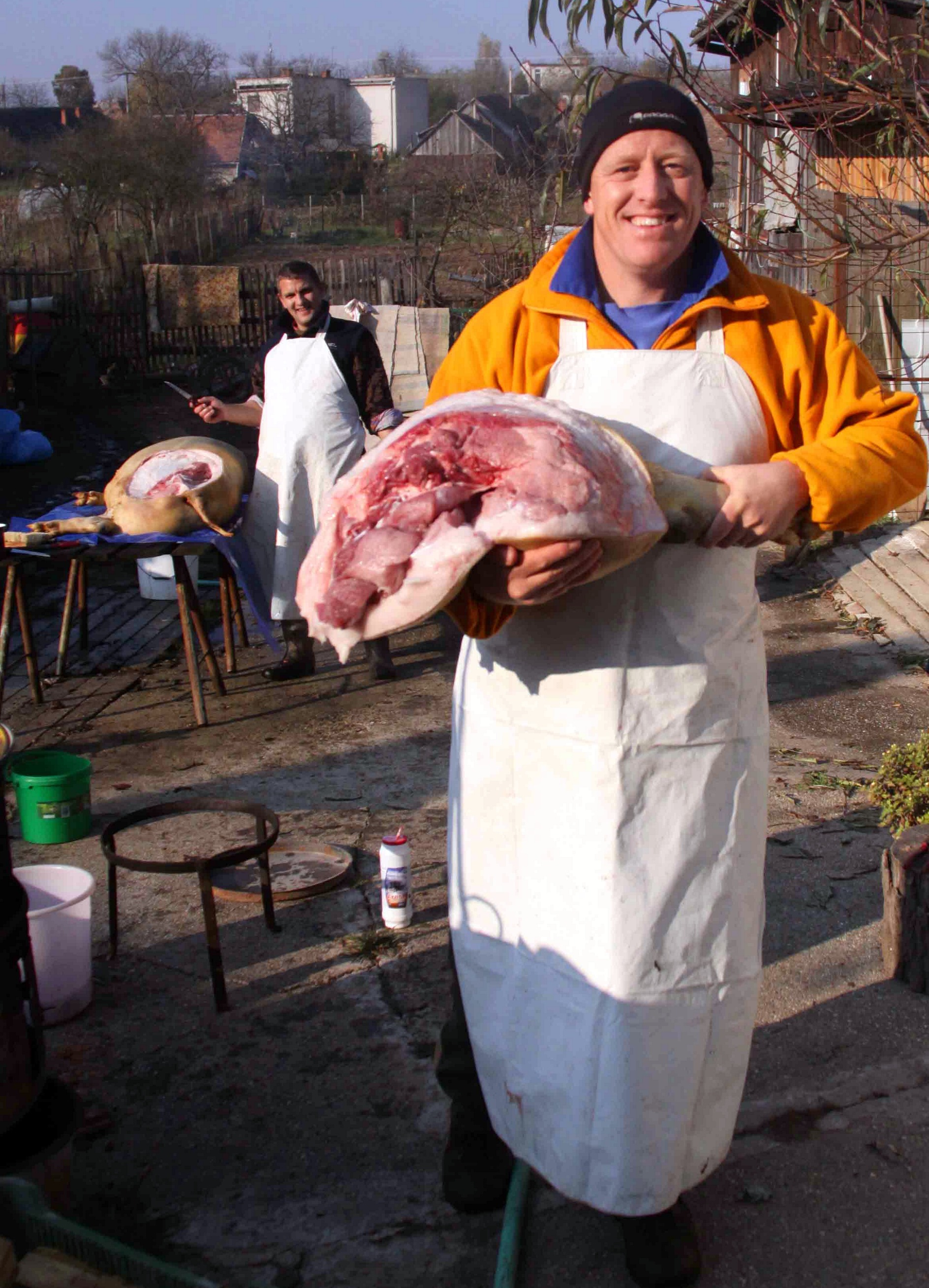
img: Simon participating in the traditional slaughter of pigs that occurs in his Slovakian village every year. His comment: “Most village families rear a couple of pigs every year for this purpose. The custom was new to me, and I didn’t like the idea — never ever thought I’d be doing this kind of thing! But it does mean you can fill your freezer with good quality, home-bred meat and sausages, and I’ve gotten used to it.”

STAY TUNED for tomorrow’s installment from our displaced fictional heroine, Libby, who encounters her very first 4th of July celebrations.

If you enjoyed this post, we invite you to subscribe for email delivery of The Displaced Nation. That way, you won’t miss a single issue. SPECIAL OFFER: New subscribers receive a FREE copy of “A Royally Displaced Tea.”

Related posts:

The Displaced Nation celebrates American — and its own — independence

Today being the Fourth of July, the whole of America is celebrating its independence from Great Britain.

The Displaced Nation is celebrating, too, but in our usual idiosyncratic style. According to the mini-introduction on our site:

Here at The Displaced Nation, we are passionate about the experience of becoming a global resident.

Celebrating one country’s detachment from another, 235 years ago, doesn’t seem quite in keeping with this Declaration of Independence from nationhood of the conventional kind.

So instead of looking back to 1776, two of us are looking back only to this time last year — to a time when The Displaced Nation didn’t even have a name.

Kate Allison:
This time in 2010, I blogged about the Queen’s visit to New York, which tactfully had been scheduled to start just after the Fourth. In my post I described the awkwardness of representing the very country from which America was celebrating its independence:

Imagine gatecrashing a silver wedding anniversary bash, given in honor of your ex-husband and his subsequent wife, and that’s pretty much what it’s like to be a Brit in America on the 4th of July.

And yet last year was better than others had been in the past. The reason?  I’d discovered an online world full of other people who had lived away from their home country for some time, who weren’t sure any more where the heart was, and therefore didn’t know where to call Home.

Two of those people, of course, are my fellow writers, Anthony Windram and ML Awanohara, at The Displaced Nation. When ML first emailed to ask if I would be interested in this joint venture, being a fan of her own site I naturally said yes. But I had no idea what a lifesaver this intense project would turn out to be, during a difficult time for me.

It’s been an exhilarating three months since the site went live. So although I can never quite get to grips with the spirit of Fourth of July, I’m going to celebrate anyway.

Fire up the barbecue, cue the fireworks, and pass a Corona. Cheers!

ML Awanohara:
I was feeling very misplaced, out of place, out of sorts last Fourth of July. I wrote a rather caviling post maintaining that celebrations of American Independence Day haven’t seemed the same since I repatriated to the U.S., after so many years in the UK and Japan.

I had three main gripes:
1) The latest poll showing that most Americans didn’t know from which nation we’d declared our independence. In the version being circulated in 2010, some had actually speculated it was from Japan or China.
2) Inferiority of American fireworks to those I’d seen over the Sumida River in Tokyo. Why hadn’t we bothered to update them?
3) Boring barbecues. At the very least, I thought it was time for Americans to consider expanding their grilling repertoires to include British bangers.

Two Brits who’ve displaced themselves to the United States, Kate Allison and Anthony Windram, read my post — and stepped up to offer their cyber-friendship.

One year later, I’m thinking about how delighted I am to have have joined forces with them in founding a nation for displaced types like ourselves.

What’s more, The Displaced Nation has just turned three months old, as of July 1. That’s nothing, of course, compared to the American nation (whose 235 years is nothing compared to China’s 5,000 years of history, let alone the histories of most European countries).

But surely it’s something in cyberspace?

We hope that you, too, by now are beginning to put down roots in The Displaced Nation, and we thank you for your contributions to our nation-building efforts.

QUESTION: Which kinds of posts would make you feel even more at home on The Displaced Nation site? We’d love to get your suggestions and input.

STAY TUNED for tomorrow’s post, proposing a new theme (woo hoo!) for The Displaced Nation to explore for the remainder of the month.

If you enjoyed this post, we invite you to subscribe for email delivery of The Displaced Nation. That way, you won’t miss a single issue. SPECIAL OFFER: New subscribers receive a FREE copy of “A Royally Displaced Tea.”

Related post:

Another Friday, another royal wedding of international fame

Who’s the happy Royal couple today?

Ah yes. Kate Moss and Jamie Hince, in a three-day bling-fest entailing two top chefs, six marquees, and performances by Snoop Dogg and Kanye West. I bet the residents of  Little Faringdon are loving that one. There probably haven’t been as many twitching net curtains since Kate entertained a pipedream of opening a London pub in the middle of the peaceful English Cotswolds.

But I’m joking, of course. While Kate Moss’s wedding is taking place today, the real Royal wedding is that of Prince Albert of Monaco and his 20-years-junior, South African fiancée Charlene Wittstock, in a two-day bling-fest entailing super-chef Alain Ducasse, a Royal courtyard, and performances by Jean-Michel Jarre and The Eagles.

Money no object – money the object

With an estimated price tag of $65 million, Prince Albert’s wedding makes William and Catherine’s April nuptials look like five minutes in a Las Vegas chapel. Sadly, this extravagance seems to be the main point of the exercise: an attempt to revive both Monaco’s struggling economy and its reputation of classy glamour, the latter which, to a large extent, died with Princess Grace in 1982.

With Monaco awash in heads of state, fashion designers, and A-list celebrities, who could fail to notice the wealth and pizzazz of this little principality?

Prince Albert himself said:

“Even if it’s not the main purpose [of the wedding], it will be a chance to shine a light on the principality and to contribute to ending stubborn clichés [about Monaco].”

A runaway bride?

Recent rumors, however, seem to be shining lights in other, unwanted directions.

Already the father of two illegitimate children, the Prince must have been perturbed when a new whisper surfaced that a third offspring was toddling out of the woodwork.

Further rumors that, in response to this revelation, Ms. Wittstock tried to back out of the wedding and fly back to South Africa, and claims by Monaco police that her passport was confiscated to stop her doing so, have surely cast a shadow on the proceedings.

Prince Albert (and his lawyers) have vigorously denied the claims – but then, as Mandy Rice-Davies once said, “Well, he would, wouldn’t he?”

You can’t have a Royal wedding where the bride is perceived as being frog-marched down the aisle.

Lambs to the altar

Actually, you can. It used to happen all the time, and not too long ago either, but we like to think we’ve moved on.

We haven’t. Not really. Royal dynasties need heirs. Prince Rainier needed heirs because if there were none, Monaco would revert to France under a 1918 treaty. Grace Kelly duly produced heirs.

Not surprisingly, parallels have been drawn between Grace Kelly and Charlene Wittstock: both tall and blonde, both ‘commoners’, one an American film star, the other a South African Olympic swimmer who bears more than a passing resemblance to Grace Kelly.

Thirty years ago, similar parallels were drawn between Princess Grace and Lady Diana Spencer, before she became Diana, Princess of Wales. Another tall blonde, capable of producing heirs for a royal family; another dazzling wedding to shine a light upon a country in recession.

One can only hope that, despite this week’s rumors, Her Serene Highness, Princess Charlene of Monaco will have a better fate than the other two. If the marriage is less than perfect, let’s hope it hasn’t all been in vain and that the flagging economy in Monaco recovers as a result.

Plan B

If not, perhaps they could approach Kate Moss and offer her a venue in Monte Carlo to open the London pub she was thinking about. That would soon revive the economy.

Whether it would do the same for Monaco’s classy glamour, however, would remain to be seen.

Related posts:

Jerry Seinfeld – the Royal Wedding’s answer to Ricky Gervais

A displaced American writer, awash in a sea of Royal Wedding apathy

A toast to two displaced writers with passionate views of royal passion

In search of 007th heaven: A travel yarn in three parts (Part 3)

We welcome back Sebastian Doggart for the final installment of his story about the pilgrimage he made to Goldeneye, the Jamaican coastal retreat where Ian Fleming wrote all the James Bond novels. In Part 1, Sebastian reports on his clever ploy to gain admission to the birthplace of James Bond. In Part 2, he registers disappointment at the conversion of Goldeneye into GoldenEye, a soulless bolt-hole for the rich and famous. In this final part, he tracks down the original locations where some famous scenes in two early Bond films were shot.

Back on the cactus-studded road, fortified with a cup of 007’s favorite Blue Mountain coffee, I — along with my two Bond girls: my lovely girlfriend, Emily, and our cheeky six-month-old daughter, Alma — renewed the quest to find some legitimate traces of Britain’s greatest spy.

The movie that pays greatest tribute to Fleming’s love for Jamaica is Dr. No (1962). Filmed just outside the island’s capital city, Kingston, on the south coast, Dr. No features the first Bond car chase, as glimpsed in the film’s original trailer. (Notably, I did not encourage our red-eyed Jamaican driver to hit the accelerator and, for Alma’s sake, was relieved to see a large blue traffic safety sign saying: “SPEED KILLS. Don’t be in a hurry to eternity”.)

Also as glimpsed in this trailer, Dr. No also introduced the world to the first Bond Girl: Ursula Andress as Honey Ryder — emerging from the waves, cuddling a conch shell.

No matter that her voice was dubbed in the final film, Ms. Andress in a bikini was a vision that launched a million erotic fantasies, including my own. The beach where this iconic scene was filmed is as hard to reach today as it was for Bond in the movie. Located four miles west of Ocho Ríos, behind the Roaring River generating station, on a privately owned, rentable estate, it is approached by an unmarked track that ends at a security gate. The Laughing Waters stream — in which Bond and Honey concealed themselves — still pours into the sea.

But Bond and Honey’s actual hiding place is now a very unromantic drainage ditch.

In both the movie and the book, Honey’s beach lies on the island of Crab Key, which is Dr. No’s well-appointed hide-out. Bond and Honey make their way from the beach, through a lush forest, where they find a stunning waterfall in which to wash off.

I would do the same thing…

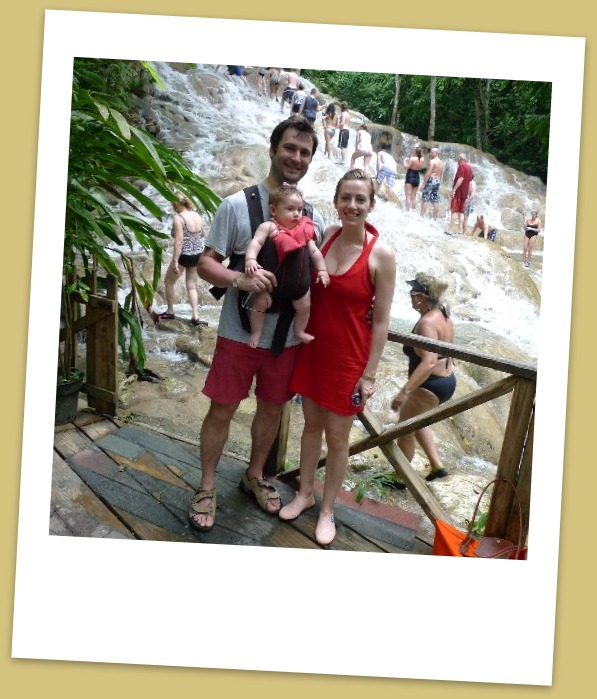
The cascade used for the movie is now one of Jamaica’s top tourist attractions, Dunn’s River Falls. As we reached this reputedly picturesque spot, the first thing we noticed were grotesque conga lines of cruise-ship passengers — mainly American, but with a large smattering of Chinese — clambering over the rocks. How I wished I’d had a Walther PPK pistol to silence the tour-guides as they orchestrated raucous football chants.

(Afterwards, Alma exacted her own ruthless revenge on the commercialized desecration of the waterfall. As we were waiting for our driver to pull up, a septuagenarian American couple, all sunhats and positive energy, approached us. Alma served up her gummiest, sweetest grin to the lady, whose tired face melted. “Awww,” she cooed, “you are the cuutest ba–“, at which moment she stumbled sharply and fell face first on to the asphalt. A blackish red liquid oozed from her mouth. Emily shielded Alma’s gaze from the horror. The husband yelled for help. A call went out to out to an ambulance, which — do they have one permanently stationed at the Falls to handle tourists tumbling down the rocks? — arrived within minutes. The lady was carried into the back of the ambulance, as her husband asked a fellow cruise passenger to tell the captain not to leave until she had been patched up and discharged.)

Dr. Julius No’s lair was where he entertained Bond and Honey for dinner…and concealed the laser that could disable American missiles. It also contained the nuclear reactor where he would meet his death, sinking into the boiling liquid from which he was unable to escape because of his metal hands.

The building used for the reactor’s exterior is a bauxite plant that sits beside the main road on the crescent harbor of Discovery Bay. It’s owned and operated by the American company Kaiser. Beneath its russet-stained dome is where the “red gold” that is Jamaica’s second-leading money earner after tourism is transformed into aluminium for export to U.S. refineries.

The other movie where Jamaica plays a major role is Live and Let Die (1974), the first film to star Roger Moore as James Bond.

Jamaica stands in as the Louisiana bayou for the classic scene in the crocodile farm owned by the evil Mr. Big. In the film, Mr. Big’s real name is Kananga, which was taken from real-life crocodile wrangler Ross Kananga, who was the double for Moore in the scene where Bond escapes by running over a phalanx of crocodiles.

In this clip you can see all five takes of Kananga performing this perilous stunt for Moore. The location was an actual crocodile farm called Swamp Safari, near the town of Falmouth. (It was being refurbished when we visited and is due to re-open next year.)

In Live and Let Die, Jamaica is also the fictional Caribbean island of San Monique. In the original novel, Bond comes here to track down what his MI6 boss, M, believes to be a stash of gold that was originally amassed by the notorious pirate Henry Morgan, himself an early foreign resident of Jamaica. That gold was being used by the criminal network SMERSH to fund nefarious activities in America.

In the movie, Kananga’s base was conceived of as a cathedral-like cave beneath a cemetery. It was here where the infamous drug lord kept his submarine. And it was here, in a shark-infested lagoon, that Moore kills Kananga by stuffing a bullet of compressed air down his throat, causing him to explode.

The Kananga scenes were shot in the real-life Green Grotto and Runaway Caves near Discovery Bay. They comprise a network of limestone caves and a limpid lake, 120 feet below sea level. Originally a Taíno place of worship, the caves had a recent incarnation as a nightclub — but after revelers damaged the stalactites, it was closed down. Today, tour guides are scrupulously protective of the green algae on the walls.

As my Bond girls and I wound up our 007 tour and headed back to New York, I was re-energized to write my own Bond novel. It will begin with our hero discovering that his mother, whom he has not seen since he was very young, is alive but has been kidnapped by a mysterious criminal gang.

With Bond’s fascination for women clearly linked to an Oedipal complex and an impossible love for his mother, this will set up the highest stakes of any 007 story ever. In an extraordinary final twist, his mother will be revealed as none other than…M herself!

M for Mummy! Genius!

What do you think? Will this effectively reboot the Bond franchise?

img: The intrepid Sebastian Doggart with his equally intrepid “Bond girls,” girlfriend Emily and their daughter Alma, snapped in front of Dunn’s River Falls, Jamaica, with conga lines of cruise-ship passengers in the background.

STAY TUNED for tomorrow’s installment from our displaced fictional heroine, Libby, who, having just said good-bye to her London home, is about to embark on her long-anticipated relocation adventure.

If you enjoyed this post, we invite you to subscribe for email delivery of The Displaced Nation. That way, you won’t miss a single issue. SPECIAL OFFER: New subscribers receive a FREE copy of “A Royally Displaced Tea.”

Related posts:
See also:

DISPLACED Q: Wimbledon — is it an anachronism in today’s international sporting world?

Given that Fred Perry was the last British man to win a Wimbledon singles event (1936) and Virginia Wade the last British woman (1977), the British public’s enthusiasm for this rather quaint championship is surprising. Then again, nothing fuels their enthusiasm as much as cheering on the underdog, and goodness knows, there are underdogs aplenty for them at Wimbledon.

Every now and then, a British competitor with a sniffing chance at victory will come along and be vigorously rooted for. Alas, no amount of national pride will change the inevitable outcome of (Andy Murray excepted) the Brit’s hangdog expression as he packs away his racquet and towel after losing 6-0 6-0 6-0 on an outside court to an American or Rumanian.

As Clive James, the Australian writer and broadcaster, pointed out:

“A traditional fixture at Wimbledon is the way the BBC TV commentary box fills up with British players eliminated in the early rounds.”

Perhaps different countries are wired for different sports? Czech-born Martina Navratilova, nine times winner of Wimbledon Ladies’ Singles, thinks not:

“I’m an American. You can’t go on where you were born. If you do, then John McEnroe would be a German.”

John McEnroe (born to American parents in West Germany) caused controversy at Wimbledon in 1981, when he loudly criticized a line call and called umpire Ted James “the pits of the world.”

Despite being named by Sports Illustrated as one of the Top 10 Men’s Tennis Players of All Time, McEnroe fears the reputation of his temperament will outlast that of his talent:

“I want to be remembered as a great player, but I guess it will be as a player who got angry on a tennis court.”

For those who say there’s no such thing as bad publicity, McEnroe disagrees:

“Princess Diana, she used to come watch the tennis [at Wimbledon]. And even though she had it 1,000 times worse than I ever did, she pulled me aside a few times and said, ‘I really feel for you.'”

Meeting the Royal Family is something that doesn’t happen too often at, say, the U.S. Open. Perhaps it would be better if it did. Serena Williams, who has her own reputation for putting her verbal equipment in gear ahead of time, describes a Wimbledon meeting with Queen Elizabeth:

“I was supposed to say, ‘Your Majesty.’ I totally choked. I was like, ‘Hey, nice to meet you’, total American style. And then she started talking. Then I was like ‘Your Majesty’ while she was talking… Maybe she’ll remember me.”

Undoubtedly. Serena should have heeded Jimmy Connors’ rueful comment nearly 30 years ago:

“New Yorkers love it when you spill your guts out there. Spill your guts at Wimbledon and they make you stop and clean it up.”

Some international tennis players remain unimpressed by the oldest, and to some the most prestigious, tennis tournament in the world. Russian player Nikolay Davydenko says:

“Wimbledon is the world’s most boring tournament. There’s hardly anything to do apart from tennis. You constantly find yourself yawning – there’s no entertainment here.”

Is he referring to the arduous 30-minute train ride into the bright lights of central London, or is it simply a severe case of sour grapes at never progressing beyond the fourth round at Wimbledon? Whatever the reason, he isn’t alone.

“A lot of people think that everything revolves around Wimbledon but it is just one week of the year for us. If nothing happens at Wimbledon, it’s not the end of the world.”

— this from Elena Baltacha, the Ukraine-born British player, after losing at Wimbledon 2009 and sadly proving Martina right in her earlier statement about birthplace versus nationality. Oh, and Elena — Wimbledon is a two-week tournament. Perhaps that’s where you’re going wrong.

But maybe she’s right not to take it so seriously. My all-time favorite saying by a tennis player is that of Boris Becker, youngest ever winner of Wimbledon’s Men’s Singles, when he lost in the 1987 final to Pete Doohan:

“Nobody died. I only lost a tennis match, nothing more.”

So, let us have your views! Do you see Wimbledon as an anachronism in today’s sporting world, or are its slightly eccentric traditions to be cherished? The strict dress code of white for competitors; the strawberries and champagne; and above all, the venue of the All England Lawn Tennis and Croquet Club. (How Alice is that!)

And on the subject of Alice, our last words come from Venus Williams, on her tennis outfit at this year’s Australian Open:

“The outfit is inspired by Alice in Wonderland. It’s kind of about a surprise, because when Alice goes down the rabbit hole, she finds all these things that are so surprising. This outfit is about having a surprise in a tennis dress, and showing some skin and then just having a print. Prints don’t happen that often in tennis. So it’s called the Wonderland dress.”

Call me old-fashioned, but I’m with the Wimbledon dress code on this one.

STAY TUNED for tomorrow’s post, Part 3 of Sebastian Doggart’s thrilling chase after James Bond creator Ian Fleming’s Jamaican haunts.

Related posts:

“Zuzu in Prahaland”: A departing expat takes inventory of strange, Lovecraftian Prague

For much of June, The Displaced Nation has been looking at what the story of Alice in Wonderland can tell us about displacement of the curious, unreal kind — as anchored by Kate Allison’s 5 Lessons Wonderland taught me about the expat life, by Lewis Carroll’s Alice. Today we welcome guest blogger Sezin Koehler, who received one of our Alice Awards for writing about her current home, Prague, in this vein. Koehler and her husband plan to leave the Czech Republic on August 2. Here, she credits their four-year stay in its capital city for bringing out the Alice in Wonderland, or Zuzu*, in her character.

When I first moved to Prague I had no idea I’d be entering a living snow globe rather than going down the proverbial rabbit hole. Not just any old snow globe, but one incessantly shaken by a petulant child, refusing to let but a glimmer of sunlight through the gray haze. I also had no idea that Prague was not so much a city, but rather some kind of unpronounceable Lovecraftian entity with a mind of its own.

The old mother with claws

Kafka called Prague “the old mother with claws,” and he struggled his whole life to escape from her clutches. He never managed.

After four years in her grasp, I myself feared I would never get out from her cruel and cold embrace. My suspicion is that if you die in Prague, your soul is trapped here forever, unable to move on or away, locked in a limbo that the entity within feeds upon, like a relentless vampire queen.

Since the Velvet Revolution that ended the reign of Communism in 1989, Prague has welcomed fresh blood in the form of expats with open arms. There is an entire community of American, Australian, British, Canadian and other expats who have lived here since the 1990s, and they make up their own insulated subculture within greater Prague. The mother claws have them, and good.

These long-term expats joke that Prague is a city that draws you in, makes you comfortable — and then, in the snap of a bony hand, chews you up and spits you out.

In my brief tenure I have witnessed this phenomenon several times: expats, happy as pie, loving the beer and the high life Prague affords — only to find themselves unceremoniously booted out of the country with no friends, no money and only a drinking problem to show for their life here.

Many of those who remain in the clutches for too long have, in the process, become a mutant strain of Czech: wary of outsiders, unwelcoming and generally cold people unless surrounded by their own.

The mother claws are a fickle bunch, taking what they need and discarding of you when there is nothing left.

Prague isn’t just a city, but an entity of some kind. My creativity in Its abode has come with often hefty prices. Two years into my stint here, I developed tendinitis in both wrists simultaneously from a combination of overwork and the extreme cold. I spent three months with both wrists in braces, unable to wash or clothe myself; it took steroid shots and brutal physiotherapy to finally get my hands back in working order.

Now I have the uncanny knack of predicting rain and cold snaps.

Looking back at this strange, sometimes nightmarish interlude, I offer up 20 stream-of-consciousness memories:

1. The place where my husband and I went from being just a couple to being a team.

2. A fairytale land on this side of the rainbow where my dreams started to come true — published in print for the first time, wrote my first screenplay, published my first novel and began work on its three sequels, started building my own platform as a writer. I can call myself what I wanted to be ever since I can remember.

3. Neo-Nazis and being screamed at by a racist Czech granny on the 18 tram.

4. Getting caught in the blizzard of 2010 and finally understanding that it’s not only people that can threaten you — the very elements themselves are forces of their own will and we live at their whim.

5. The phenomenal view of the University Botanical Garden from our living room window, as well as the original 6th century settlement of Prague, right smack in the middle of the city.

6. Chapeau Rouge, the friendliest bar in Prague — but only if you are there with me. I’ll make sure you pay homage to what I call Our Lady of the Music: an art installation featuring a Mary with a disco ball above her head and a record between her praying hands.

7. Discovering Afghan cuisine and vegetarian restaurants; also remembering South Indian cuisine and ordering Indian delivery online — useful especially when the streets were knee-deep in snow.

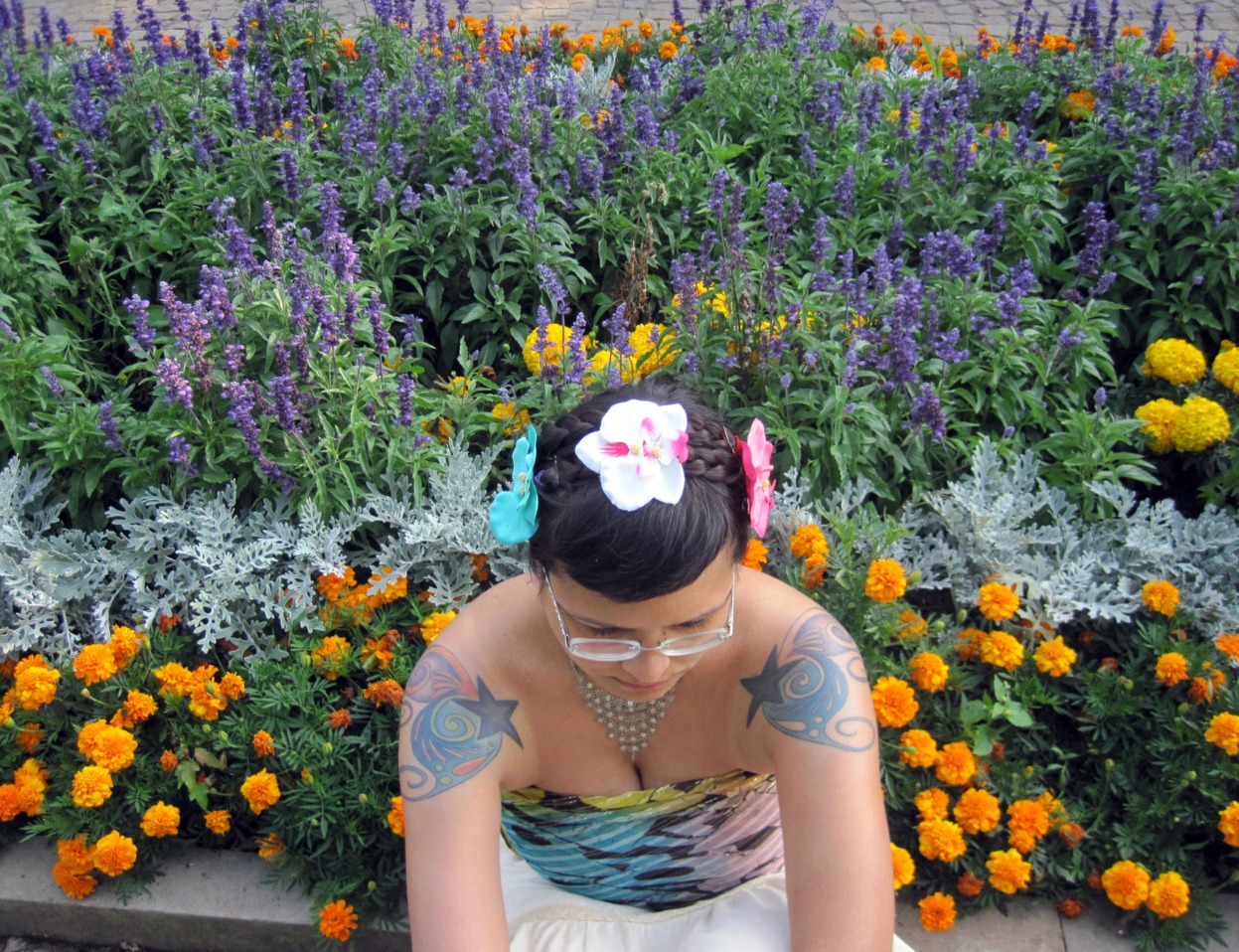
8. Bara, the world’s most talented tattoo artist: she gave me wings, stars, Falcor and Edward Scissorhands.

9. Cold that sinks right into your bones, feet aching and joints swelling from trudging through it across treacherous cobblestones and hidden patches of ice.

10. Bonsai and carnivorous plant exhibits at the Botanical Garden.

11. Sitting in our apartment, feeling my ears pop like I’m on an airplane from the rising and falling air pressure.

12. Lady Gaga’s monster brawl at the O2 arena: the Czechs marked the 21-year anniversary of the Velvet Revolution by punching people who wanted to dance; MGMT at Divadlo Archa; free passes to the Irish-American funk band Flogging Molly at Retro Music Hall — and hanging out with them afterwards.

13. Dancing in what was then Klub Kostel (literally, Church Club) on Hallowe’en, dressed as a witch.

14. Yearly fireworks and light shows over Vyšehrad (castle on a hill over the Vitava River), with a stage front view right from our window.

15. Mourning the deaths of, from a distance, Heath Ledger, Michael Jackson, Patrick Swayze, Corey Haim, Ryan Dunn … and close up, Curtis Jones, an American expat performance artist who’d been living in Prague since 1989 — a dear friend to many dear friends of mine in this city.

16. Cleaning up my first ever poop-drenched child, at an international pre-school where I worked. (I don’t and never will have kids.)

17. The vista of Prague from the tram on the way up to the castle, skyline scraped with spires and a cloud of fog overhead, feeling like I had somehow escaped the evil snow globeness if only for a moment.

18. Working for a newspaper, a mentally unbalanced artist, a shady off-shore investment banking firm, an international relocation company, a British school, and the largest university in central and eastern Europe.

19. The stench of Prague’s walking dead — homeless people with rotting parts of their bodies or insides, including one fellow with a black foot, the gangrene working its way up his leg. The worst thing I have ever smelled in my life, and I’ve lived in India and Africa; impossible to describe how awful and sad it is.

20. Seeing open graves for the first time ever, in Olšanské hřbitovy (Prague’s largest cemetery) — and imagining an imminent zombie invasion.

Na shledanou, Prahaland

I have made a tenuous peace with Prague.

This has been a place of great pain and great inspiration. The Entity is letting me go without a struggle: It knows that I will be telling stories about It for years to come.

It doesn’t even care if I paint Its portrait with darkness and horror — It wants to be seen, It wants to scare, It wants to fascinate so it can feed.

It knows the things I write, good and bad, will help bring many more people into Its icy embrace.

Prague is always hungry for fresh blood. Will yours be next?

*Sezin Koehler owes her nickname “Zuzu” to Rebi and Tereza, two Czech girls she took care of in an after-school program she organized. “Good afternoon, Miss Zuzu,” they would say. “Zuzu” is a common Czech nickname, short for “Zuzana.” This tickled Koehler’s fancy as one of her favorite films of all time — It’s a Wonderful Life — features a character named Zuzu Bailey. She has even named her blog Zuzu’s Petals — which, she says, “signify the most beautiful turning point in the film.”

Sezin Koehler is a half-American, half-Sri Lankan global nomad, horror novelist, writer and editor. Her first novel, American Monsters, was released last year. It has since been picked up by Ghostwoods Books, and an illustrated 2nd edition will be released by Fall 2011. Koehler’s Twitter moniker is @SezinKoehler.

img: “NO REST FOR THE WINGÉD — Zuzu Kahlo,” by Steven Koehler.

STAY TUNED for tomorrow’s post consisting of quotes attesting to the curious, unreal nature of Wimbledon tennis — which, to the more discerning observer, can seem disturbingly akin to the Queen of Hearts’ game of croquet.

If you enjoyed this post, we invite you to subscribe for email delivery of The Displaced Nation. That way, you won’t miss a single issue. SPECIAL OFFER: New subscribers receive a FREE copy of “A Royally Displaced Tea.”

Related posts: