The Displaced Nation

A home for international creatives

Category Archives: Golden Oldies

Bob Costas as the ugly American: NBC and the Olympics

Yesterday’s post was on the opening ceremony of the London Olympics. Here in the US, I was able to watch it (hours after the rest of the world) on NBC.

I hadn’t planned to write a post about the Olympics and the opening ceremony. In fact, I was vehemently against the idea when it was suggested to me. However, as the days have gone on, I’ve found my attitude softening.

They are two reasons for this.

Firstly, the Games have made me homesick. My usual cynicism is no match for the enthusiasm of my London friends, all of whom seem to be attending events (if Facebook is anything to go by) while I sit watching it in one of the dullest towns in California. The opening ceremony elicited in me a mixture of pride and embarrassment — and as such, perfectly encapsulated for me what it is to be British. The ceremony also irritated Rush Limbaugh — so clearly job well done on Danny Boyle‘s part there.

The second reason I’ve decided to backtrack on my decision to blog on the Games is I am enduring the NBC coverage. Those of you spending too much of your time on Twitter have probably already noticed that the channel has been receiving a fair amount of criticism for its decision to time-delay the opening ceremony, its cutting of the “memorial” wall tribute from the ceremony as they didn’t feel it relevant to a US audience (yeah, because NBC knows what’s relevant to a US audience), its role in the suspension of journalist Guy Adams from Twitter, and the really awful library-esque studio they’ve set up for Bob Costas. Each night Bob reminds me of the narrator from The Rocky Horror Show. Oh God, do you think he’s got pantyhose under that desk?

This is the second Summer games that I have watched in the US, so I am not surprised that NBC in its prime time slots edits the games more like a reality show, such as American Idol, than an actual sporting event. They are filmed inserts galore highlighting particular favored US Olympians giving us a look into their struggles and achievements, their family dynamics, and ideally some terrible (juicy) tragedy that has befallen them.

What has really irritated me, however, has been NBC’s commentary. I understand that Trevor Nelson had some role in the BBC commentary during the opening ceremony, so in the interest of fairness I imagine that was pretty dire, too; but it was disappointing to see Matt Lauer, Bob Costas and Meredith Vieira prove so adept in their roles as ugly Americans.

On behalf of those blessed without NBC, I re-watched the opening ceremony and parade of nations this morning. I give you the following comments from said broadcast:

On London mayor Boris Johnson

By the way if you think he’s been so busy, he couldn’t get a haircut — this is his haircut.

Actually, fair enough.

On British English

A billion — that’s with a ‘b’ — will watch at home on what they call “the telly” around here.

On the reveal of the giant baby

I don’t know whether that’s cute or creepy. — Matt Lauer

Coincidentally, I had the same thought on seeing Meredith Vieira.

On Tim Berners-Lee

If you haven’t heard of him — we haven’t either.

Yes, Meredith, let’s revel in our ignorance.

On various countries

Australia was famously settled as a penal colony in the late-1700s.

Belgium, as you know, is homeland to IOC President, Dr Jacques Rogge, who competed as a sailor for them three times in ’68, ’72 and ’76.

We’re meant to know that, but not about Tim Berners-Lee?

Central African Republic is made up of more than 80 ethnic groups and they each have their own language, which I’m guessing makes subtitles at the movies a major undertaking.

Jesus Christ, it’s like watching the games with your unfunny uncle.

And that leads me perfectly to Croatia: their flag-bearer Venio Losert is the goalkeeper of the handball team. This is a sport that just doesn’t have a great foothold in the United States, but if you’re looking for a way to get a medal in the Olympics it would be a good sport to take up.

Yup, the US doesn’t play it, so handball must be a piece of piss.

On Kim Jong-Il and golf

Bob Costas: Matt, as a golfer you’d know that North Korea’s greatest athletic achievement belonged to the Dear Leader Kim Jong-il, who, according to his official biography, carded 11 holes in one. Not over a lifetime, but over the first he ever played. I’m guessing the ones off the windmill and the clown’s nose were especially impressive.”

Matt Lauer: Sure, you joke. You’re not going to vacation there.

Bob Costas: Unlikely.

Feel free to contribute to my Kickstarter campaign to help raise funds to send Bob Costas to North Korea for his vacation.

On badminton coverage

Bob Costas: If you’re looking for badminton coverage, and who isn’t, you’ll find it on our cable networks and streaming live on nbcolympics.com throughout the games.

Matt Lauer: Let’s not make light, this is not your backyard, picnic variety badminton. This is tough stuff.

Bob Costas: No, that shuttle cock moves at “daunting” speeds!

Like those competing in handball, the badminton players should be thankful Bob Costas isn’t playing their easy-peasy sport. Bob can also bitch-slap Chuck Norris.

On various countries

Djibouti — now, there’s a few countries whose names simply make you smile. Djibouti would win the gold medal in that category. Maybe Cameroon taking the silver.

Don’t leave us in suspense, Matt. Who comes in bronze?

Germany is next. Long-time Olympic power, the medal count has slipped in recent years, so they’ve now returned to East German-style Olympic schools to better train their young athletes — but they’re quick to point out their talking about the positive aspects of such a program.

Thank God, for a moment I thought they’d brought the Stasi back.

Madagascar — a location associated with a few huge animated movies.

The Maldives are the lowest country on earth. A couple of medals here might boost them up a little bit.

A few medals will sort out the rising sea levels!

Next is Pakistan. While world leaders keep a wary eye on this country, of much less importance Pakistani athletes to keep an eye are likely to be found in field hockey.

Seamless, Bob. Absolutely seamless.

Winston Churchill once described the African nation of Uganda and its lush landscape as the pearl of Africa. Of course, Churchill never met Idi Amin.

On the speed of the Parade of Nations

Bob Costas: I don’t know if you can sense this, folks, but we’re having to edit through our notes. We have never seen a parade of nations move at a clip like this.

Matt Lauer: Just means we get to the United States and Great Britain a little earlier.

Bob: Tsch, we have to sit through all these other countries.

On athletes smiling

As all these Olympians enter, smiling and quickly, I think part of this is in deference to the 86-year-old Queen who made — along with James Bond — one of the great entrances in Olympic history earlier.

I mean, what other reasons are there for an athlete to be smiling at making the Olympics?

On London pubs and football

You’ll see signs in the windows of London pubs sometimes saying no football jerseys allowed because the mere sight of the wrong jersey can ignite a brawl. But nobody is in a brawling mood tonight.

That ending is worthy of Alan Partridge. Also, as someone who has drank in far more London pubs than Bob Costas and Matt Lauer, I have never seen such a sign.

.

If you enjoyed this post, we invite you to register for The Displaced Dispatch, a round up of weekly posts from The Displaced Nation, with seasonal recipes, book giveaways and other extras. Register for The Displaced Dispatch by clicking here!

Related posts:

THE DISPLACED Q: In your world travels, which Olympics athletic skill would come in most handy?

As I travel around, I often wonder what it would be like to be an Olympic-quality athlete. No, really! I do. I just LOVE the idea of pushing my body to extremes, of being all I can be.

I find it curious that the Dutch sprinter Fanny Blankers-Koen, who won four gold medals in 1948 — the last time the Summer Olympics were held in London — commented afterwards:

All I’ve done is run fast. I don’t see why people should make much fuss about that.

A humble sentiment, to be sure — but, hey, there’s something to be said for displaying your prowess at times.

The way I see it, the pursuit of excellence — in anything, from sprinting to eating a banana to waiting for a bus — should always be applauded. Why be average at anything when you can be great at it?

And if I haven’t managed it yet, that’s not for want of trying! Except in one area. Like many travelers and expats I know I find traveling rather thirsty work — and have developed the skill of lifting a pint, or a large gin and tonic, with the best of them!

But with the London Games soon upon us, I keep imagining all the Olympic-champion-level skills that would come in handy for your average traveler, if only we could enhance our bodies in certain ways.

For example:

CYCLING

As a powerful cyclist, you could transport yourself the length of a continent without ever having to squeeze onto a chicken-infested bus.

WEIGHT-LIFTING

That would help out when it came to backpacking – no need to ban your girlfriend from taking a hairdryer anymore! Just man up and shoulder the extra weight.

SAILING

Did you know sailing was an Olympic sport? (It was actually known as yachting for its first 100 years…)

Top-notch sailing skills would not only make international crossings a pleasure, but you might also be able to pick up a bit of work here and there — maybe even end up crewing a mega-yacht for the rich and famous! (I know someone who is doing this job at the moment. He reports it’s quite enjoyable…)

GYMNASTICS

For the life of me, I can’t figure out how diving or gymnastics could ever be useful. They’re just totally random skills that take a lifetime of effort to acquire and perfect, and are good for exactly two weeks in every four years, until you turn twenty and suddenly become too old. Well, I guess if you’re really lucky, you could launch a clothing label or a perfume brand to finance your travels.

TAEKWONDO and/or KARATE

Taekwondo and karate are both Olympic sports and both fiercely competitive (well, fierce when compared to, say, figure skating!).

Imagine the healthy glow of confidence you’d project strutting around the globe as one of the world’s top martial artists! Downtown in a strange city in the dead of night, you could nip out for a taco safe in the knowledge that any low-life waiting to mug you was about to get an education.

In all seriousness, though, I honestly believe that some self-defense training is essential for the modern traveler. Not so much because you might get a chance to use it, but just knowing some basic moves to defend yourself boosts your confidence a hundredfold. And people out to cause trouble can often tell this at a distance — just by watching the way you walk. They look for easy targets; if you don’t present one, you may never even know you were in danger.

WRESTLING

This could be the all-time winner for us traveling types. Last in line for a ticket? Only one croissant left at the deli? Wrestle your way through!

Caught without enough money after living it up in a posh restaurant? Try skipping out. The maître d’ will never see it coming…

Of course, traveling with bottles and bottles of baby oil is going to present its own challenges — not least when customs wants to know exactly what it’s for. Then again…you could always show ’em!

MARATHON

Ah, the Olympic marathon — traditionally the last event of the athletics calendar, with a finish inside the Olympic stadium, often within hours of, or even incorporated into, the closing ceremonies.

I’ve always fancied myself as an endurance athlete, as a marathon runner — if I was ever in the right place long enough to train for it. That kind of endurance, the ability to not give up even when it becomes impossibly hard — that’s the Olympic-level skill I value the most.

Because, as I said, traveling can be hard. It can be grueling, unpleasant, dangerous and occasionally downright painful!

But as is so often the case in life, if you can just see past all that to the bigger picture — can take a step back from the hardship of the moment and find the strength and positivity to carry you through — you’ll be able to go the distance.

You’ll be the one still traveling when all the others give up and go home; the one who perseveres with the difficult language, makes new friends from scratch and/or manages to fully integrate into an unfamiliar culture.

And that’s where the real rewards come from, the traveler’s equivalent of winning gold: being able to appreciate what you’ve achieved in spite of all the obstacles that were placed in your way.

Because, no matter how competitive some of us world travelers are, the fact remains that travel is not a race. You are only really competing with yourself — trying to see how many life experiences you can assimilate and how far you can go towards achieving your dreams.

And more often than not in that quest, slow and steady is the way to go.

* * *

So what do YOU think? Which areas of athletic prowess would you prefer to master, and why? Any Olympic skill is fair game (hahaha). Let me know in the comments!

STAY TUNED for tomorrow’s interview with Olympian author Wendy Nelson Tokunaga.

If you enjoyed this post, we invite you to register for The Displaced Dispatch, a round up of weekly posts from The Displaced Nation, with seasonal recipes, book giveaways and other extras. Register for The Displaced Dispatch by clicking here!

Related posts:
img: Chronicling Tony James Slater’s attempts to become a gymnast, a martial artist and a weightlifter of note.

5 reasons why American aviatrix Amelia Earhart could be an expat heroine

The American aviatrix Amelia Earhart has been propelling her way into the news headlines this week. Yesterday marked the 75th anniversary of her Lockheed Electra disappearing over the Pacific Ocean.

And today marked the beginning of an expedition, led by an American nonprofit group, to locate the wreckage from her plane. The group plans to scan the depths of the Pacific Ocean near a remote island where they believe Earhart and her navigator, Fred Noonan, died as castaways.

With America’s most famous aviatrix back on our horizons, it seems a timely moment to nominate her for our Displaced Hall of Fame, where we put all of our expat heroes and heroines.

What, was she an expat, too? I can hear you asking. In fact, she was an expat briefly — during World War I, when she went to visit her sister in Toronto and ended up staying on as a nurse’s aide in a military hospital.

But I’ll admit that Earhart seems more of a domestic heroine — as American as apple pie, you might say. Born in Atchison, Kansas, in America’s heartland, Amelia grew up tall and willowy like the corn in the fields. As the Reigning Queen of the Air, she became the nation’s sweetheart and to this day retains a special place in the hearts of young American women.

What’s more, recruiting her to serve as a heroine for global nomads, many of whom have hybrid nationalities, might not fly with my fellow Americans. Secretary of State Hillary Clinton has endorsed the expedition to hunt for Earhart’s plane, saying that Earhart embodies the “spirit of America coming of age and increasingly confident, ready to lead in a quite uncertain and dangerous world…”

But in reviewing the main facts of Earhart’s life, I have found plenty of aspects that show how “displaced” she actually was — “displaced” in the sense of being “removed from the usual or proper place” (see definition on our About page) — and hence belongs in our orbit. Here are five of my top reasons:

1) She was born with wings.

Veteran expats and long-term travelers cannot afford to have fear, or dislike of, flying. Should we incline at all in this direction, it may help to lie back in your airplane seat (or pretend you have a seat where it’s possible to lie back) and think of Earhart, who took to the skies without hesitation, as though the airplane wings were her own. Legend has it that she first caught the aviation bug while an expat in Canada. She went to see an exhibition of stunt flying at a fair in Toronto and later wrote about the sensation she’d felt as a pilot began diving at her and her friend:

I remember the mingled fear and pleasure which surged over me as I watched that small plane at the top of its earthward swoop. I did not understand it at the time, but I believe that little red airplane said something to me as it swished by.

From then on, it was all she could do to keep her feet on the earth. Of her first airplane flight she said: “As soon as we left the ground, I knew I had to fly.” In 1921 she took her first flying lesson, and soon saved enough money to buy a second-hand plane.

Of course it helped that in the early days, flying was a romantic sport for the lucky few, not a form of transport where everyone from pilot to passenger feels as though they’re herding or being treated like cattle. Earhart named her first plane “Canary” because of its bright yellow color. Perhaps she felt like a canary when setting her first women’s record: rising to an altitude of 14,000 feet.

By the time she became the first female pilot to cross the Atlantic solo (Charles Lindbergh was first to do so), she had her own little red airplane — a cherry-colored Lockheed Vega, reputed to be the world’s fastest aircraft and therefore favored by pioneering aviators. Hmmm… Did it make her feel like a cardinal?

2) Always restless with the status quo, she let it drive her adventures.

What’s the litmus test for being a travel or expat type? A person who is always upping the ante. We’re a gang of permanent malcontents!

No sooner had Earhart become the first woman to cross the Atlantic (as a passenger) — a flight that made headlines because three women had died within the same year in trying to achieve it — but she sought to become the first woman to fly solo across the Atlantic (1932) and the first person to fly solo across the Pacific, from Honolulu to Oakland (1935), among other achievements.

At that point, there was nothing for it but to make a bid to become the first person to fly around the world (1937).

One wonders what Earhart might have done next, had she not gone down in her plane on the very last leg of the journey. Perhaps she would she have concluded that she’d peaked out too early? (No doubt many of you serial expats and repats can relate…)

3) She had no qualms whatsoever about the risks involved in an adventuresome life.

In the lore surrounding Earhart, great emphasis is placed on her early feminism. Much of it is said to be due to her mother, who had very little interest in bringing up Amelia and her younger sister as “nice little girls” — she even allowed them to wear bloomers!

Clad in this comfortable attire (Amelia would later design a clothing line for women who wanted comfort), the Earhart sisters climbed trees, hunted rats with a rifle, and “belly-slammed” their sleds downhill.

The young Amelia also kept a scrapbook of newspaper clippings about successful women in predominantly male fields, including film direction and production, law, advertising, management, and mechanical engineering.

Although she did marry eventually — to the publisher George Putnam — she always referred to the marriage as a “partnership” with “dual control,” and did not change her last name.

When she became the first woman to fly solo across the Atlantic, Earhart said it proved that men and women were equal in “jobs requiring intelligence, coordination, speed, coolness and willpower.”

(No doubt she would be knocked out to learn that women’s boxing will be included in the London 2012 Olympics for the very first time.)

But to me, what’s even more impressive about Earhart’s life is that she knew about the risks involved in her chosen occupation — but decided not to let them hold her back. That same kind of risk-taking is at the heart of the overseas travel enterprise, which goes against the grain of most people’s common sense. (“You want to go THERE? And FOR HOW LONG?” Expats and global nomads know the drill of fielding constant questions and doubts from the people back home.)

When Earhart set out on her second attempt to circumnavigate the world (the first had ended in a crash when a tire blew out on take-off), she wrote to her husband: “Please know I am quite aware of the hazards.” And then she went ahead and packed a jar of freckle cream. (I say that because a jar of freckle cream was found on the Pacific Island that’s now being searched.)

4) She was never more in her element than when out of her element (quite literally).

There is something that draws all of us to the displaced life. Since it’s a life of challenges, I have to assume that for most of us, it’s that feeling of being a pioneer, of going the way no one else in our circles has gone before…

In Earhart’s case, the displacement was quite literal: she loved being in the empty sky and facing the unknown. In that sense she was like a character out of Greek myth — a female Icarus. As she once said of an early flight:

The stars seemed near enough to touch and never before have I seen so many. I always believed the lure of flying is the lure of beauty…

Jane Mendelsohn was inspired to write her first novel, I Was Amelia Earhart, after reading that a piece of what may have been Earhart’s plane had been recovered on an atoll in the Pacific. Imagining the life that Earhart and Noonan might have led as castaways, Mendelsohn shows Earhart coming into her own in the desert-island setting, and finding peace of mind.

Random House editor Kristin Fritz commends Mendelsohn for creating a whole new iteration of Earhart as

a woman who had perhaps “taken this journey in order to escape the madness of the world,” a woman who “didn’t give a damn if she was alone” and finally a woman who would “live the rest of her long and brilliant life on this wild and desolate island.”

Now that’s displaced! And if Fritz is right and Medelsohn captured the essence of Earhart in her novel, then we should not feel too bad that she perished on an island out in the middle of nowhere. That’s how she would have wanted it…

5) Last but not least, she appears to have known the value of chocolate.

Here we come to the true test of an expat or international traveler: do they like chocolate? Are they addicted to that sudden charge of energy, the little lift, one gets from the sugar and the caffeine? Most seasoned expats and international travelers know that we could never have prevailed during the inevitable moments of loneliness and displacement the life entails without a chocolate supply of some sort.

When Earhart embarked on her 2,408-mile solo flight across the Pacific in 1935, she packed a thermos of hot chocolate in case she felt chilled. As she later observed:

Indeed, that was the most interesting cup of chocolate I have ever had sitting up eight thousand feet over the middle of the Pacific Ocean, quite alone.

* * *

Now that we’re touching down, I feel the need to quote from Mendelsohn’s recent op-ed for the New York Times:

We still wonder what happened to Amelia Earhart — perhaps soon we may even find out — but do we know what to do with her? Do we know how to make not just her mysterious disappearance but also her miraculous life relevant and inspiring to our global society? And could she matter across the globe, that ball around which she tried to fly that feels so much smaller today but is in fact exactly the same size as it was then?

For me there’s an easy answer to all three of Mendelsohn’s questions: YESSSSSSS!!! It’s time Amelia Earhart went global, and not just literally…don’t you agree?

STAY TUNED for Wednesday’s post, another in our Expat Moments series by Anthony Windram — and yes, it does have to do with the 4th of July!

If you enjoyed this post, we invite you to register for The Displaced Dispatch, a round up of weekly posts from The Displaced Nation, with seasonal recipes, book giveaways and other extras. Register for The Displaced Dispatch by clicking here!

Related posts:
 

THE DISPLACED POLL: Which of these 4 travel champions deserves an Olympic gold medal?

Hi there, folks! In keeping with our summer theme — we’ve been talking up the Olympics, in case you haven’t noticed — today I’ll be taking a look at some travely-types who have performed what can only be described as Herculean endeavors.

Which one of these travel worthies would you vote onto the gold medal podium for their efforts? Register your choice in our poll below.

1) THE SPRINTER: Gunnar Garfors

The 30-something Norwegian Gunnar Garfors (he’s a tech and new media guy as well as an avid traveler and former footballer) will never forget where he was on June 18th, 2012. Because he was in Istanbul (Asia), Casablanca (Africa), Paris (Europe), Punta Cana (North America) and Caracas (South America). Yup — all of ’em! He managed to create a new world record by visiting five different continents in one day!

Although the “day” was quite a long one, as Gunnar used the advancing dateline to squeeze a few more hours into his schedule.

It’s hard to believe that something like this is possible… I’m guessing he didn’t use Qantas for any of the flights. (Okay, that little dig was meant for Australians!)

Seriously, he makes me tired just thinking about it! Can you remember what you did on Monday? I think I got a hair cut…

Definitely an Olympian achievement.

2) THE MARATHONER: Jean Béliveau (no, not the ice hockey icon; we’re talking summer Olympics!)

Montrealer Jean Béliveau took a little longer to accomplish his feat than Gunnar Garfors — because Jean walked all the way around the word. No, really! 47,000 miles… It took him 11 years — and 53 pairs of shoes!

At 45, Jean went through a mid-life crisis with the failure of his neon sign business. In his own words:

“I played the game. It left me empty.”

Jean liked the idea of sailing around the world, but ocean-going yachts cost too much. Instead, he began to imagine running away as far as he could.  He started jogging and working out but told no one of his plans — not even his life partner, Luce Archambault. When he finally told Luce, she gave him her blessing — but insisted that he do it for a cause. Jean chose world peace and the safety of children, something no one could disagree with (at that point, he was after some peace of mind).

He began by running south, but by the time he’d reached Atlanta, his knees had started bothering him, so he switched to walking. He waked through the rest of America, Mexico, Latin America, Africa, Europe and Asia — six continents and 64 countries.

His interest in promoting peace didn’t stop him from being mugged, as well as imprisoned (the latter in Ethiopia). But he carried on and eventually even came to embrace his cause, telling people that to achieve peace, we must see the world through “eyes of love.”

It’s an achievement so staggering it begs the question: what can he possibly do next? Where do you go from there?

“Hey honey, let’s celebrate with a holiday…”

“NO! Already been there.”

Another record, of course, belongs to Luce, who has remained loyal to Jean despite his absence of 11 years from their home in Montreal and his falling for a woman in Mexico. Once a year, she would come to him and they would spend three weeks together, in one place.

Jean walked back into Montreal in October of last year. How does the couple find it being under one roof again? Rumor has it, they’re writing a book together! Talk about Olympian challenges…

3) THE PREPOSTEROUS POLYGLOT: Benny Lewis

Brendan (Benny) Lewis is a polyglot who hails from Cavan County in Ireland. (No, “polyglot” isn’t a type of glue; it’s a person who speaks four or more languages fluently.) Benny earned this title — he is also a vegetarian and a teetotaler — after nine years on the road, during which he taught himself to speak eight languages fluently (with more than a smattering of half a dozen more).

I know nothing about Benny’s musculature, but it’s clear his tongue has gotten plenty of exercise.

Benny now considers himself to be a “technomad” — a full-time technology-enabled globe-trotter. His Web site, Fluent in Three Months, is a treasure trove of tips and tricks for picking up languages (called “language hacks”), as well as a tribute to his mind-boggling achievement. (I’m actually surprised that his head hasn’t exploded from the pressure of all that knowledge.)

According to him, it is no big deal — anyone can do what he has done. All they need is dedication, hard work…and more of the same. (Times a million!)

You know, I have to hand it to Benny, he’s the very essence of — sorry, I can’t resist — a cunning linguist. (Well, I said I was sorry! Please stop throwing things at me.)

4) THE MASTER OF EXTREME ENDURANCE: Ben Hatch

The British novelist and travel writer Ben Hatch is the author of a hugely popular (and very entertaining) book about a recent adventure of his: driving 8,000 miles around Britain in a cramped Vauxhall Astra, while researching a guidebook for Frommers.

“But why is that worthy of an Olympics gold medal?” I hear you ask. “Novelists usually aren’t athletes. And he only traveled around his own neck of the woods, Britain.”

Well, there are lots of reasons I could pick: because he practically lived in his car for five months, because he purposefully inflicted dozens of tourist attractions on himself every week, because he had a car crash en route, or because he stayed in a haunted Scottish castle.

But the one I like best is the fact that he did all this with his wife and two children — aged four and two! — in tow.

Can you imagine? While the family was attempting fine dining in a posh hotel restaurant, his children engaged in food fights and eating mashed potatoes with their bare hands. There were tears and tantrums in the car — every single day. For months. It sounds like my worst nightmare! And I don’t even have kids…

The resulting trauma became his best-selling book Are We Nearly There Yet? 8,000 Misguided Miles Round Britain in a Vauxhall Astra — which I can only assume was written cathartically, in a desperate attempt to cling on to what remained of his sanity after such a grueling experience. I think he deserves a medal just for surviving the first week. And of course, once the kids are old enough to read what he’s written about them, he’ll be in for a whole new world of trouble…

* * *

Right! There’s my suggestions. What do think. folks? I just know there are loads of people out there making epic journeys, achieving the unachievable, and generally making the rest of us look like couch potatoes in comparison. Do you know of any? (Olympians, I mean, not couch potatoes — I’ve got enough of the latter in my house.) BTW, I toyed with the idea of including an older traveler, as unlike sport, there seems to be no real age limit on world travel, especially with all the recent growth in the international cruise-ship industry (see photo above).

In any event, I’d love to hear from you — let me know in the comments, or hit us up on Twitter: @DisplacedNation and/or @TonyJamesSlater

And don’t forget to vote in our poll!

STAY TUNED for Tuesday’s post on a historical traveler worthy of a gold medal or two.

If you enjoyed this post, we invite you to register for The Displaced Dispatch, a round up of weekly posts from The Displaced Nation, with seasonal recipes, book giveaways and other extras. Register for The Displaced Dispatch by clicking here!

Related posts:

Image: MorgueFile

RANDOM NOMAD: Melissa Stoey, Former Expat in UK and Incurable Britophile

Place of birth: Northern Virginia, USA
Passports: USA
Overseas history: England (Huntingdon, Cambridgeshire + Shefford, Bedfordshire): 1988-91.
Occupation: Research technician (basically I do data analysis) and part-time professional blogger.
Cyberspace coordinates: Smitten by Britain: Home of the Britophile (blog); @SmittnbyBritain (Twitter handle); Facebook page; and Pinterest.

What made you leave your homeland in the first place?
I’m intrigued by other cultures and more specifically by the British culture. I have been fascinated by Britain since I was a young teen. I have always had the itch for travel and I knew I definitely wanted to visit the UK, if not live there. My love for travel one of the reasons I joined the military. I put England down as my first choice for duty station and I got it!

Where were you stationed?
At Chicksands air base (Chicks for shorts). It’s now Royal Air Force (RAF) Chicksands. Britain’s Ministry of Defense has since taken it over.

You ended up marrying a Brit, right?
Yes. My first husband, and the father of my son, was stationed at what was then RAF Brampton, which is in Cambridgeshire. At first we lived in Huntingdon, but then he got transferred to a base in Hitchin, which is closer to Chicks, so we moved to Shefford.

Is anyone else in your immediate family “displaced”?
Ironically, my brother was stationed at Chicks three years before, so it sort of felt like I was meant to go there. Right now, I don’t have any displaced relatives, but my son is a dual national between the U.S. and U.K. I suspect at some point he may move to the U.K. after he fulfills his dream of living and teaching in Japan for a year. We’ll see! It may be a case of like mother, like son.

So you and your son now live in the United States?
Yes. His father and I are divorced. We came back and lived in Texas for a year, then West Virginia. We now live in Pennsylvania. Meanwhile, his father has gone back to Scotland, where he is from.

How often do you return to the U.K.?
My son and I, and my second husband — I am now married to an American! — try to go every year or at least once very two years, depending on funds and time off.

Can you describe the moment in your association with Britain when you felt the most displaced?
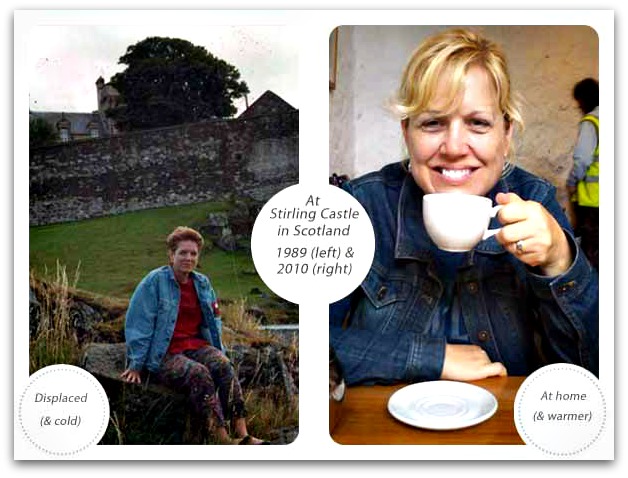
The first night I was in England the culture shock was horrible. I lived around sixty miles north of London in a small village where there were no street lights, and when I looked out the window there was complete and utter darkness. It felt as if I’d landed on a different planet with no signs of life. This was 1988 when almost everything closed much earlier than it does now and wasn’t open on Sundays. If you switched on the radio you might pick up two or three stations, the television had only four channels and of course there was no Internet. It felt much more isolating than if you moved to England today; it has changed by leaps and bounds in the last 25 years as far as conveniences go. I envy current expats who have so many wonderful resources available to help limit the culture shock and make the transition easier.

Is there any particular moment that stands out as your “least displaced”?
We had a great night back in July of 2010 when we met a Glaswegian couple at a curry house in the west end of Glasgow. They invited us to the pub for drinks where we spent the night taste testing different whiskies. I felt totally at home, like I had known this couple my whole life. The Scots have a way — similar to Americans — of making one feel welcomed and accepted. I can say this because of having once been married to a Scot and having spent a lot of time there. My ex-husband was, and still is, one of the friendliest people I know.

You may bring one curiosity you’ve collected from your adopted country into The Displaced Nation. What’s in your suitcase?
My bag is always full of tea and sweets from England. I never return without them. I always pack a few British newspapers as well because my parents are Anglophiles, have been to England many times and enjoy reading them. Rumor has it that some of you Displaced Nation citizens are avid tea drinkers and readers, and that you rarely turn down sweets.

You are invited to prepare one meal based on your travels for other members of The Displaced Nation. What’s on your menu?

I will fix my favorite meal which is a nice Sunday roast that includes roast beef, roasted potatoes, carrots, peas, and Yorkshire pudding (I don’t do sprouts, thank you.) We’ll finish it off with a nice pot of tea and a slice of Victoria sponge, with jam and whipped cream.

And now you may add a word or expression from each of the countries where you’ve lived to The Displaced Nation argot. What will you loan us?
I’m feeling peckish. I say that quite often and it always results in the odd look or two. It’s just not used here, at least where I live. To feel “peckish” means to feel slightly hungry.

Earlier this month, we did a series of posts on Queen Elizabeth’s Diamond Jubilee. Incurable Britophile that you are, I presume you celebrated from a distance?
I watched the River Pageant, which was on early in the morning East Coast time, and then hosted my own Diamond Jubilee lunch (see photos on my blog). The food was great — we nibbled on leftovers for days! Even though I didn’t have a big party (it was just for my family), I was glad to do it to show my blog readers that you don’t have to be in Britain to celebrate properly. You can still enjoy yourself and take part in your own little way.

A couple of us on The Displaced Nation team thinks that the Queen deserves an Olympic medal for having survived almost being displaced by Princess Diana. Do you agree?
I don’t agree that the Queen was almost displaced by Diana; if she was going to be displaced it would have been due to her actions (or lack of) that left the British public feeling as if she was heartless and out of touch. However, I still don’t think she would have been displaced. Time heals and I think many of us now understand the dilemma she faced as a grandmother trying to protect her grandchildren who just lost their mother. However, as Head of State I do wish she had at least made a televised message to the public within the first 24 hours. Waiting five days was a bit much.

Americans seem to love the Royal Family. Do you think the United States might benefit from having one?
The idea of the United States having a royal family at this point is a silly one. It doesn’t fit our history or where we are headed as a country. Let’s leave that to the nation that does Monarchy the best.

Readers — yay or nay for letting Melissa Stoey into The Displaced Nation? Tell us your reasons. (Note: It’s fine to vote “nay” as long as you couch your reasoning in terms we all — including Melissa — find amusing!)

STAY TUNED for tomorrow’s episode in Libby’s Life, our fictional expat series set in small town New England. (What, not keeping up with Libby? Read the first three episodes of her expat adventures and/or check out “Who’s Who in Libby’s Life.”)

If you enjoyed this post, we invite you to register for The Displaced Dispatch, a round up of weekly posts from The Displaced Nation, with seasonal recipes, book giveaways and other extras. Register for The Displaced Dispatch by clicking here!

Related posts:

img: Melissa Stoey at Stirling Castle, Scotland, then and now — in 1989, when she was displaced (and cold!), and in 2010, when she was visiting (and warmer!).

TRAVEL YARN: A second date with Rome

Kym Hamer, an Australian expat in London, joins us today as guest blogger to share her version of a Roman Holiday — one of several trips she has made since having the continent of Europe and all of its history on her doorstep. Notably, for Kym, Rome doesn’t need Gregory Peck to be irresistible!

After 12 years away, I recently went back to Rome.

My only previous dalliance with the Eternal City was part of a “12 cities in 20 days” type tour that at the time, seemed to be the best option for getting a taste of Europe in the three weeks of holiday I had available from my job in Australia. You see, when you’re coming from the other side of the world, the flights are long and expensive, so there needs to be a pretty high rate of return for the time and money invested.

It was an amazing holiday. I visited a whole range of places — some hotly anticipated, some moving me unexpectedly, some not quite what I had hoped for. Each got 1-2 days with an experienced tour guide who made the queues disappear, added humour to the gruelling schedule and brought each city to life with her own blend of historic narrative and personal storytelling.

But each stop allowed no more than a brief and flirtatious encounter, the faint ripples disappearing almost as quickly as they were made by the time I’d left. Each major European city, Rome included, made its impression but was quickly over-run by the next.

Living the dream in London

When I moved to London from Melbourne more than eight years ago, it was the third time I travelled to the UK’s capital in four years. The first time I had been drawn for a week and the second time for four days — both times before a longer “whistlestop” tour of the sort just described. And on both of these visits, I split my time between “tourist” and “traveller,” between the seeing what I wanted to see and the aimless wandering: immersing myself in the city streets, using the local transport and chatting with the natives. One way and another, I got the true taste of the city that was to become my home just a few years later.

I love history and I’ve read it — beginning in the guise of historical fiction (by the likes of Jean Plaidy) through to Simon Schama, Alison Weir and several others — since my very early teens, always trying to imagine what those real worlds, leaping off the pages in front of me, were actually like.

Once I’d moved to London, suddenly I felt I was living the dream (albeit one never particularly aligned to that city). I still stand on Waterloo Bridge at night, gazing at all that history along the riverbank reflected in the Thames, pinching myself and wondering: “Wow, how did I get here?”

Was it a love of history that had tempted me across the world? Not really…there were other candidate cities, but the “right” circumstances conspired with a passionate fling to bring me here. And just as you never know where things might lead in life, the fling came and went, yet London had captured my heart.

The grass still looks green(er)

But my yen to explore means there’s always a sense of looking over the fence (so to speak) with curiosity. What’s it like over there? Would I like it? Be disappointed or even worse, nonplussed?

Which leads me to Rome and some of the other cities I’ve visited since living in London. Being able to hop on a plane (or train — the Eurostar is a pretty fabulous way to travel) and, in just a couple of hours, walk the historic cobbled laneways of a completely different place is an extraordinary experience for any Antipodean. Only a few short hours is required to separate oneself from the familiar and the habitual.

European travel has an especially strong hold on my bucket list. For the most part, Australia’s history is both inextricably linked to and considerably newer than anywhere on the Continent, even though some of the names and boundaries may have changed since I first learned of these faraway lands in the schoolroom.

Of course, nothing can ever take you back in time to know truly what it was like standing at The Green at the Tower of London or inside Newgrange passage tomb in Ireland’s Boyne Valley or atop Hadrian’s Mausoleum — now known as Castel Sant’Angelo — in Rome.

But in the Eternal City, there’s a deep sense of generations past, not just battles won and lost and the rise and fall of the empires that at one time or another shaped “the world” — but also everyday trifles, evidence of the “day-to-day” living of previous generations (take, for instance, Trajan’s market, the “shopping” centre where people went to buy their fresh produce). Both strands of history — the extraordinary and the quotidian — are accessible and visible everywhere.

Second-date nerves

There’s always a part of me that feels a little nervous when I first arrive somewhere new — a piece of me that says, “You could stay in the hotel room tonight, read your guidebook a bit more and be really sure when you set out tomorrow morning.” And it takes some mustering of courage to stop dawdling and plunge right in.

I’m always glad, invigorated actually, once I set off but I guess that essential human-ness in us wants to avoid the risks and keep ourselves safe and sound.

The Rome I had encountered on our first date, before moving to London, had grown faint and unfamiliar. But on this second Roman Holiday, I surprised myself by diving right in to its sights, sounds and smells. I was out the door just an hour after checking in to my hotel. Not for me the lolling about to “recover” from my travels. No way. I had only four days and I wanted to fill it with…well, Rome. It was an immersive experience I was after.

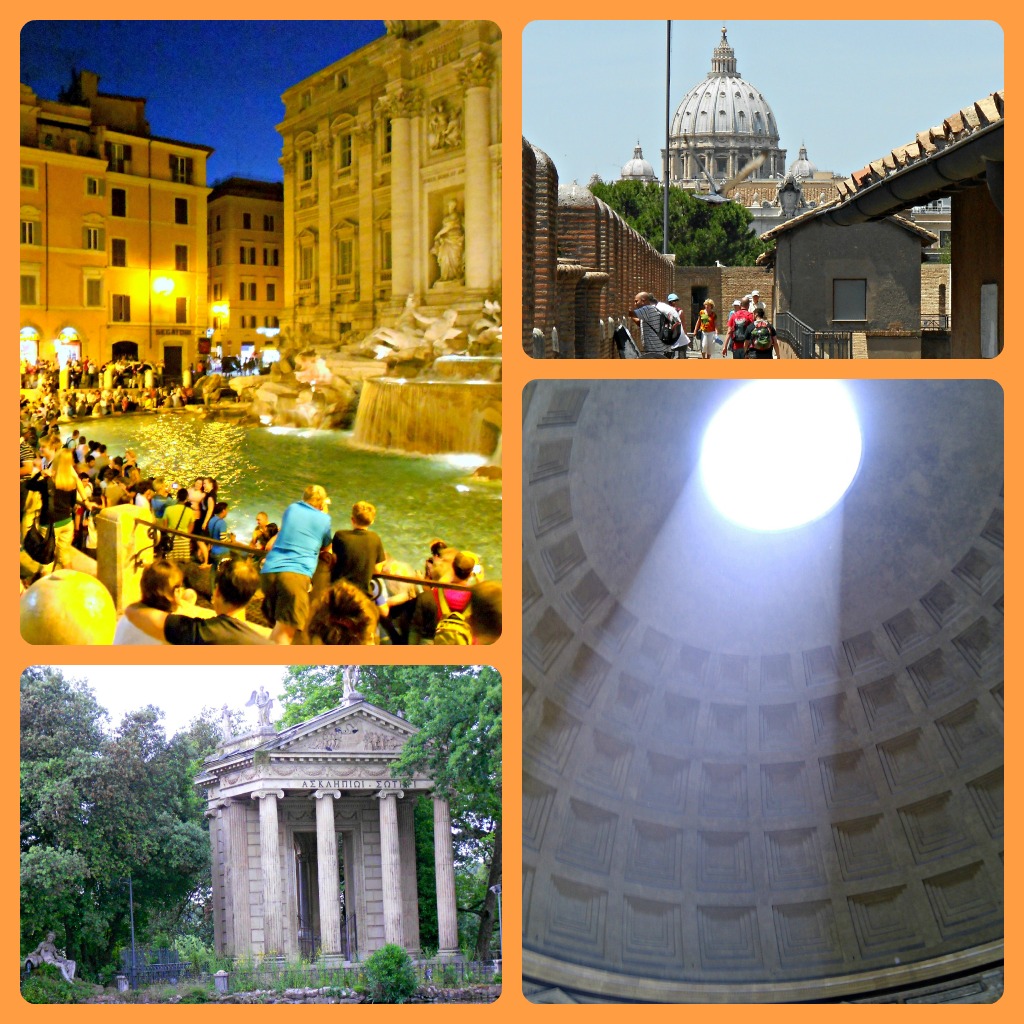
So I walked down from Quirinale in the darkening streets as night fell, map in one hand, camera in the other, my eyes filled with wonder and excitement. A stranger in the night if you will: with no local knowledge, limited lingo (si and grazie get you only so far) and quite frankly no idea where I was going. Tingling and a little breathless with the thrill of discovery somehow I found my way through the warren of streets to the Fontana di Trevi.

And the four days flew by. I walked and bus-sed and walked and Metro-ed and walked and cruised and walked some more. Compact and exuberant, Rome spreads its charm around every corner. The noise and busy-ness were energising although the traffic in some of the piazzas less so.

(I always imagined piazzas to be intimate and bustling, even green, rather than spacious, concrete or filled with litter. So the Piazza Navona and Campo de’ Fiori — the latter translates into “field of flowers” — were amongst the few “oh, is that it?” moments.)

A piece of my heart

From my coin toss into the Trevi on that first night to my final morning meandering in the warm rain through the gardens of the Villa Borghese, my second encounter with Rome has moved us beyond the acknowledgement of two passing strangers. But while we are not yet close friends, there’s a piece of my heart that’s indelibly stamped with a sense of delightful possibility.

Will I return to the Italian capital for a gentle kiss, for one more embrace perhaps? I don’t know but it’s exciting, exhilarating, a little self-conscious and filled with promise.

Just like Rome.

Born and raised in Melbourne, Kym Hamer has worked in London in sales and marketing for the past eight-and-a-half years. She writes the popular blog Gidday from the UK. Also follow Kym on Twitter: @giddayfromtheuk.

STAY TUNED for tomorrow’s Random Nomad interview with an American who has taken the “phile” in Anglophile to an extreme.

If you enjoyed this post, we invite you to register for The Displaced Dispatch, a round up of weekly posts from The Displaced Nation, with seasonal recipes, book giveaways and other extras. Register for The Displaced Dispatch by clicking here!

Related posts:

Images: Some enchanted moments from Kym’s second date with Rome. Clockwise from top left: Off peak at the Trevi Fountain (“busy, yes, but somehow still magical”); the Vatican from the battements of the Castel Sant’Angelo; sunlight pouring into the Pantheon; the Giardino del Lago at the Villa Borghese.

THE DISPLACED POLL: Who will win the Ladies’ Grunt Championship at Wimbledon?

Ah, the start of Wimbledon Fortnight. Two weeks of tennis whites, polite applause, Royalty, and strawberries and cream.

And grunts. Don’t forget the grunts. Especially the ladies’ grunts.

If some of the newspapers this week are to believed, that’s what modern tennis is all about.

The history of the grunt

Men’s tennis grunts started back in the 1970s with Jimmy Connors, and the popularity soon spread among the guys. In the 1988 US Open, Ivan Lendl complained about opponent Andre Agassi‘s grunts, saying they threw him, Lendl, off his timing.

Women’s tennis took a little longer to catch on, starting with Monica Seles‘s guttural shrieks in the 1990s. Once started, though, the women soon raised grunting to an art form, or at least another sport, putting the men’s feeble efforts to shame.

Serve in silence

Fans and media, however, are not amused by Centre Court’s soundtrack, and Martina Navratilova, a champion when women’s tennis was played in dignified silence, also disapproves. Her view is that the grunt masks the sound of the ball leaving the grunter’s racquet, putting the non-grunting opponent at a disadvantage.

“The grunting has reached an unacceptable level. It is cheating, pure and simple. It is time for something to be done.”

World Tennis Association chairman and chief executive, Stacey Allaster, agrees:

“It’s time for us to drive excessive grunting out of the game for future generations.”

Quite how this will be achieved, though, is rather vague. A fine for noisy players. perhaps? It would have to be a big one to have any effect. Michelle Larcher de Brito, the Portuguese player, and rumoured to be the next Maria Sharapova as far as grunt volume goes, reportedly said:

 “I’d rather get fined than lose a match because I had to stop grunting.”

The WTA is quick to point out that current players will not have to curb their on-court vocal emissions. The ban on grunts will be phased in after a period of educating up-and-coming players in grunt etiquette.

In the mean time, however, perhaps the solution would be to make Grunting an official Olympic sport, permissible only at Olympics (i.e. every four years) and not at Grand Slam tournaments.

With grunt decibel readings at similar levels to pneumatic drills, that would be music to everyone’s ears.

Judge for yourself:

Serena Williams and Victoria Azarenka

Maria Sharapova – Russia

And vote for the Gold Medal Winner in our poll!

Image: MorgueFile

Which country produces the people who travel the farthest, the longest — and with the most credit cards?

The Displaced Nation was contacted about doing a post on a recent survey by Travelex on “How the World Vacations” — the results of which are summed up in a cool infographic (see bottom of this post).

Since Travelex helps travelers with their foreign currency needs, they were particularly interested in finding out not only where people are traveling internationally but also how they are financing their vacations.

I thought I’d go over some of their findings and see if it helps me to understand this Big Wide World of Travel.

Really? Did I? Or did I do something altogether more irresponsible, and just pull it apart for my own amusement? Well, you all know me by now. You decide…

What’s up with international travel?

More people are doing it now than ever before. Even in the most parochial parts of England, folk are pulling the ferrets out of their trousers, staring at glossy magazine adverts and dreaming of something more glamorous than a weekend caravanning in Skegness.

Rumor has it that almost ten percent of Americans now own a passport; even more significantly, some of them have actually used them!

Yes, travel beyond one’s borders is growing — but so is the human race. So it’s only to be expected, right? (The numbers of people going abroad did decline, however, in 2008 due to the global recession, but in 2009 the upwards trend resumed.)

And now for some stereotype-busting!?

I’m not sure how much the survey tells us that we didn’t already know, to be honest — but I’m willing to be persuaded otherwise, if one of you is a better statistician than I am.

Where do the Brits go on holiday? Hmm. Tough one.

If you guessed Spain, you can give yourself a pat on the back. It is Spain. For two weeks. The survey doesn’t tell us this, but most of them spend the entire fortnight lying lobster-red on the beach before heading for the nearest bar. Had the survey asked what they ate, the finding would have been 85 percent fish and chips, of which most would have been washed down with beer — the local variety of course, because it’s so staggeringly cheap.

The destination that comes in second for the Brits? Right again! France. The main surprise is how few are going to the United States nowadays: just nine percent (versus over fifty percent to Spain and France).

The Americans? They head to Mexico and Canada. Goodness, that’s a revelation! And if they venture any further, it’s usually to Europe, especially the UK and Italy, or to the Caribbean. That said, there are a few brave American souls visiting China these days.

The survey doesn’t report this, but most Americans when they go abroad eat burgers and fries, even when sitting in an Italian restaurant. They drink beer, too — but the good stuff, because it’s still cheap, and imported, which makes everything taste better!

Noticed any Chinese tourists lately?

Thanks to its booming economy, China gets pride of place in this survey. (The Japanese used to be the most well-traveled of all Asians, but I’m afraid they’ve been displaced!)

Interestingly, the 1.3 billion Chinese are represented by a sample of 20,000; anyway, for most of them the average length of holiday is six days. Perhaps it’s not surprising, then, that they end up going to Hong Kong — which I’m not sure counts as foreign these days. (Didn’t my country transfer sovereignty to China in 1997, or have I misremembered something?)

Chinese mostly use credit cards to pay their way, despite almost a third of those being refused. Which is a shame, though I can’t say it surprises me. Would you take a Chinese credit card? Be honest.

And a surprising number, about a third, travel by boat. Still trying to puzzle that one out, given how short their vacations are. Fear of flying, perhaps? I’ve heard some nightmare stories about China Airlines.

How about Brazilians?

Another booming emerging economy is Brazil, which is the fourth country to be featured in a big way in the survey. Guess where most Brazilians go? You got it, their wealthy neighbor to the North, the United States!

But what I’d really like to know is whether the five percent of Brazilians who had their bank cards stolen were the same ones that said they traveled by rail — in which case, it serves ’em right. Everyone knows that if you take a train in Brazil, you get robbed — it’s, like, common knowledge.

International holiday central

Australia, my adopted and much beloved homeland, makes a brief appearance in the statistics for “how long they stay.” We’re at the top of the charts. Did you know that Aussies having the longest holidays IN THE WORLD, by almost a week?

The survey doesn’t tell you how often we go abroad and where we go, however.  Because if you knew that every man, woman, child and most of the sheep here take a foreign holiday every single year — and that the vast majority spend it in Bali — you’d have perished of jealousy by now (or else looking into emigrating!).

As it is, I’m worried that if the Chinese see that Aussie vacations are almost three times longer than theirs, it will trigger a revolt, for which Australia will somehow be blamed! 🙂

Herzlichen Glückwunsch!

In their write-up of the survey findings, Travelex said:

We were surprised to find that the most consistent destination for international travel seems to be Germany. That’s right! Germany. We guess lederhosen and lagers hold a certain amount of appeal no matter what native language you speak.

It’s a fair point — who’da thunk it? Even the Chinese went to Germany. Well, 1.9 percent of them did. (Which, out of the 20,000 vacationers surveyed, means at least 382 out of a country of 1.3 billion.) Germany must be thrilled at this news of its new-found popularity across cultures.

I suppose another surprising finding is that while Chinese are busy having their credit cards turned down, Brits tend to err on the side of caution, doing their money exchanges before they leave, while many Americans are still getting away with using dollars — despite the recent talk of abandoning the U.S. dollar as the single major reserve currency.

* * *

It’s often said that statistics can be made to say whatever you want them to say. And then of course, there’s the old truism that 97.6 percent of statistics are made up on the spot…

Not that I’m saying Travelex did any of this, of course. Far be it from me to cast aspersions on their information-gathering tactics. I’m just wondering if something like this can tell us much. Still, it’s a pretty infographic — the designer of which has certainly earned a vacation overseas, in my opinion!

Please talk to me in the comments. Are you into travel surveys? Have I missed something earthshaking in this one? Am I being too flippant? I’d love to know your thoughts!

Additionally, you can hit us up on Twitter: @DisplacedNation and/or @TonyJamesSlater

And now for that fabuloso infographic:

STAY TUNED for Tuesday’s post reviewing some books by expats in Dubai.

If you enjoyed this post, we invite you to register for The Displaced Dispatch, a round up of weekly posts from The Displaced Nation, with seasonal recipes, book giveaways and other extras. Register for The Displaced Dispatch by clicking here!

Related posts:

Infographic courtesy of Adria Saracino, Distilled Creative.

RANDOM NOMAD: Lynne Murphy, American Expat in UK & Champion Linguist

Place of birth: Western New York State, USA
Passports: USA + UK
Overseas history: South Africa (Johannesburg): 1993-97; Texas, USA (Waco): 1997-99 — definitely a different country!; England, UK (Brighton): 2000 – present.
Occupation: Senior Lecturer in Linguistics, University of Sussex
Cyberspace coordinates: Separated by a Common Language — observations on British and American English by an American linguist in the UK (blog); @LynneGuist (Twitter handle).

What made you leave your homeland in the first place?
What made me move were jobs. I am a theoretical lexicologist. Not many places want a theoretical lexicologist, so I applied far and wide and have been rewarded with some very interesting jobs and living experiences.

Is anyone else in your immediate family “displaced”?
I was the first person in my immediate family-of-birth to own a passport.

Can you describe the moment when you felt the most displaced?
The night after the American student Amy Biehl was killed in South Africa, in August 1993. At that point, I lived in a granny flat — an outbuilding behind a house in a Johannesburg suburb. I came home to find my neighbours in the main house packing up and leaving for a safe place to stay, as they’d been robbed during the day. As they left, they told me the thieves had taken the spare keys to my flat — and had already come back to steal the bicycles from the garage. At that point, I had no car, no telephone (setting one up there took FOREVER), nowhere to go and no way to get there. I stayed up all night with the lights on and with a newspaper with the story of Biehl’s murder on the front page, feeling very alone and very scared.

Is there any particular moment that stands out as your “least displaced”?
Sometimes it’s funny to reflect on the fact that my own child speaks with an English accent, and I feel most absolutely at home with her. But I also often feel really divorced from the US when I read the news. When the hullabaloo about “Obamacare” was going on, I just couldn’t believe that I came from a place where many people seem not to see good medical care as a basic right for all. And it especially galled when I saw some Americans spreading lies about how British healthcare works and others willing to believe those lies. The National Health Service isn’t perfect, but it has saved my life, and I have more confidence in its care for me than I had in the insurance-industry-driven care I had in the US.

You may bring one curiosity you’ve collected from your adopted country into The Displaced Nation. What’s in your suitcase?
From South Africa: It’s the art that’s lasted! Two pieces by Ezekiel Madiba, a print and one of his printing blocks — which is nice because it’s sturdy enough to put in a suitcase and to hug every once in a while.
From Texas: My doctor’s instructions on what to do the next time I’m stung by a fire ant (to try to avoid being bed-ridden for a week, like the first time).
From England: My wedding ring. It’s a one-off, made by a Brighton goldsmith, and it’s a curiosity, because I hadn’t thought I was the marrying type.

You are invited to prepare one meal based on your travels for other members of The Displaced Nation. What’s on your menu?

Starter/Appetizer: South African biltong. A nice peppery one—but I don’t mind if it’s beef or game. Maybe a selection.
Main course: For this, I’ll bring together the British and the American — not fancy but delicious. I haven’t given it a name, but here’s the recipe: Toast crumpets. cover with cheddar cheese and put under the broiler/grill. Slather on A1 Steak Sauce. Eat with knife and fork.
Dessert: Eton mess with raspberries instead of strawberries.
Drinks: South African wine (I never had a South African wine I didn’t like while I was in South Africa– the exported stuff is of more variable quality, in my experience); Castle Lager (a South African beer); and Schweppes Bitter Lemon (a popular soft drink in South Africa, no longer being produced in this part of the world as far as I know).

And now you may add a word or expression from each of the countries where you’ve lived to The Displaced Nation argot. What will you loan us?
From South Africa: Putting hey? on the ends of sentences. It was so easy to start doing, since I’d grown up using the “Canadian” eh? (Though I hadn’t realized I said it till I moved from upstate New York to Massachusetts, where they don’t say it.) It’s been a while since I lived in South Africa, but I still find myself doing it.
From the UK: There are so many great expressions, but the thing that’s invaded my language most is lovely. When I write emails, I have to go back at the end and take out half of the lovelies because I say it so terrifically much.

This month we have been doing some posts on Queen Elizabeth’s Diamond Jubilee. How did you spend the Bank Holiday weekend? Did you celebrate?
We’re not much into the monarchy in my house, so we just enjoyed the extra time off. But we did go to a friend’s house and eat red-white-and-blue cupcakes — which we should probably have called “fairy cakes” if we wanted to take the whole Rule Britannia thing seriously.

A couple of us on The Displaced Nation team thinks that the Queen deserves an Olympic medal for being on the throne for so long. Do you agree?
I respect the queen for handling many awkward situations with grace, but all she has done to be on the throne so long is not die yet. She got a national holiday for the occasion—I think that’s sufficient!

Readers — yay or nay for letting Lynne Murphy into The Displaced Nation? Tell us your reasons. (Note: It’s fine to vote “nay” as long as you couch your reasoning in terms we all — including Lynne — find amusing!)

STAY TUNED for tomorrow’s episode in Libby’s Life, our fictional expat series set in small town New England. (What, not keeping up with Libby? Read the first three episodes of her expat adventures and/or check out “Who’s Who in Libby’s Life.”)

If you enjoyed this post, we invite you to register for The Displaced Dispatch, a round up of weekly posts from The Displaced Nation, with seasonal recipes, book giveaways and other extras. Register for The Displaced Dispatch by clicking here!

Related posts:

img: Lynne Murphy looking rather other-worldly — or  “out of this displaced world,” as we like to say — in a Brighton pub.

A marathon reign of Olympic proportions: Queen Elizabeth II’s Diamond Jubilee

Regardless of where you were in the world at the weekend, you were most likely aware of a little party going on in Britain, to celebrate one woman’s six decades as Queen.

Queen Elizabeth II is only the second monarch of Great Britain to have reigned sixty years, the first being Queen Victoria, who was on the throne for 63 years and 7 months. Given the Royal Family’s record of longevity — the Queen Mother was 101 when she died in 2002 —  Victoria’s record could well be beaten in 2016, and Brits shouldn’t rush to chuck away the flags and bunting. They’ll probably need them in another ten years’ time for Britain’s first Platinum Jubilee.

Sixty years is a long time for anyone to be in one job, particularly when you didn’t get much say in your nomination for it. And, OK, while republican sympathizers might think a carriage clock for the mantlepiece at Buckingham Palace would be adequate recognition, millions of Brits this weekend seemed very happy to foot their share of the bill for the extravagant national celebrations.

A job for life

Most people would have quit that job long ago. The Queen, however, is made of sterner stuff, and her determination to see the job through to the end — quite literally — means, inevitably, she has seen huge changes during her reign.

Not least of these is the issue of how she came to be Queen in the first place. Forced to choose between being King and marrying divorcee Wallis Simpson, Edward VIII abdicated the crown to be with the love of his life, and in doing so made his younger brother King, and his niece Elizabeth first in line to the throne. To have a monarch married to a divorcee went against the teachings of the Church of England, of which the British monarch is Supreme Governor.

Ironic, then, that three of Queen Elizabeth’s four children have divorced, including, of course, the Prince of Wales, Britain’s next King. They all divorced or separated in 1992, the year referred to by the Queen as her “annus horribilis”.

The monarchy survived this crisis with its usual show of stalwartness and stiff upper lip, only to be hit, five years later, by a much bigger crisis — the greatest since the abdication of the Queen’s uncle in 1936.

Making a rod for one’s own back

After the sudden death of Diana, Princess of Wales, the Queen again employed a stiff upper lip in her “business as usual” approach to the tragedy, but drastically underestimated the intensity of the public’s grief at the death of her ex-daughter-in-law. The public perceived the Queen as cold and uncaring when she stayed in Scotland in Balmoral Castle while insisting on adhering to Royal  protocol by not having the flag at Buckingham Palace flying at half mast.

In an article in The Telegraph, Mary Francis, a former advisor of the Queen,  said that at the time she “feared that republican MPs would call for a end to the monarchy because of public anger at the Royal Family’s initial reaction to the death of Diana.”

In the Radio 4 documentary, “A Royal Recovery”, Mrs. Francis said:

I do remember walking into Buckingham Palace the first morning I was back. Although there were so many people around, it was very quiet. It was a threatening and rather unpleasant atmosphere.

Rising from the ashes

Incredible, then, fifteen years later, to watch the enthusiastic crowds in London at the weekend as 1,000 boats sailed up the River Thames in the largest pageant on the Thames since the reign of Charles II, 350 years ago. It was as if the Diana crisis had never happened. Or maybe it was something more – an acknowledgement, admiration, of this woman’s unswerving devotion to duty.

As my Australian friend, Kym, said to me yesterday:

“Regardless of what you think of the monarchy, it’s an amazing testament to a woman who has been in ‘the job’ for 60 years.”

Indeed. Sixty years is, in terms of Olympian feats, a marathon; one which deserves a crowd to cheer on the runner.

Our theme for summer: Olympian Feats

It’s fitting, therefore, that the Jubilee’s acknowledgement of stamina and determination should come at the time of another event when these qualities are essential:  the 2012 Summer Olympics in London.

Because of this, we have decided to revolve our summer posts around an Olympic theme — not necessarily the sports themselves, but more about the qualities required of an Olympic athlete, or a long-reigning monarch.

As we are more armchair sportsmen, however — and it is Wimbledon very soon, of course, which takes up an awful lot of armchair time —  we will be taking a break ourselves, by cutting our posts down to four per week rather than the usual five. Nevertheless, you can look forward to two new series starting this month — “Chance Encounters” and “You CAN Go Home Again” as well as the familiar Random Nomads, Displaced Qs, questions for Mary-Sue, book reviews, and bulletins from Libby in Woodhaven.


If you enjoyed this post, we invite you to subscribe for email delivery of The Displaced Dispatch, a round up of the week’s posts from The Displaced Nation. Sign up for The Displaced Dispatch by clicking here!
