The Displaced Nation

A home for international creatives

Category Archives: Features

Marry a diplomat, travel the world and write expat guides: Talking to new author Véronique Martin-Place

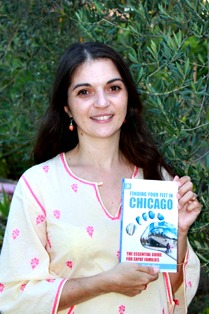
Veronique and her bookAs some readers may know, before the Displaced Nation, I had my own blog, called “Seen the Elephant” — which I used as an outlet while struggling to readjust to life in America after having lived abroad, in England and Japan, for quite a few years. (The name for the blog came from the expression used by Victorian travelers: “Been there, done that, seen the elephant.” Which is how I felt…)

It was because of that blog that I got to know today’s guest, Véronique Martin-Place, since she, too, was quite active in the expat blogging world.

And when I found out she was a Frenchwoman living in Chicago, I was intrigued. What did she make of the city of broad shoulders, jazz, and deep-dish pizza?

I asked her this and a host of other questions in an interview for my blog. For starters, she said that she and her family — her husband is a French diplomat and they have two young daughters — were gradually finding their feet in Chicago. (She did not, however, mention she was planning to write a book of that title!) She didn’t entirely approve of America’s throw-away society and still cooked every day for her family — she even offered her recipe for “real” vinaigrette in the comments. She also reported she’d seen plenty of elephants while living in Sri Lanka (her husband’s second assignment, after Norway).

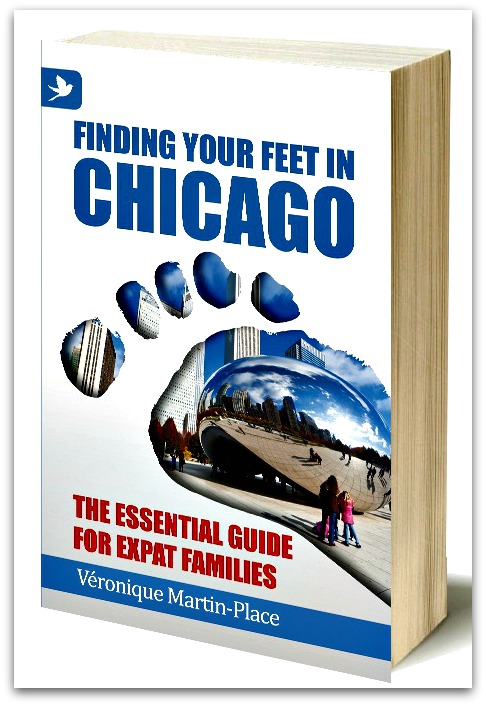
Véronique leads life in the fast lane. A little over three years since our conversation, I find that she has written the definitive expat guide to Chicago: Finding Your Feet in Chicago — The essential guide for expat families (Summertime, 2012). And she is already putting her feet down in a brand new city, one of the world’s trendiest… Here is our exchange:

Bonjour, Véronique! When we last spoke, toward the end of 2010, you told me you’d arrived in Chicago with hopes of getting a job, but then the recession hit, so you’d started up your own writing business. When did you hatch the plan to write a book for expats in the Windy City?
I was already thinking about it when we connected. After witnessing several incidences of culture shock at my daughters’ school, I realized I wasn’t alone in having troubles. Several families from different parts of the world had moved to Chicago around the same time. All of us were in need of information and advice. Meanwhile, I’d started up my blog, Expat Forever, to share my experiences about Chicago — tips on where to settle, which schools to choose, etc. I looked around for local guidebooks to recommend — but there was nothing. So I decided to write one myself.

finding-your-feet-in-chicago-3D-Book CoverThat reminds me of the famous quote by Toni Morrison: “If there’s a book that you want to read, but it hasn’t been written yet, then you must write it.” How long did it take you to produce the book?
From the idea to holding the book in my hands, it took one year and a half! Writing the book directly in English was difficult at the beginning, since English is not my native language. But after a while, I got used to it.

Besides writing in English, what was the most challenging part of the process?
Editing the manuscript. I decided to hire an editor to help with the task.

I know from our previous conversation that having fresh, healthy food is important to you — after all, that’s part of being French! I also seem to recall that you were not a fan of Chicago pizza. You said it was too heavy. But did you cover it in your book?
Of course! I have a chapter dedicated to “Having fun in Chicago,” which includes a section on family-friendly dining out. Before giving my top 10 Chicago child-friendly restaurants, I explain what the Chicago specialties are and insist that children (and their parents) MUST try them. That includes Chicago-style pizza and Chicago-style hot dogs.

What has been the response thus far?
Rather good, I think. I’ve gotten only five-stars comments on Amazon!

Which sections are the most popular?
Readers say they like having so much practical information on family-related topics — not just the advice itself, but all the personal anecdotes and testimonials I include from expat parents. I talked to lots of them and wrote up their stories as “blog posts” or interviews. The stories really speak to the kinds of anxieties most expats have — and they make the book an easy, fun read.

And now your husband has moved on to a diplomatic post in Shanghai! Tell me, does ANYTHING about China remind you of the United States, or are these two countries poles apart?
The United States and China are definitely different cultures — but one similarity struck me right away. Both are consumerist societies. In the US, everything is done to make you purchase and there are plenty of opportunities for you to part with your money. Here in Shanghai, it seems that the only occupation is “shopping.” It’s the only activity people urge you to do from the moment you arrive — visit malls, markets, supermarkets and so on. And I can tell you they have tons of malls, tons of markets (from traditional, the kinds that sell crickets and flowers, to modern, selling electronics, furniture, shoes, and so on), and many, many supermarkets.

How did you prepare yourself and your two daughters for the move?
We didn’t have the chance to make a look-see visit. But six months before moving to Chicago, I’d gone to Shanghai on business, so I had a picture of what to expect: a very urbanized and polluted city. That is also why we decided to settle in the new and “green” development area of Shanghai that is called Pudong.

Did your daughters have any idea of the change they were in for?
My husband and I found some videos about the city on the Internet for them to watch. Fortunately, they’d studied some Mandarin at their American elementary school, so already knew a lot about Chinese traditions and stories. To be honest, I think we learned as much from them about cultural matters as they learned from us on the practical aspects. It was real team work!

I know it’s still early days, but what have you enjoyed the most about living in Shanghai?
Perhaps surprisingly, the fact I can bike! In Pudong, there are a lot of protected biking trails, so it allows me to discover independently this part of the city, and it’s much faster than by foot. But I don’t bike in Puxi (the other side of the Huangpu River, which divides the city into two regions: Pudong, where I live, and Puxi, the city’s historic center). It’s too dangerous.

What is the feature you enjoy the least?
Shanghai is extremely urbanized and I miss greenery. Also, it is very polluted, though less so than Beijing.

What is the top piece of advice you’d give to anyone thinking of becoming an expat in that part of the world — particularly a trailing spouse?
I have five — and actually, they’re for anywhere, not just Shanghai:
1) Learn the language.
2) Get involved in your local community.
3) Keep doing your (or start new) hobbies and/or sports.
4) Discover your surroundings little by little, and you’ll eventually come to know the city as well as the content of your pocket.
5) If you are an accompanying spouse and cannot work locally, go back to school and get new skills, or volunteer to do something you can use professionally upon returning home for good.

And now I have to ask you the obvious question: any plans to write Finding Your Feet in Shanghai?
Many people have indeed asked me that question. And I must admit, the idea was in the back of my mind when I first started my book for expats in Chicago. I thought to myself, this can be the first in a collection, and the next one will be about the city where my husband gets posted next. But at least at this point, I don’t think I’ll write an expat guide to Shanghai. One reason is that there are already lots of books, magazines as well as Web sites for expats in this city. There isn’t the same need as there was in Chicago. But another reason is that my time here is so limited. My husband’s post is for just three years. I’d have to spend all of my time doing research and interviews, getting to know the city like my pocket. And that’s before I can start writing. My book on Chicago was released a couple of weeks after I left to fly to Shanghai — which didn’t give me any time for promoting it locally. I found that very frustrating and wouldn’t want to repeat the experience. Books these days have to be promoted like crazy, and although you can do a lot of it online, I don’t think online promotions can replace interacting with readers in person.

But surely you’ll write another book?
I may not write another book for expat families living in Shanghai, but I already know I will write another book about expatriation. Actually, I have already started it. But I cannot say much more. It is too early.

Aha! You are always so mysterious… Last but not least, I’d like to ask a series of questions that I’ve asked some of our other featured authors, about your reading and writing habits:
1. Last truly great book you read: Rien Ne S’oppose a la Nuit (Nothing Holds Back the Night), by Delphine de Vigan.
2. Favorite literary genre: Memoirs — but also novels, illustrated books like the ones of Danny Gregory (I love his writings and drawings), and carnets de voyage (travel journals). And I have to confess that I still read a lot of children books, especially picture books. My dream is to write and illustrate one.
3. Reading habits on a plane: Something fun and easy to read on my Kindle! I travel light.
4. The one book you’d require the president of France to read, and why: My book, of course! I’m joking. I would like him to read Les mots pour le dire (The Words to Say It), by Marie Cardinal. Everyone should read it.
5. Favorite books as a child: Astérix and Obélix comic book stories, by René Goscinny (illustrated by Albert Uderzo) and Le Petit Prince (The Little Prince), by Antoine de Saint Exupéry.
6. Favorite heroine: Anna Karenina
7. The writer, alive or dead, you’d most like to meet: There are several — all alive and all women: Robin Pascoe, the author of four books about expatriation; Anne Lamott; Annie Ernaux; and the aforementioned Delphine De Vigan.
8. Your reading habits: Every evening, at least one hour, and Sundays as much as I can.
9. The book you’d most like to see made as a film: Hidden in Paris, by Corine Gantz
10. The book you plan to read next: The Help (but I got the French translation), by Kathryn Stockett.

* * *

Wow, what a stimulating list! Readers, any questions or comments for Véronique while we have her attention? Ce qu’est une femme extraordinaire — I think you’ll agree!

STAY TUNED for tomorrow’s post, another installment in the life of our fictional expat heroine, Libby. (What, not keeping up with Libby? Read the first three episodes of her expat adventures.)

If you enjoyed this post, we invite you to register for The Displaced Dispatch, a round up of weekly posts from The Displaced Nation, with seasonal recipes, book giveaways and other extras. Register for The Displaced Dispatch by clicking here!

Related posts:

Images: Véronique Martin-Place with her Chicago book; the book cover in 3D (author’s own photos).

EXPAT BOOK REVIEW: “Trucking in English” by Carolyn Steele

Image.ashx

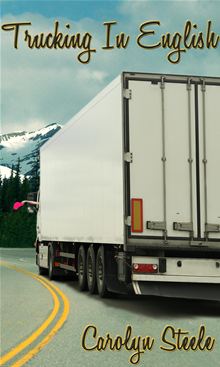
Today we review Carolyn Steele’s Trucking in English: a memoir of being a woman in what is very much a man’s world: that of long-haul tractor-trailor driving in North America.  A Londoner born and bred, Carolyn is now a Canadian citizen and lives in Kitchener, Ontario, where she ran a Bed & Breakfast for five years before trying her hand at negotiating 18-wheelers. Depending on who is asking,  she “maintains that she is either multi-faceted or easily bored”. Confirming this, her résumé states that, in addition to being a lady trucker, she has also been a psychologist and a London Ambulance Service paramedic, while her hobbies include tatting, a form of lace-making.

Trucking in English is available from SmashwordsAmazon (Canada, USA, UK), and Barnes & Noble, but this week we at TDN are in luck: Carolyn is giving away 3 ebook copies to Displaced Nation readers! (Details below.)

TITLE: Trucking in English
AUTHOR: Carolyn Steele
AUTHOR’S CYBER COORDINATES:
Blog: Trucking in English
Website: Carolyn Steele
Twitter: @Trucking_Lady
Facebook: Trucking in English
PUBLICATION DATE: November 2012
FORMAT: Paperback, Ebook (Kindle)
GENRE: Memoir
SOURCE: Review copy from author

Amazon Summary:

“So here’s the plan. I’m going to train to drive a truck and go long-haul. I can get paid and maybe write a book at the same time. What do you reckon?” “Go for it Mum, how bad can it be?” This is the tale of what happens when a middle-aged mum from England decides to actually drive 18-wheelers across North America instead of just dreaming about it. From early training (when it becomes apparent that negotiating 18 wheels and 13 gears involves slightly more than just learning how to climb in) this rookie overcomes self-doubt, infuriating companions and inconsiderate weather to become a real trucker. She learns how to hit a moose correctly and how to be hijacked. She is almost arrested in Baltimore Docks and survives a terrifying winter tour of The Rockies. Nothing goes well, but that’s why there’s a book. Trucking in English began as a blog from the cab and became a popular podcast before taking book form. It is part of Carolyn’s ‘Armchair Emigration’ series.

Review:

“Why would a fifty-something, nicely brought-up mother suddenly decide to go trucking?”

Indeed. Until I read this book, I’d considered trucks to be part of the roads’ parallel universe: menacing beasts that slow you down going uphill, hurtle dangerously fast behind you downhill, or who scatter remnants of blown tires across three lanes, strategically positioned to rip open your door skins like sardine cans.

Carolyn Steele, however, has given me a glimpse inside this parallel universe, and I’ll say this: she’s braver than I’ll ever be.  If I announced to my own family my intention of learning to drive one of these shiny monsters, the reaction would be unflattering: “You?” (Cue gales of incredulous laughter.) “You can’t even reverse a Mini.”  I’m not one of Life’s natural drivers, which makes me all the more admiring of people who are, particularly “fifty-something, nicely brought-up mothers.”

Trucking in English starts at Carolyn’s pipe dream to become a truck driver:

Why not get paid to see North America? I’d driven for a living before, I’d seen little of Canada and nothing of the States, how hard could it be?

— takes us through the training period which was more demanding than she’d anticipated:

I’d assumed it was merely a matter of getting used to where the corners were and developing a technique for climbing in.

— and recounts Carolyn’s adventures once she was let loose on the road.

These long-haul expeditions across Canada and the USA are peppered with frustrations deriving from red tape (seriously — Campbell’s Chicken Soup requires a Customs’ Meat Inspection certificate before it can cross the border?) and the sexism, both unintentional and blatant, that a female truck driver will encounter.

Red-faced squaddie escorted us outside and managed not to look too confused when we [Carolyn and her male co-driver] headed for the wrong sides of our vehicle and it became horribly apparent that I was driving.

Throughout the book shines Carolyn’s good humor, frankness, and sense of the ridiculous.  The characters and events she encounters are described so vividly that they seemed as real to me as they were to her, and in such a way that I had to stifle snorts of laughter if I was reading my Kindle in a public place.

Finally, as March is Style and Beauty Month at TDN, it would be remiss of me not to share a few of Carolyn’s style tips for lady truck drivers:

1. Do not go anywhere without a large supply of baby wipes. You never know when or where your next shower will be.

2. Use a bathroom whenever you see one, even if you don’t need to. (Ever wondered what happens when truckers are taken short in the middle of nowhere during a Canadian blizzard?)

3. Most important of all — dress androgynously. Do not, under any circumstances, let other truck drivers on the road know you are a woman.

A chap in a slower truck does not like to be overtaken by a woman and some of them can get quite snippy about it…With a cap over my eyes (so long as it isn’t pink) hair tucked up into it, large sunglasses and a golf-shirt I can just about pass for anybody… I left the cap off one day due to being so hot that even my hair was sweating. Overtook a truck just south of Toledo and he tried extremely hard to run [me] off the road.

And now it’s your chance to ENTER OUR DRAW TO WIN A FREE  COPY!!!  You can either:

1) Leave a comment on this post, saying why you’d like your own copy of Trucking in English, or

2) Head across to Twitter and tweet the following:

“I want a copy of Trucking in English by Carolyn Steele: http://wp.me/p11cxT-55G via @Trucking_Lady @DisplacedNation”

Don’t forget, you double your chances if  you’re a Displaced Dispatch subscriber!!!

The winner will be announced in our Displaced Dispatch in April.

.

STAY TUNED for tomorrow’s author interview!

Image: Book cover — “Trucking in English”

If you enjoyed this post, we invite you to register for The Displaced Dispatch, a round up of weekly posts from The Displaced Nation, with seasonal recipes, book giveaways and other extras. Register for The Displaced Dispatch by clicking here!

Related posts:

BOOK REVIEW: “The Career Break Traveler’s Handbook” by Jeffrey Jung

careerbreak_coverThe author of today’s reviewed book, Jeff Jung, was one of our featured Random Nomads last May. We caught up with him again at Christmas, shortly after The Career Break Traveler’s Handbook was published.

TITLE: The Career Break Traveler’s Handbook
AUTHOR: Jeffrey Jung

AUTHOR’S CYBER COORDINATES:
Website: Career Break Secrets
Twitter: @Career BrkSecret
Other: Facebook page, YouTube channel
PUBLICATION DATE: October 2012

FORMAT: Paperback, Ebook (Kindle)
GENRE: Nonfiction, Travel
SOURCE: Review copy from author

Author Bio:

Host of the new global TV show, The Career Break Travel Show, and publisher of CareerBreakSecrets.com, Jeff Jung is the world’s leading career break expert. Originally from Fredericksburg, Texas, Jeff became an international traveler at the age of sixteen with his first trip to Australia and, when he left a successful marketing career for his own career break, became a “true citizen of the world.” He lives in Bogotá, Colombia.

Summary:

The Career Break Traveler’s Handbook is your indispensable tool for dreaming, planning, and finally taking your trip of a lifetime. Filled with tips, stories, and photos from around the world, the Career Break Traveler’s Handbook will both excite you and prepare you.”

(Source: Amazon.com book description)

Review:

Six years ago, Jeff Jung, like many other people, was experiencing dissatisfaction with corporate life.  Business trips abroad racked up frequent flyer miles and provided a temporary escape from the office cubicle and constant phone calls, but those were the only benefits of his adult experiences of travelling. Faced with years more of a work-life balance teetering heavily on the “work” side of the scale, Jeff wondered if he had 

“made a bargain with the devil, building a successful career while sacrificing a satisfying personal life?”

More to the point:

“How was I ever going to engage with the things that really mattered to me: time for myself, for my family and friends, time to pursue my personal passions?”

A throwaway question from two friends provided the catalyst he needed to do something about this unsatisfactory state of affairs.

“What’s it going to take to make you happy?”

In answer, Jeff quit his job four weeks later, although it was several months before he set off on his trip. Planning is all — which is where this book comes in. It’s one thing to dream about getting away from it all, and another thing to do it right.

Based on Jeff’s own experiences, plus those of other seasoned travelers, this book offers advice on aspects from the mundane (budgeting and saving for both the trip and your return, when you might be out of work for a while) to the slightly morbid (make a will; go through details of insurance and finance with a close family member or friend; appoint someone to have power of attorney). There are tips on emotional aspects, too: how to stop talking yourself out of this wild idea, or how to deal with people who, out of concern or jealousy, aren’t as enthusiastic about this adventure as you are.

As you would expect, much of the book covers advice on preparations and the trip itself, such as managing money on the road, dealing with unexpected loneliness, and adjusting to being free again. It also includes specific tips such as “White headphones are an unmistakable marker of an iPod. Replace them with black ones” which might not occur to you at the packing stage and won’t be much use occurring to you when a mugger is running away with your iPod and unsaved photographs.

The final part of the book deals with your return trip, your re-entry into your old life, and how you can turn that “dreaded résumé gap” to your advantage.

It’s worth noting, however, that after their life-changing travels many career-breakers — including the author — don’t re-enter their old life at all but instead make a new one.

Word of wisdom:

On persuading yourself:

You only get one shot at life. Are you really sure you can’t take less than 3 percent of your working life to do what you want to do, to reconnect with yourself and pursue personal passions?

On reasons for going:

This is not a time to run away. It’s a time to run to something.

TDN verdict:

With many companies starting to see the benefits in offering paid sabbaticals to their employees — nearly one-quarter of Fortune’s 2012 “Best 100 Companies To Work For” do so — career breaks, we hope, will become more common. This book will help you make the most of yours.

STAY TUNED for next week’s posts!

Image: Book cover — “The Career Break Traveler’s Handbook”

If you enjoyed this post, we invite you to register for The Displaced Dispatch, a round up of weekly posts from The Displaced Nation, with seasonal recipes, book giveaways and other extras. Register for The Displaced Dispatch by clicking here!

Related posts:

The artichoke of cross-cultural love: Italy calls!

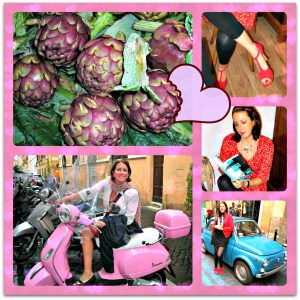
Signora Stella CollageAmore é gioia, amore é gelosia, amore é soffrire, amore é tenerezza, amore é calore. Amore sei tu! Is it any wonder that Italians always make the top-10 list whenever women are asked to rate the world’s best lovers? We are truly fortunate, then, in having the displaced author Estelle Jobson as today’s guest blogger. As you will see, this South African likens falling in love with an Italian man to feasting on a succulent artichoke — a rather curious analogy, to be sure, until one remembers that artichokes are cultivated in the Mediterranean. It is also a rather mysterious vegetable. How exactly do you eat it? As Jobson shows, it’s a matter of  peeling off the outer petals, one at a time… We are also fortunate in that Signora Stella is giving away an autographed copy of the book she wrote on her Roman love story! Grazie mille, Signora! (Details below.)

— ML Awanohara

The first call to write about Italy came when I was ten. With a smudgy HB pencil, I outlined an epic in my lockable, pink diary. It was to be about an extended Italo-American family who would make it big selling tyres. The main character, Pia, was to be my age, torn (theatrically) between her Italian roots and her American life. There would be family dramas (dramatic!), cascades of curls (curly!), Virgin Maries (statues and exclamations), and a stout grandma overseeing boiling pots of pasta. The novel would be shot through with shouting, gesticulating, and emotional-blackmail-meets-amore.

This literary project was soon shelved on the grounds of inadequate content knowledge: I knew nothing of the tyre business and had exhausted my repertoire on Italians. So the plot was filed amongst my many “books to write one day”.

Loving the individual

??????????What I did finish writing, in my thirties, is Finding Rome on the Map of Love, in which travel narrative meets love story. It is an autobiographical account of moving to Rome with an Italian man. It is about love radiating out from the heart of my Italo-South African couple, to love for a family, language, people, culture, and country. Just like the concentric rings within an artichoke. This happens in all relationships, however it is much more pronounced when the language, culture, and people are not those you grew up with. The rings within the artichoke make it very difficult to know which characteristic belongs to whom. Is it your beloved who is prone to interrupting others mid-speech? A family trait? Or that of the whole nation?

Just as Italians are sometimes drawn to the prudish, earnest, and ploddish Protestant way, so are we Anglo-Saxons drawn to their swaggering, flamboyant charm — and sometimes alarmingly cavalier approach to work. It threatens us to the core, yet opposites attract. And how! A part of us secretly longs to become the other. But since we can’t quite pull it off, the next best is to have them close to our hearts. Or better still, right in the bed. We say “Be mine.”

So the beloved in question — termed “the Meterosexual” for his dapper grooming — was in varied and bewitching ways the very opposite of what I grew up with. Unlike the wooden, roughly-hewn South African man, an Italian one may adore you, quite tangibly and vocally (poetically even), from head to toe. Because in his culture, your coiffure and your shoes are crucial. Core-shakingly so. The Meterosexual debated how I should do my hair for a job interview (“Hup? Down? No, hup. More professional!”) and set me straight on shoes that were an insult to an outfit. Certain footwear was actually banned from leaving the cupboard!

For a woman to have her appearance critiqued by a man, even an exquisitely stylish one, demands a certain thickness of skin.

But being South African, I had it.

Loving the family and culture

The next ring of artichoke love is that for your sweetheart’s family and culture. First I had la mamma pressing a hairdryer upon me lest I got a cervicale (the special Italian, wet-hair induced crick in the neck).

And soon thereafter, I was up against what felt like an entire nation (in this case, 60 million citizens) all clucking, fussing, and advising on health, the risk of catching a cold, and what food may be consumed at specific times of day, linked to its digestibility. This counsel was dispatched entirely unsolicited, but with tenderness.

Which is almost the same as love, isn’t it?

Italians regarded me, being Anglo-Saxon, as afflicted with a lumpishly undiscerning cultural palate. I was urged by strangers to read Dante Alighieri, listen to Vivaldi, and, above all, focus on what went into my mouth. The Meterosexual brought home gifts of emerald olive oil, popping with vitality, and parcels of pastries wrapped in a bow, popping with calories. His mother served me the Tuscan carciofini fritti (deep-fried artichokes). And his countryfolk served me regional cuisine, ubiquitous coffees, plus the unloseable gift: an ability to discern the superiority of mozzarella di bufala (female buffalo) over mucca (cow).

Loving a language

Further spirals of love lay in the process of gaining Italian language skills. Italian has delightful suffixes, to make words bigger, smaller, cosier, cuter, or nastier and uglier versions of themselves. This, to an English-speaker, is like playing Lego® with language.

With my ability to converse came a gradual adaptation to local ways. Although, truth be told, it’s easier to learn a foreign language than, for example, to wend your way successfully through the Italian national health system or to fathom the quasi-pagan fetishizing of the modern Catholic saint.

Loving the modus operandi

Living in Rome, I learned to ride a scooter in the city’s hair-raising traffic. This turned out to be a superbly transferable skill, relevant to many other Italian things, such as being honest. Telling the truth, the Italian way, is a flexible, savvy and self-preserving art. People lie with flair. In fact, it isn’t really lying at all, they explain. It’s being diplomatic, being furbo (smart). Banging your head against all this with rigid Protestant morals will only make your cranium ring. The Italians have taught me that blurting out the truth willy-nilly is ill-advised. It is gauche, hurts other people’s feelings, and counter-productive.

Now I know: one good lie deserves another.

Becoming the other

So it is that you start off in love with a foreign person and you end up assimilating their culture. Over time, some of the once-exotic features become yours and you may even lose bits of your cultural DNA, for lack of use (e.g., wearing ugly shoes). When I find myself using an Italian gesture or expression, because nothing else will do, I know I am no longer mimicking.

This is a moment of profound integration: deeper than love, more metaphysical than the first sip of the first cappuccino of the day. It will always be yours. It’s like becoming your own artichoke.

* * *

Readers, I have a confession to make. I’ve always found the artichoke a bit intimidating. I’m not sure I’m any less intimidated after hearing what Estelle has to say — but thanks to her, I’m can now appreciate its succulent taste and tender heart. And I know I prefer it steamy!

I can imagine her dashing Roman metrosexual calling her not just Stella but mia stella polare — his polar star! (And how can I get me a pair of those cool red shoes?)

What about you? Are you eager to hear more about Estelle’s love adventure with an Italian, and with Italy itself?

Listen to what readers of her book had to say:

Liesl Jobson (Estelle’s sister, still in South Africa and also a writer — one who wins awards for her short stories!):

Finding Rome on the Map of Love is an utterly enchanting and fabulously funny journey outwardly, into the city of Rome, but inwardly, Estelle bravely squares up her options in love and life. Her sharp eye investigates the real and the imagined and her inimitable voice always rings true. … [W]hile the focus is Rome, it is as much about being a stranger in a foreign country and the resourcefulness that is required to learn a language, understand the customs and become familiar with the ways of any new place.

Amazon reviewer:

You will adore this book; Estelle and her quirks will delight you, you’ll fall passionately in lust with the Eternal City and its people and be sad when it’s over. … Estelle’s writing skills will astonish you and you will ask, “Where has this writer been and why have I not heard of her?”

Amazon reviewer:

When I started reading Estelle Jobson’s observations on Italian culture, I felt I had run into an old friend on a common wavelength. Yes, me too!

Amazon reviewer:

Estelle Jobson is a very talented writer with a wonderful ear for the nuance and absurdity of language, and for the cross-culturally bizarre. … The book also boasts an extensive glossary that is bound to satisfy even the most pedantic of linguists.

And let’s not forget the back-cover blurb:

Estelle has an admirable career in publishing and a hectic, yet rich life. When her Italian diplomat boyfriend gets posted to Rome, she throws it all up to accompany him. There, she reinvents herself as Signora Stella, a casalinga (housewife) on the city’s highest hill, Monte Mario. Starting in autumn, she muses on life amongst the Italians and cycles through the seasons and sentiments of the Italian psyche. Signora Stella commences and ends at the same place: Follie, the local hairdresser run by Salvatore, a gay Neapolitan. This book captures a year’s worth of quirky, humorous, vivid observations about life amongst the Italians.

Can’t wait to read it? Jobson has published an excerpt on Italian Intrigues, the blog kept by one of our recent Random Nomads, Patricia Winton.

And now it’s your chance to ENTER OUR DRAW TO WIN A FREE AUTOGRAPHED COPY!!! Simply leave a comment in answer to the question:
**What has been your most entertaining experience with a cross-cultural relationship?**
Extra points for likening it to a vegetable; double the points if you’re a Displaced Dispatch subscriber!!!

The winner will be announced in our Displaced Dispatch on March 2, 2013.

NOTE: If you’re not the lucky winner but would still like a print copy, send an e-mail to findingrome@gmail.com.

Estelle Jobson has over a dozen years’ experience in book publishing and a Masters in Publishing from New York University which she attended on a Fulbright. She speaks five languages and has lived in as many countries; three years in Rome. She now lives in Geneva. To find out more about the book and follow its promotion, like the Finding Rome FB page. You can also follow Jobson on Twitter and read her occasional blog posts — for instance, this one on adopting Italian nationality, which she wrote for Novel Adventurers.

STAY TUNED for tomorrow’s post, when we announce the films that have qualified for this year’s Displaced Oscars!

If you enjoyed this post, we invite you to register for The Displaced Dispatch, a round up of weekly posts from The Displaced Nation, with seasonal recipes, book giveaways and other extras. Register for The Displaced Dispatch by clicking here!

Related posts:

Images: All photos supplied by Estelle Jobson.
A once-displaced author on muses, monkeys & murder — and your chance to win her new book!

EdithmcclintockOur first featured author of the new year, Edith McClintock, is today’s guest. Her post should help to alleviate the January doldrums and this “brass monkey” weather. By way of introduction, I should point out that even though she does write mysteries, she herself is a bit of a mystery. Tee hee-hee ha-ha! On the one hand, she is a former Peace Corps worker, and has worked to preserve rainforests. On the other, she has harbored dreams of killing off her fellow researchers in the Amazon! Indeed, working with Edith sounds about as much fun as a barrel of monkeys! But let’s find out more about her creative muses, shall we, before leaping to any conclusions…

— ML Awanohara


I can’t pinpoint the moment I decided to write a novel. The idea percolated for years starting in my early teens. I did, however, always know — to the extent I even understood book categories, which was not much — that my first book would be a mystery, heavy on romantic suspense, and definitely a touch gothic.

Maybe a modern-day version of M.M. Kaye’s light mysteries (before she wrote The Far Pavilions), each set in an exotic locale.

And maybe a little Barbara Michaels mixed with Elizabeth Peters’ humor.

They were all early muses.

But so was travel. I knew the setting would have to be international, exotic…romantic. I wanted my characters to be trapped in a confined setting — like the best Agatha Christie.

From my first trip to Spain when I was thirteen, across Europe and Central and South America in my twenties, I contemplated castles, ruins, plunging cliffs, and remote islands based on their novelistic setting potential.

We are not aMUSEd: “Writing is hard”

But I needed more than a muse to write a book. I needed an obsession. For me, that’s the only way it could have happened, because writing Monkey Love and Murder was hard. Writing is hard. The rejection was crushing.

I cried. My sister cried. The rewriting and rewriting and rewriting again often felt meaningless. More sacrifice than joy. Sometimes exhilarating. More often tedious and lonely.

The truth is the time lost probably wasn’t worth it. I had demanding, more than full-time jobs. I wrote on weekends and evenings. My friends and family were celebrating, playing, gathering, the sun shining. I was hunched over a computer screen talking to my make-believe world.

It takes a certain arrogance to believe you can even write a book. To believe it will get published. To believe people will actually like it. Maybe love it. I had that in the beginning. For years, really. I had to love the idea, the place, the characters.

The place as muse

Because it took an obsession to keep writing and rewriting, in my case probably much longer than I should have. But it wasn’t a person that grabbed me and wouldn’t let go. My muse, my obsession, was the rainforest and a place called Raleighvallen in the Central Suriname Nature Reserve.

MonkeyLoveAndMurder_dropshadowI think my protagonist, Emma, expresses it best:

Even with all the frustrations, I fell completely and irretrievably in love with the rainforest that week — the deep rich smells of dirt and decay and teeming, thriving life; the warm soft light of the rocky moss-covered paths hidden beneath layers of climbing and tumbling lianas and roots; soaring tree trunks wrapped in colorful bromeliads, orchids, moss, and lichens; and the canopy of leaves of every conceivable size and shape. Each day was a new adventure, new wildlife (some good, some terrifying) and ever changing forest, from the sunlit traveling palm groves to the dense, swampy marshes near the river; to the rocky, open forests with the towering trees the spider monkeys loved. I enjoyed watching the spider monkeys too, but I could have been just as happy watching any number of wildlife. It was simply being in the rainforest I loved most.

Like Emma, I spent two years as a Peace Corps volunteer in Suriname living in the capitol, Paramaribo. Unlike her, I joined a monkey research project post-Peace Corps simply because I wanted to spend more time in the rainforest — and chasing monkeys through the jungle seemed like fun.

It was. Hot, frustrating, itchy and wonderful.

I was there for six months, ideas percolating, but I didn’t begin writing until I came home. That’s when I moved beyond the idea of writing as abstract concept and into deep obsession.

Ignorance plus arrogance — a lethal combo?

I came home to the United States, spent three months working full-time and decided I couldn’t continue. Not yet. I was in the throes of a typical angst-ridden readjustment process combined with the initial bubbling of obsession. So I quit my job and drove cross-country to housesit for my sister and then a friend while I pounded out that first draft. I finished and returned to full-time work again, sure my first draft was destined for the bestseller lists.

I clearly had the arrogance. Unfortunately, I also had heaps of ignorance. I still do. I don’t understand publishing. I may never understand publishing.

Nine years later, following hundreds of rejections, countless rewrites, frequent tears and regular quitting (for months, even a year), my first novel is finally published. People, friends, strangers, will read it. Judge it.

It’s wonderful and scary and it took a passionate, often-painful obsession. But still, I’d do it again. I am doing it — I’ve just finished my second mystery (I hope). I have a plan for the next and the next and the next.

As for Monkey Love and Murder, thankfully, I’m finally over that obsession. And it turns out the best thing about finally being published is that I NEVER have to read or rewrite it again!

But still, I hope you’ll read it. I hope you’ll like it. I certainly did. For years.

* * *

Whoop! Whoop! Thank you, Edith! Readers, to whet your taste even more, here are a couple of reviews for Edith’s debut novel, Monkey Love and Murder:

Kirkus Review:

This debut from McClintock, who served in the Peace Corps and worked on a monkey research project, has the ring of authenticity, along with romance and a mystery that keeps you guessing.

Library Journal Review:

This romantic-suspense debut is perfect for those seeking adventure mixed in with their mystery. McClintock creates a vivid jungle environment, a perfect venue for a closed-room mystery. Her characters run a little larger than life, making the story feel like a reality TV show. With a bit of Scott Smith’s tone, this would work for Hilary Davidson fans too.

And let’s not forget the blurb:

Emma Parks joins a monkey research project deep in the South American rainforest on a whim. She refuses to admit it might have something to do with a close friend’s death from which she hasn’t recovered, but it’s certainly not because she knows anything about spider monkeys, least of all what they look like. She’s barely arrived when International Wildlife Conservation’s renowned director drowns during a party celebrating the group’s controversial takeover of the park. Tension mounts following the machete murder of a researcher, threatening Emma’s budding primatology career, her secret romance with an Australian zoologist, and more importantly — her life.

Can’t wait to read it? Why not download the first chapter?

I know, I know, one chapter isn’t the same as reading the whole book. SO ENTER OUR DRAW TO WIN A FREE COPY — in 3 easy steps:
1) Comment on Edith’s post
2) Like her book’s Facebook page
3) Subscribe to our Displaced Dispatch
Yes, of course you can take just one of these steps, or two — but do all three and you’ll have an even greater chance of winning!!! @(‘_’)@

The winners will be announced in our Displaced Dispatch (and on Edith’s Facebook page) on Feb. 2, 2013. She will contact you for your address and is open to shipping anywhere in the world.

NOTE: If you’re not lucky enough to win one of Edith’s books, you can always order it from Amazon, Barnes and Noble, or The Book Depository.

Born in a school bus in the Tennessee woods on the largest commune to come out of the sixties, Edith McClintock works in the conservation and development field and blogs about travel on Novel Adventurers. Although a lifelong reading addict, she didn’t write fiction until post–Peace Corps, when she joined a monkey research project deep in the Amazon. Trapped in a tiny jungle cabin for six months, there was little to do but imagine creative ways to kill off her fellow researchers (all of whom were too nice to make it into her first novel, despite their begging). To find out more about Edith, visit her author’s blog.

STAY TUNED for tomorrow’s post, also on expat writing.

If you enjoyed this post, we invite you to register for The Displaced Dispatch, a round up of weekly posts from The Displaced Nation, with seasonal recipes, book giveaways and other extras. Register for The Displaced Dispatch by clicking here!

Related posts:

Images: Edith McClintock’s author photo (yes, that’s her — in Chinatown in Seattle, buying mangoes) and book cover.

Expats and travelers, the adage is true: There’s no place like home for the holidays

“I’ll be home for Christmas if only in my dreams” — Bing Crosby’s closing line has special meaning for best-selling Australian author Lana Penrose. As reported below, she will never forget spending the holidays in Europe during her decade-long stint as an expat, beginning in Greece — highlights from which are chronicled in two memoirs: To Hellas and Back and Kickstart My HeartNOTE: As a special gift to Displaced Nation readers, Lana is giving away a print copy of To Hellas and Back! See details below.

— ML Awanohara

It’s that time again: Christmas, where the cynical amongst us are found warbling, “‘Tis the season to be melancholy.” For the displaced expat, this period really can be an odd time. If you’re remaining in your adopted country, you may catch yourself yearning for your friends, family and homeland. Somehow drunken Uncle Ernie who likes to lick your neck vanishes from memory.

Yes, there’s no place like home, particularly on Christmas Day. I know this because (a) I lived as an expat in Athens for 5 years; (b) I also lived as an expat in London for 5 years; and (c) I’ve written books about it, one a bestseller titled To Hellas and Back (see what I did there?).

So I get it. I truly do.

And I’m no stranger to grappling with the unfamiliar during the festive season. Actually, make that most celebratory occasions.

Hell yeah!

I believe it all started when I was encouraged to join “The Circle.” No, it wasn’t a cult (arguably), although there was a noticeable absence of Kool-Aid and Nike trainers.

I was attending a Greek boyfriend’s cousin’s engagement party in my native country of Australia. It was to be my first head-on collision with Hellenic culture. I distinctly recall being led by the hand towards my beau’s extended family. And as Greek folk music wailed from tinny speakers, I watched relatives dance around and around connected by tightly clutched handkerchiefs.

The leg-scissoring madness was mesmerizing — and there was nothing else for it but to clap along as though attending a barn dance, get hitched and relinquish my country for at least half a decade.

As the years passed, I swallowed more foreign tradition than I did dolmades. I was now living in Greece. And as I’d done so many times before, come Easter I was straddling yet more unfamiliar customs. There I was ingesting mageiritsa soup, traditionally made from lambs’ tongue, lungs, liver and intestines.

It seemed all about innards as my own sighed dejectedly.

A misplaced gift

I also remember a Christmas where I was presented with a gift from a bone fide Athenian native. I excitedly opened a grey velvet box — and there, inside, was a flashy faux gold necklace of the type preferred by gangland hos.

It kind of made sense considering he’d once also given me a birthday present in the form of a pair of black and gold shoes and a fluffy white vest.

At the end of the day, the gesture was beautiful and I couldn’t wait to try everything on as an ensemble … and submit a job application to the Black Eyed Peas.

Food — a substitute for love?

But that stuff’s plain amusing. The toughest part about spending auspicious occasions away from home is missing the people you love most, which thankfully at Christmas usually means the perfect excuse for unprecedented weight gain (if you’re in a country that celebrates such things).

In contrast to Easter, for me Greek Christmases meant hoovering up* delicious fare — including egg and lemon chicken, rice soup, roast pork, turkey stuffed with ground beef, spinach and cheese pies, stuffed cabbage leaves and salads of every description, followed by sesame baklava and cinnamon melomakarona.

My standout memory of a Christmas abroad, however, is the time that an older Greek couple lamented how sorry they were that I wasn’t able to spend the festive season with my family. They “got” it. Because they’d lived as expats, too.

That couple promised to do all in their power to make my day happy, and they succeeded simply by being mindful, considerate and absolutely lovely.

The sentiment was so touching that it will stay with me forever.

So, yeah, the pros and cons of celebrating Christmas abroad. The anomalies are hardly going to kill you, but sometimes you just want to click your shiny red shoes and declare, “There’s no place like home.”
*Canadian slang for “eat very fast and too much.” (Lana, where and when did you pick that up?!)

* * *

And now to that giveaway! Readers, Lana Penrose has offered to send a copy of her best-selling memoir, To Hellas and Back, to the person who leaves the best comment in answer to the question:  Where are you spending the holidays this year, and will you feel at home or displaced? To tempt you even more, consider the fact that To Hellas and Back, which was first published by Penguin, has been described as an “Eat, Pray, Love face-ploughing into a steaming pile of moussaka.” Its dedication coincidentally reads: “For the displaced.” So if you’re tired of reading about the joys of successfully renovating Tuscan homes and the like, this book might be for you!

Sydney-based (and no longer displaced!) author Lana Penrose has had various incarnations, including music journalist, record company promotions gal, music television producer and personal assistant to an iconic pop sensation whose name shall never be revealed unless she’s subjected to Chinese water torture. She also once worked with the now-infamous Simon Cowell, which she today finds really odd. You can read more about her and her works on her author blog and/or follow her on Twitter: @LanaPenrose

STAY TUNED for tomorrow’s post, when we’ll be checking in on some of our Random Nomads from earlier in the year and find out what they’re up to for the holidays and beyond.

If you enjoyed this post, we invite you to register for The Displaced Dispatch, a round up of weekly posts from The Displaced Nation, with seasonal recipes, book giveaways and other extras. Register for The Displaced Dispatch by clicking here!

Related posts:


An expat author on why he can’t get enough of Beirut — and your chance to win his thriller named for that city!

Beirut Collage 3We here at the Displaced Nation simply can’t get enough of the displaced thriller-writer Alexander McNabb. Last month he gave away his first book in his Levant series, Olives — A Violent Romance, to several lucky Displaced Nation readers. (Yes, they were thrilled!) And today we announce a couple of more McNabb giveaways, including of his second book, Beirut (see below). But before we explode with excitement, let’s hear what Alexander has to say about that notoriously dangerous city…

— ML Awanohara

To start off, I’d like to present a passage from my new book, Beirut, that I hope captures the flavor of this historic and extremely dynamic Middle Eastern city. The scene centers on the displaced Gerald Lynch, the British Secret Intelligence Service officer we encountered in Olives:

It was late in the afternoon as Gerald Lynch hopped along the uneven paving that lined Gouraud Street, the heart of Beirut’s bustling Gemayze area. He wore jeans and a leather jacket against the chill spring air, his hands in his pockets as he squeezed between the parked cars.
Gouraud’s bars, as ever, welcomed those who wanted to party and forget the woes of a world where violence and conflict were a distant memory but a constant worry. Orphaned by Belfast’s troubles, Lynch appreciated Beirut’s fragile peace and sectarian divides, the hot embers under the white ash on the surface of a fire that looked, to the casual observer, as if it had gone out. Lynch scowled as he passed a poster carrying Michel Freij’s smiling face, encircled in strong black script: “One Leader. One Lebanon.”

There can be few places on earth so sexy, dark, cosmopolitan and brittle as Beirut. At night the city celebrates with a vigour that borders on the manic. Louche young things puff cigarette smoke up into the air, DJs make music, poets dream and artists stencil the walls with the painful irony of youth. Drinkers drink, dancers dance. They celebrate life there as only people who realize how slender the tightrope they walk is — as only a people who collaborated in a 15-year-long enterprise designed to wipe themselves, and their country, off the face of the earth can.

But first, the country

It’s important to understand that Lebanon is a country of divides: north and south; mountain and coast; Shia, Sunni, Christian and Druze.

The country was born out of Greater Syria and the collapse of the Ottoman Empire following World War II. The French as the reigning colonial power created it by cobbling together communities who had been in conflict since the Crusades and legislating their way through ancient attitudes and rivalries.

Lebanon’s answer? To enshrine the sectarianism in its constitution, with each religious sect being given its own proscribed role.

Beirut, the Monte Carlo of the East

From its early days as Roman Berytus, Beirut — Lebanon’s capital and largest city — has been a city with greatness in her heart. Surrounded by lush Mediterranean countryside, the verdant Chouf mountains and the glorious fecundity of the Bekaa Valley, served by the sea and a history of maritime trade going back to the Phoenicians, Beirut developed in the course of the 20th century into a major financial center and trade entrepôt.

It was “the Monte Carlo of the East,” the jewel of the Mediterranean. Rich Arab playboys tossed cash around them like leaves; mean-eyed British spies clung to the hotel bars, trading waspish observations and gathering undiplomatic innuendoes. And the women! The olive-skinned beauties of the Levant, like Beirut itself, were so welcoming, so corrupting!

The impact of the Lebanese Civil War (1975-1990)

Lebanon tore itself apart in a war as senseless as any other, admirably abetted by the Palestine Liberation Organization, Syria and Russia, America and Israel. It’s always the outsiders who throw kindling on the hot passions of Lebanon’s divisions. And then the Lebanese pay a heavy price for their lack of moderation and willingness to invite those outsiders in.

After the war, Beirut dragged itself wearily to its feet, slowly but surely rebuilding its commercial heart — the efforts to rebuild dogged by constant conflict, corruption and terrible old men who weave together influence and fear to maintain their profitable status quo.

When the war finally ended, in 1990, the travel magazines were starting to gush about Beirut again — its stunning restaurants, funky bars and glorious sights.

But the potential for violence remains. As you may recall, a deadly car bomb attack occurred in October of this year. It tore a busy square in Ashrafiyeh apart, killing the head of Lebanese intelligence.

A bomb as big as the monstrous blast that had taken the life of Rafiq Hariri in 2005, the man who had led the effort to rebuild Beirut — an explosion big enough to make the Syrians finally quit Lebanon.

Both of these car-bomb assassinations left three-meter craters.

The book Beirut

Although Beirut — An Explosive Thriller is set across a swathe of Europe and not just Beirut, the book is about Beirut at its core. It’s about sectarianism and power, corruption and sex. It’s about wealth and poverty, love and betrayal.

While writing it, I spent hours walking around the city, along the curving corniche and up into the busy streets that cling to the foothills rising from the coast up to the snow-capped mountains.

Walking with friends, walking alone — day and night, spring and summer. From the maze of funky little bars of Hamra to the boutiques of Verdun, from the spicy Armenian groceries of Bourj Hammoud to the cafés overlooking the famous rocks at Raouché, I have long reveled in the city’s beautiful wealth and its grim poverty.

How can you not write books set in the Levant? I’m only amazed I’m in such scant company. As a playground for spies and powerful men, beautiful women and deadly conflicts you can’t beat it. And yet, as a writer of novels, I have it pretty much to myself.

* * *

Now it’s time for the freebies! Displaced Nation readers, you can get your very own copy of my latest book. Here are 2 ways to do so:

1) For TDN readers with an iPad or ePub compatible reader (Nook, Sony, Kobo, Android etc): Get your copy of Beirut — An Explosive Thriller free of charge (and save $4.99) on Smashwords. But first, you’ll need to sign up for the DISPLACED DISPATCH to get the code (it will come in the issue delivered this Saturday, December 8). NOTE: The code is valid ONLY FROM THIS SATURDAY, DECEMBER 8th TO MONDAY DECEMBER 10 — and then, pfft, it’ll disappear. Dear readers, you are MORE than welcome to share that code with family, friends, strangers, dogs in the street — even lawyers.

2) For TDN readers with Kindles: Leave a comment on this post with your e-mail, and I will send a Kindle file and instructions how to install it. Best I can do, I’m afraid — Amazon doesn’t let me do freebies! Do remember to use “name dot name at domain dot com” so the spambots don’t find you! Or you can hit me up directly at @AlexanderMcNabb on Twitter.

If you miss out on these opportunities and/or would like to read something else I’ve written, my first novel, Space (a spoof of international spy thrillers), is available for free download on Amazon from today onwards for three days.

TO ALL READERS: If anyone wants to add their voice (whichever way it leans) about my books on Amazon or Goodreads, that’s welcome feedback. The more people know they exist, the merrier! 🙂

Finally, congrats to Apple Gidley, who left an engaging comment on my last post and will be getting a print copy of Olives by post!

STAY TUNED for tomorrow’s post, consisting of some 2012 highlights from the Anthony Windram series, Expat Moments.

If you enjoyed this post, we invite you to register for The Displaced Dispatch, a round up of weekly posts from The Displaced Nation, with seasonal recipes, book giveaways and other extras. Register for The Displaced Dispatch by clicking here!

Related posts:

Images (of the book, of Beirut): All from Alexander McNabb.