The Displaced Nation

A home for international creatives

Category Archives: Cool Columns

For this displaced Irish writer and cultural chameleon, a picture says…

Aisha Ashraf Collage

Canon zoom lens; photo credit: Morguefiles. Aisha Ashraf at Air Canada Centre, Toronto, for her very first live ice hockey game, 2013.

Welcome to our monthly series “A picture says…”, created to celebrate expats and other global residents for whom photography is a creative outlet. The series host is English expat, blogger, writer, world traveler and photography enthusiast James King, who likes to think of a camera as a mirror with memory. If you like what you see here, be sure to check out his blog, Jamoroki.

A happy new year to one and all at the Displaced Nation. My guest today is 38-year-old Irish expat, blogger, traveller and photographer Aisha Ashraf. She is currently based in Canada with her husband and three children. A freelance features writer, Aisha has published articles in newspapers, magazines and a range of expat and mental health websites. She says she has been a cultural chameleon since she first emigrated from Ireland to England at the age of eight. She is also a friend to the Displaced Nation and a recent recipient of one of its “Alice Awards” for a post on her Expatlog blog, provocatively entitled “My mother was a nun.”

Today I’ve asked Aisha to shares with us her experiences and view of the world via a selection of photos from her peripatetic life. I have followed Aisha on Expatlog for a short while and am so impressed by her pictures and the stories behind them.

* * *

From the glamor of Europe (Paris, France)…

Hi, Aisha. It’s good to meet you here at the Displaced Nation. I understand you now live in Canada. But where were you born, and when did you spread your wings and start traveling?
I was born in the same Dublin hospital as Bono from U2 and spent my early childhood roaming the family farm on the broad plains and bogs of Co Kildare, Ireland. Following my father’s diagnosis of bipolar disorder (“manic depression” in those days), we emigrated to England so that my mother could be nearer her family, swapping the farm for suburban living. I was eight when we left and it was many years before the night-time tears of homesickness subsided.

I have seen U2 twice. A great experience and I wonder if Bono knows he was born in the same hospital as you!! I trust those difficult times are now a distant memory, and I know travel has featured quite a lot in your adult life.
Aside from travelling all over the British Isles (we moved house almost annually after leaving Ireland), I didn’t travel abroad again until I met my husband. Together we explored Europe—we drove all over Malta in a yellow convertible. We also loved Paris so much we kept returning. He proposed to me in the bar of the Metropole Hotel in Brussels—a gorgeous historical landmark in the centre of Belgium’s capital, the setting for numerous films and host to royalty, foreign dignitaries, presidents and film stars.

That gives us quite a lot in common. In 1995 I had a great holiday in Malta, and Paris is a favourite of mine, too. And now I would love to know how you and your husband finally ended up in Canada.
Just before our second child turned one, my husband took a post in Libya while I held the fort at home in the UK. He travelled around the country seeing the sights and even sleeping under the stars in the Sahara, but the long absences were tough on all of us. After six months we were certain we didn’t want to continue living apart and considered moving our family to Tripoli. Luckily for us a post in Canada was offered because in the following months expats were evacuated when the revolutionary spirit that had taken Tunisia by storm spread to Libya, and the Gaddafi regime crumbled. We began the Canadian chapter of our life in 2010 and have been here since.

…to the rugged beauty of North America (Paris, Ontario)

scenefromAishaslife

Paris, Ontario. Photo credit: Aisha Ashraf

Canada is a big country. Where exactly do you live, and what is life like in those parts?
We live in Ontario, just outside Toronto. Initially my husband was slotted for a Toronto office but when Canadian HR learned he had a family they felt we’d be happier in Whitby, a once-bustling port on the banks of Lake Ontario, now a haven for families. It’s a great base from which to explore natural wonders like Niagara Falls and Algonquin Provincial Park, along with historic settlements like Kingston, Stratford, Bracebridge and Paris—Ontario!—which you can see in this first photo. I took it from the bridge spanning the Grand River.

A moment

A moment in the Distillery District, Toronto. Photo credit: Aisha Ashraf

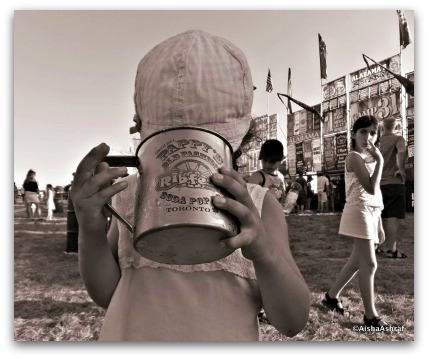
Boywithtincup

The local ribfest. Photo credit: Aisha Ashraf

Thank you for sharing some of the photos that capture a few of your favourite memories of Canada thus far. I’ve never been there, but I can see it is an amazing place. Can you tell us a bit more about these next two photos, which I believe are of your children?
This first one, of my son standing awestruck before a monstrous sculpture with an exploded head, brings to mind a bitterly cold winter’s day spent exploring Toronto’s Distillery District, where the kids got to meet Santa and the Victorian architecture and cobbled streets made us nostalgic for home. Back then we still felt like tourists. The second one is of my youngest child taking a deep draught from a tin mug at the local ribfest. I’m recalling a day of competitive rib-eating and blazing sunshine that melted into a night of flashing lights and fairground rides. Children are always such rewarding subjects—their innocence and unselfconsciousness makes them great fun to photograph—and the photos I take of my own children of course have special meaning.

hawkbyAisha

Soaring turkey vulture. Photo credit: Aisha Ashraf

And this next must be a New World bird of prey?
Yes, it’s called a turkey vulture. I got lucky after several attempts of zooming in and losing it to the vastness of a magnified sky. The photo always reminds me of an afternoon spent at the slipway, watching people get their boats in and out of the lake whilst navigating some particularly plentiful algae—it was more entertaining than TV.

The irresistible pull of the Great Outdoors

I think that is so interesting because, recently, I have been looking back over photos I took 35 years ago in many different countries and there isn’t a single one that doesn’t bring on a flood of memories. Photos are like that for me, a trigger, and they always have a story attached. Your two shots of the children are quite compelling—I love the girl picking her nose in the fairground photo—and the vulture is a great shot. Do you have any favorite places in Canada to take photographs?
Without a doubt, it has to be Lake Ontario—it’s where we head to chill, explore, reconnect and refocus. I actually get withdrawal symptoms if I don’t go regularly. The ever-changing light and character mean I snap lots of pictures that, once home, I usually find I have failed to capture whatever elusive quality it was I was trying for. We go for walks on trails and in conservation areas so I have countless photos of woods and water. Here are just a few that I really like:

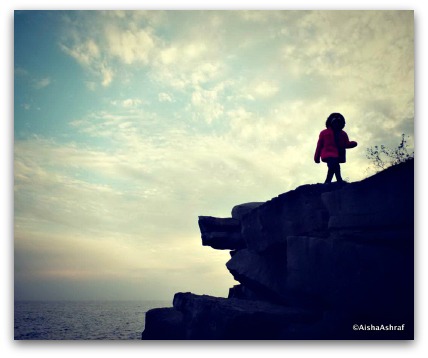
Daughterwalkingoncliff

Cliff walk near Lake Ontario. Photo credit: Aisha Ashraf

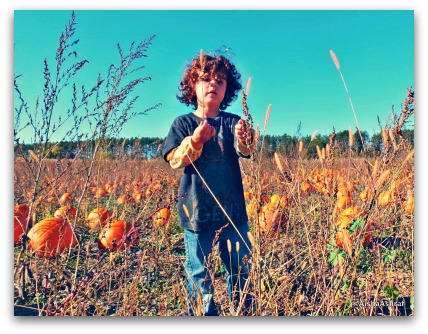
boyinpumpkinfield

Pumpkin field near Zephyr, Uxbridge, Ontario. Photo credit: Aisha Ashraf

Wavesofthelake

Lake Ontario. Photo credit: Aisha Ashraf

The one of your daughter in the field full of pumpkins is so vital, and the naturalness of the colours brings your lovely composition to life. By complete contrast, your daughter on the rocks is positively Neolithic and, although it’s Canada, so Cornish! Nourishing stuff. And I understand that the black-and-white photo of the sea lapping the shore of the lake is a real favourite of yours. Can you explain why these places inspire you?
I love nature—perhaps it was growing up on a farm and spending most of my time outdoors. I have a condition called Borderline Personality Disorder (BPD) and getting outside is a big factor in alleviating its debilitating hold. I see incredible, uncomplicated beauty in the natural world that I find soothing and strengthening. I try to capture it with my camera in a way that may allow others to be moved/nourished by it, too.

Thank you for your honesty about your condition, Aisha. I feel exactly the same about photographing the natural world: it allows us to capture not just the picture but the way we feel at that particular moment. Unfortunately, unlike you I am only at a level where I am trying to move and nourish myself. If others are moved also, that’s a bonus. Now I know you enjoy photographing your kids, but do you ever go to the other extreme: ie, taking photos of people you don’t know in the places where you visit, and do you find that awkward?
Absolutely! I know my shyness has cost me many a great photo-op. I’m not sure if it’s my BPD or my peripatetic life, but I always feel like an observer, standing in the periphery looking in. This translates into a preference for my subjects to be oblivious to me and my camera. I like to capture the raw moment.

Yes, I know that feeling. You want to melt into the undergrowth and take the most natural shot possible. Do you ask permission before taking people’s photographs and how do you get around any language barriers?
I have, on occasion, screwed up my courage and asked someone if they’d mind if I took their picture—come to think of it, no one’s ever said no. I think if language were a barrier, it might make things easier. Tourists get away with a lot!

I understand. Taking people photos can be a bit personal. It’s so much easier shooting a mountain as it’s too far away to argue! Would you say that photography and the ability to be able to capture something unique which will never be seen again is a powerful force for you?
Capturing memories and the perfect picture are my twin obsessions. I’m in love with light and the effect it has on everything: the study, the photographer, the viewer. Is there anything else so intangible, potent and unspoken, and whose experience is unique to each individual?

When did you come to realise the importance of light?
Ever since I can remember, I’ve been transported by the tone of light or the way it falls—it triggers memories for me like nothing else can. Not so much of occasions, but of feeling and being. For a few brief seconds I’m caught in a flashback. Time slows so that even the dialogue in my head is distorted, becoming deep and stretched like treacle, a voice on a tape recorder played too slow.

Such powerful analogies. Now for the technical stuff which I am not very good at. What kind of camera and lenses do you use?
I have a Fuji FinePix f750EXR—it’s just a regular compact camera, no fancy lenses or anything. If I couldn’t fit it in my pocket, I wouldn’t be able to take it everywhere with me. Photography is as much about identifying a good picture as it is about capturing it, and many great photographers have started with a basic machine. A good eye is evident whatever tool you have at your disposal.

I can’t tell you how much better that makes me feel! Finally, do you have any advice for wannabe photographers (like me) who are traveling or living abroad?
Never leave home without your camera. Mine even comes grocery shopping with me—you just never know where that next great shot will be. Sometimes you find the sublime in the ordinary, and for me that’s the sign of a great photographer—that ability to show the beauty in the everyday.

Thank you so much, Aisha, for joining me in this interview. It really has been a pleasure talking to you.

* * *

Readers, what do you make of Aisha’s experiences and her photography advice? And do you have any questions for her on her photos and/or travels? Please leave them in the comments!

And if you want to know more about Aisha, don’t forget to visit her excellent blog, Expatlog. You are also welcome to contact her at aisha-a@hotmail.co.uk +/or follow her on social media:
Twitter: @AishaAshraf1
Facebook: Expatlog FB Page
Linkedin: Linkedin profile
Google+: Linkedin Profile

(If you are a photographer and would like to be interviewed by James for this series, please send your information to ml@thedisplacednation.com.)

STAY TUNED for tomorrow’s post, when our fictional expat heroine, Libby, returns to the Displaced Nation to update us on her many adventures. (What, not keeping up with Libby? Read the first three episodes of her expat adventures.)

If you enjoyed this post, we invite you to register for The Displaced Dispatch, a round up of weekly posts from The Displaced Nation, with seasonal recipes, book giveaways and other extras. Register for The Displaced Dispatch by clicking here!

Related posts:

LOCATION, LOCUTION: JD Smith – from Cornwall to 3rd century Syria

Book cover art, Tristan & Iseult; JD Smith author photo; JJ Marsh author photo

Book cover art, Tristan & Iseult; JD Smith author photo; JJ Marsh author photo

In this month’s “Location, Locution”, expat crime writer JJ Marsh interviews  JD Smith, author of the novella Tristan and Iseult and the first in The Rise of Zenobia series, Overlord, based in ancient Palmyra, to be released in early 2014.

JD Smith lives in the English Lake District. She has worked in the graphic design industry for over a dozen years, and now specialises in book cover design and typesetting.

The pseudonym JD Smith was adopted as her preferred Editor’s title when launching the writing magazine Words with JAM.

Which comes first, story or location?
Always the story. The location is influential to the story, but the story is the most important thing, the part which excites me as a reader. The location is the background upon which the story is played out, and the history is the framework upon which it is hung.

How do you go about evoking the atmosphere of a place?
With great difficulty. In writing Tristan and Iseult I evoked the wet and wind the British know only too well. I’ve always lived on the coast, though in the north, not Cornwall (Kernow), but those salt winds and perpetually grey skies are the same. The Rise of Zenobia is based in 3rd century Syria, and I’m finding that much harder. I didn’t grow up with the atmosphere ingrained in me. I haven’t spent years of my childhood visiting the remains, the palaces and the fortifications. I rely on films a lot. Being a designer I’m an incredibly visual person, and seeing it played out, filmed in the locations I’m trying to conjure on the written page, helps immensely.

Which particular features create a sense of location? Landscape, culture, food?
All of the above, definitely. Although I think in order to relate better to a reader I am all in favour of sacrificing certain aspects which readers might not gel with, and using others to push plotlines forward. Of course, all of these things give a clue as to the time, as well as the place, in which a book is set.

How well do you need to know the place before using it as a setting?
I’ve never visited Syria but I’m writing about it. You need to know it to a degree, but I think you need to know your characters more. Location is secondary. You can paint the background afterwards. Of course it depends. I write historical novels based on historical events and people, and knowing them and the history of the place, rather than the place as it stands, is key.

Could you give a brief example from your work which you feel brings the location to life?
These two extracts are my favourite descriptions of the weather in Britain which for me was a huge part of the setting of Tristan and Iseult:

Rustling emanates from the dense forest, even though the wind has dropped. White mist shrouds us. I tense to stop cold shivers taking hold. The rain is fine, yet a hand through my hair proves it is wetter than the streams in springtime and my footing slides on the muddy grass as we pick our way through undergrowth.

And:

‘Ireland is no home for me,’ she says. ‘I was at home with the sea and the sand and the shingle of my shores, with the salt spray in my hair.’

Which writers do you admire for the way they use location?
Tricky one. I tend to admire writers for their story, and their characters, not for their use of location. And for me it’s both the time and the place that work together as one with any author’s writing, because I love historical fiction. Time and place are tied so tightly together one does not exist without the other. Sarah Bower’s descriptions are second to none.  Philippa Gregory evokes the royal court with ease. And Bernard Cornwell can describe a battle on any field.

Next month on Location, Locution:  award-winning author Amanda Hodgkinson.

 * * *

JJ Marsh grew up in Wales, Africa and the Middle East, where her curiosity for culture took root and triggered an urge to write. After living in Hong Kong, Nigeria, Dubai, Portugal and France, JJ finally settled in Switzerland, where she is currently halfway through her European crime series, set in compelling locations all over the continent and featuring detective inspector Beatrice Stubbs.

STAY TUNED for tomorrow’s post!

If you enjoyed this post, we invite you to register for The Displaced Dispatch, a round up of weekly posts from The Displaced Nation, with seasonal recipes, book giveaways and other extras. Register for The Displaced Dispatch by clicking here!

Related posts:

GLOBAL FOOD GOSSIP: The Mysterious Case of the Missing Pastries

global food gossipJoanna Masters-Maggs, our resident repeat-expat Food Gossip and Creative Chef, is back with her column for like-minded food lovers.

This month: The regrettable global takeover of the Cronut, and what should be getting the publicity instead.

* * *

“What in dog-breeding hell is a Cronut?” demanded my son Seb, reading over my shoulder while swigging milk from the bottle in that annoying way 16-year-olds have. Baffled for a second, I realized the confusion and laughed.  My German Shepherd, Sophie, is my obsession and I am always reading articles about breeding and training.  Today, though, I was reading a food magazine which discussed trends for the New Year. Seb had seen a headline that asked:

“2013 was the year of the Cronut and Duffin but what does 2014 hold?”

Those of you elsewhere — anywhere except France, that is — may laugh, but Seb’s assumption that a Cronut is German Shepherd-related rather than food-related was completely justifiable.  My own ignorance of Cronuts and other “blended” pastries was only brought to my attention in December, when a friend living in Kuala Lumpur posted that they had finally arrived there.

I think it true to say that the Cronut hasn’t yet arrived in France and probably never will.

Some dishes deserve to go global

I do hope the same will not be the case for other treats that, my magazine suggested, will be sweeping tastebuds worldwide this year.  I was particularly happy to see the arepa from Venezuela and Columbia on the list. My hips might not want to revisit my interest in these delectable goodies, but I am smacking my lips in anticipation.

I first met arepas in Maracaibo, Venezuela, and our friendship deepened while I lived in Caracas.  These flattened balls of unleavened maize flour-based dough are fried and then filled with a cornucopia of ingredients, depending on the region. North Western Venezuela, where I first fell in love with the arepa, has its own speciality, the Arepa Cabimera, whose filling consists of the improbable combination of cheese, jam, chicken and boiled eggs.  You know when someone is eating a Cabimera as the arepas are unusually square.  Other varieties often include queso guayanés  — a mild, medium-soft cheese similar to mozzarella, shredded chicken and, if you are very lucky, crispy pork rind.

Global — with the exception of France, that is

The idea that I will miss such delights as they sweep the world is distressing, but our ignorance of the Cronut is a sad portent of what might come.  How had the Year of the Cross-bred Pastry missed France? Perhaps it’s not such a surprise; France is not culturally inclined to faddy trends as is, say, London or New York.  Why a “need-to-please” hybrid, when a classic, small, and delightfully buttery croissant is available?  How intolerably vulgar to take such perfection and, presumably, add jam and deep-fry it.

I can feel a thousand thin and elegantly clad Parisian shoulders shudder at the thought.

Hybrid – it’s the new pedigree

On further reflection, my less-thin shoulders shudder too.  As my son’s comment shows, cross-bred dogs are very much at the front of people’s minds at the moment.  Maybe the Cockerpoo, Labradoodle, and Schitzpoo are the canine equivalents of our human desire to have our cake and eat it.  A dog that doesn’t shed and mess up the carpet and sinuses, and a croissant that doesn’t — oh, wait. It does crumble.  Well, a pastry that isn’t a croissant or a doughnut but which still makes a crumbly mess…

Why?  Why make a mash-up of existing pastries when you could come up with something less plagiaristic or stick with what already works?  Oh, listen to me: maybe I do belong in France!  After all, for each hybrid that works there are the unlucky ones in each batch which fail to inherit the best of both worlds and instead exhibit the worst of each.  A croissant where the delicate buttery flavor has been killed by over-sweetening?  A  Labradoodle which sheds anyway and isn’t a pedigree but which costs the same and has the potential to inherit the congenital defects of two different breeds?

What’s more, the frying of such a delicate thing as croissant pastry is not for amateurs.  Getting the layers of pastry and butter to open in the heat of an oven is no mean feat; getting them to do the same in hot fat is entirely different.  Apart from that, think how easily butter burns.  That’s a lot of worry when pâtissierières across France already have mastered the art of injecting chocolate into croissants to make pain au chocolate or, better, almond paste.

For me the almond croissant is the pinnacle of pastry pleasure.  This marriage of crisp pastry with nutty and unctuous almond paste represents the Paul Newman and Joanne Woodward of the Pâtisserie.

The Cronut is, as yet, a Brangelina wannabe and everyone is already asking how much longer is it going to last.

“New” but not necessarily “improved”

The French disdain for change for change’s sake can be seen everywhere.  Fashion classics which stand the test of time are valued over the new and the shocking.  London fashion is all about iconoclasm and rebellion, rather than restraint.   Surely, when it comes to food, good taste should not be derided.  Maybe the French are right not to jump on the bandwagon of each new craze, instead waiting to see what stands the test of time and has what it takes to become part of the pâtisserie canon.

I doubt that the Duffin will ever be the Little Black Dress of the pâtisserie world; certainly not with a name that makes it sound like something an ageing hippie would wear on a cold winter day in Glastonbury, UK.

Hmm, pause for thought indeed.  At least with baking, we can bin the rejects; we cannot do the same with our canine friends who don’t pass the successful hybrid test.

How, then, can a modern culinary classic find acceptance in France?

So, let me find order to my reasoning.  The French, so far, have not accepted the hybrid pastry which tries too hard to please and lacks the elegant restraint of better behaved French patisserie staples.  However, history reveals that the French will eventually accept what will not go away: dishes with an enduring appeal, such as the pizza so…

…let’s return to my arepa whose pedigree cannot be questioned.  This is a traditional, tried and tested, and regionally variable dish.  Given time, I am hopeful that the French, who enjoy regional variety in cheese and wine, should be open to accepting this newcomer.  France has already embraced with overwhelming enthusiasm the pizza and tweaked it to French tastes – crème fraiche anyone?  There is a little van with a wood burning stove on most street corners in every city, town and village of the country.  For every Domino there are scores of restaurants, parlours, and vans, nearly all of them French owned and run.

For the arepa this is hopeful news indeed. I may have to wait longer than a resident of London, Birmingham or, indeed, Kuala Lumpur, but I have hope that the Venezuelans are coming to Aix.

* * *

Joanna was displaced from her native England 16 years ago, and has since attempted to re-place herself and blend into the USA, Holland, Brazil, Malaysia, Venezuela, Saudi Arabia, and now France. She describes herself as a “food gossip”, saying: “I’ve always enjoyed cooking and trying out new recipes. Overseas, I am curious as to what people buy and from where. What is in the baskets of my fellow shoppers? What do they eat when they go home at night?”

Fellow Food Gossips, share your own stories with us!

STAY TUNED for tomorrow’s post!

If you enjoyed this post, we invite you to register for The Displaced Dispatch, a round up of weekly posts from The Displaced Nation, with seasonal recipes, book giveaways and other extras. Register for The Displaced Dispatch by clicking here!

Related posts:

Images: All images from Joanna’s personal photo albums, and used here with her permission

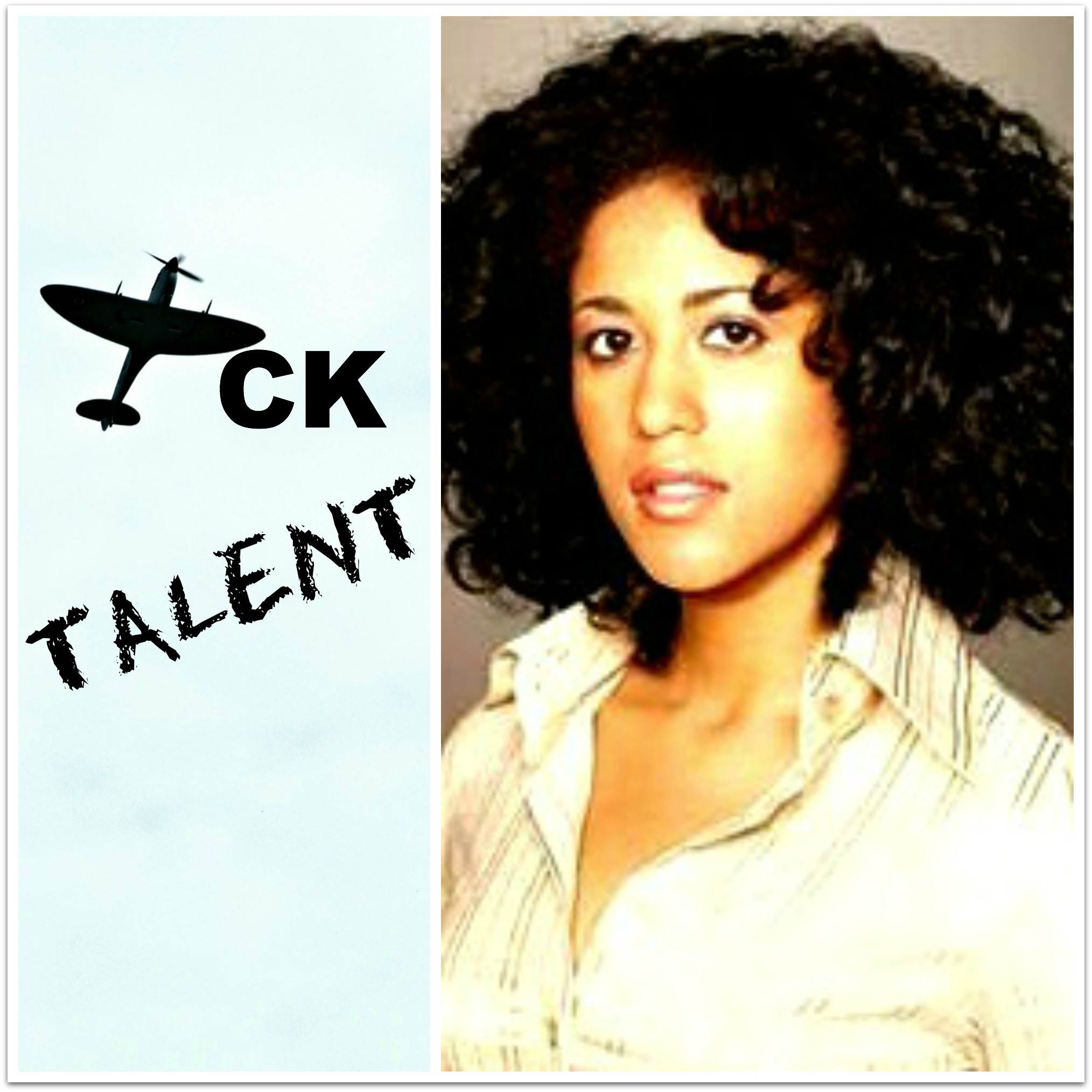
TCK TALENT: Laura Piquado, New York City Actress & One Well-Traveled Kid!

Laura Piquado Collage FINALWelcome to Elizabeth (Lisa) Liang’s monthly column about Adult Third Culture Kids (ATCKs) who work in creative fields, Lisa herself being a prime example. A Guatemalan-American of Chinese-Spanish-Irish-French-German-English descent, she recently debuted her one-woman show about being a TCK, which I had the pleasure of seeing during its too-short run in New York City in September of last year: stupendous!

—ML Awanohara

Happy new year, readers! Let’s start today’s interview by plunging right in. My guest is Laura Piquado, a professional actress based in New York who grew up in six countries, including Egypt, where we were drama classmates in high school.

* * *

Welcome to The Displaced Nation, Laura. It’s wonderful to reconnect with a Cairo classmate! I know you grew up as the daughter of a pair of teachers who were full of wanderlust. Can you give us a run-down of the countries you lived in as a kid?
My mother always told me that her earliest dream memory was of wanting to move to Africa. And as soon as she graduated from university in Canada, that’s what she did. She met my father in Sierra Leone in the mid 1960s. He was there with the Peace Corps, while she was being sponsored by CUSO (Canadian University Service Overseas)—a Peace Corps-style organization. They left when my mother was six months pregnant with my brother. My mother is tall, almost 5’11”, but at that time weighed only 120 lbs. I think having parasites, or the occasional bout of malaria was commonplace, but the risk to her health became too great.

After my (healthy) brother was born in Washington, DC, my parents decided to go overseas again. The first job my dad got was as an English teacher in a small village in northern Newfoundland, where I was born. Less than a year later, we moved to Beirut, Lebanon. Four years after that, when war broke out, we were evacuated to Shahin-Shahr, Iran, for almost four years. War broke out again, and we were evacuated again. The next stop was São Paulo, Brazil, for two years. My mom and dad hated the city, and we left every other weekend and holiday to get away from it. Consequently, my memories of Brazil are of travel, and of everywhere but São Paulo. After Brazil, we lived for four years in Bontang, Indonesia, which is in the province of East Kalimantan on the island of Borneo. After seventh grade we moved again, to Cairo, Egypt, where I graduated high school. That’s where you and I first met! My parents then moved on to Ecuador and China for 16 more years.

My parents loved being overseas, and at no point did they yearn to “come home.” They wanted their lives to be as teachers in international schools, and for 40 years that’s what they did. They retired a few years ago to a small town in New Hampshire.

A hard landing into adulthood

How did you feel about living in so many places?
I loved it, actually. Adjusting to new environments, new friends, new cultures, languages, was never difficult for me. I don’t know why. Perhaps I just got used to it. But I don’t think you ever get used to leaving friends and people you love—that’s always hard.

As an adult, do you find yourself drawn to other TCKs?
I definitely identify with other TCKS, though it’s not always a given we will hit it off. In fact, I used to be magnetically drawn to anyone who was a visible minority. “You’re from Indonesia?! I used to live in Indonesia!” “Hey, you’re Alexandrian! I lived in Cairo for 5 years!” I was always wanting to make a connection with a world that was no longer mine—and maybe never was mine, if I adhere to the rules of 3rd culture. But just because someone grew up all over the world as I did, or just because they are an actor like me, doesn’t guarantee I’ll be friends with that person—but it’s a starting point. And if a person grew up in different countries, at least their eyes won’t glass over when I answer the question, “Where are you from?”

You now live in New York City. How do you find life in the USA?
I’ve lived in the United States longer than I’ve lived anywhere else. Yet it’s the first place I’ve ever lived that doesn’t feel like home. For the first 20 years of my life I played with my friends, explored the jungle, hiked the Andes, swam in the Red Sea and the East Timor Straights, climbed salt flats, made forts in the desert, went horse-back riding around the Great Pyramids, woke to gibbon songs and the muezzin’s call to prayer. And then I came back here to go to school, get some degrees, get a job, and try to figure things out… I had this exhilarating childhood, and then this less-than-thrilling transition to adulthood.

Does your identity revolve around any one particular culture that you’ve lived in?
I am Dyak and atheist, Muslim, Christian, Bahá’í, Jain, Egyptian, Italian, Canadian—there is nowhere in the world that has ever felt foreign to me. I am all of these things, and none of them. After moving to the United States for the first time for college, being able to be all of them at the same time was what mattered the most. I was striving to understand who I was and what my life had been, and trying to share that with others, even if I couldn’t articulate it to myself. It’s taken a long time, and I suppose I’m still working at it. That said, I love meeting the kind of person who, unlike me, was raised in the same town he or she was born in, and still goes back there for family visits and holidays. I am attracted to the sense of being anchored somewhere, to a particular place. That perceived sense of belonging somewhere: it’s something I just don’t have; I don’t know what it feels like.

From an actor on the global stage, to an actor on a real stage

Tell us what you studied in college and how you made the leap to pursuing an acting career.
I did my master’s degree in Islamic Studies at McGill University in Montreal. I wanted, as an adult, to understand the cultural, political, and social environments in which I grew up. On some level I was looking for a path that would take me overseas again, which I was aching to do. I wanted to work in the development of women’s education in post-conflict societies because it was work that I was passionate about.

Just as I was finishing my degree, and thinking about streamlining into a doctoral program, I went back to Cairo. I hadn’t been back since high school. For a whole month I walked through the streets of my old neighborhood, saw my friends, went to mosques and bazaars and the Red Sea, and smelled and ate and absorbed Egypt again. It was glorious. But something changed in me after that, and made it okay for me to move on.

When I came back to Montreal, I started applying to drama schools. Although I had been involved in theatre since I was a kid, I hadn’t wanted to study it as an undergrad. There were other things in my life that I needed to address before I embarked on that.

But now I was ready for drama school—I enrolled in the London Academy of Music and Dramatic Art. At LAMDA, I felt like I was flying. I was so happy. To allow myself the ability to change horses mid stream, and for it to feel natural and fluid and right—that was tremendous. I don’t think any of us is just one person, and we aren’t the same person at 15, 25, 35, 55. We have multiple loves and lives and wants, and finding ways to marry them all, if we’re lucky enough to know what they are in the first place, can be overwhelming.

How did your family react to your decision to pursue an acting career?
I’ve only ever had a supportive family. So instead of calling me a flake, or accusing me of lacking any sense of stick-to-itiveness when I told them I wanted to go to drama school, they became, again, my most enthusiastic supporters.

I think our peripatetic childhoods trained us to be actors—to observe, listen, and adjust our behavior to our surroundings. Do you agree?
I do agree, for the most part. But I also think personality has a lot to do with it. Just because you grew up all over the world doesn’t de facto make you a keen observer, or an astute listener, and not all kids who move around a lot are able to adjust to their changing environment. On the other hand, if you have had a peripatetic life, and you also happen to be a good listener, observer, etc., it seems it can only enrich your depths as an actor (and certainly as a human being). For me, adaptability became a defining aspect of my personality.

I think that for us TCKs, the challenge of convincing a casting director that you truly can be this other person is made easier because of all of those things we bring to the table—listening, observing, adjusting, maybe even having lived or known the character’s life. But also for that reason, many of us find it even harder to put up with being typecast.

Which sorts of roles are you attracted to, and do you think your upbringing influenced this?
I’m usually attracted to damaged characters, or quirky ones. And accents are always juicy! I’ve always been a mimic, and am grateful for that gift as it makes it easier to play a variety of roles. Why I’m drawn to quirky characters is less apparent. Does it have something to do with my upbringing? That’s an interesting thought. I’ve never made that correlation, but it makes complete sense.

So which parts have been your faves?
I loved playing Goneril in King Lear with the Texas Shakespeare Festival. I’ve always thought that she’s been inappropriately maligned as a character. Lear is not the easiest father—demanding, impulsive—and to require his daughters to prove, to prove, their undying love for him—for the sole purpose of measuring it against their inheritance—makes him something of a jerk in my book.

Playing the painter in Ionesco‘s The Painting with the Phoenix Theatre Ensemble was pretty great as well. Aside from the play’s absurdism, the part was perverse because of the the vocal and physical qualities we decided on. It’s not often that you get to play grotesque and obsequious, mismanage your voice, throw out your back, and sprain your jaw because the part demands it. Fantastic! 🙂

And a role on the damaged front, I suppose, was Charlotte in Sharr White‘s Sunlight, for its world premiere with the New Jersey Rep. While I’m less attracted to straightforward, modern dramas (though in truth, I love it all), the whole premise for who Charlotte is, for what motivates and oppresses her, is her having been in the Towers on September 11th and losing her child as a result of the trauma. And while that’s not what the play’s about (thank God!), it defines who she is able to become (or not become) in the ensuing decade.

* * *

Wow, that’s an impressive list! Thank you, Laura! I wish you the very best in your career and hope to see you on stage and/or screen soon. Readers, please leave questions or comments for Laura below.

STAY TUNED for tomorrow’s post, from our Global Food Gossip!

If you enjoyed this post, we invite you to register for The Displaced Dispatch, a round up of weekly posts from The Displaced Nation, with seasonal recipes, book giveaways and other extras. Register for The Displaced Dispatch by clicking here!

Related posts:

For this peripatetic Argentine, now an expat in Queensland, a picture says…

Canon zoom lens; photo credit: Morguefiles. Belu in Buddha Truth Relic Temple, Singapore; photo credit: Belu.

Canon zoom lens; photo credit: Morguefiles. Belu in Buddha Truth Relic Temple, Singapore; photo credit: Belu.

Welcome back to our series “A picture says…”, created to celebrate expats and other global residents for whom photography is a creative outlet. The new series host is English expat, blogger, writer, world traveler and photography enthusiast James King, who blogs at Jamoroki and truly believes a camera is a mirror with memory…

Greetings, Displaced Nation-ers. My guest today is the 35-year-old Argentine Belu: an expat, blogger, world traveller and photography enthusiast. Belu studied industrial design at university in Argentina and then moved to Europe. Not long ago, she relocated to Australia, where she sells her designs at street markets and travels as much as her finances allow.

Belu brings her experiences and unique view of the world to her photography blog, BeluChi, and to the travel blog, Travel Tips and Pictures, where she is the main travel writer.

I have followed Belu for a short while and love the simple, down-to-earth way she brings her pictures and the stories behind them to life through her writings.

* * *

South American but with deep European roots

Hi, Belu. Thanks for agreeing to this interview. Can we begin by having you tell us: where did you live in Argentina, and when did you spread your wings, leave the nest and start your world travels?
I was born in Mar del Plata, a pretty big town located 500km south of Buenos Aires. I lived there until I was 25, and it was about that time that I became curious about travel and ended up moving to Europe.

So you got the travel bug. I can relate to that—but what really inspired you to travel?
Travelling for me is a way to get connected with people and to nature. I so love meeting people, and I knew travelling would give me that opportunity better than anything else. I love it when people tell me about their lives, their cultures and traditions, stories and dreams. I learn so much from my travels.

I know exactly what you mean. It’s quite addictive and I can see you are a compulsive globe-trotter. Tell me what countries have you visited so far?
Aside from Argentina and southern Brazil, I’ve travelled mostly around Europe: Portugal, Spain, France, Italy, Monaco, Belgium, England, Scotland and Ireland. And now, because I live in Australia, I’m starting to be more in touch with Oceania and Asia—Indonesia and Singapore, for example. I’m planning a trip to China next year, and in 2015 I hope to travel to India and some countries in Africa.

Wow, that’s quite a package! Tell us, how did you end up in Australia, and what is life like for you your new home?
I met my partner when travelling in Australia over two years ago, when living in Barcelona. So, after going back and forth several times, we decided to live together here in beautiful Cairns, a city in the far north of Queensland. So far, so good. I believe that how you feel in a different place and culture depends mostly on how you connect and interact with the people in your new environment, at least in my case. Weather is also important to me because I’m a “sunlight” lover.

Pizza San Marco, Venice Italy. Photo credit: Belu

Piazza San Marco, Venice, Italy. Photo credit: Belu

You offered this photo—of you and all the pigeons in the Piazza San Marco in Venice—as one of your favorite shots that captures cherished memories. Thank you for sharing it. Can you tell us more about why it’s so special?
This photo brings me back to the first time my parents came to Barcelona to visit me. We went to Venice and Rome—spectacular!—and then to Lettopalena, a tiny little village up on the top of a mountain in Chieti Province, around 200km from Rome. It was the place where my grandmother was born. I met my Italian family, who are still living there. That trip was exiting because of the contrasts.

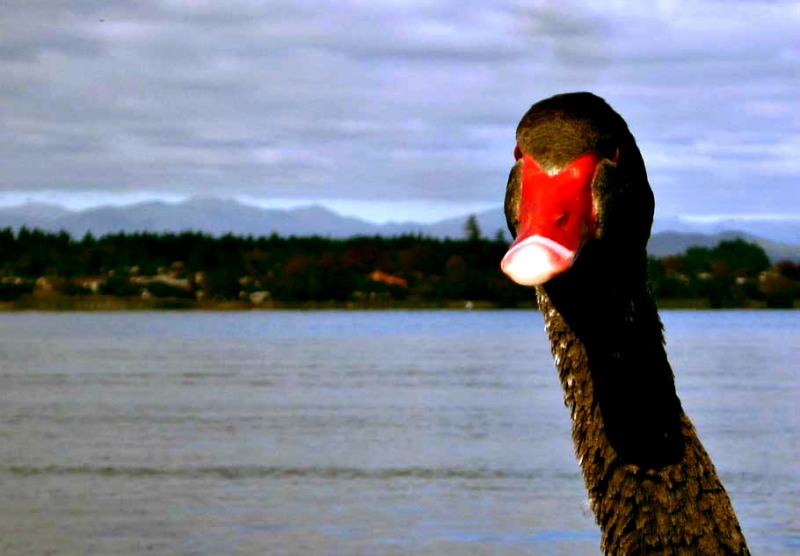
Taupo Lake, Taupo, New Zealand. Photo credit: Belu.

Black swan on Lake Taupo, New Zealand. Photo credit: Belu.

Solo travel and staying with locals

That must be a very personal piece of your life. Now moving on to your photo of a beautiful black swan on Lake Taupo in Taupo, New Zealand.
Lake Taupo is in the centre of the North Island. My trip to New Zealand was unforgettable because of the natural beauty. It was also solo-travel, so I could be more in contact with locals and travellers from everywhere. I love this kind of travel. I usually have a “tentative plan” that I hardly ever follow. I love the freedom of changing and re-organising my itinerary according to my feelings.

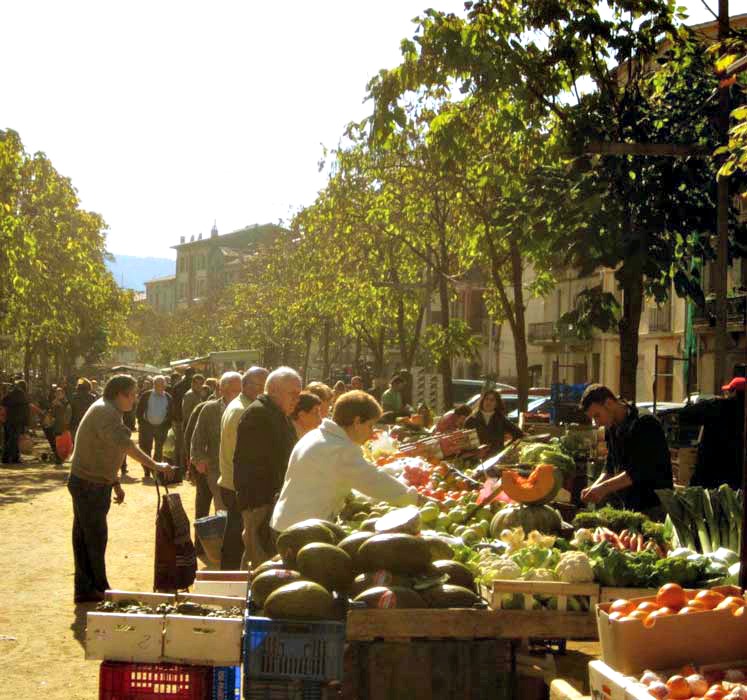
Oh! I know the feeling well. No one to nag you. Free as a bird (so to speak). Okay, so now for a photo of the everyday scene—a street market in Ripoll, Girona (one of the four provinces comprising Catalonia), Spain. My favourite country!

Street market in Ripoll, Spain. Photo credit: Belu.

Street market in Ripoll, Spain. Photo credit: Belu.

I spent a Saturday morning strolling around the heart of Catalonia, in southeastern Spain. I had the honour of staying at my friend’s parents’ home, always with locals… that made this travel special. I did visit popular tourist spots in that area, but when you are with local inhabitants, it makes the place so much more interesting and you learn so much more about their culture. They told me folk tales and stories that you’ll never find in any guidebook.

I seem to be agreeing with everything you say, but it’s difficult to argue with that. So many people travel but never really integrate with the local people. They miss so much. But we must move on now. Where were or are your favourite spots to take photographs?
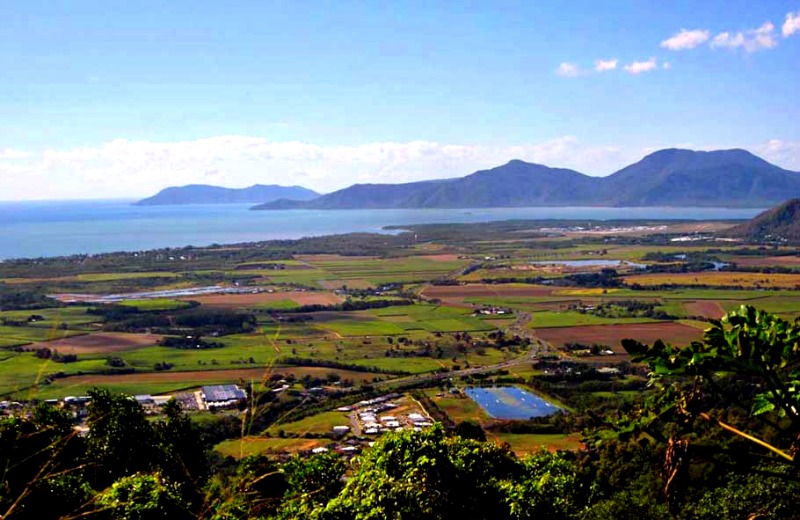
My favourite spots are high viewpoints and streets.From high viewpoints you get to admire the whole picture, almost like aerial photography. I find that very exhilarating. And when I am in the streets I am close to the people and can really feel the ambiance and capture the essence of the place.

High vs low, scenery vs people

The last three photos you’ve chosen illustrate the difference between high (looking down) and low (streets at ground level) admirably:

Cairns, Queensland, Australia. Photo credit: Belu.

Cairns, Queensland, Australia. Photo credit: Belu.

Back street, Bali, Indonesia. Photo credit: Belu.

Back street, Bali, Indonesia. Photo credit: Belu.

London (near St. Paul's), England. Photo credit: Belu.

London (near St. Paul’s), England. Photo credit: Belu.

The photo of Bali is so typical of a Southeast Asian back street. And the one of London, showing a tramp walking between a dust cart and a City businessman with St. Paul’s Cathedral as the backdrop, is an absolute gem. Actually, this photo leads to my next question: do you ever feel reserved about snapping photos of people, particularly when they are conscious that you are doing so? And do you ask permission before taking people’s photographs? How do you get around any problem of language?
It usually depends on the situation and the local culture. I sometimes ask permission by words or sign language, especially if I feel the person is uncomfortable because of the camera. Fortunately, I have never had any problem about that. Most of the time people say “yes”.

That must make it easier to take natural shots; so would you say that photography and the ability to be able to capture something unique which will never be seen again is a powerful force for you?
For me the answer to that is “most definitely, yes!” When I left Argentina I, maybe unconsciously, realised what a powerful force pictures are. To be able to produce something that can never be repeated exactly is quite amazing.

Let’s get technical

Now for the technical stuff which I am not very good at. What kind of camera and lenses do you use?
I have a Canon Ixus 107 called “Anastasia”. She is always in my bag. It isn’t a professional camera but it works as it were! A useful camera for me must be compact and not too expensive, because I don’t want to be too worried about it when travelling.

Finally, do you have any advice for wannabe photographers (like me) who are travelling or living abroad?
Well, the Internet has plenty of information, videos, etc, for those in search of photography tips. But I can tell you what I do: stay curious, learn from others, and meet people.

* * *

Readers, what do you make of Belu’s experiences and her photography advice? And do you have any questions for her on her photos and/or travels? Please leave them in the comments! 

Once again, if you want to read more of Belu, don’t forget to visit her sites (see links above). You can also contact her via aquibeluchi@gmail.com.

(If you are a photographer and would like to be interviewed by James for this series, please send your information to ml@thedisplacednation.com.)

STAY TUNED for next week’s fab posts, including an interview with this month’s featured author!

If you enjoyed this post, we invite you to register for The Displaced Dispatch, a round up of weekly posts from The Displaced Nation, with seasonal recipes, book giveaways and other extras. Register for The Displaced Dispatch by clicking here!

Related posts:

LOCATION, LOCUTION: Jeet Thayil on bringing location to life in a semi-dream state

Jeet Thayil

Clockwise from top: author photo Jeet Thayil; book cover art “Narcopolis”; author photo JJ Marsh

In this month’s “Location, Locution”, expat crime writer JJ Marsh interviews Jeet Thayil, author of  Narcopolis.

Jeet Thayil was born in Kerala, India, in 1959 and educated in Hong Kong, New York and Bombay. He is a performance poet, songwriter, librettist and guitarist, and has published four collections of poetry: These Errors Are Correct (Tranquebar, 2008), English (2004, Penguin India, Rattapallax Press, New York, 2004), Apocalypso (Ark, 1997) and Gemini (Viking Penguin, 1992). He is also the editor of The Bloodaxe Book of Contemporary Indian Poets (2008). His first novel, Narcopolis (Faber & Faber, 2012), won the DSC Prize for South Asian Literature and was shortlisted for the 2012 Man Booker Prize and the Hindu Literary Prize 2013. He currently lives in Berlin.

Which came first, story or location?
I knew Narcopolis would be set in Bombay. I started with that city and that period in mind. It was about telling a story that hadn’t been told before, in a way that Indian fiction doesn’t really tell stories. Unsentimental, brutal and beautiful. When I realised that was what the book would be like, it revealed itself to me.

What’s your technique for evoking the atmosphere of a place?
When I was working on Narcopolis, I would work till very late at night, go to bed, wake up and start on it again, without really thinking. I found that when you’re in that oneiric, half-oneiric state, still slightly in the dream, very interesting things would happen. I’d come up with things I’d never have thought of later in the day. I was astonished about how much I remembered from that time, 25 years earlier, when I had no idea I would write a novel, when I was not exactly in the clearest of mental states. I was also surprised how unhealthy it was, the process of remembering.

A negative experience?
Absolutely. It was the opposite of cathartic.

Which particular features create a sense of location? Landscape, culture, food?
All of those. I’m a big fan of crime fiction, the bloodier the better. I’m addicted to crime thrillers. That, and poetry, is what I read on a daily basis. I’m sure a lot of that atmospheric noir milieu seeped into Narcopolis.

That’s curious. Not a link I would have made. I was going to ask you if you had a guilty reading pleasure, but you obviously don’t feel guilty.
Not at all. I hold those books up proudly on the train.

How well do you need to know the place before using it as a setting?
I’ve set poems in places I’ve never been to, and that can be a huge liberation. I think the worst is to know a place glancingly. To visit a place for a few days, get a false sense of it and then try to write about it. It might even be better to have never been there than read a guide about it.

Because it’s too superficial?
I think so. Either never go there or have been there too long.

Which writers do you admire for the way they use location?
I mentioned my love for crime writers and the way they do exactly that, evoking streets and cities and ambiance. But I’m also tremendously fond of the fiction that’s set in the opposite of cities: William Trevor, Henry James, E.M. Forster. Writers that do evoke a sense of place but often in the most mysterious and indirect of ways.

Next on Location, Locution … JD Smith, author of Tristan and Iseult (12th-century Cornwall) and Overlord: The Rise of Zenobia (3rd-century Syria), to be released in early 2014.

 * * *

JJ Marsh grew up in Wales, Africa and the Middle East, where her curiosity for culture took root and triggered an urge to write. After living in Hong Kong, Nigeria, Dubai, Portugal and France, JJ finally settled in Switzerland, where she is currently halfway through her European crime series, set in compelling locations all over the continent and featuring detective inspector Beatrice Stubbs.

STAY TUNED for tomorrow’s post!

If you enjoyed this post, we invite you to register for The Displaced Dispatch, a round up of weekly posts from The Displaced Nation, with seasonal recipes, book giveaways and other extras. Register for The Displaced Dispatch by clicking here!

Related posts:

TCK TALENT: Amber Godfrey, Diplomatic Kid Turned Performer-Writer

Amber Godfrey Collage

Photo credits: left: RoganJosh (MorgueFiles); right: Amber Godfrey, from her portfolio.

Welcome to Elizabeth (Lisa) Liang’s monthly column about adult Third Culture Kids (TCKs) who work in creative fields. Lisa is herself a prime example. A Guatemalan-American of Chinese-Spanish-Irish-French-German-English descent, she recently debuted her one-woman show about being a TCK, which I had the pleasure of seeing during its too-short run in New York City in September: stupendous!

—ML Awanohara

Happy Thanksgiving, readers! I’m thankful to be bringing you today’s guest, a kindred spirit of mine. She is Amber Godfrey, an actress-writer who, like me, has written and performed her own solo show about growing up as a TCK of mixed heritage.

* * *

Welcome to The Displaced Nation, Amber! I’m happy to have met another solo performer whose TCK story parallels my own. Since your dad is a Canadian diplomat, you grew up in eight countries. Can you tell us which ones?
Besides Canada, I’ve lived in the USA, Ecuador, Trinidad, India, Hong Kong, Sri Lanka and England.

Growing up, which of these countries do you identify most strongly with?
I identified, and continue to identify, strongly as a Canadian probably because of my dad’s job and the fact that we always connected with the Canadian expat community wherever we went. I also heard on more than one occasion (usually when I was being busted for some rebellious act): “You represent Canada!!” I’ve spent most of my adult life in Canada and the US, so I feel very “North American” at this point. At the same time, though, I do feel like a “citizen of the world,” and the bond that I feel with other TCKs is unique.

“Are you adopted?”

Your family is particularly diverse. Let’s see if I can get this right. You are the daughter of an Ecuadorian mom and an African American father, but you were raised by your mom and a Caucasian-Jewish Canadian stepdad, who then had your brother, David. Was your family’s status ever challenged by strangers, like mine was? In grade school, no one believed my brother was my brother, and people asked my mom if I was adopted.
Yes! This still happens all the time. When the four of us go out for dinner, servers will assume my brother and I are a couple. If I check into a hotel with my Dad, we get stares. When I was in fifth grade, I had to go to the school nurse and, when she realized who my brother was, she asked pointedly: “Are you adopted?” I panicked and said “Yes,” even though that wasn’t the whole truth. Looking back—what an inappropriate question to ask a 10-year-old!

Do you feel offended when that happens?
Honestly, it sort of tickles me that people don’t know what to make of us. I figure, that’s their problem and it doesn’t have to ruin my day. As an actor, I get irritated by the under-portrayal of mixed-race families on stage and in film. When I was auditioning a lot, I became really frustrated realizing I would most likely not be considered for “sister of” so-and-so because the other actor had already been cast as white.

Love the place you’re in

I completely relate! So, with such a mixed background, which culture(s) form the core of your identity?
I grew up with a lot of focus on Jewish history, tradition and heritage, which I resisted up to a point—I chose not to be Bat Mizvah’d—but to which I also really connected. As a pre-teen I was obsessed with The Diary of Anne Frank and wrote short stories about young Jewish girls in the Nazi era. In my early 20s, the combination of acting roles I was being sent out for and my burgeoning adulthood piqued a stronger curiosity in the African-American side of me, which ultimately led to me reaching out to find my birth father. Now, in my 30s, I find myself seeking to connect with my Latin American roots. Of course I also identify with the cultures of the countries I grew up in! I think the quest to understand my “identity” is ongoing…

Were you happiest in a certain place at a certain time?
I guess the short answer is: I aim to be happiest in the moment I am in. Every place I went to had its good and bad moments…

What were your school experiences like growing up?
I went to private school in California, international schools in India, HK and Sri Lanka, and the local public school in Canada. During high school I had to contend with three completely different school systems, which was a challenge to say the least.

How about college?
I went back to Canada for college: I studied theatre at Acadia University, in Nova Scotia. It was hard to get good information back then (the Internet was just a baby!), but my Dad pointed out that as a small school in a small town, it might be an easier transition than if I went to a big school in a bigger city like Toronto. And Acadia has a good theatre program.

“It’s all in me…”

Did your TCK upbringing influence your desire to become a performer?  
Being in school plays or performance groups was a good way to get involved and make friends when moving from place to place. But I also think that portraying characters on stage allowed different parts of myself to come forth and was a way for me to work out my identity. I’m laughing because I’m thinking of Whitney Houston’s “I’m Every Woman”—I’m a hippy at heart and believe we are all one and connected. Seeking to experience and understand life/truth from multiple viewpoints is an essential part of who I am.

Before we get into your solo show, let’s talk about your series of performances of Anna Deavere Smith‘s solo show Fires in the Mirror, a docudrama for a solo performer about the racial tensions that erupted between blacks and Jews in Brooklyn in 1991.
I was asked to do Fires in the Mirror by Jesse Freedman, a fellow performer and prolific director, whom I met in a SITI Company Suzuki/Viewpoints workshop. I jumped at the chance to engage with this epic piece because it is constructed so thoughtfully and allows me to play with my Black/Jewish roots. I initially performed Fires in the Mirror at the Limmud Conference, which took place in Coventry, England. Then the Jewish Theatre Workshop in Baltimore requested the show as part of an initiative to continue dialogue between Blacks and Jews who share space in that community. I also had a short run in NYC at the New Yiddish Repertory Company Theatre.

Moving over to your autobiographical solo show: why did you create DipKid?
I’d been thinking for many years about telling my story but couldn’t decide which way to tell it. After taking a Soulo-Show Workshop with Tracey Erin Smith, I finally started writing. I submitted a proposal to a small festival in NY, and when I got in, I realized it was time to start making the show! My efforts resulted in a short but sweet twenty-minute piece (you can watch it here).

How was it received?
The reaction was fascinating. I had assumed my story was unique, but it seemed that people could relate to it, and wanted more! That’s where the struggle began for me. I didn’t know how to finish the piece because I felt I wanted it to link up with my current situation—but that kept changing! The next time I performed the show, I expanded it to 45 minutes but felt less satisfied. I’d watched the video of my first performance so many times I felt sort of stuck in the past. I also found myself listening to many differing opinions on where my show should go and how it should be crafted—my vision got a little lost in the din. Finally, the festival format was crazy-making—especially as I was holding down a full-time job. Trying to write and rehearse this piece all for just one evening was too much pressure. My dream would be to take the show to the countries I lived in and beyond. I’d love to perform it at international schools and for expat communities worldwide.

As the interviewer, I think I can permit one question that’s of particular interest to me, which is: how do you like solo performing?
Solo performance is relatively new for me and I do miss getting to work with other actors on stage. That said, the medium allows me to be a bit more in control of the work and my approach. And it’s wonderfully vulnerable!

I understand you’re planning to film a documentary. What will it be about?
The focus will be on other children of diplomats (i.e., “dip kids”) and how their lives have been shaped by their upbringing and the jobs of their parent(s). I plan to tell the story from my perspective and also weave in my experiences as a mixed-race individual who continues to search for an understanding of and connection to my identity, heritage and all the parts that I am made of.

Do you have any other projects coming up?
I am writing a memoir that will delve deeper into the stories I reveal in DipKid.

Best and worst (Canadian) Thanksgiving memories

Canadian Thanksgiving was in October, but since American Thanksgiving is today, please share with us your best and worst Thanksgivings.
The best occurred when we were living in New Delhi. We were invited to the Official Residence of the High Commissioner for a Canadian Thanksgiving celebration. It was a big party with live music and food sprawled out on the grounds. At dusk everyone looked up and gasped as hundreds of bats swarmed the sky. It was the coolest thing I had ever seen!

I think the worst was my first Thanksgiving away from home. My parents were in Sri Lanka and I was in Wolfville, Nova Scotia (where Acadia U is). Everyone I knew at school had family nearby, but it was only October and I hadn’t bonded with anyone enough to get an invite. I ate Pop-Tarts and drank Dr. Pepper and felt homesick for my family and a bit sorry for myself…

* * *

Thank you, Amber, for being you, a fellow TCK theatre-maker! Readers, please leave questions and comments for Amber below. And if you want to keep up with her creative undertakings, I suggest you also follow her on Twitter: @DipKidAmber.

STAY TUNED for next week’s/month’s fab posts!

If you enjoyed this post, we invite you to register for The Displaced Dispatch, a round up of weekly posts from The Displaced Nation, with seasonal recipes, book giveaways and other extras. Register for The Displaced Dispatch by clicking here!

Related posts:

GLOBAL FOOD GOSSIP: Stuffing a chair with boar’s hair, and your face with Charlotte Royale – British style, bien sûr.

global food gossipJoanna Masters-Maggs, our resident repeat-expat Food Gossip and Creative Chef, is back with her column for like-minded food lovers, which includes pretty much every expat we’ve ever encountered.

This month: Upholstering armchairs to the tune of Mary Berry.

* * *

I haven’t been cooking much this month.

This is because, instead, I have been totally absorbed in reupholstering an armchair for my daughter’s bedroom.

Like so many “trailing spouses”, I am an International Jack of All Trades and, possibly, Masters of None.  Work visas are rarely applied to spouses and we must do what the current location allows us if we wish to work.

In my time I have taught English (yes, I have a qualification), arranged flowers (basic qualification), taught exercise classes on a Saudi compound (absolutely qualified with first aid certificates to boot) and baked and decorated birthday cakes (the qualification here is hard to pin down, but I am very enthusiastic).

My latest enterprise, however, is gripping me, and might well be what saves me from permanent life as an expat dilettante.

A family history, as recorded on sofa cushions

Over the years my four children have wrought destruction on all our soft furnishing, but the sofas have suffered the worst.  In part, I have been loath to recover them, as they represent something of both the material culture and culinary history of our family.  The stains, ever more poorly hidden by artfully draped throws and cushions, track the growth of the children from breast to solids. Here and there are the stains of snacks smuggled from the pantry or the marks made by friends I felt woefully too weak to upbraid.   Perhaps I’m just too English to tell off other people’s kids successfully.  My “Take the hamburger back to the kitchen before I am forced to beat you” delivered mildly with a smile and a wink, is taken as face value and ignored – I should expect no more, really.   Anyway, confronted with an upholstery bill that reached into five digits, I decided to take another “Have a go, Jo” course.

The result is that I can no longer visit a friend’s house, or watch a film or TV, without becoming entirely distracted by the chairs and sofas on display.

Thanksgiving stuffing? Not unless it’s made of boar’s hair

This new interest has caused me to all but abandon the kitchen.  Meals are late and gracelessly served.  Plates generally consist of pasta with a side of chopped tomatoes, cucumber, and sundry vegetables dragged from the back of the fridge or freezer – anything to make up the 5 a day and free me to return to the basement.  I’m amazed that my family is bored by this approach.  Perhaps they need a little footstool project of their own.

Thankfully for this webpage, this dearth of food-related happenings in my household has been tempered by my need to listen to radio or TV while I work.

This month I caught up with Great British Bake Off: the perfect accompaniment for the stripping and recovering process.  If you haven’t yet discovered the delights of this quintessentially British of “competitions”, I recommend a quick rifle through YouTube.  I’m sure you too will be hooked.

None of the competitors claim that winning the show is their dream, or assure us that they must win because they want it so bad. That they don’t do so on a televised competition comes as a surprise and seems to suggest that things back home have changed more than I could ever have guessed.  So accustomed are we all to naked ambition and self-puffery despite slender talents that the shock of modesty seems inconceivable.  This year there was even a competitor, Ruby, who was so self-effacing that she became a hate figure in the press.  Holding up her various offerings and apologizing for their variously burned, dry or just plain terrible states, she seemed to hail from a bygone age, ignorant of Simon Cowell.  But today this is mistrusted and seems to be insincere, even manipulative.  Interestingly, Mary Berry, the rather strict octogenarian judge, was quick to comfort and reassure.  Modesty has been lost to the British TV in 15 years of TV competitions in music, food, modeling and god-knows-what.

The public might mistrust Ruby’s handwringing over her uselessness, but Mary did the proper thing and bucked her up.

What, really, is so wrong with such a world?

Killing two oiseaux

IMG_2070

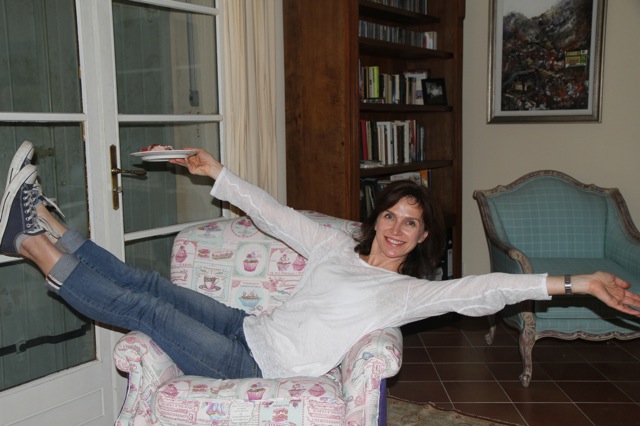
Joanna and her impressive reason
for a lack of cooking this month

Where am I going with this?  Welcome to the wandering mind of someone whose hands are deep in boar’s hair and webbing.  I’ll tell you where, though.  It occurred to me that, since this hugely successful show had been spun off to many countries, each tweaking it to its own tastes and state of mind, I could find the French version and improve my lamentable French while never pausing in my upholstery endeavours.

The first two hour episode proved to be a deeply comforting and successful experiment in language acquisition — mal cuit, anyone?  But then, halfway through the next episode I received a bit of a douche froide, so to speak.  The announcer, thankfully less humorous than her British counterparts as my French is barely up to understanding French slapstick let alone gentle, self-deprecating humour, announced that the Challenge Technique would be English in origin.  Cue the endless pause so beloved of such shows, then:

“Le challenge est……….  Charlotte aux fruits rouge.

Well, strike me down with a langue de chat.  You see, Charlotte Royale wasn’t English, it was French.  I knew this, because it had appeared only a week before on English T.V. and during French Week, no less.

Charlotte? C’est un French name, non?

Finally, something had occurred which made me look up from my stitching.  What gave Charlotte her ambiguous status between the French and the Brits, while retaining value as a challenge worth attempting?  The British show gave no clue.  Although their Charlotte involved Swiss Roll and looked like one of the illustrations in your mother’s 1970s copy of, er, a Mary Berry recipe book, it was accepted without demur by all as French.  Similarly, the French contestants, while sucking in their breath and declaring they were going to have to concentrate hard on this one, they failed to cry as one patissier,  “Zut alors, c’est un recet francais!”

The French presenter thickened the plot further, introducing a historian to explain the English origins of the dish.  Apparently, it was invented by Antoine Carême (yes, the father of the art of patisserie) who worked at both the English and Russian courts for a time.  You see?  Strange, no?  He made it for either a Queen Charlotte, a Princess Charlotte, a cousin Charlotte and then at some point tagged on Russe to include the Tsar in his flattery.

So why is this not considered French if a French man really did invent it?

Unearthing Charlotte’s origins in my own kitchen

IMG_2042

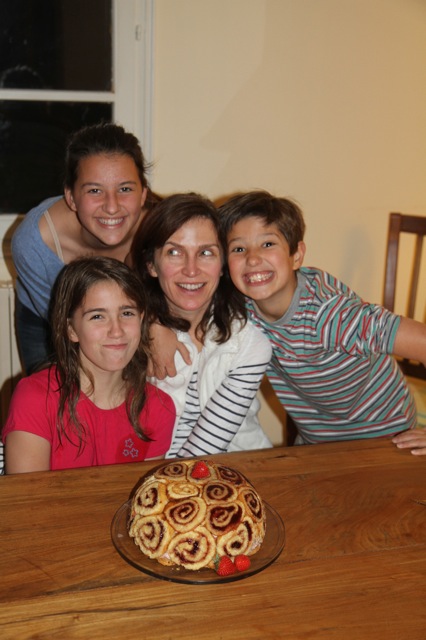
Patrick sharing his British Charlotte Royale. In France.

Patrick, my 9 year old, and I, decided to make the British version.  Doing it for myself cleared up all my questions.  It was, let’s say, a woman of substance.  French Women Do Not Get Fat, and their puddings cannot be hefty either.

My own Charlotte Royal was no slip of a thing.

The Swiss Roll lining was easily managed by Patrick working alone with our trusty KitchenAid.  While the French contestants piped boudoir biscuits to surround their moulds for the light bavarois filling, Patrick sliced up jammy sponge rolls which gave the pud a slightly cerebral air when turned out. How can you cut a petite tranche from that?  Piping even biscuits would be much more of a challenge for child and adult alike.  The Swiss Roll is infinitely more forgiving.

The difference between the French version and the English became clearer.  Simiar amounts of work and skill are involved, but one must be elegant and the other must be generous.  One should look preternaturally perfect, and the other is valued for comfort.  A French dessert should perhaps make you feel you are not quite elegant enough to eat it, while the English makes you feel better because you do not look like the Duchess of Windsor.  Ha ha –  it is not generosity of spirit that holds the French back from planting the tricolor on this this dish.  They are anxious that it is a recipe that can look unfinished, so trifle-like.

When Carême returned to France, he apparently rechristened the dish Charlotte á la Parisienne, probably to soothe the nerves of alarmed locals who may have heard a thing or two about the English king Carême had worked for.  I have no doubt when Charlotte arrived on French shores she resembled a trifle as little as possible.

Carême’s Charlotte is a little rootless, like so many of us expats.  Like us, it is unsure where it belongs and if home will ever be home again.  The Charlotte is perhaps a sort of Third Culture Dessert.

But at least I think I may have found the name for my upholstery business if I ever start one.

Here’s to Third Culture Sofas.

* * *

Joanna was displaced from her native England 16 years ago, and has since attempted to re-place herself and blend into the USA, Holland, Brazil, Malaysia, Venezuela, Saudi Arabia, and now France. She describes herself as a “food gossip”, saying: “I’ve always enjoyed cooking and trying out new recipes. Overseas, I am curious as to what people buy and from where. What is in the baskets of my fellow shoppers? What do they eat when they go home at night?”

Fellow Food Gossips, share your own stories with us!

STAY TUNED for tomorrow’s post!

If you enjoyed this post, we invite you to register for The Displaced Dispatch, a round up of weekly posts from The Displaced Nation, with seasonal recipes, book giveaways and other extras. Register for The Displaced Dispatch by clicking here!

Related posts:

Images: All images from Joanna’s personal photo albums, and used here with her permission

For semi-retired expat blogger James King, a picture says…

Welcome back to our series “A picture says…”, which we created to celebrate those for whom photography is a creative outlet—who rely on a camera to register the look, character, and ambiance of the people and places that capture their fancy as they move around the globe.

Today’s guest is English expat, blogger, writer, world traveler and photography enthusiast James King. From December onwards, James will take over the hosting of this column from Andy Martin and publish it monthly.

As James plans to ask his interviewees to provide a selection of photos that help to tell their personal travel stories, it seems only fair that we require him to undergo the same exercise. What pix would he use to illustrate his peripatetic life of the past 25 years?

Indeed, “peripatetic” seems an apt descriptor for James. Semi-retired and now living in Chiang Mai, Thailand, he has traveled to over twenty countries. He lived in South Africa for a couple of decades and Thailand for the past five years. Here, in summary, are his vital travel stats:
Place of birth: England, UK
Passports: UK and EU (British citizen)
Resident in: UK (Bristol): 1942 to 1995; South Africa (Durban, Johannesburg, Cape Town): 1995 to 2008; Thailand (Chiangmai): 2008 to present.
Main countries visited: France, Spain, Greece, Italy, Morocco, Gambia, Kenya, Botswana, South Africa, USA, Thailand, Malaysia, West Indies.
Business interests: Majority shareholder in WestJewel (Pty) Ltd., a Cape Town jewelry wholesaler he founded in 2004.
Social media coordinates:
Twitter: @JimKing28265666
Facebook: Jim King
Linkedin: James King
Google+: jamoroki@gmail.com
Blog: Jamoroki.com

* * *

A bloomin’ late bloomer!

Hi, James. I see you were born in England during World War II. When did you actually start traveling?
Life was pretty austere after the war, we had rationing and people lived a fairly simple life. There were very few restaurants and I don’t actually remember ever going out to eat with my parents. Don’t get me wrong, we weren’t on the “bread line”; but it just didn’t happen in those days. We had TV for the first time in 1953, and it wasn’t until I was 24 that I first traveled overseas; to Paris in fact. When I got into my thirties, then I really started to spread my wings but I was very busy trying to make a living so I didn’t have the freedom I gained later in life. Only then was the adventurous side of me given wings, so to speak. Eventually, at the age of 53, I packed my bags and emigrated to South Africa after a few sorties there in the three years before.
SouthAfricanBeach_JK

Photo credit: James King

Okay, time to see your first photo. What’s the story behind this one?
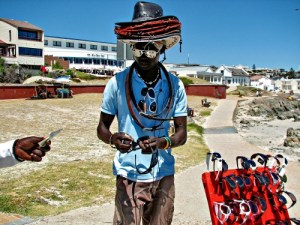
This guy wears many hats and makes a living selling his wares on the beach at Bloubergsands, which is close to the house that I bought (and am now trying to sell!) in Table View in Cape Town. Generally these traders are not South African. They often travel a very long way from neighboring countries such as Zimbabwe, Zambia and Mozambique. Many of them dodge border posts by hiding in the back of goods trucks. They all hope to make a new life in South Africa after escaping from oppressive regimes or poverty. Some of them are intelligent, articulate and well educated, as I remember this guy was.

What do you like most about this shot?
I like that it highlights the harshness of Cape Town light. The ozone layer is so thin there—I had to be far more careful of the sun than I do in the tropics. I also like the photo because at that time, I wasn’t into photography at all and had even less idea about what I was doing than I do now. I always have to be aware of what harsh light can do to my pics.

Okay, let’s move along to another photo that speaks to your South Africa experience.
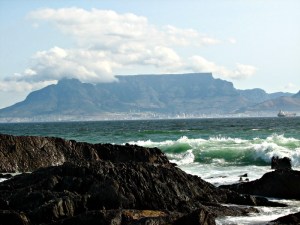
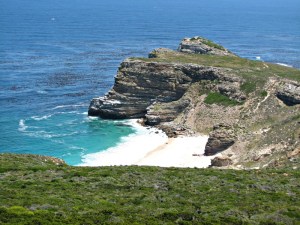
Can I have two shots, please? One of the Cape of Good Hope and the other of Table Mountain, with Cape Town below.
EndoftheEarth_JK

Photo credit: James King

TableMountain

Photo credit: James King

For me, these photos bring back memories of how wonderful the landscape is in that part of the world. So overwhelming, you really have to experience it in person. Just think, we are at the Cape of Good Hope, the bottom of Africa! And, despite how beautiful it looks, you don’t want to know how cold that water is. Naked you may survive ten minutes in there!

What particularly appeals to you about the Table Mountain photo?
I love how the clarity changes as soon as you hit the shore line below the mountain. It really is like that and not a cock-up on my part. It won’t win awards, but it is very personal so I love it.

How did you end up in Cape Town?
How long have you got? Things went a bit wrong for me in England after I got divorced, and then I met a guy who used to live in Durban and still had some business interests there. His wife had died the previous year so we were both single and hit it off. He had to go to South Africa again, so we decided to go and work together. That’s the “nutshell” version.

Semi-retirement in the Thai tropics

And now 20 years later you are in Thailand. How did that happen?
I’ll have to get the “nutshell” out again. In 2004, with some backing, I bought a jewelry wholesale business. Most of our silver is sourced and manufactured in Thailand, and I took on the responsibility of buying overseas. So I started traveling to Bangkok to meet suppliers and go to the Gems and Jewelry Fair in March and September. I met so many new people and also took a couple of holidays in Phuket before going back to Cape Town. Gradually I got a taste for SE Asia and, after a few years, decided to stay for four months getting to know more whilst still working remotely. That was it. Semi-retirement in the tropics beckoned and I was hooked!

I imagine it’s all been plain sailing since you moved to Thailand. Just kidding! I see from your blog you’ve had your struggles.
It is very difficult to précis my life over the last four years. I wrote my first book, the memoir MASK, to try and show the different sides to Thailand, its people and their culture. The book isn’t everybody’s cup of tea, but it was a cathartic exercise and helped me a lot. I should add that I didn’t include everything in it. The rest may come out later. But now I have a new lease of life and am so pleased I found blogging and photography because I believe the two go hand in glove. Writing, which has been a passion of mine for a long time, can embellish the photos and photos can enhance the writing, so in blogging you have the best of both worlds.

You say that photography gives you the ability to be able to capture something unique, which will never be seen again. What brought you to this realization?
I have always admired great photography while not having time to pursue it because I was working. Now, through my blog, I am learning how to incorporate photos into my posts. It’s fair to say my appreciation is growing as I hope will my knowledge. Writing is still my primary passion, but I now have another tool in my observation box. Although late in life for me, we are so lucky to be living in a technological age where we have the tools to enable us to express ourselves like never before. Sorry to take over the interviewing, but don’t you think it is so amazing?
Thailand2_JK

Photo credit: James King

But of course! Getting back to you and the photos that capture special memories: what do you choose next?
Actually, on my “to do” list is scanning some of the photos from my pre-digital collection, beginning in the 1970s, a number of which carry powerful memories and should help to create some rather interesting blog posts. In the meantime I have selected three of my more recent favorites for you.

The first one shows this guy and his wife who live in their little house at the end of Kata Noi, a beach on Koh Phuket. Every grain of sand is polished every day, they welcome everyone whether you want a drink or something to eat or just to say hello. They have a few beach loungers as well if you want to relax there. If you can have a more simple stress free existence, I’d like to know about it. On this particular day, I visited early one morning before the tourists woke up, and they made me feel most welcome.
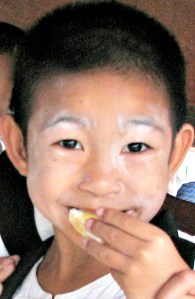
Thailand3_JK

Photo credit: James King

This little seven-year-old boy lives in my village in Chiang Mai. As you can imagine he is very naughty and the older children tease him unmercifully. So he comes to my house at weekends to annoy me and get chocolate and biscuits. He always wants me to take his pic, and on this occasion I caught him waiting for the school bus. He felt very proud.

Let’s not get technical

What kind of camera and lenses do you use?
Please don’t ask me anything technical. It says on the bottom “Canon PC1130” and on the front “Power Shot S2 IS”. One fixed lens 12x Optical Zoom with lots of numbers on it. It has lots of settings but I don’t know what they are for so I leave it on auto-pilot and hope for the best. Oh, and most importantly, the rechargeable batteries are held in with an elastic band. I haven’t got a clue whether it is any good or not: I just shoot and ask questions afterwards. But sometimes I do worry that my photos are not so good when I see many accomplished photographers blogs. I just console myself I must work extra hard on the subject matter.
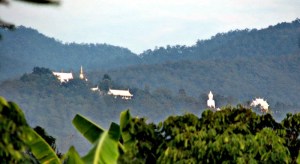
ThaiWhiteTemple_jk

Photo credit: James King

I think you have one more Thai photo?
Yes, this one: the white temple in the forest, which can be viewed from my village. This is very special because most of the time, although I know it is there, I can’t see it for mist or haze. Then one evening it was there and so was I with my camera!

Where have been your very favorite places to take photographs?
On safari in Kenya, Mykonos Island in Greece, and here in Chiang Mai where, even though I say it myself, I’ve managed to capture some beautiful morning and evening landscapes.
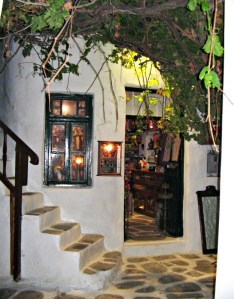
MykonosTown_JK

Photo credit: James King

Do you have a shot that’s your all-time favorite?
I pick this one, of a house in Mykonos Town, taken in 2005. I think it will always be one of my favorites.

A few parting shots

Do you feel reserved about taking photos of people, particularly when they are conscious that you are doing so?
It’s a very good question because I am always conscious that they may be shy and so I try and make a quick judgement call. But I do have an aversion to posed photos in the natural environment, so getting the balance right is important to me.

Do you ask permission before taking people’s photographs?
I just try and feel how they feel if they are aware I want to shoot them. I prefer to take them when they are unaware, then smile and say thanks. Otherwise I don’t get the naturalness I want. Look, I’m not experienced so I am not over-confident and I need all the advantages I can get. I find people will show you pretty quickly if they don’t want their picture taken.

But how do you get around problems of language?
Funnily enough I find not speaking the same language gives me an excuse not to ask. I have a smattering of Thai so the people here know I’m not a tourist, which definitely helps a bit.

Finally, do you have any advice for wannabe photographers who are traveling or living abroad?
In a nutshell (there I go again!), here are two pieces of advice:

  1. Never leave your camera at home or you may miss the shot of a lifetime out of nowhere. (Up until recently I have regretted not taking my camera on so many occasions. Now I hardly go anywhere without it, so much so that I often feel like a Japanese tourist. Believe it or not, most of my best shots were taken when I forgot to put in the SD card!)
  2. If, like me, you are not proficient, use other skills such as writing and storytelling or bizarre scenes, so that the photos don’t have to stand alone, to be judged naked.

* * *

Thank you, James! Readers, what do you make of James’s experiences and his photography advice? And do you have any questions for him on his photos and/or travels? Please leave them in the comments! (If you are a photographer and would like to be interviewed by James for this series, please let me know: ml@thedisplacednation.com.)

Once again, if you want to read more of James, be sure to check out his blog, Jamoroki.com. (Hmmm…I suspect there’s a story in that name!)

STAY TUNED for tomorrow’s post, an interview with November’s featured author, a novelist!

If you enjoyed this post, we invite you to register for The Displaced Dispatch, a round up of weekly posts from The Displaced Nation, with seasonal recipes, book giveaways and other extras. Register for The Displaced Dispatch by clicking here!

Related posts:

Main image at top of page: Camera lens from Morguefile; James King at the Khao Panong Rung Khmer Temple near Buriram, NE Thailand. All other images by James King.

LOCATION, LOCUTION: Janet Skeslien Charles, bringing Odessa to life through writing

2013-11 jsc visual

Images, clockwise from top: Moonlight in Odessa cover art; Janet Skeslien Charles author photo; JJ Marsh author photo

In this month’s “Location, Locution”, expat crime writer JJ Marsh interviews Janet Skeslien Charles, author of Moonlight in Odessa.

Janet, welcome! Tell us a little about yourself.
I grew up on the plains of Montana, in a town of two thousand people. I have always been a writer, with a journal for observations, prose, and poetry, though for me, writing is a very private activity.

At the University of Montana, I studied English, French, and Russian. I also spent a year on a university exchange at the University of Maryland. After graduation, I went to Odessa, Ukraine, for two years as a Soros Fellow.

I found a job in France and intended to stay for a year. On my first day in France, I met the man who became my husband, and I’ve been in Paris for over ten years.

Moonlight in Odessa is truly an international effort. The novel is set in Odessa, Ukraine. My agent is English. My editor’s assistant is Japanese-Danish, my copy editor is from New Zealand. I’m American. The book was written in France and typeset in Scotland. My first fan letter came from a Swede. Rights have been sold in Germany, Italy, the Netherlands, Brazil, Sweden, Iceland, Serbia, Romania, Taiwan, and Denmark.

When you’re writing, which comes first, story or location?
My novel was an ode to Odessa, a city I love. The story grew from the place.

How do you go about evoking the atmosphere of a place?
The way my characters speak, what they eat, how they dress, who they believe, how they love, and where they go are all very particular to the city of Odessa.

Which particular features create a sense of location? Landscape, culture, food?
For me, it is how characters react to situations. Odessa is the humor capital of the former Soviet Union, which means that my characters use humor as a shield to ward off painful situations. Odessans are capable of laughing at things that would make me bawl. Their mental toughness is impressive. So for me, the sense of city is the sense of self.

Also, trying to understand what is important to characters is important. My character Daria is defined by her ambitions, which exist because of her experiences in Odessa, a comsmopolitan sea port.

How well do you need to know the place before using it as a setting?
I was immersed in Odessa for two years and am still in touch with friends there, so it was easy for me to write about the city, but I love that Jeanette Winterson wrote The Passion without visiting Venice. It is one of my favorite books and so evocative of time and place. I don’t think you need to know a place, though it helps. I think imagination and observation are the most important tools when creative a setting.

Could you give a brief example from your work which you feel brings the location to life?
Daria, my main character, is at a job interview and must decide whether she is able to do the job and stay ahead of the lecherous boss:

Chess. There’s a reason the former Soviet Union has more world champion players than any other country. Chess is strategy, persistence, cunning, and the ability to look farther into the future than an opponent. The bloodlust of killing off others, one at a time. Chess is every man for himself. Building traps and avoiding them. It is mental toughness. And sacrifice. In Odessa, life is chess. Moves. Countermoves. Feigns. Knowing your adversary and staying one step ahead of him.

I took the job.

Which writers do you admire for the way they use location?
I absolutely love Venice in Jeanette Winterson’s The Passion. Michael Perry’s Population: 485 and Julia Alvarez’s How the Garcia Girls Lost Their Accents are also great examples of how place shapes the narrative. I have also read two unpublished novels by friends — one evokes North London, the other life in small-town France — and six months later, I am still savoring these two places I have never been.

The authors are Marie Houzelle, a French woman who writes in English, and Katya Jezzard-Puyraud, who wrote about North London so convincingly, I finished her novel feeling as if I had grown up there.

Next month’s Location, Locution guest  will be Jeet Thayil, the winner of the DSC Prize for South Asian Literature, shortlisted for the 2012 Man Booker Prize and the Hindu Literary Prize 2013.

 * * *

JJ Marsh grew up in Wales, Africa and the Middle East, where her curiosity for culture took root and triggered an urge to write. After living in Hong Kong, Nigeria, Dubai, Portugal and France, JJ finally settled in Switzerland, where she is currently halfway through her European crime series, set in compelling locations all over the continent and featuring detective inspector Beatrice Stubbs.

STAY TUNED for tomorrow’s post!

If you enjoyed this post, we invite you to register for The Displaced Dispatch, a round up of weekly posts from The Displaced Nation, with seasonal recipes, book giveaways and other extras. Register for The Displaced Dispatch by clicking here!

Related posts: