The Displaced Nation

A home for international creatives

Tag Archives: Writers we love

The John Steinbeck Encyclopedia of Road Trips

When we announced this month’s theme — road trips — some of you may have wondered if we’d gone around the bend. Zen and the Art of Motorcycle Maintenance — really? That’s a book for roadgeeks or — if you get into its philosophical meanderings — Roads Scholars, not for Displaced Nation types, most of whom equate travel with boarding an international flight.

Besides, road trips are for the young and restless — something you do when you’ve just graduated college.

But before you put the brakes on the road-trip idea again, let me convince you to take one more test drive. Only this time, instead of riding pillion on Robert Persig’s motorcycle, you’ll be seated in John Steinbeck’s camper station wagon next to his pet dog, Charley, on a 10,000-mile journey across America — from Long Island to Maine to Chicago to Seattle to California to Texas to New Orleans and back to New York City.

As the Nobel prize-winning writer puts his engine in gear, may I invite you to peruse our specially compiled John Steinbeck Encyclopedia of Road Trips.

A is for Autumn

John Steinbeck made a road trip across America in the autumn season and in the autumn of his life. He set out from his home in Sag Harbor, Long Island, shortly after Labor Day in 1960. He was 58 years old and not in the best of health. As Edward Weeks wrote of Steinbeck’s expedition in The Atlantic:

He set out with some misgiving, not sure his health would stand up to the 10,000-mile journey he envisioned; as he traveled, the years sloughed off him…

B is for Bestseller

Steinbeck wrote a book about his journey, Travels with Charley. It reached #1 on the New York Times bestseller list for non-fiction on October 21, 1962. To this day, the book retains a special place in the American imagination, despite attempts to challenge its categorization as “non-fiction” (see F).

C is for Charley

Meet Charley, Steinbeck’s middle-aged French poodle, one of the most civilized and attractive dogs in literature. He’s the genuine article, a real French poodle, having been born on the outskirts of Paris, where he also received his training. As his proud owner once said:

…while he knows a little Poodle-English, he responds quickly only to commands in French. Otherwise he has to translate, and that slows him down.

D is for Dog

For Steinbeck, a dog is an ideal companion on the open road as well as being an effective ice breaker:

A dog is a bond between strangers. Many conversations en route began with “What degree of dog is that?”

E is for Environment

Steinbeck was extremely attuned to the intimate connection between people’s lives and the rhythms of nature — weather, geography, the cycles of the seasons. But while nature animates his picaresque tale of his travels with his dog, one of his key observations was the the high price Americans would eventually pay for lives filled with ease and convenience. He felt they were trashing their environment for the sake of material prosperity. (A tad prescient, might we say?)

F is for Fictions

Journalist Bill Steigerwald set out to retrace Steinbeck’s steps on the 50th anniversary of his road trip. He concluded that not only had the Nobel laureate invented characters, he’d also embellished the hardships of his cross-country journey with Charley. In other words, this brilliant author’s much-loved book is loaded with creative fictions. (Wait, I thought all travel writers used some creative license — is there anything wrong with a novelist-turned-travel-writer using some?)

G is for Giant Redwoods

After sorting out his flat tire in Oregon (see O), Steinbeck visited the giant redwoods and ancient Sequoias and found them as awe inspiring as ever:

The vainest, most slap-happy and irreverent of men, in the presence of redwoods, goes under a spell of wonder and respect.

Steinbeck was further impressed when his dog, Charley, refused to urinate on the trees…

H is for Hurricane

The best-laid schemes of mice and men go oft awry, and Steinbeck had to delay the start of his trip slightly due to Hurricane Donna, which made a direct hit on Long Island. (Still, it could have been worse. It could have been Hurricane Irene!)

I is for International

While he never became an expat, Steinbeck moved to New York City and took quite a few international trips, mostly to Europe. He hoped that his road trip would enable him to reconnect with both the people and the landscape of his native land. He also wanted to see his birthplace — Salinas, California — one last time.

J is for Jamming

Steinbeck’s journey concluded with jamming Rocinante (see R) across a busy New York City street, during a failed attempt at making a U-turn. He reports having said to the traffic policeman:

Officer, I’ve driven this thing all over the country — mountains, plains, deserts. And now I’m back in my own town, where I live — and I’m lost.

K is for Knight-errant

A mainstay of medieval romance literature, the knight-errant wanders the land in search of adventures to prove himself a worthy warrior. Don Quixote is a famous example (see Q). Likewise, Steinbeck hoped to recapture his youth, the spirit of a knight-errant, through his travels. (Makes sense if you’re middle aged and your health is rapidly deteriorating — see P.)

L is for Language (of Road Signs)

Steinbeck closely observes the language of road signs during his trip across country. In New York State, he notes that the road signs are commands: “Stop! No turning!” But in Ohio, the language is gentler, with friendly advice rather than curt demands.

M is for Maine

Steinbeck reports that he learned not to ask for directions in Maine because locals don’t like tourists and tend to give them the wrong directions — another example of regional differences (see L).

N is for North Dakota

Upon arriving at Fargo, North Dakota, Steinbeck declares that the mentality of the American nation has grown “bland.” He fell head over heels in love with Montana, however. NOTE: Steinbeck’s account of meeting an itinerant Shakespearean actor outside the town of Alice, North Dakota, is disputed by the journalist Bill Steigerwald (see F).

O is for Oregon

Having his first flat tire on a remote back road in Oregon inspired Steinbeck to write a send-up of similarly desperate scenes in his most famous novel, The Grapes of Wrath:

It was obvious that the other tire might go at any minute, and it was Sunday and it was raining and it was Oregon.

P is for Poignancy

When Steinbeck set out on his road trip, he knew he could have died at any point along the way because of his heart condition. This knowledge suffuses Travels with Charley with a certain poignancy, and perhaps explains why it’s such a beloved book.

Q is for Quixote

As one might expect of a man who won a Nobel Prize in Literature, Steinbeck had a literary hero in mind when he set out on his road trip: Don Quixote. Like the ingenious gentleman of La Mancha, it seems that Steinbeck fancied himself a knight-errant in search of adventure (see K). He even named his camper truck for Quixote‘s steed (see R).

R is for Rocinante

As the narrator of Don Quixote explains, its hero feels obliged to find the right name for his horse:

Four days were spent in thinking what name to give it, because (as he said to himself) it was not right that a horse belonging to a knight so famous, and one with such merits of his own, should be without some distinctive name…

At last, Don Quixote calls the skinny steed Rocinante. In a nod to this fictional knight-errant (see K), Steinbeck christened the vehicle for his journey — a green GMC truck, which he’d had custom-fitted with a camper — Rocinante. He even painted the name across the side of the truck in 16th-century Spanish script.

S is for Salinas

Steinbeck was born in Salinas, California. He wrote his first stories about the Salinas Valley and was determined to see his hometown one last time before he died. Visiting a bar from his youth, he lamented the loss of several regulars as well as quite a few of his childhood chums, wondering if perhaps Thomas Wolfe was right (see Y).

T is for Texas

Steinbeck remarked of Texas that it was the kind of state that “people either passionately love or passionately hate.” He went on:

Texas is a state of mind. Texas is an obsession. Above all, Texas is a nation in every sense of the word. … A Texan outside of Texas is a foreigner.

Texas was also where Charley (see C) became ill for a few days and stayed in a veterinary hospital. NOTE: From Texas onwards, Steinbeck’s travel writing gives way to social commentary, culminating in the account of a school integration crisis he witnesses firsthand in New Orleans.

U is for U.S. Route 66

In mid-November of 1960, Steinbeck crossed the Mojave Desert and picked up the historical U.S. Route 66 at Barstow, California. He and Charley then drove 1,300 miles to arrive in time for a Texas-style Thanksgiving on a cattle ranch near Amarillo. U.S. Route 66, known colloquially as the “Main Street of America” or the “Mother Road” was a major path for those who migrated west. In Steinbeck’s classic novel The Grapes of Wrath, the poor family of sharecroppers, the Joads, make their way west from Oklahoma to California on U.S. Route 66.

V is for Viking Press

Travels with Charley was published by the Viking Press in mid-summer of 1962, several months before Steinbeck was awarded the Nobel Prize in Literature.

W is for Wanderlust

Steinbeck begins Travels with Charley by describing his wanderlust, saying he’s had a life-long impulse to travel and explore the world.

X is for Xena the Warrior Princess

This entry has nothing to do with John Steinbeck, but I have included it in case there are any women travelers who are having trouble identifying with the adventures of a rugged, broad-shouldered, six-foot-tall writer, and his desire to be seen as a knight-errant (see K). Xena the Warrior Princess reminds me of the title of Debbie Anderson’s best-selling guide for women who travel the open road: Simple Rules for…The Road-Warrior Princess.

Y is for “You can’t go home again”

When Steinbeck reached his birthplace of Salinas, he discovered the truth of Thomas Wolfe’s words “You can’t go home again.” Saying good-bye to his hometown for the last time was a bittersweet experience:

I printed once more on my eyes, south, west, and north, and then we hurried away from the permanent and changeless past where my mother is always shooting a wildcat and my father is always burning his name with his love.

Z is for Zzzzz (under the stars)

Steinbeck reports that camping out with Charley in the American outback — where they enjoyed lots of zzzzz under the stars — was one of the highlights of their trip (though the veracity of that experience is now disputed — see F). But, despite the magnificent setting, both he and Charley often suffered moments of crushing loneliness. Ultimately, man and dog concurred that however much they relished their adventure, home is where the heart is.

So…are you inspired? Can you now see yourself motoring across country in the autumn and/or autumn of your life? And how about attempting a best-selling travelogue? (Or am I still driving you bonkers?!)

STAY TUNED for tomorrow’s post, a Displaced Q about none else than road trips(!).

If you enjoyed this post, we invite you to register for The Displaced Dispatch, a round up of weekly posts from The Displaced Nation. Includes seasonal recipes and book giveaways. Register for The Displaced Dispatch by clicking here!

Related posts:

Image: MorgueFile
Family visits — 3 universally acknowledged truths by Jane Austen

Summer is the time when displaced people often visit or are visited by their families, and because of the distances involved, this usually means more than just popping round for a quick cup of tea.

As easy air travel is a fairly recent innovation, it’s tempting to think of these lengthy visits as recent also. They’re not, of course. A hundred-mile trip by horse and carriage two hundred years ago to see family was as tiring as a flight from Heathrow to Sydney now, and visits would last several weeks.

It’s only the mode of transport that has changed, though.

Take it from Jane herself.

1. Eliza Bennet Syndrome

It is a truth universally acknowledged, that a displaced person in possession of a new abode in slightly exotic location, must be in want of visitors from home.

I feel sorry for Eliza Bennet. Despite marrying the richest man in Derbyshire and living in a house only slightly smaller than that county, she would always bear the burden of her awful relatives.

Even Pemberley wouldn’t have been big enough when they came to visit — and visit they surely would, as Jane Austen’s characters spent much time in the company of relatives scattered around England.

Evidently, it was dangerous to do otherwise – a visit with a mere friend to that iniquitous den, Brighton, resulted in social and financial ruin for Lydia Bennet when she eloped with Mr Wickham.

A decorous horse-and-carriage trip through Derbyshire with a respectable aunt and uncle, however, rewarded her sister Eliza with a good-looking (if emotionally constipated) husband, and her share of his ten thousand a year.

The moral, gentle reader: If you do not wish to be blamed for the consequences of young visitors searching for a good time with unsuitable handsome army officers, ensure that your foreign abode is in a quiet backwater where the only entertainment is weekly bingo in the church hall. Don’t live near a British bar in Ibiza. If you can find a house big enough so the raucous tones of your visiting mother cannot be heard by you or your neighbors, so much the better.

2. Mr Woodhouse Syndrome

It is a truth universally acknowledged, that some people will never visit on your own territory, and when you visit theirs, it is never for long enough to keep them happy.

Some people will never visit you, believing flights only travel in one direction, or that you live somewhere foreign and unhealthy. It is, therefore, your duty to visit them, since you were thoughtless enough to move away in the first place.

Emma Woodhouse’s father fell into this category of people. Although his married daughter, Isabella, lived only sixteen miles away in London, he disliked visiting her because

“…the truth is, that in London it is always a sickly season. Nobody is healthy in London, nobody can be. It is a dreadful thing to have you forced to live there! so far off!–and the air so bad!”

Instead, to see her father, poor Isabella had to drag her entourage of five children to Highbury, where Mr Woodhouse would offer her a nice welcoming bowl of gruel.

She had nothing to wish…but that the days did not pass so swiftly. It was a delightful visit;–perfect, in being much too short.

Too short for her father, that is. Not Isabella. She was just being polite. Take it from me.

The moral, gentle reader: Bring your own bottle. You’re going to need it, especially if all your folks have to offer is gruel for supper.

3. Fanny Price Syndrome

It is a truth universally acknowledged, that the longer you have lived away, the more foreign your home country will feel, and at some point you will ponder the issue of whether it is possible to go home again.

Fanny Price, protagonist of Mansfield Park, and a lesser-known heroine than Eliza Bennet and Emma Woodhouse, understood this better than most.

At the age of nine, Fanny was booted from her home in Portsmouth to live at Mansfield Park with her advantageously-married aunt, to make room for yet another baby in her own family. Desperately homesick and missing her beloved brother William, Fanny is the Cinderella of her adopted family, mocked by her society cousins, and used as whipping-girl and general dogsbody by her two aunts. It wasn’t quite Charles Dickens territory — Fanny was given proper food — but it wasn’t far off.

She did, however, have a raging crush on her cousin, Edmund. Enough said.

Regardless of Fanny’s feelings for her cousin, one might assume that she would one day be glad to leave her aunt’s house and visit her family in Portsmouth. When she eventually did, it was many years after her first arrival, and as her uncle’s punishment for refusing to marry Henry Crawford, an upper-class philanderer. The implication was that, just as Fanny had been raised in society by her uncle, so could she once again descend to her miserable roots if her uncle chose.

While Fanny’s visit in no way persuaded her to marry that cad, Henry, she did realize that her spiritual home was no longer with her parents and siblings. Her parents, whom presumably she had loved at one time, and who had never mistreated her, were a huge disappointment to her. She perceived her mother as

a partial, ill-judging parent, a dawdle, a slattern.

So, conveniently forgetting the unkindness of her Aunt Norris and her cousins, and the indolent neglect of her Aunt Bertram,

[Fanny] could think of nothing but Mansfield, its beloved inmates, its happy ways. Every thing where she was was in full contrast to it. The elegance, propriety, regularity, harmony — and perhaps, above all, the peace and tranquility of Mansfield, were brought to her remembrance every hour.

The moral, gentle reader: Are you sure you can never go home — or are you, in fact, suffering from Stockholm Syndrome?

If you enjoyed this post, we invite you to subscribe for email delivery of The Displaced Dispatch, a round up of the week’s posts from The Displaced Nation. Sign up for The Displaced Dispatch by clicking here!

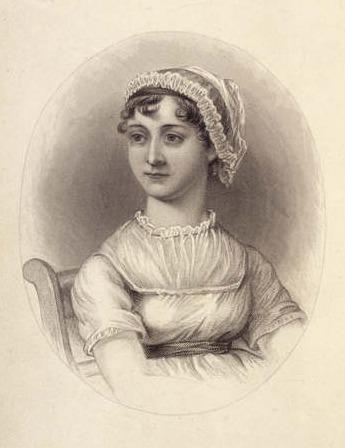
Img: 1869 engraving of Jane Austen, based on a sketch by her sister, Cassandra Austen (WikiCommons)

RETURN TRIP: Even in Paris, expats can’t escape former lives: A celebration of displaced novelist Corine Gantz

As summer draws to a close, The Displaced Nation is reissuing some posts that, for one reason or another, have enchanted our readers. Enjoy these “return trips”!
This past spring, The Displaced Nation interviewed Corine Gantz, a popular expat blogger, about her newly published novel, Hidden in Paris. The action centers on a group of expat Americans trying to start their lives afresh in the City of Light. At that time, TDN was exploring the theme of Gothic Tales. We wanted Mme Gantz to tell us more about the premise at the heart of her book — the idea that people travel to other lands to escape their former lives. How does it usually play out: as a dream come true or as a recurring nightmare?

The Displaced Nation has been examining the “gothic” side of expat life over the past couple of weeks. Thus it may seem odd that today we have chosen to celebrate a book that takes place in La Ville-Lumière (“The City of Light” or “The Illuminated City”) by an author who lives near the City of Angels.

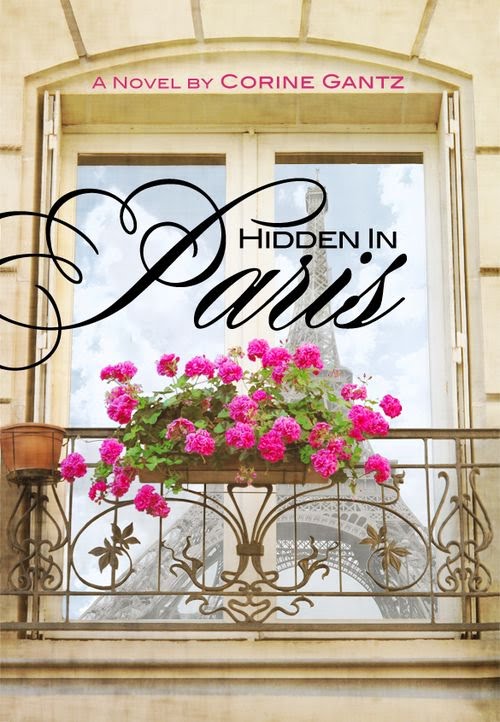
But looks can be deceiving — and the cover of Corine Gantz’s debut novel, Hidden in Paris, is quite a cunning ruse. It shows a Parisian balcony with French doors reflecting the Eiffel Tower, and a flower box bursting with hot-pink geraniums. What could possible be amiss within such a picture-perfect setting, you may wonder? Plenty, it turns out.

But before we get into that, let’s begin our fête in honor of Mme Gantz and her book. To put ourselves in the proper mood, we have prepared a special cocktail, a French 75. We’ve also gone all out with our canapés. There’s a savory gougère, brie en croûte, duck rillettes, chilled asparagus with mustard sauce, a Puy lentil salad — and, in honor of Mme Gantz, her family favorite, taramasalata on toast (see her father’s recipe below).

Okay, seats, please! Our honored guest has agreed to kick off the festivities by answering a few questions from The Displaced Nation team. After that, the floor is yours, dear reader.

Hidden in Paris coverYour new novel, Hidden in Paris, may not tell a gothic tale per se, but we think it relates to our theme because it centers on three women who are running away from their lives. Is that a fair assessment?
People who say they love to be scared amuse me. They have a fascination with horror flicks, they read vampire books, they ride roller coasters. Yet they might be the same people who walk great circles around a pile of bills or make every effort to avoid a difficult phone call. What can be scarier than real life?

I think there is a limit to what we can handle, and at some point the tendency is to want to run way, literally or figuratively. In Hidden in Paris three strangers — all American women — have reached the point of terminal discomfort, when tackling real issues feels more terrifying than running away abroad.

Lola is running away from her husband, Althea from an eating disorder, and Annie, although she pretends to be the most high functioning member of the group, is hiding the biggest secret of all. (Just to add some spice, there is also a male character, Lucas, who is hiding his love for Annie.)

People often fantasize that “elsewhere” — particularly Paris because of the attached notion of romance — will solve their problems, or at least make the problems go away for a while. Well, we long-term expats know better. Moving to another country brings great logistical changes to one’s life, which can distract you into thinking you’ve left your pathos behind, when, in fact, you’ve brought it along in your suitcase. Wherever you go, you bring your own personal gothic tale with you.

In the case of these three female characters, the disruptions to their routines, along with new encounters, bring them to the tipping point toward change.

The thing is, as in real life, my characters fight the change they need kicking and screaming, which makes for fun story telling.

Food is another obsession of ours at The Displaced Nation. We detect from reading an excerpt from Hidden in Paris that it also plays a big role in your book.
You detect correctly. For me, writing a novel is a barely disguised way for me to talk about food — the novel being a vehicle for food just as grilled toast is a vehicle for foie gras.

I grew up in France on my mother’s terrific cooking. But she is the type of cook who wants no help in the kitchen, so at age 23 I arrived in the United States never having cooked an egg. I was terribly homesick and depressed and needed to “taste home” again — so had no choice but to teach myself how to cook. The saving grace was that I had a copy of a recipe book filled with my mother’s recipes, so I proceeded to recreate the food, and jolly myself out of my depression. Cooking gave my life a purpose: it became my creative outlet.

I think the preparation of food can be extremely healing, meaningful and joyful. Food is, after all, the soul and spirit of a home. I enjoy cooking as much as I enjoy eating, and when I’m not doing one or the other I’m telling stories where food turns out to be one of the principal characters.

You are a Française who has been “displaced” to the Los Angeles area for a couple of decades, where you live with your American husband and two sons. Does your novel echo that experience?
Had I landed on an alien planet I doubt I would have been any more confused and out of place. I understood none of the codes, none of the cultural references, of Los Angeles. I could not understand people or express myself — and I resented them for that.

Writing sprouted from this: the frustrated need for self-expression and communication. Like my protagonist, Annie, I had to figure out how to function, and I would be lying to say I functioned well. Also like Annie, I resisted my country of adoption for years. I did not have both feet in it. A part of me felt in limbo: I was standing by for my eventual return to my home country.

Twenty years later I don’t even feel French anymore, but no one here lets me forget I’m not American either. Americans seem fascinated with my Frenchness, as though it defines me. For example, it’s often about how I say things rather than what I say. Yesterday I was saying to a friend: “On the envelope my husband gave me for mother’s day there was a…” She interrupted and said: “Could you repeat that?” I repeated and she fell into peals of laughter: “I just love how you said the word ‘envelope’!”

In Hidden in Paris, I wanted to transpose my experience and reverse it. I wanted to bring American women to France and see how well they coped with that set of codes and cultural idiosyncrasies. That’s only fair, don’t you think? I’m a little miffed to report that they are more adaptable than I was.

You have a popular blog, Hidden in France, where you’ve been entertaining Francophiles and others with stories of the writing life, décor, food, family, travel and all things French. In fact, The Displaced Nation has featured one of your posts — about the time you fell into your swimming pool when the first day of spring brought heavy rains to the LA area. Tell us, has your blog had an influence on your writing? Also, why have you chosen the trope “hidden in”?
The blog has everything to do with my writing. Before the blog, I was a closet writer, ashamed that my English was too imperfect. The blog gave me a sense of just how forgiving and supportive readers were. I have readers now, and I have fans! Had I based my self-worth as a writer on agent rejections, I would have changed my hobby to fly-fishing. Readers are what make someone a writer.

The word “hidden” is significant only in the sense that I was hiding for years behind an alias as a blogger, and I just recently came out as writer for the world to see (speaking of fear…).

When it came time to settle on a title for the book, it felt natural to give it the same title as the blog — but I decided against it because there was already a memoir by that name. So Hidden in France became Hidden in Paris.

Finally, The Displaced Nation supports a fictional character, Libby, who is about to move from London to Boston with her husband. Do you have any advice for her?
Well, how about if I let my own fictional character, Annie — who moved from Boston to Paris to follow her own husband twelve years ago — speak to Libby directly:

Don’t do it, Libby! Kidding! Well I would suggest you have more babies, some siblings for your son, Jack, and fast. They will keep you busy and busy is the name of the game: no time to think! And if you decide against having more babies, then take on a hobby (such as cooking and eating) to keep your sanity without demanding that your husband become your everything for companionship, friendship and intellectual stimulation.

Don’t be like me in other words. Don’t forget that the man has a job and he is tired at the end of the day and nobody needs a needy wife. (Sorry for the harsh words, Libby, but this is the truth.)

You could also take a run-down house and remodel it. I did. You will have no skin left on your fingers but lifting bags of concrete makes for pretty shapely biceps. The remodeling might bring you to financial ruin but if that becomes the case, you will always have eating, which you can become very good at.

Without further ado, let’s pour the champagne for a toast to Corine Gantz. Tchin-tchin! And now, patient reader, it’s your turn. Questions, please, for this très gentille debut novelist… If you want to check out her book a little more, go to her author’s site, and to buy it, go to her Amazon page.

Taramasalata on toast — Corine Gantz’s family recipe
You will need:

  • one packet of smoked cod roe (seriously, can you even find this in the US?)
  • 8 tablespoons safflower oil
  • 2 tablespoons lemon juice.

Mix fish roe and lemon juice, then slowly beat with a fork and add the oil as you would do to make mayonnaise.Spread thinly on toasts and serve with very good champagne, et voilà! Très festif.

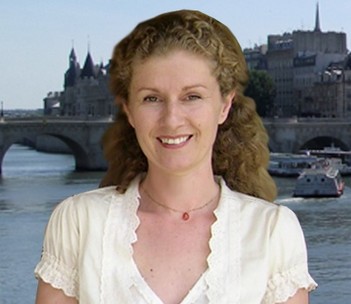
Images: Author’s photo; Hidden in Paris cover, artwork by Robin Pickens.

If you enjoyed this post, we invite you to subscribe to The Displaced Dispatch, a weekly round up of posts from The Displaced Nation, plus some extras such as seasonal recipes and occasional book giveaways. Sign up for The Displaced Dispatch by clicking here!

Related posts:

RETURN TRIP: 5 lessons Wonderland taught me about the expat life, by Lewis Carroll’s Alice

August is finally drawing to a close — we hope you managed to have an enchanting time of it. Here is one more in our series of “return trips” to posts that, for one reason or another, enchanted our readers. Enjoy!
All three members of The Displaced Nation team have found Alice, of Wonderland and Through the Looking-Glass renown, a source of inspiration on our travels — seeing her as a kind of ultimate expat. Thus we decided to dedicate the month of June to Lewis Carroll’s “little heroine.” Kate Allison launched a series of posts on our Alice in Wonderland theme with 5 “lessons” Alice had allegedly learned from her adventures. It remains one of our most popular posts to date.

To kick off our Alice in Wonderland theme, we asked Alice if she had any advice for today’s Displaced Person:

*

Indeed I do. It might be many years since I fell down the rabbit hole, but human nature hasn’t changed. This is a little of what I learned:

1. Keep the golden key in your pocket at all times, and make a note of the emergency exits.

In another moment down went Alice after [the White Rabbit], never once considering how in the world she was to get out again.

My first mistake was to plunge down the rabbit-hole without planning ahead. The adventurous life is all very well, but it’s good to have a bolt-hole, as well as a rabbit-hole, when you need to escape to the old and familiar.

My second mistake was to leave the key on the glass table before drinking from the bottle marked “Drink Me.” In your vernacular, that’s like buying a return ticket home for this evening, then discovering your passport expired six months ago. Be prepared for the unexpected, the peculiar, and the almost impossible.

2. No matter how hard you try contrariwise, at some point you will offend someone.

Evidently Humpty Dumpty was very angry… “It is a—MOST—PROVOKING—thing,” he said at last, “when a person doesn’t know a cravat from a belt!”

Oh dear! If only I had a shilling for every time I inadvertently offended one of the creatures in Wonderland and through the Looking Glass! Not knowing Humpty Dumpty’s neck-wear from midriff-wear; my compulsive mentioning of cats and dogs in the Mouse’s presence without considering that he and I might have a different perspective of these animals…the list went on and on.

In the end, I think the Red Queen’s advice was the best:

“Always speak the truth—think before you speak—and write it down afterwards.”

But still, I couldn’t help thinking:

“I wish the creatures wouldn’t be so easily offended!”

3. “The rule is, jam to-morrow and jam yesterday — but never jam to-day.” Different country, different rules.

The Queen of Hearts was the worst example of this:

“No, no!” said the Queen. “Sentence first—verdict afterwards.”

I suggest if you are ever in this situation yourself, you employ more tact than I did. “Stuff and nonsense!” I said. “The idea of having the sentence first!”

Perhaps today a quick telephone call to your country’s embassy might be better.

Better still, acquaint yourself with the country’s rules before you go jumping on aeroplanes or down rabbit holes.

4. Go to a party or a Caucus-Race — don’t drown in your own tears.

“I am so VERY tired of being all alone here!”

The Caucus-Race proved to me that I could make friends with the most unlikely companions.

After a few minutes it seemed natural to Alice to find herself talking familiarly with them, as if she had known them all her life.

If you feel alone in your new environment, seek out company, even if it’s not the kind of company you’re used to. You might find your life is richer for it.

5. And finally: Keep a note of your name in your memorandum-book.

“Who are YOU?” said the Caterpillar.

Alice replied, rather shyly, “I—I hardly know, sir, just at present—at least I know who I WAS when I got up this morning, but I think I must have been changed several times since then.”

I spent a great deal of time in both countries wondering who I was now. Was I my little friend Ada, or Mabel, perhaps?

Tweedledum even suggested I wasn’t really there at all.

“You’re only one of the things in his dream. You know very well you’re not real.”

“I AM real!” said Alice and began to cry.

Take a tip from me and write your name in a memorandum-book. Then keep a journal.

That way you will always remember who you were on any particular day.

And one day, people might read about you as they do about me.

*

Thank you, Alice!


If you enjoyed this post, we invite you to subscribe to The Displaced Dispatch, a weekly round up of posts from The Displaced Nation, plus some extras such as seasonal recipes and occasional book giveaways. Sign up for The Displaced Dispatch by clicking here!

Related posts:

6 celebrated women travel writers with the power to enchant you

Any wannabe expat/travel writer would do well to consult with Kristin Bair O’Keeffe, herself a novelist and former expat, before beginning their Great Works. Kristin offers a wealth of writing tips on Writerhead, a blog that she launched on April 1 of this year (which, coincidentally, was the same day we launched The Displaced Nation).

Of the helpful hints Kristin has offered thus far, I have many favorites, but if I had to pick one, it would be her post entitled “Write Wee.” In her breathlessly inimitable style, Kristin assures us that producing a multi-volume series on one’s overseas adventures is not the way to go:

Instead find a nugget. A moment. A single object. One exchange. One epiphany. One cultural revelation.

Find one story and tell it.

Just it.

The only thing I would add is that in general, women are better at extracting such nuggets than men.

Actually, what got me started in thinking about the difference in travel writing styles of the sexes was a post I wrote a couple of weeks ago on Edwardian novelist Elizabeth von Arnim, who penned the much-loved work, The Enchanted April, about four women who escape to a medieval castle in Italy for a much-needed break from their routines.

For me, von Arnim typifies one of characteristics that makes women’s travel writing so special (no doubt there are many more!). As she wandered far and wide across Europe and America, she paid extremely careful attention to the details of her surroundings.

A forerunner of what today we’d call a nature freak, she could get lost in telling the story of watching a “nightingale on a hornbeam, in loud raptures at the coming of the sun…” — I quote from her largely autobiographical novel The Solitary Summer, about a woman, also called Elizabeth, who is anything but solitary. She has a husband, to whom she refers as the Man of Wrath, small child and household to care for.

Perhaps such descriptive powers are born of necessity. Women have little choice but to make the most of spinning tales out of the moments they snatch from lives that are otherwise spent ministering to the needs of others — even when they’re technically on vacation.

Having combed through the pages of The Virago Book of Women Travellers (ed. Mary Morris with Larry O’Connor), I think I may be on to something. I discovered any number of women travel writers with the power to enchant their readers by capturing in their works the moments, exchanges, and personal ephiphanies their wanderings have yielded.

Here are six whose “nuggets” continue to gleam for us modern-day nomads:

Frances Trollope (1780-1863)

Who was she? Mother of Anthony and like her son, a prolific writer of novels (34 in total!).
Key work: Domestic Manners of the Americans, a travel book that made her name, about the four years she spent pursuing opportunities in the United States after her family suffered financial setbacks.

from DOMESTIC MANNERS OF THE AMERICANS
At length my wish of obtaining a house in the country was gratified….But even this was not enough to satisfy us when we first escaped from the city, and we determined upon having a day’s enjoyment of the wildest forest scenery we could find. So we packed up books, albums, pencils, and sandwiches, and, despite a burning sun, dragged up a hill so steep that we sometimes fancied we could rest ourselves against it by only leaning forward a little. In panting and in groaning we reached the top, hoping to be refreshed by the purest breath of heaven; but to have tasted the breath of heaven we must have climbed yet farther, even to the tops of the trees themselves, for we soon found that the air beneath them stirred not, nor ever had stirred, as it seemed to us, since first it settled there, so heavily did it weigh upon our lungs.

Still we were determined to enjoy ourselves, and forward we went, crunching knee deep through aboriginal leaves, hoping to reach some spot less perfectly air-tight than our landing place. Wearied with the fruitless search, we decided on reposing awhile on the trunk of a fallen tree; being all comfortably exhausted, the idea of sitting down on this tempting log was conceived and executed simultaneously by the whole party, and the whole party sunk together through its treacherous surface into a mass of rotten rubbish that had formed part of the pith and marrow of the eternal forest a hundred years before.

We were by no means the only sufferers from the accident; frogs, lizards, locusts, katydids, beetles, and hornets, had the whole of their various tenements disturbed, and testified their displeasure very naturally by annoying us as much as possible in return; we were bit, we were stung, we were scratched; and when, at last, we succeeded in raining ourselves from the venerable ruin, we presented as woeful a spectacle as can well be imagined. We shook our (not ambrosial) garments, and panting with heat, stings, and vexation, moved a few paces from the scene of our misfortune, and again sat down; but this time it was upon the solid earth.

We had no sooner begun to “chew the cud” of the bitter fancy that had beguiled us to these mountain solitudes than a new annoyance assailed us. A cloud of mosquitoes gathered round, and while each sharp proboscis sucked our blood, they teased us with their humming chorus, till we lost all patience, and started again on our feet, pretty firmly resolved never to try the al fresco joys of an American forest again.

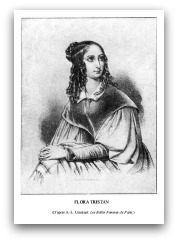
Flora Tristan (1803-1844)

Who was she? French reformer who campaigned for workers’ and women’s rights; grandmother to artist Paul Gauguin.
Key work: Peregrinations of a Pariah, about a trip she made alone to Peru to stake her claim to her family’s fortune.

from PEREGRINATIONS OF A PARIAH
Mr. Smith took me to the house of his correspondents, and here once more I found all of the luxury and comfort characteristic of the English. The servants were English, and like their masters they were dressed just as they would have been in England. The house had a verandah, as do all the houses in Lima, and this is very convenient in hot countries, as it gives shelter from the sun and enables one to walk all round the house to take the air. This particular verandah was embellished with pretty English blinds. I stayed there for some time and could survey in comfort the only long wide street which constitutes the whole of Callao. It was a Sunday, and sailors in holiday attire were strolling about; I saw groups of Englishmen, Americans, Frenchmen, Dutchmen, Germans — in short, a mixture from nearly every nation — and I heard snatches from every tongue. As I listened to these sailors, I began to understand the charm they find in their adventurous life… When I tired of looking at the street I cast a glance into the large drawing-room whose windows overlooked the verandah, where five or six immaculately dressed Englishmen, their handsome faces calm and impassive, were drinking grog and smoking excellent Havana cigars as they swung gently to and fro from hammocks from Guayaquil suspended from the ceiling.

Mary Anne Barker (1831 – 1911)

Who was she? Jamaica-born, England-educated author and journalist who with her second husband tried to run a sheep station in New Zealand (they later traveled to Mauritius, Western Australia, Barbados and Trinidad for his colonial appointments).
Key works: Station Life in New Zealand (1870); First Lessons in the Principles of Cooking (1874); A Year’s Housekeeping in South Africa (1880).

from STATION LIFE IN NEW ZEALAND
All this beauty would have been almost too oppressive, it was on such a large scale and the solitude was so intense, if it had not been for the pretty little touch of life and movement afforded by the hut belonging to the station we were bound for. It was only a rough building, made of slabs of wood with cob between; but there was a bit of fence and the corner of a garden and an English grass paddock, which looked about as big as a pocket-handkerchief from where we stood. A horse or two and a couple of cows were tethered near, and we could hear the bark of a dog. A more complete hermitage could not have been desired by Diogenes himself, and for the first time we felt ashamed of invading the recluse in such a formidable body, but ungrudging, open-handed hospitality is so universal in New Zealand that we took courage and began our descent. … We put the least scratched and most respectable-looking member of the party in the van, and followed him, amid much barking of dogs, to the low porch; and after hearing a cheery “Come in,” answering our modest tap at the door, we trooped in one after the other till the little room was quite full. I never saw such astonishment on any human face as on that of the poor master of the house, who could not stir from his chair by the fire, on account of a bad wound in his leg from an axe. There he sat quite helpless, a moment ago so solitary, and now finding himself the centre of a large, odd-looking crowd of strangers. He was a middle-aged Scotchman, probably of not a very elevated position in life, and had passed many years in this lonely spot, and yet he showed himself quite equal to the occasion.

After that first uncontrollable look of amazement he did the honours of his poor hut with the utmost courtesy… His only apology was for being unable to rise form his arm-chair (made out of half a barrel and an old flour-sack by the way); he made us perfectly welcome, took it for granted we were hungry — hunger is a very mild world to express my appetite, for one… I never felt more awkward in my life than when I stooped to enter that low doorway, and yet in a minute I was quite at my ease again; but of the whole party I was naturally the one who puzzled him the most. In the first place, I strongly suspect that he had doubts as to my being anything but a boy in a rather long kilt; and when this point was explained, he could not understand what a “female,” as he also called me, was doing on a rough hunting expedition. He particularly inquired more than once if I had come of my own free will, and could not understand what pleasure I found in walking so far.

Vivienne de Watteville (1900 – 1957)

Who was she? British writer and adventurer who accompanied her father on a safari in Kenya. After he was killed by a lion, she finished the trip on her own.
Key works: Out in the Blue (1927); Speak to the Earth: Wanderings and Reflections among Elephants and Mountains (1937).

from SPEAK TO THE EARTH
Finally, it was the boys themselves who pointed to the summit and said it was not very far.

Enviously, I admired the way they could climb. As for me, … I was badly spent; my knees trembled as I panted up through the reeling boulders. …

At last I climbed above the forest zone, passing beneath the last outposts — stunted trees ragged with beard-moss in whose chequered shade lay a carpet of tiny peas … whose blossoms were a lovely transparent blue. Above them flitted miniature butterflies, as though the petals themselves had taken wing. …

The top, when I at last reached it, was, after all, not really the top, and beyond a dipping saddle another granite head still frowned down upon me.

But meanwhile, below me the south side disclosed a grassing depression girt about by the two summits and bare granite screes; and amid that desolation the grass stretched so green and rural that you had looked there for shepherds with their flocks. Instead of which, on the far side of a quaking bog, I saw — grey among the grey slabs — two rhino.

… I drew to within forty yards of the rhino, yet they still looked like a couple of grey boulders as they browsed off an isolated patch of sere grass. …

The wind had risen to a tearing gale, and nosing straight into it I approached the rhino somewhat downhill. There was no chance of this steady blow jumping around to betray me, and it was strong enough to carry away any sound of my footsteps. Precaution was therefore unnecessary, and I walked boldly up to them. Just how close I was, it is hard to say; but I felt that I could have flipped a pebble at them, and I noted subconsciously that the eye of the one nearest me was not dark brown as I had imagined it, but the colour of sherry.

… he now came deliberately towards me nose to the ground, and horn foremost, full of suspicion. … In the finder [of my small cinema camera] I saw his tail go up, and knew that he was on the point of charging. Though it was the impression of a fraction of a second, it was unforgettable. …

… I read the danger signal, yet in a kind of trance of excitement I still held the camera against my forehead. Then Mohamed fired a shot over the rhino’s head to scare him, and I turned and fled for my very life.

M. F. K. Fisher (1908 – 1992)

Who was she? A preeminent American food writer, whose books are an amalgam of food literature, travel and memoir.
Key works: How to Cook a Wolf (1942); Map of Another Town: A Memoir of Provence (1964); Dubious Honors (1988); Long Ago in France: The Years in Dijon (1991).

from LONG AGO IN FRANCE
Monsieur Venot was a town character and was supposed to be the stingiest and most disagreeable man in Dijon, if not in the whole of France. But I did not know this, and I assumed that it was all right to treat him as if he were a polite and even generous person. I never bought much from him but textbooks, because I had no extra money, but I often spent hours in his cluttered shop, looking at books and asking him things, and sniffing the fine papers there, and even sitting copying things from books he would suggest I use at his worktable, with his compliments and his ink and often his paper. In other words, he was polite and generous to me, and I liked him. …

In Monsieur Venot’s shop I learned to like French books better than any others. They bent to the hand and had to be cut, page by page. I liked that; having to work to earn the reward, cutting impatiently through the cheap paper of a “train novel,” the kind bought in railroad stations to be thrown away and then as often kept for many years, precious for one reason or another. I liked the way the paper crumbled a little into my lap or my blanket or my plate, along the edges of each page.

Mary Lee Settle (1918 – 2005)

Who was she? American writer, novelist and expat, one of the founders of the PEN/Faulkner Award for Fiction.
Key works: “Beulah Quintet” novel series (1956-1982), about the history of her native West Virginia (and hence of America); Turkish Reflections: A Biography of Place (1991).

from TURKISH REFLECTIONS
I hadn’t heard anything move, yet he stood there in front of me, smiling, quite silent, a large strong Turkish man, holding in his hand a small bunch of sweet wild thyme. He held it toward me, saying nothing, still smiling. There was something so gentle about him that I could not be afraid. I took the wild thyme, and I thanked him, in Turkish. He smiled again and touched his mouth and his ear. He was deaf and dumb. I still have the wild thyme, pressed and dried, kept like a Victorian lady’s souvenir of the Holy Land.

Dumb was the wrong word for him. There was no need for speech. He was an actor, an eloquent mime. I pointed to the atrium below and held my hands apart to show I didn’t know how to get down into it. He took my arm, and carefully, slowly, led me down a steep pile of rubble.

He mimed the opening of a nonexistent door and ushered me through it. He showed me roofless room after roofless room after roofless room as if he had discovered them. …

I think he had scared people before, and he was happy that there was someone who would let him show his house, for it was his house. Maybe he didn’t sleep there. I don’t know. I only know that he treated me as a guest in a ruin ten feet below the levee of the ground, and that he took me from room to room where once there had been marble walls and now there was only stone, where he was host and owner for a little while.

He showed me a small pool, held out his hand the height of a small child, and then swam across the air. All the time he smiled. He took me to a larger pool and swam again. Then he grabbed my arm and led me through a dark corridor toward what I thought was at first a cave. It was not. He sat down in an niche in the corridor, and strained until his face was pink, to show me it was the toilet. Then he took me into the kitchen where there were two ovens. …

For the first one he rolled dough for bread, kneaded it in air, slapped it, and put it in the oven. Then he took it out, broke it, and shared it with me. I ate the air with him. …

When I gave my friend, my arkadaş, some money, he kissed my hand and held it to his forehead, and then, pleased with the sun and me, and the fact that someone had not run away from him who lived like Caliban in a ruin, he put his arms around me and kissed me on both cheeks. Then I went down the hill to Ephesus. When I looked back to wave he had disappeared.

STAY TUNED for tomorrow’s post, a tell-all from Kate Allison on what inspired her to create her fictional expat heroine, Libby.

If you enjoyed this post, we invite you to subscribe to The Displaced Dispatch, a weekly round up of posts from The Displaced Nation, plus some extras such as seasonal recipes and occasional book giveaways. Sign up for The Displaced Dispatch by clicking here!

Related posts:

A glowing moment of enchantment in a displaced summer

Continuing this month’s theme on Enchanted Summer, contributor Anthony Windram weighs in with his opinion.

Elizabeth von Arnim, who wrote The Enchanted April, was right in selecting April as the month of enchantment. Spring charms me in a way that summer doesn’t. The budding boughs are full of fresh scents, to borrow from Christina Rossetti, and the land restores itself. Nature, in a universe governed by entropy, pulls off a majestic conjuring trick.

By contrast, I find summer a little unenchanting. Let’s face it, it’s not a good time for the English. We can’t really be trusted with summer. We should be banned from it, it’d be for the best. Pack us all up and send us to the Arctic for three months. That way we might avoid the collective fever that descends upon us where we dehydrate our bodies with copious quantities of lager and show off our sun blistered skin and bad tattoos.

So, as you probably have gathered, I’m not much of a summer fan and that hasn’t changed having now lived in places that have actual, proper summers as opposed to England’s illusion of a summer. I can usually be found in the summer months (when not enjoying a self-imposed seasonal exile in the Arctic) wandering from one airconditioned building to another. If I do have to venture out into the heat, I only do so after liberally applying sunblock (factor 100).

But this post is about enchantment with the summer, and it’s only when the sun has set and the temperature has lowered that such moments have occurred. I share Simon Wheeler’s thoughts on the sounds of crickets. To me, it’s a foreign sound. A memory of childhood holidays abroad. Hearing that rhythmic sound each evening reminds me that I am in a foreign country, and as I listen the everyday mundanity of my setting dissolves away.

I am not, despite what this post might suggest, an amateur entomologist. If anything, I have an immediate revulsion with most creepy crawlies, but my second summer enchantment also involves them and like the music of the crickets it was a fleeting moment that stripped me of cynicism and returned me to childhood. It was my first summer in the US, I was in my in-laws’ garden. I was listening to the crickets and feeling very happy with myself when an insect flew past me, its lower abdomen pulsating a yellow, illuminiscent light. I knew the answer, but I couldn’t be certain as I had never seen one before. “Is that a firefly?” I asked.

And where there had been one, there was another, and then another. Looking around, thrilled in the same way I would have been as a child, it seemed that there was a swarm of fireflies captivating me utterly — a glowing moment of enchantment in the summer evening.

DISPLACED Q: What’s your most enchanting memory of a summer spent in your adopted homeland(s)?

STAY TUNED for tomorrow’s discussion of The Displaced Nation’s themed posts.

If you enjoyed this post, we invite you to subscribe to The Displaced Dispatch, a weekly round up of posts from The Displaced Nation, plus some extras such as seasonal recipes and occasional book giveaways. Sign up for The Displaced Dispatch by clicking here!

Related posts:

RETURN TRIP: Travel author Janet Brown channels Alice in Wonderland’s “tone deaf” adventures

While our writers take off on what they hope will be enchanting August breaks, The Displaced Nation will occasionally be reissuing some posts that, for one reason or another, enchanted our readers. Enjoy these “return trips”!
June was “Alice in Wonderland” month in The Displaced Nation, and the enchanting travel author Janet Brown came to our online tea party. She answered ML Awanohara’s questions on the curious and unreal aspects of her life in Thailand. Last time we checked in with Janet, she was in the process of moving back to the States. Will her counterculture shock prove to be another Alice adventure? We hope to hear back from Janet in the coming months.

As you may have noticed, The Displaced Nation has gone Alice-in-Wonderland mad since around the first of June. To take just a few examples:

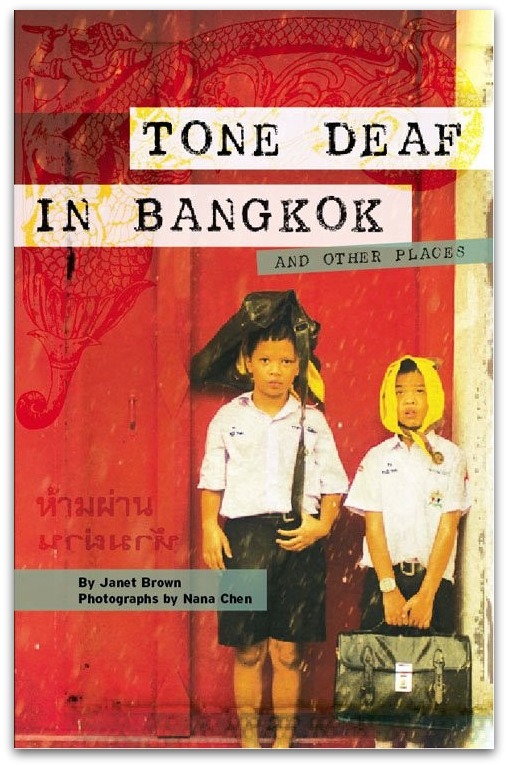
And now, to top that all off, the extraordinary travel writer Janet Brown is paying us a visit. Brown could almost be a stand-in for the Lewis Carroll heroine herself, having published a book on travel to and life in Thailand called Tone Deaf in Bangkok, to much acclaim.

“Tone deaf” — it puts one in mind of poor Alice’s plea to the Mouse, “I didn’t mean it…But you’re so easily offended, you know!”

But if Brown sees herself as tone deaf, her readers regard her as anything but. Here is a sampling of her reader reviews on Amazon:

It has been ages since I have loved a piece of travel literature…, and so when I read TONE DEAF IN BANGKOK, I was thrilled. This is a good travel book, and it is a good book, period.

I am not a traveler, nor do I typically read travel books. Shame on me, I know, but here’s the thing: … The author brought Bangkok to life in a way that made me want to go there, yes, but it was her own story that captivated me and kept me turning the pages. Now I’d read anything Janet Brown writes!

Janet Brown’s TONE DEAF IN BANGKOK is a travelogue, to be sure. Yet it is more, so much more. It’s also an investigation into how dislocated we can become by ourselves, by our priorities and by all that we demand of the cultures in which we live. … That she has a gift for spotting the universal in the exotic makes this collection all the more profound.

Janet Brown has graciously agreed to answer some of my Alice-related questions. After that, dear reader, I urge you to chime in!

Before we go down the rabbit-hole, can you tell me a little bit more about your background?
My parents turned me into a gypsy before I was two, by taking me on their journey by jeep from New York City to Alaska when the 49th state was still a territory and the Alcan Highway was still an unpaved trail into the frozen north. I have wandered ever since, most recently in Southeast Asia with Bangkok as my home, writing down the stories I encounter as I explore. My books include:

Maybe because I’m so steeped in Alice-of-Wonderland lore this month, I think of you as Alice Personified. To what extent can you relate to Alice’s sense of disorientation? Going back not just to the first time you went to Thailand but also when your family dragged you to Alaska…
I was 18 months old when my family moved to Alaska from Manhattan. I coped with any displacement issues by making my mother read my favorite book over and over again — a truly saccharine Little Golden Book called The New Baby. The main character had the same name as I so that was the big attraction — all about me! My mother swears she can still recite it verbatim after having two martinis.

Alice came to mind constantly in my first months in Bangkok — and frequently thereafter. I knew I’d gone through the looking glass — or had entered the postcard — and asked myself often if that experience had been as painful for Alice as it often was for me.

Can you describe your worst “Pool of Tears” moment in Bangkok, where you wished you hadn’t decided on living there?
I’ve tried to make light of that time when I wrote about it in Tone Deaf in Bangkok, but it nearly demolished me. When the manager of my apartment turned me into Ryan’s Daughter by listening in on my phone calls and then entertaining the neighborhood with highly embroidered versions of my life — and when people fell silent when I walked down the street and began gabbling excitedly after I’d passed — I felt as though my life had been stolen from me and I shut down to the point of hypothermia. If my students hadn’t helped me find a new neighborhood, I would have gone home a gibbering mess.

Thailand is renowned for its distinctive cuisine. Was there anything that carried an “Eat me” label that you felt hesitant about at first, but then discovered you loved?
I’ve written about durian in Tone Deaf, how I thought its smell in the market was sewer gas and then how I was forced to taste it, with happy results. Fried grasshoppers were another thing I didn’t warm to at first sight and then liked as much as I do popcorn — they have much the same crunch and texture.

By the same token, were there any foods that you thought might be good but then didn’t acquire a taste for? (For Alice, of course, that was the Duchess’s over-peppered soup.)
One night I stopped to buy green papaya salad from a food cart to take home for supper. There was something in a little plastic bag that looked like a sort of relish, so I bought that, too.When I opened it at home a smell of rot filled the air, but remembering the delightful surprise that durian had proved to be, I took a generous spoonful. It was pla ra — fermented fish, a Northeastern Thailand culinary staple that is meant to be added and mixed judiciously with the salad, not eaten like peanut butter. There wasn’t enough toothpaste in the world to rid my mouth of that thoroughly foul taste.

As already mentioned, Alice finds it’s easy to offend the creatures in Wonderland without even trying. Why did you choose the expression “tone deaf” for the title of your book on Bangkok?
“Tone deaf” can be taken quite literally. Thai is a tonal language with five different tones giving meaning to every word. Use the wrong tone and at best you’re incomprehensible, at worst shocking. The most common mistake for foreigners is to tell someone their baby is beautiful, while actually announcing that the infant is bad luck. Another pitfall is confusing the word “near” with the word for “far” — they are the same sound, differentiated by a crucial tone.

But travelers to Thailand can also be “tone deaf” when it comes to figuring out the Thais’ communication style. As a Thai-American friend has observed, the important things are what remain unsaid. “You looked so beautiful yesterday” probably means today you resemble dogfood and ought to go home and rectify that at once. Subtlety is the hallmark of Thai communication, and is often expressed through a quirk of an eyebrow or a famous Thai smile, which has at least one hundred different meanings — including disdain or outright menace.

Describe the biggest faux pas you’ve made since settling in Bangkok.
Oh, how to choose — it’s impossible not to make faux pas every second because Thai etiquette is demanding and complex. The one that makes me cringe most is in my first week when I set off on my first solo bus ride. I was clutching a twenty-baht note, which like all bank notes in Thailand bears the countenance of the King. He is revered to the point of near godhood in his kingdom and his picture is always elevated to the highest spot in a room — nothing is above the King. But I was fresh off the boat and when I dropped my money and it was caught in a little breeze, I put out my foot (the lowest and most ignominious part of the body) and stepped on the picture of the King’s face to secure my bus fare. I was too clueless to pick up on the ripples of horror that this caused others at the bus stop, but now I writhe when I remember this.

“Off with her head!” as the chief royal in Alice’s story is wont to proclaim. Actually, never mind your head. Your mention of your foot makes me think of how physically awkward Alice feels around the creatures in Wonderland. As a farang in Bangkok, do you often feel self conscious?
I’m short and dark in a family of pale-skinned people, so I was used to being an anomaly from early childhood. In Bangkok, if I dressed like a Thai woman and wore sunglasses and walked slowly, I felt as though I blended in. But one day I walked down a quiet street on my way to a class, and someone looked up and said, “Look at the foreigner.” “How did she know?” I asked my class of teenage girls. “Your hair,” they said. “No, lots of Thai women have dyed their hair brown,” I replied — to which they responded: “Your nose.” It was my big American nose that gave me away every time — and since I hate pain and surgery, I just had to accept that.

Have you tweaked your personal style at all so as to fit in better?
Yes — I adopted the conservative “Don’t show your bare shoulders” school of dressing that prevailed in Bangkok when I first arrived and slowed my pace to that of the women around me. I learned to keep my facial expression as bland as I possibly could to achieve the quiet Thai “public face,” and I ironed everything, including my Levis. Now women are much more casual in the way they dress but I’m still stuck in the cultural mores of the 90s. To foreign women who live here now, my introductory years in Bangkok seem like fiction — things have changed so drastically in the past 16 years.

Time for a quote from the Cheshire Cat: “…we’re all mad here. I’m mad. You’re mad.” Can you relate?
Riding on the back of a motorcycle taxi down a crowded city sidewalk, buying a glass of Shiraz to take with my popcorn into a movie theater, being drenched to the bone during Thai New Year’s — this is actually the most difficult question you’ve asked so far because at this point it all seems normal.

If you were to hold your own Mad Hatter’s Tea Party in Bangkok, whom would you invite, and why?
Anais Nin, because she would love the unbridled hedonism of this place, Evelyn Waugh because he would satirize the expat scene so well, Ho Chi Minh because he could help put together the revolution that is needed here, Emily Hahn because she has always been my role model since I first read her when I was twelve, and Elvis because in Bangkok he is still the king.

Alice becomes aware that Wonderland is turning her into a different person, unrecognizable to the one she used to be. Has your identity has shifted in fundamental ways since living in Bangkok?
This is a very complex question — I’ve written one book about it and am working on a second one, Almost Home. I’m always drawn back to the US because my children are there. Seeing them for two weeks a year doesn’t work for me. Once I get back to the US this time around, I’ll return here but plan to spend the bulk of my time near family in the Pacific Northwest. I won’t know how much I’ve been changed by this recent incarnation in Bangkok until then. Ask me again in several months.

Can you offer any advice for newcomers to Bangkok, who aren’t sure who they are any more?
Tone Deaf in Bangkok and my next book, Almost Home, are where I directly address the challenges of feeling like an Alice in Thailand. In addition, the recently published Lost and Found Bangkok, for which I wrote the text, may be helpful for newcomers. It’s a book in which five different photographers — two American men, two Thai men (both from Bangkok), and one Taiwanese-American woman — show the city they live in. New arrivals can look at the photos and see some great places to get lost — and find out who they are — in this Wonderland-like city.

img: Janet Brown with friends at an all-you-can-eat DIY barbecue at a huge restaurant under a bridge in Bangkok, by Will Yaryan.

If you enjoyed this post, we invite you to subscribe to The Displaced Dispatch, a weekly round up of posts from The Displaced Nation, plus some extras such as seasonal recipes and occasional book giveaways. Sign up for The Displaced Dispatch by clicking here!

Related posts:

Some enchanted reading: A round-the-world tour from 4 of our featured writers

For this month’s reading suggestions, we have compiled a list of books from four of our recent featured writers — all of different genres, and set in different parts of the world.

If you are stay-cationing this year, we hope one of these books will transport you for a while to a different place —  and all for a fraction of the cost of a plane ticket.

IRAN – Sons of the Great Satan – Anthony Roberts

Our featured writer in April, Tony Roberts spent his childhood in Saudi Arabia and Iran before the Islamic revolution forced him and his family back to their hometown in Kansas — which, to Tony, no longer seemed like home.

Now living in Hawai’i with his New Zealand wife and their son, Tony has published his first novel, Sons of the Great Satan. It tells the story of the friendship between two teenagers — one American, one Iranian — in the last hours before the fall of the Shah of Iran.

Amazon description:

“SONS OF THE GREAT SATAN is a tale of culture clash, international politics, heroism, friendship, cowardice and sinister betrayal. The character and beliefs of the Shah of Iran, President Jimmy Carter and the Ayatollah Khomeini are all put to the test as the whirlwind of chaos engulfs them all. The actions of these powerful men play out on the world stage and forever change the lives of those who called Tehran home in the late 1970s.”

NEW YORK – Exiled – Shireen Jilla

Third Culture Kid Shireen Jilla (half English, half Persian, and grew up in Germany, Holland and England) currently lives in London after being an expat in Paris, Rome, and New York.

Commenting on our May 7th article, Shireen said, “New York is a material fantasy that most wannabe expats have had. People imagine it to be an adventure laced only with IPad2s and lychee martinis. But, as many of you know, stepping outside your own cultural comfort zone is never as straight forward as those people, longing for it from the comfort of their three-piece sofa in the suburbs, imagine. So I choose to write about Anna, an eager expat looking for experience, but finding she sucked into a cultural nightmare that she neither could control, or understand.”

Amazon description:

“In love with her husband Jessie, an ambitious British diplomat, whose first posting brings them to New York, Anna begins the hectic, enjoyable life of a successful expat. But New York also brings her into contact with her husband’s manipulative and competitive stepmother Nancy, a powerful American socialite and philanthropist. When a silly incident with her only son Josh involves the Police Department, Anna’s seemingly perfect world begins to shatter. As Jessie’s journey to rediscover his New York roots draws him closer to Nancy, terrible and strange things keep happening to Anna. She begins to fear that someone is out to destroy her family.”

FRANCE – Hidden in Paris – Corine Gantz

Our second featured writer in May, Corine Gantz has just released her debut novel about a group of American women who try to start new lives in Paris.

A displaced Parisian in Los Angeles, where she lives with her husband and two sons, Corine blogs at Hidden in France.

Amazon description:

When bankruptcy threatens her beloved house, her one anchor in life, Annie has no choice but to find renters, and quick. Leave it to someone socially phobic to phrase a want ad in all the wrong ways. With shimmering promises of ‘Starting over in Paris’ –– a concept she has no intention of applying to her own life––Annie attracts tenants with the kind of baggage that doesn’t fit in suitcases.

THAILAND – Tone Deaf in Bangkok – Janet Brown

The last book on today’s list is by Janet Brown, whom we featured on June 10th.

In the article, Janet said: “My parents turned me into a gypsy before I was two, by taking me on their journey by jeep from New York City to Alaska when the 49th state was still a territory and the Alcan Highway was still an unpaved trail into the frozen north. I have wandered ever since, most recently in Southeast Asia with Bangkok as my home, writing down the stories I encounter as I explore.”

Amazon description:

“From her first bewildered hours to the moment that she reluctantly leaves, Janet Brown describes her experience of falling in love with, and in, Thailand’s largest city. Nana Chen’s evocative photographs provide illustrations of daily living in Bangkok.”
BC Magazine review:
“Janet Brown’s experiences in Thailand are chronicled in short essays that bypass the usual tourist spots and concepts and present an intimate and revealing understanding of Bangkok and the Thai way of life from a female foreigner’s fascinated point of view.”

If you enjoyed this post, we invite you to subscribe for email delivery of The Displaced Dispatch, a round up of the week’s posts from The Displaced Nation. Sign up for The Displaced Dispatch by clicking here!

Related posts:

Ho’ omaika’i ‘Ana to TCK writer Tony Roberts

Expat life as psychological thriller? An unholy appreciation of novelist Shireen Jilla

CLASSIC DISPLACED WRITING: Joy in the place — Elizabeth von Arnim

The novelist Elizabeth von Arnim (1866-1941) wrote many enchanting books, all of which were autobiographical to some extent, linked to persons or places she knew.

But does that necessarily mean that Elizabeth — born Mary Annette, nicknamed May, she called herself “Elizabeth” upon becoming a professional writer — led an enchanted life?

Yes and no. By all accounts, she was an enchanting person herself, constantly delighting other people with her sharp wit.

She also kept enchanting company: E.M. Forster was tutor to her children, Katherine Mansfield was her adopted cousin, and H.G. Wells was one of her lovers.

Displaced almost from birth (she was born in Kirribilli Point, Australia, and then moved to England at the age of three), she made a life-long habit of flitting from one enchanting locale to the next.

Having spent her formative years in London, she moved to Pomerania in Prussia (Germany) for her first marriage, where she raised five children.

Upon the death of her husband in 1910, she made her home in the Valais, Switzerland, living in a glamorous house, Chalet Soleil, which she’d built from her riches as an author.

With the failure of her second marriage, Elizabeth zigzagged between homes in the United States and Europe.

She died in Charleston, South Carolina.

A full measure of sorrows

But a peripatetic life isn’t always a charmed one, as many of us expats and former expats can attest. As her life progressed, Elizabeth experienced a full measure of sorrows.

Her first marriage — to a domineering Prussian count — wasn’t particularly happy. She nicknamed him the Man of Wrath, and they separated several years before his death.

Her second marriage, to Frank Russell, elder brother of Bertrand, was even more miserable (he proved to be a despotic egoist).

Her only true love she met when she was 54 — and he was nearly 30 years younger. (They never married.)

She also suffered the grievous deaths of a daughter and a brother.

By the time she died, Elizabeth was estranged from most of her children, crippled with arthritis, and almost forgotten by her adoring public.

Her only devoted companion was her dog, Billy.

Escape artist par excellence

But despite these tribulations, Elizabeth remained throughout her life, in the words of gardening writer Deborah Kellaway,

a steadfast hedonist, firmly suppressing sorrows. … Her journals and letters repeatedly record moments of happiness, usually associated with sunny days.

As Elizabeth once wrote in a letter to one of her daughters,

“What I really am by nature is an escapist.”

Thus what we can learn from Elizabeth’s life — and from her many autobiographical books — is the art of escaping into happier worlds.

As Kellaway explains:

[The heroines of her novels] escape from richness into the simple life, or from conventional home life into foreign travel; they escape from houses into caravans.

The most famous example, of course, is Elizabeth’s 1922 novel, The Enchanted April — from which we’ve taken our theme of enchantment on the blog this month.

As everyone knows who has read that book — or, more likely, seen the 1992 film or the 2003 Broadway play — four women who share only their unhappiness and a love of wisteria flee 1920s London and converge in Portofino, Italy, on a magical medieval villa overlooking the Mediterranean.

Simple pleasures are the best?

But while Italian castles can certainly be a tonic — if offered one, I’d be off like a shot — what most people don’t know is that Elizabeth was equally fond of much simpler escapes. In the first two books that made her reputation as a writer, the heroine escapes her marital, motherly and household duties by venturing into a German garden, set in a wide landscape.

Here is the most lyrical passage from the second of these, The Solitary Summer (1899):

Yesterday morning I got up at three o’clock and stole through the echoing passages and strange dark rooms, undid with trembling hands the bolts of the door to the verandah, and passed out into a wonderful, unknown world. I stood for a few minutes motionless on the steps, almost frightened by the awful purity of nature when all the sin and ugliness is shut up and asleep, and there is nothing but the beauty left. It was quite light, yet a bright moon hung in the cloudless, grey-blue sky; the flowers were all awake, saturating the air with scent; and a nightingale sat on a hornbeam quite close to me, in loud raptures at the coming of the sun. …

It was wonderfully quiet, and the nightingale on the hornbeam had everything to itself as I sat motionless watching that glow in the east burning redder; wonderfully quiet, and so wonderfully beautiful because one associates daylight with people, and voices and bustle, and hurrying to and fro, and the dreariness of working to feed our bodies, and feeding our bodies that we may be able to work to feed them again; but here was the world wide awake and yet only for me, all the fresh pure air only for me, all the fragrance breathed only by me, not a living soul hearing the nightingale but me, the sun in a few moments coming up to warm only me…

A lovely garden at just the right time of day — as I know from my own experience of enduring many city summers*, that’s all it sometimes takes to escape into happiness.

*On that note, I’d like to recommend a walk on the High Line in early morning or late afternoon, to anyone living in or traveling to New York City this month…

QUESTION: What does it take for you to escape the dog days of summer into happiness: a trip to Italy, a walk in the garden — or something else?

STAY TUNED for tomorrow’s post, on our new weekly newsletter, The Displaced Dispatch.

If you enjoyed this post, we invite you to subscribe for email delivery of The Displaced Nation. That way, you won’t miss a single issue. SPECIAL OFFER: New subscribers receive a FREE copy of “A Royally Displaced Tea.”

Related posts:

CONTEMPORARY DISPLACED WRITING: David Foster Wallace – A Supposedly Fun Thing I’ll Never Do Again

A few weeks ago I found myself in Claremont, California. I hadn’t intentionally planned to stop there, it was a spur-of-the-moment thing. I’d been at a wedding in Southern California the day before, and as I made the long drive back home the next day my stomach began to rumble, and there were signs on the highway for Claremont. That name rang a bell with me, but I couldn’t quite recall why. Possibly, being not the world’s greatest driver, I was too busy concentrating on the road, and the suicidal, kamikaze driving of the locals, to really stop and think on why the name Claremont was so familiar to me. My wife told me that it was probably because I’d heard of Ponoma College, a liberal arts university, which is based in downtown Claremont. That certainly sounds familiar. Yep, it must be that, I thought. And being a college town, it seemed like the perfect place to stop for lunch on a Sunday afternoon.

It was only as after lunch as I was getting back into my car – already dreading the thought of getting back onto the highway, staying on it for another 6 hours, and sharing it with mad men – that I realised why the name Claremont and Ponoma College had seemed so familiar. It wasn’t through a synapse suddenly working, finally passing a neuron to that part of my brain that stores all my thoughts on Claremont. No, it was my wife googling Ponoma College on her iPhone. Reading its Wikipedia entry, she said, “Oh, David Foster Wallace was a professor here. You must have known that, surely?”

David Foster Wallace had taught at Ponoma College, and it was in Claremont that he had sadly taken his life in 2008. You probably already know about him, so I won’t waste time repeating things here that you already know. What I will note is what an important writer he has been for me. Foster Wallace was not, as far as I know (or as far as I can remember, and as we have established, it’s not clear if we can really trust my synapses) an expat, which is what this blog focuses on. His writing does, at least to me, convey better than any other writer of his generation a sense of displacement with himself and with his America.

Moving to the U.S. in 2007, Foster Wallace’s essays were something I eagerly reconsumed. I’d read them early, but that was from the position of being a young Englishman in his early 20s who had never been to the U.S. Somehow, it didn’t count as much. Now with an I-551 visa stamped in my passport, Foster Wallace’s essays, along with de Tocqueville were the first books off my shelf as an American resident. Like de Tocqueville, Foster Wallace, though American, gave me an outsider’s perspective on my new homeland.

So this week’s displaced writing is David Foster Wallace’s essay “A Supposedly Fun Thing I’ll Never Do Again.” It was first published in Harpers and has since been republished in book form along with other Foster Wallace essays. It’s the Harpers version that I’m going to link to as it’s still available for free on the web. The essay details an assignment Foster Wallace had, trapped and displaced, on a Carribean cruiseliner and which is the supposedly fun thing he’ll never do again.

Click below to read.

“I have seen sucrose beaches and water a very bright blue. I have seen an all-red leisure suit with flared lapels. I have smelled what suntan lotion smells like spread over 21000 pounds of hot flesh. I have been addressed as “Mon” in three different nations. I have watched 500 upscale Americans dance the Electric Slide. I have seen sunsets that looked computer-enhanced and a tropical moon that looked more like a sort of obscenely large and dangling lemon than like the good old stony U.S. moon I’m used to. I have (very briefly) joined a Conga Line.”

STAY TUNED for Monday’s post, when we explore next month’s theme: “An Enchanted August.”

If you enjoyed this post, we invite you to subscribe for email delivery of The Displaced Nation. That way, you won’t miss a single issue. SPECIAL OFFER: New subscribers receive a FREE copy of “A Royally Displaced Tea.”

Related posts: