The Displaced Nation

A home for international creatives

Tag Archives: Writers we love

Mark Hillary delivers reality check to gringos who moan about Brazil, in self-published book (1/2)

Mark_HillaryA little while ago I interviewed Megan Farrell, a fellow gringo in São Paulo, about the book she had written about “exbrat” life in the city. As far as I’m aware, Megan’s was the first book to be written about life in SP by a foreigner, although she seems to have started a new trend because within the last fortnight another has emerged: Reality Check: Life in BRAZIL through the eyes of a foreigner.

Reality Check is by Mark Hillary, a fellow Brit in São Paulo (he recently moved outside the city), who is an author, blogger, and advisor on technology and globalization. He has already published a number of books and is a contributor to Huffington Post, Reuters, The Guardian, and Computer Weekly.

Mark is also a friend of mine. We connected through Twitter just over a year ago. We eventually met at a local bar when—unsurprisingly, given his background in technology and social media—he organized a meet-up of gringos who had connected online but had yet to meet up in the flesh.

Since then he and I have continued to meet up, although less so since his move to the countryside. We had a particularly memorable trip in June to Rio to watch England play Brazil in football at the brand new Maracanã Stadium. (As anyone who follows my posts should recall, I’m a bit of a football geek.)

Over the past year Mark has written, in his column for the Huffington Post, a number of insightful articles about life as a foreigner in Brazil—most notably, “No HP Sauce, Endless Red Tape: Would You Want to Live in Brazil?, which responded to a gringo Facebook forum that had listed all the reasons why foreigners hated living in this country.

It was to my pleasant surprise, then, when Mark announced he had extended his account of life in Brazil and intended to publish it as an e-book.

Leaving aside my acquaintance with Mark (and the fact he gives a nod to my personal blog in the book!), I must say that I found Reality Check a very enjoyable read. It is a thoughtful and critical, yet balanced, account of his experiences in Brazil and of the country in general—and frankly, I’m rather annoyed that I haven’t written it myself.

Mark’s book also seems to be a good accompaniment to Megan’s. Whilst hers is a straightforward, step-by-step guide to life in São Paulo, his is a narrative providing a broad overview of gringo life. Either way, both books will be of use to those who are either moving to Brazil or perhaps are simply interested in finding out a bit more about South America’s largest and most populous country (it’s also the world’s fifth largest economy).

Anyway, enough of my wittering on. Let’s hear more from Mark himself.

* * *

RealityCheck_bookcoverHi, Mark. Congratulations on your new book and thanks for agreeing to this interview. First off, can you say a little more about what inspired you to write it?
As you already mentioned, I wrote the book in large part as a reaction to the negative posts about Brazil in online gringo communities. Everyone has their own reasons for moving and living away from their home country, but the majority of the groups I’ve encountered online are full of complaints about Brazilian food, prices, bureaucracy… Anyone who reads the posts made in the Facebook group for Gringoes.com would think that the UK and US offer a utopian paradise that would be madness to ever leave.

As you said in your intro, I wrote an article for the Huffington Post where I tried to give a more balanced view on life in Brazil.

Then I thought that, as someone who has rented and bought a home, started a company, hired people, and married a Brazilian, I could probably give a more detailed opinion on the experience—hence the book.

So being married to a Brazilian was what brought you to Brazil?
Yes, we were living in London, but after the financial crash in 2008 my business was much slower than before. By 2010 it became clear that there were many more opportunities for me to build a research and publishing business in Brazil than in the UK and so we moved just before the end of that year, nearly four years ago.

We recently featured another book about expat life in Brazil: American Exbrat in São Paulo, by Megan Farrell. Megan’s focus was on the “exbrat” community in São Paulo—i.e., those who are transferred here for work by a large company. My impression is that your focus is less specific and more of a broad overview of life in Brazil as a foreigner.
I’m not really interested in the exbrats. If a big company transfers someone to Brazil and they have their home taken care of and a driver to ferry them around, and they only ever go for a drink in expat pubs, then I don’t think they are experiencing the real Brazil. I’m not suggesting that the only authentic Brazil experience is living in a favela, but there are other kinds of foreigners here—journalists, teachers, people from all walks of life—who are constantly looking for ways to explore their new home.

Did you have a specific audience in mind when you wrote the book?
I really set out to explore some of my own experiences, with the expectation that people investing in Brazil or looking for a job here might have an interest in the book.

The book has only just been published (2nd September) so I guess it is a little early to tell, but how has it been received so far?
It is very recent, but there is already a very positive review from a Brazilian reader on Amazon. I started my author Facebook page when I published the book, and that community is growing by around a hundred people every day—so people are noticing it. One of the biggest newspapers in Brazil (Folha de SP) has been in touch to interview me about the book—despite my not having done any press promotion for the book due to my traveling almost every day since the publication!

Did you connect with São Paulo and/or Brazil in any new ways whilst writing the book?
It made me more determined to plug areas outside of Rio, which has a lot of friends already. I’ve really enjoyed living in both São Paulo the city and interior—SP needs a few gringo fans to speak out and remind people that the city is not just about concrete and cops murdering civilians.

You recently moved to the countryside outside São Paulo—how and why did that come about?
We spent two years living in the centre of São Paulo and just wanted to find something a bit quieter. I love it where we are now. There is a great sense of community; the neighbours all know each other. There is none of the security paranoia you find in the city centre, and there is some fantastic scenery on our doorstep.

Do you miss SP at all?
I miss being able to go out to see my friends in the city, or go to concerts by international bands that will only ever play in major cities. But we are planning to get a very small apartment in SP soon, so we don’t completely lose touch with it.

You mentioned the “security paranoia” in SP. In my observation, most of us gringos carry a fear that is at odds with how our Brazilian partners and/or friends feel. I enjoyed reading the section of your book covering this perception gap. Do you think that more positive accounts of Brazil by writers/bloggers like you and myself can help to shift these perceptions?
If people like you and me can get visitors to realize that they can walk down Avenida Paulista or along Copacabana Beach without fearing for their life, that would help. On more than one occasion I have met business contacts who flew into town and then were shocked when I suggested meeting away from their hotel. Standard advice from American and European companies is often to stay inside when in Brazil because of all the street crime.

The Brazilians, too, should play a part in correcting this situation. I don’t think we have much influence because we are seen as outsiders, but as more Brazilians get exposed to alternative cultures through travel, I hope it can change a little.

Last year I brought my wife’s teenage cousin on a trip to the USA, just to show her what life is like outside of Brazil. She found it incredible that you could walk up to the front of so many celebrity homes in Los Angeles—that anyone could walk into Sylvester Stallone’s garden. That’s unimaginable in Brazil.

What are you thoughts on foreign media portrayals of Brazil? Do you feel, for example, that persistent foreign criticisms of Brazil’s preparations for the World Cup and Olympics have been fair?
Every World Cup and Olympic games gets this negative press, so I don’t know if it is any worse than the last time. Anyone from the UK should be able to recall how the London Games were going to be a disaster right up to the week of the Games—the attitude seemed to change only when everyone saw that spectacular opening ceremony.

All I know from personal experience is that when you and I went to the Brazil v England football game at the Maracanã in June, the organization was superb. The stadium looked good, the public transport all worked, and the volunteers helping the crowd were great. I couldn’t fault it—so I’m really looking forward to the World Cup.

From the way you write so passionately about Brazil it is clear that you love living here, but there must have been the odd difficult moment when you wondered whether you’d made the right decision in fleeing the economically stagnant UK for your wife’s native land. When have you felt most displaced?
Sometimes the bureaucracy in daily life does get perverse and goes beyond just the criticism of a foreigner claiming that it all works better in Europe. Examples include having to pay someone to get my car registered to a new address or being fined for not paying my stamp duty on the day I agreed a mortgage with the bank—even though I paid on the day I got the documents myself. Sometimes I wonder if there is ever going to be any government that sweeps away this nonsense. I also fear that the job cuts created by improved efficiency means we are stuck with much of this.

Conversely, when have been your least displaced moments, when it all seemed to make sense?
I live in a really beautiful place now surrounded by a lot of wonderful people. Every morning when I take my dog for a walk then start work for the day I know I’m lucky to be here.

* * *

Readers, I will be talking to Mark again on Tuesday of next week, when we focus on his decision to self-publish his book. Any further questions for him, meantime? And don’t forget, if you’re interested in Reality Check, you can purchase it on Amazon. I would also recommend becoming a fan of its Facebook page and following Mark on Twitter: @MarkHillary

STAY TUNED for tomorrow’s post, a new episode in our “Location, Locution” series, by JJ Marsh.

If you enjoyed this post, we invite you to register for The Displaced Dispatch, a round up of weekly posts from The Displaced Nation, with seasonal recipes, book giveaways and other extras. Register for The Displaced Dispatch by clicking here!

Related posts:

images: Mark Hillary’s author image and book cover

Don Quixote & Sancho, John Steinbeck & Charley…Olga & George? A travelogue for the expat annals (plus we’re giving away a copy!)

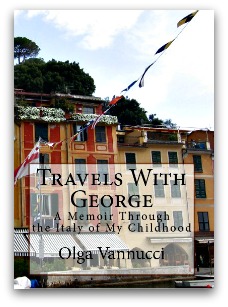
Olga Vannucci CollageWhen I first stumbled across Olga Vannucci’s memoir, Travels with George, I wondered whether the title alluded to John Steinbeck’s book Travels with Charley, about his road trip across America in the company of his French standard poodle, Charley.

Turns out, I got it right. Born in Italy, Olga went to Brown University and currently lives in rural New Jersey. As she tells it, she was driving through Doylestown, Pennsylvania, one day when Steinbeck’s travelogue popped into her head, and she knew she wanted to call her book “Travels with George.” When she announced this to her son (the “George” of the title), he said: “So I’m the dog?”

As you can gather from this story, mother and son make quite a pair.

Olga says she’s no Steinbeck, though she does prefer a plain and honest writing style. Also like Steinbeck, she had the desire to see her native land again.

So, how did she find the Italy of today: did she still fit in? And what did her sidekick, George, the blonde all-American kid, make of his mammina‘s homeland? Did he enjoy these escapades or feel puzzled by his mother’s motives? Perhaps the story he saw himself in wasn’t Steinbeck’s at all, but a modern Italian version of Don Quixote, in which he occupied the role of a skeptical Sancho Panza?

Olga has kindly agreed to give away one copy of the book to the reader who is keenest to find out the answers to these questions (see giveaway details below).

But before we get into that, let’s talk to Olga and hear some more about the travels that inspired her to put pen to paper…

* * *
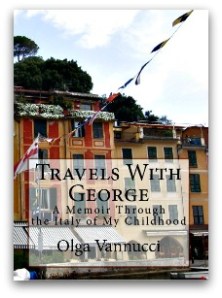
Travels with George Book CoverCiao, Olga! Let’s begin at the beginning. Tell us more about your decision to take a trip to Italy with your young son and write about it.
I was born in Italy (Milano), lived in Brazil two different times as a child, and came to the United States to attend college. I’ve been here ever since. When my son was seven years old, I realized suddenly that I hadn’t been back to Italy in ten years, and I went, taking him along. I thought he would learn about Italy and acquire a feel for what it’s like. I also hoped he would learn some Italian. I don’t know how much of that was accomplished, but I loved showing him around. We went back four more times over the course of six years (he is now 14). I wrote the book about those trips: a mix of travelogue, personal history, and little anecdotes, with some humor.

What impact did writing about the experience have on you—did it help you process your childhood memories?
It was wonderful to see the locales of my childhood again. At this point, my memories are either indelibly fixed or just gone—for instance, I can remember clearly sitting on the steps with my friends Sassello, in Ligurio, as I recount here:

[My sister and I] had two friends in Sassello, two girls the same age as [us]—Paola and Maria Elena. They spent their summers thirty meters from where we spent ours, and we spent hours and hours of every day together.

[George and I] walk by the steps where we used to sit. I expect to see them, I expect them to be there, but they’re not. No one is. It’s all the same, but it isn’t.

Did you also learn something about yourself, in taking these excursions down Memory Lane?
I did find out about my current self through the book, but primarily from what others told me my words said about me—for example that I’m kind, funny, and honest. It was also interesting to hear from others about the things that they could relate to in the book, ranging from the more profound to the totally mundane situations. That was amazing, to realize that what I wrote spoke to others.

George’s ordeal

Do you think it will help George someday, in understanding part of his heritage that might not otherwise be accessible?
George has not read the book because, he says, “I was there, I don’t need to read about it.” I do hope and trust that both the experience and the writing will be a part of him, that he will consider the book a gift.

What was your most displaced moment when you & George were touring Italy, when you thought of yourself as a stranger within your homeland?
I always struggle with whether I am Italian or, at this point, American, or, more likely, not really either one. What makes me feel at home in Italy is the fact that it’s largely so unchanged. What makes me feel displaced is that the people of the older generation, my parents’ generation, who are the people I particularly associate with Italy, are passing. They’re my biggest connection with Italy, and they will soon be gone. After that, I may feel displaced…

I gather you don’t feel nearly as comfortable with younger generations of Italians?
Yes. I’m not sure why not. Possibly because the younger generation is doing its own thing and is more all over the place, unlike the older, which has stayed put.

What was your least displaced moment, when it all seemed to make sense for you and George to be there—that you fit right in?
On all the trips we visited my aunt, my mother’s sister, and stayed at her house, where we slipped naturally into being part of the family. I had coffee with her in the morning, we planned meals, I helped her water her garden, George fed her goldfish, and we watched television in the evening.  There was not an ocean or even a smidge of formality between us.

I love the description you provide of your aunt in the book:

My aunt is a lovely person, she’s beautiful and she likes to dress well. She’s 80 now, and she still looks good in her clothes, she wears fashionable clothes. She is cheerful and tells funny stories. She loves to do stuff and see people, she’s chatty. She’s fun to be around.

In that same passage, you mention the “recurring nightmare” of finding food that George likes to eat. What was the most challenging thing about traveling with a young child?
I did not realize how jarring the experience would be for George. To me, Italy is pleasant, and while I knew it would all be new to him, I didn’t realize how different it really was. Being in a completely unrecognizable place where he didn’t understand the language was way outside his comfort zone. I also probably didn’t verbalize things enough. I could have prepared him more and explained things better.

The other thing about traveling with a small child is that I, as the adult, had to be “on” 100% of the time.  Not only did I have to plan and handle everything, but I also had to manage him and make sure I didn’t lose him, which was something I actually worried about, and when I became stressed I had to try to hide it so he wouldn’t become stressed, which I didn’t do very well. He’s very perceptive.

What do you think he took from the experience?
The knowledge that he can survive a terrible ordeal… Possibly I took him on a few too many hikes up hills. It wasn’t always fun and idyllic. I do believe that the trips will serve as a foundation for him to understand that the world is large and diverse and for him to appreciate differences.

The potential perils of writing about one’s offspring

What was the most difficult part of the book-writing process?
It was hard to write about others and protect their privacy at the same time, particularly with my son. I find him very amusing, but he doesn’t intend to amuse me, and he is sensitive to it. He thinks I’m making fun of him, basically. So I’m always walking that line, writing about him, but trying to be respectful of him.

I understand you decided to self-publish the book. Why is that, and do you have any advice for other writers who opt for self-publishing?
I made some attempts to get an agent but ultimately I went with self-publishing because I didn’t have the patience to wait. What I like about self-publishing is that it’s all mine, I created the book cover, I chose the font, I decided to favor the comma over all other punctuation, and it’s been incredibly fun and very rewarding.

There are so many options today to publish and distribute and get the word out, and it can be done without a big financial investment. All you need is the investment of time. Given that this is your passion, you want to spend your time on it anyway. And there are so many people who are open to help. I would encourage other writers not to be afraid to ask. Putting your thoughts out there to share with others is a gift, and people respond very kindly.

What audience did you intend for the book, and has it been reaching those people?
I thought it was a mother/son book, which it is, but it’s very much a book for people who love Italy, who have been there, or who plan to go. My writing is very direct and the book is written in the present tense, so readers feel like they’re there along with me. It combines some very personal time in Italy–with family or revisiting places of personal significance—with visits to the big tourist destinations like Venice and Rome.

Are you working on any other ambitious writing projects?
I am working on a book about traveling with George in America. It’s not an organized itinerary, it’s just places we’ve been or will go to. Mostly in the northeast, plus San Fran and Arizona. It’s still in the infant stages, this project. But I promise it will be extra funny!

10 questions for Olga Vannucci

Finally, I’d like to ask a series of questions that I’ve asked some of our other featured authors, about your reading and writing habits:
1. Last truly great book you read: Don’t Let’s Go to the Dogs Tonight, by Alexandra Fuller, about growing up in Africa.
2. Favorite literary genre: Definitely travel!
3. Reading habits on a plane: I don’t like to fly so I bring an easy-reading book that I know will keep me engaged, and paperback so it’s lightweight.
4. The one book you’d require President Obama to read, and why: He has such a tough job. I would wish, not require exactly but only wish, for him to read a book that his daughters like, so he can have a topic of conversation that they can share and enjoy. He will then tackle his job rejuvenated.
5. Favorite book as a child: Mary Poppins—the P.L. Travers book and the Disney movie, too. I think I had it in both languages. It was just magical, different, not at all like my daily life with my mother and sister.
6. Favorite heroine: Martha Gellhorn, who was a great journalist and writer. She was married to the literary giant Ernest Hemingway yet always retained a strong sense of herself.
7. The writer, alive or dead, you’d most like to meet: I would like Calvin Trillin to take me out to eat in New York, in the Village, to all his favorite eating places. It might take several days because he has a lot of favorite eateries. I would like to hear all about Alice, about his daughters, and about his long and brilliant career.
8. Your reading habits: I read in bed every single night, and I have been reading more during the day recently. I’ve been deliberate about carving out more time in the day, when it’s otherwise easy to get caught up in other activities.
9. The book you’d most like to see made as a film: Any book that takes place overseas, so I can see the place in which the events take place.
10. The book you plan to read next: Hard to tell… I have a stack of some thirty books in my bedroom, and I’m not sure which one is next. I may need to devise a lottery system to determine the reading order…

* * *

Grazie tanto, Olga! Your story certainly sounds amusing while also saying something profound about parent-child relationships and the quest to go home again. Something to rival the wisdom of Steinbeck or Miguel de Cervantes, for sure.

Readers, it’s time for you to ENTER OUR DRAW TO WIN A FREE COPY of Olga Vannucci’s book, by entering a comment below. Olga says she will favor comments that tell her why you’d like to read about her and George’s adventures.

Extra points, as always, if you’re a Displaced Dispatch subscriber!

The winner will be announced in our Displaced Dispatch on September 28, 2013.

To read more excerpts from Travels with George, go to Olga Vannucci’s author site. You can also keep up with her on the book’s very active Facebook page. Also feel free to order the book from Amazon.com.

STAY TUNED for tomorrow’s quota of Global Food Gossip. Rumor has it, Joanna Masters-Maggs has something particularly tasty in store for us!

If you enjoyed this post, we invite you to register for The Displaced Dispatch, a round up of weekly posts from The Displaced Nation, with seasonal recipes, book giveaways and other extras. Register for The Displaced Dispatch by clicking here!

Related posts:

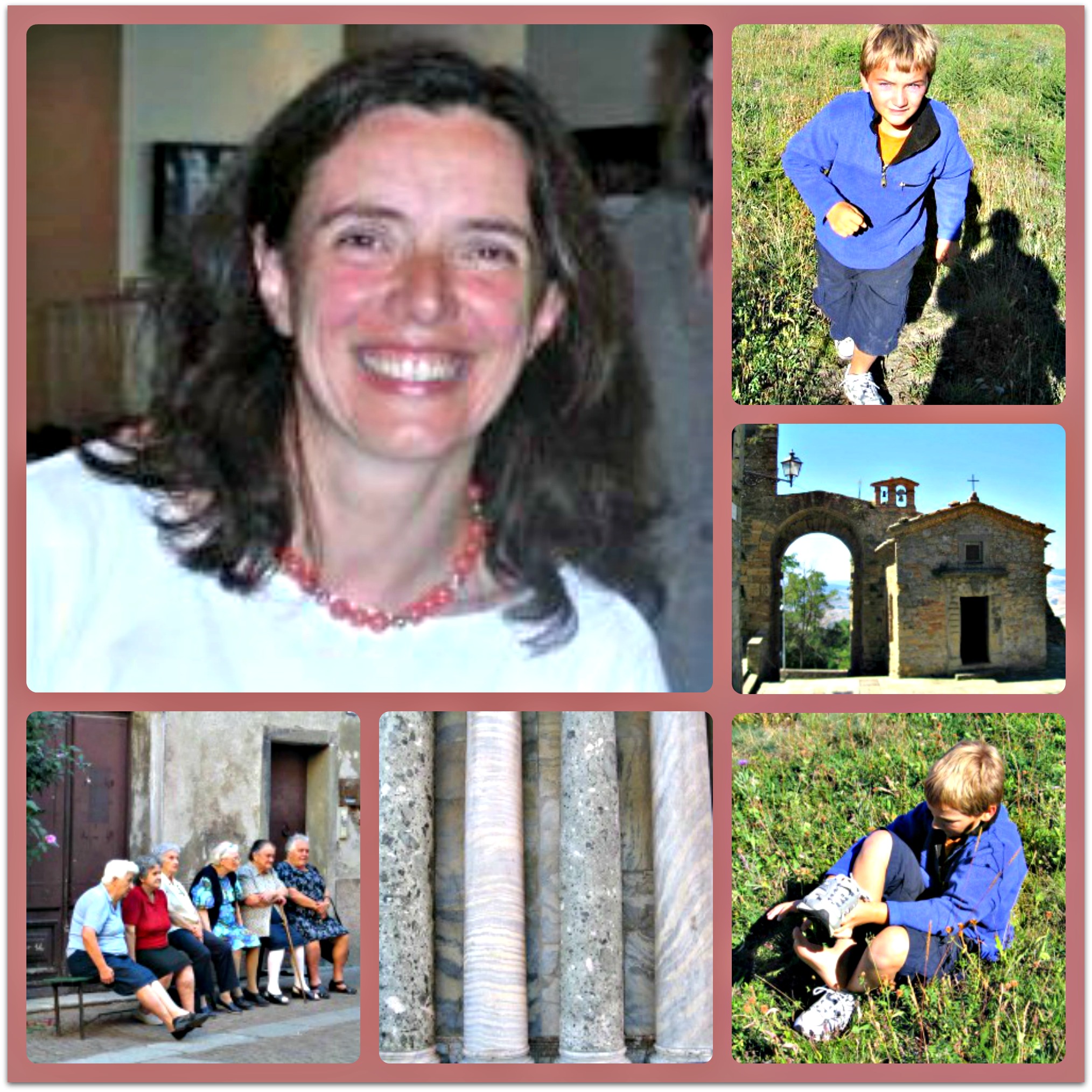
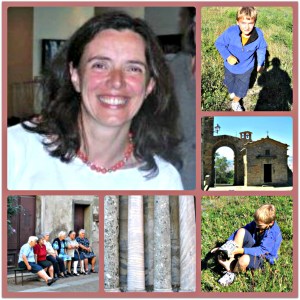
Images: Olga Vannucci and George, interspersed with Italian scenery. Of the George photos, Olga writes:

Let me provide the audio from George: “Where are we going? How much longer? I have something in my shoe. I want to go back. Why are we doing this? Do you know where we are? Do you know where we’re going? Mammaaaaaaa!”

JACK THE HACK: Expat authors, let’s review the reviewer situation

JACK THE HACK _writingtipsAfter an expat experience in Bodrum, Turkey, that was literally something to write home about (as in a book!), Jack Scott traded in the dream for a less pressured existence back in the UK, than the one he was originally escaping from. In his monthly column for the Displaced Nation, he attempts to give back something to the poor souls out there who are still displaced and hacking away at travelogues-cum-memoirs or, in some cases, autobiographical novels. Jack the Hack has been there and done that and can lend a helping hand. Warning to non-Brits: Don’t be put off by his wry sense of humo(u)r!

—ML Awanohara

There’s no doubt that a sparkling set of reviews is one of the most potent ways to market a book (or anything else for that matter). Conversely, bad reviews (or no reviews at all) are poison.

So, how difficult is it to elicit those five gold stars everyone’s chasing?

Apart from emotionally blackmailing your nearest and dearest (something I assume you’ve already done), there are a number of little tricks you can try when it comes to beefing up your scrapbook.

Tricks of the trade

Here are three basics:
1) Whenever someone writes something positive about your masterpiece on social media or on your blog, do the right thing and thank them. While you’re at it, ask if they wouldn’t mind posting a review on Amazon or Goodreads. Some won’t but some will.

2) Search out book review sites online. Some review for free, some for a small fee—and all will expect a freebie. Many of these sites will post their review on the major bookselling sites as well as their own website.

3) Raise your game even further by approaching the Amazon top reviewers. Click on a reviewer, check out their interests and if they have listed their contact details, drop them a begging letter. This won’t guarantee you a good review (or one at all)—and be careful to select someone who is interested in your type of book. Someone into soft porn vampire romps is unlikely to rave about your expat escapades, however worthy and well written they are.

Damning with faint praise

There’s a downside to all this. Reviewing can be a rum business. Amateur hacks, often anonymous and sometimes with an axe to grind or with lofty literary pretensions, can damn with faint praise or go nuclear with their toxic pen.

Naturally, no book appeals to everyone. Literature, as with art, is in the eye of the beholder.

Even writers at the top of the heap get mixed critiques. Someone once wrote that Captain Corelli’s Mandolin was “…the worst book I’ve ever read.” Sure, it’s not everyone’s cup of tea—but the worst book ever?

Was the author, Louis de Bernières, much bothered? Not with a fat cheque for the film rights in his back pocket, he wasn’t.

Should a review like that count? Well, here’s the rub. Mass appeal retailers who positively encourage reviews as part of their business model are far too egalitarian. There’s very little discernment and no filter. Generally speaking, every comment carries equal weight. (A notable exception is something written by one of Amazon’s top reviewers, as mentioned earlier. These guys do have clout).

Hoisted by their own petard? If only…

Have you ever read a book review that’s so badly written, it’s barely readable? I know I have. Talk about irony. It’s like a playground brat screaming “I don’t like you so there!” just because he can.

For my part, if I don’t have anything good to say, I tend not to say it at all. It’s bad karma.

Like it or lump it, mixed reviews are an occupational hazard. People are entitled to express their view about something they’ve paid hard cash to read. Good, bad or indifferent, as long as it’s honest and not gratuitously offensive, it’s fair comment even when you think it’s unfair. Just hope the good drowns out the bad.

As for me, I’ve gotten off lightly. Reviews for my book have been very positive, but I’ve had the odd wobbly moment, too. Someone once joined Goodreads just to trash my book and make sure it dropped down a reading list by voting up every other title. Who was the literary troll? I will never know. Was I hurt? Sure was.

Rogue reviewers? It reminds me of why dogs lick themselves—because they can.

Which leads to—

WRITING TIP FOR EXPATS NO 6:

The best you can do is rise above the din, turn the other cheek and keep you own counsel. It doesn’t do to spit back even when sorely provoked.

* * *

Readers, any comments, further questions for Jack the Hack? He’ll be back next month with some more writing tips…

Jack Scott’s debut book, Perking the Pansies—Jack and Liam move to Turkey, is a bitter-sweet tragi-comedy that recalls the first year of a British gay couple in a Muslim country. For more information on this and Jack’s other titles, go to his author site.

STAY TUNED for next week’s fab posts!

If you enjoyed this post, we invite you to register for The Displaced Dispatch, a round up of weekly posts from The Displaced Nation, with seasonal recipes, book giveaways and other extras. Register for The Displaced Dispatch by clicking here!

Related posts:

Images: from top, clockwise: Hand with pen / MorgueFile.com; Boats in King’s Lynn, Norfolk / MorgueFile.com; Jack Scott, used with his permission; Turkish boats / MorgueFile.com

And the August 2013 Alices go to … these 3 international creatives

 © Iamezan | Dreamstime.com Used under license

© Iamezan | Dreamstime.com
Used under license

As subscribers to our weekly newsletter know, our Displaced Dispatch presents a weekly “Alice Award” to a writer or other kind of creative person who we think has a special handle on the curious and unreal aspects of the displaced life of global residency and travel. Not only that, but this person likes to use their befuddlement as a spur to creativity.

Today’s post honors August’s three Alice recipients. Beginning with the most recent, they are (drumroll…):

1) CALLISTA FOX, TCK blogger and author of the serial novel Suite Dubai

Source: “Friday Night Lights vs. The Eurotrash Girl on CallistaFox.com
Posted on: 26 June 2013
Snippet:

Our boarding school offered cheer leading as an afternoon activity… I signed up because it sounded better than typing or drafting and my parents wouldn’t pay for dressage. We knew only a handful of cheers. None of us could name a proper jump, let alone do one. We wore white tennis skirts and blue sweatshirts and any color of hightop Reebok we owned. When we ran out onto the field to do our pathetic cartwheels the audience was quiet, a few laughed. True, the grass was wet and my roommate Samantha slipped and skidded on her chin. We didn’t have our routine perfected.

Citation: Who stole the tarts, Callista? Who stole the tarts? Your account of your bout with cheer leading at a boarding school in Austria suggests that you were in a classic Alice-in-Wonderland situation, perhaps without even realizing it. Because no young American woman in her right mind would cheer an Austrian team playing Australia in American-style football on a field marked for soccer, unless they’d stepped through the looking glass. Indeed, your description is missing some crucial details, for instance:

  1. Were the teams using a koala bear as the ball? Koalas being to Austria what flamingos are to England—namely, more New World than Old. (Notably, koalas like to eat the leaves of the eucalyptus tree, which doesn’t exactly thrive in The Land of Long-needled Pines.)
  2. Did anyone propose a trial for all of those unruly fans in the half-filled stands who were throwing things at you and the other cheerleaders?

All of which brings us back to our original question: was it an Aussie or an Ausie, the Knave who stole the tarts? That’s what we (and presumably your all-American Texan husband) would most like to know.

Still, we did find amusing the tales of ThirdCultureKid-land that you told to your better half. Clearly your quintessentially TCK life had its moments, including the time you watched a guy eat glass in a bar in Nicosia, Cyprus, when you were only 14.

Is it any wonder that when your parents moved you back to Norman, Oklahoma, when you were 20, you felt exactly like Alice, who told her sister: “Oh, I’ve had such a curious dream!” (You did make a lot of it up, right?)

2) CHRIS ALDEN, British expat; author and journalist

For his book: “101 Reasons to Live Abroad…and 100 Reasons Not To”
Published: March 2013
From the book description:

Do you dream of living abroad? If so, you’re in good company. Tens of thousands of people every year emigrate from the UK—leaving behind the security of work, family and friends for the promise of better weather (hopefully), better prospects (sometimes) and a carefree existence (keep dreaming).

So is now the time to leave Britain and start life as an expat? Or have you already started planning the big move overseas?

101 Reasons to Live Abroad … & 100 Reasons Not To helps you discover if living abroad is right for you. It’s an uplifting guide to the positive sides of life as an expatriate—and a reality check about the challenges that relocation brings.

Citation: Chris, we understand that you’re also the author of 250 Things to Do in Cyprus on a Sunny Day, so would encourage you at some point to compare notes with your fellow Alice awardee, Callista Fox. In the post cited above, Callista reports that, when attending boarding school in Nicosia, she and her friends particularly enjoyed hanging out in a bar drinking Carlsberg with UN soldiers (they were there to keep the peace between Cypriots and Turks). We’re genuinely curious: does this particular activity rank in your Top 250? Or perhaps you think it’s better left for a rainy day? (Actually, does Cyprus even have rainy days? Oh, that’s right: it’s only semi-arid.)

Anyway, we’re awarding you an Alice because, like Lewis Carroll’s little heroine, you appear to appreciate both the positive and negative aspects of turning one’s life upside down, with the balance tipped every so slightly towards the positive. We believe Alice would be impressed that you offer a final, 101st reason to live abroad for those who, having been offered as many as a hundred reasons both for and against, still find themselves dithering. After all, when Alice’s sister urges her to run inside to get her tea, she obliges her “thinking while she ran, as well she might, what a wonderful dream it had been.”

3) LINDA JANSSEN, writer, speaker, consultant, global adventurer and cultural enthusiast

For her book: “The Emotionally Resilient Expat”
Published: 22 June 2013
From the book description:

Linda A. Janssen combines candid personal stories from experienced expats and cross-culturals, with a wealth of practical tools, techniques and best practices from emotional, social and cultural intelligence, positive psychology, mindfulness, stress management, self-care and related areas.”

Citation: Linda, as you know, we’ve been an avid follower of yours on Adventures in Expatland, which has helped to stimulate many of our own “through the looking glass” insights. And now we see you’ve contributed a tome to the discourse on what to do when you fall through the rabbit hole and feel culturally discombobulated. According to your book, which is sprinkled with expat stories and anecdotes, the answer lies in calling on (or developing) reserves of emotional resilience—a quality Alice had in spades, so to speak. Upon hearing of the Queen of Heart’s intention to have her decapitated, she retorted thus:

You’re nothing but a pack of cards!

At which point

the whole pack rose up into the air, and came flying down upon her: she gave a little scream, half of fright and half of anger, and tried to beat them off, and found herself lying on the bank, with her head in the lap of her sister, who was gently brushing away some dead leaves that had fluttered down from the trees upon her face.

Now if that isn’t resilience, what is?

From now on, we look forward to reading about your Adventures in Repatland, which as we noticed from your last post, are only just beginning:

At long last I’m beginning to surface, coming up for air in a new stage in a new place in a country and culture which seem familiar yet I don’t always recognize.

Hey, if it helps to know, we’ve got your back on this one!

* * *

So, readers, do you have a favorite from the above, or have you read any recent posts you think deserve an Alice Award?  We’d love to hear your suggestions! And don’t miss out on these weekly sources of inspiration. Get on our subscription list now!

STAY TUNED for our next post!

Writers and other international creatives: If you want to know in advance whether you’re one of our Alice Award winners, sign up to receive The Displaced Dispatch, a round up of weekly posts from The Displaced Nation, with news of book giveaways, future posts, and of course, our weekly Alice Award!. Register for The Displaced Dispatch by clicking here!

Related posts:

LOCATION, LOCUTION: Award-winning author Steven Conte, bringing location to life through writing

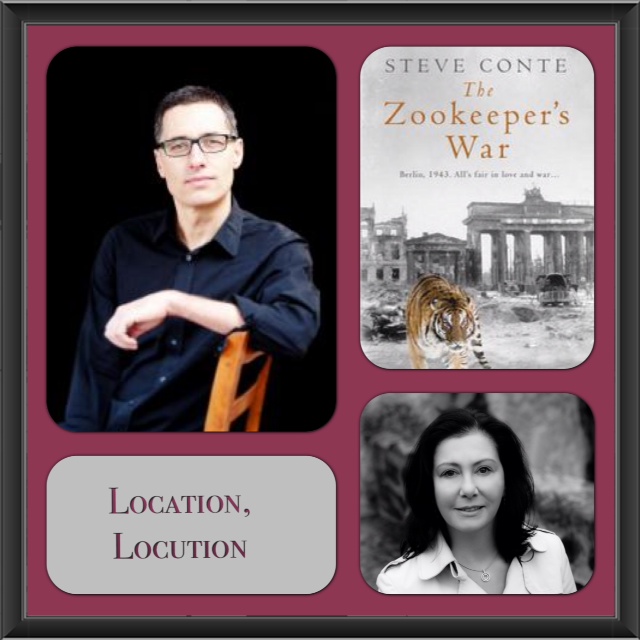
steven conte visualIn this month’s “Location, Locution”, expat crime writer JJ Marsh interviews  Steven Conte, the Melbourne-based author of The Zookeeper’s War. The setting is the Berlin Zoo, 1943. An Australian woman, Vera, and her German husband, Axel, the zoo’s director, struggle to look after the animals through the air raids and food shortages.

In 2008, The Zookeeper’s War won the inaugural Australian Prime Minister’s Award for Fiction, then worth A$100,000. The Zookeeper’s War has been published in Britain and Ireland and translated into Spanish and Portuguese. Barman, life model, taxi driver, public servant, book reviewer and university tutor are some of the jobs with which Steven has supported his writing.

*  *  *

Which comes first, story or location?
For me this depends on the project. The city of Berlin was definitely the initial inspiration for The Zookeeper’s War, in particular the atmosphere of enclosure and entrapment which I sensed there three years before the Berlin Wall came down. While I chose to set my novel in the Berlin of WWII, the Cold War tensions I had witnessed there in 1986 helped me to imagine what it might have felt like to live through the twelve terrifying years of the Third Reich. It was only after the novel was published that I realised I had chosen a setting which has powerful, indeed mythic, associations for many readers (some other examples being New York, Paris, London and, in the east, Hong Kong and Shanghai).

How do you go about evoking the atmosphere of a place?
Stimulating the reader’s senses is the most reliable way, though in a realist narrative a character needs psychologically plausible reasons to notice his or her environment, a difficult ask if focal characters are already familiar with their surroundings. Selecting a focal character who is a newcomer to the setting is one way to emphasise place. Another is to take the focal character on a journey. In The Zookeeper’s War I chose a setting which aerial bombing destroys day by day, compelling the characters to keep on noticing their surroundings.

Which particular features create a sense of location? Landscape, culture, food?
All of the above, provided that accounts of them belong in the story and ring true to the narrative voice. Ideally, descriptive detail reveals as much about the focal character or narrator as it does about setting. In contrast, “unanchored” description can sound like passages of travel writing or anthropology.

How well do you need to know the place before using it as a setting?
With skill, only moderately well, though it’s probably wise to minimise the difference between your characters’ supposed knowledge of a setting and your own. This aside, the best fiction implies more than it states (Hemingway’s iceberg principle), and a few vivid details can be enough to evoke an entire town or city or region. I’d recommend not writing about famous landmarks, since locations such as the Brooklyn Bridge, the Eiffel Tower and the Brandenburg Gate will remain clichés of place however brilliantly they might be described.

Could you give a brief example from your work which you feel brings the location to life?
In the following passage from The Zookeeper’s War the heroine, Vera, walks through Berlin the morning after an air raid:

In the Mitte, the old city, bombs had caved in the skyline, dropping telegraph poles, power lines and tram cables onto burnt-out lorries and trams. Shops were destroyed or boarded up, and glass, chunks of plaster and shrapnel paved the streets. Field kitchens had sprouted at the major intersections, and in alleys off Alexanderplatz girls were already soliciting. Outside one bombed-out tenement Vera read the chalked inscription, Everyone in this shelter has been saved. Around the corner: My angel where are you? Leave a message for your Sigi. In a house without walls on Unter den Linden, a man played Bach on a grand piano, and below him, in a lake fed by a burst water main, a fur stole clung to a hatstand. Half the people on the streets wore a uniform: police, air-raid wardens, women postal workers. Soldiers moved in squads and the only vehicles were staff cars and Wehrmacht lorries, as if the army had conquered Berlin and deployed clerks and shop assistants to the front in a fleet of private cars.

Which writers do you admire for the way they use location?
Cormac McCarthy for the poetry and grandeur of his descriptions, in Blood Meridian and The Border Trilogy, of the border regions of Mexico and the United States. Colm Tóibín for his evocation of the eroding coastline of County Wexford in his early novel The Heather Blazing. William Styron for the magnificent range of settings in Sophie’s Choice, from post-war New York, New England and North Carolina to Warsaw under German occupation and the netherworld of Auschwitz.

* * *

Readers, what did you think of Steven’s suggestions on evoking place? Next month, my guest will be Liza Perrat, author of Spirit of Lost Angels.

JJ Marsh grew up in Wales, Africa and the Middle East, where her curiosity for culture took root and triggered an urge to write. After living in Hong Kong, Nigeria, Dubai, Portugal and France, JJ finally settled in Switzerland, where she is currently halfway through her European crime series, set in compelling locations all over the continent and featuring detective inspector Beatrice Stubbs.

STAY TUNED for Tuesday’s, another installment in the life of our fictional expat heroine, Libby. (What, not keeping up with Libby? Read the first three episodes of her expat adventures.)

If you enjoyed this post, we invite you to register for The Displaced Dispatch, a round up of weekly posts from The Displaced Nation, with seasonal recipes, book giveaways and other extras. Register for The Displaced Dispatch by clicking here!

Related posts:

NEW VS OLDE WORLDS: The “expat ten” can work both ways!

Libby Collage New&OldEvery two weeks, the Displaced Nation publishes an episode in the life of fictional expat Libby Patrick, a 30-something British woman who has relocated with her spouse to a town outside Boston. Her diary, Libby’s Life, by Kate Allison, is replete with observations about life in New England vs. England. In the weeks when Libby isn’t published, we are featuring posts by writers who are sensitive to the subtle yet powerful differences between new and “olde” worlds. Today Bobbi Leder, an American trailing spouse, responds to Claire Bolden’s post of two weeks ago, in which she claimed that a tour in the United States inevitably entails a ten-pound weight gain. Turns out, it goes both ways!

—ML Awanohara

* * *

Bobbi with sausage and friesMexico has just surpassed the United States as the fattest country in the world, according to new UN figures released last month.

It’s an honor another country can have as far as I’m concerned, but when America was the fattest in the land I was truly perplexed.

Yes, you heard that right: perplexed. Now I know there’s a lot of unhealthy food in the States (e.g., BBQ ribs, deep-fried everything-you-can-possibly-think-of, junk food galore) and many Americans are addicted to their sugar, fat and salt. But conversely there’s also a lot of very healthy food available in the States.

At the end of the day, it’s about making a choice.

When I expatriated to the UK over a decade ago—I moved from the Washington, D.C., metro area to Southampton, on the south coast of England—I didn’t have many healthy choices. Over a decade ago, that part of England simply didn’t have health food stores, nor were there restaurants catering to those of us who sought out low-fat, low-salt meals. As for vegetarian dishes, these were practically non-existent.

It was impossible to find a sandwich where the bread wasn’t smothered in butter or the fillings weren’t loaded with fatty meats or (full fat) mayonnaise. I found it very difficult to eat well because the food options I was used to simply weren’t available.

Cheery bye to Size 2!

Before moving to England I was thin, some would even say skinny at a size 2 (an American size 2 that is); but after living in Southampton for a few months, my weight crept up on me like a burglar in the night, and before I knew it, I was two sizes heavier.

And if you think I was binging on fish and chips, think again. I never touched any of the stereotypical British foods because they loaded with saturated fat. I still remember never being able to eat breakfast at the Southampton airport because all they served was the greasy English breakfast. The sight of a full English breakfast made me nauseous: back bacon, sausages, beans, two fried eggs, mushrooms, and fried bread, all cooked in grease—and they say America is the capital of fried food?

There was a reason why we went out for Thai food every Friday. It was the only place we could find that didn’t serve fatty meals and they’d alter any dish to suit their customers. Forget about trying to find a healthy item on the typical pub menu or in the food court of the local mall.

Even in the supermarkets I couldn’t find the healthy choices I was used to, like veggie burgers, soy cheese, and low-calorie bread.

Before moving to Southampton, I’d eaten a mostly ovo-vegetarian diet, with the occasional lean poultry and fish. When I wanted “junk food,” I would buy lower calorie options like baked potato chips.

After the move, I felt as if I had no choice but to start eating ingredients I never would have eaten otherwise including pork, beef and cheese. And food prices were higher compared to the States, which made grocery shopping a challenge—even at Asda, a British supermarket chain owned by Walmart. The produce was often not up to par, and grocery costs were higher than we’d budgeted for.

So I found myself eating things that made me gain weight—despite going to the gym four times a week, and either walking or biking to most places—and I wasn’t happy about it.

New diet, new regimen

After receiving an invitation to my cousin’s wedding in the States, I knew I had to lose weight in just a few months, so I did something I never had the time to do before: I learned how to cook.

I looked for low-fat recipes online that included ingredients I could realistically obtain. I took charge of what I was eating despite my location and its limitations.

Eventually, the weight came off, and after living in Southampton for a year and a half, we moved to London, where healthier food choices were more readily available.

I even took my cooking to the next level after watching British culinary shows—I knew the Brits could make healthy food—and began to make gourmet meals that were not only tasty but low in calories and fat.

After London we moved to Wales and wound up being in the United Kingdom for six years. Not once during that time did I have:

I did, however, have one British staple: the Sunday roast, which consists of roasted vegetables, potatoes and lean beef or chicken.

It was actually one of my favorite meals.

My cup of tea

Today, after moving a few more times (ah, the life of a trailing spouse!), I live in St. John’s, Newfoundland, where I’m fortunate that the times have changed and health food as well as vegetarian options are the norm in most supermarkets and restaurants.

I have no idea if Southampton now offers healthier choices in their restaurants and supermarkets—one can only hope so for the sake of the university students who make up a large population of its city.

The moral of my story is that even though you might move to a country (or an area of that country) where fatty food is the staple, it doesn’t mean you have to eat it.

Looking back, I’m grateful for my experience in Southampton because even though I saw beef and cheese as the enemy when I first moved there, I still eat both today (just in moderation alongside my usual healthy diet), which makes life so much easier when dining out and moving around the globe as an expat.

* * *

Thanks, Bobbi, for making us realize that America is not the only country that fosters weight gain. Readers, what do you make of her observations? Are we global nomads destined to balloon in size as we move around the globe—has that been your experience? Do tell! (A good thing Bobbi hasn’t ended up in Mexico yet, that’s all I can say…)

Bobbi Leder, 43, is originally from New York and grew up in New Jersey. She has moved at least 11 times (she lost count after the fifth move) in the last 18 years thanks to her husband’s job in the oil and gas industry. Leder is a freelance writer and the author of the children’s book, The Secret Police-Dog, but her most important roles are those of cocker mom (to her very high maintenance English cocker spaniel or just cocker spaniel to everyone outside of North America) and wife to her workaholic husband. Leder still exercises several times a week, eats well most of the time—hey, a gal has to treat herself every now and then—and does something British daily: she drinks tea.

STAY TUNED for next week’s fab posts!

If you enjoyed this post, we invite you to register for The Displaced Dispatch, a round up of weekly posts from The Displaced Nation, with seasonal recipes, book giveaways and other extras. Register for The Displaced Dispatch by clicking here!

Related posts:

img: Bobbi Leder enjoying(?!) a sausage and fries during a trip to Germany while living in the UK.

Portrait of woman from MorgueFile; Lighthouse (R) from MorgueFile; Lighthouse (L) from MorgueFile

JACK THE HACK: Expat writers, now to deal with fame and fortune … or the lack

JACK THE HACK _writingtipsJack Scott is back with his monthly column for all of you wannabe authors who are hacking away at travelogues-cum-memoirs, or autobiographical novels. After an expat experience in Bodrum, Turkey, that was literally something to write home about, Jack and his partner, Liam, traded in the dream for a less pressured existence back in the UK.

—ML Awanohara

So your labour of love is out there on the virtual shelves (and a few actual shelves with a fair wind and a bit of luck). After an initial flurry, it’s all gone a bit quiet on the sales front and you’re dropping down the Amazon rankings like a stone.

It can be disheartening, depressing even.

We all want a little recognition for our art and a few shillings for our trouble—but don’t let the dream carry you off with the fairies. Let’s face it, very few authors make a decent living from writing and even fewer reach the premier league (if only I had that idea about a boy wizard called Harry).

So don’t expect literary agents to vie for your attention or film moguls to beat a path to your door. Hell might freeze over before that invite to the daytime TV sofa drops on the mat. Nor will you be batting off the paparazzi with a stick—even well-known writers aren’t photo-fodder for the Sunday rags. Instant celebrity is generally reserved for the young and fresh faced.

Writing’s just not that sexy.

Will it even pay the rent?

Sure, writing can provide a useful extra income stream but it’s unlikely to pay the rent.

Unless you’re tapping into that trust-fund set up my your dearly departed maiden aunt (the one everyone knew was a lesbian but no one mentioned it) or have a partner who doesn’t mind indulging you (that’ll be me, then), don’t give up the day job just yet.

Even a book that does well won’t buy you that Maserati. If you’re lucky enough to get a publishing deal, expect a royalty rate of between 10 and 50 percent. This sounds a lot (particularly at the upper end) but remember, that’s a percentage of net sales after pretty much everyone else has taken their cut.

You will be last to be fed.

But, not to despair!

All is not lost. You might be able to supplement your royalties by writing for Websites and magazines because, as a published author, your street cred will improve and you’ll be seen as someone with something interesting to say.

Not to mention the chance to promote your book.

Trouble is, most don’t pay very much or don’t pay at all. Another option is to sell your soul to the Devil by writing general copy for a huge range of internet sites desperate for content. Again, they pay a poor return and you may not get any credit for your words.

Whatever you earn, whether you’re a minnow of a big fish, remember to declare your income to the nasty taxman. You don’t want a stink in the clink, do you?

What’s it all about, Jack?

I don’t know about you, but this isn’t the reason I got into this writing lark. Cherish your writing for what it is, something you enjoy and have a passion for.

Be careful though. It’s very easy to get lost in the scribbling moment (I know, I’ve done it). It’s intoxicating. Suddenly you snap out of it only to realize that you’ve sat by the computer all day long in your nightie, haven’t washed, haven’t brushed your teeth—and you’ve forgotten to pick the kids up from school.

Quick, stick that ready meal in the microwave and get to the kids before social services do.

So, savour the unique voice writing gives you but remember to look up occasionally. A little ambition and self-belief is a good thing. There’s no need to lower you expectations, just keep them in check.

Which leads to—

WRITING TIP FOR EXPATS NO 5:

Be realistic. You never know, you might hit the jackpot. But, until that day comes, write for the right reasons.

* * *

Readers, any comments, further questions for Jack the Hack? He’ll be back next month with some more writing tips…

Jack Scott’s debut book, Perking the Pansies—Jack and Liam move to Turkey, is a bitter-sweet tragi-comedy that recalls the first year of a British gay couple in a Muslim country. For more information on this and Jack’s other titles, go to his author site.

STAY TUNED for next week’s fab posts!

If you enjoyed this post, we invite you to register for The Displaced Dispatch, a round up of weekly posts from The Displaced Nation, with seasonal recipes, book giveaways and other extras. Register for The Displaced Dispatch by clicking here!

Related posts:

Images: from top, clockwise: Hand with pen / MorgueFile.com; Boats in King’s Lynn, Norfolk / MorgueFile.com; Jack Scott, used with his permission; Turkish boats / MorgueFile.com

And the July 2013 Alices go to … these 4 international creatives

 © Iamezan | Dreamstime.com Used under license

© Iamezan | Dreamstime.com
Used under license

As subscribers to our weekly newsletter know, each week our Displaced Dispatch presents an “Alice Award” to a writer who we think has a special handle on the curious and unreal aspects of the displaced life of global residency and travel. Not only that, but this person likes to use their befuddlement as a spur to creativity.

Today’s post honors July’s four Alice recipients, beginning with the most recent and this time including citations.

So, without further ado: The July 2013 Alices go to (drumroll…):

1) HELENA HALME, author and Finnish expat in London

For her latest novel: The Red King of Helsinki
Published: March 2013
From the book description:

Nordic Noir meets Cold War Espionage.

Pia’s ambitions to win a gymnastics competition between her Helsinki college and a school from Moscow trigger a set of dangerous events when her best friend disappears and a violent KGB spy, The Red King of Helsinki, threatens her. Will a friendly British ex-navy officer, Iain, be able to save Pia before its too late?

This fast-moving novel set in Finland has everything—a young, feisty protagonist, Nordic Noir and old-fashioned chivalry.

Citation: Helena, how could we not award you an Alice once we heard you’d written a story revolving around a Red King? While we do not know whether you purposely modeled your Red King of Helsinki on the Red King of Lewis Carroll’s Through the Looking Glass, it almost doesn’t matter. The point is, you present us with a classic through-the-looking-glass situation, having set the action during the Cold War and made your Red King into a Soviet spy. Will Pia/Alice checkmate the Red King with the help of that kindly British military gentleman? Or will she go out—bang—like a candle? No need for Tweedledum/dee to explicate. What’s more, you are the perfect person to take us on this particular fictional journey. With your thick blonde locks and acute appreciation for the curious and unreal in your adopted country, it’s not much of a stretch to dub you the Finnish Alice!

2) TRACEY CROKE, Manchester-born, Australia-based freelance journalist and blogger

Source: “A Pom versus the pests” in Telegraph‘s Expat Life
Posted on: 12 June 2013
Snippet:

Small self-amputating lizards dart out of my fruit bowl. Ants march in to weightlift a few missed crumbs off my floor. Possums push their cute limits with roof-dancing antics.

While the elusive ghost bug remains a mystery, large “harmless” spiders, innocent-sounding paper wasps and alien insects get the boot or get spiked by my neighbour’s stilettoes.

It’s just a few of the ways to deal with uninvited houseguests in the subtropics.

Citation: Tracey, your description of the critters of Aussie-land is almost as fascinating as Alice’s account of Wonderland’s inhabitants. In fact, in many ways it sounds as though you have it worse than Alice, who at least didn’t have lizards and hairy hunstman spiders to contend with, though she did have the Caterpillar. Still, on the plus side, you’re lucky that these various creatures do not interact, apart from the Hunstman spiders, that is, who like to eat cockroaches and geckos. Poor Alice, in watching a large plate come out of the door of the Duchess’s house and graze the nose of her footman, couldn’t help but mutter to herself: “It’s really dreadful, the way all the creatures argue. It’s enough to drive one crazy!”

3) STEPHEN CLARKE, an Englishman who grew up in Bournemouth and now lives in Paris; author and Telegraph Expat blogger

Source: “If you listen carefully, you can hear French cheese breathing,” in his Telegraph Expat blog
Posted on: 6 July 2013
Snippet:

A friend sent me the link to a BBC report about American food officials declaring French cheese “filthy” and inedible. The funniest thing was that it was Mimolette, a hard Edam-like cheese that even I as a Brit find a bit bland. It’s usually sold in small semi-circular slices with a curve of rind, or the kind of rectangular rindless blocks that you would think the Americans might enjoy. It’s the last cheese you would expect to get an import ban.

Citation: Stephen, we agree with you that anything bland does not deserve an import ban. For Alice, the most objectionable food in Wonderland was the Duchess’s soup, which had so much pepper that she, the Duchess, and the Duchess’s baby couldn’t stop sneezing. That would hardly do for a roomful of customs officials! Also, since you did such a good job in writing about cheese, we hope you will write about mushrooms next—a food close to Alice’s heart, and also, we believe, very important to the French. Only, do they have any varieties that can alter one’s size? (As long as they don’t alter speed, Americans may not object…)

4) TORRE DE ROCHE, Australian-American TCK and author

Source: “Blogger to Watch: Torre de Roche talks about her journey to big publishing deal”: interview by Jade Craven on ProBlogger.net
Posted on: 22 June 2013
Snippet:

Art is uncertain. Sometimes, in order to feel the delicious comfort of certainty, you might try to make art while grasping onto some idea or technique that seems safe. If you do that, your writing will come out stiff and contrived because you’re not creating, you’re imitating.

Loosen your grip. Let go of control. Embrace the freefalling sensation of having no idea where you’re going with something.

Good art comes from risk, experimentation, and play.

Citation: Torre, we love the way you took your own advice and embraced the free-falling sensation of having no idea where you were going when you fell for a handsome Argentinean man with a humble sailboat and agreed to join him in pursuing the dream of setting off to explore the world, this despite your morbid fear of water. You’ve had a series of adventures to rival Alice’s. Also like her, you’ve lived to tell the story for subsequent generations of wannabe free-falling adventurers, via both your highly successful blog, which you aptly refer to as a “literary potluck party, Mad Hatter style,” and now memoir, Love with a Chance of Drowning. Kudos!

* * *

So, readers, do you have a favorite from the above, and do you have any posts you’d like to see among August’s Alice Awards? We’d love to hear your suggestions! And don’t miss out on these weekly sources of inspiration. Get on our subscription list now!

STAY TUNED for tomorrow’s post!

Writers and other international creatives: If you want to know in advance whether you’re one of our Alice Award winners, sign up to receive The Displaced Dispatch, a round up of weekly posts from The Displaced Nation, with news of book giveaways, future posts, and of course, our weekly Alice Award!. Register for The Displaced Dispatch by clicking here!

Related posts:

LOCATION, LOCUTION: Booker Prize-nominated author AD Miller, on bringing a location to life through writing

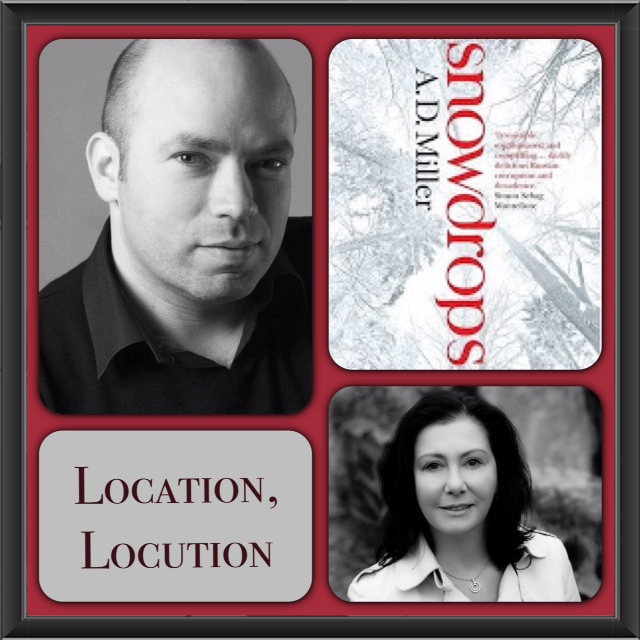
ADMillerIn the second of our series “Location, Locution”, expat crime writer JJ Marsh interviews AD Miller, the British author and journalist.

About AD Miller

AD Miller was born in London in 1974. He studied literature at Cambridge and Princeton, where he began his journalistic career writing travel pieces about America. Returning to London, he worked as a television producer before joining The Economist to write about British politics and culture. In 2004 he became The Economist’s correspondent in Moscow, travelling widely across Russia and the former Soviet Union. He is currently the magazine’s Writer at Large; he lives in London with his wife Emma, daughter Milly and son Jacob. He wrote a critically acclaimed non-fiction book, The Earl of Petticoat Lane, in 2006. His second novel, Snowdrops, was shortlisted for the 2011 Booker Prize.

About his novel, Snowdrops

A fast-paced drama that unfolds during a beautiful but lethally cold Russian winter. Ostensibly a story of naive foreigners and cynical natives, the novel becomes something richer and darker: a tale of erotic obsession, self-deception and moral freefall. It is set in a land of hedonism and desperation, corruption and kindness, magical hideaways and debauched nightclubs; a place where secrets, and corpses, come to light when the snows thaw.

Q&A on Location, Locution

JJ Marsh: Which comes first, story or location?  
AD Miller: Story. But locations can be suggestive of certain kinds of story. For example, Russia lends itself to tales of moral challenge and to philosophical inquiry.

JJM: How do you go about evoking the atmosphere of a place?
ADM: Take notes. Write down what people wear on the Metro and what the vendors on commuter trains are selling. You will recollect less than you think you will. For historical settings, read old newspapers and unpublished memoirs. Remember it is the inconsequential detail that is most important.

JJM: Which particular features create a sense of location? Landscape, culture, food?
ADM: Smell. Sounds. Language (especially slang and proverbs). Clothes. And weather: in Snowdrops, the Russian winter functions as a sort of ancillary sub-plot.

JJM: How well do you need to know the place before using it as a setting?
ADM: You need to know it, and then you need to unknow it. A novel isn’t a travelogue or an encyclopaedia; you enlist only those aspects or details of a place that serve the narrative.

JJM: Could you give a brief example from your work which you feel brings the location to life?
ADM: There’s a passage in Snowdrops in which Nick, the narrator, is taxiing at night alongside “the soupy Moscow River, not yet frozen and curling mysteriously through the wild city”, which is OK.

JJM: Which writers do you admire for the way they use location?
ADM: Isaac Babel and Giorgio Bassani (Odessa and Ferrara respectively).

* * *

Thanks, JJ, for that fabulous interview! Readers, any comments on what AD Miller had to say? Up next month in Location, Locution: Steven Conte, Australian author of The Zookeeper’s War.

JJ Marsh grew up in Wales, Africa and the Middle East, where her curiosity for culture took root and triggered an urge to write. After living in Hong Kong, Nigeria, Dubai, Portugal and France, JJ finally settled in Switzerland, where she is currently halfway through her European crime series, set in compelling locations all over the continent and featuring detective inspector Beatrice Stubbs.

STAY TUNED for tomorrow’s post, another installment in the life of our fictional expat heroine, Libby. (What, not keeping up with Libby? Read the first three episodes of her expat adventures.)

If you enjoyed this post, we invite you to register for The Displaced Dispatch, a round up of weekly posts from The Displaced Nation, with seasonal recipes, book giveaways and other extras. Register for The Displaced Dispatch by clicking here!

Related post:

Why “exbrats” in São Paulo need their own book to appreciate life in Brazil’s largest city

MeganFarrell CollageThis week’s guest interviewee is Megan Farrell, who like myself is an estrangeiro (foreigner) in São Paulo and married to a Brazilianalthough unlike my good British self, Megan is American and also has a young daughter (sounds like far too much responsibility if you ask me!).

Megan and her family previously lived in New York, but she took a sabbatical from her job on Wall Street in 2009 to become a full-time mum. Then, when her husband was offered a job opportunity here in São Paulo in 2010, they decided it would be a perfect opportunity for Megan and their daughter to learn Portuguese, experience life in a different culture, and learn more about Dad’s home country.

I first came to know of Megan when I moved to São Paulo myself at the start of 2012 and found her blog Born Again Brazilian whilst doing some research for my own blog. Ever since, I’ve kept up-to-date with her tales and travails, and was pleasantly surprisedif not a little enviouswhen she announced earlier this year that she would be releasing a step-by-step guide for foreigners who are living (or planning to) in São Paulo: American Exbrat in São Paulo: Advice, Stories, Tips and Tricks for Surviving South America’s Largest City.

I say envious because a similar idea had occasionally cropped up in my mind, but having read Megan’s book, I’m actually rather glad I didn’t attempt it myselfthere’s no way I could have had done the topic justice to the same extent. Megan has done her research, even offering advice on visas, taxes and other mundanebut extremely importantdetails that a move to São Paulo can entail. She includes things I would definitely not have thought of or, to be honest, had the patience to cover.

My only quibble—which perhaps tells you more about me than it does about the book, which is excellent—is that it reflects the experiences of a small minority in Brazil: exbrats. As someone who loves history as well as current affairs, I tend to prefer books that provide a holistic overview of life in a particular country. What’s more, the life of the exbrat seems completely outside my realm of experience. Though a cynic might suggest that I’m on an extended holiday, I didn’t move to Brazil on an all-expenses paid work package.

And to be fair, Megan doesn’t fall into the “exbrat” category either: her husband is Brazilian so didn’t qualify for the relocation package that makes countries like Brazil so enticing to non-Brazilians.

So, who exactly are these exbrats? And why write a book for them? Megan and I had the pleasure of meeting up I person a few days ago and talking about the audience she had in mind for her book. The following are some highlights from our conversation.

* * *

AmericanExbratinSaoPaulo_cover_pmHi, Megan. Tudo bem? Why did you decide to write a guidebook for non-Brazilians who come to live in Sao Paulo?
If you are making a move to a country such as Brazil, you need to have your expectations managed appropriately. Much of the pain my fellow expats have experienced has been because they were unprepared to deal with some of the idiosyncrasies of life in São Paulo.

What do you mean by an “exbrat”? Was the book specifically aimed at them?
I used “exbrat” because it feels rather fitting of the collection of people I’ve come across here. Expats, including myself, often stomp their feet over inconveniences they’ve encountered here, yet still expect and enjoy all the benefits of being in Brazil. Not necessarily in a pejorative way, but it felt very bratty to me. You also meet people who were previously army brats and were never able to shake their nomadic waysso “exbrat” is also an adult term for these foreigners.

So exbrats are primarily the foreigners who move to Brazil because of job opportunities?
Yes, the target audience is largely people who are moving to São Paulo or have recently arrived in the city for work, as well as human resource managers at companies who send employees to Brazil.

You included yourself just now in the “exbrat” category. But you are married to a Brazilian who didn’t get an expat package.
Believe me, some aspects of the things I’ve experienced here in Brazil have been a shock, as they probably were to you as well. So, while the book is definitely aimed at exbrats, I don’t think it’s too “exclusive.” There is an element of the “exbrat” in all of us. Some people are never able to get out of the exbrat cycle and as a result, fail to take advantage of the opportunities living in this country offers. My hope is that my book will give them a clearer picture of what to expect, and how they can prepare for that reality, so that they can get over the culture shock and go exploring. One of the world’s most fascinating countries awaits.

I think I know what you mean. I particularly remember reading in the book about your shock of attending an officially organized children’s “play-date” and there being seven paid staff to run it, as well as each child returning home afterwards with a crystal tea set as a parting gift!
Yes, exactly! That is far removed from my experiences in New York but is not so uncommon if you and your family start to mix in the same social circles with people towards the very top end of society in Brazilwhether that be through expat communities, your child’s school, or spouse’s workplace.

Has the book reached other audiences besides those who are moving to São Paulo? Perhaps people moving to other South American countries or those where English is not the first language?
Thus far the audience has been very specific to people moving to São Paulo, as opposed to other countries in South America—or even other cities in Brazil. It’s also attracted a few readers who work with Brazilians but in other countries.

Injecting her own anecdotes, and photos, into the book

Which section of the book are readers enjoying the most?
People tell me that they really enjoy the humorous stories I’ve included, which are based on some of my most painful and awkward experiences. For example, I tell the story of how I visited the same bakery for over a year before someone explained that because I wasn’t emphasizing the appropriate accent in the word pão (bread), to a Brazilian ear it sounded like I was asking for pau (penis)! Living in a non-English-speaking country provides plenty of opportunities for embarrassment or frustration, but when something goes wrong, I’m the kind of person who chooses to laugh, not cry.

Did you connect with the city in any new ways in the process of writing the book?
Definitely. I wanted the book to be as complete as possible (without taking ten years to write) and so I did more exploring on some of the subjects I wanted to include. Also, the photos in the book, minus a few I purchased the rights to, are ones I took. Much of the photography I already had in my collection. But there were gaps, so I had to get out and take pictures, which always gives you a second perspective on what you are seeingmore removed and analytical.

The topic of domestic servants

What was your most displaced moment when doing the research for the book, when you wondered why you’d embarked on this mission?
Trying to explain the culture of the people who might work in your homethe culture of the working poor in Brazil.

What do you mean when you say “culture of the working poor”? In your book you seem to suggest that household workers, who are of a far less lower rung on the lady in Brazilian society, are just taking advantage of the situation that they are in. Do you think this is cultural, or the impact of their socio-economic circumstances?
Half and half. I think it is definitely a Brazilian thing to try to take advantage of different situationsand this exists at all levels of society. For example, there’s the term jeitinho Brasileiro, which Brazilians use for situations in which they “creatively” try to get round complications in life.

However, yes, there is also a socio-economic component. If you are from a poor neighborhood and are working in the home of a rich family or person, it’s probably not too surprising that you might want to take advantage of your situation by asking for a loan or a raise.

From blogging to book-writing (she hasn’t looked back!)

Why a book instead of a series of blog posts?
Believe it or not, people still like reading books! HA. Over the past three years, since I’ve written my blog, I’ve received a number of questions about moving to São Paulo and life here. Most of the answers were already within the posts of my blog. I wanted to create a document that was more comprehensive, arranged by topic and easier to navigate. I also did a survey of my expat friends, and almost all of them said they would have purchased at least three books about moving to São Paulo before they camehad any actually existed. So I decided there was at least a bit of demand. Blogs are great, but sometimes you want to read a story from beginning to end. Plus, I’ve always just wanted to write a book.

What was the most challenging part of the book-writing process?
Editing. The editing process was a collaboration with my awesome friends, as well as my mother. It’s difficult to edit yourself. Actually, it is impossible to edit yourself. And when you have a pile of people helping you sort through the stories and facts, you get lots of opinions. But it was all good. However, I don’t think I can advantage of my friends again, so I’ll probably hire an editor for the next one.

Why did you self-publish the book?
A few of my writer friends encouraged me to try and find a publisher. But I just couldn’t figure out what a publisher was going to do for me that I couldn’t do for myself. I have a strong network and a background that includes marketing. I also don’t have the patience to go through a bureaucratic publishing process with an extended timeline. I knew that even if I did manage to find a publisher, I would not be their priority. The market for this is not on the level that would make a publisher move fast.

What’s next? Are you working on any other writing projects?
I am. I’ll probably update this book sometime in the next year. I also plan to write one for Rio. My husband is from Rio, and most of my experiences in Brazil (prior to moving to São Paulo) were in that city, so I know it pretty well.

You mentioned at the outset that you like broader books. I’d love to write something about Brazil as a wholeto counter the focus I put in this one on the expat life. It won’t be another step-by-step guide but a more of a general analysis, including politics, culture and so forth.

Finally, I’m working on some fiction stories that take place in Brazil. When living in New York, I did a screenplay course so have some experience in writing fiction. Currently, my idea is to write two series of short stories. The first will be based around Brazilian folklore, and the second, around some real-life episodes I’ve witnessed that are difficult to record in a blog or non-fiction format.

Ten Questions for Megan Farrell

Finally, we’d like to ask a series of questions that I’ve asked some of our other featured authors, about your reading and writing habits:

1. Last truly great book you read: Don’t Let the Pigeon Drive the Bus, by Mo Willems. I have a five-year-old. But we’ve read it more than a hundred times and it still makes me laugh. Okay, Don’t Let the Pigeon Stay Up Late is another contender. Mo Willems is a genius.
2. Favorite literary genre: I’d love to lie and offer up a more intellectual answer, but my favorite genre has always been horror. I enjoy a good creepy tale. After that, humorous memoirs from people who have overcome great obstacles, like Jeannette Walls‘s The Glass Castle.
3. Reading habits on a plane: I’m most happy if I have a copy of The Economist with me on a plane
4. The one book you’d require President Obama to read, and why: I wish Michael Bloomberg would write a book that Obama could read, because I think the USA would benefit by being run more like a business. But since Bloomberg has yet to put pen to paper, I’d have to say Getting to Yes: Negotiating Agreement Without Giving In.
5. Favorite books as a child: I loved any book that involved a child in a new world. James and the Giant Peach. Charlie and the Chocolate Factory. The Little Prince. The Little House series by Laura Ingalls Wilder. Pippi Longstocking.
6. Favorite heroine: Wonder Woman. I think if Brazil had a Wonder Woman, or the collection of super heroes that we have in the States as—albeit fictional—role models, people would emulate change for the good of the people. Brazil needs to believe in something other than futebol—but that seems to be in the process of changing, as Andy and I discussed last month on this blog.
7. The writer, alive or dead, you’d most like to meet: Hands down, Stephen King. I hope he doesn’t die before I get to meet him. I just need to figure out a way to do it that doesn’t involve stalking.
8. Your reading habits: I used to spend the weekends (sometimes all weekend) reading. But now that I have a child, I usually read right before I go to bed—in bed.
9. The book you’d most like to see made as a film: American Exbrat in São Paulo, of course!
10. The book you plan to read next: I suppose I should say Fifty Shades of Grey, because I haven’t read much of it and people keep bugging me about it. But if you’ve read Anne Rice’s Sleeping Beauty Trilogy (I only read the first), Fifty Shades is like reading Judy Blume. Yawn. I think I’ll wait for Stephen King’s Doctor Sleep. How could anyone resist a sequel to The Shining?

* * *

Readers, as I said, Megan was a delight to meet in person, a sense of which I hope I’ve conveyed above. Any further questions? Have I pressed her too hard on the “exbrat” point?

STAY TUNED for tomorrow’s post, a new episode in our “Location, Locution” series, by JJ Marsh.

If you enjoyed this post, we invite you to register for The Displaced Dispatch, a round up of weekly posts from The Displaced Nation, with seasonal recipes, book giveaways and other extras. Register for The Displaced Dispatch by clicking here!

Related posts:

images: Megan Farrell’s author image and book cover; photo of Sao Paulo from MorgueFile.