The Displaced Nation

A home for international creatives

Tag Archives: What a Displaced World

My first flirtation with the lawlessness of global travel: 4 painful lessons

Today we welcome Lara Sterling to The Displaced Nation as a guest blogger. She wrote this post as part of our series on Gothic Tales, anchored by ML Awanohara’s “What did Agatha Christie know? Expats make great criminals.”  A native Californian, Sterling is an inveterate traveler. Her many adventures include a round-the-world trip and a stint as an expat in Spain (2001-2005).

Have you ever traveled to a foreign country, thinking you could get away with murder?

Maybe that’s what Amanda Knox was thinking…

Regardless of whether you believe Knox is guilty or not, I’m talking about getting away with murder on a trip I made to Guatemala.

Well, not actual murder — just a little bypassing of the laws.

War-torn tourism

This was Guatemala in 1993. The country was in the last days of a decades-long civil war. The nation’s social fabric had been torn apart. That meant there weren’t many laws anyhow. Or at least laws that anyone was abiding.
I remember one time drinking at a bar in Antigua, a city in the Guatemalan highlands. Plainclothes cops showed up to get bribes from the travelers who didn’t have passports.

I was twenty-three. I was a female traveling alone in a dangerous country. It was appealing to team up with the handsome German man I’d met in Antigua.

His name was Fritz. He wanted me to travel with him to the pyramids in Tikal, in the north.

I was nervous about travel to Tikal. I had heard many terrible stories about travel outside of the cities. Buses were high-jacked by bandits. Women were raped. But Fritz was gorgeous! I couldn’t resist.

Lesson #1: Don’t trust handsome Germans

Fritz and I traveled to Tikal without problems. I agreed to travel more, to Livingston, on the coast.

Livingston is an enclave in Guatemala. A slave ship wrecked there in a past century. The inhabitants speak a local patois, the Garifuna language.

Fritz and I disembarked the boat. There were men with machetes everywhere. They were returning home from work in the fields. My overactive tourist imagination went crazy. I thought we were going to be robbed at every corner.

Muggings and rapes were known to take place on the trails outside of town. Fritz wanted to hike, but I was nervous. We spent our afternoons at the beach and drinking coffees in the local cafes.

At some point, we were approached by one of the natives, a guy named Billy. He had a business proposition.

“Ya want to buy yaself some fun?” Billy asked.

“What’s that?” asked Fritz in English.

The man bent in close. “Crack.”

Crack cocaine? I asked myself. Surely, Fritz will say no.

He didn’t.

Lesson #2: Give a wide berth to a man with a machete

Before I knew it, Fritz and I were following Billy into a cluster of trees off of a back street. Billy’s eyes were bloodshot. He was armed with his machete. I was terrified.

Fritz handed over some quetzales. Billy handed over a small, plastic baggie.

Fritz and I retired to the room we were renting. I watched as Fritz got out some tin foil and a lighter. He began to smoke. The odor was metallic, and the smoke was blue. Fritz’s eyes glazed over.

I told him I was going for a walk.

I walked down to where the women washed their clothes in a community well. I can leave, I thought. I can get another room.

I couldn’t. I had a serious crush on Fritz.

Luckily, by the time I returned, the effects of the drugs had worn off of Fritz. He wanted to go out again.

It was still light. We walked to the edge of town. Fritz pointed to a small swathe of beige that looked like it was miles away.

“There’s a beach over there,” he said.

Between us and the beach was jungle.

Maybe in kilometers, it seemed shorter.

Lesson #3: Dogs are not the same the world over

Fritz and I began our hike. Because of the infamy of the trails, I was a nervous wreck. But I was also tired of buying into my fears. I had traveled all the way here. I might as well have some fun.

The sounds of birds chirping in the trees and of leaves rustling in the breeze calmed me.

Suddenly, two mutts appeared. They were small, and their coats were white and black. They were growling, barking.

I hoped they would go away, like the dogs I knew from home. They didn’t. The dogs moved closer, encroaching.

The mutts leapt at our bodies. One of the canines sank his incisors into my behind. I screamed.

Fritz was bitten too, in the leg.

A couple of Guatemalan children emerged from the jungle. They beat the dogs off with sticks. The dogs retreated behind the palms.

My bottom was bleeding. I needed stitches. Luckily, someone had called the local doctor. He was waiting for us on the street at the edge of the jungle.

The doctor led us to his office. I climbed onto his examining table. He numbed my butt, then sewed my loose flesh back up again.

“You must return to Guatemala City for rabies shots,” the doctor said.

I felt woozy, weak. “We’ll have to leave tonight,” I told Fritz.

“I can’t,” Fritz said. “I have to get to El Salvador.”

El Salvador?

“But what if you get rabies?” I asked.

“Then I will come and bite you,” Fritz responded.

He flashed me the same mischievous smile I had fallen for.

Lesson #4: Make sure you have a cubicle waiting for you back home

Fritz and I parted ways, never to meet again. Alone, I suffered through a week of visits to the Guatemalan hospital.

Each day, I took the bus to the hospital, then waited in the hours-long lines. Finally, I’d get my shot in the stomach.

The employees of the hospital were on strike. I was lucky I was treated at all.

It wasn’t until weeks afterward that I mustered up the gumption to leave the country.

Guatemala had changed me. I had learned a lot. A lot of lessons.

But I was also the same person: young, hungry, ambitious, confused.

I thanked my lucky stars there was a job waiting for me at home. In some cubicle!

I couldn’t wait.

Question: Have you ever encountered world travelers who think that the laws of the lands they visit don’t apply to them — and, time to ‘fess up, have you ever been in their ranks? We’d love to hear your stories.

Lara Sterling has contributed to many magazines, was a columnist for Spanish Playboy, and published one of Spain’s first non-fiction books on fetish sexuality. She currently teaches writing at www.yourplotthickens.com.

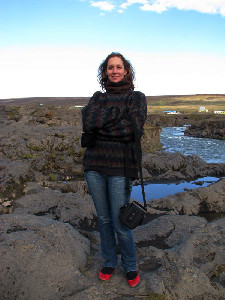
img: Lara Sterling on a lava bed in Iceland, on one of her many trips.

If you enjoyed this post, we invite you to subscribe for email delivery of The Displaced Nation. That way, you won’t miss a single issue. SPECIAL OFFER: New subscribers receive a FREE copy of “A Royally Displaced Tea.”

Related posts:

DISPLACED Q: What items from home can you not live without?

UK department store John Lewis recently announced it would soon launch versions of its Website for shoppers in 27 countries, including the USA, Australia, and Singapore. The company has no plans to open stores in these locations, however; all orders will be delivered by courier.

Marks and Spencer, another institution of the British High Street, already ships to 80 countries worldwide, even though it has over 300 international stores scattered around the globe.

It seems both John Lewis and M&S  understand something that all expats know — there are certain items you only feel comfortable buying from home.

Marks & Spencer, for example, accounts for around thirty percent of the UK lingerie market; it’s not unreasonable to assume that displaced Brits with diminishing lingerie supplies and no access to M&S stores make up a goodly proportion of the international shipping numbers. Meanwhile, John Lewis has the most popular gift list in the UK. How about some Conran bed linen or Denby pottery to make your relations feel at home in their Moscow abode? Sometimes only the familiar will do.

It’s not all about the goods, either. Expat in Germany, in her March 17 post, explained why she hesitated to buy a wedding dress in Germany instead of in her native Canada. It had nothing to do with the quality of wedding gowns and everything to do with the charming honesty of German sales assistants that made her pine for a gentler shopping experience at home.

But these facts and anecdotes made us wonder: No matter how displaced you have become, are there certain items — other than food — that you still prefer to import from your home country?

Two members of the Displaced Nation Team kick off the discussion:

Kate Allison: During my 15 years as a Brit in the US, I have been known to ask visitors to bring gifts of children’s cotton pyjamas. The cotton in the UK is much nicer, somehow, than in the US. I also had a brief sojourn into Next duvet covers, because duvets aren’t as popular in the US as they are in Europe.  Last time I was over, though, it was shoes that caught my eye. And yes, they came from Marks and Spencer. It’s not that they were any better than their American counterparts — just different, and not from Macy’s.

ML Awanohara: As far as wedding (and other special) dresses go, the more exotic the better. I was never an expat in Rome but went shopping for my wedding dress a few years back in a charming boutique, Maga Morgana, very near the Piazza Navona. (If I had it to do over, I’d have studied abroad in Italy — art history, of course. So perhaps I was playing out that fantasy…) Kate, it’s funny you mention shoes. While living in the UK and Japan, I always preferred to buy shoes in the US. It wasn’t that I didn’t like the shoes in those countries — I coveted them. But they made my feet hurt, something to do with the “last” not being big enough. I noticed recently on an expat news feed that displaced New Zealanders often head to a shop called Minnie Cooper’s as soon as they get home. This piqued my curiosity: is it for the styles, the NZ leather, or both?

Your turn to chime in: What homey items, apart from food, have you yet to wean yourself off?

If you enjoyed this post, we invite you to subscribe for email delivery of The Displaced Nation. That way, you won’t miss a single issue. SPECIAL OFFER: New subscribers receive a FREE copy of “A Royally Displaced Tea.”

What did Agatha Christie know? Expats make great criminals

I’m going to kill myself for saying this — I’m an Agatha Christie fan — but I think the Queen of Crime got it wrong.

Either that or she purposely misled us into thinking that the most cunning criminal minds were hiding behind lace curtains in oldy-worldy English villages.

I don’t know about you, but for a while, I found it convincing. Don’t most scions of wealthy families want to murder the patriarch? And what better place to do it than in the library of his stately home…

But then I became what the tagline of this blog refers to as a “global voyager.” As I navigated worlds far beyond the one in which I was born, I wasn’t so clueless any more. I began to notice that the perpetrators of the some of the worst crimes are people who no longer live in their villages, who are displaced in some way.

And the more I thought about it, the more sense it made.

No Gardens of Eden out there

Psychological studies have shown that we are less likely to cheat when we’re aware of someone else observing our behavior — even if it’s a poster with eyes on it.

Thus, having a village busybody like Miss Marple should help to deter crime, never mind solving it.

Now many international travelers — especially those with plum expat packages — feel they live in a self-anointed paradise. And perhaps they have to convince themselves of this, or else they wouldn’t travel.

But the sad fact is, no one is immune. To rephrase an old saying, some of us are born bad, others achieve badness, and still others have badness thrust upon us.

If anything, badness is more likely to be a feature of the international life. Those of us who become adept at navigating the globe sometimes lose our moral compass along the way.

As for the Miss Marples, chances are, they’ve gone home. Many of an expat’s associates are transients.

So many bad apples

As you’re probably aware by now, not every expat you meet is a good egg. Some are in fact bad apples (not sure why an egg is good and an apple bad — call it a mystery of English slang).

The actress Anne Hathaway had to learn this lesson the hard way. She fell for Raffaello Follieri, who headed the Follieri Group, a real estate development company based in New York City.

With his mop of brown hair and cherubic features, Follieri came across as the embodiment of old world charm and manners. He cut what the Italians call a bella figura.

He was also, it turned out, a crook. He wined and dined Hathaway with the money he’d conned it out of people by posing as the Vatican’s real-estate man. He’s now in prison.

Murder most foul

Just as we don’t like to think of rats being part of the animal kingdom, we don’t like to think of conmen, pirates, gangsters, and terrorists being part of the group we have loosely defined as “global voyagers” — such a noble concept, and one to which The Displaced Nation has dedicated itself.

But trust me, they are a part of it — as are murderers.

Take, for instance, Nancy Kissel. One day she was living in an exclusive high-rise apartment complex in Hong Kong, the city that scores a perfect 10 as an expat destination, with a banker husband worth many millions.

The next day she was known as the Milkshake Murderess — accused (and then convicted, conviction now upheld) of bludgeoning her husband to death after drugging him with a sedative-laced strawberry milkshake and then wrapping his body in an Oriental carpet destined for basement storage.

It’s a story more than worthy of Agatha Christie.

Or ask the parents of Meredith Kercher, a young British woman who went to Italy as part of the Erasmus student exchange programme, to study and immerse herself in the language and culture.

She chose the ancient city of Perugia in Umbria. Surely nothing could go wrong in such a serene setting?

Wrong again. Unless you’ve been living on another planet, you’ve heard that Meredith was brutally murdered, allegedly by two men and her American roommate, Amanda Knox, in what prosecutors called a violent sex game. Only one of the alleged perpetrators was a native-born Italian.

Public fascination with the case has continued unabated — and not just because of the media circus surrounding Knox, who maintains her innocence and is appealing her conviction.

As the Christian Science Monitor put it in an article last September:

…the highly contested circumstances of the crime make it a genuine murder mystery.

(Where is Hercule Poirot when you need him — surely his marrows would thrive in the Umbrian soils?)

And now for a bit of a twist!

I’d like to retract my statement on the Queen of Crime. Je me suis trompé! I’ve done her an injustice.

True, Agatha Christie did produce lots of drawing-room mysteries, but she also also told us everything we need to know about expat criminality in her classic work Murder on the Orient Express.

When the shifty-looking Samuel Edward Rachett is found stabbed to death, the redoubtable Hercule Poirot assembles the 12 suspects in the restaurant car. It’s an odd assortment — call it an expat enclave in microcosm — consisting of an American translator, a British valet, a French conductor, a British governess, a retired British army officer, an elderly Russian noblewoman, a German maid, a Hungarian diplomat and his wife, a Swedish missionary, an elderly American woman who has just been to see her daughter in Baghdad, and an Italian-American businessman from Chicago.

So, whodunit? Can you remember? The answer is: all 12! Each of these characters had thrust the knife into Ratchett, making it impossible for Poirot to determine who delivered the fatal blow.

But as it turned out, it didn’t matter. Ratchett deserved his fate for his own dastardly deeds. He was, of course, the most displaced of all the passengers on that exotic train: a fugitive from justice, whose real name was Cassetti.

I’m sure I don’t have to tell you which transnational group of gangsters he was affiliated with. No surprises there!

Question: Do you agree that citizens of The Displaced Nation have criminal potential, and have you ever come face to face with any criminal elements in your travels? I’d love to hear your stories, however unsavory…

img: “There’s been a murder!” by Richard Bogle.

If you enjoyed this post, we invite you to subscribe for email delivery of The Displaced Nation. That way, you won’t miss a single issue. SPECIAL OFFER: New subscribers receive a FREE copy of “A Royally Displaced Tea.”

Related posts:

In sum, here’s how three displaced people “saw” Britain’s pomp

Once upon a time there lived Three Stooges in a kingdom ruled by a queen, otherwise known as a queendom. But eventually, each of them moved away to a republic that had renounced that very same monarchy hundreds of years ago (but which still retained a certain fascination for their descendents).

Now these Three Stooges just so happen to be the authors of this blog — ML Awanohara, Kate Allison, and Anthony Windram. When news of an impending Royal Wedding reached them at The Displaced Nation, one of them, ML, hatched a rather zany scheme of covering the event from their displaced perspectives. Thanks to the new technology, they could do this by tweeting like birds, she said.

So the three of them rose at ungodly hours on April 29, 2011, and recorded their impressions: Kate and Anthony from the point of view as displaced citizens of said queendom, ML as a displaced resident (born in the republic, she had lived in the queendom as a student and retains an inordinate nostalgia for those days).

What follows are some edited highlights from their Dawn Chorus. NOTE: All three would like to offer special thanks to Princess Bea for attempting a Cthulhu imitation. The possibility of perching on her antlers helped to sustain them during the lengthy bits, of which there were several.

I. PRE-CEREMONY

ML Awanohara: I can hear many excited voices outside my window here in the East Village. It’s a global event! Kate Allison, what are you wearing?

Kate Allison: What I slept in. Duh. But have contacts in. The contacts not needed to see the size of some of these hats. Sheesh.

ML: You aren’t wearing a hat? I have on my Chinese PJs and a cute little fascinator…

KA: Probably got a NY Yankees hat somewhere. Would that be ok?

ML: So we both watched Charles & Diana 30 years ago, in UK. And now we’re both “displaced,” on US East Coast, watching on TV. Strange!

Anthony Windram: Why on earth am I up at this time? No semblance of sense.

ML: Isn’t it cool that we are all connected like this, watching a quintessential British event?

AW: On CBS, Beth from New York and Jody from Philly came over especially for this. That’s just silly.

KA: Eugenie, or is it Beatrice, is wearing antlers! You cannot look cute in antlers unless you have a glowing nose as well.

ML: Camilla is being criticized for wearing white. I actually think she looks stunning.

KA: Camilla would be criticized whatever she wore. Take no notice, Camilla. Lovely outfit.

AW: Credit where it’s due, this is one of the few events where children cheer an 85-year-old woman.

ML: I have to say, primrose doesn’t suit the Queen. Though I suppose she does match the clergy in that color.

KA: Some bishop’s done a Scarlett O’Hara and nicked the curtains for his dress.

ML: Shut the front door! Kate is on her way!

KA: Little bridesmaids. Utterly cute.

ML: Fashionistas are calling the dress very Gracy Kellyish.

KA: ….ooohhhhh. Gorgeous.

AW: Will Rowan Williams also be wearing Alexander McQueen?

II. CEREMONY

ML: I do like the aerial view. Train looks just the right length for the Abbey.

AW: At what point in the proceedings do they replace Kate Middleton with a shape-shifting lizard?

KA: Not a meringue in sight, to quote Hugh Grant.

AW: Sod the wedding dress, that’s the most beautiful sight: Westminster Abbey.

KA: Poor girl looks terrified!

AW: Why no Rowan Williams? Boo. Oh, wait, here he is. Love a bit of Rowan.

ML: Catty alert, but Kate looks older than Wills, which she is. Too much makeup?

AW: Rowan Williams should narrate audio books. Think he’d be a good fit with some Trollope.

ML: Oh, no! Wills could barely get ring over Kate’s knuckle! Not a good omen…

AW: I always think the Royal Family jumped the shark with the Glorious Revolution.

ML: Must be the aging process, but I don’t find this nearly as moving as 1981.

KA: I think I’m a lapsed royalist coming back to the fold!

ML: Kate, are you serious? We seem to be switching places. I knew that was going to happen.

KA: I am totally serious and today totally British.

ML: Who is representing us Americans btw? Obamas weren’t invited…

KA: Posh and Becks are representing the Americans, obviously.

AW: James Middleton has the eyes of a killer.

ML: The Londonist is keeping a “not the royal wedding” blog: everything happening in the world except for the royal wedding. For instance, there are these dangerous headache-inducing caterpillars in Bournemouth, and the horror flick Insidious opens today.

AW: Those two nuns got great seats — all thanks to Ticketmaster.com.

ML: Fun fact: Today is the “feast” day of St. Catherine of Siena, a famous 14th-century bulimic.

AW: I got up at 2:30 a.m. to listen to a religious service, a Protestant religious service no less. I may crawl back to bed.

ML: No, don’t leave us! Your jokes are keeping me awake!

AW: Oh annoying CBS, don’t start talking as soon as “Jerusalem” starts.

KA: Ah, “Jerusalem.” But of course: can’t beat it if you’re English. Guaranteed to bring anyone back to the fold. … And now the national anthem. ML, this is the original version of that song you guys sing in grade school.

ML: “My country ’tis of thee, sweet land of liberty…”

KA: What, Queen not singing her own tune?

ML: Someone at the New Yorker just tweeted that Westminster is full of bodies (bones?) of kings. Rather macabre.

KA: ML, at the Chapel Royal of St Peter ad Vincula in the Tower of London, they found about 1,800 skeletons underneath. Now that’s macabre.

AW: Nothing more British than the bureaucracy of everyone going to sign the wedding register in the middle of the ceremony.

ML: Just saw the antler hat. Truly bizarre. … Is Princess Anne wearing purple?

III. POST-CEREMONY

AW: So many Union flags. It’s like Rangers at a Scottish Cup final. …

ML: Okay, someone please tell me: it is distance or aging, but I feel like it’s a little flat this time around.

AW: On the basis of that crowd, the world must think the British are a collection of plastic hat wearing morons. In fairness, most of the crowd are Americans. Anglophiles, I’ll never understand you. Give me five minutes with an Anglophile — I’ll soon dampen their enthusiasm for all things English.

ML: They’re showing a pair of older Brits singing “God save the Queen” off key.

AW: Am I meant to feel national pride because a slightly dim, over-privileged couple got hitched? Really? Some mediocre St Andrews grads get to be Duke and Duchess of Cambridge. Hurry up and kiss and then I can get back to bed.

ML: What’s going on behind the net curtains on the windows facing out on the famous balcony?

AW: The balcony scenes are always disappointing. They never fall off.

ML: Was that it?!?!?!?!?

AW: No tongue. Duke of Edinburgh seems to making the moves on Pippa. He’s muscling out Harry there.

KA: Someone’s going to drop a small child off that balcony if they’re not careful.

AW: Balcony would be enlivened with some Michael Jackson-style children dangling. I’m thinking the annoying little blonde page.

ML: Well, this has certainly been a stimulating three hours. Time to say cheerio for now? That kiss was such an anticlimax.

KA: Anticlimax? What did you have in mind for them? Royal weddings are G rated.

AW: BBC really are insisting on talking to every nutter they meet.

ML: So, my dears, any parting impressions? Was it worth losing sleep over?

AW: So we’ve learned (or relearned) nobody does annoying and wacky quite like the British. We’ve learned that the Duke of Edinburgh still has it. Pippa needs to watch out at the disco.That CBS felt the need to make half a dozen references to Meet the Fockers. And we learned you can be born into a dim family that lacks intellectual curiosity, be unremarkable, and one day you’ll be king. But the biggest takeaway was the baby Cthulhu that has hatched itself to Princess Beatrice’s forehead.

ML: Beatrice and Eugenie look like how I always imagined Cinderella’s wicked stepsisters.

KA: LOLOL

ML: On TLC just now, American commentators are saying they were disappointed by the kiss. But the crowds in Times Square cheered anyway.

KA: Disappointed by the kiss? What do they want? Video on YouTube a la Pamela Anderson? Puh-leese.

If you enjoyed this post, we invite you to subscribe for email delivery of The Displaced Nation. That way, you won’t miss a single issue.

Related posts:
A toast to two displaced writers with passionate views of royal passion

Special notice: The writers we are celebrating in today’s post — best-selling novelist Jane Green and expat blogger Karen Van Drie — have kindly agreed to “come in” and respond to your comments and questions on the topic of the hour: yesterday’s royal wedding. Don’t be shy!

A cheery hello to you all. We have a special treat in store for Displaced Nation readers: a royal wedding-themed party in honor of two expat writers — one an acclaimed author, the other an acclaimed blogger — who take very different views of yesterday’s “wedding of the century.”

Jane Green is the author of a dozen novels dealing with real women, real life, and all the things life throws at them. She is also an expat. Born in London — she spent her early career as a writer of women’s features for the Daily Express — she now lives in Connecticut with her husband, six children, and assorted pets.

Karen Van Drie is an American who decided to travel the world after her youngest daughter left for college. Based in Istanbul and Prague, she travels extensively and records her observations in her award-winning blog, Empty Nest Expat. The blog was called out last year in the Wall Street Journal as a “fun read for anyone looking for reassurance that change can be a wonderful thing.”

No in-betweens, even (especially?) among expats

Vogue magazine editor Alexandra Shulman observed that Britain’s “wedding of the century” divided the British nation into lovers and loathers — so was a “perfect Marmite moment.”

Well, she could have been talking about the Displaced Nation just as well as the British nation. Over the past few weeks, we English-speaking expats and repats have divided into two opposing camps.

If anything, we tend to be even more passionate about our views because of the distance factor.

GREEN: “A modern fairytale”

As explained in an April 13 blog post on her newly released e-book for ABC News* on three generations of royal love stories, Jane Green knew little about Kate and William before starting her research but came away impressed:

I loved discovering just how unusual William and Kate are: grounded, humble, and thoroughly modern, eschewing much of the pomp and circumstance that surrounded the wedding of Charles and Diana.

Her book, which blends text, video, still images and interactive features, celebrates Kate for achieving the seemingly impossible feat of bringing an age-old fairytale up to date.

VAN DRIE: “If princesses didn’t exist…”

In the overheated countdown to the Big Day, Karen Van Drie resurrected a post she had written in February about the evolution of her personal views on royals, especially princesses.

Van Drie was prompted to write on this topic during a week-long visit to Sweden, where she noticed that the Swedish Royal Palace gift shop was packed out with tourists snapping up merchandise related to last year’s wedding between Princess Victoria and her personal trainer, Daniel Westling.

Somewhat to her surprise, Van Drie could not get into the spirit. This apathy marked a change from her twenties when she’d fallen head over heels for the fairy tale of Prince Charles and Lady Diana and studied every detail of their royal wedding. When she got married herself, she asked the florist to reproduce Diana’s bouquet exactly.

What’s more, after reading an article about the Swedish Republican Association, Van Drie decided they were thought leaders on the subject of monarchy elimination. She wondered aloud on her blog:

If princesses didn’t exist, what would young women dream of being? Could it likely be a healthier idea for humanity and relationships? A more realistic idea? Can you imagine people of the future laughing at us for even allowing the idea of undemocratic monarchies to exist? For needing the “idea” of princesses?

Where do you stand?

Dear readers, it’s your turn now. While we put out the bunting, pour glasses of Pimms, make pots of tea, and prepare plates of crustless cucumber sandwiches, scones, and Tiffin, for our feast in honor of Green and Van Drie, we’re hoping you will tell us: what do you see when you look at the relationship between William and Kate close up? Do you share Green’s picture of a modern fairytale, or are you more inclined to Van Drie’s notion of a gothic horror story?

* A Modern Fairytale is ABC’s first e-book and Green’s first-ever work of nonfiction. It is available through top etailers — Apple’s iBookstore, Kindle, Nook, etc. — and through the new ABC Video Bookstore app.

If you enjoyed this post, we invite you to subscribe for email delivery of The Displaced Nation. That way, you won’t miss a single issue.

Related posts:

A displaced American writer, awash in sea of Royal Wedding apathy

Today we welcome Kristen Ashley to The Displaced Nation as a guest blogger. She wrote this post in response to Kate Allison’s “Jerry Seinfeld — the Royal Wedding’s Answer to Ricky Gervais.” Kristen is Kate’s opposite number: an American (originally from Indiana) who has been living in England: in a small seaside town in the West Country.

When I was asked to write an American’s perspective on Britain’s perspective on The Royal Wedding, at first I demurred. I did this because usually I have a lot to say on any subject but this one I didn’t.

This isn’t because I hold disdain for the upcoming nuptials. Indeed, back in the day when I was just thirteen, I, like many other Americans, woke up at an ungodly hour to watch Diana marry Charles. I did this with excitement akin to waking up Christmas morning. Well before their wedding day I was devoted follower of Diana and I still think she was a very stylish, kind and compassionate woman. And, living in England for eight years, I’ve come to respect Charles. And, lastly, it appears they raised two fine sons. In fact, the Royals as a whole seem okay in my book. I know they have their foibles but don’t we all?

Wedding — what wedding?

No, the reason I demurred from writing this piece was because no one here cares much about The Royal Wedding. In fact, William and Kate were engaged for days before I knew they’d made the announcement, and I only found out about it from seeing the Facebook statuses of my American brethren. Just yesterday, less than two weeks before the big event, I learned that Kate was given Diana’s ring, she wore blue during the announcement and did her own makeup. All this came from my sister who lives in Phoenix.

Therefore, considering the lack of interest was the piece, once I’d agreed to write it, I started to pay attention. By no means did I do any statistical research but I did make the effort to scan the magazines at the checkout counters, none of which, for weeks, had picture one of the happy couple and they still don’t.

A good day for a street party…or to mow the lawn

We get a bank holiday here for the wedding and that’s the only subject I’ve noted of any non-instigated chatter about The Wedding. Even so, no one I know is going to be sitting at home watching it. They’ll likely be in their gardens or on a jaunt to the seafront or some such British activity.

So, I brought up the subject, and not to talk about the bank holiday. When I suggested to a group of friends that we have a Royal Wedding party at my house, I received blank faces. The kind where someone is trying desperately to find a good lie where they can say they’re doing something important like grooming their cat and couldn’t possibly attend your party. The conversation died at that point and even when I told them I’d have plentiful Pimm’s and lemonade on hand there were no takers.

They did talk about the amusing anecdote of an article in the local newspaper describing how one small town was surprised that no one had applied to have a street party on the Big Day. Another indication that folks were taking the bank holiday not to celebrate the nuptials but to trim their rose bushes.

Time to load up on choccie biccies

I have noted, of late, that Clinton’s Cards has Union Jack decorations for sale should there be any takers but this display has only sprung up recently. And McVities has a commemorative tin of biscuits available — but it’s already on special offer and the event hasn’t even passed.

Other than that, it’s business as usual on this sceptred isle with everyone far more interested in what’s happening with Cheryl Cole and Katie Price than their future king claiming his bride.

As for me, I’m undecided. I’m curious about Ms. Middleton’s dress. That’s as far as I can build my interest. Perhaps it’s the lack of enthusiasm that surrounds me or perhaps the ugly, public and, in the end, literal death of the fairytale for William’s mother has soured me on the whole shebang.

I know this, if it’s sunny like it has been here for days, it’s unlikely I’ll be inside in front of a TV. This is England after all and you’re likely to be put to death if you sit inside when it’s sunny. I’m certain there will be plenty of photos on hand where I can examine the future queen’s wedding gown in detail.

But I’ll undoubtedly find them on American Web sites.

Question: How will you spend April 29th? And should the extra British holiday for the Royal Wedding be donated to a more enthusiastic audience?

Kristen Ashley is a novelist and the author of the Rock Chick Book Series. She offers downloadable chapters of her books, great recipes, and much more at www.kristenashley.net.

img: author photograph – Kristen Ashley

If you enjoyed this post, we invite you to subscribe for email delivery of The Displaced Nation. That way, you won’t miss a single issue.

What the concept of home means for expats

My mother was the kind of woman who knew she wanted to be a journalist from the age of 12. She never stopped moving. Maybe that’s why I remember so clearly the one ambitious sewing project that she managed to finish. It was a sampler that lay over one of the chairs in our family home embroidered with the words “Home is where the heart is.”

I’ve often pictured my mother’s needlework as I wandered the globe, first as an expat in England, then as an expat in Japan. Where was my heart, and therefore my home: with my mother, my husband, my husband’s family, or in some of the places I’d visited and connected with? Hadn’t I left a piece of my heart in each of those places?

Then when I finally returned to my native land, having spent as many years abroad as I’d consciously lived in the United States, I was no longer sure if this country could be my home any more, as it appeared to have changed so much.

Misery loves company, especially when it includes Joanna Penn

Oh, why does life have to be so complicated? Why can’t it be summed up on a sampler?

Still, I have taken much solace in knowing I’m not alone in grappling with such questions. Just last week, I was pleasantly surprised to discover that my expat-to-repat group now includes the extraordinary Joanna Penn, author, speaker, and business consultant.

I am a faithful subscriber to Joanna’s blog, The Creative Penn, which not for nothing has achieved the distinction of being one of the top ten blogs for writers. Recently, Joanna gave us the thrill of live-blogging the writing and self-publishing process for her very first novel, a fast-paced thriller called Pentacost.

Somehow, though, it hadn’t clicked with me that Joanna was an expat.

But then I read her 8 April 2011 post and watched the accompanying YouTube video, “What the Concept of Home Means for Writers.”

Joanna was prompted to talk about “home” because she’s repatriating to England after having spent the past 11 years in New Zealand and Australia. Not only that but it turns out that Joanna was a so-called third-culture kid. Her family moved all over the place when she was young, including to Africa for a while.

For Joanna, home is a spiritual bond

Joanna thinks outside the box when it comes to publishing, so I suppose I shouldn’t be too surprised that she thinks outside the box when it comes to being an expat. She seems to regard her displaced state as par for the course, as nothing particularly special. This is because she sees herself as a writer first and an expat second:

… for me the concept of home is not necessarily where I’m physically based at any one point but somewhere where I spiritually feel I belong…

We could say Joanna is out of the James Joyce mould, as described by Anthony Windram in his latest TDN article, “James Joyce’s Paris.”

This is not to say Joanna isn’t fond of the countries where she’s lived. She says she still has a soft spot for Malawi, where she went to school as a kid, and has enjoyed her more recent time Down Under.

That said, I sense she will be glad to see the back of Oz in some ways — judging by her response to one of the commenters on her “concept of home” post, that she is “looking forward to being without mosquitoes, huge spiders, sweltering heat and humidity.”

Joanna’s mention of the spiders gives her something in common with Robert Pickles, who has stirred up some controversy for his Daily Telegraph series on why he’s decided to ditch his dream of Australia and move back to Blighty — the “vast array of insects … with fizzing wings and frenzied little eyes” being at the top of his list of dislikes.

A tale of two cities that are now “home”

But that is where the similarity between Penn and Pickles ends. Unlike Robert Pickles, Joanna Penn never really thought of Australia as “home.” Right now she feels a spiritual kinship with two cities: Oxford, where she went to university and near where her father now lives, and Jerusalem, which she’s visited at least ten times because she loves it there so much.

What’s more, Joanna connects these two cities in her mind and has done so ever since reading the Thomas Hardy novel Jude the Obscure as a kid.

The novel’s tragic hero, Jude, is a working-class boy who tries to educate himself. He idealizes Oxford (known in the book as Christminster) as a “city of light,” where “the tree of knowledge grows.” Coming over a ridge and gazing at the city of his dreams for the first time, he refers to it as a “new Jerusalem.”

Joanna approves of Jude’s hypocatastasis. (“And did those feet in ancient time…” is now playing in my head.) Steeped in religious studies, she sees both Oxford and Jerusalem as holy cities, worthy of pilgrimages and therefore an intense romantic attachment.

Some parting spiritual reflections

In the week of Passover and Easter, I sometimes envy those people with strong spiritual ties, a pull that I’ve never especially felt.

In fact, the only time I’ve ever wanted to kiss the ground upon first discovering a place was when I landed in Taipei and my husband took me to a restaurant called Din Tai Fung. The dumplings were so delectable that I decided then and there that if ever I were told I had only a few days left to live, I’d demand to be transported to that restaurant for my final few hours.

Could a Taiwanese dumpling house really be my spiritual home? No doubt that explains why I’m writing about Jamie Oliver’s food revolution on this blog whereas Joanna Penn is working on her second in a series of religious thrillers set in Oxford and Jerusalem.

Still, fans of Ang Lee’s Eat Drink Man Woman should understand how I feel… My mother would understand it: she was an excellent cook, when she had time for it…

But I digress.

Question: What do you think of Joanna’s notion of a spiritual home? Is “home” for you a place that has captured your heart, your imagination and your spirit? Or is it a place where you live with your nearest and dearest?

If you enjoyed this post, we invite you to subscribe for email delivery of The Displaced Nation. That way, you won’t miss a single issue.

“Living in the Midwest,” by Susanna Daniel

Join us today in eating some virtural Wisconsin cheese on crackers and drinking White Russians in honor of our favorite article of the week: “Living in the Midwest” by Susanna Daniel. (Later on, there might even be some tap dancing on the bar in Dansko clogs!)

Susanna reinforces our theory that you can suffer culture displacement without the inconvenience of an international flight — in this case, by moving from New York to Iowa and Wisconsin.

I’m considered an outsider by many locals, even after a decade, even considering my roots here…  When or if I’ll ever slough off the designation of “recent transplant,” I’m not sure.

Let us know when you do, please. It’s OK. We’re patient people.

Susanna Daniel is the author of the novel “Stiltsville.”  You can find her at http://susannadaniel.com/.

Posts relating to this article:  Mobile in America; The Domestic expat

If you enjoyed this post, we invite you to subscribe for email delivery of The Displaced Nation. That way, you won’t miss a single issue.

Burglars alarmed

Canine vigilantes were too much for two burglars who tried to break into expat Gerard Carroll’s house in Pruna, Spain.

When pinned to the ground by the homeowner’s specially trained guard dogs, the thieves had no option but to call the police to help them out of their predicament.

Gerard Carroll told The Olive Press that he had bought the dogs after his house was robbed a year ago. He considered the police action at the time to be less than satisfactory, and burglaries in the area had continued.

But taking the matter into his own hands seemed to have worked, he said.

At the time of the article in The Olive Press, one of the burglars was still receiving hospital treatment.

Source: The Olive Press


Mobile in America

Today we welcome Mandy Rogers to The Displaced Nation as a guest blogger. She wrote this post in response to Kate Allison’s “The Domestic Expat.”

I don’t always understand what people are saying. I’m temperamentally unsuited to the noise and lack of personal space. I don’t think I’ll ever completely fit in. What am I?

A Mississippian in Manhattan!

My husband, Kary, and I moved to New York City two-and-a-half years ago, when we were in our early thirties. Until then, we had spent our entire lives in Mississippi. We loved it and had a great community of friends, whom we still miss.

Making the move

What possessed us to pick up stakes and try out life somewhere else?

Kary and I met in the marching band at Mississippi State. I played the flute and he the trumpet. We both landed jobs at the university immediately upon graduation. But there was something in each of us, a kind of restlessness. We knew we couldn’t be content with staying in Starkville forever. Was it a passion for travel or a fear of growing too complacent? Perhaps a bit of both…

There was also a practical reason for making the move. I’d gone back to school in my late twenties to do a masters in landscape architecture. I discovered I really enjoyed doing projects involving public spaces, such as parks, gardens, and streetscapes. Public green space isn’t a priority in Mississippi, where most people have their own land.

During my graduate studies, I’d taken a road trip with Kary and my sister to New York City, visiting Central Park, Paley Park, and Bryant Park. The amount of green space was a surprise to me. It’s something my mother, another garden lover, noticed during her first visit to the city, too.

In the end, it all happened rather quickly. Kary was offered the first job in New York he applied for. He actually got it via Twitter!

We packed up our belongings in a rental car — our cocker spaniel, Callie, in her seat belt harness and our three cats in their carriers — and traveled over three days to our new home in the Big Apple, staying in pet-friendly hotels along the way. (We’d flown out to find an apartment just beforehand, signing a lease for one in Brooklyn, which several of our friends had recommended as a great place to live.)

When we first moved, I didn’t have a job so spent the time exploring gardens and parks in Brooklyn, the Bronx and Staten Island. Even now that I’m working for a landscape architecture firm in Manhattan, I escape to the Brooklyn Botanic Garden whenever I can to see what’s in bloom. My dad gave me a membership there just before he died. We had a complicated relationship so it’s a nice reminder of him and our common love of gardens.

The adjustment process

People still ask me: where are you from? They usually guess North Carolina or Georgia; no one has guessed Mississippi yet.

I’m still picking up new vocabulary and pronunciations. “House-ton” instead of “Hue-ston” Street; standing “on line” at the grocery store (in the South we say “in line”).

And I continue to be amazed that the number of people living in Brooklyn equals the entire population of Mississippi (2.5 million). No wonder one of our most difficult adjustments has been to the noise and (by our standards) overcrowding.

Still, there are lots of things we love in this part of the world, beginning with the climate. Thunder and tornadoes are much less frequent here. And believe it or not, even after this rough winter, we still can’t get enough of snow.

We’ve adjusted very quickly to living without a car. You can see and experience so much more on foot than behind the wheel. That said, I usually did most of my singing in the car, and I miss that! (I don’t sing around my apartment too much, as the neighbors could hear me.)

And, although the South is renowned for its hospitality, I am often surprised by how much nicer, friendlier, and helpful New Yorkers are than they are given credit for being.

Moving right along…

Despite these many “likes,” I don’t think we’ll ever be true New Yorkers. To this day, I always relish running into other Southerners. The past two years, Kary and I have attended the annual picnic held in Central Park for folks from Mississippi. There’s always a blues band and plenty of fried catfish, sweet tea, and other Southern delicacies.

Not all Mississippians have exactly the same values, but each of us knows what it was like growing up in that neck of the woods, and it gives us a powerful bond.

During the year, Kary and I congregate with fellow Mississippi State alumni at a local bar to watch our alma mater compete in football or basketball. We’ve made some new acquaintances that way, such as a native New Yorker who went to MSU in the 1970s to run track.

Like most expats, Kary and I debate about the right moment to move on and where to go next. Will we try the West Coast, or consider moving back south? Every time I visit Mississippi these days — I’ve been back three times since we left — I realize how much I’ve missed its hospitality, beautiful forests, and tranquility. Plus it’s been nice catching up with family and friends over hearty Southern meals.

Still, the hot, humid summer would take some getting used to again. And now that we’ve been bitten by the travel bug, we’re contemplating our wish list again. We visited San Francisco last year and liked what we saw.

Being mobile in America — it’s a trip, in more ways than one. Tell me, why do so many Americans seek adventure overseas when it’s perfectly possible to be an expat here?

Question: Can being an “expat” within your own borders be just as enriching as becoming one by crossing borders?

Mandy doesn’t have a blog but you can follow her on Twitter: @mandyluvsplants

img: Mandy (right) and a friend she ran into at a Central Park picnic for Mississippians in New York. Mandy’s comment: “My friend still lives in Mississippi but was here with her daughter, who was attending the picnic as part of her duties as Mississippi’s Miss Hospitality. My mom says I can’t go anywhere without running into someone I know — I guess she’s right!”

If you enjoyed this post, we invite you to subscribe for email delivery of The Displaced Nation. That way, you won’t miss a single issue.