
The Displaced Nation

A home for international creatives

Tag Archives: What a Displaced World

English – is it really the international language it claims to be?

Despite speaking English as the Wonderland creatures did, Alice frequently found there to be a language barrier:

Alice felt dreadfully puzzled. The Hatter’s remark seemed to have no sort of meaning in it, and yet it was certainly English. “I don’t quite understand you,” she said as politely as she could.

I sympathize with Alice; some years after the publication of Wonderland, George Bernard Shaw made his famous remark that

England and America are two countries separated by a common language

and that sentiment is as true today as it was in the 1800s.

“Perhaps it doesn’t understand English,” thought Alice.

I’ve got a piece of Facebook flair that says

“Sar-chasm: The giant gulf between the sarcastic comment and the person who doesn’t get it”

and this definition pretty much accounts for the language barrier between my home country and my adopted one.

Sarcasm is a Brit’s second language, and it’s disconcerting not to be understood when you speak it. A few years ago when our house in the States was for sale, we had the misfortune to deal with a prospective buyer who said he’d like to buy our house, but who actually wanted to amuse himself over several months by grinding our asking price down to the 1985 construction cost before saying, “You know, I think I’d rather live ten miles away in a different town altogether.”

When negotiations had come to an unpleasant halt, we observed facetiously to our real estate agent that at this point we’d prefer to torch the place than let this particular person live in the neighborhood, to which she replied, quite seriously, “I don’t think that would be a good idea. Arson’s illegal.”

A British estate agent may have replied, “Here’s twenty quid. Get some matches and petrol on me.”

Or maybe they wouldn’t these days. The litigious society has been shipped from America to Britain and is doing quite nicely, from what I can tell from the Daily Mail. Had the place had gone up in flames after an overenthusiastic barbecue, we could have sued the realtor for giving us ideas.

“Then you should say what you mean,” the March Hare went on.

Occasionally I do meet that rare American who understands sarcasm, but because they don’t go around ringing bells and shouting “Unclean!” I don’t realize they’re using it until it’s too late and I’m saying, “Oh, wait – no, I get this, I do, it’s just I’m out of practice…” (The exception is if he or she has a Brooklyn accent, in which case we greet each other with a secret handshake.)

The best way to identify sarcasm-users is to ask them what they watch on TV. Assuming they correctly identify your accent, they’ll generally say one of two things in reply: either “I have the whole of Monty Python on DVD!” or “Oh, wow, that Benny Hill – isn’t he just awesome?” If it’s the latter, don’t even think of mentioning the benefits of lighter fuel and matches in any part of the house other than the brick barbecue.

Especially if there’s a For Sale sign in the garden.

.

STAY TUNED for Tuesday’s post on the characters you can meet along the way in your own Wonderland…

If you enjoyed this post, we invite you to subscribe for email delivery of The Displaced Nation. That way, you won’t miss a single issue. SPECIAL OFFER: New subscribers receive a FREE copy of “A Royally Displaced Tea.”

Related posts:
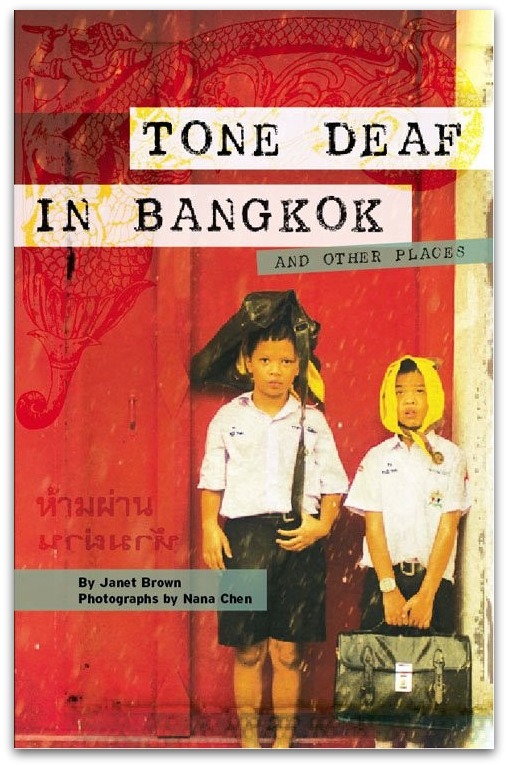
Travel author Janet Brown channels Alice in Wonderland’s “tone deaf” adventures

SPECIAL TREAT FOR TDN READERS: JANET BROWN, author of the travel gem Tone Deaf in Bangkok, has kindly agreed to “come in” and respond to your comments and questions. 

As you may have noticed, The Displaced Nation has gone Alice-in-Wonderland mad since around the first of June. To take just a few examples:

And now, to top that all off, the extraordinary travel writer Janet Brown is paying us a visit. Brown could almost be a stand-in for the Lewis Carroll heroine herself, having published a book on travel to and life in Thailand called Tone Deaf in Bangkok, to much acclaim.

“Tone deaf” — it puts one in mind of poor Alice’s plea to the Mouse, “I didn’t mean it…But you’re so easily offended, you know!”

But if Brown sees herself as tone deaf, her readers regard her as anything but. Here is a sampling of her reader reviews on Amazon:

It has been ages since I have loved a piece of travel literature…, and so when I read TONE DEAF IN BANGKOK, I was thrilled. This is a good travel book, and it is a good book, period.

I am not a traveler, nor do I typically read travel books. Shame on me, I know, but here’s the thing: … The author brought Bangkok to life in a way that made me want to go there, yes, but it was her own story that captivated me and kept me turning the pages. Now I’d read anything Janet Brown writes!

Janet Brown’s TONE DEAF IN BANGKOK is a travelogue, to be sure. Yet it is more, so much more. It’s also an investigation into how dislocated we can become by ourselves, by our priorities and by all that we demand of the cultures in which we live. … That she has a gift for spotting the universal in the exotic makes this collection all the more profound.

Janet Brown has graciously agreed to answer some of my Alice-related questions. After that, dear reader, I urge you to chime in!

Before we go down the rabbit-hole, can you tell me a little bit more about your background?
My parents turned me into a gypsy before I was two, by taking me on their journey by jeep from New York City to Alaska when the 49th state was still a territory and the Alcan Highway was still an unpaved trail into the frozen north. I have wandered ever since, most recently in Southeast Asia with Bangkok as my home, writing down the stories I encounter as I explore. My books include:

Maybe because I’m so steeped in Alice-of-Wonderland lore this month, I think of you as Alice Personified. To what extent can you relate to Alice’s sense of disorientation? Going back not just to the first time you went to Thailand but also when your family dragged you to Alaska…
I was 18 months old when my family moved to Alaska from Manhattan. I coped with any displacement issues by making my mother read my favorite book over and over again — a truly saccharine Little Golden Book called The New Baby. The main character had the same name as I so that was the big attraction — all about me!  My mother swears she can still recite it verbatim after having two martinis.

Alice came to mind constantly in my first months in Bangkok — and frequently thereafter. I knew I’d gone through the looking glass — or had entered the postcard — and asked myself often if that experience had been as painful for Alice as it often was for me.

Can you describe your worst “Pool of Tears” moment in Bangkok, where you wished you hadn’t decided on living there?
I’ve tried to make light of that time when I wrote about it in Tone Deaf in Bangkok, but it nearly demolished me. When the manager of my apartment turned me into Ryan’s Daughter by listening in on my phone calls and then entertaining the neighborhood with highly embroidered versions of my life — and when people fell silent when I walked down the street and began gabbling excitedly after I’d passed — I felt as though my life had been stolen from me and I shut down to the point of hypothermia. If my students hadn’t helped me find a new neighborhood, I would have gone home a gibbering mess.

Thailand is renowned for its distinctive cuisine. Was there anything that carried an “Eat me” label that you felt hesitant about at first, but then discovered you loved?
I’ve written about durian in Tone Deaf, how I thought its smell in the market was sewer gas and then how I was forced to taste it, with happy results. Fried grasshoppers were another thing I didn’t warm to at first sight and then liked as much as I do popcorn — they have much the same crunch and texture.

By the same token, were there any foods that you thought might be good but then didn’t acquire a taste for? (For Alice, of course, that was the Duchess’s over-peppered soup.)
One night I stopped to buy green papaya salad from a food cart to take home for supper. There was something in a little plastic bag that looked like a sort of relish, so I bought that, too.When I opened it at home a smell of rot filled the air, but remembering the delightful surprise that durian had proved to be, I took a generous spoonful. It was pla ra — fermented fish, a Northeastern Thailand culinary staple that is meant to be added and mixed judiciously with the salad, not eaten like peanut butter. There wasn’t enough toothpaste in the world to rid my mouth of that thoroughly foul taste.

As already mentioned, Alice finds it’s easy to offend the creatures in Wonderland without even trying. Why did you choose the expression “tone deaf” for the title of your book on Bangkok? 
“Tone deaf” can be taken quite literally. Thai is a tonal language with five different tones giving meaning to every word. Use the wrong tone and at best you’re incomprehensible, at worst shocking. The most common mistake for foreigners is to tell someone their baby is beautiful, while actually announcing that the infant is bad luck. Another pitfall is confusing the word “near” with the word for “far” — they are the same sound, differentiated by a crucial tone.

But travelers to Thailand can also be “tone deaf” when it comes to figuring out the Thais’ communication style. As a Thai-American friend has observed, the important things are what remain unsaid. “You looked so beautiful yesterday” probably means today you resemble dogfood and ought to go home and rectify that at once. Subtlety is the hallmark of Thai communication, and is often expressed through a quirk of an eyebrow or a famous Thai smile, which has at least one hundred different meanings — including disdain or outright menace.

Describe the biggest faux pas you’ve made since settling in Bangkok.
Oh, how to choose — it’s impossible not to make faux pas every second because Thai etiquette is demanding and complex. The one that makes me cringe most is in my first week when I set off on my first solo bus ride. I was clutching a twenty-baht note, which like all bank notes in Thailand bears the countenance of the King. He is revered to the point of near godhood in his kingdom and his picture is always elevated to the highest spot in a room — nothing is above the King. But I was fresh off the boat and when I dropped my money and it was caught in a little breeze, I put out my foot (the lowest and most ignominious part of the body) and stepped on the picture of the King’s face to secure my bus fare. I was too clueless to pick up on the ripples of horror that this caused others at the bus stop, but now I writhe when I remember this.

“Off with her head!” as the chief royal in Alice’s story is wont to proclaim. Actually, never mind your head. Your mention of your foot makes me think of how physically awkward Alice feels around the creatures in Wonderland. As a farang in Bangkok, do you often feel self conscious?
I’m short and dark in a family of pale-skinned people, so I was used to being an anomaly from early childhood. In Bangkok, if I dressed like a Thai woman and wore sunglasses and walked slowly, I felt as though I blended in. But one day I walked down a quiet street on my way to a class, and someone looked up and said, “Look at the foreigner.” “How did she know?” I asked my class of teenage girls. “Your hair,” they said. “No, lots of Thai women have dyed their hair brown,” I replied — to which they responded: “Your nose.” It was my big American nose that gave me away every time — and since I hate pain and surgery, I just had to accept that.

Have you tweaked your personal style at all so as to fit in better? 
Yes — I adopted the conservative “Don’t show your bare shoulders” school of dressing that prevailed in Bangkok when I first arrived and slowed my pace to that of the women around me. I learned to keep my facial expression as bland as I possibly could to achieve the quiet Thai “public face,” and I ironed everything, including my Levis. Now women are much more casual in the way they dress but I’m still stuck in the cultural mores of the 90s. To foreign women who live here now, my introductory years in Bangkok seem like fiction — things have changed so drastically in the past 16 years.

Time for a quote from the Cheshire Cat: “…we’re all mad here. I’m mad. You’re mad.” Can you relate?
Riding on the back of a motorcycle taxi down a crowded city sidewalk, buying a glass of Shiraz to take with my popcorn into a movie theater, being drenched to the bone during Thai New Year’s — this is actually the most difficult question you’ve asked so far because at this point it all seems normal.

If you were to hold your own Mad Hatter’s Tea Party in Bangkok, whom would you invite, and why?
Anais Nin, because she would love the unbridled hedonism of this place, Evelyn Waugh because he would satirize the expat scene so well, Ho Chi Minh because he could help put together the revolution that is needed here, Emily Hahn because she has always been my role model since I first read her when I was twelve, and Elvis because in Bangkok he is still the king.

Alice becomes aware that Wonderland is turning her into a different person, unrecognizable to the one she used to be. Has your identity has shifted in fundamental ways since living in Bangkok?
This is a very complex question — I’ve written one book about it and am working on a second one, Almost Home. I’m always drawn back to the US because my children are there. Seeing them for two weeks a year doesn’t work for me. Once I get back to the US this time around, I’ll return here but plan to spend the bulk of my time near family in the Pacific Northwest. I won’t know how much I’ve been changed by this recent incarnation in Bangkok until then. Ask me again in several months.

Can you offer any advice for newcomers to Bangkok, who aren’t sure who they are any more?
Tone Deaf in Bangkok and my next book, Almost Home, are where I directly address the challenges of feeling like an Alice in Thailand. In addition, the recently published Lost and Found Bangkok, for which I wrote the text, may be helpful for newcomers. It’s a book in which five different photographers — two American men, two Thai men (both from Bangkok), and one Taiwanese-American woman — show the city they live in. New arrivals can look at the photos and see some great places to get lost — and find out who they are — in this Wonderland-like city.

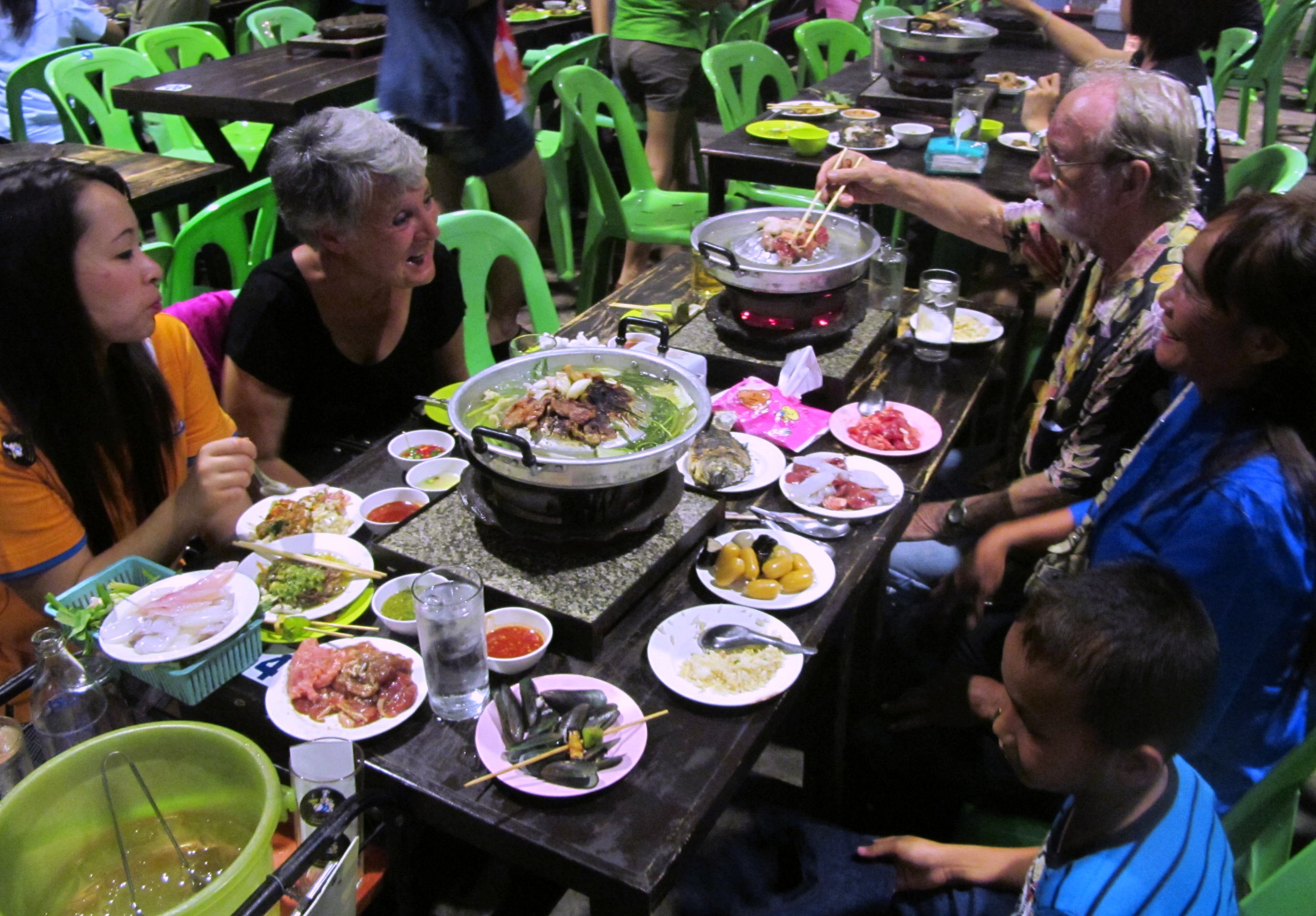
img: Janet Brown with friends at an all-you-can-eat DIY barbecue at a huge restaurant under a bridge in Bangkok, by Will Yaryan.

STAY TUNED for Monday’s post on the problems one can anticipate in trying out one’s humor on Wonderland’s inhabitants…

If you enjoyed this post, we invite you to subscribe for email delivery of The Displaced Nation. That way, you won’t miss a single issue. SPECIAL OFFER: New subscribers receive a FREE copy of “A Royally Displaced Tea.”

Related posts:
For curious and unreal travel, Tokyo sure beats Wonderland

Today we welcome Carole Hallett Mobbs to The Displaced Nation as a guest blogger. During June, TDN is looking at what the story of Alice in Wonderland can tell us about displacement of the curious, unreal kind — as anchored by Kate Allison’s “5 Lessons Wonderland taught me about the expat life, by Lewis Carroll’s Alice.” Hallet Mobbs can identify, having just left Japan — a country that Western travelers have long regarded as the ultimate topsy-turvy destination — after four-and-a-half years of living with her family in Tokyo.

“I’ve believed seen as many as six impossible things before breakfast”: this seems the most logical place to begin my account of life in Wonderland Japan.

In Tokyo, you can see a minimum of six impossible or incredible things before breakfast.

And then another six after breakfast.

In fact, I can safely say that a day spent in Tokyo will guarantee you a double-take moment approximately every ten minutes.

I know this, because I timed myself one day, using an oversized pocket watch.

Jaw-dropping sights abound — and I never failed to be delighted and amazed every single day during my four-and-a-half-year stay.

And if,  like me, you prefer seeing to believing, then Tokyo is the place to be.

Curiouser…

Whilst driving my young daughter, Rhiannon, to school one day, I absentmindedly pointed out a Routemaster bus.

Double take! A red double-decker is a London inhabitant, not normally seen outside the Big Smoke. What on earth was one doing trundling its way around Tokyo?

These beasts are not known for their flying abilities but it had obviously migrated somehow. I discovered that a Japanese diplomat who’d been posted to Britain persuaded London Transport to donate one of these wonderful buses to Japan. It’s now a cruising restaurant.

People, too, arrest your attention. With their unique, carefully honed fashion sense, Tokyoites take style to a whole new dimension.

Real Alice in Wonderlands trip along the fashionable Harajuku, mixing with other young people dressed in adult-sized furry romper suits complete with ears. (Rabbits and bears are favorites.)

A particularly memorable vision in that section of town was a fully decked-out Stormtrooper from Star Wars, casually walking up the road.

Then there are those whom I thought of as “dormice folk.” Due to their heavy workloads, many so-called salarymen need to catch forty winks whenever and wherever they can. Favorite snoozing spots include crashing out across a table in Starbucks or on a bench. And they’ve even been known to take advantage of armchair displays in department stores.

Nobody dreams of waking them; that would show a deep lack of respect.

…and curiouser

Look! That’s a baby in a sling. Oh, my mistake, it’s a white rabbit.

Stuff and nonsense… Or is it?

As well as people watching, I can highly recommend pet-watching as a surreal Tokyo pastime.

Peer into a buggy expecting to see a cute, chubby baby with spiky black hair and instead see — no, not a pig, but more than likely a dog or two.

Yes, canines are cosseted creatures in Tokyo. More often than not, they are the size of guinea pigs, and almost all wear fashionable outfits.

Is that a giant caterpillar? No, it’s a dressed-up dog. Dogs in kimono. Dogs wearing tutus with real diamond necklaces. Dogs in leather jackets and sunglasses. Dogs in boots…

More than once I had a curious conversation with fellow dog owners. I have a Japanese Shiba-Inu (unclothed). This caused much admiration — a gaijin with this special Japanese dog was a big hit — as well as some puzzlement. “But that’s a Japanese dog. How did you teach her to understand English?”

And it’s not just pets that are dreamlike.

Crows are as big as ravens, woodpeckers as small as wrens.

Saucer-sized butterflies flit by like vibrant handkerchiefs, and hornets are so large they need their own air traffic control center.

Drink me! Eat me!

Japanese interpretations of Western food can be a trifle bizarre. Experimentation is rife, and experiments include drinks such as iced Earl Grey lattes and cucumber Pepsi.

Being taken by surprise during a snack is commonplace.

Thrilled by finding some doughnuts that appeared to have jam inside, I took a huge bite. The “jam” was azuki bean paste. Not my favorite.

Another shock was a Wasabi Kit Kat. I still haven’t recovered from that one.

Some time in recent history, the sandwich reached Japan. I imagine the conversation went a little like this.

“What is a sandwich?”

“Well, it’s two slices of bread with a filling between the slices.”

“What filling goes into this sandwich?”

“Oh, anything really…”

One day a friend bought a sandwich with a lumpy filling. A gentle squeeze sent a whole cooked potato shooting across the room.

Through the looking-glass

Beckoning looks like waving goodbye.

Keys turn the wrong way.

Books and magazines are read from back to front.

Writing follows its own rules. The elegantly beautiful yet complex Chinese characters, known as kanji, are written vertically in columns and read from top to bottom and right to left.

Tell me, please, which way I should go from here?

Notably, as an Englishwoman in Europe, I can usually work out rough meanings by utilizing my limited knowledge of Latinate and Germanic languages.

In Japan, though, I was suddenly completely illiterate.

Imagine the fun my husband and I had on our car journeys. Trying to decipher the name of our destination on the map, he would say: “Look out for a sitting man, a picnic table, noughts and crosses, a ‘7”and a jellyfish.” Predictably, we got lost rather a lot.

Going somewhere on foot was no easier. Streets are not well labeled, or labeled at all. In fact, being lost in Tokyo is so common — even for Tokyoites — that everyone carries their own little maps with landmarks.

If you stand around looking pathetic for a while, a stranger will miraculously appear and guide you to your destination — and then disappear, leaving only a grin behind…

English words are considered interesting and “cool,” so are often used for shop names and slogans. But a love of English isn’t always correlated with an understanding of how our words link together — leaving us foreigners as clueless as ever.

“Tokyo Teleport Station” is just outside the city. Sadly, it’s just a train station, not a link to other worlds.

One that still puzzles me is a sign declaring “SLOB! Oxidised Sophistication.” I just have no idea.

The “Hotel Yesterday” has the tagline “Welcome to Yesterday.” I often feel like that.

Is Tokyo really a wonderland?

Goodness, what a long sleep I’ve had! Such a curious dream!

Though I’ve enjoyed using “Alice” allusions to describe my Tokyo adventures, I’m not sure if it’s of much use in helping other expats adjust to this very real yet extraordinary city.

The key to living in and enjoying Japan is to keep an open mind, embrace eccentricity and expect the unexpected at all times.

And if that’s too tall an order on any given day — rather like Alice’s serpent neck — then I suggest you follow her sister’s advice and “run in to your tea.” But if I were you, I’d give the “jam” doughnuts a miss!

Question: Can you think of any other cities that merit a “through the looking glass” reputation, or is Tokyo an extreme, as Carole Hallett Mobbs suggests?

Carole Hallett Mobbs is a trailing spouse and freelance writer. Her blog on life in Tokyo is called Japanory. After moving to Berlin with her family in April, she started up another blog, Berlinfusion, and is writing a book on expat children. Her Twitter moniker is @TallOracle.

img: Carole and her daughter, Rhiannon, caught in an Alice-like pose by 37 Frames (Tokyo).

STAY TUNED for tomorrow’s Displaced Q having to do with one of our — and Alice’s — favorite topics: food!

If you enjoyed this post, we invite you to subscribe for email delivery of The Displaced Nation. That way, you won’t miss a single issue. SPECIAL OFFER: New subscribers receive a FREE copy of “A Royally Displaced Tea.”

Related posts:

And the Alices go to … these 7 writers who get the curious, unreal side of international travel

 © Iamezan | Dreamstime.com Used under license

© Iamezan | Dreamstime.com
Used under license

Since founding The Displaced Nation on April Fool’s Day (no fooling?), Kate Allison, Anthony Windram and I have been coming across travel writers who understand just how befuddling the life of the global nomad can be.

We are inclined to think that they have channeled Lewis Carroll’s Alice.

Offering themselves up as examples, such writers talk about what’s it like for a crossborder traveler to be plagued with feelings akin to adolescent self-doubt: what am I doing here, and will I ever get over this feeling of displacedness?

And they’ve shown us how to emerge from such escapades as more fulfilled human beings, full of stories to tell, perhaps to our grandkids, one day…

In recognition of these models of displacedness, my colleagues and I have created a new accolade for the travel writing profession: the Alice’s Adventures in Wonderland Award, otherwise known as an “Alice.”

And The Displaced Nation‘s very first Alices go to…drumroll!…(listed in reverse chronological order)

1. ANABEL KANTARIA for Do we all need behavior lessons?, in the Daily Telegraph:

“Just remember, you’re not playing in your own backyard now,” my boss told me when I took my first job in the UAE. “You’re in someone else’s yard now, and you play by their rules.” It was probably the best piece of advice I was ever given about the UAE, and one that’s kept me out of trouble on numerous occasions.

Alice link: “I don’t think they play at all fairly,” Alice began, in rather a complaining tone, “… I should have croqueted the Queen’s hedgehog just now, only it ran away when it saw mine coming!”

2. SUZY GUESE for The Unexpected Benefits to Solo Travel, in Suzy Guese: Traveling with a redheaded temperament:

While I know people who travel with others can have their share of weird conversations, solo travel for some reason brings this about almost with every day. … From a musician at the Giant’s Causeway [Northern Ireland’s only UNESCO World Heritage Site] who started talking to me by insulting my shoes, to a B&B owner who told me her “journey of life”, leaving in all of the gory details, I have had some strange encounters.

Alice link: “Your hair wants cutting,” said the Hatter. He had been looking at Alice for some time with great curiosity, and this was his first speech.

3. ANDREA MARTINS for Expat women living the high life or secretly struggling?, in the Daily Telegraph:

In mid-2005, April Davidson’s world was turned upside down following her husband’s job transfer to Mexico City. … She could not understand what was happening to her and she started taking medication for anxiety and unexplained stomach problems. Little did April realise that her feelings represented a completely normal piece of the relocation jigsaw, and that taking medication to cope with the transition process was again, not uncommon.

Alice link: “You ought to be ashamed of yourself,” said Alice, “a great girl like you,” (she might well say this), “to go on crying in this way! Stop this moment, I tell you!” But she went on all the same, shedding gallons of tears, until there was a large pool all round her, about four inches deep and reaching half down the hall.

4. SEBASTIAN DOGGART for Elegy to English shepherd’s pie, in the Daily Telegraph:

One of the things I miss the most about living outside England is shepherd’s pie. … The greatest desecration is found in Quebec, where they call it “Chinese pâté” (pâté chinois). To suggest this sacred dish has anything Chinese about it is preposterous.

Alice link: “When I’m a Duchess,” she said to herself…”I won’t have any pepper in my kitchen at all. Soup does very well without…”

5. SALLY THELEN for 4 Tips on Embracing Your Inner Weirdo, in Unbrave Girl:

This morning, when I went running [in Wuxi, China], I happened upon a group of teenagers dressed up as anime characters. A crowd had formed around them to gape at their hot pink wigs, Nutcracker-like jackets and French maid dresses.

I stopped for a minute to stare slack-jawed with the rest of the crowd.

I was baffled.

I was confused.

And, frankly, I was a bit miffed. After all, didn’t these kids know that I was the main attraction at this park?

Alice link: This piece of rudeness was more than Alice could bear: she got up in great disgust, and walked off, the Dormouse fell asleep instantly, and neither of the others took the least notice of her going, though she looked back one or twice, half hoping that they would call after her…

6. SEZIN KOEHLER for My foreign body: geocharacteristics of a population, in Expat+HAREM:

When I first arrived in Prague I was a size 7, had an acceptable C-cup and chocolate-colored skin. Three years later I’ve become a size 12 and an overbearing DD-cup with skin the color of weak tea.

Aging plays only a small part….

Alice link: “Curiouser and curiouser!” cried Alice (she was so much surprised, that for the moment she quite forgot how to speak good English); now I’m opening out like the largest telescope that ever was! Good-bye, feet!”

7. JENNIFER EREMEEVA for Conversation is a One-way Street, in Dividing my time: finding the funnier side of life in Russia:

“Let me tell you about New York,” he [a Russian friend of my husband’s] said, “I was really impressed: the streets are completely strait, from one end of Manhattan to the other — ”

“– Well, except for the Village down to Wall Street,” I interjected absent-mindedly.

“Jennifer went to University in New York,” said my husband apologetically to the group.

Sergei squinted at me suspiciously, and then, changing tack, began to expand on the virtues of vacationing at Valaam on Lake Ladoga.

Alice link: “I’ve been to a day-school, too,” said Alice; “you needn’t be so proud as all that.” … “…[Y]ours wasn’t a really good school,” said the Mock Turtle in a tone of great relief. “Now at ours they had at the end of the bill, ‘French, music, and washing — extra.”

QUESTION: Do you have a favorite from the above, and do you have any other writers/posts to nominate for our next round of Alices? We’d love to hear your suggestions.

STAY TUNED for tomorrow’s interview with Random Nomad Balaka Basu. She appeals for citizenship in The Displaced Nation — and agrees to answer one Alice question!

If you enjoyed this post, we invite you to subscribe for email delivery of The Displaced Nation. That way, you won’t miss a single issue. SPECIAL OFFER: New subscribers receive a FREE copy of “A Royally Displaced Tea.”

Related post:

5 lessons Wonderland taught me about the expat life, by Lewis Carroll’s Alice

The Displaced Nation’s theme for June is the ultimate expat – Alice, of Wonderland and Through the Looking-Glass renown.

Throughout the month, we will explore some of the issues Alice faced, such as loss of identity, overwhelming communication barriers, and isolation – and as usual, we want to hear about your experiences in your own Wonderlands.

To kick off the theme, we asked Alice if she had any advice for today’s Displaced Person:

Indeed I do. It might be many years since I fell down the rabbit hole, but human nature hasn’t changed. This is a little of what I learned:

1. Keep the golden key in your pocket at all times, and make a note of the emergency exits.

In another moment down went Alice after [the White Rabbit], never once considering how in the world she was to get out again.

My first mistake was to plunge down the rabbit-hole without planning ahead. The adventurous life is all very well, but it’s good to have a  bolt-hole, as well as a rabbit-hole, when you need to escape to the old and familiar.

My second mistake was to leave the key on the glass table before drinking from the bottle marked ‘Drink Me.’ In your vernacular, that’s like buying a return ticket home for this evening, then discovering your passport expired six months ago. Be prepared for the unexpected, the peculiar, and the almost impossible.

2. No matter how hard you try contrariwise, at some point you will offend someone.

Evidently Humpty Dumpty was very angry… “It is a—MOST—PROVOKING—thing,” he said at last, “when a person doesn’t know a cravat from a belt!”

Oh dear! If only I had a shilling for every time I inadvertently offended one of the creatures in Wonderland and through the Looking Glass!  Not knowing Humpty Dumpty’s neck-wear from midriff-wear; my compulsive mentioning of cats and dogs in the Mouse’s presence without considering that he and I might have a different perspective of these animals…the list went on and on.

In the end, I think the Red Queen’s advice was the best:

“Always speak the truth—think before you speak—and write it down afterwards.”

But still, I couldn’t help thinking:

“I wish the creatures wouldn’t be so easily offended!”

3. “The rule is, jam to-morrow and jam yesterday—but never jam to-day.” Different country, different rules.

The Queen of Hearts was the worst example of this:

“No, no!” said the Queen. “Sentence first—verdict afterwards.”

I suggest if you are ever in this situation yourself, you employ more tact than I did. “Stuff and nonsense!” I said. “The idea of having the sentence first!”

Perhaps today a quick telephone call to your country’s embassy might be better.

Better still, acquaint yourself with the country’s rules before you go jumping on aeroplanes or down rabbit holes.

4. Go to a party or a Caucus-Race – don’t drown in your own tears.

“I am so VERY tired of being all alone here!”

The Caucus-Race proved to me that I could make friends with the most unlikely companions.

After a few minutes it seemed natural to Alice to find herself talking familiarly with them, as if she had known them all her life.

If you feel alone in your new environment, seek out company, even if it’s not the kind of company you’re used to. You might find your life is richer for it.

5. And finally –  Keep a note of your name in your memorandum-book.

“Who are YOU?” said the Caterpillar.

Alice replied, rather shyly, “I—I hardly know, sir, just at present—at least I know who I WAS when I got up this morning, but I think I must have been changed several times since then.”

I spent a great deal of time in both countries wondering who I was now. Was I my little friend Ada, or Mabel, perhaps?

Tweedledum even suggested I wasn’t really there at all.

“You’re only one of the things in his dream. You know very well you’re not real.”

“I AM real!” said Alice and began to cry.

Take a tip from me and write your name in a memorandum-book. Then keep a journal.

That way you will always remember who you were on any particular day.

And one day, people might read about you as they do about me.

*

Thank you, Alice!

And now, stay tuned for our Alice Awards, going to expat bloggers and travel writers who get the curious, unreal side of the global nomad’s life…

.

If you enjoyed this post, we invite you to subscribe for email delivery of The Displaced Nation. That way, you won’t miss a single issue. SPECIAL OFFER: New subscribers receive a FREE copy of “A Royally Displaced Tea.”

What the Finnish Spring can teach us about expats and politics

SPECIAL TREAT FOR TDN READERS: Anu Partanen, though she’s currently on the road, has promised to “come in” and respond to your comments and questions over the next few days. So, ask away!

Anu Partanen has done the impossible. She has made me care about the Finnish Spring, and I’ve never once been to Finland.

No, we’re not talking travel here, though I’d love to go to her country someday and see the ice melt and the vivid violet sinivuokko push their way through the leaves.

Rather, I refer to Finnish politics. Partanen wrote an op-ed that caught my eye in the May 13 edition of the New York Times. It was about Finland’s parliamentary elections, which took place with the arrival of the sinivuokko, on April 17 — the outcome of which, she claims, is the Finnish equivalent of the Arab Spring.

No, the Finns did not have any armed uprisings, just a quiet, proper democratic election. But the results were just as revolutionary:

Overnight, Finland seemed transformed from possibly the most sensible, even boring, country in Europe — known for excellent schools, zero corruption, gender equality, and a pro-European Union approach to politics — into the nationalistic, populist, Euro-skeptic home of the True Finn Party.

The only thing is, I haven’t quite decided yet what to make of the True Finns. According to Partanen, as an American, I “might consider them the equivalent of Tea Partiers (if they didn’t support the welfare state, that is).”

Most significantly, the True Finns will do anything they can to block Finland from contributing its share to bailing out bankrupt European countries — Portugal being the latest example, following on the heels of Greece and Ireland.

Notably, Partanen, too, admits to some ambivalence about the European experiment, for the first time in her life:

Myself, I’ve benefited a great deal from the European Union — I’ve studied abroad, traveled easily, enjoyed a strong euro. … Yet I was shaken when I learned that we Finns were supposed to lend money to Greece. It didn’t seem fair that my taxes would go to a country that had been living beyond its means.

Political voyeurism

But another big reason why I’m so captivated by Partanen’s take on Finnish politics is that she’s an expat based in the United States. Currently living in Brooklyn, she continues to work as a journalist for several Finnish publications. In addition, she is writing a memoir about being Scandinavian in America.

Partanen told me in an email exchange that the book is still in the early stages. I’ll be curious to see what it has to say about the challenge of participating in home-country politics from a distance.

That was something I used to think about a lot during my own expat years. If you care about the politics of your home country — as Partanen clearly does, as I did — then why aren’t you living there? Unlike me, Partanen keeps a foot in Finnish politics by continuing to write articles for the national media.

Still, it must be strange for someone as highly politicized as she is to be in the United States while an important debate is taking place about what kind of country Finland is, and wants to be.

In her Times op-ed, Partanen mentions that although she has offered her couch in Brooklyn to friends from home who would like to become political refugees, as yet no one has taken her up:

…my friends in Helsinki seem to be deciding that this is no time for retreat. Instead they’ll stay to help determine the future of their country.

Hmmm… Is that a reason why, despite my love of living overseas, I eventually bit the bullet and came back to the United States?

Politics not as usual

By the same token, Partanen shows us that living abroad can help you see your own country’s politics, and those of other nations, in a new light. Domestic politics can be very village like, and in my experience, it’s not until you step away from the village tribe that you begin to discern your own beliefs.

As already mentioned, Partanen has discovered since leaving Finland that she has developed some sympathy for the idea of setting limits on how much of its wealth Finland should share with other Europeans.

In her Times article, Partanen suggests that her position may have something in common with that held by the Americans who’ve expressed a reluctance to contribute to universal health care. Noting that America is twice the size of the European Union, she says:

It’s not quite parallel, but if Finns were asked to contribute to the health care of the Greeks, the Irish, and the Portuguese, they might feel a little like the Americans.

My experience is rather different from Partanen’s: I was an American living abroad, first in England and then in Japan, which meant listening to everyone excoriate the United States. But like her, I found that getting physically outside of my country was a stimulus to thinking outside the box and deciding on my own core truths — never mind what the mainstream parties and their media outlets (the village elders) kept telling me to think.

Also like Partanen, I moved further to the right (I hope she won’t mind me using that term) — but not on universal health care. I benefited from socialized medicine in both the UK and Japan so can be counted as a fan of Obamacare, though I do wish it included a public option.

What I came to appreciate much more fully was the tough role the United States has been assigned in world affairs. I can’t tell you how many times I felt like saying to the European and Asian critics who accosted me: “You try policing the globe, and see how much you enjoy it!”

(There were of course far more European critics than Asian ones. The Japanese, though they don’t relish the thought of our Marines continuing to be based on Okinawa, see it as their best hedge against, among other things, the wacky North Korean leadership.)

Now, that’s a true political awakening — call it an Expat Spring.

* * *

Question: How about you? Are you an expat, and if so, what’s your relationship with your home country’s politics — do you remain involved, and have you adjusted any of your basic political beliefs since going abroad?

If you enjoyed this post, we invite you to subscribe for email delivery of The Displaced Nation. That way, you won’t miss a single issue. SPECIAL OFFER: New subscribers receive a FREE copy of “A Royally Displaced Tea.”

Related posts:

DISPLACED Q: In the words of The Clash, “Should I stay or should I go?”; When reality bites in your adopted country, are you more — or less — determined to stay as an expat?

In our post on March 20, When in doubt, have a pint of Guinness, we drew attention to the Britons who resolutely stayed in post-earthquake Japan rather than fleeing with the majority of their expat countrymen back to the UK. Despite the danger of the nuclear situation, one man interviewed by the Telegraph said

“I actually feel a bit of a duty not to leave.”

Friends in need

Although this person’s mother couldn’t see his point, I understand this mentality. The events of September 11, 2001, so close to our home in Virginia, made me defensive of my adopted country, and outraged at such an audacious attack. To leave at this stage was unthinkable. That would mean we were just fair weather friends of the USA.

Instead, we taped a small American flag to our mailbox, as the rest of our neighbors did to theirs. It couldn’t help the 3,000 who died that day, but it showed our sympathy and solidarity, which didn’t go unnoticed: a neighbor made a point of telling me how touched she was that I, a foreigner, had done this.

Yet I suppose expats here did leave to go back home after 9/11, because it’s human nature to think the grass is greener – or safer – on the other side.

More trolls, not greener grass

It’s not greener or safer, of course. I know this from years of frequent news reports of IRA bombings.  The Spanish know this from decades of Basque separatist attacks. 2009 saw 10,999 terrorist attacks worldwide, and while 60 percent of these occurred in Iraq, Afghanistan, and Pakistan, that still leaves over 4,000 to be shared by the rest of the globe.

As chance had it, I arrived at Heathrow the day before the 2005 bombings of London’s transport system, and had planned to take the tube into the city the following morning to do some sightseeing with my children. Had we not been tired from jetlag and therefore overslept on July 7th, we could easily have been on one of the trains that were destroyed.

Was I as upset by 7/7 as I had been by 9/11? Undoubtedly. Yet there was something else, too – a feeling of deja vu, of “here we go again” or – dare I say it? – resignation.

Whether you run or stay, there is a difference between enduring atrocities in your own country and suffering them on another’s turf.

Not all disasters are manmade

It doesn’t have to be a terrorist atrocity, as our friends drinking Guinness in Tokyo can testify. Perhaps you were an expat in Christchurch, New Zealand during the last two earthquakes; perhaps you were posted to New Orleans just before Katrina hit the Gulf Coast. Only two days ago, Joplin, Missouri was devastated by a deadly tornado.

The world is a dangerous place. There are no certainties, especially when it comes to safety. To quote The Clash again:

“If I go there will be trouble

And if I stay it will be double.”

So, tell us:  What’s an expat to do when disaster strikes?

If you enjoyed this post, we invite you to subscribe for email delivery of The Displaced Nation. That way, you won’t miss a single issue. SPECIAL OFFER: New subscribers receive a FREE copy of “A Royally Displaced Tea.”

Related posts:

In the jaws of political or natural disaster: When reality bites for expats

Lately I’ve been thinking about plot lines for movies based on adventure travel. The one I like the most involves a round-the world traveler spotting a shark while scuba diving in the Indian Ocean…

In the hands of the right director, I could see it becoming a remake of Jaws.

Speaking of which, did you notice that first prize for the Matador Network’s “When Travel Goes Wrong” photo contest went to a young woman whose travel bag — containing passport, wallet and cell phone — fell down a Swiss sewage drain and got fished out by a kind, thin stranger. Now that has real Jaws potential!

Unfortunately, however, travel is not today’s focus. Rather, my goal is to highlight some of the mishaps that occur when a global voyager becomes a global resident.

“Boring!” I can hear you say. And having been an expat myself twice over, I have to admit, at some level, you are right.

They’re a privileged set, those expats.

Privileged with insider knowledge. You’re not going to catch them on the street with the open sewers.

Privileged with accommodation. Not for them a stay in Fawlty Towers, or the equivalent.

Still, reality has a way of impinging even on the most glittering expat lives, and in my experience, global residents tend to be even more traumatized than their short-stay counterparts when something goes badly amiss.

(Is that because they’re spoiled? I’ll let you decide…)

Gothic horror redux

In case you haven’t been tuning into The Displaced Nation of late, our posts have been exploring cases where individual expats have had their lives turned upside down, or worse (see “related posts” below).

My colleagues and I have put forth incontrovertible evidence that the expat life, like any other, can have its gothic moments.

Lest any skeptics remain, may I draw your attention to the Friday May 13 incident in Spain’s Canary Islands. A homeless Bulgarian man stabbed and hacked off the head of a 62-year-old British resident of Tenerife, after which he paraded into the street, holding his “treasure” up by the hair for all to see.

According to one eyewitness, who, too, is a long-term British resident of the Canaries:

When I saw the man holding the head, the first thing that popped into my mind was the scene from “Clash Of The Titans,” where the hero holds up the Gorgon’s head — but his was real.

Disruption en masse

Now let’s turn to the instances where the expat life gets disrupted en masse by natural disaster or political upheaval.

Emily Cannell, an American who’s been living in Tokyo with her family since last year, paid a visit to The Displaced Nation as a random nomad last Thursday. She told us about what it was like to be in that city when the Great East Japan Earthquake struck on March 11. In just a few moments, she went from a woman whose biggest worry was driving to car pool on time, to wondering if her kids were alive or dead.

And let’s not forget Tony Roberts, who was an honored guest on our site several weeks ago. His story, now written up in the form of a novel, is about what it was like being a teenager in Iran in 1979, just before the revolution took place. The trauma came when his family was given just 24 hours to evacuate back to their home in Kansas, and he had no time to say good-bye to his friends. For some time afterwards, this Third Culture Kid suffered from General Anxiety Disorder, “with feelings of unresolved anger,” as the psychologists put it. He tweeted recently: “Revolution will do that.”

Snatched from the jaws of [domestic terrorism]

I myself had an experience of this ilk towards the end of my stay in Japan, when the religious cult Aum Shinrikyo attacked the Tokyo subway with sarin gas — killing a couple of people in the station just down the street from my house. In all, 13 people died, and thousands more suffered from after-effects. It was and remains the most serious incident of this kind in Japanese history.

As I struggled to come to grips with the idea of nice, safe Japan being populated by terrorists, quite a few thoughts raced through my head; for instance:

1) This place is weirder than I’d realized.
I’d never before heard of the kind of cult where the adherents are well-off, educated young people and their leader, a bearded mystic with a destructive political agenda. (Needless to say, I hadn’t heard of al-Qaeda. But even if I had, Japan is the Far, not the Middle, East.)

2) Do the authorities know what they are doing?
From what I’d observed of the Japanese police, they seemed pretty wimpy, precisely because the country doesn’t have a high incidence of violent crime. Did they really have the chops to capture Shoko Asahara and put an end to his madness? (The attack on the subway took place on March 20, and they didn’t find him until May 16. He was hiding inside the wall of a cult building in the group’s compound near Mt Fuji, dressed in purple robes and in good health.)

3) Who’s looking out for us foreigners?
I suspected that we foreign residents would be the last to know if further incidents were likely to take place. (For weeks following the subway attack, rumors of imminent attacks were rife, and I didn’t know whom to believe.)

Though I eventually got on the Tokyo subway again, the incident took its toll on how I felt about living in that city. Little did I know that I would one day be working in New York City and reliving many of the same emotions — ignorance, disenfranchisement, and vulnerability — in the wake of 9/11.

I discovered, however, in comparing these two incidents that when reality bites in one’s native land, it’s not nearly as unsettling as when it happens abroad.

After 9/11, I wanted to stay in NYC and carry on — it was a way of fighting back. Whereas after the subway attack in Tokyo, I started to fantasize about leaving Japan.

* * *

Are there any world travelers out there who’ve stuck with me throughout this catalogue of woes? I wouldn’t be surprised if you’ve come to the conclusion that your nomadic life, even with its many dangers, is preferable to that of most world residents.

Or perhaps you’re feeling a touch of envy? In that case, you may wish to check out Bootsnall’s virtual tour of the top 10 shark-infested beaches in the world.

Question: Have you had any experiences of large-scale disasters during your stay abroad, and if so, how did it affect your perceptions of your adopted country — did it make you feel any less “at home” there?

If you enjoyed this post, we invite you to subscribe for email delivery of The Displaced Nation. That way, you won’t miss a single issue. SPECIAL OFFER: New subscribers receive a FREE copy of “A Royally Displaced Tea.”

Related posts:

3 hardboiled observations on the displaced TV series “The Killing”

Hillstreet Blues Law and Order Crime Scene Investigation (CSI)Bones… I could keep going, but point made: American TV is the undisputed godfather of the crime series genre.

These shows may be fiction, but they are underpinned by a grim reality: the United States has the highest rates of homicide and other violent crimes in the industrialized world.

But, not so fast. There’s a rookie on the scene that is taking on the veteran. I refer to the Danish crime series, The Killing, which is currently airing on AMC.

Now, what do the Danes know about crime — apart from suicide (regicide, too, if we go as far back as Hamlet)? Well, I’m here to tell you that this “smorgasbord thriller” has fast achieved cult status in the UK and now the US. As Alessandra Stanley wrote in her New York Times review:

It’s unnerving how well the Nordic sensibility fits a genre that for a long time seemed indisputably and inimitably violent and American, particularly given that Sweden, Norway and Denmark have homicide rates that suggest that they have more mystery writers per capita than murders.

Having become a a diehard (haha!) fan of the Danish noir series after a couple of episodes, I’ve been thinking about it of late in the context of The Displaced Nation. What happens when a TV series becomes expatified? Can we who have chosen to displace ourselves to other countries glean anything from its acculturation process?

Here are three hardboiled observations:

1) America is not Britain.

I was an expat in the UK for many years so am fated to have this thought nearly everyday: America is not Britain. Still, it’s gratifying to have it confirmed by third-party sources. Gratifying and, I must say, somewhat surprising given how quickly the UK appears to have become Americanized since I left. (I mean, pub grub now includes peanut-butter-and-jelly sandwiches! That would NEVER have happened in my day!)

Here’s the thing: the UK imported the original Danish series, entitled Forbydelsen, and simply added subtitles. Which completely makes sense to me — yes, I remain that anglicized.

But for an American audience, of course, subtitles won’t do. Thus AMC hired Veena Sud to come up with an adaptation. Sud moved the action to Seattle, which, she says, is the “closest American city, viscerally, to Copenhagen.”

2) Sud is right: Seattle is as creepy as Copenhagen.

Who knew that Seattle could be so creepy? Certainly not me. Though I’ve never had the honor of visiting that Pacific Northwest city, being an East Coaster I have always held a romantic view of it. At one point I even thought of Seattle as a place I might like to live in some day —  especially as the people are reputed to behave with greater decency towards each other than us competitive, dog-eat-dog New Yorkers.

But The Killing has quashed this “domestic expat” fantasy of mine, at least for now.

It underlines a truth we’ve been exploring recently on The Displaced Nation: horrific crimes can happen anywhere, even in settings where people are bending over backwards to be pleasant to one another.

3) But the series also addresses themes that transcend national borders, at least in Western countries.

Setting is important — one of the reasons for the series’ popularity in Britain is that so many people coveted the female detective’s classic Feroese sweater, and I think some fans of the AMC production enjoy watching a crime drama that takes place in Seattle, not New York or L.A.

But if setting is a crucial hook, it’s by no means the only reason The Killing has captivated viewers beyond Denmark and made such a killing for the Danish Broadcasting Corporation.

The show also addresses themes of widespread concern to Western countries: most notably, the fact that even in our supposedly civilized societies (we don’t have female genital mutilation! we don’t have honor killings!), many young women continue to be victims of violence.

The killing to which the title refers is that of a teenage girl, and each each one-hour episode depicts 24 hours in the police investigation, during which we are able to observe the impact of the tragedy has had on the girl’s family, her community, and the people involved in the investigation.

Another theme running through the series is xenophobia: the distrust American and European societies have for Muslim immigrants. America has yet to process the legacy of 9/11, while the Danes are still reeling from the incident involving cartoonist Kurt Westergaard. (To this day, he receives death threats for his cheeky portrayal of the Prophet Muhammad.)

For better or for worse, this Danish crime thriller holds up a mirror to Western culture and shows how easy it is for us to pin the murder of the girl on the Muslim teacher. It eerily reflects the times we live in — perhaps its most chilling facet.

Question: Do you have an experience with a TV show or series that made you look at your own and/or other cultures in a fresh light?

If you enjoyed this post, we invite you to subscribe for email delivery of The Displaced Nation. That way, you won’t miss a single issue. SPECIAL OFFER: New subscribers receive a FREE copy of “A Royally Displaced Tea.”

Related posts:

DISPLACED Q’s: In your global travels, which close encounter of the animal kind was the least welcome?

In yesterday’s article My first flirtation with the lawlessness of global travel: 4 painful lessons, our guest blogger Lara Sterling recalls the toe-curling time in Guatemala when she was attacked by a couple of dogs and had to spend a week in hospital queues, waiting for rabies shots to her stomach. It doesn’t bear thinking about. Most of us cringe at the prospect of a trip to the dentist.

Rabies isn’t something you consider where I come from; if you’re bitten by a dog in the UK, in today’s litigious society you’ll probably phone your lawyer rather than your local hospital.

Neither is rabies foremost in your mind if you have bats roosting in your attic – you’re more likely wondering how to evict them without breaching wildlife protection laws, since bats are a protected species in many parts of the world. But around 1% of bats carry rabies, as a friend in the US discovered when she woke up to find a bat flying around her bedroom and had to undergo a course of rabies shots, just to be on the safe side.

This was my first inkling that Connecticut wildlife might consist of more than, say, a few sparrows on the bird table.

Disney cartoons – the best place for rodents

While I haven’t had bats for roommates, I’m now used to seeing certain animals in my American back yard that I’d previously only seen in Bambi or Chip n Dale. Visitors from the UK exclaim over the proliferation of gray squirrels, but I’ve adopted the jaded attitude of a Connecticut native: squirrels are just rats with good PR. If you’ve ever had one fall down the chimney into your basement, where it runs amok and tries to eat the wall insulation, you’ll know what I mean.

Other wildlife guests in our back yard party have included deer, Canada geese, snapper turtles, wild turkeys, raccoons, and, while we were waiting for the school bus one morning, a fisher cat – a member of the weasel family that has been known to attack humans. This one, however, simply gave us a very superior look and shuffled off into the woods, never to appear again. I wish I could say the same for the local mice, who seem to think they have winter squatting rights in the attic.

The skunk in Bambi might be very cute, but until you’ve smelled this animal’s musk, you can’t imagine how foul it is; the odor carries up to a mile, apparently. I’ve never seen a live skunk, although I’ve driven past plenty of roadkill. The operative word there is ‘past’ — you don’t want to drive over a recently killed skunk.

A squirmy moment came one summer when we found a three-foot-long snake in the garage. Fortunately, it was a Black Racer, and therefore not venomous – although it easily could have been. About two miles away is a preservation area affectionately known as Rattlesnake Run. Local police logs in the newspaper often carry reports of callouts to houses because of a rattlesnake sunning itself on someone’s porch.

“Old MacDonald had a…”  Mum, what’s that thing called again?

The flip side of living in what is essentially a forest is that we don’t see many ‘normal’ animals. During our trip to the UK, relatives were amazed when our young children weren’t sure what the white woolly animals in fields were. They’d heard of sheep and seen pictures and Fisher Price plastic sheep…but never sheep in the flesh, as it were. Yet on the same visit, while Auntie was cooing over a stripy squirrel-like thing in a cage and wondering what it was, the kids scoffed. “Chipmunks? They’re all over the place at home. Mum can’t stand them, they dig holes everywhere.”

But definitely the most interesting encounter was when our five-year-old came in the house after playing outside, and told me that there was a dog in the yard. Wondering if our neighbor’s dog had decided to make a break for freedom, I looked out of the window. It was a dog all right, but not one you want your five-year-old to play with. While coyotes rarely attack humans, I’d seen too many episodes of Road Runner to take a chance with the statistics.

Waiting for the Big One

And finally – a few months ago, in the street where we go trick-or-treating at Halloween, police cars swarmed. A black bear had been sighted. Now, every time I’m in the kitchen and looking out at the maples and pine trees behind our house, I look a little farther into the woods, wondering what else is out there.

It can only be a matter of time.

So, tell us: Which wildlife encounter of your own would you rather not have experienced?

If you enjoyed this post, we invite you to subscribe for email delivery of The Displaced Nation. That way, you won’t miss a single issue. SPECIAL OFFER: New subscribers receive a FREE copy of “A Royally Displaced Tea.”

Related post:
