The Displaced Nation

A home for international creatives

Tag Archives: USA

Two displaced royals, William & Kate, in la-la land

We welcome Emily Henry to The Displaced Nation as a guest blogger. In this post on the royal visit to California that just took place, Emily neatly combines two of our blog’s favorite topics: what Alice in Wonderland can teach us about the displaced life, and how to assess royalty from within a global framework. A US citizen with an English mother, Emily grew up in the UK. She has been living in California, first in LA and now Oakland, for about 5 years.

In Chapter 3 of Lewis Carroll’s Alice’s Adventures in Wonderland, Alice experiences a “Caucus Race,” as the Dodo calls it. This race — run with the intention of getting all of the sopping wet animals dry — goes nowhere but round and round in a circle.

Despite making a ridiculous scene for themselves, the animals treat the affair with as much pomp and circumstance as they can muster. Although there is no clear winner,

“Everyone has won,” declares the Dodo, and “must be given prizes.”

A race with no rules and no winner, but drowned in ceremony and self-congratulation, might be somewhat similar to a royal tour. Watching the Duke and Duchess of Cambridge land in Los Angeles Friday afternoon made me wonder just how tiring it must be to run around in circles in another world — this time, California rather than Wonderland.

When I first heard that William and Kate would be visiting California, I imagined a sunny adventure for the new faces of the Royal Family. After all, I thought we had all agreed that these newlyweds were to be the modern, affectionate royal couple, not a re-enactment of the traditional frigid romance of yore.

They had proved themselves to be sufficiently “unstuffy” in Canada, so in California I imagined them sipping cocktails on the rooftop of the Standard Hotel, running hand-in-hand along the beach, or munching popcorn during a movie premier at the Chinese Theatre.

But then their schedule was released, and it turned out to be a Caucus Race. William and Kate must spend their few days in California running around in circles for the high and mighty: California Governor Jerry Brown was there to greet them from the plane, along with Los Angeles Mayor Antonio Villaraigosa. A bunch of flowers were presented. No doubt the weather was mentioned, as it would be — no doubt — in almost every instance of small talk throughout the rest of the trip.

Instead of cocktails and a rooftop bar, Friday night meant discussions of “innovation,” “communication” and “technology” at Variety’s Venture Capital and New Media Summit.

If these conceptual, “big picture” lectures weren’t enough to “dry” the couple out, the Duke and Duchess of Cambridge had an evening with businessmen and politicians to look forward to at the British Consular General’s house.

William, of course, is used to this sort of thing.

But much like Alice, who had arrived in Wonderland only to be forced to listen to a boring lecture on William the Conqueror given by a mouse, Kate must be stifling her yawns in disappointment.

However, she is doing an excellent job.

Perhaps what is most endearing about Kate Middleton is her ability to appease the pomp-loving self-congratulators while at the same time revealing the sense of humor and personality bubbling beneath her regal smile.

I knew I liked her from the moment she flashed a secret smile at William during their wedding as the couple shared a private joke. Amid the ridiculousness of her enormous wedding, the long-winded prayers, songs and sermons followed by more prayers, songs and sermons, Kate seemed to appreciate the funny side. She played her part beautifully, maintaining the airs of the occasion but accepting her wedding ring with an inward giggle.

Alice, too, accepts her self-given “prize” after the Caucus Race with the same sense of irony:

Alice thought the whole thing very absurd, but they all looked so grave that she did not dare to laugh; and, as she could not think of anything to say, she simply bowed, and took the thimble, looking as solemn as she could.

QUESTION: How did Kate and William’s first royal tour look from your displaced perspective — and do you agree with Emily that they, particularly Kate, managed it wonderfully?

Emily Henry is an associate local editor for Patch.com, reporting and editing for 11 hyper-local news Web sites in the East Bay area of California. She is currently running the Berkeley Patch site.

STAY TUNED for tomorrow’s post, when we return to our Pocahontas theme and consider some of the perils of cross-cultural marriage.

If you enjoyed this post, we invite you to subscribe for email delivery of The Displaced Nation. That way, you won’t miss a single issue. SPECIAL OFFER: New subscribers receive a FREE copy of “A Royally Displaced Tea.”

Related posts:

RANDOM NOMAD: Simon Wheeler, Steel Automotives Project Leader & Former Cricketer

Born in: Aylesbury, Bucks, England
Passport: English (never ever say British!)
Countries lived in: Australia (Adelaide): 1996-98; California (Newport Beach): 2006-09; Slovakia (Plavé Vozokany): 2006-present
Cyberspace coordinates: Rambling Thoughts of Moon | Englishman’s travelling thoughts from England, California and now Slovakia, Plavé Vozokany… Ahoj !! (blog)

What made you leave your homeland in the first place?
My initial travels to Australia came through boredom of work. Having worked in a large pharmaceutical company from 17, at 24 I realized that I needed to have some new adventures. I am a firm believer that if you don’t like your current situation, change it. When I was asked to go play cricket at Grade A level for the Fulham Cricket Club in Adelaide, I packed my bags and left. Actually, I got cold feet about two weeks before I was due to leave. But then a close friend was suddenly struck ill on a Friday, and sadly died two days later. That was the kick I needed.

Is anyone else in your immediate family displaced?
My sister is now a Canadian citizen living in Vancouver. She has been away from England for over 15 years.

Describe the moment when you felt most displaced over the course of your many displacements.
Can I have two? The first occurred just after I’d gotten married to my gorgeous wife on top of Grouse Mountain in Vancouver. After the wedding, she had to go back to her job in California, while I continued waiting in Vancouver for my visa to be approved. In those three months of waiting, the uncertainty of not knowing if I would be allowed to join her made for very stressful times. We could simply have flown back to England, where a job was being held for me in the City. That would have been so easy, but that said, we have never chosen the easy option.

The other time occurred much earlier: May 24th, 1997. A very precise date, but I remember it so well. I was on the road from Melbourne to Sydney, all on my own, on my birthday, and not one person said “Happy Birthday” or even knew it was my special day.

Describe the moment when you felt least displaced.
I’d have to say right now. We moved to my wife’s homeland two years ago. The culture shock, combined my lack of language skills, was daunting at first. The people, especially her family, have been incredible, but finding a life was very tough. Since we moved here, we have both found jobs in the same company; had our first child, the adorable Matej; and are about two months away from moving into the cottage we are renovating in the village next door to Plavé Vozokany (we’ve been living here with my wife’s parents since our arrival). So, right now, I am on the verge of having all I have ever wanted. To settle into a new country takes time, a lot of time, especially one that is so different to your homeland. I still have some time to go, but with the growing family, a supportive wife, a good job, and soon my dream house, I am ticking all the right boxes.

You may bring one curiosity you’ve collected from each of the countries where you’ve lived into the Displaced Nation. What’s in your suitcase?
From England: My St George’s flag — not because I wish to be associated with rowdy football supporters but because it’s a symbol of my country that I’m very proud of.
From Australia: My Ugg boots from the open-air market in Port Adelaide. I have them on right now!
From California: My photographs from the incredible national and state parks in the Western United States: Grand Canyon, Death Valley, Zion, Bryce, Joshua Tree, Big Sur… I could go on…
From Slovakia: A bottle of homemade Slivovica, a plum brandy strong enough to blow your socks off!

You’re invited to prepare one meal based on your travels for other Displaced Nation members. What’s on the menu?
Whoa, that’s tough… But let me try. To start, we’d have fresh prawns and seafood from Australia. As my main, I’d offer my Mum’s Christmas dinner: turkey, sausages and bacon, Brussels sprouts, veggies galore, roast potatoes, cranberries, stuffing… And if there’s still room, I’d throw in some sushi from Masa Sushi, a tiny, simple, dirty-looking place off 19th Street and Habour in Costa Mesa, California — the host/chef really knows what he’s doing. For dessert, we’d have fresh, homemade cream cakes from my mother-in-law here in Slovakia. It would all be washed down with an Australian white, a pint of Coopers (Southern Australian beer), and a couple of shots of Slivovica.

You may add one word or expression from each of the countries you’ve lived in to The Displaced Nation argot. What words do you loan us?
From Australia: Beauty (said in a heavy Aussie accent). It’s used all the time — but most especially on the cricket fields, after a player hits a good shot or the bowler gets a wicket.
From England“In England’s green and pleasant land…” We sang “Jerusulem” at my wedding and on many drunken occasions. It always takes me home…
From California: Awesome — but I’d advise that you restrict the usage to things that are truly awesome; otherwise, it loses its meaning. That pair of shoes is AWESOME; that TV show is AWESOME; You are AWESOME — no! The Grand Canyon is awesome — yes!

It’s Pocahontas month at The Displaced Nation, and we’re focusing on cross-cultural communications (or the lack). By living in your wife’s country, do you find that you’re relying on her to serve as your “interpreter” for Slovakian language and culture? Does this place a special stress on the marriage, and if so, how do the two of you cope with it?
Yes, it definitely does. When you go away on holiday and do, say, exploratory grocery shopping, it’s all a bit of fun trying to cope, but when you actually move to the country it’s totally different. So many things to sort out: banks, mortgages, identity cards, driving license — the list is endless. And she has to do all of this. Even if I have to make a trip to the doctor’s, she has to come. When you are sitting there having two people discuss your health, and you cannot understand what they’re saying, it’s very stressful. As I mentioned earlier, we are renovating an old Slovak cottage. But to communicate with all the different workers and tradesmen, again, she has to do it all… You can imagine what a workload she carries for this project, and the uselessness I feel in not being able to help her.

Our relationship, like so many others, works because one of us takes the lead, and in our case, that happens to be her. Imagine Monica Geller from Friends — well, that is my wife. She likes to be in control. Even when we were living in America, she was in charge. So for us, with some blips, it does work. But whenever I want to do things — relieve her of some of her workload and stress — it’s a struggle. My Slovak is improving, but it is not good enough to cope with these kinds of demands. It’s a very tough language, and at 40, I am a poor student.

QUESTION: Readers — yay or nay for letting Simon Wheeler into The Displaced Nation? Tell us your reasons. (Note: It’s fine to vote “nay” as long as you couch your reasoning in terms we all — including Simon — find amusing.)

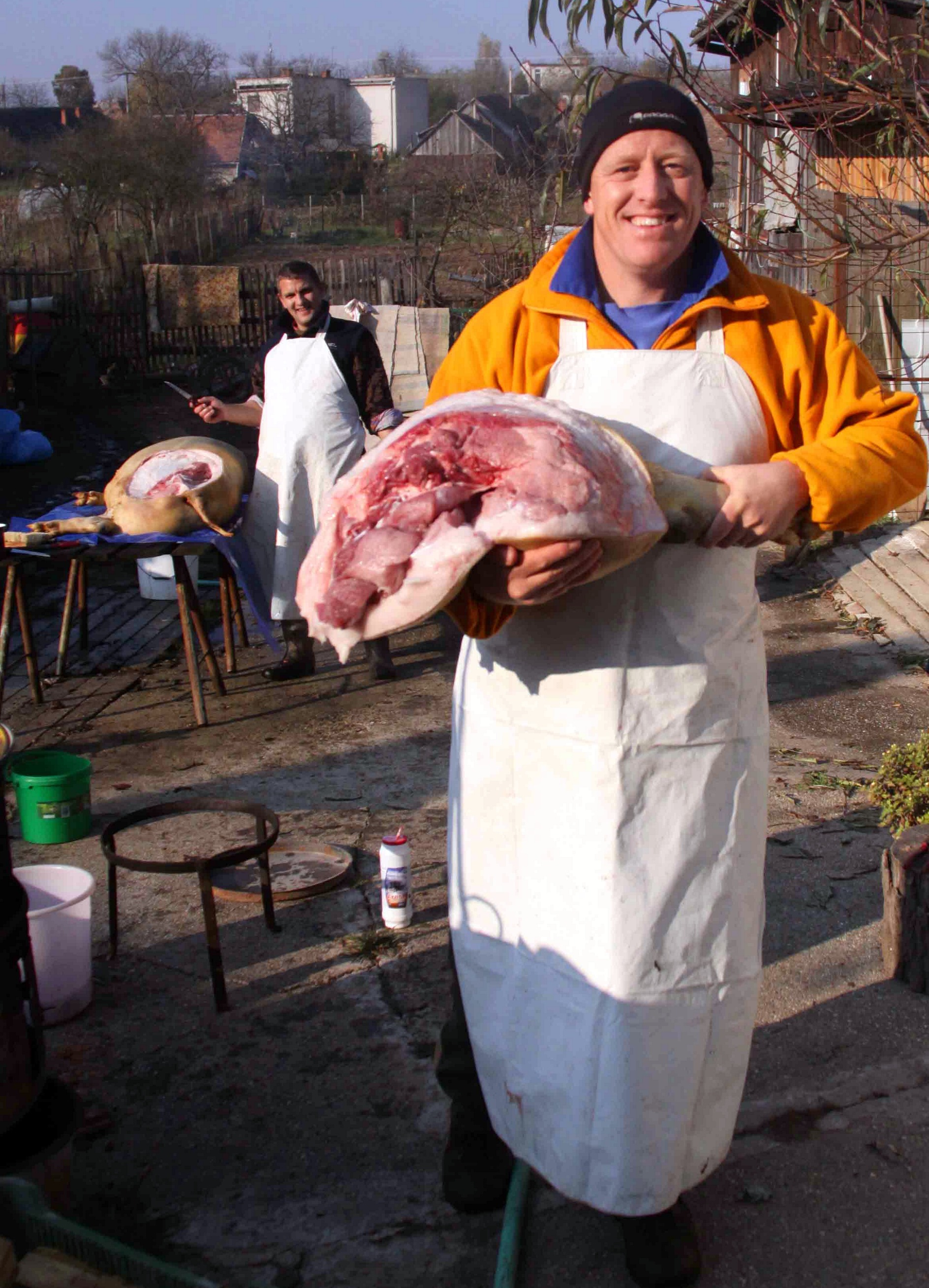
img: Simon participating in the traditional slaughter of pigs that occurs in his Slovakian village every year. His comment: “Most village families rear a couple of pigs every year for this purpose. The custom was new to me, and I didn’t like the idea — never ever thought I’d be doing this kind of thing! But it does mean you can fill your freezer with good quality, home-bred meat and sausages, and I’ve gotten used to it.”

STAY TUNED for tomorrow’s installment from our displaced fictional heroine, Libby, who encounters her very first 4th of July celebrations.

If you enjoyed this post, we invite you to subscribe for email delivery of The Displaced Nation. That way, you won’t miss a single issue. SPECIAL OFFER: New subscribers receive a FREE copy of “A Royally Displaced Tea.”
Related posts:

5 proverbs on cross-cultural relations, by Pocahontas

June was Alice-in-Wonderland month at The Displaced Nation, when we discovered that Alice’s “curiouser and curiouser” adventures have something akin to the situations expats and travelers often find themselves in.

But how do local people feel when global nomads land — kerplunk! — on their soil? During July, we’ll be looking at cross-cultural communications (or the lack) with the help of the legendary Pocahontas, one of the world’s foremost experts on fostering intercultural understanding.

As everyone knows — even kids, thanks to Disney — Pocahontas was the human bridge between foreign and local cultures. She helped to connect two groups that were about as different, and as opposed in their aims, as could be imagined: the Algonquin Indians of the Tidewater region of what is now Virginia, led by her father, Chief Powhatan; and the English settlers who’d been sent by the Virginia Company of London to found Jamestown, led by John Smith.

Earlier today, The Displaced Nation performed a special ceremony to invoke the spirit of Pocahontas. She has paid us a short visit, during which she had the following to say:

Chama Wingapo. That’s “Welcome, friends” in the language of my tribe, the Powhatan. “Powhatan” by the way means waterfall.

As you may know from your studies of history, ours was an Algonquian Indian tribe that lived in the Tidewater region of what I understand is now known as Virginia. My father was their king.

Chama Wingapo. I must say, it’s a little strange to speak these words of welcome aloud. Did you know that no one has spoken our language for more than two centuries? It became extinct as we Indians declined in number, dispersed and lost our cultural identity.

Still, I know you’re not interested in the topic of our displacement. It’s just that it was on my mind when I saw you’d just been discussing what some of our descendants irreverently call White Independence Day.

But to return to my mission for The Displaced Nation: I’ve come back to give you some ideas on what building bridges between so-called “local” people and their foreign visitors entails.

Allow me to offer these five proverbs, which represent the distillation of my own experiences:

1. Not everyone you meet in a foreign land will be over the umpsquoth (moon) about your presence in their territory.

I understand you’ve all chosen to travel overseas for your own self-edification, not on behalf of your government’s colonization campaign. And I applaud you for that.

But some of the people you’ll encounter on your travels don’t give two feathers what brought you there. They will always see you as an outsider — not so much displaced but out of place. Nothing would make them happier than if you returned to your own tribe and ceased taking up space in theirs.

Still others will tolerate your presence — but only as long as they can profit from you in some way.

My people, for instance, offered John Smith land for his colonists to live on, in addition to providing the settlers with food — bread, corn and fish — all for an opportunity to trade with them.

Ideally, you will also at some point find someone like me who is interested in forging a genuine friendship across cultures and (where applicable) races. Someone willing to take the time to serve as the intermediary, go-between, guide, translator — I’ve been told that our brethren on the Japan Islands have their own unique term, iki jibiki (walking dictionary) — between you and local residents, with enough skill to ward off the impact of any poison arrows sent your way.

(While on this topic, I have a slight confession to make. I didn’t really save Captain John Smith’s life. Goodness, I was only ten years old at the time we met. What’s more, we were welcoming him into our tribe during the ceremony when I allegedly performed this feat. Talk about cross-cultural communications gone badly wrong! His life was never endangered…)

2. In adapting to another tribe’s ways, you will constantly struggle between respect and disrespect.

Our esteemed descendant Chief Roy Crazy Horse of the Powhatan Renape Nation said the Disney movie of my early life “distorts history beyond recognition.”

While I largely agree with him, there’s one thing that this film got exactly right. I can’t tell you how many times I had the following exchange, not just with Captain Smith but with many of the other palefaces:

JOHN SMITH: We’ve improved the lives of savages all over the world.
POCAHONTAS: Savages?
JOHN SMITH: Uh, not that you’re a savage.
POCAHONTAS: Just my people!

Of course he (and the others) saw me as a savage, too — I was a heathen, after all!

But just like the wind that can blow hot or cold, this strong aversion to our people would sometimes change into something approaching deep love. In particular, the English respected us for respecting nature.

On this point, the Disney movie went a little too far, portraying me as the original — Aboriginal — tree hugger:

JOHN: Pocahontas, that tree is talking to me!
POCAHONTAS: Then you should talk back!
JOHN: What do you say to a tree?
POCAHONTAS: Anything you want!

Still, there is a grain of truth in that exchange. Our animism was something our foreign friends envied, and hoped they could pick up by association.

3. Romantic love for a person of another culture often has tangled roots.

I should know as I was married twice — once to a fellow Algonquian, and the second time to an English settler by the name of John Rolfe. (No, I was not in love with John Smith — another Disney distortion. I loved him as a father, though.)

Did you know that John Rolfe fretted for several weeks over whether to marry me because I wasn’t a Christian? In the end, I converted and gave myself a Christian name, Rebecca.

At the same time, though, John worshiped the ground I walked on. I was his exotic Indian princess. But sometimes I thought he was more in love with the idea of me as a Noble Savage (rather literally!) than with who I was as a person.

4. When a man or woman moves away from his tribe, opportunities await.

I offer up this proverb for any locals who are considering marriages to foreign visitors.

Thanks to my marriage to John Rolfe, I was able to expand my world far beyond its original boundaries. In the spring of 1616, I, Rebecca Rolfe, took a sea voyage to London as a guest of the Virginia Company. They presented me in all my finery to King James I and the best of London society.

But what is life? The flash of a firefly in the night. I fell ill and died just as we set out on the voyage home. In my memory, the English erected a life-size bronze statue of me at St George’s Church — which you can visit to this day.

Not bad for someone who trod upon this earth a mere 22 years… As I understand it, most people must wait many many umpsquoth before being appointed as the ambassador for their nation.

5. Be ever-watchful of the child whom others may judge harshly because of a mixed heritage.

I had just one child, Thomas Rolfe, who was born to me and John just before we left for England. It’s to my regret that I didn’t live long enough to shield him from the inevitable prejudices shown against Indian-white “mixed-bloods.”

That said, he appears to have thrived, even without my help. Among those who claim descent from Thomas today are several of Virginia’s First Families and the wife of one of your presidents, Nancy Reagan — a strong woman if there ever was one.

The limb doesn’t fall far from the tree!

+ + +

Cheskchamay (all friends), I wish you well on your travels, and I bid you, go in e-wee-ne-tu (peace).

There is one Native American precept that lies beneath all five of these proverbs:

“Do not judge your neighbor until you walk two moons in his moccasins.”

If you remember only this from our encounter, your journey will be a fruitful one.

* * *

Thank you, Pocahontas!

Question: Readers, do you have any responses to Pocahontas’s proverbs — anything to add from your own experiences?

STAY TUNED for tomorrow’s RANDOM NOMAD interview, in which our special guest will answer a Pocahontas-related question.

If you enjoyed this post, we invite you to subscribe for email delivery of The Displaced Nation. That way, you won’t miss a single issue. SPECIAL OFFER: New subscribers receive a FREE copy of “A Royally Displaced Tea.”

The Displaced Nation celebrates American — and its own — independence

Today being the Fourth of July, the whole of America is celebrating its independence from Great Britain.

The Displaced Nation is celebrating, too, but in our usual idiosyncratic style. According to the mini-introduction on our site:

Here at The Displaced Nation, we are passionate about the experience of becoming a global resident.

Celebrating one country’s detachment from another, 235 years ago, doesn’t seem quite in keeping with this Declaration of Independence from nationhood of the conventional kind.

So instead of looking back to 1776, two of us are looking back only to this time last year — to a time when The Displaced Nation didn’t even have a name.

Kate Allison:
This time in 2010, I blogged about the Queen’s visit to New York, which tactfully had been scheduled to start just after the Fourth. In my post I described the awkwardness of representing the very country from which America was celebrating its independence:

Imagine gatecrashing a silver wedding anniversary bash, given in honor of your ex-husband and his subsequent wife, and that’s pretty much what it’s like to be a Brit in America on the 4th of July.

And yet last year was better than others had been in the past. The reason?  I’d discovered an online world full of other people who had lived away from their home country for some time, who weren’t sure any more where the heart was, and therefore didn’t know where to call Home.

Two of those people, of course, are my fellow writers, Anthony Windram and ML Awanohara, at The Displaced Nation. When ML first emailed to ask if I would be interested in this joint venture, being a fan of her own site I naturally said yes. But I had no idea what a lifesaver this intense project would turn out to be, during a difficult time for me.

It’s been an exhilarating three months since the site went live. So although I can never quite get to grips with the spirit of Fourth of July, I’m going to celebrate anyway.

Fire up the barbecue, cue the fireworks, and pass a Corona. Cheers!

ML Awanohara:
I was feeling very misplaced, out of place, out of sorts last Fourth of July. I wrote a rather caviling post maintaining that celebrations of American Independence Day haven’t seemed the same since I repatriated to the U.S., after so many years in the UK and Japan.

I had three main gripes:
1) The latest poll showing that most Americans didn’t know from which nation we’d declared our independence. In the version being circulated in 2010, some had actually speculated it was from Japan or China.
2) Inferiority of American fireworks to those I’d seen over the Sumida River in Tokyo. Why hadn’t we bothered to update them?
3) Boring barbecues. At the very least, I thought it was time for Americans to consider expanding their grilling repertoires to include British bangers.

Two Brits who’ve displaced themselves to the United States, Kate Allison and Anthony Windram, read my post — and stepped up to offer their cyber-friendship.

One year later, I’m thinking about how delighted I am to have have joined forces with them in founding a nation for displaced types like ourselves.

What’s more, The Displaced Nation has just turned three months old, as of July 1. That’s nothing, of course, compared to the American nation (whose 235 years is nothing compared to China’s 5,000 years of history, let alone the histories of most European countries).

But surely it’s something in cyberspace?

We hope that you, too, by now are beginning to put down roots in The Displaced Nation, and we thank you for your contributions to our nation-building efforts.

QUESTION: Which kinds of posts would make you feel even more at home on The Displaced Nation site? We’d love to get your suggestions and input.

STAY TUNED for tomorrow’s post, proposing a new theme (woo hoo!) for The Displaced Nation to explore for the remainder of the month.

If you enjoyed this post, we invite you to subscribe for email delivery of The Displaced Nation. That way, you won’t miss a single issue. SPECIAL OFFER: New subscribers receive a FREE copy of “A Royally Displaced Tea.”

Related post:

Funny foreigners: A response to “Is English really the international language it claims to be?”

Last week Displaced Nation writer Kate Allison wrote about sarcasm. She expressed an idea I’ve heard before that the UK and US are not so much separated by a common language, but by different understandings of sarcasm and irony, the idea being that British humour and American humor are fundamentally very different beasts.

While I enjoyed Kate’s post, I can’t help but feel that she was perhaps being a little unfair on a country that has produced among many others Gore Vidal, Groucho Marx and Stephen Colbert.

Eddie Izzard, noted comedian, marathon runner and jam enthusiast claims that there is absolutely no difference between the two countries when it comes to humour. I’ve seen him perform the same material on different sides of the Atlantic, and while in both cases the audience had that happy, warm and disturbing feeling of having pissed their pants (in both the US and UK sense of the word, unless some of the audience attended the show commando) at Izzard’s brand of surreal lunacy, if I’m honest I thought it was noticeable that different parts of the act got very different responses in Philadelphia than they did in London.

I’m not convinced I can extrapolate that into fundamental differences between the two countries, there’s a strange alchemy that occurs between a stand up audience and a comic, and sometimes — as I felt when I saw Izzard in Philadelphia — it just doesn’t gel as well as it could, but the same could have happened in London too.

Of course, we need to keep all of this quiet. We’re among friends here so I’ll let you into a little secret. It is in the interest of British self-esteem for us to let Americans think that there’s a huge chasm between the British and the American sense of humour. We, the country that gave the world 29 Carry On films, like to project onto ourselves this idea that we have a sophisticated, dry humour unique to our soil. We (Brits) talk about “irony” in the similarly loose, off-putting, undefined, making-it-on-the-sly way that the French talk about “terroir.”

And yes, I wouldn’t for a moment contest that, in general, the rhythm and beats that make up my humour are not necessarily the rhythm and beats that make up my friends’ American humor.  For instance that time-honoured, equal opportunity offender, “taking the piss” doesn’t translate that well to the US. But it’s a giant leap from that to saying that the Americans don’t “get” irony as well as the British. The UK is not a land of 60 million Oscar Wildes all excelling in the arts of irony, witticisms and dry put downs. We’re a country that to our eternal shame has commissioned five seasons of Celebrity Juice — and with each season the carcass of comedy putrifies further.

Yes, we may use irony far more socially than is normal for Americans, and this is of course surprising and befuddling for the poor American who wasn’t expecting an ironic response when they politely asked if you’d had a nice weekend, but that is a very different from the idea that Americans don’t “get” it. Smart people get irony, and there’s plenty of smart people in the US, and no, that’s not me being ironic.

For anyone who is still curious on this subject you may be interested in this video via Big Think: “Ricky Gervais on British and American humo(u)r and their differences.”

STAY TUNED for Tuesday’s post, Part 2 of Sebastian Doggart’s Bond-worthy quest to track down traces of Ian Fleming in today’s Jamaica.

If you enjoyed this post, we invite you to subscribe for email delivery of The Displaced Nation. That way, you won’t miss a single issue. SPECIAL OFFER: New subscribers receive a FREE copy of “A Royally Displaced Tea.”

Related post:

English – is it really the international language it claims to be?

Despite speaking English as the Wonderland creatures did, Alice frequently found there to be a language barrier:

Alice felt dreadfully puzzled. The Hatter’s remark seemed to have no sort of meaning in it, and yet it was certainly English. “I don’t quite understand you,” she said as politely as she could.

I sympathize with Alice; some years after the publication of Wonderland, George Bernard Shaw made his famous remark that

England and America are two countries separated by a common language

and that sentiment is as true today as it was in the 1800s.

“Perhaps it doesn’t understand English,” thought Alice.

I’ve got a piece of Facebook flair that says

“Sar-chasm: The giant gulf between the sarcastic comment and the person who doesn’t get it”

and this definition pretty much accounts for the language barrier between my home country and my adopted one.

Sarcasm is a Brit’s second language, and it’s disconcerting not to be understood when you speak it. A few years ago when our house in the States was for sale, we had the misfortune to deal with a prospective buyer who said he’d like to buy our house, but who actually wanted to amuse himself over several months by grinding our asking price down to the 1985 construction cost before saying, “You know, I think I’d rather live ten miles away in a different town altogether.”

When negotiations had come to an unpleasant halt, we observed facetiously to our real estate agent that at this point we’d prefer to torch the place than let this particular person live in the neighborhood, to which she replied, quite seriously, “I don’t think that would be a good idea. Arson’s illegal.”

A British estate agent may have replied, “Here’s twenty quid. Get some matches and petrol on me.”

Or maybe they wouldn’t these days. The litigious society has been shipped from America to Britain and is doing quite nicely, from what I can tell from the Daily Mail. Had the place had gone up in flames after an overenthusiastic barbecue, we could have sued the realtor for giving us ideas.

“Then you should say what you mean,” the March Hare went on.

Occasionally I do meet that rare American who understands sarcasm, but because they don’t go around ringing bells and shouting “Unclean!” I don’t realize they’re using it until it’s too late and I’m saying, “Oh, wait – no, I get this, I do, it’s just I’m out of practice…” (The exception is if he or she has a Brooklyn accent, in which case we greet each other with a secret handshake.)

The best way to identify sarcasm-users is to ask them what they watch on TV. Assuming they correctly identify your accent, they’ll generally say one of two things in reply: either “I have the whole of Monty Python on DVD!” or “Oh, wow, that Benny Hill – isn’t he just awesome?” If it’s the latter, don’t even think of mentioning the benefits of lighter fuel and matches in any part of the house other than the brick barbecue.

Especially if there’s a For Sale sign in the garden.

.

STAY TUNED for Tuesday’s post on the characters you can meet along the way in your own Wonderland…

If you enjoyed this post, we invite you to subscribe for email delivery of The Displaced Nation. That way, you won’t miss a single issue. SPECIAL OFFER: New subscribers receive a FREE copy of “A Royally Displaced Tea.”

Related posts:

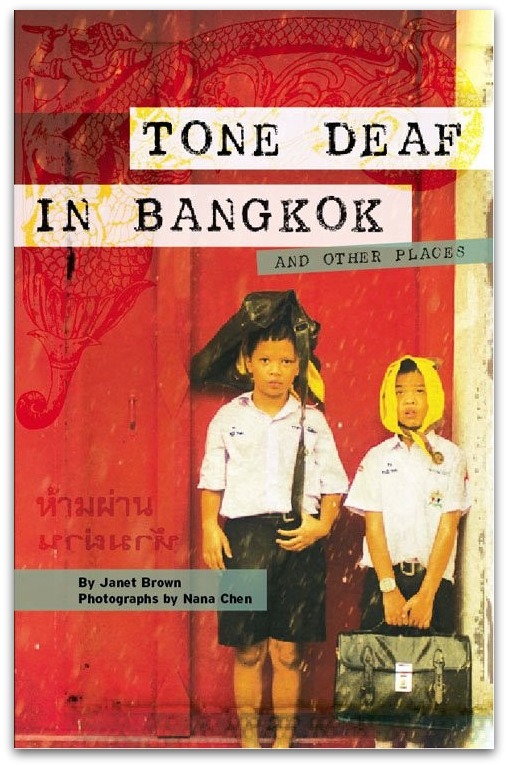
Travel author Janet Brown channels Alice in Wonderland’s “tone deaf” adventures

SPECIAL TREAT FOR TDN READERS: JANET BROWN, author of the travel gem Tone Deaf in Bangkok, has kindly agreed to “come in” and respond to your comments and questions. 

As you may have noticed, The Displaced Nation has gone Alice-in-Wonderland mad since around the first of June. To take just a few examples:

And now, to top that all off, the extraordinary travel writer Janet Brown is paying us a visit. Brown could almost be a stand-in for the Lewis Carroll heroine herself, having published a book on travel to and life in Thailand called Tone Deaf in Bangkok, to much acclaim.

“Tone deaf” — it puts one in mind of poor Alice’s plea to the Mouse, “I didn’t mean it…But you’re so easily offended, you know!”

But if Brown sees herself as tone deaf, her readers regard her as anything but. Here is a sampling of her reader reviews on Amazon:

It has been ages since I have loved a piece of travel literature…, and so when I read TONE DEAF IN BANGKOK, I was thrilled. This is a good travel book, and it is a good book, period.

I am not a traveler, nor do I typically read travel books. Shame on me, I know, but here’s the thing: … The author brought Bangkok to life in a way that made me want to go there, yes, but it was her own story that captivated me and kept me turning the pages. Now I’d read anything Janet Brown writes!

Janet Brown’s TONE DEAF IN BANGKOK is a travelogue, to be sure. Yet it is more, so much more. It’s also an investigation into how dislocated we can become by ourselves, by our priorities and by all that we demand of the cultures in which we live. … That she has a gift for spotting the universal in the exotic makes this collection all the more profound.

Janet Brown has graciously agreed to answer some of my Alice-related questions. After that, dear reader, I urge you to chime in!

Before we go down the rabbit-hole, can you tell me a little bit more about your background?
My parents turned me into a gypsy before I was two, by taking me on their journey by jeep from New York City to Alaska when the 49th state was still a territory and the Alcan Highway was still an unpaved trail into the frozen north. I have wandered ever since, most recently in Southeast Asia with Bangkok as my home, writing down the stories I encounter as I explore. My books include:

Maybe because I’m so steeped in Alice-of-Wonderland lore this month, I think of you as Alice Personified. To what extent can you relate to Alice’s sense of disorientation? Going back not just to the first time you went to Thailand but also when your family dragged you to Alaska…
I was 18 months old when my family moved to Alaska from Manhattan. I coped with any displacement issues by making my mother read my favorite book over and over again — a truly saccharine Little Golden Book called The New Baby. The main character had the same name as I so that was the big attraction — all about me!  My mother swears she can still recite it verbatim after having two martinis.

Alice came to mind constantly in my first months in Bangkok — and frequently thereafter. I knew I’d gone through the looking glass — or had entered the postcard — and asked myself often if that experience had been as painful for Alice as it often was for me.

Can you describe your worst “Pool of Tears” moment in Bangkok, where you wished you hadn’t decided on living there?
I’ve tried to make light of that time when I wrote about it in Tone Deaf in Bangkok, but it nearly demolished me. When the manager of my apartment turned me into Ryan’s Daughter by listening in on my phone calls and then entertaining the neighborhood with highly embroidered versions of my life — and when people fell silent when I walked down the street and began gabbling excitedly after I’d passed — I felt as though my life had been stolen from me and I shut down to the point of hypothermia. If my students hadn’t helped me find a new neighborhood, I would have gone home a gibbering mess.

Thailand is renowned for its distinctive cuisine. Was there anything that carried an “Eat me” label that you felt hesitant about at first, but then discovered you loved?
I’ve written about durian in Tone Deaf, how I thought its smell in the market was sewer gas and then how I was forced to taste it, with happy results. Fried grasshoppers were another thing I didn’t warm to at first sight and then liked as much as I do popcorn — they have much the same crunch and texture.

By the same token, were there any foods that you thought might be good but then didn’t acquire a taste for? (For Alice, of course, that was the Duchess’s over-peppered soup.)
One night I stopped to buy green papaya salad from a food cart to take home for supper. There was something in a little plastic bag that looked like a sort of relish, so I bought that, too.When I opened it at home a smell of rot filled the air, but remembering the delightful surprise that durian had proved to be, I took a generous spoonful. It was pla ra — fermented fish, a Northeastern Thailand culinary staple that is meant to be added and mixed judiciously with the salad, not eaten like peanut butter. There wasn’t enough toothpaste in the world to rid my mouth of that thoroughly foul taste.

As already mentioned, Alice finds it’s easy to offend the creatures in Wonderland without even trying. Why did you choose the expression “tone deaf” for the title of your book on Bangkok? 
“Tone deaf” can be taken quite literally. Thai is a tonal language with five different tones giving meaning to every word. Use the wrong tone and at best you’re incomprehensible, at worst shocking. The most common mistake for foreigners is to tell someone their baby is beautiful, while actually announcing that the infant is bad luck. Another pitfall is confusing the word “near” with the word for “far” — they are the same sound, differentiated by a crucial tone.

But travelers to Thailand can also be “tone deaf” when it comes to figuring out the Thais’ communication style. As a Thai-American friend has observed, the important things are what remain unsaid. “You looked so beautiful yesterday” probably means today you resemble dogfood and ought to go home and rectify that at once. Subtlety is the hallmark of Thai communication, and is often expressed through a quirk of an eyebrow or a famous Thai smile, which has at least one hundred different meanings — including disdain or outright menace.

Describe the biggest faux pas you’ve made since settling in Bangkok.
Oh, how to choose — it’s impossible not to make faux pas every second because Thai etiquette is demanding and complex. The one that makes me cringe most is in my first week when I set off on my first solo bus ride. I was clutching a twenty-baht note, which like all bank notes in Thailand bears the countenance of the King. He is revered to the point of near godhood in his kingdom and his picture is always elevated to the highest spot in a room — nothing is above the King. But I was fresh off the boat and when I dropped my money and it was caught in a little breeze, I put out my foot (the lowest and most ignominious part of the body) and stepped on the picture of the King’s face to secure my bus fare. I was too clueless to pick up on the ripples of horror that this caused others at the bus stop, but now I writhe when I remember this.

“Off with her head!” as the chief royal in Alice’s story is wont to proclaim. Actually, never mind your head. Your mention of your foot makes me think of how physically awkward Alice feels around the creatures in Wonderland. As a farang in Bangkok, do you often feel self conscious?
I’m short and dark in a family of pale-skinned people, so I was used to being an anomaly from early childhood. In Bangkok, if I dressed like a Thai woman and wore sunglasses and walked slowly, I felt as though I blended in. But one day I walked down a quiet street on my way to a class, and someone looked up and said, “Look at the foreigner.” “How did she know?” I asked my class of teenage girls. “Your hair,” they said. “No, lots of Thai women have dyed their hair brown,” I replied — to which they responded: “Your nose.” It was my big American nose that gave me away every time — and since I hate pain and surgery, I just had to accept that.

Have you tweaked your personal style at all so as to fit in better? 
Yes — I adopted the conservative “Don’t show your bare shoulders” school of dressing that prevailed in Bangkok when I first arrived and slowed my pace to that of the women around me. I learned to keep my facial expression as bland as I possibly could to achieve the quiet Thai “public face,” and I ironed everything, including my Levis. Now women are much more casual in the way they dress but I’m still stuck in the cultural mores of the 90s. To foreign women who live here now, my introductory years in Bangkok seem like fiction — things have changed so drastically in the past 16 years.

Time for a quote from the Cheshire Cat: “…we’re all mad here. I’m mad. You’re mad.” Can you relate?
Riding on the back of a motorcycle taxi down a crowded city sidewalk, buying a glass of Shiraz to take with my popcorn into a movie theater, being drenched to the bone during Thai New Year’s — this is actually the most difficult question you’ve asked so far because at this point it all seems normal.

If you were to hold your own Mad Hatter’s Tea Party in Bangkok, whom would you invite, and why?
Anais Nin, because she would love the unbridled hedonism of this place, Evelyn Waugh because he would satirize the expat scene so well, Ho Chi Minh because he could help put together the revolution that is needed here, Emily Hahn because she has always been my role model since I first read her when I was twelve, and Elvis because in Bangkok he is still the king.

Alice becomes aware that Wonderland is turning her into a different person, unrecognizable to the one she used to be. Has your identity has shifted in fundamental ways since living in Bangkok?
This is a very complex question — I’ve written one book about it and am working on a second one, Almost Home. I’m always drawn back to the US because my children are there. Seeing them for two weeks a year doesn’t work for me. Once I get back to the US this time around, I’ll return here but plan to spend the bulk of my time near family in the Pacific Northwest. I won’t know how much I’ve been changed by this recent incarnation in Bangkok until then. Ask me again in several months.

Can you offer any advice for newcomers to Bangkok, who aren’t sure who they are any more?
Tone Deaf in Bangkok and my next book, Almost Home, are where I directly address the challenges of feeling like an Alice in Thailand. In addition, the recently published Lost and Found Bangkok, for which I wrote the text, may be helpful for newcomers. It’s a book in which five different photographers — two American men, two Thai men (both from Bangkok), and one Taiwanese-American woman — show the city they live in. New arrivals can look at the photos and see some great places to get lost — and find out who they are — in this Wonderland-like city.

img: Janet Brown with friends at an all-you-can-eat DIY barbecue at a huge restaurant under a bridge in Bangkok, by Will Yaryan.

STAY TUNED for Monday’s post on the problems one can anticipate in trying out one’s humor on Wonderland’s inhabitants…

If you enjoyed this post, we invite you to subscribe for email delivery of The Displaced Nation. That way, you won’t miss a single issue. SPECIAL OFFER: New subscribers receive a FREE copy of “A Royally Displaced Tea.”

Related posts:

RANDOM NOMAD: Balaka Basu, Ph.D. Student in English Literature

Born in: New York City, USA
Passport(s): USA
Countries lived in: India (New Delhi): 1981, 1987-89, 1991, 2003-04; Italy (Rome): 2002
Cyberspace coordinates: The Society of Friends of the Text (collaborative blog)

What made you leave your homeland in the first place?
I’ve inherited displacement from my parents, who moved (individually) to the United States from India for graduate studies and sort of never left. They made periodic attempts to pick up stakes and move back, taking me with them, but these never lasted for more than a year at a time. My childhood left me feeling like a person without a homeland, always living between worlds, never quite belonging anywhere.

Describe the moment when you felt most displaced over the course of your many displacements.
As a child, it used to be while saying — or rather, in my case, not saying — the Pledge of Allegiance at morning assemblies. Now, every so often, out of nowhere, I’ll have this weird sense of wanting to go “home” and smell the jasmine and the honeysuckle, and the smoky, pungent mustard oil, and have someone bring me a glass of freshly pressed pomegranate juice.

Describe the moment when you felt least displaced.
This is a difficult question because the land of my birth is sort of my adopted homeland. I was born in the United States — but was taken back to India when I was 28 days old. My first language is not English, but I can neither read nor write in Bengali. I’m pretty much always feeling displaced. However, I’ve got the subway map of New York tattooed on my heart, and it’s always been the place I’ve come back to. I love coming into the city early in the morning from points east and watching the rose-gold light of the sunrise reflecting back from the million glass windows. And one of the things I loved about Rome is that it felt a bit like Calcutta — a city also caught between two worlds, displaced all on its own.

You may bring one curiosity you’ve collected from the country where you’ve lived into the Displaced Nation. What’s in your suitcase?
From India: A beaten copper sculpture of a woman bathing, a gift from my father.
From New York: A poster of the New Yorker cover “View of the World from Ninth Avenue,” by the Romanian-born American cartoonist Saul Steinberg. It depicts the supposedly limited mental geography of Manhattanites.
From Rome: A copy of Bernini’s marble baby elephant.

You’re invited to prepare one meal based on your travels for other Displaced Nation members. What’s on the menu?
Llish (a fish only available in India/Bengal) in mustard and chili paste, which has been smoked in banana leaves; rice; green mangoes in oil; and for dessert, by way of Rome, blackberry gelato and an espresso.

You may add one word or expression from each of the countries you’ve lived in to the Displaced Nation argot. What words do you loan us?
From India: Arbit, short for arbitrary, used as slang in India. Whenever I hear Indian people say “arbit,” it reminds me that English is one of their national languages, too, and has evolved in a distinct and separate way.
From Italy: Prego: the indispensable word! How can you not like a word that means “if you please,” “you’re welcome,” “excuse me,” “would you mind if I walked in front of you,” and so on. You can say it any time, and it will almost never be wrong. How economical!
From New York (which I think is fair to include even though it’s my birthplace): I’ve got to go with the unprintable expletive here. When I go other places, it’s terribly difficult to remember that curse words aren’t universally accepted as terms of endearment.

This month The Displaced Nation is celebrating Alice in Wonderland as a literary analogue for disorientation and displacement. Upon entering Wonderland, Alice commits many social blunders, as when telling Mouse all about her cat, Dinah. Can you describe an instance where you inadvertently offended someone in one of your adopted lands?
Well, there was this one time when I met an astrologer in New Delhi, who apparently used to read the stars for a previous prime minister. I asked how anyone in the civilized world could take these things seriously. But I’m not sure that was exactly … inadvertent.

QUESTION: Readers — yay or nay for letting Balaka Basu into The Displaced Nation? Tell us your reasons. (Note: It’s fine to vote “nay” as long as you couch your reasoning in terms we all — including Balaka — find amusing.)

img: Balaka Basu by Edie Nugent, taken in Edie’s Manhattan apartment.

STAY TUNED for tomorrow’s installment from our displaced fictional heroine Libby — and see if you can spot the Alice references!

If you enjoyed this post, we invite you to subscribe for email delivery of The Displaced Nation. That way, you won’t miss a single issue. SPECIAL OFFER: New subscribers receive a FREE copy of “A Royally Displaced Tea.”

Related posts:

And the Alices go to … these 7 writers who get the curious, unreal side of international travel

 © Iamezan | Dreamstime.com Used under license

© Iamezan | Dreamstime.com
Used under license

Since founding The Displaced Nation on April Fool’s Day (no fooling?), Kate Allison, Anthony Windram and I have been coming across travel writers who understand just how befuddling the life of the global nomad can be.

We are inclined to think that they have channeled Lewis Carroll’s Alice.

Offering themselves up as examples, such writers talk about what’s it like for a crossborder traveler to be plagued with feelings akin to adolescent self-doubt: what am I doing here, and will I ever get over this feeling of displacedness?

And they’ve shown us how to emerge from such escapades as more fulfilled human beings, full of stories to tell, perhaps to our grandkids, one day…

In recognition of these models of displacedness, my colleagues and I have created a new accolade for the travel writing profession: the Alice’s Adventures in Wonderland Award, otherwise known as an “Alice.”

And The Displaced Nation‘s very first Alices go to…drumroll!…(listed in reverse chronological order)

1. ANABEL KANTARIA for Do we all need behavior lessons?, in the Daily Telegraph:

“Just remember, you’re not playing in your own backyard now,” my boss told me when I took my first job in the UAE. “You’re in someone else’s yard now, and you play by their rules.” It was probably the best piece of advice I was ever given about the UAE, and one that’s kept me out of trouble on numerous occasions.

Alice link: “I don’t think they play at all fairly,” Alice began, in rather a complaining tone, “… I should have croqueted the Queen’s hedgehog just now, only it ran away when it saw mine coming!”

2. SUZY GUESE for The Unexpected Benefits to Solo Travel, in Suzy Guese: Traveling with a redheaded temperament:

While I know people who travel with others can have their share of weird conversations, solo travel for some reason brings this about almost with every day. … From a musician at the Giant’s Causeway [Northern Ireland’s only UNESCO World Heritage Site] who started talking to me by insulting my shoes, to a B&B owner who told me her “journey of life”, leaving in all of the gory details, I have had some strange encounters.

Alice link: “Your hair wants cutting,” said the Hatter. He had been looking at Alice for some time with great curiosity, and this was his first speech.

3. ANDREA MARTINS for Expat women living the high life or secretly struggling?, in the Daily Telegraph:

In mid-2005, April Davidson’s world was turned upside down following her husband’s job transfer to Mexico City. … She could not understand what was happening to her and she started taking medication for anxiety and unexplained stomach problems. Little did April realise that her feelings represented a completely normal piece of the relocation jigsaw, and that taking medication to cope with the transition process was again, not uncommon.

Alice link: “You ought to be ashamed of yourself,” said Alice, “a great girl like you,” (she might well say this), “to go on crying in this way! Stop this moment, I tell you!” But she went on all the same, shedding gallons of tears, until there was a large pool all round her, about four inches deep and reaching half down the hall.

4. SEBASTIAN DOGGART for Elegy to English shepherd’s pie, in the Daily Telegraph:

One of the things I miss the most about living outside England is shepherd’s pie. … The greatest desecration is found in Quebec, where they call it “Chinese pâté” (pâté chinois). To suggest this sacred dish has anything Chinese about it is preposterous.

Alice link: “When I’m a Duchess,” she said to herself…”I won’t have any pepper in my kitchen at all. Soup does very well without…”

5. SALLY THELEN for 4 Tips on Embracing Your Inner Weirdo, in Unbrave Girl:

This morning, when I went running [in Wuxi, China], I happened upon a group of teenagers dressed up as anime characters. A crowd had formed around them to gape at their hot pink wigs, Nutcracker-like jackets and French maid dresses.

I stopped for a minute to stare slack-jawed with the rest of the crowd.

I was baffled.

I was confused.

And, frankly, I was a bit miffed. After all, didn’t these kids know that I was the main attraction at this park?

Alice link: This piece of rudeness was more than Alice could bear: she got up in great disgust, and walked off, the Dormouse fell asleep instantly, and neither of the others took the least notice of her going, though she looked back one or twice, half hoping that they would call after her…

6. SEZIN KOEHLER for My foreign body: geocharacteristics of a population, in Expat+HAREM:

When I first arrived in Prague I was a size 7, had an acceptable C-cup and chocolate-colored skin. Three years later I’ve become a size 12 and an overbearing DD-cup with skin the color of weak tea.

Aging plays only a small part….

Alice link: “Curiouser and curiouser!” cried Alice (she was so much surprised, that for the moment she quite forgot how to speak good English); now I’m opening out like the largest telescope that ever was! Good-bye, feet!”

7. JENNIFER EREMEEVA for Conversation is a One-way Street, in Dividing my time: finding the funnier side of life in Russia:

“Let me tell you about New York,” he [a Russian friend of my husband’s] said, “I was really impressed: the streets are completely strait, from one end of Manhattan to the other — ”

“– Well, except for the Village down to Wall Street,” I interjected absent-mindedly.

“Jennifer went to University in New York,” said my husband apologetically to the group.

Sergei squinted at me suspiciously, and then, changing tack, began to expand on the virtues of vacationing at Valaam on Lake Ladoga.

Alice link: “I’ve been to a day-school, too,” said Alice; “you needn’t be so proud as all that.” … “…[Y]ours wasn’t a really good school,” said the Mock Turtle in a tone of great relief. “Now at ours they had at the end of the bill, ‘French, music, and washing — extra.”

QUESTION: Do you have a favorite from the above, and do you have any other writers/posts to nominate for our next round of Alices? We’d love to hear your suggestions.

STAY TUNED for tomorrow’s interview with Random Nomad Balaka Basu. She appeals for citizenship in The Displaced Nation — and agrees to answer one Alice question!

If you enjoyed this post, we invite you to subscribe for email delivery of The Displaced Nation. That way, you won’t miss a single issue. SPECIAL OFFER: New subscribers receive a FREE copy of “A Royally Displaced Tea.”

Related post:

What the Finnish Spring can teach us about expats and politics

SPECIAL TREAT FOR TDN READERS: Anu Partanen, though she’s currently on the road, has promised to “come in” and respond to your comments and questions over the next few days. So, ask away!

Anu Partanen has done the impossible. She has made me care about the Finnish Spring, and I’ve never once been to Finland.

No, we’re not talking travel here, though I’d love to go to her country someday and see the ice melt and the vivid violet sinivuokko push their way through the leaves.

Rather, I refer to Finnish politics. Partanen wrote an op-ed that caught my eye in the May 13 edition of the New York Times. It was about Finland’s parliamentary elections, which took place with the arrival of the sinivuokko, on April 17 — the outcome of which, she claims, is the Finnish equivalent of the Arab Spring.

No, the Finns did not have any armed uprisings, just a quiet, proper democratic election. But the results were just as revolutionary:

Overnight, Finland seemed transformed from possibly the most sensible, even boring, country in Europe — known for excellent schools, zero corruption, gender equality, and a pro-European Union approach to politics — into the nationalistic, populist, Euro-skeptic home of the True Finn Party.

The only thing is, I haven’t quite decided yet what to make of the True Finns. According to Partanen, as an American, I “might consider them the equivalent of Tea Partiers (if they didn’t support the welfare state, that is).”

Most significantly, the True Finns will do anything they can to block Finland from contributing its share to bailing out bankrupt European countries — Portugal being the latest example, following on the heels of Greece and Ireland.

Notably, Partanen, too, admits to some ambivalence about the European experiment, for the first time in her life:

Myself, I’ve benefited a great deal from the European Union — I’ve studied abroad, traveled easily, enjoyed a strong euro. … Yet I was shaken when I learned that we Finns were supposed to lend money to Greece. It didn’t seem fair that my taxes would go to a country that had been living beyond its means.

Political voyeurism

But another big reason why I’m so captivated by Partanen’s take on Finnish politics is that she’s an expat based in the United States. Currently living in Brooklyn, she continues to work as a journalist for several Finnish publications. In addition, she is writing a memoir about being Scandinavian in America.

Partanen told me in an email exchange that the book is still in the early stages. I’ll be curious to see what it has to say about the challenge of participating in home-country politics from a distance.

That was something I used to think about a lot during my own expat years. If you care about the politics of your home country — as Partanen clearly does, as I did — then why aren’t you living there? Unlike me, Partanen keeps a foot in Finnish politics by continuing to write articles for the national media.

Still, it must be strange for someone as highly politicized as she is to be in the United States while an important debate is taking place about what kind of country Finland is, and wants to be.

In her Times op-ed, Partanen mentions that although she has offered her couch in Brooklyn to friends from home who would like to become political refugees, as yet no one has taken her up:

…my friends in Helsinki seem to be deciding that this is no time for retreat. Instead they’ll stay to help determine the future of their country.

Hmmm… Is that a reason why, despite my love of living overseas, I eventually bit the bullet and came back to the United States?

Politics not as usual

By the same token, Partanen shows us that living abroad can help you see your own country’s politics, and those of other nations, in a new light. Domestic politics can be very village like, and in my experience, it’s not until you step away from the village tribe that you begin to discern your own beliefs.

As already mentioned, Partanen has discovered since leaving Finland that she has developed some sympathy for the idea of setting limits on how much of its wealth Finland should share with other Europeans.

In her Times article, Partanen suggests that her position may have something in common with that held by the Americans who’ve expressed a reluctance to contribute to universal health care. Noting that America is twice the size of the European Union, she says:

It’s not quite parallel, but if Finns were asked to contribute to the health care of the Greeks, the Irish, and the Portuguese, they might feel a little like the Americans.

My experience is rather different from Partanen’s: I was an American living abroad, first in England and then in Japan, which meant listening to everyone excoriate the United States. But like her, I found that getting physically outside of my country was a stimulus to thinking outside the box and deciding on my own core truths — never mind what the mainstream parties and their media outlets (the village elders) kept telling me to think.

Also like Partanen, I moved further to the right (I hope she won’t mind me using that term) — but not on universal health care. I benefited from socialized medicine in both the UK and Japan so can be counted as a fan of Obamacare, though I do wish it included a public option.

What I came to appreciate much more fully was the tough role the United States has been assigned in world affairs. I can’t tell you how many times I felt like saying to the European and Asian critics who accosted me: “You try policing the globe, and see how much you enjoy it!”

(There were of course far more European critics than Asian ones. The Japanese, though they don’t relish the thought of our Marines continuing to be based on Okinawa, see it as their best hedge against, among other things, the wacky North Korean leadership.)

Now, that’s a true political awakening — call it an Expat Spring.

* * *

Question: How about you? Are you an expat, and if so, what’s your relationship with your home country’s politics — do you remain involved, and have you adjusted any of your basic political beliefs since going abroad?

If you enjoyed this post, we invite you to subscribe for email delivery of The Displaced Nation. That way, you won’t miss a single issue. SPECIAL OFFER: New subscribers receive a FREE copy of “A Royally Displaced Tea.”

Related posts:
