The Displaced Nation

A home for international creatives

Tag Archives: UK

In search of 007th heaven: A travel yarn in three parts (Part 2)

GoldenEye collageWe welcome back Sebastian Doggart for the second in his three-part travel yarn about his attempt to infiltrate the Caribbean retreat called GoldenEye, where Ian Fleming composed all the Bond books. In Part 1, Sebastian reports on his arrival on Jamaica’s northern coast and admission at the gates of the compound that marks the birthplace of James Bond — newly remade into a resort for the super-rich. Stay tuned for Part 3, where Sebastian continues his Bond-worthy quest for traces of Fleming elsewhere in Jamaica.

Alighting from the car, I was greeted by Jenny Wood, GoldenEye’s English general manager, whose plummily cheerful efficiency had echoes of Miss Moneypenny. She welcomed us warmly and introduced us to a Jamaican employee called Henry, who would take us to our friends, the Usmanovs.

As Henry led us down a stone path, I asked him about visiting Fleming’s house. He said that, the week before, Bono had been staying there, but that it was now vacant.

Thrillingly, Henry promised he would get a key and take us to see inside.

He took us through a wooded area, where the trees had all been planted by a celebrity guest. Handwritten signs showed a tamarind planted by Princess Margaret, a royal palm by the Clintons, a lime by Harrison Ford, an ackee by River Phoenix, a cinnamon by Willie Nelson, and a guava by Johnny Depp.

Surely, this was the most eco-friendly example of name-dropping in the world.

Shaken, not stirred

We came to the luxuriously simple main restaurant, which also housed a bar in the very gazebo where Fleming would do some of his writing. Henry informed us that, when British Prime Minister Anthony Eden visited in 1956, he used this as a command post.

It was a perfect spot for a quick drink. I eschewed the obvious choice of a dry martini, shaken not stirred and ordered instead Bond’s own creation, a Vesper. Named after his Casino Royale lover Vesper Lynd, it’s made of three measures of Gordon’s gin, one of grain vodka, half a measure of Kina Lillet, all shaken until iced cold, and served with a slice of lemon peel in a champagne goblet.

Energized, we walked on to a wooden bridge, over an emerald waterway that drifted into the sea, through a maze of discreet wooden buildings, each bordering a lagoon, to our friends’ own villa.

They welcomed us with a rum punch, made from Blackwell’s own self-named brand. We sat on the back deck, listening to the resort’s own reggae-oriented radio station, and savoring the sweet scent of marijuana wafting from the neighboring cabana. I slipped into my bathing suit and leapt into the cool water.

On the other shore of the lagoon nestled the spa, described in the resort guidebook as a place where guests have “a license to chill,” and where Bond himself “would willingly put down his guns, girls and gadgets to lose himself — and find himself.”

I went back inside my friends’ cabana for a shower. The bedroom smelled of fresh cedar and was immaculately decorated. The bathroom, adorned with new Villeroy & Boch taps and a craw-feet tub, was outside — shielded by a bamboo fence and festooned with bougainvillea.

I hope you can swim, Goodnight.

Soon after, Henry returned to honor his promise to take us to Bond’s actual birthplace, and we said goodbye to our friends.

Henry led us to the private beach where Fleming used to don flippers and a diving mask (but no snorkel) to look at parrotfish and snapper, and to spear lobsters and octopi for his dinner. A glass-bottomed boat is now available for guests to peer for barracuda.

On the shore, hotel lounge-chairs broke the natural rhythms. A rock pool that Fleming built for his son, Casper, teemed with black crabs — the same beasts that Dr. No used to torture Honey Rider. I wondered whether Fleming and his “Jamaican wife,” Blanche Lindo, might have indulged in some related zoologically erotic games.

Overlooking the beach was a charming sunken garden which Fleming had hallowed out for dining al fresco. Shaded by a proscenium arch of almond trees, he and his illustrious chums would sit here feasting on ackee, curried goat, and grilled salt-fish.

Henry took out a key to show us inside the complex known as “The Fleming House.” The renovations have expanded Fleming’s own modest footprint to embrace four houses, all built around a new, sunken swimming pool. The main building is an enlarged version of Fleming’s original bungalow, and there are three neighboring villas, which contain guest rooms and a private cinema.

Time to face gravity!

To stay in the Fleming House is beyond most mortals’ spending power: it rents for between $7,000 and $21,000 a night, depending on the season.

To put that in context, Henry, whom Chris Blackwell was paying $60 a week, would have to work seven years — and incur no other expenditures — in order to take his family to the Fleming House for just one night.

My first impression on entering the main building was similar to that of Noël Coward,
who, in a teasing ode he wrote to Fleming, complained about the hard furniture and the airless rooms.

Totemic African statues stared threateningly down into the cavernous living room. Paintings of a conch shell and a sea-view looked as though they had been bought from the local market. The floor was made of cold, pale stone.

The master bedroom was where Fleming did most of his writing, but this too was disappointing. Below a framed black-and-white photograph of Fleming stood a bullet-wood corner desk, but Henry admitted that it was a replica.

There was no sign either of the Imperial typewriter that Fleming used to write most of the Bond novels, or of the gold-plated Royal Quiet DeLuxe portable that he later purchased from the Royal Typewriter Company in New York. (The Royal, I learned later, had been sold to Bond actor Pierce Brosnan for a reported $75,000.)

As Henry led me back to my car, past a lime tree planted by Yoko Ono, the whole place suddenly felt fake and exploitative. It seemed more a celebration of celebritocracy than a tribute to the creative spirit — more akin to Scaramanga’s island than to Fleming’s original Goldeneye.

And as the iron gates clanged behind us, I suspected that, if Fleming had a chance to see how his erstwhile 007th heaven has been transformed, he would feel that Chris Blackwell has leapt on an ugly Bondwagon — and, like Auric Goldfinger, may be suffering from a deadly Midas complex.

img: (top to bottom) Fleming’s private beach; Fleming’s sunken garden; GoldenEye villa outdoor bath; GoldenEye villa bedroom — all by Sebastian Doggart.

STAY TUNED for Part 3, in which Sebastian continues his search for 007 on the beach where Ursula Andress appeared, in evil Doctor Kananga’s limestone caves, and in Dr. No’s lair on Coral Key. And before that we have tomorrow’s post — an interview with Random Nomad Vicki Jeffels, who answers an Alice question.

If you enjoyed this post, we invite you to subscribe for email delivery of The Displaced Nation. That way, you won’t miss a single issue. SPECIAL OFFER: New subscribers receive a FREE copy of “A Royally Displaced Tea.”


Related post:

Funny foreigners: A response to “Is English really the international language it claims to be?”

Last week Displaced Nation writer Kate Allison wrote about sarcasm. She expressed an idea I’ve heard before that the UK and US are not so much separated by a common language, but by different understandings of sarcasm and irony, the idea being that British humour and American humor are fundamentally very different beasts.

While I enjoyed Kate’s post, I can’t help but feel that she was perhaps being a little unfair on a country that has produced among many others Gore Vidal, Groucho Marx and Stephen Colbert.

Eddie Izzard, noted comedian, marathon runner and jam enthusiast claims that there is absolutely no difference between the two countries when it comes to humour. I’ve seen him perform the same material on different sides of the Atlantic, and while in both cases the audience had that happy, warm and disturbing feeling of having pissed their pants (in both the US and UK sense of the word, unless some of the audience attended the show commando) at Izzard’s brand of surreal lunacy, if I’m honest I thought it was noticeable that different parts of the act got very different responses in Philadelphia than they did in London.

I’m not convinced I can extrapolate that into fundamental differences between the two countries, there’s a strange alchemy that occurs between a stand up audience and a comic, and sometimes — as I felt when I saw Izzard in Philadelphia — it just doesn’t gel as well as it could, but the same could have happened in London too.

Of course, we need to keep all of this quiet. We’re among friends here so I’ll let you into a little secret. It is in the interest of British self-esteem for us to let Americans think that there’s a huge chasm between the British and the American sense of humour. We, the country that gave the world 29 Carry On films, like to project onto ourselves this idea that we have a sophisticated, dry humour unique to our soil. We (Brits) talk about “irony” in the similarly loose, off-putting, undefined, making-it-on-the-sly way that the French talk about “terroir.”

And yes, I wouldn’t for a moment contest that, in general, the rhythm and beats that make up my humour are not necessarily the rhythm and beats that make up my friends’ American humor.  For instance that time-honoured, equal opportunity offender, “taking the piss” doesn’t translate that well to the US. But it’s a giant leap from that to saying that the Americans don’t “get” irony as well as the British. The UK is not a land of 60 million Oscar Wildes all excelling in the arts of irony, witticisms and dry put downs. We’re a country that to our eternal shame has commissioned five seasons of Celebrity Juice — and with each season the carcass of comedy putrifies further.

Yes, we may use irony far more socially than is normal for Americans, and this is of course surprising and befuddling for the poor American who wasn’t expecting an ironic response when they politely asked if you’d had a nice weekend, but that is a very different from the idea that Americans don’t “get” it. Smart people get irony, and there’s plenty of smart people in the US, and no, that’s not me being ironic.

For anyone who is still curious on this subject you may be interested in this video via Big Think: “Ricky Gervais on British and American humo(u)r and their differences.”

STAY TUNED for Tuesday’s post, Part 2 of Sebastian Doggart’s Bond-worthy quest to track down traces of Ian Fleming in today’s Jamaica.

If you enjoyed this post, we invite you to subscribe for email delivery of The Displaced Nation. That way, you won’t miss a single issue. SPECIAL OFFER: New subscribers receive a FREE copy of “A Royally Displaced Tea.”

Related post:

In search of 007th heaven: A travel yarn in three parts (Part 1)

We welcome Sebastian Doggart to The Displaced Nation as a guest blogger. Sebastian won one of our Alice Awards for a Telegraph Expat blog post entitled “Elegy to English shepherd’s pie.” Today, however, Sebastian will be giving Displaced Nation readers a break from our Alice theme, with the first in a three-part travel yarn about his chase after Goldeneye — the Caribbean retreat where Ian Fleming wrote all of his Bond books. Stay tuned for Parts 2 & 3 in the coming weeks.

On the northern coast of Jamaica, fringed by icing-sugar beaches and rocky coves, lies the holy place where Ian Fleming wrote all the James Bond novels. Now populated by the rich and famous in search of paradise, it is one of the most desired and exclusive oases on earth. Its name is GoldenEye.

Over the last two years, this secluded tract of land has been mysteriously shut to the world. The official story has been that the site has been undergoing a $75 million renovation. As with arch-villain Francisco Scaramanga’s private island, its inaccessibility has made it even more appealing as a travel destination. So when I heard that the legendary site was re-opening to a handful of invited guests, I was ready to risk life and limb to gain access.

I called the number listed on GoldenEye’s new Web site, and a lilting Jamaican voice gave me an email address for a London-based PR company. Its boss, whose broken English suggested she might in fact be the murderous Rosa Klebb, declined my request to write an article on the resort — unless I could come up with $21,000 a night.

I had neither the resources of Blofeld to satisfy her demand, nor a willingness to accept her rejection. With the ingenious forces of Q behind me, I devised a cunning plan to infiltrate the compound. Two friends were getting married and had been granted a honeymoon suite in GoldenEye. I would take my chances and show up on their doorstep for a celebratory cup of tea.

The name’s Bond. James Bond.

The approach to GoldenEye is a coastal road that passes the brand new Ian Fleming International Airport. Opened in January 2011 to cater for the super high-end tourist, it is specifically designed to welcome small jets. Rolling Stone Keith Richards, who has a house in nearby Ocho Ríos is a grateful new user.

I passed a sign marking the border of the town where GoldenEye geographically sits, Oracabessa. Once a banana port, it has fallen on hard times as Jamaica’s economy has struggled. Oracabessa’s name, a derivation from the Spanish oro cabeza, or golden head, is one of the various inspirations that Fleming has cited for his home’s own name.

No sign marked the entrance to GoldenEye. After driving past twice, I stopped and ask a local shopkeeper where the entrance was. She gave me a grave look of disapproval, as if I were complicit in a rich white man’s folly, but still had the grace to direct me to an unmarked iron gate, flanked by high walls. I pulled up and saw, hidden discreetly amongst the trees, a guard-post. I felt as nervous as if I were trying to break in to Dr. No’s lair on Coral Key.

As further ammunition to melt the guard’s heart, I was accompanied by two lovely ladies: my partner, Emily, who is even lovelier than Mary Goodnight; and my six-month-old daughter, who shares a birthday, November 11, with Bond himself.

“Good afternoon,” I said, breezily. “We’re here for tea with the Usmanovs.”

“Are they expecting you?” he asked, his wariness visibly dissolving as he glanced at my Bond girls.

“They are indeed. They’re the happy newly-weds.”

“One moment, please.”

The guard retreated into his bunker. With this level of security, I felt our chances were slim. Our friends would probably be out of their room, frolicking in the pool.

But we were in luck. The guard returned. “Drive through. Follow the path, keeping to your left. You will be escorted to the cabana of the Usmanovs.”

As the heavy gates swung open, and I scrunched over the gravel to within GoldenEye’s walls, my heart was pounding. The dream of seeing the birthplace of one my greatest heroes was about to come true…

Mr. Bond, it’s good to see you again…

The story of GoldenEye — originally spelled Goldeneye, without the upper case “e” — is an epic one. The estate’s first known owner was Henry Morgan, the 17th century Welsh pirate. He made use of its location, on a headland with a panoramic view, to look out for Spanish fleets heading for Havana. When he saw a new ship, he would send a signal to his own boat hidden behind an island, and its captain would then sail forward to claim their bounty.

Morgan used his piratic skills to help the British acquire Jamaica as a colony in 1658. He reveled in the pleasures of nearby Port Royal, “the richest and wickedest city in Christendom,” and would leave his name on every bottle of Captain Morgan rum.

Little is known of Goldeneye until the early 20th century, when it became a donkey racecourse. This is what Ian Fleming, then a commander in British naval intelligence, first saw in 1943, vowing to return after the war had ended. In 1946, he purchased the property from a powerful Jamaican land-owner, Blanche Lindo, with whom he began a life-long love affair. On the site of the racecourse café that once served banana dumplings and coconut oil, he built a white-walled bungalow.

Explaining its name in a later interview with Playboy, Fleming said:

I had happened to be reading Reflections in a Golden Eye by Carson McCullers, and I’d been involved in an operation called Goldeneye during the war: the defence of Gibraltar, supposing that the Spaniards had decided to attack it; and I was deeply involved in the planning of countermeasures which would have been taken in that event.

Goldeneye became Fleming’s winter retreat, where he would spend at least two months a year. He hosted an increasingly illustrious group of friends, including Graham Greene, Evelyn Waugh, Cecil Beaton, Laurence Olivier, and Truman Capote. His friend Noël Coward, who built his own house, Firefly, a few miles away, described his first visit thus:

We arrived before dusk. It is quite perfect, a large sitting room sparsely furnished, comfortable beds and showers, an agreeable staff, a small private coral beach with lily white sand and warm clear water. The beach is unbelievable. We swam after a delicious dinner, and lay on the sand unchilled under a full moon.

Honey Ryder: “Looking for shells?” Bond: “No, I’m just looking.”

Like Bond, Fleming was a womanizer, and Goldeneye was a fine place to woo a lady. In 1948, he brought Lady Ann Rothermere, whose response was effusive: “The air is so clear of dirt or dust, there is an illusion of a vast universe, and the sea horizon is very round.”

Fleming gave Ann a gift, the latest edition of Field Guide to Birds of the West Indies, by an American ornithologist named James Bond. He nicked the name for the hero of his first novel, Casino Royale, which he began writing in 1952, soon after he had discovered that Ann was pregnant and married her.

When writing, Fleming closed Goldeneye’s glassless, wooden shutters called jalousies, to avoid the distraction of the Caribbean horizon. He went on to create all 13 of his Bond novels in those surroundings. He would write later:

Would these books have been born if I had not been living in the gorgeous vacuum of a Jamaican holiday? I doubt it… I suppose it is the peace and silence and cut-offness from the madding world that urges people to create here…. A wonderful escape from the cold and grime of winters in England, into blazing sunshine, natural beauty and the most healthy life I could wish to live.

The Flemings’ marriage deteriorated into bickering, and Ann stopped coming to Jamaica. Our hero’s attentions turned to his “Jamaican wife,” Blanche. She was herself married — to Joseph Blackwell, an heir to the Crosse & Blackwell food family; but that only added spice to the affair. Blanche Blackwell gave Fleming a romantic gift of a coracle named Octopussy with which to explore the surrounding coves. The boat’s name became the title of the fourteenth and final Bond tale, published posthumously as part of a short story collection in 1966.

A lover of the sea, Blanche was the inspiration for Dr. No’s Honeychile Rider, whom Bond first sees emerging from the sea — naked in the book, bikini-clad in the movie. She was also the basis for Pussy Galore in Goldfinger.

You only live twice, Mr. Bond…

Blanche had a son, Chris Blackwell, who would go on to become a location manager on the movie Dr. No. He would then found the indie record label Island Records, which launched artists like Bob Marley and U2. Chris describes his first visit:

I went with my mother to a party that Ian Fleming was giving for friends. Noël Coward was there. It was a casual affair — with lunch served under the almond trees and overlooking the beach — and what I remember most is a lot of laughter.

In 1964, two years after both the release of the movie Dr. No and Jamaica’s independence from Britain, Fleming came to Goldeneye to write his last and most nostalgic Bond novel, The Man with the Golden Gun:

My own life has been turned upside down at, or perhaps even by, [this] small house … that I built 18 years ago… I sat down at the red bullet-wood desk where I am now typing this and, for better or worse, wrote the first of 12 best selling thrillers that have sold around twenty million copies and been translated into 23 languages.

Fleming died soon after, undramatically, of a heart attack, and was buried in Wiltshire, where he would later be joined by his son Casper (who tragically died of a drug overdose, aged 22) and his wife Ann.

The Fleming family held on to Goldeneye, which gradually fell into disrepair, until 1977, when they put it on the market. Bob Marley was interested, but eventually decided it was “too posh”. Encouraged by his mother, Chris Blackwell himself stepped in and purchased the property. He bought further land, increasing the estate from 16 to 100 acres and building what he called “a model for residential tourism” — a network of luxury villas that hosted celebrities including Naomi Campbell, Quincy Jones, Rachel Weisz, and Martha Stewart.

Two years ago, Blackwell shut it all down to embark on a $75 million renovation, with the goal of creating “a community of free spirits dedicated to living an inventive, balanced life where the imagination and the environment could co-exist in perfect harmony.”

We were now some of the first people to assess whether he had achieved this dream with the latest incarnation, GoldenEye.

STAY TUNED for Part 2, in which Sebastian continues his search for 007 — and for Monday’s post, where we’ll return to Wonderland for further scrutiny of its sense of humor (or the lack).

If you enjoyed this post, we invite you to subscribe for email delivery of The Displaced Nation. That way, you won’t miss a single issue. SPECIAL OFFER: New subscribers receive a FREE copy of “A Royally Displaced Tea.”
RANDOM NOMAD: Helena Halme, Book Seller, Fashion Addict & Writer

Born in: Tampere, Finland
Passport: Finnish (only, and proud of it!)
Countries lived in: Sweden (Stockholm): 1971-74; Finland (Turku): 1975; Finland (Helsinki): 1975-84; England (Portsmouth): 1984-86, 1988; England (Plymouth): 1987; England (Wiltshire): 1989-2010; England (London): 2011-present
Cyberspace coordinates: Helena’s London Life | A Nordic view on style, fashion, art, literature, food and love in the city (blog)

What made you leave your homeland in the first place?
I left Finland for the first time as a 10-year-old with my family due to my father’s work, then moved back again for the same reason. And then I left Finland for good to marry my English husband. I’ve written 48 blog posts — soon to be a Kindle book called The Englishman — about how I came to be in England.

Is anyone else in your immediate family displaced?
My father is the only member of the family who still lives in Finland. My mother lives in Stockholm (she is remarried), and my sister lives also in Sweden (she married a Swedish man). Oh dear, that makes it sound as though we are are very man-dependent women, but I can assure you we’re strong and independent — really.

Describe the moment when you felt most displaced over the course of your many displacements.
I felt most displaced when I moved back to Finland at the age of 14. I didn’t want to leave Stockholm and felt completely alien in my home country. Since then I haven’t really felt at home anywhere. Although the two countries are divided only by the Baltic Sea, Finland was — and still is to a certain extent — a very different country to Sweden. The Finnish language is notoriously difficult, and in those days the culture was heavily influenced by Finland’s proximity to Russia (then the Soviet Union). Having lived in the very Western European city of Stockholm for three years, I saw my home country as being part of the Eastern bloc (even though it most certainly wasn’t). The radio played little pop music, and the TV was full of political broadcasts and dark plays about the struggle of the working classes. Western films took longer to arrive, and most people seemed dull and depressing. Nobody smiled and they all dressed in old-fashioned clothes. There seemed to be nothing you could buy in the shops. My sister and I would take the ferry across to Stockholm for many years afterwards — and wow our friends with the H&M clothes we brought back.

Describe the moment when you felt least displaced.
Once I had my children in the UK, I felt I belonged much more — although I took care to make sure they knew they were half-Finnish. To this day, we combine Finnish and English customs: have two Christmases, grow special grass for Easter called rairuoho, and so on… No particular moment stands out in my head where I’ve felt especially at home — yet! That said, the move to London last year has given me an even greater sense of belonging… Perhaps that’s it; perhaps it happened just this year, when we moved to Northwest London?

You may bring one curiosity you’ve collected from each of the countries where you’ve lived into the Displaced Nation. What’s in your suitcase?
From Finland (even though it’s my homeland, it remains somewhat foreign): A Finnish knife (puukko).
From Sweden: A slice of the traditional Swedish cake known as Prinsesstårta.
From England: BBC Radio 4.

You’re invited to prepare one meal based on your travels for other Displaced Nation members. What’s on the menu?
I love food and don’t think I’ve changed my tastes all that much since coming to the UK. Thus my menu for The Displaced Nation is mostly Scandinavian but with one concession to British tastes. (These days, of course, you can get almost any foodstuffs from Finland in London. Bless this multicultural city!)

You may add one word or expression from each of the countries you’ve lived in to The Displaced Nation argot. What words do you loan us?
From Sweden: Fy fan (bloody hell), because it just sounds right for a sense of frustration.
From Finland: Kippis (cheers) — it sounds like “get pissed” to an Englishman’s ears.
From the UK: That’s very interesting… The person who utters these words is usually dying of boredom. (A typical English white lie…)

A statement on your blog’s Home Page strikes us as being very Alice-like: “Rye bread not toast, pickled herring not fish & chips, cinnamon buns not Victoria sponge, ice-hockey not football, wander in a forest not walk in a park, silence not polite conversation.” Does the Alice-in-Wonderland story speak to the life you’ve led in the UK?
In England I’ve always felt as if I were the largest person in the room, particularly against the slight “English roses” — just as Alice did when she entered Wonderland. When I first arrived in this country, I’d often recall the words of the Queen of Hearts to Alice at the trial: “All persons more than a mile high must leave the court.”

QUESTION: Readers — yay or nay for letting Helena Halme into The Displaced Nation? Tell us your reasons. (Note: It’s fine to vote “nay” as long as you couch your reasoning in terms we all — including Helena — find amusing.)

img: Helena Halme’s self-portrait on the number 13 bus. As Halme explained in a blog post last month, the No 13 featured in the British TV series On the Buses, which was broadcast on Finnish TV in the 1970s and was an early influence on her view of men in England. Also please note that Halme’s hair in this picture owes to her own efforts; she hadn’t yet discovered the Brazilian blow dry.

STAY TUNED for tomorrow’s installment from our displaced fictional heroine, Libby, who is debating whether Woodhaven, Massachusetts, is really the picture-perfect Wonderland it seemed at first sight. (She also meets a realtor who is most decidedly a Red Queen…)

If you enjoyed this post, we invite you to subscribe for email delivery of The Displaced Nation. That way, you won’t miss a single issue. SPECIAL OFFER: New subscribers receive a FREE copy of “A Royally Displaced Tea.”

Related posts:

English – is it really the international language it claims to be?

Despite speaking English as the Wonderland creatures did, Alice frequently found there to be a language barrier:

Alice felt dreadfully puzzled. The Hatter’s remark seemed to have no sort of meaning in it, and yet it was certainly English. “I don’t quite understand you,” she said as politely as she could.

I sympathize with Alice; some years after the publication of Wonderland, George Bernard Shaw made his famous remark that

England and America are two countries separated by a common language

and that sentiment is as true today as it was in the 1800s.

“Perhaps it doesn’t understand English,” thought Alice.

I’ve got a piece of Facebook flair that says

“Sar-chasm: The giant gulf between the sarcastic comment and the person who doesn’t get it”

and this definition pretty much accounts for the language barrier between my home country and my adopted one.

Sarcasm is a Brit’s second language, and it’s disconcerting not to be understood when you speak it. A few years ago when our house in the States was for sale, we had the misfortune to deal with a prospective buyer who said he’d like to buy our house, but who actually wanted to amuse himself over several months by grinding our asking price down to the 1985 construction cost before saying, “You know, I think I’d rather live ten miles away in a different town altogether.”

When negotiations had come to an unpleasant halt, we observed facetiously to our real estate agent that at this point we’d prefer to torch the place than let this particular person live in the neighborhood, to which she replied, quite seriously, “I don’t think that would be a good idea. Arson’s illegal.”

A British estate agent may have replied, “Here’s twenty quid. Get some matches and petrol on me.”

Or maybe they wouldn’t these days. The litigious society has been shipped from America to Britain and is doing quite nicely, from what I can tell from the Daily Mail. Had the place had gone up in flames after an overenthusiastic barbecue, we could have sued the realtor for giving us ideas.

“Then you should say what you mean,” the March Hare went on.

Occasionally I do meet that rare American who understands sarcasm, but because they don’t go around ringing bells and shouting “Unclean!” I don’t realize they’re using it until it’s too late and I’m saying, “Oh, wait – no, I get this, I do, it’s just I’m out of practice…” (The exception is if he or she has a Brooklyn accent, in which case we greet each other with a secret handshake.)

The best way to identify sarcasm-users is to ask them what they watch on TV. Assuming they correctly identify your accent, they’ll generally say one of two things in reply: either “I have the whole of Monty Python on DVD!” or “Oh, wow, that Benny Hill – isn’t he just awesome?” If it’s the latter, don’t even think of mentioning the benefits of lighter fuel and matches in any part of the house other than the brick barbecue.

Especially if there’s a For Sale sign in the garden.

.

STAY TUNED for Tuesday’s post on the characters you can meet along the way in your own Wonderland…

If you enjoyed this post, we invite you to subscribe for email delivery of The Displaced Nation. That way, you won’t miss a single issue. SPECIAL OFFER: New subscribers receive a FREE copy of “A Royally Displaced Tea.”

Related posts:

RANDOM NOMAD: Piglet in Portugal, Award-Winning Expat Blogger

Born in: Harrow, England
Passport(s): British
Country lived in: Portugal Has had a house there from 2006-present
Cyberspace coordinates: Piglet in Portugal (blog)

What made you leave your homeland in the first place?
Although we left the UK primarily due to health reasons, we were also in search of a better quality of life. The jobsworth* culture and the “health and safety” people, plus the PC Brigade**, were slowly driving us mad; we no longer had the right to exercise common sense any more than we were capable of making our own decisions. Yes, Mr Jobsworth, we know if we stand by the edge of a cliff we could fall off it. Or if we go out in the rain, we are likely to get wet. There appeared to be a whole army of people telling us what to do and what to think! England is not nicknamed the Nanny State*** for nothing!
* Jobsworth: A person in a position of minor authority who invokes the letter of the law in order to avoid any action requiring initiative, cooperation, etc.
** PC Brigade: Politically correct brigade.
*** Nanny State: A government that makes decisions for people that they might otherwise make for themselves, especially those relating to private and personal behavior.

Is anyone else in your immediate family displaced?
Our daughter moved to Lyon in France with her ice dance partner when she was just 15 years old to rain with a world-famous ice dance coach. When she gave up skating ten years ago, she met her French husband-to-be and remained in France. They have just had their first child — our first grandchild.

Describe the moment when you felt most displaced over the course of your many displacements.
I am unable to pinpoint the exact moment I felt “displaced” — it was more, shall we say, “moments” which gradually crept up on me over time. Language is a huge problem, and despite my valiant efforts to learn Portuguese, I have failed miserably. I’ve spent thousands of euros on private lessons, studied hard, but am still unable to converse properly in Portuguese. I’ve had to accept I am not a natural linguist and have resigned myself to doing the best I can. (No, I do not need any more lectures as to “you have to learn the language to integrate.” I have really tried.) Because of this failure, I now know what it feels like to be in a room full of people and feel totally alone — almost as if the room were empty or you were invisible. You are there in body but not in mind; simply a spectator. This is really difficult for me as I am gregarious by nature and a natural “chatterbox.” I am sure there are many expats out there who can relate… I am also a real foodie and, apart from desserts and cakes, am not that keen on Portuguese food…

Actually, you have made me stop and think again about this question.

Perhaps the moment I actually felt “displaced” was when our first grandchild was born recently in France. We also have another grandchild due in September, but in the UK. My first thoughts were: do we relocate to France or the UK? We have no family in Portugal so why stay here? I have begun to feel restless.

Describe the moment when you felt least displaced.
I have always felt at home in Portugal, despite language difficulties and a cuisine that is rather “basic” for my tastes. I have never tried to change anything: e.g., protest against bullfighting or insist our local snack bar serves fish and chips or curry. I accept life as it is.

You may bring one curiosity you’ve collected from the country where you’ve lived into the Displaced Nation. What’s in your suitcase?
My curiosity item would have to be bacalhau. It is dried salted cod fish and a long-time favorite with the Portuguese. I wrote a blog post about it.

You’re invited to prepare one meal based on your travels for other Displaced Nation members. What’s on the menu?
It’s a struggle for me to find Portuguese recipes I like. Most of the restaurants here in the Algarve serve up very much the same dishes: chicken piri-piri, sardines or grilled fish and meats served with salad and chips, etc. “Dish of the Day” offers other variations, but as I do not like snails, the “unmentionable” parts of animals or beans, this means the choice of food is often limited. But here goes:
Piglet’s Menu for The Displaced Nation

  • Calde de Verde (Portuguese Cabbage Soup)
  • Carne de Porco a Alentejana (Pork with Clams) [See recipe.]
  • A selection of Portuguese cheeses and crusty bread
  • Molotof — a light dessert made with egg whites. [Watch video.]

You may add one word or expression from the country you’ve lived in to The Displaced Nation argot. What word do you loan us?
My first instinct is to loan you leitão, which means “piglet” in Portuguese. My husband and I went out to lunch soon after we arrived in Portugal, and I thought I’d ordered roast pork. It turned out to be suckling pig! Hmmmm it made my trotters twitch! Mental note — I need to be more careful in translating the menu in future. Porco is pork. But perhaps it would be more in keeping for me to loan you the first Portuguese word I learned: bonita. It means beautiful.

Alice meets many curious animals when she ventures into Wonderland, including a piglet at one point. We’re curious (and curiouser!): why have you chosen the piglet moniker, avatar, and doppelgänger
Because I adore pigs. I would love to keep Vietnamese pot-bellied pigs if we had a large garden. I was nearly tempted to buy a little pig a few months ago at the local market until my head ruled my heart and common sense kicked in. Awww, but it was so cute! Some people love dogs. With me it is pigs.

QUESTION: Readers — yay or nay for letting Piglet in Portugal into The Displaced Nation? Tell us your reasons. (Note: It’s fine to vote “nay” as long as you couch your reasoning in terms we all — including Piglet — find amusing.)

STAY TUNED for tomorrow’s installment from our displaced fictional heroine, Libby. Kate Allison has assured us it will contain some more Alice in Wonderland references — but will there be any piglets? Curiouser and curiouser, I think you’ll agree…

If you enjoyed this post, we invite you to subscribe for email delivery of The Displaced Nation. That way, you won’t miss a single issue. SPECIAL OFFER: New subscribers receive a FREE copy of “A Royally Displaced Tea.”

Related posts:

DISPLACED Q: Which dish is the worst international traveler?

Although “Does it travel well?” is a question usually asked of wine, we think the same query should be demanded of food, and often.

Alice agrees with us.

Soup didn’t cross successfully from the sublime to Wonderland:

“There’s too much pepper in that soup!” Alice said to herself as well as she could for sneezing.

At least use the correct animal.

In his Telegraph article, “Elegy to English shepherd’s pie”, our Alice Award winner, Sebastian Doggart, bemoans American ineptitude when it comes to making this most English of lamb dishes.

Americans just don’t get it.

First problem, encountered even in supposedly English pubs here in New York, is that it’s usually made with beef.

Putting the wrong animal in a dish? For shame!

Perhaps food should follow the jet stream.

Bill Bryson, in his book The Lost Continent, describes an equally disappointing encounter with another dish that hadn’t traveled well from East to West: a Cornish pasty in Michigan:

It was awful. There wasn’t anything, wrong with it exactly—it was a genuine pasty, accurate in every detail—it was just that after more than a month of eating American junk food it tasted indescribably bland and insipid, like warmed cardboard.

Although he attributes its lackluster flavor to his tastebuds becoming accustomed to American cuisine, I beg to differ on this point. Some dishes simply don’t travel well, and the Cornish pasty is evidently one of them. No one should attempt to recreate it outside England’s borders.

Or perhaps direction doesn’t matter.

However, Mr. Bryson found that some foods didn’t travel successfully across the Atlantic in the opposite direction, either.

In Notes from a Small Island, he comments on British hamburger chain Wimpy in the 1970s, before McDonald’s ruled UK fast food :

“I confess a certain fondness for the old-style Wimpy’s with their odd sense of what constituted American food, as if they had compiled their recipes from a garbled telex.”

He has a point. You don’t find American McDonald’s serving Big Macs with a side of Heinz baked beans.

And lastly — if you can’t boil a kettle, don’t make the tea.

Here, I am going to jump up on my hobby horse and say emphatically, “If you don’t understand that tea must be made with boiling water –- that’s when the cooking thermometer reads 100 degrees Celsius, not Fahrenheit –- don’t even try.”  Leave the tea to the British and Indian experts and stick to coffee instead.

I’ve lost count of the times when restaurants have served me “tea” by plonking down a cup of barely hot water with a teabag, still in its paper wrapper, at the side.

Why, for goodness’ sake? I also ordered a sandwich, but wasn’t handed two slices of stale bread and a packet of ham and told to get on with it.

Once bitten

Alice could have warned us of these perils, naturally. Her culinary adventures in Wonderland made her cautious before she jumped through the looking-glass:

“How would you like to live in Looking-glass House, Kitty? I wonder if they’d give you milk in there? Perhaps Looking-glass milk isn’t good to drink.”

Out of the mouth of babes and Victorian child-heroines, indeed.

So tell us: What’s the worst-traveled food you’ve encountered?

If you enjoyed this post, we invite you to subscribe for email delivery of The Displaced Nation. That way, you won’t miss a single issue. SPECIAL OFFER: New subscribers receive a FREE copy of “A Royally Displaced Tea.”

Related posts:

And the Alices go to … these 7 writers who get the curious, unreal side of international travel

 © Iamezan | Dreamstime.com Used under license

© Iamezan | Dreamstime.com
Used under license

Since founding The Displaced Nation on April Fool’s Day (no fooling?), Kate Allison, Anthony Windram and I have been coming across travel writers who understand just how befuddling the life of the global nomad can be.

We are inclined to think that they have channeled Lewis Carroll’s Alice.

Offering themselves up as examples, such writers talk about what’s it like for a crossborder traveler to be plagued with feelings akin to adolescent self-doubt: what am I doing here, and will I ever get over this feeling of displacedness?

And they’ve shown us how to emerge from such escapades as more fulfilled human beings, full of stories to tell, perhaps to our grandkids, one day…

In recognition of these models of displacedness, my colleagues and I have created a new accolade for the travel writing profession: the Alice’s Adventures in Wonderland Award, otherwise known as an “Alice.”

And The Displaced Nation‘s very first Alices go to…drumroll!…(listed in reverse chronological order)

1. ANABEL KANTARIA for Do we all need behavior lessons?, in the Daily Telegraph:

“Just remember, you’re not playing in your own backyard now,” my boss told me when I took my first job in the UAE. “You’re in someone else’s yard now, and you play by their rules.” It was probably the best piece of advice I was ever given about the UAE, and one that’s kept me out of trouble on numerous occasions.

Alice link: “I don’t think they play at all fairly,” Alice began, in rather a complaining tone, “… I should have croqueted the Queen’s hedgehog just now, only it ran away when it saw mine coming!”

2. SUZY GUESE for The Unexpected Benefits to Solo Travel, in Suzy Guese: Traveling with a redheaded temperament:

While I know people who travel with others can have their share of weird conversations, solo travel for some reason brings this about almost with every day. … From a musician at the Giant’s Causeway [Northern Ireland’s only UNESCO World Heritage Site] who started talking to me by insulting my shoes, to a B&B owner who told me her “journey of life”, leaving in all of the gory details, I have had some strange encounters.

Alice link: “Your hair wants cutting,” said the Hatter. He had been looking at Alice for some time with great curiosity, and this was his first speech.

3. ANDREA MARTINS for Expat women living the high life or secretly struggling?, in the Daily Telegraph:

In mid-2005, April Davidson’s world was turned upside down following her husband’s job transfer to Mexico City. … She could not understand what was happening to her and she started taking medication for anxiety and unexplained stomach problems. Little did April realise that her feelings represented a completely normal piece of the relocation jigsaw, and that taking medication to cope with the transition process was again, not uncommon.

Alice link: “You ought to be ashamed of yourself,” said Alice, “a great girl like you,” (she might well say this), “to go on crying in this way! Stop this moment, I tell you!” But she went on all the same, shedding gallons of tears, until there was a large pool all round her, about four inches deep and reaching half down the hall.

4. SEBASTIAN DOGGART for Elegy to English shepherd’s pie, in the Daily Telegraph:

One of the things I miss the most about living outside England is shepherd’s pie. … The greatest desecration is found in Quebec, where they call it “Chinese pâté” (pâté chinois). To suggest this sacred dish has anything Chinese about it is preposterous.

Alice link: “When I’m a Duchess,” she said to herself…”I won’t have any pepper in my kitchen at all. Soup does very well without…”

5. SALLY THELEN for 4 Tips on Embracing Your Inner Weirdo, in Unbrave Girl:

This morning, when I went running [in Wuxi, China], I happened upon a group of teenagers dressed up as anime characters. A crowd had formed around them to gape at their hot pink wigs, Nutcracker-like jackets and French maid dresses.

I stopped for a minute to stare slack-jawed with the rest of the crowd.

I was baffled.

I was confused.

And, frankly, I was a bit miffed. After all, didn’t these kids know that I was the main attraction at this park?

Alice link: This piece of rudeness was more than Alice could bear: she got up in great disgust, and walked off, the Dormouse fell asleep instantly, and neither of the others took the least notice of her going, though she looked back one or twice, half hoping that they would call after her…

6. SEZIN KOEHLER for My foreign body: geocharacteristics of a population, in Expat+HAREM:

When I first arrived in Prague I was a size 7, had an acceptable C-cup and chocolate-colored skin. Three years later I’ve become a size 12 and an overbearing DD-cup with skin the color of weak tea.

Aging plays only a small part….

Alice link: “Curiouser and curiouser!” cried Alice (she was so much surprised, that for the moment she quite forgot how to speak good English); now I’m opening out like the largest telescope that ever was! Good-bye, feet!”

7. JENNIFER EREMEEVA for Conversation is a One-way Street, in Dividing my time: finding the funnier side of life in Russia:

“Let me tell you about New York,” he [a Russian friend of my husband’s] said, “I was really impressed: the streets are completely strait, from one end of Manhattan to the other — ”

“– Well, except for the Village down to Wall Street,” I interjected absent-mindedly.

“Jennifer went to University in New York,” said my husband apologetically to the group.

Sergei squinted at me suspiciously, and then, changing tack, began to expand on the virtues of vacationing at Valaam on Lake Ladoga.

Alice link: “I’ve been to a day-school, too,” said Alice; “you needn’t be so proud as all that.” … “…[Y]ours wasn’t a really good school,” said the Mock Turtle in a tone of great relief. “Now at ours they had at the end of the bill, ‘French, music, and washing — extra.”

QUESTION: Do you have a favorite from the above, and do you have any other writers/posts to nominate for our next round of Alices? We’d love to hear your suggestions.

STAY TUNED for tomorrow’s interview with Random Nomad Balaka Basu. She appeals for citizenship in The Displaced Nation — and agrees to answer one Alice question!

If you enjoyed this post, we invite you to subscribe for email delivery of The Displaced Nation. That way, you won’t miss a single issue. SPECIAL OFFER: New subscribers receive a FREE copy of “A Royally Displaced Tea.”

Related post:

What the Finnish Spring can teach us about expats and politics

SPECIAL TREAT FOR TDN READERS: Anu Partanen, though she’s currently on the road, has promised to “come in” and respond to your comments and questions over the next few days. So, ask away!

Anu Partanen has done the impossible. She has made me care about the Finnish Spring, and I’ve never once been to Finland.

No, we’re not talking travel here, though I’d love to go to her country someday and see the ice melt and the vivid violet sinivuokko push their way through the leaves.

Rather, I refer to Finnish politics. Partanen wrote an op-ed that caught my eye in the May 13 edition of the New York Times. It was about Finland’s parliamentary elections, which took place with the arrival of the sinivuokko, on April 17 — the outcome of which, she claims, is the Finnish equivalent of the Arab Spring.

No, the Finns did not have any armed uprisings, just a quiet, proper democratic election. But the results were just as revolutionary:

Overnight, Finland seemed transformed from possibly the most sensible, even boring, country in Europe — known for excellent schools, zero corruption, gender equality, and a pro-European Union approach to politics — into the nationalistic, populist, Euro-skeptic home of the True Finn Party.

The only thing is, I haven’t quite decided yet what to make of the True Finns. According to Partanen, as an American, I “might consider them the equivalent of Tea Partiers (if they didn’t support the welfare state, that is).”

Most significantly, the True Finns will do anything they can to block Finland from contributing its share to bailing out bankrupt European countries — Portugal being the latest example, following on the heels of Greece and Ireland.

Notably, Partanen, too, admits to some ambivalence about the European experiment, for the first time in her life:

Myself, I’ve benefited a great deal from the European Union — I’ve studied abroad, traveled easily, enjoyed a strong euro. … Yet I was shaken when I learned that we Finns were supposed to lend money to Greece. It didn’t seem fair that my taxes would go to a country that had been living beyond its means.

Political voyeurism

But another big reason why I’m so captivated by Partanen’s take on Finnish politics is that she’s an expat based in the United States. Currently living in Brooklyn, she continues to work as a journalist for several Finnish publications. In addition, she is writing a memoir about being Scandinavian in America.

Partanen told me in an email exchange that the book is still in the early stages. I’ll be curious to see what it has to say about the challenge of participating in home-country politics from a distance.

That was something I used to think about a lot during my own expat years. If you care about the politics of your home country — as Partanen clearly does, as I did — then why aren’t you living there? Unlike me, Partanen keeps a foot in Finnish politics by continuing to write articles for the national media.

Still, it must be strange for someone as highly politicized as she is to be in the United States while an important debate is taking place about what kind of country Finland is, and wants to be.

In her Times op-ed, Partanen mentions that although she has offered her couch in Brooklyn to friends from home who would like to become political refugees, as yet no one has taken her up:

…my friends in Helsinki seem to be deciding that this is no time for retreat. Instead they’ll stay to help determine the future of their country.

Hmmm… Is that a reason why, despite my love of living overseas, I eventually bit the bullet and came back to the United States?

Politics not as usual

By the same token, Partanen shows us that living abroad can help you see your own country’s politics, and those of other nations, in a new light. Domestic politics can be very village like, and in my experience, it’s not until you step away from the village tribe that you begin to discern your own beliefs.

As already mentioned, Partanen has discovered since leaving Finland that she has developed some sympathy for the idea of setting limits on how much of its wealth Finland should share with other Europeans.

In her Times article, Partanen suggests that her position may have something in common with that held by the Americans who’ve expressed a reluctance to contribute to universal health care. Noting that America is twice the size of the European Union, she says:

It’s not quite parallel, but if Finns were asked to contribute to the health care of the Greeks, the Irish, and the Portuguese, they might feel a little like the Americans.

My experience is rather different from Partanen’s: I was an American living abroad, first in England and then in Japan, which meant listening to everyone excoriate the United States. But like her, I found that getting physically outside of my country was a stimulus to thinking outside the box and deciding on my own core truths — never mind what the mainstream parties and their media outlets (the village elders) kept telling me to think.

Also like Partanen, I moved further to the right (I hope she won’t mind me using that term) — but not on universal health care. I benefited from socialized medicine in both the UK and Japan so can be counted as a fan of Obamacare, though I do wish it included a public option.

What I came to appreciate much more fully was the tough role the United States has been assigned in world affairs. I can’t tell you how many times I felt like saying to the European and Asian critics who accosted me: “You try policing the globe, and see how much you enjoy it!”

(There were of course far more European critics than Asian ones. The Japanese, though they don’t relish the thought of our Marines continuing to be based on Okinawa, see it as their best hedge against, among other things, the wacky North Korean leadership.)

Now, that’s a true political awakening — call it an Expat Spring.

* * *

Question: How about you? Are you an expat, and if so, what’s your relationship with your home country’s politics — do you remain involved, and have you adjusted any of your basic political beliefs since going abroad?

If you enjoyed this post, we invite you to subscribe for email delivery of The Displaced Nation. That way, you won’t miss a single issue. SPECIAL OFFER: New subscribers receive a FREE copy of “A Royally Displaced Tea.”

Related posts:

RANDOM NOMAD: Jack Scott, Former Bureaucrat & Soon to Be Published Author

Born in: Canterbury, England
Passport(s): British with official Turkish Residency
Countries lived in: Malaysia (Malacca): 1967-1969; Turkey (Bodrum): 2010-present
Cyberspace coordinates: Perking the Pansies | A comical narrative of expat life (blog)

What made you leave your homeland in the first place?
I moved to Bodrum in Turkey with my civil partner, Liam. I was a petty bureaucrat for 30 years gently ascending a career ladder to middle management, middle income and a middling London suburban terrace; comfortable, secure and passionately dissatisfying. We thought it high time to take a break from our labors, put our feet up and watch the pansies grow while we were young enough to enjoy it.

Is anyone else in your immediate family a “displaced” person?
My father more or less ran away from home when he was 16 to join the army. If he hadn’t, he probably would have ended up down a mine or in a factory (the days when Britain had such things). He (and then we) traveled widely — to Northern Ireland, where he met and married my mother and where my eldest brother was born; then on to Germany, where my second brother was born and contracted polio; then on to Malaya (before independence), where my elder sister was born; then back to England (Canterbury), where I was born. Our family then moved to Pimlico, in Central London, living in a barracks that is now the Chelsea School of Art(!). Finally, we went to Malaysia, where my younger sister was born. In Malaysia, we lived in a large, self-contained complex on the coast near Malacca called Terendak Camp. The camp had been built along miles of golden sands overlooking the Malacca Straights for army personnel and their families from Britain and across the Commonwealth — we shared it with Aussies, Kiwis and a few people from Malta. It was all very colonial, unimaginable today. I also seem to remember Dad traveling on his own to Cyprus, Aden (in Yemen), and Egypt. He died some years ago. Maybe I’ll write something about him one day…

Describe the moment when you felt most displaced over the course of your many displacements.
It was right here in Bodrum. We were spited by a storm of Biblical proportions that was punctured by a spectacular light-and-sound show that lit up the sopping sky and cut the power. Prodigious pulses of horizontal rain assailed every crack and cranny of our house, through every easterly window frame and beneath every threshold. It was freezing, so Liam and I hid under the duvet and fought over the hot water bottle. All Turkish houses leak, have no insulation and precious little heating. Of course, it rains in England, too — but not like that. Now, that’s not in the guidebooks and travelogues.

Describe the moment when you felt least displaced.
Liam and I were chuffed when our Turkish neighbors invited us over for dinner. Our grasp of Turkish remains lamentably poor and their English is virtually non-existent — but they made us feel very welcome and the food was delicious. There was much waving of hands and furious gesticulation. We used a Turkish-English dictionary to chuck random words into the conversation just for the hell of it. Turks are blessed with an honorable tradition of hospitality long abandoned in the West. In London I hardly knew my neighbors.

You may bring one curiosity you’ve collected from the country where you’ve lived into the Displaced Nation. What’s in your suitcase?
I was very young when I lived in Malaysia. I haven’t been back since though would love to. Sadly, I’ve kept nothing from those distant days. As for Turkey, our prized possession is the fragment of an ancient Ionian capital in our garden. It’s a bit heavy to put in a suitcase, and I’d be arrested if tried. Turkey is an incredible land where history lies casually underfoot.

You’re invited to prepare one meal based on your travels for other Displaced Nation members. What’s on the menu?
Turkish cuisine is up there with the best in the world. I would offer a meze plate of tasty Turkish fare using the best produce from the local market seasoned with exotic herbs and spices you just can’t get at Sainsburys. My guests would be offered:

  • roasted aubergine blended with garlic puree; artichoke hearts with herb dressing, peas and lemons
  • seaweed with a tangy vinaigrette
  • vine leaves stuffed with spiced rice
  • sauteed beans with olive oil and tomatoes
  • white cheese with olives drizzled in olive oil and garnished with oregano
  • finally, the ubiquitous but delicious sigara borek – shallow, fried, cigar-shaped mixed-cheese pastries.

It makes my mouth water just thinking about it. Yours?

You may add one word or expression from each of the countries you’ve lived in to the Displaced Nation argot. What words do you loan us?
Avustralyalılaştıramadıklarımızdanmışsınızcasına. This is a Turkish term pronounced as a single word and an extreme example of agglutination, the process of adding affixes to the base of a word. This word translated into English means “as if you were one of those whom we could not make resemble the Australian people.” Though rhythmic and poetic on the ear, Turkish is not an easy language for Europeans to assimilate as it is thought to belong to the Altaic language family and is distantly related to Mongolian, Korean and other inscrutable Asiatic tongues. Despite Atatürk’s valiant 1928 adoption of the Latin alphabet and the fact that the language is phonetic and mostly regular, the word order, agglutinations and the absence of familiar sounds all conspire to make learning Turkish a very daunting prospect. I’ve chosen it specially for The Displaced Nation to torture, to amuse and to remind everyone how completely hopeless many of us — particularly native English speakers — are with foreign tongues.

Question: Readers — yay or nay for letting Jack Scott into The Displaced Nation? Tell us your reasons. (Note: It’s fine to vote “nay” as long as you couch your reasoning in terms we all — including Jack — find amusing.)

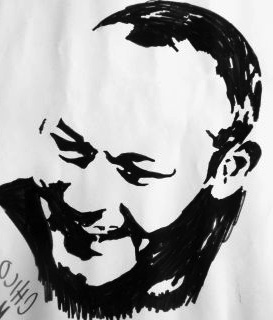
img: Pencil sketch of Jack Scott by a local Turkish artist

If you enjoyed this post, we invite you to subscribe for email delivery of The Displaced Nation. That way, you won’t miss a single issue. SPECIAL OFFER: New subscribers receive a FREE copy of “A Royally Displaced Tea.”

Related posts: