The Displaced Nation

A home for international creatives

Tag Archives: UK

TRAVEL YARN: A second date with Rome

Kym Hamer, an Australian expat in London, joins us today as guest blogger to share her version of a Roman Holiday — one of several trips she has made since having the continent of Europe and all of its history on her doorstep. Notably, for Kym, Rome doesn’t need Gregory Peck to be irresistible!

After 12 years away, I recently went back to Rome.

My only previous dalliance with the Eternal City was part of a “12 cities in 20 days” type tour that at the time, seemed to be the best option for getting a taste of Europe in the three weeks of holiday I had available from my job in Australia. You see, when you’re coming from the other side of the world, the flights are long and expensive, so there needs to be a pretty high rate of return for the time and money invested.

It was an amazing holiday. I visited a whole range of places — some hotly anticipated, some moving me unexpectedly, some not quite what I had hoped for. Each got 1-2 days with an experienced tour guide who made the queues disappear, added humour to the gruelling schedule and brought each city to life with her own blend of historic narrative and personal storytelling.

But each stop allowed no more than a brief and flirtatious encounter, the faint ripples disappearing almost as quickly as they were made by the time I’d left. Each major European city, Rome included, made its impression but was quickly over-run by the next.

Living the dream in London

When I moved to London from Melbourne more than eight years ago, it was the third time I travelled to the UK’s capital in four years. The first time I had been drawn for a week and the second time for four days — both times before a longer “whistlestop” tour of the sort just described. And on both of these visits, I split my time between “tourist” and “traveller,” between the seeing what I wanted to see and the aimless wandering: immersing myself in the city streets, using the local transport and chatting with the natives. One way and another, I got the true taste of the city that was to become my home just a few years later.

I love history and I’ve read it — beginning in the guise of historical fiction (by the likes of Jean Plaidy) through to Simon Schama, Alison Weir and several others — since my very early teens, always trying to imagine what those real worlds, leaping off the pages in front of me, were actually like.

Once I’d moved to London, suddenly I felt I was living the dream (albeit one never particularly aligned to that city). I still stand on Waterloo Bridge at night, gazing at all that history along the riverbank reflected in the Thames, pinching myself and wondering: “Wow, how did I get here?”

Was it a love of history that had tempted me across the world? Not really…there were other candidate cities, but the “right” circumstances conspired with a passionate fling to bring me here. And just as you never know where things might lead in life, the fling came and went, yet London had captured my heart.

The grass still looks green(er)

But my yen to explore means there’s always a sense of looking over the fence (so to speak) with curiosity. What’s it like over there? Would I like it? Be disappointed or even worse, nonplussed?

Which leads me to Rome and some of the other cities I’ve visited since living in London. Being able to hop on a plane (or train — the Eurostar is a pretty fabulous way to travel) and, in just a couple of hours, walk the historic cobbled laneways of a completely different place is an extraordinary experience for any Antipodean. Only a few short hours is required to separate oneself from the familiar and the habitual.

European travel has an especially strong hold on my bucket list. For the most part, Australia’s history is both inextricably linked to and considerably newer than anywhere on the Continent, even though some of the names and boundaries may have changed since I first learned of these faraway lands in the schoolroom.

Of course, nothing can ever take you back in time to know truly what it was like standing at The Green at the Tower of London or inside Newgrange passage tomb in Ireland’s Boyne Valley or atop Hadrian’s Mausoleum — now known as Castel Sant’Angelo — in Rome.

But in the Eternal City, there’s a deep sense of generations past, not just battles won and lost and the rise and fall of the empires that at one time or another shaped “the world” — but also everyday trifles, evidence of the “day-to-day” living of previous generations (take, for instance, Trajan’s market, the “shopping” centre where people went to buy their fresh produce). Both strands of history — the extraordinary and the quotidian — are accessible and visible everywhere.

Second-date nerves

There’s always a part of me that feels a little nervous when I first arrive somewhere new — a piece of me that says, “You could stay in the hotel room tonight, read your guidebook a bit more and be really sure when you set out tomorrow morning.” And it takes some mustering of courage to stop dawdling and plunge right in.

I’m always glad, invigorated actually, once I set off but I guess that essential human-ness in us wants to avoid the risks and keep ourselves safe and sound.

The Rome I had encountered on our first date, before moving to London, had grown faint and unfamiliar. But on this second Roman Holiday, I surprised myself by diving right in to its sights, sounds and smells. I was out the door just an hour after checking in to my hotel. Not for me the lolling about to “recover” from my travels. No way. I had only four days and I wanted to fill it with…well, Rome. It was an immersive experience I was after.

So I walked down from Quirinale in the darkening streets as night fell, map in one hand, camera in the other, my eyes filled with wonder and excitement. A stranger in the night if you will: with no local knowledge, limited lingo (si and grazie get you only so far) and quite frankly no idea where I was going. Tingling and a little breathless with the thrill of discovery somehow I found my way through the warren of streets to the Fontana di Trevi.

And the four days flew by. I walked and bus-sed and walked and Metro-ed and walked and cruised and walked some more. Compact and exuberant, Rome spreads its charm around every corner. The noise and busy-ness were energising although the traffic in some of the piazzas less so.

(I always imagined piazzas to be intimate and bustling, even green, rather than spacious, concrete or filled with litter. So the Piazza Navona and Campo de’ Fiori — the latter translates into “field of flowers” — were amongst the few “oh, is that it?” moments.)

A piece of my heart

From my coin toss into the Trevi on that first night to my final morning meandering in the warm rain through the gardens of the Villa Borghese, my second encounter with Rome has moved us beyond the acknowledgement of two passing strangers. But while we are not yet close friends, there’s a piece of my heart that’s indelibly stamped with a sense of delightful possibility.

Will I return to the Italian capital for a gentle kiss, for one more embrace perhaps? I don’t know but it’s exciting, exhilarating, a little self-conscious and filled with promise.

Just like Rome.

Born and raised in Melbourne, Kym Hamer has worked in London in sales and marketing for the past eight-and-a-half years. She writes the popular blog Gidday from the UK. Also follow Kym on Twitter: @giddayfromtheuk.

STAY TUNED for tomorrow’s Random Nomad interview with an American who has taken the “phile” in Anglophile to an extreme.

If you enjoyed this post, we invite you to register for The Displaced Dispatch, a round up of weekly posts from The Displaced Nation, with seasonal recipes, book giveaways and other extras. Register for The Displaced Dispatch by clicking here!

Related posts:

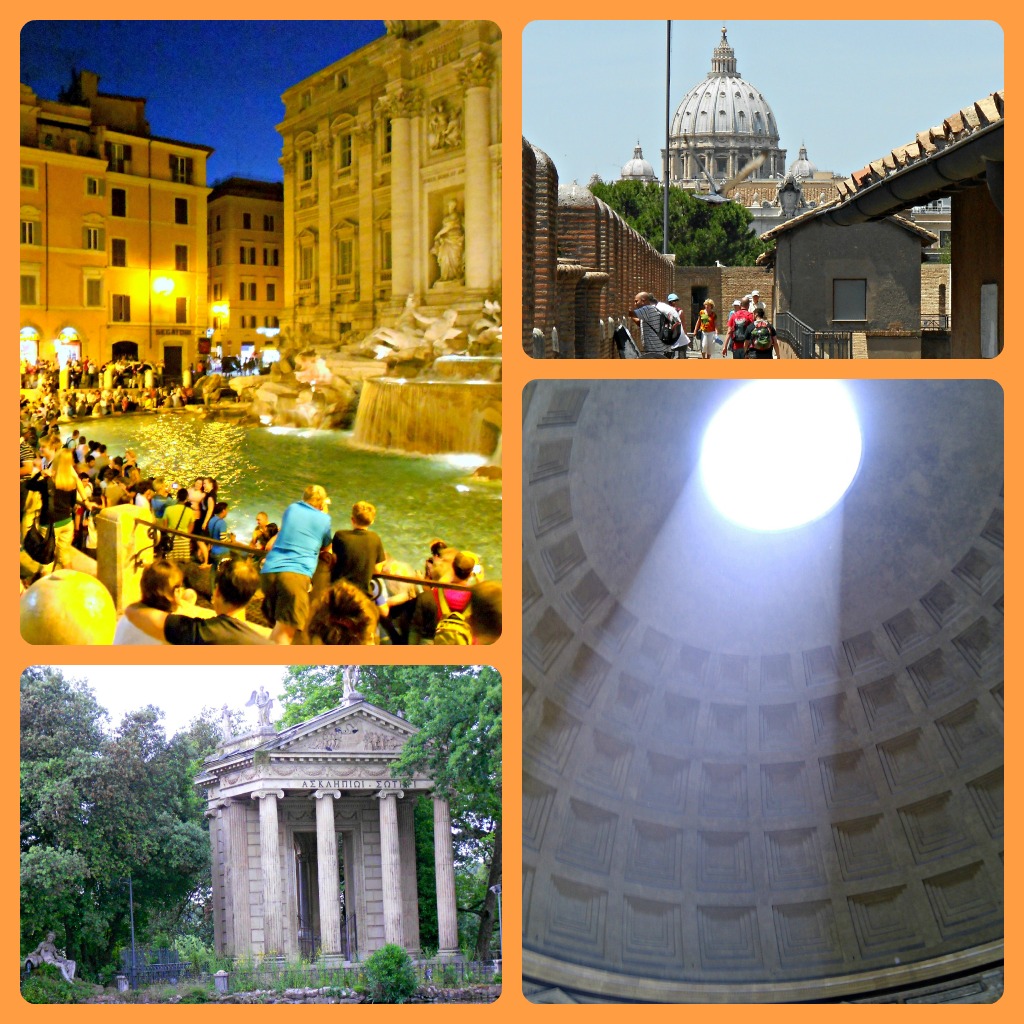
Images: Some enchanted moments from Kym’s second date with Rome. Clockwise from top left: Off peak at the Trevi Fountain (“busy, yes, but somehow still magical”); the Vatican from the battements of the Castel Sant’Angelo; sunlight pouring into the Pantheon; the Giardino del Lago at the Villa Borghese.

THE DISPLACED POLL: Who will win the Ladies’ Grunt Championship at Wimbledon?

Ah, the start of Wimbledon Fortnight. Two weeks of tennis whites, polite applause, Royalty, and strawberries and cream.

And grunts. Don’t forget the grunts. Especially the ladies’ grunts.

If some of the newspapers this week are to believed, that’s what modern tennis is all about.

The history of the grunt

Men’s tennis grunts started back in the 1970s with Jimmy Connors, and the popularity soon spread among the guys. In the 1988 US Open, Ivan Lendl complained about opponent Andre Agassi‘s grunts, saying they threw him, Lendl, off his timing.

Women’s tennis took a little longer to catch on, starting with Monica Seles‘s guttural shrieks in the 1990s. Once started, though, the women soon raised grunting to an art form, or at least another sport, putting the men’s feeble efforts to shame.

Serve in silence

Fans and media, however, are not amused by Centre Court’s soundtrack, and Martina Navratilova, a champion when women’s tennis was played in dignified silence, also disapproves. Her view is that the grunt masks the sound of the ball leaving the grunter’s racquet, putting the non-grunting opponent at a disadvantage.

“The grunting has reached an unacceptable level. It is cheating, pure and simple. It is time for something to be done.”

World Tennis Association chairman and chief executive, Stacey Allaster, agrees:

“It’s time for us to drive excessive grunting out of the game for future generations.”

Quite how this will be achieved, though, is rather vague. A fine for noisy players. perhaps? It would have to be a big one to have any effect. Michelle Larcher de Brito, the Portuguese player, and rumoured to be the next Maria Sharapova as far as grunt volume goes, reportedly said:

 “I’d rather get fined than lose a match because I had to stop grunting.”

The WTA is quick to point out that current players will not have to curb their on-court vocal emissions. The ban on grunts will be phased in after a period of educating up-and-coming players in grunt etiquette.

In the mean time, however, perhaps the solution would be to make Grunting an official Olympic sport, permissible only at Olympics (i.e. every four years) and not at Grand Slam tournaments.

With grunt decibel readings at similar levels to pneumatic drills, that would be music to everyone’s ears.

Judge for yourself:

Serena Williams and Victoria Azarenka

Maria Sharapova – Russia

And vote for the Gold Medal Winner in our poll!

Image: MorgueFile

EXPAT MOMENTS: American Dentata

Following last month’s post on expat moments, we start a new series focusing on little moments of expat experience — moments that at the time seemed pifflingly insignificant.

The dentist I went to as a child was located in a Victorian terrace which had been converted into a practice. What must have once been a gloomy living room where the family of the house had sat in sullen silence had now become a gloomy waiting room where the patients of the current occupant sat on musty couches until called for their appointment. When it was finally your turn, you would make your way up a staircase just off from the waiting room; a staircase that always seemed too steep, too narrow, too dark.

There at the top of the stairs were three rooms; two always had their doors shut, but the third would always be open. This was the examination room; no threadbare carpet or peeling plaster here. The smell of must from downstairs replaced with the sweet smell of eugenol. Clean and white with foreboding looking machinery, the centrepiece being that chair, it all felt futuristic and at odds with the rest of the house, and to my imagination it was as if I had stepped through the wardrobe or into the TARDIS. I was in the unknown.

Not so now; there is no peeling plaster, musty smells or dark Gormenghast shadows to navigate at my current dentist’s. I am in a box within a box; that is, like nearly every business in this part of California, the practice is to be found in a strip mall and the examination room is in a perfectly square room that reminds me of the prefab annexes I was sometimes taught in at Secondary school. My mouth is in the painful process of being “Americanized”. A molar is ground down in order to be crowned and slowly a childhood’s worth of NHS fillings, the colour of slate, will be extracted and the teeth will be capped gleaming white.

Bereft of a crumbling Victorian house my nightmarish fears of the dentist may have gone, but they have simply been replaced with a fear of humiliation and mockery. Opening my mouth in a dental surgery here I feel self-conscious. When my dentist starts scraping around in there I feel a whole nation’s health system being judged rather than my own admittedly poor choices.

British teeth and their perceived awfulness have become an established American comic meme popularized by The Simpsons and personified by Mike Myer’s Austin Powers. It’s an entrenched stereotype and always good for a cheap laugh.

When I open my still predominantly British mouth (it’s only partly been Americanized, the vowels and consonants it forms are still resolutely British) it inspires my American dentist to grandiose plans of what she should do with it – rip out those British pegs and start from scratch and craf me an all-American smile.

My understanding is that a teeth whitening course will be a compulsory part of the American citizenship test.

This post was first featured on Culturally Discombobulated

STAY TUNED for Monday’s post, a poll on Wimbledon by Kate Allison.

If you enjoyed this post, we invite you to register for The Displaced Dispatch, a round up of weekly posts from The Displaced Nation, with seasonal recipes, book giveaways and other extras. Register for The Displaced Dispatch by clicking here!

Related posts:

img courtesy morguefile

LESSONS FROM TWO SMALL ISLANDS — 2) Keep calm and learn to enjoy imperfection

I must have been born with a melancholy nature, because it didn’t take me long to work out that we live in an imperfect world.

Imagine my discomfort, then, when I realized that many of the people who surrounded me in my nation of birth — my fellow Americans — were obsessed with having perfect teeth, perfect bodies and a perfect appearance during their brief time on this earth.

“What’s that about?” I thought to myself at a relatively early age (I was around 6, already on the way to driving my mother, an eternal optimist, crazy). “We’re all going to grow old and die regardless.”

By the time I reached adolescence, I decided that the need to be flawless was my birth nation’s fatal flaw. It was our best feature — hey, no one can deny how good we look flashing those orthodontically-enhanced smiles — but also our worst. The list is long of fabulously talented Americans who have perished in the pursuit of physical perfection.

That lists always begins with Marilyn Monroe — a pretty and bright young thing who ruthlessly remade herself into a sex symbol, and died at age 36. (Among other things, she got work done on her nose and chin to create her classic, timeless look.) And culminates in Michael Jackson, for whom it apparently wasn’t enough to be blessed with good looks and an extraordinary musical talent. No, the King of Pop felt compelled to have lots of plastic surgery — even if it meant destroying his career and himself.

Endearing little imperfections (England)

It’s a pity Marilyn and Michael were never offered the chance to study abroad in England, that’s all I can say. My prolonged stint as a graduate student at a British university soon cured me of any lingering fixations on fixing my looks.

Why bother when the people around you seem so oblivious? None of the Brits I knew seemed to mind that the politicians who were gracing their TV screens had funny eyebrows (cue Michael Heseltine), dowdy outfits (cue Shirley Williams) or speech impediments like rhotacism, pronouncing the sound r as w (cue the now-departed Roy Jenkins).

And not just politicians but also British actresses seemed much less interested than their American counterparts in their looks. On the contrary, such glamorous types appear to thrive on their imperfections — Kate Winslet proudly flaunting her curves, Helen Mirren daring to be sexy despite having wrinkles.

And now we have the English singer Adele (Laurie Blue Adkins), who is fond of saying things like: “Fans are encouraged that I’m not a size 0 — that you don’t have to look a certain way to do well.”

Have I mentioned teeth yet? An American journalist once complimented the comedian Ricky Gervais on being prepared to wear unflattering false teeth for his role as an English dentist in the film Ghost Town — only those were his real chompers! As Gervais told a BBC reporter:

He was horrified that I could have such horrible real teeth. It’s like the biggest difference between the Brits and the Americans, they are obsessed with perfect teeth.

Imperfection is perfection (Japan)

And then I reached my second small island, Japan, which I soon came to see as the Land of Melancholy — and hence as a kind of spiritual home for someone of my proclivities. I instantly appreciated the fact that Japanese revere the cherry blossom not so much for its beauty as for the brevity of that beauty. The blossom lasts just a few days before its petals scatter to the wind.

The Japanese aesthetic that attracts so many of us in the West is based on this notion of flawed beauty. We’re talking wabi-sabi here — the value derived from the Buddhist teaching on life’s impermanence. Wabi-sabi stands in stark contrast to the Greek ideals of beauty and perfection found in many Western countries. (Hey, those Greeks have a lot to answer for, besides their spendthrift ways!)

A good example is the tea ceremony bowl: not quite symmetrical, rough in texture, and often deliberately chipped or nicked at the bottom. You turn it around slowly to appreciate its hidden beauty, a kind of diamond in the rough…

And did I mention teeth yet? Japan is the land of REALLY crooked teeth. Even some young girls who don’t have crooked teeth apparently are asking their dentists to give them a fang-like yaeba (snaggletooth) as they think it’s charming to be imperfect. Japanese celebrities too, are imperfectly perfect.

Don’t overcultivate your garden

On the face of it, the English cottage garden has very little in common with the Japanese garden — the former full of flowers and exuberance, the latter much more subdued and restrained.

But I think they are alike in one important respect: both embrace imperfection. As California horticulturalist and lover of English gardens Mary Lou Heard once said:

The thing about a cottage garden is that it is not perfect. It is not a sterile place; there is always a lot happening and changing.

Not sterile — I like that. It means that something is breathing, growing, alive…and probably imperfect. To my way of thinking, as informed by my long expat life, a row of perfect brilliant white teeth looks a bit like a row of tomb stones, and a facelifted face, like a death mask.

A Japanese garden celebrates imperfection as well — but by using elements that have a natural, rough finish. If the garden features a wooden bridge, for example, it will be made of planks of different sizes, and the wood itself will have crooked edges or knobs.

For the Japanese, the point is not to restructure reality but to embrace its quirks. That’s why they’d rather see pile of rocks in different colors and sizes than a statue surrounded by carefully landscaped bushes.

My takeaways

As I mentioned in my first post in the series, “Keep Calm and Carry On,” repatriating to the United States has been a feat of Olympian proportions. Clearly I left it a little too long! But at least I stayed away for long enough that, upon coming home again, I have conquered the part of me that says I must always be striving for physical perfection. I no longer fear looking imperfect.

Thus, while my countrymen and women engage in excessive exercising, crash dieting, and surgical enhancements, I am free to sit back and enjoy the beautiful — precisely because it is imperfect — world we live in.

This means I’m not keeping up with the Kardashians. And for a long time, I assumed Mitt Romney was from central casting, not an actual presidential candidate. (I understand he has a problem of coming across as real enough, even among mainstream Americans, which is saying a lot. If I were his image consultant, I’d suggest growing his eyebrows to look more like those of the Archbishop of Canterbury, Rowan Williams. Now that would give him some character.)

If you are a fellow American and are reading this, I suggest that you, too, try weaning yourself off our nation’s physical-perfection kick. Here are a few scenarios close to some I’ve experienced, with pointers on appropriate responses:

1 — The dentist says that in his opinion, you’d look a lot better with straight teeth. Keep calm and inform him that you’ve learned to enjoy nature’s little imperfections. If he persists, then say you were actually thinking of getting a snaggletooth, and does he happen to have any expertise in that area? If not, then whip out a photo of Ricky Gervais’s fangs to show him. (Notably, I did not take my own advice on this. Shortly I returned to the Land of the Straight Teeth, I succumbed to my dentist’s suggestion that I get braces again!)

2 — A woman stops you on the subway to point out you have a run in your stockings, or a work colleague comes up to you to tuck in the label hanging out the back of your blouse. Keep calm and tell them you’ve learned to appreciate life’s little imperfections, and they, too, may wish to get some wabi-sabi in their lives.

3 — You’re picking a mini-labradoodle puppy, and your husband wants to get the one that looks “normal,” but you like the one whose markings have asymmetry, because of her parti-colored poodle father. Keep calm and instruct your husband that the one with the strange spots is much more beautiful, and that one day people will make offers to take her away from you. (True story — my imperfect dog is perfection itself! And no, that is not her in the photo…)

* * *

So, tell me: does any of this make sense, or has living abroad for so long rendered me totally bonkers?!

STAY TUNED for Thursday’s post, another in our new “Expat Moments” series, by Anthony Windram.

If you enjoyed this post, we invite you to register for The Displaced Dispatch, a round up of weekly posts from The Displaced Nation, with seasonal recipes, book giveaways and other extras. Register for The Displaced Dispatch by clicking here!

Related posts:

Image: MorgueFile

Which country produces the people who travel the farthest, the longest — and with the most credit cards?

The Displaced Nation was contacted about doing a post on a recent survey by Travelex on “How the World Vacations” — the results of which are summed up in a cool infographic (see bottom of this post).

Since Travelex helps travelers with their foreign currency needs, they were particularly interested in finding out not only where people are traveling internationally but also how they are financing their vacations.

I thought I’d go over some of their findings and see if it helps me to understand this Big Wide World of Travel.

Really? Did I? Or did I do something altogether more irresponsible, and just pull it apart for my own amusement? Well, you all know me by now. You decide…

What’s up with international travel?

More people are doing it now than ever before. Even in the most parochial parts of England, folk are pulling the ferrets out of their trousers, staring at glossy magazine adverts and dreaming of something more glamorous than a weekend caravanning in Skegness.

Rumor has it that almost ten percent of Americans now own a passport; even more significantly, some of them have actually used them!

Yes, travel beyond one’s borders is growing — but so is the human race. So it’s only to be expected, right? (The numbers of people going abroad did decline, however, in 2008 due to the global recession, but in 2009 the upwards trend resumed.)

And now for some stereotype-busting!?

I’m not sure how much the survey tells us that we didn’t already know, to be honest — but I’m willing to be persuaded otherwise, if one of you is a better statistician than I am.

Where do the Brits go on holiday? Hmm. Tough one.

If you guessed Spain, you can give yourself a pat on the back. It is Spain. For two weeks. The survey doesn’t tell us this, but most of them spend the entire fortnight lying lobster-red on the beach before heading for the nearest bar. Had the survey asked what they ate, the finding would have been 85 percent fish and chips, of which most would have been washed down with beer — the local variety of course, because it’s so staggeringly cheap.

The destination that comes in second for the Brits? Right again! France. The main surprise is how few are going to the United States nowadays: just nine percent (versus over fifty percent to Spain and France).

The Americans? They head to Mexico and Canada. Goodness, that’s a revelation! And if they venture any further, it’s usually to Europe, especially the UK and Italy, or to the Caribbean. That said, there are a few brave American souls visiting China these days.

The survey doesn’t report this, but most Americans when they go abroad eat burgers and fries, even when sitting in an Italian restaurant. They drink beer, too — but the good stuff, because it’s still cheap, and imported, which makes everything taste better!

Noticed any Chinese tourists lately?

Thanks to its booming economy, China gets pride of place in this survey. (The Japanese used to be the most well-traveled of all Asians, but I’m afraid they’ve been displaced!)

Interestingly, the 1.3 billion Chinese are represented by a sample of 20,000; anyway, for most of them the average length of holiday is six days. Perhaps it’s not surprising, then, that they end up going to Hong Kong — which I’m not sure counts as foreign these days. (Didn’t my country transfer sovereignty to China in 1997, or have I misremembered something?)

Chinese mostly use credit cards to pay their way, despite almost a third of those being refused. Which is a shame, though I can’t say it surprises me. Would you take a Chinese credit card? Be honest.

And a surprising number, about a third, travel by boat. Still trying to puzzle that one out, given how short their vacations are. Fear of flying, perhaps? I’ve heard some nightmare stories about China Airlines.

How about Brazilians?

Another booming emerging economy is Brazil, which is the fourth country to be featured in a big way in the survey. Guess where most Brazilians go? You got it, their wealthy neighbor to the North, the United States!

But what I’d really like to know is whether the five percent of Brazilians who had their bank cards stolen were the same ones that said they traveled by rail — in which case, it serves ’em right. Everyone knows that if you take a train in Brazil, you get robbed — it’s, like, common knowledge.

International holiday central

Australia, my adopted and much beloved homeland, makes a brief appearance in the statistics for “how long they stay.” We’re at the top of the charts. Did you know that Aussies having the longest holidays IN THE WORLD, by almost a week?

The survey doesn’t tell you how often we go abroad and where we go, however.  Because if you knew that every man, woman, child and most of the sheep here take a foreign holiday every single year — and that the vast majority spend it in Bali — you’d have perished of jealousy by now (or else looking into emigrating!).

As it is, I’m worried that if the Chinese see that Aussie vacations are almost three times longer than theirs, it will trigger a revolt, for which Australia will somehow be blamed! 🙂

Herzlichen Glückwunsch!

In their write-up of the survey findings, Travelex said:

We were surprised to find that the most consistent destination for international travel seems to be Germany. That’s right! Germany. We guess lederhosen and lagers hold a certain amount of appeal no matter what native language you speak.

It’s a fair point — who’da thunk it? Even the Chinese went to Germany. Well, 1.9 percent of them did. (Which, out of the 20,000 vacationers surveyed, means at least 382 out of a country of 1.3 billion.) Germany must be thrilled at this news of its new-found popularity across cultures.

I suppose another surprising finding is that while Chinese are busy having their credit cards turned down, Brits tend to err on the side of caution, doing their money exchanges before they leave, while many Americans are still getting away with using dollars — despite the recent talk of abandoning the U.S. dollar as the single major reserve currency.

* * *

It’s often said that statistics can be made to say whatever you want them to say. And then of course, there’s the old truism that 97.6 percent of statistics are made up on the spot…

Not that I’m saying Travelex did any of this, of course. Far be it from me to cast aspersions on their information-gathering tactics. I’m just wondering if something like this can tell us much. Still, it’s a pretty infographic — the designer of which has certainly earned a vacation overseas, in my opinion!

Please talk to me in the comments. Are you into travel surveys? Have I missed something earthshaking in this one? Am I being too flippant? I’d love to know your thoughts!

Additionally, you can hit us up on Twitter: @DisplacedNation and/or @TonyJamesSlater

And now for that fabuloso infographic:

STAY TUNED for Tuesday’s post reviewing some books by expats in Dubai.

If you enjoyed this post, we invite you to register for The Displaced Dispatch, a round up of weekly posts from The Displaced Nation, with seasonal recipes, book giveaways and other extras. Register for The Displaced Dispatch by clicking here!

Related posts:

Infographic courtesy of Adria Saracino, Distilled Creative.

LIBBY’S LIFE #54 – Opening the cocoon

There’s probably a word for it in the Complete Oxford English Dictionary. An obscure word that only makes an appearance on Radio 4 intellectual game shows. Something like:

Tri-gami-matri-taci-filial (noun, Old English) — the silence of a son regarding his mother’s marriage to a serial bigamist after the father’s third marriage.

Then people like Stephen Fry and Paul Merton would make clever, rude jokes about this word, and you’d wonder why the English language possessed such an item, because such a situation was unlikely to exist.

Except the situation does exist, and consequently I’d like to know the word that has this definition:

“The pissed-off feeling after realising that your husband of nearly seven years has accidentally-on-purpose forgotten to tell you that his estranged father was a serial bigamist and didn’t run off with a local librarian like he and your mother-in-law had always led you to believe.”

I mean, it’s not as if it would have mattered, is it? If Oliver had told me on our second date, “Oh, by the way, Libs, I didn’t grow up with a father because my mum found out that he was married to a couple of other women at the same time” — I would hardly have stomped out of the restaurant before he could ask me out on a third date.

Did he really think I would have said, “God, Oliver, I’m glad you came clean with me now because obviously, there is no way I could marry the spawn of such pond slime”?

I know what you’re thinking. If it wouldn’t have been such a big deal on our second date, why am I making a fuss now?

Because it’s gone past the point of being an unfortunate fact about Oliver’s ancestry. Ten years ago, before our engagement, I could have processed the knowledge and said, “Poor Oliver. Your poor mum. What a terrible thing to happen.”

Now, although I still think that way, pity has been overtaken by hurt that Oliver couldn’t see fit to tell me.

I am being treated like the criminal, but why? The real criminal is Oliver. He has known about this all along, and in the ten years we have known each other, has never told me this story, although it’s obvious that he knew. Why did he not feel he could tell me, his girlfriend, his fiancé, his wife, his soulmate? Has he so little faith in me? I feel bereft, my faith in Oliver plundered.

But self-pity inevitably mutates into anger.

Today, I am angry, and everyone knows it.

Well, nearly everyone. Jack knows it, George knows it, and Beth knows it. The only person who is oblivious is Oliver himself, the object of my anger, and as usual he’s out, avoiding the issue. Avoiding me.

Meanwhile, rage swirls around my head and seeps out through my ears, filling the house with noxious atmosphere.

I’ve been passive too long.

I gather up the twins and strap them into the double stroller. Jack peeps cautiously at me from behind the sofa where he is quietly playing with Lego bricks.

“Put your sneakers on,” I say. “We’re going out.”

*  *  *

It’s a long time since we’ve been out.  Nursery school has finished for the summer. After the first couple of weeks when the Coffee Morning Posse delivered freezer casserole after freezer casserole, no one has been to visit — not even Maggie. I suppose they think I’ve got enough to do without catering to visitors. Even my mother has been quiet, phoning only once since she got back home. For the last few weeks, I’ve holed myself up in the house, seeing no one, ordering groceries online, too depressed and timid to put a foot outside.

But today is a beautiful, sunny day, my anger is invigorating, and I’m tired of being a hermit. I make Jack hold the handle of the stroller, loop Fergus’s leash round my wrist, and off we set, along Juniper Close.  We are walking to Main Street, to a place of busy-ness, to be with other people who will only coo at my babies and won’t see the rage and hurt in the back story.

Fergus, however, has other ideas. He crosses the street docilely enough, but as we turn right towards the road that leads to Main Street, however, he lags behind and his leash pulls on my wrist. He wants to go the other way.

I tug on the leash. He sits. I tug again. He lies down.

It’s an impasse. Fergus and I stare at each other. He usually wins these stare-down contests, but I’m in no mood for defeat. Today, I’m determined to win, so I don’t break my gaze, not even when I hear footsteps on the sidewalk behind me. Whoever it is can step onto the road and walk around us.

The footsteps slow, then stop.

“We first met,” I hear Maggie say, “when there was another drama going on between you and this dog. I haven’t seen you out with these children for weeks. Were you coming to see me?”

I continue to stare at Fergus so I don’t have to meet Maggie’s eyes. She’s right. I haven’t seen her since the twins were a couple of weeks old. How time flies when you’re having fun.

“If I hadn’t seen you today,” she goes on, “I’d have come to visit. I don’t like to intrude, but…”

“It’s been difficult,” I mutter. “The twins — they’re a lot of work.”

“I’m sure they are,” she says. “And from what I hear, so is your husband.”

She has my attention now.

“How do you know?” I demand. “What do you know?”

Maggie places a hand on my forearm and takes Fergus’s leash from my wrist. She gives the leash a gentle shake, and he gets up to stand by her, as docile as you please.

“Your mother and I became pretty good friends while she was here, you know. We made an agreement. I would be there for her daughter in America, and if the need ever arises, she will be there for mine in England.”

Mums’ Army. The Maternal Foreign Legion.

“Come on, Jack,” Maggie says, taking his hand. “Back to Granny Maggie’s house.”

With difficulty, I turn the wide stroller around to face the other direction.

“‘Granny Maggie’?” I ask. “Does that make you my mother, then?”

Maggie smiles, just a little.

“The next best thing on this side of the ocean,” she says.

.

Next post: LIBBY’S LIFE # 55 – Dark secrets

Previous post: LIBBY’S LIFE #53 – Preserved on tape 

Need the 411 on characters in Libby’s Life? Click here for  Kate’s page  of Who’s Who in Woodhaven.

Click here to read Libby’s Life from the first episode.


STAY TUNED for Monday’s post — a Dolce Vita Slideshow!

If you enjoyed this post, we invite you to subscribe for email delivery of The Displaced Dispatch, a round up of the week’s posts from The Displaced Nation. Sign up for The Displaced Dispatch by clicking here!

Image: Travel – Map of the World by Salvatore Vuono / FreeDigit
RANDOM NOMAD: Lynne Murphy, American Expat in UK & Champion Linguist

Place of birth: Western New York State, USA
Passports: USA + UK
Overseas history: South Africa (Johannesburg): 1993-97; Texas, USA (Waco): 1997-99 — definitely a different country!; England, UK (Brighton): 2000 – present.
Occupation: Senior Lecturer in Linguistics, University of Sussex
Cyberspace coordinates: Separated by a Common Language — observations on British and American English by an American linguist in the UK (blog); @LynneGuist (Twitter handle).

What made you leave your homeland in the first place?
What made me move were jobs. I am a theoretical lexicologist. Not many places want a theoretical lexicologist, so I applied far and wide and have been rewarded with some very interesting jobs and living experiences.

Is anyone else in your immediate family “displaced”?
I was the first person in my immediate family-of-birth to own a passport.

Can you describe the moment when you felt the most displaced?
The night after the American student Amy Biehl was killed in South Africa, in August 1993. At that point, I lived in a granny flat — an outbuilding behind a house in a Johannesburg suburb. I came home to find my neighbours in the main house packing up and leaving for a safe place to stay, as they’d been robbed during the day. As they left, they told me the thieves had taken the spare keys to my flat — and had already come back to steal the bicycles from the garage. At that point, I had no car, no telephone (setting one up there took FOREVER), nowhere to go and no way to get there. I stayed up all night with the lights on and with a newspaper with the story of Biehl’s murder on the front page, feeling very alone and very scared.

Is there any particular moment that stands out as your “least displaced”?
Sometimes it’s funny to reflect on the fact that my own child speaks with an English accent, and I feel most absolutely at home with her. But I also often feel really divorced from the US when I read the news. When the hullabaloo about “Obamacare” was going on, I just couldn’t believe that I came from a place where many people seem not to see good medical care as a basic right for all. And it especially galled when I saw some Americans spreading lies about how British healthcare works and others willing to believe those lies. The National Health Service isn’t perfect, but it has saved my life, and I have more confidence in its care for me than I had in the insurance-industry-driven care I had in the US.

You may bring one curiosity you’ve collected from your adopted country into The Displaced Nation. What’s in your suitcase?
From South Africa: It’s the art that’s lasted! Two pieces by Ezekiel Madiba, a print and one of his printing blocks — which is nice because it’s sturdy enough to put in a suitcase and to hug every once in a while.
From Texas: My doctor’s instructions on what to do the next time I’m stung by a fire ant (to try to avoid being bed-ridden for a week, like the first time).
From England: My wedding ring. It’s a one-off, made by a Brighton goldsmith, and it’s a curiosity, because I hadn’t thought I was the marrying type.

You are invited to prepare one meal based on your travels for other members of The Displaced Nation. What’s on your menu?

Starter/Appetizer: South African biltong. A nice peppery one—but I don’t mind if it’s beef or game. Maybe a selection.
Main course: For this, I’ll bring together the British and the American — not fancy but delicious. I haven’t given it a name, but here’s the recipe: Toast crumpets. cover with cheddar cheese and put under the broiler/grill. Slather on A1 Steak Sauce. Eat with knife and fork.
Dessert: Eton mess with raspberries instead of strawberries.
Drinks: South African wine (I never had a South African wine I didn’t like while I was in South Africa– the exported stuff is of more variable quality, in my experience); Castle Lager (a South African beer); and Schweppes Bitter Lemon (a popular soft drink in South Africa, no longer being produced in this part of the world as far as I know).

And now you may add a word or expression from each of the countries where you’ve lived to The Displaced Nation argot. What will you loan us?
From South Africa: Putting hey? on the ends of sentences. It was so easy to start doing, since I’d grown up using the “Canadian” eh? (Though I hadn’t realized I said it till I moved from upstate New York to Massachusetts, where they don’t say it.) It’s been a while since I lived in South Africa, but I still find myself doing it.
From the UK: There are so many great expressions, but the thing that’s invaded my language most is lovely. When I write emails, I have to go back at the end and take out half of the lovelies because I say it so terrifically much.

This month we have been doing some posts on Queen Elizabeth’s Diamond Jubilee. How did you spend the Bank Holiday weekend? Did you celebrate?
We’re not much into the monarchy in my house, so we just enjoyed the extra time off. But we did go to a friend’s house and eat red-white-and-blue cupcakes — which we should probably have called “fairy cakes” if we wanted to take the whole Rule Britannia thing seriously.

A couple of us on The Displaced Nation team thinks that the Queen deserves an Olympic medal for being on the throne for so long. Do you agree?
I respect the queen for handling many awkward situations with grace, but all she has done to be on the throne so long is not die yet. She got a national holiday for the occasion—I think that’s sufficient!

Readers — yay or nay for letting Lynne Murphy into The Displaced Nation? Tell us your reasons. (Note: It’s fine to vote “nay” as long as you couch your reasoning in terms we all — including Lynne — find amusing!)

STAY TUNED for tomorrow’s episode in Libby’s Life, our fictional expat series set in small town New England. (What, not keeping up with Libby? Read the first three episodes of her expat adventures and/or check out “Who’s Who in Libby’s Life.”)

If you enjoyed this post, we invite you to register for The Displaced Dispatch, a round up of weekly posts from The Displaced Nation, with seasonal recipes, book giveaways and other extras. Register for The Displaced Dispatch by clicking here!

Related posts:

img: Lynne Murphy looking rather other-worldly — or  “out of this displaced world,” as we like to say — in a Brighton pub.

THE DISPLACED POLL: Which of these 4 exotic sports should be part of the Olympics?

One thing everyone in Britain knows at the moment — if not everyone in the world — is that the Games of the XXX Olympiad (July 27 – August 12, 2012) are coming to London!

Although this grandest of international sporting events is still a ways off, we’re already starting to get into the mood at The Displaced Nation.

So I’ve decided to review some of the sports I’ve observed in my travels around the world that I’d like to see making an appearance at the Summer Olympic Games. And I’ll need your help with deciding on the most suitable candidate, which I’ll of course put forward to the International Olympic Committee — which will of course guarantee its inclusion if not this year then in four years’ time. Well, maybe. 🙂

Because I’m a recent addition to the population of the Southern Hemisphere, I’ve picked some of the more interesting and praiseworthy activities from my part of the world, which, I believe, have been under-represented at a set of games that had their origins in ancient Greece.

I know there’s loads of candidates in the UK, in Europe and the US — we’ve all heard about cheese-rolling and bog snorkeling and beard-growing…haven’t we? Ah well, maybe we’ll get to those crazy sports next week.

I’ll open with an oddly appropriate quote from the American sports journalist Robert Strauss, on how success is achieved:

It’s a little like wrestling a gorilla. You don’t quit when you’re tired; you quit when the gorilla is tired.

With that in mind, let’s get down to the voting for the Next Olympic Sport. Here are your four candidates:

1) From Australia: SHEEP SHEARING

It’s a job; it’s a sport; it’s a hobby…the Aussies even hold a world championship of their own! Apparently seasoned shearers (or “guns”) can have the complete fleece off a medium-sized sheep is as little as two minutes. The current champion is Aussie Brendan Boyle, who in 2007 singlehandedly deprived 841 sheep of their coats in 24 hours! Hell, I think he deserves a medal just for wanting to. Or perhaps something more akin to a straight-jacket…

2) From South Africa: OSTRICH RACING

Yes, it’s true. It’s a sport and everything! They have jockeys and racetracks and…well, everything else you would expect, though it certainly isn’t sponsored by Goodyear. There are ostrich farms that occasionally let tourists have a go — but it’s not for the faint-hearted. Not only are ostriches damn hard to get on, harder to stay on and capable of doing over 40 mph — they’re also quite dangerous. Near Oudtshoorn, where the sport is most famously practiced, there are two or three people killed every year by ostriches — and up to a hundred world-wide! Brilliant. Kicked to death by an ostrich is going on my list of all-time weirdest ways to die!

Amazingly enough, this sport is on the increase. If you happen to live in New Jersey, you might get chance to see some — there’s a camel and ostrich race coming to the Meadowlands Racetrack in four days’ time!

3) From India: ROLLER SKATING LIMBO

I know, not exactly Southern Hemisphere — but this sport is so amazing it has to be given a chance! Check it out:

Like most sports, this probably goes on in other places too. Other, equally crazy places… But for the feat of flexibility this activity requires, you really can’t beat the Birthplace of Yoga when it comes to training. In India, when roller-skating under bars and beams ceases to be enough of a challenge, they try skating under cars! And when that’s no enough — under LOTS of cars!

In October of last year, an 11-year-old boy Rohan Ajit Kokane took advantage of the 35cm ground clearance and skated, blindfolded, underneath 20 cars in a row — a new Guinness World Record! If asked how he’d felt during the challenge, I’m sure he’d have replied “a little low…”

4) From New Zealand: ZORBING

Well, it’s hard to see how rolling down a hill in a giant inflatable ball could become competitive enough for a spot in the Olympics —  unless the challenge was to see how many times you could do it without being violently sick all over yourself, whilst still inside…! (Oh yeah, that would take some cleaning up!)

As an athletic activity though, you can’t beat zorbing. Trust the New Zealanders to come up with such an immensely fun sport! I can foresee zorbing obstacle courses coming into vogue in the not-distant future — after all, you can literally walk on water in one of these things. Or, wait — is that the next Olympic sport? White-water zorbing! Now surely there’s something medal-worthy in that? As for an athlete who would like to compete? Me. I’ll do it! Please…?

So what do you think, Displaced Nation-ers?

Which of these four is worthy of being the next Olympic sport?

Cast your votes in our poll — and if you have any other suggestions, I’d love to hear ‘em! Comment below, or hit us up on Twitter: @DisplacedNation and/or @TonyJamesSlater

Img: Tony James Slater celebrates his zorbing success (2009).

STAY TUNED for Wednesday’s Random Nomad interview with a champion linguist.

If you enjoyed this post, we invite you to register for The Displaced Dispatch, a round up of weekly posts from The Displaced Nation, with seasonal recipes, book giveaways and other extras. Register for The Displaced Dispatch by clicking here!

Related posts:

EXPAT MOMENTS: Two Englishmen in New York

Following last month’s post on expat moments, we start a new series focusing on little moments of expat experience — moments that at the time seemed pifflingly insignificant. This week involves a celebrity encounter. No prizes for guessing the name of the celeb.

At Columbus Circle, for a fleeting moment, an opportunity presents itself.

A sidewalk collision between two pasty-faced men is avoided as both intuitively, if ungracefully, swerve to avoid bumping into each other. They are both headed towards the same crosswalk where they wait, shoulder-to-shoulder, for the traffic to stop. An observant onlooker might guess — correctly, as it turns out — from their uncoordinated, somewhat flailing gaits that both men are, in fact, English. The onlooker might also note, despite the difference in ages between these two men, that they are dressed similarly; both wear brown brogues, blue jeans, white shirts and blue velvet jackets. However, having established that this onlooker is particularly observant he or she notices more than that; they can see that though they are dressed similarly, the clothes of one of the men — the older man — are expensive and designer label whereas the younger man’s are from a department store.

As these two men wait at the crosswalk the younger man glances at the older and, though he has never before met him, recognizes him immediately. If you were to ask the younger man, he would confirm that he holds very strong views of the older man he is stood next to. If you were to press further, the younger man would admit that he has long judged the moral character of the older man stood next to him. If you were to have asked the younger man only an hour before how he would define “unctuousness,” he would merely would have replied with the name of the older man.

The younger man considers that he could lean in towards the older man and tell him that he thinks he should go “f**k himself.” But the younger man, though he would not admit it, is enthralled enough by the older man’s celebrity that he is striken momentarily dumb.

Instead, the younger man — who in his more vainglorious moments views himself as a modern-day Frank Capra everyman — thinks homicidal thoughts. As they keep on waiting at the crosswalks for the pedestrian light, and car after speeding car passes them, the younger man thinks about how the most … “accidental” … of nudges would send the older man under a New York cab.

And those few seconds, as they wait for the pedestrian light, last for the younger man the thinking and execution of a thousand “accidental” deaths, until finally there is the glow of the pedestrian crossing light and they safely cross the road before separating to go their own ways and the younger man can go back to pretending that he’s at heart a decent chap.

This post was first featured on Culturally Discombobulated

STAY TUNED for tomorrow’s post.

If you enjoyed this post, we invite you to register for The Displaced Dispatch, a round up of weekly posts from The Displaced Nation, with seasonal recipes, book giveaways and other extras. Register for The Displaced Dispatch by clicking here!

Related posts:

Image: MorgueFile

THE DISPLACED Q: Does living abroad make you more or less patriotic?

Now then, this IS an interesting question. Very topical, especially for me, as the Queen’s Diamond Jubilee is still being televised ad infinitum here in Australia. It’s almost like the networks can’t get enough of it. At one point this week it was on three channels simultaneously!

I’m not normally very patriotic — my opinions on the state of England and the UK are…well, let’s just say, that’s why I moved to Australia!

And yet — as I watch the parades, listen to the crowds shrieking, and imagine the atmosphere outside Buckingham Palace, part of me thinks: maybe I should be there? It is my home after all…and whatever else I end up being, I will always be British as well. I can’t imagine giving it up completely — it’s my history, man! And there are still things I do love about the old country. It’s an awfully pretty place, for one thing! It’s not England’s fault it’s being run into the ground by a bunch of idiots.

Mark Twain said:

Patriotism is supporting your country all the time, and your government when it deserves it.

Transferred loyalties

Oddly enough, I sometimes transfer my loyalties to wherever I call home, at least temporarily. It helps me to feel more involved with the local culture when I’m in a place, and I’m the kind of guy who’s more than happy celebrate whatever makes their country great as well.

In Thailand, for the King’s birthday, I kidnapped a gigantic yellow flag and fastened it to the back of my scooter. I saw nothing wrong with committing a minor offense to display my support for their monarch. And neither did the local police — they stopped me to applaud my efforts!

In Australia it goes without saying that I celebrate their national holiday, Australia Day. I do it for two reasons: first, I genuinely love Australia and all it stands for — it’s why I moved here as soon as I could! I really believe in their attitude to government, their national traits and their value system. Australia IS great, and it works. I think that’s quite rare in the world, and deserves recognition.

Oh and the second reason? Well, you celebrate Australia Day by going out in the sunshine, down to the river, and getting drunk. It’s not like it’s much of a hardship to get involved. 😉

But Britain is “great” — isn’t it?

Back to the Queen’s Diamond Jubilee. I hear stirring speeches from celebrities and Royal Family members, and feel…I dunno. Uplifted? Triumphant? It’s hard not to feel a tickle of pride when the eyes of the whole world are on the monarch of my tiny island.

But is it rose-tinted glasses that make me tear just a little, as the cameras zoom in on the Queen smiling at a joke from the commentator? Am I just caught up in the fever of the moment? The rest of England is going crazy for this. It’s hard not to feel just a little infected by it. But what exactly is it that I’m feeling? Mere nostalgia? Fond memories and a touch of homesickness?

As already mentioned, there’s plenty of reason not to feel pride in the country of my birth. There’s also plenty going wrong in England at the moment. The wages are terrible, unemployment is rampant, the economy is in the dumps. In my humble opinion, the UK is falling apart.

But the Jubilee itself was quite stirring, inspiring even, a reminder of all that was Great about Britain, and perhaps could be again.

Then again, I can’t help but remember that the Ancient Romans had the same idea: when the masses are starving in the streets, give them GAMES! A spectacle to take their mind off the hunger, to remind them of what a glorious empire they belong to — give them a taste of grandeur whilst they’re dying in the gutters.

Okay, so that’s a pretty cynical view to take. Hey, I’m here to play the Devil’s Advocate too, right?

So here’s my question to you kind folks: does being displaced — or out of your “home” country for any reason — make you feel MORE or LESS patriotic? And why is that?

Tell me what you think in the comments, or feel free to hit me up on Twitter at @TonyJamesSlater.

STAY TUNED for our next post, which will be on Monday.

If you enjoyed this post, we invite you to register for The Displaced Dispatch, a round up of weekly posts from The Displaced Nation, with seasonal recipes, book giveaways and other extras. Register for The Displaced Dispatch by clicking here!

Related posts:

Image: MorgueFile