The Displaced Nation

A home for international creatives

Tag Archives: TCK Talent

TCK TALENT: Lisa Liang performs “Alien Citizen” before fellow aliens

Alien Citizen Collage_dropshadowThis month Elizabeth (Lisa) Liang takes a break from interviewing fellow Adult Third Culture Kids (ATCKs) who work in creative fields, to tell us about what it was like to perform her one-woman show about being a TCK as the closing keynote at last month’s Families in Global Transition (FIGT) conference.

Hello again, Displaced Nationers! I was excited and anxious about performing my solo show, ALIEN CITIZEN: An Earth Odyssey, as the closing keynote at the Families in Global Transition (FIGT) conference, held March 21-23 in Virginia.

Excited because the FIGT audience comprises ATCKs, global nomads, TCK parents, and various professionals (cross-cultural experts, therapists, school administrators, etc.) who help expat families with issues specific to their lifestyles—in other words, my target audience. I hoped that if conference participants liked the show, it could lead to more bookings.

But if I was excited, I was also anxious. What if my work didn’t resonate with the FIGT crowd? That would signal a massive failure on my part as performer/writer.

On the other hand, what if it resonated with them too much? Maybe the FIGT participants would be looking for something light-hearted by the end of two-and-a-half days. While my show uses humor, it also goes to some dark places. Would it make people uncomfortable?

Of course I never know how my shows will be received, but I felt more was at stake at FIGT. As with other performances, I wanted people to laugh, but I also wanted them to be moved.

* * *

Here’s what happened:

1) The audience was quiet at first. I couldn’t tell if they were bored or listening intently—we were in a ballroom and I was on a platform, not close enough to see anyone’s expression. But I didn’t want to lose sight of the storytelling so charged ahead as usual.

2) To my relief, they started laughing at the right places, including lines I like but that don’t always get laughs, such as:

“So I sit in the back until I make friends with another misfit. Also known as an Australian.”

3) They listened intently. I began to realize this about twenty minutes in, which gave me the confidence to tweak some lines. The majority of the audience were my generation and older, so I sensed that if I said “I first fell in love with [Clark Gable] when I saw Judy Garland sing to him in THAT’S ENTERTAINMENT on our Betamax,” they would laugh. Normally I say “on video” because anyone younger than I am has no idea what a Betamax is.

4) I got a standing ovation as soon as the lights came up at the end. It felt warm and sincere and lasted a while.

The keynote of my keynote: Special effects

I hoped the FIGT audience would be pleasantly surprised by the show’s video projections and sound effects, since those are unusual elements in a conference setting.

Everything I attended at the conference was fascinating and of excellent quality. But my piece was something else, something purely theatrical. At the show’s beginning, the room fades to darkness as you hear David Bowie’s “Space Oddity” and then see a projection of the moon flashing past the Earth. The lights come up and I’m standing on the platform with kooky headgear and a bobbly alien headband, grinning at you.

Showtime!

One of my favorite memories of the whole experience was the Q2Q (or cue-to-cue) rehearsal the day before. The hotel staff were busy setting tables and preparing for the following day’s events. Several of them seemed bemused as they watched me performing excerpts so that the projections and sound cues could be rehearsed.

My brother John was my techie, running the cues off of my laptop in the back of the room while telling the hotel’s A/V technician when to fade down/up the lights.

John hadn’t worked in a theatre booth in something like 25 years, but you would never have guessed. And as my brother was taking on the mantle of stage manager/techie, the A/V guy started telling us how he could do some sound mixing during a tricky part of the show.

Then another hotel staffer offered to give me some background lighting to enhance the effect, until the A/V guy told him it wouldn’t be possible to run light cues, so the staffer said he could at least set up the lights to have a nice glow for me from the start.

To our delight, there were showbiz folks among the hotel staff. They loved having something to do other than give people mikes and set tables and were jazzed about what they saw, which boosted my confidence.

After the show, shows of emotion and gratitude

My brother said that when the lights came up there were people who were trying to compose themselves before they stood for the ovation. For the next half hour, people came up to thank me. Some talked at length about how the show affected them, while others just gave me big hugs. A few ATCKs with swollen eyes lodged a complaint: they felt it should have been mandatory to have a box of tissues at every table!

I recall one woman thanking me for “coming out” with my painful adolescent experiences, saying she had experienced the same when growing up in a foreign country.

Another one said the show had changed her mind about theatre—she had no idea it could be moving and transformative. That’s a compliment to my director, Sofie Calderon, who made the show far more dynamic than I could on my own.

Several parents of TCKs told me the show had given them a lot to think about, and one said she could now appreciate some of the issues she ought to be dealing with on behalf of her kids.

To my relief given my initial trepidations, the response was overwhelmingly positive. I also felt, and continue to feel, gratified that people have continued discussing their impressions on blogs, Twitter, Facebook, and email. This confirmed what I’ve learned since the world premiere and through the show’s international tour: the story is relatable and interesting; it’s a testament to TCKs’ strength; and if a story is told with humor, people will listen to the darker side of it, and empathize.

As I had hoped, FIGT has led to a new booking: I’m performing excerpts at the gala dinner for the World Bank Family Network, to be held in Washington, DC, on May 13. That’s right after my San Francisco premiere at the United States of Asian America Festival, sponsored by the Asian Pacific Islander Cultural Center, on May 10.

Hey, if the show has antennae, it also has legs!

Also, since I posted about ALIEN CITIZEN: An Earth Odyssey a year ago on the Displaced Nation, my dream of taking it Off Off Broadway came true this past September. And my goal to take it on the college circuit has come to fruition: I’ve performed the show or excerpts at Princeton, M.I.T., and CSULA, and today, April 10th, I’m taking it to my alma mater, Wesleyan University.

Another desire of mine was to perform the show at international schools, and this, too, is beginning to be fulfilled: right after FIGT, I performed excerpts at two international schools and the U.S. Embassy in Panama.

I’ve also led workshops on how to create a solo show / memoir / personal essay at Princeton, CSULA, FIGT (in 2013 and 2014), and in private classes in Los Angeles.

I’m astonished, thrilled, and humbled by the show’s life and hope to take it all over the world.

* * *

Thank you, Lisa! Your experience at the FIGT conference sounds out of this world (figuratively as well as literally), and it’s wonderful to hear news of all the progress you’ve made since this time last year, when we first “discovered” your talent! Readers, please leave questions or comments for Lisa below.

STAY TUNED for next week’s fab posts!

If you enjoyed this post, we invite you to register for The Displaced Dispatch, a round up of weekly posts from The Displaced Nation, with seasonal recipes, book giveaways and other extras. Register for The Displaced Dispatch by clicking here!

Related posts:

TCK TALENT: Heidi Durrow, Afro-Viking Renaissance Woman and Award-winning Novelist

Heidi Durrow Collage Drop ShadowElizabeth (Lisa) Liang is back with her monthly column about Adult Third Culture Kids (ATCKs) who work in creative fields, Lisa herself being a prime example. A Guatemalan-American of Chinese-Spanish-Irish-French-German-English descent, she has developed her own one-woman show about being a TCK, which will be the closing keynote at this month’s Families in Global Transition (FIGT) conference, “The Global Family.”

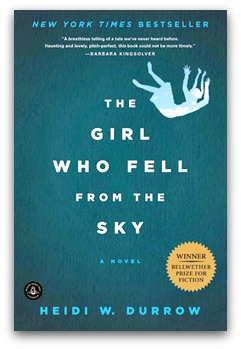
Today I’m excited to introduce Heidi Durrow, the author of the New York Times best-selling novel The Girl Who Fell From the Sky (Algonquin Books), which received writer Barbara Kingsolver’s 2008 PEN/Bellwether Prize for Socially Engaged Fiction. Heidi grew up in Turkey, the USA, and Germany. She and I first met at the Mixed Roots Literary & Film Festival that Heidi co-founded, which celebrates storytelling of the Mixed racial and cultural experience.

* * *

Welcome to The Displaced Nation, Heidi. As the TCK child of an American Air Force dad and a Danish mom, you’ve lived in North Carolina, Turkey, Washington state, and Germany. Can you tell us a little more about the chronology of the moves?
I was born in Seattle and moved to Turkey at the age of six months. The next years until I was 11, I was in North Carolina and Germany, with summers and holidays in Denmark. Since college, which was at Stanford, I have lived in NYC for grad school, Connecticut for law school, and now I split my time between the East and West Coasts.

Do you remember being happier in one place in particular?
I was pretty happy in all the places where I grew up—I was still very young. I never felt out of place or unwelcome.

Repatriations can be the hardest moves of all for TCKs, and repeated repatriation can be particularly tough, so I’m curious to know if this was true for you whenever you returned to the United States.
I had never thought of the moves as “repatriations” but that’s interesting. I think when I was very young I wasn’t aware of a lot of difficulties. But when we finally moved back to the States when I was 11, it was very difficult.  I was at an age of awareness. I felt more like an immigrant. It was so interesting to me that I had an idea of what America was when I lived overseas, and I learned quickly that America didn’t operate the way I’d imagined it from far away.

“We family.”—African-American proverb

Tell us about your summers and holidays in Denmark with your mom’s family.
It was awesome for me—in particular because my mother raised us speaking Danish and English. I am forever grateful that I have both languages. It made me infinitely closer to my aunts and cousins, whom I adore. As an adult, it’s been interesting to see how Denmark is changing. I remember going back when I was in college. I hadn’t been in ten years. My cousins had Copenhagen boyfriends, and they’d laugh whenever I talked. It wasn’t because they didn’t understand what I was saying, but they found my country accent strange. I guess I sounded like someone from Birmingham, Alabama, visiting NYC. It’s English, but it sounds very different. For years after that visit, I have often wondered whether certain traditions or sayings I learned were in fact Danish or just my mom’s own quirks.

Do you identify most with a particular culture or cultures? Or are you like many TCKs who are more likely to identify with people who have similar interests and perhaps similar cross-cultural backgrounds? (And of course it’s not a given that we’ll identify with them, either.)
I identify myself as an Afro-Viking—that is a small but growing demographic, by the way! In terms of who I am most likely to identify with—well, I think for many years in my adulthood I was very interested in finding other “mixed” friends. I wanted to know how they negotiated being multiracial and multicultural. I have found that I still have that affinity, but now I am more drawn to people who have the same career interests, who are moving on the same path at the same rate.

Studies have shown that TCKs have similar identity issues and struggles to children of mixed heritage. You and I are TCKs of mixed heritage, which makes our identities more layered than most, and makes for quite an identity struggle during adolescence. And sometimes there are shifts. I was culturally Guatemalan when I was very little, but that hasn’t been my main identity for decades.  
I haven’t shed any of my identities—I feel like I’ve added on to them over time. I remember in college I was essentially “passing” as Latina. I lived in the Hispanic-theme dorm, took Spanish classes and became the second-vice-chair of the Latino Electrical Engineering Society. I liked the idea that in latino culture they had already thought about the idea of the mestizo. So I added that on to my identity. And then when I moved to NYC I found that people thought I was what they were. Bangladeshis thought I was Bangladeshi, Puerto Ricans thought I was Puerto Rican, Greeks thought I was Greek. I’m not any of those things, but I feel like the fact that people see me as part of their own tribes has added another layer to my identity: a layer of belonging.

“He hath need of his wits who wanders wide.”—Old Norse proverb

I can relate: I was very pleased to be mistaken for Turkish when my husband and I honeymooned in Turkey. As an adult TCK, do you ever suffer from “itchy feet,” which make you want to move (locations, jobs, etc.) frequently?
You got me. I actually live on two coasts—flying back and forth every few days. I fly more than 100,000 miles per year. I can’t stay still. The same has been true for my career: I’ve been a Hallmark greeting-card writer, a journalist, a lawyer, a life skills trainer to NFL and NBA players, a podcaster, a festival producer and now a writer. Who knows what’s next?!

I often wonder if ATCKs who pursue writing careers do so because the story is entirely in their hands as opposed to the experienced upheaval of their peripatetic childhoods. Meanwhile, a peripatetic childhood fosters so many incredible experiences and thus stories to tell! Did your TCK upbringing influence your desire to become a writer?
My TCK upbringing has been great fuel for my writing, but it’s not the reason I wanted to become a writer. I do remember having a special feeling about writing as a child because of my upbringing—I loved to write letters. I’d write letters to the friends I moved away from and to my family—they were always far away. I was the kid who would save money to buy stationary and stamps.

girl-who-fell-from-sky-coverBut isn’t it fair to say that your choice of topic for your debut novel, The Girl Who Fell from the Sky, was influenced by your TCK upbringing and mixed-race heritage?
The story is autobiographical only insofar as it is about a biracial and bicultural girl growing up in the Northwest. I guess that is to say: the confusion of the character is a confusion I experienced. But the story—about a girl who survives a family tragedy—well, that was inspired by a real story I’d read in the news many years ago.

The Girl Who Fell from the Sky was fantastically well received. Did you learn something pivotal about yourself and your TCK upbringing in the process of writing it?
Oh gosh. I learned so much. I am still learning—in particular as the book reaches students in high school and college as required reading. I’m always so interested in the ways in which readers identify their own “displacement” with that of the main character, Rachel. I think the TCK experience is one of being an outsider in all places—and, strangely, that feeling is universal, familiar even to those who have grown up in one place their whole lives.

On your author site and your blog, Light-Skinned-ed Girl, as well as on your Mixed Experience Podcast, you mention that you’re working on a second novel. Can you tell us anything about it?
The new novel is still a work in progress. I’m on the verge of finishing a good complete draft at last! All I can say about it is that it’s about my obsessions again—about identity, and race and culture and grief; it’s about beauty and connectedness. Hopefully it’s something folks can relate to.

* * *

Thank you, Heidi! I wish you all the best in your endeavors, and feel confident you’ll soon be repeating your amazing successes. I understand you’ve got the Mixed Remixed Festival coming up in mid-June here in LA, which will celebrate the stories of the Mixed experience through films and books—something Displaced Nationers would love to hear more about. Readers, please leave questions or comments for Heidi below.

STAY TUNED for next week’s fab posts!

If you enjoyed this post, we invite you to register for The Displaced Dispatch, a round up of weekly posts from The Displaced Nation, with seasonal recipes, book giveaways and other extras. Register for The Displaced Dispatch by clicking here!

Related posts:
TCK TALENT: Why do so many Adult Third Culture Kids gravitate toward acting, and is that the best use of their talents?

Com & Trag Collage

Tragedy and Comedy, Scarborough Hotel, Bishopgate, Leeds. Photo credit: Tim Green via Flickr.

Elizabeth (Lisa) Liang is back with her monthly column about Adult Third Culture Kids (ATCKs) who work in creative fields, Lisa herself being a prime example. A Guatemalan-American of Chinese-Spanish-Irish-French-German-English descent, she has developed her own one-woman show about being a TCK, which will be the closing keynote at this year’s Families in Global Transition (FIGT) conference, “The Global Family.”

In my last column, I interviewed Laura Piquado, a professional actress based in New York who grew up in six countries, including Egypt, where we were drama classmates in high school. As a result of the interview, Laura, editor ML Awanohara, and I had a lively discussion about Laura’s career change from education/activism to acting.

ML said she was puzzled as to why so many intelligent, well-educated Adult Third Culture Kids feel so at home in the acting world. She expressed concern that acting might cultivate a narcissistic outlook on life, which is the opposite of a TCK’s worldly upbringing. She said she found it particularly jarring that Laura could go from go from almost doing a PhD on women’s education in post-conflict societies, to enrolling in acting school—and not look back.

Laura’s response was so eloquent that I am posting it here.

Before you read it, I recommend watching this TED Talk by British actor Thandie Newton:

Born to a Zimbabwean mother and English father, Newton always felt disconnected or “other” while growing up in the UK:

“From about the age of 5, I was aware that I didn’t fit. I was the black, atheist kid in the all-white, Catholic school run by nuns. I was an anomaly.”

Acting gave her a chance to play with her different selves.

And now from Laura Piquado:

I had a similar reaction to yours, Lisa, in seeing acting described by ML as a narcissistic endeavor. While I can certainly understand that reputation (indeed, the Golden Globe awards), I have always idealized what theatre can be: life-changing, hopeful, inspiring, and necessary. It’s the worst to be onstage with someone who’s “masturbating” their way through a show (and equally as painful for an audience member).

I was in Maine a few years ago at a craft school (I’m a potter), and I sat next to a visiting artist at dinner (the amazing Hungarian-born sculptor Gyöngy Lake). She asked me what I did. When I told her I was an actor she said:

“We love you! We need you! You tell the stories of our lives!”

Now while that sounds uber-maudlin, I was completely overwhelmed. I had known this woman for less than two minutes, but she had described, for me, what the essence of art is.

On the other hand, I don’t want to get beaten over the head with social and political commentary every time I go to the theatre. I mean, I love Brecht, but can you imagine if that’s all theatre was? Mother Courage after Mother Courage, after The Caucasian Chalk Circle, after Arturo Ui…ugh. People would stop going. There’s room for pomp-y, wacky, ridiculousness (all hail The Book of Mormon), and everything in between. But I do think theatre at its best, the stories that stay with you, are the ones that connect to a deeper human context.

I was reading an interview with Supreme Court Justice Stephen Breyer in the New York Review of Books where he recounts a story he heard while a law student:

At the turn of the last century, the court was called upon to decide a case on prices for theater tickets—could they be considered basic necessities, and could they be regulated as such? The majority thought the theatre was not a necessity. The great Justice Olive Wendell Holmes Jr. replied in his dissent: “We have not that respect for art that is one of the glories of France. But to many people, the superfluous is the necessary.”

The interview was a larger discourse on France and Proust, but the point Holmes made about the necessity of art resonates.

ML also made the comment:

An interest in international affairs implies that you care about effecting positive social change on behalf of less fortunate people… Do you foresee bringing those two strands of your life together at some point?

The notion of “effecting positive social change” is what I’ll respond to. Again, it’s what I believe theatre can be, from Winter Miller‘s In Darfur to Moisés Kaufman‘s The Laramie Project. Being a part of that kind of theatre is deeply gratifying and something I always seek out. (Or as a potter: being able to go to communities to work with local artisans to make pots that filter clean, potable water falls into that same category.)

The leap from one discipline (social justice through academia) to another (theatre) wasn’t so quantum for me. And while they are vastly different on so many practical and actual levels, “effecting positive social change,” for me, lies at the heart of both.

* * *

So, readers, do you have anything to add to the debate? Are we ATCKs doing ourselves, and the world, a disservice by turning to acting, or can acting be one of our more profound contributions?

STAY TUNED for next week’s fab posts!

If you enjoyed this post, we invite you to register for The Displaced Dispatch, a round up of weekly posts from The Displaced Nation, with seasonal recipes, book giveaways and other extras. Register for The Displaced Dispatch by clicking here!

Related posts:
TCK TALENT: Laura Piquado, New York City Actress & One Well-Traveled Kid!

Laura Piquado Collage FINALWelcome to Elizabeth (Lisa) Liang’s monthly column about Adult Third Culture Kids (ATCKs) who work in creative fields, Lisa herself being a prime example. A Guatemalan-American of Chinese-Spanish-Irish-French-German-English descent, she recently debuted her one-woman show about being a TCK, which I had the pleasure of seeing during its too-short run in New York City in September of last year: stupendous!

—ML Awanohara

Happy new year, readers! Let’s start today’s interview by plunging right in. My guest is Laura Piquado, a professional actress based in New York who grew up in six countries, including Egypt, where we were drama classmates in high school.

* * *

Welcome to The Displaced Nation, Laura. It’s wonderful to reconnect with a Cairo classmate! I know you grew up as the daughter of a pair of teachers who were full of wanderlust. Can you give us a run-down of the countries you lived in as a kid?
My mother always told me that her earliest dream memory was of wanting to move to Africa. And as soon as she graduated from university in Canada, that’s what she did. She met my father in Sierra Leone in the mid 1960s. He was there with the Peace Corps, while she was being sponsored by CUSO (Canadian University Service Overseas)—a Peace Corps-style organization. They left when my mother was six months pregnant with my brother. My mother is tall, almost 5’11”, but at that time weighed only 120 lbs. I think having parasites, or the occasional bout of malaria was commonplace, but the risk to her health became too great.

After my (healthy) brother was born in Washington, DC, my parents decided to go overseas again. The first job my dad got was as an English teacher in a small village in northern Newfoundland, where I was born. Less than a year later, we moved to Beirut, Lebanon. Four years after that, when war broke out, we were evacuated to Shahin-Shahr, Iran, for almost four years. War broke out again, and we were evacuated again. The next stop was São Paulo, Brazil, for two years. My mom and dad hated the city, and we left every other weekend and holiday to get away from it. Consequently, my memories of Brazil are of travel, and of everywhere but São Paulo. After Brazil, we lived for four years in Bontang, Indonesia, which is in the province of East Kalimantan on the island of Borneo. After seventh grade we moved again, to Cairo, Egypt, where I graduated high school. That’s where you and I first met! My parents then moved on to Ecuador and China for 16 more years.

My parents loved being overseas, and at no point did they yearn to “come home.” They wanted their lives to be as teachers in international schools, and for 40 years that’s what they did. They retired a few years ago to a small town in New Hampshire.

A hard landing into adulthood

How did you feel about living in so many places?
I loved it, actually. Adjusting to new environments, new friends, new cultures, languages, was never difficult for me. I don’t know why. Perhaps I just got used to it. But I don’t think you ever get used to leaving friends and people you love—that’s always hard.

As an adult, do you find yourself drawn to other TCKs?
I definitely identify with other TCKS, though it’s not always a given we will hit it off. In fact, I used to be magnetically drawn to anyone who was a visible minority. “You’re from Indonesia?! I used to live in Indonesia!” “Hey, you’re Alexandrian! I lived in Cairo for 5 years!” I was always wanting to make a connection with a world that was no longer mine—and maybe never was mine, if I adhere to the rules of 3rd culture. But just because someone grew up all over the world as I did, or just because they are an actor like me, doesn’t guarantee I’ll be friends with that person—but it’s a starting point. And if a person grew up in different countries, at least their eyes won’t glass over when I answer the question, “Where are you from?”

You now live in New York City. How do you find life in the USA?
I’ve lived in the United States longer than I’ve lived anywhere else. Yet it’s the first place I’ve ever lived that doesn’t feel like home. For the first 20 years of my life I played with my friends, explored the jungle, hiked the Andes, swam in the Red Sea and the East Timor Straights, climbed salt flats, made forts in the desert, went horse-back riding around the Great Pyramids, woke to gibbon songs and the muezzin’s call to prayer. And then I came back here to go to school, get some degrees, get a job, and try to figure things out… I had this exhilarating childhood, and then this less-than-thrilling transition to adulthood.

Does your identity revolve around any one particular culture that you’ve lived in?
I am Dyak and atheist, Muslim, Christian, Bahá’í, Jain, Egyptian, Italian, Canadian—there is nowhere in the world that has ever felt foreign to me. I am all of these things, and none of them. After moving to the United States for the first time for college, being able to be all of them at the same time was what mattered the most. I was striving to understand who I was and what my life had been, and trying to share that with others, even if I couldn’t articulate it to myself. It’s taken a long time, and I suppose I’m still working at it. That said, I love meeting the kind of person who, unlike me, was raised in the same town he or she was born in, and still goes back there for family visits and holidays. I am attracted to the sense of being anchored somewhere, to a particular place. That perceived sense of belonging somewhere: it’s something I just don’t have; I don’t know what it feels like.

From an actor on the global stage, to an actor on a real stage

Tell us what you studied in college and how you made the leap to pursuing an acting career.
I did my master’s degree in Islamic Studies at McGill University in Montreal. I wanted, as an adult, to understand the cultural, political, and social environments in which I grew up. On some level I was looking for a path that would take me overseas again, which I was aching to do. I wanted to work in the development of women’s education in post-conflict societies because it was work that I was passionate about.

Just as I was finishing my degree, and thinking about streamlining into a doctoral program, I went back to Cairo. I hadn’t been back since high school. For a whole month I walked through the streets of my old neighborhood, saw my friends, went to mosques and bazaars and the Red Sea, and smelled and ate and absorbed Egypt again. It was glorious. But something changed in me after that, and made it okay for me to move on.

When I came back to Montreal, I started applying to drama schools. Although I had been involved in theatre since I was a kid, I hadn’t wanted to study it as an undergrad. There were other things in my life that I needed to address before I embarked on that.

But now I was ready for drama school—I enrolled in the London Academy of Music and Dramatic Art. At LAMDA, I felt like I was flying. I was so happy. To allow myself the ability to change horses mid stream, and for it to feel natural and fluid and right—that was tremendous. I don’t think any of us is just one person, and we aren’t the same person at 15, 25, 35, 55. We have multiple loves and lives and wants, and finding ways to marry them all, if we’re lucky enough to know what they are in the first place, can be overwhelming.

How did your family react to your decision to pursue an acting career?
I’ve only ever had a supportive family. So instead of calling me a flake, or accusing me of lacking any sense of stick-to-itiveness when I told them I wanted to go to drama school, they became, again, my most enthusiastic supporters.

I think our peripatetic childhoods trained us to be actors—to observe, listen, and adjust our behavior to our surroundings. Do you agree?
I do agree, for the most part. But I also think personality has a lot to do with it. Just because you grew up all over the world doesn’t de facto make you a keen observer, or an astute listener, and not all kids who move around a lot are able to adjust to their changing environment. On the other hand, if you have had a peripatetic life, and you also happen to be a good listener, observer, etc., it seems it can only enrich your depths as an actor (and certainly as a human being). For me, adaptability became a defining aspect of my personality.

I think that for us TCKs, the challenge of convincing a casting director that you truly can be this other person is made easier because of all of those things we bring to the table—listening, observing, adjusting, maybe even having lived or known the character’s life. But also for that reason, many of us find it even harder to put up with being typecast.

Which sorts of roles are you attracted to, and do you think your upbringing influenced this?
I’m usually attracted to damaged characters, or quirky ones. And accents are always juicy! I’ve always been a mimic, and am grateful for that gift as it makes it easier to play a variety of roles. Why I’m drawn to quirky characters is less apparent. Does it have something to do with my upbringing? That’s an interesting thought. I’ve never made that correlation, but it makes complete sense.

So which parts have been your faves?
I loved playing Goneril in King Lear with the Texas Shakespeare Festival. I’ve always thought that she’s been inappropriately maligned as a character. Lear is not the easiest father—demanding, impulsive—and to require his daughters to prove, to prove, their undying love for him—for the sole purpose of measuring it against their inheritance—makes him something of a jerk in my book.

Playing the painter in Ionesco‘s The Painting with the Phoenix Theatre Ensemble was pretty great as well. Aside from the play’s absurdism, the part was perverse because of the the vocal and physical qualities we decided on. It’s not often that you get to play grotesque and obsequious, mismanage your voice, throw out your back, and sprain your jaw because the part demands it. Fantastic! 🙂

And a role on the damaged front, I suppose, was Charlotte in Sharr White‘s Sunlight, for its world premiere with the New Jersey Rep. While I’m less attracted to straightforward, modern dramas (though in truth, I love it all), the whole premise for who Charlotte is, for what motivates and oppresses her, is her having been in the Towers on September 11th and losing her child as a result of the trauma. And while that’s not what the play’s about (thank God!), it defines who she is able to become (or not become) in the ensuing decade.

* * *

Wow, that’s an impressive list! Thank you, Laura! I wish you the very best in your career and hope to see you on stage and/or screen soon. Readers, please leave questions or comments for Laura below.

STAY TUNED for tomorrow’s post, from our Global Food Gossip!

If you enjoyed this post, we invite you to register for The Displaced Dispatch, a round up of weekly posts from The Displaced Nation, with seasonal recipes, book giveaways and other extras. Register for The Displaced Dispatch by clicking here!

Related posts: