The Displaced Nation

A home for international creatives

Tag Archives: Strange sightings

4 films that will make you want to travel — and one that won’t!

Now, there’s a pretty standard list of travel-inspiring movies out there; it’s everywhere you look online, and it goes something like this:

But I wanted to give you some slightly more alternative choices — because I try to avoid being ordinary whenever possible. Yes, okay, you can say it — because I’m downright weird. So in place of those otherwise awesome films, may I present to you the following movies which have inspired me personally:

1) The Adventures of Priscilla, Queen of the Desert (1994), directed by Stephan Elliot

Why I love this film: It’s ridiculous and lots of fun, which is pretty much how I think all life should be! As three Sydney drag queens travel through the barren Australian outback, we get to see that iconic terrain, vast and empty and aching to be explored. This film has it all: humor, a light-hearted way of handling a serious message (about homophobia) and visuals to die for as the trio procession through some of Australia’s most awe-inspiring scenery. In a big pink bus.
Personal note: Not only did I travel to Australia and fall in love with a woman who considers this her favorite movie ever –- I also had the good fortune to be with her when she decided to re-enact one of the film’s famous scenes, when the drag queens hike around King’s Canyon in their fabulous dresses! I’d say we got mixed reactions from the other tourists — probably me, most of all…
Memorable line:

Felicia: The only life I saw for the last million miles were the hypnotized bunnies. Most of them are now wedged in the tires.

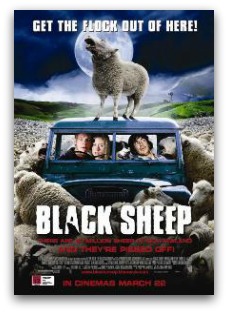
2) Black Sheep (2007), directed by Jonathan King

Also ran: Actually, I was going to nominate The Lord of the Rings trilogy but then decided — NO! I can’t use it. It’s too easy. Plus we’ve already had one film with Hugo Weaving (the mighty Elrond played a drag queen in Priscilla!). I know, across the three films they showcase the sights of New Zealand at their jaw-dropping best — anyone who hasn’t watched these films and felt an urgent need to visit New Zealand needs to watch them again but ignore the kick-ass sword fighting… Yeah, I know. That’s never going to happen.
Why Black Sheep won out: The rugged landscape looks every bit as impressive in this movie as it does in Lord of the Rings — but it’s also populated by were-sheep, an accidental result of some unusual genetic manipulation… See it, and laugh at the New Zealanders. Oddly enough, they’ll love you for it. It’s the Kiwis’ love of poking fun at everything, especially themselves — their self-deprecating humor — that really made me want to visit the place. I felt like I would fit in there. And I did — I stayed for two years. By the time I left, I was on a first-name basis with the entire population.
Memorable lines:

There are 40 million sheep in New Zealand…and they’re pi**ed off!

Harry (as the were-sheep charge towards them): F**k, the sheep!
Tucker: No mate, we haven’t time for that.

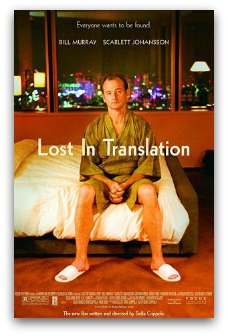
3) Lost in Translation (2003), directed by Sofia Coppola

Why I love this film: It’s an odd one, this one. The first time I watched it, my mind boggled at how something so boring, with nothing remotely resembling a plot, could get made into a movie. Then I watched it again. And again. Because it was the rainy season in Thailand, where I was living, so I couldn’t go outside — and we only had three DVDs in English, so we watched all of them every day. For two months. Somewhere around the halfway point of this torturous process, I fell in love with Lost in Translation — maybe I just needed to relax to appreciate it? Once I stopped looking for something to happen, I started to understand what it was all about: loneliness, uncertainty, being adrift and confused in a completely alien culture. And ever since then I’ve desperately wanted to go to Tokyo. Well, not enough to actually go there — yet — but you know what I mean. I do travel vicariously — just sometimes — and this is one of ‘em.
Caveat: If, like me, you’re a fan of films where, you know, stuff happens — it might take you a few viewings to get used to it. Forty or fifty should do the trick.
Memorable line:

Charlotte: Let’s never come here again because it would never be as much fun.

4) Ip Man (2008), directed by Wilson Yip

Why I love this film: The closest I’ve come to China are the little “made in” labels on almost everything I own. This film, however, kindled a desire to visit China that I never knew I had in me. It’s the biographical story of the most famous kung fu practitioner in the world — not Bruce Lee but his teacher in Wing Chun kung fu, master Ip Man. It’s set in Foshan, China in the 1930s-40s during the Japanese Invasion, but was filmed in Shanghai. It follows the family of the master as he becomes ensnared in the war, losing everything over the course of the Occupation and being forced to face the hardest choices a man could make. The insight into a lifestyle and culture so utterly different from my own was fascinating enough, but this is a story both moving and powerful.
Audience participation: I dare anyone to watch it and not leap off the couch at some point with a cry of “Yeah, kick his ASS!” Ahem. Okay, so maybe that’s just me.
In sum: Will it make you want to visit China? I think so. Will it make you want to learn kung fu? I absolutely guarantee it!

And because I’m a contrary kind of guy, I just had to retaliate against my own optimism by highlighting a film that made me NOT want to travel:

5) Cidade de Deus (City of God) (2002), directed by Fernando Meirelles and Katia Lund

Why I don’t recommend this film: The film is set in the 1970s, in the poorest districts surrounding Rio de Janeiro, where drugs and guns rule and the population live in a fear only matched by their misery. I saw it in South America, in its native Portuguese — but with Spanish subtitles. Given my fledgeling abilities in that language, as described in a previous post, I may have failed to grasp every nuance of the story, but basically what I took from it was: “DON’T EVER GO THERE! They will kill you for the hell of it.”
Analysis:There is poverty everywhere in the world — I’ve worked in homeless shelters in the UK and seen people every bit as desperate as the denizens of Brazilian favelas (shanty towns). But these kind of places, where automatic weapons are more readily available than McDonald’s hamburgers and life is so very cheap…they absolutely terrify me.
In sum: Brazil remains on my list of all-time favorite, must-visit countries — but no way am I going anywhere near the favelas in Rio. This film has put me off — for life.

* * *

And finally…there’s one character that stands head and shoulders (and hat!) above all the rest when it comes to inspiring my travels. I’ve carefully avoided mentioning his films, as I was trying hard to keep this a cheese-free list — but I can’t hold it in any more.

I WANT TO BE INDIANA JONES!

I know, I know! So does everybody in the world, ever. Even people in remote tribes that have never been contacted by the Western world, secretly harbor a desire to be Indiana Jones — they just don’t know how to put it into words.

So — now it’s your turn!
1) What films have made you want to travel? And why?
2) What films have made you want to run screaming from the very idea of travel — and why?
3) If you WERE Indiana Jones — what would you do?

STAY TUNED for tomorrow’s post on cinema and the expat life.

If you enjoyed this post, we invite you to register for The Displaced Dispatch, a round up of weekly posts from The Displaced Nation, with seasonal recipes, book giveaways and other extras. Register for The Displaced Dispatch by clicking here!

Related posts:

Images: Tony James Slater (yes, that’s really him!) playing out his fantasy of being Indiana Jones; film posters courtesy Wikipedia.

7 foods to seduce your Valentine (or not) — wherever your home and heart may be

As a sequel to Seven deadly dishes — global grub to die for, today’s post turns its attention to foodstuffs that might promote…well, not death, but perhaps a smaller version: the one the French call La Petite Mort.

Food and romance go hand in hand — you only have to think of the restaurant scene in the film Tom Jones — so, in case you’re already planning a special meal with ulterior motives for next Tuesday, I’ve been looking for ingredients to go on your shopping list.

I have to say, after doing the internet research, I have serious doubts about the genuine aphrodisiac properties of most of these suggestions.

But see what you think.

1. Coco de Mer – Seychelles

The picture above is of a nut from the Coco de Mer tree, a palm found in the Seychelles, and for which the ancient botanical term is Lodoicea callipyge. (Callipyge comes from the Greek for “beautiful buttocks.”)

Used in Eastern medicine and as a flavor enhancer in Cantonese cuisine, the fruit is also the basis of a liqueur called Coco D’Amour which is sold in the Seychelles.

After their honeymoon in May, Prince William and Kate Middleton were presented with a Coco de Mer fruit by the Seychelles Minister for Foreign Affairs. (I would love to have been a fly on the wall at that presentation.)

Budget alternative: Since the Coco’s attraction lies in its suggestive shape, try peaches, nectarines, or butternut squash. Frankly, if you’re determined to see innuendo in the vegetable section of the supermarket, anything will do.

2. Oysters – Louisiana, Galway, Prince Edward Island…

Everyone knows that oysters are supposed to be aphrodisiacs. It’s all to do with the high content of zinc, phosphorous, and iodine.

Put like that, they don’t sound romantic at all.

Budget alternative: Fish fingers, table salt, Pepsi, and a couple of cherry Cold-EEZE zinc tablets for dessert.

3. Lobsters – Maine

Presumably considered aphrodisiacs for the same reason as oysters — zinc, phosphorous, iodine — but honestly, lobsters? It is impossible to eat them without looking like the explosion at the end of Jaws. Plus you’re at the table, swathed in a plastic bib while wielding a pair of large nutcrackers — not the best picture to get a new boyfriend in the mood.

Budget alternative: Poor Man’s Lobster. It’s cod, dripping in butter, so you’ll probably still need the bib — but at least you can ditch the nutcrackers.

4. Strawberries – California

They’re red, they’re heart-shaped, they’re the perfect edible valentine.

And, more to the point, you have to buy whipped cream to go with them.

Budget alternative: Just buy the whipped cream.

5. Truffles – Alba

With white truffles costing $2000 a pound, it’s not these overpriced mushrooms per se that’s the aphrodisiac. If your date is buying you these in a restaurant, the turn-on is the size of his wallet.

Budget alternative: Chocolate truffles. Who wants to eat fungus anyway?

6. Champagne – France

Supposedly an aphrodisiac because its bouquet replicates the smell of female pheromones. However, with the expensive stuff, the Truffle Theory of Attraction (see #5) can be applied.

Budget alternative: Since, according to WebMD, there isn’t any solid proof that human pheromones exist at all, save your money. Buy anything with a Sale sticker on it at the liquor store. Anything above 10% proof will work just fine, as long as you adjust the quantity accordingly, otherwise you might defeat the purpose by falling asleep. This is where #7 comes in.

7. Chocolate – the local grocery store

In its more pure forms – I’m talking 70% cacao or more — half a bar of chocolate is more potent than a gallon of espresso. It will keep you awake for hours. For good measure, one brand actually puts espresso beans in its 72% chocolate as well!

Now there’s a company that understands the delicate connection between chocolate, alcohol, and love.

Budget alternative: There is no budget alternative. Chocolate is known as a substitute for love, but as every woman knows, love is merely a substitute for chocolate.

STAY TUNED for Wednesday’s Random Nomad interview.

If you enjoyed this post, we invite you to register for The Displaced Dispatch, a round up of weekly posts from The Displaced Nation, with seasonal recipes, book giveaways and other extras. Register for The Displaced Dispatch by clicking here!

Related posts:


Travel yarn: The Holy Land, transformative art — and Michael Jackson?!

We welcome Joanna Liss to the Displaced Nation as a guest blogger. A veteran of volunteering overseas, she recently went to Israel with the voluntourism group GoEcoon a quest that can best be described as quasi-spiritual.

I must confess I do not consider myself a particularly spiritual person. I have been on what would qualify as a spiritual retreat only once — about 40 years ago, when spending a weekend at a Zen center in the mountains of New Mexico. I was a student at the University of New Mexico at the time, with a religious studies minor (though a non-religious person, I was fascinated by religion’s folkloric aspects).

We were assigned to our dorm accommodations, given sparse meals of miso soup and bread, spent many hours sitting still and meditating — interspersed with breaks of walking and meditating — and were instructed not to talk, at all, all weekend.

My major memory of that experience was a dorm companion gesturing, rather frantically, and graphically, in a charade that I finally interpreted as a request for a tampax. I had a hard time stifling giggles for the rest of the weekend.

An unholy visit to the Holy Land

I have traveled to many places but never, until recently, to Israel. I never, honestly, had much of a desire to go — perhaps ironically, because my heritage is Jewish. It is difficult for me to sit through a Bat or Bar Mitzvah service, and my religion-related endeavors consist mostly of cooking potato latkes and matzoh brei.

I also admit that my politics do not necessarily align with those of the Israeli government. I wasn’t interested in religious travel, and there were too many other places that called to me more.

What finally prompted my visit to the Holy Land was an online listing for a volunteer project in a gallery of Arab art in Umm el-Fahem, an Arab city in Israel. I was ignorant enough to not have realized, beforehand, that there were Arab cities in Israel, or that a full 20 percent of Israeli citizens are Arab. I had thought of the Israel-Arab conflict as between Israelis and Palestinians, complicated enough, without knowing that it was made even more complex by the situation of Arab Israelis. (I asked around and was somewhat comforted, perhaps wrongly, to learn that most of my friends, even those who are Israeli Jews, were not aware of the Arab Israeli situation.)

And so, I set off for what would be a rather unorthodox Israeli experience, as a Jewish woman living, for six weeks, in an art gallery in an Israeli city where I was the only Jewish person.

Yes, I not only worked in the gallery but actually lived in an apartment on the rooftop third floor, surrounded by the whimsical sculptures on the rooftop patio outside my apartment. This living space afforded a spectacular view of the city, and several times daily the steep hills of the city echoed with the sounds of the muezzin calling out their amplified prayers.

If I were to call an experience spiritual, I suppose this would be one, especially when the amplified voices of the muezzin blended and harmonized, intentionally or coincidentally, I couldn’t say. It would probably have been a less moving experience for me, though, if I had been able to understand the words.

Travel as a source of personal renewal

I’ve heard, often enough, a person say she or he wasn’t religious, but spiritual. But what exactly is spirituality, especially of the secular kind? According to my prime informational source, Wikipedia, secular spirituality can be experienced as a source of inspiration or orientation in life, without necessarily accepting belief in a divine being. It can encompass compassion, patience, tolerance, contentment, responsibility, forgiveness, and concern for others.

In that sense, all my travels can be considered spiritual experiences, at least in secular terms. So maybe I am more spiritual than I thought?

Still, for me renewal comes not from retreat but from immersion in a new experience — be it a hot spring in the snow, watching the Eiffel Tower’s midnight light show from my garret apartment, or enjoying a leisurely breakfast at home of my favorite cereal with plump fresh blueberries and the sun shining in through the window.

Travel renews me, certainly — when I’m viewing an architectural or natural wonder, a work of art and, most of all, when I’m interacting with interesting people I might not otherwise have encountered.

The mystery of the falling headscarf

Back to Israel: I had many experiences in Umm el-Fahem that might fit the spiritual bill. Let me relate a couple. An artist on exhibit while I was there was Fatima Abu Rumi, whose meticulously detailed paintings deal with issues of self-identity. She paints herself repeatedly, totally veiled, with hijab (head scarf) hiding her hair but not her face, with the same scarf around her neck in quite a modern style, without any scarf at all.

Almost every school day, groups of young local children visited the gallery with their teachers and some mothers, the women all wearing the hijab. After some discussion Halima, the gallery educator, would bring out a basket of scarves, and all the children, boys and girls, helped by the adults, would don scarves, on their heads, over their faces, over their shoulders, as they chose.

Morning after morning, I descended from my apartment and watched, mesmerized. Some children were shy, some posed for my camera. I was as fascinated by the positive reactions of the adults as by the children. I only wish I could have understood what Halima had told them.

In a small niche hung a headscarf, black and white, identical to the one Fatima had repeatedly painted herself wearing. One morning, before my eyes, the hanging scarf suddenly fell off its hook on the wall. There had been no draft of air. I debated whether to pick it up or leave it. Later that month, when we delivered one of Fatima’s paintings to a prominent Jewish art collector, I noticed that the scarf had been tucked into the back of the frame, and told him the story.

Transformative art

Another significant moment came at the Haifa Museum of Art. We had gone to watch another Umm el-Fahem artist, Farid abu Shakra, do a performance piece. Farid is the younger brother of Said abu Shakra, the founding director of the Umm el-Fahem Art Gallery. An artist and an art teacher, Farid also curates some of the gallery’s exhibits.

At the end of the piece, Farid took two pieces of cloth that were hanging on the museum wall, a tallit (Jewish prayer shawl) and a keffiyah (the black and white cloth worn as a head covering by some Arab men). He tied them together. The message was clear. No words were necessary — and no religious belief — to feel the power of the moment, as well as to demonstrate the power of art to transform people, a major goal of the gallery.

(Amusingly, when I later showed my photo of the connected cloths to Farid, he commented, “very powerful image” — as if he were complimenting me, when the image was his.)

Farid also shared with me a series of maxims he had written in English. Here is my favorite:

He said to me, are you happy with your life? And I said to him, first explain the meaning of happiness, and then I tell you my reply.

Further mysterious sightings

On my next to last day in Umm el-Fahem, I visited the nearby ruins of Tel Megiddo, aka Armaggedon. It was just after a certain American minister had re-predicted the coming of the end of the world, realizing he had miscalculated the first time around. The site, and the world, were still intact when I visited. The ruins were interesting, and peaceful, aside from the surly saleswoman in the gift shop. We walked through the ancient stables and down into a huge stone lined cistern. I do feel a heightened intensity of place where historical events have occurred, and Tel Megiddo has had its share of events and battles over the millennia. The now quiet ruins actually might not be a bad place to spend the world’s final days.

Israel, of course, is replete with places of intense spirituality, to folks of many different beliefs, and it impossible not to feel the significance, historically and religiously, particularly in places like Jerusalem and Nazareth. Although I was not there for spiritual reasons, there are, wherever you turn, places of extreme importance to many. One encounters ultra-religious Jews in their dark clothes, side curls on the men and boys, head scarves on the women, Christians walking the literal stations of the Cross shouldering large wooden crosses, Muslim houses painted with what looks like graffiti but is actually a mark that the owner has made the pilgrimage to Mecca.

I went to the Western Wall on the day before Yom Kippur, the Day of Atonement, along with thousands of others. It was crowded, of course, but, surprisingly, not very difficult to make one’s way, after security, to the wall itself. I did make the mistake, at first, of heading toward the men’s side, and was kindly directed to the other side. There were women of all ages and kinds, some with strollers, some with canes, most praying, some just being tourists like me.

I walked up to the wall and touched my hand to it briefly; it seemed like the right thing to do. I did not write a prayer on paper and stick it in a crevice the way most people were doing, although it was tempting. I do like rituals at times, and mysterious things.

Here is the biggest mystery of my Israeli sojourn. On the women’s side of the wall was a woman (man?) who was a dead ringer for Michael Jackson. No kidding. I have the photo to prove it. S/he was standing next to more normal looking women, complete with quasi-military jacket, brass buttons and epaulets. There are many mysteries in the world that may never be solved. But please, is there someone who can explain this to me? I am hoping, and praying, that someone will.

Readers, can you relate to Joanna’s description of her secular spiritual travels — or do we need to come up with another term for it?

Joanna Liss has been traveling from the time she was a child in the Bronx, first to exotic destinations such as Brooklyn and Manhattan, later on family car trips up and down the East Coast, to places including Maine, Delaware, Montreal, and Miami, through all of which she professed that she could never live anyplace but New York. That all changed when she moved to Paris after high school. She has been traveling ever since. Her trip to Israel with GoEco marked her eighth adventure volunteering overseas; the other seven were with Volunteers for Peace. You can follow Liss’s adventures at her blog: Joanna’s Journey. Next stop: Havana.

STAY TUNED for Tuesday’s post, an interview with Dave Prager, author of Delirious Delhi, on our list of 2011 books for, by and about expats.

If you enjoyed this post, we invite you to register for The Displaced Dispatch, a round up of weekly posts from The Displaced Nation, with seasonal recipes, book giveaways and other extras. Register for The Displaced Dispatch by clicking here!

Related posts:

Images (top to bottom): The view from the rooftop of Liss’s apartment in Umm el-Fahem, Israel; the artist Fatima Abu Rumi (note the Hello Kitty tee shirt) with one of her paintings; the keffiyah and tallit tied together at the Haifa Museum; and the Michael Jackson lookalike Liss spotted at the Western Wall in Jerusalem (women’s side).

Travel for excitement, not enlightenment


As I write this I am in a well-known brand of coffee shop. When I stop and think about it, it is all busy, a regular footpath of traffic. Office workers stream in and out for a shot of caffeine to get them through their Monday morning. In between customers the two baristas discuss the smaller one’s mother-in-law (she looks so young that I am surprised to discover that she’s already married); the two open top buttons on the shirt of the man at the table next to mine reveals an interesting chest tattoo of an eagle; a policeman walks in — he carries two guns. All this takes place over a minute or two to the unlikely soundtrack of Tony Bennett’s recording of “A Nightingale Sang in Berkeley Square,” which the well-known brand of coffee shop is piping into its store.

The reason that I mention all of this is that I need to actively stop and think to notice the interesting things around me, those moments of local color. As an expat if this had happened a year or two previously I would have been fascinated by this scene. I would have been alarmed, even repulsed by my close proximity to two firearms.  Now it has all become quotidian. I have lived in cities on three continents and it is remarkable how quickly the exotic turns into the mundane.

For most of us we sleepwalk through life, it is one of quiet monotony — and that isn’t necessarily a bad thing. For many of us we have a life of traffic jams, of unpleasant bosses, of evenings in the grocery store and weekends in the mall. You may be in a city of six million or a town of two hundred thousand, live alone or with your wife and 2.4 children but for many points it may feel as if one existence of mundane solitude.

Last week on this blog ML Awanohara posted her top 10 expat and travel posts on spiritual escapes, about the need many people feel to search for some “me” time. One of the articles that she linked to was “The Joy of Quiet” by Pico Iyer that was from the New York Times.

ML had previously mentioned this article to me and thought that I might enjoy it, or at least find something of interest to it. And, in fairness to her, I did.

Admittedly on reading the opening sentence, which drips with name-dropping, knowingness and smugness  —

About a year ago, I flew to Singapore to join the writer Malcolm Gladwell, the fashion designer Marco Ecko and the graphic designer Stefan Sagmesiter in addressing a group of advertising people on “Marketing to the Child of Tomorrow”…

— I was ready to throw the article across my living room. In fact, I almost did throw it across the room at full force until I remembered that this wasn’t the dead tree edition of the NYT that I was reading, but a digital subscription read via my iPad.

(As someone who has always taken to heart Dorothy Parker‘s adage that this is a book that “should be thrown with great force,” I’m still not entirely happy with reading in the digital age as throwing a kindle or an iPad with great force will only serve to void you of your warranty.)

So not wishing to break my iPad, I kept reading. Iyer is concerned that technology is bombarding us and with that comes an increasing need for us to seek quiet, to try and mediate, to seek some form of solace from the “noise” of the modern world.

There’s nothing particularly original, per se, about this idea nor does Iyer claim so. Perhaps the greatest work in American literature (though other opinions are available) is Thoreau’s Walden. There has always been a desire to escape. We can go way further back than Walden– Christ and the Buddha both headed out to the wilderness. When we couple this desire as Iyer does with the tech writer Nicholas Carr‘s hypothesis that the Internet is shortening our attention spans, altering the very way in which we think, there is a desire to be a modern Canute and try to stop the advancing waves of technology.

That brings us to this month’s theme which concerns itself with the search for solitude or for a transforming experience, which some may class as being spiritual. Often this, as seen with the likes of Elizabeth Gilbert, means taking a rather patronizing view of the country that you are visiting that I find entirely unpalatable.

To me it seems that Iyer is in the Gilbert new-agey BS camp. Returning to the “Joy of Quiet” he writes:

For more than 20 years, therefore, I’ve been going several times a year — often for no longer than three days — to a Benedictine hermitage, 40 minutes down the road, as it happens, from the Post Ranch Inn. I don’t attend services when I’m there, and I’ve never meditated, there or anywhere; I just take walks and read and lose myself in the stillness, recalling that it’s only by stepping briefly away from my wife and bosses and friends that I’ll have anything useful to bring to them. The last time I was in the hermitage, three months ago, I happened to pass, on the monastery road, a youngish-looking man with a 3-year-old around his shoulders. . . .

Now most of us can’t be as amazing as Pico Iyer — that’s just the burden we have to carry through our lives. We can’t just move to rural Japan and fetishize solitude. We will still spend our evenings in the grocery store, our weekends in the mall, they will still be those 2.4 children and those bloody traffic jams — as David Byrne sang,“same as it ever was.”

What I am going to do try and do in 2012 (and yes even though it’s mid-January I still feel it is early enough to mention resolutions in a post) is to take advantage of technology to find some solitude. I’m not going to posture by lighting an incense stick as if the path to personal enlightenment lies in sniffing in something called Egyptian Musk. What I am going to do is take advantage of the quiet moments that my everyday life provides by sitting and concentrating at a task and deriving satisfaction from that. It may be by learning programming, a foreign language, or taking advantage of the sheer, vast number of books that are now available for free on Google books. In this well-known brand of coffee shop while Tony Bennett plays to me and the tattooed man and the policeman and the baristas return to talking about the smaller one’s mother-in-law, I have on my iPad access to a library of books greater than the Bodleian — reason enough not to throw the iPad across the room when I’m annoyed by Iyer.

So, I’ll be making a greater effort to sit and read. Return to my first love. I do read a lot, but my attention span has suffered in the Internet age to what it was before. But when I listen to David Foster Wallace in the embedded video (2 minute 14 seconds in is the pertinent part in my opinion), I am inspired to make a greater effort. That will be my act of meditation. My escape from the mall and the grocery shopping.

Travel will not be an escape from the noise, from the barrage of imagery. It will remain a escape from the quotidian, a retreat from the banal. It will be where I go to barraged by sound, sight, people, history, culture — thank God for that.

Hmm… Readers, do you agree that travel writer Pico Iyer belongs in the Gilbert new-agey BS camp? And do you travel for excitement or escape from excitement? Where are you on the continuum?

STAY TUNED for Tuesday’s post, a Displaced Q on healthy food by new TDN writer Tony James Slater.

If you enjoyed this post, we invite you to register for The Displaced Dispatch, a round up of weekly posts from The Displaced Nation, with seasonal recipes, book giveaways and other extras. Register for The Displaced Dispatch by clicking here!

Related posts:

Top 10 expat & travel posts on spiritual escapes

As the holidays draw to a close and a new calendar year commences, many of us find ourselves desperately in need of some “me” time — a chance to reassess our “to do” lists and decide which of our life goals deserves top priority.

Gah?? Did I just write that? Talk about understatements! If you’re like me, you are lucky if you can remember that you used to have personal goals at one point. (My only aims for the past few weeks have been writing x many cards, wrapping x many gifts, hosting/visiting x many relations…)

That could be why Kate Allison’s post on Monday — announcing that The Displaced Nation has dedicated this month to spiritual escapes — was a goad to such debate. Does the quest for spiritual enlightenment require geographical displacement, away from the demands of family and everyday life? And what about those who are already living far away from “home” — do they need to displace themselves even further, to the most obscure corners of the globe? (Wait, aren’t some of them already living there?!)

Having tracked this topic on social media for several weeks, I would like to share my top 10 findings as further food for meditation, so to speak… My hope is that these writers can help us disentangle our thoughts — which might otherwise come to resemble advanced yoga positions — on the best techniques for getting in touch with the innermost core of our beings.

As usual, and as befits our blog’s slightly irreverent tone, they’re from a mix of indie and conventional publications.

1) Meditation vacation
Author: Matthew Green (@MattGreenAfPak), a reporter covering Pakistan and Afghanistan and author of The Wizard of the Nile
Publication: Financial Times, Life & Arts (@FTlifeandarts)
Why it’s helpful: Spending so much time in war zones, Green desperately needed the kind of retreat where alcohol, email — and talking — are all banned. During his 10-day “Buddhist boot camp” at the Himachal Vipassana Centre in the Himalayas, he ended up weeping harder than he could remember, for a reason he couldn’t fathom — but he also had to bite his lip to stifle the kind of giggles he hadn’t felt since school!

2) The Joy of Quiet
Author: Pico Iyer, British essayist, novelist, travel writer, and Third Culture Kid (born in Britain to Indian parents, he grew up in California), who once said: “And if nowhere is quite home, we can be optimists everywhere.”
Publication: New York Times Week in Review (@nytopinion)
Why it’s helpful: Iyer suggests that there’s something in the zeitgeist to make us all in need of stillness at this particular moment — that the more ways we have to connect, the more desperate we become to unplug, and would pay almost anything for the privilege. (Hmmm… Perhaps I should end this post right here?) I also found it interesting that as a writer, he prefers to live in rural Japan,

“in part so I could more easily survive for long stretches entirely on foot, and every trip to the movies would be an event.”

(Presumably the other part, which he doesn’t mention, is that his wife is Japanese.) Almost needless to say, Iyer has never tweeted or gone on Facebook.

3) The Threshold
Author: Catherine Yiğit (@Yarzac), a writer who was born, bred and buttered in Ireland but who now lives as an expat (also mother and wife) in northwestern Turkey near the mythical city of Troy.
Publication: The Skaian Gates: Notes from an Online Wanderer (Yiğit’s personal blog)
Why it’s helpful: If you’re serious about bringing change to your life, sometimes it helps to take a “tough love” approach. Yiğit found the kick she needed for empowering herself after stumbling upon a program for women writers called “A Year with Myself.” The approach, she says, is gentler than that taken by the unmercifully profane Chuck Wendig (@ChuckWendig), he of the author-advice blog Terrible Minds. (Ironically, Yiğit cites a post by Wendig that I’d shortlisted for this top-ten list: 25 Things Writers Should Stop Doing Right F****** Now. But then I found Yiğit’s post — and could relate to her yearning for some blend of toughness and forgiveness to help her cross the threshold…)

4) A year in awe over the fabulously mundane
Author: Lauren Alissa Hunter (@SankofaMeLately ), world traveler, former expat in China, and blogger (SankofaMe Lately), currently in search of a publisher for her WIP.
Publication: She Writes (@shewritesdotcom), a virtual workplace for women who write from all 50 states and more than 30 countries.
Why it’s helpful: Wannabe novelists, before making any major changes to your life this year, take heed of this rather cautionary tale. A year ago, Hunter upped and quit her job and booked a one-way flight to China in hopes it would spark her creativity as a writer. But instead of finding serenity, she found “intense loneliness, terrifying introspection, emotional vulnerability.” Still, at least she discovered where “home” is — her native United States. What’s more, she currently finds the mundane simply fabulous.

5) The (hateful) ties that bind: Expats and cultural criticism
Author: Camden Luxford (@camdenluxford), an Australian traveler and freelance writer who is now an expat in Argentina. Note: Luxford has been one of TDN’s Random Nomads.
Publication: The Brink of Something Else (Luxford’s blog)
Why it’s helpful: In her inimitable style, Luxford raises the vexed issue of why some expats can’t resist slagging off the countries where they live. Though she didn’t design the post as a contemplation on the January blahs, it dovetails neatly with TDN’s current theme. Are some of us feeling low simply because we can’t stand the thought of starting a new calendar year in the same old same old country? Or because we’re no longer that thrilled about being a world traveler? Burn-out is a serious condition. If you think you might be a victim, I would suggest adding to the comments on Luxford’s post as a first step to recovery… (In this connection, it’s also worth taking a look at the post Struggling in Seville by Ayngelina on her Bacon is magic blog. Ayngelina was traveling solo through Latin America, ended up in Spain — and then decided she was done with being a nomad and would return to Canada. Her post attracted a whopping 168 comments!)

6) 10 of the world’s best yoga retreats 2012
Author: Susan Greenwood (@Pedalfeet) — Guardian writer, bike rider & blogger (Pedalfeet)
Publication: Guardian Travel (@GuardianTravel)
Why it’s helpful: One of the things that always puts me off considering a yoga retreat is the cost — for which you’ll need some controlled breathing even before you’ve learned the proper technique! Greenwood claims that the retreats on her list qualify not only as inspirational but also affordable. I’m not sure if that’s true, especially if you had to add the cost of airplane travel to the cost of the retreat (most of these places aren’t exactly offering bargain-basement prices). Still, the Yoga Barn in Bali seems surprisingly unpretentious and good value — eat-pray-love, anyone?
Worth noting: This Saturday’s Guardian Travel has a special issue on healthy holidays and “courses that will change your life.”

7) 5 magical places in China to disconnect from the world and recharge
Author: “travelingman” Troy on GotSaga (From California, he is now planning a trip to Peru.)
Publication: GotSaga (@GotSaga), an online community for sharing travel sagas, tips, and destinations.
Why it’s helpful: Having been to Mainland China several times, I wouldn’t put it first on my destination list for spiritual escapes, though it’s such a large country it’s bound to have a few spots that are conducive to contemplation — especially if you’re willing to venture to the back of Outer Mongolia. Though Troy doesn’t completely persuade me — some of his proposed retreats sound rather touristy — I do like the idea of glimpsing rural life amid the bamboo forests of Huzhou, which also boasts the distinction of having the world’s only museum devoted to bamboo. As I rather like things that are in bad taste, I might even be tempted to take home some kitsch bamboo products along with my white tea, for the memories. (Listen, if you can find peace of mind in today’s China, you can find it anywhere! No need for fancy yoga retreats…)

8) Happy New Year and the Clutter-free Home
Author: Jennifer L. Scott (@jenlyneva), author of Lessons from Madame Chic, a how-to book based on her experience of living in posh apartment in Paris for a semester while a student at the University of Southern California. (NOTE: The book was featured on our 2011 expat book list.)
Publication: The Daily Connoisseur (Scott’s popular lifestyle blog)
Why it’s helpful: I love the idea of someone deriving powerful life lessons from a study-abroad experience and then distilling them into a “Top 20” list for the benefit of wider humanity. (I’m also rather jealous — have always wanted to do something like that with my years in Japan…) And what better time to contemplate such life lessons than in January — beginning with the need to declutter. Because they understand the pleasure of only using the best things you own, the French apparently excel at getting rid of excess belongings (or not buying them in the first place). Les gens extraordinaires!

9) Quick and Dirty Japanese: It’s What’s for Dinner
Author: Larissa Reinhart Hoffman (@RisWrites), a former expat in various parts of Japan, with a WIP entitled “Portrait of a Dead Guy.”
Publication: The ExPat Returneth: A place to express what you miss about living abroad (a new blog just started up by Hoffman — she hopes to recruit other writers eventually).
Why it’s helpful: Have you included healthier eating in your New Year’s resolutions? Then you ought to be eating Japanese food, Hoffman states. She also gives short shrift to complaints that it’s too hard to tackle their cooking, insisting that if she can handle making Japanese food (she was a late bloomer to cooking), anyone can. While living in Japan as an expat with her (American) husband and their two girls, Hoffman developed a repertoire of what she likes to call “quick and dirty” recipes (the Japanese might be horrified by the latter adjective!). Her main message:

You don’t have to be Martha Stewart to make home-style Japanese food.

Thank God.

10) The Buzz in Mexico
Author: Melina Gerosa Bellows, editor-in-chief of National Geographic Kids and Huffington Post blogger
Publication: Jan/Feb 2012 issue of National Geographic Traveler (@NatGeoTraveler)
Why it’s helpful: Bellows spins the yarn of her recent trip to Tulum, Mexico. She was on a mission to follow the path of the stingless Melipona beecheii bee, which is now endangered — a cause of concern to all those who value traditional Mayan culture. As she explains:

At risk of dying along with the insect is a beekeeping tradition that for centuries has been sacred to the Maya for its spiritual benefits.

In the process, she slows down and learns to value the art of “just being” (pun intended?). Her story is a reminder of how peace of mind can hit you over the head when you least expect it — in Bellows’ case, while on a work assignment (albeit to a very agreeable part of the world, where even bees behave in a civilized manner).

* * *

Question: Can you suggest any other works that should have made the list?

STAY TUNED for Monday’s post, a contrarian perspective on spiritual escapes from TDN contributor Anthony Windram.

If you enjoyed this post, we invite you to register for The Displaced Dispatch, a round up of weekly posts from The Displaced Nation, with seasonal recipes, book giveaways and other extras. Register for The Displaced Dispatch by clicking here!

Related posts:

Image: MorgueFile

12 NOMADS OF CHRISTMAS: Lyn Fuchs, American expat in Mexico (5/12)

Current home: Oaxaca, Mexico
Past overseas locations: India, Japan, Kenya, Canada
Cyberspace coordinates: Sacred Ground Travel Magazine (blog) and @LynFuchs (Twitter handle)
Most recent post: “Spice Girl Caravan to Srisailam India” [guest post by Evelyn Hills, author of Ivana and the Secret Lake Adventures: Magic vs. Love] (December 26, 2011)

Where are you spending the holidays this year?
I’ll be spending half the time at home in the jungle lowlands of Oaxaca and half the time climbing Mount Pico de Orizaba to gather material for my next book, Fresh Wind and Strange Fire.

What do you most like doing during the holidays?
Experiencing fresh snow, warm fires, soulful music and the goodness of family.

Will you be on or offline?
Online, drunk and probably naked.

What’s the thing you most look forward to eating?
Mashed yams with cashew sprinkles, steamed kale with olive oil/balsamic vinegar dressing, turkey with cranberry relish…

If you could travel anywhere for Christmas, where would it be?
Now that political-correctness has shown us how to rid the world of evil and suffering, I’d like to go back in time to when the cartoon Rudolph The Red-Nosed Reindeer was first broadcast, and fix a few things:

  1. I’d encourage Rudolph to walk off the job on Christmas Eve, find a lawyer and file a suit against Donner and Blitzen for bullying,
  2. I’d tell off Ms. Claus for turning a blind knitting eye to the hostile work environment and that fat cat Santa for sexual harassment in his constant ill-defined references to the North Pole.
  3. I’d rename the Abominable Snow Monster as the Indominable-spirited Snow Person of White Color.
  4. I’d dub the Island of Misfit Toys as the Differently-enabled Toy Cooperative and organize a special sports competition to which Barbie, Ken, and that machismo G.I. Joe are not invited.

Then we’d all live happily ever after — in a fairy-tale sense.

What famous person do you think it would be fun to spend New Year’s Eve with?
I’d like to be in a smoky cafe in Argentina with sultry music, steak, pasta and red wine, sharing literary conversation and long glances with Jane Austen.

Can you recommend any good books you’ve read this year?
Santa’s book of whose been naughty and nice in the expat and travel worlds.

What’s been your most displaced holiday experience?
On December 24th 2008, I was displaced from the palace of an elegant and voluptuous Saudi princess, after I attempted to demonstrate a “traditional Christmas goose.” I still fantasize about returning and showing her how to do a “traditional Christmas stuffing.”

How about the least displaced experience — when you’ve felt the true joy of the season?
When Displaced Nation contacted me about doing this, I immediately got misty-eyed and felt a part of this family of nomads, Bedouins, and international drug mules (hahahahaha). I fondly imagined the big cash payment Displaced Nation will send me so that my son Tiny Tim will finally have the operation he needs. Merry Christmas and God bless us every one.

On the first day of Christmas, my true love said to me:
FIVE GOOOOOOOFY EXPATS.
FOUR ENGLISH CHEESES,
THREE DECENT WHISKIES,
TWO CANDY BOXES,
& AN IRISHMAN IN A PALM TREE!

STAY TUNED for tomorrow’s featured nomad (6/12) in our 12 Nomads of Christmas series.

If you enjoyed this post, we invite you to register for The Displaced Dispatch, a round up of weekly posts from The Displaced Nation, with seasonal recipes, book giveaways and other extras. Register for The Displaced Dispatch by clicking here!

Related posts:

12 NOMADS OF CHRISTMAS: Brian Peter, Scottish expat in Brazil (3/12)

Current home: Rio das Ostras, RJ, Brazil
Past overseas location: Houston, Texas, USA
Cyberspace coordinates: A Kilt and a Camera | Travel tales, reviews, photos, interviews and crazy goings on. Because you never know what’s going to happen (blog) and @KiltandaCamera (Twitter handle)
Most recent post: Brazil — “Getting to know Aldeia Velha,” by Peg Peter [Brian’s American photographer wife] (December 19, 2011)

Where are you spending the holidays this year?
In Houston.

What will you do when you first arrive?
Peg will arrive three weeks before I do, so the first thing I want to do is hug my wife. After that I’ll put my feet up and relax after the long flight from Rio for a few hours. That night we will spend the evening with good friends we haven’t seen in way too long.

What do you most like doing during the holidays?
Relax. We are living in Brazil while I’m working as a manufacturing and production manager in the oil and gas field. The growth in the industry has been enormous. I’ve been working long hours, and long weeks, for too many months. I’m going to turn off my phone, keep my laptop shut and switch my mind off.

So you’ll be offline?
Pegs is the Internet junkie of the team so I trust she’ll let me know if anything important happens out in cyberworld.

Are you sending any cards?
Peg will send a few Christmas cards for us. As for a Christmas letter, we do too many things and go to too many places each year to write something brief. Our family and friends who want to know more about what we’re doing can take a look at our Web site.

What’s the thing you most look forward to eating?
A bloody decent whiskey, and a tin of haggis. If I can find a good smoked mackerel, I’ll eat that too. I really wish I could get my hands on an Orkney black pudding.

Can you recommend any good books other expats or “internationals” might enjoy?
Because of work I haven’t had time to read a single book all year, unless you count industrial engineering books as a good read. But Peg always has her nose in a book. Right now she says she’s really enjoying Barbara Kingsolver’s The Poisonwood Bible. The sense of stepping into another world is something any traveler or expat can relate to.

If you could travel anywhere for New Year’s Eve, where would it be?
I’d love to do an Old Year’s Night in Comrie, a small village in the Scottish highlands. As I remember, its Hogmanay ritual starts in the evening with the kids in a fancy-dress parade riding on the back of a lorrie — a kind of float. That goes on until nearly midnight, when the whole community gathers at the bridge on the side of town near Oban and throws three flambeaux (flaming torches) over it into the River Earn. Then there’s a procession through the village with a pipe band leading the way — the villagers in the middle, the float bringing up the rear. When they reach the bridge at the other end of town, they throw the remaining flambeaux into the river. The whole thing is a ritual to protect the village from evil spirits for the year. Back in the center of town the party, including a céilidh, will go on for hours.

My sister has lived there for the past twenty years. Someday I’ll take Peg back there to show her how my family of Scots does an old fashioned Old Year’s Night properly.

What’s been your most displaced celebration of the holidays?
My first Christmas in Houston. I spent the day in shorts, roasting by the pool. It just doesn’t feel like Christmas without freezing your b*******s off.

How about the least displaced — when you’ve felt the true joy of the season?
Even though we live in Brazil, we always go back to Houston to spend the holidays with Peg’s kids. I’ve enjoyed the last few holidays with them, among new family, but I still don’t feel at home as much as I did back in Scotland– especially since I’m so far away from my own adult sons.

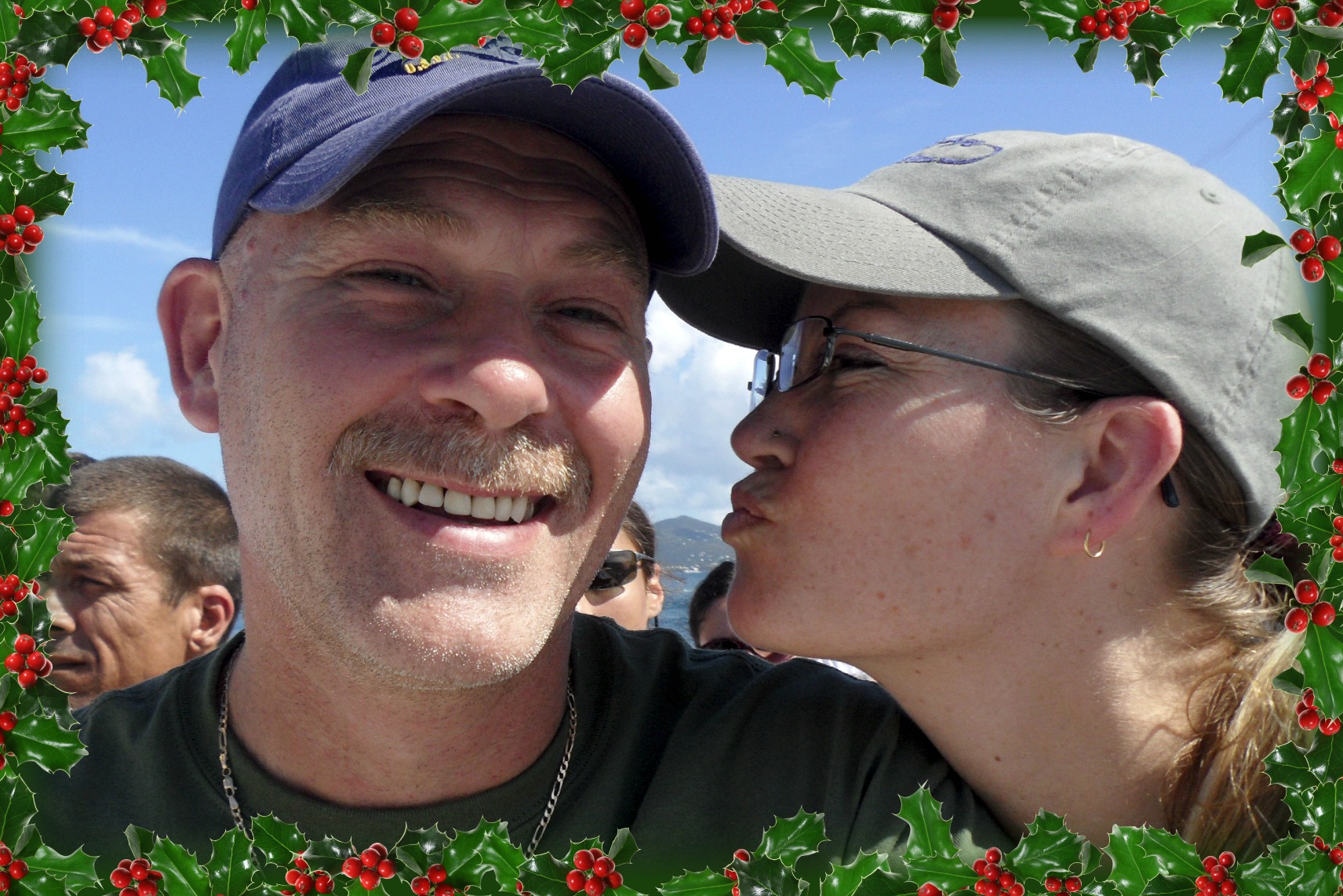
However, last year was a bit more exciting because Peg and I had a big secret plan between us. On Boxing Day we hopped on a plane and flew to the Caribbean. One long haul, three airports, three islands and one ferry later we arrived on St. John in the US Virgin Islands, where we eloped on the beach on December 28th. The photo above was taken of us on the ferry ride over to the courthouse in Charlotte Amalie to pick up our marriage license the day before. This year, of course, we’ll have our first anniversary!

How do you feel when the holidays are over?
It’s a bit anti-climactic. I start the new year with a long flight back to Brazil, which is a country we love living in, but it means back to work for a while. When my job is done there, we’ll have more time to travel when we please. In the meantime, we’ll enjoy as much of Brazil as we can. We both love to travel and look forward to the day when we can just keep going.

On the first day of Christmas, my true love said to me:
THREE DECENT WHISKIES,
TWO CANDY BOXES,
& AN IRISHMAN IN A PALM TREE!

STAY TUNED for tomorrow’s featured nomad (4/12) in our 12 Nomads of Christmas series.

If you enjoyed this post, we invite you to register for The Displaced Dispatch, a round up of weekly posts from The Displaced Nation, with seasonal recipes, book giveaways and other extras. Register for The Displaced Dispatch by clicking here!

Related posts:

I’ll (not) be home for Christmas: A holiday travel yarn

Today we welcome Kat Selvocki to The Displaced Nation as a guest blogger. A retired roller derby skater and yogini who has lived in New York City for the past six years, Selvocki is en route to Sydney, Australia, to start a new chapter in her life as a yoga teacher. In this travel yarn, she contemplates being in Europe for the holidays, without any family.

When I left Brooklyn on September 27, I had every intention of arriving in Australia by December 23. That way, even though I was away from my parents and brother for the first time ever on Christmas, I would at least be able to spend the holiday with my cousins on the other side of the globe.

One of the first rules of travel is that things never go exactly as planned. It’s no surprise, then, that I’ve been in Europe for two months with no sign of purchasing a plane ticket to Australia.

By the time I finished the first leg of my travels — two weeks in Iceland volunteering on farms — I had a feeling I’d be in Europe longer than initially expected. My one hesitation was that, after spending thirty some years celebrating Christmas with my family, the idea of spending it alone scared the hell out of me.

I spent a solo New Year’s Eve in my Queens apartment in 2007; I’d decided I didn’t feel like venturing out and about into the craziness of New York that night. Though I don’t especially enjoy that particular holiday, there was something upsetting about wishing myself a happy new year. I didn’t want to repeat that mistake.

Central Europe works its charm

I arrived in Prague the day before Thanksgiving and was greeted by friends who immediately invited me to spend Christmas with them in Austria.

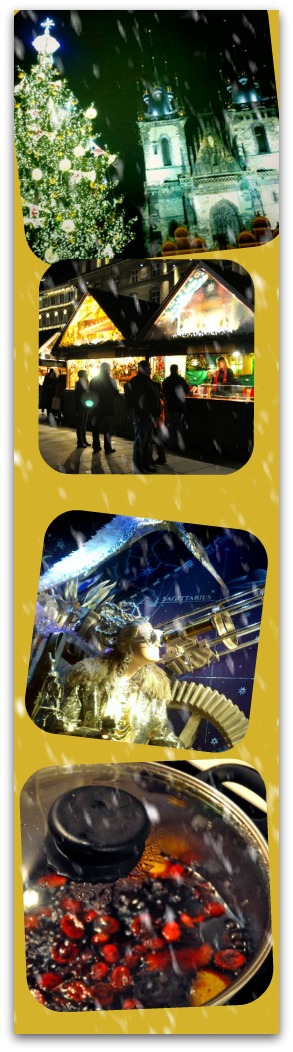
Prague is one of my favorite cities in the world, and the holiday season is one of the best times to be there, its Christkindlmarkts being among the best in Europe. Mugs of glühwein (mulled wine), tubes of bread coated with cinnamon, palačinky (Czech crêpes) dripping with lemon and sugar, the glimmer of fairy lights, handicrafts for sale, Christmas trees, live concerts — what’s not to like?

Though I didn’t have the space in my bags this time around to purchase any gifts at the markets, I was happy to return for some of my favorite Czech treats. As I perused the stands one chilly Saturday, I happily munched on lázeňské oplatky, large round spa wafers served with chocolate filling sandwiched in between.

The flavor brought back memories of Christmas Eve dinners of my youth, spent with my paternal grandparents. Though my grandmother and grandfather were both born in the United States, they continued some traditions passed down from their Polish parents. On December 24, my grandmother would serve a meatless meal at their house: fish that my grandfather had caught that fall, homemade pierogi (the Polish equivalent of ravioli, stuffed with potato and cheese), and vegetables from their friend’s farm.

We began the meal with those wafers, breaking pieces from each other’s opłatek as a symbol of forgiveness and the spirit of Christmas, as well as a reminder of the importance of family.

The ghost of holidays past

Prague was also where I spent my first Thanksgiving away from home, in 2002. I was on a study abroad program with American University, and all of us had gathered to celebrate at one of our favorite pubs, where our program director had reserved several long tables for us, piled with food — mostly Czech versions of traditional Thanksgiving dishes like stuffing, mashed potatoes, and green bean casserole. The American ideas were there, but the execution and seasonings were distinctly Czech.

(At least this was an improvement over a Thanksgiving dinner that a friend of mine had during her Parisian semester abroad, where bowls of peanut butter were served alongside the turkey and roasted vegetables.)

At my table, my tall anarchist friend with a mohawk carved the turkey. After we’d feasted, several classmates took over the restaurant’s upright bass and piano as the rest of us cheered and clapped.

Most of us had met only three months earlier, but there was a tight bond between us that day.

I called home later in the evening. My cousin’s husband answered the phone, and at first he couldn’t believe it was me, all the way from Europe. He yelled to the rest of my family to get on the phone. Though I probably used up my phone card, it was worth it.

My mother came to visit me in Prague not long afterwards. She, too, couldn’t resist the siren song of all the beautiful handmade items at the holiday markets. She settled on a blown glass ornament covered with simple stars made out of straw. It still hangs on my parents’ tree today, an annual reminder of when she and I traveled together.

Holidays are all about the 3 Fs: Family, Friends & (especially!) Food

My family and I have always enjoyed the culinary traditions associated with each of the holidays, be it Thanksgiving, Christmas or Easter. While Christmas was always tops for me as a kid, over the years my allegiance has shifted, and I now look forward the most to sharing the Thanksgiving meal with my nearest and dearest. (This may have been triggered by extended Christmas vacations in college, which so often seemed to end in ridiculous battles with my parents.)

Last month, I was lucky enough to celebrate Thanksgiving twice — each time with a mix of American travelers/expats and international friends.

At the first of these dinners, which took place in Prague, my Belgian friend asked the Americans in the room about the significance of Thanksgiving. While I think he might have meant historically, I replied with the answer that is truest to me: Thanksgiving is about eating lots of food and spending time with people you love.

On that occasion, friends new and old shared their talents in the kitchen. One friend made a traditional Austrian stuffing, while another roasted three Cornish hens and taught us how to make mulled wine. We mashed potatoes together — both white spuds and sweet — and roasted a colorful array of vegetables. I offered my baking talents with a pear-plum pie, inspired by a drink I’d had the night before.

The small kitchen of our rented apartment quickly filled with the mingling scents of cinnamon and cloves, parsley and chives.

I couldn’t have asked for anything better.

The lingering fairy tale of New York

Some of my holiday nostalgia also relates to my recent past — to the six years I’ve just spent living and working as a volunteer manager in New York City. There may be no place more magical than Central Europe, but there’s also something I’ll always miss about being in Manhattan during the holidays.

During each of the six years that I lived in New York, I would have periods of doubt over whether I wanted to stay. But then December would come along and I’d fall in love with the city all over again.

Some of my fondest memories are of walking around late at night gazing at the major Christmas displays in the shop windows. I preferred viewing the windows at that time, with fewer tourists around and the street lamps casting an atmospheric glow.

My favorites were always Bergdorf Goodman’s windows; I could stand and stare at those for hours and never quite take in all of the perfectly arranged details.

And, while my friends are currently lamenting the unseasonably warm weather in New York, I’m cherishing the memories of December nights when I would get off the subway in Brooklyn or Queens and walk home through a fresh layer of snow, surrounded by silent streets.

Volunteerism, burning bright

Still, the náměstís of Prague and plätze of Graz have proved to be a pretty good distraction, as has the volunteer work that I did in Iceland, when I first arrived in Europe.

After visiting Iceland in November of last year, I wanted to go back again and, after a bit of research, learned that there were a few Icelandic farms looking for volunteer labor.

Assisting with the end-of-season harvest — a time of year when farms need all the hands they can get: it seemed like the perfect way to experience one of the most beautiful countries I’ve ever seen, along with learning new skills.

At the organic farm I went to near Egilsstaðir in northeastern Iceland, called Vallanes, there were 11 of us volunteering (4 Americans, 3 Germans, 1 Italian, 1 Tasmanian, 1 Singaporean, and 1 Belgian), plus two paid workers (1 German and 1 Icelander, in case you’re curious).

The friendships we all formed in the turnip fields and the kitchen were an unexpected bonus.

Though it was sad to leave when the season ended, the spirit of Vallanes remains with me as I contemplate the next chapter of my life, the adventure of setting up as a yoga instructor in Sydney.

The saying that your friends are the family you choose becomes more true for me every year. This year, the holidays might not be the same as they were when I was young, and while I miss my family and it’s hard to be away, I’m enjoying the opportunity to soak up — and create — new traditions of my own while sharing the ones with which I was raised. Traveling alone has opened my heart to a variety of new people and experiences.

All of it feels right somehow, at this current crossroads — which led me to leave the familiarity of my old job, New York, and the United States to pursue a new career halfway around the world.

This New Year’s Eve will see me in Vienna. I will not be alone but with a mix of expats and native Austrians, drinking red wine and watching fireworks — concluding a year of transitions and ringing in what I hope will be an exciting new life overseas in 2012.

NOTE: You can read more about Kat Selvocki’s travel adventures on her blog, Pierced Hearts and True Love, and sample some of her gluten-free baking recipes at Kat of All Trades. You can also hire her to give you personalized yoga lessons over Skype; details on KatSelvocki.com

STAY TUNED for Monday’s post, a list of 2011 books for, by, and about expats.

If you enjoyed this post, we invite you to subscribe to The Displaced Dispatch, a weekly round up of posts from The Displaced Nation, with seasonal recipes and occasional book giveaways. Sign up for The Displaced Dispatch by clicking here!

Related posts:

Images (top to bottom): Staromestske namesti (Old Town Square in Prague) decked out for the holidays; waffle stall at the Christkindlmarkt in Graz; Bergdorf Goodman’s window, 2010; mulled wine in preparation for an Austrian Thanksgiving dinner. All photos by the multi-talented (yes, she does photography, too!) Kat Selvocki.

RANDOM NOMAD: Turner Jansen, American Canine in Holland

Date & place of birth: November 2004, probably West Virginia*
Countries, states, cities lived in: West Virginia (Berkeley): 2004-05; Maryland (Knoxville): 2005-08; The Netherlands (Utrecht): 2008-11; (Amersfoort): 2011 – present.
Canine parentage: Boxer, Chinese Shar-Pei, Great Pyrenees, Retriever, Italian Spinone, English Springer Spaniel…any other guesses?!
Human parentage: Tiffany & Bram Jansen
Cyberspace coordinates: Clogs and Tulips | An American in Holland and @clogsandtulips (mother’s blog** and Twitter handle) ; @turnerinNL (my Twitter handle)
*I was dumped at a shelter when I was only a baby.
**She even has a post about me: “Expat’s Best Friend”

Tell us, how did you get the name Turner?
My brother and I were dropped off at the shelter in West Virginia together, and our two-legged caretakers named us Turner and Hooch after the Tom Hanks movie by the same name (for those who don’t know it, it’s a comedy!). Hooch was adopted before I was, so my mother, Tiffany, never got to meet him. She thought about changing my name, but in the end she decided that Turner was a unique name for a dog — and that it fit me somehow. /(^.^)\

What made you leave your homeland in the first place?
My dad is from the Netherlands, so after my parents got married, Mommy and I moved to be with him.

Describe for us the moment when you felt most displaced — when you asked yourself the question: what’s a nice dog like me doing in a place like this?
The first time I walked around the city of Utrecht. I came from the countryside in the US, and wasn’t used to all the people and cars. And there are so many bicycles here — bikes are scary!

Describe for us the moment when you felt least displaced — when you felt more at home in an adopted homeland than you had in the land of your birth.
We recently moved from an apartment in busy Utrecht to a house in quiet Amersfoort — with a backyard! Our house is a nice size — not too big, not too small. I love when we have friends or family over to visit, and I can show them my backyard and all my toys. Amersfoort is all the things I loved about living in Maryland plus all the things I loved about living in Utrecht.

You may bring one curiosity you’ve collected from each of your adopted countries into the Displaced Nation. What’s in your suitcase?
I have a squeaky toy that looks like the Dutch birthday cake tompouce that I love to play with. I would also bring my doggie musical chairs trophies from the US. They don’t have games like that for dogs here and I am very proud of the fact that I have so many of them!

The Displaced Nation will fix you a welcome meal. What would you like us to serve you?
I LOVE bread (croissants, krentenbollen, bagels, whole wheat bread) and French and Dutch cheeses. Here in the Netherlands, dishes where you boil and mash together vegetables with potatoes are very popular and I love them! The only one I can’t have is zuurkool stamppot (sauerkraut-and-potato mash with bacon) because sauerkraut makes dogs very very sick (my parents and I found that out the hard way!).

Have you learned any commands in other languages since going abroad, and if so can you give us an example?
Daddy talks to me in Dutch only if I’m being bad, so I don’t really care for the language. I have learned how to “shake” on both the English and Dutch commands of “paw” and “poot.” But for some reason, I only sit when given the command in English, even though the Dutch zit sounds almost the same. Mommy says I have a disease called Selective Hearing.

Have you made any new friends with canines or other creatures in your adopted land?
I don’t really play much with other dogs. I prefer being with humans and cats. I have seen my first hedgehogs since coming here and I love them! I just wish they weren’t so afraid of me. They always curl up so I can’t talk to them.

I see you’re already kitted out for the holidays. Where will you be celebrating?
I’m getting a (human) little sister in December, so we’re staying at home in the Netherlands.

That’s very exciting! I presume you’re looking forward to spending the holidays in your new home?
I love when friends and family come to visit, and I love getting presents and treats. We just now celebrated Sinterklaas, and I feasted on those special little ginger/spice cookies called pepernoten. My Dutch grandparents always get me my own bag! I also like seeing my Christmas stocking hung up next to Mommy’s and Daddy’s and listening to Christmas carols once Sinterklaas is over. And on Christmas morning, Mommy always makes waffles and even gives me a small waffle or two of my own mixed with milk and syrup! <:@)

Readers — yay or nay for letting Turner into The Displaced Nation? Tell us your reasons. (Note: It’s fine to vote “nay” as long as you couch your reasoning in terms we all — including Turner and his parents — find amusing.)

img: Turner Jansen under the table at Café Olivier Utrecht — taken in September 2009 but jazzed up for this post. (Turner’s comment: “Not sure I like this hat. Woof!”)

STAY TUNED for tomorrow’s installment from our displaced fictional heroine, Libby, who is still recovering from the shock of her mother-in-law’s body piercing. (What, not keeping up with Libby? Read the first three episodes of her expat adventures.)

If you enjoyed this post, we invite you to register for The Displaced Dispatch, a round up of weekly posts from The Displaced Nation, with seasonal recipes, book giveaways and other extras. Register for The Displaced Dispatch by clicking here!

Related posts:

The Displaced Nation’s Halloween post is…mysteriously displaced!

Kate Allison was supposed to post today, for Halloween…but then, pouf, she vanished without a trace!

How very strange, we think you’ll agree…

Her topic was going to be Halloween costumes for expats. Given her offbeat sense of humor, none of us would have been the least bit surprised had she suggested we dress up as:

  • Dorothy, staggering around with a sign that says “I’m not in Kansas any more.”
  • Pocahontas &  John Rolfe — suitable for cross-cultural, bi-racial couples with large age differences.
  • Mary-Sue Wallace, to give ourselves a break from feeling displaced for a few hours.
  • A giant red snail, to signal enthusiastic support for the slow-food movement that began in Italy and is s-l-o-w-l-y spreading around the world.
  • Marcel Proust, carrying a madeleine and looking very displaced.

But instead of speculating what Kate might have written about, perhaps we should be spending our time wondering where she has gone. ML Awanohara and Anthony Windram have a few hypotheses — do let us know if you can think of any others!

  1. She enjoyed a repast of the seven deadly dishes from around the world, overdosed on snake wine, took a nap to recover, and hasn’t yet woken up.
  2. She is out flying on a broomstick with her fictional sidekick, Libby — or, even more likely, with Libby’s nemesis, Melissa (and they are evilly plotting Melissa’s next move on Libby).
  3. She was the victim of some sort of gothic expat tale — either a trick-or-treater dressed up as Hannibal Lecter, who thought she looked tasty and got carried away; or else some sort of natural disaster, such as a bizarre October blizzard, leading to widespread power outages.

Kate, chills are running down our spines as we fantasize about all the spooky things that might have befallen you on this All Hallows’ Eve. New England is not the same as Merry Olde, as no doubt you and your English family have discovered…

Of course, knowing you as well as we do, you may simply be playing a prank by not treating us with one of your posts.

But if that’s not the case and you truly have been spirited away, send us a signal, and the citizens of The Displaced Nation will perform some incantations on your behalf over a bubbling cauldron — a molten mix of Marmite, Fluff and chocolate, with the odd tongue-in-cheek thrown in…

STAY TUNED for Tuesday’s post, introducing November’s theme, on those who displace themselves on behalf of those less fortunate.

If you enjoyed this post, we invite you to subscribe to The Displaced Dispatch, a weekly round up of posts from The Displaced Nation, plus some extras such as seasonal recipes and occasional book giveaways. Sign up for The Displaced Dispatch by clicking here!

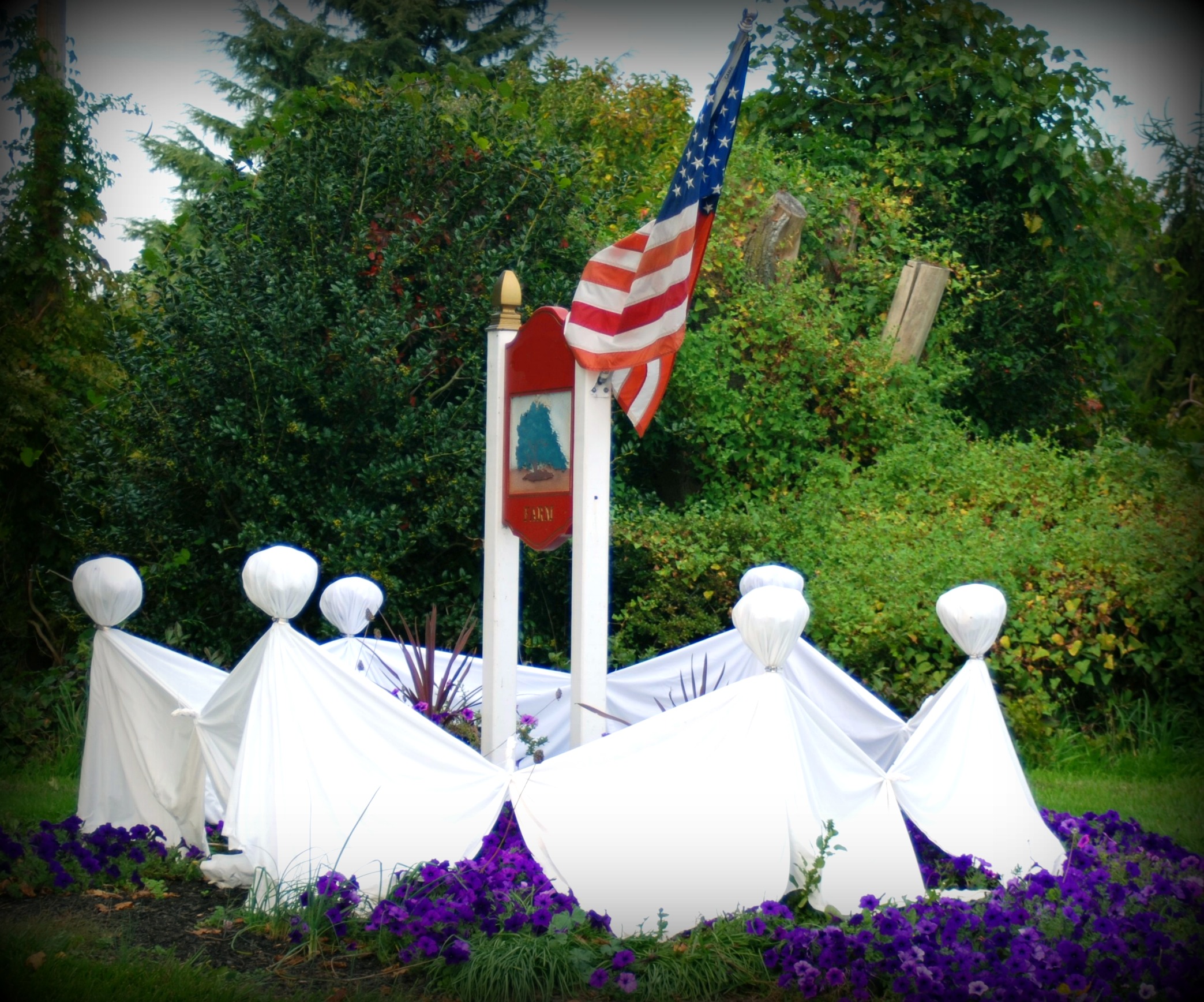
Image: MorgueFile