The Displaced Nation

A home for international creatives

Tag Archives: New York

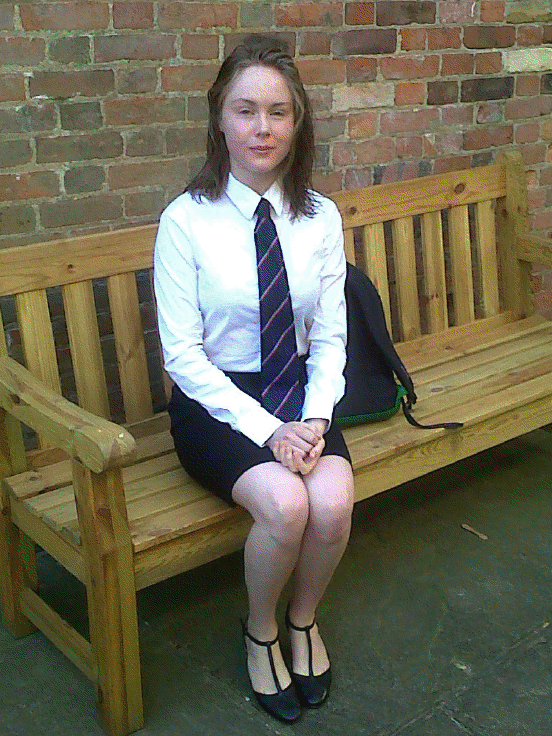
RETURN TRIP: Random Nomad – Charlotte Day, High School Student (Sixth Former)

While our writers take off on what they hope will be enchanting August breaks, The Displaced Nation will occasionally be reissuing some posts that, for one reason or another, enchanted our readers. Enjoy these “return trips”!
As youngsters head back to school, we’re reissuing a Random Nomad interview ML Awanohara did with Charlotte Day, a displaced teenager in England. Charlotte spent a chunk of her summer taking a Russian-language course in St. Petersburg and living with a Russian family. She has produced a travel yarn on her adventures, which will appear on Monday.

Born in: Sydney, Australia
Passports: Australia, UK and US Green Card
Countries lived in: Australia (Sydney): 1994-2001; United States (New York, New York): 2001-2010; England (Sevenoaks, Kent): 2010-present

What made you leave your homeland in the first place?
My father is Australian and my mother English. They split up when I was two. When I was six, my mother met and married an Australian who had been living in New York for thirty years. I was rather disgruntled about moving to the United States and for two or three years, remained determined never to accept it as “home.” At that time, I was deeply patriotic to my native country — though this sentiment has dissipated since.

Is anyone else in your immediate family a “displaced” person?
My mother’s family, originally from England, has long been displaced. My mother herself was born in Kenya, in 1961. Following the Mau Mau Uprising, her parents were forced to relocate, and my grandfather, presented with a choice between Australia and Canada, chose the warmer of the two countries. My mother spent her childhood bouncing between schools in England and Australia. She eventually grew so fed up with packing and unpacking, she decided to leave school at the age of 16. Her father agreed to the plan provided she spend a final year at the school in Switzerland his own mother had attended as a girl. My mother moved on from Swiss finishing school to work in London, Paris and Sydney. But she appears to have made New York her last port of call. Indeed, we had a fairly solid life in the city until I decided to take myself off to boarding school in England.

Describe the moment when you felt most displaced over the course of your many displacements.
It must have been when I first arrived in New York as a six-year-old. I stepped out of the JFK arrivals terminal into a snowy March night. My stepfather was wearing a leather coat, the interior of his car smelled of leather — and the world outside the car window seemed an undulating stream of black and silver. Though it was the end of 2001’s warm winter, my Australian blood froze beneath my first-ever coat. And their apartment — that was all leather as well. It smelled of musk and cologne. Since that time, I have felt similar pangs of displacement, some of which lasted for considerable periods. But those first few moments in New York stand out as the most acute concentration of “displacedness” I have ever known.

Describe the moment when you felt least displaced.
For the last five or so years in New York, I have felt more at home than I ever did in Sydney. I ascribe this to growing up: at a certain age, one can take possession of a city, know its streets, bridges, tunnels and transportation system. I was too young when I lived in Sydney to reach that kind of comfort level. But when have I felt the most like a New Yorker? Perhaps it was the last time I came home for the holidays, and took the 4 train uptown for the first time in months. At that moment I realized how much this train had been a part of my life — conveying me home from school every day for two years. My old life would always be waiting for me on the subway, ready for me to pick it up again. That’s something only a New Yorker could say!

You may bring one curiosity you’ve collected from each of the countries where you’ve lived into the Displaced Nation. What’s in your suitcase?
From Australia: A miniature wooden wombat figurine — a gift from my grandfather. It conjures memories of a childhood spent beating about the bush (literally) and fishing for yabbies at the dam in the company of audacious dogs who stuck their heads down wombat holes, to no good end.
From New York: A pair of fake Harry Potter glasses. These defined my first six months in New York — I even wore them to my first day of school. I think it is telling that even at the age of six, I was unwilling to give all of my real self to this new home.
From England: My school tie — representative of the alternative universe I seem to have entered. At boarding school, the sense of removal from reality can be disconcerting — especially after having spent a decade in the city I regard as the world’s capital.

You’re invited to prepare one meal based on your travels for other Displaced Nation members. What’s on your menu?
I’d like to make you a Sydney breakfast: scrambled eggs, made with cream, salt and pepper and served on a bed of Turkish toast, with avocado and stewed tomato on the side (is this being greedy?). Our meal will be accompanied by a large “flat white”: what we call perfectly strong, milky coffee without excessive froth. I suggest we consume it overlooking a beach on a Sunday morning. At least, I assume The Displaced Nation has beaches?

You may add one word or expression from each of the countries you’ve lived in to The Displaced Nation argot. What words do you loan us?
From Australia: Daggy. I use this word all the time — and did not realize it was exclusively Australian until I was informed of the etymology. Apparently, it comes from trimming the soiled wool around a sheep’s bottom. Which part of this repugnant whole is actually the “dag,” I do not remember. (No, I’m not a proper Australian!) But as I understand it, “daggy” means sloppy in appearance or badly put together.
From New York: There are so many words, and most are second nature by now. However, I will choose grande-soy-chai-tea-latte because I still shudder to think of myself as the kind of person who can utter such a phrase, at great speed, with great insistence. In fact, I’m still in denial about my love for Starbucks: having known Sydney coffee, my standards should be higher.
From England: Banter. I still do not know the precise meaning of this word, but it seems to encapsulate everything that makes someone my age feel socially acceptable — and, of course, I have no banter whatsoever. I think it means the capacity for combining wit with meaningless conversation. But there are other components, too, which seem to me unfathomable.

Question: Readers, tell us what you think: should we welcome Charlotte Day to The Displaced Nation and if so, why? (Note: It’s fine to vote “no” as long as you couch your reasoning in terms you think we all — Charlotte included — will find amusing.)

img: Charlotte Day at her boarding school in southeast England

If you enjoyed this post, we invite you to subscribe to The Displaced Dispatch, a weekly round up of posts from The Displaced Nation, plus some extras such as seasonal recipes and occasional book giveaways. Sign up for The Displaced Dispatch by clicking here!

Related posts:

RETURN TRIP: Mobile in America

While our writers take off on what they hope will be enchanting August breaks, The Displaced Nation will occasionally be reissuing some posts that, for one reason or another, enchanted our readers. Enjoy these “return trips”!
Mandy Rogers wrote this post — about what it’s like to be a Southerner in New York City — in response to Kate Allison’s “The Domestic Expat.” Since then, her domestic expat adventure has entered a new phase. She and her husband, Kerry, packed up pets and belongings again at the end of July and set out on across-country trip to their new home — in San Francisco. We hope to hear back from Mandy before too long…

I don’t always understand what people are saying. I’m temperamentally unsuited to the noise and lack of personal space. I don’t think I’ll ever completely fit in. What am I?

A Mississippian in Manhattan!

My husband, Kary, and I moved to New York City two-and-a-half years ago, when we were in our early thirties. Until then, we had spent our entire lives in Mississippi. We loved it and had a great community of friends, whom we still miss.

Making the move

What possessed us to pick up stakes and try out life somewhere else?

Kary and I met in the marching band at Mississippi State. I played the flute and he the trumpet. We both landed jobs at the university immediately upon graduation. But there was something in each of us, a kind of restlessness. We knew we couldn’t be content with staying in Starkville forever. Was it a passion for travel or a fear of growing too complacent? Perhaps a bit of both…

There was also a practical reason for making the move. I’d gone back to school in my late twenties to do a masters in landscape architecture. I discovered I really enjoyed doing projects involving public spaces, such as parks, gardens, and streetscapes. Public green space isn’t a priority in Mississippi, where most people have their own land.

During my graduate studies, I’d taken a road trip with Kary and my sister to New York City, visiting Central Park, Paley Park, and Bryant Park. The amount of green space was a surprise to me. It’s something my mother, another garden lover, noticed during her first visit to the city, too.

In the end, it all happened rather quickly. Kary was offered the first job in New York he applied for. He actually got it via Twitter!

We packed up our belongings in a rental car — our cocker spaniel, Callie, in her seat belt harness and our three cats in their carriers — and traveled over three days to our new home in the Big Apple, staying in pet-friendly hotels along the way. (We’d flown out to find an apartment just beforehand, signing a lease for one in Brooklyn, which several of our friends had recommended as a great place to live.)

When we first moved, I didn’t have a job so spent the time exploring gardens and parks in Brooklyn, the Bronx and Staten Island. Even now that I’m working for a landscape architecture firm in Manhattan, I escape to the Brooklyn Botanic Garden whenever I can to see what’s in bloom. My dad gave me a membership there just before he died. We had a complicated relationship so it’s a nice reminder of him and our common love of gardens.

The adjustment process

People still ask me: where are you from? They usually guess North Carolina or Georgia; no one has guessed Mississippi yet.

I’m still picking up new vocabulary and pronunciations. “House-ton” instead of “Hue-ston” Street; standing “on line” at the grocery store (in the South we say “in line”).

And I continue to be amazed that the number of people living in Brooklyn equals the entire population of Mississippi (2.5 million). No wonder one of our most difficult adjustments has been to the noise and (by our standards) overcrowding.

Still, there are lots of things we love in this part of the world, beginning with the climate. Thunder and tornadoes are much less frequent here. And believe it or not, even after this rough winter, we still can’t get enough of snow.

We’ve adjusted very quickly to living without a car. You can see and experience so much more on foot than behind the wheel. That said, I usually did most of my singing in the car, and I miss that! (I don’t sing around my apartment too much, as the neighbors could hear me.)

And, although the South is renowned for its hospitality, I am often surprised by how much nicer, friendlier, and helpful New Yorkers are than they are given credit for being.

Moving right along…

Despite these many “likes,” I don’t think we’ll ever be true New Yorkers. To this day, I always relish running into other Southerners. The past two years, Kary and I have attended the annual picnic held in Central Park for folks from Mississippi. There’s always a blues band and plenty of fried catfish, sweet tea, and other Southern delicacies.

Not all Mississippians have exactly the same values, but each of us knows what it was like growing up in that neck of the woods, and it gives us a powerful bond.

During the year, Kary and I congregate with fellow Mississippi State alumni at a local bar to watch our alma mater compete in football or basketball. We’ve made some new acquaintances that way, such as a native New Yorker who went to MSU in the 1970s to run track.

Like most expats, Kary and I debate about the right moment to move on and where to go next. Will we try the West Coast, or consider moving back south? Every time I visit Mississippi these days — I’ve been back three times since we left — I realize how much I’ve missed its hospitality, beautiful forests, and tranquility. Plus it’s been nice catching up with family and friends over hearty Southern meals.

Still, the hot, humid summer would take some getting used to again. And now that we’ve been bitten by the travel bug, we’re contemplating our wish list again. We visited San Francisco last year and liked what we saw.

Being mobile in America — it’s a trip, in more ways than one. Tell me, why do so many Americans seek adventure overseas when it’s perfectly possible to be an expat here?

Question: Can being an “expat” within your own borders be just as enriching as becoming one by crossing borders?

Mandy doesn’t have a blog but you can follow her on Twitter: @mandyluvsplants

img: Mandy (right) and a friend she ran into at a Central Park picnic for Mississippians in New York. Mandy’s comment: “My friend still lives in Mississippi but was here with her daughter, who was attending the picnic as part of her duties as Mississippi’s Miss Hospitality. My mom says I can’t go anywhere without running into someone I know — I guess she’s right!”

STAY TUNED for Some Enchanted Reading on Monday! 

If you enjoyed this post, we invite you to subscribe for email delivery of The Displaced Dispatch, a round up of the week’s posts from The Displaced Nation, including some extras such as quiz questions, recipes, and occasional book giveaways. Sign up for The Displaced Dispatch by clicking here!

In search of 007th heaven: A travel yarn in three parts (Part 3)

We welcome back Sebastian Doggart for the final installment of his story about the pilgrimage he made to Goldeneye, the Jamaican coastal retreat where Ian Fleming wrote all the James Bond novels. In Part 1, Sebastian reports on his clever ploy to gain admission to the birthplace of James Bond. In Part 2, he registers disappointment at the conversion of Goldeneye into GoldenEye, a soulless bolt-hole for the rich and famous. In this final part, he tracks down the original locations where some famous scenes in two early Bond films were shot.

Back on the cactus-studded road, fortified with a cup of 007’s favorite Blue Mountain coffee, I — along with my two Bond girls: my lovely girlfriend, Emily, and our cheeky six-month-old daughter, Alma — renewed the quest to find some legitimate traces of Britain’s greatest spy.

The movie that pays greatest tribute to Fleming’s love for Jamaica is Dr. No (1962). Filmed just outside the island’s capital city, Kingston, on the south coast, Dr. No features the first Bond car chase, as glimpsed in the film’s original trailer. (Notably, I did not encourage our red-eyed Jamaican driver to hit the accelerator and, for Alma’s sake, was relieved to see a large blue traffic safety sign saying: “SPEED KILLS. Don’t be in a hurry to eternity”.)

Also as glimpsed in this trailer, Dr. No also introduced the world to the first Bond Girl: Ursula Andress as Honey Ryder — emerging from the waves, cuddling a conch shell.

No matter that her voice was dubbed in the final film, Ms. Andress in a bikini was a vision that launched a million erotic fantasies, including my own. The beach where this iconic scene was filmed is as hard to reach today as it was for Bond in the movie. Located four miles west of Ocho Ríos, behind the Roaring River generating station, on a privately owned, rentable estate, it is approached by an unmarked track that ends at a security gate. The Laughing Waters stream — in which Bond and Honey concealed themselves — still pours into the sea.

But Bond and Honey’s actual hiding place is now a very unromantic drainage ditch.

In both the movie and the book, Honey’s beach lies on the island of Crab Key, which is Dr. No’s well-appointed hide-out. Bond and Honey make their way from the beach, through a lush forest, where they find a stunning waterfall in which to wash off.

I would do the same thing…

The cascade used for the movie is now one of Jamaica’s top tourist attractions, Dunn’s River Falls. As we reached this reputedly picturesque spot, the first thing we noticed were grotesque conga lines of cruise-ship passengers — mainly American, but with a large smattering of Chinese — clambering over the rocks. How I wished I’d had a Walther PPK pistol to silence the tour-guides as they orchestrated raucous football chants.

(Afterwards, Alma exacted her own ruthless revenge on the commercialized desecration of the waterfall. As we were waiting for our driver to pull up, a septuagenarian American couple, all sunhats and positive energy, approached us. Alma served up her gummiest, sweetest grin to the lady, whose tired face melted. “Awww,” she cooed, “you are the cuutest ba–“, at which moment she stumbled sharply and fell face first on to the asphalt. A blackish red liquid oozed from her mouth. Emily shielded Alma’s gaze from the horror. The husband yelled for help. A call went out to out to an ambulance, which — do they have one permanently stationed at the Falls to handle tourists tumbling down the rocks? — arrived within minutes. The lady was carried into the back of the ambulance, as her husband asked a fellow cruise passenger to tell the captain not to leave until she had been patched up and discharged.)

Dr. Julius No’s lair was where he entertained Bond and Honey for dinner…and concealed the laser that could disable American missiles. It also contained the nuclear reactor where he would meet his death, sinking into the boiling liquid from which he was unable to escape because of his metal hands.

The building used for the reactor’s exterior is a bauxite plant that sits beside the main road on the crescent harbor of Discovery Bay. It’s owned and operated by the American company Kaiser. Beneath its russet-stained dome is where the “red gold” that is Jamaica’s second-leading money earner after tourism is transformed into aluminium for export to U.S. refineries.

The other movie where Jamaica plays a major role is Live and Let Die (1974), the first film to star Roger Moore as James Bond.

Jamaica stands in as the Louisiana bayou for the classic scene in the crocodile farm owned by the evil Mr. Big. In the film, Mr. Big’s real name is Kananga, which was taken from real-life crocodile wrangler Ross Kananga, who was the double for Moore in the scene where Bond escapes by running over a phalanx of crocodiles.

In this clip you can see all five takes of Kananga performing this perilous stunt for Moore. The location was an actual crocodile farm called Swamp Safari, near the town of Falmouth. (It was being refurbished when we visited and is due to re-open next year.)

In Live and Let Die, Jamaica is also the fictional Caribbean island of San Monique. In the original novel, Bond comes here to track down what his MI6 boss, M, believes to be a stash of gold that was originally amassed by the notorious pirate Henry Morgan, himself an early foreign resident of Jamaica. That gold was being used by the criminal network SMERSH to fund nefarious activities in America.

In the movie, Kananga’s base was conceived of as a cathedral-like cave beneath a cemetery. It was here where the infamous drug lord kept his submarine. And it was here, in a shark-infested lagoon, that Moore kills Kananga by stuffing a bullet of compressed air down his throat, causing him to explode.

The Kananga scenes were shot in the real-life Green Grotto and Runaway Caves near Discovery Bay. They comprise a network of limestone caves and a limpid lake, 120 feet below sea level. Originally a Taíno place of worship, the caves had a recent incarnation as a nightclub — but after revelers damaged the stalactites, it was closed down. Today, tour guides are scrupulously protective of the green algae on the walls.

As my Bond girls and I wound up our 007 tour and headed back to New York, I was re-energized to write my own Bond novel. It will begin with our hero discovering that his mother, whom he has not seen since he was very young, is alive but has been kidnapped by a mysterious criminal gang.

With Bond’s fascination for women clearly linked to an Oedipal complex and an impossible love for his mother, this will set up the highest stakes of any 007 story ever. In an extraordinary final twist, his mother will be revealed as none other than…M herself!

M for Mummy! Genius!

What do you think? Will this effectively reboot the Bond franchise?

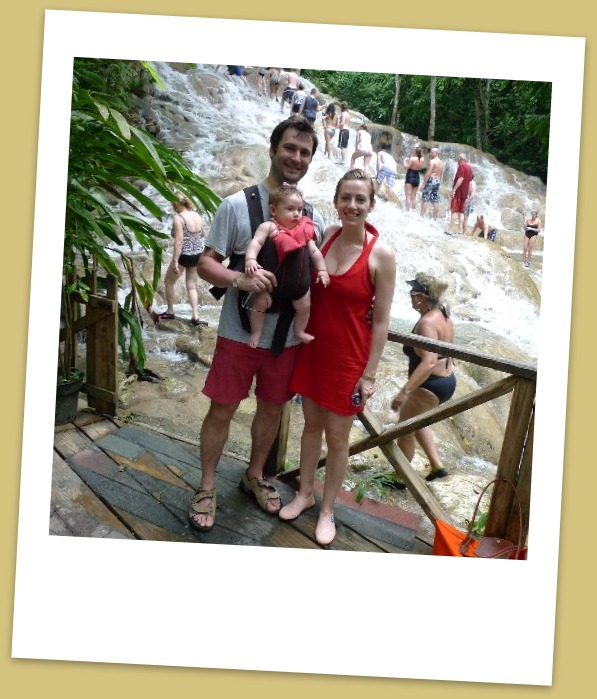
img: The intrepid Sebastian Doggart with his equally intrepid “Bond girls,” girlfriend Emily and their daughter Alma, snapped in front of Dunn’s River Falls, Jamaica, with conga lines of cruise-ship passengers in the background.

STAY TUNED for tomorrow’s installment from our displaced fictional heroine, Libby, who, having just said good-bye to her London home, is about to embark on her long-anticipated relocation adventure.

If you enjoyed this post, we invite you to subscribe for email delivery of The Displaced Nation. That way, you won’t miss a single issue. SPECIAL OFFER: New subscribers receive a FREE copy of “A Royally Displaced Tea.”
Related posts:

See also:

In search of 007th heaven: A travel yarn in three parts (Part 2)

GoldenEye collageWe welcome back Sebastian Doggart for the second in his three-part travel yarn about his attempt to infiltrate the Caribbean retreat called GoldenEye, where Ian Fleming composed all the Bond books. In Part 1, Sebastian reports on his arrival on Jamaica’s northern coast and admission at the gates of the compound that marks the birthplace of James Bond — newly remade into a resort for the super-rich. Stay tuned for Part 3, where Sebastian continues his Bond-worthy quest for traces of Fleming elsewhere in Jamaica.

Alighting from the car, I was greeted by Jenny Wood, GoldenEye’s English general manager, whose plummily cheerful efficiency had echoes of Miss Moneypenny. She welcomed us warmly and introduced us to a Jamaican employee called Henry, who would take us to our friends, the Usmanovs.

As Henry led us down a stone path, I asked him about visiting Fleming’s house. He said that, the week before, Bono had been staying there, but that it was now vacant.

Thrillingly, Henry promised he would get a key and take us to see inside.

He took us through a wooded area, where the trees had all been planted by a celebrity guest. Handwritten signs showed a tamarind planted by Princess Margaret, a royal palm by the Clintons, a lime by Harrison Ford, an ackee by River Phoenix, a cinnamon by Willie Nelson, and a guava by Johnny Depp.

Surely, this was the most eco-friendly example of name-dropping in the world.

Shaken, not stirred

We came to the luxuriously simple main restaurant, which also housed a bar in the very gazebo where Fleming would do some of his writing. Henry informed us that, when British Prime Minister Anthony Eden visited in 1956, he used this as a command post.

It was a perfect spot for a quick drink. I eschewed the obvious choice of a dry martini, shaken not stirred and ordered instead Bond’s own creation, a Vesper. Named after his Casino Royale lover Vesper Lynd, it’s made of three measures of Gordon’s gin, one of grain vodka, half a measure of Kina Lillet, all shaken until iced cold, and served with a slice of lemon peel in a champagne goblet.

Energized, we walked on to a wooden bridge, over an emerald waterway that drifted into the sea, through a maze of discreet wooden buildings, each bordering a lagoon, to our friends’ own villa.

They welcomed us with a rum punch, made from Blackwell’s own self-named brand. We sat on the back deck, listening to the resort’s own reggae-oriented radio station, and savoring the sweet scent of marijuana wafting from the neighboring cabana. I slipped into my bathing suit and leapt into the cool water.

On the other shore of the lagoon nestled the spa, described in the resort guidebook as a place where guests have “a license to chill,” and where Bond himself “would willingly put down his guns, girls and gadgets to lose himself — and find himself.”

I went back inside my friends’ cabana for a shower. The bedroom smelled of fresh cedar and was immaculately decorated. The bathroom, adorned with new Villeroy & Boch taps and a craw-feet tub, was outside — shielded by a bamboo fence and festooned with bougainvillea.

I hope you can swim, Goodnight.

Soon after, Henry returned to honor his promise to take us to Bond’s actual birthplace, and we said goodbye to our friends.

Henry led us to the private beach where Fleming used to don flippers and a diving mask (but no snorkel) to look at parrotfish and snapper, and to spear lobsters and octopi for his dinner. A glass-bottomed boat is now available for guests to peer for barracuda.

On the shore, hotel lounge-chairs broke the natural rhythms. A rock pool that Fleming built for his son, Casper, teemed with black crabs — the same beasts that Dr. No used to torture Honey Rider. I wondered whether Fleming and his “Jamaican wife,” Blanche Lindo, might have indulged in some related zoologically erotic games.

Overlooking the beach was a charming sunken garden which Fleming had hallowed out for dining al fresco. Shaded by a proscenium arch of almond trees, he and his illustrious chums would sit here feasting on ackee, curried goat, and grilled salt-fish.

Henry took out a key to show us inside the complex known as “The Fleming House.” The renovations have expanded Fleming’s own modest footprint to embrace four houses, all built around a new, sunken swimming pool. The main building is an enlarged version of Fleming’s original bungalow, and there are three neighboring villas, which contain guest rooms and a private cinema.

Time to face gravity!

To stay in the Fleming House is beyond most mortals’ spending power: it rents for between $7,000 and $21,000 a night, depending on the season.

To put that in context, Henry, whom Chris Blackwell was paying $60 a week, would have to work seven years — and incur no other expenditures — in order to take his family to the Fleming House for just one night.

My first impression on entering the main building was similar to that of Noël Coward,
who, in a teasing ode he wrote to Fleming, complained about the hard furniture and the airless rooms.

Totemic African statues stared threateningly down into the cavernous living room. Paintings of a conch shell and a sea-view looked as though they had been bought from the local market. The floor was made of cold, pale stone.

The master bedroom was where Fleming did most of his writing, but this too was disappointing. Below a framed black-and-white photograph of Fleming stood a bullet-wood corner desk, but Henry admitted that it was a replica.

There was no sign either of the Imperial typewriter that Fleming used to write most of the Bond novels, or of the gold-plated Royal Quiet DeLuxe portable that he later purchased from the Royal Typewriter Company in New York. (The Royal, I learned later, had been sold to Bond actor Pierce Brosnan for a reported $75,000.)

As Henry led me back to my car, past a lime tree planted by Yoko Ono, the whole place suddenly felt fake and exploitative. It seemed more a celebration of celebritocracy than a tribute to the creative spirit — more akin to Scaramanga’s island than to Fleming’s original Goldeneye.

And as the iron gates clanged behind us, I suspected that, if Fleming had a chance to see how his erstwhile 007th heaven has been transformed, he would feel that Chris Blackwell has leapt on an ugly Bondwagon — and, like Auric Goldfinger, may be suffering from a deadly Midas complex.

img: (top to bottom) Fleming’s private beach; Fleming’s sunken garden; GoldenEye villa outdoor bath; GoldenEye villa bedroom — all by Sebastian Doggart.

STAY TUNED for Part 3, in which Sebastian continues his search for 007 on the beach where Ursula Andress appeared, in evil Doctor Kananga’s limestone caves, and in Dr. No’s lair on Coral Key. And before that we have tomorrow’s post — an interview with Random Nomad Vicki Jeffels, who answers an Alice question.

If you enjoyed this post, we invite you to subscribe for email delivery of The Displaced Nation. That way, you won’t miss a single issue. SPECIAL OFFER: New subscribers receive a FREE copy of “A Royally Displaced Tea.”
Related post:

In search of 007th heaven: A travel yarn in three parts (Part 1)

We welcome Sebastian Doggart to The Displaced Nation as a guest blogger. Sebastian won one of our Alice Awards for a Telegraph Expat blog post entitled “Elegy to English shepherd’s pie.” Today, however, Sebastian will be giving Displaced Nation readers a break from our Alice theme, with the first in a three-part travel yarn about his chase after Goldeneye — the Caribbean retreat where Ian Fleming wrote all of his Bond books. Stay tuned for Parts 2 & 3 in the coming weeks.

On the northern coast of Jamaica, fringed by icing-sugar beaches and rocky coves, lies the holy place where Ian Fleming wrote all the James Bond novels. Now populated by the rich and famous in search of paradise, it is one of the most desired and exclusive oases on earth. Its name is GoldenEye.

Over the last two years, this secluded tract of land has been mysteriously shut to the world. The official story has been that the site has been undergoing a $75 million renovation. As with arch-villain Francisco Scaramanga’s private island, its inaccessibility has made it even more appealing as a travel destination. So when I heard that the legendary site was re-opening to a handful of invited guests, I was ready to risk life and limb to gain access.

I called the number listed on GoldenEye’s new Web site, and a lilting Jamaican voice gave me an email address for a London-based PR company. Its boss, whose broken English suggested she might in fact be the murderous Rosa Klebb, declined my request to write an article on the resort — unless I could come up with $21,000 a night.

I had neither the resources of Blofeld to satisfy her demand, nor a willingness to accept her rejection. With the ingenious forces of Q behind me, I devised a cunning plan to infiltrate the compound. Two friends were getting married and had been granted a honeymoon suite in GoldenEye. I would take my chances and show up on their doorstep for a celebratory cup of tea.

The name’s Bond. James Bond.

The approach to GoldenEye is a coastal road that passes the brand new Ian Fleming International Airport. Opened in January 2011 to cater for the super high-end tourist, it is specifically designed to welcome small jets. Rolling Stone Keith Richards, who has a house in nearby Ocho Ríos is a grateful new user.

I passed a sign marking the border of the town where GoldenEye geographically sits, Oracabessa. Once a banana port, it has fallen on hard times as Jamaica’s economy has struggled. Oracabessa’s name, a derivation from the Spanish oro cabeza, or golden head, is one of the various inspirations that Fleming has cited for his home’s own name.

No sign marked the entrance to GoldenEye. After driving past twice, I stopped and ask a local shopkeeper where the entrance was. She gave me a grave look of disapproval, as if I were complicit in a rich white man’s folly, but still had the grace to direct me to an unmarked iron gate, flanked by high walls. I pulled up and saw, hidden discreetly amongst the trees, a guard-post. I felt as nervous as if I were trying to break in to Dr. No’s lair on Coral Key.

As further ammunition to melt the guard’s heart, I was accompanied by two lovely ladies: my partner, Emily, who is even lovelier than Mary Goodnight; and my six-month-old daughter, who shares a birthday, November 11, with Bond himself.

“Good afternoon,” I said, breezily. “We’re here for tea with the Usmanovs.”

“Are they expecting you?” he asked, his wariness visibly dissolving as he glanced at my Bond girls.

“They are indeed. They’re the happy newly-weds.”

“One moment, please.”

The guard retreated into his bunker. With this level of security, I felt our chances were slim. Our friends would probably be out of their room, frolicking in the pool.

But we were in luck. The guard returned. “Drive through. Follow the path, keeping to your left. You will be escorted to the cabana of the Usmanovs.”

As the heavy gates swung open, and I scrunched over the gravel to within GoldenEye’s walls, my heart was pounding. The dream of seeing the birthplace of one my greatest heroes was about to come true…

Mr. Bond, it’s good to see you again…

The story of GoldenEye — originally spelled Goldeneye, without the upper case “e” — is an epic one. The estate’s first known owner was Henry Morgan, the 17th century Welsh pirate. He made use of its location, on a headland with a panoramic view, to look out for Spanish fleets heading for Havana. When he saw a new ship, he would send a signal to his own boat hidden behind an island, and its captain would then sail forward to claim their bounty.

Morgan used his piratic skills to help the British acquire Jamaica as a colony in 1658. He reveled in the pleasures of nearby Port Royal, “the richest and wickedest city in Christendom,” and would leave his name on every bottle of Captain Morgan rum.

Little is known of Goldeneye until the early 20th century, when it became a donkey racecourse. This is what Ian Fleming, then a commander in British naval intelligence, first saw in 1943, vowing to return after the war had ended. In 1946, he purchased the property from a powerful Jamaican land-owner, Blanche Lindo, with whom he began a life-long love affair. On the site of the racecourse café that once served banana dumplings and coconut oil, he built a white-walled bungalow.

Explaining its name in a later interview with Playboy, Fleming said:

I had happened to be reading Reflections in a Golden Eye by Carson McCullers, and I’d been involved in an operation called Goldeneye during the war: the defence of Gibraltar, supposing that the Spaniards had decided to attack it; and I was deeply involved in the planning of countermeasures which would have been taken in that event.

Goldeneye became Fleming’s winter retreat, where he would spend at least two months a year. He hosted an increasingly illustrious group of friends, including Graham Greene, Evelyn Waugh, Cecil Beaton, Laurence Olivier, and Truman Capote. His friend Noël Coward, who built his own house, Firefly, a few miles away, described his first visit thus:

We arrived before dusk. It is quite perfect, a large sitting room sparsely furnished, comfortable beds and showers, an agreeable staff, a small private coral beach with lily white sand and warm clear water. The beach is unbelievable. We swam after a delicious dinner, and lay on the sand unchilled under a full moon.

Honey Ryder: “Looking for shells?” Bond: “No, I’m just looking.”

Like Bond, Fleming was a womanizer, and Goldeneye was a fine place to woo a lady. In 1948, he brought Lady Ann Rothermere, whose response was effusive: “The air is so clear of dirt or dust, there is an illusion of a vast universe, and the sea horizon is very round.”

Fleming gave Ann a gift, the latest edition of Field Guide to Birds of the West Indies, by an American ornithologist named James Bond. He nicked the name for the hero of his first novel, Casino Royale, which he began writing in 1952, soon after he had discovered that Ann was pregnant and married her.

When writing, Fleming closed Goldeneye’s glassless, wooden shutters called jalousies, to avoid the distraction of the Caribbean horizon. He went on to create all 13 of his Bond novels in those surroundings. He would write later:

Would these books have been born if I had not been living in the gorgeous vacuum of a Jamaican holiday? I doubt it… I suppose it is the peace and silence and cut-offness from the madding world that urges people to create here…. A wonderful escape from the cold and grime of winters in England, into blazing sunshine, natural beauty and the most healthy life I could wish to live.

The Flemings’ marriage deteriorated into bickering, and Ann stopped coming to Jamaica. Our hero’s attentions turned to his “Jamaican wife,” Blanche. She was herself married — to Joseph Blackwell, an heir to the Crosse & Blackwell food family; but that only added spice to the affair. Blanche Blackwell gave Fleming a romantic gift of a coracle named Octopussy with which to explore the surrounding coves. The boat’s name became the title of the fourteenth and final Bond tale, published posthumously as part of a short story collection in 1966.

A lover of the sea, Blanche was the inspiration for Dr. No’s Honeychile Rider, whom Bond first sees emerging from the sea — naked in the book, bikini-clad in the movie. She was also the basis for Pussy Galore in Goldfinger.

You only live twice, Mr. Bond…

Blanche had a son, Chris Blackwell, who would go on to become a location manager on the movie Dr. No. He would then found the indie record label Island Records, which launched artists like Bob Marley and U2. Chris describes his first visit:

I went with my mother to a party that Ian Fleming was giving for friends. Noël Coward was there. It was a casual affair — with lunch served under the almond trees and overlooking the beach — and what I remember most is a lot of laughter.

In 1964, two years after both the release of the movie Dr. No and Jamaica’s independence from Britain, Fleming came to Goldeneye to write his last and most nostalgic Bond novel, The Man with the Golden Gun:

My own life has been turned upside down at, or perhaps even by, [this] small house … that I built 18 years ago… I sat down at the red bullet-wood desk where I am now typing this and, for better or worse, wrote the first of 12 best selling thrillers that have sold around twenty million copies and been translated into 23 languages.

Fleming died soon after, undramatically, of a heart attack, and was buried in Wiltshire, where he would later be joined by his son Casper (who tragically died of a drug overdose, aged 22) and his wife Ann.

The Fleming family held on to Goldeneye, which gradually fell into disrepair, until 1977, when they put it on the market. Bob Marley was interested, but eventually decided it was “too posh”. Encouraged by his mother, Chris Blackwell himself stepped in and purchased the property. He bought further land, increasing the estate from 16 to 100 acres and building what he called “a model for residential tourism” — a network of luxury villas that hosted celebrities including Naomi Campbell, Quincy Jones, Rachel Weisz, and Martha Stewart.

Two years ago, Blackwell shut it all down to embark on a $75 million renovation, with the goal of creating “a community of free spirits dedicated to living an inventive, balanced life where the imagination and the environment could co-exist in perfect harmony.”

We were now some of the first people to assess whether he had achieved this dream with the latest incarnation, GoldenEye.

STAY TUNED for Part 2, in which Sebastian continues his search for 007 — and for Monday’s post, where we’ll return to Wonderland for further scrutiny of its sense of humor (or the lack).

If you enjoyed this post, we invite you to subscribe for email delivery of The Displaced Nation. That way, you won’t miss a single issue. SPECIAL OFFER: New subscribers receive a FREE copy of “A Royally Displaced Tea.”

RANDOM NOMAD: Balaka Basu, Ph.D. Student in English Literature

Born in: New York City, USA
Passport(s): USA
Countries lived in: India (New Delhi): 1981, 1987-89, 1991, 2003-04; Italy (Rome): 2002
Cyberspace coordinates: The Society of Friends of the Text (collaborative blog)

What made you leave your homeland in the first place?
I’ve inherited displacement from my parents, who moved (individually) to the United States from India for graduate studies and sort of never left. They made periodic attempts to pick up stakes and move back, taking me with them, but these never lasted for more than a year at a time. My childhood left me feeling like a person without a homeland, always living between worlds, never quite belonging anywhere.

Describe the moment when you felt most displaced over the course of your many displacements.
As a child, it used to be while saying — or rather, in my case, not saying — the Pledge of Allegiance at morning assemblies. Now, every so often, out of nowhere, I’ll have this weird sense of wanting to go “home” and smell the jasmine and the honeysuckle, and the smoky, pungent mustard oil, and have someone bring me a glass of freshly pressed pomegranate juice.

Describe the moment when you felt least displaced.
This is a difficult question because the land of my birth is sort of my adopted homeland. I was born in the United States — but was taken back to India when I was 28 days old. My first language is not English, but I can neither read nor write in Bengali. I’m pretty much always feeling displaced. However, I’ve got the subway map of New York tattooed on my heart, and it’s always been the place I’ve come back to. I love coming into the city early in the morning from points east and watching the rose-gold light of the sunrise reflecting back from the million glass windows. And one of the things I loved about Rome is that it felt a bit like Calcutta — a city also caught between two worlds, displaced all on its own.

You may bring one curiosity you’ve collected from the country where you’ve lived into the Displaced Nation. What’s in your suitcase?
From India: A beaten copper sculpture of a woman bathing, a gift from my father.
From New York: A poster of the New Yorker cover “View of the World from Ninth Avenue,” by the Romanian-born American cartoonist Saul Steinberg. It depicts the supposedly limited mental geography of Manhattanites.
From Rome: A copy of Bernini’s marble baby elephant.

You’re invited to prepare one meal based on your travels for other Displaced Nation members. What’s on the menu?
Llish (a fish only available in India/Bengal) in mustard and chili paste, which has been smoked in banana leaves; rice; green mangoes in oil; and for dessert, by way of Rome, blackberry gelato and an espresso.

You may add one word or expression from each of the countries you’ve lived in to the Displaced Nation argot. What words do you loan us?
From India: Arbit, short for arbitrary, used as slang in India. Whenever I hear Indian people say “arbit,” it reminds me that English is one of their national languages, too, and has evolved in a distinct and separate way.
From Italy: Prego: the indispensable word! How can you not like a word that means “if you please,” “you’re welcome,” “excuse me,” “would you mind if I walked in front of you,” and so on. You can say it any time, and it will almost never be wrong. How economical!
From New York (which I think is fair to include even though it’s my birthplace): I’ve got to go with the unprintable expletive here. When I go other places, it’s terribly difficult to remember that curse words aren’t universally accepted as terms of endearment.

This month The Displaced Nation is celebrating Alice in Wonderland as a literary analogue for disorientation and displacement. Upon entering Wonderland, Alice commits many social blunders, as when telling Mouse all about her cat, Dinah. Can you describe an instance where you inadvertently offended someone in one of your adopted lands?
Well, there was this one time when I met an astrologer in New Delhi, who apparently used to read the stars for a previous prime minister. I asked how anyone in the civilized world could take these things seriously. But I’m not sure that was exactly … inadvertent.

QUESTION: Readers — yay or nay for letting Balaka Basu into The Displaced Nation? Tell us your reasons. (Note: It’s fine to vote “nay” as long as you couch your reasoning in terms we all — including Balaka — find amusing.)

img: Balaka Basu by Edie Nugent, taken in Edie’s Manhattan apartment.

STAY TUNED for tomorrow’s installment from our displaced fictional heroine Libby — and see if you can spot the Alice references!

If you enjoyed this post, we invite you to subscribe for email delivery of The Displaced Nation. That way, you won’t miss a single issue. SPECIAL OFFER: New subscribers receive a FREE copy of “A Royally Displaced Tea.”

Related posts:

In the jaws of political or natural disaster: When reality bites for expats

Lately I’ve been thinking about plot lines for movies based on adventure travel. The one I like the most involves a round-the world traveler spotting a shark while scuba diving in the Indian Ocean…

In the hands of the right director, I could see it becoming a remake of Jaws.

Speaking of which, did you notice that first prize for the Matador Network’s “When Travel Goes Wrong” photo contest went to a young woman whose travel bag — containing passport, wallet and cell phone — fell down a Swiss sewage drain and got fished out by a kind, thin stranger. Now that has real Jaws potential!

Unfortunately, however, travel is not today’s focus. Rather, my goal is to highlight some of the mishaps that occur when a global voyager becomes a global resident.

“Boring!” I can hear you say. And having been an expat myself twice over, I have to admit, at some level, you are right.

They’re a privileged set, those expats.

Privileged with insider knowledge. You’re not going to catch them on the street with the open sewers.

Privileged with accommodation. Not for them a stay in Fawlty Towers, or the equivalent.

Still, reality has a way of impinging even on the most glittering expat lives, and in my experience, global residents tend to be even more traumatized than their short-stay counterparts when something goes badly amiss.

(Is that because they’re spoiled? I’ll let you decide…)

Gothic horror redux

In case you haven’t been tuning into The Displaced Nation of late, our posts have been exploring cases where individual expats have had their lives turned upside down, or worse (see “related posts” below).

My colleagues and I have put forth incontrovertible evidence that the expat life, like any other, can have its gothic moments.

Lest any skeptics remain, may I draw your attention to the Friday May 13 incident in Spain’s Canary Islands. A homeless Bulgarian man stabbed and hacked off the head of a 62-year-old British resident of Tenerife, after which he paraded into the street, holding his “treasure” up by the hair for all to see.

According to one eyewitness, who, too, is a long-term British resident of the Canaries:

When I saw the man holding the head, the first thing that popped into my mind was the scene from “Clash Of The Titans,” where the hero holds up the Gorgon’s head — but his was real.

Disruption en masse

Now let’s turn to the instances where the expat life gets disrupted en masse by natural disaster or political upheaval.

Emily Cannell, an American who’s been living in Tokyo with her family since last year, paid a visit to The Displaced Nation as a random nomad last Thursday. She told us about what it was like to be in that city when the Great East Japan Earthquake struck on March 11. In just a few moments, she went from a woman whose biggest worry was driving to car pool on time, to wondering if her kids were alive or dead.

And let’s not forget Tony Roberts, who was an honored guest on our site several weeks ago. His story, now written up in the form of a novel, is about what it was like being a teenager in Iran in 1979, just before the revolution took place. The trauma came when his family was given just 24 hours to evacuate back to their home in Kansas, and he had no time to say good-bye to his friends. For some time afterwards, this Third Culture Kid suffered from General Anxiety Disorder, “with feelings of unresolved anger,” as the psychologists put it. He tweeted recently: “Revolution will do that.”

Snatched from the jaws of [domestic terrorism]

I myself had an experience of this ilk towards the end of my stay in Japan, when the religious cult Aum Shinrikyo attacked the Tokyo subway with sarin gas — killing a couple of people in the station just down the street from my house. In all, 13 people died, and thousands more suffered from after-effects. It was and remains the most serious incident of this kind in Japanese history.

As I struggled to come to grips with the idea of nice, safe Japan being populated by terrorists, quite a few thoughts raced through my head; for instance:

1) This place is weirder than I’d realized.
I’d never before heard of the kind of cult where the adherents are well-off, educated young people and their leader, a bearded mystic with a destructive political agenda. (Needless to say, I hadn’t heard of al-Qaeda. But even if I had, Japan is the Far, not the Middle, East.)

2) Do the authorities know what they are doing?
From what I’d observed of the Japanese police, they seemed pretty wimpy, precisely because the country doesn’t have a high incidence of violent crime. Did they really have the chops to capture Shoko Asahara and put an end to his madness? (The attack on the subway took place on March 20, and they didn’t find him until May 16. He was hiding inside the wall of a cult building in the group’s compound near Mt Fuji, dressed in purple robes and in good health.)

3) Who’s looking out for us foreigners?
I suspected that we foreign residents would be the last to know if further incidents were likely to take place. (For weeks following the subway attack, rumors of imminent attacks were rife, and I didn’t know whom to believe.)

Though I eventually got on the Tokyo subway again, the incident took its toll on how I felt about living in that city. Little did I know that I would one day be working in New York City and reliving many of the same emotions — ignorance, disenfranchisement, and vulnerability — in the wake of 9/11.

I discovered, however, in comparing these two incidents that when reality bites in one’s native land, it’s not nearly as unsettling as when it happens abroad.

After 9/11, I wanted to stay in NYC and carry on — it was a way of fighting back. Whereas after the subway attack in Tokyo, I started to fantasize about leaving Japan.

* * *

Are there any world travelers out there who’ve stuck with me throughout this catalogue of woes? I wouldn’t be surprised if you’ve come to the conclusion that your nomadic life, even with its many dangers, is preferable to that of most world residents.

Or perhaps you’re feeling a touch of envy? In that case, you may wish to check out Bootsnall’s virtual tour of the top 10 shark-infested beaches in the world.

Question: Have you had any experiences of large-scale disasters during your stay abroad, and if so, how did it affect your perceptions of your adopted country — did it make you feel any less “at home” there?

If you enjoyed this post, we invite you to subscribe for email delivery of The Displaced Nation. That way, you won’t miss a single issue. SPECIAL OFFER: New subscribers receive a FREE copy of “A Royally Displaced Tea.”
Related posts:

RANDOM NOMAD: Charlotte Day, High School Student (Sixth Former)

Born in: Sydney, Australia
Passports: Australia, UK and US Green Card
Countries lived in: Australia (Sydney): 1994-2001; United States (New York, New York): 2001-2010; England (Sevenoaks, Kent): 2010-present

What made you leave your homeland in the first place?
My father is Australian and my mother English. They split up when I was two. When I was six, my mother met and married an Australian who had been living in New York for thirty years. I was rather disgruntled about moving to the United States and for two or three years, remained determined never to accept it as “home.” At that time, I was deeply patriotic to my native country — though this sentiment has dissipated since.

Is anyone else in your immediate family a “displaced” person?
My mother’s family, originally from England, has long been displaced. My mother herself was born in Kenya, in 1961. Following the Mau Mau Uprising, her parents were forced to relocate, and my grandfather, presented with a choice between Australia and Canada, chose the warmer of the two countries. My mother spent her childhood bouncing between schools in England and Australia. She eventually grew so fed up with packing and unpacking, she decided to leave school at the age of 16. Her father agreed to the plan provided she spend a final year at the school in Switzerland his own mother had attended as a girl. My mother moved on from Swiss finishing school to work in London, Paris and Sydney. But she appears to have made New York her last port of call. Indeed, we had a fairly solid life in the city until I decided to take myself off to boarding school in England.

Describe the moment when you felt most displaced over the course of your many displacements.
It must have been when I first arrived in New York as a six-year-old. I stepped out of the JFK arrivals terminal into a snowy March night. My stepfather was wearing a leather coat, the interior of his car smelled of leather — and the world outside the car window seemed an undulating stream of black and silver. Though it was the end of 2001’s warm winter, my Australian blood froze beneath my first-ever coat. And their apartment — that was all leather as well. It smelled of musk and cologne. Since that time, I have felt similar pangs of displacement, some of which lasted for considerable periods. But those first few moments in New York stand out as the most acute concentration of “displacedness” I have ever known.

Describe the moment when you felt least displaced.
For the last five or so years in New York, I have felt more at home than I ever did in Sydney. I ascribe this to growing up: at a certain age, one can take possession of a city, know its streets, bridges, tunnels and transportation system. I was too young when I lived in Sydney to reach that kind of comfort level. But when have I felt the most like a New Yorker? Perhaps it was the last time I came home for the holidays, and took the 4 train uptown for the first time in months. At that moment I realized how much this train had been a part of my life — conveying me home from school every day for two years. My old life would always be waiting for me on the subway, ready for me to pick it up again. That’s something only a New Yorker could say!

You may bring one curiosity you’ve collected from each of the countries where you’ve lived into the Displaced Nation. What’s in your suitcase?
From Australia: A miniature wooden wombat figurine — a gift from my grandfather. It conjures memories of a childhood spent beating about the bush (literally) and fishing for yabbies at the dam in the company of audacious dogs who stuck their heads down wombat holes, to no good end.
From New York: A pair of fake Harry Potter glasses. These defined my first six months in New York — I even wore them to my first day of school. I think it is telling that even at the age of six, I was unwilling to give all of my real self to this new home.
From England: My school tie — representative of the alternative universe I seem to have entered. At boarding school, the sense of removal from reality can be disconcerting — especially after having spent a decade in the city I regard as the world’s capital.

You’re invited to prepare one meal based on your travels for other Displaced Nation members. What’s on your menu?
I’d like to make you a Sydney breakfast: scrambled eggs, made with cream, salt and pepper and served on a bed of Turkish toast, with avocado and stewed tomato on the side (is this being greedy?). Our meal will be accompanied by a large “flat white”: what we call perfectly strong, milky coffee without excessive froth. I suggest we consume it overlooking a beach on a Sunday morning. At least, I assume The Displaced Nation has beaches?

You may add one word or expression from each of the countries you’ve lived in to The Displaced Nation argot. What words do you loan us?
From Australia: Daggy. I use this word all the time — and did not realize it was exclusively Australian until I was informed of the etymology. Apparently, it comes from trimming the soiled wool around a sheep’s bottom. Which part of this repugnant whole is actually the “dag,” I do not remember. (No, I’m not a proper Australian!) But as I understand it, “daggy” means sloppy in appearance or badly put together.
From New York: There are so many words, and most are second nature by now. However, I will choose grande-soy-chai-tea-latte because I still shudder to think of myself as the kind of person who can utter such a phrase, at great speed, with great insistence. In fact, I’m still in denial about my love for Starbucks: having known Sydney coffee, my standards should be higher.
From England: Banter. I still do not know the precise meaning of this word, but it seems to encapsulate everything that makes someone my age feel socially acceptable — and, of course, I have no banter whatsoever. I think it means the capacity for combining wit with meaningless conversation. But there are other components, too, which seem to me unfathomable.

Question: Readers, tell us what you think: should we welcome Charlotte Day to The Displaced Nation and if so, why? (Note: It’s fine to vote “no” as long as you couch your reasoning in terms you think we all — Charlotte included — will find amusing.)

img: Charlotte Day at her boarding school in southeast England

If you enjoyed this post, we invite you to subscribe for email delivery of The Displaced Nation. That way, you won’t miss a single issue. SPECIAL OFFER: New subscribers receive a FREE copy of “A Royally Displaced Tea.”
Related posts:

Expat life as psychological thriller? An unholy appreciation of novelist Shireen Jilla

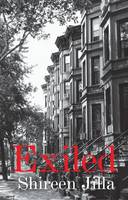
SPECIAL TDN ANNOUNCEMENT: Dear readers, we have some thrills and chills in store for you: a chance to engage with expat writer Shireen Lilla. She has kindly agreed to respond to our comments and questions on her new novel, Exiled.

Please accept this candle. You’ll need it to light your way to the faux coffin where we’re serving Victorianesque nibbles and “finger” foods in honor of the novelist Shireen Jilla.

Be sure to try our house speciality: fried tartantula. Such an exquisite dish! Or how about some maggoty cheese, imported straight from Sardinia for the occasion? It makes an excellent pairing with our special punch. (Go on, have a sip! It’s only bubbling because we added dry ice to the bowl.)

Our honored guest looks lovely, doesn’t she, in her long black cape with the red-satin collar? But don’t be fooled. Looks are extremely deceiving in her case. Jilla harbors no illusions about the dark side of expat life — and she isn’t afraid to grasp you by the hand and seduce you into entering that netherworld for an adventure.

Many an expat veteran has advised that being stationed overseas isn’t necessarily the life of Riley. But how many of them have ever warned us of the dangers lurking on the other side: everything from psychological breakdown to murder most foul?

Slyvia Plath, the American poet who’d been living in a bucolic a part of the English countryside, put her head in the oven upon returning to London. Nancy Kissel, who was living in an exclusive Parkview high-rise apartment complex in Hong Kong, allegedly killed her husband with a blunt instrument and rolled up his body in an Oriental rug.

But why dwell on real-life cases when Jilla’s imagination can provide us with all the macabre details we need?

Deliciously “exiled”

Shireen Jilla
Let us raise our goblets to Jilla’s debut novel, Exiled, a dark, dysfunctional psychodrama set in New York City.

The novel tells the story of Anna, who is so in love with her husband, Jessie, an ambitious British diplomat, that she can’t wait to start a new chapter of their life together in New York. Jessie is the ticket (quite literally!) for Anna to leave her old life in rural Kent far behind.

At first, New York lives up to its promise. The couple find a brownstone on the Upper West Side and fall into the rhythm of New York life. But then disaster strikes, again and again.

As Anna herself puts it in her Foreword to the story:

I couldn’t imagine that my romantic dream would turn into a dark battle for everything I loved.

In our current gothic mood, we laud the idea of this book (unfortunately, we’ve only read excerpts as it’s not yet available in the U.S.) for:

1) Defying stereotypes: Many outsiders who write about New York are tempted to extol the city’s glitz and glamor a la Sex and the City. Not Jilla. As one critic put it, she gives us a New York that is “a teeming pit of hissing vipers, only just covered with a finely buffed veneer of sophistication.”

Exiled2) Pushing the envelope: Jilla, a Third Culture Kid (she is half English, half Persian, and grew up in Germany, Holland and England) who has also been an expat — in Paris, Rome, and New York — hasn’t simply replicated her experience but has dug deeper to reveal psychological truths about the people she has observed. Anna’s step-mother-in-law is a powerful socialite and philanthropist of precisely the sort seen on The Real Housewives of New York City. In Jilla’s rendering, though, she is further revealed as calculating, manipulative — and evil. As one reader-reviewer on Amazon says:

Imagine the stark terror of Rosemary’s Baby firmly grounded in reality. Shireen Jilla has created the sharp thrill of horror in a world of utterly true and compelling characters.

3) Presenting a heroine who could almost be Libby’s alter-ego: Now who is Libby, you might ask? She is the Displaced Nation’s fictional about-to-be expat wife. Her diary entries appear every Friday on this blog. After hearing about Anna, we can’t help but wonder: will Libby’s life take a sinister turn once she reaches Boston? No, Boston isn’t New York — but how long before Libby encounters a Boston Brahmin…or two?!

Time to break the spell?

Before we blow out our candles, it’s your turn, dear reader:

Has Shireen Jilla also illuminated something for you by exploring the gothic side of our displaced lives? Does she speak to your own experience — to the times when you’ve been face to face with people who seemed evil, or with nefarious doings?

And do you have any questions for Jilla about what motivated her to write such a gloriously dark book?

img: New York Skyline, by plastAnka.

If you enjoyed this post, we invite you to subscribe for email delivery of The Displaced Nation. That way, you won’t miss a single issue. SPECIAL OFFER: New subscribers receive a FREE copy of “A Royally Displaced Tea.”

Related posts:

RANDOM NOMAD: Kim Andreasson, Management Consultant

Kim AndreassonBorn in: Sweden
Passport: Swedish
Countries lived in: Australia(Sydney): 1988-89; USA (New York and LA): 1996-2010; Vietnam (Saigon): 2010-present
Cyberspace coordinates: DAKA Advisory (business)

What made you leave your homeland in the first place?
My parents decided to travel around the world in 1988-89 and took me along for the ride. We left a snowy Sweden in December and arrived at our first destination, Los Angeles, in 72 degrees and sunshine, staying in the Hyatt on Sunset (now the Andaz West Hollywood). We explored the city’s many attractions including Disneyland and Universal Studios. I was sold and ever since, have considered LA to be the greatest city in the world. At the same time, my curiosity was piqued and I was sold on the idea of leaving something you know well for something different. I have never looked back.

Is anyone else in your immediate family a “displaced” person?
My California-born wife is now displaced as we are living in Saigon. By the way, we first met at a Swedish restaurant in Chinatown in New York City — call it displacement in microcosm.

Describe the moment when you felt the most displaced over the course of your various travels.
I’ve been fortunate to live in the kinds of cities where it’s relatively easy to blend in. But I’ve certainly experienced some memorable cultural contrasts. Soccer (what we Europeans call “football”) is a good example. During the World Cup in 2002 I was in an Irish pub on New York City’s Upper East Side at 4 a.m. watching the match between Sweden and Argentina. I believe I was the only one there watching the game. That was a really strange feeling. By contrast, during the 2009 qualifying match, the time difference was better and there were thousands of of us Swedes watching the games at a bar near Times Square in the middle of the day. This time, I thought I was in Sweden, which was also strange, in its way.

Describe the moment when you felt least displaced.
It’s a curious thing, but it’s when I leave my adopted homeland(s) that I feel especially at home in them. If you ask me my nationality in Vietnam, I’ll always say I’m Swedish. But if you ask me when I’ve just left Vietnam, I’ll say I’m Saigonese (a resident of Saigon). I was in Bangkok recently and couldn’t stop talking about how much I preferred life in Saigon. Likewise, when I lived in the U.S. and went home to Europe, I would feel more American than European during my visit.

You may bring one curiosity you’ve collected from your travels into the Displaced Nation. What’s in your suitcase?
From Australia, a boomerang, for the symbolism of always coming back. From America, a basketball because I enjoy the game and would like to continue playing it. And from Vietnam, a business suit — you can get world-class tailoring here at a very good price.

You’re invited to prepare one meal based on your travels for other Displaced Nation members. What’s on your menu?
Without a doubt, as a Swede, I am known for my guacamole. No, really. I guess because I lived in LA for so long, I came to love Mexican food. I would prepare it for you according to a classic recipe, something like:
1 tablespoon red onion
1 tablespoon cilantro
1 tablespoon jalapeno
1 avocado
2 tablespoons diced tomato
1 pinch of salt

You may add one word or expression from each of the countries you’ve lived in to The Displaced Nation argot. What words do you loan us?
From Australia: “G’day mate” — for its friendliness.
From the USA: “Awesome” — it reminds me of how globalized LA jargon has become, courtesy of Hollywood.
From Vietnam: “Ba” — and if you repeat it three times, you get a beer (333)!

img: Kim Andreasson on his way to Bến Thành Market, in Saigon (Ho Chi Minh City) — that’s if he can navigate the intersection of Le Loi, Ham Nghi, Tran Hung Dao Avenues and Le Lai Street.

If you enjoyed this post, we invite you to subscribe for email delivery of The Displaced Nation. That way, you won’t miss a single issue.