The Displaced Nation

A home for international creatives

Tag Archives: Love love love

RANDOM NOMAD: Russell VJ Ward, A Bloke from Basingstoke with a Bloomin’ Extraordinary Life

Russell Ward Collage_pmPlace of birth: Basingstoke*, Hampshire, United Kingdom
Passports: UK & Australia
Overseas history: Canada (Vancouver and Ottawa): 2003-06; Australia (Sydney, New South Wales): 2006 – present.
Occupation: Civil servant in New South Wales (state) government; blogger; wannabe fiction writer and entrepreneur — currently setting up a corporate writing business.
Cyberspace coordinates: In Search of a Life Less Ordinary (2012 finalist in the Best Australian Blogs competition); In Search of a Life Less Ordinary (Facebook page); @RussellVJWard (Twitter handle).
*Basingstoke (aka Amazingstoke) is a small commuter town in the south of England that is occasionally voted one of the less preferred towns in Britain — though not by me!

So tell me, how did a bloke from Basingstoke end up in the lovely harbour city of Sydney?
As much as I like Basingstoke, displacement came easy! I always had a burning desire to experience life in a country different to my own. I wanted to explore new environments, opportunities and activities. I was initially drawn to Canada as my grandfather was Canadian, and I had a long-held desire to explore this great country. I left England in 2003 in pursuit of less stress, more emphasis on the greater outdoors, and for a healthier and fuller way of living life. In Canada I lived by mountains and the snow. I blame my Australian wife for the subsequent move to Australia — she wanted to come back home for a while, and knew I was a soft touch for living by the ocean. These days, when spending every available minute doing something, anything, by the beach, I blame her and curse her and blame her some more…

Is anyone else in your immediate family “displaced”?
My grandfather is my opposite number. He met my grandmother while serving with the Canadian Army in Europe during World War II and married her while based in the UK. He returned to Canada several times but ultimately lived out the rest of his life in England.

And wasn’t your wife also displaced at some point? Otherwise, the pair of you would never have met…
Yes, my wife was working in England for a year, while also spending time with her English family (her mother is English and moved to Australia when she was 12). We met in my home town at the gym of all places — she always used to go to the same classes as me.

It sounds as though you’re living the dream in Sydney, but I can imagine you’ve had your displaced moments. Which one stands out?
It occurred just after we arrived in Sydney with our two dogs. I was walking them at a small park opposite our rental house. The younger pup was playing under a tree with his ball when I noticed something dangling out of the tree immediately above him. As I got closer, I realized said dangly thing was a humungous python wrapped around a branch, with its head swinging perilously close to my dog’s own. Thankfully, he’s an obedient little guy (my dog, not the snake) so he came to me as soon as I called. I remember standing there muttering over and over to myself: “What have I done? Where have I taken us? Did I just see a python hanging from a tree?” It became even more surreal when an elderly couple strolled past the tree while out for their morning walk. “Watch out for the python!” I called out. “Oh, don’t worry about him,” the white haired gent replied. “He’s just a harmless diamond python.” I knew then that I was truly displaced … and a lonnnnnnng way from Kansas, Dorothy.

When have you felt the least displaced?
The moment last November when our son, Elliot, was born. Australia was now his place of birth and it suddenly had a new, much more personal, meaning for me. This wild and rugged, unashamedly and devastatingly beautiful country will always be his home, wherever we are as a family in the future. He is an Australian first and foremost — and I’m incredibly proud of having provided that for him.

I’ve seen some of Elliott’s baby pix on Facebook and I must say, he’s adorable! No wonder you’re a proud papa! Besides your wife and new baby, you may bring one precious item or curiosity you’ve collected from the country (or each of the countries) you’ve lived in to The Displaced Nation. What’s in your suitcase?
From Canada: A bowl of poutine — a bowl full of french fries coated with brown gravy and topped off with curd cheese (which is a strange thing to be carrying in your suitcase and no doubt illegal to carry on your travels, but there you go). I’ve always had a penchant for the odd hot chip or fry. When I landed in Canada and somebody introduced me to this delightful French-Canadian dish, I knew I’d found my manna from heaven. Poutine. The very word itself makes me salivate.
From Australia: Probably a pair of budgie smugglers, which, though I’ve never worn — I can never quite get my head around the concept of wearing — would remind me of Oz as the majority of Australian men over the age of 40 wear them. FYI, the budgie smuggler — otherwise known as the “tighty-whitey” or “banana hammock” — is Australian slang for men’s tight-fitting Speedo-style swimwear. It’s something I shall never be seen wearing unless on a desert island by myself.

Don’t even think about it once you’re inside The Displaced Nation. We like to keep a sense of decorum. Next question: Can you donate any words or expressions from your travels to our displaced argot?
From Canada: It has to be “eh?”. “Canada, eh?” is something of a legendary sentence! “How’s it going, eh?” Used often and everywhere, it’s cute, quaint and so very Canadian. I also adore the way Canadians say “out”. Next time you’re near a Canadian, ask him or her to say it and you’ll see why.
From Australia: I’m going to avoid the “g’day” and “no worries” stereotypes and go with “ah yeah” — which I’m told I say all the time and which my friends tell me sounds very Australian. I think I probably used to say it in Amazingstoke, but years later, with the Aussie twang, it sounds less Jude Law and more Steve Irwin.

Let’s move on (or back) to food. You are invited to prepare a meal for the Displaced Nation, based on your travels. What’s on the menu? No poutine, please, we’re displaced!

Appetizer: From Canada — okay, no poutine but possibly a serving of waffles with Canadian maple syrup. I know, it’s not all that healthy and it’ll fill you up as a starter, but it was either that or the BeaverTails (fried dough pastry that resemble a beaver’s tail).
Main: I’ll revert to my current Australian habitat and chuck a couple of steaks with a few prawns on the barbie. (I know it’s an overused cliche — but one I’ve found to be true of life in the land down under.)
Dessert: I’ll whip up a key lime pie — a taste acquired from my short period of time working in the US. The pie was served on my arrival and, after seven hours of cattle-class airplane food, was quite easily the most delicious thing I’d tasted all day.
Drinks: I could share a few schooners of Australian lager, but instead I’ll opt for a jug of iced tea for the non-alcohol drinkers out there — I used to consume it by the gallon when living in Vancouver.

A theme we’ve been exploring this month, in honor of Valentine’s Day, is cross-cultural love. Thanks to your Aussie wife, you qualify! Tell me, what’s your idea of a romantic evening for two — and has it changed since the time when you were an unattached male who hadn’t yet left Britain?
It’s quite similar to when I lived in Britain: i.e., dinner for two, flowers, chocolates, a card and so on. In other words, fairly traditional. The difference now is the setting. In Sydney we’ll sit by the water at a local restaurant, maybe at the edge of the sand on one of the Northern Beaches. The sound of the ocean can be quite soothing … but is it an aphrodisiac, I hear you ask? Next time, I’ll order the oysters and let you know!

😀 Our other theme of the month is film, in honor of the Oscars. Can you recommend any films that speak to the situation of expats and their displacement?
A film I watched recently that I’d thoroughly recommend and which completely spoke to the expat situation was The Best Exotic Marigold Hotel. It’s a British comedy-drama about a group of retirees who travel to India to take up residence in what they believe is a newly restored hotel. The most interesting part for me was the way in which the different characters deal with their displacement, especially to such a polar-opposite country to their own. Some cope well, others not so. And the parallels with everyday expat living are apparent throughout.

That’s actually one of the films we nominated for this year’s Displaced Oscars — results to be announced in our Dispatch on Saturday! We’ll be sure to register your vote before then.

So, readers — yay or nay for letting Russell Ward into The Displaced Nation? Among other contradictions, he’s an Aussie citizen but can’t seem to cope with nonpoisonous snakes and refuses to don a budgie smuggler. And he claims to be loyal to Basing/Amazingstoke, but wants to serve us Canadian (sweet) iced tea. (Note: It’s fine to vote “nay” as long as you couch your reasoning in terms we all — including Russell — find amusing!)

STAY TUNED for tomorrow’s post, a review of Jeff Jung’s new book on mid-life career changes involving travel and the expat life.

If you enjoyed this post, we invite you to register for The Displaced Dispatch, a round up of weekly posts from The Displaced Nation, with seasonal recipes, book giveaways and other extras. Register for The Displaced Dispatch by clicking here!

Related posts:

Images (top to bottom): Banner from Russell VJ Ward’s blog; with his wife on Sydney Harbour (2010); photo he uses for his blog — taken in Launceston, Tasmania, in 2011; wearing Canadian mittens on Avalon Beach, Sydney, just before the Vancouver 2010 Winter Olympics — his way of showing his Canadian friends that he was supporting their athletes: “You should have seen the looks I got from the locals; it was a 35 degree Celsius day and I looked like a madman!”

The artichoke of cross-cultural love: Italy calls!

Signora Stella CollageAmore é gioia, amore é gelosia, amore é soffrire, amore é tenerezza, amore é calore. Amore sei tu! Is it any wonder that Italians always make the top-10 list whenever women are asked to rate the world’s best lovers? We are truly fortunate, then, in having the displaced author Estelle Jobson as today’s guest blogger. As you will see, this South African likens falling in love with an Italian man to feasting on a succulent artichoke — a rather curious analogy, to be sure, until one remembers that artichokes are cultivated in the Mediterranean. It is also a rather mysterious vegetable. How exactly do you eat it? As Jobson shows, it’s a matter of  peeling off the outer petals, one at a time… We are also fortunate in that Signora Stella is giving away an autographed copy of the book she wrote on her Roman love story! Grazie mille, Signora! (Details below.)

— ML Awanohara

The first call to write about Italy came when I was ten. With a smudgy HB pencil, I outlined an epic in my lockable, pink diary. It was to be about an extended Italo-American family who would make it big selling tyres. The main character, Pia, was to be my age, torn (theatrically) between her Italian roots and her American life. There would be family dramas (dramatic!), cascades of curls (curly!), Virgin Maries (statues and exclamations), and a stout grandma overseeing boiling pots of pasta. The novel would be shot through with shouting, gesticulating, and emotional-blackmail-meets-amore.

This literary project was soon shelved on the grounds of inadequate content knowledge: I knew nothing of the tyre business and had exhausted my repertoire on Italians. So the plot was filed amongst my many “books to write one day”.

Loving the individual

??????????What I did finish writing, in my thirties, is Finding Rome on the Map of Love, in which travel narrative meets love story. It is an autobiographical account of moving to Rome with an Italian man. It is about love radiating out from the heart of my Italo-South African couple, to love for a family, language, people, culture, and country. Just like the concentric rings within an artichoke. This happens in all relationships, however it is much more pronounced when the language, culture, and people are not those you grew up with. The rings within the artichoke make it very difficult to know which characteristic belongs to whom. Is it your beloved who is prone to interrupting others mid-speech? A family trait? Or that of the whole nation?

Just as Italians are sometimes drawn to the prudish, earnest, and ploddish Protestant way, so are we Anglo-Saxons drawn to their swaggering, flamboyant charm — and sometimes alarmingly cavalier approach to work. It threatens us to the core, yet opposites attract. And how! A part of us secretly longs to become the other. But since we can’t quite pull it off, the next best is to have them close to our hearts. Or better still, right in the bed. We say “Be mine.”

So the beloved in question — termed “the Meterosexual” for his dapper grooming — was in varied and bewitching ways the very opposite of what I grew up with. Unlike the wooden, roughly-hewn South African man, an Italian one may adore you, quite tangibly and vocally (poetically even), from head to toe. Because in his culture, your coiffure and your shoes are crucial. Core-shakingly so. The Meterosexual debated how I should do my hair for a job interview (“Hup? Down? No, hup. More professional!”) and set me straight on shoes that were an insult to an outfit. Certain footwear was actually banned from leaving the cupboard!

For a woman to have her appearance critiqued by a man, even an exquisitely stylish one, demands a certain thickness of skin.

But being South African, I had it.

Loving the family and culture

The next ring of artichoke love is that for your sweetheart’s family and culture. First I had la mamma pressing a hairdryer upon me lest I got a cervicale (the special Italian, wet-hair induced crick in the neck).

And soon thereafter, I was up against what felt like an entire nation (in this case, 60 million citizens) all clucking, fussing, and advising on health, the risk of catching a cold, and what food may be consumed at specific times of day, linked to its digestibility. This counsel was dispatched entirely unsolicited, but with tenderness.

Which is almost the same as love, isn’t it?

Italians regarded me, being Anglo-Saxon, as afflicted with a lumpishly undiscerning cultural palate. I was urged by strangers to read Dante Alighieri, listen to Vivaldi, and, above all, focus on what went into my mouth. The Meterosexual brought home gifts of emerald olive oil, popping with vitality, and parcels of pastries wrapped in a bow, popping with calories. His mother served me the Tuscan carciofini fritti (deep-fried artichokes). And his countryfolk served me regional cuisine, ubiquitous coffees, plus the unloseable gift: an ability to discern the superiority of mozzarella di bufala (female buffalo) over mucca (cow).

Loving a language

Further spirals of love lay in the process of gaining Italian language skills. Italian has delightful suffixes, to make words bigger, smaller, cosier, cuter, or nastier and uglier versions of themselves. This, to an English-speaker, is like playing Lego® with language.

With my ability to converse came a gradual adaptation to local ways. Although, truth be told, it’s easier to learn a foreign language than, for example, to wend your way successfully through the Italian national health system or to fathom the quasi-pagan fetishizing of the modern Catholic saint.

Loving the modus operandi

Living in Rome, I learned to ride a scooter in the city’s hair-raising traffic. This turned out to be a superbly transferable skill, relevant to many other Italian things, such as being honest. Telling the truth, the Italian way, is a flexible, savvy and self-preserving art. People lie with flair. In fact, it isn’t really lying at all, they explain. It’s being diplomatic, being furbo (smart). Banging your head against all this with rigid Protestant morals will only make your cranium ring. The Italians have taught me that blurting out the truth willy-nilly is ill-advised. It is gauche, hurts other people’s feelings, and counter-productive.

Now I know: one good lie deserves another.

Becoming the other

So it is that you start off in love with a foreign person and you end up assimilating their culture. Over time, some of the once-exotic features become yours and you may even lose bits of your cultural DNA, for lack of use (e.g., wearing ugly shoes). When I find myself using an Italian gesture or expression, because nothing else will do, I know I am no longer mimicking.

This is a moment of profound integration: deeper than love, more metaphysical than the first sip of the first cappuccino of the day. It will always be yours. It’s like becoming your own artichoke.

* * *

Readers, I have a confession to make. I’ve always found the artichoke a bit intimidating. I’m not sure I’m any less intimidated after hearing what Estelle has to say — but thanks to her, I’m can now appreciate its succulent taste and tender heart. And I know I prefer it steamy!

I can imagine her dashing Roman metrosexual calling her not just Stella but mia stella polare — his polar star! (And how can I get me a pair of those cool red shoes?)

What about you? Are you eager to hear more about Estelle’s love adventure with an Italian, and with Italy itself?

Listen to what readers of her book had to say:

Liesl Jobson (Estelle’s sister, still in South Africa and also a writer — one who wins awards for her short stories!):

Finding Rome on the Map of Love is an utterly enchanting and fabulously funny journey outwardly, into the city of Rome, but inwardly, Estelle bravely squares up her options in love and life. Her sharp eye investigates the real and the imagined and her inimitable voice always rings true. … [W]hile the focus is Rome, it is as much about being a stranger in a foreign country and the resourcefulness that is required to learn a language, understand the customs and become familiar with the ways of any new place.

Amazon reviewer:

You will adore this book; Estelle and her quirks will delight you, you’ll fall passionately in lust with the Eternal City and its people and be sad when it’s over. … Estelle’s writing skills will astonish you and you will ask, “Where has this writer been and why have I not heard of her?”

Amazon reviewer:

When I started reading Estelle Jobson’s observations on Italian culture, I felt I had run into an old friend on a common wavelength. Yes, me too!

Amazon reviewer:

Estelle Jobson is a very talented writer with a wonderful ear for the nuance and absurdity of language, and for the cross-culturally bizarre. … The book also boasts an extensive glossary that is bound to satisfy even the most pedantic of linguists.

And let’s not forget the back-cover blurb:

Estelle has an admirable career in publishing and a hectic, yet rich life. When her Italian diplomat boyfriend gets posted to Rome, she throws it all up to accompany him. There, she reinvents herself as Signora Stella, a casalinga (housewife) on the city’s highest hill, Monte Mario. Starting in autumn, she muses on life amongst the Italians and cycles through the seasons and sentiments of the Italian psyche. Signora Stella commences and ends at the same place: Follie, the local hairdresser run by Salvatore, a gay Neapolitan. This book captures a year’s worth of quirky, humorous, vivid observations about life amongst the Italians.

Can’t wait to read it? Jobson has published an excerpt on Italian Intrigues, the blog kept by one of our recent Random Nomads, Patricia Winton.

And now it’s your chance to ENTER OUR DRAW TO WIN A FREE AUTOGRAPHED COPY!!! Simply leave a comment in answer to the question:
**What has been your most entertaining experience with a cross-cultural relationship?**
Extra points for likening it to a vegetable; double the points if you’re a Displaced Dispatch subscriber!!!

The winner will be announced in our Displaced Dispatch on March 2, 2013.

NOTE: If you’re not the lucky winner but would still like a print copy, send an e-mail to findingrome@gmail.com.

Estelle Jobson has over a dozen years’ experience in book publishing and a Masters in Publishing from New York University which she attended on a Fulbright. She speaks five languages and has lived in as many countries; three years in Rome. She now lives in Geneva. To find out more about the book and follow its promotion, like the Finding Rome FB page. You can also follow Jobson on Twitter and read her occasional blog posts — for instance, this one on adopting Italian nationality, which she wrote for Novel Adventurers.

STAY TUNED for tomorrow’s post, when we announce the films that have qualified for this year’s Displaced Oscars!

If you enjoyed this post, we invite you to register for The Displaced Dispatch, a round up of weekly posts from The Displaced Nation, with seasonal recipes, book giveaways and other extras. Register for The Displaced Dispatch by clicking here!

Related posts:

Images: All photos supplied by Estelle Jobson.

RANDOM NOMAD: Christina Ashcroft, British Expat, Australian Citizen, and Writer of Hot Paranormal Romance

Christina Ashcroft Tiara WriterPlace of birth: Croydon*, South London, United Kingdom
Passport: Australia (My UK passport expired a few years ago.)
Overseas history: Australia (just outside Perth, Western Australia): 1998 – present. “I live five minutes from the beach!”
Occupation: Writer of steamy historical and paranormal romance for Penguin and Ellora’s Cave.
Cyberspace coordinates: Christina Ashcroft: Welcome to my dark world of archangelic eroticism (author site) and @ChristinaAsh_ (Twitter handle).
*I always get very excited whenever I see Croydon mentioned in a book (which isn’t very often!)

Before moving to Australia, you lived in England all of your life. What made you take the leap to Down Under?
My husband and I were high school sweethearts — he, too, comes from South London (Upper Norwood). We had talked about moving to Australia off and on for several years. We used to watch the programs on the TV of expats, and it all seemed very exotic and exciting. The decider came when my brother made the move to Perth, WA, in 1994. We visited him in ’96 when he got married (to the girl he’d gone to Uni with in the UK). Despite being chased by the biggest cockroach in the history of cockroaches, we fell in love with the country. We arrived home in early January to ice and snow, and within a couple of weeks we filed our application! We moved out here with our three kids.

So your brother is also “displaced”?
Yes, he, his wife and two daughters live about an hour from us.

In your 15 years in Oz, when have you felt the most displaced — apart from the time when you were literally displaced by that cockroach?
Only when there’s a big family get together in the UK and we know we can’t make it. We used to have great family parties and I really miss them. Apart from that I’ve honestly never felt displaced, except for the first month or so when I did get a bit homesick… 🙂

When have you felt the least displaced?
When I’m spending time in front of my laptop, lost in the mystical worlds of my characters. I’ve made a lot of writer friends online but I’ll never forget the first time I met up with my two critique partners (CPs) in the “real world.” It was just magic. I had found my tribe, and even though I’d had to travel to the other side of the world before we found each other, it was completely worth it. Funnily enough one of my CPs is also an expat from the UK who moved to New Zealand, but now lives in Australia. The other one is an Australian who was living in the UK when we first met online but she has now moved back to Oz.

It sounds as though you credit the move to Australia with your decision to become an author.
I’ve often wondered whether my career would have followed the same route if we’d stayed in the UK. While I’ve always loved writing it wasn’t until we moved to Australia that I decided to to write with the aim of publication. The support, encouragement and friendship I’ve found in the Romance Writers of Australia has been phenomenal. I also don’t think I would have met up with my CPs, and they are the ones who originally suggested I should try writing erotic romance.

ArchangelofMercyCoverAll this talk of erotic romance is helping to put us in the mood for Valentine’s Day. Can you tell us a little more about the plots of your books?
My paranormal romances feature fallen bad ass Archangels and the women who capture their hearts. I’m thrilled that my first Archangel book, Archangel of Mercy, was a finalist in the 2012 Australian Romance Readers Award for Favorite Paranormal Romance.

Wow, congratulations! And don’t you write historical romances as well?
My historical romances are set during the first century when Rome invaded Britain. There are sexy warrior heroes, magical Druid heroines and powerful goddesses.

You may bring one curiosity you’ve collected while living in Australia into The Displaced Nation. What’s in your suitcase besides your books?
Well, I’ve not brought a suitcase, I’ve brought a traveling basket with my three adorable kitties! 🙂 I’d always had cats in England, but we were here for 12 years before I finally adopted two sisters. One of them had four kittens but unfortunately only one survived. We spoil him terribly!

You are invited to prepare a meal for the Displaced Nation, based on your travels. What’s on the menu?

It would have to be a barbeque, of course! Not only can you cook practically anything on the BBQ but it always tastes a lot better than having to cook it in the kitchen. Plus it means I don’t have to actually do any cooking, since my husband and son take over with tongs and fork — always a bonus!

Since lamb is very popular here, we could have lamb and capsicum kebabs with salad and fresh crusty bread, washed down with a local wine and cold beer. Seeing as I’m from the UK, I should only ever drink warm beer, but I have to confess I’ve joined the Dark Side on that one!

For dessert — what could be yummier than a mango cheesecake?

Can you donate an Aussie word or expression to the Displaced Nation’s argot?
One of the best expressions in Australia is “No worries.” While my children take great delight in telling me I still sound “so British,” I do love saying “no worries.” It’s just so laid back and zen and also rolls off the tongue very easily!

Returning one last time to this month’s Valentine’s Day theme, what’s your idea of a romantic evening for two? Has it changed since the time when you were still living in Britain?
Room service in a fabulous hotel with a gorgeous view of the ocean. We’d eat our meal on the balcony as we watched the sun set and later we’d crack open a bottle of bubbly in the private spa. Although we’ve only managed this romantic getaway a couple of times in recent years, we never did anything like it in Britain.

Readers — yay or nay for letting Christina Ashcroft into The Displaced Nation? She drinks cold beer yet her children accuse her of being “so British.” And, though we might enjoy her erotic tales of fallen archangels and the women who capture their hearts around Valentine’s Day, would we benefit from a steady diet of this out-of-this-displaced-world fare? (Note: It’s fine to vote “nay” as long as you couch your reasoning in terms we all — including Christina — find amusing!)

STAY TUNED for tomorrow’s post, another in our “Capital Ideas” series — focusing on one of the world’s most romantic cities (but of course!).

If you enjoyed this post, we invite you to register for The Displaced Dispatch, a round up of weekly posts from The Displaced Nation, with seasonal recipes, book giveaways and other extras. Register for The Displaced Dispatch by clicking here!

Related posts:

img: Christina Ashcroft looking a little bit displaced(?) at the Romance Writers of Australia conference held in August 2012. Christina says: “My critique group call ourselves the Tiara Girls, so we take along our tiaras and wear them at the Friday night conference cocktail party. It’s just a bit of fun!”

Is it cooler to be married to someone from another country? Yes, particularly if they’re Brazilian!

Is it cooler being married to someone from another country? In my experience, it’s often everyone else who seems to think so, although maybe that’s because I happen to be married to someone from a country whose people are perennially voted the coolest nationality on the planet.

Typically, as soon as I mention that I’m married to a Brazilian the almost universal reaction is:

“Cool! I’ve always wanted to go to Brazil!”

Such reactions inevitably tend to be informed by the idealized images most people have about Brazil and Brazilians:

  • Carnaval
  • Samba
  • Football
  • Exotic beaches frequented by beautiful people wearing minuscule pieces of beach attire.

Brazil is, of course, far more complex than this. It’s as equally well-known for its

  • Favelas
  • Drugs
  • Gang violence
  • And…errr…films about favelas, drugs and gang violence.

Naturally though, people tend to assume that I probably haven’t married a gun-wielding, drug-pusher from the favelas, and so it’s the cool, beach-loving Brazilians they tend to envisage whenever I mention my marital status.

So, in everyone else’s eyes at least, my story of marrying the Brazilian girl I met in Argentina is way cooler than that about the girl they met in their local boozer in London.

And to be fair, it is a pretty cool story.

Cool as in mind-expanding

Yes, the samba, the beaches and the football (especially the football!) make life exciting, but what’s even cooler is that marriage to a Brazilian woman has been a life-changer — in a good way. For instance:

1) My horizons have been broadened immeasurably.
I’ve learned to view things through the eyes of someone who’s experienced them within another country and culture. Thus, things you may have previously found exotic, unusual or irrational become familiar, normal and logical.

2) I now see “cultural differences” in a positive light.
True, cultural differences have the potential to make a relationship fractious. But in our case, these cultural differences help to fill in certain gaps that we’d always looked for in the people we’d dated.

As a self-conscious Brit (British stereotype No 1: tick), I find it appealing to have a naturally sociable and confident wife (Brazilian stereotype No 1: tick), who is able to take control of social situations in which I’d otherwise feel uncomfortable. Her effortless sociability is the perfect counterbalance to my stuttering inability to engage in anything other than mindless small talk with most strangers.

By the same token, she appears to have found it a pleasant surprise to encounter a man who was a little less “forward” than what she had been used to in Brazil.

That, and the fact that I was the only man she’d ever met who could cook, I imagine.

3) I also think that cultural differences are often overdone.
Despite the perceived and real differences between our countries and cultures, there are occasions when I realize that in many ways, my wife and I aren’t all that different. As a football geek, I’ve found my wife’s interest in watching football one of life’s great blessings (Brazilian stereotype No. 2: tick; British stereotype No. 2: tick). I’ve lost count of the number of times I’ve come home to find her watching a game on the telly.

Cool as in constant adventure

Another cool thing about marrying someone from another country is that life becomes more adventurous — at times rather literally. For example:

1) I’ve had the opportunity to learn and explore a culture and country with what effectively amounts to having a free tour guide.
And, let’s face it, where would you rather go when you have to go and visit the in-laws: Brazil or another boring town in England?

2) I’ve now embarked on the adventure of learning another language.
This is something I’d always wanted to do but was too lazy. Also, language schooling is pretty appalling in the UK — I can barely remember any of the French of German that I learnt all those years ago.

Whilst it’s still a work in progress, my Portuguese is now at least functional — and improving everyday.

3) I’ve been able to do something I always wanted to do, live abroad.
Indeed, my language learning has been significantly aided by our recent relocation from London to São Paulo. Would I have done this without my wife? Maybe not, because of circumstances and/or apprehension of moving countries on my own. For me, the option to live in Brazil was instantly made more manageable by my wife being from the country we moved to — my own personal relocation advisor if you will. As explained it my Random Nomad interview, it makes me feel a lot less displaced.

But, not always as cool as it sounds

However, despite how cool all this sounds it’s not to say that marrying someone from another country doesn’t come without its own particular challenges. Here are two that really stand out for me:

1) The early days weren’t easy.
Once we’d both returned home, following what was effectively a holiday romance, there was the little issue of us both living in different continents — a mere 6,000 miles apart.

And then, once we’d decided to give the whole (very) long-distance relationship a go, there was the feeling, similar to the one expressed by fellow Brit James Murray in his column last month, that the few weeks here and there we occasionally managed to spend together consisted mainly of getting re-acclimatized, rather than enjoying each other’s company.

And, of course, there were the usual issues that complicate long-distance relationships: loneliness, uncertainty, jealousy, lack of communication, etc. Fortunately, we had the Internet — a relationship like ours would have been unimaginable 15 years ago.

2) UK immigration laws — need I say more?
When my wife made the crunch decision to move to the UK, there was the added complication of the navigating a Kafka-esque immigration system that does its best to keep out anyone deemed to be from a “developing country.” Four years, various visa refusals, threats of deportation and thousands of pounds later, my wife was finally able to settle her status permanently in the UK.

Rather ironically, as soon as she received permanent status, we scarpered from the economic crisis in Europe to the relative calm in Brazil — where they’ve been far happier to accept me as a resident.

But hey! That’s pretty cool, too.

* * *

Readers, having witnessed Andy’s valentine to his Brazilian wife, what do you think? Are you in a cross-cultural relationship and if so, do you perceive similar benefits? Or are you more jaded than he is — suspecting that the challenges can outweigh the benefits once the “cool factor” wears off? Please leave your thoughts in the comments!

STAY TUNED for tomorrow’s post, when a Random Nomad with a finely-tuned sense of romance joins us!

If you enjoyed this post, we invite you to register for The Displaced Dispatch, a round up of weekly posts from The Displaced Nation, with seasonal recipes, book giveaways and other extras. Register for The Displaced Dispatch by clicking here!

Related posts:

5 movies for expats and world travelers looking to stir up romance this Valentine’s Day

Editor’s note: Today we are happy to welcome a new member to the Displaced Nation team, Andy Martin. His debut post introduces our two favorite February’s themes: Valentine’s Day (aka expat love) and displaced movies (in honor of Oscar season). For those who haven’t read Andy’s Random Nomad interview with us, it’s worth knowing that he’s a UK-qualified social worker who now lives in Brazil with his Brazilian wife, and a self-professed football geek.

One of the things I discovered when I moved to Brazil is that Valentine’s Day is not actually celebrated here until 12th June, where it is instead known as Dia dos Namorados (Boyfriend’s/Girlfriend’s Day). The reasoning for this is that 12th June is the eve of St. Anthony’s Day, the saint otherwise known as “the marriage saint.”

Additionally, what the rest of us know as Valentine’s Day (14th February) typically falls during or around the time of Carnaval, and anyone who knows anything about the excesses of Carnaval knows that a holiday to celebrate fidelity may probably be best left until later in the year — say, June time.

Anyhow, seeing as my wife has lived in the UK and now openly embraces British culture she’s suggested that it would only be proper to celebrate both the British and Brazilian holidays — she’s a clever one! And what more traditional way to celebrate than a trip to the cinema?

Bearing this in mind, I’ve made a list of 5 films that couples like us — multicultural, expat, glolo and/or nomadic — might like to watch this coming Valentine’s Day, to stir up the romance of travel that brought you together in the first place…

The one about adventure

IndianaJones_small1) Indiana Jones and the Raiders of the Lost Ark (1981), dir. Steven Spielberg
An action-adventure drama that pits Indiana Jones (played by Harrison Ford) against a group of Nazis who are searching for the Ark of the Covenant because Adolf Hitler believes it will make their army invincible.

Why I like it: The original Indiana Jones trilogy was released between 1981 and 1989, and despite the pointless release of Indiana Jones and the Kingdom of the Crystal Skull in 2008, it will forever remain, for my generation at least, what introduced us to the potential excitement of exploring the unknown.

Personal note: I love my in-laws but they neglected their parenting duties in one pretty big way: their failure to introduce my wife to Indiana Jones (a situation that has, thankfully, now been rectified).

Most stunning aspect: Let’s face it, any film that can make archaeology seem like the coolest profession in the world has got to be doing something right hasn’t it?

The ones with the romantic clichés

The traveler is often accused of being a romantic, an idealist and of someone who is running away from life and all the problems and commitments that go with it. The alternative argument is that the traveler is actually taking life by the scruff of the neck and living it to the full.

Either way, two films that best capture this dialectic are the two that often most lionized by today’s generation of travelers:

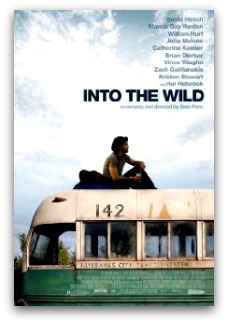
IntotheWild_small2) Into the Wild (2007), dir. Sean Penn
An adaptation (also by Penn) of the book of the same name, by Jon Krakauer, depicting the true story of Chris McCandless, a 24 year-old American and persistent wanderer whom believed that there was more to life than settling for the 9-5 grind in an office.

Why I like it: My wife introduced me to it (her riposte to my Indiana Jones exasperation). She had watched it early on in our relationship, when she was in Brazil and I was in London — a genuinely long distance relationship.

Personal note: She said that the film’s protagonist, Chris McCandless, reminded her of me — although fortunately our story has had a bit of a happier ending than his (I’ll say no more in order not to ruin it for you).

No half-measures: Boy did McCandless walk the walk, giving away his $24,000 college fund to charity before hitchhiking to Alaska and plunging into the wilderness, gradually seeking the means to remove himself from the “real world. ”

TheMotorcyleDiaries_small3) The Motorcycle Diaries (Spanish: Diarios de motocicleta) (2004), dir. Walter Salles
A biopic of Ernesto “Che” Guevara as a young man, representing an adaptation of Che’s memoir of the same name, recounting the trip he made around South America with his best friend, Alberto Granado.

Why I like it: Whatever you view of Che is, there is actually relatively little politics in the film, although one is introduced to some of the experiences that started to inform what he later became in life. Instead, for the most part, this is a film which perfectly captures what is to be young and curious of the world outside your own town or city. Che and Alberto chase beautiful landscapes and beautiful people, but also volunteer their time to those less fortunate than themselves.

Personal note: This film was the tipping point in inspiring me to travel around South America.

Memorable scene: There’s a great scene that highlights the dichotomy between the travel romanticized by “travelers” and that which is driven by the needs of most other migrants around the world — the topic of my guest post last month for The Displaced Nation. In it Che and Alberto meet an indigenous couple who have been forced from their lands and who are traveling in order to find work. When the couple ask Alberto and Che why they are traveling, they reply: “We travel just to travel.” Confused, the wife replies: “God bless you.”

The one about being displaced

Lost_in_Translation_small4) Lost in Translation (2003), dir. Sofia Coppola
The story of the unlikely bond between an aging movie star, played by the awesome Bill Murray, and a trailing spouse (Scarlett Johansson), after they meet in the bar of their five star hotel in Tokyo.

Why I like it: Life as a nomad is not all about romantic adventures and life-changing experiences — there are also just as many challenges and struggles: homesickness, culture shock and loss being just some of them. Lost in Translation is, perhaps, one of the films that best explores some of these issues.

Additional benefits: The story is poignant, and the film is beautifully shot.

The one that’s not actually about travel or expats

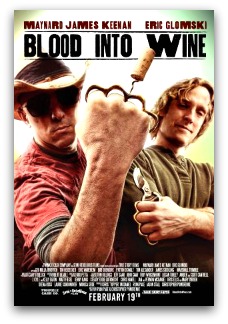
Blood_into_Wine_small5) Blood Into Wine (2010), dirs. Ryan Page & Christopher Pomerenke
A documentary about the Northern Arizona wine industry focusing on the musician Maynard James Keenan and Eric Glomski and their winery, Caduceus Cellers.

Why I like it: This film doesn’t really have anything to do with either travel or expat life, but I’m including it here because it’s about one of my favorite artists: Maynard James Keenan. A slightly biased choice perhaps, but I think it deserves a merit for the way it encapsulates the spirit of those people who have dreams and then act upon them to make them happen — a spirit which, I think, drives many of us travelers and expats.

Maynard’s dream: Maynard dreams of starting a vineyard in Arizona. Yes, Arizona. Despite the doubts and concerns of the experts he consulted Maynard invested almost his entire fortune, made from working with the bands Tool and A Perfect Circle, to start a vineyard in Arizona — a state entirely unknown for growing wine.

Does he succeed? You’ll have to watch it, I guess… And don’t forget to invite a date!

* * *

Readers, what do you think of Andy’s suggestions? Are these the sorts of films that make you feel romantic, or do you think he’s bonkers? We’re open to any and all comments…as well as to further recommendations of films likely to bring out the romantic side in us glomads!

STAY TUNED for tomorrow’s post from our monthly columnist, James Murray, who right now can be found in front of his fireplace in Boston — and not because he’s in a romantic mood! Far from it…

If you enjoyed this post, we invite you to register for The Displaced Dispatch, a round up of weekly posts from The Displaced Nation, with seasonal recipes, book giveaways and other extras. Register for The Displaced Dispatch by clicking here!

Related posts:

A newly arrived expat in Boston asks: Is distance really the antidote to romance?

James_Murray_DisplacedToday, we welcome guest blogger James Murray to The Displaced Nation. Originally from East Sussex, UK, James “recently arrived in Boston, Massachusetts, with a half-written book, a smattering of web design skills and a utopian vision that will probably never change the world.” He’s here for his partner, Ash, who is American (although few people think of her that way). Though he doesn’t really label himself a traveler, his displacement is “likely to verge on the permanent.”

I’m finally here in America. After the best part of a year living in separate countries, my partner and I are finally married — which I suppose makes her my wife. The word doesn’t sit well — we have a pretty equal relationship, where the terms ‘husband’ and ‘wife’ seem to imply a structure; a certain assignment of roles. In a husband-and-wife relationship, you can make a guess as to who does the cooking and cleaning; but in a relationship of two partners there are no preconceptions (apart from the one that you might be gay).

But the labels of husband and wife are just one of a number of areas where the typical encapsulation of a relationship differs from the reality.

For around eight months I’d been sitting in limbo over the other side of the Atlantic, fidgeting around with various projects and living in various temporary places — it’s been okay, but I’ve just wanted to get settled for a bit. My partner, Ash, visited a few times, but those occasions weren’t what you would think.

The old airport reunion kiss

In particular, there’s a fault with the ‘airport reunion kiss’ — that little run-up, the unseen orchestra with its musical swell and the big hug and the big kiss between two people who have spent so much time apart. I want to blame Hollywood, but I simply couldn’t find an example of this happening in a movie, so I think it must just be hard-wired into the human mind — that this is simply how it happens, a tempestuous embrace with no doubts and no awkwardness.

It doesn’t work like that. Certainly we kissed at the airport, but after months apart, living our separate lives, we couldn’t quite get our heads around who this other person was. Logically, you know, you could recite details about this person — their likes and dislikes; their beliefs; their habits; but there are memories that are harder to keep.

For instance, how do you remember what it feels like to kiss your partner? How do you remember their smell or a particular look they might give you? There are things that, once they’re not physically there in front of you, just disappear, so when you finally see them again after a long separation, it’s a shock. Not a bad shock, but it’s not comfortable yet — you have to re-acclimatise.

Ash and I found that meeting again after our first three months apart, it actually took about a week for this to happen. Which means that when your partner comes to stay with you for ten days, you’re finally re-discovering your groove when you’re just about to say good-bye again.

Doubt — nothing wrong with that!

Lots of expats know what it’s like to have a long distance relationship — for many that’s the reason they’re expats; but I think we’re badly served by the standard story of long-distance romance and reunion. Who’s talking about the difficulties of keeping the faith throughout doubts and the regular tribulations of a normal life?

It’s hard to discuss doubt sometimes — it’s seen as a sign of weakness, a sign that you don’t love the person you’ve committed yourself to. It’s not — it’s perfectly normal (and it’s normal even if your partner is actually in the same country).

Everyone has doubts and it’s really the failure to acknowledge them that leads to problems. About the least supportive thing I ever said on the phone to Ash was that I had ‘absolute faith’ in our relationship. I wasn’t saying it meanly, but I had essentially raised the bar for our relationship impossibly high — nobody has absolute faith, especially when faced with the unknowns of long distance.

If you have doubts and the other person has absolute faith, who do you turn to? It makes it hard to discuss or even acknowledge those doubts — and you should discuss them if you want to resolve them. Absolute faith is the trump card that ends the conversation, and potentially the relationship, but it’s so often just assumed.

Creatures of the moment?

The funny thing is that now that I’m here and we’ve got used to each other again, it’s as hard to remember the separated life of the past year as it once was to picture living here with Ash.

I think that more than we’d care to admit it, we really are creatures of the moment — what matters is now. Committing to the future is vague and riddled with doubt; the past is foggy and easily forgotten. What carries us through is faith rather than emotion — a faith based on the knowledge that at some point in the past you felt strongly enough to say ‘let’s get married’. You have to trust that knowledge long after you’ve forgotten how exactly you felt at the time.

If what I’m describing sounds peculiar, that’s only because these aren’t the terms we’re usually given to describe our relationships — because the language of romance is a language of absolutes; because to question the titles of ‘husband’ and ‘wife’ seems tantamount to saying you aren’t ready to be one.

There isn’t just one experience of a relationship — no single narrative that applies to everybody; but that’s how it often feels.

So for all the people with doubts — the people who aren’t in a Hollywood romance, but are in love just the same; the people for whom the happiest day of their lives will probably not be the day they got married (or even the birth of their first child) — I think we can still count ourselves as romantics — especially after moving continents (twice in my case) to be with our loved ones.

* * *

Readers, what are your thoughts on long-distance relationships? Does distance lend enchantment to the view, or is it a case of “out of sight, out of mind”?

Check out James’s own blog at quaintjames.com

.

Image: James looking vaguely itinerant in his bike helmet.

STAY TUNED for Thursday’s post!

If you enjoyed this post, we invite you to register for The Displaced Dispatch, a round up of weekly posts from The Displaced Nation, with seasonal recipes, book giveaways and other extras. Register for The Displaced Dispatch by clicking here!

Related posts:

An expat looks for love in her adopted country — only to be told she’s “exotic,” the Other (2/2)

We welcome back Zeynep Kilic to the Displaced Nation for Part 2 of her story about searching for love in the United States. Turkish born and bred, she’d endured two failed marriages to Turkish men before determining to hunt for an American mate. By then she’d taken out American citizenship and had an American Ph.D. In Part 1 of this post, she described her first bout of Internet dating in Arizona. She’d become increasingly frustrated by being told she looked “exotic” as compared to American women. Let’s see how she fares in Alaska, the aptly-named Last Frontier…

— ML AWANOHARA

I move away to Alaska in 2008, slightly tired of the recurring comments from American men about my exoticism as well as my record of failure on Arizona’s online dating scene. I know nobody means any harm by labeling me exotic. I know it is a compliment. I have been told that many times.

Still, it doesn’t sit well in my heart.

But the fact is, I am still shaking my metaphorical ass in this literal mating dance, which must mean one of two things at this point:

  1. I must have some hope left that gentlemen don’t prefer blondes; or
  2. I am desperate to make it work with an American before going back to choosy Turkish mothers and their sons.

Lots of space — and lots of men?

Before my move, everybody jokes that there are so many men per woman in Alaska that I should find a man soon enough. Like a good academic, I research the validity of this legend — only to find that it’s true only if you can stand to live in the Bush — the remote, rural parts of the state. In such places, sexual abuse and rape are also rampant, particularly against Alaska Native women.

I will not be going anywhere near.

In fact, I am moving to the largest city in Alaska — which is literally the smallest town I would have ever lived in as an adult. And in this city, the male-to-female ratio is about the same as elsewhere in America.

I am not holding my breath.

As I search through profiles I realize that my chances in fact might be lower in this part of the world. I see just two kinds of men:

  1. The über-athlete who can’t go to bed in peace unless he skis a super hard-core mountain every weekend, backpacks all summer, and camps in -30 degree weather because — gasp! — it is “fun”; or
  2. The I-kill-a-bear-for-my-woman-with-my-bare-hands kind of guy, who lives for his gas-guzzling vehicle, be it a dirt bike, snow machine, or huge truck that hauls thousands of pounds of manly stuff in the back.

I decide I have no chance in this town. These are not my people.

It’s all relative!

To my surprise, my profile attracts greater interest in the frozen north. Who knew I had to drive across the continent to become a relative hottie!

I am almost forty and still overweight. I’ll take it.

Though I am still surprised no one thinks I am an American.

Let’s be honest, the name is not helping — but seriously? How could I have been blind for so long? Why did I fancy myself as Americanized?

My friend Eun tells me I need to acquire racial consciousness: I am not a white woman; I am a woman of color. I consider it. It will take three years but I will eventually acknowledge the debt I owe to the American men I met in a romantic context — who, unbeknownst to me, upon seeing my picture online, established my exotic quotient right away.

Who would have guessed I would learn a lesson about my racialized self because of these men who objectified me — not because of my education on the topic? This moment of reckoning does not make me feel good about my academic self, by the way, though my non-academic self is sheepishly feeling, well, sexified.

Happily ever after…

But let’s get on with my story. Am I with an American now? Yep. Is he close to his mother? Nope! Am I feeling bad about myself for wishing for a hands-off mother-in-law? You betcha!

He (his name is Wayne) is blond and has blue eyes. I take Wayne to Turkey, and all my friends and family tell me what lovely blue eyes he has. “Oh, no,” I cut them off, “stop focusing on his blue American eyes! That does not make him a better guy compared to my earlier Turkish mates who had beautiful non-blue eyes.”

They all laugh. They think I am so uptight (must be the sociologist in me).

“Relax,” they say. “He is a cute American, and we like his tattoo.”

Did I mention that Wayne has a manly tattoo sprawling across his very muscular — non-Turkish — arms?

Wayne is truly enjoying the objectifying comments from the ladies — my mom of all people, who whispers about how strong he looks and covers her smile with her hand like a schoolgirl.

He states with a grin that Turkish men look kind of puny. “Yeah, they haven’t been eating hormone-injected beef on a daily basis,” I say sarcastically.

Enough of this Orientalism

What is wrong with him? What is wrong with everyone? Has no one read Edward Said?!!!

One day when Wayne and I are lying in bed, he tells me how exotic my skin is, how much he loves my olive complexion.

I stop him with a sigh:

Do I look green or black to you, because that is all the olives I know?

I see him with a deer-in-the-headlight look on his face, wondering if he has messed up. He is probably thinking: “She is a PhD and holds all kinds of theories in her head. Not wonder she gets bent out of shape unexpectedly. But, wait, her skin is definitely darker than mine, it’s exotic — what do I do, what do I do?” So he apologizes.

I tell him that, incidentally, I am considered to have very fair skin in Turkey. He says he is sorry; he just meant I am hot, that’s all.

He is a nice guy. He means well and he absolutely thinks I am exotic and sees nothing wrong with this.

I tell him that wheat makes more sense than olive. He agrees.

From now on, every time he eats his cherished Turkish olives, he smiles and says he can never look at a zeytin (olive) the same way anymore.

Neither can I.

* * *

Readers, now that you know how Zeynep’s story ends, do you have any comments or further observations about the perils, and potential joys, of seeking love abroad? Please leave them in the comments. We’d love to hear them…

Zeynep Kilic lives in Anchorage with her blue-eyed American husband, complains about the dark or cold on a regular basis, and fails miserably at skiing. She is an assistant professor of sociology at the University of Alaska Anchorage, where she is navigating the treacherous waters of tenure. You can find her on Google+ and on Twitter: @zeynepk

STAY TUNED for another episode in the life of our fictional expat heroine, Libby. (What, not keeping up with Libby? Read the first three episodes of her expat adventures.)

If you enjoyed this post, we invite you to register for The Displaced Dispatch, a round up of weekly posts from The Displaced Nation, with seasonal recipes, book giveaways and other extras. Register for The Displaced Dispatch by clicking here!

Related posts:

Images: The photo of Zeynep Kilic and her husband, Wayne, is her own; photos of olives, wheat, Arizona cactus and Alaska are from Morguefiles.

An expat looks for love in her adopted country — only to be told she’s “exotic,” the Other (1/2)

Today’s guest blogger, Zeynep Kilic, did not come to the United States in 1993 looking for love. Turkish born and bred, she was here for an overseas adventure (she worked as an au pair for a year in New Jersey) and to pursue graduate studies (she went on to earn a PhD in sociology at Arizona State). But then, two failed marriages to Turkish men later (they were also expats), she changed her tune about American men — and was looking for love…in the desert.

— ML AWANOHARA

I am not as much a foreigner as I was before. Not any more, right? After all, I have been living in the United States for almost fifteen years. I get the references to popular culture, politics or religion; I went to graduate school here, I taught here, worked here, established close friendships here, annnnnnd I can cook the traditional dishes served during holidays.

Plus I am an American citizen. What else is there?

Except — and here is where culture shock sets in, 15 years too late — I have no clue how Americans perceive me.

Chapter 1 of my single life: Arizona 2007

It is 2007 — time I date an American already. This may be due in large part to my two failed marriages with Turkish men, along with my hope that I may be more acceptable to an American mother-in-law.

Not to mention my even more fervent hope that American men aren’t as attached to their mothers as Turkish men are.

After the first divorce, I have become an undesirable partner for any Turkish mother’s precious son. After the second, I’m considered an untouchable. I may as well be wearing the red letter D on my forehead, forewarning all Turkish families about the dangers of an educated woman who thinks that no man can come up to her standard.

(Actually, did I really think those things about my own people — I, a sociologist, who teaches students about the pitfalls of stereotyping and blanket generalizations? For shame!)

Maybe I shouldn’t worry about the man’s family right away, I tell myself, particularly his mother. Let the cultural weirdness enter the picture a bit later. At least that’s my plan.

I will ask my American friends to set me up with their American friends. Luckily, I am already a citizen and no one can blame me for being after a green card. This should work. Except, none of my friends have any single friends to introduce me to. Must I really endure the Internet? I am overweight; no one is going to email me back.

I come up with a strategy: put all my fat-angle pictures up to give potential suitors a slightly worse, but still realistic, version of who I am. Then, if they still want to meet me, they will be pleasantly surprised.

This goes against everybody else’s strategy on the Internet but I think it should work. Maybe I’ve found the loophole?

After much dragging of feet I tell myself what they say in the Black Sea:

Once you get up to join the horon (folk dance), you must shake your ass!

So here I come, timidly jiggling my metaphorical ass on the Internet dating sites with a profile that says — too much really. I guess my tendency to speak too much in the classroom translates very well into writing too much on the profile. I am a consistently verbose woman.

To my surprise, over a period of time, I meet a few men.

Candidate #1

The first guy I meet is a handsome Latino with a very well-groomed beard. He says he likes the curves. Okay, we are good. Then he says he likes the wavy hair. “Very exotic,” he says with a wink.

I change the subject to his kids and job. I am a very serious academic after all. Enough with the objectification…

I don’t see him again but keep thinking about his comment on my exotic hair. Am I supposed to feel good about this?

The next day, I meet my friend Jill for a run. I recount the story and tell her I am slightly bothered by the “exotic hair” comment. She assures me that it was meant to be a compliment, to suggest that I looked different than a “generic” American — which is not a bad thing.

I glance at her fine blond hair blowing in the morning desert breeze and wonder if her hair is the generic American hair. Let’s not make a mountain out of a molehill, I tell myself.

Candidate #2

The second guy doesn’t work out either, though we have a pleasant lunch. He is wearing ripped, skin-tight jeans and sporting a bleached ponytail. I am wearing the opposite — literally and metaphorically. As he says goodbye, he leans in for a kiss on the cheek, sighs and says:

It would have been hot to add Turkish to my list.

I recount this to Jill on another run, telling her that I never thought that the major thing these men would notice about me would be my non-Americanness, which I seem to exude in spades.

I’ve been feeling quite at home in Arizona, especially after a 13-year-long residence, exactly as long as my life in Ankara, where I went to college. Sure, my name always invites questions about its origin, and people sometimes remark how “pretty” it is and all that. But I don’t have the thickest accent and I certainly do not talk about my differences all the time, especially not with a stranger.

It dawns on me that nobody sees an American when they look at me. This is a surprise because nobody made any comments about it before. I guess exoticizing someone is not cool in a non-dating context. The subtext of racism makes it too politically incorrect to bring up.

Jill stops my ranting to say, a little apprehensively, that she always liked that I was Turkish. I am different than her other friends. I cook different things, and she loves my slight accent. She also loves saying my name, and receiving wonderfully “authentic” gifts from my visits back home, such as evil eye beads I gave to her babies. It is not a bad thing, she says — it is a good thing.

Okay, I must enjoy this and use it to my advantage, I say to myself — make the wave in my hair even wavier. Onwards, to the next encounter!

Candidate #3

Guy #3 does not work out either. He makes a lot of references to his parents though he has not actually seen them in the last year and a half. He also does not speak to his brother. He shrugs and says, “You know how it is.” I don’t actually, so I just smile tentatively.

When silence falls on the conversation, he reiterates that I am so exotic — something refreshing in his desert dating experience. “Scottsdale types,” he adds.

I think he means he’s been seeing mostly blonde, tanned woman with straight hair and French manicures.

Finally, I ask: “What do you mean by that, what makes me exotic exactly?”

A little taken aback, he says I have interesting, chunky jewelry. I haven’t heard that one before. Do American women not wear chunky jewelry? I glance at Jill next time I see her and notice her diamond pendant the size of a pea and her very small hoop earrings.

Candidate #4

The fourth one is a clean-cut guy from Chicago. He is very particular about his finances and is investing in a large house even though he lives alone (but we all know he will have a family populating the rooms some day soon!).

He assures me that he dated a lot of “ethnic” women — like when he was in Korea, he had Korean girlfriends. He then proceeds to tell me how he will never forget that time in a baseball field’s dugout with two friends…

I am not sure if he is expecting a pat on the back. I don’t.

* * *

Readers, tune in next week to Part 2 of Zeynep’s story — covering her decision to leave the deserts of Arizona for the frozen grounds of Alaska — to find out how the story ends. Meanwhile, do you have any stories about the process of self-discovery when seeking love abroad? Please leave them in the comments. We’d love to hear them…

Zeynep Kilic is an assistant professor of sociology at the University of Alaska Anchorage, where she is navigating the treacherous waters of tenure. You can find her on Google+ and on Twitter: @zeynepk

STAY TUNED for another episode in the life of our fictional expat heroine, Libby. (What, not keeping up with Libby? Read the first three episodes of her expat adventures.)

If you enjoyed this post, we invite you to register for The Displaced Dispatch, a round up of weekly posts from The Displaced Nation, with seasonal recipes, book giveaways and other extras. Register for The Displaced Dispatch by clicking here!

Related posts:

Images: All are from Zeynep Kilic’s own collection except for those of the Arizona cactus and the view of Istanbul, which are from Morguefiles.

For the displaced writer Martin Crosbie, a life between two cultures is the stuff of literary fiction

Readers who’ve been paying attention will know that a couple of days ago, in honor of The Displaced Nation’s first birthday, we fleshed out a prospectus for a literary festival for authors who’ve been expats, third culture kids and/or global nomads.

Should this litfest ever happen, this month’s featured author, Martin Crosbie, would make an exciting addition to the line-up.

Last year he published a sensitive, partly autobiographical first novel, My Temporary Life, telling the story of Malcolm, a young half-Scot half-Canadian. As Malcolm informs us towards the start of the book:

I live with a father [in Scotland], who didn’t intend to have a son with no wife, or I spend my summers in Canada, with a mother who forgets that I’m there.
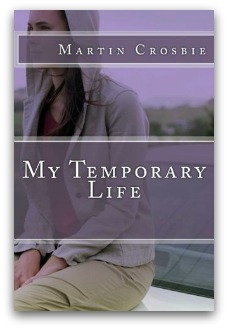
Eventually, circumstances make it impossible for Malcolm to continue this peripatetic life, and he heads to Canada to finish up his schooling. Even then, he feels unsettled:

It really does feel like everything is going to be okay, or at least it might be for a little while. Nothing in my life has ever been forever anyways. Everything is always just temporary, always temporary.

The novel has taken the Amazon charts by storm, garnered rave reviews and turned Crosbie into an overnight publishing sensation.

In fact, I recommend you become part of the storm by reading the book RIGHT NOW — or as soon as you’ve finished this post.

Here’s a link to the book on Amazon: My Temporary Life.

Alternatively, you can sign up for our DISPLACED DISPATCH — and cross your fingers that you’ll be one of this month’s two lucky winners!

And now for some highlights from my exchange with Martin Crosbie…

Is Malcolm Martin?

Hi there, Martin!
Hi, Tony!

Can you tell me a bit about your upbringing — where you were born and how you ended up in Vancouver?
I was born in Aberdeen in Scotland but I was adopted and transplanted to Kilmarnock when I was still an infant. I lived there until I was ten and my family moved us to the west coast of Canada. Other than a few years in Toronto and in Ontario when I was in my twenties, I have always lived here, just outside of Vancouver, British Columbia.

I’ve read your book My Temporary Life, and I loved it. I was particularly impressed by the way your writing flows, which is the mark of a very accomplished writer.
Thanks for saying that, I really appreciate it. This is my first novel and I think one of the reasons that it’s done well is that it went through so many re-writes and revisions. The novel that is out there today is very unlike the first few drafts.

You’ve lived in both Scotland and Canada, the two locations in the book. You also share the main character’s love of running… So I have to ask — how much of this character is autobiographical?
I had a writing teacher who would say “What is truth, in fiction? Write something down!”

Then, he’d sit down and wouldn’t answer any questions until the class had all written something, anything.

Once we shared what we’d written, he’d talk about the fact that when you read something and it “rings true” — in that you get lost in the scene — the reason is that the emotions the writer has conveyed are coming from a true place.

So, I appreciate your question because it means that my story probably worked when you read it.

But did the events in the book really happen — the boy with two parents from two cultures (Malcolm), his best friend whose parents beat him up (Hardly), and his dream woman, who, too, has had an abusive childhood (Heather)?
A lot of the incidents did in fact happen — but to different people at different times. The book is most definitely fictional.

But it is true?
Without wanting to become the next James Frey, yes, on some level it is. I had the daughter of a friend read the novel and really enjoy it, and she asked me if I was Malcolm. I told her that some days I feel like Malcolm and some days I feel like Hardly — lol.

The ups and downs of self-publishing

Quite a few authors in The Displaced Nation’s circle have self-published their works, myself included. Can you tell us what was behind your decision to self-publish My Temporary Life?
I self-published My Temporary Life because I was turned down over one hundred times by agents and publishers. The strange thing, though, was I’d pass my work to readers and they enjoyed it — very few of them didn’t. Oh, there were changes that I made along the way because of readers’ input, but the feedback was almost always decent. And they all wanted to know the same thing: “When’s the next book?”

So I self-published through Amazon, and it’s been an incredible ride. In less than three months 85,000 copies of my book are out there. I say that number and it absolutely astounds me that so many people have taken the time to give My Temporary Life a chance.

Is there a particular group of readers who’ve found particular resonance with your story?
One of the challenges with my novel has been that it doesn’t fit any specific genre, and when that happens you don’t know where to market your work. This has been good and bad. Not knowing whether to call it a coming-of-age story, a romance, or a thriller has been challenging. But not knowing exactly to whom it might appeal has also been a good thing, because I now have women and men readers of all ages.

I guess Malcolm is a reluctant, flawed hero and we can all kind of relate to that.

Self-publishing , as I know from my own experience, can be time consuming, however rewarding it is. Have you found it that way?
Without self-publishing, my story would not have reached anyone. It’s as simple as that. Having said that, the downside is that it’s a lot of work — and I mean, a lot of work. I promote my book anywhere that I can online where I think folks might be interested. Unfortunately, this takes me away from writing my next book, and that’s what I really want to be doing these days.

The positive of self-publishing is that I enjoy interacting with folks who’ve read or are reading My Temporary Life. I’m very accessible. I answer every email. I am on chat loops, Facebook groups, Yahoo groups — anywhere that somebody wants to talk about self-publishing or writing or my work. And, in doing that, I’ve formed some incredible friendships.

You know when you meet someone, whether it’s virtually or in person, and you just know that they’re going to be in your life for a long time? Well, I have met friends like that because of my book.

In the past week, I’ve had instant messages, tweets and emails from all kinds of people. One lady was ribbing me because she had to call in sick after being up all night reading my book. Another woman sent me a barbecued salmon recipe — she’d liked the recipe in my book but thought hers was better. And a gentleman sent me a message who is a huge fan of the book. He said that he’d told his wife that if she didn’t read it, she had to pack her bags, lol.

And, the readers that I am “meeting” are from all over: Taiwan, Luxembourg, lots in Australia, the UK of course, and the US.

It’s an amazing world that we live in that I’m able to experience that, and it’s all because I self-published my book.

Cross-cultural relationships

Malcolm gets involved with Heather, who’s a born-and-bred Canadian from a secluded little town in Northern Ontario. Heather says to Malcolm when they first meet: “You have this Scottish look to you, like you just got off the boat and are still lost; it’s very cute.” What’s your view on cross-cultural relationships? Do you see them as particularly challenging? (Many Displaced Nation readers are in them, which is why I ask…)
It’s funny that you bring that up as I’m trying to address it in my work in progress. I don’t really know if I’m properly qualified to comment… I live in an area of Vancouver where I have friends from pretty much every culture you can imagine. I’m lucky in that respect, and of course because of that, I get to eat lots and lots of different foods. Food is very very important to me, Tony, I do love to eat.

The importance of being Scottish

You’ve lived in Canada a long time. But does Scotland still exert some kind of pull?
Scotland calls me back every few years. Right now it’s been three years since I was there and it’s whispering in my ear again, so I’ll be back there soon.

You see, when you’re a Scot, you’re always a Scot. There are third and fourth generation Scots who live in Canada who still call themselves Scottish.

Well, I was born and bred there and have been back many times, and even though I am a Canadian citizen now, you can’t not be a Scot. It’s more than just being born there. It’s much more than that.

When I arrive at Glasgow airport and present my European passport (yes, I have a Canadian and European one), and the customs agent sees my birthplace and says, “Welcome home, Mr Crosbie,” I always get a tear in my eye.

And, there are many many things that I miss about Scotland.

I miss the passion that they have for football, real football. I miss big sour pickled onions. I miss the way the rain can be lashing in your face and somebody will say to you that it’s a “grand” day. I miss the way that Scottish history is real history, real old history.

The dream of partial repatriation

Would you ever go back to live in Scotland?
I’m fortunate that I can go back from time to time, and in the movie of my life that plays in my head, I do live there part time too. One day I hope to make it happen. I already have the city picked out in Scotland where I’d like to live…

But wouldn’t you have to make some adjustments?
During the months when I’m living in Scotland, I expect I’d miss the mountains that we have here on the Vancouver coast — but I’d sure like to try it for a little while.

If my next book is as successful as My Temporary Life, I might just find a way to fulfill my dream and live part time in both countries.

A Temporary Life — The Sequel

Rumor has it you’ll be doing a sequel following the life of Malcolm’s Scottish friend, Hardly. What can you tell us about this work in progress?
I can tell you that I’ve seldom been as excited about anything as much as I’m excited about my next novel. Yes, it is the story of Hardly. I’m having so much fun writing it.

Just what the final product will look like I don’t really know, so at this point I’ll just say that it’s like the first novel in the sense that it’s an in-depth character study of a man and his motivations, and in terms of how the novel reads, well, I do love plot twists, Tony, and I can absolutely guarantee you that this book will have them.

Sounds fantastic! Thanks so much for your time, Martin.
Thanks for doing this Tony, and of course now I’m going to be dreaming tonight about the wee chip shop in Stewarton, and the farm house that my cousins live in in Inverness, and a multitude of other Scottish things.

* * *

Anyone who’d like to know more about Martin’s life and his work, you can check out his author site and follow his escapades on Twitter: @martinthewriter

And if you have any questions for Martin, please feel free to ask them in the comments!

And don’t forget to sign up for our Dispatch to be eligible for the giveaway of Martin’s book!

STAY TUNED for tomorrow’s installment in the life of our fictional expat heroine, Libby, which will be another party-themed post — this time, of course, it’s a baby shower! (What, not keeping up with Libby? Read the first three episodes of her expat adventures.)

If you enjoyed this post, we invite you to register for The Displaced Dispatch, a round up of weekly posts from The Displaced Nation, with seasonal recipes, book giveaways and other extras. Register for The Displaced Dispatch by clicking here!

Related posts:

Wedding celebrations: Who does it better, Britain or America?

We’ve spent the last two weeks looking at festivals and parties around the world, and today it’s time to take a glimpse at nuptial celebrations, with a guest post by Meagan Adele Lopez. As an American who once lived in the UK — she also has a British boyfriend — Lopez can be considered an unofficial expert on British versus American weddings.

Please don’t invite my British beau and me to a wedding unless you really want us to come — we are more than likely going to reply “yes”!

Many have made that mistake. For some reason, it is impossible for us to say “no” — perhaps we are living vicariously through the bride and groom (going to a wedding is much cheaper than throwing one, let’s be honest).

Over the course of four years we have been invited to 28 weddings, 23 of which we will attend/have attended. These weddings span four countries (Wales, England, Dominican Republic and the USA) and 14 cities.

I wish I could say I was a professional wedding guest, getting paid to attend these lavish affairs. But no, we just happen to have many friends who are getting engaged at this time of my life. Some are even going through their second weddings.

One of the many benefits of dating a British guy is being able to attend British weddings — complete with hats, fascinators, castles and tail coats. I’ve become a bit of an expert on both.

So, I’ve been keeping a running tally of the best things that British and American wedding celebrations have to offer. Right now Britain is winning, but only by one, so that could change!

4 great things about British weddings

1) Less financial outlay for bridesmaids
It’s kind of atrocious that Americans still “invite” their best friends in the world to have the “honor” of becoming a bridesmaid only to pick out the most expensive dress they can find, make their best friends pay for it, and take them on a lavish bachelorette party that they must also pay for.

The British have it right. I mean, if you’re paying £25,000 on a wedding already, why not shell out an extra thousand to make your poor bridesmaids happy? After all, they didn’t choose to get married, you did.

2) Betting on the speeches
Let’s face it — sometimes speeches at a wedding can be really, really hilarious and entertaining. They can be so entertaining and hilarious that you have no idea how much time has gone by, whether or not you’ve eaten, or if the dancing has even happened yet. But, a lot of times, they can be painful and long, and somewhat boring. So, what better way to keep the crowd entertained than by going to each table and getting the guests’ bets on how long the speeches will last?

Personally, I love speeches and find it fascinating to see how each person tackles this challenge to charm a crowd of 150 people — 20 of whom you probably know personally. However, knowing that I have the chance to win a pot of 200 quid makes it that much better!

3) The Groom’s Speech
I actually find it a travesty that American grooms aren’t made to give a speech. Perhaps it’s because a woman marrying a British man knows that this one speech might be the only time she will hear her husband tell her how gorgeous, wonderful and amazing she is, and how he is the luckiest man on the planet. After all, British men aren’t known for being overly flattering or sentimental. I blubber like an idiot, wiping the mascara from my eyes, when I hear a doting British man, for the first (and probably only) time, open up to his friends and family about why he is truly in love with this woman.

But I’m sure most brides who marry a British man will tell you that the groom’s speech is one of the best moments of their wedding night. For me, as a guest, it beats the father’s speech and even the first dance. Perhaps the vows are the only thing that trump it.

4) Romantic venues
I’ve attended weddings in a ninth-century castle, in a tenth-century church, in an old manor house in Sussex, on a farm in the West Country, in a hotel where prime ministers stay, and next to a marsh in West Wales. Something about a British wedding makes it that much more romantic. Of course, it’s every girl’s dream to get married in a castle, but in Great Britain, you actually can!

3 great things about American weddings

1) Open bar
The first time I truly found out about the horror that is a cash bar at a wedding, I was invited to just the evening part. You see, my boyfriend and I had been together for over a year, but since the groom had never met me, he didn’t think it important to invite (ah hem, “pay”) for me to come to dinner, or attend the ceremony.

Apparently, it’s quite normal in England for a significant other not to be invited to the entire evening with their partner if they have never met the girlfriend. Being an American, I was already incredibly offended — especially since we had traveled an hour to be there, stayed in a really expensive hotel (the only one in the entire town), and paid for two separate £40 cab rides to the venue from the hotel (since we weren’t leaving together). So, you can imagine my dismay when I got to the reception and had to pay for my own drinks! I understand that not everyone can afford to have an open bar, but I most certainly prefer the American mentality that when you invite a guest, they are to be treated as such.

2) The women’s speeches
In Great Britain, traditionally, the speeches include the Father of the Bride, the Groom and the Best Man. I agree with all of these choices for speeches, but I have to admit, I did find it a teeny bit sexist that no women spoke at weddings the first time I saw it happen. Most British women don’t mind since they would rather the attention be off of them for the night, but what happened to the Maid of Honor? Why can’t she throw in a speech?

Women bring a different take to speech land, and I definitely prefer the American tradition of allowing us to speak.

3) Creative venues
Where the British score points for tradition, history, elegance and romance, American weddings score points for creativity, grandiosity and variety. Obviously, America is a much bigger country with many more choices for venues, and many more options for good weather. I have been to a wedding on a cliff overlooking the Pacific Ocean, at a museum in the middle of downtown Chicago, a country club in Maryland, and by a river at a historic house in Austin, Texas. The possibilities are truly endless in America, and always keep you guessing. While many British weddings have struck me as being similar, it’s hard for me to say that any American wedding has resembled another. This is also probably due to the diversity of the American population and the variety of religions in this country.

Combining the two traditions — still working on that!

I’d be lying if I didn’t admit that with all of these weddings I didn’t think about how I would like my half British, half American wedding to go…but I simply can’t admit to what I dream of just yet. Call it superstition or what have you, but until I get engaged I won’t disclose my dream wedding. My worst nightmare is having my dream wedding down on paper, and then it never happening!

In the meantime, I’ll continue to break down the weddings I go to and figure out which bits I want to keep for myself.

Editor’s note: This post is adapted from a post that appeared on Smitten by Britain: “British vs. American Weddings” (25 January 2012).

Question for readers: Have you been to weddings in the country where you live? How do they compare?

MEAGAN ADELE LOPEZ is the author of Three Questions: Because a quarter-life crisis needs answers, which was featured in February on The Displaced Nation. You can learn more about Lopez and her book at her author site and by following her on Twitter: @meaganadele.

STAY TUNED for tomorrow’s post, an interview with first-time novelist Martin Crosbie. (Sign up for our Dispatch to be eligible for the giveaway of his book, A Temporary Life!)

If you enjoyed this post, we invite you to register for The Displaced Dispatch, a round up of weekly posts from The Displaced Nation, with seasonal recipes, book giveaways and other extras. Register for The Displaced Dispatch by clicking here!

Related posts: