The Displaced Nation

A home for international creatives

Tag Archives: It’s Fiction!

LOCATION, LOCUTION: An expat life in Istanbul frees Oliver Tidy to write crime novels set in places he knows well (and Turkey, too!)

Location Locution
Columnist Lorraine Mace, aka Frances di Plino, is back with her second interview guest: fellow crime writer Oliver Tidy.

Hello, readers. My guest this month is Oliver Tidy, who on his author site refers to himself as a “semi-professional fantasist” and an “attention seeking vanity publisher” who is “living in exile.”

He also says he has a “yearning for yarning”—so how much of this is true and how much an exaggeration?

Well, it’s patently true he is a self-published author, currently with nine books available for download through Amazon:

  • four in his Romney and Marsh Files British police procedural series. Newly promoted Detective Sergeant Joy Marsh is shipped out to Dover on the Kent coast to work under Detective Inspector Romney, a cantankerous copper who nevertheless is good at his job…
  • three in his Acer Sansom thriller series. British soldier Acer Sansom resurfaces a year after the world thought he was dead, possessed with a single-minded need for vengeance…
  • two in his Booker & Cash mystery story series. An unlikely detective team, David Booker and Jo Cash, solve mysteries in Romney Marsh, a wetland area in southeast England…

As for the “exile” part, Oliver tells me he left the UK in 2009 looking for change and ended up in Istanbul, where he “got change in spades.”

He is currently working in a Turkish school teaching English as a foreign language to young learners. It’s a job that affords him enough time for writing, something he deeply appreciates:

When I lived in the UK, I tried a couple of times to write, but with the responsibility of property and family and work, and the distractions of television and radio and newspapers and people I never got anywhere with it. One of the many things that I have learned about writing is that you have to sit down and write—often.

Now that he lives in Istanbul, Turkey, Oliver Tidy is able to write stories set in his homeland, the most recent one being He Made Me. Photo credits: (clockwise) Oliver Tidy (supplied) and book cover art; St Thomas Becket, Fairfield, Kent, by Amanda Slater via Flickr (CC BY-SA 2.0).

Living in Istanbul, Turkey, Oliver Tidy has been able to write books set in the place where he was born and bred, the most recent one being He Made Me, which takes place in Romney Marsh, UK. Photo credits: (clockwise) Oliver Tidy (supplied) and book cover art; St Thomas Becket, Fairfield, Kent, by Amanda Slater via Flickr (CC BY-SA 2.0).

As for the vanity publishing, Oliver also confesses he initially tried to get a literary agent because he never wanted to self-publish, believing that self-publishing was tainted with shades of ego-tripping.

“How wrong I was,” he said. “How wonderful and liberating self-publishing truly is. If I had not taken the step to self-publish, my readership would still be limited to my mum and me—and I’m sure that mum skim-reads most of my stuff.”

Judging by the Amazon reviews he receives, his audience extends far beyond his mum—and what his fans seem to love the most about his writing is its “local colour,” “sense of place,” and “wonderful descriptions of settings.”

Let’s find out how he does it, shall we?

* * *

Which comes first, story or location?

Why does this make me think of chickens and eggs? Such a hard opening question. I hope they’re not all going to be like this. I much prefer questions about my favourite things: raindrops on roses and whiskers on kittens, that sort of thing.

Anyway, here goes. As you mentioned in you kind introduction, I write three different series of books: one is set in Dover, Kent—The Romney and Marsh Files; one is set on Romney Marsh—Booker & Cash Stories; and one where, in three books so far, my central protagonist has shot up several different countries on a variety of continents—the Acer Sansom novels. (Acer is a great advert for Brits abroad. Bit of a one-man stag party.)

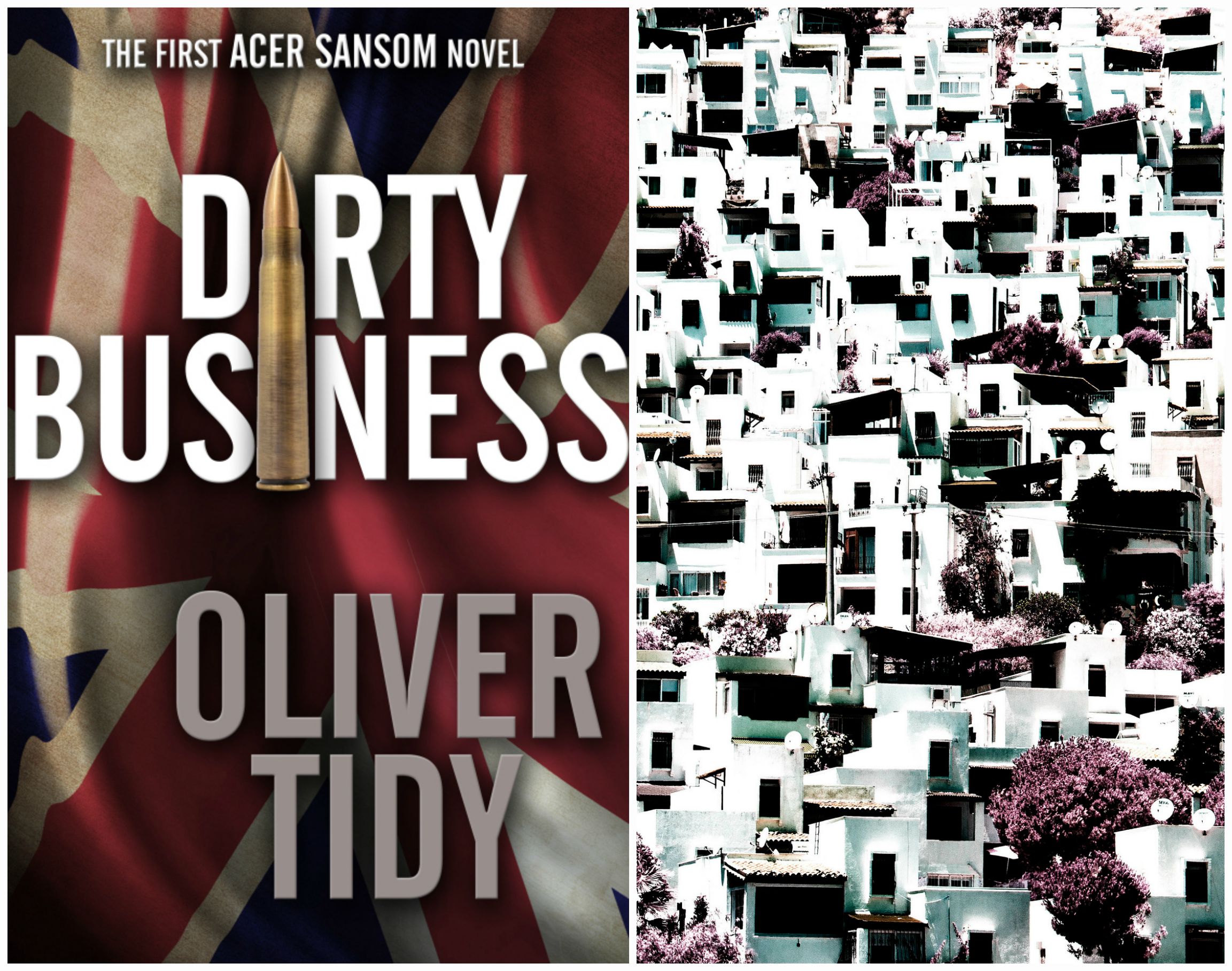
With the Romney and Marsh Files, story and location had an equal weighting in development. With the Booker and Cash stories it was certainly location first—I am Romney Marsh born and bred. As for the Acer Sansom novels, the first, Dirty Business, involved him visiting Istanbul, a city that I’d been living in for about a year. Acer went from Istanbul to Bodrum, a seaside resort town in Turkey that I’d spent the summer in. That book was definitely heavily influenced by my geographical experiences. The subsequent two books were predominantly plot led.

What’s your technique for evoking the atmosphere of a place?

Tumble weed moment. In six years of writing I’m yet to experience writer’s block…until now. Give me a minute. I’ll come back to this one at the end. (I came back to it at the end and I still couldn’t answer it. Sorry.)

Which particular features create a sense of location? Landscape, culture, food?

These questions are providing an opportunity to really reflect on my writing—something I’m feeling I don’t do enough of.

I don’t write much about what my characters eat. I write a little more than nothing on the cultures of my settings. Physical geography features more than either of the other two in all of my series. As far as my globe-trotting Acer Sansom novels go, after the first book—where I did have experience of the locations involved—I have to say a massive thank you to the Internet, especially Google maps, Google earth, Google street view. Maybe I should just say thanks Google. I’ve also obtained good insight from some travel blogs. Some of those are a wonderful resource for armchair writers.

Can you give a brief example of your work which illustrates place?

I’ll use a short passage from the first Acer Sansom novel. One of my characters has driven from Istanbul to Bodrum.

Oliver Tidy’s first Acer Sansom thriller, Dirty Business, is set partly in Bodrum, Turkey, where he lived for a year. Photo credit: Cover art; The best place to live! by Tuncay Coşkun via Flickr (CC BY 2.0).

Before long the vista opened up before her. As she sometimes had in the years that she had driven to Bodrum, she pulled into a loose gravel pocket at the side of the road and got out of the car.

From her lofty vantage point high up in the hills that embraced the area, she was able to look down at the sprawling panorama of the holiday capital of Turkey. Little enclaves of white boxes, taking advantage of the best geography, were packed so tightly together in places that they might have been one huge solid mass of concrete.

The steep hills that backed these separate little communities demonstrated both the developers’ greed and the sun-seekers’ need for yet more building as newer communities sprang up, patching the arid landscape white like some poorly-designed chess board.

At this time of year Bodrum would be heaving not just with the Turks who could afford to escape the suffocating heat and humidity of the bigger cities but also thousands of holidaymakers of all ages and nationalities.

Once, she thought, the place must have looked like paradise from where she stood—before Man’s concrete assault paradoxically began the ruination of the very environment that made him invest in the area. Would it always be only a matter of time and money before the need to develop areas of outstanding natural beauty outstripped Man’s admiration for them? Thank goodness there were still some idyllic pockets of the area where the authorities had elected to cease development. She felt grateful, if a little hypocritical, that her family owned a villa in one of them.

Her gaze took in the superb sweep of the Aegean, glistening in the early morning light, stretching out towards Greek territory; the differing hues of green and blue combined to create the most inviting scene. She tried to make out details of the ships anchored across the bay but was too far away.

How well do you need to know the place before using it as a setting?

Having lived on Romney Marsh for over forty years has made the two stories—the third is under construction—in my Booker & Cash series much easier in the penning-the-setting stakes. My memories of the place are vivid and unshakeable and I return there for a few weeks each year in the summer which allows me to top them up.

I know Dover fairly well, having spent a lot of time there a few years ago. When I return to the UK I like to jump on the bus from my home on Romney Marsh to Dover for the day just to refresh my memory and see what’s new.

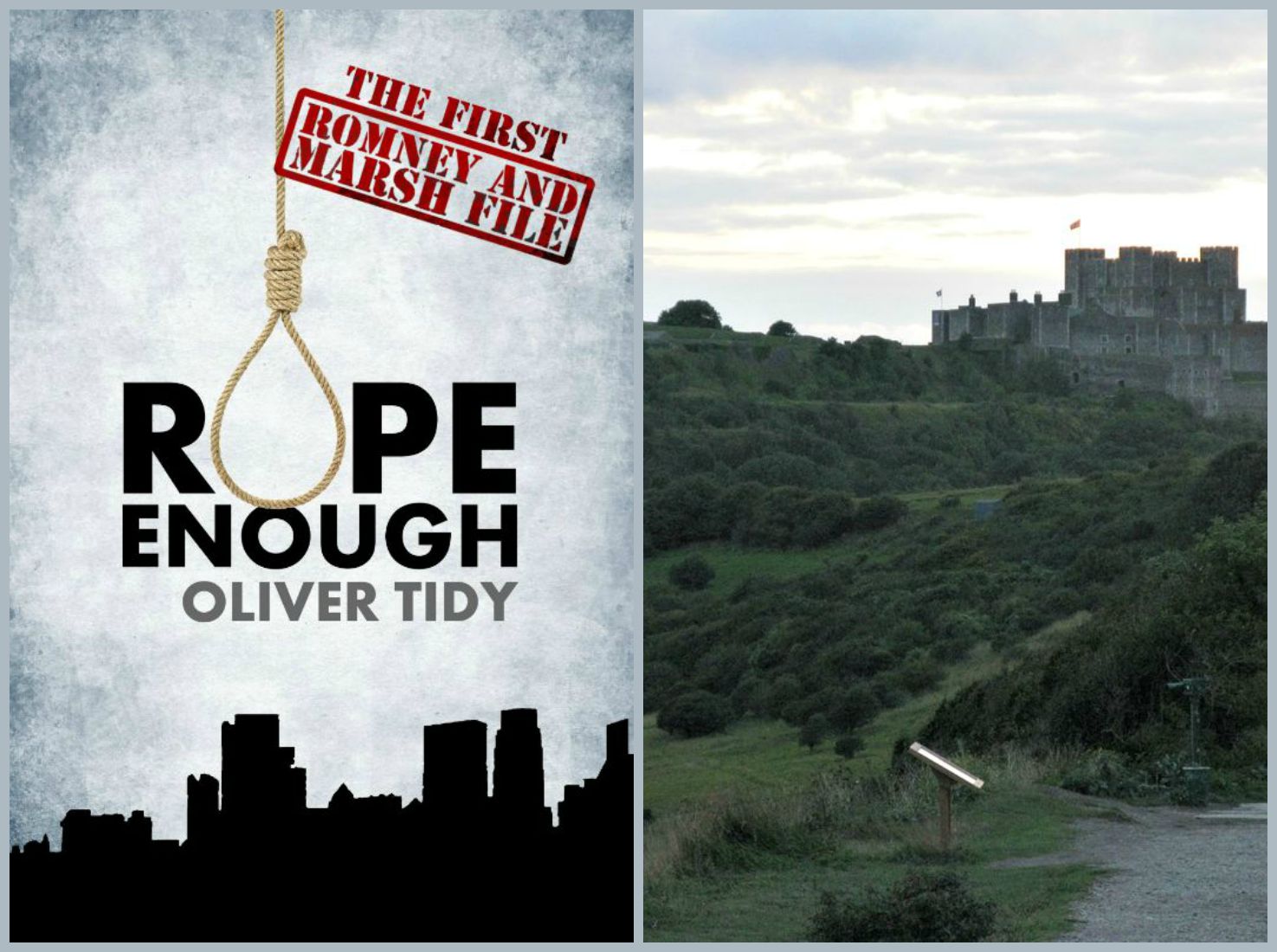
Cover art of Rope Enough, first in police procedural series set in Dover; Dover Castle, by Andrew and Annemarie (CC BY-SA 2.0).

Cover art for Rope Enough, first in Tidy’s “Romney and Marsh File” police procedural series set in Dover; Dover Castle, by Andrew and Annemarie (CC BY-SA 2.0).

As I mentioned, in the first Acer Sansom book I used Istanbul and Bodrum for my exotic locations—two places that I felt I had enough experience of to write convincingly about them. Most of Acer’s locations in the subsequent two books I have never visited. I’m always waiting to be taken to task by readers who have personal and insightful experiences of the places I’ve depicted. What can you do sometimes? You need to write about somewhere you’ve never been. You log on, do some research and then your best.

Which writers do you admire for the way they use location?

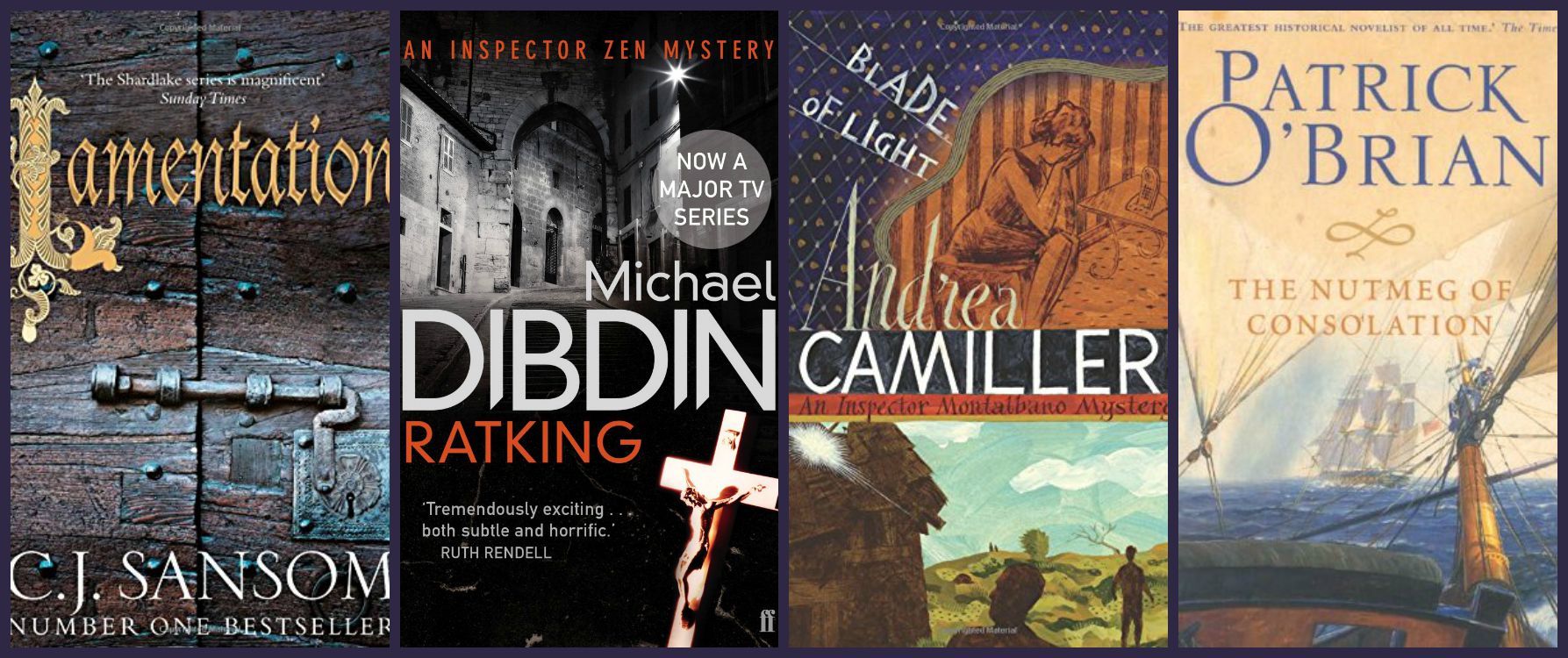
CJ Sansom for the way he portrays London in Tudor times; Michael Dibdin and Andrea Camilleri for their descriptions of Italy, and the unbeatable Patrick O’Brian for his depictions of any location, be it land or sea, that he touches upon in any of his Aubrey/Maturin novels. What a writer.

A few of Tidy's favorite authors, who know how to handle "location, locution."

A few of Tidy’s favorite authors, who have demonstrated a mastery of “location, locution.”

Thanks so much, Oliver!

* * *

Readers, any questions for the jolly Oliver Tidy? Please leave them in the comments below.

And if you’d like to discover more about Oliver Tidy, why not pay a visit to his author site. You can also follow him on twitter at @olivertidy.

Until next month!

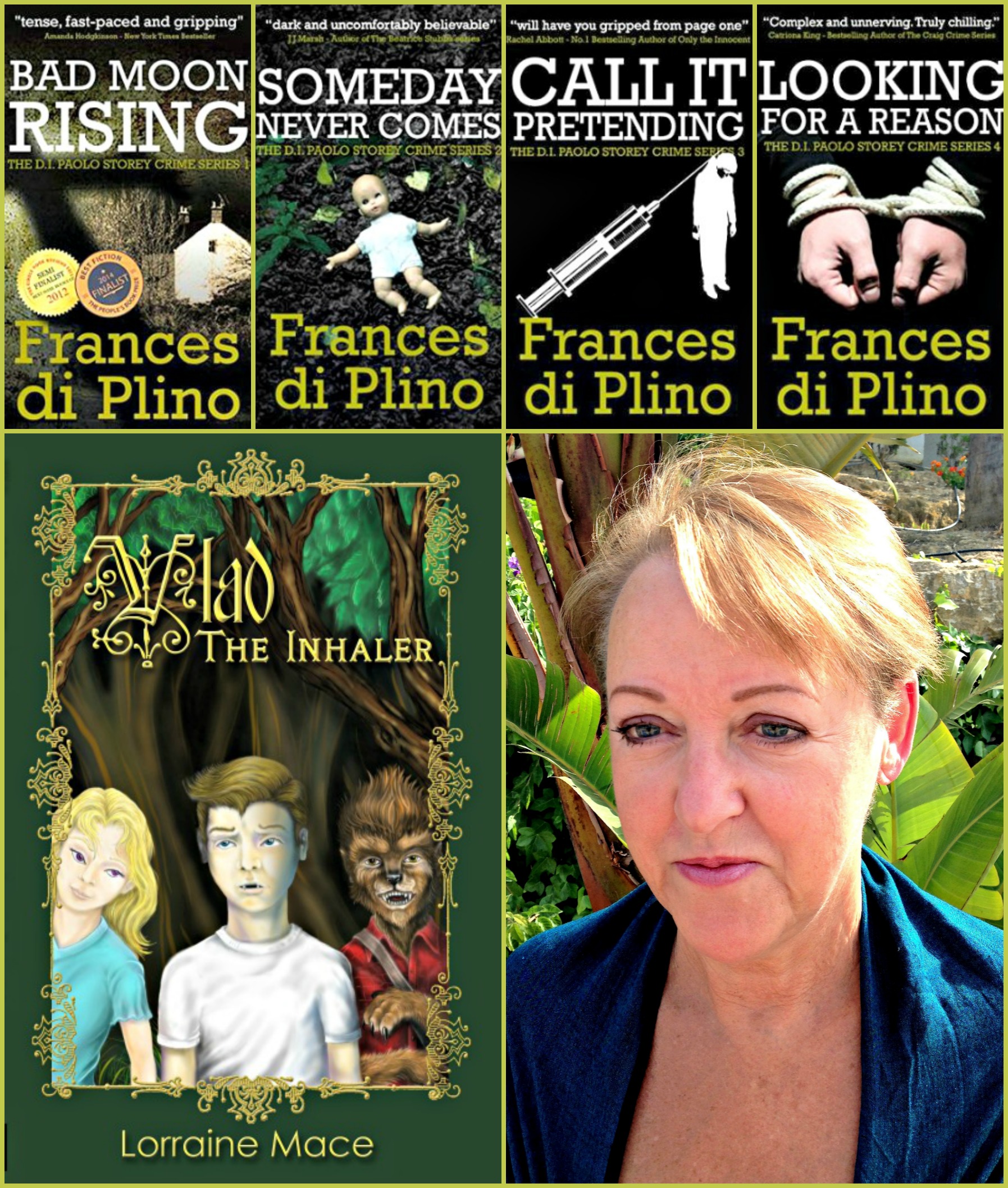
Lorraine Mace writes for children with the Vlad the Inhaler books. As Frances di Plino, she writes crime in the D.I. Paolo Storey series. She is a columnist for both of the UK’s top writing magazines, has founded international writing competitions and runs a writing critique service, mentoring authors on three continents.

STAY TUNED for the next fab post!

If you enjoyed this post, we invite you to register for The Displaced Dispatch, a round up of weekly posts from The Displaced Nation, with weekly updates and much, much more. Register for The Displaced Dispatch by clicking here!

Related posts:

Photo credits (top of page): The World Book (1920), by Eric Fischer via Flickr; “Writing? Yeah.” by Caleb Roenigk via Flickr (both CC BY 2.0).


LOCATION, LOCUTION: Nik Morton draws from his nomadic expat life to author genre fiction

Location Locution
Columnist Lorraine Mace, aka Frances di Plino, is back with her very first interview guest, the extraordinary Nik Morton. (Nik, thank you for giving the Displaced Nation a shout-out in one of your recent posts!)

Hello, readers. This month we have the delight of discovering how Nik Morton, a British-born resident of Spain who is also a prolific author, handles location, locution.

Although Nik has fifty years of writing experience, having sold hundreds of articles and more than a hundred short stories, he came late to being a published author. His first novel, a western, came out in 2007. This year he will publish his twenty-second book—Catacomb, the second in his Avenging Cat crime series. (The first was Catalyst and the third will be Cataclysm. All are named for the series’ protagonist, the Avenging Catherine Vibrissae.)

In addition to this contemporary crime series, which he publishes with Crooked Cat (there’s that feline theme again!), Nik has written:

  • westerns (Black Horse series, under the pseudonym Ross Morton, published by Robert Hale)
  • fantasy (co-written with Gordon Faulkner under the pseudonym Morton Faulkner, published by Knox Robinson)
  • Cold War thrillers (the Tana Standish series, which Crooked Cat will reissue).

Nik has run writing workshops and chaired writers’ circles, and has been a magazine editor, a publisher’s editor, and even an illustrator. His writing guide, Write a Western in 30 Days: With Plenty of Bullet-Points!, is said to be useful for all genre writers, not only writers of westerns.

Spain, where he currently lives, was the inspiration for the stories collected in Spanish Eye.

Spain is one of several inspiration sources for the well-travelled writer Nik Morton.

Nik was displaced, incidentally, long before he and his wife retired to Alicante. He spent 23 years in the Royal Navy, during which he had the chance to visit many exotic places—among them Rawalpindi, the Khyber Pass, Sri Lanka, Tokyo, Zululand, Mombasa, Bahrain, Tangier, Turkey, Norway, Finland, South Georgia and the Falklands. He has also travelled widely in his private life, giving him a wealth of places to draw on in his works in addition to his current home of Spain.

* * *

Which comes first, story or location?

This is a tough question, and the answer is ‘it depends’. For my seven western novels, the character and the story came first; the location for each required research for the period and the State, usually Dakota Territory.

Yet location definitely comes first for my Cold War thrillers featuring psychic spy Tana Standish: The Prague Papers, The Tehran Text and the third, a work in progress, The Khyber Chronicle. Each adventure in the series is based around actual historic events, so the location is crucial.

I’ve always hankered after writing about exotic places, and as you mentioned in your introduction, I’ve been fortunate enough to travel widely, both privately and with the Royal Navy. My wife and I lived for 20 months in Malta and out of that location emerged a cross-genre novel, a modern-day vampire romantic thriller, now out of print.

We’ve visited Tenerife on five separate occasions and from that evolved my romantic thriller, Blood of the Dragon Trees.

Having lived in Spain for over 11 years, I’ve absorbed quite a bit about the politics and crime situation here and have had 22 short stories published set in Spain, collected in Spanish Eye—exploring the human condition as seen through the eyes of Leon Cazador, half-English, half-Spanish private eye, written ‘in his own words’.

For my latest crime series about ‘the avenging cat’, Catherine Vibrissae, the story definitely came first: but the exotic locations were a close second—Barcelona (Catalyst), Morocco (Catacomb) and Shanghai (Cataclysm).

What’s your technique for evoking the atmosphere of a place?

Place is important in almost every scene; I want the reader to see the characters in the scene, so the place needs to be described in relation to them. Character point of view can provide an emotional appreciation of the scene too. The rugged, inhospitable High Atlas of Morocco, for example, can be strengthened by the character experiencing the intense heat and the almost preternatural silence of the place.

Technique: be there, in the scene. Of course you can’t overburden the story with too much description, but the weather, the flora and maybe even fauna, the landscape as character, all have their input at various times. If I can’t visualise the scene through my characters’ eyes, then there’s little chance that the reader will. I may not always succeed, but that’s what I strive towards—using all of the character’s senses.

Which particular features create a sense of location? Landscape, culture, food?

All of the above, depending on the dramatic content of the scene. People have to eat to live, so it’s natural that my characters eat from time to time. I don’t want to labour the point for the reader, but if I simply wrote ‘Corbin ate a meal at the hotel and then went out,’ then we’re in the realms of ‘tell’ not ‘show’; which has its place from time to time, but perhaps mentioning some particular food can make it more ‘real’ and show more of the character, such as:

Stomach full with Chili de Sangre Anaranjada, Corbin read the local newspaper in the hotel lounge, allowing the beef and pork to digest. He had complimented the chef, a Swede by the moniker of Iwan Morelius. Apparently, Morelius had been on the staff of Baron Ernst Mattais Peter von Vegesack, who had been given leave to fight for the Union. While the baron returned to Sweden after the war, Morelius stayed and Mr Canaan, the hotel manager, was vociferously proud of his culinary acquisition.

—From The $300 Man, by Ross Morton (p. 84)

Culture is definitely relevant if the story takes place abroad—whether that’s Prague or Shanghai. And we’ve already touched upon landscape, which can become a character that tests individuals to the limit.

Can you give a brief example of your work which illustrates place?

This cafe in Tenerife will soon be populated by characters from Nik Morton's imagination. Photo credit: Tenerife, Canary Islands, by Carrie Finley-Bajak[https://www.flickr.com/photos/cruisebuzz/8158748971] via Flickr (CC BY 2.0)

This cafe in Tenerife will soon be populated by characters from Nik Morton’s imagination. Photo credit: Tenerife, Canary Islands, by Carrie Finley-Bajak via Flickr (CC BY 2.0)

In Blood of the Dragon Trees, Laura has come to Tenerife to teach a couple of Spanish children. I wanted to create an ambiance while moving her through the story. She is waiting for Andrew Kirby, a mystery man who attracts her:

Clutching her Corte Inglés shopping bag, Laura arrived at the square about fifteen minutes early and, as usual, the adjoining roads were jammed with delivery trucks and a variety of taxis: Mercedes, Toyota, Seat, Peugeot. She was lucky and grabbed a café’s outdoor table with two vacant chairs. She sat and politely fended off the attentive waiter, explaining in Spanish that she would order when her friend joined her. Friend?

In the meantime, she waited, idly studying the antics of the men at the taxi rank in front of a series of phone booths. One of them was pushing his car along the rank, rather than switch on the engine, as the row moved forward. The taxis sported a colorful and distinctive coat of arms.

Sitting on the corner of the street was a blind man selling lottery tickets. She doubted if that would be possible in any town or city in England; the poor man would be mugged in seconds.
Most of the people at the other tables appeared to be businessmen and women, though there were some exceptions. An overdressed elderly woman sat with her Pekinese dog on her lap, feeding it biscuits while sipping her Tío Pepe. At the table next to her, a large bull of a man was glancing through the newspaper, El Día; he possessed a Neanderthal jaw and crewcut dark brown hair. For a second she thought she’d seen him before, but shook off the idea. Andrew Kirby was making her unreasonably suspicious!

—from Blood of the Dragon Trees, by Nik Morton (p. 116)

So, besides the observation of little details going on around her—and the suspenseful hint for the reader that we’ve seen the man with the Neanderthal jaw before—there’s the compelling influence that Andrew is exerting on her.

How well do you need to know the place before using it as a setting?

Ideally, travel to the place. But even then additional back-up research is necessary. Of course you can’t hope to travel to every exotic place you write about. I’ve been to many of the places in my novels and short stories, but not all—and I must then concentrate on research.

Sadly, non-fiction reference books can quickly become out-of-date—bus colours might change, customs may once have been quaint only to be replaced by adopted globalised traits. (Yes, it has happened to me!)

Any piece of fiction set in the past requires research; yes, you can travel the battlefields, visit the ancient cities; but you can’t experience that time, only imagine it.

Official map of the territory of Dakota[https://www.flickr.com/photos/normanbleventhalmapcenter/14009763855/], by http://maps.bpl.org via Flickr (CC BY 2.0) [https://creativecommons.org/licenses/by/2.0/]

Some places can’t be visited, only researched. Official map of the territory of Dakota, by http://maps.bpl.org via Flickr (CC BY 2.0).

Fiction requires a writer to be bold, to do research and then re-imagine the place, with its sights, smells and sounds. The bottom line is, it’s fiction, which means an approximation of the real world. If a critic blithely dismisses writers who make a few errors in their research because they haven’t travelled there, then that critic is misguided.

Which writers do you admire for the way they use location?

Some books could be set anywhere; location is not significant to the story. Others, the location is vital to the story. The old practitioners Desmond Bagley, Hammond Innes, Nevil Shute, and Alistair Maclean described the location their main characters found themselves in, and you believed every word. Bernard Cornwell’s Sharpe novels thrust you into a period and a place that seems real while you’re reading. Donna Leon’s Italy is real.

A few of the writers Nik Morton admires for their depiction of place in their novels.

A few of the novelists Nik Morton admires for their skill with depicting location.

Thanks so much, Nik!

* * *

Readers, any questions for my first guest? Please leave them in the comments below.

And if you’d like to discover more about Nik, why not pay a visit to his author site; his blog, called Writealot (no exaggeration in his case); and the archives of Auguries, a science fiction, fantasy and horror magazine Nik edited from 1983 to 1994. You can also follow Nik on twitter at @nik_morton.

Until next month!

Lorraine Mace writes for children with the Vlad the Inhaler books. As Frances di Plino, she writes crime in the D.I. Paolo Storey series. She is a columnist for both of the UK’s top writing magazines, has founded international writing competitions and runs a writing critique service, mentoring authors on three continents.

STAY TUNED for the next fab post!

If you enjoyed this post, we invite you to register for The Displaced Dispatch, a round up of weekly posts from The Displaced Nation, with weekly updates and much, much more. Register for The Displaced Dispatch by clicking here!

Related posts:

Photo credits (top of page): The World Book (1920), by Eric Fischer via Flickr; “Writing? Yeah.” by Caleb Roenigk via Flickr (both CC BY 2.0).

LOCATION, LOCUTION: Expat author and new columnist Lorraine Mace offers her own thoughts on writing about place

Location Locution
Please join us in welcoming Lorraine Mace, aka Frances di Plino, to the Displaced Nation for the first time. From this month, she’ll be taking over the Location, Locution column from JJ Marsh.

Hello, Displaced Nationers! I am thrilled to be taking over this column from JJ Marsh, and I already have lots of interesting guests lined up to take part over the coming months. For this first post, however, I am going to follow in Jill’s footsteps and use my first column to answer the “location locution” questions as a means of introducing myself.

But before I do that, let me give you a few basics. I was born and raised in London, but moved to South Africa just before my 25th birthday. I first lived just outside Johannesburg, then moved to the Orange Free State before discovering, and falling in love with, “the fairest cape”. Since leaving Cape Town I’ve been a nomad for more years than I care to count, having moved continent and country nine times. I finally put down roots in Spain, but have an inclination to spend summers in British Columbia, Canada.

Like JJ, I write crime fiction. I also have a book series for children.

Lorraine May and books

The prolific Lorraine Mace has produced four books in her D.I. Paolo Storey crime thriller series, and one book in her Vlad the Inhaler series (vampires, werewolves and peaches, oh my!).

Oh, and one last item before I move to the questions: don’t forget to visit my predecessor’s farewell post and enter the book giveaway competition. So far there’s only two comments, which by my reckoning gives you a pretty good chance at winning seven great e-books!

* * *

Which came first, story or location?

This can vary from book to book and story to story. However, in my crime novels, written as Frances di Plino, story came first—but then location helps to formulate the plots. Although the series is set in a fictional town, the surrounding British countryside is very real. Bradchester is situated close to Rutland Water and the nearest city is Leicester, both of which feature in the novels on a regular basis. I know this area well. During my last (brief) sojourn in England I lived in a small village a stone’s throw from Rutland Water and frequently visited Leicester.

What’s your technique for evoking the atmosphere of a place?

I put myself into the heads of my characters and experience the place through their senses. When I can smell the bread in the local bakery, or hear the cries of street vendors, weep over a beautiful sunset, taste an orange straight from the tree, or touch the moss-covered stones of a monastery, I know it’s time to start writing, using my character’s experiences of the place.

Which particular features create a sense of location? Landscape, culture, food?

All three, but I must admit I find it easier to use food allied to culture when the story is set outside of the British Isles. Having lived in South Africa, on the Maltese island of Gozo, as well as in France and Spain, I know I can use regional dishes to bring areas of those countries to life. But in Britain I think we have lost the regional aspect of many of our foods. Fish and chips, roast beef and so on are now available throughout the country, where other nations seem to have guarded their regional food identities.

Can you give a brief example of your work which illustrates place?

Bradchester is a town that has more than its fair share of rundown, seedy areas set side by side with gentrified neighbourhoods. This leads to a great deal of social unrest—the haves want the have-nots moved elsewhere and the have-nots resent the wealth and easy life of the haves. This short passage illustrates an area that has, as yet, remained untouched by either sector, but just a street away it is very different.

Station Road wasn’t exactly the best part of town, but the place looked respectable. Paolo was pleased to see that most of the businesses he remembered from his youth were thriving. This was one of the few communities that still had a drycleaners, newsagent, old-fashioned fruit and veg shop, alongside a mini-supermarket, hairdressers and a bank. He glanced up. Even the flats above the businesses looked lived in and cared for. Nice nets and curtains framed the windows and many of the street doors had been painted in recent history.

They walked a couple of hundred yards before turning into Zephyr Road. It was like moving into another country. Here, most of the shops they passed were boarded up and the few remaining open for business seemed to Paolo to concentrate on ways to transform goods into money. Pawnbrokers, gold for cash, payday cheque converters. It appeared as though all the dregs of the financial service industry had found their way into this street. This time when he glanced up, Paolo saw the flats above the shops were likewise either boarded up or had dirty nets hiding whatever was going on up there.

net curtains

The quality of the net curtains tells you where you are in Bradchester. Photo credit: Joss Smithson via Flickr (CC BY-SA 2.0).

How well do you need to know the place before using it as a setting?

I prefer to use places I’ve lived in, or visited many times. I like to know the area and people so well I can conjure them up at will when I’m writing.

Which writers do you admire for the way they use location?

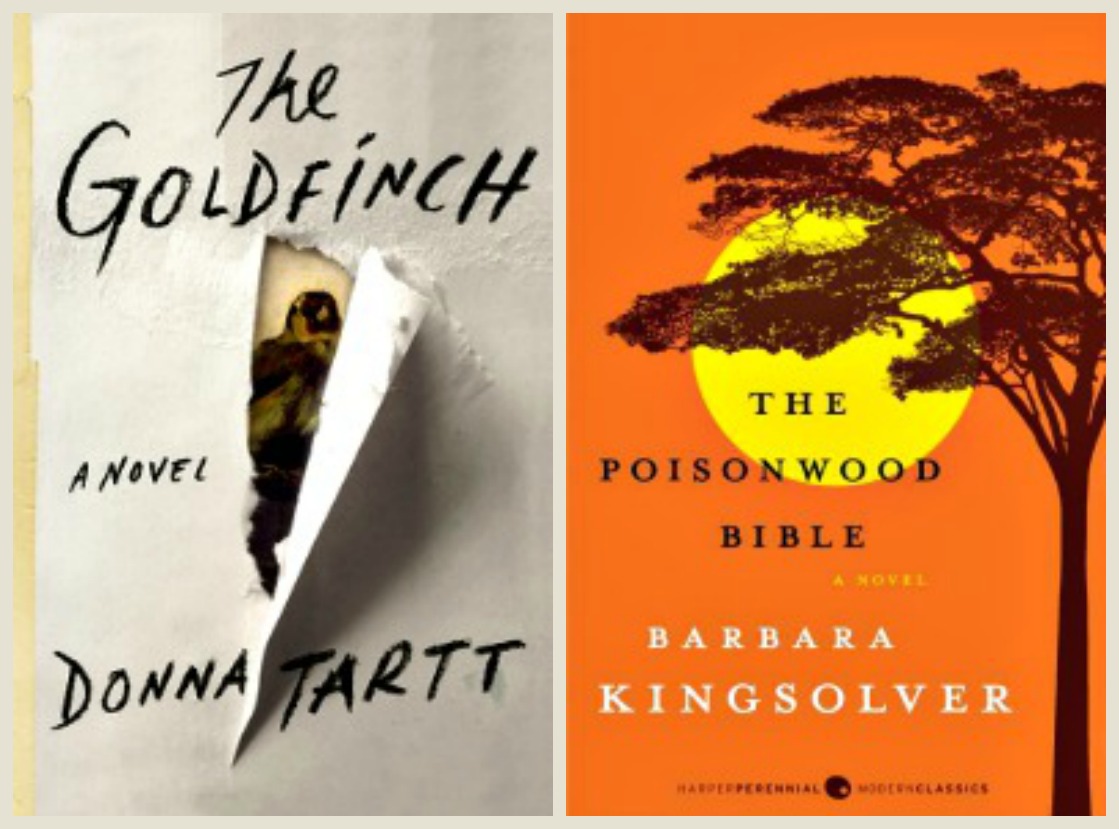
Barbara Kingsolver and Donna Tartt spring to mind. With both authors I feel as if I am living in the locations depicted. In Donna Tartt’s The Goldfinch she manages to recreate both city and desert locations to the extent one can almost feel the weather. Kingsolver’s The Poisonwood Bible brings the 1959 Belgian Congo to life so powerfully the reader is swept into the villages, fearful alike of jungle creatures and the inhospitable landscape.

Books that get "place" right: The Goldfinch, by Donna Tartt; and The Poisonwood Bible, by Barbara Kingsolver.

Books that get “place” right: The Goldfinch, by Donna Tartt; and The Poisonwood Bible, by Barbara Kingsolver.

* * *

Thanks so much, Lorraine! I’m impressed that you created your own place for your crime series novels, and that it’s in the UK, where you haven’t lived for quite some time. Readers, any words of welcome and/or questions for our new columnist? Please leave them in the comments below.

And don’t forget to leave a comment on her predecessor, JJ Marsh’s last post for a chance to win 7 e-books that should take you through the summer. All you have to do is answer the question, in 50 words or less: Where and when in the world would you like to go, and why?

Lorraine Mace writes for children with the Vlad the Inhaler books. As Frances di Plino, she writes crime in the D.I. Paolo Storey series. She is a columnist for both of the UK’s top writing magazines, has founded international writing competitions and runs a writing critique service, mentoring authors on three continents.

STAY TUNED for the next fab post!

If you enjoyed this post, we invite you to register for The Displaced Dispatch, a round up of weekly posts from The Displaced Nation, with weekly updates and much, much more. Register for The Displaced Dispatch by clicking here!

Related posts:

Photo credits (top of page): The World Book (1920), by Eric Fischer via Flickr; “Writing? Yeah.” by Caleb Roenigk via Flickr (both CC BY 2.0).

DIARY OF AN EXPAT WRITER: After the hard slog of producing second book in series, the rush that comes with boost to sales

Diary of an Expat WriterAmerican expat in Hong Kong Shannon Young quit her day job last year to become a full-time writer. Here is her latest entry in her expat writer’s diary.

Dear Displaced Diary,

Last month, I told you all about my writing process—all the work that goes into a book before it ever shows up in an editor’s inbox. It’s a slow process requiring perseverance and many hours sitting in a chair every day. And then there’s copyediting, formatting, and a final proofread, after which I finally hit publish.

That’s when things get interesting.

This month, I would even say amazing.

But we’ll get to that. First, let me refresh your memory on where we are. Diary, as you will recall from previous entries, I’ve been writing my post-apocalyptic series, the Seabound Chronicles, under my Jordan Rivet pen name for two-and-a-half years now. The first book, Seabound, came out in November. Sales have been modest, with complimentary reviews but rankings that won’t set the world on fire.

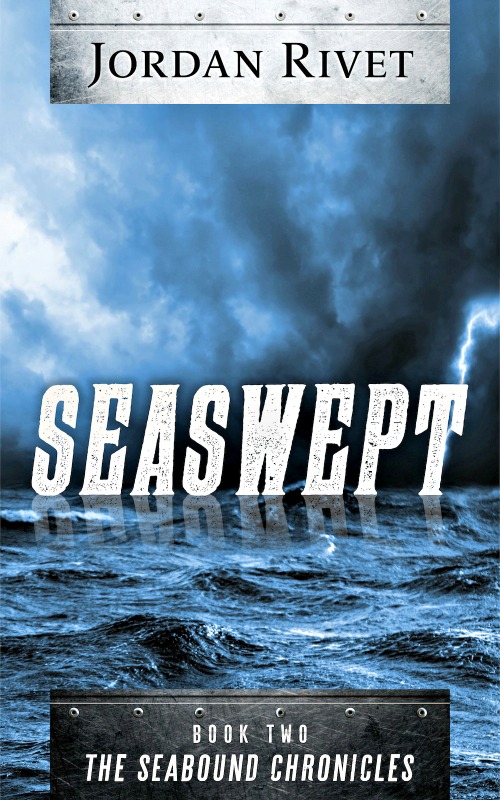
My intention has always been to put out Book Two before doing bigger promotions and (hopefully) seeing bigger results. With the publication of the sequel, Seaswept, at the beginning of this month, I finally had the chance to set that plan in motion.

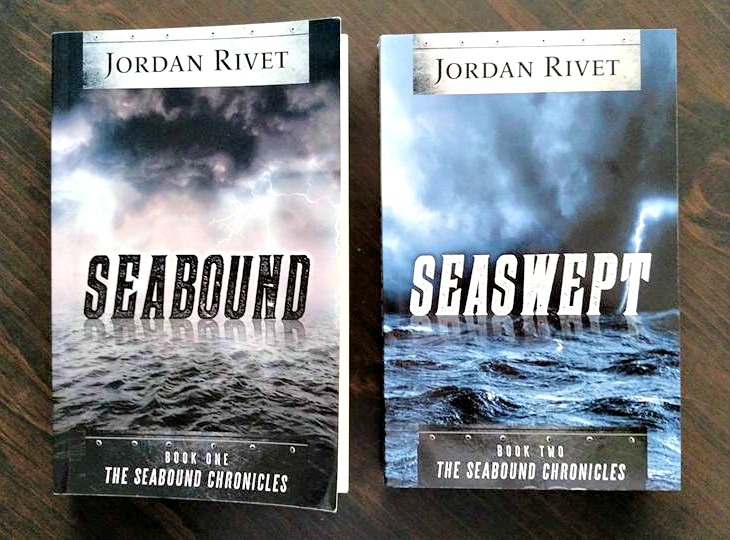
Seaswept and Seabound Paperbacks

Jordan Rivet’s Seabound Chronicles is now a real series, with the publication of Book Two, Seaswept, earlier this month.

She’s got high hopes…

Here’s how it went down. When I released the second installment in the series, it generated sales and a bit of attention for the first book. A few days after Seaswept came out, I put Seabound on sale for $0.99 and advertised it with a couple of book recommendation sites.

My hopes were high, especially as soon I’ll need to decide whether or not to get a new day job. Displaced Diary, as you’ve been following my expat writer journey for a while, you’ll know my big goal is to make a full-time living as a writer, and I’ve been working hard under my own name and a pen name to achieve this. But my savings are running low, and Hong Kong isn’t exactly famous for its low cost of living.

The sale on Seabound lasted five days. For the first two, I booked smaller promo sites—some free, some charging a few dollars for the ads. The sales were similarly modest: 10 on day one and 14 on day two.

To be honest, I was disheartened. Even though these results were consistent with the reach of the smaller promotional sites, I’d hoped for more. If I couldn’t get the ball rolling with multiple books out, maybe it was time to polish up my CV. Failure would mean going back to teaching or hoping for a job opening in Hong Kong’s tiny publishing industry.

For those two days I felt . . . underwhelmed. I dug into the draft of another book to keep from obsessing over my sales graphs, but found myself clicking over at least once an hour anyway. More often than not, nothing had changed.

On the third day…

It was time to bring in the big guns. I’d booked ads on such sites as eReader News Today, Free Kindle Books and Tips, and BookSends. These sites were supposed to get my discounted title in front of tens of thousands of additional readers. And some of those readers decided to buy.

On Day Three, I woke early to over 60 sales. It was already my best sales day ever, and I hadn’t even had my coffee. I spent most of the day glued to my computer, watching the spike tick upward. The numbers climbed and climbed, finishing with a three-digit total.

Throughout the weekend of the promotion, I refreshed my sales dashboard regularly. For three straight mornings I woke to sales multiple times better than my previous best day.

I had scheduled lunches with friends and spent Sunday afternoon on a boat—but snuck off to the restroom to check my ranking every chance I got. Seabound reached the top 1,800 overall in the Kindle store and ranked in the highly competitive Dystopian and Post-Apocalyptic categories for the first time. It even took the #1 spot in Sea Adventures for a little while.

My angst of the previous days was starting to look a bit silly.

Checking sales of self-pubbed books on Amazon

Checking Amazon sales becomes an obsession for self-published authors.

High apple pie in the sky…sales!

It turns out it’s a real rush to see my books climbing the rankings. I experienced a bit of this when my Kindle Single, Pay Off launched with prime placement on Amazon, but sales of the Seabound Chronicles have now surpassed those of the Single. My goal of making a living off my Jordan Rivet pen name feels more and more possible.

The promo has ended but the sales haven’t. This has been the best month of my career. In fact, it has been so good that May sales of Seabound and Seaswept, are double the Seabound sales for the previous six months, and we still have a week to go. I’ll be able to press on to the summer before making any decisions about new jobs or new careers.

Diary, I’m reporting this good news in case you were feeling a little anxious after last month’s post. That one was all about the work: sitting in a chair, outlining, writing and rewriting and rewriting and rewriting. The work is 99 percent of this job. But every once in a while you get to watch the results rolling in—and it’s kind of awesome.

A writer’s “One Percent”

Next month I’m going to see a different set of results, when my traditionally published travel memoir launches worldwide and in e-book (it has been out in Hong Kong since November). This is the very first book I ever sat down to write, so I’m proud that it’ll finally be out in the world. But I’m also proud that I’ve taken what I’ve learned and kept writing. I’m sitting down to start the fourth draft of the Seabound prequel right now.

And so it goes.

Thanks for enjoying this 1 percent event with me as well cheering me on through the 99 percent days, Displaced Diary.

Here’s to many more Mays for us both!

Until next time,

Shannon Young
AKA Jordan Rivet
www.shannonyoungwriter.com
JordanRivet.com

* * *

Readers, it’s encouraging to hear that light can be at the end of the expat writer’s tunnel. Any words of congratulations for Shannon, thoughts on this recent sales experience, or questions for her on marketing techniques, please leave in the comments. And be sure to do so soon, before she gets swept up in the excitement of her memoir coming out next month!

STAY TUNED for next week’s fab posts!

If you enjoyed this post, we invite you to register for The Displaced Dispatch, a round up of weekly posts from The Displaced Nation and much, much more. Register for The Displaced Dispatch by clicking here!

Related posts:

BOOKLUST, WANDERLUST: In Shireen Jilla’s second novel, a group of old friends go on safari and unpack their lives

Booklust Wanderlust column for the Displaced Nation

Attention displaced bookworms! Our book review columnist, Beth Green, an American expat in Prague (she is also an Adult Third Culture Kid), is back with her latest recommended read.

Hello Displaced Nationers! Do I have a treat in store for you this month! Shireen Jilla, whose 2011 psychological thriller, Exiled, was previously featured on the Displaced Nation, is with us again. She has written a new novel, The Art of Unpacking Your Life, which came out in March, and has graciously agreed to answer my questions about her latest work.

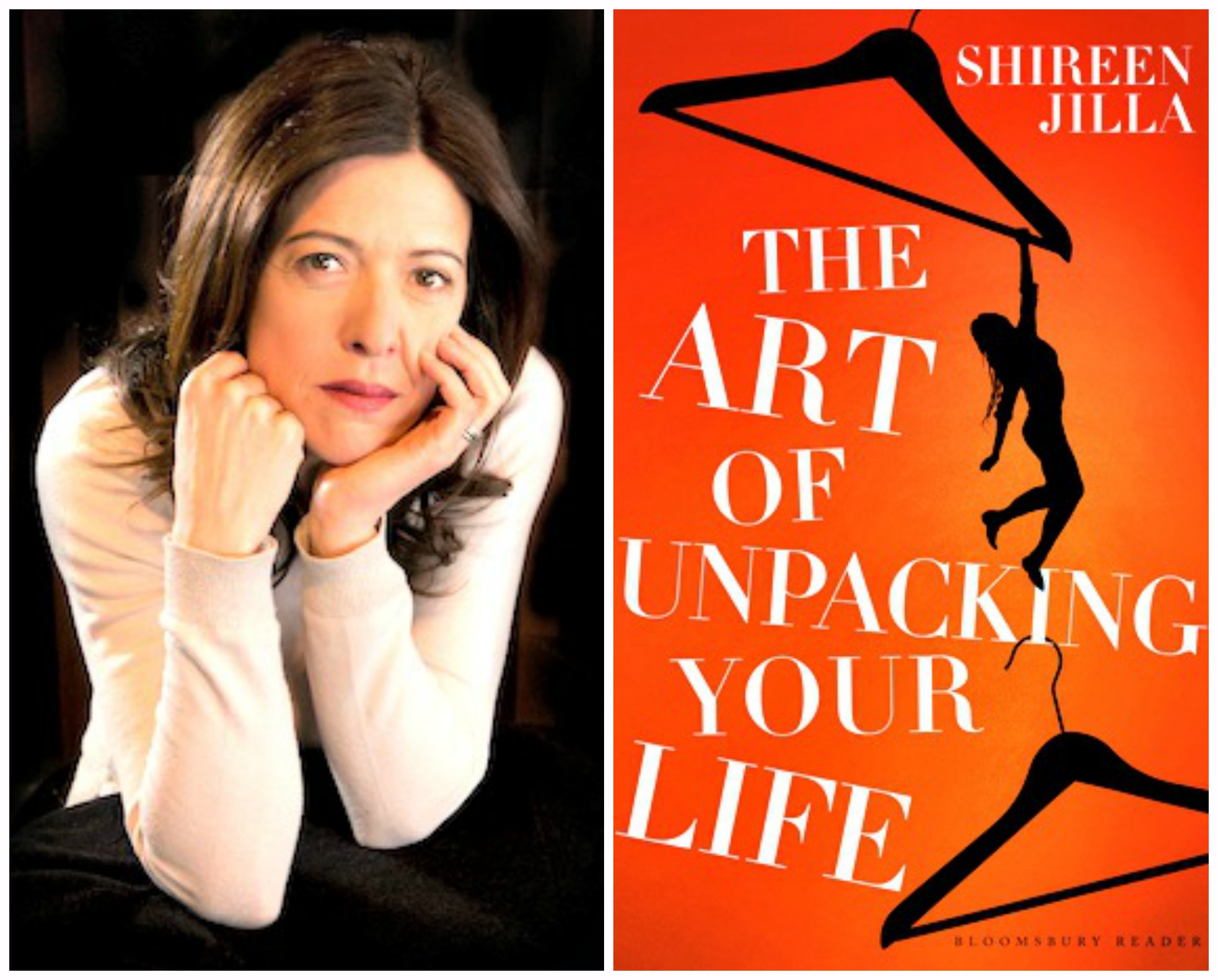
Shireen Jilla author photo and book cover for her second novel, The Art of Unpacking Your Life

Shireen Jilla author photo, by Francesco Guidicini (from her author site); cover art.

The book made our list of anticipated “displaced reads” for 2015. For those not in the know, it tells the story of what happens when an Englishwoman named Connie decides to celebrate her 40th birthday by organizing a group of her old university friends and their partners to go on an African safari.

But if Connie is the main character, she is not the only point-of-view character. She functions as the heart of the group—but, as we soon learn, doesn’t seem to manage her own affairs very well. To quote one of my favorite lines from the book:

“Connie was brilliant at life’s details, particularly other people’s life details.”

We all know someone like that, don’t we?

Many authors stick to similar genres and even similar stories but in her two books, Jilla has explored very different places and themes. Where Exiled is a thriller akin to Rosemary’s Baby—it centers on Anna, a British expat leading a privileged life in New York—Unpacking is The Big Chill set in an exotic landscape. Anna may feel isolated within the bustle of the Big Apple, but Unpacking‘s characters are faced with the Kalahari Desert, the kind of place where one must unpack one’s life, finding strengths as well as weaknesses.

Both stories are informed by Jilla’s own travels. An adult TCK and former expat, she has lived in Paris, Rome, and New York as an adult; and in Germany, Holland and England as a kid. (She is now back “home” in London.) And as a traveler, she has experienced firsthand the dry, unusual beauty of the South African bush she describes in Unpacking.

But enough introduction! Time to give Shireen Jilla the floor.

* * *

Hi, Shireen, and welcome back to the Displaced Nation. When we discussed your previous novel, you told us about how the cityscape of New York lent itself to writing a thriller. What made you go from New York’s hustle bustle to the stark, sparse landscape you describe in The Art of Unpacking Your Life? Why the Kalahari?
I had the characters in my mind for a long time. I wanted to explore my generation’s surprisingly disparate lives: single, divorced, gay, with children, successful, jobless. I needed them to be away from home, from their daily lives, unnerved and unsure and therefore open to exploring their issues. I tried setting the book in Sardinia because I know it well. But it wasn’t remote or dramatic enough to force them to “unpack” their problems. When I stepped out of an eight-seater plane into the vast orange heat of the Green Kalahari, I knew I had found my setting.

“Everything in Africa bites—but the safari bug, worst of all.” —Brian Jackman

Tell us more about that moment. I understand from another of your interviews that you went to the Kalahari with your brother?
Yes. My brother generously took me on what can only be called a trip of a lifetime to a private reserve, Tswalu, in the Northern Cape Province of South Africa, bang near the border of Botswana. I had never been to Africa before. So my own experience of this extraordinary trip coloured my story in Unpacking. I was surprisingly drawn to the Kalahari.

Connie and her friends started out in the same place—in a shared house at university—but when the book takes place, they’re all at different places in their lives and don’t appear to have much in common any more. One is a happy housewife, or so she thinks, another feels like success has passed her by both professionally and romantically, others want to start a family, while still others are recuperating from seeing their families crumble. Many books are written from the point of view of a single character, but you give us a glimpse into the thoughts of six multi-layered characters. Was it difficult to imagine how all these people would react to the same events—how they would react to travel?
Thank you for asking this question. It touches the heart of the novel. I wanted to tell this story from the point of view of each of the main six characters because I am fascinated by how differently people read, and react to, the same events. I was inspired by Virginia Woolf’s Mrs Dalloway, which roams from character to character, from paragraph to paragraph. That said, I wasn’t keen to jump around that much, so each chapter in Unpacking is told from a different character’s point of view. I loved writing the same scene from different points of view. It gave me a great sense of freedom.

“Africa is mystic; it is wild; it is a sweltering inferno…” —Beryl Markham

Many of our readers are international creatives, so I’m asking this with them in mind: how do you capture inspiration while you travel? 

“Instead they snapped away, looking up periodically from their cameras, as if undecided whether photo memories or physical ones were more powerful.”

This line in Unpacking reflects my own feelings. While in Africa, I kept a detailed diary and took hundreds of photos, a selection of which are on my author’s site. Having started life as a journalist, I also bought books and talked extensively to the guides. I used all of this material for Unpacking, which I believe is faithful to the actual setting.

In the book, Connie and her group have a very dramatic encounter with one of the animals in the park and the friends’ various reactions reveal their state of mind. Did you have any big-animal encounters during your Africa adventure? 
Thankfully not! The scene was imagined.

Giraffe & Namibian sand Collage

A silent, self-contained Kalahari giraffe and blood orange sands make it into Shireen Jilla’s novel about a group of friends on an African safari. Photo credits: Male giraffe, by Charles Sharp, and Silhouettes in Sossusvlei, by Monica Guy, both via Flickr (CC BY 2.0).

“The more I traveled, the more I realized, fear makes strangers of people who should be friends.” —Shirley MacLaine

As I mentioned in the introduction, you grew up a Third Culture Kid and you’ve also been an expat. Is there anything from your experiences living abroad as a child and an adult that worked its way into this book?
From own experience, I am acutely interested in how people react to being outside their comfort zone. Living or traveling abroad is a very visceral way of exploring this theme. With Unpacking, I wanted to place a group of close friends, who haven’t traveled extensively, into a remote, unnerving location. For me, it gives the novel its heartbeat.

I’m an Adult Third-Culture Kid, too (and an expat currently), and one of the things that I found remarkable in this book is the close cohesion of a group of people who met at an early stage of their adult lives—not always something we TCKs can find! I’m curious. Do you have a group of friends like Connie’s?
Actually, I have a varied and disparate group of old friends from many places and stages in my life. What I drew on in Unpacking is the notion that one can still feel intensely loyal to old friends, despite growing in different directions. But no, I’ve never planned a big trip with old friends as Connie does.

I noticed that within the group of friends you’ve created, there are two cross-cultural relationships. I enjoyed watching the conflicts from their opposing cultures arise in their relationships. Was this something you set out to capture from the beginning?
This is an interesting question. I haven’t consciously created two cross-cultural relationships. But I am clearly fascinated by and drawn to them. I loved writing both relationships, particularly exploring the cultural misunderstandings between the English friends and New Yorker Katherine.

“Travel and change of place impart new vigor to the mind.” —Seneca

So far you’ve given us two great books based on interesting locations—New York and South Africa. What’s next? Will you follow up with Connie and her friends in another novel? Take your readers on a new adventure somewhere else?
I’m normally adverse to sequels, but I would actually love to write another novel based on the same characters. I’m not ready to let any of them go. I am deeply attached to them all. And I would also enjoy the challenge of another new setting abroad. It’s like moving country. Always exciting.

Lastly, my favorite question for everyone—what are you reading at the moment? Any suggestions for good books that might appeal to the Displaced Nation audience?
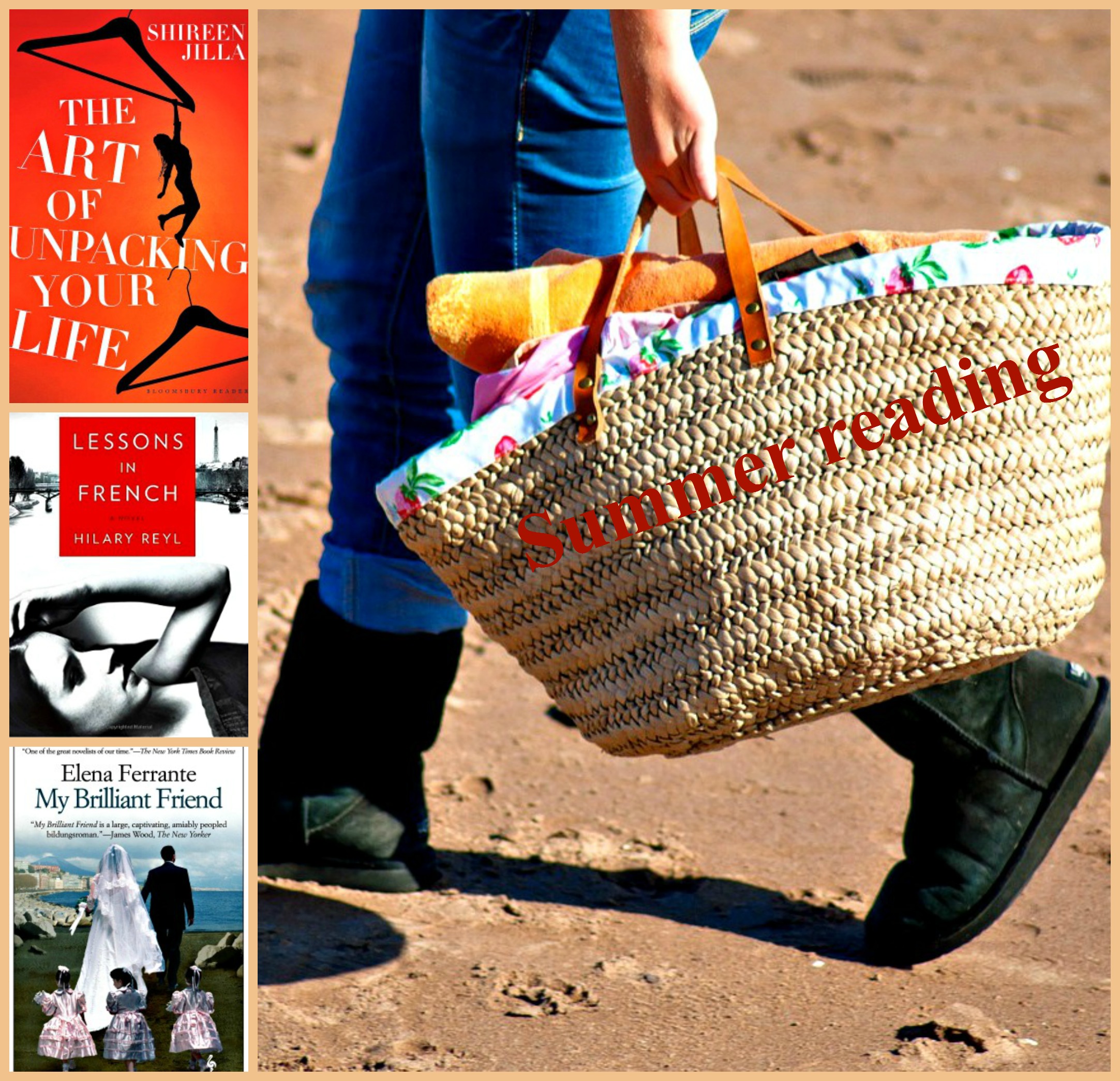
I am currently reading New York writer Hilary Reyl’s Lessons in French. The novel is an absorbing coming-of-age story about an American girl who does work experience with a demanding photographer in Paris. It’s an evocative, lyrical read for all expats. Elena Ferrante’s My Brilliant Friend, is another addictive page turner that lights up a poor working class community in fifties Naples.

Thanks, Shireen, I’ll check those out! And readers, if you’re selecting books for your summer reading list, I suggest you pack Unpacking in your beach bag! Or on your Kindle, more likely… 🙂

Beach bag via Pixabay.

Don’t go to the beach without Shireen’s book and at least one of her recommended reads! Beach bag via Pixabay; book cover art.

* * *

And now Displaced Nationers, it’s your turn to answer some questions. And have you ever tried traveling with friends? Did you pick up any insights about them and/or about yourself? Do let us know in the comments!

Beth Green is an American writer and English teacher living in Prague, Czech Republic. She grew up on a sailboat and, though now a landlubber, continues to lead a peripatetic life, having lived in Asia as well as Europe. Her personal Web site is Beth Green Writes, and she is about to launch a new site called Everyday Travel Stories. To keep in touch with her in between columns, try following her on Facebook and Twitter. She’s a social media nut!

STAY TUNED for the next fab post!

If you enjoyed this post, we invite you to register for The Displaced Dispatch, a round up of weekly posts from The Displaced Nation, and SO much more. Register for The Displaced Dispatch by clicking here!

Related posts:

Photo credit (top of page): “Notebook in hand,” by Oleh Slobodeniuk via Flickr (CC BY-NC-SA 4.0).

LOCATION, LOCUTION: Columnist JJ Marsh bids farewell with generous book giveaway

JJ Marsh hands over the Location Locution reins to Lorraine Mace, who will start next month.

JJ Marsh hands over the Location Locution reins to Lorraine Mace, who will start next month.

JJ Marsh first graced the shores of the Displaced Nation two years ago. Growing up a Third Culture Kid in Africa and the Middle East, and now an expat in Switzerland, she was an immediate fit. For two years we have benefited from her love of language and place, and now, as she takes her leave from this column (though not from the Displaced Nation), she does something that makes us love her even more: hand picks a successor and offers a chance to win a set of SEVEN books from Triskele, the acclaimed writers’ collective she helped to found. Thank you, JJ!

—ML Awanohara

Two years after joining Displaced Nation with the Location, Locution column, it’s time for me to say goodbye.

It’s been a terrific experience and I’ve learnt so much from my interviewees, not to mention discovering wonderful books and unexplored places. Heartfelt thanks to ML Awanohara and the Displaced Nation team for taking a risk on me.

I’m going to hand over to a fresh face, with her own unique flair. From June, Location, Locution will be in the expert hands of inveterate creative and nomad, Lorraine Mace. I asked Lorraine to introduce herself to you next month by providing her own answers to the Location, Locution questions.

Finally, I’d like to leave you with a goodbye present. As international creatives, I know you enjoy exploring books that make a feature of place.

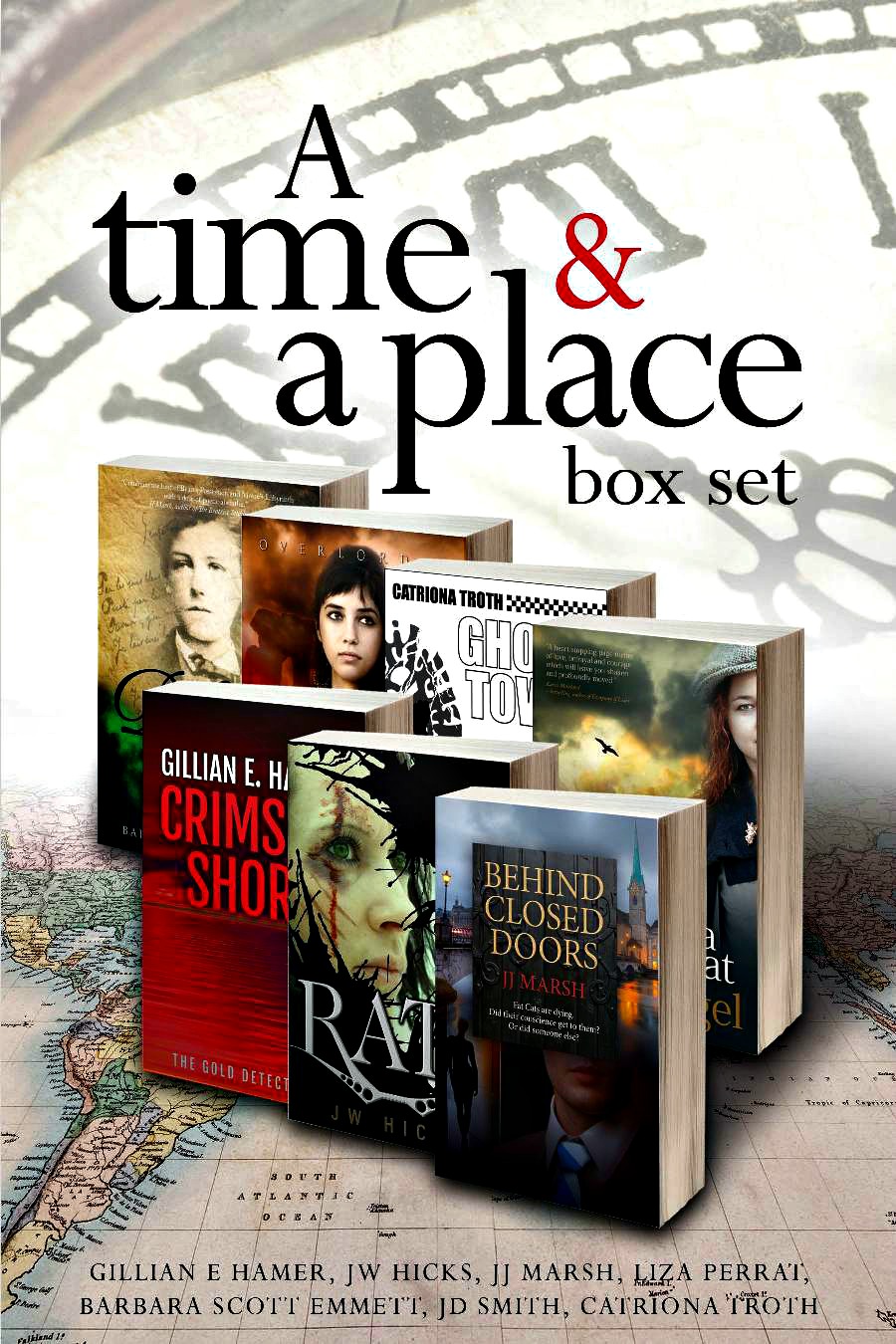
My colleagues and I at Triskele Books have created a box set of books to transport you across time and place, from 3rd century Syria to futuristic Wales. A Time & A Place contains seven award-winning novels that have in common the theme of this column: location, locution.

Come on a journey.
We’ll take you to another place.
And tell you a story.

And as my farewell gift to Displaced Nation readers, I have one free copy (ebook only) to give away. You can win by adding a comment in the box below. In no more than 50 words, where and when in the world would you like to go, and why?

JJ Marsh's farewell giveaway

JJ Marsh’s farewell giveaway

The winner will be announced in next month’s Location, Locution.

* * *

Where would you like to be taken?

1) Modern-day Anglesey on the trail of a psychopath
Crimson Shore, by Gillian Hamer (Contemporary crime)
“Hamer does for Anglesey what Rankin does to Edinburgh, what Dexter did to Oxford”

2) Post-apocalyptic Wales, surviving with a rat pack
Rats, by JW Hicks (YA)
“An absolute treat for fans of SF, dystopian, and YA novels, but I would recommend it to anyone who loves a great story brilliantly told.”

3) Contemporary Zurich, where everyone has a secret
Behind Closed Doors, by JJ Marsh (European crime)
“Warning: once you start this book you may not be able to put it down, and you may find yourself talking to it.”

4) WWII France to resist occupation and fall in love
Wolfsangel, by Liza Perrat (Historical fiction)
“Fascinating, forceful and extremely well researched… will thrill historical fiction fans.”

5) Ancient Palmyra to fight alongside a warrior queen
The Rise of Zenobia, by JD Smith (Historical fiction)
“Packed to the hilt with tension and adventure, it kept me spellbound.”

6) Charleville, France, and the poetic voyage of a manuscript
Delirium – The Rimbaud Delusion, by Barbara Scott-Emmett (Literary fiction)
“Beautifully plotted and written, this absorbing, enchanting novel is one of the best books I have read this year.”

7) Coventry – a 1980s crucible of racial tensions
Ghost Town, by Catriona Troth (Literary fiction)
“Unique and brilliant… not just a compelling read, but also a learning experience.”

JJ Marsh and her  fellow Triskelites.

JJ Marsh and her fellow Triskelites.

Can’t wait to get the set? It’s available for a limited period at the special offer price of $9.99/£7.99. Don’t miss this box of delights. Who knows what you’ll discover?

Or, to reiterate, you can try your luck at winning a FREE copy (ebook only) by adding a comment in the box below:

In no more than 50 words, where and when in the world would you like to go, and why?

Goodbye, thank you for reading the column and I wish you all excellent journeys.

Jill

* * *

Happy trails to you as well, Jill! I noticed you said in a recent interview: “My definition of literary genius is writing about places you want to visit.” May that become the Displaced Nation’s new mantra! Readers and JJ fans, let’s all bid JJ a fond farewell by answering the question: In no more than 50 words, where and when in the world would you like to go, and why? (Seven books, wow! That’s your summer reading…)

JJ Marsh grew up in Wales, Africa and the Middle East, where her curiosity for culture took root and triggered an urge to write. After living in Hong Kong, Nigeria, Dubai, Portugal and France, JJ finally settled in Switzerland, where she has been writing a European crime series set in compelling locations all over the continent and featuring detective inspector Beatrice Stubbs. She recently produced the fourth book in the series: Cold Pressed, which takes place on a luxury cruise bound for Santorini.

STAY TUNED for the next fab post!

If you enjoyed this post, we invite you to register for The Displaced Dispatch, a round up of weekly posts from The Displaced Nation, with weekly updates and much, much more. Register for The Displaced Dispatch by clicking here!

Related posts:

WONDERLANDED: “Can you make me a Manhattan?” by A. Spaice

Can you make me a Manhattan Collage

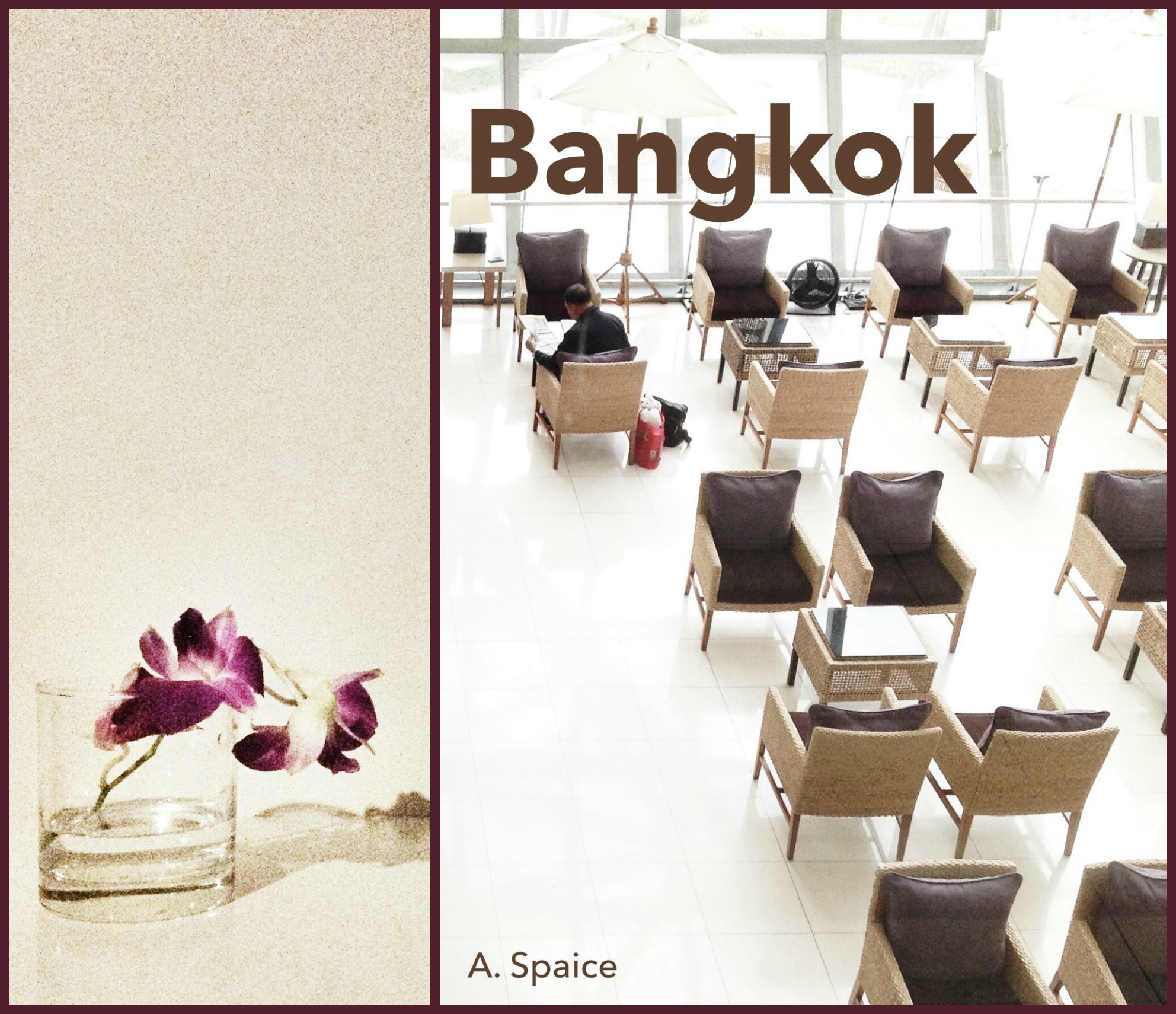
Drink a Manhattan at Eat Me in Bangkok. Photo credit: “Alice 15,” by AForestFrolic via Flickr (CC BY 2.0); Eat Me Restaurant, Bangkok; Manhattan cocktail via Pixabay.

A couple of days ago, we wonder-landed in Phnom Penh with serial expat writer, artist and sometime photographer A. Spaice. She told us falling down rabbit holes in Europe and Asia has sparked her imagination in untold ways—not least by convincing her that a Mad Hatter’s tea Party would not be complete without champagne and an opera singer.

Spaice ended her musings on the expat writer’s life on this fittingly dramatic note:

Knowing it’s the connection that I write for now, instead of the “art,” I’m moving into a different channel. I trust this current, because it feels good. It moves, it flows. Sometimes, when I’m lucky, it even likes to dance.

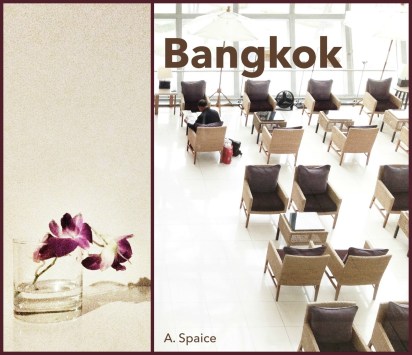
Today she offers a sample of her work that seeks to connect with others who have wonder-landed and lived to tell the story—whether in words, photos, or other forms of creative expression. It’s an except from her short book Bangkok, which she produced as a kind of roman à clef after taking a trip from her current home of Phnom Penh to the Thai capital. Bangkok marks the first in an unconventional short book series she is planning, titled n+1.

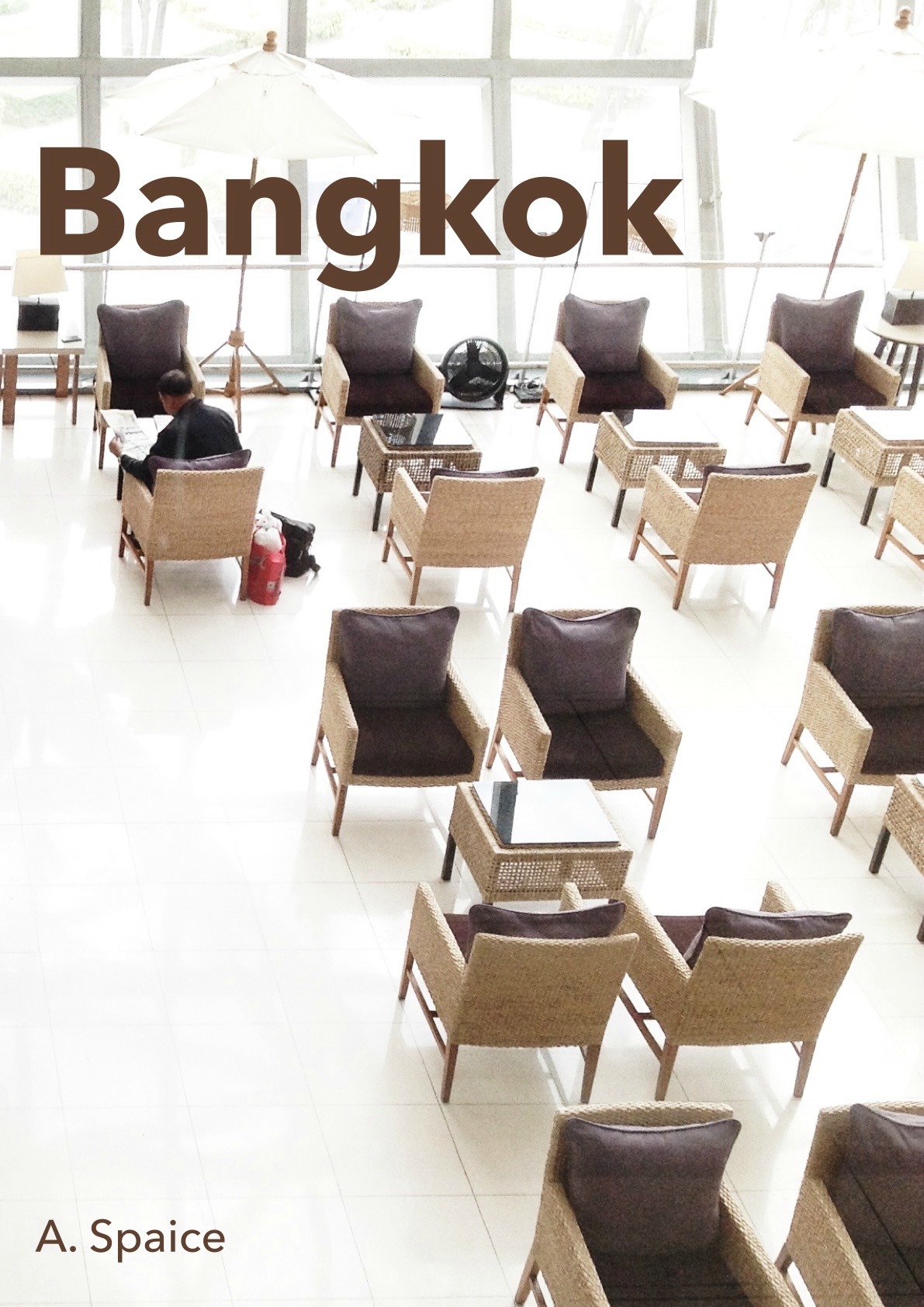
Cover art for Bangkok, by A. Plaice.

Cover art for Bangkok, by A. Spaice

* * *

Excerpt from Bangkok

The story principally concerns Karin Malhotra’s attempt to reconnect with an old female friend in Bangkok, Thailand, the Land of Smiles, only to discover they are no longer that compatible. But in this passage, Karin is about to meet someone new, another displaced creative, a magazine editor who has professed an interest in her work…

“CAN YOU MAKE ME A MANHATTAN?” I asked, truly wondering. “Of course.” This was supposed to be the best bar on this side of Bangkok, according to the gay couple that seemed like good people to ask the day before. I wanted a comfortable place. Not too conspicuous, not too loud. But I didn’t expect it to have the kind of name it did. Eat Me.

Still, the guy from the magazine had said “yes,” to meet me there. I muttered something about the name and how I’d heard about it from a bunch of people (two being a bunch) and thought it could work for a conversation space.

He was taller than I’d pictured, and seemed like he might have been French, because of the two-kiss thing that the Europeans like to do when they meet you for the first time. For some reason, he was extremely close to the lips on the second one, but that was kind of flattering, in a way, because he had a rich dark musty scent and I rather liked it.

“So,” he said. “You’re Karin Malhotra. We meet at last.”

At last? Hadn’t we just talked online like, twice? Business conversation making, that was the agenda today.

“Tell me about what you do.”

Oh, boy. Here it was. The test. I hadn’t really prepared for this. I was going to have to wing it. Really, at the end of the day, pretty much everything good that’s come to my life has come of winging it, I realized. With that thought in the forefront of my mind, I got into character. “I make space. I know that might sound odd, but I was meant to be an architect. Designing physical spaces with bricks and glass and maybe new materials but not concrete because in Kyoto I got a giant magazine with Tadao Ando teahouses all in these sad greys which got me depressed for a while because the ones they have in northern Thailand, Chiang Mai and stuff? They have these lovely bamboo colors and textures and earth tones. Which is better. Anyway, I didn’t become an architect for lots of reasons, the biggest one being that I don’t like projects that take more than three or four months to finish. With books, you know, you can take years to write books, but I got into eBooks and nothing more than like a two-hour read, you know? People like that. Short and sweet.”

“Uh-huh.”

“People like it because we are so time-poor right now. Modern people, that is. I’m talking about the malaise of the Western progressive world, where we have books and medicine but we have nothing to get happy about because our souls aren’t nourished properly in the time we’re growing up.

“What I’ve been doing, what I’ve just started since putting the brakes on my own design studio, which you’ll never believe this but is the second time I’ve done that. The first time I just felt compelled to do the same thing again, when we moved from Seattle to Durham NC. Durham is in North Carolina. Have you been there?”

“No. I rarely go to America. I can’t say that I’d ever want to live there, and visiting is a trial.”

“So you’re actually from…”

“Vienna.”

Oh. Memories of college.

Schubert.

Nabokov.

A bottle of Sauvignon blanc.

“Yes, I knew someone from your country once.” I stammered. I wanted to forget about that, but you can’t really forget about those ones you fall for at first sight. Why was I talking about that, though? That was weird. “He was a colleague.” A lie. But… so?

“Where did you work together?”

Shite. I was going to have to keep going with this one? “Oh, just a small firm in Tokyo. They did architecture, but had a base in Los Angeles. I thought I’d make it to Los Angeles because I knew my husband was big into the West Coast, drier air and all. But we wound up in Seattle. It took a while to get there from our time in Japan, though.”

“I love Japanese teas, they are the best.”

“I prefer Darjeeling to everything, personally. But I do love those whisks from those places they have in Kyoto.”

“Are your genetics from India?”

Wow. That was a first. No one put it that way before. Are my genetics from India?

“Yes,” I said. Not barking at them that I’m from the outskirts of Detroit. I hate the where-are-you-from question but I still ask other people, for some reason. I guess it’s habit? Smalltalk.

My bar companion brushed his dark brown hair with his hand, and I noticed that it had a few stray grays. This was interesting. When did I ever think men with gray hair could be attractive? This was news. Maybe it had something to do with turning almost-forty. A round number.

“I have never been to India,” said Glenn. He had a really long last name that I couldn’t pronounce, much less remember to spell. What was the custom in Austria when greeting someone? Was it two kisses like the French, or three like the Swiss? I tried to remember how it had been in those couple of weeks with

“But I intend to go. This winter, in fact.” Glenn was all business, and that reminded me to focus. Not on his hair and his hands and his blue eyes, so puzzlingly deep, but the agenda. “I have to get more writers from that part of the world.”

“You do?”

“Yes. We want to diversify the magazine. It’s far too European for its own good. I really want to bring in some new voices. From afar. From the East. That’s why I contacted you. You seem to have… an Indian-sounding name. I’m sorry… I guess I just assumed…”

“Oh, that’s fine,” I said, waving it away. The truth was it wasn’t fine. Why did my stupid name have to make me into an Indian person automatically? I’d been there enough times to know that the gender bias there is ridiculous and horrid and people aren’t nice within their families, especially to daughters. Goodness knows I’d put up with enough of that growing up with my mother. My complicit brother and father, standing by while she’d hurl psychological abuse upon stones. I hated thinking about those days, and pushed aside the thought as if it were one of Glenn’s locks. I had to stop myself from reaching out to touch his crown, to see if he might notice that kind of action. Just out of curiosity, I’d say, if he asked. Not trying to get with you or anything. Just like the look of you, and enjoy studying your features. High, strong cheekbones made him look a little feminine, but his hands were rough from, what? Magazine work couldn’t possibly be physical.

“Were you always in the publishing industry?”

He took a sip of a new drink that arrived, a tall slim glass that contained a mojito. Kind of a girly drink, wasn’t it?

“No,” he said. “I was a joiner in the past.” “A what?” “Joinery. It’s a kind of carpentry, but specialized. I trained in Germany for it, for about four years. That’s where I met my partner.” “Your… partner?” “He’s a joiner, too, yes.” He. I recalibrated, and quickly. “Ah.”

The waiter came around and saved me. “Another drink?”

* * *

Readers, what did you make of this portion of A. Spaice’s expat-life story? Among other things, I think she has nailed the down-the-rabbit-hole feeling of no longer knowing who you really are or anyone else is, once you have wonder-landed.

Interested to read more of Bangkok? It’s available for purchase at Gumroad and Amazon.

STAY TUNED for next week’s fab posts!

If you enjoyed this post, we invite you to register for The Displaced Dispatch, a round up of weekly posts from The Displaced Nation, and much, much more. Register for The Displaced Dispatch by clicking here!

Related posts:


Wonderlanded in Phnom Penh with serial expat writer, artist and sometime photographer A. Spaice

A Spaice Wonderlanded Collage

Tea in Bangkok and Yellow in Phnom Penh. Photo credit: A. Spaice.

Curiouser and curiouser! Residents of the Displaced Nation have always had a deep affiliation with Lewis Carroll’s Alice. We can identify with her experiences of falling down a rabbit-hole and stepping through a look-glass into a world where one doesn’t know, can’t even guess at, the rules of the game. Alice’s sense of discombobulation—which of us hasn’t had at least one pool-of-tears moment after moving to another culture?

By the same token, which of us hasn’t grown, and been stretched, in new and unexpected directions by our displaced lives of global residency and travel?

This year, to celebrate the 150 years of Alice’s Adventures in Wonderland, I am hosting a new “Wonderlanded” series, beginning with today’s post.

Our very first Wonderlanded story is from A. Spaice, who has led a life of remarkable transitions after falling
d
o
w
n
the hole.

Spaice grew up in a rich Western country to be an engineer-artist, disappointing a lot of relatives who insisted (without invitation) that a more “normal” career would make life easier.

But this just pushed her to resent all sorts of social mores, sparking a journey that would never stop anywhere for more than six years. Her path cut a line to the Far East, looped Western Europe, and now, as we hear the details of her Wonderlanded story, Spaice writes from Phnom Penh, Cambodia, having assumed a few new layers to her creative identity as she continues to insist on looking inward to work out Alice’s big question:

“Who in the world am I?’ Ah, that’s the great puzzle!”

Without further ado, I give you A. Spaice!

* * *

Greetings, Displaced Nation readers! I look forward to telling you my story of how I became wonderlanded. But first, a few details about me. Before taking this new name, A. Spaice, I’d been happily writing under my own, mostly first-person essay style accounts and often set in foreign lands. It was fine. I got places. I enjoyed it. But then, I hit bricks. Through my writing, I’d wanted to tell my story and when that was done, I realized it was okay to stretch a bit, to try new things, maybe even third person. Crazy! So after a long time of not knowing one phase could end and a new one begin, I feel a reinventing going on, from within. This propels me, and it’s been a while since I’ve felt that kind of inward push, and I know this is the kind of thing you need to have if you want to get it done and make it good. So I’m happy to make the transition, and let go of the old style.

“Why, sometimes I’ve believed as many as six impossible things before breakfast.”

Along the way I got surprised about something. My major in college was engineering, and I worked in architecture firms for a while, so it’s been fun playing with new concepts in my work, like torque and momentum, or the radiation heat transfer equation, that kind of thing. I’m going to have to find a way to use ! for factorial. I’m terribly excited, and I hope this energy will reverberate through in my just-born, about-to-become-something N+1 series. (Mathy, right? I kind of dig it.)

“I’m afraid I can’t explain myself, sir. Because I am not myself, you see?”

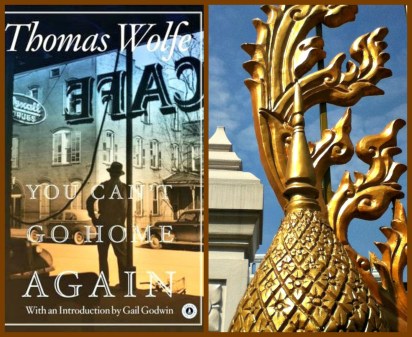
A year ago at this time I was in Chiang Mai, Thailand. I had no idea what I was going to do for work or how I was going to “make it,” or if I’d need to abandon some old idea about what that even means, or something else. Among my possessions was an old copy of You Can’t Go Home Again, which, if you are traveling Asia and the kind of person who sizes people up by the amount of luggage they have, you wouldn’t have given me an ounce of attention because this thing is cement.
You Can't Go Home_Thailand

You can’t go home again; you’re in the Kingdom of Wonder! Photo credit: Book cover art; A. Spaice.

Thomas Wolfe was pretty roundly criticized, it says in the back notes of the book, for not being able to edit stuff himself and relying on people to help him cut things into a story-like form. But wow. His writing. It’s just…it’s so lovely and right on.

It was there with me in the suitcases, and it is here with me now, as I write. It’s been a comfort. I didn’t know anything about what was ahead (a bus ride to Siem Reap, then another to Phnom Penh, a welcome from some people social media introduced me to, and then, falling in love with Cambodia in an abstract way, because of the whole “Kingdom of Wonder” thing, but also, in general, its aesthetics (architecture, attention to symmetry, detail, and something… something I’m working on trying to capture and will stay until I can name). Ask me about the tuk tuk driver whose floor’s decked out with astroturf. A humor, a style, something else. Unpretentiousness, perhaps? Directness? Reality? Maybe it was this that made me feel, “Yes. Stay.”

But the book, that book being with me, that’s been an anchor. I keep it for comfort. I read it for love. I look to it to remember that yes, the road is ahead of you, that you can’t go back, that you just can’t fall upon some idyllic picture that isn’t real. Snap! You Can’t Go Home Again. And accepting that, right there, in the middle of the wondering, in the enchanting early evening hour of arriving on that long road from Chiang Mai to Phnom Penh, with sun reddening this sky, I knew. Something would work out. “I’ve got this. This is going to be just fine.”

An early “pool of tears” moment

Ireland. 2000. I was plonking myself into the countryside “indefinitely.” There were times out there on the farm in southwest County Cork that I wondered, “What the heck was I thinking?” I was still young then, and feared I was missing something. The city, the lights. A more familiar variety of arts and culture. What did I have in the hills? Views, rainbows, sheep, the grass-fed cow’s milk and Kerry Gold butter, sometimes shared by friends and neighbors in Union Hall and Dunmanway. Lots and lots of partying, but the honest kind, with board games and stories and singing and the craic. This was before the Internet era, so I have my doubts it would be the same now. But little by little, sticking around three years and a bit, you got to know the place and the people, and they got to know you. (A part of me is Irish, you know. From West Cork, like, so.)

“But I’m not used to it!” pleaded poor Alice in a piteous tone.

bathroom slippers anime

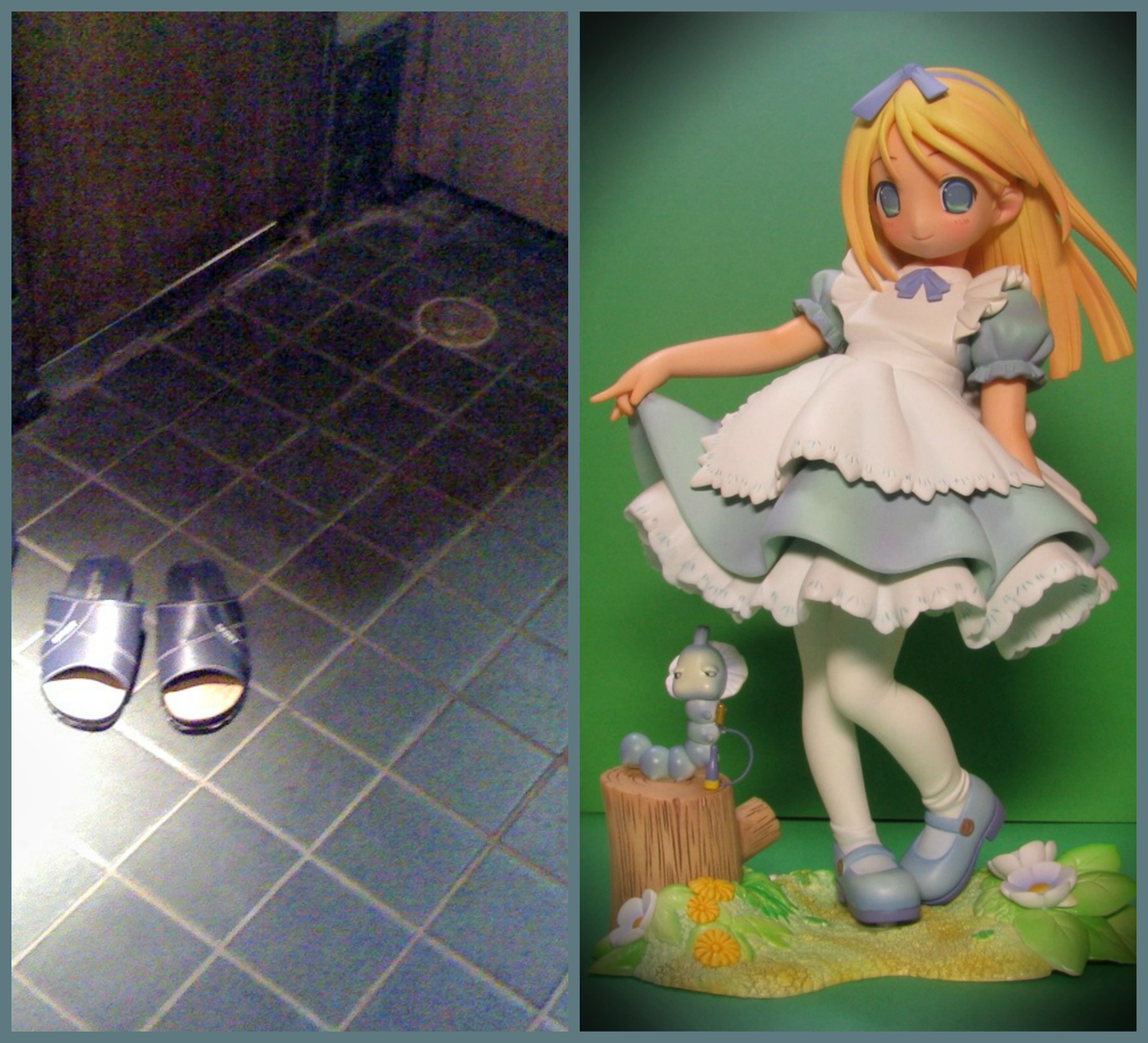
Through the Utsunomiya looking glass. Photo credit: Toilet Slippers, by Lloyd Morgan (CC BY-SA 2.0); Alice in Wonderland anime doll.

When I was in high school I did a Youth for Understanding exchange to Utsunomiya, Japan. I knew some things, like how you were supposed to bring omiyage so I had one small item each for my host brother, sister, father, and mother. I felt cool knowing you were supposed to leave your shoes in the genkan and wear slippers around the house. What I didn’t know was that when you go to the bathroom you change into special bathroom slippers.

I saw those, put them on, but forgot to change back into regular non-bathroom slippers and so entered the dining room, excited about all the new kinds of food. My host family was horrified. Awkward, but they made a printout of house rules, which they left on the kitchen table the next day. “Bathroom slippers are for the bathroom.” When I realized what had happened, I was redder than the cherry tomato atop the last night’s dinner salad.

“Well, I’ll eat it,” said Alice.

Iced tomato smoothies. Saigon.

Recipe for a successful Mad Hatter’s tea party

I’d host it in a place with lots of windows, preferably floor-to-ceiling, maybe on the second floor of a well-maintained building with high ceilings. There would be just 16 people—I find this to be a magical number for gatherings, you can arrange guests in pairs and then change it up, into four sets of four. Also cozy. I love having people shift about when I throw a party, it changes up the energy, and gives it a tint of surprise. I would invite people of all ages and career types because there tends to be a lot of silos out here. There would be tea for everyone, and later, an impromptu concert, with an opera singer, and then, champagne. (The opera singer and champagne part actually happened once here, magic!, so I’d have that for my guests for sure.)

champagne and opera

This mad hatter entertains with champagne and opera. Photo credit: Champagne via Pixabay; singer via Pixabay

“Oh, I’ve had such a curious dream!”

I think it’s weird when I go to California, say, and see people eating salads out of boxes. Noticed myself wishing there was more rice around San Francisco. I wondered, quite out of character, why women don’t cover their skin, especially when swimming. Isn’t that funny, when you’ve grown up in the West? Yet there are also the nice parts: people understand one hundred percent of what I say, and vice versa, and I can joke around, and it’s received, and I feel like my “old” self again. Remarkable.

“I almost wish I hadn’t gone down that rabbit-hole—and yet—and yet—it’s rather curious, you know, this sort of life!”

But I also see now that I’m interested in other kinds of things and that my experiences have taken me to far edges, the kinds of edges that aren’t photographable, and these make me feel like I get along better with a traveled set, not necessarily those from a particular country, or style, or personality, or something else. I like the everykind, the mixitup. I like the sense of possibility and connect with those who also want to keep it open, not box it in. Maybe that’s why I’ve lost interest in identifying with a certain country, or any other kind of label, come to think of it, too. Disorientation is part of it, but it’s precisely because of the crisscrossings that I’m figuring out, slowly, who I am. And it’s this feeling, this waking-up feeling, that is why I wanted to connect with Displaced Nation because it’s here I see it’s not just me in this big pot of “Wait. What just happened?”

Advice for those who have only just gone through the looking glass

Trust the process.

“Alice had begun to think that very few things indeed were really impossible.”

Okay. Well, moving from essays in high school to papers in college to, later, writing that has to go out on deadline, I’m finally able to say: I’ve got my voice. I know who the writer in me is. I’m confident, too, that this writer really wants to grow and stretch beyond previous boundaries, and that’s where this new thing, this thing I’m calling “N+1”, came from. A series of short books, based on the people I’m meeting in real time in the places where I go for three weeks or maybe two months at a time.
"In Bangkok" by A. Spaice; cover art for A. Spaice's short book, Bangkok

Creative output from Bangkok. Photo credit: “In Bangkok” by A. Spaice; cover art for A. Spaice’s first short book, Bangkok.

I’ve spent my whole life observing and taking notes, but it’s not the notes I’m referring to anymore. It’s not the pretty turns of phrase that I can feel like I can put in there, just, there!, or things I used to think made a person go, “I’m a writer!” No, it’s other stuff. It’s knowing that something you’re saying actually resonates. Connecting deeply with other people in small moments of sharing—that’s important to me. Words have a brilliant potency to make that possible, but they’re just one way. Knowing it’s the connection that I write for now, instead of the “art,” I’m moving into a different channel. I trust this current, because it feels good. It moves, it flows. Sometimes, when I’m lucky, it even likes to dance.

After Bangkok I’ll publish a new piece set in Dalat. It’ll be the first thing I’ve written in third person. My best friend, and my go-to editor, is listening to me read this aloud, and nodding, and smiling. Switching gears, writing different. It’s a good, happy change.

* * *

Readers, how did you enjoy spending time being wonderlanded with A. Spaice? Did you find her story a curiosity or could you relate?

STAY TUNED for the next fab post: an excerpt from A. Spaice’s short book Bangkok!

If you enjoyed this post, we invite you to register for The Displaced Dispatch, a round up of weekly posts from The Displaced Nation, and much, much more. Register for The Displaced Dispatch by clicking here!

Related posts:

DIARY OF AN EXPAT WRITER: My writing process, now being applied to a shiny new book series

DiaryExpatWriterAn American expat newlywed in Hong Kong, Shannon Young took the momentous decision last summer to quit her day job and launch out as a full-time writer. She’d given herself until Chinese New Year to see if she could make a living but has now postponed the decision—something we’re actually rather glad about as her expat writer’s diary can continue!

—ML Awanohara

Dear Displaced Diary,

It’s a hazy, jet-lagged time for me right now. Ever since I returned to Hong Kong from London last week, I’ve been awake through the night and struggling out of bed at noon or later. One advantage of setting my own schedule is that I can afford these late starts and still get plenty of work done during the afternoons and evenings (and in the hours past 3:00 a.m., it turns out). On the other hand, I don’t have a boss and a required start time to get me back on track—so could be on London time for a while yet.

But the work goes on no matter what time it is or where in the world I happen to find myself. I’m currently waiting for Seaswept, the second book in the Seabound Chronicles, to come back from my editor.

The cover for Jordan Rivet's latest book

The cover for Jordan Rivet’s latest book

As soon as it arrives I’ll jump into the final stages of proofreading and publication.

In the meantime, I’m working on my next book series.

That next book will be the first installment, which I’m aiming to release upon completion of the Seabound Chronicles.

It has been a while since I began an all-new project with all-new characters set in an all-new world. I’m trying to apply the same writing process I’ve been using for the Seabound books to the new idea.

So far it’s going well!

Since you, Dear Diary, are the vessel for my intimate thoughts about the writing process, today I want to share with you how I approach a new book. I developed this method while working on the four books in the Seabound Chronicles. As you know, all four are now completed—but in vastly different stages. Book 1 is published. Book 2 is finished and with the editor. Book 3 (the prequel) is in the third draft. Book 4 is a rough draft.

You may think I have too many projects on the go at once, but this in fact is the key to my writing process, as you’ll soon see.

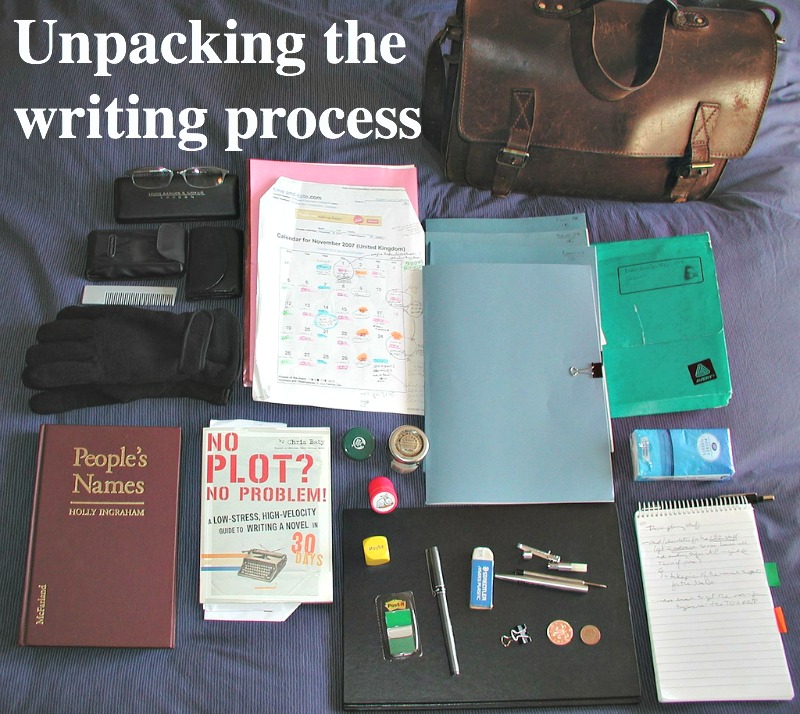
"Emptying the NaNo bag at last," by  Anne-Lise Heinrichs via Flickr ().

“Emptying the NaNo bag at last,” by Anne-Lise Heinrichs via Flickr (CC BY 2.0).

STEP ONE: The Idea

You can’t force yourself to come up with an amazing concept for a new book, but you can help the inspiration process along. Before producing Seabound, I knew I wanted to write a fast-paced story with high stakes and cool world-building, probably science fiction or fantasy, but I needed an idea. Then one day I hopped on a boat and spotted the cruise ship that inspired my post-apocalyptic Seabound series. It took more than just seeing a cruise ship, of course, for the concept to take hold. It took leaving my mind open and not forcing things, so that my subconscious could oblige.

With the Seabound Chronicles under way, the hope entered my mind of coming up with another fantasy project to work on; but this time I wanted an original take or some kind of cool mash-up. I held that thought for months and cycled through various ideas (a secret agent in a fantasy world? a fantasy apocalypse?); but none of them felt quite right. Then, suddenly, the idea was there when I arrived at my usual Starbucks. I could see it plain as day. I was actually supposed to be working on Seaswept edits, but instead I opened up a new Word doc and hammered out notes for several hours.

STEP TWO: Characters and Worlds

Once I had the concept of the world, the characters followed quickly on its heels. For some of these characters, I used a method similar to the one described above, where I had a general sense of what the person should be like, and then when I saw someone who matched the idea in my head, fleshed out my portrayal. (I spotted “Esther” walking down the Mid-Levels escalator with a camera around her neck that became a pair of storm goggles; “David Hawthorne” walked into one of my regular coffee shops dressed like an investment banker and wearing memorable black-framed glasses.)

"Mid-levels escalator blur," by Maureen Didd via Flickr.

“Mid-levels escalator blur,” by Maureen Didde via Flickr (CC BY 2.0).

For other characters, I started with people I’ve encountered as a jumping off point to develop key aspects of their personalities, appearances, and roles they would play in the story. I spent several writing sessions scribbling notes on the characters and describing the basic structure of the world they inhabit. I held off on writing the first chapter for as long as possible because I wanted to give the ideas time to mature. I also worked out the world’s magic system, which I’m treating differently than in a typical fantasy novel.

STEP THREE: The Rough Outline

As my ideas for the story became more concrete, I wrote a rough outline of the plot. This is a back and forth process. As I developed more ideas for the story I’d go back and flesh out the existing characters or create new ones. My outlines typically follow a three-act structure and they absolutely must include the main conflict and climactic scene. Outlines are essential for my process, but I don’t do a strict chapter-by-chapter plan at this stage.

For the new fantasy project, I’ve now written a very rough outline for a five-book series. Even so, I’ll have to get further into the first book before I know whether the story will support all five books in the plan.

STEP FOUR: The Rough Draft

I am now 16,000 words into the rough draft for my newest book. I’m a huge believer in writing fast, messy first drafts.

I wrote three of the four rough drafts for the books in the Seabound Chronicles during three consecutive National Novel Writing Months. I didn’t worry about whether they would be any good at this stage. I told myself I can always take things out and rewrite as needed. This method really helped me keep up the story’s pace.

Seaswept is the only one of the Seabound books for which I wrote the first draft over a longer period (about six months, during which I took a break to rewrite my memoir, Year of Fire Dragons). The edits for this volume were actually more difficult than for the other titles.

Writing the first draft is a bit like watching a movie play out—it’s best if you can do it without too many gaps.

STEP FIVE: Rest and Repeat

As soon as I finish a draft I put it away, something Stephen King recommends in his book On Writing. The work needs to sit for a bit and I need to get some distance from it before I can rewrite effectively. But I don’t stop writing. At this stage, I’ll start the next book.

Go back to Step One and repeat!

STEP SIX: Read and Rewrite

With another rough draft under my belt, I’ll go back to the first one, print it out, and read the whole thing. I’ll make tons of notes as I go, but I won’t rewrite until I’ve completed a full read-through.

At this stage, I also create a more detailed outline. My rough drafts follow a basic plot structure, but sometimes they take unexpected twists, and I like to leave room for those in the new outline. Other times, I find gaps or pacing issues that I’m not aware of until I step back and look at the book as a whole.

When I do my first read-through, I plug the events of the rough draft into a storyboard. I use this one, which covers a classic plot progression over twenty chapters. I write the basic plot points in where they occur, paying attention to gaps in the storyboard. Then I may plan additional chapters for my next draft.

Stories are actually quite similar in structure, so the books often fit quite neatly into the storyboard with only a bit of tweaking. I don’t like doing this at the outset because I want to leave room for those unexpected twists—let the ideas come out once I’m really living in the draft.

After I’ve worked out what changes need to be made based on my read-through and storyboard, I rewrite the book from the beginning. I do all this in the same document and keep a lot of the first draft, but I also add thousands of words, fleshing out scenes and filling in chapters. At this stage, I’m still not worried about how neat the actual writing is.

STEP SEVEN: Rest and Repeat

I put that new draft away and then go back to do the second draft of the second book. Or the first draft of the third book. Or the third draft of the last book in the last series. You get the picture. It gets complicated from here, and this is why I have so many books on the go at once. Each time a draft needs to rest, I’ll have something else to work on.

And so on!

My process continues like this, and the books get better with each draft. I also become a better writer with each draft. By the time I wrote the final draft of Seaswept last month, I was far better writer than when I wrote the first draft in early 2013.

After I’ve done at least two, usually three, drafts, I ask other people to read the book and give me feedback. Then there will be more notes, more drafts, more hours spent sitting in the chair and refining the story and the prose.

Some problems are just easier to solve on the second (or third or fourth) rewrites.

I estimate that each book goes through five or six drafts before I send it off for editing. I’m hoping that as I become a better writer it’ll take fewer drafts to get the book where I want it, but the important thing is that I try not to get bogged down by worrying whether any one draft is good enough. Taking this approach is liberating, and it allows me to get a lot of work done.

"Edited Version of First Book," by Joanna Penn via Flickr (CC BY 2.0).

“Edited Version of First Book,” by Joanna Penn via Flickr (CC BY 2.0).

So, Dear Diary, this is my writing process as it exists so far. I’m having fun applying it to my shiny new project.

Seaswept will be out soon and then I’ll be doing another draft of Burnt Sea, the prequel, but in the meantime it’s exciting to have another series on the go!

Thanks for following along on my writing journey. I hope this glimpse at my process might be helpful for another budding writer or two. It is certainly helping me get my brain back in order so I can get back to work

I remain yours,

Shannon Young/Jordan Rivet
www.shannonyoungwriter.com
JordanRivet.com

* * *

Readers, Shannon has graciously shared her writing process with us this month. By breaking it all down, she almost makes it seem easy! (You can tell that she’s been a teacher.) So, what do you think—any responses to her methods, questions, words of encouragement for her next endeavor? Do let her know in the comments!

STAY TUNED for next week’s fab posts!

If you enjoyed this post, we invite you to register for The Displaced Dispatch, a round up of weekly posts from The Displaced Nation and much, much more. Register for The Displaced Dispatch by clicking here!

Related posts:
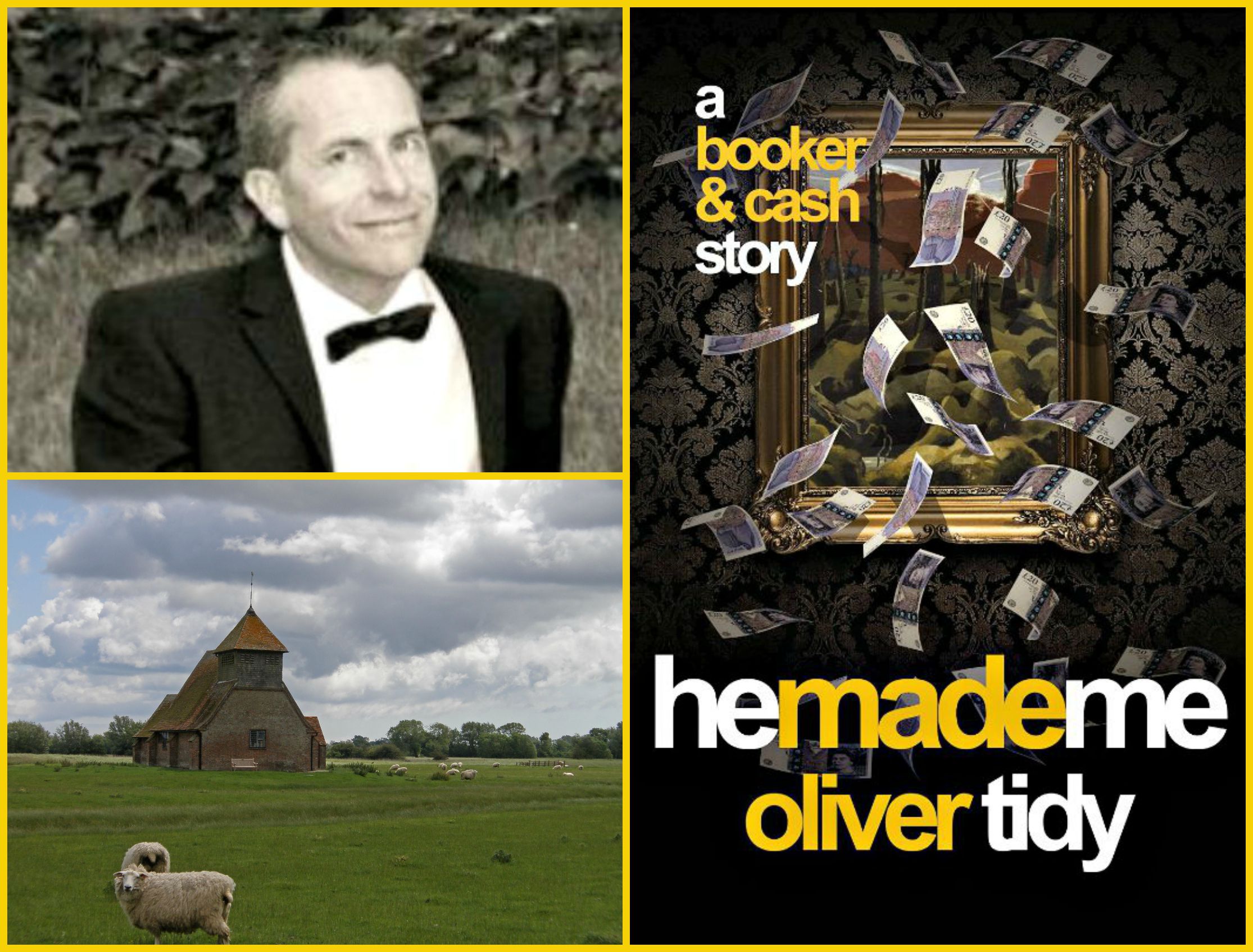
LOCATION, LOCUTION: Canadian writer Lee Strauss uses busy, multicultural Dresden as setting for romance

Location Locution_LeeStrauss

LOCATION, LOCUTION: JJ Marsh (left) talks to author Lee Strauss about the craft of setting contemporary romance novels in foreign locations.

In “Location, Locution” expat crime series writer JJ Marsh chats with fellow displaced fiction writers about their methods of portraying place in their works. Her guest today is contemporary romance and speculative fiction writer Lee Strauss. Born near Chicago to Canadian parents, Lee might have grown up a California girl had it not been for Vietnam, which caused her parents to retreat back to Canada. At age 22, she married Norm Strauss, a Canadian folk rock musician—and signed up for a life of adventure. They have traveled extensively overseas and live part-time in Germany.

—ML Awanohara

Lee Strauss is the author of the Minstrel Series, a collection of contemporary romance novels set in the singer/songwriter world, taking place in Germany and England; the Perception Series, a trilogy of young adult dystopian novels; and several works of YA historical fiction. Under the alter ego of Elle Strauss, she writes fanciful younger adult stories about time travel, mermaids and fairies.

Lee is the married mother of four grown children, three boys and a girl. Because of her husband’s job as an indie folk musician, she has traveled to twelve European countries, Mexico, fourteen states, and six Canadian provinces. Currently, the couple divide its time between Kelowna, a town in British Columbia’s temperate Okanangan Valley, and Dresden, Germany. When not writing or reading Lee likes to cycle, hike and do yoga. She enjoys travel (but not jet lag :0), soy lattes, red wine and dark chocolate.

Now let’s talk to Lee about how she has woven European settings into several of her books.

* * *

Which came first, story or location?

It was a simultaneous decision. My singer-songwriter husband and I spent some time brainstorming on how we could merge our two worlds, indie publishing collaborating with indie music artists, and the idea for the Minstrel Series was born. (Each of the books has accompanying music.) The first two books, Sun & Moon and Flesh & Bone, are song titles of music used in the books. We live part of the year in Dresden, Germany, and I just knew that the books had to be set there, right in our neighbourhood.

Minstrel Series Set in Dresden

Cover art from first two books of the Minstrel Series; (middle) view of Dresden’s historical center, from the same spot where Canaletto made his famous painting.

I’ve also written a WW2 historical novel called Playing with Matches, about a group of boys growing up in Hitler Youth. The story takes place in Passau and Nuremberg. Traveling to both cities made a huge difference in getting the setting and ambiance right.

Playing with Matches Collage

Clockwise, left to right: Cover art; Nuremberg citiscape; view of Veste Oberhaus, a 13th-century fortress in Paussau, in lower Bavaria, Germany.

What’s your technique for evoking the atmosphere of a place?

Nothing like living in the middle of it! The street and building in Dresden where we lived are featured in great detail in Sun & Moon and Flesh & Bone. Many readers comment on how they feel like they visited Germany while reading my books.

Which particular features create a sense of location? Landscape, culture, food?

All three. I share a lot of Dresden images on Tumblr, including not just landscape but also food and the local culture.

Can you give a brief example of your work which illustrates place?

Here’s a passage from the Minstrel Series, describing a scene in Dresden:

Katja stood in one of the cutaways on the old stone bridge over the River Elbe that joined the Altstadt with the Neustadt, the old city with the new.

She shivered despite her winter jacket and the scarf wrapped around her neck and strummed her guitar with fingerless gloves. The limestone dome of the Frauenkirche—the Church of our Lady—peaked out over the city’s ancient, baroque skyline. Like all the buildings in the historic center, it had been completely demolished during the Second World War. The entire city was rebuilt to look much like it had before it was destroyed. In essence, the old town was now the new one, and the new town the old one.

It was majestic and awe-inspiring to look upon.

Most days.

Katja’s guitar case lay open at her feet. She’d thrown in the few cents she’d found under the sofa cushions, hoping to lure other donations.

The cold wind kept people hunched over and moving at a fast pace across the bridge, most with chins tucked down and hands shoved into deep pockets. No one took the time to stop and listen, much less drop money in her case.

How well do you need to know the place before using it as a setting?

Spending time living there is the absolute best way. There’s so much you see and learn about a place over time. The second best is to visit in person. After that, talking to people who have lived or visited there along with research and Google Earth.

Which writers do you admire for the way they use location?

Maeve Binchy has a wonderful way of pulling the reader deep into Ireland. (My next book in The Minstrel Series will be set in Ireland and Boston, where I’ve lived.) Susan Grafton does the same for Southern California with her Alphabet Mystery series, set in the fictional city of Santa Teresa, based on Santa Barbara.

* * *

Readers, if this interview has piqued your curiosity about Lee Strauss and her creative array of fiction works, we encourage you to visit her author site.

JJ Marsh grew up in Wales, Africa and the Middle East, where her curiosity for culture took root and triggered an urge to write. After living in Hong Kong, Nigeria, Dubai, Portugal and France, JJ finally settled in Switzerland, where she is currently halfway through her European crime series, set in compelling locations all over the continent and featuring detective inspector Beatrice Stubbs.

STAY TUNED for the next fab post!

If you enjoyed this post, we invite you to register for The Displaced Dispatch, a round up of weekly posts from The Displaced Nation, with weekly updates and much, much more. Register for The Displaced Dispatch by clicking here!

Related posts: