The Displaced Nation

A home for international creatives

Tag Archives: France

And the July 2013 Alices go to … these 4 international creatives

 © Iamezan | Dreamstime.com Used under license

© Iamezan | Dreamstime.com
Used under license

As subscribers to our weekly newsletter know, each week our Displaced Dispatch presents an “Alice Award” to a writer who we think has a special handle on the curious and unreal aspects of the displaced life of global residency and travel. Not only that, but this person likes to use their befuddlement as a spur to creativity.

Today’s post honors July’s four Alice recipients, beginning with the most recent and this time including citations.

So, without further ado: The July 2013 Alices go to (drumroll…):

1) HELENA HALME, author and Finnish expat in London

For her latest novel: The Red King of Helsinki
Published: March 2013
From the book description:

Nordic Noir meets Cold War Espionage.

Pia’s ambitions to win a gymnastics competition between her Helsinki college and a school from Moscow trigger a set of dangerous events when her best friend disappears and a violent KGB spy, The Red King of Helsinki, threatens her. Will a friendly British ex-navy officer, Iain, be able to save Pia before its too late?

This fast-moving novel set in Finland has everything—a young, feisty protagonist, Nordic Noir and old-fashioned chivalry.

Citation: Helena, how could we not award you an Alice once we heard you’d written a story revolving around a Red King? While we do not know whether you purposely modeled your Red King of Helsinki on the Red King of Lewis Carroll’s Through the Looking Glass, it almost doesn’t matter. The point is, you present us with a classic through-the-looking-glass situation, having set the action during the Cold War and made your Red King into a Soviet spy. Will Pia/Alice checkmate the Red King with the help of that kindly British military gentleman? Or will she go out—bang—like a candle? No need for Tweedledum/dee to explicate. What’s more, you are the perfect person to take us on this particular fictional journey. With your thick blonde locks and acute appreciation for the curious and unreal in your adopted country, it’s not much of a stretch to dub you the Finnish Alice!

2) TRACEY CROKE, Manchester-born, Australia-based freelance journalist and blogger

Source: “A Pom versus the pests” in Telegraph‘s Expat Life
Posted on: 12 June 2013
Snippet:

Small self-amputating lizards dart out of my fruit bowl. Ants march in to weightlift a few missed crumbs off my floor. Possums push their cute limits with roof-dancing antics.

While the elusive ghost bug remains a mystery, large “harmless” spiders, innocent-sounding paper wasps and alien insects get the boot or get spiked by my neighbour’s stilettoes.

It’s just a few of the ways to deal with uninvited houseguests in the subtropics.

Citation: Tracey, your description of the critters of Aussie-land is almost as fascinating as Alice’s account of Wonderland’s inhabitants. In fact, in many ways it sounds as though you have it worse than Alice, who at least didn’t have lizards and hairy hunstman spiders to contend with, though she did have the Caterpillar. Still, on the plus side, you’re lucky that these various creatures do not interact, apart from the Hunstman spiders, that is, who like to eat cockroaches and geckos. Poor Alice, in watching a large plate come out of the door of the Duchess’s house and graze the nose of her footman, couldn’t help but mutter to herself: “It’s really dreadful, the way all the creatures argue. It’s enough to drive one crazy!”

3) STEPHEN CLARKE, an Englishman who grew up in Bournemouth and now lives in Paris; author and Telegraph Expat blogger

Source: “If you listen carefully, you can hear French cheese breathing,” in his Telegraph Expat blog
Posted on: 6 July 2013
Snippet:

A friend sent me the link to a BBC report about American food officials declaring French cheese “filthy” and inedible. The funniest thing was that it was Mimolette, a hard Edam-like cheese that even I as a Brit find a bit bland. It’s usually sold in small semi-circular slices with a curve of rind, or the kind of rectangular rindless blocks that you would think the Americans might enjoy. It’s the last cheese you would expect to get an import ban.

Citation: Stephen, we agree with you that anything bland does not deserve an import ban. For Alice, the most objectionable food in Wonderland was the Duchess’s soup, which had so much pepper that she, the Duchess, and the Duchess’s baby couldn’t stop sneezing. That would hardly do for a roomful of customs officials! Also, since you did such a good job in writing about cheese, we hope you will write about mushrooms next—a food close to Alice’s heart, and also, we believe, very important to the French. Only, do they have any varieties that can alter one’s size? (As long as they don’t alter speed, Americans may not object…)

4) TORRE DE ROCHE, Australian-American TCK and author

Source: “Blogger to Watch: Torre de Roche talks about her journey to big publishing deal”: interview by Jade Craven on ProBlogger.net
Posted on: 22 June 2013
Snippet:

Art is uncertain. Sometimes, in order to feel the delicious comfort of certainty, you might try to make art while grasping onto some idea or technique that seems safe. If you do that, your writing will come out stiff and contrived because you’re not creating, you’re imitating.

Loosen your grip. Let go of control. Embrace the freefalling sensation of having no idea where you’re going with something.

Good art comes from risk, experimentation, and play.

Citation: Torre, we love the way you took your own advice and embraced the free-falling sensation of having no idea where you were going when you fell for a handsome Argentinean man with a humble sailboat and agreed to join him in pursuing the dream of setting off to explore the world, this despite your morbid fear of water. You’ve had a series of adventures to rival Alice’s. Also like her, you’ve lived to tell the story for subsequent generations of wannabe free-falling adventurers, via both your highly successful blog, which you aptly refer to as a “literary potluck party, Mad Hatter style,” and now memoir, Love with a Chance of Drowning. Kudos!

* * *

So, readers, do you have a favorite from the above, and do you have any posts you’d like to see among August’s Alice Awards? We’d love to hear your suggestions! And don’t miss out on these weekly sources of inspiration. Get on our subscription list now!

STAY TUNED for tomorrow’s post!

Writers and other international creatives: If you want to know in advance whether you’re one of our Alice Award winners, sign up to receive The Displaced Dispatch, a round up of weekly posts from The Displaced Nation, with news of book giveaways, future posts, and of course, our weekly Alice Award!. Register for The Displaced Dispatch by clicking here!

Related posts:

Meet author Rosie Whitehouse, who trailed her spouse into a war zone (and enter to win her book!)

Rosie Whitehouse CollageOne of the expressions I picked up from living in England for many years is “Keep the home fires burning.” For some reason, that expression, along with the WWI song from which it comes, is running through my head as I contemplate talking to today’s featured author, Rosie Whitehouse (click here to hear it being sung):

Keep the Home Fires Burning,
While your hearts are yearning.
Though your lads are far away
They dream of home.
There’s a silver lining
Through the dark clouds shining,
Turn the dark cloud inside out
Till the boys come home.

For me, Rosie is an up-to-date version of what the songwriters had in mind. Educated at the University at London, with a career as a BBC journalist, she chose to stay at home with her children and keep the house warm and welcoming, and the family’s spirits up, while her husband, the journalist Tim Judah, went off to report on various wars for The Economist and other newspapers.

Rosie even went the further step of moving the family home to be closer to Tim for a time. Ironically, she kept the home fires burning in the very place where World War I began, the Balkans. She flew out to a crumbling Bucharest—it had been knocked down by the notorious Ceaușescu, whose secret police killed hundreds during Romania’s 1989 revolution—with one child in tow and another one on the way.

Then, when it seemed possible that her own home could go up in flames as war spread across the former Yugoslavia, Rosie did not give up. She stayed for a total of five years before returning to London, by which time “keeping the home fires burning” was second nature both for her and the couple’s five kids (Tim carried on covering wars in Iraq, Afghanistan, and the Congo).

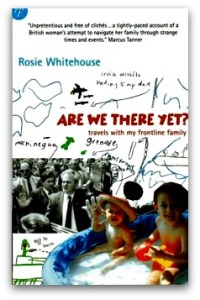
Having revived her career as a freelance journalist, she decided to write her first book: Are We There Yet? Travels with my Frontline Family—a copy of which we’ll be giving away! (See details below). The book is a tribute to families who have been “burners of the home fires,” whose emotional pain tends to go unheralded. It is also, in her words, “quite funny.” (Hey, growing up in Bucharest, Belgrade, Croatia and Bosnia can be fun!)

By now you must be as curious as I am to meet the intrepid Rosie Whitehouse and learn more about what motivated her to seek out such an unusually displaced (at least by most of our standards!) life. I note that she has an Irish mother—perhaps that explains it?! (I’m thinking Queen Boudicea…)

* * *
AreWeThereYet_cover_dropshadowHi, Rosie. In your book you say that your husband’s journalist colleagues in Romania, all of whom were single, were shocked to hear he had a two-year-old son and another child on the way. Did people often tell you you were crazy?
Yes, lots of people thought I was crazy.

As a former journalist with a background in Russian studies, do you think you felt a tinge of envy for Tim’s opportunities—which made you want to be on the scene?
Not really, as I would not have been able to cope with going to morgues and so on.

I know you’re going to challenge our definition of “displacement,” but I’ll go ahead and ask: what was your most displaced moment during your stay in the Balkans—when you had to explain Daddy’s muddy boots (he’d been walking in a mass grave), when you visited empty supermarkets, or when you heard the first shots of the conflict in Bosnia while strolling around Sarajevo with the kids?
Those things were reality so in that one doesn’t feel displacement. Quite the opposite in fact. I was intimately plugged into life and death at those moments.

How did you keep yourself sane?
I coped with stressful moments by bunkering down. I wouldn’t send the kids to school and cuddled up with them instead. As long as I shut my front door, where ever I am and whatever is going on, and it is just us, I am able to feel at home.

But getting back to your question about displacement: My best moment in a foreign country was when I saw my mother drive off in a taxi in Bucharest and realizing that apart from my two year old son I didn’t know a soul in the country (my husband was away in Albania for weeks). Wow, at last no one to tell me what to do! Freedom!

More seriously, most displacements do not happen by choice, and my most displaced moments have been as a result of this. I recount a story in the book when I took the kids to Berlin ten years ago. My mother-in-law was born there but fled in 1933 as she was Jewish. The family settled in Paris. As a result I have half French children who speak fluent French and we don’t speak a word of German.

It was a rather stressful visit as we searched for old family homes, one of which the family were still trying to reclaim. My daughter Esti got a headache. I pointed to the department store and suggested that we go in to buy an aspirin. It was Wertheims. My mother in law’s mother was a Wertheim and was murdered in Aushwitz. Esti said:

What, first they give me a headache by stealing the department store and murdering my great granny–and now I am expected to go in and buy an aspirin to make it better? You have to be kidding!

That’s displacement.

Child-rearing on the frontlines

What was the biggest challenge about having children with you on the frontlines?
The biggest challenge was often the simplest thing such as getting them something to eat and getting hold of baby milk.

Did anything surprise you?
Life never ceases to surprise me where ever I am and what ever is going on. The terrible things and the good things always amaze me.

What do you think the kids got out of the experience?
The kids learnt a lot. My eldest son, Ben, would ask about why there was no food in Romania. For me it was a matter of telling simple tales of communism and 1917. For him it began a life-long interest in Russia. He is following in his father’s footsteps.

My eldest daughter, Esti, would like to work for an NGO like Human Rights Watch.

For all of us, it drew us closer together. We are a tight-knit family.

I’ve heard of war reporters feeling bored when they come back to “reality” in their home countries. Did your family experience any of that after five years in the Balkans? What was it like to go “home” again?
Going home is just as difficult as moving to a new country. By the way, the wars didn’t stop either after we got back. My husband has since covered lots of wars and famines including Afghanistan, Iraq and the Congo.

Writing a book, but from the backlines

After you left the Balkans, it took quite a few years before you decided to write the book. What was the catalyst?
It was during the invasion of Iraq in 2003. I was standing in the supermarket and they had just installed a TV with a live feed from Iraq by the checkout. Some soldiers were running across a street in Basra, where some of the heaviest fighting took place, followed by a reporter and camera man. All of their faces were clearly visible. My husband was in Baghdad covering the story for The Economist. I had actually popped out for five minutes of fresh air before the bombers took off from the UK and the countdown to the blitz on Baghdad began.

I realized, to my horror, you could be buying a packet of frozen peas and watch your husband killed in front of your eyes. I know this thought had never entered the mind of the supermarket manager who had simply installed the TV to attract customers.

That evening I found my ten-year-old glued to a grainy grey screen showing an image of Baghdad as the cruise missiles were expected. What do you say? I had to make dinner and she had to do her homework. The UK had a huge debate about the war and the way it was covered, and I felt nobody knew what it was really like to be part of it and a kid to boot.

I also found that very quickly after the Berlin Wall came down that people forgot in Western Europe just how hard life had been under communism, especially in Romania and Albania. No surprise in that, really, as since 1945 most people in Western Europe just forgot the East existed.

I also found people in the UK quick to judge and condemn people in Southeastern Europe as being violent and prone to war. I wanted them to realize we are no different. That is why I’ve also included a chapter on Ireland in the book.

And I wanted to describe the multicultural experience of bringing up half-French, half-Jewish, part-Irish children in various countries, something I found fascinating.

Was it also part of your mission to show others what it is like to be married to, the child of, a war reporter?
Yes, not just to a war reporter but also those who are married to soldiers—especially those who are part-time soldiers and live in the community.

Did you have any personal motives in writing the book, to help you process what you’d been through and to provide your children with a record of where they’d lived?
No, not really. I didn’t write it for us but to make people think about what was going on. I am sure that the kids will appreciate it when they are older.

What was the most difficult part of the book-writing process?
Getting time to do it. I often wrote with my computer on the kitchen side as I was cooking dinner, which was good as I could hear kids talking; and as I was writing about them, it helped to have them there doing their thing.

Did you find it easy to find a publisher for the book?
No it was hard. publishing is a tough business. I started my own publishing company, Reportage Press, which closed a few years ago. Are We There Yet? is on Amazon as a self-published download these days. We also have a number of journalist friends who are taking the self-publishing route quite successfully.

What audience did you intend for the book? Did you think it would also appeal to other kinds of expats, who don’t go to war-torn countries?
Yes, there is a large expat element to the readership, and I know the book has touched the hearts of women feeling lonely and bewildered in a new country. I have been hugged and kissed by quite a few of them. One lady said reading the book had saved her marriage. I’m not sure it was me, but I hope I helped her realize it wasn’t so bad being lonely in London. It is hard being in a strange country with children. It is you who have to interpret it for them and as you are far from the family support group and friends, it is inevitably all up to you to be their world. It’s a tough job. That said, the book is far from serious. It’s actually quite funny.

Can you give us some examples of humorous moments in the book?
The kids are a laugh a minute, so whatever was going on they would often say or do something funny. For example:

For me the market in Piaţă Amzei is the focal point of life in the city centre [of Bucharest]…

“Let’s see the old ladies with the cheese. Come on!” shouts Ben as he darts out of the pushchair and into a smelly covered hall, where they sell heaps of yellowy looking curds, which are akin to feta.They are covered in flies.

The old women with their long black skirts and headscarves beckon him over and offer him little crumbs. He watches their lips and toothy grins with fascination. They look unnerving, like witches with crunched up dirty teeth, but he doesn’t run away. He has come deliberately to stare at them. He studies an old lady’s face carefully as she says something he can’t possibly understand. He is like his father, never frightened of anything and intrigued by the smallest thing. He loves the bizarre and the quirky.

* * *

“Where’s Mr Parking? Why doesn’t he find us a space?” asks Ben as we drive up and down the street outside our flat. Ben loves Mr Parking. I can’t see him anywhere.

Mr Parking is the man who organises the parking lots outside Belgrade town hall. It’s an elegant 1880s building that was once the royal palace and is right next to our block of flats. For a tip, he lets us park in the lots reserved for local officials. I haven’t seen him for weeks and have to be careful where I put the car, or we’ll be towed.

“I think he has gone back to Bosnia to fight, Ben.”

“What!” Ben is horrified.

“Why? I want to park the car. Doesn’t he want to stay here?”

“No, I expect he wanted to go home and defend his village.”

“Where is his village?”

“He’s from eastern Bosnia, the bit between here and Sarajevo [Bosnia’s capital city]. He told Dad he comes from Kamenica. It’s in one of the last bits there that’s still under Muslim control.” It’s a village close to the town of Srebrenica [the town where a massacre took place in 1995, said to be a crime of genocide].

“What! He’s a Muslim?” Ben is amazed: “But he looks like everyone else!”

“Of course, he does! You don’t look different if you’re Muslim. Bosnians look the same whether they are Muslims or not.” My mother has just sent him a book about the Crusades.

“I thought Muslims looked like Arabs.”

Are you working on any other ambitious writing projects?
I would like to write an expat guide to Britain. I spend a lot of time explaining Britain to people as I live in an expat world in the UK to a certain extent as my children have been or go to the French Lycée, and we have a lot of foreign friends who live in London.

Ten Questions for Rosie Whitehouse

Finally, I’d like to ask a series of questions that I’ve asked some of our other featured authors, about your reading and writing habits:
1. Last truly great book you read: Malaparte is on my mind as I am driving to Ukraine. His book on the 1941 invasion of Russia is unforgettable.
2. Favorite literary genre: Novels
3. Reading habits on a plane: Nothing. I am too tense on a plane as I hate flying. If I am calm enough I love to look out of the window.
4. The one book you’d require President Obama to read, and why: My son Ben’s book on Russia: Fragile Empire: How Russia fell in and out of love with Vladimir Putin. It’s a great portrait of contemporary Russia. I am his mum—what else am I supposed to say to this one?
5. Favorite books as a child: I loved Little House on the Prairie but above all I loved the stories my dad used to tell me.
6. Favorite heroine: She doesn’t have a name. She is one of the millions of women who have struggled to keep their families together against the odds. These are the mums who keep the world turning.
7. The writer, alive or dead, you’d most like to meet: I always wanted to meet William Shirer. He must have had an extraordinary experience living in Berlin at the start of World War II. Perhaps the ultimate expat experience! I suggested an interview programme with him to BBC World Service in the 80s but they didn’t have the cash to send me to America to do it. A pity as he died after that.
8. Your reading habits: I read a lot. If you want to write you have to read. I also have to read a lot for work.
9. The book you’d most like to see made as a film: None, really. If you love a book, the last thing you want is for it to become a film as you have the pictures in your head and they are your pictures not someone else’s.
10. The book you plan to read next: Vasily Grossman‘s An Armenian Sketchbook is in my suitcase. I love Grossman. He is a fantastic writer. If you haven’t read Life and Fate, you have really missed out.

* * *

Thanks so much, Rosie! Personally, I found your story very moving and think we should confer on you a “home fires” medal for all you’ve achieved!

Readers, it’s time for you to ENTER OUR DRAW TO WIN A FREE COPY of Rosie Whitehouse’s book. Rosie is giving away ONE COPY and will favor comments that tell her why you’d like to read the book.

Extra points, as always, if you’re a Displaced Dispatch subscriber!

The winner will be announced in our Displaced Dispatch on August 2, 2013.

Rosie Whitehouse is a parenting journalist and mother of five. She is one of the UK’s leading experts on family travel. She has written widely on family matters and traveling with children for The Sunday Telegraph, The Independent, The Guardian, The Daily Mail, Sunday Express, Family Circle, The Economist, and others, as well as for the Web sites B4Baby.com and Raisingkids.co.uk. She has also spoken at events and on television and radio on parenting matters, promoting her travel books and her autobiography, Are We There Yet? Travels with my Frontline Family. You can follow her latest adventures at http://www.rosiewhitehouse.co.uk/.

STAY TUNED for tomorrow’s post in our Olde vs New World series, by guest blogger Claire Bolden.

If you enjoyed this post, we invite you to register for The Displaced Dispatch, a round up of weekly posts from The Displaced Nation, with seasonal recipes, book giveaways and other extras. Register for The Displaced Dispatch by clicking here!

Related posts:

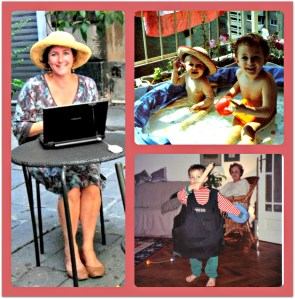
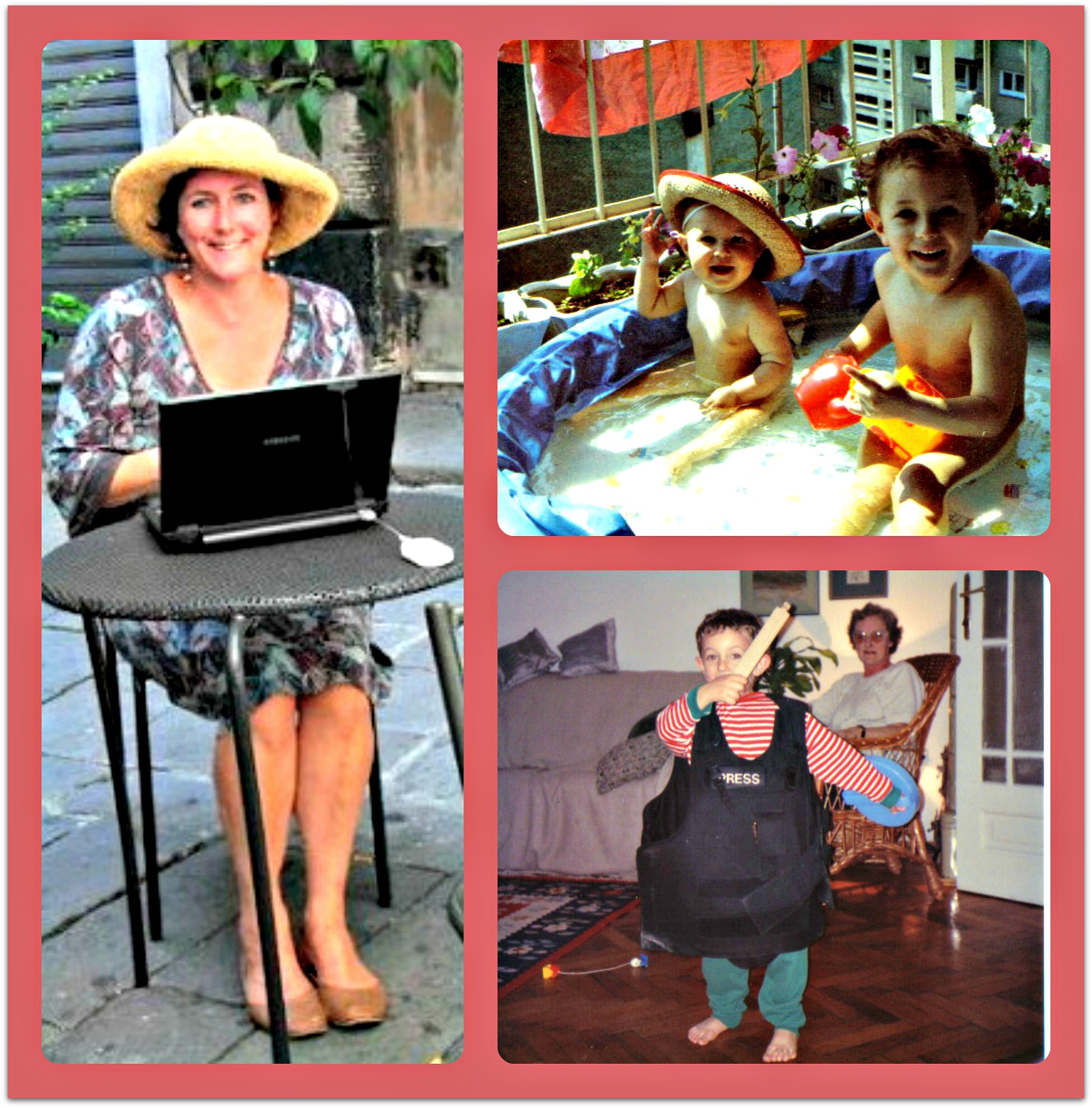
Images (clockwise from left): Rosie Whitehouse at “home” in London; Ben and his baby sister, Esti, living it up on the balcony in Bucharest (July 1991); Ben trying on his dad’s new bulletproof jacket, with Rosie’s mother in background (Belgrade, May 1992).

GLOBAL FOOD GOSSIP: Pastry or pie dough? Whatever you call it, it’s child’s play.

JoannaJoanna Masters-Maggs, our resident Food Gossip, is back with her monthly column for like-minded food gossips.

This month, Joanna comes clean about the reasons for her dissatisfaction with the world today. Who knew that pastry (that’s pie dough to Americans) could be such a contentious subject?

* * *

You know how it is when you have known someone for a while.  Not long, but a while.  Things are so pleasant, and positive and fun, you can’t imagine ever getting irritated with them.  Then one day, you just are.  I’m afraid, my darlings, it is the day of revelation of a certain grumpiness in my personality.  A grumpiness that I usually do backbends to hide, but now I feel our relationship demands a little more honesty.

What on earth, you must be asking, could make Sunshine Lady feel less than, well, sunshiney?  Well, if you must know (and you know you must)  — it’s the sad state of the world’s flaky pastry.  We have come to a point in our culinary evolution where we have all but lost respect for the art of pastry making.  Supermarket shelves are heaving with the frozen stuff, and ready-made pie-crusts are to be found in abundance.  Marie-Antoine Carême, that French master of the art of the Mille Feuille  or thousand leaves of pastry, must be turning in his grave like a poorly controlled rotary whisk. That his peaceful rest is being tampered with can only make me feel justified in my fury.

Child’s play (doh)

Flaky pastry is a subject dear to my heart.  I first learned the rudiments of the art at the tender age of 12.  It was the pinnacle of a year’s pastry training.  We began with scones, worked up to shortcrust, then rough puff or cheat’s flaky, and then to flaky.  By the age of 15 or 16 we were all capable of producing a three course meal which included bread, a béchamel or similar sauce and pastry from scratch in a space of but 2 ½ hours.  Having survived this exam it’s difficult to be impressed by the stresses of Masterchef, or indeed the controlling of flight patterns at Heathrow. I may be exaggerating with the Air Traffic Controller bit, but I stand by my comments on Masterchef.  You see, flaky pastry wasn’t even the star of the show, it was just a skill to be demonstrated alongside the rest — in a very short space of time.

Nowadays, I like to make a day of my pastry making.  I download some good Radio 4 programmes to listen to.  In Our Time with Melvyn Bragg always hits the spot, and I take far longer than 2 ½ hours to make a large batch to use and freeze.  I find the rolling, addition of butter, folding and rolling, a therapeutic, meditational and endlessly gratifying process.  Best, is that the end, the product, homemade, without additives and addictively light, is without parallel.

I’ll repeat that. Homemade pastry is without equal — and I dare to write that, albeit behind locked shutters, in France.

A pastry protest

A few years ago I cancelled my subscription to BBC Good Food magazine.  It was in protest against their increasingly habitual calls for frozen pastry in their recipes.  Not “or you can buy some frozen pastry if pushed for time”, but brazenly, “2 sheets of good frozen pastry” as if it was the most reasonable thing in the world.  “Good frozen pastry” should be a shocker of an oxymoron to anyone who takes their food even halfway seriously.  For heaven’s sake, that their readers bought a magazine with the title “Good Food” suggests not only they have an interest in GOOD Food but that they might be open to the gentle suggestion they make their own pastry?  Indeed, BBC, it is possible that they expect to make their own pastry and require a recipe for it?

If I am wrong — and in this mood it’s hard to own the possibility — might I politely suggest the title is renamed BBC  OK, But Not Quite Good Enough FoodBBC Good Food is not the only transgressor, of course, but it is the only magazine for which I had a subscription and thus the opportunity to register my grievances.

French frozen pastry — it’s got to be better, right?

I can understand why you would buy pastries from a patissier here in France.  A qualified patissier is well-trained and takes a pride in being in the van of pastry production.  A patissier’s products are worlds away from frozen products mass-produced in some factory on the outskirts of Dijon. I believe the patissiers of France share my outrage at the frozen product of which I speak.  (Surely, surely they must?) 

In the spirit of fairness and a desire to appear reasonable, I decided to try a few samples of available frozen pastry here in France.  The stuff has taken over in the same depressing way the Nespresso machine has sidelined truly great coffee, and the world seems to be willing to accept mediocre as long as it is reliably so.

I tried to pick out the pure butter pastries or the ones that advertised themselves as Granny’s best, as if I were a BBC Good Food reader searching for two good sheets.  I took them home, baked them, carefully labeled them to avoid mix-ups and then herded my four kids into the kitchen for the taste test.   I had some misgivings about that last part.  They can be annoying at times, but they are my own, and by now, I had read the ingredients on the packets.  Despite the promises of “sans additives” and “pur buerre” I was perturbed by some of the contents. What flavourings do you need in a butter pastry other than butter itself ?  As for Granny, well — she evidently swapped the butter for palm and sunflower oil, and spent the savings on gin.  She certainly wasn’t sober when she made the thick and flabby batch I sampled, which cooked up into an oily mess.

Happily the kids survived, and the general consensus was that the pastry samples were all “OK” — just not very tasty.  Generally, the pastries rose into crisp puffs with an empty hollow where 947 leaves would have been expected. But OK, I take the point that not all of us have the time or inclination to spend a day listening to Melvyn in the kitchen, no matter how divine he might be.  If that is your case and pastry-making is a bother to you, I think it would be better to whip up a simple bowl of pasta or salad with some nice bread and forget about the quiches and tarts.

Homemade — it really is best.

Mass produced, marketed, and well-travelled frozen flaky pastry doesn’t have a hope in hell of bettering anything made at home. If you are going down the frozen route, just be sure to read the packets carefully.  Even some of the pure butter brands slip in various extras and a great deal of salt, if my raging thirst that night was anything to go by.

But stop!  Why issue advice on how to buy this stuff?   The top advice is to get into the kitchen and discover that most of the hours involved in making this kind of pastry are actually spent waiting for it to chill in the fridge between rollings.  An ideal time for a cup of tea or a glass of rose – and you’re still, technically, ‘working’.

It’s a win-win situation.

“If a  Bunch of 12 year Old Girls Can Do It, So Can You” Flaky Pastry Recipe

IMG_0091I can’t accept any credit for this recipe. It’s the first I learned.  Since then I have tried many other wonderful recipes and many methods of making flaky pastry, but this one is delicious and reliable.  The lard gives the pastry the short crispiness which one should demand in a flaky pastry, while the butter gives the flavor.  Lard is fat from the stomach of the pig.  It is clarified for use in much the same way as ghee is clarified.  If you are American, you might well be asking if Crisco is lard.  The short answer is “no”.  Crisco is vegetable based and lard is an animal fat.  Neither should be eaten in vast quantity, but at least lard is natural.  Use Crisco if you will, but use lard if you want excellence.

I should have mentioned that if you are worried about the fat content, you are in the wrong place.  It’s the fat that gives the flavour and texture.  If you are unhappy about it, go and buy a lettuce.

You will need:

  • 225 g plain flour pinch of salt
  • 80 g lard
  • 80 g butter      (blend both fats together and chill well)
  • Chilled water — about 120 mls
  • Dash of lemon juice

Rub a quarter of the fat into the flour and salt.  Then slowly add enough chilled water (about 120 mls) with a dash of lemon juice to bring the mixture together into a messy ball.  Now roll out into a rectangle shape about the size of a brownie pan.  Use a knife to score lines 1/3 and 2/3 down.  Use about a ¼ of the remaining butter to “dob” over the top two-thirds.  Fold up the bottom layer and down the top layer to form an envelope.  Turn the dough around to the vertical and repeat the process twice, but without butter.  Wrap in cling film and chill for 10 minutes.

Repeat the process until you have used up the remaining two quarters of fat. Wrap well and chill for at least an hour.

After the first few rollings you will find this pastry very easy to handle.  That’s the thing about flaky pastry, despite its reputation — it is very easy-going.

You can use this basic flaky for any recipe that calls for frozen pastry!  I love to make beef pies with it, but it is equally useful for sweet recipes.

Once you have mastered it, you can start to explore other methods.  This, though, is a good start..  Do try it and, please, never go back to frozen.   I hope that my work is done here.

Joanna was displaced from her native England 16 years ago, and has since attempted to re-place herself and blend into the USA, Holland, Brazil, Malaysia, Venezuela, Saudi Arabia, and now France. She describes herself as a “food gossip”, saying: “I’ve always enjoyed cooking and trying out new recipes. Overseas, I am curious as to what people buy and from where. What is in the baskets of my fellow shoppers? What do they eat when they go home at night?”

Fellow Food Gossips, share your own stories with us!

STAY TUNED for tomorrow’s post!

If you enjoyed this post, we invite you to register for The Displaced Dispatch, a round up of weekly posts from The Displaced Nation, with seasonal recipes, book giveaways and other extras. Register for The Displaced Dispatch by clicking here!

Related posts:

Images: Joanna’s daughter, Catherine, proving that even 11-year-olds can make flaky pastry


For travel & shutter bug Ildrim Valley, a picture says …

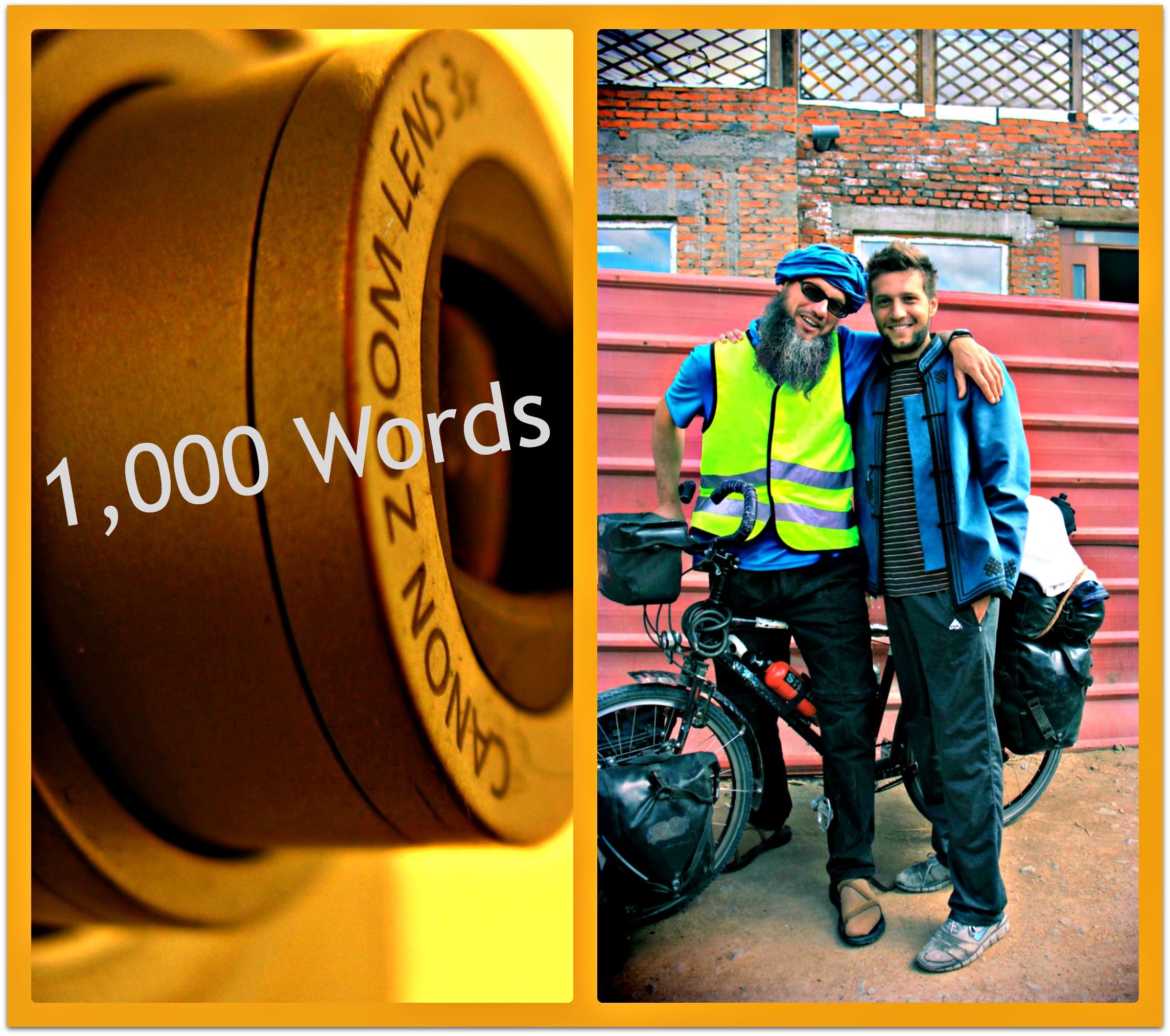
Collage_1000words_Ildrim_dssWelcome to our new series: “A picture says …”, featuring interviews with displaced creatives for whom a camera is a mode of artistic expression for the sights and people they encounter in their nomadic wanderings.

To kick off the series, I have the pleasure of conversing with Ildrim Valley, an intrepid adventurer who is also an economist(!) and travel photographer. It is, of course, this last point we’ll be focusing on, so to speak…

But first a few of Ildrim’s vital statistics:

Place of birth: Baku, Azerbaijan
Passports: Canada; Azerbaijan
Overseas history: From least to most recent: Azerbaijan (Baku); Switzerland (Geneva); Kenya (Nairobi); Canada (Vancouver, British Columbia); Hungary (Budapest); France (Toulouse)—2012 to present.
Occupations: Graduate student of economics; travel photographer; amateur snowboarder; adventurer!
Cyberspace coordinates: Curious Lines (photography blog)

Without further ado, let’s find out more about Ildrim and the way he uses photography as a creative outlet for his international adventures.

Peripatetic from an early age

Hello there, Ildrim. Welcome to the Displaced Nation. Let’s begin by having you tell us a bit about your travels. What inspired you to set off and what has motivated you to keep on going?
My first travel experiences come from traveling with my mom and brother. My mom is eager to change her surroundings, so thanks to her I was lucky to move around and travel early in life. At an early age I’ve been amazed at how life can be so different for people elsewhere than my hometown.

I think that this early fascination developed into a strong curiosity about lifestyles. Now that my mom no longer takes me on adventures (she gets herself into trouble without me!), I try to find my own means of traveling and satisfying my curiosity about places around the world.

You are a self-described adventurer. Do you prefer going and going, or do you sometimes settle in one place for a time?
As I travel more, I realize that it’s not just about seeing a new place that excites me the most. As fun as it is to keep going and going, simply being somewhere new isn’t always satisfying. Settling somewhere for a time gives me an opportunity to live through something different and possibly understand it.

I understand you recently moved to Toulouse, France?
Yes, I moved to Toulouse in September 2012 for graduate school. I felt like grad school would open a few doors to pursue some of my other interests, and it presented a fairly easy way to move to another country. So I set out to look for good schools around the world that fit my background as well as academic interests. At the time I was interested in southern Europe, and Toulouse offers the right kind of balance: it’s a great school with welcoming people and fine landscapes to be explored. Plus an opportunity to finally master French was very appealing—though I have to say I’m not doing a very satisfactory job so far.

On your photography blog, Curious Lines, you say:

Photography for me isn’t just an art form, it’s a way to share experiences.

When and why did you start using DSLR cameras?
I got my first DSLR in 2010, shortly before moving to Budapest. I got it in order to document the move.

Does the process itself of capturing a place or moment affect the relationship you have with that place? For example, does capturing a good set of photos increase the fondness you have for that place?
The process of capturing a moment does affect the way I experience a place, which in turn affects my relationship with it. But how I feel about a place has a lot to do with how I feel about the people from that place. So when I spend enough time in one spot, I get to meet people and build relationships. However, when the stays are short, the camera has a more significant role as it facilitates a connection with others. It helps me get a reaction, an emotional response—a smile or maybe a conversation.

But it’s important to point out that in some places around the world, carrying a camera can have a negative affect. People are fast to judge you on how you look. In Kenya, for example, I have a lighter skin tone, which results in the locals treating me differently, not necessarily in a positive way.

Likewise, having a large camera around your neck or in your hand will send a different signal and will be interpreted in a different way depending on where you are in the world.

I would just like to add that one way in which camera affects my experiences is that it taught me how to look at things differently without a lens. It helps me appreciate things differently and it’s important to know when to put the camera away and enjoy things with your own eyes. It’s easy for me to get sucked into continuous photo taking when I’m in a new place. Though I enjoy it, there are still other things to be enjoyed behind the lens, which is even more true when you’re traveling with someone else. But it doesn’t have to be one or the other; with time I’ve been learning how to balance the two.

For me, the camera has to be an extension of the adventure and not the purpose for it.

Looking back on all the places where you’ve taken photos, which have been your top three favorite places to shoot?
Although my opinion changes with time, my top spot for now is Mongolia. Last year I spent about a month there. The people and their lifestyles around the country fascinate me. The landscapes are pure and surreal. When you have such a keen interest and curiosity about your subject, shooting becomes that much more enjoyable. I’m actually redesigning my Website to present more content via other channels than a blog. One of the new sections will be about my experiences in Mongolia. The other two places that I love for photography are coastal British Columbia and Croatia.

An eye for the London Eye

On your blog you also say:

Once I started using a DSLR I’ve realized that scenes that come out on my computer screen don’t reflect the whole beauty of the moment. They don’t transmit the same type of emotion I felt standing behind the lens. So I tried and am still experimenting with different techniques to bring myself and others closer to how it actually was, at least in my mind. I don’t always try to achieve the most “realistic” looking photos, but rather try to transmit the feeling of the scene.

the-london-eye_dropshadowI notice that one of the techniques you’ve used is High Dynamic Range Imaging (HDR), an example of which can be seen in this striking image of my hometown London (original here)—by the way, you’ve now made me feel a little homesick! Tell me a little about HDR and how a novice photographer like myself can go about trying to achieve similar effects with a DSLR camera.
I have a very basic example of what High Dynamic Range (HDR) does in one of my blog posts. In a nutshell, cameras don’t capture the range of light the same way our eyes do. Our eyes adjust to both bright and dark spots in the same scene while for cameras it’s always a trade off.

HDR photography allows you to capture more light by taking multiple shots of different exposures. I take three: one normal, one overexposed bright photo, and one underexposed dark photo. By combining these three shots together you get a higher range of light information available to play with. Some people take five or even seven photos, but three is enough in most situations.

To achieve this HDR effect, I take my three shots bearing these points in mind:

  • The auto-bracketing option on modern-day cameras helps you take three photos with a single click.
  • Set the camera on Aperture priority mode (“AV” or “A” on most cameras) to have the same aperture and depth of field in all three shots.
  • Ensure that the three shots are as identical in composition as possible. A tripod could be useful. (The surroundings or simply holding your breath will do in many cases.)
  • Use software* to combine all three shots together and then let your imagination take charge.

*Some of the most popular softwares are Photomatix Pro, HDR EFEX PRO and HDR Darkroom. Then there are options like Luminance HDR, which is free (open source) but will take some time getting used to. Whichever software you choose, it will help you combine all this light information into one image. Then it’s almost always a good idea to take it into your preferred photo editing software and continue working as you would with any other photo.

People pix

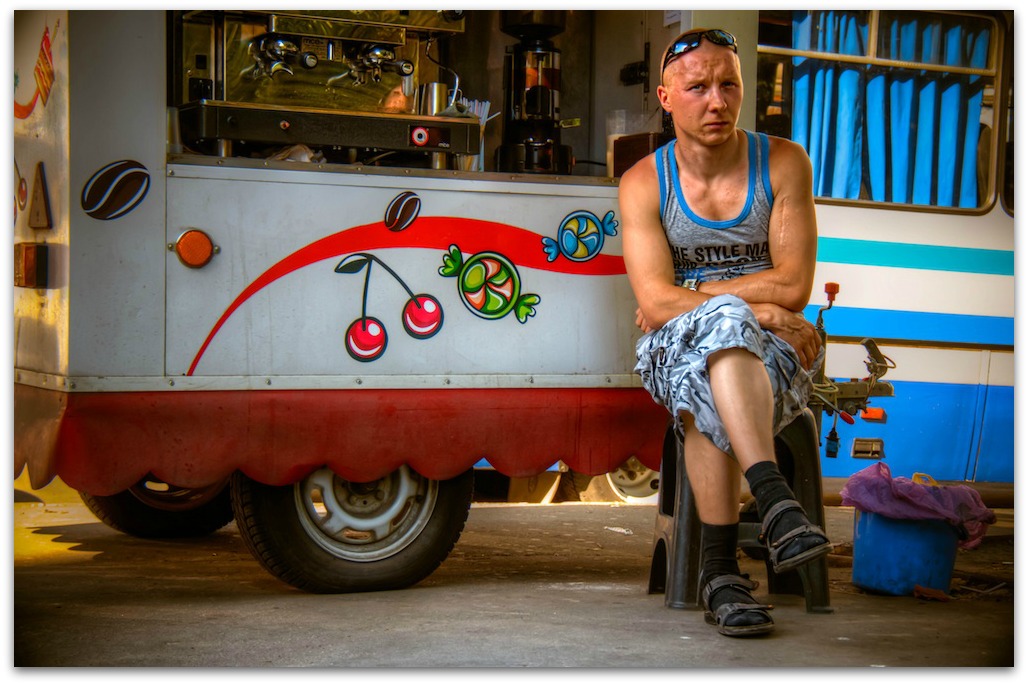
Streetvendor_drop shadowTell me about this recent photo you took of a street vendor in Kiev (original here). How did you find yourself in Kiev?
I was on a long earthbound trip in 2012 from Budapest to Hong Kong, which took me through Kiev.

How did you come across this street vendor? Did you converse with him before taking his photo?
There was no verbal communication. Rather, I nodded at the guy while moving the camera in my hand slowly, indicating that I wanted to take his photo. His face was blank in acceptance so I went ahead and snapped the photo.

Do you always try to try get permission from people when trying to take a photo?
I prefer to ask for permission, but sometimes it’s the spontaneity that makes the photo and asking would yield a different result when they prepare themselves for the photo. Either way, I make sure the subject knows I’m taking their photo.

Is it difficult to obtain permission when facing a language barrier?
It’s important to learn how to communicate with your facial expressions and your body as well as being able to read others. In my experience, regardless of whether your communications are verbal or non-verbal, the more confident and subtle you are, the more likely you are to get approval.

One thing about the street vendor picture that really stands out for me is the boldness of the colors. Can you tell me why and how you set up the shot like this?
Initially, I tried to achieve an effect that would provoke an emotional response akin to the one I had in that moment. A new environment can be emotionally overwhelming—a feeling that can be difficult to capture. First impressions are special. So when I first started editing it was the exaggeration of colors that made me feel the closest to “re-experiencing” the place. Although you can never really re-live the moment, you can come up with something that reminds you of it.

In a way it’s like when a friend tells you a “you really had to be there” story—and exaggerates the details to make the point. It’s not that the true story needs any exaggeration to be interesting, but you need to have the exaggeration to translate the feeling.

Many of these aspects of photography are, of course, a matter of experience and taste. Believe it or not, my earlier photos were even more color crazy. With more experience I’m leaning away from it and trying to express the moment in other ways. I really like black-and-white photography and the subtlety of its expression. I find it trickier and am experimenting with it more at the moment.

Parting shots…

When you take a look at the two photos mentioned above, what’s the first thing you remember?
The London photo reminds me of my host, a friend I haven’t seen in years.

The photo of the Ukrainian street vendor reminds me of a young violinist I met on the train and spent the day with. It also reminds me of how hot the day was and my craving for kvass (a fermented drink made from rye bread). Believe me, a hot day in Ukraine can make you crave kvass as a refreshment.

Are you hoping that these photos will evoke similar emotions in other viewers?
The intent is not always to prompt the same reaction I had. The same photo can prompt many different reactions. I like it when visitors to my site send messages expressing how my photos reminded them of their own experiences.

Finally, do you have any advice for wannabe photographers who are traveling or living abroad, on getting started?
I’d say to take photos for yourself first and not to think about what others would want to see or to try to meet their expectations. The first person your photos should move is yourself.

Thank you, Ildrim! Readers, what do you make of our first photographer post? Some wise words here, and who knew that autobracketing could be so useful? So, any further questions for Ildrim? Please leave them in the comments!

STAY TUNED for tomorrow’s post from expat author, Helena Halme, who is giving away THREE COPIES of her latest novel! 🙂

If you enjoyed this post, we invite you to register for The Displaced Dispatch, a round up of weekly posts from The Displaced Nation, with seasonal recipes, book giveaways and other extras. Register for The Displaced Dispatch by clicking here!

Related post:

Images (from left): Camera lens from MorgueFile; Ildrim Valley (on right) with a traveler he met last summer in Ulaanbaatar in Mongolia. Says Ildrim: “He was originally from Slovenia but didn’t like being associated with any particular place. He’d been traveling on his bicycle for about four years at that point.”

Marry a diplomat, travel the world and write expat guides: Talking to new author Véronique Martin-Place

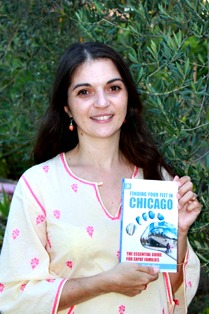
Veronique and her bookAs some readers may know, before the Displaced Nation, I had my own blog, called “Seen the Elephant” — which I used as an outlet while struggling to readjust to life in America after having lived abroad, in England and Japan, for quite a few years. (The name for the blog came from the expression used by Victorian travelers: “Been there, done that, seen the elephant.” Which is how I felt…)

It was because of that blog that I got to know today’s guest, Véronique Martin-Place, since she, too, was quite active in the expat blogging world.

And when I found out she was a Frenchwoman living in Chicago, I was intrigued. What did she make of the city of broad shoulders, jazz, and deep-dish pizza?

I asked her this and a host of other questions in an interview for my blog. For starters, she said that she and her family — her husband is a French diplomat and they have two young daughters — were gradually finding their feet in Chicago. (She did not, however, mention she was planning to write a book of that title!) She didn’t entirely approve of America’s throw-away society and still cooked every day for her family — she even offered her recipe for “real” vinaigrette in the comments. She also reported she’d seen plenty of elephants while living in Sri Lanka (her husband’s second assignment, after Norway).

Véronique leads life in the fast lane. A little over three years since our conversation, I find that she has written the definitive expat guide to Chicago: Finding Your Feet in Chicago — The essential guide for expat families (Summertime, 2012). And she is already putting her feet down in a brand new city, one of the world’s trendiest… Here is our exchange:

Bonjour, Véronique! When we last spoke, toward the end of 2010, you told me you’d arrived in Chicago with hopes of getting a job, but then the recession hit, so you’d started up your own writing business. When did you hatch the plan to write a book for expats in the Windy City?
I was already thinking about it when we connected. After witnessing several incidences of culture shock at my daughters’ school, I realized I wasn’t alone in having troubles. Several families from different parts of the world had moved to Chicago around the same time. All of us were in need of information and advice. Meanwhile, I’d started up my blog, Expat Forever, to share my experiences about Chicago — tips on where to settle, which schools to choose, etc. I looked around for local guidebooks to recommend — but there was nothing. So I decided to write one myself.

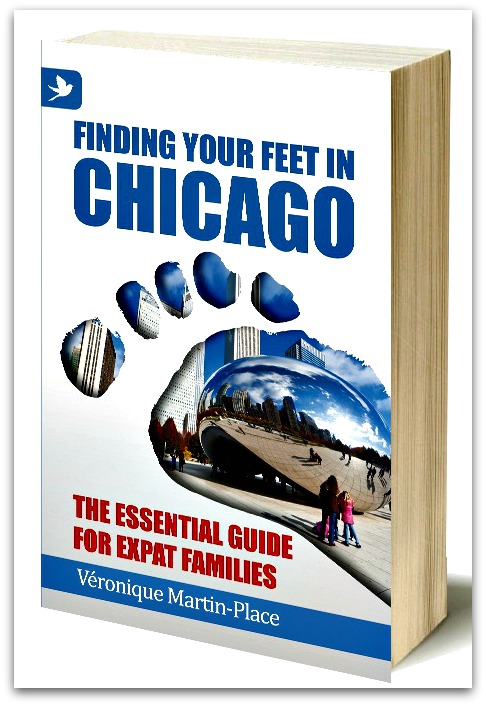
finding-your-feet-in-chicago-3D-Book CoverThat reminds me of the famous quote by Toni Morrison: “If there’s a book that you want to read, but it hasn’t been written yet, then you must write it.” How long did it take you to produce the book?
From the idea to holding the book in my hands, it took one year and a half! Writing the book directly in English was difficult at the beginning, since English is not my native language. But after a while, I got used to it.

Besides writing in English, what was the most challenging part of the process?
Editing the manuscript. I decided to hire an editor to help with the task.

I know from our previous conversation that having fresh, healthy food is important to you — after all, that’s part of being French! I also seem to recall that you were not a fan of Chicago pizza. You said it was too heavy. But did you cover it in your book?
Of course! I have a chapter dedicated to “Having fun in Chicago,” which includes a section on family-friendly dining out. Before giving my top 10 Chicago child-friendly restaurants, I explain what the Chicago specialties are and insist that children (and their parents) MUST try them. That includes Chicago-style pizza and Chicago-style hot dogs.

What has been the response thus far?
Rather good, I think. I’ve gotten only five-stars comments on Amazon!

Which sections are the most popular?
Readers say they like having so much practical information on family-related topics — not just the advice itself, but all the personal anecdotes and testimonials I include from expat parents. I talked to lots of them and wrote up their stories as “blog posts” or interviews. The stories really speak to the kinds of anxieties most expats have — and they make the book an easy, fun read.

And now your husband has moved on to a diplomatic post in Shanghai! Tell me, does ANYTHING about China remind you of the United States, or are these two countries poles apart?
The United States and China are definitely different cultures — but one similarity struck me right away. Both are consumerist societies. In the US, everything is done to make you purchase and there are plenty of opportunities for you to part with your money. Here in Shanghai, it seems that the only occupation is “shopping.” It’s the only activity people urge you to do from the moment you arrive — visit malls, markets, supermarkets and so on. And I can tell you they have tons of malls, tons of markets (from traditional, the kinds that sell crickets and flowers, to modern, selling electronics, furniture, shoes, and so on), and many, many supermarkets.

How did you prepare yourself and your two daughters for the move?
We didn’t have the chance to make a look-see visit. But six months before moving to Chicago, I’d gone to Shanghai on business, so I had a picture of what to expect: a very urbanized and polluted city. That is also why we decided to settle in the new and “green” development area of Shanghai that is called Pudong.

Did your daughters have any idea of the change they were in for?
My husband and I found some videos about the city on the Internet for them to watch. Fortunately, they’d studied some Mandarin at their American elementary school, so already knew a lot about Chinese traditions and stories. To be honest, I think we learned as much from them about cultural matters as they learned from us on the practical aspects. It was real team work!

I know it’s still early days, but what have you enjoyed the most about living in Shanghai?
Perhaps surprisingly, the fact I can bike! In Pudong, there are a lot of protected biking trails, so it allows me to discover independently this part of the city, and it’s much faster than by foot. But I don’t bike in Puxi (the other side of the Huangpu River, which divides the city into two regions: Pudong, where I live, and Puxi, the city’s historic center). It’s too dangerous.

What is the feature you enjoy the least?
Shanghai is extremely urbanized and I miss greenery. Also, it is very polluted, though less so than Beijing.

What is the top piece of advice you’d give to anyone thinking of becoming an expat in that part of the world — particularly a trailing spouse?
I have five — and actually, they’re for anywhere, not just Shanghai:
1) Learn the language.
2) Get involved in your local community.
3) Keep doing your (or start new) hobbies and/or sports.
4) Discover your surroundings little by little, and you’ll eventually come to know the city as well as the content of your pocket.
5) If you are an accompanying spouse and cannot work locally, go back to school and get new skills, or volunteer to do something you can use professionally upon returning home for good.

And now I have to ask you the obvious question: any plans to write Finding Your Feet in Shanghai?
Many people have indeed asked me that question. And I must admit, the idea was in the back of my mind when I first started my book for expats in Chicago. I thought to myself, this can be the first in a collection, and the next one will be about the city where my husband gets posted next. But at least at this point, I don’t think I’ll write an expat guide to Shanghai. One reason is that there are already lots of books, magazines as well as Web sites for expats in this city. There isn’t the same need as there was in Chicago. But another reason is that my time here is so limited. My husband’s post is for just three years. I’d have to spend all of my time doing research and interviews, getting to know the city like my pocket. And that’s before I can start writing. My book on Chicago was released a couple of weeks after I left to fly to Shanghai — which didn’t give me any time for promoting it locally. I found that very frustrating and wouldn’t want to repeat the experience. Books these days have to be promoted like crazy, and although you can do a lot of it online, I don’t think online promotions can replace interacting with readers in person.

But surely you’ll write another book?
I may not write another book for expat families living in Shanghai, but I already know I will write another book about expatriation. Actually, I have already started it. But I cannot say much more. It is too early.

Aha! You are always so mysterious… Last but not least, I’d like to ask a series of questions that I’ve asked some of our other featured authors, about your reading and writing habits:
1. Last truly great book you read: Rien Ne S’oppose a la Nuit (Nothing Holds Back the Night), by Delphine de Vigan.
2. Favorite literary genre: Memoirs — but also novels, illustrated books like the ones of Danny Gregory (I love his writings and drawings), and carnets de voyage (travel journals). And I have to confess that I still read a lot of children books, especially picture books. My dream is to write and illustrate one.
3. Reading habits on a plane: Something fun and easy to read on my Kindle! I travel light.
4. The one book you’d require the president of France to read, and why: My book, of course! I’m joking. I would like him to read Les mots pour le dire (The Words to Say It), by Marie Cardinal. Everyone should read it.
5. Favorite books as a child: Astérix and Obélix comic book stories, by René Goscinny (illustrated by Albert Uderzo) and Le Petit Prince (The Little Prince), by Antoine de Saint Exupéry.
6. Favorite heroine: Anna Karenina
7. The writer, alive or dead, you’d most like to meet: There are several — all alive and all women: Robin Pascoe, the author of four books about expatriation; Anne Lamott; Annie Ernaux; and the aforementioned Delphine De Vigan.
8. Your reading habits: Every evening, at least one hour, and Sundays as much as I can.
9. The book you’d most like to see made as a film: Hidden in Paris, by Corine Gantz
10. The book you plan to read next: The Help (but I got the French translation), by Kathryn Stockett.

* * *

Wow, what a stimulating list! Readers, any questions or comments for Véronique while we have her attention? Ce qu’est une femme extraordinaire — I think you’ll agree!

STAY TUNED for tomorrow’s post, another installment in the life of our fictional expat heroine, Libby. (What, not keeping up with Libby? Read the first three episodes of her expat adventures.)

If you enjoyed this post, we invite you to register for The Displaced Dispatch, a round up of weekly posts from The Displaced Nation, with seasonal recipes, book giveaways and other extras. Register for The Displaced Dispatch by clicking here!

Related posts:

Images: Véronique Martin-Place with her Chicago book; the book cover in 3D (author’s own photos).

And the nominees for best expat/travel film are…seeking your vote! Welcome to the 2013 Displaced Oscars

Don’t miss our 4 polls below! Results to be announced in March 2nd Displaced Dispatch! Enjoy!

When I first repatriated to the United States, I relished the chance to watch the Oscars again. For some reason — I’m not sure why, particularly as I was never a big movie buff — I regretted missing out on the pinnacle of Hollywood glamour during my years of living overseas, first in England and then in Japan.

It did not take long, however, before the novelty wore off. I grew bored with the dresses — they all seemed so same-y. And a tux is a tux is a tux.

I also grew bored with the selection of films. Typically, Oscar-nominated films take place within a single country’s borders — and when people cross these borders, it is in the service of maintaining them (IT’S WAR!!!). Apart from when Sofia Coppola was singled out for her Lost in Translation screenplay, the plots do not exactly speak to me and my prior situation of displacement.

Case-in-point: 2013 Oscar nominees

A great example of what I’m talking about are the two historical — or, more accurately, historically informed — movies that are up for this year’s Oscars:

  1. Steven Spielberg’s Lincoln — the quintessential American biographical period piece that the Academy loves (it is predicted to win five Oscars, including best director for Spielberg).
  2. Les Misérables, the film of the musical theatre adaptation — which in turn is based on an historical novel by Victor Hugo (1862), depicting life in the aftermath of the French Revolution. (Les Mis is likely to win for its score, sound mixing, makeup and hair styling, and best supporting actress for Anne Hathaway.)

Actually, make that three historical films, as Quentin Tarantino’s Django Unchained (up for best picture, cinematography and best original screenplay) can come under that rubric as well. The first half is a mock Western and the second, a mock-revenge melodrama about slavery. At least, though, it has one foreign character: German bounty hunter King Schultz (Christoph Waltz). Posing as a dentist, he gallivants around Texas, speaking perfect English. And you’ll never guess what? He’s a villain. He does have manners — but does that mitigate or enhance his villainy? One can never tell with Mr Tarantino…

Likewise, Argo (likely to win best picture along with some other prizes) and Zero Dark Thirty (likely to win for best original screenplay) depict epic events in the — albeit much more recent — American past. And although each of these films portrays Americans abroad, it shows them acting in the service of president and country — with the aim of protecting other Americans. Nothing too displaced about that.

The comedy-drama Silver Linings Playbook (likely to win Best Actress for Jennifer Lawrence) is about two people who bond over shared neuroses — could anything be more American? Not to mention their common love of pro-football (no, Andy, not the soccer kind!).

Perhaps the best of this year’s films for anyone with a proclivity for venturing across borders is Life of Pi (likely to win for best original score and visual effects). The story is about an Indian family that is emigrating to Winnipeg, Canada. Yet, as even those of us who haven’t seen the film know by now, Pi Patel (Suraj Sharma) gets stranded on a lifeboat in the Pacific with a Bengal tiger. (That’s after the steamliner carrying his family’s zoo is pulled underwater during a freak storm.)

Over the course of months, the two unlikely castaways must depend on each other to survive — a scenario that provides an occasion for reflecting on cross-spiritualism, not cross-culturalism. (Pi, who was born a Hindu, loves Jesus and practices Islam.)

It also provides an occasion for displaced Taiwanese filmmaker Ang Lee to try his hand at 3D storytelling.

Why are we trying so hard to fit in when we were born to stand out?

WELCOME TO THE 2013 DISPLACED OSCARS. If we don’t fit into the Hollywood version, we may as well host our own event. We invite you to vote on your favorite films in the four categories we have created below. Preliminary results were announced in the Displaced Dispatch that came out on Saturday, February 23rd. Final results will appear in the Dispatch that comes out on Saturday, March 2nd. Be sure to sign up if you haven’t already!

1) Best Film Exploring Themes of Interest to Expats & International Travelers

This category honors the films that put cross-cultural themes right at the center. And the nominees are:

ShanghaiCalling_pm1) Shanghai Calling (2012, dir. by Daniel Hsia)
SUMMARY: Manhattanite Sam (Daniel Henney), an arrogant young lawyer, is transferred to his firm’s Shanghai office. He bungles his first assignment and finds his career in jeopardy. With the help of his beautiful relocation specialist, among others, he just might be able to save his job and learn to appreciate the wonders that Shanghai has to offer.
WHAT CRITICS ARE SAYING: How often do we get to see Shanghai on the big screen? That said, the plot is somewhat shallow and fails to make the most of Sam’s background as a Chinese American.


TheBestExoticMarigoldHotel_pm2) The Best Exotic Marigold Hotel (2012, dir. by John Madden)
SUMMARY: A group of British retirees — played by British acting greats like Judi Dench, Maggie Smith and Bill Nighy — have outsourced their retirement, attracted by the less expensive and seemingly exotic India. They are enticed by advertisements about the newly restored Marigold Hotel and given false dreams of a life with leisure.
WHAT CRITICS ARE SAYING: At the 2012 Mumbai Film Festival, the film was honored for showcasing Indian filming locations — a view not necessarily shared by viewers outside the subcontinent. Some of us feel that India was slighted by being treated as the shimmering background to a story about retirement-age self-renewal.

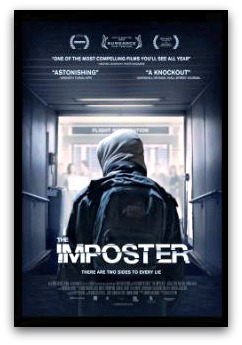
TheImposter_pm3) The Imposter (2012, dir. by Bart Layton)
SUMMARY: Thirteen-year-old Nicholas Barclay disappeared from his home in San Antonio, Texas, in 1994. Three and a half years later, he is allegedly found alive, thousands of miles away in a village in southern Spain with a story of kidnapping and torture. His family is overjoyed to bring him home. But all is not quite as it seems. The boy bears many of the same distinguishing marks he always had, but why does he now have a strange accent? Why does he look so different? This British documentary concerns the 1997 case of French serial imposter Frédéric Bourdin.
WHAT CRITICS ARE SAYING: By common consensus, The Imposter is one of the year’s most provocative pictures. Certainly, Displaced Nation writer Anthony Windram found it that way. In one of our most popular posts of last year, he mused that Bourdin’s story is not entirely unfamiliar to expats, all of whom have chameleon-like qualities.

CAST YOUR VOTE HERE!

2) Best Foreign Displaced Film

This category honors films about displacement that take place in non-English speaking countries and therefore require English speakers to read subtitles while learning about other cultures. And the nominees are:

Tabu_pm1) Tabu (2012, dir. by Portugal’s Miquel Gomes)
SUMMARY: The action in this experimental fiction ranges from contemporary Lisbon to an African colony in the distant past, in what was Portuguese Mozambique. First we are introduced to a cantankerous elderly Portuguese lady with a gambling addition. Then we flashback to her youth as a beautiful young woman living a kind of White Mischief existence at the foot of Mount Tabu, where she falls in love with a handsome adventurer…(Notably, the film’s title references the 1931 German silent film of that name, which took place in the South Seas.)
WHAT CRITICS ARE SAYING: The film shows what happens to expats who live too long — there are no remnants of “paradise” left. But some — e.g., A.O. Scott of the New York Times — have faulted the director for glossing over the issues of colonialism in the film in favor of simple aestheticism.

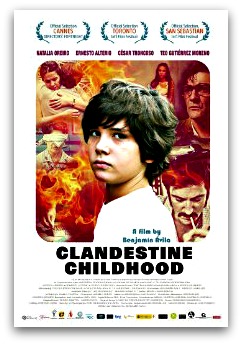
ClandestineChildhood_pm2) Clandestine Childhood (2011, dir. by Benjamín Ávila)
SUMMARY: A cinematic memoir drawn from Ávila’s own experiences, the film paints an unsettling portrait of families affected by military dictatorships. The year is 1979, five years after Perón’s death, and the family of 12-year-old Juan, who have been living in exile in Cuba, returns secretly to Argentina. Juan’s parents are members of an underground organization and for sake of their cover, he must assume the name of “Ernesto” and pretend to be a newcomer from northern Argentina.
WHAT CRITICS ARE SAYING: Juan’s parents aren’t fleeing the law because of their past misdeeds but are trying violently to overthrow a current dictatorship. The film therefore raises the question: do urban guerrillas make good parents? After all, they are asking their son, a Third Culture Kid, to act the part of a native in the homeland he never knew, for the sake of their political ideals. But while this question is intriguing, the story is driven almost entirely by clichés. As one critic remarked:

[T]he writing needs to be sharper to avoid feeling like a generic coming-of-ager.

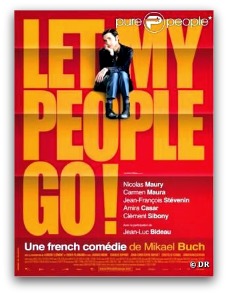
LetMyPeopleGo_pm3) Let My People Go (2011, dir. by Mikael Buch)
SUMMARY: French immigrant Reuben (Nicolas Maury) is living in fairytale Finland — where he got his MA in “Comparative Sauna Cultures” — with his gorgeous Nordic boyfriend Teemu (Jarkko Niemi). He works as the mailman in a neighborhood whose colorful houses look like Scandinavian Skittles. Then, after a misunderstanding involving a parcel full of Euros, Teemu casts his lover out of Eden, sending him back to where he came from: Paris.
WHAT CRITICS ARE SAYING: Ruben’s return to Paris — where he finds his family weathering various crises as well as emotional instability — demonstrates why he left in the first place. (Aren’t most expats escaping something?) However, the scenes with his wacky, feuding family members soon become tedious. As one critic puts it:

The movie’s labored attempt at creating comedy mostly means lots of scenes with Ruben cringing as relatives shout.

CAST YOUR VOTE HERE!

3) Most Displaced Director

This category honors the director who has shown the most chutzpah in raiding the literature of other cultures to make a commercially successful movie (note: they do not cast the natives!). This year’s nominees are:

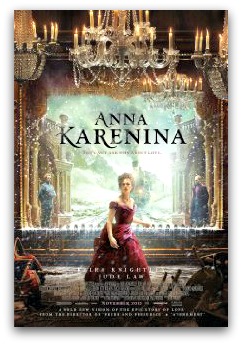
AnnaKarenina_pm1) Joe Wright for doing a British version of Anna Karenina (2012), casting his muse (Keira Knightly) in the titular role
WHAT CRITICS ARE SAYING: Some enjoyed Wright’s bold new interpretation of this classic Russian novel, while others felt that he did Tolstoy a terrible injustice — for instance, New Yorker critic Richard Brody had this to say:

Wright, with flat and flavorless images of an utterly impersonal banality, takes Tolstoy’s plot and translates it into a cinematic language that’s the equivalent of, say, Danielle Steel, simultaneously simplistic and overdone.

LesMiserables_pm2) Tom Hooper for casting a bunch of Aussies, Brits and Americans in Les Misérables
WHAT CRITICS ARE SAYING: Since Hooper previously won the Best Director Oscar for the terribly English drama The King’s Speech (historical drama, yay!), many found it odd that he would choose to take on this sprawling French story, and beloved musical, to create what he calls “an oil tanker of a picture.” But for what it’s worth, Hooper had no qualms about directing a film having to do with French history instead of his own. He is persuaded that Victor Hugo’s story speaks to issues of concern today:

Hugo’s story of populist uprising in 1832 Paris resounds in an era of the Arab Spring, the Occupy protests and general frustration over economic inequality.

DangerousLiaisons_pm3) Korean director Hur Jin-ho for making an Asian version of Dangerous Liaisons (2012) — which was originally an 18th-century novel by Pierre Choderlos de Laclosset — and setting it in 1930s Shanghai
WHAT CRITICS ARE SAYING: Many have complimented Hur Jin-ho’s decorous adaptation, saying it was clever of him to swap the insular, decadent world of de Laclos’ book, which takes place pre-French Revolution, with the similarly gilded cage of Chinese aristocrats just prior to the Japanese invasion. But the film isn’t particularly sophisticated on a political or historical level. As one critic writes: “It’s all just window-dressing: pretty, but substance-free.”

CAST YOUR VOTE HERE!

4) Most Displaced Actor/Actress

This category honors the actor who has performed this year’s greatest feat of playing a role that requires them to take on a whole new nationality. We’re talking Versatility Plus! And the nominees are:

Daniel_Day-Lewis_pm1) Daniel Day-Lewis, the Anglo-Irish actor who portrayed Abe Lincoln in Lincoln
WHAT CRITICS ARE SAYING: Apparently, there was no American actor good enough to play one of the most exceptional presidents the nation has ever known as critics have had nothing but praise for Day Lewis’s performance. Here is a sampling:

His Lincoln is tall and tousled and bent over with the weight of melancholy responsibility in the fourth year of the Civil War.

[Day-Lewis] manages to inject so much quiet humour into what could have been a very reverential portrait.

[The actor] inhabits the ageing figure of the 16th President of the United States with exquisite poise, intellect and grace.

AnneHathaway_pm2) Anne Hathaway for playing saintly prostitute Fantine in Les Misérables
WHAT CRITICS ARE SAYING: Many find it impressive that Hathaway, cast as the tragic Fantine, sings the show-stopping “I Dreamed a Dream” in one take. (Tom Hooper’s contribution to the genre was having the actors sing rather than lip synch.) And some say that her willingness to have her locks shorn off on screen shows her commitment to her craft. That said, her performance is not to everyone’s taste. “Rarely have the movies seen such an embarrassingly naked plea for applause,” writes Australian film critic Jake Wilson — the implication being the Victor Hugo’s Fantine would have had more dignity.

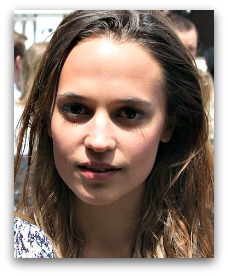
Alicia_Vikander_pm3) Swedish actress Alicia Vikander for taking on two non-Swedish roles: Caroline Matilda of Great Britain (she served as Queen of Denmark and Norway in the 18th century) in A Royal Affair (2012); and Kitty in Anna Karenina (2012)
WHAT CRITICS ARE SAYING: Vikander’s “moxie” is apparently what landed her both of these parts. According to A Royal Affair director Nikolaj Arcel, every actress in Denmark wanted the role of Mathilde, but only Vikander had the requisite “regal quality.” She even went to Copenhagen two months before shooting began to learn to speak Danish fluently. Likewise, Anna Karenina director Joe Wright saw in her the qualities to play Kitty, a flirtatious young woman who believes the dashing Count Vronsky is her Prince Charming, only to find love with a kind-hearted farmer named Levin. It is not uncommon for movie-goers to remark that she outshines Kiera Knightly’s Anna.

CAST YOUR VOTE HERE!

* * *

Are we missing out on any films/categories? Please leave your suggestions in the comments below.

Longing for even more expat and international travel films? Please go to our Displaced Oscars Pinterest board.

As for me, I’m going in search of a displaced after-party! Let’s hope I don’t have to travel too far to find one! 🙂

STAY TUNED for tomorrow’s post, another installment in the life of our fictional expat heroine, Libby. (What, not keeping up with Libby? Read the first three episodes of her expat adventures.)

If you enjoyed this post, we invite you to register for The Displaced Dispatch, a round up of weekly posts from The Displaced Nation, with seasonal recipes, book giveaways and other extras. Register for The Displaced Dispatch by clicking here!

Related posts:

Images: Oscar statuette courtesy Dave_B_ on Flickr; actor pix from Wikimedia.

5 displaced reads for tickling an expat/global wanderer’s intellect

Hello again, expats, global nomads, serial wanderers, world citizens, and internationals!

As suggested in my post of last week about mentors and muses, it being January, we have resolved to think Big Thoughts about displacement.

We all know what it feels like to venture across borders to travel and/or live. But how often do we stand back and look at the trees? Or, as Burt Bacharach and Hal David put it in their theme song for the 1966 British film starring Michael Caine:

What’s it all about, Alfie?

To help us figure it out, I propose that we turn to the works of Big Thinkers. I’m talking about the kinds of people who take the kind of life we lead — living here, there and everywhere — for granted, and are more interested in questions of what we’re all doing on this planet and can learn from each other and from ourselves, for that matter.

Against that rather dramatic background, here are 5 displaced — and displacing — reads for your consideration:

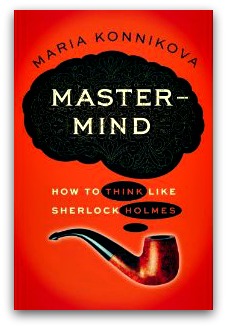
Mastermind_cover_pm1) Mastermind: How to Think Like Sherlock Holmes (Viking, January 2013)

Author: Maria Konnikova
Genre: Self-Help; Cognitive Psychology
Synposis: A primer on increasing one’s mindfulness, based on the lessons imparted by British master sleuth Sherlock Holmes.
Author’s displaced credentials: Born in Russia, Konnikova arrived in the United States at age 4. Though a Third Culture Kid, she has adapted very well to the American scene. She was educated at Harvard, writes the “Literally Psyched” blog for Scientific American, and is doing a PhD at Columbia University in psychology. That said, she has found a muse in an unexpected place: in the fictional works of the terribly Victorian Sir Arthur Conan Doyle.
Why it’s stimulating: So many of us are caught up in the literal idea of travel that we forget that the most interesting voyage of them all lies in exploring the inner workings of our own minds. But Konnikova takes us one step further. She suggests displacing ourselves into the mind of the hyper-observant Sherlock Holmes. To show us how, she does a bold thought experiment — something that most of us, especially those who are living in isolation from family and friends, would find anathema: she downloads Freedom, a program that blocks Internet access completely for a specified amount of time, and sees how it affects her writing. She is shocked by the results. Her conclusion:

Thinking like Sherlock Holmes isn’t just a way to enhance your cognitive powers. It is also a way to derive greater happiness and satisfaction from life.

How we heard about it: Konnikova’s recent article in Slate, “Do You Think Like Sherlock Holmes?”

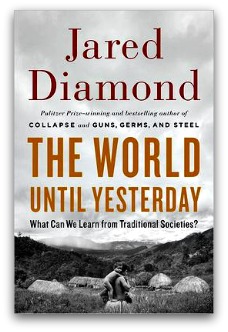
TheWorldUntilYesterday_cover_pm2) The World Until Yesterday: What Can We Learn from Traditional Societies? (Viking, December 2012)

Author: Jared Diamond
Genre: Social History
Synposis: An account of how people in traditional societies — the New Guinea Highlanders, the Inuit, the Amazonian Indians, the Kalahari San — live and what they can teach the rest of us.
Author’s displaced credentials: A polymath and one of the foremost writers of popular science, Diamond was born in the United States, got a degree from Cambridge University, and has had careers in physiology, ecology (specializing in New Guinea and nearby islands), and geography. With the publication of Guns, Germs, and Steel: The Fates of Human Societies, his most popular work to date, he became known for his mastery of global history.
Why it’s stimulating: Diamond displaces us to our (not-so-distant) past by taking us to remote corners of the earth — from the New Guinea Highlands and the Amazon rainforest, to Africa’s Kalahari Desert and the Arctic Circle — where it’s possible to encounter people who are managing without air travel, telecommunications and other fruits of modernity. Pointing out that such accoutrements are extremely recent, he asks: what can traditional peoples teach those of us who live in “complex” societies about how we might live better today? As it turns out, Diamond says, we may be better off dialing down the complexity and living closer to our ancestors:

We get ideas about how to bring up our children. We get ideas about how to have a better old age. We get ideas about how not to die of cancer, heart attacks and stroke.

How we heard about it: An interview with Jared Diamond in Smithsonian Magazine.

Immigrant_Advantage_Book_Cover_pm3) The Immigrant Advantage: What We Can Learn from Newcomers to America about Health, Happiness, and Hope (Free Press, October 2011)

Author: Claudia Kolker
Genre: Social Sciences; Immigration
Synposis: An examination of some of the customs imported by America’s newest residents.
Author’s displaced credentials: A journalist and Third Culture Kid (her mother was from Mexico and father from Ukraine), Claudia Kolker once worked as a freelance reporter in El Salvador from 1992 to 1995, where she covered the Salvadoran postwar recovery as well as social issues throughout Central America, Cuba, Haiti and the Dominican Republic. She has also reported from Japan and India. She now lives in Houston.
Why it’s stimulating: Kolker was spurred to do her research after discovering that most immigrants to the United States, even those from poor or violence-wracked countries, are physically and mentally healthier — they actually live longer! — than most native-born Americans. In a work that in some ways parallels Jared Diamond’s (#2 above), her book takes us on a tour of immigrant households in the United States — Mexican, Hispanic, Chinese, Korean, Vietnamese, Jamaican, etc. — and shows us that there are things about their values we should not only respect but emulate. I don’t know about you, but I find it refreshing to think that privileged Americans like us, who choose to displace ourselves to other lands, could stand to learn some major life lessons from the forcibly displaced. Kudos to Kolker for turning the tables!
How we heard about it: From a recent interview with Kolker on PBS Newshour.

onthemap_cover_pm4) On the Map: A Mind-expanding Exploration of the Way the World Looks (Gotham, December 2012)

Author: Simon Garfield
Genre: Social Sciences; Human Geography
Synposis: A history of mankind’s love affair with maps, beginning with Ptolemy’s world map (one of the 100 diagrams that changed the world); moving through the “cartographic dark ages,” which lasted for about a thousand years; and culminating in our modern obsession with maps, which in fact dates from 1450s Venice, when the atlas became a craze.
Author’s displaced credentials: By splitting his life between London and St. Ives, Cornwall, Garfield could be described as a “domestic expat” within the UK.
Why it’s stimulating: “Displacement” of the sort we talk about in this blog requires constant rewriting and editing of the map you were born with — both figuratively and literally. Garfield shows us that while some of our cases may be extreme (the Displaced Nation being a prime example, with our “Here Be Dragons” obsession), mapmaking is something we humans can’t get enough of:

Maps relate and realign our history. They reflect our best and worst attributes — discovery and curiosity, conflict and destruction — and they chart our transitions of power. Even as individuals, we seem to have a need to plot a path and track our progress, to imagine possibilities of exploration and escape.

How we heard about it: From a 1 Jan 2013 post by Maria Popova on her Brain Pickings blog.

Cosmopolitanism-Appiah-Kwame_cover_pm5) Cosmopolitanism: Ethics in a World of Strangers (W.W. Norton, 2007)

Author: Kwame Anthony Appiah
Genre: Politics; Philosophy; Ethics; Globalization
Synposis: An examination of the ancient philosophy of “cosmopolitanism” — the idea that all human ethnic groups belong to a single community based on a shared morality — and the influence it has had on the Enlightenment, the French Revolution, and the UN’s Universal Declaration of Human Rights.
Author’s displaced credentials: Appiah is the product of a cross-cultural union: his mother was an English author and daughter of the statesman Sir Stafford Cripps, and his father a Ghanaian barrister and politician, who was constantly exhorting his children to remember that they were “citizens of the world.” Raised in Ghana and educated in England, Appiah has taught philosophy on three continents and is now a professor at Princeton University.
Why it’s stimulating: Whether we realize it or not, those of us who venture across borders are making a step towards reducing our culturally isolation. We are opening our minds to seeing the world outside our own contextual walls. But how far can we actually take this? Pretty far, claims Appiah, pointing out that we humans are an inter-cultural, intertwined, and interdependent species, just like every other on the planet — replete with cross-pollinations of language, religion, art, dress, rites, metaphysical outlooks, and progeny. But if Appiah rejects the Sam Huntington view of an inevitable clash of civilizations, he is also not a universalist:

Cosmopolitans suppose that all cultures have enough overlap in their vocabulary of values to begin a conversation. But they don’t suppose, like some Universalists, that we could all come to agreement if only we had the same vocabulary.

How we heard about it: The book was a Global Niche Bookshelf pin, by GlobalNiche.net, on Pinterest.

* * *

Whoa, are you still with me? That was quite a Head Trip! Readers, any responses to this list — any other works to suggest? Much obliged for your input! I think I’ve had a little too much stimulation for one blog post and need to give my brainbox a rest…

STAY TUNED for another episode in the life of our fictional expat heroine, Libby. (What, not keeping up with Libby? Read the first three episodes of her expat adventures.)

If you enjoyed this post, we invite you to register for The Displaced Dispatch, a round up of weekly posts from The Displaced Nation, with seasonal recipes, book giveaways and other extras. Register for The Displaced Dispatch by clicking here!

Related posts:

Expats, here’s how to enrich your lives in 2013: Choose a mentor or a muse!

Expats and other world adventurers, let me guess. You have you spent the past week making resolutions about

  • staying positive about your new life in Country X;
  • indulging in less of the local stodge;
  • giving up the smoking habit that no one is nagging you about now that you’re so far away from home;
  • and/or taking advantage of travel opportunities within the region that may never come your way again

— while also knowing full well that at some point in the not-distant future, you’ll end up stuffing your face with marshmallows (metaphorically speaking).

Never mind, it happens to the best of us, as psychologist Walter Mischel — he of the marshmallow experimentrecently told Abby Hunstman of the Huffington Post. Apparently, it has something to do with the way impulses work in the brain. The key is to trick the brain by coming up with strategies to avoid the marshmallow or treat it as something else.

Today I’d like to propose something I found to be one of the most effective strategies for turning away from the marshmallows you’ve discovered in your new home abroad or, for more veteran expats, turning these marshmallows into something new and exotic. My advice is to find a mentor or a muse in your adopted land — someone who can teach you something new, or who inspires you by their example to try new things…

Trust me, if you choose the right mentor +/or muse, benefits like the following will soon accrue:

1) More exotic looks — and a book deal.

Back when I lived abroad, first in England and then in Japan, I was always studying other women for style and beauty tips. I made a muse of everyone from Princess Diana (I could hardly help it as her image was being constantly thrust in front of me) to the stewardesses I encountered on All Nippon Airways. Have you ever seen the film Fear and Trembling, based on the autobiographical novel of that name, by the oft-displaced Amélie Nothomb? On ANA flights, I behaved a little like the film’s young Belgian protagonist, Amélie, who secretly adulates her supervisor Miss Fubuki. I simply couldn’t believe the world contained such attractive women…

The pay-off came upon my repatriation to the US. With such a wide array of fashion and beauty influences, I’d begun to resemble Countess Olenska in The Age of Innocence — with my Laura Ashley dresses, hair ornaments, strings of (real) pearls, and habit of bowing to everyone.

Is it any wonder my (Japanese) husband-to-be nicknamed me the Duchess? (Better than being the sheltered May Welland, surely?)

My one regret is that I didn’t parlay these style tips into a best-seller — unlike Jennifer Scott, one of the authors who was featured on TDN this past year. While studying in Paris, Scott was in a mentoring relationship with Madame Chic and Madame Bohemienne. (The former was the matriarch in her host family; the latter, in her boyfriend’s host family.) Mme C & Mme B took her under their wing and taught her everything she knows about personal style, preparation of food, home decor, entertaining, make-up, you name it…and is now imparting to others in her Simon & Schuster-published book.

2) More memorable dinner parties.

As mentioned in a previous post, I adopted actress and Indian cookbook writer Madhur Jaffrey as my muse shortly after settling down in the UK. I was (still am) madly in love with her, her cookbooks, even her writing style.

And her recipes do me proud to this day.

Right before Christmas I threw a dinner party for 10 featuring beef cooked in yogurt and black pepper, black cod in a coriander marinade, and several of her vegetable dishes.

It was divine — if I say so myself! To be fair, the guests liked it, too…

3) Improved language skills.

Now the ideal mentor for an adult seeking to pick up a new foreign language is a boyfriend or girlfriend in the local culture — preferably one with gobs of patience. The Japanese have the perfect expression for it: iki jibiki, or walking dictionary.

Just one caveat: If you’re as language challenged as Tony James Slater, it could prove a headache and, ultimately, a heartache.

Still, nothing ventured, nothing gained…

(Married people, you might want to give up on this goal. I’m serious…)

4) A fondness for angels who dance on pinheads.

After seeing the film Lost in Translation, I became an advocate for expats giving themselves intellectual challenges. Really, there’s no excuse for ennui of the sort displayed by Scarlett Johansson character, in a well-traveled life.

It was while living in the UK as a grad student that I discovered the extraordinary scholar-writer Marina Warner, who remains an inspiration to this day. Warner, who grew up in Brussels and Cambridge and was educated at convent school and Oxford University, is best known for her books on feminism and myth.

After reading her book Monuments and Maidens, I could never look at a statue in the same way again!

In her person, too, she is something of a goddess. Though I’d encountered women of formidable intellect before, I found her more appealing than most, I think because she wears her learning lightly and has an ethereal presence, like one of the original Muses.

Booker prizewinner Julian Barnes has written of her “incandescent intelligence and Apulian beauty” (she is half Italian, half English). The one time I met her — I asked her to sign my copy of her Booker Prize-shortlisted novel, The Lost Father — I could see what he meant.

I was gobsmacked.

Major girl crush!

(Don’t have a girl crush? Get one! It will enrich your life immeasurably.)

5) Greater powers of mindfulness — and a book deal.

Third Culture Kid Maria Konnikova was born in Moscow but grew up and was educated in the US. She has started the new year by putting out a book with Viking entitled Mastermind: How to Think Like Sherlock Holmes. Who would guess that a young Russian-born woman would use Conan Doyle’s fictional creations, Holmes and Watson, as her muses? But, as she explains in a recent article in Slate, she has learned everything she knows about the art of mindfulness from that master British sleuth:

Mindfulness allows Holmes to observe those details that most of us don’t even realize we don’t see.

So moved is she by Holmes’s example — and so frustrated by her own, much more limited observational powers — Konnikova does the boldest of all thought experiments: she gives up the Internet…

So does her physiological and emotional well-being improve as a result? Does her mind stop wandering away from the present? Does she become happier? I won’t give it away lest you would like to make Konnikova this year’s muse and invest in her book. Hint: If you do, we may not see you here for a while. 😦

6) The confidence to travel on your own.

We expats tend to be a little less intrepid than the average global wanderer: we’re a little too attached to our creature comforts and may need a kick to become more adventuresome. But even avid travelers sometimes lose their courage, as Amy Baker recently reported in a post for Vagabondish. She recounts the first time she met a Swedish solo traveler in Morocco, who had lived on her own in Zimbabwe for 10 years. This Swede is now her friend — and muse:

She was level-headed, organized and fiercely independent — all characteristics that I aim to embody as a female traveler.

With this “fearless Swedish warrior woman” in mind, Amy started venturing out on her lonesome — and hasn’t looked back.

* * *

Readers, the above is not intended as an exhaustive list as I’m hoping you can contribute your own experiences with mentors and muses abroad: What do you do to avoid the “marshmallows” of the (too?) well-traveled life? Who have you met that has inspired you to new creative, intellectual, or travel heights? Please let us know in the comments. In the meantime, I wish you a happy, healthy — and most of all, intellectually stimulating — new year!

STAY TUNED for next week’s posts.

If you enjoyed this post, we invite you to register for The Displaced Dispatch, a round up of weekly posts from The Displaced Nation, with seasonal recipes, book giveaways and other extras. Register for The Displaced Dispatch by clicking here!

Related posts:


LESSONS FROM TWO SMALL ISLANDS — 5) Keep calm and pour some tea

Teatime CollageDecember greetings, everyone! Can you see us twinkling? The Displaced Nation wants to be part of your Festival of Lights this December — a source of brightness and enLIGHTenment during the dark days of winter. (Unless, of course, you reside in the Southern Hemisphere, in which case, you should be helping all of us to feel brighter!)

But before we get to that — Kate Allison will be delivering some tips tomorrow on generating holiday cheer regardless of location — do you fancy what the Brits would call a cuppa?

If you said no, that you’d prefer coffee or cold beverage, I suspect you may be a compatriot of mine. Once upon a time, I was an American like you — I didn’t drink any caffeinated beverages apart from Diet Coke. But then I traveled to Europe and Asia, and now I can’t imagine a life without tea. As the Chinese lady who owns Ching Ching Cha, a traditional Chinese tea house in Georgetown, DC, once remarked to me, when I told her how much I’d grown to like tea from my travels: “For me, tea is a way of life.”

Those who already know what I’m talking about may read no further. But for the unconvinced, here are 10 lessons I learned while living in two major tea-drinking nations, Britain and Japan, for many years. (If you’re the bucket-list-keeping type, think of it is as 10 reasons to develop a tea-drinking habit before you die!)

1) Even if coffee is more your cup of tea, so to speak, give tea a chance.

Coffee is great for that jolt to the system. One of its most effective uses, apart from first thing in the morning when you’re going to work, is for the jet lag that occurs after a really long international flight — say between the United States and Japan. (Japanese, btw, love coffee as much as the English do — and perhaps thanks to German influence, can make an even better cup than anyone in the UK or the USA.) But unlike coffee, tea is what keeps you going day in day out, putting one foot in front of the other. It’s the sustenance beverage for the marathon known as life.

2) I mean tea, not tisanes.

I apologize to those expats who’ve spent their formative years in France. I have nothing against those herbal drinks with medicinal qualities. I just think it would be a shame to miss out on the kind of caffeine that tea has to offer — the kind that produces sustained mental alertness. Not to mention tea’s own medicinal qualities — all of those lovely antioxidants. Why do you think the Japanese live so long, with all their bad habits of smoking, drinking to excess and overwork? Likewise, the English writer, George Orwell, was able to sustain himself on cups of tea when living “down and out” in Paris and London.

3) Tea has a special role to play in the holiday season.

It’s the perfect libation to help you recover when your feet are aching after a full day of shopping and wrapping gifts (surely, the bane of any adult female’s existence this time of year!) or when you think your hand will drop off if you have to write one more Christmas card. It’s also the perfect drink to serve, because so convivial and relaxing, when meeting up with friends or family you haven’t seen in a long time.

4) Tea is a primary aid for developing a more stoical attitude towards life.

As explained in the very first post in this series, I found it a bit of a challenge to adapt to the brand of stoicism-cum-fatalism both of these small islands, England and Japan, have cultivated over the centuries. But the day I worked out the connection between tea-drinking and stoicism marked the beginning of the end of my struggle. If only I’d paid closer attention to Orwell, who said:

All true tea lovers not only like their tea strong, but like it a little stronger with each year that passes.

5) Tea may also be the key to a philosophical approach to life.

The process of drinking a cuppa slows you down for long enough to clear your head of pressing thoughts and work out what is important. Strangely, I found Brits to be almost as insistent on the importance of a regular tea-drinking habit as the Japanese — even though it’s the latter who are renowned for their Zen approach to tea. Take these words of Rudyard Kipling’s, for example:

We haven’t had any tea for a week…
The bottom is out of the Universe

It reads like a haiku, doesn’t it? Certainly, his sentiments are not far removed from the Japanese proverb:

If man has no tea in him, he is incapable of understanding truth and beauty.

6) The rituals are just as important as the tea itself.

After nearly a decade of living in Britain, I had it all down to a fine art: boiling water to serve tea, heating the pot, putting the milk in the cup first, and pouring the tea without spilling. To this day, I cannot imagine making a pot of tea without pouring hot water in it first to heat the pot. The water and the pot need to be at the right temperature to brew the tea properly. Imagine the affront I experienced upon returning to this country and being served a cup of either semi-warm water or boiling water with a Lipton’s tea bag on the side. And though I found some of the Japanese tea-drinking rituals a bit obscure, especially those related to the tea ceremony — twirl the cup around three times, really? — I still took delight in the spectacle.

7) Tea should be served with something sweet.

“Tea and biccies, anyone?” as they say in England — usually meaning the chocolate-coated digestive biscuits. And the perfect way to offset the super bitter green tea (macha) of the Japanese tea ceremony is with the almost sickeningly sweet kashi and wagashi — confections that are usually served beforehand. A tad of sugar helps this most medicinal of teas go down. Not only that but it’s a beautiful combination, as anyone who has sampled green tea ice cream, by now a classic flavor, will attest.

8) Tea should be served in an aesthetically pleasing cup — never paper or plastic!

Part of the pleasure of taking tea at Fortnum & Mason’s or the Ritz is the bone china it is served in. If the world had a treasure chest, surely it would contain a full set of Wedgwood or Royal Doulton? In Japan, by contrast, it is the roughness and imperfection of the tea cup that provides aesthetic pleasure, or, if you’re drinking Western tea (usually served with lemon, not milk), the sheen of a fine china tea cup — either English (Wedgwood Wild Strawberry is very popular there) or a Japanese version (eg, Noritake). Can’t be bothered with china? At the very least, make your tea in a proper mug.

9) Tea is the ultimate social drink.

Perhaps the British writer known as Saki (yes, he was born in the Far East) put it best when he wrote:

Find yourself a cup of tea; the teapot is behind you. Now tell me about hundreds of things.

Japanese may not be as fond of having a natter when they take tea; nevertheless, they see it as a custom that fosters social harmony.

10) No one should ever be too busy for a tea break.

My fellow Americans, are you still with me? This pointer is particularly for you — particularly those of you who are always crazy busy — although as Tim Kreider pointed out on the New York Times‘s Opinionator blog, it’s often not clear why what you’re doing is so important. Perhaps if you took time out for a regular tea break, you would slow down a bit — see 5) — and find an escape from your self-imposed “busy trap.”

****

And now I must leave you as the clock says ten to three — only, is there still honey for my tea?

Readers, do you agree that tea may be the answer? Or is this just another of my moonbat pronouncements that’s put you in need of a strong cup of Joe?!

STAY TUNED for tomorrow’s post from Kate Allison.

If you enjoyed this post, we invite you to register for The Displaced Dispatch, a round up of weekly posts from The Displaced Nation, with seasonal recipes, book giveaways and other extras. Register for The Displaced Dispatch by clicking here!

Related posts:

Img: Collage made of two photos available on Flickr via Creative Commons: (left) “High tea,” by John Heaven, and “Japanese tea ceremony,” by JoshBerglund19.

Expats, do you play with your identities? Are you an imposter or a chameleon?

Pretending to be a dead child is the cruelest trick you could play on a family.

Insinuating yourself into their lives, claiming falsely the intimacy and bonds that only exists between immediate family — mother and son; brother and sister — and to convince them that that son, that brother, that they feared murdered, has returned. There was, it transpires, nothing to worry about all along. You were fine. You are alive.

To succeed in such a deception scarcely seems possible. It sounds like the plot of a mystery novel, but it is, in fact, chillingly true. We have ourselves a real-life Talented Mr Ripley.

This post is concerned with the case of Frédéric Bourdin, a 23-year-old brown-eyed Frenchman who convinced a Texan family, the Barclays, that he was Nicholas, their missing blue-eyed teenage son and brother.

A conman, a fantasist, a sociopath, Bourdin already had a history of impersonating destitute children when in 1997 he convinced authorities in France and the US that he was the unruly child who at aged thirteen had disappeared from the Barclay family in San Antonio, Texas. The police presumed Nicholas was dead until Bourdin concocted a tale that the child had been snatched by a pedophile ring and brought to Europe. Bourdin lived with the Barclay family for three months before a private investigator revealed the truth.

With the release of the documentary film, The Imposter, directed by Bart Layton, the story of Bourdin has returned to the news. The film, a success at Sundance, is now in limited release in the US. Bourdin’s masquerade is so hard to believe, and so stranger than fiction, that it is of little surprise that is perfect material for a documentary.

This is not, however, the first time that the story of Bourdin has been depicted on the cinema screens. In 2010 a fictionalized account entitled The Chameleon was released, directed by Jean-Paul Salomé.

To be honest, The Chameleon is a disappointing film that despite being based on the most compelling of true-life tales is never itself compelling. (For anyone in the US who might be interested, it is available for streaming on Netflix.)

A better use of your time may be spent reading about Bourdin in David Grann’s essay “The Chameleon,” which belongs to his essay collection The Devil & Sherlock Holmes. This is where I first came across the story. The essay is actually available on The New Yorker Web site and I can’t recommend it enough.

Why, however, have we chosen this topic for The Displaced Nation? Well, we think that The Imposter is a film that you may be fascinated by, but we also think that there’s something about Bourdin’s tale, undeniably horrific and callous as it, that resonates with an expat audience. How did this man with his French accent convince others that he was an American teenager? In an interview with The Daily Telegraph, Bourdin stated that there was an unspoken collusion on the part of Nicholas Barclay’s mother, Beverly Dollarhide — that she knew damn well that this was not her son:

Most people who go to church don’t believe in God, very few of them really believe, but somewhere deep inside they try to convince themselves there is a God. It’s the same thing for the Dollarhide family. It happened exactly the same way.

Bourdin throughout his life has cruelly taken playing roles to an extremity. Despite being jailed for identity fraud after it is was revealed that he was not Nicholas Barclay, he continued to pass himself off as teenagers. In 2004 he claimed to be a Spanish adolescent whose mother had been killed in that year’s Madrid train bombings. The next year he again pretended to be a Spanish orphan, this time claiming that he lost his parents in a car accident.

While none of us play roles to that extent, this imposter and chameleon aspect of Bourdain’s personality is — though I am aware that I over-reaching here somewhat to make a point — reflected in many of our lives as expats.

I know that I find myself occupying roles I had previously not thought I would before. Sometimes I am the imposter. I play a role that isn’t me. In my case, it may be exaggerating national characteristics and language that I feel people expect of me, but that I would never use back home. At other times, I find myself trying to be the chameleon. Trying to scrub away my otherness so that no attention is drawn to me because I sound different, or behave differently.

What about you? What sort of an expat do you find yourself to be. In your adopted home, do you find yourself, at time, to be a chameleon? Or are you more an imposter?

STAY TUNED for Tuesday’s post, a list of travel situations that spell H-O-R-R-O-R!

If you enjoyed this post, we invite you to register for The Displaced Dispatch, a round up of weekly posts from The Displaced Nation, with seasonal recipes, book giveaways and other extras. Register for The Displaced Dispatch by clicking here!

Related posts:

Image: MorgueFile