The Displaced Nation

A home for international creatives

Tag Archives: France

Even in Paris, expats can’t escape former lives: A celebration of displaced novelist Corine Gantz

SPECIAL ANNOUNCEMENT: Ever wanted to escape to Paris in the springtime? Today you can do so, as it were, in the company of the très très charmante Corine Gantz. Originally from the City of Light but now living near the City of Angels, Mme Gantz has just released her debut novel about a group of American women who try to start afresh in Paris. She has kindly agreed to respond to our questions and comments. 

The Displaced Nation has been examining the “gothic” side of expat life over the past couple of weeks. Thus it may seem odd that today we have chosen to celebrate a book that takes place in La Ville-Lumière (“The City of Light” or “The Illuminated City”) by an author who lives near the City of Angels.

Hidden in Paris coverBut looks can be deceiving — and the cover of Corine Gantz’s debut novel, Hidden in Paris, is quite a cunning ruse. It shows a Parisian balcony with French doors reflecting the Eiffel Tower, and a flower box bursting with hot-pink geraniums. What could possible be amiss within such a picture-perfect setting, you may wonder? Plenty, it turns out.

But before we get into that, let’s begin our fête in honor of Mme Gantz and her book. To put ourselves in the proper mood, we have prepared a special cocktail, a French 75. We’ve also gone all out with our canapés. There’s a savory gougère, brie en croûte, duck rillettes, chilled asparagus with mustard sauce, a Puy lentil salad — and, in honor of Mme Gantz, her family favorite, taramasalata on toast (see her father’s recipe below).

Okay, seats, please! Our honored guest has agreed to kick off the festivities by answering a few questions from The Displaced Nation team. After that, the floor is yours, dear reader.
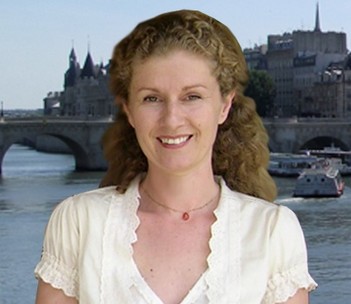
Corine GantzYour new novel, Hidden in Paris, may not tell a gothic tale per se, but we think it relates to our theme because it centers on three women who are running away from their lives. Is that a fair assessment?
People who say they love to be scared amuse me. They have a fascination with horror flicks, they read vampire books, they ride roller coasters. Yet they might be the same people who walk great circles around a pile of bills or make every effort to avoid a difficult phone call. What can be scarier than real life?

I think there is a limit to what we can handle, and at some point the tendency is to want to run way, literally or figuratively. In Hidden in Paris three strangers — all American women — have reached the point of terminal discomfort, when tackling real issues feels more terrifying than running away abroad.

Lola is running away from her husband, Althea from an eating disorder, and Annie, although she pretends to be the most high functioning member of the group, is hiding the biggest secret of all. (Just to add some spice, there is also a male character, Lucas, who is hiding his love for Annie.)

People often fantasize that “elsewhere” — particularly Paris because of the attached notion of romance — will solve their problems, or at least make the problems go away for a while. Well, we long-term expats know better. Moving to another country brings great logistical changes to one’s life, which can distract you into thinking you’ve left your pathos behind, when, in fact, you’ve brought it along in your suitcase. Wherever you go, you bring your own personal gothic tale with you.

In the case of these three female characters, the disruptions to their routines, along with new encounters, bring them to the tipping point toward change.

The thing is, as in real life, my characters fight the change they need kicking and screaming, which makes for fun story telling.

Food is another obsession of ours at The Displaced Nation. We detect from reading an excerpt from Hidden in Paris that it also plays a big role in your book.
You detect correctly. For me, writing a novel is a barely disguised way for me to talk about food — the novel being a vehicle for food just as grilled toast is a vehicle for foie gras.

I grew up in France on my mother’s terrific cooking. But she is the type of cook who wants no help in the kitchen, so at age 23 I arrived in the United States never having cooked an egg. I was terribly homesick and depressed and needed to “taste home” again — so had no choice but to teach myself how to cook. The saving grace was that I had a copy of a recipe book filled with my mother’s recipes, so I proceeded to recreate the food, and jolly myself out of my depression. Cooking gave my life a purpose: it became my creative outlet.

I think the preparation of food can be extremely healing, meaningful and joyful. Food is, after all, the soul and spirit of a home. I enjoy cooking as much as I enjoy eating, and when I’m not doing one or the other I’m telling stories where food turns out to be one of the principal characters.

You are a Française who has been “displaced” to the Los Angeles area for a couple of decades, where you live with your American husband and two sons. Does your novel echo that experience?
Had I landed on an alien planet I doubt I would have been any more confused and out of place.  I understood none of the codes, none of the cultural references, of Los Angeles. I could not understand people or express myself — and I resented them for that.

Writing sprouted from this: the frustrated need for self-expression and communication. Like my protagonist, Annie, I had to figure out how to function, and I would be lying to say I functioned well. Also like Annie, I resisted my country of adoption for years. I did not have both feet in it. A part of me felt in limbo: I was standing by for my eventual return to my home country.

Twenty years later I don’t even feel French anymore, but no one here lets me forget I’m not American either. Americans seem fascinated with my Frenchness, as though it defines me. For example, it’s often about how I say things rather than what I say. Yesterday I was saying to a friend: “On the envelope my husband gave me for mother’s day there was a…” She interrupted and said: “Could you repeat that?” I repeated and she fell into peals of laughter: “I just love how you said the word ‘envelope’!”

In Hidden in Paris, I wanted to transpose my experience and reverse it. I wanted to bring American women to France and see how well they coped with that set of codes and cultural idiosyncrasies. That’s only fair, don’t you think? I’m a little miffed to report that they are a more adaptable than I was.

You have a popular blog, Hidden in France, where you’ve been entertaining Francophiles and others with stories of the writing life, décor, food, family, travel and all things French. In fact, The Displaced Nation has featured one of your posts — about the time you fell into your swimming pool when the first day of spring brought heavy rains to the LA area. Tell us, has your blog had an influence on your writing? Also, why have you chosen the trope “hidden in”?
The blog has everything to do with my writing. Before the blog, I was a closet writer, ashamed that my English was too imperfect. The blog gave me a sense of just how forgiving and supportive readers were. I have readers now, and I have fans! Had I based my self-worth as a writer on agent rejections, I would have changed my hobby to fly-fishing. Readers are what make someone a writer.

The word “hidden” is significant only in the sense that I was hiding for years behind an alias as a blogger, and I just recently came out as writer for the world to see (speaking of fear…).

When it came time to settle on a title for the book, it felt natural to give it the same title as the blog — but I decided against it because there was already a memoir by that name. So Hidden in France became Hidden in Paris.

Finally, The Displaced Nation supports a fictional character, Libby, who is about to move from London to Boston with her husband. Do you have any advice for her?
Well, how about if I let my own fictional character, Annie — who moved from Boston to Paris to follow her own husband twelve years ago — speak to Libby directly:

Don’t do it, Libby! Kidding! Well I would suggest you have more babies, some siblings for your son, Jack, and fast. They will keep you busy and busy is the name of the game: no time to think! And if you decide against having more babies, then take on a hobby (such as cooking and eating) to keep your sanity without demanding that your husband become your everything for companionship, friendship and intellectual stimulation.

Don’t be like me in other words. Don’t forget that the man has a job and he is tired at the end of the day and nobody needs a needy wife. (Sorry for the harsh words, Libby, but this is the truth.)

You could also take a run-down house and remodel it. I did. You will have no skin left on your fingers but lifting bags of concrete makes for pretty shapely biceps. The remodeling might bring you to financial ruin but if that becomes the case, you will always have eating, which you can become very good at.

Without further ado, let’s pour the champagne for a toast to Corine Gantz. Tchin-tchin! And now, patient reader, it’s your turn. Questions, please, for this très gentille debut novelist… If you want to check out her book a little more, go to her author’s site, and to buy it, go to her Amazon page.

Taramasalata on toast — Corine Gantz’s family recipe
You will need:

  • one packet of smoked cod roe (seriously, can you even find this in the US?)
  • 8 tablespoons safflower oil
  • 2 tablespoons lemon juice.

Mix fish roe and lemon juice, then slowly beat with a fork and add the oil as you would do to make mayonnaise.Spread thinly on toasts and serve with very good champagne, et voilà! Très festif.

Images: Hidden in Paris cover, artwork by Robin Pickens; author’s photo.

If you enjoyed this post, we invite you to subscribe for email delivery of The Displaced Nation. That way, you won’t miss a single issue. SPECIAL OFFER: New subscribers receive a FREE copy of “A Royally Displaced Tea.”

Related posts:

Mia Wasikowska — a Third Culture Kid who is no Cinderella

Neatly coinciding with The Displaced Nation’s recent themes of the Royal Wedding and Gothic Tales, Maureen Dowd in her New York Times article “Who Married Up: The Women or the Men?” compares Cinderella with Kate Middleton and Charlotte Bronte’s Jane Eyre.

While the comparison with Kate Middleton is oft-cited, Bronte’s tale is less obvious: the story of a society misfit Plain Jane who suffers a series of gothic melodramas before finally claiming her maimed prince – but on her own terms. It’s possible that at some point during her ten-year waiting game in which Prince William apparently called all the shots, Kate Middleton may have sympathized with Jane Eyre’s wistful statement in the latest adaptation of Bronte’s novel:

“I wish a woman could have action in her life, like a man.”

A shooting star who needs no wishes

Mia Wasikowska, who stars in the title role of Cary Fukunaga’s “Jane Eyre,” needs no such wishful thinking. The 21-year-old Australian had her first US TV role at 17, was named the following year as one of  Variety magazine’s Top Ten Actors To Watch, and won the 2010 Hollywood Film Festival Award for Best Breakthrough Actress. Until “Jane Eyre” came along, she was best known for her portrayal of Tim Burton’s Alice in Wonderland.

While it is hard to imagine two female characters more different than Jane Eyre and Alice,  they do share some similarities:  Jane’s feeling of exile, of being shunned by society, is echoed in Burton’s Alice. In an interview with Australian Harper’s Bazaar, Wasikowska spoke of her interpretation of the role:

“Alice has a certain discomfort within herself, within society and among her peers. I feel similarly, or have definitely felt similarly, about all of those things, so I could really understand her not quite fitting in.”

Although Ms. Wasikowska  does not elaborate about her own feelings of displacement — and certainly most young women feel insecure at some time or other —  one can’t help wondering if she is referring to travel experiences in her childhood and teens.

A TCK in Tinseltown

The daughter of an Australian father and Polish-born mother, Wasikowska is a TCK (Third Culture Kid.) She was born and raised in Canberra, Australia, and when she was eight years old the family moved to Szczecin, Poland, for a year, during which time they also traveled in France, Germany and  Russia.  At 17, she was cast in the role of Sophie in HBO’s “In Treatment,” which necessitated a move to Los Angeles.

One could argue that anyone, of any nationality, who is flung into the Hollywood carnival at such a tender age could qualify for the label of TCK.

Ignore the naysayers

The US Department of State defines Third Culture Kids as:

“those who have spent some of their growing up years in a foreign country and experience a sense of not belonging to their passport country when they return to it…they are often considered an oddity [and] what third culture kids want most is to be accepted as the individuals they are.”

A most depressing definition, highlighting the bad and ignoring all the good. It says nothing of the inevitable expansion of horizons that enable a TCK to empathize with other ways of life, to walk in another’s shoes – and if you’re an actor, the ability to walk in another’s shoes is crucial.

It would be nice to think that, despite governmental gloom, TCK experiences played a part in Wasikowska’s professional development and rocketing career.

Home is where reality is

Canberra is still Wasikowska’s home, however, and she lives there with her family between film projects. When asked by PopEater if she was treated like a celebrity at home, she answered:

“I still take the rubbish out and empty the dishwasher. It’s good going back for that reason.”

Well, that’s OK. After all, Kate Middleton said she intended to cook dinner for Prince William when they married.

And I expect even Cinderella swept a few floors in her new castle.

Img: Tomdog/Wikimedia Commons

If you enjoyed this post, we invite you to subscribe for email delivery of The Displaced Nation. That way, you won’t miss a single issue.

CLASSIC EXPAT WRITING: James Joyce’s Paris

Statue of the Republic, Paris, c. 1890, from Wikimedia Commons (Public domain)

In producing this small, slightly piffling series of blog posts dedicated to expat writing, or members of the literati that we might class as expats, one thing that keeps holding me back somewhat and that is that I frankly dislike the term “expat writer”.

Expat writer: say it quietly to yourself and no doubt it conjures up thoughts about Peter Mayle and his numerous imitators, and do we really want to be conjuring up thoughts about Peter Mayle and his numerous imitators? If it’s not careful, expat writing can seem to be  mostly about a rather self-satisfied soul who is a little too pleased with himself and a little too enchanted with his surrounding. And if, like me, you’re one of those fusty souls who thinks that any writer worth their salt is more concerned with internalising thoughts and emotions, poor expat writers, who seem interested purely in the external, can drive you mad.

I was reminded a little about what this expat writer conundrum when on Twitter I stumbled across a discussion led by some of this parish about whether James Joyce should be considered an expat writer or not. Of course, it seems simple. Joyce spent most of his adult life living in continental Europe. It logically follows that we can lay claim to the title of expat writer for Joyce on account of him being both an expat and a writer. But it seems others would argue that Joyce is not an expat writer. And it is true, I grant you, that he certainly not in the Peter Mayle mould of expat writer. Paris, on the surface, does not seem to have inspired him. It never nourished, on the surface, his work in the way that Dublin did. But we could argue that Joyce needed the intellectual climate of France in the 20s and 30s to feed his own modernist work. If we were to be glib we might say that Finnegans Wake was conceived in Dublin, but Paris was its midwife.

With this in mind, for this week I’m drawing attention to an interesting essay from the New York Times first published in 1982 which takes a closer look at Joyce’s Paris and its effect on his work. An extract follows, but the full article can be found here at the New York Times Website.

N o. 7, Rue Edmond Valentin. A six-story facade, heavy ornamental moldings, a wrought-iron grille door, the Eiffel Tower in sight down the street: the heartland of upper-bourgeois Paris. Poodleland. Beneath the city’s winter overcast, these arrondissements – the 7th, the 8th, the 16th, the 17th -are an endless yellow-gray undercast: bland and impermeable. They are a chilly mask: and for the later James Joyce, who cloaked his turbulence with formality, they made an oddly appropriate residence.

Joyce spent 20 years in Paris – almost as long as in Dublin – but that is like counting the time we sleep. In 1922, two years after he arrived from Zurich, he immersed himself in the elusive dream that took him 16 years to finish: ”Finnegans Wake.”

In ”Ulysses,” the tangible presence of Dublin is memorialized: paving-stone and brick wall, legend and grilled kidneys, gab and gossip. ”Finnegans Wake” is a sleeping packrat dragging the world in, bit by bit. There are slivers of Paris in the pack but they are transmuted, as a dream transmutes the sound of a passing car into an army in flight.

So how is the pilgrim to find Joyce in Paris? There is, of course, his biographical presence, which will be attended to in a moment. But mostly what we look for in a literary pilgrimage is the cafe the characters drank in, not the one where the author did. Not, that is, unless the author is materially incorporated in the characters. We follow the characters Stephen and Bloom in and about Dublin; and we follow Joyce too, because he gave them his meanderings. In Paris, Joyce’s work and his life diverge d. How do you follow the sleeping Hum- phrey Chimpden Earwicker, whose dream is ”Finnegans Wake”? Strictly speaking: by eating an indigestible dinner, falling asleep, and letting the toots and stirrings outside and an uneasy memory infiltrate your dreams.

By the time Joyce got to Paris he was approaching middle age and near-blindness. He was not inactive, but he did not throw himself into the life of the city in order to find himself or his subjects or his art. He had them already. He used Paris for its quiet, its elegance and the congenial atmosphere it offered a writer.

He had company and diversion. He had the material support of Harriet Weaver, who sent him astonishing sums from London, and of Sylvia Beach and Adrienne Monnier, who got ”Ulysses” into print when nobody else dared to. He had a reasonable amount of lionizing; but he also had the privacy and aloofness that Paris allows to its lions, because it possesses so many of them.

Mostly, except for brief visits in 1902 and 1903, Joyce’s Paris geography is a series of respectable apartments, such as the one on Edmond Valentin, where he sat and wrote. They were havens of a sort, but invaded more and more by shadows. Literal ones: He had at least 10 eye operations, and at times could barely see to write. Correcting proofs, he would lay his head sideways on the page to achieve the only odd angle at which he still had some vision.

There were other troubles. The lion grew moth-eaten, as his Herculean labors on ”Finnegans Wake” were rewarded by puzzlement and distress on the part of many of his admirers. Even the American poet Ezra Pound, not exactly a clear-running stream, wrote him: ”I will have another go at it, but up to present I make nothing of it whatever … I don’t see what which has to do with where …”

Question: I’d be fascinated to know your own thoughts on what constitutes an expat writer. Do you need to focus your work on the expat life to be one?

Free at last of the media bubble: The FT’s Simon Kuper on the expat life

Every once in a while, I come across an article on the expat life that is so brilliant, I cannot refrain from screaming “yes!” aloud — thereby disturbing my two dogs, who don’t like being aroused from their naps unless it’s food.

That’s how I felt when reading Simon Kuper’s “Why expats don’t get tinnitus,” which appeared in the March 25 FT Magazine.

Kuper had me with the opening sentence:

I’ve lived in Paris for nine years now, but I’m still often not sure what goes on here.

Yes, I can relate, after my nine years in England and my seven in Japan!

He then goes one to say that he doesn’t actually mind living in ignorance, if it means being immune to the daily news cycle —  who’s up and who’s down — as well as the “status dance.”

Yes, I get that, too! Particularly in Japan, where I soon reached the point of not really knowing or caring whether I was meeting VIPs (the exception being when I met Prince Charles). I could decide whether I liked a person for who they were, not for the “status hat” they were wearing. (Not sure he could have worn a hat, with those ears.)

For Kuper, living in the media bubble can be likened to having a “constant dreadful ringing sound in your ears,” or tinnitus. He says he loves his tinnitus-free life, recognizing he’s not the first expat to feel this way. (No, he’s not!) He quotes the writer James Baldwin saying he was grateful to Paris for treating him with “utter indifference,” notes that Gertrude Stein appreciated Paris for a similar reason, and acknowledges Pico Iyer for capturing the liberation-through-alienation sentiment so well in his book The Global Soul.

The only thing I can’t concur with is Kuper’s conclusion, that if the Internet could be shut down, he’d be completely cured of his tinnitus. Were it not for the Web and my Google alerts, I may never have discovered this article of his, and would be the poorer for it.

If you enjoyed this post, we invite you to subscribe for email delivery of The Displaced Nation. That way, you won’t miss a single issue.

Displaced by choice, architect comes to aid of compatriots displaced by fate

The word “displaced” connotes being forcibly removed from one’s home or homeland. Fleeing from war or natural disaster, displaced people have little in common with the expats we encounter at the Displaced Nation, most of whom have voluntarily chosen a life of displacement and adventure.

Japanese architect Shigeru Ban belongs in the tradition of Japanese fashion designers and other creative people who have chosen to live outside their native land, gravitating to artistic enclaves in Paris or Manhattan.

But if Ban is displaced by choice, he does not hesitate to help his countrymen who’ve been displaced by fate. When an earthquake struck Kobe in 1995, Ban was there, building emergency housing for survivors with beer-crate foundations and walls made of recycled cardboard paper tubes. (The paper tube is a Ban speciality. He got the idea of using paper tubes after observing the solidity of rolls of fax paper and experimenting with the idea for several years.)

And now Ban is in Japan again, lending a helping hand to those made homeless by the Tōhoku earthquake and tsunami. He is building simple partitions to place between families who have been evacuated to gymnasiums and other large-roof facilities. He hopes that by enjoying more privacy, they will experience greater peace of mind.

Ban prides himself on the ability to work quickly and well when the exigency of circumstances demands it. Asked in a March 24 New York Times interview to comment on why in the wake of disaster, innovative ideas designers present for shelters never get built, he said:

We don’t need innovative ideas. We just need to build normal things that can be made easily and quickly. A house is a house.

And if you’re lucky enough to land in one of Ban’s shelters, it’s a house that brings you one step closer to having a home again.

If you enjoyed this post, we invite you to subscribe for email delivery of The Displaced Nation. That way, you won’t miss a single issue.

French woman falls in pool, dies of shame

The first day of spring brought strong rains to the LA area, causing rock slides in Malibu and closing parts of the Pacific Coast Highway.

It was an eventful time for Corine, a French expat in LA. As reported in her March 21 post to her blog, Hidden in France:

Yesterday, at precisely 8 p.m. Eastern Standard time, in pitch darkness and 50 degree temperature, dressed in head to toe rain suit, boots, plastic pants and all, I fell, headfirst, into my pool.

At the time of taking this rather ignominious plunge, Corine was attempting to put garden hoses into the pool to syphon out some of the water, which was already overflowing and creeping towards her house. She was freaking out about the possibility of damage to her wooden floors.

How did the normally tres chic Corine end up making such a faux pas? (The title of this post comes from Corine’s own tweet.) She blames her klutziness on the combination of bad vision and the fact that someone had moved the pool to the left by a couple of feet.

Still, all’s well that ends well. Despite bruises to her self-esteem (and self?), Corine was happy to report that her floors remained undamaged, the “tsuna-mini” having been averted. Comme il faut…

If you enjoyed this post, we invite you to subscribe for email delivery of The Displaced Nation. That way, you won’t miss a single issue.

CLASSIC EXPAT WRITING: The French as Dostoevsky Saw Them — Saul Bellow

Renting an apartment in Paris was not a simple matter in 1947, but a good friend of mine, Nicolaus, had found one for us on the right bank, in a fussy building. I had brought a new Remington portable typewriter, which the landlady had absolutely demanded as a gift. She had to have the rent in dollars, too. Francs would not do. It was a steep rental. Nicolaus, however, said the apartment was worth the money. He knew Paris, and I took his word for it. Nicolaus spoke French perfectly. People from Indianapolis take to French quite naturally; I have observed this time and again. He was a perfect Frenchman, carried a pair of gloves and drove a French car. He was annoyed with me when I asked my landlady how one disposed of the garbage in this apartment. “In France,” he said to me severely, detaining me in the chilly dining-room, “no man would ask such a question. Garbage is not your concern. You are not supposed to know that garbage exists. Besides, ordures is not a nice word.”

“Oh,” I said. “I’m sorry. I suppose I shouldn’t have asked.”

The landlady now brought forth her inventaire. An amazing document! A catalogue of every object in the house, from the Chippendale chair to the meanest cup, fully and marvelously described in stiff, upright, copious letters. We started to go through the list, and moved from Madame’s room, a flapper’s boudoir of the ‘twenties, backwards to the kitchen. Madame read the description and displayed each article. “Dining room table. Style Empire. Condition excellent. Triangular scratch on left side. No other defect.” We finished in the kitchen with three lousy tin spoons.

“Ah,” said Nicolaus, “What a sense of detail the French have!”

I was less impressed, but one must respect respect itself and I did not openly disagree.

As soon as Madame left, I turned a somersault over the Chippendale chair and landed thunderously on the floor. This lightened my heart for a time, but in subsequent dealings with Madame and others in France I could not always recover my lightness of heart by such means.

Depressed and sunk in spirit, I dwelt among Madame’s works of art that cold winter of 1948. The city lay under perpetual fog and the smoke could not rise and flowed in the streets in brown and gray currents. An unnatural medicinal smell emanated from the Seine. Many people suffered from the grippe Espagnole — all diseases are apt to be of foreign origin — and many more from melancholy and bad temper. Paris is the seat of a highly developed humanity, and one thus witnesses highly developed forms of suffering there. Witnesses and sometimes, experiences. Sadness is a daily levy that civilization imposes in Paris. Gay Paris.? Gay, my foot! Mere advertising. Paris is one of the grimmest cities in the world. I do not ask you to take my word for it. Go to Balzac and Stendhal, to Zola, to Strindberg — to Paris itself. Nicolaus said the Parisians were celebrated for their tartness of character. He declared that it would be better for me to feel my way into it than to criticize it. Himself, he was a connoisseur of the Parisian temperament. I was lacking in detachment, he said. To this accusation I confessed and pleaded guilty. I was a poor visitor and, by any standard, an inferior tourist…

Click here to read the full article at The New Republic.

If you enjoyed this post, we invite you to subscribe for email delivery of The Displaced Nation. That way, you won’t miss a single issue.