The Displaced Nation

A home for international creatives

Tag Archives: Crosscultural marriage

12 NOMADS OF CHRISTMAS: Brian Peter, Scottish expat in Brazil (3/12)

Current home: Rio das Ostras, RJ, Brazil
Past overseas location: Houston, Texas, USA
Cyberspace coordinates: A Kilt and a Camera | Travel tales, reviews, photos, interviews and crazy goings on. Because you never know what’s going to happen (blog) and @KiltandaCamera (Twitter handle)
Most recent post: Brazil — “Getting to know Aldeia Velha,” by Peg Peter [Brian’s American photographer wife] (December 19, 2011)

Where are you spending the holidays this year?
In Houston.

What will you do when you first arrive?
Peg will arrive three weeks before I do, so the first thing I want to do is hug my wife. After that I’ll put my feet up and relax after the long flight from Rio for a few hours. That night we will spend the evening with good friends we haven’t seen in way too long.

What do you most like doing during the holidays?
Relax. We are living in Brazil while I’m working as a manufacturing and production manager in the oil and gas field. The growth in the industry has been enormous. I’ve been working long hours, and long weeks, for too many months. I’m going to turn off my phone, keep my laptop shut and switch my mind off.

So you’ll be offline?
Pegs is the Internet junkie of the team so I trust she’ll let me know if anything important happens out in cyberworld.

Are you sending any cards?
Peg will send a few Christmas cards for us. As for a Christmas letter, we do too many things and go to too many places each year to write something brief. Our family and friends who want to know more about what we’re doing can take a look at our Web site.

What’s the thing you most look forward to eating?
A bloody decent whiskey, and a tin of haggis. If I can find a good smoked mackerel, I’ll eat that too. I really wish I could get my hands on an Orkney black pudding.

Can you recommend any good books other expats or “internationals” might enjoy?
Because of work I haven’t had time to read a single book all year, unless you count industrial engineering books as a good read. But Peg always has her nose in a book. Right now she says she’s really enjoying Barbara Kingsolver’s The Poisonwood Bible. The sense of stepping into another world is something any traveler or expat can relate to.

If you could travel anywhere for New Year’s Eve, where would it be?
I’d love to do an Old Year’s Night in Comrie, a small village in the Scottish highlands. As I remember, its Hogmanay ritual starts in the evening with the kids in a fancy-dress parade riding on the back of a lorrie — a kind of float. That goes on until nearly midnight, when the whole community gathers at the bridge on the side of town near Oban and throws three flambeaux (flaming torches) over it into the River Earn. Then there’s a procession through the village with a pipe band leading the way — the villagers in the middle, the float bringing up the rear. When they reach the bridge at the other end of town, they throw the remaining flambeaux into the river. The whole thing is a ritual to protect the village from evil spirits for the year. Back in the center of town the party, including a céilidh, will go on for hours.

My sister has lived there for the past twenty years. Someday I’ll take Peg back there to show her how my family of Scots does an old fashioned Old Year’s Night properly.

What’s been your most displaced celebration of the holidays?
My first Christmas in Houston. I spent the day in shorts, roasting by the pool. It just doesn’t feel like Christmas without freezing your b*******s off.

How about the least displaced — when you’ve felt the true joy of the season?
Even though we live in Brazil, we always go back to Houston to spend the holidays with Peg’s kids. I’ve enjoyed the last few holidays with them, among new family, but I still don’t feel at home as much as I did back in Scotland– especially since I’m so far away from my own adult sons.

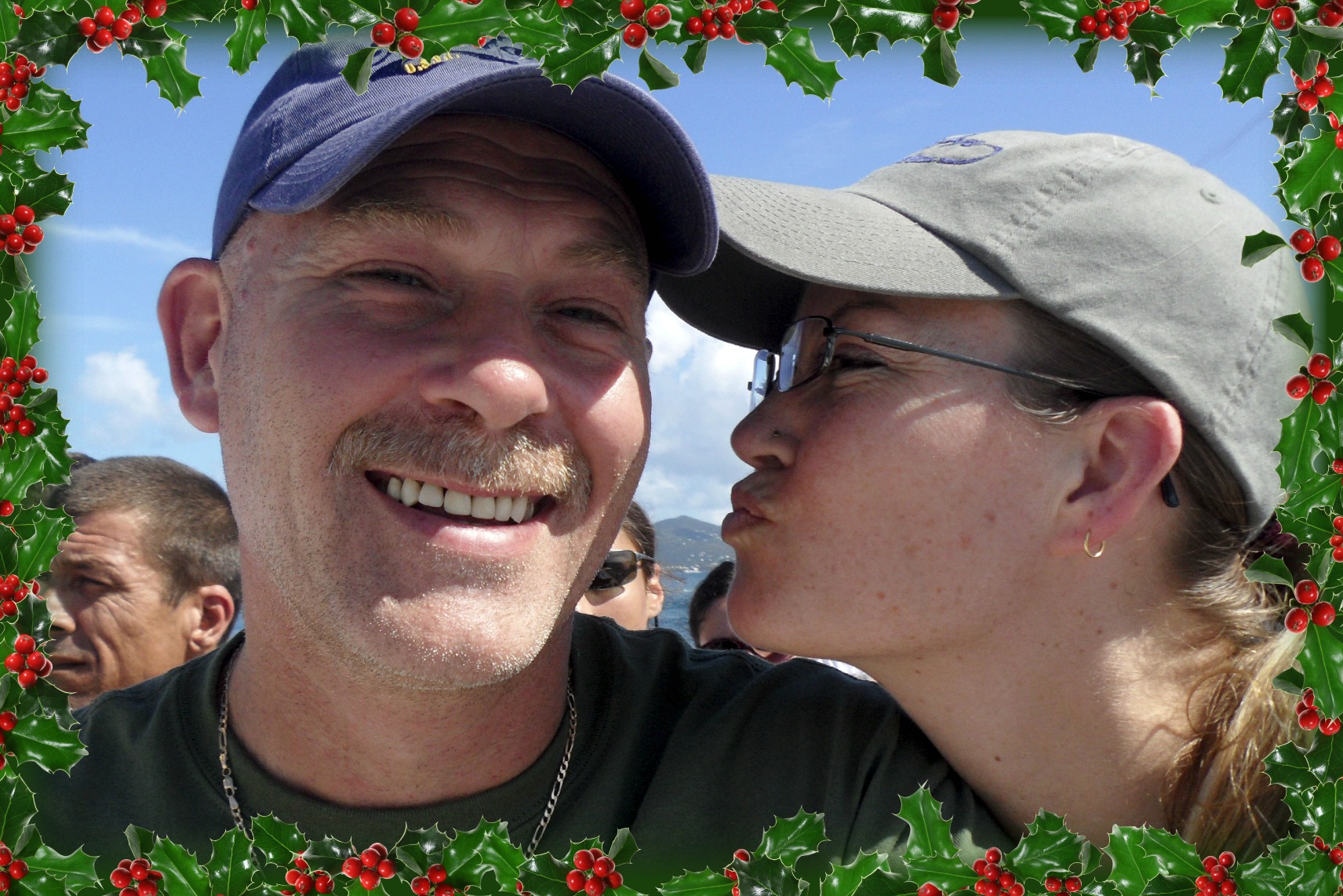
However, last year was a bit more exciting because Peg and I had a big secret plan between us. On Boxing Day we hopped on a plane and flew to the Caribbean. One long haul, three airports, three islands and one ferry later we arrived on St. John in the US Virgin Islands, where we eloped on the beach on December 28th. The photo above was taken of us on the ferry ride over to the courthouse in Charlotte Amalie to pick up our marriage license the day before. This year, of course, we’ll have our first anniversary!

How do you feel when the holidays are over?
It’s a bit anti-climactic. I start the new year with a long flight back to Brazil, which is a country we love living in, but it means back to work for a while. When my job is done there, we’ll have more time to travel when we please. In the meantime, we’ll enjoy as much of Brazil as we can. We both love to travel and look forward to the day when we can just keep going.

On the first day of Christmas, my true love said to me:
THREE DECENT WHISKIES,
TWO CANDY BOXES,
& AN IRISHMAN IN A PALM TREE!

STAY TUNED for tomorrow’s featured nomad (4/12) in our 12 Nomads of Christmas series.

If you enjoyed this post, we invite you to register for The Displaced Dispatch, a round up of weekly posts from The Displaced Nation, with seasonal recipes, book giveaways and other extras. Register for The Displaced Dispatch by clicking here!

Related posts:

Best of 2011: Books for, by and about expats

One of our Random Nomads in November, Aaron Ausland, had this to say about those of us who venture across borders:

Travel to a new place for three weeks and you can write a book, travel for three months and you can write an article, travel for three years and you’ll likely have nothing to say.

While that may be true, I’m afraid it hasn’t stopped many of us who’ve spent large chunks of our lives gallivanting around the globe trying out life in different countries, from taking up the pen.

As with any other group, some are born writers (and thrive on new surroundings), while others have become writers (attempting to make sense of their adventures), while still others have had writing thrust upon them (responding to invitations to share their experiences).

At the Displaced Nation, we revere people who publish books, fiction or non, that in some way assist those of us who are (or have been) engaged in overseas travel and residency. We feature — and do giveaways of — their works. And, for established writers with a global following, we’ve created a unique “category” called the Displaced Hall of Fame.

In this spirit — and in the December tradition of looking back at the past year’s highlights — I present the following (admittedly incomplete) list of books for, by, and about expats that were published in 2011, in these five sections (click on the title to go to each section):

  1. NOVELS ABOUT EXPATS
  2. NOVELS ABOUT “HOME”
  3. EXPAT MEMOIRS
  4. SELF-HELP, CROSS-CULTURAL & OTHER NONFICTION WORKS
  5. INSPIRATIONAL ANTHOLOGIES

A few more points to note:

  • Books in each category are arranged from most to least recent.
  • I’ve mixed indie books with those by conventional publishers (it suits our site’s somewhat irreverent tone).
  • To qualify for the list, authors must have been expats for at least six months at some point.

* * *

NOVELS ABOUT EXPATS

Three Questions: Because a quarter-life crisis needs answers (CreateSpace, October 2011)
Author: Meagan Adele Lopez
Genre: Women’s fiction
Synposis: A love story based loosely on the author’s own romance with a lad from Bristol, the action traverses continents through letters and features a quarter-life crisis, a road trip to Vegas, and two crazy BFFs.
Expat credentials: An American, Lopez lived as an expat in the UK for a while (she is now back in Chicago).
How we heard about it: Melissa of Smitten by Britain was a fan of Lopez’s blog (originally titled The Lady Who Lunches). The pair met her London in the summer of 2010, when Lopez was still living in England. Recently, Melissa has been supporting Lopez’s attempt to gain sponsorship for turning the novel into a screenplay.
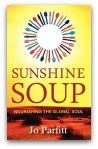
Sunshine Soup: Nourishing the Global Soul (Summertime, October 2011)
Author: Jo Parfitt
Genre: Women’s fiction
Synopsis: Six expat women from the UK, US, Thailand, Ireland, Norway and Holland converge in Dubai in 2008. The action centers on a Brit, who is on her first posting, and an American, who is on her 25th. The Brit learns the ropes and settles in, while the American woman’s world begins to crumble.
Expat credentials: A prolific author, publisher and pioneer in addressing the issues of accompanying spouses and aspiring expat writers worldwide, Parfitt has been an expat for nearly a quarter of a century. Born British, she now lives in the Hague.
How we heard about it: We noticed a couple of interviews with Parfitt — one by expat coach Meg Fitzgerald and another by Expat Women.

The Beautiful One Has Come: Stories (Wyatt-MacKenzie Publishing, July 2011)
Author: Suzanne Kamata
Genre: Cross-cultural romance
Synopsis: Twelve short stories reveal the pains and the pleasures experienced by expat women, most of whom live in Japan.
Expat credentials: Kamata is an American who has lived in Japan for 20 years.
How we heard about it: Kamata and her book were featured on Kristin Bair O’Keeffe’s Writerhead Wednesday in July of this year.

Hidden in Paris (Carpenter Hill Publishing, April 2011)
Author: Corine Gantz
Genre: Women’s fiction
Synopsis: Three strangers — all American women — have reached the point of terminal discomfort with their lives so run away to Paris to begin anew.
Expat credentials: Gantz is a French expat living near Los Angeles. She is getting her own back by writing about American expats in Paris.
How we heard about it: We are long-time fans of Gantz’s blog, Hidden in France — in fact, we promoted one of her posts (about falling into her swimming pool) with the launch of TDN in April. We also interviewed her about her first novel as part of our “gothic tales” theme this past May.

Exiled (Quartet Books, April 2011)
Author: Shireen Jilla
Genre: Psychological thriller
Synopsis: The wife of an ambitious British diplomat, whose first posting brings them to New York, looks forward to escaping from Kent and leading the high-profile life of a successful expat — only to find her world being threatened by dark psychological forces on a par with those depicted in Rosemary’s Baby.
Expat credentials: A Third Culture Kid (she is half English, half Persian, and grew up in Germany, Holland and England), Jilla has also been an expat in Paris, Rome, and New York.
How we heard about it: TDN writer ML Awanohara read a review of Jilla’s novel by Kate Saunders in the Sunday Times. She approached Jilla in May about having an exchange with our readers about the gothic themes in her novel, in line with our site’s own delvings into the gothic aspects of expat life. Our readers loved her!

NOVELS ABOUT “HOME”

Lady Luck (Colorado Mountain Series)
Author: Kristen Ashley
Genre: Romance
Synopsis: Ex-con hero, wrongly imprisoned, gets mixed up with unlucky heroine, who will stop at nothing to help him get revenge.
Expat credentials: Born in Gary, Indiana, Ashley grew up in Brownburg and then moved to Denver, where she lived for 12 years. She now lives with her husband in a small seaside town in Britain’s West Country, where she has produced more than twenty books featuring rock-chick, Rocky Mountain, and other all-American heroines.
How we heard about it: Ashley is the friend of an old schoolfriend of TDN writer Kate Allison, who invited her to do a guest post for us on Britain’s (lack of) Royal Wedding preparations  for our Royal Wedding coverage.

Queen by Right: A Novel (Touchstone, May 2011)
Author: Anne Easter Smith
Genre: Historical romance
Synopsis: This is the fictional story of Cecily of York, mother of two kings and said to be one of the most intelligent and courageous women in English history.
Expat credentials: The daughter of an English army colonel, Easter Smith spent her childhood in England, Germany and Egypt. She came to New York City at age 24, and as she puts it:

Many years, two marriages, two children and five cross-country moves later I’m very definitely a permanent resident of the U.S. — but my love for English history remains.

(She now lives in Plattsburgh, New York.)
How we heard about it: Easter Smith and her book were featured on Kristin Bair O’Keeffe’s Writerhead Wednesday in October.

Dance Lessons (Syracuse University Press, March 2011)
Author: Áine Greaney
Genre: Irish Studies, Women’s Fiction
Synopsis: The action centers on a woman of French-Canadian background who marries an Irish emigrant who is working illegally in a bar in Boston. After his death by drowning, she visits Ireland for the first time and finds out what a shattered man he actually was.
Expat credentials: She may be a resident of Boston’s North Shore, but Greaney continues to identify herself as an Irish writer (County Mayo).
How we heard about it: Greaney and her book were featured on Kristin Bair O’Keeffe’s Writerhead Wednesday in October.
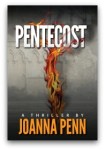
Pentecost: A Thriller (The Creative Penn, January 2011)
Author: Joanna Penn
Genre: Thriller
Synopsis: The Keepers of the stones from Jesus’s tomb — which enabled the Apostles to perform miracles — are being murdered. The stones have been stolen by those who would use them for evil in a world. An Oxford University psychologist spearheads a search for them in a race against time…
Expat credentials: English by birth, Penn grew up as a third-culture-kid and at the time of producing her first novel, was living in Australia.
How we heard about it: We are avid followers of Penn’s blog, The Creative Penn. Several months ago, TDN writer ML Awanohara deconstructed Penn’s post about what “home” means for writers for what it might teach expats and others who struggle with this issue as well. For Penn, home means some sort of spiritual kinship, which she has with two places: Oxford, where she went to university and near where her father now lives, and Jerusalem, which she’s visited at least ten times because she loves it there so much. Not surprisingly, she chose to set much of the action for her debut novel in these two cities.

EXPAT MEMOIRS
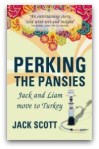
Perking the Pansies: Jack and Liam move to Turkey (Summertime Publishing, December 2011)
Author: Jack Scott
Synopsis: Dissatisfied with suburban life and middle management, Scott and his civil partner, Liam, abandon the sanctuary of liberal London for an uncertain future in Bodrum, Turkey. The book is based on Scott’s irreverent blog of the same name, which after its launch in 2010, quickly became one of the most popular English language blogs in Turkey.
How it came to our attention: Scott was featured as one of our Random Nomads in May of this year and since then, has done us the favor of commenting on and liking several of our posts. **Kate Allison will be reviewing his book for our site on Wednesday.**

Ramblings of a Deluded Soul (CreateSpace, September 2011)
Author: Jake Barton
Synopsis: In his inimitable style, the British-born Barton strings together snippets from new novels and try-outs with reminiscences and, for the first time, insight into his own remarkable experiences as a traveler and expat in Europe (he once owned a small French vineyard and had another job he’s not supposed to talk about). NOTE: Barton’s first novel, Burn, Baby, Burn, burned its way into the Top Ten of the Amazon All Books list.
How it came to our attention: Barton is an online acquaintance of TDN writer Kate Allison. We celebrated him in the early days of our blog for his insights on foreign-language learning in Spain.

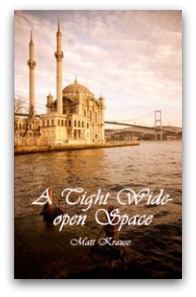
A Tight Wide-open Space: Finding Love in a Muslim Land (Delridge Press, August 2011)
Author: Matt Krause
Synopsis: A Californian who is now a Seattle-ite recounts how he became an Istanbullu, all for the love of a beautiful Turkish woman he met on a airplane. The year is 2003, and he can still hear the echoes of 9/11 as well as being acutely conscious of America’s engagement in two wars in Muslim countries. Eventually, he comes to love his new home more deeply than he might have expected.
How we heard about it: Linda Janssen, who writes the blog Adventures in Expatland, interviewed Krause about his book in October.

Planting Dandelions: Field Notes from a Semi-Domesticated Life (Penguin, April 2011)
Author: Kyran Pittman
Synopsis: A native of Newfoundland (her father was a well-known Newfoundler poet), Pittman writes about co-parenting with her charming Southern U.S. hubbie (they have three rambunctious boys); keeping the fiscal wolf from the door of their home in Little Rock, Arkansas; and honoring her marriage vows despite her refusal to give up her party-girl persona.
How we heard about it: Pittman came to our notice when she was a guest on Kelly Ryan Keegan‘s Bibliochat in late September.

Big in China: My Unlikely Adventures Raising a Family, Playing the Blues, and Becoming a Star in Beijing (Harper, March 2011)
Author: Alan Paul
Synopsis: Paul tells the story of trailing his journalist-wife to China and unwittingly becoming a rock star. His Chinese American blues rock band, called Woodie Alan, even earned the title of Beijing’s best band.
How we heard about it: We were early fans of Alan Paul’s back in the days of his Wall Street Journal online column, “The Expat Life.” Also, Paul and his book were featured on Kristin Bair O’Keeffe’s Writerhead Wednesday this past April.

The Foremost Good Fortune (Knopf, February 2011)
Author: Susan Conley
Synopsis: Conley, her husband, and their two young sons say good-bye to their friends, family, and house in Maine for a two-year stint in a high-rise apartment in Beijing. All goes well until Conley learns she has cancer. She goes home to Boston for treatment and then returns to Beijing, again as a foreigner — to her own body as well.
How we heard about it: Conley and her book were featured on Kristin Bair O’Keeffe’s Writerhead Wednesday in early October.

SELF-HELP, CROSS-CULTURAL AND OTHER NONFICTION WORKS

The Globalisation of Love (Summertime, November 2011)
Author: Wendy Williams
Genre: Relationships, self-help, humor
Synopsis: Williams interviews multicultural, interfaith and biracial partners from all over the world on what it feels like to “marry out” of one’s culture, religion and/or race. She also talks to experts on the topic and coins a term for it: “GloLo.”
Expat credentials: From a British-Ukrainian-Canadian family, Williams has been married to an Austrian for 13 years and lives in Vienna.
How we heard about it: TDN writer ML Awanohara listened to Jo Parfitt’s interview with Williams on her Writers Abroad show (Women’s International Network) and was attracted to the ideas of a book that treats this topic with humor. **TDN writer Anthony Windram will review the book for our site tomorrow (Tuesday).**

Modern Arab Women — The New Generation of the United Arab Emirates (Molden Verlag, November 2011)
Author: Judith Hornok
Genre: Women’s studies
Synopsis: The book consists of 20 chapters, each a stand-alone interview with an Emirati woman from disciplines as varied as business, film, medicine and politics. The women talk to Hornok about their careers, philosophies of life and plans for the future. The book, which is published in German and English, aims to dispel some of the Western myths surrounding Arab women.
Expat credentials: While not quite an expat, Hornok has been moving between the UAE and her home in Vienna, Austria, for eight years.
How we heard about it: TDN writer ML Awanohara read an article on the book in The National (UAE English-language publication) and became intrigued.

Expat Women: Confessions — 50 Answers to Your Real-life Questions about Living Abroad (Expat Women Enterprises Pty Ltd ATF Expat Women Trust, May 2011)
Authors: Andrea Martins and Victoria Hepworth (foreword by Robin Pascoe)
Genre: Women’s self-help, family, relationships
Synopsis: Experienced expats share wisdom and tips on topics that most expat women face, such as the trauma of leaving family back home, the challenges of transitioning quickly, intercultural relationships, parenting bilingual children and work-life balance. They also tackle more difficult issues such as expat infidelity, divorce, alcoholism and reverse culture shock. The book is based on the “confessions” page of Expat Women, the largest global Web site helping women living overseas.
Expat credentials: Andrea Martins is the director and co-founder of Expat Women. An Australian who has spent many years abroad, she began dreaming of connecting expat women worldwide when an expat in Mexico City. Victoria Hepworth is a New Zealander who has lived in Japan, China, Russia, Sweden, India and is currently living in Dubai, UAE. She is a trained psychologist who specializes in expat issues.
How we heard about it: Andrea Martins announced the publication of the book to much fanfare on Twitter and in other social media venues. It has been widely reviewed on expat blogs.

Marriage in Translation: Foreign Wife, Japanese Husband (CultureWave Press, April 2011)
Author: Wendy Nelson Tokunaga
Genre: Relationships, self-help
Synopsis: Tokunaga conducts a series of candid conversations with 14 Western women about the challenges in making cross-cultural marriages work both inside and outside Japan. She quizzes them about the frustrations, as well as the joys, of adapting to a different culture within married life.
Expat credentials: Born in San Francisco, Tokunaga has spent numerous years studying, living, working and playing in Japan. She is the author of two Japan-related novels, published by St. Martins Griffin. Oh, and did we mention her Japanese “surfer-dude” husband?
How we heard about it: Sometimes one tweet is all it takes! (We follow Wendy Tokunaga on Twitter.)

A Modern Fairytale: William, Kate and Three Generations of Royal Love (Hyperion/ABC Video Book, April 2011)
Author: Jane Green
Genre: Romance, royalty
Synopsis: In this video book for ABC News, produced just in time for the Royal Wedding in March, best-selling chick-lit novelist Jane Green follows the stories of three generations of royal love from their meeting up to and after their respective wedding days. She concludes that Kate and William have a much better chance than William’s parents of enjoying a relationship on their own terms.
Expat credentials: Born in London, Green worked as a feature writer for The Daily Express before trying her hand at writing novels. She now lives in Westport, Connecticut, with her second husband and their blended family.
How we heard about it: One of us noticed that Jane Green had been tapped to provide coverage of the Royal Wedding for ABC News. We then invited her to talk about her e-book and engage with our readers in a debate on whether women should still aspire to be “princesses” in the 21st century — a post that received a record number of comments.

INSPIRATIONAL ANTHOLOGIES

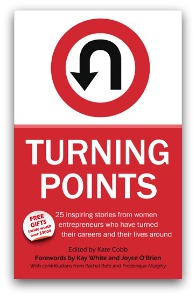
Turning Points: 25 inspiring stories from women entrepreneurs who have turned their careers and their lives around (Summertime Publishing, November 2011)
Editor: Kate Cobb
Synopsis: In this collection of stories from women all over the world, the focus is on the moments, or short passages of time, when a woman was facing something challenging and came out the other side smiling.
Expat credentials: Cobb is a British woman living in France, and about a third of the contributors — including Jo Parfitt and Linda Janssen — are expats who now run their own businesses.
How we heard about it: Linda Janssen promoted the book on her blog, Adventures in Expatland.

Indie Chicks: 25 Women 25 Personal Stories (Still Waters Publishing, October 2011)
Compiler: Cheryl Shireman
Synopsis: 25 indie novelists share personal stories in hopes of inspiring other women to live the life they were meant to live. (All proceeds go to the Susan G. Komen Foundation for breast cancer research.)
Expat credentials: Close to half of these indie authors are expats or have done significant overseas travel. To take a few examples: After living in Portland, Oregon, for most of her life, Shéa MacLeod now makes her home in an Edwardian town house in London just a stone’s throw from the local cemetery. Linda Welch was born in a country cottage in England, but then married a dashing young American airman, left her homeland, raised a family, and now lives in the mountains of Utah. Julia Crane is from the United States but recently moved to Dubai with her huband and family (her personal story concerns the adjustment process).
How we heard about it: Again, sometimes all it takes it a tweet (we picked up one of Linda Welch’s).

* * *

Questions: Have you read any of the above works and if so, what did you think of them? And can you suggest other works to add to the list? My colleagues and I look forward to reading your comments below!

STAY TUNED for tomorrow’s post, a review of The Globalisation of Love, by Wendy Williams, and for Wednesday’s post, a review of Perking the Pansies, by Jack Scott.

If you enjoyed this post, we invite you to subscribe to The Displaced Dispatch, a weekly round up of posts from The Displaced Nation, plus some extras such as seasonal recipes and occasional book giveaways. Sign up for The Displaced Dispatch by clicking here!

Related posts:
A Julia Child for our times: Expat author & French cookery expert Elizabeth Bard

Et voila. In a little less than a month, The Displaced Nation has gone from reminiscing over American expat in France Julia Child to engaging with American expat in France Elizabeth Bard.

Move over Julie Powell. At a pace rather like a simmering le Creuset pot of Child’s signature boeuf bourguignon, Bard is on the way to becoming the 21st-century’s answer to that towering figure of 20th-century cuisine Française.

The similarities between the two women are intriguing. Child went to France as a trailing spouse for an American diplomat. Bard went to France trailing a Frenchman.

Child was seduced by France. She found herself through French cuisine. Bard was seduced by France (after being seduced by a Frenchman). She found a way into French culture through the markets and cooking — and found herself in the process.

On this point, the line between the two women gets a little blurry. Which one, Child or Bard, said the following:

More than the museums, more than the ancient streets, these stalls of fruits and vegetables and spices were the Paris that inspired me.

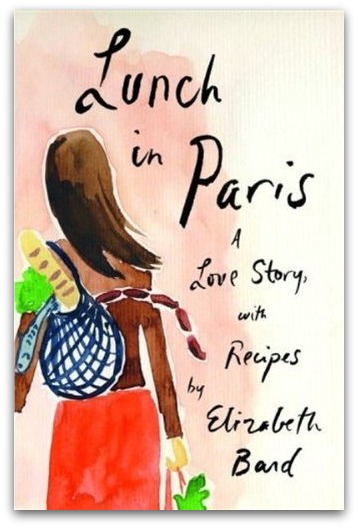
As everyone knows, Child returned to the United States to launch a career in television. Whereas Bard has become a long-term resident of France — and has launched a brilliant writing career with the publication of Lunch in Paris: A Love Story, with Recipes, a New York Times and international bestseller, a Barnes & Noble “Discover Great New Writers” pick, and the recipient of the 2010 Gourmand World Cookbook Award for Best First Cookbook. NOTE: We are giving away copies to two lucky DISPLACED DISPATCH subscribers. Sign up today!

Child inspired Julie Powell to make all of her recipes. Bard has inspired, among others, two Displaced Nation writers — myself and Anthony Windram — to try out her recipes.

But here the comparison ends. A key difference is that Bard’s recipes are nowhere near as difficult as Child’s — which is exactly what makes Bard so perfect for our times. She’s approachable, and her cooking suggestions are doable. She also has a rich life outside cooking — the life of a woman who has displaced herself into another culture — and enjoys sharing that part of her story as well.

Mesdames et Messieurs, I would now like to offer you the fruits (not to mention veggies) of my exchange with expat author, chef and lifestyle muse Elizabeth Bard.

Tell me a little more about your background.
I grew up in Northern New Jersey and spent weekends with my father in New York City. I studied English Lit as an undergrad at Cornell, then art history at Christie’s and the Courtauld Institute in London. My dream was to be the chief curator of the Pierpont Morgan Library in Manhattan. I was always convinced I’d been born in the wrong century. I love old objects, lost worlds, so, of course, I was instantly seduced by Paris (and of course, my French husband).

Over the years, I’ve written on art, travel and food, and digital culture for the New York Times, International Herald Tribune, Harper’s Bazaar, Wired, Time Out and Huffington Post, among others. Lunch in Paris was my first book.

In July 2010, my husband and I and our baby son Augustin moved to a small village in Provence, to live in the wartime home of the famous poet and WWII Resistance leader René Char. At the time, we had no plans to leave Paris — it was a date with destiny. You can find the complete (completely crazy?) story of how we found the house on my blog.

How are you finding life in Provence as compared to Paris?
As a city girl, village life is a discovery for me. I’m still adjusting to hanging my undies in the sun, and learning the names of the local birds (they can’t all be pigeons…). I’m surrounded by wonderful cooks and gardeners; last week, I went on my first saffron harvest. The move has been a wonderful transition for us as a family — it has made me question many of the things I believe about work/life balance, health, and being close to nature. All things I hope to share (along with my neighbor’s recipe for Provençal soupe au pistou) in my next book.

Turning to Lunch in Paris: What made you decide to write a book telling the story of your transition to living in France?
I hope Lunch in Paris captures something real about what it means to build a life in another culture. As an American, I follow generations of women who all came from somewhere else. They learned to cook with new ingredients, speak a new language, manage in a new world. My Jewish grandmother learned to make spaghetti sauce with pork ribs from the Italian ladies she met on line at the butcher shop during the war; I’m simply another in a long line.

Did you ever think of writing a novel instead? I ask because in reading the book, I kept noticing your facility with dialogue and description.
It never occurred to me to write Lunch in Paris as a novel. Fantasy lives in France are easy to imagine — but I wanted to express some of the things I’d learned personally, about what it means to take risks, to put happiness first on your checklist. That’s not a fictional decision — that’s something we struggle with every day.

Why did you decide to include recipes in your book?
Almost as soon as I arrived in Paris, I knew that I wanted to write about the roller coaster of international living, and the richness of intercultural marriage. When I sat down to think about the moments that really helped me discover French life, I kept coming back to the dinner table, the markets, the recipes — so it seemed natural to structure Lunch in Paris around those experiences.

Do you still use the recipes from the book and which one is your favorite?
I’m always trying new recipes, which I share on the blog or Facebook page, but I do use my copy of Lunch in Paris as a cookbook — I keep it handy in the cabinet with the pasta. The recipes I go back to again and again: for summer, it’s the haricot verts with walnut oil, for winter, the lentils. The tagines are great for a party — and the molten chocolate cakes work anytime.

Which portion of your book — Paris, the love story, the recipes — have readers responded to most?
I’m so surprised, humbled, gratified by the fact that Lunch in Paris has found such a wide audience. I’m so pleased that the book has been a vivid piece of armchair (or bathtub) travel for those who love Paris — and a temptation for those who’d like to go. I’ve had many young readers say it inspired them hold on to their dream of living abroad, or simply doing something a bit outside the box with love or career.

I’m also thrilled that people are getting their books all greasy, using the recipes — and posting photos of their creations on the Lunch in Paris Facebook page. I’m a home cook; I tested all the recipes myself. I was determined that readers take as much pleasure (and as little stress) in preparing them as I did. Maybe the nicest thing anyone has said came from a friend in London:

“It’s nice for Augustin to have such a wonderful record of his parent’s romance.”

I’m proud to be passing that on.

The thing that has surprised me the most is the wonderful online community. Though the readers are all over the world, it really feels warm and personal to me. I love that social media allows people to share recipes and stories from all over the world. A few months ago, I got an email from a New Zealander living in Crete. I now follow her blog to learn about traditional Cretean cooking.

As I mentioned in my intro, Julia Child was the inspiration for TDN’s October theme — and you remind me of a 21st century version of her in some ways. I’m curious, do you have her Mastering the Art of French Cooking — and do you actually use it?
I have my mom’s copy of Mastering the Art, but at the moment – I’m too busy trying recipes from my French neighbors to actually use it!

What did you think of Julie Powell’s blogging about making all the recipes from that encyclopedic book?
I love a good project — especially one that gets a girl out of a rut — it was fun to read about how the random adventures we set for ourselves can change everything.

How about the film, Julie & Julia?
The film — well, it just proves that Meryl Streep can do ANYTHING.

We’ve been asking our Random Nomad interviewees this month if they identify with any of the following Julia Child quotes and why. Can we ask you as well?
I agree with the choice that both Mardi and Jennifer made:

The only real stumbling block is fear of failure. In cooking, you’ve got to have a what-the-hell attitude.

I’d say this goes for goes for life in general — not just cooking. With all of our “Just-do-it” attitude, Americans are particularly prone to fear of failure: everything is possible, so everything we don’t accomplish is our fault. Fear is paralyzing. I work every day to get the hell out of my own way.

Quite a few of our readers are long-term expats who’ve entered cross-cultural marriages. What do you think is the biggest challenge about marrying someone of another culture?
The Franco-American combination is a very powerful one. I gave my husband a bit of the American can-do spirit, permission to pursue his dreams based on his own qualities, instead of family or class. He gave me a bit of the French joie de vivre — permission to live in the moment, to consider happiness, rather than some abstract (and culturally relative) notion of “success”, as my ultimate goal.

Was language an obstacle at all?
I speak fluent French now. It was a struggle at the beginning — you feel a bit invisible. That’s one reason cooking became so important to me. During the early days of our marriage, I used food to welcome people. My husband’s friends didn’t know if I was intelligent, charming, witty, or warm. What they did know is that I made a mean sweet potato puree. There were times when I used the kitchen to hide. French dinner parties are marathons of cuisine and conversation — 4 or 5 hours minimum. With the rapid-fire French buzzing in my ears, and my brain foggy from the wine, it was just easier to say, “I’m just going to check the roast” than “Dear God, I’m so bored and exhausted I’m considering sticking my head in the oven.”

Do you think you could fit back into living in American culture after a decade of living in France?
I’ve been away for a long time — and like many expats, I find myself in a no-man’s land, not quite one or the other. Honestly, I think the hardest thing about moving back to the States would be the portions — even with a great farmer’s market nearby I think it would be a struggle to maintain our very healthy French eating habits. That and the hyper-competitive attitude about raising kids. I’m not sure I’m ready for preschool applications.

As it happens, on October 13 Travelers Night In (#TNI) was French inspired, and everyone tweeted their answers to 10 questions about the best of the best in France. Could you do us — and the traveling community at large — the honor of providing your own short answers?
Q1. The best thing about French people is…
Food is not fuel.
Q2. France is famous for food, what dish is your favorite? Best food city?
Give me a perfect, flaky, buttery croissant.
Q3. Favorite French countryside escape?
The rolling hills of Burgundy — with a stop at the cathedral in Vézelay.
Q4. What is the most overrated thing about France?
April in Paris (it rains)
Q5. What defines Paris?
PDA (does that still mean public display of affection?)
Q6. French museum or monument that shouldn’t be missed?
Musée Jacquemart-André, Paris
Q7. Perfect place to enjoy a glass of French wine? What varietal, region, winery?
People watching along the Canal Saint-Martin, any glass recommended at the Verre Vole (rue de Lancry)
Q8. Top way to spend a night out in Paris?
Walking along the banks of the Île Saint-Louis with a double scoop of Berthillon sorbet.
Q9. Best things to do on the French Riviera?
We avoid the French Riviera — over-crowded, over-priced, over.
Q10. Biggest misconception about the French?
French cooking is complicated.

Thank you so much for engaging in this tête-à-tête! Readers, do you have your own questions for this 21st-century answer to Julia Child? Hurry up, before she disappears into her kitchen or heads out to another saffron field!

Images: Head shot of Elizabeth Bard by Cindi de Channes (2008); book cover.

STAY TUNED for tomorrow’s installment from our displaced fictional heroine, Libby, who is taking seriously her friend’s advice to make time for herself, and enjoying her freedom while Jack is in nursery school. Someone had better remind her that small babies tend to put a damper on such wanton activities. (Speaking of which, Libs — isn’t it time you saw a doctor?) What, not keeping up with Libby? Read the first three episodes of her expat adventures.

If you enjoyed this post, we invite you to subscribe for email delivery of The Displaced Dispatch, a round up of the week’s posts from The Displaced Nation, including seasonal recipes and book giveaways. Sign up for The Displaced Dispatch by clicking here!

Related posts:

“My country, ’tis of thee” applies to my expat mum but not to me

We take a break from road trips today with this guest post from Lawrence Hunt, a recent graduate of Warwick University (UK). Followers of The Displaced Nation may recall that we interviewed two cross-cultural married couples last summer. Hunt is the product of a cross-cultural union between an American mother and an English father. Let’s listen to what he has to say regarding the oft-perplexing matter of cultural identity. NOTE: This post has not been edited for British spelling or punctuation.

One of the things that expats like to tell themselves is that home is a state of mind.

But for me, the child of an English father and an American mother, home stands for a physical place: the one where I was born and grew up, England.

For years my mother has sipped her morning coffee from the same extravagantly large mug, Stars and Stripes boldly printed around the outside. She picked it up at an airport in Washington DC where we were visiting her sister. It’s curvaceous and welcoming, a daily caffeinated hit of homeland comfort. I’ve started drinking from it, too — but more as an ironic gesture.

Mum grew up reciting the Pledge of Allegiance in class, but in ultra-PC Britain, patriotism has to be decidedly lower key. It seems commonplace to see flags hoisted outside American homes, but over here the very act of being seen with a St George’s flag in any context other than sporting events or royal weddings is infrequent enough to draw stares. People see you with it and instantly wonder what fanatical scheme for national purification you’re plotting behind closed doors.

Now, I don’t fault my mum for being proud of her cultural upbringing. I think in some ways her extended absence makes her all the more keen to assert her identity and share it with us.

She did some family history research recently that confirmed we’re the distant descendants of Charles Carroll of Carrollton, the only Catholic and longest surviving signatory of the Declaration of Independence. That’s my strongest claim to fame, and I’m holding onto it.

Chocolate — the way to an English child’s heart

That said, America has never played much of a role in our regular family rituals. For one thing, traditions like the Fourth of July and Labour Day just aren’t compatible with the British calendar.

I do remember Mum hosted a wonderful Thanksgiving dinner once with some other American expats when I was little. Without having the next day off to recuperate, however, everyone left early and I think she found the mountain of washing up too colossal to repeat the effort.

The one institution she has passed down to us (and this is something I cannot thank her enough for) was the American Easter basket hunt. The concept, as I explain it to my friends, is simple but ingenious – essentially, it’s what all kids in England do but with two key differences: 1) More chocolate, and 2) Baskets.

While other English kids were being handed single Cadbury creme eggs in flimsy cardboard boxes, my brothers and I were racing around the garden looking for mighty hoards of chocolate hidden among the shrubbery by a miraculously literate bunny that knew how to spell our names on post-it notes.

As American as everyone else in Britain?

Basket cases aside, it’s difficult to say exactly how ‘Americanized’ I am as a result of my mother, and how much of it is just living in a country where America’s influence pervades almost every cultural platform.

The most differentiating feature of mum’s background has always been her accent. I can do a pretty convincing American accent on a good day, and I used to mimic my mother so often when I was a child that I still lapse into it sometimes without realising.

But even my mother, having lived here for almost thirty years, isn’t really that American any more in her diction. I think the few Americanisms I sometimes find myself using, like ‘movie’ rather than ‘film’, or ‘take-out’ rather than ‘takeaway’, are more because I hear them in American movies and prefer them than because I’ve picked them up from her.

I certainly feel something for the States — a fondness and a familiarity, I suppose. I’ve been lucky enough to go with her on visits to her family almost every other year since I was a baby. Some of my favourite memories have come from spending summers at lake houses in North Carolina, climbing the mountains of West Virginia and walking down endless blocks of New York.

When I was seventeen I took a position teaching at a French camp in the woods in Minnesota, and made friends who I still keep in contact with.

America as distant entity

But America lives for me, as it does for many Brits, more in fiction than in reality. From the moment I read JD Salinger, I was hooked, and I’ve probably read more American writers than British ones: Steinbeck, Fitzgerald and Kerouac, right through to more recent contemporaries like Bret Easton Ellis, David Foster Wallace and Jonathan Franzen.

They all essentially seem to be commenting on the same thing: the tragic failure of American life to live up to its promises. Paradoxically though, in the richness of the characters and landscapes they describe, they evoke a utopia in my mind that’s been hard to shake.

In my final year at university I enrolled in a contemporary American Literature module — ‘States of Damage — US Writing and Culture in the Post 9/11 Context’. I didn’t know what I was getting myself into. It was a step-by-step dissection of everything wrong with free market America, from George Trow’s attack on media culture in ‘Within the Context of No Context’ to Naomi Klein’s The Shock Doctrine, an expose on America’s foreign policy over the past 40 years.

The critique seemed appallingly one-sided to me, and an hour a week for an entire year I felt compelled to fight America’s corner against the scathing intellects of my fellow students. Truth be told, I just like a good debate, and this was a difficult one. There’s a lot about American politics that we find objectionable in British culture — even though we’re implicated in most of the same hypocrisies ourselves.

To be fair, however, my fellow students showed a very different side on Obama’s inauguration night. The Students Union had been decked out in American flags and YESWECAN posters, and multitudes of students were queuing up to buy hotdogs and other American staples. I voted in that election, and it was a night when I felt nothing but pride to be half American.

My mum’s sweet land of liberty

I sometimes think it would be nice to use my dual citizenship and live on the other side of the Atlantic for a while, preferably near the coast. Mum believes that on the whole, Americans are more open, friendlier (at least on the outside) and more honest than British people. She’s even been known to point out these qualities in my brothers and me, when they appear, as our ‘American side’.

I’m sceptical that you can generalise about such vast groups of people in any meaningful way, especially as the world becomes increasingly mixed.

Ultimately, I think when you spend very little time in a place, and you miss it greatly, you begin to feel connected to a idealised version of it, one that’s perhaps better than the reality. When I ask about America, the memories my mother recalls from behind the vapours of her star-spangled mug are those of the pioneering Midwest. She tells me she always wanted to be one of the pioneers in Little House on the Prairie, struggling against the elements and striking out on her own.

That adventurousness is, ironically, probably part of what made her leave America for pastures new in the first place.

I can see the real things she’s had to give up in establishing her new life here — the family, the friends, the holiday traditions, a million different flavours and details that in some cases are only slightly different here from what she grew up with. Those are also the things I take for granted about my own life in Britain.

I was born here, and that counts for a great deal more than where my mother was born.

img: Lawrence Hunt with his mum’s stars-and-stripes mug, at home in Chorley Wood

STAY TUNED for Monday’s post, in which Matthew Cashmore, aka The London Biker, relays his personal “Zen” of this rather risky, albeit exhilarating, mode of travel.

If you enjoyed this post, we invite you to subscribe to The Displaced Dispatch, a weekly round up of posts from The Displaced Nation, plus some extras such as seasonal recipes and occasional book giveaways. Sign up for The Displaced Dispatch by clicking here!

Related posts:

The Displaced Nation’s Agony Aunt: Introducing Mary-Sue

Please give a warm welcome to Mary-Sue Wallace, The Displaced Nation’s agony aunt. We’re delighted to have Mary-Sue on board and know that her thoughtful advice will be able to ease and soothe our readers with any cross-cultural quandary or travel-related confusion that they may have.

Mary-Sue is a retired travel agent who lives in Tulsa with her husband Jake. She has taken a credited course in therapy from Tulsa Community College and is the best-selling author of Traveling Made Easy, Low-Fat Chicken Soup for the Traveler’s Soul, The Art of War: The Authorized Biography of Samantha Brown, and William Shatner’s TekWar: An Unofficial Guide. If you have any questions that you would like Mary-Sue to answer, you can contact her at thedisplacednation@gmail.com, or by adding to the comments below.

I’m a 68-year-old retired insurance salesman from Buffalo, NY. Six months ago I got married for a second time to a woman that I met on www.meetukranianbrides.com, an international matchmaking site. My new wife, Oksana, is 24 and she seems increasingly distant with me. I’m worried that she doesn’t like Buffalo as much as I thought she would and that she’s having second thoughts about me. What can I do? DP, Buffalo.

Oh, DP, I think it’s time to start turning that frown upside down, don’t you? As you write in your letter, you’re a retired insurance salesman from Buffalo. What’s not to love about that? How can that fail to get the passion inflamed? My husband, Jake, is a retired insurance salesman from Tulsa, and let me tell you, I could not be happier — both in and out of the bedroom.

I bet you have a nice little pension from a life spent working hard. Now is the time to open up that wallet and throw the moolah around a bit. That way you can have a romantic time while also showing off all the best that Buffalo has to offer. Take her to Country Buffet or to Cracker Barrel, order her the meatloaf, she’ll soon stop her pining for Odessa. And over your romantic all-you-can-eat buffet, why not take this time to open up about yourself. Us gals love to know how our hubbys tick, believe me. Tell Oksana about your time as an insurance salesman. Tell her precisely how premiums work. Explain how your job was to give peace of mind to your average Joe. Believe me, Oksana will be reminded of just why she fell in love with you in the first place, that magical moment when she logged into her email and saw the JPEG file of your passport photo you’d sent her.

As an Irish Expat in Austria I sometimes have a hard time connecting with people. It seems humour-wise I’m on a different wavelength to everyone else. I’m used to using humour to diffuse situations or to put people at ease, but every time I make a joke here it’s met with stony silence. The sort of stuff that they laugh at I get really confused by. How can I bridge this humour gap? MA, Vienna.

It’s Austria, stony silence is a good thing. It’s when they start laughing at your jokes you’ve got a problem — that’s the time you really need to ask for help.

img: Close, by Corina Sanchez.

STAY TUNED for tomorrow’s post, on celebrated women travel writers of old.

If you enjoyed this post, we invite you to subscribe to The Displaced Dispatch, a weekly round up of posts from The Displaced Nation, plus some extras such as seasonal recipes and occasional book giveaways. Sign up for The Displaced Dispatch by clicking here!

CLASSIC DISPLACED WRITING: Joy in the place — Elizabeth von Arnim

The novelist Elizabeth von Arnim (1866-1941) wrote many enchanting books, all of which were autobiographical to some extent, linked to persons or places she knew.

But does that necessarily mean that Elizabeth — born Mary Annette, nicknamed May, she called herself “Elizabeth” upon becoming a professional writer — led an enchanted life?

Yes and no. By all accounts, she was an enchanting person herself, constantly delighting other people with her sharp wit.

She also kept enchanting company: E.M. Forster was tutor to her children, Katherine Mansfield was her adopted cousin, and H.G. Wells was one of her lovers.

Displaced almost from birth (she was born in Kirribilli Point, Australia, and then moved to England at the age of three), she made a life-long habit of flitting from one enchanting locale to the next.

Having spent her formative years in London, she moved to Pomerania in Prussia (Germany) for her first marriage, where she raised five children.

Upon the death of her husband in 1910, she made her home in the Valais, Switzerland, living in a glamorous house, Chalet Soleil, which she’d built from her riches as an author.

With the failure of her second marriage, Elizabeth zigzagged between homes in the United States and Europe.

She died in Charleston, South Carolina.

A full measure of sorrows

But a peripatetic life isn’t always a charmed one, as many of us expats and former expats can attest. As her life progressed, Elizabeth experienced a full measure of sorrows.

Her first marriage — to a domineering Prussian count — wasn’t particularly happy. She nicknamed him the Man of Wrath, and they separated several years before his death.

Her second marriage, to Frank Russell, elder brother of Bertrand, was even more miserable (he proved to be a despotic egoist).

Her only true love she met when she was 54 — and he was nearly 30 years younger. (They never married.)

She also suffered the grievous deaths of a daughter and a brother.

By the time she died, Elizabeth was estranged from most of her children, crippled with arthritis, and almost forgotten by her adoring public.

Her only devoted companion was her dog, Billy.

Escape artist par excellence

But despite these tribulations, Elizabeth remained throughout her life, in the words of gardening writer Deborah Kellaway,

a steadfast hedonist, firmly suppressing sorrows. … Her journals and letters repeatedly record moments of happiness, usually associated with sunny days.

As Elizabeth once wrote in a letter to one of her daughters,

“What I really am by nature is an escapist.”

Thus what we can learn from Elizabeth’s life — and from her many autobiographical books — is the art of escaping into happier worlds.

As Kellaway explains:

[The heroines of her novels] escape from richness into the simple life, or from conventional home life into foreign travel; they escape from houses into caravans.

The most famous example, of course, is Elizabeth’s 1922 novel, The Enchanted April — from which we’ve taken our theme of enchantment on the blog this month.

As everyone knows who has read that book — or, more likely, seen the 1992 film or the 2003 Broadway play — four women who share only their unhappiness and a love of wisteria flee 1920s London and converge in Portofino, Italy, on a magical medieval villa overlooking the Mediterranean.

Simple pleasures are the best?

But while Italian castles can certainly be a tonic — if offered one, I’d be off like a shot — what most people don’t know is that Elizabeth was equally fond of much simpler escapes. In the first two books that made her reputation as a writer, the heroine escapes her marital, motherly and household duties by venturing into a German garden, set in a wide landscape.

Here is the most lyrical passage from the second of these, The Solitary Summer (1899):

Yesterday morning I got up at three o’clock and stole through the echoing passages and strange dark rooms, undid with trembling hands the bolts of the door to the verandah, and passed out into a wonderful, unknown world. I stood for a few minutes motionless on the steps, almost frightened by the awful purity of nature when all the sin and ugliness is shut up and asleep, and there is nothing but the beauty left. It was quite light, yet a bright moon hung in the cloudless, grey-blue sky; the flowers were all awake, saturating the air with scent; and a nightingale sat on a hornbeam quite close to me, in loud raptures at the coming of the sun. …

It was wonderfully quiet, and the nightingale on the hornbeam had everything to itself as I sat motionless watching that glow in the east burning redder; wonderfully quiet, and so wonderfully beautiful because one associates daylight with people, and voices and bustle, and hurrying to and fro, and the dreariness of working to feed our bodies, and feeding our bodies that we may be able to work to feed them again; but here was the world wide awake and yet only for me, all the fresh pure air only for me, all the fragrance breathed only by me, not a living soul hearing the nightingale but me, the sun in a few moments coming up to warm only me…

A lovely garden at just the right time of day — as I know from my own experience of enduring many city summers*, that’s all it sometimes takes to escape into happiness.

*On that note, I’d like to recommend a walk on the High Line in early morning or late afternoon, to anyone living in or traveling to New York City this month…

QUESTION: What does it take for you to escape the dog days of summer into happiness: a trip to Italy, a walk in the garden — or something else?

STAY TUNED for tomorrow’s post, on our new weekly newsletter, The Displaced Dispatch.

If you enjoyed this post, we invite you to subscribe for email delivery of The Displaced Nation. That way, you won’t miss a single issue. SPECIAL OFFER: New subscribers receive a FREE copy of “A Royally Displaced Tea.”

Related posts:
Marriage, cross-cultural style: Two veterans tell all (Part 2)

A week is a long time in blogging, and since Part 1 of this post went up last Monday, horrifying events in Norway have delivered a chilling reminder of the venom that can be unleashed when cultures mix and values clash.

Thus I am full of renewed admiration for our two married couples — Gabriela & Daniel Smith, Jeffrey & Naoko Huffman — who have tested themselves more than most on cultural tolerance and openness.

Last week, we heard from Gabriela and Jeffrey, the nomadic halves of each partnership. Let’s introduce them again — along with their better halves, who this week have kindly agreed to “come in” and answer a few of my questions.


GABRIELA & DANIEL SMITH have been married for eight years. Gabriela was born in Venezuela to Spanish parents, but ended up in the UK, where she met Daniel and they currently live.


JEFFREY & NAOKO HUFFMAN have been married for 19 years. They met in Nagoya, Japan, where Jeffrey, an American, had journeyed for his work. They now live in Seattle.

Naoko and Daniel, I’d like ask you both a question I posed to your respective spouses last week: did you ever think you would marry someone from another culture?


NAOKO: My parents expected that I would agree to an arranged marriage, and when growing up, I thought I would do as they told me. But then I attended an English as a Second Language (ESL) program in San Francisco. After meeting lots of people from different countries, I became more open to the idea of an international marriage. But I don’t think I chose Jeff as my husband because he is a foreigner. I just wanted to be with him and spend the rest of our lives together.


DANIEL: I was drawn by Gabriela’s Latin charm, but what attracted me to her primarily was her personality and way of looking at life. I never experienced any inhibitions about asking her to marry me. I assume that whatever the background of your partner, if you make the decision you love someone and want to be with that person forever, there will always be a considerable amount of risk — as in not knowing how each person will change and how their values and perceptions will evolve. In reality could the “girl next door” be a higher risk? For example, I now know what it feels like to be an expat from having worked for six years in France, but I had no way of predicting my life would take that path.

How did you find your new in-laws?


NAOKO: Jeff’s parents were nice to me from the beginning, even though my English wasn’t good enough to communicate with them on a deep level. But while they treated me with respect, I think they were also wondering how Jeff’s two grandmothers would feel about me.


DANIEL: On our first visit to my new parents-in-law, the only true reservation I had was based on what type of food I would be offered and if there was a different etiquette I would be expected to follow. Navigating the new culture proved relatively straightforward, although I did discover that calamares — whether fried, baked or stewed — isn’t fit for human consumption.

Let’s bring in all the partners now and talk a little more about family life. As mentioned in Part 1, each of you has two kids, a girl and a boy. What’s been the biggest challenge in bringing up kids from two different cultural backgrounds? Have they adopted one of your cultures more than the other?


JEFFREY: At 9, I think our son is too young to have much “cultural consciousness.” He has Asian American, African American, and Muslim American classmates. He’s aware of the general differences, but none of it seems to matter at this point — although he was rooting for Japan, not the U.S., to win the women’s World Cup.

Our daughter, on the other hand, is quite proud of her Japanese heritage — while not being particularly well versed in the culture. She has at least four other haffu classmates and lots of Korean American and Chinese American classmates. Of her best friends, one is African American, and another is a half-Phillipina girl whose adoptive mother is a lesbian. Her cohort gives me hope for America’s future as an open and tolerant society.

Neither Naoko nor I is religious, so that’s never been much of an issue — less so, however, with my mother, who is Christian and probably believes we’re all going to hell.


NAOKO: I had a concern about how our kids would feel about being Japanese when they learned about WWII. But they just accepted as a fact and were okay with it. I was impressed. I do wish we’d started them on Japanese language training earlier, though. Our daughter was only 18 months old when we moved back to the U.S. After that, I stopped using Japanese at home and soon returned to work full time. They are just now beginning formal Japanese-language instruction.


GABRIELA: I was born in Venezuela to Spanish parents and have never been able to choose between my two — Spanish and Venezuelan — heritages. Perhaps our children will just take the best from each of these cultures, and from English culture. No doubt their choices will be influenced by where they live, the type of people they meet, and how they position themselves in the world. I don’t know if they will feel more one or the other, especially if we live in a neutral third country, which as I mentioned last week is our goal. Right now, for example, my daughter says she is French because she was born in France. I’m happy with that.


DANIEL: I don’t find it challenging at all to bring up children who are a mix of cultures. Of course I’m always noticing their Spanish looks and ways, inherited from Gabriela.

How about for meals? Do you try to blend your cultures in the foods you prepare for the family? Who cooks?


JEFFREY: We eat as much if not more Asian/Japanese food as we do Western. Our son would eat soba and shumai seven days a week. We both cook.


GABRIELA: I cook for our children and my husband cook for the two of us. Since I’m not much of a cook, my kids have to eat my invented meals (bless them!), and as for my husband, well, I let him decide what he wants to make. I just enjoy it and do the washing up afterwards! He occasionally makes Venezuelan and Spanish meals, perhaps as often as he does English ones.

Jeff and Naoko, do you think you’ll ever move back to Japan? Last time, Jeff hinted that you might like to one day.


JEFFREY: The longer we’ve been back in the U.S., the harder it’s become for us to return to Japan. That being said, even in today’s economy, Naoko would have little difficulty finding work in Japan — she’s in finance. Whereas I’m pretty much unsuited to anything in Japan that would pay all that well. The kids, particularly our daughter who is just entering high school, would probably mutiny as well if we uprooted them at this point. Maybe after retirement?


NAOKO: Jeff keeps telling me to get posted to London, so perhaps we could give that a try?

Gabriela, how often do you get back to Venezuela to see family and friends?


GABRIELA: The last time I visited was three years ago. After that, I decided not to go back due to the political situation and have been relying on telephone calls and the Internet to keep in touch. But, to be honest, I don’t communicate with my family all that often. I have been away 14 years, so am used to the distance.

How about your kids? Actually, that’s a question for Naoko, too, since both of you are living away from the countries where you grew up.


GABRIELA: Only some of my family come to the UK and visit, usually just once a year for a few days. Those are the only times my children see them.


NAOKO: We haven’t been able to go back to Japan as often as we would wish since it’s so expensive for a family of four to fly there. Over the last five years, we’ve gone back every other year. But from now we’ll be making more of an effort to visit my parents since my father is not doing so well. My family always talks about coming to see us in Seattle, but they haven’t done it yet. Only my mother has been here — for my wedding, 19 years ago.

Finally, we are honoring Pocahontas this month at The Displaced Nation for her expertise in cross-cultural relations. I’m wondering if each of you could offer some advice to other couples in cross-cultural relationships — preferably in the form of a Native American proverb.


GABRIELA & DANIEL:

Cultural barriers are in the eye of the beholder.


JEFFREY & NAOKO:

For cross-cultural marriage to work, there can be no shortcuts. Each partner must accept the other’s culture.

Warm thanks to both of our couples for allowing their marriages to be put under The Displaced Nation’s microscope for two weeks running. Readers, do you have any more questions or comments?

STAY TUNED for tomorrow’s post, Part 2 of the travel yarn “How foreign is Fez?” — by guest blogger Joy Richards.

If you enjoyed this post, we invite you to subscribe for email delivery of The Displaced Nation. That way, you won’t miss a single issue. SPECIAL OFFER: New subscribers receive a FREE copy of “A Royally Displaced Tea.”

Related posts:

In fiction and in life, this expat pursues paradise

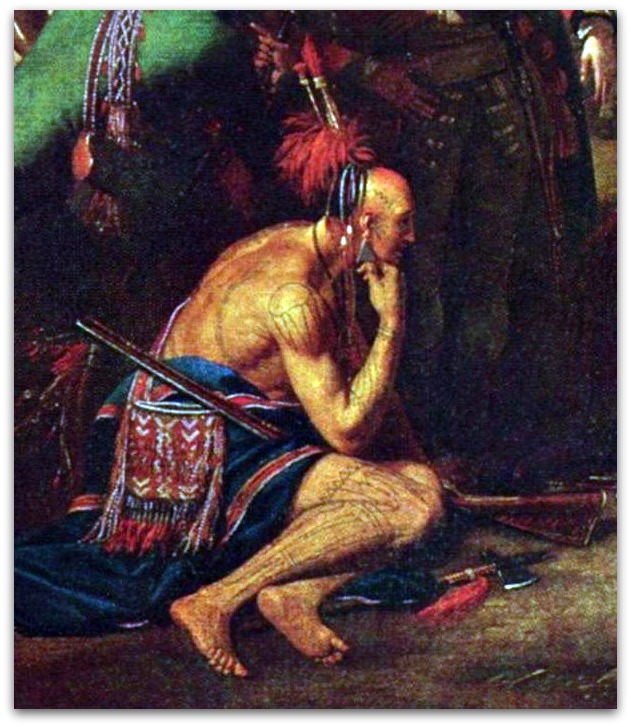
As regular readers of The Displaced Nation will know, Pocahontas is the heroine of our blog this month. Sprightly, playful, well-featured and solicitous — unencumbered by the corrupting influences of civilization, in tune with Nature — she, and other women of her ilk, conformed to the vision Europeans held of the New World.

They were also the subject of many a European man’s romantic fantasy.

After meeting a Pocahontas, a European could brag to his friends back home that he’d found Paradise on Earth.

Flash forward almost four hundred years, and we find something similar going on with certain groups of international travelers. I speak of those who are restlessly searching for places that have yet to be touched by Western materialism and other corrupting ideas — where people lead simpler lives and are more decent.

And for male travelers, that vision usually encompasses finding their own Pocahontas: a native woman with long, dark hair, who unlike her Western sisters, still knows how to care for a man…

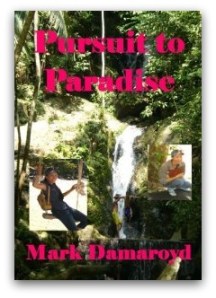
Mark DamaroydAgainst this background, we welcome author Mark Damaroyd to The Displaced Nation. As an expat in Thailand, Damaroyd lives — and has written about — the utopian life to which no small number of men who’ve ventured into foreign countries aspire.

His first work of fiction, published in 2010, is called Pursuit to Paradise. Described by one reviewer as a “tale of romantic intrigue that keeps the pages turning,” the novel takes place in Thailand and the UK, and centers around an Englishman’s relationship with an exotic Thai woman.

Mark Damaroyd has kindly agreed to answer some of my questions about his life and book, and about the challenges of cross-cultural relationships more generally. After that, the floor is open — be sure to chime in!

Can you tell us something about yourself?
Firstly, ML, thank you so much for your invitation to be interviewed by The Displaced Nation.

I’m English, born in Cambridge, but not lucky enough to go to university there. I spent many years in Devon, a beautiful county in Southwest England. I still sometimes miss the thatched country pubs, pasties and cider.

Bitten by the travel bug in 1968 — yes, I really am that old! — I traveled overland from England to India in a camper van. You may have heard about the “Hippie Era,” the “Make love not war” days. I was a short-haired, beardless hippie.

In those days, we got our thrills journeying as a group through countries like the former Yugoslavia, Iran and Afghanistan — so many treasured memories.

Since those days, I’ve lived and worked in Australia, Spain, Portugal and Thailand, taking periods out to sail round the world in a couple of the old passenger ships, now out of service.

Back home in 2005, I found myself jobless at an age where finding new employment was just about impossible. In the wake of failed marriages that produced three offspring, adult and doing their own thing now, I packed my bags, gave up everything in the UK and headed for Thailand, where sales jobs in the holiday industry happened to be available.

I met my Thai bride-to-be in 2007, married the next year, inherited two stepsons, now aged ten and five, and live happily in Isaan, Northeast Thailand, not far from the Laos border.

Having retired a couple of years ago, after a lifetime in sales and marketing, I decided to write Pursuit to Paradise my first published novel, released in 2010.

If I ever get the next book off the drawing board, it’ll be about an English family uprooting to make a new life in Thailand. I envision it as a comedy drama, suitable for family reading.

What made you decide to write a novel rather than a travel book about Thailand?
I’ve always enjoyed writing fiction; a couple of earlier manuscripts still sit on the shelf gathering dust. In addition, there are numerous travel books about the country. I doubt I’d find a loophole in that area.

And why did you decide on the genre of romance?
I sort of fell into that genre by accident. I started out intending to write a mildly erotic action adventure. As the characters developed, the plot veered more towards romance and relationships.

Did you have a real island in mind when creating the “paradise island” of Koh Pimaan?
The Gulf of Thailand has several islands, mostly with similar features. But, having lived on Koh Samui, I think the settings for the book resemble that island more than the rest.

Koh Samui? That’s the kind of place where supermodels go because they like the snorkeling.
It even gets Angelina Jolie popping over for tattoos!

Tell us a little more about your protagonist, Ben. To what extent is he based on your own experiences? Is there anything of you in him?
Ben is hotheaded – I created him that way. He’s also fearful of failure in business and relationships. When he finds himself in a bit of a predicament, his snap reaction hurtles him into an adventure beggaring belief. I must admit there’s a bit of myself in him.

Do you think that most Western men who go to Thailand in search of love and adventure will relate to Ben?
Some Western men who come to Thailand will relate to him. It’s a fact this country attracts men of all ages. Older men come seeking new partners, often ending up with women many years younger. The media understandably focuses on this aspect in order to achieve a bit of sensationalism. But there are also younger guys in their 20’s to 40’s who find the lifestyle, business opportunities and the local girls suit them.

And now let’s talk about the women in the book. Again, did you have any real-life models in mind for Ben’s English ex-girlfriend, Gail, and his Thai love interest, Nataya?
No, there were absolutely no real-life models for these women. I portrayed Gail as something of a nuisance purely to add drama to the story. She’s linked with another character causing headaches for Ben. Nataya can be contrasted with her best friend, Kanita: they have completely different personalities and backgrounds – essential to the story. Western men who are keen to meet Thai girls think they all have beautiful faces, long, shiny black hair, flashing white teeth and slender bodies. The girls in my book fit this description. Obviously, the nation’s females aren’t all like this!

Would it have been possible to write the same kind of novel without exploring the “steamy” side of life in Thailand including erotic moviemaking?
The story could work without mentioning the steamy side of life. To be honest, it was a late decision to introduce erotic moviemaking. I guess it occurred on a day when I felt bored with the plot! However, by adding this element, several new characters emerged that seemed to fit in nicely.

Is the sex industry integral to life in Thailand, especially as seen from the foreign perspective?
Although the glitzy nightlife is famous, Thailand has an abundance of fascinating places to visit far off the beaten track. Many tourists come purely for the history and culture.

Whom did you see as the primary audience for your book?
Originally, I aimed the book at a male readership made up of expats and those with connections or interest in Thailand. That was before I secured a publishing contract with an American company specializing in romantic fiction for women. Their marketing focused on American female readers, so we ended up with a mishmash promotion. Now the book has a new publisher in Bangkok, whose target is much the same as my initial plan.

Will the book ever be translated into Thai?
No.

How does your book compare to other Westerners’ novels about Thailand?
Over the years, many Western men have written novels concentrating almost exclusively on relationships with Thai girls. Generally, they break down into subject matter best described as Sexy Encounters, Finding My Thai Dream Girl, or Humorous/Amorous Adventures. Some authors have moved away from these well-worn genres, producing quality thrillers and mysteries, often set in Bangkok.

A number of female writers have created brilliant stories based on their own experience of life in Thailand. A fine example is Mai Pen Rai Means Never Mind, written by American Carol Hollinger back in 1965 but still relevant, with a reprint in 2000. Her honest and lively anecdotes of this exotic country and its people, and the difficulties and delights foreigners have in adjusting to life in a completely new environment, is refreshingly different.

In my book, I’ve attempted to incorporate a little sensuality, humor, action, mystery and romance. Some scenes are set in England, providing a sharply contrasting backdrop to the sunny paradise locations concealing shady goings on. A strong subplot should keep the reader guessing to the end.

This month, The Displaced Nation has been exploring Pocahontas as a symbol for cross-cultural communications and marriages. In your experience, what are the biggest sources of miscommunication between Westerners and Thais — and can you give some examples?
A huge problem arises from language barriers. Some Westerners make no effort to learn Thai, yet expect their partners to learn English – or whatever the chap’s native language happens to be. Amazingly, Thais manage to grasp passable English extremely quickly, eager to improve communication. Another source of miscommunication is lack of respect or understanding of cultural differences. In Thailand, the Buddhist religion teaches respect, love and compassion. Top of the list is respect for parents and elders. Love and compassion encompasses providing financial support should it be required at any stage in life, as well as physically taking care of parents in old age. Foreigners often misinterpret this obligation, depicting Thai women as money-grabbers. Countless numbers of girls working bars in tourist areas do so because they have no other way to earn money. Yes, it’s fair to say some do attempt to exploit Westerners. On the other hand, many Westerners take advantage, so why accuse the girls?

Finally, from your own experience, what would you say is the top challenge of an interracial, intercultural marriage, and can you recommend any coping strategies?
In the majority of Western-Thai relationships, one partner will be living in a foreign land. The ability to accept that many things are going to be a million miles removed from your own preferences, habits and requirements is essential. Your partner will need to accept that you, too, have some cultural differences. You may not want to eat rice for breakfast, and your partner may consider sausage, bacon, eggs, beans and hash browns a trifle unhealthy. If you see rising early to houseclean or pray to Buddha as unnecessary, then bury your head in the pillow and enjoy an extra hour in bed, knowing the chores are in capable hands.

Being willing to give and take, and having a genuine desire to understand a different culture, will be rewarded by firm bonding and appreciation. Never state that your own way of life is — or was — the best. We can all glean much from each other if we care to do so.

Can you sum it all up in a Native American-style proverb?
“Blending the familiar with the unfamiliar can lead to a more purposeful existence.”

img: Book cover and photo of Mark Damaroyd in Isaan.

STAY TUNED for tomorrow’s installment of our displaced fictional heroine, Libby, who has escaped from her prison of cardboard boxes and is busy exploring her new habitat of small town New England.

If you enjoyed this post, we invite you to subscribe for email delivery of The Displaced Nation. That way, you won’t miss a single issue. SPECIAL OFFER: New subscribers receive a FREE copy of “A Royally Displaced Tea.”

Related posts:

DISPLACED Q: Is the “noble savage” trope still relevant to today’s expats?

As the July theme for The Displaced Nation is Pocahontas, it seems a fitting moment to ask whether tourists and expats still cling to some kind of notion of the “noble savage” in the countries where they visit and live.

The answer of course should be a resounding “no” — because today’s global nomads (or anyone for that matter) have no business treating the people they meet in other countries in a condescending, racist manner.

To quote from Merriam-Webster to give a brief introduction to the underlying idea, the noble savage is a “mythic conception of people belonging to non-European cultures as having innate natural simplicity and virtue uncorrupted by European civilization.” It’s an idea that was wonderfully useful for racist scientists in the 19th century. It romanticizes primitivism.

Most expats these days seem to be fairly well-educated, well-positioned people who either for reasons of career, lifestyle or marriage have moved to another country. Although there may be constant befuddlement and discombobulation at living in another country, you probably have some existing frame of reference for wherever you are going and for what sights you will see. You are inescapably a product of the late 20th and early 21st centuries —  and I would argue that the noble savage trope absolutely has no relevance to you.


EDITOR’S NOTE: But is awindram right — or do some of you romanticize the natives in the countries where you’re staying?

img: Cropped version of Benjamin West’s “The Death of General Wolfe,” showing the Native American — a portrayal that has often been cited as an example of the “noble savage,” courtesy Wikimedia.

If you enjoyed this post, we invite you to subscribe for email delivery of The Displaced Nation. That way, you won’t miss a single issue. SPECIAL OFFER: New subscribers receive a FREE copy of “A Royally Displaced Tea.”

Related posts:

Marriage, cross-cultural style: Two veterans tell all (Part 1)

In the life of the global traveler, one of the most thrilling escapades you can have is a romantic encounter with someone you meet in a far-flung land.

But should your story involve going the further step and hitching your wagon to a person from a completely different culture — well, that’s another level of adventure altogether.

For marriage, you will need the ability to stand by the courage of your convictions.

Or, as one of our Random Nomads, Helena Halme put it in her comment on last week’s post covering this topic, cross-cultural marriage tends to be “for the mad bad and young — or foolish.”

Today and next Monday, one half of each of two cross-cultural couples have agreed to take the floor and answer my questions about what made them take the plunge:


GABRIELA SMITH has been married to Daniel for eight years. She was born in Venezuela to Spanish parents, but ended up in the UK, where she met Daniel and they currently live.


JEFFREY HUFFMAN has been married to Naoko for 19 years. They met in Nagoya, Japan, where Jeffrey, an American, had journeyed for his work. They now live in Seattle.

How did you meet your spouse-to-be?


GABRIELA: We were working for the same company in the UK; we met on my first day at work.


JEFFREY: We’re something of a cliché couple. She was a student in the summer Teaching English as a Foreign Language (TOEFL) prep course I was teaching in Nagoya. She had just graduated from college and wanted to pursue a second degree at a university in the U.S. and needed to pass the TOEFL to do so.

What made you think that this is the person for me? Did culture have anything to do with it?


JEFFREY: Definitely, Naoko represented a tie to the Japanese culture that I wanted to have. Seattle has a pretty large Asian community, I had taken Japanese at university with dozens of nikkei-jin, and I had been to Japan on visits twice before. But it wasn’t until I went to live there that it all fell in place.


GABRIELA: I arrived in the UK at 23 — marriage was not even in my mind. Additionally, I had no wish to stay in the UK so wasn’t looking for an Englishman to marry. I was going to travel more. I actually had a one way ticket to Italy when I fell in love with my husband.

Did you have any reservations before deciding to tie the knot, having to do with the other person being a different nationality?


JEFFREY: No reservations on my side, probably because Naoko had lived in the States for a year as an undergrad by the time I met her, and because her English was so good.


GABRIELA: Not at all. I thought — and I still think — that culture has very little effect on the “amount of risk” in a relationship. Values are important, of course, and I considered my husband’s values as an individual — not by placing him within a category ruled by his nationality.

How long were you together before you decided to get married?


JEFFREY: A point of no small contention with my wife. We’d been together for four years, two in Japan and two in the States, before I finally got around to asking her formally. Naoko was just about to graduate from Seattle University, and I’d been accepted at Columbia for grad school when I finally woke up and realized the time had come…


GABRIELA: Exactly 12 months after the day we met for the first time. Daniel asked me.

Where were your weddings held? Did you have cross-cultural ceremonies?

GABRIELA: The civil wedding was held in England; from my side there was just me. The religious ceremony was held in Venezuela a week after; from my husband’s side there was just him. The ceremony was in Spanish, a language that he does not speak! We held the reception party three weeks later when we were back in England — again, just me from my side. I even looked for a wedding dress on my own, and was on my own at the hairdressers on my wedding day. People may have thought it was strange, but I never minded. I thought it was all very exciting.


JEFFREY: We were married in my parent’s living room by a family friend who was a county judge. He wrote the ceremony for us, and it was very nice – just family and a few friends. We did a recommitment ceremony a few years later in Hawaii. Naoko didn’t want any kind of ceremony in Japan. She comes from Aichi-ken, where weddings tend to be an extravaganza. (Of course the real reason is that she was embarrassed to be marrying me — just kidding.)

Which makes me think of another question… What was it like meeting your in-laws for the first time? Did you have any awkward moments?


GABRIELA: Of course we’ve had some communication barriers, but mainly been due to my accent. I just have to repeat several times a word, or get my husband to “translate” for me. Ah, and the fact that I never drink tea or eat Christmas pudding seems to surprise his family each time!


JEFFREY: I think her parents and older brother initially took a dim view of our relationship, because I didn’t speak Japanese very well. To this day, my wife is my conduit with her parents (their Aichi-ben still leaves me lost a lot of the time). Overall, though, I think they are comfortable with me as I’m pretty comfortable with the culture.

How much of your married life has been spent in each other’s countries? And have you also lived in countries that are foreign to both of you?


GABRIELA: I don’t exactly have a country as my parents are originally from Spain but I grew up in Venezuela. Daniel and I have yet to live in a Spanish-speaking culture. We did, however, spend six years of our married life in a country foreign to us both: France. Otherwise, we’ve been in the UK.


JEFFREY: We’ve never lived anywhere else besides our home countries, and we’ve lived much longer in the U.S. than in Japan. Our time in Japan as a married couple consisted of three years in the Greater Tokyo area in the mid-1990s.

Are you settled down where you are now, or do you think you will change countries again?

JEFFREY:
Seattle is home for the time being. That said, I know Naoko misses her family. We’ve had some very emotional send-offs by family and friends in Japan. If fortuitous circumstances presented themselves (i.e. we were both offered obscene amounts of money and guaranteed vacation time), we’d be fools to not go. Barring that Disney scenario, we fully expect to spend at least part of the year in Japan in retirement, which isn’t that far off. It’s just eight years until our youngest is in college.


GABRIELA: What attracted me the most to my husband is that he also wanted to travel and live in other countries. I think things would have been very different if he said he wanted to stay in England “forever.” Now that we’ve spent six years in France I’ve realized that the weather really influences the social life and, to some extent, how people behave. It would be easier for my career if I stayed in the UK, but I have always placed my lifestyle before my career. Thankfully, my husband is quite happy with the idea of having late dinners on a terrace, under the sun, with wine and cheese on the table! Being Spanish, I would love for us to live in Spain one day.

What language do you speak with your respective spouses?


JEFFREY: Painful as it is to admit, about 99% English.


GABRIELA: Always English.

Tell me more about your kids.


GABRIELA: We have two wonderful children — a girl, 6, and a boy, 2. They were born in France, I was five months pregnant when we moved. Communicating with the midwives during childbirth was … interesting.


JEFFREY: We also have a girl and a boy, but they are a little older. Our girl is 14, and our boy, 9. Our daughter was born in Kawasaki, and our son in Seattle.

What language do you and your partner speak with the kids?


JEFFREY: The children are just now taking formal Japanese lessons.


GABRIELA: Spanish and English with my children. Occasionally I tease them — and my husband — in French. I must say that no matter what language I speak they all reply to me in English.

We look forward to hearing more from Jeffrey and Gabriela — and their spouses — next week. Let them know any comments or questions in the meantime!

If you enjoyed this post, we invite you to subscribe for email delivery of The Displaced Nation. That way, you won’t miss a single issue. SPECIAL OFFER: New subscribers receive a FREE copy of “A Royally Displaced Tea.”

Related posts: