The Displaced Nation

A home for international creatives

Tag Archives: Acquired tastes

A Julia Child for our times: Expat author & French cookery expert Elizabeth Bard

Et voila. In a little less than a month, The Displaced Nation has gone from reminiscing over American expat in France Julia Child to engaging with American expat in France Elizabeth Bard.

Move over Julie Powell. At a pace rather like a simmering le Creuset pot of Child’s signature boeuf bourguignon, Bard is on the way to becoming the 21st-century’s answer to that towering figure of 20th-century cuisine Française.

The similarities between the two women are intriguing. Child went to France as a trailing spouse for an American diplomat. Bard went to France trailing a Frenchman.

Child was seduced by France. She found herself through French cuisine. Bard was seduced by France (after being seduced by a Frenchman). She found a way into French culture through the markets and cooking — and found herself in the process.

On this point, the line between the two women gets a little blurry. Which one, Child or Bard, said the following:

More than the museums, more than the ancient streets, these stalls of fruits and vegetables and spices were the Paris that inspired me.

As everyone knows, Child returned to the United States to launch a career in television. Whereas Bard has become a long-term resident of France — and has launched a brilliant writing career with the publication of Lunch in Paris: A Love Story, with Recipes, a New York Times and international bestseller, a Barnes & Noble “Discover Great New Writers” pick, and the recipient of the 2010 Gourmand World Cookbook Award for Best First Cookbook. NOTE: We are giving away copies to two lucky DISPLACED DISPATCH subscribers. Sign up today!

Child inspired Julie Powell to make all of her recipes. Bard has inspired, among others, two Displaced Nation writers — myself and Anthony Windram — to try out her recipes.

But here the comparison ends. A key difference is that Bard’s recipes are nowhere near as difficult as Child’s — which is exactly what makes Bard so perfect for our times. She’s approachable, and her cooking suggestions are doable. She also has a rich life outside cooking — the life of a woman who has displaced herself into another culture — and enjoys sharing that part of her story as well.

Mesdames et Messieurs, I would now like to offer you the fruits (not to mention veggies) of my exchange with expat author, chef and lifestyle muse Elizabeth Bard.

Tell me a little more about your background.
I grew up in Northern New Jersey and spent weekends with my father in New York City. I studied English Lit as an undergrad at Cornell, then art history at Christie’s and the Courtauld Institute in London. My dream was to be the chief curator of the Pierpont Morgan Library in Manhattan. I was always convinced I’d been born in the wrong century. I love old objects, lost worlds, so, of course, I was instantly seduced by Paris (and of course, my French husband).

Over the years, I’ve written on art, travel and food, and digital culture for the New York Times, International Herald Tribune, Harper’s Bazaar, Wired, Time Out and Huffington Post, among others. Lunch in Paris was my first book.

In July 2010, my husband and I and our baby son Augustin moved to a small village in Provence, to live in the wartime home of the famous poet and WWII Resistance leader René Char. At the time, we had no plans to leave Paris — it was a date with destiny. You can find the complete (completely crazy?) story of how we found the house on my blog.

How are you finding life in Provence as compared to Paris?
As a city girl, village life is a discovery for me. I’m still adjusting to hanging my undies in the sun, and learning the names of the local birds (they can’t all be pigeons…). I’m surrounded by wonderful cooks and gardeners; last week, I went on my first saffron harvest. The move has been a wonderful transition for us as a family — it has made me question many of the things I believe about work/life balance, health, and being close to nature. All things I hope to share (along with my neighbor’s recipe for Provençal soupe au pistou) in my next book.

Turning to Lunch in Paris: What made you decide to write a book telling the story of your transition to living in France?
I hope Lunch in Paris captures something real about what it means to build a life in another culture. As an American, I follow generations of women who all came from somewhere else. They learned to cook with new ingredients, speak a new language, manage in a new world. My Jewish grandmother learned to make spaghetti sauce with pork ribs from the Italian ladies she met on line at the butcher shop during the war; I’m simply another in a long line.

Did you ever think of writing a novel instead? I ask because in reading the book, I kept noticing your facility with dialogue and description.
It never occurred to me to write Lunch in Paris as a novel. Fantasy lives in France are easy to imagine — but I wanted to express some of the things I’d learned personally, about what it means to take risks, to put happiness first on your checklist. That’s not a fictional decision — that’s something we struggle with every day.

Why did you decide to include recipes in your book?
Almost as soon as I arrived in Paris, I knew that I wanted to write about the roller coaster of international living, and the richness of intercultural marriage. When I sat down to think about the moments that really helped me discover French life, I kept coming back to the dinner table, the markets, the recipes — so it seemed natural to structure Lunch in Paris around those experiences.

Do you still use the recipes from the book and which one is your favorite?
I’m always trying new recipes, which I share on the blog or Facebook page, but I do use my copy of Lunch in Paris as a cookbook — I keep it handy in the cabinet with the pasta. The recipes I go back to again and again: for summer, it’s the haricot verts with walnut oil, for winter, the lentils. The tagines are great for a party — and the molten chocolate cakes work anytime.

Which portion of your book — Paris, the love story, the recipes — have readers responded to most?
I’m so surprised, humbled, gratified by the fact that Lunch in Paris has found such a wide audience. I’m so pleased that the book has been a vivid piece of armchair (or bathtub) travel for those who love Paris — and a temptation for those who’d like to go. I’ve had many young readers say it inspired them hold on to their dream of living abroad, or simply doing something a bit outside the box with love or career.

I’m also thrilled that people are getting their books all greasy, using the recipes — and posting photos of their creations on the Lunch in Paris Facebook page. I’m a home cook; I tested all the recipes myself. I was determined that readers take as much pleasure (and as little stress) in preparing them as I did. Maybe the nicest thing anyone has said came from a friend in London:

“It’s nice for Augustin to have such a wonderful record of his parent’s romance.”

I’m proud to be passing that on.

The thing that has surprised me the most is the wonderful online community. Though the readers are all over the world, it really feels warm and personal to me. I love that social media allows people to share recipes and stories from all over the world. A few months ago, I got an email from a New Zealander living in Crete. I now follow her blog to learn about traditional Cretean cooking.

As I mentioned in my intro, Julia Child was the inspiration for TDN’s October theme — and you remind me of a 21st century version of her in some ways. I’m curious, do you have her Mastering the Art of French Cooking — and do you actually use it?
I have my mom’s copy of Mastering the Art, but at the moment – I’m too busy trying recipes from my French neighbors to actually use it!

What did you think of Julie Powell’s blogging about making all the recipes from that encyclopedic book?
I love a good project — especially one that gets a girl out of a rut — it was fun to read about how the random adventures we set for ourselves can change everything.

How about the film, Julie & Julia?
The film — well, it just proves that Meryl Streep can do ANYTHING.

We’ve been asking our Random Nomad interviewees this month if they identify with any of the following Julia Child quotes and why. Can we ask you as well?
I agree with the choice that both Mardi and Jennifer made:

The only real stumbling block is fear of failure. In cooking, you’ve got to have a what-the-hell attitude.

I’d say this goes for goes for life in general — not just cooking. With all of our “Just-do-it” attitude, Americans are particularly prone to fear of failure: everything is possible, so everything we don’t accomplish is our fault. Fear is paralyzing. I work every day to get the hell out of my own way.

Quite a few of our readers are long-term expats who’ve entered cross-cultural marriages. What do you think is the biggest challenge about marrying someone of another culture?
The Franco-American combination is a very powerful one. I gave my husband a bit of the American can-do spirit, permission to pursue his dreams based on his own qualities, instead of family or class. He gave me a bit of the French joie de vivre — permission to live in the moment, to consider happiness, rather than some abstract (and culturally relative) notion of “success”, as my ultimate goal.

Was language an obstacle at all?
I speak fluent French now. It was a struggle at the beginning — you feel a bit invisible. That’s one reason cooking became so important to me. During the early days of our marriage, I used food to welcome people. My husband’s friends didn’t know if I was intelligent, charming, witty, or warm. What they did know is that I made a mean sweet potato puree. There were times when I used the kitchen to hide. French dinner parties are marathons of cuisine and conversation — 4 or 5 hours minimum. With the rapid-fire French buzzing in my ears, and my brain foggy from the wine, it was just easier to say, “I’m just going to check the roast” than “Dear God, I’m so bored and exhausted I’m considering sticking my head in the oven.”

Do you think you could fit back into living in American culture after a decade of living in France?
I’ve been away for a long time — and like many expats, I find myself in a no-man’s land, not quite one or the other. Honestly, I think the hardest thing about moving back to the States would be the portions — even with a great farmer’s market nearby I think it would be a struggle to maintain our very healthy French eating habits. That and the hyper-competitive attitude about raising kids. I’m not sure I’m ready for preschool applications.

As it happens, on October 13 Travelers Night In (#TNI) was French inspired, and everyone tweeted their answers to 10 questions about the best of the best in France. Could you do us — and the traveling community at large — the honor of providing your own short answers?
Q1. The best thing about French people is…
Food is not fuel.
Q2. France is famous for food, what dish is your favorite? Best food city?
Give me a perfect, flaky, buttery croissant.
Q3. Favorite French countryside escape?
The rolling hills of Burgundy — with a stop at the cathedral in Vézelay.
Q4. What is the most overrated thing about France?
April in Paris (it rains)
Q5. What defines Paris?
PDA (does that still mean public display of affection?)
Q6. French museum or monument that shouldn’t be missed?
Musée Jacquemart-André, Paris
Q7. Perfect place to enjoy a glass of French wine? What varietal, region, winery?
People watching along the Canal Saint-Martin, any glass recommended at the Verre Vole (rue de Lancry)
Q8. Top way to spend a night out in Paris?
Walking along the banks of the Île Saint-Louis with a double scoop of Berthillon sorbet.
Q9. Best things to do on the French Riviera?
We avoid the French Riviera — over-crowded, over-priced, over.
Q10. Biggest misconception about the French?
French cooking is complicated.

Thank you so much for engaging in this tête-à-tête! Readers, do you have your own questions for this 21st-century answer to Julia Child? Hurry up, before she disappears into her kitchen or heads out to another saffron field!

Images: Head shot of Elizabeth Bard by Cindi de Channes (2008); book cover.

STAY TUNED for tomorrow’s installment from our displaced fictional heroine, Libby, who is taking seriously her friend’s advice to make time for herself, and enjoying her freedom while Jack is in nursery school. Someone had better remind her that small babies tend to put a damper on such wanton activities. (Speaking of which, Libs — isn’t it time you saw a doctor?) What, not keeping up with Libby? Read the first three episodes of her expat adventures.

If you enjoyed this post, we invite you to subscribe for email delivery of The Displaced Dispatch, a round up of the week’s posts from The Displaced Nation, including seasonal recipes and book giveaways. Sign up for The Displaced Dispatch by clicking here!

Related posts:

A further Parisian lunch, à la displaced author Elizabeth Bard

As we’re continuing this month’s theme where we celebrate all culinary things Frenchie (well, you’ve got to really, the French are such a retiring lot — they’d never dream of singing their own praises), it seems like now is the time to let you into my shameful, dark secret. There is something in my past that I cannot escape from, no matter how much I may wish to. That secret, dear reader, is that I am, in fact, a quarter-French. Yes, some of my genetic make-up is Frenchie. Being a proud Englishman, this obviously churns me up inside.

Now my Gran, or Bonne-Maman as I called her, like many a Frenchie, thought of herself a good cook. Unfortunately for her she moved to England shortly after the end of the First World War. She left the bucolic center of France and found herself in the industrial paradise that is Teesside. It is somewhat redundant to note, but I will anyway, that England in the 1920s and 1930s was very different from the England of now. This is a time pre-Ainsley Harriot. Look at what passed for cookery films — not a single mention of Sally Salt or Percy Pepper. Even in the leafy climes of Islington you would be hard pressed to find a sun-dried tomato or a tub of hummus. These were dark, Ainsley Harriot-less times indeed.

So when I was instructed that as part of this blog I would be making a Parisian lunch using Elizabeth Bard recipes here in the Dennys-loving part of California that I call home, I thought back on my Bonne-Maman. Living in another country now is so easy. On my phone I can read English papers, I can, for the most part, try and approximate dishes that I’ve eaten in other countries. I can go into a supermarket in your average suburban strip-mall and I can guarantee I can find some exotic fruit or vegetable that it would have been unthinkable for this supermarket to stock 15 or 20 years ago. So when I received my recipes for an Omelette with Goat Cheese and Artichoke Hearts and for what Elizabeth Bard titles Better than French Onion Soup (after today’s Rugby World Cup Final, I’m guessing she means it should be called New Zealand Onion Soup), I’m struck by how easy it is to find all these ingredients and how easy it would be to find them in my hometown, where my Bonne-Maman spent the next 60 years of her life after moving there from France as a young adult.

But, for the most part, Bonne-Maman wasn’t able to get everything that she needed and so would make do with local alternatives. As a child in the early 80s when Bonne-Maman was still able to live in her own house and do her own cooking, I saw the end product of all of her years living in the north-east of England (hardly the gourmet capital of the world) and the compromises she had to make to recreate dishes from her French background. There was a whole repertoire that she had. One, in particular, that I recall was that when she would make a roast she would have a little side-dish to go alongside it that consisted of sliced onion doused in malt vinegar. It seems curious, though the way she made it, not at all unpleasant, and I am sure it has some French classic as its antecedents and for years could probably only buy malt vinegar in Hartlepool. The other thing I remember is steaks. Her steaks were bloody, which I think the neighbors rationalized as her being French (and they are such an odd sort). I seem to recall this being a source of contention in my parents’ relationship as my Dad favored the bloody steaks he had been brought up on, but my Mum insisted that they had to be cooked well-done. It was a debate that was only ended when the crisis over British beef in the late 80s saw my family dramatically reduce its beef consumption.

So as I follow Elizabeth’s recipes, I am just struck by how easy it is to buy and prepare all the ingredients that I need to recreate a delicious Parisian lunch, but my poor grandmother had to make do with malt vinegar, pease pudding and her own ingenuity.

STAY TUNED for tomorrow’s post on classic displaced writing.

If you enjoyed this post, we invite you to subscribe for email delivery of The Displaced Dispatch, a round up of the week’s posts from The Displaced Nation, including seasonal recipes and book giveaways. Sign up for The Displaced Dispatch by clicking here!

Related posts:
A Parisian lunch in Manhattan, à la displaced author Elizabeth Bard

I have a confession to make. I have a bit of fluff on the side. I’ve had it for many years now — and the flame of my passion never diminishes. The love burns in my soul, aches in my flesh, and ignites my nerves.

Why am I revealing this now, and in such a public way? As you may know, the Displaced Nation is dedicating many of its October posts to the joys of moving to France and learning French cooking.

I take this as a sign that the time has arrived for me to own up to my own rather torrid relationship with La Belle Cuisine Française — she of infinite variety, who makes hungry where she most satisfies.

Admittedly, I do feel a little guilty talking so openly about our affair while my husband, who is Japanese, is away on a business trip. (Because I’m so practiced at hiding it, I think he assumes that, like him, I would always choose Asian food over Western, Italian over French.)

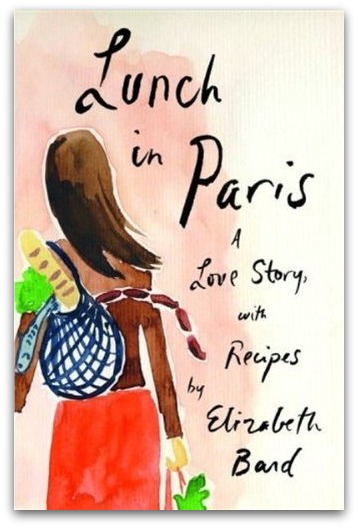
But there you have it, my little secret. And now that it’s out in the open, allow me to report on my most recent tryst — a Parisian lunch I hosted in Manhattan yesterday using the recipes of Elizabeth Bard, who will be featured on this blog next week. A former New Yorker who now lives in Provence with her French husband, Bard is the author of Lunch in Paris: A Love Story, with Recipes.

Friday, Oct 7 — plotting my assignation

I download Bard’s book to my Kindle and retreat to bed — mais oui! — for a read.

I am instantly enchanted. Bard is a woman after my own heart: she went to Europe to study and then fell head over heels for the culture, a man, the food…

I’m having a hard time choosing among Bard’s recipes, though.

The guest list is easy: my sister (who will go into the hospital on Wednesday for an operation, after which she won’t be able to enjoy food for a while) and two foodie friends, a couple, with whom I’ve collaborated on some lovely meals.

Except this time I’ll be going solo, especially as my husband is away (though maybe that’s just as well as he tends to dismiss French food out of hand, and therefore out of kitchen, for being too rich and creamy).

Actually, it’s the main course I’m dithering about — not the starter or the dessert.

I know I want to do mussels for the opening course as that’s one of my sister’s favorites, and Bard has a classic recipe for Mussels with White Wine and Fennel (and fennel is now in season).

I see that on her Web site, Bard has a recipe for Spicy Chocolate Pots with Fresh Figs — and quickly decide to make that my dessert. Like most sane people, I consider chocolate (along with champagne and oysters) to be the perfect food for revving up the libido.

And figs — Bard says that every autumn, around this time, she stages her own mini Figapalooza. I like the sound of that orgy. The more I think about it, the more convinced I become that the Bible got it wrong: Eve must have seduced Adam with a fig, not an apple. Didn’t he cover himself up with a fig leaf afterwards?

Speaking of apples, the recipe of Bard’s I’m most attracted to for the main course is her Pork Tenderloin with Four Kinds of Apples. The only thing holding me back is that my sister has a pet pig. For a moment, I imagine being able to persuade her to partake of this forbidden meat. “Oh, go on, just one little taste…” But then I realize how offended I’d be, as a dog owner and lover, if I were invited to lunch at a Korean household and they were serving dog.

No, not a good idea. So I opt for Bard’s Pasta with Fresh Peas, Arugula, and Goat Cheese for my main. To be honest, I feel a little sheepish about it. Surely my infatuation with La Belle Cuisine should drive me to my boldest feats of exploration and invention?

But then I remember Bard’s story about her husband-to-be inviting her to lunch at a Parisian restaurant that specializes in du porc noir de Bigorre. She refuses to indulge, even (especially?) when the waitress tells her he’s a happy pig, ordering the cassoulet instead.

Pasta it is, even though the only thing French about it involves topping the pasta with extravagantly big gobs of goat cheese.

Saturday, Oct 8 — shopping for just the right ingredients

I head to the green market in Union Square very early, my two dogs in tow. Just before I reach the Patches of Star Dairy stand, which sells fresh goat cheeses and goat cheese ice cream, one of them, my cocker spaniel, scavenges a brussels sprout and someone asks me if he is a vegetarian. (I wonder if his English springer spaniel heritage is kicking in, and he’s registering his disapproval of my love affair with France?)

Other green market finds include freshly picked arugula (also for the pasta), onions and fennel (for the mussels), and heavy cream (for the dessert).

I see some blue salvia at the flower stall that remind me of postcards I’ve seen of Provence, and appropriate these for the table decor.

I still need to get peas (they aren’t in season), so leave the dogs at home and go out again. Bard makes a curious observation at the start of her pasta recipe:

Five years ago, if someone told me I would take this much satisfaction in shelling my own peas, I would have laughed out loud. How times have changed.

I guess I’m not quite there yet (or perhaps I was there when I was younger — am I getting too old for these affairs?), as I find myself heading to the Trader Joe’s on 14th Street for a bag of freshly shelled English peas (yes, English — apparently there are limits to my love).

Actually, waiting on the line at Trader Joe’s on a Saturday is almost as tedious as shelling peas, and I almost laugh out loud — but then console myself by noting that I’ve also managed to score the bow tie pasta. It’s not whole wheat, though, as Bard recommends. I’m not sure if I’ve ever seen whole wheat farfalle, TBH. (I wonder where Bard gets hers?)

It still remains to get fresh pesto (from the Italian specialty store on E 11th St), Green & Black’s 70% organic chocolate and ras el hanout for the dessert. I find both of these items at the Indian grocery around the corner from Little India. The ras el hanout is labeled “couscous spice” and smells appropriately exotic.

I stay up late infusing the ras el hanout in the heavy cream and melting the chocolate in that mixture for the dessert. Heaven!

Sunday, Oct 9 (morning) — final mad preparations

Another early start. I swing by the East Village Cheese store for a fresh whole wheat baguette, and then it’s off to the green market at Tompkins Square Park, to buy fresh mussels at the fishmonger’s.

There’s a spring in my step as I approach his stall. I am a woman in love, a woman possessed. Little do I know that disaster is about to strike — he had only a small supply of mussels and sold them all first thing.

Aïe. I stumble away from his stall trying to hide my tears. But then, American ingenuity kicks in: why don’t I try using Bard’s recipe but for little neck clams, which are in large supply? I go back and discuss with the fishmonger, who’s a friendly sort, très sympathique. He ends up giving me 40 clams for the price of three dozen.

But I’m not out of the woods yet. I have forgotten the figs — those delectable little fruits that ooze with flesh and seeds when you cut them open. Despite trying three grocery stores, I can’t find a single fig in the East Village — and this is fig season. Go figure!

On this ingredient, I cannot compromise. I text my foodie friends who are coming to the lunch (they live in the West Village) and ask them to scour the shops for the fleshiest, freshest figs they can find. They come through for me, confirming my long-held belief that West Village is the city’s epicurean center.

Sunday Oct 9 (1 p.m. onwards) — ah, quel plaisir!

My sister and friends arrive, the wine (initially the Muscadet I’m cooking the clams in) flows, and conversation does as well, ranging from tales of our misspent youths to the Wall Street protests.

I produce the first course, and it’s judged a big success. Does anyone mind that it’s clams and not mussels, I ask? All agree that it’s the broth that counts — and the broth, a mix of fennel, onions, garlic and white wine, is divine.

Despite being a little tipsy on the wine — we have now progressed to a bottle of red from the family domaine of Robert Sérol, au cœur de la Côte Roannaise — I manage to make the bow tie pasta al dente. I stir in the peas and the pesto, divide among four plates and then dollop on the lightly salted chevre. My guests and I gorge ourselves on this latest creation, exclaiming as several nuances emerge and caress our taste-buds — oh là là!

I suggest that we take a short break before the dessert. My cocker spaniel is nipping at my pant legs — signaling that it’s time for the guests to go home as he needs my full attention (and some treat toys with the leftovers).

But my other dog, who is mostly poodle, is having the time of her life (bien sûr), making several rounds with the guests for extended petting sessions.

Enfin, it’s back to the table for my chocolate dessert, which, I’m sorry to say, falls a little flat because — absolument incroyable! — it’s too chocolatey. Is that our fault (we don’t know chocolate from chocolate) or could the recipe use some sugar?

But the purplish-brown figs, which are ripe and ever-so-sweet, save the day.

Over little cups of coffee we all agree that my Parisian lunch at the hands of Elizabeth Bard has been an affair to remember.

Monday, Oct 10 — the morning after

My husband calls in the wee hours of the morning. He is now in Tokyo, with another week to go on his business trip.

“How was your Sunday?” he asks.

“Well, I had some my sister and some friends over for a little lunch,” I reply, thinking to myself: what he doesn’t know won’t hurt him.

I go back to bed and awaken several hours later, at around 8:00 a.m. I lie there for a few minutes, basking in the afterglow of yesterday’s tryst.

When I at last rouse myself and face the mounds of dishes still to be done, I realize that this little flirtation of mine has its costs (not to mention my exhaustion at having to clean the apartment).

At least the hole in my pocketbook isn’t too bad. I reckon this particular fling has cost me around $80, including the wine — not bad considering what it would cost for four people to go out for a proper French lunch in Manhattan.

Hmmm… I wonder if I can fit in one more quickie meal before my husband gets home on Friday?

As Mario Cuomo, former New York State governor and father of our current governor, once said:

When you’ve parked the second car in the garage, and installed the hot tub, and skied in Colorado, and wind-surfed in the Caribbean, when you’ve had your first love affair and your second and your third, the question will remain, where does the dream end for me?

Touché — only I don’t think he’s ever been seduced by French cuisine à la Elizabeth Bard?

Images (top to bottom): Friendly fishmonger at Tompkins Square Park; little neck clams in fennel; an enthusiastic canine participant; chocolate pot with figs.

STAY TUNED for Tuesday’s post on classic displaced writing.

If you enjoyed this post, we invite you to subscribe for email delivery of The Displaced Dispatch, a round up of the week’s posts from The Displaced Nation, including seasonal recipes and book giveaways. Sign up for The Displaced Dispatch by clicking here!

Related posts:

12 French cooking terms — a glossary for kitchen dummies, or anyone not lucky enough to be an expat in France

Although Julia Child made a career out of teaching French cuisine to the masses, not all of us have had the opportunity to practice our culinary skills to the extent that good lady may have envisioned.

Still, the good news is, sometimes we use French cooking methods without even realizing it.

For those not lucky enough to live in France or to have studied French cooking for a dedicated period, here is a short glossary of common terms — as defined by culinary experts (Master Chefs) and dummies (whose experience tends toward Gordan Ramsey’s Kitchen Nightmares).

1. BEIGNETS
Master Chef Definition: Small lumps of fried dough.
Kitchen Nightmare Definition: Donut holes. (See: Dunkin Donut, Krispy Kremes, Fairground stands, etc.)

2. BEURRE NOISETTE –
MC Definition: Browned butter.
KN Definition: The realistic result of squabbling children and the following recipe direction: “Gently melt 1 ounce of butter over a low heat.”

3. CANAPE –
MC Definition: An appetizer consisting of a piece of bread or toast or a cracker topped with a savory spread (such as caviar or cheese.)
KN Definition: Ritz crackers and Marmite.

4. CHAPELUX –
MC Definition: Browned bread crumbs.
KN Definition: The contents of the toaster’s crumb-catcher.

5. CROUTONS –
MC Definition: Small cubes of toasted or crisply fried bread
KN Definition: The best part of a salad.

 6. DARIOLE –
MC Definition: A small cup-shaped mold used for making individual dishes.
KN Definition: A small cup-shaped mold in a set of six, bought in a fit of retail therapy enthusiasm in specialist kitchen shop. Used once for packet Jell-O. Now gathering dust at back of pantry, possibly with the addition of dead wasp or similar.

7. DEGLACER – 
MC Definition: To dissolve cooking juices attached to the sides of a pot or pan with a little hot liquid to create a sauce. 
KN Definition: A way of cleaning the burnt bits off a pan without using a Brillo pad.

8. ESCALOPE –
MC Definition: A piece of boneless meat, thinned out by using a mallet.
KN Definition: 1) A method of making the dregs of the freezer go further; 2) Friday night stress-reliever after aggravating week.

9. FLAMBE
MC Definition: Covered with liquor and set alight briefly.
KN Definition: A sinful waste of good alcohol.

10. MARMITE
MC Definition: An earthenware container for soup.
KN Definition:  Oh come on. Everyone knows what Marmite really is. (See “Canape”)

11. RECHAUFEE –
MC Definition: Reheated food.
KN Definition:  A fancy word to disguise the fact you’re giving the family leftovers for the third day in a row.

12. TERRINE –
MC Definition: A mixture of chopped ingredients baked in a loaf-shaped container, served at room temperature.
KN Definition: Day-old meat loaf

STAY TUNED for Monday’s Recipe Review – A Parisian Lunch in Manhattan.

Related posts:

If you enjoyed this post, we invite you to subscribe for email delivery of The Displaced Dispatch, a round up of the week’s posts from The Displaced Nation. Sign up for The Displaced Dispatch by clicking here!

Image: MorgueFile

Finding Paradise in Provence, Part 2: Our expat foodie asks – Patisserie or Pudding?

In the second of her guest posts this month, Joanna Masters-Maggs talks more about her recent culinary discoveries in France, as we ask her, “Is the foodie capital of the world everything it’s cracked up to be – or does the emperor need to put his clothes on?”

“I’m tired of these perfectly-glazed French tarts”, my husband declared last night. “I want a big, fat, English pudding.”

I looked up sharply. Was he making some untoward comparison between chic French ladies and less well-presented English women, such as myself? I hoped not, for his sake. But he was ruefully regarding the Mille Fueille on the plate before him.

“Some custard too. That would be nice.” He looked at me sadly.

I wasn’t sure how to react. “Get me some Golden Syrup and I’ll make steamed pudding,” I offered. Sixteen years overseas, but how English we are!

Just desserts…every Sunday

We have only been in Aix for six weeks and have held to our plan of finding the best food and drink it has to offer. Part of this includes buying a cake or tart from a patisserie each week for Sunday dinner. I reflected on what we have so far sampled: a chocolate Opera for the weekend of my daughter’s birthday, an open apple tart, another filled with patisserie cream and topped with fruit and, yes, glaze. We tried the Tropezienne which hails from St Tropez and was named by Brigitte Bardot.

Now this “thousand leaves of pastry” sat before us. Like its predecessors, it was pedigree in origin. Only the most shameless “bring–a-dish” guest would try to pass this off as homemade. Perfectly cut, evenly browned, you just knew it would not suffer from a soggy bottom or any similar such indignity.

So why is it that with these desserts fastidious restraint is so easy to find? My husband is right. If we had a steamed syrup pudding and some custard before us, we would have been slavering for second helpings. With this aristocrat, to do so would seem uncouth and unnecessary.

The proof of the pudding…

Perhaps, dare I even suggest, in terms of flavour and texture, if not the skill required to make it, Syrup Pudding and its like are superior as a pudding to their French counterparts. I am ducking the missiles I feel may be coming my way. But if I am unrefined in my tastes, surely I cannot be alone? Syrup Pudding may be simple, comfort food but it is also a divine comination of textures and flavours. The addition of custard, Crème Anglaise if you will, serves to cut any possible cloyingness of texture or the risk of oversweetness. Surprisingly light, but pleasingly substantial, there always seems room for another serving.

I have, on occasion, offered to clean up after dinner, singlehanded. Not some heroic act of self-sacrifice, offered at the shrine of my family’s comfort. Rather, the siren call of the dish the pudding was steamed in, enticing me to scrape it out. Can the same be said for the tin in which a Tarte Tatin was made? I fear not.

Leave it to the experts – or leave it to Mum?

I have been told that no French person would take along homemade pudding as a contribution to a dinner to which he or she had been invited. Such a thing would be to insult the host with a poor quality, amateur offering. Why take some ramshackle amateur affair when there are professionals to do a proper job?

It seems that we English – well, at least, my husband and I – feel differently. The “homemadeness” is what we enjoy. The time spent making it, the compliment to the host. As I cast my mind back to adverts for cakes and packaging for various factory-made cakes and puddings, it is clear that supermarkets and manufacturers are keen to stress their product is “Just like home” or “What Mum used to make.” The Brits will remember Mr. Kipling and his extraordinary cakes, which he liked to bring out for village fetes and cricket matches. It’s just that Mr. Kipling was a factory, somewhere fairly industrial in England, churning out Battenbergs by the thousand.

I have enjoyed and will continue to enjoy my foray into French patisseries. However, I feel it will not end my love of the home-baked, and what I will enjoy in most French bakeries are the comfortable croissants and brioches.

The best of both sides (of the English Channel)

For me food seems less about style and more about comfort and general “toothsomeness”. Is this another difference between England and France? I think it may be. I count myself lucky that, at the moment, I can enjoy both attitudes. But this weekend, my husband will get his syrup pudding and custard. Not, not just custard — make that “Crème Anglaise”!

Related posts:

Finding Paradise in Provence, Part I: An expat foodie’s views on French cuisine for the very young

Displaced Q: in modern French cuisine, who wins the race — the slow-food tortoise or the McDonald’s fast-food hare?

When a Julia Child-like curiosity about French cuisine leads to a displaced life — bienvenue au October theme

If you enjoyed this post, we invite you to subscribe for email delivery of The Displaced Dispatch, a round up of the week’s posts from The Displaced Nation. Sign up for The Displaced Dispatch by clicking here!

Img: MorgueFile

Give a dog a chocolate — why US-based expats shouldn’t use UK Chocolate Week to revive an old complaint

Continuing this month’s food-related theme — and in honor of National Chocolate Week in the UK — founding contributor Anthony Windram weighs in with some thoughts on the often contentious expat topic of American chocolate.

Though I do, like most people, enjoy a bit of chocolate, I’ve never been a connoisseur of the stuff. Any old rubbish will do for a quick fix, truth be told. I’m not one of those people looking for what percent of cocoa is in a bar. As a six year old, I remember my Nana — God bless her, then in the beginnings of dementia — had bought me a packet of chocolate from the corner shop. I can still recall the packet which, rather tellingly, was taken up with the picture of a happy dog. The chocolate inside was a little more out of the ordinary, a little grittier than normal. But it was chocolate and I was happy sat on the floor of my Nana’s living room munching away while watching TV, my mouth doubtless covered in chocolate. My dad, however, happened to notice the packet of chocolate and asked me if he could see it for a moment. Being a trusting child I made the mistake of giving him the packet of chocolate. I was never to see it again.

Nana, I was later to learn, had inadvertently purchased for me some chocolatey dog treats. However, as I recall they really weren’t too bad. Yes, the texture was more gritty than you’d prefer, but I had been as happy as Larry eating them. That should have been the moment that I realized that I was not, and never would be, a chocolate aficionado. When I was older and the only chocolate that I could find in the house was cooking chocolate, I was more than happy to snack on that, too. Coincidentally, its grittier taste reminded me of the dog treats I’d been given all those years before.

In its own way eating that chocolatey dog treat turned out to be good preparation for living in the US. The European expat now often seems to have strong views about chocolate in the US. Without any prompting they’ll bring the subject up and scrunch their face in disgust. “American chocolate,” they’ll say, spitting out the words like they probably do the chocolate itself, “is disgusting.”  And yes, I will admit, that it’s not great. Hershey’s chocolate has a lingering, bitter aftertaste that after eating it I often think I’m suffering from GERD. But you can eat a Milky Way and for the most part it is fine. You’ll possibly suffer from cognitive dissonance from the fact that an American Milky Way is, in fact, like a British Mars bar rather than a British Milky Way bar which is, in turn, like an American Three Musketeers Bar…oh, the confusion! But the chocolate in a Milky Way, while different, isn’t necessarily worse. It’s just in the grand scheme of things in the world of chocolate, American chocolate is the chocolate dog treats my confused Nana bought — and that isn’t something I’m going to complain too much about.

Question: What are your thoughts on American chocolate?

Image: MorgueFile

STAY TUNED for tomorrow’s post, part 2 of Joanna Masters-Maggs’ quest to find paradise in Provence.

If you enjoyed this post, we invite you to subscribe to The Displaced Dispatch, a weekly round up of posts from The Displaced Nation, plus some extras such as seasonal recipes and occasional book giveaways. Sign up for The Displaced Dispatch by clicking here!

Related posts:
RETURN TRIP: Random Nomad – Charlotte Day, High School Student (Sixth Former)

While our writers take off on what they hope will be enchanting August breaks, The Displaced Nation will occasionally be reissuing some posts that, for one reason or another, enchanted our readers. Enjoy these “return trips”!
As youngsters head back to school, we’re reissuing a Random Nomad interview ML Awanohara did with Charlotte Day, a displaced teenager in England. Charlotte spent a chunk of her summer taking a Russian-language course in St. Petersburg and living with a Russian family. She has produced a travel yarn on her adventures, which will appear on Monday.

Born in: Sydney, Australia
Passports: Australia, UK and US Green Card
Countries lived in: Australia (Sydney): 1994-2001; United States (New York, New York): 2001-2010; England (Sevenoaks, Kent): 2010-present

What made you leave your homeland in the first place?
My father is Australian and my mother English. They split up when I was two. When I was six, my mother met and married an Australian who had been living in New York for thirty years. I was rather disgruntled about moving to the United States and for two or three years, remained determined never to accept it as “home.” At that time, I was deeply patriotic to my native country — though this sentiment has dissipated since.

Is anyone else in your immediate family a “displaced” person?
My mother’s family, originally from England, has long been displaced. My mother herself was born in Kenya, in 1961. Following the Mau Mau Uprising, her parents were forced to relocate, and my grandfather, presented with a choice between Australia and Canada, chose the warmer of the two countries. My mother spent her childhood bouncing between schools in England and Australia. She eventually grew so fed up with packing and unpacking, she decided to leave school at the age of 16. Her father agreed to the plan provided she spend a final year at the school in Switzerland his own mother had attended as a girl. My mother moved on from Swiss finishing school to work in London, Paris and Sydney. But she appears to have made New York her last port of call. Indeed, we had a fairly solid life in the city until I decided to take myself off to boarding school in England.

Describe the moment when you felt most displaced over the course of your many displacements.
It must have been when I first arrived in New York as a six-year-old. I stepped out of the JFK arrivals terminal into a snowy March night. My stepfather was wearing a leather coat, the interior of his car smelled of leather — and the world outside the car window seemed an undulating stream of black and silver. Though it was the end of 2001’s warm winter, my Australian blood froze beneath my first-ever coat. And their apartment — that was all leather as well. It smelled of musk and cologne. Since that time, I have felt similar pangs of displacement, some of which lasted for considerable periods. But those first few moments in New York stand out as the most acute concentration of “displacedness” I have ever known.

Describe the moment when you felt least displaced.
For the last five or so years in New York, I have felt more at home than I ever did in Sydney. I ascribe this to growing up: at a certain age, one can take possession of a city, know its streets, bridges, tunnels and transportation system. I was too young when I lived in Sydney to reach that kind of comfort level. But when have I felt the most like a New Yorker? Perhaps it was the last time I came home for the holidays, and took the 4 train uptown for the first time in months. At that moment I realized how much this train had been a part of my life — conveying me home from school every day for two years. My old life would always be waiting for me on the subway, ready for me to pick it up again. That’s something only a New Yorker could say!

You may bring one curiosity you’ve collected from each of the countries where you’ve lived into the Displaced Nation. What’s in your suitcase?
From Australia: A miniature wooden wombat figurine — a gift from my grandfather. It conjures memories of a childhood spent beating about the bush (literally) and fishing for yabbies at the dam in the company of audacious dogs who stuck their heads down wombat holes, to no good end.
From New York: A pair of fake Harry Potter glasses. These defined my first six months in New York — I even wore them to my first day of school. I think it is telling that even at the age of six, I was unwilling to give all of my real self to this new home.
From England: My school tie — representative of the alternative universe I seem to have entered. At boarding school, the sense of removal from reality can be disconcerting — especially after having spent a decade in the city I regard as the world’s capital.

You’re invited to prepare one meal based on your travels for other Displaced Nation members. What’s on your menu?
I’d like to make you a Sydney breakfast: scrambled eggs, made with cream, salt and pepper and served on a bed of Turkish toast, with avocado and stewed tomato on the side (is this being greedy?). Our meal will be accompanied by a large “flat white”: what we call perfectly strong, milky coffee without excessive froth. I suggest we consume it overlooking a beach on a Sunday morning. At least, I assume The Displaced Nation has beaches?

You may add one word or expression from each of the countries you’ve lived in to The Displaced Nation argot. What words do you loan us?
From Australia: Daggy. I use this word all the time — and did not realize it was exclusively Australian until I was informed of the etymology. Apparently, it comes from trimming the soiled wool around a sheep’s bottom. Which part of this repugnant whole is actually the “dag,” I do not remember. (No, I’m not a proper Australian!) But as I understand it, “daggy” means sloppy in appearance or badly put together.
From New York: There are so many words, and most are second nature by now. However, I will choose grande-soy-chai-tea-latte because I still shudder to think of myself as the kind of person who can utter such a phrase, at great speed, with great insistence. In fact, I’m still in denial about my love for Starbucks: having known Sydney coffee, my standards should be higher.
From England: Banter. I still do not know the precise meaning of this word, but it seems to encapsulate everything that makes someone my age feel socially acceptable — and, of course, I have no banter whatsoever. I think it means the capacity for combining wit with meaningless conversation. But there are other components, too, which seem to me unfathomable.

Question: Readers, tell us what you think: should we welcome Charlotte Day to The Displaced Nation and if so, why? (Note: It’s fine to vote “no” as long as you couch your reasoning in terms you think we all — Charlotte included — will find amusing.)

img: Charlotte Day at her boarding school in southeast England

If you enjoyed this post, we invite you to subscribe to The Displaced Dispatch, a weekly round up of posts from The Displaced Nation, plus some extras such as seasonal recipes and occasional book giveaways. Sign up for The Displaced Dispatch by clicking here!

Related posts:

RETURN TRIP: Seven deadly dishes — global grub to die for

While our writers take off on what they hope will be enchanting August breaks, The Displaced Nation will occasionally be reissuing some posts that, for one reason or another, enchanted our readers. Enjoy these “return trips”!
Some months ago, The Displaced Nation explored the theme of Gothic tales — the idea that many of us return from our world travels with some horrific stories to tell. That’s assuming we return at all, of course. Displaced Nation writer Kate Allison contributed this piece on deadly dishes as part of our “It’s Food!” category. It’s one of our most popular posts to date.

A Briton abroad spends a surprising amount of time defending his native national cuisine. I remember going to a steak house in Connecticut where the waitress, upon taking our order and hearing our accents, said brightly, “From England, huh? I hear you don’t get anything good to eat over there. ” When she brought the filet mignon to the table, she did so with the pitying smile of one delivering alms to the starving.

British super-chefs like Gordon Ramsay and Jamie Oliver may be taking the US by storm, but still this delusion of bad food persists. To which I say: whatever the perceived faults of English cuisine, at least no one has to take out extra life insurance before eating Yorkshire pudding.

Yet there are quite a few delicacies from countries without this dismal food reputation, where a top-up premium might be useful before you take that first bite.

In ascending order of danger or toxicity:

7. Snake wine – Vietnam, Southeast Asian, Southern China.

An assortment of herbs, small snakes, and a large venomous snake are steeped for many months in a glass jar of rice wine, then consumed in small shots for medicinal purposes. Fortunately, the ethanol renders snake venom harmless.

6. Surströmming – Sweden.

Fermented Baltic herring. Stored in cans, where the fermentation continues, causing the cans to bulge. In 2006, Air France and British Airways banned surstromming from their flights because they said the cans were potentially explosive. According to a Japanese study, the smell of this Scandinavian rotten fish is the most putrid food smell in the world.

5. Fried tarantula – Cambodia.

Tarantulas, tossed in MSG, sugar, and salt, are fried with garlic until their legs are stiff and the abdomen contents less liquid. The flesh tastes a little like chicken or white fish, and the body is gooey inside. Certain breeds of tarantula have urticating hairs on their abdomen, which they use for self-defense. If the spiders are not prepared properly – i.e., if the offending hairs are not removed with a blow torch or similar – these hairs can cause pharyngeal irritation in the consumer.

4. Sannakji – Korea.

Small, live, wriggling octopus, seasoned with sesame and sesame oil. The suction cups are still active, so bits of tentacle may stick to your throat as you swallow, especially if you’ve had one too many drinks before dinner. The trick is to chew thoroughly so no piece is big enough to take hold of your tonsils. Some veteran sannakji eaters, however, enjoy the feel of longer pieces of writhing arm and are prepared to take the risk.

3. Stinkhead – Alaska

Heads of salmon, left to ferment in a hole in the ground for a few weeks. Traditionally, the fish was wrapped in long grasses and fermented in cool temperatures, but then someone discovered Baggies and plastic buckets, which increase the speed of the process. Unfortunately, they also increase the number of botulism cases.

2. Casu Marzu – Sardinia

Made by introducing the eggs of the cheese fly to whole Pecorino cheese (hard cheese made from sheep’s milk) and letting the cheese ferment to a stage of terminal decomposition. Locally, the cheese is considered dangerous to eat when the maggots are dead, so you eat them live and squirming. As the larvae can jump six inches in the air, it is advisable to cover your cheese sandwich with your hand while eating to prevent being smacked in the face by grubs. An alternative is to put the cheese in a paper bag to suffocate the maggots, then eat it straight away. The maggots will jump around in the bag for a while, making a sound, I imagine, not unlike that of popcorn in the microwave. Although the European Union outlawed this food for a while, it has since been classified as a “traditional” food and therefore exempt from EU food hygiene regulations.

1. Fugu (Puffer fish) – Japan

Considered to be the second most toxic vertebrate in the world, puffer fish is a delicacy in Japan, but preparation of the food is strictly controlled, with only specially trained chefs in licensed restaurants permitted to deal with the fish. Fugu contains tetrodotoxin, a poison about 1200 times stronger than cyanide, which is most highly concentrated in the fish’s liver — the tastiest part. Sadly, for gourmets who like to live life on the edge, fugu liver in restaurants was banned in Japan in 1984.

Question: What is the most adventurous dish you’ve ever eaten?

If you enjoyed this post, we invite you to subscribe for email delivery of The Displaced Dispatch, a round up of the week’s posts from The Displaced Nation. Sign up for The Displaced Dispatch by clicking here!

RETURN TRIP: Travel author Janet Brown channels Alice in Wonderland’s “tone deaf” adventures

While our writers take off on what they hope will be enchanting August breaks, The Displaced Nation will occasionally be reissuing some posts that, for one reason or another, enchanted our readers. Enjoy these “return trips”!
June was “Alice in Wonderland” month in The Displaced Nation, and the enchanting travel author Janet Brown came to our online tea party. She answered ML Awanohara’s questions on the curious and unreal aspects of her life in Thailand. Last time we checked in with Janet, she was in the process of moving back to the States. Will her counterculture shock prove to be another Alice adventure? We hope to hear back from Janet in the coming months.

As you may have noticed, The Displaced Nation has gone Alice-in-Wonderland mad since around the first of June. To take just a few examples:

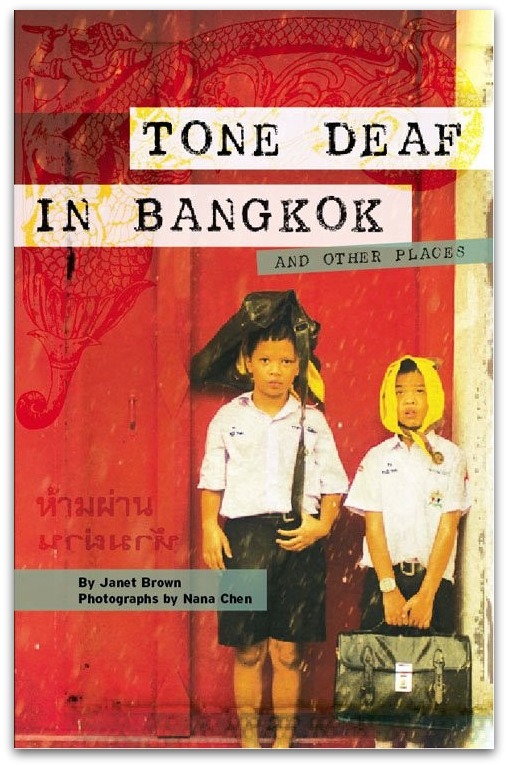
And now, to top that all off, the extraordinary travel writer Janet Brown is paying us a visit. Brown could almost be a stand-in for the Lewis Carroll heroine herself, having published a book on travel to and life in Thailand called Tone Deaf in Bangkok, to much acclaim.

“Tone deaf” — it puts one in mind of poor Alice’s plea to the Mouse, “I didn’t mean it…But you’re so easily offended, you know!”

But if Brown sees herself as tone deaf, her readers regard her as anything but. Here is a sampling of her reader reviews on Amazon:

It has been ages since I have loved a piece of travel literature…, and so when I read TONE DEAF IN BANGKOK, I was thrilled. This is a good travel book, and it is a good book, period.

I am not a traveler, nor do I typically read travel books. Shame on me, I know, but here’s the thing: … The author brought Bangkok to life in a way that made me want to go there, yes, but it was her own story that captivated me and kept me turning the pages. Now I’d read anything Janet Brown writes!

Janet Brown’s TONE DEAF IN BANGKOK is a travelogue, to be sure. Yet it is more, so much more. It’s also an investigation into how dislocated we can become by ourselves, by our priorities and by all that we demand of the cultures in which we live. … That she has a gift for spotting the universal in the exotic makes this collection all the more profound.

Janet Brown has graciously agreed to answer some of my Alice-related questions. After that, dear reader, I urge you to chime in!

Before we go down the rabbit-hole, can you tell me a little bit more about your background?
My parents turned me into a gypsy before I was two, by taking me on their journey by jeep from New York City to Alaska when the 49th state was still a territory and the Alcan Highway was still an unpaved trail into the frozen north. I have wandered ever since, most recently in Southeast Asia with Bangkok as my home, writing down the stories I encounter as I explore. My books include:

Maybe because I’m so steeped in Alice-of-Wonderland lore this month, I think of you as Alice Personified. To what extent can you relate to Alice’s sense of disorientation? Going back not just to the first time you went to Thailand but also when your family dragged you to Alaska…
I was 18 months old when my family moved to Alaska from Manhattan. I coped with any displacement issues by making my mother read my favorite book over and over again — a truly saccharine Little Golden Book called The New Baby. The main character had the same name as I so that was the big attraction — all about me! My mother swears she can still recite it verbatim after having two martinis.

Alice came to mind constantly in my first months in Bangkok — and frequently thereafter. I knew I’d gone through the looking glass — or had entered the postcard — and asked myself often if that experience had been as painful for Alice as it often was for me.

Can you describe your worst “Pool of Tears” moment in Bangkok, where you wished you hadn’t decided on living there?
I’ve tried to make light of that time when I wrote about it in Tone Deaf in Bangkok, but it nearly demolished me. When the manager of my apartment turned me into Ryan’s Daughter by listening in on my phone calls and then entertaining the neighborhood with highly embroidered versions of my life — and when people fell silent when I walked down the street and began gabbling excitedly after I’d passed — I felt as though my life had been stolen from me and I shut down to the point of hypothermia. If my students hadn’t helped me find a new neighborhood, I would have gone home a gibbering mess.

Thailand is renowned for its distinctive cuisine. Was there anything that carried an “Eat me” label that you felt hesitant about at first, but then discovered you loved?
I’ve written about durian in Tone Deaf, how I thought its smell in the market was sewer gas and then how I was forced to taste it, with happy results. Fried grasshoppers were another thing I didn’t warm to at first sight and then liked as much as I do popcorn — they have much the same crunch and texture.

By the same token, were there any foods that you thought might be good but then didn’t acquire a taste for? (For Alice, of course, that was the Duchess’s over-peppered soup.)
One night I stopped to buy green papaya salad from a food cart to take home for supper. There was something in a little plastic bag that looked like a sort of relish, so I bought that, too.When I opened it at home a smell of rot filled the air, but remembering the delightful surprise that durian had proved to be, I took a generous spoonful. It was pla ra — fermented fish, a Northeastern Thailand culinary staple that is meant to be added and mixed judiciously with the salad, not eaten like peanut butter. There wasn’t enough toothpaste in the world to rid my mouth of that thoroughly foul taste.

As already mentioned, Alice finds it’s easy to offend the creatures in Wonderland without even trying. Why did you choose the expression “tone deaf” for the title of your book on Bangkok?
“Tone deaf” can be taken quite literally. Thai is a tonal language with five different tones giving meaning to every word. Use the wrong tone and at best you’re incomprehensible, at worst shocking. The most common mistake for foreigners is to tell someone their baby is beautiful, while actually announcing that the infant is bad luck. Another pitfall is confusing the word “near” with the word for “far” — they are the same sound, differentiated by a crucial tone.

But travelers to Thailand can also be “tone deaf” when it comes to figuring out the Thais’ communication style. As a Thai-American friend has observed, the important things are what remain unsaid. “You looked so beautiful yesterday” probably means today you resemble dogfood and ought to go home and rectify that at once. Subtlety is the hallmark of Thai communication, and is often expressed through a quirk of an eyebrow or a famous Thai smile, which has at least one hundred different meanings — including disdain or outright menace.

Describe the biggest faux pas you’ve made since settling in Bangkok.
Oh, how to choose — it’s impossible not to make faux pas every second because Thai etiquette is demanding and complex. The one that makes me cringe most is in my first week when I set off on my first solo bus ride. I was clutching a twenty-baht note, which like all bank notes in Thailand bears the countenance of the King. He is revered to the point of near godhood in his kingdom and his picture is always elevated to the highest spot in a room — nothing is above the King. But I was fresh off the boat and when I dropped my money and it was caught in a little breeze, I put out my foot (the lowest and most ignominious part of the body) and stepped on the picture of the King’s face to secure my bus fare. I was too clueless to pick up on the ripples of horror that this caused others at the bus stop, but now I writhe when I remember this.

“Off with her head!” as the chief royal in Alice’s story is wont to proclaim. Actually, never mind your head. Your mention of your foot makes me think of how physically awkward Alice feels around the creatures in Wonderland. As a farang in Bangkok, do you often feel self conscious?
I’m short and dark in a family of pale-skinned people, so I was used to being an anomaly from early childhood. In Bangkok, if I dressed like a Thai woman and wore sunglasses and walked slowly, I felt as though I blended in. But one day I walked down a quiet street on my way to a class, and someone looked up and said, “Look at the foreigner.” “How did she know?” I asked my class of teenage girls. “Your hair,” they said. “No, lots of Thai women have dyed their hair brown,” I replied — to which they responded: “Your nose.” It was my big American nose that gave me away every time — and since I hate pain and surgery, I just had to accept that.

Have you tweaked your personal style at all so as to fit in better?
Yes — I adopted the conservative “Don’t show your bare shoulders” school of dressing that prevailed in Bangkok when I first arrived and slowed my pace to that of the women around me. I learned to keep my facial expression as bland as I possibly could to achieve the quiet Thai “public face,” and I ironed everything, including my Levis. Now women are much more casual in the way they dress but I’m still stuck in the cultural mores of the 90s. To foreign women who live here now, my introductory years in Bangkok seem like fiction — things have changed so drastically in the past 16 years.

Time for a quote from the Cheshire Cat: “…we’re all mad here. I’m mad. You’re mad.” Can you relate?
Riding on the back of a motorcycle taxi down a crowded city sidewalk, buying a glass of Shiraz to take with my popcorn into a movie theater, being drenched to the bone during Thai New Year’s — this is actually the most difficult question you’ve asked so far because at this point it all seems normal.

If you were to hold your own Mad Hatter’s Tea Party in Bangkok, whom would you invite, and why?
Anais Nin, because she would love the unbridled hedonism of this place, Evelyn Waugh because he would satirize the expat scene so well, Ho Chi Minh because he could help put together the revolution that is needed here, Emily Hahn because she has always been my role model since I first read her when I was twelve, and Elvis because in Bangkok he is still the king.

Alice becomes aware that Wonderland is turning her into a different person, unrecognizable to the one she used to be. Has your identity has shifted in fundamental ways since living in Bangkok?
This is a very complex question — I’ve written one book about it and am working on a second one, Almost Home. I’m always drawn back to the US because my children are there. Seeing them for two weeks a year doesn’t work for me. Once I get back to the US this time around, I’ll return here but plan to spend the bulk of my time near family in the Pacific Northwest. I won’t know how much I’ve been changed by this recent incarnation in Bangkok until then. Ask me again in several months.

Can you offer any advice for newcomers to Bangkok, who aren’t sure who they are any more?
Tone Deaf in Bangkok and my next book, Almost Home, are where I directly address the challenges of feeling like an Alice in Thailand. In addition, the recently published Lost and Found Bangkok, for which I wrote the text, may be helpful for newcomers. It’s a book in which five different photographers — two American men, two Thai men (both from Bangkok), and one Taiwanese-American woman — show the city they live in. New arrivals can look at the photos and see some great places to get lost — and find out who they are — in this Wonderland-like city.

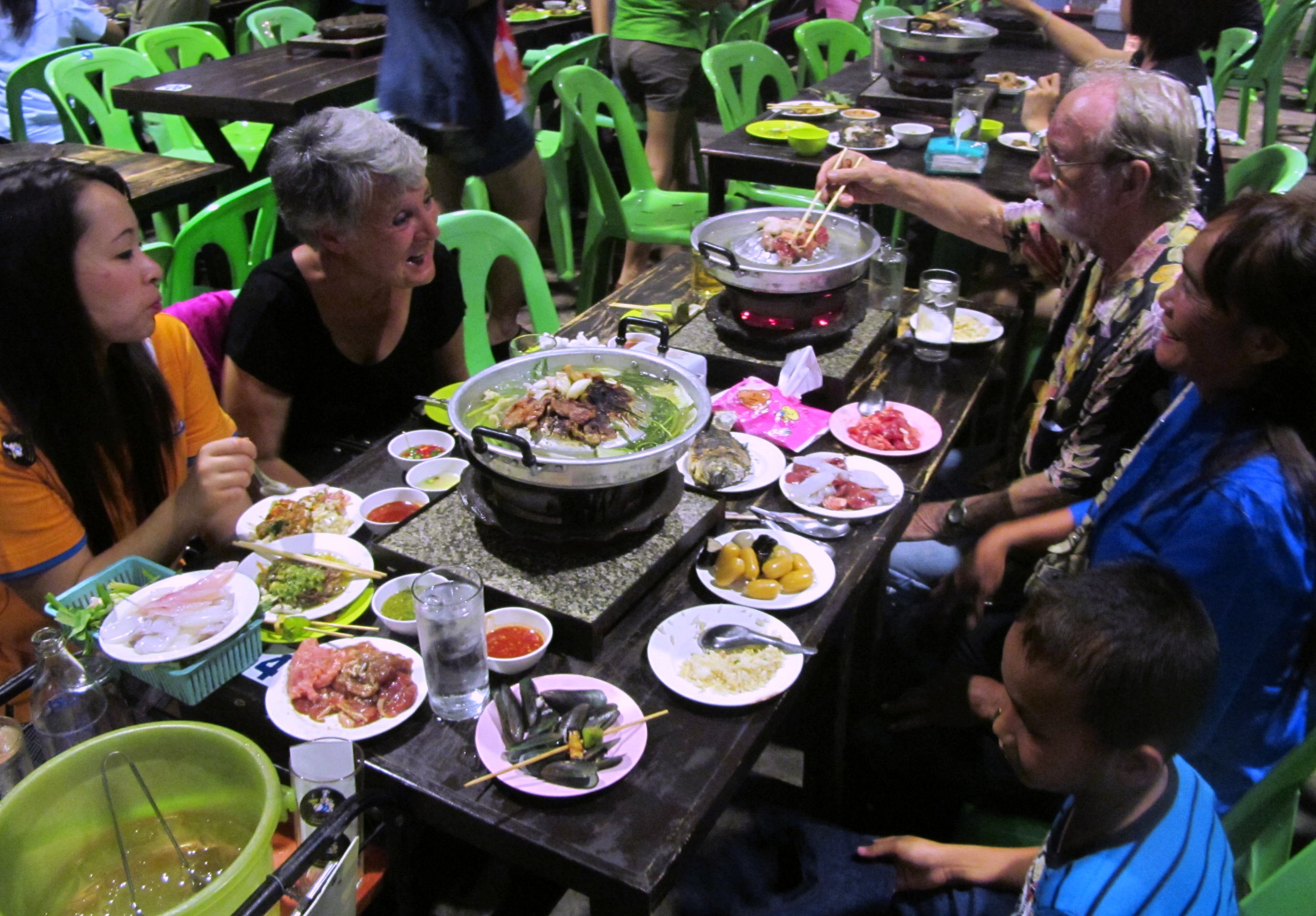
img: Janet Brown with friends at an all-you-can-eat DIY barbecue at a huge restaurant under a bridge in Bangkok, by Will Yaryan.

If you enjoyed this post, we invite you to subscribe to The Displaced Dispatch, a weekly round up of posts from The Displaced Nation, plus some extras such as seasonal recipes and occasional book giveaways. Sign up for The Displaced Dispatch by clicking here!

Related posts:
“Zuzu in Prahaland”: A departing expat takes inventory of strange, Lovecraftian Prague

For much of June, The Displaced Nation has been looking at what the story of Alice in Wonderland can tell us about displacement of the curious, unreal kind — as anchored by Kate Allison’s 5 Lessons Wonderland taught me about the expat life, by Lewis Carroll’s Alice. Today we welcome guest blogger Sezin Koehler, who received one of our Alice Awards for writing about her current home, Prague, in this vein. Koehler and her husband plan to leave the Czech Republic on August 2. Here, she credits their four-year stay in its capital city for bringing out the Alice in Wonderland, or Zuzu*, in her character.

When I first moved to Prague I had no idea I’d be entering a living snow globe rather than going down the proverbial rabbit hole. Not just any old snow globe, but one incessantly shaken by a petulant child, refusing to let but a glimmer of sunlight through the gray haze. I also had no idea that Prague was not so much a city, but rather some kind of unpronounceable Lovecraftian entity with a mind of its own.

The old mother with claws

Kafka called Prague “the old mother with claws,” and he struggled his whole life to escape from her clutches. He never managed.

After four years in her grasp, I myself feared I would never get out from her cruel and cold embrace. My suspicion is that if you die in Prague, your soul is trapped here forever, unable to move on or away, locked in a limbo that the entity within feeds upon, like a relentless vampire queen.

Since the Velvet Revolution that ended the reign of Communism in 1989, Prague has welcomed fresh blood in the form of expats with open arms. There is an entire community of American, Australian, British, Canadian and other expats who have lived here since the 1990s, and they make up their own insulated subculture within greater Prague. The mother claws have them, and good.

These long-term expats joke that Prague is a city that draws you in, makes you comfortable — and then, in the snap of a bony hand, chews you up and spits you out.

In my brief tenure I have witnessed this phenomenon several times: expats, happy as pie, loving the beer and the high life Prague affords — only to find themselves unceremoniously booted out of the country with no friends, no money and only a drinking problem to show for their life here.

Many of those who remain in the clutches for too long have, in the process, become a mutant strain of Czech: wary of outsiders, unwelcoming and generally cold people unless surrounded by their own.

The mother claws are a fickle bunch, taking what they need and discarding of you when there is nothing left.

Prague isn’t just a city, but an entity of some kind. My creativity in Its abode has come with often hefty prices. Two years into my stint here, I developed tendinitis in both wrists simultaneously from a combination of overwork and the extreme cold. I spent three months with both wrists in braces, unable to wash or clothe myself; it took steroid shots and brutal physiotherapy to finally get my hands back in working order.

Now I have the uncanny knack of predicting rain and cold snaps.

Looking back at this strange, sometimes nightmarish interlude, I offer up 20 stream-of-consciousness memories:

1. The place where my husband and I went from being just a couple to being a team.

2. A fairytale land on this side of the rainbow where my dreams started to come true — published in print for the first time, wrote my first screenplay, published my first novel and began work on its three sequels, started building my own platform as a writer. I can call myself what I wanted to be ever since I can remember.

3. Neo-Nazis and being screamed at by a racist Czech granny on the 18 tram.

4. Getting caught in the blizzard of 2010 and finally understanding that it’s not only people that can threaten you — the very elements themselves are forces of their own will and we live at their whim.

5. The phenomenal view of the University Botanical Garden from our living room window, as well as the original 6th century settlement of Prague, right smack in the middle of the city.

6. Chapeau Rouge, the friendliest bar in Prague — but only if you are there with me. I’ll make sure you pay homage to what I call Our Lady of the Music: an art installation featuring a Mary with a disco ball above her head and a record between her praying hands.

7. Discovering Afghan cuisine and vegetarian restaurants; also remembering South Indian cuisine and ordering Indian delivery online — useful especially when the streets were knee-deep in snow.

8. Bara, the world’s most talented tattoo artist: she gave me wings, stars, Falcor and Edward Scissorhands.

9. Cold that sinks right into your bones, feet aching and joints swelling from trudging through it across treacherous cobblestones and hidden patches of ice.

10. Bonsai and carnivorous plant exhibits at the Botanical Garden.

11. Sitting in our apartment, feeling my ears pop like I’m on an airplane from the rising and falling air pressure.

12. Lady Gaga’s monster brawl at the O2 arena: the Czechs marked the 21-year anniversary of the Velvet Revolution by punching people who wanted to dance; MGMT at Divadlo Archa; free passes to the Irish-American funk band Flogging Molly at Retro Music Hall — and hanging out with them afterwards.

13. Dancing in what was then Klub Kostel (literally, Church Club) on Hallowe’en, dressed as a witch.

14. Yearly fireworks and light shows over Vyšehrad (castle on a hill over the Vitava River), with a stage front view right from our window.

15. Mourning the deaths of, from a distance, Heath Ledger, Michael Jackson, Patrick Swayze, Corey Haim, Ryan Dunn … and close up, Curtis Jones, an American expat performance artist who’d been living in Prague since 1989 — a dear friend to many dear friends of mine in this city.

16. Cleaning up my first ever poop-drenched child, at an international pre-school where I worked. (I don’t and never will have kids.)

17. The vista of Prague from the tram on the way up to the castle, skyline scraped with spires and a cloud of fog overhead, feeling like I had somehow escaped the evil snow globeness if only for a moment.

18. Working for a newspaper, a mentally unbalanced artist, a shady off-shore investment banking firm, an international relocation company, a British school, and the largest university in central and eastern Europe.

19. The stench of Prague’s walking dead — homeless people with rotting parts of their bodies or insides, including one fellow with a black foot, the gangrene working its way up his leg. The worst thing I have ever smelled in my life, and I’ve lived in India and Africa; impossible to describe how awful and sad it is.

20. Seeing open graves for the first time ever, in Olšanské hřbitovy (Prague’s largest cemetery) — and imagining an imminent zombie invasion.

Na shledanou, Prahaland

I have made a tenuous peace with Prague.

This has been a place of great pain and great inspiration. The Entity is letting me go without a struggle: It knows that I will be telling stories about It for years to come.

It doesn’t even care if I paint Its portrait with darkness and horror — It wants to be seen, It wants to scare, It wants to fascinate so it can feed.

It knows the things I write, good and bad, will help bring many more people into Its icy embrace.

Prague is always hungry for fresh blood. Will yours be next?

*Sezin Koehler owes her nickname “Zuzu” to Rebi and Tereza, two Czech girls she took care of in an after-school program she organized. “Good afternoon, Miss Zuzu,” they would say. “Zuzu” is a common Czech nickname, short for “Zuzana.” This tickled Koehler’s fancy as one of her favorite films of all time — It’s a Wonderful Life — features a character named Zuzu Bailey. She has even named her blog Zuzu’s Petals — which, she says, “signify the most beautiful turning point in the film.”

Sezin Koehler is a half-American, half-Sri Lankan global nomad, horror novelist, writer and editor. Her first novel, American Monsters, was released last year. It has since been picked up by Ghostwoods Books, and an illustrated 2nd edition will be released by Fall 2011. Koehler’s Twitter moniker is @SezinKoehler.

img: “NO REST FOR THE WINGÉD — Zuzu Kahlo,” by Steven Koehler.

STAY TUNED for tomorrow’s post consisting of quotes attesting to the curious, unreal nature of Wimbledon tennis — which, to the more discerning observer, can seem disturbingly akin to the Queen of Hearts’ game of croquet.

If you enjoyed this post, we invite you to subscribe for email delivery of The Displaced Nation. That way, you won’t miss a single issue. SPECIAL OFFER: New subscribers receive a FREE copy of “A Royally Displaced Tea.”

Related posts: