The Displaced Nation

A home for international creatives

Funny foreigners: A response to “Is English really the international language it claims to be?”

Last week Displaced Nation writer Kate Allison wrote about sarcasm. She expressed an idea I’ve heard before that the UK and US are not so much separated by a common language, but by different understandings of sarcasm and irony, the idea being that British humour and American humor are fundamentally very different beasts.

While I enjoyed Kate’s post, I can’t help but feel that she was perhaps being a little unfair on a country that has produced among many others Gore Vidal, Groucho Marx and Stephen Colbert.

Eddie Izzard, noted comedian, marathon runner and jam enthusiast claims that there is absolutely no difference between the two countries when it comes to humour. I’ve seen him perform the same material on different sides of the Atlantic, and while in both cases the audience had that happy, warm and disturbing feeling of having pissed their pants (in both the US and UK sense of the word, unless some of the audience attended the show commando) at Izzard’s brand of surreal lunacy, if I’m honest I thought it was noticeable that different parts of the act got very different responses in Philadelphia than they did in London.

I’m not convinced I can extrapolate that into fundamental differences between the two countries, there’s a strange alchemy that occurs between a stand up audience and a comic, and sometimes — as I felt when I saw Izzard in Philadelphia — it just doesn’t gel as well as it could, but the same could have happened in London too.

Of course, we need to keep all of this quiet. We’re among friends here so I’ll let you into a little secret. It is in the interest of British self-esteem for us to let Americans think that there’s a huge chasm between the British and the American sense of humour. We, the country that gave the world 29 Carry On films, like to project onto ourselves this idea that we have a sophisticated, dry humour unique to our soil. We (Brits) talk about “irony” in the similarly loose, off-putting, undefined, making-it-on-the-sly way that the French talk about “terroir.”

And yes, I wouldn’t for a moment contest that, in general, the rhythm and beats that make up my humour are not necessarily the rhythm and beats that make up my friends’ American humor.  For instance that time-honoured, equal opportunity offender, “taking the piss” doesn’t translate that well to the US. But it’s a giant leap from that to saying that the Americans don’t “get” irony as well as the British. The UK is not a land of 60 million Oscar Wildes all excelling in the arts of irony, witticisms and dry put downs. We’re a country that to our eternal shame has commissioned five seasons of Celebrity Juice — and with each season the carcass of comedy putrifies further.

Yes, we may use irony far more socially than is normal for Americans, and this is of course surprising and befuddling for the poor American who wasn’t expecting an ironic response when they politely asked if you’d had a nice weekend, but that is a very different from the idea that Americans don’t “get” it. Smart people get irony, and there’s plenty of smart people in the US, and no, that’s not me being ironic.

For anyone who is still curious on this subject you may be interested in this video via Big Think: “Ricky Gervais on British and American humo(u)r and their differences.”

STAY TUNED for Tuesday’s post, Part 2 of Sebastian Doggart’s Bond-worthy quest to track down traces of Ian Fleming in today’s Jamaica.

If you enjoyed this post, we invite you to subscribe for email delivery of The Displaced Nation. That way, you won’t miss a single issue. SPECIAL OFFER: New subscribers receive a FREE copy of “A Royally Displaced Tea.”

Related post:

In search of 007th heaven: A travel yarn in three parts (Part 1)

We welcome Sebastian Doggart to The Displaced Nation as a guest blogger. Sebastian won one of our Alice Awards for a Telegraph Expat blog post entitled “Elegy to English shepherd’s pie.” Today, however, Sebastian will be giving Displaced Nation readers a break from our Alice theme, with the first in a three-part travel yarn about his chase after Goldeneye — the Caribbean retreat where Ian Fleming wrote all of his Bond books. Stay tuned for Parts 2 & 3 in the coming weeks.

On the northern coast of Jamaica, fringed by icing-sugar beaches and rocky coves, lies the holy place where Ian Fleming wrote all the James Bond novels. Now populated by the rich and famous in search of paradise, it is one of the most desired and exclusive oases on earth. Its name is GoldenEye.

Over the last two years, this secluded tract of land has been mysteriously shut to the world. The official story has been that the site has been undergoing a $75 million renovation. As with arch-villain Francisco Scaramanga’s private island, its inaccessibility has made it even more appealing as a travel destination. So when I heard that the legendary site was re-opening to a handful of invited guests, I was ready to risk life and limb to gain access.

I called the number listed on GoldenEye’s new Web site, and a lilting Jamaican voice gave me an email address for a London-based PR company. Its boss, whose broken English suggested she might in fact be the murderous Rosa Klebb, declined my request to write an article on the resort — unless I could come up with $21,000 a night.

I had neither the resources of Blofeld to satisfy her demand, nor a willingness to accept her rejection. With the ingenious forces of Q behind me, I devised a cunning plan to infiltrate the compound. Two friends were getting married and had been granted a honeymoon suite in GoldenEye. I would take my chances and show up on their doorstep for a celebratory cup of tea.

The name’s Bond. James Bond.

The approach to GoldenEye is a coastal road that passes the brand new Ian Fleming International Airport. Opened in January 2011 to cater for the super high-end tourist, it is specifically designed to welcome small jets. Rolling Stone Keith Richards, who has a house in nearby Ocho Ríos is a grateful new user.

I passed a sign marking the border of the town where GoldenEye geographically sits, Oracabessa. Once a banana port, it has fallen on hard times as Jamaica’s economy has struggled. Oracabessa’s name, a derivation from the Spanish oro cabeza, or golden head, is one of the various inspirations that Fleming has cited for his home’s own name.

No sign marked the entrance to GoldenEye. After driving past twice, I stopped and ask a local shopkeeper where the entrance was. She gave me a grave look of disapproval, as if I were complicit in a rich white man’s folly, but still had the grace to direct me to an unmarked iron gate, flanked by high walls. I pulled up and saw, hidden discreetly amongst the trees, a guard-post. I felt as nervous as if I were trying to break in to Dr. No’s lair on Coral Key.

As further ammunition to melt the guard’s heart, I was accompanied by two lovely ladies: my partner, Emily, who is even lovelier than Mary Goodnight; and my six-month-old daughter, who shares a birthday, November 11, with Bond himself.

“Good afternoon,” I said, breezily. “We’re here for tea with the Usmanovs.”

“Are they expecting you?” he asked, his wariness visibly dissolving as he glanced at my Bond girls.

“They are indeed. They’re the happy newly-weds.”

“One moment, please.”

The guard retreated into his bunker. With this level of security, I felt our chances were slim. Our friends would probably be out of their room, frolicking in the pool.

But we were in luck. The guard returned. “Drive through. Follow the path, keeping to your left. You will be escorted to the cabana of the Usmanovs.”

As the heavy gates swung open, and I scrunched over the gravel to within GoldenEye’s walls, my heart was pounding. The dream of seeing the birthplace of one my greatest heroes was about to come true…

Mr. Bond, it’s good to see you again…

The story of GoldenEye — originally spelled Goldeneye, without the upper case “e” — is an epic one. The estate’s first known owner was Henry Morgan, the 17th century Welsh pirate. He made use of its location, on a headland with a panoramic view, to look out for Spanish fleets heading for Havana. When he saw a new ship, he would send a signal to his own boat hidden behind an island, and its captain would then sail forward to claim their bounty.

Morgan used his piratic skills to help the British acquire Jamaica as a colony in 1658. He reveled in the pleasures of nearby Port Royal, “the richest and wickedest city in Christendom,” and would leave his name on every bottle of Captain Morgan rum.

Little is known of Goldeneye until the early 20th century, when it became a donkey racecourse. This is what Ian Fleming, then a commander in British naval intelligence, first saw in 1943, vowing to return after the war had ended. In 1946, he purchased the property from a powerful Jamaican land-owner, Blanche Lindo, with whom he began a life-long love affair. On the site of the racecourse café that once served banana dumplings and coconut oil, he built a white-walled bungalow.

Explaining its name in a later interview with Playboy, Fleming said:

I had happened to be reading Reflections in a Golden Eye by Carson McCullers, and I’d been involved in an operation called Goldeneye during the war: the defence of Gibraltar, supposing that the Spaniards had decided to attack it; and I was deeply involved in the planning of countermeasures which would have been taken in that event.

Goldeneye became Fleming’s winter retreat, where he would spend at least two months a year. He hosted an increasingly illustrious group of friends, including Graham Greene, Evelyn Waugh, Cecil Beaton, Laurence Olivier, and Truman Capote. His friend Noël Coward, who built his own house, Firefly, a few miles away, described his first visit thus:

We arrived before dusk. It is quite perfect, a large sitting room sparsely furnished, comfortable beds and showers, an agreeable staff, a small private coral beach with lily white sand and warm clear water. The beach is unbelievable. We swam after a delicious dinner, and lay on the sand unchilled under a full moon.

Honey Ryder: “Looking for shells?” Bond: “No, I’m just looking.”

Like Bond, Fleming was a womanizer, and Goldeneye was a fine place to woo a lady. In 1948, he brought Lady Ann Rothermere, whose response was effusive: “The air is so clear of dirt or dust, there is an illusion of a vast universe, and the sea horizon is very round.”

Fleming gave Ann a gift, the latest edition of Field Guide to Birds of the West Indies, by an American ornithologist named James Bond. He nicked the name for the hero of his first novel, Casino Royale, which he began writing in 1952, soon after he had discovered that Ann was pregnant and married her.

When writing, Fleming closed Goldeneye’s glassless, wooden shutters called jalousies, to avoid the distraction of the Caribbean horizon. He went on to create all 13 of his Bond novels in those surroundings. He would write later:

Would these books have been born if I had not been living in the gorgeous vacuum of a Jamaican holiday? I doubt it… I suppose it is the peace and silence and cut-offness from the madding world that urges people to create here…. A wonderful escape from the cold and grime of winters in England, into blazing sunshine, natural beauty and the most healthy life I could wish to live.

The Flemings’ marriage deteriorated into bickering, and Ann stopped coming to Jamaica. Our hero’s attentions turned to his “Jamaican wife,” Blanche. She was herself married — to Joseph Blackwell, an heir to the Crosse & Blackwell food family; but that only added spice to the affair. Blanche Blackwell gave Fleming a romantic gift of a coracle named Octopussy with which to explore the surrounding coves. The boat’s name became the title of the fourteenth and final Bond tale, published posthumously as part of a short story collection in 1966.

A lover of the sea, Blanche was the inspiration for Dr. No’s Honeychile Rider, whom Bond first sees emerging from the sea — naked in the book, bikini-clad in the movie. She was also the basis for Pussy Galore in Goldfinger.

You only live twice, Mr. Bond…

Blanche had a son, Chris Blackwell, who would go on to become a location manager on the movie Dr. No. He would then found the indie record label Island Records, which launched artists like Bob Marley and U2. Chris describes his first visit:

I went with my mother to a party that Ian Fleming was giving for friends. Noël Coward was there. It was a casual affair — with lunch served under the almond trees and overlooking the beach — and what I remember most is a lot of laughter.

In 1964, two years after both the release of the movie Dr. No and Jamaica’s independence from Britain, Fleming came to Goldeneye to write his last and most nostalgic Bond novel, The Man with the Golden Gun:

My own life has been turned upside down at, or perhaps even by, [this] small house … that I built 18 years ago… I sat down at the red bullet-wood desk where I am now typing this and, for better or worse, wrote the first of 12 best selling thrillers that have sold around twenty million copies and been translated into 23 languages.

Fleming died soon after, undramatically, of a heart attack, and was buried in Wiltshire, where he would later be joined by his son Casper (who tragically died of a drug overdose, aged 22) and his wife Ann.

The Fleming family held on to Goldeneye, which gradually fell into disrepair, until 1977, when they put it on the market. Bob Marley was interested, but eventually decided it was “too posh”. Encouraged by his mother, Chris Blackwell himself stepped in and purchased the property. He bought further land, increasing the estate from 16 to 100 acres and building what he called “a model for residential tourism” — a network of luxury villas that hosted celebrities including Naomi Campbell, Quincy Jones, Rachel Weisz, and Martha Stewart.

Two years ago, Blackwell shut it all down to embark on a $75 million renovation, with the goal of creating “a community of free spirits dedicated to living an inventive, balanced life where the imagination and the environment could co-exist in perfect harmony.”

We were now some of the first people to assess whether he had achieved this dream with the latest incarnation, GoldenEye.

STAY TUNED for Part 2, in which Sebastian continues his search for 007 — and for Monday’s post, where we’ll return to Wonderland for further scrutiny of its sense of humor (or the lack).

If you enjoyed this post, we invite you to subscribe for email delivery of The Displaced Nation. That way, you won’t miss a single issue. SPECIAL OFFER: New subscribers receive a FREE copy of “A Royally Displaced Tea.”
RANDOM NOMAD: Helena Halme, Book Seller, Fashion Addict & Writer

Born in: Tampere, Finland
Passport: Finnish (only, and proud of it!)
Countries lived in: Sweden (Stockholm): 1971-74; Finland (Turku): 1975; Finland (Helsinki): 1975-84; England (Portsmouth): 1984-86, 1988; England (Plymouth): 1987; England (Wiltshire): 1989-2010; England (London): 2011-present
Cyberspace coordinates: Helena’s London Life | A Nordic view on style, fashion, art, literature, food and love in the city (blog)

What made you leave your homeland in the first place?
I left Finland for the first time as a 10-year-old with my family due to my father’s work, then moved back again for the same reason. And then I left Finland for good to marry my English husband. I’ve written 48 blog posts — soon to be a Kindle book called The Englishman — about how I came to be in England.

Is anyone else in your immediate family displaced?
My father is the only member of the family who still lives in Finland. My mother lives in Stockholm (she is remarried), and my sister lives also in Sweden (she married a Swedish man). Oh dear, that makes it sound as though we are are very man-dependent women, but I can assure you we’re strong and independent — really.

Describe the moment when you felt most displaced over the course of your many displacements.
I felt most displaced when I moved back to Finland at the age of 14. I didn’t want to leave Stockholm and felt completely alien in my home country. Since then I haven’t really felt at home anywhere. Although the two countries are divided only by the Baltic Sea, Finland was — and still is to a certain extent — a very different country to Sweden. The Finnish language is notoriously difficult, and in those days the culture was heavily influenced by Finland’s proximity to Russia (then the Soviet Union). Having lived in the very Western European city of Stockholm for three years, I saw my home country as being part of the Eastern bloc (even though it most certainly wasn’t). The radio played little pop music, and the TV was full of political broadcasts and dark plays about the struggle of the working classes. Western films took longer to arrive, and most people seemed dull and depressing. Nobody smiled and they all dressed in old-fashioned clothes. There seemed to be nothing you could buy in the shops. My sister and I would take the ferry across to Stockholm for many years afterwards — and wow our friends with the H&M clothes we brought back.

Describe the moment when you felt least displaced.
Once I had my children in the UK, I felt I belonged much more — although I took care to make sure they knew they were half-Finnish. To this day, we combine Finnish and English customs: have two Christmases, grow special grass for Easter called rairuoho, and so on… No particular moment stands out in my head where I’ve felt especially at home — yet! That said, the move to London last year has given me an even greater sense of belonging… Perhaps that’s it; perhaps it happened just this year, when we moved to Northwest London?

You may bring one curiosity you’ve collected from each of the countries where you’ve lived into the Displaced Nation. What’s in your suitcase?
From Finland (even though it’s my homeland, it remains somewhat foreign): A Finnish knife (puukko).
From Sweden: A slice of the traditional Swedish cake known as Prinsesstårta.
From England: BBC Radio 4.

You’re invited to prepare one meal based on your travels for other Displaced Nation members. What’s on the menu?
I love food and don’t think I’ve changed my tastes all that much since coming to the UK. Thus my menu for The Displaced Nation is mostly Scandinavian but with one concession to British tastes. (These days, of course, you can get almost any foodstuffs from Finland in London. Bless this multicultural city!)

You may add one word or expression from each of the countries you’ve lived in to The Displaced Nation argot. What words do you loan us?
From Sweden: Fy fan (bloody hell), because it just sounds right for a sense of frustration.
From Finland: Kippis (cheers) — it sounds like “get pissed” to an Englishman’s ears.
From the UK: That’s very interesting… The person who utters these words is usually dying of boredom. (A typical English white lie…)

A statement on your blog’s Home Page strikes us as being very Alice-like: “Rye bread not toast, pickled herring not fish & chips, cinnamon buns not Victoria sponge, ice-hockey not football, wander in a forest not walk in a park, silence not polite conversation.” Does the Alice-in-Wonderland story speak to the life you’ve led in the UK?
In England I’ve always felt as if I were the largest person in the room, particularly against the slight “English roses” — just as Alice did when she entered Wonderland. When I first arrived in this country, I’d often recall the words of the Queen of Hearts to Alice at the trial: “All persons more than a mile high must leave the court.”

QUESTION: Readers — yay or nay for letting Helena Halme into The Displaced Nation? Tell us your reasons. (Note: It’s fine to vote “nay” as long as you couch your reasoning in terms we all — including Helena — find amusing.)

img: Helena Halme’s self-portrait on the number 13 bus. As Halme explained in a blog post last month, the No 13 featured in the British TV series On the Buses, which was broadcast on Finnish TV in the 1970s and was an early influence on her view of men in England. Also please note that Halme’s hair in this picture owes to her own efforts; she hadn’t yet discovered the Brazilian blow dry.

STAY TUNED for tomorrow’s installment from our displaced fictional heroine, Libby, who is debating whether Woodhaven, Massachusetts, is really the picture-perfect Wonderland it seemed at first sight. (She also meets a realtor who is most decidedly a Red Queen…)

If you enjoyed this post, we invite you to subscribe for email delivery of The Displaced Nation. That way, you won’t miss a single issue. SPECIAL OFFER: New subscribers receive a FREE copy of “A Royally Displaced Tea.”
Related posts:

DISPLACED Q: How many of these 5 expat Alice characters do you recognize?

After two weeks of total immersion in all things Alice, we’re finding that even normal people look like Wonderland characters.

Here are a few we’ve noticed:

1. The Red Queen

The Red Queen, as her title suggests, queens it over the less experienced and the newly-arrived in Wonderland (or Looking-glass country, if you would like to be pedantic.)

We all knew her in school. She’s the bossy one who made a beeline for The New Girl recently arrived from out-of-town, made a big deal about showing her around, and kindly explained the school rules in a manner guaranteed to confuse and subtly terrify the newcomer – which, of course, was the intention.

Now fully grown rather than three inches high, she reigns supreme over the expat coffee morning posse and sends out Tupperware party invitations which no one dares refuse for fear of excommunication from the International School’s PTA.

Her self-proclaimed superiority is based on her many years in Wonderland, and her familiarity with the country. She knows the place forwards, backwards, sideways, and diagonally.

2. The White Rabbit.

The Red Queen’s (or Duchess’s) sidekick. Always busy, always rushing somewhere, always checking her watch or BlackBerry, always worrying that she will be late for something – although no one cares whether she is there or not, and most would prefer that she isn’t.

She organizes coffee mornings, school bake sales, and garden fetes, and is never happier than when she is chairing a committee. She loves giving orders, which are generally followed but with much resentful muttering from the minions.

Her favorite expression, apart from “Oh my fur and whiskers!” is “If you want something doing properly, do it yourself”, followed by a heavy sigh at the bumbling incompetents with whom she is forced to associate by dint of a common nationality.

3. The Cheshire Cat.

The Cheshire Cat holds himself slightly aloof from the madness that is the expat enclave, accepts Wonderland’s eccentricities with smiling resignation, but has a tendency to disappear when the going gets tough.

Although he is friendly and happy to chat, don’t expect more than a superficial friendship from this one.

4. The Hatter.

Here is someone who should have left Wonderland years ago. Time no longer has any true meaning to The Hatter, who calculates it in days rather than hours, and in months until visa expiration rather than weeks since the beginning of  tea time. He makes jokes that aren’t funny, then gets offended when no one laughs.

The Hatter is a  great fan of the traditional expat gin and tonic, however, and it is always six o’clock in his house.

5. Alice.

The homesick newcomer, desperately trying to make sense of a new country and managing to offend people every time she opens her mouth.

She soon discovers that the beautiful, magic place she tried so many times to enter is full of faults, just like home, and the people in it of whom she was once  in awe are “nothing but a pack of cards.”

At this point she often leaves the country, as she has found the grass on the other croquet lawn isn’t any greener after all. Ironically, if she stays just a little longer, she will find that she has gone through the most difficult time of adjustment, and life in Wonderland can – probably – only get easier.

So – Do you know one of these Alice characters, or – dare you admit it – are you one yourself?

Img: — Many thanks to Emily Cannell at Hey From Japan for the photograph of waxwork Alice at the Tokyo  Tower!

STAY TUNED for tomorrow’s interview with Random Nomad Helena Halme. She appeals for citizenship in The Displaced Nation — and answers an Alice question!

If you enjoyed this post, we invite you to subscribe for email delivery of The Displaced Nation. That way, you won’t miss a single issue. SPECIAL OFFER: New subscribers receive a FREE copy of “A Royally Displaced Tea.”

Related posts:

English – is it really the international language it claims to be?

Despite speaking English as the Wonderland creatures did, Alice frequently found there to be a language barrier:

Alice felt dreadfully puzzled. The Hatter’s remark seemed to have no sort of meaning in it, and yet it was certainly English. “I don’t quite understand you,” she said as politely as she could.

I sympathize with Alice; some years after the publication of Wonderland, George Bernard Shaw made his famous remark that

England and America are two countries separated by a common language

and that sentiment is as true today as it was in the 1800s.

“Perhaps it doesn’t understand English,” thought Alice.

I’ve got a piece of Facebook flair that says

“Sar-chasm: The giant gulf between the sarcastic comment and the person who doesn’t get it”

and this definition pretty much accounts for the language barrier between my home country and my adopted one.

Sarcasm is a Brit’s second language, and it’s disconcerting not to be understood when you speak it. A few years ago when our house in the States was for sale, we had the misfortune to deal with a prospective buyer who said he’d like to buy our house, but who actually wanted to amuse himself over several months by grinding our asking price down to the 1985 construction cost before saying, “You know, I think I’d rather live ten miles away in a different town altogether.”

When negotiations had come to an unpleasant halt, we observed facetiously to our real estate agent that at this point we’d prefer to torch the place than let this particular person live in the neighborhood, to which she replied, quite seriously, “I don’t think that would be a good idea. Arson’s illegal.”

A British estate agent may have replied, “Here’s twenty quid. Get some matches and petrol on me.”

Or maybe they wouldn’t these days. The litigious society has been shipped from America to Britain and is doing quite nicely, from what I can tell from the Daily Mail. Had the place had gone up in flames after an overenthusiastic barbecue, we could have sued the realtor for giving us ideas.

“Then you should say what you mean,” the March Hare went on.

Occasionally I do meet that rare American who understands sarcasm, but because they don’t go around ringing bells and shouting “Unclean!” I don’t realize they’re using it until it’s too late and I’m saying, “Oh, wait – no, I get this, I do, it’s just I’m out of practice…” (The exception is if he or she has a Brooklyn accent, in which case we greet each other with a secret handshake.)

The best way to identify sarcasm-users is to ask them what they watch on TV. Assuming they correctly identify your accent, they’ll generally say one of two things in reply: either “I have the whole of Monty Python on DVD!” or “Oh, wow, that Benny Hill – isn’t he just awesome?” If it’s the latter, don’t even think of mentioning the benefits of lighter fuel and matches in any part of the house other than the brick barbecue.

Especially if there’s a For Sale sign in the garden.

.

STAY TUNED for Tuesday’s post on the characters you can meet along the way in your own Wonderland…

If you enjoyed this post, we invite you to subscribe for email delivery of The Displaced Nation. That way, you won’t miss a single issue. SPECIAL OFFER: New subscribers receive a FREE copy of “A Royally Displaced Tea.”

Related posts:

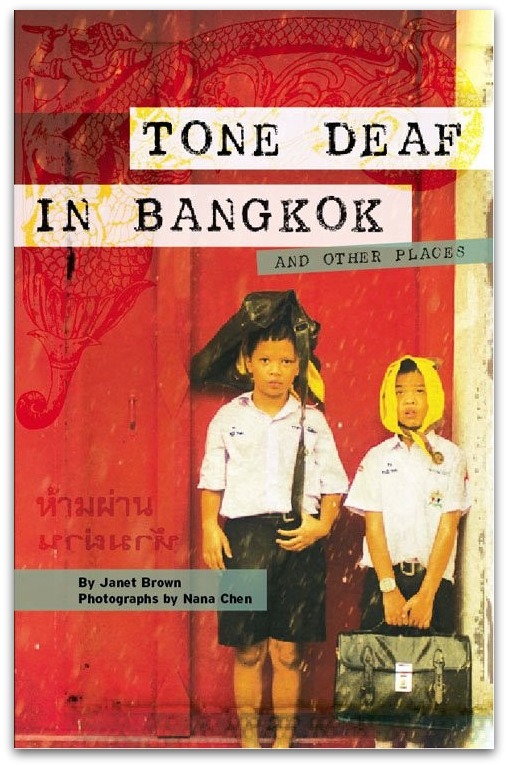
Travel author Janet Brown channels Alice in Wonderland’s “tone deaf” adventures

SPECIAL TREAT FOR TDN READERS: JANET BROWN, author of the travel gem Tone Deaf in Bangkok, has kindly agreed to “come in” and respond to your comments and questions. 

As you may have noticed, The Displaced Nation has gone Alice-in-Wonderland mad since around the first of June. To take just a few examples:

And now, to top that all off, the extraordinary travel writer Janet Brown is paying us a visit. Brown could almost be a stand-in for the Lewis Carroll heroine herself, having published a book on travel to and life in Thailand called Tone Deaf in Bangkok, to much acclaim.

“Tone deaf” — it puts one in mind of poor Alice’s plea to the Mouse, “I didn’t mean it…But you’re so easily offended, you know!”

But if Brown sees herself as tone deaf, her readers regard her as anything but. Here is a sampling of her reader reviews on Amazon:

It has been ages since I have loved a piece of travel literature…, and so when I read TONE DEAF IN BANGKOK, I was thrilled. This is a good travel book, and it is a good book, period.

I am not a traveler, nor do I typically read travel books. Shame on me, I know, but here’s the thing: … The author brought Bangkok to life in a way that made me want to go there, yes, but it was her own story that captivated me and kept me turning the pages. Now I’d read anything Janet Brown writes!

Janet Brown’s TONE DEAF IN BANGKOK is a travelogue, to be sure. Yet it is more, so much more. It’s also an investigation into how dislocated we can become by ourselves, by our priorities and by all that we demand of the cultures in which we live. … That she has a gift for spotting the universal in the exotic makes this collection all the more profound.

Janet Brown has graciously agreed to answer some of my Alice-related questions. After that, dear reader, I urge you to chime in!

Before we go down the rabbit-hole, can you tell me a little bit more about your background?
My parents turned me into a gypsy before I was two, by taking me on their journey by jeep from New York City to Alaska when the 49th state was still a territory and the Alcan Highway was still an unpaved trail into the frozen north. I have wandered ever since, most recently in Southeast Asia with Bangkok as my home, writing down the stories I encounter as I explore. My books include:

Maybe because I’m so steeped in Alice-of-Wonderland lore this month, I think of you as Alice Personified. To what extent can you relate to Alice’s sense of disorientation? Going back not just to the first time you went to Thailand but also when your family dragged you to Alaska…
I was 18 months old when my family moved to Alaska from Manhattan. I coped with any displacement issues by making my mother read my favorite book over and over again — a truly saccharine Little Golden Book called The New Baby. The main character had the same name as I so that was the big attraction — all about me!  My mother swears she can still recite it verbatim after having two martinis.

Alice came to mind constantly in my first months in Bangkok — and frequently thereafter. I knew I’d gone through the looking glass — or had entered the postcard — and asked myself often if that experience had been as painful for Alice as it often was for me.

Can you describe your worst “Pool of Tears” moment in Bangkok, where you wished you hadn’t decided on living there?
I’ve tried to make light of that time when I wrote about it in Tone Deaf in Bangkok, but it nearly demolished me. When the manager of my apartment turned me into Ryan’s Daughter by listening in on my phone calls and then entertaining the neighborhood with highly embroidered versions of my life — and when people fell silent when I walked down the street and began gabbling excitedly after I’d passed — I felt as though my life had been stolen from me and I shut down to the point of hypothermia. If my students hadn’t helped me find a new neighborhood, I would have gone home a gibbering mess.

Thailand is renowned for its distinctive cuisine. Was there anything that carried an “Eat me” label that you felt hesitant about at first, but then discovered you loved?
I’ve written about durian in Tone Deaf, how I thought its smell in the market was sewer gas and then how I was forced to taste it, with happy results. Fried grasshoppers were another thing I didn’t warm to at first sight and then liked as much as I do popcorn — they have much the same crunch and texture.

By the same token, were there any foods that you thought might be good but then didn’t acquire a taste for? (For Alice, of course, that was the Duchess’s over-peppered soup.)
One night I stopped to buy green papaya salad from a food cart to take home for supper. There was something in a little plastic bag that looked like a sort of relish, so I bought that, too.When I opened it at home a smell of rot filled the air, but remembering the delightful surprise that durian had proved to be, I took a generous spoonful. It was pla ra — fermented fish, a Northeastern Thailand culinary staple that is meant to be added and mixed judiciously with the salad, not eaten like peanut butter. There wasn’t enough toothpaste in the world to rid my mouth of that thoroughly foul taste.

As already mentioned, Alice finds it’s easy to offend the creatures in Wonderland without even trying. Why did you choose the expression “tone deaf” for the title of your book on Bangkok? 
“Tone deaf” can be taken quite literally. Thai is a tonal language with five different tones giving meaning to every word. Use the wrong tone and at best you’re incomprehensible, at worst shocking. The most common mistake for foreigners is to tell someone their baby is beautiful, while actually announcing that the infant is bad luck. Another pitfall is confusing the word “near” with the word for “far” — they are the same sound, differentiated by a crucial tone.

But travelers to Thailand can also be “tone deaf” when it comes to figuring out the Thais’ communication style. As a Thai-American friend has observed, the important things are what remain unsaid. “You looked so beautiful yesterday” probably means today you resemble dogfood and ought to go home and rectify that at once. Subtlety is the hallmark of Thai communication, and is often expressed through a quirk of an eyebrow or a famous Thai smile, which has at least one hundred different meanings — including disdain or outright menace.

Describe the biggest faux pas you’ve made since settling in Bangkok.
Oh, how to choose — it’s impossible not to make faux pas every second because Thai etiquette is demanding and complex. The one that makes me cringe most is in my first week when I set off on my first solo bus ride. I was clutching a twenty-baht note, which like all bank notes in Thailand bears the countenance of the King. He is revered to the point of near godhood in his kingdom and his picture is always elevated to the highest spot in a room — nothing is above the King. But I was fresh off the boat and when I dropped my money and it was caught in a little breeze, I put out my foot (the lowest and most ignominious part of the body) and stepped on the picture of the King’s face to secure my bus fare. I was too clueless to pick up on the ripples of horror that this caused others at the bus stop, but now I writhe when I remember this.

“Off with her head!” as the chief royal in Alice’s story is wont to proclaim. Actually, never mind your head. Your mention of your foot makes me think of how physically awkward Alice feels around the creatures in Wonderland. As a farang in Bangkok, do you often feel self conscious?
I’m short and dark in a family of pale-skinned people, so I was used to being an anomaly from early childhood. In Bangkok, if I dressed like a Thai woman and wore sunglasses and walked slowly, I felt as though I blended in. But one day I walked down a quiet street on my way to a class, and someone looked up and said, “Look at the foreigner.” “How did she know?” I asked my class of teenage girls. “Your hair,” they said. “No, lots of Thai women have dyed their hair brown,” I replied — to which they responded: “Your nose.” It was my big American nose that gave me away every time — and since I hate pain and surgery, I just had to accept that.

Have you tweaked your personal style at all so as to fit in better? 
Yes — I adopted the conservative “Don’t show your bare shoulders” school of dressing that prevailed in Bangkok when I first arrived and slowed my pace to that of the women around me. I learned to keep my facial expression as bland as I possibly could to achieve the quiet Thai “public face,” and I ironed everything, including my Levis. Now women are much more casual in the way they dress but I’m still stuck in the cultural mores of the 90s. To foreign women who live here now, my introductory years in Bangkok seem like fiction — things have changed so drastically in the past 16 years.

Time for a quote from the Cheshire Cat: “…we’re all mad here. I’m mad. You’re mad.” Can you relate?
Riding on the back of a motorcycle taxi down a crowded city sidewalk, buying a glass of Shiraz to take with my popcorn into a movie theater, being drenched to the bone during Thai New Year’s — this is actually the most difficult question you’ve asked so far because at this point it all seems normal.

If you were to hold your own Mad Hatter’s Tea Party in Bangkok, whom would you invite, and why?
Anais Nin, because she would love the unbridled hedonism of this place, Evelyn Waugh because he would satirize the expat scene so well, Ho Chi Minh because he could help put together the revolution that is needed here, Emily Hahn because she has always been my role model since I first read her when I was twelve, and Elvis because in Bangkok he is still the king.

Alice becomes aware that Wonderland is turning her into a different person, unrecognizable to the one she used to be. Has your identity has shifted in fundamental ways since living in Bangkok?
This is a very complex question — I’ve written one book about it and am working on a second one, Almost Home. I’m always drawn back to the US because my children are there. Seeing them for two weeks a year doesn’t work for me. Once I get back to the US this time around, I’ll return here but plan to spend the bulk of my time near family in the Pacific Northwest. I won’t know how much I’ve been changed by this recent incarnation in Bangkok until then. Ask me again in several months.

Can you offer any advice for newcomers to Bangkok, who aren’t sure who they are any more?
Tone Deaf in Bangkok and my next book, Almost Home, are where I directly address the challenges of feeling like an Alice in Thailand. In addition, the recently published Lost and Found Bangkok, for which I wrote the text, may be helpful for newcomers. It’s a book in which five different photographers — two American men, two Thai men (both from Bangkok), and one Taiwanese-American woman — show the city they live in. New arrivals can look at the photos and see some great places to get lost — and find out who they are — in this Wonderland-like city.

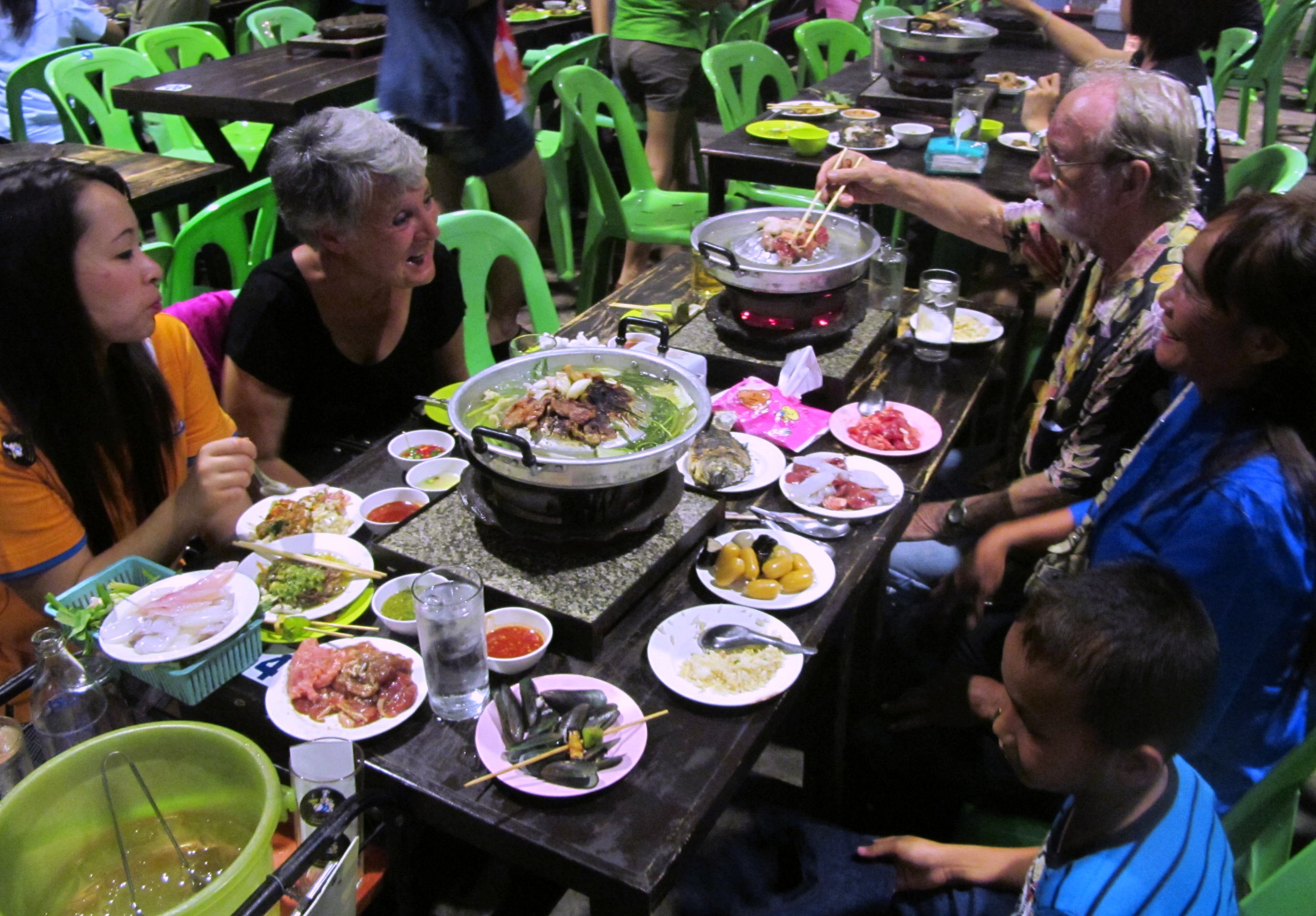
img: Janet Brown with friends at an all-you-can-eat DIY barbecue at a huge restaurant under a bridge in Bangkok, by Will Yaryan.

STAY TUNED for Monday’s post on the problems one can anticipate in trying out one’s humor on Wonderland’s inhabitants…

If you enjoyed this post, we invite you to subscribe for email delivery of The Displaced Nation. That way, you won’t miss a single issue. SPECIAL OFFER: New subscribers receive a FREE copy of “A Royally Displaced Tea.”

Related posts:

RANDOM NOMAD: Piglet in Portugal, Award-Winning Expat Blogger

Born in: Harrow, England
Passport(s): British
Country lived in: Portugal Has had a house there from 2006-present
Cyberspace coordinates: Piglet in Portugal (blog)

What made you leave your homeland in the first place?
Although we left the UK primarily due to health reasons, we were also in search of a better quality of life. The jobsworth* culture and the “health and safety” people, plus the PC Brigade**, were slowly driving us mad; we no longer had the right to exercise common sense any more than we were capable of making our own decisions. Yes, Mr Jobsworth, we know if we stand by the edge of a cliff we could fall off it. Or if we go out in the rain, we are likely to get wet. There appeared to be a whole army of people telling us what to do and what to think! England is not nicknamed the Nanny State*** for nothing!
* Jobsworth: A person in a position of minor authority who invokes the letter of the law in order to avoid any action requiring initiative, cooperation, etc.
** PC Brigade: Politically correct brigade.
*** Nanny State: A government that makes decisions for people that they might otherwise make for themselves, especially those relating to private and personal behavior.

Is anyone else in your immediate family displaced?
Our daughter moved to Lyon in France with her ice dance partner when she was just 15 years old to rain with a world-famous ice dance coach. When she gave up skating ten years ago, she met her French husband-to-be and remained in France. They have just had their first child — our first grandchild.

Describe the moment when you felt most displaced over the course of your many displacements.
I am unable to pinpoint the exact moment I felt “displaced” — it was more, shall we say, “moments” which gradually crept up on me over time. Language is a huge problem, and despite my valiant efforts to learn Portuguese, I have failed miserably. I’ve spent thousands of euros on private lessons, studied hard, but am still unable to converse properly in Portuguese. I’ve had to accept I am not a natural linguist and have resigned myself to doing the best I can. (No, I do not need any more lectures as to “you have to learn the language to integrate.” I have really tried.) Because of this failure, I now know what it feels like to be in a room full of people and feel totally alone — almost as if the room were empty or you were invisible. You are there in body but not in mind; simply a spectator. This is really difficult for me as I am gregarious by nature and a natural “chatterbox.” I am sure there are many expats out there who can relate… I am also a real foodie and, apart from desserts and cakes, am not that keen on Portuguese food…

Actually, you have made me stop and think again about this question.

Perhaps the moment I actually felt “displaced” was when our first grandchild was born recently in France. We also have another grandchild due in September, but in the UK. My first thoughts were: do we relocate to France or the UK? We have no family in Portugal so why stay here? I have begun to feel restless.

Describe the moment when you felt least displaced.
I have always felt at home in Portugal, despite language difficulties and a cuisine that is rather “basic” for my tastes. I have never tried to change anything: e.g., protest against bullfighting or insist our local snack bar serves fish and chips or curry. I accept life as it is.

You may bring one curiosity you’ve collected from the country where you’ve lived into the Displaced Nation. What’s in your suitcase?
My curiosity item would have to be bacalhau. It is dried salted cod fish and a long-time favorite with the Portuguese. I wrote a blog post about it.

You’re invited to prepare one meal based on your travels for other Displaced Nation members. What’s on the menu?
It’s a struggle for me to find Portuguese recipes I like. Most of the restaurants here in the Algarve serve up very much the same dishes: chicken piri-piri, sardines or grilled fish and meats served with salad and chips, etc. “Dish of the Day” offers other variations, but as I do not like snails, the “unmentionable” parts of animals or beans, this means the choice of food is often limited. But here goes:
Piglet’s Menu for The Displaced Nation

  • Calde de Verde (Portuguese Cabbage Soup)
  • Carne de Porco a Alentejana (Pork with Clams) [See recipe.]
  • A selection of Portuguese cheeses and crusty bread
  • Molotof — a light dessert made with egg whites. [Watch video.]

You may add one word or expression from the country you’ve lived in to The Displaced Nation argot. What word do you loan us?
My first instinct is to loan you leitão, which means “piglet” in Portuguese. My husband and I went out to lunch soon after we arrived in Portugal, and I thought I’d ordered roast pork. It turned out to be suckling pig! Hmmmm it made my trotters twitch! Mental note — I need to be more careful in translating the menu in future. Porco is pork. But perhaps it would be more in keeping for me to loan you the first Portuguese word I learned: bonita. It means beautiful.

Alice meets many curious animals when she ventures into Wonderland, including a piglet at one point. We’re curious (and curiouser!): why have you chosen the piglet moniker, avatar, and doppelgänger
Because I adore pigs. I would love to keep Vietnamese pot-bellied pigs if we had a large garden. I was nearly tempted to buy a little pig a few months ago at the local market until my head ruled my heart and common sense kicked in. Awww, but it was so cute! Some people love dogs. With me it is pigs.

QUESTION: Readers — yay or nay for letting Piglet in Portugal into The Displaced Nation? Tell us your reasons. (Note: It’s fine to vote “nay” as long as you couch your reasoning in terms we all — including Piglet — find amusing.)

STAY TUNED for tomorrow’s installment from our displaced fictional heroine, Libby. Kate Allison has assured us it will contain some more Alice in Wonderland references — but will there be any piglets? Curiouser and curiouser, I think you’ll agree…

If you enjoyed this post, we invite you to subscribe for email delivery of The Displaced Nation. That way, you won’t miss a single issue. SPECIAL OFFER: New subscribers receive a FREE copy of “A Royally Displaced Tea.”

Related posts:

DISPLACED Q: Which dish is the worst international traveler?

Although “Does it travel well?” is a question usually asked of wine, we think the same query should be demanded of food, and often.

Alice agrees with us.

Soup didn’t cross successfully from the sublime to Wonderland:

“There’s too much pepper in that soup!” Alice said to herself as well as she could for sneezing.

At least use the correct animal.

In his Telegraph article, “Elegy to English shepherd’s pie”, our Alice Award winner, Sebastian Doggart, bemoans American ineptitude when it comes to making this most English of lamb dishes.

Americans just don’t get it.

First problem, encountered even in supposedly English pubs here in New York, is that it’s usually made with beef.

Putting the wrong animal in a dish? For shame!

Perhaps food should follow the jet stream.

Bill Bryson, in his book The Lost Continent, describes an equally disappointing encounter with another dish that hadn’t traveled well from East to West: a Cornish pasty in Michigan:

It was awful. There wasn’t anything, wrong with it exactly—it was a genuine pasty, accurate in every detail—it was just that after more than a month of eating American junk food it tasted indescribably bland and insipid, like warmed cardboard.

Although he attributes its lackluster flavor to his tastebuds becoming accustomed to American cuisine, I beg to differ on this point. Some dishes simply don’t travel well, and the Cornish pasty is evidently one of them. No one should attempt to recreate it outside England’s borders.

Or perhaps direction doesn’t matter.

However, Mr. Bryson found that some foods didn’t travel successfully across the Atlantic in the opposite direction, either.

In Notes from a Small Island, he comments on British hamburger chain Wimpy in the 1970s, before McDonald’s ruled UK fast food :

“I confess a certain fondness for the old-style Wimpy’s with their odd sense of what constituted American food, as if they had compiled their recipes from a garbled telex.”

He has a point. You don’t find American McDonald’s serving Big Macs with a side of Heinz baked beans.

And lastly — if you can’t boil a kettle, don’t make the tea.

Here, I am going to jump up on my hobby horse and say emphatically, “If you don’t understand that tea must be made with boiling water –- that’s when the cooking thermometer reads 100 degrees Celsius, not Fahrenheit –- don’t even try.”  Leave the tea to the British and Indian experts and stick to coffee instead.

I’ve lost count of the times when restaurants have served me “tea” by plonking down a cup of barely hot water with a teabag, still in its paper wrapper, at the side.

Why, for goodness’ sake? I also ordered a sandwich, but wasn’t handed two slices of stale bread and a packet of ham and told to get on with it.

Once bitten

Alice could have warned us of these perils, naturally. Her culinary adventures in Wonderland made her cautious before she jumped through the looking-glass:

“How would you like to live in Looking-glass House, Kitty? I wonder if they’d give you milk in there? Perhaps Looking-glass milk isn’t good to drink.”

Out of the mouth of babes and Victorian child-heroines, indeed.

So tell us: What’s the worst-traveled food you’ve encountered?

If you enjoyed this post, we invite you to subscribe for email delivery of The Displaced Nation. That way, you won’t miss a single issue. SPECIAL OFFER: New subscribers receive a FREE copy of “A Royally Displaced Tea.”

Related posts:

For curious and unreal travel, Tokyo sure beats Wonderland

Today we welcome Carole Hallett Mobbs to The Displaced Nation as a guest blogger. During June, TDN is looking at what the story of Alice in Wonderland can tell us about displacement of the curious, unreal kind — as anchored by Kate Allison’s “5 Lessons Wonderland taught me about the expat life, by Lewis Carroll’s Alice.” Hallet Mobbs can identify, having just left Japan — a country that Western travelers have long regarded as the ultimate topsy-turvy destination — after four-and-a-half years of living with her family in Tokyo.

“I’ve believed seen as many as six impossible things before breakfast”: this seems the most logical place to begin my account of life in Wonderland Japan.

In Tokyo, you can see a minimum of six impossible or incredible things before breakfast.

And then another six after breakfast.

In fact, I can safely say that a day spent in Tokyo will guarantee you a double-take moment approximately every ten minutes.

I know this, because I timed myself one day, using an oversized pocket watch.

Jaw-dropping sights abound — and I never failed to be delighted and amazed every single day during my four-and-a-half-year stay.

And if,  like me, you prefer seeing to believing, then Tokyo is the place to be.

Curiouser…

Whilst driving my young daughter, Rhiannon, to school one day, I absentmindedly pointed out a Routemaster bus.

Double take! A red double-decker is a London inhabitant, not normally seen outside the Big Smoke. What on earth was one doing trundling its way around Tokyo?

These beasts are not known for their flying abilities but it had obviously migrated somehow. I discovered that a Japanese diplomat who’d been posted to Britain persuaded London Transport to donate one of these wonderful buses to Japan. It’s now a cruising restaurant.

People, too, arrest your attention. With their unique, carefully honed fashion sense, Tokyoites take style to a whole new dimension.

Real Alice in Wonderlands trip along the fashionable Harajuku, mixing with other young people dressed in adult-sized furry romper suits complete with ears. (Rabbits and bears are favorites.)

A particularly memorable vision in that section of town was a fully decked-out Stormtrooper from Star Wars, casually walking up the road.

Then there are those whom I thought of as “dormice folk.” Due to their heavy workloads, many so-called salarymen need to catch forty winks whenever and wherever they can. Favorite snoozing spots include crashing out across a table in Starbucks or on a bench. And they’ve even been known to take advantage of armchair displays in department stores.

Nobody dreams of waking them; that would show a deep lack of respect.

…and curiouser

Look! That’s a baby in a sling. Oh, my mistake, it’s a white rabbit.

Stuff and nonsense… Or is it?

As well as people watching, I can highly recommend pet-watching as a surreal Tokyo pastime.

Peer into a buggy expecting to see a cute, chubby baby with spiky black hair and instead see — no, not a pig, but more than likely a dog or two.

Yes, canines are cosseted creatures in Tokyo. More often than not, they are the size of guinea pigs, and almost all wear fashionable outfits.

Is that a giant caterpillar? No, it’s a dressed-up dog. Dogs in kimono. Dogs wearing tutus with real diamond necklaces. Dogs in leather jackets and sunglasses. Dogs in boots…

More than once I had a curious conversation with fellow dog owners. I have a Japanese Shiba-Inu (unclothed). This caused much admiration — a gaijin with this special Japanese dog was a big hit — as well as some puzzlement. “But that’s a Japanese dog. How did you teach her to understand English?”

And it’s not just pets that are dreamlike.

Crows are as big as ravens, woodpeckers as small as wrens.

Saucer-sized butterflies flit by like vibrant handkerchiefs, and hornets are so large they need their own air traffic control center.

Drink me! Eat me!

Japanese interpretations of Western food can be a trifle bizarre. Experimentation is rife, and experiments include drinks such as iced Earl Grey lattes and cucumber Pepsi.

Being taken by surprise during a snack is commonplace.

Thrilled by finding some doughnuts that appeared to have jam inside, I took a huge bite. The “jam” was azuki bean paste. Not my favorite.

Another shock was a Wasabi Kit Kat. I still haven’t recovered from that one.

Some time in recent history, the sandwich reached Japan. I imagine the conversation went a little like this.

“What is a sandwich?”

“Well, it’s two slices of bread with a filling between the slices.”

“What filling goes into this sandwich?”

“Oh, anything really…”

One day a friend bought a sandwich with a lumpy filling. A gentle squeeze sent a whole cooked potato shooting across the room.

Through the looking-glass

Beckoning looks like waving goodbye.

Keys turn the wrong way.

Books and magazines are read from back to front.

Writing follows its own rules. The elegantly beautiful yet complex Chinese characters, known as kanji, are written vertically in columns and read from top to bottom and right to left.

Tell me, please, which way I should go from here?

Notably, as an Englishwoman in Europe, I can usually work out rough meanings by utilizing my limited knowledge of Latinate and Germanic languages.

In Japan, though, I was suddenly completely illiterate.

Imagine the fun my husband and I had on our car journeys. Trying to decipher the name of our destination on the map, he would say: “Look out for a sitting man, a picnic table, noughts and crosses, a ‘7”and a jellyfish.” Predictably, we got lost rather a lot.

Going somewhere on foot was no easier. Streets are not well labeled, or labeled at all. In fact, being lost in Tokyo is so common — even for Tokyoites — that everyone carries their own little maps with landmarks.

If you stand around looking pathetic for a while, a stranger will miraculously appear and guide you to your destination — and then disappear, leaving only a grin behind…

English words are considered interesting and “cool,” so are often used for shop names and slogans. But a love of English isn’t always correlated with an understanding of how our words link together — leaving us foreigners as clueless as ever.

“Tokyo Teleport Station” is just outside the city. Sadly, it’s just a train station, not a link to other worlds.

One that still puzzles me is a sign declaring “SLOB! Oxidised Sophistication.” I just have no idea.

The “Hotel Yesterday” has the tagline “Welcome to Yesterday.” I often feel like that.

Is Tokyo really a wonderland?

Goodness, what a long sleep I’ve had! Such a curious dream!

Though I’ve enjoyed using “Alice” allusions to describe my Tokyo adventures, I’m not sure if it’s of much use in helping other expats adjust to this very real yet extraordinary city.

The key to living in and enjoying Japan is to keep an open mind, embrace eccentricity and expect the unexpected at all times.

And if that’s too tall an order on any given day — rather like Alice’s serpent neck — then I suggest you follow her sister’s advice and “run in to your tea.” But if I were you, I’d give the “jam” doughnuts a miss!

Question: Can you think of any other cities that merit a “through the looking glass” reputation, or is Tokyo an extreme, as Carole Hallett Mobbs suggests?

Carole Hallett Mobbs is a trailing spouse and freelance writer. Her blog on life in Tokyo is called Japanory. After moving to Berlin with her family in April, she started up another blog, Berlinfusion, and is writing a book on expat children. Her Twitter moniker is @TallOracle.

img: Carole and her daughter, Rhiannon, caught in an Alice-like pose by 37 Frames (Tokyo).

STAY TUNED for tomorrow’s Displaced Q having to do with one of our — and Alice’s — favorite topics: food!

If you enjoyed this post, we invite you to subscribe for email delivery of The Displaced Nation. That way, you won’t miss a single issue. SPECIAL OFFER: New subscribers receive a FREE copy of “A Royally Displaced Tea.”

Related posts:

CLASSIC DISPLACED WRITING: Lewis Carroll

Continuing with the Alice theme that has infected the site, here’s the latest edition of Classic Displaced Writing. Also, we’re experimenting and instead of the normal, written article, I’ve done this version as a video. Be sure to tell us what you think of the new format.


QUESTION: Have you ever thought to yourself, during your various experiments with international travel and living, “I must have been mad”?

Note: The film clips are from Alice in Wonderland, a 1903 silent film by Cecil M. Hepworth, starring May Clark in the title role of Alice.

STAY TUNED for Monday’s guest post by Carole Hallett Mobbs on “Alice in Japan.”

If you enjoyed this post, we invite you to subscribe for email delivery of The Displaced Nation. That way, you won’t miss a single issue. SPECIAL OFFER: New subscribers receive a FREE copy of “A Royally Displaced Tea.”

Related posts:
