The Displaced Nation

A home for international creatives

On a Royal Future and the Royal Spawn

photo(1)From a Brit-in-America perspective

Good writing returns to you; it can illuminate moments or thoughts that you have an imprecise grasp on.

Over the last week, as an Englishman in America, I’ve had to avoid discussion about that news, that little baby. Though I wish him personally the best of health, my issue is more about his future, that it has been mapped out from the moment of conception as the head of state, my head of state on account of his lineage.

I’ll admit that outing myself as a small “r” republican (though I’m in two minds as to whether that is the right description for me as I don’t confess myself as being overly thrilled that any of the current crop of British politicos being invested with the title of “President”—even if that office is largely ceremonial) seems churlish when I’m dealing with the natives here in America who keep bringing that news up to me.

Anyway, the piece of writing that I’ve been returning to over the last week, a piece that acts as a counterpoint to some of the more banal Royal Baby conversations that I’ve have to endure in the United States, is Hilary Mantel’s essay for the London Review of Books: “Royal Bodies”. Surprisingly, it managed to achieve something very rare indeed—it’s a piece of literature that has also been written about in the British tabloid press.

Of course, the British tabloids don’t turn their attention to literary matters because they admire the style, but because they have the opportunity to manufacture a controversy. This case was no different. Mantel’s humanizing essay (initially delivered as a lecture and is mostly concerned with Anne Boleyn) about the mundane demands that we place on royalty was spun as FRUMPY WRITER DISSES OUR KATE. Politicians are always eager to jump on a popular bandwagon and provide an empty soundbite, so it was of little surprise when Cameron and Miliband joined in the critique.

If, however, any of those outraged had bothered to read the essay they would have found that this double Booker-prize winning author has taken an even-handed and nuanced view on royalty.

There is one insight of Mantel’s in particular that I’ve been returning to over the last week. I must admit that as a very recent father myself, I am a little resentful of the coverage—a little resentful that one baby has a future mapped out for it based not on any meritocratic qualities he might have. Mantel gets to the root of the issue when she says that we entrap our royalty, condemning them to live as exotic creatures within the shabby, carpet-fraying world of British institutions.

Poor George, one week old and his life will be measured out in an endless procession of hospital openings, civic events, and all those bloody awful Royal Variety Performances. The French, by comparison, were merciful to their royalty: they just guillotined them. We make ours watch Joe Pasquale.

If you haven’t read Mantel’s essay, at least read this passage, where she compares royal persons to pandas:

I used to think that the interesting issue was whether we should have a monarchy or not. But now I think that question is rather like, should we have pandas or not? Our current royal family doesn’t have the difficulties in breeding that pandas do, but pandas and royal persons alike are expensive to conserve and ill-adapted to any modern environment. But aren’t they interesting? Aren’t they nice to look at? Some people find them endearing; some pity them for their precarious situation; everybody stares at them, and however airy the enclosure they inhabit, it’s still a cage.

A few years ago I saw the Prince of Wales at a public award ceremony. I had never seen him before, and at once I thought: what a beautiful suit! What sublime tailoring! It’s for Shakespeare to penetrate the heart of a prince, and for me to study his cuff buttons. I found it hard to see the man inside the clothes; and like Thomas Cromwell in my novels, I couldn’t help winding the fabric back onto the bolt and pricing him by the yard. At this ceremony, which was formal and carefully orchestrated, the prince gave an award to a young author who came up on stage in shirtsleeves to receive his cheque. He no doubt wished to show that he was a free spirit, despite taking money from the establishment. For a moment I was ashamed of my trade. I thought, this is what the royals have to contend with today: not real, principled opposition, but self-congratulatory chippiness.

And then as we drifted away from the stage I saw something else. I glanced sideways into a room off the main hall, and saw that it was full of stacking chairs. It was a depressing, institutional, impersonal sight. I thought, Charles must see this all the time. Glance sideways, into the wings, and you see the tacky preparations for the triumphant public event. You see your beautiful suit deconstructed, the tailor’s chalk lines, the unsecured seams. You see that your life is a charade, that the scenery is cardboard, that the paint is peeling, the red carpet fraying, and if you linger you will notice the oily devotion fade from the faces of your subjects, and you will see their retreating backs as they turn up their collars and button their coats and walk away into real life.

Of course, all of the above is written with the benefit of thinking about these issues for a full week. My initial thoughts as featured on my personal blog were a little harsher. For completeness, I include them below.

……………………………………………………………………………………………………………………………………………………………………………………………………

Thoughts on the Royal Spawn or why I hate it when Americans attempt to engage me on the Royal Family

When I was 14 my Dad died, something that nobody—outside of immediate family and friends—gives two shits about. A few years later, a guy who I’ve never met loses his mother. All very sad, but acquaintances and strangers here like to bring up this death in conversation and tell me about how sorry they are for his loss.*

In my late-20s I got married. All very nice, but again, nobody—outside of immediate family and friends—really gives a flying monkey toss about it. Why should they? A little bit after me that guy I’ve never met and who’d lost his mother got married himself. Great for him, I wouldn’t begrudge him his happiness, but yet these same curiously odd people who corner me at parties and insist in trying to engage in small talk when silence really would be preferred tell me about lovely his wedding.**

A few months back, I became a father. It has been earth-shattering to me, but beyond immediate family and friends, nobody really gives a fuck. Now that guy I don’t know, who lost his mother and had a wedding, has also become a father. I’m not surprised by the news as over the last few months overly familiar troglodytic morons when they hear my voice have been asking me how his wife is doing with the pregnancy.***

I’ll be clear, only if they name him Eadwig, Harthacnut or Rylan will I be interested in the royal sprog—though fair play to the fetus for landing himself such a cushy gig.

Commiserations to Carol Ann Duffy , who is now going to have write an excruciating poem.

For the next month I will be trying to live clandestine in the US in order to avoid having excruciating conversations with people who get really excited about nonsense like this. I think I’ll put on a French accent.

*In fairness, strangers might be stopping him to tell him how sorry they are about my loss.

** Again, in fairness, he is probably cheesed off with the number of people droning on about my wedding to him.

*** If we ever meet, we’re going to laugh about this. Complete strangers were constantly asking him about how my wife’s pregnancy was going. Must be some crossed wires, we’ll say.

STAY TUNED for tomorrow’s post, the first in our TCK TALENT series.

If you enjoyed this post, we invite you to register for The Displaced Dispatch, a round up of weekly posts from The Displaced Nation, with seasonal recipes, book giveaways and other extras. Register for The Displaced Dispatch by clicking here!

Image: MorgueFile

LIBBY’S LIFE #82 – A chilly reception

Well, here we are.

After all the trials, tribulations, tears, and tantrums, Oliver and I — and Jack, George, and Beth, of course — are finally in Our House.

Our house.  How wonderful to be able to say that again.

I can’t begin to describe the feeling of being in a house that we own, or at least pay a mortgage on, rather than being in a house owned by a sociopathic landlady with the hots for Oliver.

It’s not perfect, of course. These last few days, the northeast of the country has been sweltering in ninety-five degree constant sunshine, with no cooling thunderstorms to break the heatwave. When you live in an old, cedar house such as ours — Ours! That word again! — air-conditioning under such circumstances is a good idea. Working air-conditioning, that is: the kind that kicks in when the thermostat reaches a certain level and cools the air down again. While the AC unit we have makes a big deal about kicking in, with lots of vibrations and shaking of the foundations, it doesn’t pay much attention to the part of the process where it’s supposed to pump cold air through the house. There’s only one room where it works, and that’s the dining room with the French windows at the back of the house. In fact, the room seems to be a cold air terminus, getting all the cold air while the rest of the house has none. We alternate sitting in that room to cool down, and sitting in all the others to warm up again.

So “Replace AC Unit before next summer” figures pretty highly on the house-repair list, which is growing at an average rate of four items per day.

“I can’t see it getting any smaller,” I say to Maggie, who has popped round for one last morning coffee before she disappears to the Keys for a month. At the moment she and I are in the Cooling Stage, sitting in armchairs in the icy dining room.

“It will,” she says. “It might never disappear completely, but I’m sure the list will shrink.”

I don’t find this as comforting as she probably intends it to be.

“It was in tip-top condition when Cathy had all her faculties,” she goes on. “She was always having something or other done to it. Which reminds me…” She delves into her tote bag, and pulls out a bulging manila file. “Here’s the paperwork from Chuck.”

I take the file from her and look at a few of the most recent papers on top. There are receipts for repairs to the central heating — we’ve yet to see how the house stands up to the frigid chill of a Massachusetts winter, and the number of repair bills here doesn’t look encouraging — and yellowed instruction booklets for kitchen appliances that were state of the art in 1975. Nothing that seems relevant to the immediate tasks of unpacking our belongings from Sonoma wine boxes and cleaning every room in the house. And goodness me, there are a lot of rooms.

“I’ll go through that properly later,” I say, then ask, “Did you bring Fergus? I haven’t seen him.”

“Jack took him to play in the back yard.”

I look through the glass of the French window and nod, satisfied. That’s the other great thing about living here. Despite the house having twelve acres to its name, there’s a fenced yard that the children can safely play in. Just like the back garden at home in Acacia Drive, only twenty times the size.

“I’ll miss Fergus while I’m away,” Maggie says.

Call me slow, but it hadn’t occurred to me that Fergus wouldn’t be jaunting off to Key Largo with his new owner.

“Who’s looking after him?” I ask. “Anna?”

Maggie shakes her head. “The Pooch Hotel. I’m dropping him off this afternoon. It’s very nice, they look after the dogs well, I’m sure he’ll be fine—”

“But it’s for a month! Kennels for a month will cost you a fortune!” I’m horrified that the dog I persuaded her to take off my hands is eating into her retirement fund like this. “Why on earth didn’t you ask me to have him for you?”

Maggie wriggles in her seat. “Moving house and everything? I couldn’t possibly impose upon you at such a time.”

I smile at her, feeling a rush of affection for her that, God help me, I rarely feel for my own mother without being quickly overridden by irritation.

“You could never impose,” I tell her. “Not on me. Call the kennels this minute and cancel Fergus’s booking. Any cancellation fee will be cheaper than paying for the full month.”

She looks relieved, I think, but still goes through the ritual of “No-I-couldn’t-possibly-Are-you-sure-Well-all-right-then.”

“Of course I’m sure,” I say. “Who better to look after him than his previous owners? Jack will be thrilled. Go get his things right now, before you change your mind.”

*  *  *

I’ve been dying to hear more about Maggie’s holiday plans, ever since she told me that she was vacationing with her newly rediscovered ex-husband, Derek. But Maggie’s a private person, and there’s no point trying to wangle information out of her if she’s not ready to give it.

Today though, perhaps as a quid pro quo for me looking after Fergus for a month, she’s ready to spill the beans.

“Derek won’t be in Florida with me all the time,” she says, once she’s returned with Fergus’s basket, personalised dishes, and a mound of dog toys. She spoils him, and I hope he’s not expecting the same five-star treatment at the Patrick Pooch Hotel. “He’s only visiting for the middle two weeks. He was going to get a hotel room, but I told him that was silly, I’ve got an apartment with plenty of space.”

She sets Fergus’s dishes on the floor of the mud room — we’ve moved back into the non-airconditioned part of the house to get warm again — then straightens up.

“I only hope I won’t regret this. Forty years ago, I was ready to kill him after five minutes in his company, and here I am now, offering him two weeks in my spare bedroom.”

I’m relieved to hear he’s in the spare bedroom, given Maggie’s racy reputation of her younger days.

“I felt sorry for him, though,” she continues. “At Sara’s wedding, I mean. He’d lost his wife, Cassie, only four months before, and he seemed utterly lost. It was such a long time since I’d seen him and I was reminded of the very first time we met. In my wilder days,” she says, and laughs.

I’m standing at the sink in the mud room, washing dishes that are covered with ink from the newspaper we packed them in. I hold my breath, hoping she will tell me more and not stop with a story half told, as she so often does.

“It was quite the whirlwind romance,” Maggie says, staring out the window at the garden, although her eyes are unfocused and I can tell she’s not really watching Jack and Fergus playing on the lawn. “I was visiting the States for the first time, hitchhiking my way down the east coast. One young man stopped to give me a lift in his Corvette, then foolishly gave in to my nagging and let me drive it. Derek pulled me over for speeding.”

I cough. “Derek was a cop?”

“A state trooper. He gave me a warning, then insisted I come sit with him in his police cruiser. I thought he was going to drive me to the station and have me deported or something. Instead, he asked me out to dinner. We were married a few weeks later, and I never used my return ticket back to England. In the years after, though, I often wished I had.”

Yet here she is today, planning a holiday with her ex.

“What’s changed?” I ask.

Maggie doesn’t answer for a while.

“I suppose,” she says at last, “I’m hoping that our thirty-odd years apart have been more helpful than our five years together.”

*  *  *

When Maggie has said goodbye and gone to finish getting ready for her trip tomorrow, I call Jack and Fergus in from the garden in a futile attempt to disprove the theory that only mad dogs and Englishmen go out in the midday sun.

Jack runs himself a glass of water from the fridge then takes it into the dining room, shouting at Fergus to follow him.

“Fergus is thirsty too, Jack. He’ll be with you in a minute.”

I fill Fergus’s water bowl, and he drinks for a long time. Then he trots across the kitchen and stops at the doorway that leads into the cool dining room, where Jack is brandishing a Matchbox car at Beth and repeatedly asking her if she knows what sort of car it is. (Beth, it appears, to Jack’s disgust, does not.)

“Go on,” I say to Fergus. “Go to Jack.”

But Fergus just sits on the kitchen floor and whines.

And even when the temperature on the kitchen thermometer hits 85 degrees, he still won’t enter the beautiful — if rather chilly — dining room.

.

Next post: LIBBY’S LIFE #83 – Letters from afar

Previous post: LIBBY’S LIFE #81 – Send the past packing

Read Libby’s Life from the first episode.

Want to read more? Head on over to Kate Allison’s own site, where you can find out more about Libby and the characters of Woodhaven, and where you can buy Taking Flight, the first year of Libby’s Life — now available as an ebook.

STAY TUNED for next week’s posts!

If you enjoyed this post, we invite you to subscribe for email delivery of The Displaced Dispatch, a round up of the week’s posts from The Displaced Nation. Sign up for The Displaced Dispatch by clicking here!

Image: Travel – Map of the World by Salvatore Vuono / FreeDigialPhotos.net; “Suitcase” © Tiff20 at Dreamstime.com – used under license; portrait from MorgueFile

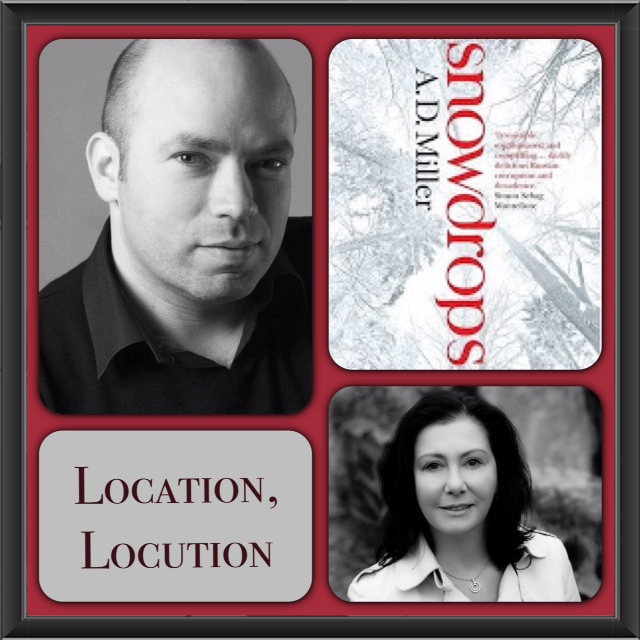
LOCATION, LOCUTION: Booker Prize-nominated author AD Miller, on bringing a location to life through writing

ADMillerIn the second of our series “Location, Locution”, expat crime writer JJ Marsh interviews AD Miller, the British author and journalist.

About AD Miller

AD Miller was born in London in 1974. He studied literature at Cambridge and Princeton, where he began his journalistic career writing travel pieces about America. Returning to London, he worked as a television producer before joining The Economist to write about British politics and culture. In 2004 he became The Economist’s correspondent in Moscow, travelling widely across Russia and the former Soviet Union. He is currently the magazine’s Writer at Large; he lives in London with his wife Emma, daughter Milly and son Jacob. He wrote a critically acclaimed non-fiction book, The Earl of Petticoat Lane, in 2006. His second novel, Snowdrops, was shortlisted for the 2011 Booker Prize.

About his novel, Snowdrops

A fast-paced drama that unfolds during a beautiful but lethally cold Russian winter. Ostensibly a story of naive foreigners and cynical natives, the novel becomes something richer and darker: a tale of erotic obsession, self-deception and moral freefall. It is set in a land of hedonism and desperation, corruption and kindness, magical hideaways and debauched nightclubs; a place where secrets, and corpses, come to light when the snows thaw.

Q&A on Location, Locution

JJ Marsh: Which comes first, story or location?  
AD Miller: Story. But locations can be suggestive of certain kinds of story. For example, Russia lends itself to tales of moral challenge and to philosophical inquiry.

JJM: How do you go about evoking the atmosphere of a place?
ADM: Take notes. Write down what people wear on the Metro and what the vendors on commuter trains are selling. You will recollect less than you think you will. For historical settings, read old newspapers and unpublished memoirs. Remember it is the inconsequential detail that is most important.

JJM: Which particular features create a sense of location? Landscape, culture, food?
ADM: Smell. Sounds. Language (especially slang and proverbs). Clothes. And weather: in Snowdrops, the Russian winter functions as a sort of ancillary sub-plot.

JJM: How well do you need to know the place before using it as a setting?
ADM: You need to know it, and then you need to unknow it. A novel isn’t a travelogue or an encyclopaedia; you enlist only those aspects or details of a place that serve the narrative.

JJM: Could you give a brief example from your work which you feel brings the location to life?
ADM: There’s a passage in Snowdrops in which Nick, the narrator, is taxiing at night alongside “the soupy Moscow River, not yet frozen and curling mysteriously through the wild city”, which is OK.

JJM: Which writers do you admire for the way they use location?
ADM: Isaac Babel and Giorgio Bassani (Odessa and Ferrara respectively).

* * *

Thanks, JJ, for that fabulous interview! Readers, any comments on what AD Miller had to say? Up next month in Location, Locution: Steven Conte, Australian author of The Zookeeper’s War.

JJ Marsh grew up in Wales, Africa and the Middle East, where her curiosity for culture took root and triggered an urge to write. After living in Hong Kong, Nigeria, Dubai, Portugal and France, JJ finally settled in Switzerland, where she is currently halfway through her European crime series, set in compelling locations all over the continent and featuring detective inspector Beatrice Stubbs.

STAY TUNED for tomorrow’s post, another installment in the life of our fictional expat heroine, Libby. (What, not keeping up with Libby? Read the first three episodes of her expat adventures.)

If you enjoyed this post, we invite you to register for The Displaced Dispatch, a round up of weekly posts from The Displaced Nation, with seasonal recipes, book giveaways and other extras. Register for The Displaced Dispatch by clicking here!

Related post:

Why “exbrats” in São Paulo need their own book to appreciate life in Brazil’s largest city

MeganFarrell CollageThis week’s guest interviewee is Megan Farrell, who like myself is an estrangeiro (foreigner) in São Paulo and married to a Brazilianalthough unlike my good British self, Megan is American and also has a young daughter (sounds like far too much responsibility if you ask me!).

Megan and her family previously lived in New York, but she took a sabbatical from her job on Wall Street in 2009 to become a full-time mum. Then, when her husband was offered a job opportunity here in São Paulo in 2010, they decided it would be a perfect opportunity for Megan and their daughter to learn Portuguese, experience life in a different culture, and learn more about Dad’s home country.

I first came to know of Megan when I moved to São Paulo myself at the start of 2012 and found her blog Born Again Brazilian whilst doing some research for my own blog. Ever since, I’ve kept up-to-date with her tales and travails, and was pleasantly surprisedif not a little enviouswhen she announced earlier this year that she would be releasing a step-by-step guide for foreigners who are living (or planning to) in São Paulo: American Exbrat in São Paulo: Advice, Stories, Tips and Tricks for Surviving South America’s Largest City.

I say envious because a similar idea had occasionally cropped up in my mind, but having read Megan’s book, I’m actually rather glad I didn’t attempt it myselfthere’s no way I could have had done the topic justice to the same extent. Megan has done her research, even offering advice on visas, taxes and other mundanebut extremely importantdetails that a move to São Paulo can entail. She includes things I would definitely not have thought of or, to be honest, had the patience to cover.

My only quibble—which perhaps tells you more about me than it does about the book, which is excellent—is that it reflects the experiences of a small minority in Brazil: exbrats. As someone who loves history as well as current affairs, I tend to prefer books that provide a holistic overview of life in a particular country. What’s more, the life of the exbrat seems completely outside my realm of experience. Though a cynic might suggest that I’m on an extended holiday, I didn’t move to Brazil on an all-expenses paid work package.

And to be fair, Megan doesn’t fall into the “exbrat” category either: her husband is Brazilian so didn’t qualify for the relocation package that makes countries like Brazil so enticing to non-Brazilians.

So, who exactly are these exbrats? And why write a book for them? Megan and I had the pleasure of meeting up I person a few days ago and talking about the audience she had in mind for her book. The following are some highlights from our conversation.

* * *

AmericanExbratinSaoPaulo_cover_pmHi, Megan. Tudo bem? Why did you decide to write a guidebook for non-Brazilians who come to live in Sao Paulo?
If you are making a move to a country such as Brazil, you need to have your expectations managed appropriately. Much of the pain my fellow expats have experienced has been because they were unprepared to deal with some of the idiosyncrasies of life in São Paulo.

What do you mean by an “exbrat”? Was the book specifically aimed at them?
I used “exbrat” because it feels rather fitting of the collection of people I’ve come across here. Expats, including myself, often stomp their feet over inconveniences they’ve encountered here, yet still expect and enjoy all the benefits of being in Brazil. Not necessarily in a pejorative way, but it felt very bratty to me. You also meet people who were previously army brats and were never able to shake their nomadic waysso “exbrat” is also an adult term for these foreigners.

So exbrats are primarily the foreigners who move to Brazil because of job opportunities?
Yes, the target audience is largely people who are moving to São Paulo or have recently arrived in the city for work, as well as human resource managers at companies who send employees to Brazil.

You included yourself just now in the “exbrat” category. But you are married to a Brazilian who didn’t get an expat package.
Believe me, some aspects of the things I’ve experienced here in Brazil have been a shock, as they probably were to you as well. So, while the book is definitely aimed at exbrats, I don’t think it’s too “exclusive.” There is an element of the “exbrat” in all of us. Some people are never able to get out of the exbrat cycle and as a result, fail to take advantage of the opportunities living in this country offers. My hope is that my book will give them a clearer picture of what to expect, and how they can prepare for that reality, so that they can get over the culture shock and go exploring. One of the world’s most fascinating countries awaits.

I think I know what you mean. I particularly remember reading in the book about your shock of attending an officially organized children’s “play-date” and there being seven paid staff to run it, as well as each child returning home afterwards with a crystal tea set as a parting gift!
Yes, exactly! That is far removed from my experiences in New York but is not so uncommon if you and your family start to mix in the same social circles with people towards the very top end of society in Brazilwhether that be through expat communities, your child’s school, or spouse’s workplace.

Has the book reached other audiences besides those who are moving to São Paulo? Perhaps people moving to other South American countries or those where English is not the first language?
Thus far the audience has been very specific to people moving to São Paulo, as opposed to other countries in South America—or even other cities in Brazil. It’s also attracted a few readers who work with Brazilians but in other countries.

Injecting her own anecdotes, and photos, into the book

Which section of the book are readers enjoying the most?
People tell me that they really enjoy the humorous stories I’ve included, which are based on some of my most painful and awkward experiences. For example, I tell the story of how I visited the same bakery for over a year before someone explained that because I wasn’t emphasizing the appropriate accent in the word pão (bread), to a Brazilian ear it sounded like I was asking for pau (penis)! Living in a non-English-speaking country provides plenty of opportunities for embarrassment or frustration, but when something goes wrong, I’m the kind of person who chooses to laugh, not cry.

Did you connect with the city in any new ways in the process of writing the book?
Definitely. I wanted the book to be as complete as possible (without taking ten years to write) and so I did more exploring on some of the subjects I wanted to include. Also, the photos in the book, minus a few I purchased the rights to, are ones I took. Much of the photography I already had in my collection. But there were gaps, so I had to get out and take pictures, which always gives you a second perspective on what you are seeingmore removed and analytical.

The topic of domestic servants

What was your most displaced moment when doing the research for the book, when you wondered why you’d embarked on this mission?
Trying to explain the culture of the people who might work in your homethe culture of the working poor in Brazil.

What do you mean when you say “culture of the working poor”? In your book you seem to suggest that household workers, who are of a far less lower rung on the lady in Brazilian society, are just taking advantage of the situation that they are in. Do you think this is cultural, or the impact of their socio-economic circumstances?
Half and half. I think it is definitely a Brazilian thing to try to take advantage of different situationsand this exists at all levels of society. For example, there’s the term jeitinho Brasileiro, which Brazilians use for situations in which they “creatively” try to get round complications in life.

However, yes, there is also a socio-economic component. If you are from a poor neighborhood and are working in the home of a rich family or person, it’s probably not too surprising that you might want to take advantage of your situation by asking for a loan or a raise.

From blogging to book-writing (she hasn’t looked back!)

Why a book instead of a series of blog posts?
Believe it or not, people still like reading books! HA. Over the past three years, since I’ve written my blog, I’ve received a number of questions about moving to São Paulo and life here. Most of the answers were already within the posts of my blog. I wanted to create a document that was more comprehensive, arranged by topic and easier to navigate. I also did a survey of my expat friends, and almost all of them said they would have purchased at least three books about moving to São Paulo before they camehad any actually existed. So I decided there was at least a bit of demand. Blogs are great, but sometimes you want to read a story from beginning to end. Plus, I’ve always just wanted to write a book.

What was the most challenging part of the book-writing process?
Editing. The editing process was a collaboration with my awesome friends, as well as my mother. It’s difficult to edit yourself. Actually, it is impossible to edit yourself. And when you have a pile of people helping you sort through the stories and facts, you get lots of opinions. But it was all good. However, I don’t think I can advantage of my friends again, so I’ll probably hire an editor for the next one.

Why did you self-publish the book?
A few of my writer friends encouraged me to try and find a publisher. But I just couldn’t figure out what a publisher was going to do for me that I couldn’t do for myself. I have a strong network and a background that includes marketing. I also don’t have the patience to go through a bureaucratic publishing process with an extended timeline. I knew that even if I did manage to find a publisher, I would not be their priority. The market for this is not on the level that would make a publisher move fast.

What’s next? Are you working on any other writing projects?
I am. I’ll probably update this book sometime in the next year. I also plan to write one for Rio. My husband is from Rio, and most of my experiences in Brazil (prior to moving to São Paulo) were in that city, so I know it pretty well.

You mentioned at the outset that you like broader books. I’d love to write something about Brazil as a wholeto counter the focus I put in this one on the expat life. It won’t be another step-by-step guide but a more of a general analysis, including politics, culture and so forth.

Finally, I’m working on some fiction stories that take place in Brazil. When living in New York, I did a screenplay course so have some experience in writing fiction. Currently, my idea is to write two series of short stories. The first will be based around Brazilian folklore, and the second, around some real-life episodes I’ve witnessed that are difficult to record in a blog or non-fiction format.

Ten Questions for Megan Farrell

Finally, we’d like to ask a series of questions that I’ve asked some of our other featured authors, about your reading and writing habits:

1. Last truly great book you read: Don’t Let the Pigeon Drive the Bus, by Mo Willems. I have a five-year-old. But we’ve read it more than a hundred times and it still makes me laugh. Okay, Don’t Let the Pigeon Stay Up Late is another contender. Mo Willems is a genius.
2. Favorite literary genre: I’d love to lie and offer up a more intellectual answer, but my favorite genre has always been horror. I enjoy a good creepy tale. After that, humorous memoirs from people who have overcome great obstacles, like Jeannette Walls‘s The Glass Castle.
3. Reading habits on a plane: I’m most happy if I have a copy of The Economist with me on a plane
4. The one book you’d require President Obama to read, and why: I wish Michael Bloomberg would write a book that Obama could read, because I think the USA would benefit by being run more like a business. But since Bloomberg has yet to put pen to paper, I’d have to say Getting to Yes: Negotiating Agreement Without Giving In.
5. Favorite books as a child: I loved any book that involved a child in a new world. James and the Giant Peach. Charlie and the Chocolate Factory. The Little Prince. The Little House series by Laura Ingalls Wilder. Pippi Longstocking.
6. Favorite heroine: Wonder Woman. I think if Brazil had a Wonder Woman, or the collection of super heroes that we have in the States as—albeit fictional—role models, people would emulate change for the good of the people. Brazil needs to believe in something other than futebol—but that seems to be in the process of changing, as Andy and I discussed last month on this blog.
7. The writer, alive or dead, you’d most like to meet: Hands down, Stephen King. I hope he doesn’t die before I get to meet him. I just need to figure out a way to do it that doesn’t involve stalking.
8. Your reading habits: I used to spend the weekends (sometimes all weekend) reading. But now that I have a child, I usually read right before I go to bed—in bed.
9. The book you’d most like to see made as a film: American Exbrat in São Paulo, of course!
10. The book you plan to read next: I suppose I should say Fifty Shades of Grey, because I haven’t read much of it and people keep bugging me about it. But if you’ve read Anne Rice’s Sleeping Beauty Trilogy (I only read the first), Fifty Shades is like reading Judy Blume. Yawn. I think I’ll wait for Stephen King’s Doctor Sleep. How could anyone resist a sequel to The Shining?

* * *

Readers, as I said, Megan was a delight to meet in person, a sense of which I hope I’ve conveyed above. Any further questions? Have I pressed her too hard on the “exbrat” point?

STAY TUNED for tomorrow’s post, a new episode in our “Location, Locution” series, by JJ Marsh.

If you enjoyed this post, we invite you to register for The Displaced Dispatch, a round up of weekly posts from The Displaced Nation, with seasonal recipes, book giveaways and other extras. Register for The Displaced Dispatch by clicking here!

Related posts:

images: Megan Farrell’s author image and book cover; photo of Sao Paulo from MorgueFile.

NEW VS OLDE WORLDS: How not to be a victim of the 10-pound Tour, aka the Expat 10

Libby Collage New&OldRegular readers of the Displaced Nation are treated every other week to a new episode in the life of fictional expat Libby Patrick, a 30-something British woman who has relocated with her spouse to a town outside Boston. Her diary, Libby’s Life, by Kate Allison, is replete with observations about life in New England vs. England. In the weeks when Libby isn’t published, we are featuring posts by writers who are sensitive to the subtle yet powerful differences between new and “olde” worlds. Today we hear from a new contributor, Claire Bolden, a Brit who lives in the Washington, D.C., area and blogs regularly on such matters. She is also a fitness expert, which, as you will see, explains a lot!

—ML Awanohara

* * *

We Brits call it the “Ten Pound Tour.” You’re here in the United States for three years; expect to gain ten pounds, that’s what they say.

I’m in the USA for three years; how is this possible? Well, let me tell you…pull up a chair and grab a cup of tea (hot is preferable—none of that iced nonsense) and a biscuit (that is a BISCUIT, not a cookie or any other sweet treat, which will be pumped full of sugar and additives).

Firstly, I’m British, so our culinary delights are much to be sniffed at. Especially boiled cabbage, I find. We’re partial to fish and chips, but it has to be soaked in vinegar and wrapped in yesterday’s news (not fake newspaper, like a fake British pub in the USA deigned to provide me with recently) and curries.

Yes, yes, I know curries are not traditional British fare, but they’ve become so ingrained in our eating out and eating in culture, that I think they are now a fully-fledged, ghee-butter-infused part of the British diet.

Claire B CollageJust thinking of growing fat…

In the USA…hmm, what culinary delights was I to chance upon? Pulled pork. I’ll have some of that.

Corn dogs…sigh, this batter-wrapped-sausage-thing-on-a-stick filled me first with joy, then dread, then Zantac.

Less a feast on a stick; more a beast on a stick. A beast of untold gastronomic consequences.

But the real devil in disguise is hidden away, tucked and folded and processed beyond belief into many, many of the foods in the Land of the Free. High Fructose Corn Syrup (HFCS).

This is not, as I understand it, part of the UK diet. Then what on earth is it doing being fed to millions of Americans? And how did I chance upon it?

The American version of “sweetbread”

Here’s the tale:

“There is sugar in bread,” a friend told me whilst I was chomping on a sandwich.

“Surely not,” I replied.

“There bloody well is,” she confirmed with vigour (she’s British, hence the “bloody” and the “u” in “vigour”).

She’s right, don’t you know. I looked more closely at the contents…

In a normal UK loaf there is stuff and nonsense, of course there is. But no sugar.

By comparison, an American grocery store’s loaf of bread ingredients will wrack up a whole host on unpronounceable allsorts, with the dearly beloved HFCS topping out as Ingredient No. 3!

And the blighter is everywhere!

HFCS has reared its nasty, cavity-making, gut-increasing syrupy head since I’ve been in the USA, and I’m not liking it too much…

What is it? Basically, HFCS goes in processed foods and is said to rot your teeth. It causes many health and obesity issues in the USA.

And so, to the cupboard to see what’s what in the food I have obtained since being in the USA. Yes, it is true, this sweetener is in all sorts of stuff.

“Out, damn HFCS. Be gone!” I’ve gone all Lady Macbeth about it

So, I see now why an expat stint in the USA has been christened the “Ten Pound Tour”—Americans might like to think of it as the “Expat 10,” after their expression the “Freshman 10” (actually it’s now the Freshman 15 as most freshmen put on at least 15 pounds during their first year of college).

Food glorious food: don’t care what it looks like!

Add to this the food porn issue. When I first heard of “food porn,” I thought it might refer to food that:
a) is so big it would make your eyes water,
b) is difficult to swallow, and/or
c) is indecent to look at, let alone put in one’s mouth.

But as my first encounter with The Cheesecake Factory (this place tops the list for calorie content) proved—it is all about the size, and, to set the record straight, size does matter.

We all know American portions are large, but in this restaurant chain, they are HUGE. My Asian chicken salad was the size of my husband’s head AND his sideburns AND his fluffy hair after he’s been swimming. That is V V V large.

Everyone eats as much as they can stuff their faces with and then takes the rest home in take-out boxes, because there is enough left for three more meals and you could potentially invite the neighbors, if they’re not already drowning in their own quagmire of take-out food porn and HFCS-infused products themselves.

So, take the food porn home. Indulge in the privacy of your own home—go on, no one’s watching…

Our senses go reeling…

As already mentioned, we’re no angels in the UK with our food and eating habits. On the healthier side, I crave a roast dinner now and then…roast lamb with all the trimmings.

Food is so much an inherent part of our cultures. It helps define us, but as expats we have to sample and pig out on what’s available in the country in which we reside.

That’s only right, is it not?

If I were in China, I’d certainly want to take advantage of the cuisine on offer there. Now, I wonder if they call it “Ten Pound Tour” in Bejing…?

American food and the custom of eating out makes the previous fortnightly little treat in the UK of a Value Meal curry for two from Tesco’s seem a right measly affair.

But maybe one day, when I return to my homeland, I will savour stabbing that plastic cover of the curry before I microwave it and pouring the egg cup-sized portion of “meat” into a dish and spooning in some hard-as-nails rice and enjoy every mouthful.

Just maybe…

* * *

Thanks, Claire, for reminding us about the dangers of high fructose corn syrup, which is lurking inside so many American foods! Readers, do you have anything to add to Claire’s observations? Also, is 10 pounds really enoughisn’t it more like 20 these days?

Claire, 38, left the UK shores a year ago in August and is living with her husband and son near Washington, D.C. They will be there for three years and have a bucket list of things to do and see in the USA during that time. Though a Brit, Claire is a flip-flop-wearing, cowboy-hat-totin’ sun worshipper who has already sampled a lot of US cuisine, including corn dogs and crab, but she still enjoys a Rich Tea biscuit with a cuppa. She spends her time talking to Americans and confusing them with her British colloquialisms, as well as writing her blog ukdesperatehousewifeusa, which takes a light-hearted look at the cultural differences between the USA and the UK.

STAY TUNED for next week’s series of posts!

If you enjoyed this post, we invite you to register for The Displaced Dispatch, a round up of weekly posts from The Displaced Nation, with seasonal recipes, book giveaways and other extras. Register for The Displaced Dispatch by clicking here!

Related posts:

Images (from left): Claire enjoying a corn dog; an all-American breakfast of pancakes and grits; a sinful dessert at The Cheesecake Factory.

Portrait of woman from MorgueFile; Lighthouse (R) from MorgueFile; Lighthouse (L) from MorgueFile

Meet author Rosie Whitehouse, who trailed her spouse into a war zone (and enter to win her book!)

Rosie Whitehouse CollageOne of the expressions I picked up from living in England for many years is “Keep the home fires burning.” For some reason, that expression, along with the WWI song from which it comes, is running through my head as I contemplate talking to today’s featured author, Rosie Whitehouse (click here to hear it being sung):

Keep the Home Fires Burning,
While your hearts are yearning.
Though your lads are far away
They dream of home.
There’s a silver lining
Through the dark clouds shining,
Turn the dark cloud inside out
Till the boys come home.

For me, Rosie is an up-to-date version of what the songwriters had in mind. Educated at the University at London, with a career as a BBC journalist, she chose to stay at home with her children and keep the house warm and welcoming, and the family’s spirits up, while her husband, the journalist Tim Judah, went off to report on various wars for The Economist and other newspapers.

Rosie even went the further step of moving the family home to be closer to Tim for a time. Ironically, she kept the home fires burning in the very place where World War I began, the Balkans. She flew out to a crumbling Bucharest—it had been knocked down by the notorious Ceaușescu, whose secret police killed hundreds during Romania’s 1989 revolution—with one child in tow and another one on the way.

Then, when it seemed possible that her own home could go up in flames as war spread across the former Yugoslavia, Rosie did not give up. She stayed for a total of five years before returning to London, by which time “keeping the home fires burning” was second nature both for her and the couple’s five kids (Tim carried on covering wars in Iraq, Afghanistan, and the Congo).

Having revived her career as a freelance journalist, she decided to write her first book: Are We There Yet? Travels with my Frontline Family—a copy of which we’ll be giving away! (See details below). The book is a tribute to families who have been “burners of the home fires,” whose emotional pain tends to go unheralded. It is also, in her words, “quite funny.” (Hey, growing up in Bucharest, Belgrade, Croatia and Bosnia can be fun!)

By now you must be as curious as I am to meet the intrepid Rosie Whitehouse and learn more about what motivated her to seek out such an unusually displaced (at least by most of our standards!) life. I note that she has an Irish mother—perhaps that explains it?! (I’m thinking Queen Boudicea…)

* * *

AreWeThereYet_cover_dropshadowHi, Rosie. In your book you say that your husband’s journalist colleagues in Romania, all of whom were single, were shocked to hear he had a two-year-old son and another child on the way. Did people often tell you you were crazy?
Yes, lots of people thought I was crazy.

As a former journalist with a background in Russian studies, do you think you felt a tinge of envy for Tim’s opportunities—which made you want to be on the scene?
Not really, as I would not have been able to cope with going to morgues and so on.

I know you’re going to challenge our definition of “displacement,” but I’ll go ahead and ask: what was your most displaced moment during your stay in the Balkans—when you had to explain Daddy’s muddy boots (he’d been walking in a mass grave), when you visited empty supermarkets, or when you heard the first shots of the conflict in Bosnia while strolling around Sarajevo with the kids?
Those things were reality so in that one doesn’t feel displacement. Quite the opposite in fact. I was intimately plugged into life and death at those moments.

How did you keep yourself sane?
I coped with stressful moments by bunkering down. I wouldn’t send the kids to school and cuddled up with them instead. As long as I shut my front door, where ever I am and whatever is going on, and it is just us, I am able to feel at home.

But getting back to your question about displacement: My best moment in a foreign country was when I saw my mother drive off in a taxi in Bucharest and realizing that apart from my two year old son I didn’t know a soul in the country (my husband was away in Albania for weeks). Wow, at last no one to tell me what to do! Freedom!

More seriously, most displacements do not happen by choice, and my most displaced moments have been as a result of this. I recount a story in the book when I took the kids to Berlin ten years ago. My mother-in-law was born there but fled in 1933 as she was Jewish. The family settled in Paris. As a result I have half French children who speak fluent French and we don’t speak a word of German.

It was a rather stressful visit as we searched for old family homes, one of which the family were still trying to reclaim. My daughter Esti got a headache. I pointed to the department store and suggested that we go in to buy an aspirin. It was Wertheims. My mother in law’s mother was a Wertheim and was murdered in Aushwitz. Esti said:

What, first they give me a headache by stealing the department store and murdering my great granny–and now I am expected to go in and buy an aspirin to make it better? You have to be kidding!

That’s displacement.

Child-rearing on the frontlines

What was the biggest challenge about having children with you on the frontlines?
The biggest challenge was often the simplest thing such as getting them something to eat and getting hold of baby milk.

Did anything surprise you?
Life never ceases to surprise me where ever I am and what ever is going on. The terrible things and the good things always amaze me.

What do you think the kids got out of the experience?
The kids learnt a lot. My eldest son, Ben, would ask about why there was no food in Romania. For me it was a matter of telling simple tales of communism and 1917. For him it began a life-long interest in Russia. He is following in his father’s footsteps.

My eldest daughter, Esti, would like to work for an NGO like Human Rights Watch.

For all of us, it drew us closer together. We are a tight-knit family.

I’ve heard of war reporters feeling bored when they come back to “reality” in their home countries. Did your family experience any of that after five years in the Balkans? What was it like to go “home” again?
Going home is just as difficult as moving to a new country. By the way, the wars didn’t stop either after we got back. My husband has since covered lots of wars and famines including Afghanistan, Iraq and the Congo.

Writing a book, but from the backlines

After you left the Balkans, it took quite a few years before you decided to write the book. What was the catalyst?
It was during the invasion of Iraq in 2003. I was standing in the supermarket and they had just installed a TV with a live feed from Iraq by the checkout. Some soldiers were running across a street in Basra, where some of the heaviest fighting took place, followed by a reporter and camera man. All of their faces were clearly visible. My husband was in Baghdad covering the story for The Economist. I had actually popped out for five minutes of fresh air before the bombers took off from the UK and the countdown to the blitz on Baghdad began.

I realized, to my horror, you could be buying a packet of frozen peas and watch your husband killed in front of your eyes. I know this thought had never entered the mind of the supermarket manager who had simply installed the TV to attract customers.

That evening I found my ten-year-old glued to a grainy grey screen showing an image of Baghdad as the cruise missiles were expected. What do you say? I had to make dinner and she had to do her homework. The UK had a huge debate about the war and the way it was covered, and I felt nobody knew what it was really like to be part of it and a kid to boot.

I also found that very quickly after the Berlin Wall came down that people forgot in Western Europe just how hard life had been under communism, especially in Romania and Albania. No surprise in that, really, as since 1945 most people in Western Europe just forgot the East existed.

I also found people in the UK quick to judge and condemn people in Southeastern Europe as being violent and prone to war. I wanted them to realize we are no different. That is why I’ve also included a chapter on Ireland in the book.

And I wanted to describe the multicultural experience of bringing up half-French, half-Jewish, part-Irish children in various countries, something I found fascinating.

Was it also part of your mission to show others what it is like to be married to, the child of, a war reporter?
Yes, not just to a war reporter but also those who are married to soldiers—especially those who are part-time soldiers and live in the community.

Did you have any personal motives in writing the book, to help you process what you’d been through and to provide your children with a record of where they’d lived?
No, not really. I didn’t write it for us but to make people think about what was going on. I am sure that the kids will appreciate it when they are older.

What was the most difficult part of the book-writing process?
Getting time to do it. I often wrote with my computer on the kitchen side as I was cooking dinner, which was good as I could hear kids talking; and as I was writing about them, it helped to have them there doing their thing.

Did you find it easy to find a publisher for the book?
No it was hard. publishing is a tough business. I started my own publishing company, Reportage Press, which closed a few years ago. Are We There Yet? is on Amazon as a self-published download these days. We also have a number of journalist friends who are taking the self-publishing route quite successfully.

What audience did you intend for the book? Did you think it would also appeal to other kinds of expats, who don’t go to war-torn countries?
Yes, there is a large expat element to the readership, and I know the book has touched the hearts of women feeling lonely and bewildered in a new country. I have been hugged and kissed by quite a few of them. One lady said reading the book had saved her marriage. I’m not sure it was me, but I hope I helped her realize it wasn’t so bad being lonely in London. It is hard being in a strange country with children. It is you who have to interpret it for them and as you are far from the family support group and friends, it is inevitably all up to you to be their world. It’s a tough job. That said, the book is far from serious. It’s actually quite funny.

Can you give us some examples of humorous moments in the book?
The kids are a laugh a minute, so whatever was going on they would often say or do something funny. For example:

For me the market in Piaţă Amzei is the focal point of life in the city centre [of Bucharest]…

“Let’s see the old ladies with the cheese. Come on!” shouts Ben as he darts out of the pushchair and into a smelly covered hall, where they sell heaps of yellowy looking curds, which are akin to feta.They are covered in flies.

The old women with their long black skirts and headscarves beckon him over and offer him little crumbs. He watches their lips and toothy grins with fascination. They look unnerving, like witches with crunched up dirty teeth, but he doesn’t run away. He has come deliberately to stare at them. He studies an old lady’s face carefully as she says something he can’t possibly understand. He is like his father, never frightened of anything and intrigued by the smallest thing. He loves the bizarre and the quirky.

* * *

“Where’s Mr Parking? Why doesn’t he find us a space?” asks Ben as we drive up and down the street outside our flat. Ben loves Mr Parking. I can’t see him anywhere.

Mr Parking is the man who organises the parking lots outside Belgrade town hall. It’s an elegant 1880s building that was once the royal palace and is right next to our block of flats. For a tip, he lets us park in the lots reserved for local officials. I haven’t seen him for weeks and have to be careful where I put the car, or we’ll be towed.

“I think he has gone back to Bosnia to fight, Ben.”

“What!” Ben is horrified.

“Why? I want to park the car. Doesn’t he want to stay here?”

“No, I expect he wanted to go home and defend his village.”

“Where is his village?”

“He’s from eastern Bosnia, the bit between here and Sarajevo [Bosnia’s capital city]. He told Dad he comes from Kamenica. It’s in one of the last bits there that’s still under Muslim control.” It’s a village close to the town of Srebrenica [the town where a massacre took place in 1995, said to be a crime of genocide].

“What! He’s a Muslim?” Ben is amazed: “But he looks like everyone else!”

“Of course, he does! You don’t look different if you’re Muslim. Bosnians look the same whether they are Muslims or not.” My mother has just sent him a book about the Crusades.

“I thought Muslims looked like Arabs.”

Are you working on any other ambitious writing projects?
I would like to write an expat guide to Britain. I spend a lot of time explaining Britain to people as I live in an expat world in the UK to a certain extent as my children have been or go to the French Lycée, and we have a lot of foreign friends who live in London.

Ten Questions for Rosie Whitehouse

Finally, I’d like to ask a series of questions that I’ve asked some of our other featured authors, about your reading and writing habits:
1. Last truly great book you read: Malaparte is on my mind as I am driving to Ukraine. His book on the 1941 invasion of Russia is unforgettable.
2. Favorite literary genre: Novels
3. Reading habits on a plane: Nothing. I am too tense on a plane as I hate flying. If I am calm enough I love to look out of the window.
4. The one book you’d require President Obama to read, and why: My son Ben’s book on Russia: Fragile Empire: How Russia fell in and out of love with Vladimir Putin. It’s a great portrait of contemporary Russia. I am his mum—what else am I supposed to say to this one?
5. Favorite books as a child: I loved Little House on the Prairie but above all I loved the stories my dad used to tell me.
6. Favorite heroine: She doesn’t have a name. She is one of the millions of women who have struggled to keep their families together against the odds. These are the mums who keep the world turning.
7. The writer, alive or dead, you’d most like to meet: I always wanted to meet William Shirer. He must have had an extraordinary experience living in Berlin at the start of World War II. Perhaps the ultimate expat experience! I suggested an interview programme with him to BBC World Service in the 80s but they didn’t have the cash to send me to America to do it. A pity as he died after that.
8. Your reading habits: I read a lot. If you want to write you have to read. I also have to read a lot for work.
9. The book you’d most like to see made as a film: None, really. If you love a book, the last thing you want is for it to become a film as you have the pictures in your head and they are your pictures not someone else’s.
10. The book you plan to read next: Vasily Grossman‘s An Armenian Sketchbook is in my suitcase. I love Grossman. He is a fantastic writer. If you haven’t read Life and Fate, you have really missed out.

* * *

Thanks so much, Rosie! Personally, I found your story very moving and think we should confer on you a “home fires” medal for all you’ve achieved!

Readers, it’s time for you to ENTER OUR DRAW TO WIN A FREE COPY of Rosie Whitehouse’s book. Rosie is giving away ONE COPY and will favor comments that tell her why you’d like to read the book.

Extra points, as always, if you’re a Displaced Dispatch subscriber!

The winner will be announced in our Displaced Dispatch on August 2, 2013.

Rosie Whitehouse is a parenting journalist and mother of five. She is one of the UK’s leading experts on family travel. She has written widely on family matters and traveling with children for The Sunday Telegraph, The Independent, The Guardian, The Daily Mail, Sunday Express, Family Circle, The Economist, and others, as well as for the Web sites B4Baby.com and Raisingkids.co.uk. She has also spoken at events and on television and radio on parenting matters, promoting her travel books and her autobiography, Are We There Yet? Travels with my Frontline Family. You can follow her latest adventures at http://www.rosiewhitehouse.co.uk/.

STAY TUNED for tomorrow’s post in our Olde vs New World series, by guest blogger Claire Bolden.

If you enjoyed this post, we invite you to register for The Displaced Dispatch, a round up of weekly posts from The Displaced Nation, with seasonal recipes, book giveaways and other extras. Register for The Displaced Dispatch by clicking here!

Related posts:

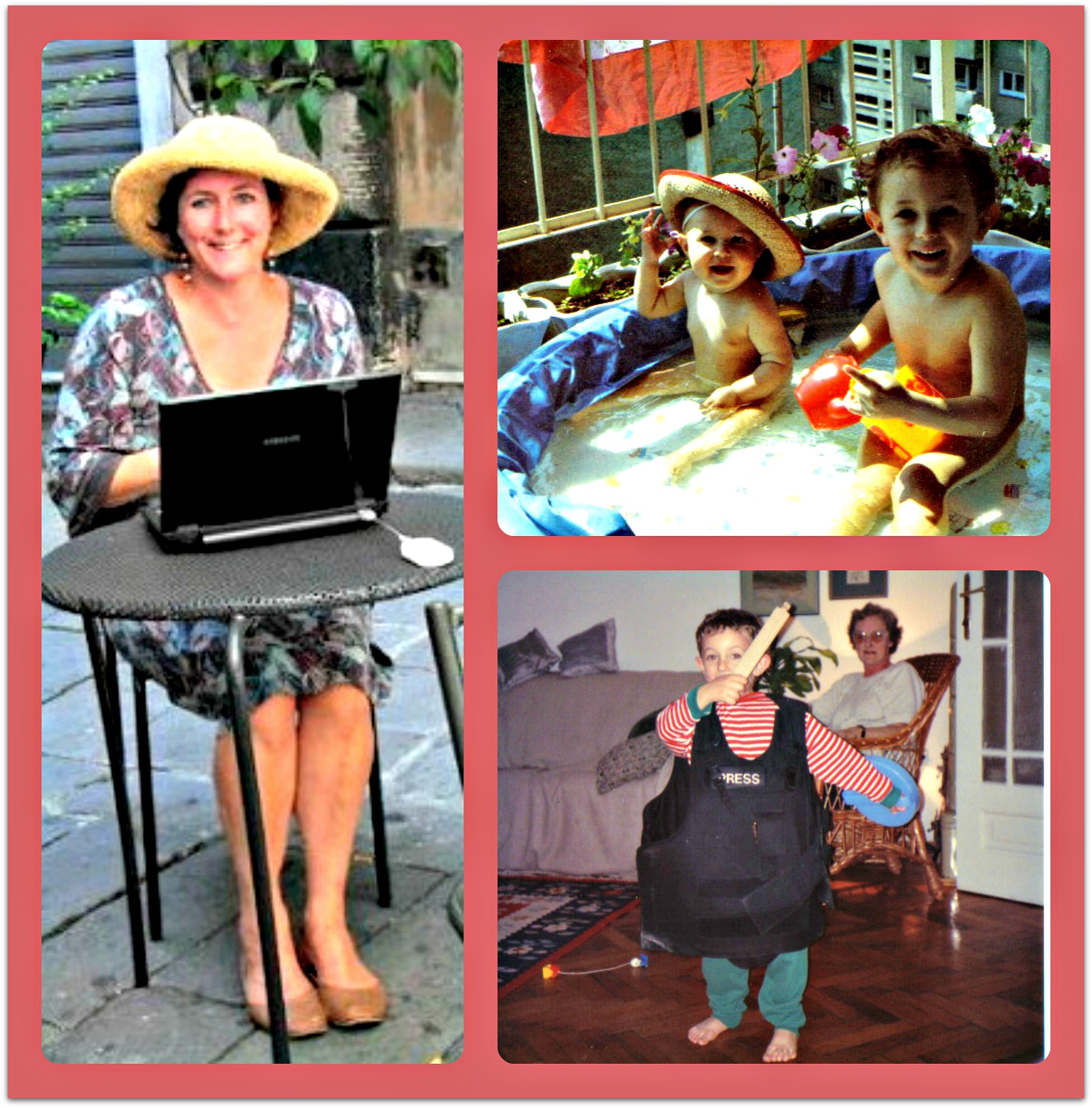
Images (clockwise from left): Rosie Whitehouse at “home” in London; Ben and his baby sister, Esti, living it up on the balcony in Bucharest (July 1991); Ben trying on his dad’s new bulletproof jacket, with Rosie’s mother in background (Belgrade, May 1992).

Are Brit international creatives better than their Yankee counterparts?

NYC_Awindram_pmWhen Chariots of Fire screenwriter Colin Welland won his Oscar in 1981, his acceptance speech began with him somewhat obnoxiously and ungraciously proclaiming: “The British are coming!”

Unlike Paul Revere, this wasn’t intended as a dire warning to fellow Americans, but was rather a British boast about perceived creative superiority over the transatlantic cousins.

Ultimately, the renaissance of British cinema that Welland envisaged did not materialize, but though that particular “British invasion” did not in the end occur, the US has since . . . oh, let’s say since 1812 . . . endured a number of British invasions: from Dickens’s arrival in Boston in 1842, to Oscar Wilde’s statement to a US customs officer that he had nothing to declare but his genius (which I would certainly not advise anyone that they should try to use that line in JFK), to the Beatles’ first performance on the Ed Sullivan Show in 1964 (considered the beginning of the British Invasion in music).

If David Carr’s recent column in the New York Times, entitled “British Invasion Reshuffles U.S. Media,” is correct, then we may be in the grip of another one. The genesis for this piece has been John Oliver‘s recent, perfectly competent portrayal of a bamboozled substitute teacher on The Daily Show.

Carr’s contention is that at the moment “everywhere you look in the United States media landscape, you find people from [Britain]”:

Piers Morgan came from Britain to take over for Larry King, the Wall Street Journal is edited by Gerard Baker, a British newspaper veteran, and the chief executive of the New York Times is Mark Thompson, who spent his career at the BBC. Anna Wintour has edited Vogue for more than two decades and, more recently, Joanna Coles took over Cosmopolitan, which defines a certain version of American womanhood.

NBC News recently looked to the mother country for leadership and found Deborah Turness, the former editor of Britain’s ITV News. ABC’s entertainment group is headed by Paul Lee, also formerly of the BBC, and Colin Myler, a Fleet Street alum, edits the New York Daily News.

The list goes on, but the point is made: when it comes to choosing someone to steer prominent American media properties, the answer is often delivered in a proper British accent.

But, as the title of this post asks, the British better at being international creatives than their American counterparts? Are we more fearless?

The examples that Carr puts forward are compelling, even if we may have to suspend our imagination and hope our stomachs do not turn too much in allowing Piers Morgan to be considered a “creative.”

However, I am unconvinced in a post-Leveson world that there is inherently anything better or more attractive about British media operators when set alongside their American counterparts.

Of course, that does not alter that it is inarguable that New York media finds itself with a number of prominent Brits.

Carr hits on one of the main reasons for this — London:

“Los Angeles, New York and Washington all have their domains, while in Britain, there is only London, a place where entertainment, politics and news media all live in the same petri dish.”

In an increasingly international world, a world in which the super elite can be found in a select number of super cities, it is only to be expected that large New York media empires would be selecting from a fairly small pool. They’ll look to New York and London — the two major English-speaking super cities.

It is perhaps a complete misconception that for the purposes of this question we think in terms of America and Britain, as if to make out an otherness between each party, when they share status as super city elites.

The true “other” would be the newspaper man from Minnesota or the TV station manager from Louisville. I know from my own anecdotal experience of MBA grads from top US business schools that the majority that I know are in New York or London. This is just the new normal — it is hardly surprising that it is reflected in New York’s media executives.

It is also noticeable to anyone who has spent any time in the UK that while a struggling, gasping industry, print media is more alive in the UK at present than it is in the US.

The result of this is that they are a large number of British candidates that would be attractive to US companies in the position to headhunt a new executive.

A final factor is the attraction of “success” in the US for Brits. I don’t say this lightly, but take a look at Piers Morgan’s twitter account . . . I know, I know . . . awful, isn’t it? However, a quick look through a random selection of Morgan’s twitter will soon reveal a man who enjoys boasting — or if I’m being more generous, teasing — other British celebrities who have no profile in the US.

Success in the US seems greater, somehow. There is a pull there that is irresistible. There is romance to it. “If I can make it there, I can make it anywhere.” What do all the many American CEOs heading boardrooms in London get to sing to themselves?

STAY TUNED for tomorrow’s post, an interview with our featured author of the month, Rosie Whitehouse.

If you enjoyed this post, we invite you to register for The Displaced Dispatch, a round up of weekly posts from The Displaced Nation, with seasonal recipes, book giveaways and other extras. Register for The Displaced Dispatch by clicking here!

img: awindram

LIBBY’S LIFE #81 – Send the past packing

The best thing about moving to a house only a mile and a half away is that you can do your own packing and take the boxes there yourself.

And the worst thing about moving to a house only a mile and a half away is that you can do your own packing and take the boxes there yourself.

Chuck, you see, nice, reasonable man that he is, has given Maggie the keys to his mother’s house and told us to move our stuff in before the official handover date. “Make things easy for yourself,” he said.

Fantastic — or so Oliver and I thought at first. We could take our time and move everything in stages, starting with the least critical items. But after a couple of days of wrapping china in newspaper and getting our hands and clothes covered in printer’s ink, we began to see why most sensible people fork out a big pile of dollar bills and pay someone else to do it.

We used cardboard wine crates from the local liquor store to pack everything in, then, after only four trips over to the house with the car filled with Napa Valley Cabernet Shiraz boxes, Oliver announced he was leaving for a business trip to Vancouver.

“I’ll be back on the eleventh,” he said. “That gives us four days to get everything together. No problem! Piece of cake!”

What, pray, does Oliver know about cake? About as much as he knows about packing, I’d say.

Before he went, we’d barely made a dent in it — packing, not cake — and now, with less than a week to go before we hand the keys back to Melissa, it’s all down to me to pack the rest up and move it across town. Not the big important pieces like bed, chests, tables, or sofas, you understand, but the fiddly, inconsequential things like clothes, toys, non-perishable food, ornaments, books, CDs, Oliver’s extensive collection of rocks and dead beetles that he catalogued when he was twelve and can’t bear to throw away…

Piece of cake. Right.

“I’ll help,” Maggie said to me, after she saw Oliver trundling his carry-on case towards the taxi marked Airport Shuttle Service.

I protested out of politeness, but not enough for her to change her mind.

“No, I insist,” she said. “It will take you twice as long on your own to transport the boxes, because you will have to take the children with you. This way, I can stay with the children while you drive over to the house on your own.”

Well, when she puts it like that… Sometimes a girl has to take whatever kind of me-time she can get.

* * *

Maggie sits on the floor of our living room and wraps up a Dresden china figurine in the sports section of the Boston Globe. I don’t like the ornament, and one part of me is hoping that it will get broken in the move, “accidentally”, of course. My mother’s aunt gave it to us for a wedding present, and while it was very kind of her, Dresden china isn’t our style. Great Aunt Esther might as well have given us a set of antimacassars or an aspidistra.

“Chuck left me a big folder of paperwork relating to the house, to give to you.” Maggie carefully places the Dresden in a cardboard crate and moves onto the next item — a pair of Wedgwood candlesticks from my grandmother. “Old paperwork. Old deeds, plans, that kind of thing.”

“Oh yes?”

I confess, I’m not paying too much attention to Maggie. I’ve just found Oliver’s badminton racquet case with the stuffed tiger in it, and I can’t help but remember the awful chain of events it precipitated last year, shortly after the twins were born.

“Mmm. I haven’t looked at it, because the house will be yours, not mine, but it could be interesting. For example, while the official date of the house is 1830, I remember Cathy saying that she thought there might have been another building there before. Something to do with the basement being only a few feet high and her not being able to stand upright in it. I’m not sure what her reasoning was, but maybe you’ll find the answer in the folder.”

I jam the badminton racquet and all its emotional baggage in a suitcase.

“Your friend Cathy must have been very tall, then,” I say. “The basement’s like any other. Dark, creepy, and full of noisy machinery. I can stand upright in it, no problem.”

“No, not that part. I mean the part behind the furnace.”

Maggie falls silent, and at first I think she’s admiring Granny’s Wedgwood candlesticks, but then I realize she’s been distracted by the packing paper and is reading about the dramatic arrest of a New England Patriots player accused of murder.

I think hard about the basement in the house we’re buying. I remember the furnace, because it was surprisingly new in such an old place. But it was next to a wall. There was no more basement space behind it.

I tell Maggie this, and she tears herself away from the gory details of local sports scandals.

“Oh no, you can’t see it now. Cathy had some work done on the house, back in the late seventies. Had the basement sealed off behind the furnace, because it was neither use nor ornament since you had to bend over double to get in there.” She places the Boston Globe-wrapped candlesticks in the box with the Dresden shepherdess. “Or at least, that’s what she… Goodness me, are these your wedding photos?”

She holds up a cream suede album.

“May I look?” she asks.

I wave my hand graciously. “Be my guest.”

I’ll have to put her in charge of the mugs and glasses. She’s too easily distracted. Still, this has reminded me of something.

“You never showed me the photos of your daughter’s wedding at Christmas,” I say, and wait as she slowly turns the pages of our album. She’s stalling for time, I think. “You promised you would, and then forgot. And we won’t have time next week what with moving, and the week after that you go to the Keys for a month.”

She looks up from the photos. She’s on the page where Oliver and I have our hands on the knife, ready to cut the wedding cake. It was a traditional, heavy fruit cake, and I recall thinking at the time that a circular saw would have been more useful than that dinky, ivory-handled cake knife.

“After we’ve finished packing for the day, how’s that?”

She sounds rather strange, I think. And I’d bet a lot of money, or at least a Dresden shepherdess and a couple of candlesticks, that she’s hoping I’ll have forgotten by the end of the day.

* * *

I make five trips to the house on Main Street, and by the end of the fourth, the sun is bobbing along behind the trees, and the children are getting cranky. To make it easier for Maggie, who is also looking tired and cranky, I decide to take Jack along with me for the last trip. He’s very excited at seeing the new house again, and wants Fergus to come along too, so we have a little family outing — me, Jack, and Fergus — which makes me feel strangely nostalgic, because it’s how we used to be in Milton Keynes, before America and before the twins were even thought of.

At the new house, I dump the boxes with all the others in the living room while Jack and Fergus play in the back garden, then I walk down the hallway to the dining room at the back of the house. The room has French windows that open out into the garden — or at least, they should open out but they’re stuck together with many layers of paint. I knock on one of the small panes at Jack, and beckon him to come back in the house.

After a few seconds I hear his running footsteps on the wooden floor, and he bumps into me as I’m closing the dining room door. He’s alone.

“Where’s Fergus?” I ask. Fergus, now that he no longer lives with us, slavishly and perversely follows Jack around whenever they’re together.

Jack points. “He’s tired.”

Fergus is lying down next to the open front door at the other end of the hallway.

“Fergus! Here, boy!”

He sits up and whines softly, but doesn’t move any nearer.

“Guess that’s a hint that he’s had enough house-moving for today,” I say to Jack. “You know what? I know exactly how he feels.”

* * *

Back at Juniper Street, I deliver Fergus to Maggie, and she murmurs something about turning in for the evening, but I’m not letting her off that easily. I remind her of her promise to show me Sara’s wedding photos and how she’s off to Florida for a month, so she trots over to her house to get them.

When she returns, I have to stop myself from snatching the album out of her hands. I’ve heard so many rumours about Sara Sharpe, this mystery woman of Woodhaven, that I’m dying to see what she looks like. A femme fatale, I imagine… The sultry looks of Nigella Lawson and the seductiveness of Greta Garbo.

I’m disappointed. She’s serious-looking, her hair dark and smooth, as severe as a ballerina’s. On most of the photos, she wears a little frown as if she’s thinking very hard about what she’s doing — and, let’s face it, you shouldn’t have to think hard about a wedding on a beach in the Seychelles. She looks absolutely nothing like Maggie.

“No,” Maggie says. “She’s the image of her father, that’s what she is.” She points at a man in the photo. “Him. Derek. My ex-husband, whom I hadn’t seen for over thirty years until that day.”

“That must have been awkward,” I say. I try to imagine meeting Oliver for the first time in thirty years at Jack’s wedding, and fail utterly. “I suppose that’s one advantage of Sara being an only child. You won’t have to meet him again.”

I hand the photos back to Maggie, and I see that her face has turned pink.

“Are you OK?” I ask. “Do you want me to turn the air conditioning up?”

She shakes her head.

“No, I’m fine.” She throws her pashmina around her shoulders and stuffs the photos into her handbag. “It was, as you say, a little awkward meeting Derek again.”

She looks down, fiddling with the clasp on the bag. “He’s widowed now, poor man. I never liked my replacement, but he obviously did. I felt sorry for him.”

“Not your problem any more, though, right?”

Her face goes a bit pinker.

“I might as well tell you, Libby. My vacation in Florida — I’m spending it with Derek. My ex-husband whom I divorced in 1976.”

.

Next post: LIBBY’S LIFE #82  – A chilly reception

Previous post: LIBBY’S LIFE #80 – A place of our own

Read Libby’s Life from the first episode.

Want to read more? Head on over to Kate Allison’s own site, where you can find out more about Libby and the characters of Woodhaven, and where you can buy Taking Flight, the first year of Libby’s Life — now available as an ebook.

STAY TUNED for next week’s posts!

If you enjoyed this post, we invite you to subscribe for email delivery of The Displaced Dispatch, a round up of the week’s posts from The Displaced Nation. Sign up for The Displaced Dispatch by clicking here!

Image: Travel – Map of the World by Salvatore Vuono / FreeDigitalPhotos.net

JACK THE HACK: Expat writers, time to crank up the PR machine!

JACK THE HACK _writingtipsJack Scott is back with his monthly column for all of you wannabe authors who are hacking away at travelogues-cum-memoirs (or cum-novels?). For those who don’t know, he was a Random Nomad for the Displaced Nation way back when we started this site. After an expat experience in Bodrum, Turkey, that was literally something to write home about, he and his partner, Liam, have traded in the dream for a less pressured existence back home in the UK.

—ML Awanohara

There’s a firm knock at your door and a postman in a tight uniform (well, we can hope!) hands you a box. You rip open the carton like an over-wrought five-year-old on Christmas morning, pull out a copy of your book, lift it to your nose and smell the pages. It’s intoxicating, better than recreational drugs. You’ve done it. For the very first time, you feel like a proper author.

Savour the moment. It may not last.

Unless you want to be stuck with a stack of books propping open a door or languishing unloved and unread in the attic, you’ll need to start phase two of your cunning marketing plan: making sure people know about your minor masterpiece.

But how do you get the message out there these days? Just what are the rules of engagement?

1) Start a blog.

As I have said many times before, blogging is a great auditioning process for writing, and the best way to experiment and grow your fan-base. In the crowded blogosphere, content is king and the best content is fresh, new and frequently updated. Aim to blog at least once a week and break up your words with interesting and relevant images. Keep your page clean and uncluttered. Fussy, multi-colored scripts and busy designs can hurt the eyes and put the reader off. Fans can be fickle and lazy. Make it easy for them to follow you by adding your social network links and the chance to subscribe to your pearls of wisdom by email.

2) Engage with social media.

Plaster the good news everywhere. Join social networks and make friends. Facebook and Twitter are the most popular and influential, although Pinterest is starting to give both of them a run for their money. Create a Facebook page and solicit “likes.” Give Linkedin a go. After all, you are a professional author now. If social forums exist for your area of interest, join them and participate meaningfully. A word of warning: Engage gently and be careful not to over-promote; otherwise, people will switch off.

3) Join book sites.

There are hundreds of book sites out there and most of them allow you to add your book. Goodreads is the biggie and most respected, Join their author programme and add your profile and book. There’s also AuthorsDen, LibraryThing and WritersNet. Make friends and become an active member of the groups you join. Reviewing the work of other new authors will help garner support and build a “bookie” network.

4) Solicit Amazon reviews.

If you’re selling your books through Amazon—an organization set on a path to either a) world domination or b) break-up by the Monopolies Commission—make sure the selling page is attractive, accurate and informative. Add an author profile, encourage people to submit positive reviews and if you do get the odd bad review (and you will) don’t spit back, it’s really not worth it.

5) Think about search engine optimisation.

Don’t be spooked by this. Search engine optimization (SEO) is just how a page is ranked on search engines and by this I mostly mean Google (another monolith on the path to world domination). If your blog doesn’t appear in the first few pages of Google then you might as well not be on the internet at all. There are many companies that claim they will increase your ranking for a fee. Don’t waste your money. Follow a few simple steps and you’ll soon by up there with the pros:

  • Reply to comments left on your blog. It’s the polite thing to do.
  • Engage with your blogging peers with comments and guest posts.
  • Add share buttons to your posts so your readers can spread the word effortlessly.
  • Create reciprocal links by listing your favorite blogs and Websites on your blog.
  • Join blog directories. Most are free and some specialize (women bloggers, expat bloggers, for example).
  • Post to Facebook and Twitter (at the very least).
  • While you’re at it, you may as well post to Google+, Pinterest and Linkedin (and any other social network you join). All that activity will help you clamber up the rankings and increase your visibility.

6) Get yourself interviewed.

Online interviews are a great way to increase your profile. Expat and book sites (notably, The Displaced Nation!) are always looking for interesting people to chat to. It provides them with content and you with exposure—a perfect double whammy.

7) Create a personal Website.

Creating a personal Website isn’t the expensive faff it used to be and the days of paying top dollar for large-brained web-designers to give birth to your labor of love are over. These days, get the right help and you can end up with a fully functional and integrated site for a fraction of what it used to cost. (PLUG ALERT: You could do worse than checking out author2author, my new low cost Website, blogging and social media service for authors.)

8) And finally…keep chipping away at it!

Exhausted? You will be. This PR lark takes a lot of graft. I know. I’ve never worked so hard. The good news is that once you’ve set the wheels in motion, you just need to keep a light touch on the tiller. Then before you know it, you’ll start getting that exposure you’ve always dreamed of and, who knows, the agents and distributors knocking at your door instead of the pretty postman.

Until then, I’m afraid there’s no substitute for
WRITING TIP FOR EXPATS NO 4:

Master the rules of engagement!

* * *

Readers, any comments, further questions for Jack the Hack? He’ll be back next month with some more writing tips…

Jack Scott’s debut book, Perking the Pansies—Jack and Liam move to Turkey, is a bitter-sweet tragi-comedy that recalls the first year of a British gay couple in a Muslim country. For more information on this and Jack’s other titles, go to his author site.

STAY TUNED for tomorrow’s post, another installment in the life of our fictional expat heroine, Libby. (What, not keeping up with Libby? Read the first three episodes of her expat adventures.)

If you enjoyed this post, we invite you to register for The Displaced Dispatch, a round up of weekly posts from The Displaced Nation, with seasonal recipes, book giveaways and other extras. Register for The Displaced Dispatch by clicking here!

Related posts:

Images: from top, clockwise: Hand with pen / MorgueFile.com; Boats in King’s Lynn, Norfolk / MorgueFile.com; Jack Scott, used with his permission; Turkish boats / MorgueFile.com

As an expat, is it my place to join another country’s political protest?

BrazilianProtest_ahpmJust after the street protests broke out in Brazil last month, Megan Farrell, an American who lives in São Paulo with her Brazilian spouse, contributed a guest post to the Displaced Nation.

Megan was very honest in admitting that she had previously taken little notice of politics or social issues in Brazil:

Being displaced … makes it easy to be in a bit of denial.

I, too, am an expat in São Paulo with a Brazilian spouse, albeit from the UK. Like Megan, I didn’t initially involve myself in Brazil’s latest political movement—but my reasoning was a little different from hers.

I’m someone who self-identifies as politically engaged and active. Back in the UK I was a union rep at my workplace and I’ve been involved in protest movements since my student days, the most prominent being those against the invasion of Iraq in 2003.

Additionally, as a social worker and student of social sciences, it’s second nature to be socially and politically aware of what is going on around me, whether that be at home or elsewhere.

Why, then, would I be reticent to involve myself in the politics of the protests that were going on around me here in São Paulo?

Not my fight to fight

Despite broadly agreeing with the objectives of the early protests (about a rise in bus fares which as a daily user of public transport, by which I was directly affected), I felt that as a gringo and a guest of Brazil, it wasn’t my place to get involved.

To be honest, I even felt a little reluctant to use social media to post articles or comment upon what was happening, and when I was asked to cover the protests for a site in the UK, my first inclination was to turn it down.

As a foreigner I was sensitive to being seen by Brazilians as poking my nose into their affairs. Additionally, I was also quite aware that there is a lot of history and background behind these protests that I am only, at best, partly aware of.

On top of this, Portuguese is my second language, so whilst I can read it without too much problem, I was apprehensive of inadvertently misconstruing a tweet, newspaper article or blog post, and using ill-informed or partly understood information to inform my opinions.

Eventually, however, I went out on the streets.

What led me to change my mind?

What was my impetus for joining the protests? I think it was seeing the extent of the violence (rubber bullets, tear gas, etc) the police used against what was widely reported as peaceful protest in São Paulo on 13 June.

And it wasn’t just me. The harsh police response was a turning point for many Brazilians as well, because while it may have successfully extinguished the 13 June protest, it also had the converse effect of igniting far broader outrage across the city and the whole of the country. At the same time, it provided an opportunity for a far wider array of grievances to be voiced (most of which Megan notes in her article so I won’t go into them again here).

Once I’d been out on the streets I felt a little bit more confident about joining in the discussion myself. When a couple of photographs I’d posted got a bit of attention on Twitter, and Planet Ivy in the UK—an online news magazine started up by a team of young, adventurous journalists—asked me to cover the protests, I agreed.

A duty to inform the folks back home

My decision was largely influenced by my realization that people at home in the UK—as first my mum and then Planet Ivy made me aware—were largely unaware of what was going on.

In Megan’s post, she mentioned her disbelief at how her friends and family members in the U.S. were still sharing updates on Facebook about their morning meals, their cats, and sports teams:

How could this be? How could they just not care?

Like her, I had the sense of being in the middle of something big and important, and for a while just assumed that everyone else around the world must be aware of it as well.

If I stopped to think about it, of course, no one is ever as interested in an event who are on the scene. But once I realized that there were people out there who wanted or needed to know more, I thought I could do my bit to inform them.

Another motivating factor was the need to correct the widespread misperceptions of the Brazil’s situation—in particular, the negative press the country has been receiving in the UK with regards to its preparations for the 2014 World Cup.

Whilst a fair amount of that criticism has been justified, it occasionally feels as though the UK press has some sort of vendetta against Brazil, with every news story seemingly inferring that “this once again casts doubts about the safety of Brazil and its ability to host a major international event.”

Alas, I thought, even if I am a naïve foreigner living in and writing about Brazil, I could at least provide some insight about what is actually going on at street level.

A closer connection with my adopted land

As an aside to this, one interesting thing about the protests is that they’ve helped alter my perception of the connection I have with São Paulo and Brazil.

Obviously, through my Brazilian wife and my residency in São Paulo, that connection is now much deeper than before. However, and as mentioned in my last post, in the 18 months since moving here I’ve evolved from whining expat (or “exbrat,” as Megan likes to say) to being an avid proponent of my new home.

My decision to join in the nation’s protests—whether participating on the streets or discussing and sharing the issues with people online—was a kind of watershed moment, effectively making the transition complete.

Of course, I’ll always primarily consider myself a Londoner, a Brit and a European (a fact I’m constantly reminded of by my Brazilian friends and family, who refer to me as “the gringo”), but increasingly I feel just as proud to be quasi-Paulistano*.

*People from São Paulo refer to themselves as Paulistanos.

* * *

COMING SOON: Andy’s interview Megan Farrell about her new book on expat life in São Paulo.

STAY TUNED for tomorrow’s post, from our travelogue writing coach Jack the Hack.

If you enjoyed this post, we invite you to register for The Displaced Dispatch, a round up of weekly posts from The Displaced Nation, with seasonal recipes, book giveaways and other extras. Register for The Displaced Dispatch by clicking here!

Related posts:

images: Photo of protesters in São Paulo, June 2103, by Andy Martin. Go to his photo blog to see more.