The Displaced Nation

A home for international creatives

Category Archives: Pot Luck

Mia Wasikowska — a Third Culture Kid who is no Cinderella

Neatly coinciding with The Displaced Nation’s recent themes of the Royal Wedding and Gothic Tales, Maureen Dowd in her New York Times article “Who Married Up: The Women or the Men?” compares Cinderella with Kate Middleton and Charlotte Bronte’s Jane Eyre.

While the comparison with Kate Middleton is oft-cited, Bronte’s tale is less obvious: the story of a society misfit Plain Jane who suffers a series of gothic melodramas before finally claiming her maimed prince – but on her own terms. It’s possible that at some point during her ten-year waiting game in which Prince William apparently called all the shots, Kate Middleton may have sympathized with Jane Eyre’s wistful statement in the latest adaptation of Bronte’s novel:

“I wish a woman could have action in her life, like a man.”

A shooting star who needs no wishes

Mia Wasikowska, who stars in the title role of Cary Fukunaga’s “Jane Eyre,” needs no such wishful thinking. The 21-year-old Australian had her first US TV role at 17, was named the following year as one of  Variety magazine’s Top Ten Actors To Watch, and won the 2010 Hollywood Film Festival Award for Best Breakthrough Actress. Until “Jane Eyre” came along, she was best known for her portrayal of Tim Burton’s Alice in Wonderland.

While it is hard to imagine two female characters more different than Jane Eyre and Alice,  they do share some similarities:  Jane’s feeling of exile, of being shunned by society, is echoed in Burton’s Alice. In an interview with Australian Harper’s Bazaar, Wasikowska spoke of her interpretation of the role:

“Alice has a certain discomfort within herself, within society and among her peers. I feel similarly, or have definitely felt similarly, about all of those things, so I could really understand her not quite fitting in.”

Although Ms. Wasikowska  does not elaborate about her own feelings of displacement — and certainly most young women feel insecure at some time or other —  one can’t help wondering if she is referring to travel experiences in her childhood and teens.

A TCK in Tinseltown

The daughter of an Australian father and Polish-born mother, Wasikowska is a TCK (Third Culture Kid.) She was born and raised in Canberra, Australia, and when she was eight years old the family moved to Szczecin, Poland, for a year, during which time they also traveled in France, Germany and  Russia.  At 17, she was cast in the role of Sophie in HBO’s “In Treatment,” which necessitated a move to Los Angeles.

One could argue that anyone, of any nationality, who is flung into the Hollywood carnival at such a tender age could qualify for the label of TCK.

Ignore the naysayers

The US Department of State defines Third Culture Kids as:

“those who have spent some of their growing up years in a foreign country and experience a sense of not belonging to their passport country when they return to it…they are often considered an oddity [and] what third culture kids want most is to be accepted as the individuals they are.”

A most depressing definition, highlighting the bad and ignoring all the good. It says nothing of the inevitable expansion of horizons that enable a TCK to empathize with other ways of life, to walk in another’s shoes – and if you’re an actor, the ability to walk in another’s shoes is crucial.

It would be nice to think that, despite governmental gloom, TCK experiences played a part in Wasikowska’s professional development and rocketing career.

Home is where reality is

Canberra is still Wasikowska’s home, however, and she lives there with her family between film projects. When asked by PopEater if she was treated like a celebrity at home, she answered:

“I still take the rubbish out and empty the dishwasher. It’s good going back for that reason.”

Well, that’s OK. After all, Kate Middleton said she intended to cook dinner for Prince William when they married.

And I expect even Cinderella swept a few floors in her new castle.

Img: Tomdog/Wikimedia Commons

If you enjoyed this post, we invite you to subscribe for email delivery of The Displaced Nation. That way, you won’t miss a single issue.

DISPLACED Q: What items from home can you not live without?

UK department store John Lewis recently announced it would soon launch versions of its Website for shoppers in 27 countries, including the USA, Australia, and Singapore. The company has no plans to open stores in these locations, however; all orders will be delivered by courier.

Marks and Spencer, another institution of the British High Street, already ships to 80 countries worldwide, even though it has over 300 international stores scattered around the globe.

It seems both John Lewis and M&S  understand something that all expats know — there are certain items you only feel comfortable buying from home.

Marks & Spencer, for example, accounts for around thirty percent of the UK lingerie market; it’s not unreasonable to assume that displaced Brits with diminishing lingerie supplies and no access to M&S stores make up a goodly proportion of the international shipping numbers. Meanwhile, John Lewis has the most popular gift list in the UK. How about some Conran bed linen or Denby pottery to make your relations feel at home in their Moscow abode? Sometimes only the familiar will do.

It’s not all about the goods, either. Expat in Germany, in her March 17 post, explained why she hesitated to buy a wedding dress in Germany instead of in her native Canada. It had nothing to do with the quality of wedding gowns and everything to do with the charming honesty of German sales assistants that made her pine for a gentler shopping experience at home.

But these facts and anecdotes made us wonder: No matter how displaced you have become, are there certain items — other than food — that you still prefer to import from your home country?

Two members of the Displaced Nation Team kick off the discussion:

Kate Allison: During my 15 years as a Brit in the US, I have been known to ask visitors to bring gifts of children’s cotton pyjamas. The cotton in the UK is much nicer, somehow, than in the US. I also had a brief sojourn into Next duvet covers, because duvets aren’t as popular in the US as they are in Europe.  Last time I was over, though, it was shoes that caught my eye. And yes, they came from Marks and Spencer. It’s not that they were any better than their American counterparts — just different, and not from Macy’s.

ML Awanohara: As far as wedding (and other special) dresses go, the more exotic the better. I was never an expat in Rome but went shopping for my wedding dress a few years back in a charming boutique, Maga Morgana, very near the Piazza Navona. (If I had it to do over, I’d have studied abroad in Italy — art history, of course. So perhaps I was playing out that fantasy…) Kate, it’s funny you mention shoes. While living in the UK and Japan, I always preferred to buy shoes in the US. It wasn’t that I didn’t like the shoes in those countries — I coveted them. But they made my feet hurt, something to do with the “last” not being big enough. I noticed recently on an expat news feed that displaced New Zealanders often head to a shop called Minnie Cooper’s as soon as they get home. This piqued my curiosity: is it for the styles, the NZ leather, or both?

Your turn to chime in: What homey items, apart from food, have you yet to wean yourself off?

If you enjoyed this post, we invite you to subscribe for email delivery of The Displaced Nation. That way, you won’t miss a single issue. SPECIAL OFFER: New subscribers receive a FREE copy of “A Royally Displaced Tea.”

What did Agatha Christie know? Expats make great criminals

I’m going to kill myself for saying this — I’m an Agatha Christie fan — but I think the Queen of Crime got it wrong.

Either that or she purposely misled us into thinking that the most cunning criminal minds were hiding behind lace curtains in oldy-worldy English villages.

I don’t know about you, but for a while, I found it convincing. Don’t most scions of wealthy families want to murder the patriarch? And what better place to do it than in the library of his stately home…

But then I became what the tagline of this blog refers to as a “global voyager.” As I navigated worlds far beyond the one in which I was born, I wasn’t so clueless any more. I began to notice that the perpetrators of the some of the worst crimes are people who no longer live in their villages, who are displaced in some way.

And the more I thought about it, the more sense it made.

No Gardens of Eden out there

Psychological studies have shown that we are less likely to cheat when we’re aware of someone else observing our behavior — even if it’s a poster with eyes on it.

Thus, having a village busybody like Miss Marple should help to deter crime, never mind solving it.

Now many international travelers — especially those with plum expat packages — feel they live in a self-anointed paradise. And perhaps they have to convince themselves of this, or else they wouldn’t travel.

But the sad fact is, no one is immune. To rephrase an old saying, some of us are born bad, others achieve badness, and still others have badness thrust upon us.

If anything, badness is more likely to be a feature of the international life. Those of us who become adept at navigating the globe sometimes lose our moral compass along the way.

As for the Miss Marples, chances are, they’ve gone home. Many of an expat’s associates are transients.

So many bad apples

As you’re probably aware by now, not every expat you meet is a good egg. Some are in fact bad apples (not sure why an egg is good and an apple bad — call it a mystery of English slang).

The actress Anne Hathaway had to learn this lesson the hard way. She fell for Raffaello Follieri, who headed the Follieri Group, a real estate development company based in New York City.

With his mop of brown hair and cherubic features, Follieri came across as the embodiment of old world charm and manners. He cut what the Italians call a bella figura.

He was also, it turned out, a crook. He wined and dined Hathaway with the money he’d conned it out of people by posing as the Vatican’s real-estate man. He’s now in prison.

Murder most foul

Just as we don’t like to think of rats being part of the animal kingdom, we don’t like to think of conmen, pirates, gangsters, and terrorists being part of the group we have loosely defined as “global voyagers” — such a noble concept, and one to which The Displaced Nation has dedicated itself.

But trust me, they are a part of it — as are murderers.

Take, for instance, Nancy Kissel. One day she was living in an exclusive high-rise apartment complex in Hong Kong, the city that scores a perfect 10 as an expat destination, with a banker husband worth many millions.

The next day she was known as the Milkshake Murderess — accused (and then convicted, conviction now upheld) of bludgeoning her husband to death after drugging him with a sedative-laced strawberry milkshake and then wrapping his body in an Oriental carpet destined for basement storage.

It’s a story more than worthy of Agatha Christie.

Or ask the parents of Meredith Kercher, a young British woman who went to Italy as part of the Erasmus student exchange programme, to study and immerse herself in the language and culture.

She chose the ancient city of Perugia in Umbria. Surely nothing could go wrong in such a serene setting?

Wrong again. Unless you’ve been living on another planet, you’ve heard that Meredith was brutally murdered, allegedly by two men and her American roommate, Amanda Knox, in what prosecutors called a violent sex game. Only one of the alleged perpetrators was a native-born Italian.

Public fascination with the case has continued unabated — and not just because of the media circus surrounding Knox, who maintains her innocence and is appealing her conviction.

As the Christian Science Monitor put it in an article last September:

…the highly contested circumstances of the crime make it a genuine murder mystery.

(Where is Hercule Poirot when you need him — surely his marrows would thrive in the Umbrian soils?)

And now for a bit of a twist!

I’d like to retract my statement on the Queen of Crime. Je me suis trompé! I’ve done her an injustice.

True, Agatha Christie did produce lots of drawing-room mysteries, but she also also told us everything we need to know about expat criminality in her classic work Murder on the Orient Express.

When the shifty-looking Samuel Edward Rachett is found stabbed to death, the redoubtable Hercule Poirot assembles the 12 suspects in the restaurant car. It’s an odd assortment — call it an expat enclave in microcosm — consisting of an American translator, a British valet, a French conductor, a British governess, a retired British army officer, an elderly Russian noblewoman, a German maid, a Hungarian diplomat and his wife, a Swedish missionary, an elderly American woman who has just been to see her daughter in Baghdad, and an Italian-American businessman from Chicago.

So, whodunit? Can you remember? The answer is: all 12! Each of these characters had thrust the knife into Ratchett, making it impossible for Poirot to determine who delivered the fatal blow.

But as it turned out, it didn’t matter. Ratchett deserved his fate for his own dastardly deeds. He was, of course, the most displaced of all the passengers on that exotic train: a fugitive from justice, whose real name was Cassetti.

I’m sure I don’t have to tell you which transnational group of gangsters he was affiliated with. No surprises there!

Question: Do you agree that citizens of The Displaced Nation have criminal potential, and have you ever come face to face with any criminal elements in your travels? I’d love to hear your stories, however unsavory…

img: “There’s been a murder!” by Richard Bogle.

If you enjoyed this post, we invite you to subscribe for email delivery of The Displaced Nation. That way, you won’t miss a single issue. SPECIAL OFFER: New subscribers receive a FREE copy of “A Royally Displaced Tea.”

Related posts:

RANDOM NOMAD: Nerissa Muijs, Business Development Specialist

Born in: Kingston S.E., a wee town in South Australia
Passport: Australian, but will be eligible to become a dual Australian-Dutch citizen this year
Countries lived in: Malaysia (Shah Alam): 1997; New Zealand (Christchurch): 2003; England (Plymouth): 2006-2007; Scotland (Edinburgh): 2007-2008; Netherlands (Almere): 2008-present
Cyberspace coordinates: Adventures in Integration (blog)

What made you leave your homeland in the first place?
I grew up in a small town in South Australia called Lucindale (just 300 people). I don’t feel like I was ever a good fit. I have always had a feeling of wanderlust and being able to go on an AFS exchange to Malaysia when I was 17 added more fuel to the fire, rather than sating my taste for experiencing new places. Once I returned home, I never really settled down again. I was constantly planning my next adventure.

Is anyone else in your immediate family a “displaced” person?
One of my Fabulous Aunts is also perfectly displaced. She lives on a yacht with her partner and two cats. They are currently floating around the Colombian coast, preparing for hurricane season before braving the Panama Canal to head back into the Pacific and beyond.

Describe the moment when you felt most displaced over the course of your many displacements.
Perhaps it was sitting in a restaurant in Malaysia with my wonderful Chinese host family. They had taken me out especially to eat shark’s fin soup. Or it could be the time I was the only Australian sitting in a bar in Christchurch watching the Wallabies beat the All Blacks in the semi finals of the 2003 Rugby World Cup. But seriously, it was probably when I found myself in the immigration offices in Amsterdam realizing I was making a potentially permanent commitment by moving to my husband’s homeland — it was time to grow up!

Describe the moment when you felt least displaced.
On my birthday in 2007. I was living in Edinburgh at the time. My Dutch boyfriend, who is now my husband — we met in Australia when he joined one of my tours to Uluru — was visiting from the Netherlands. A group of my friends took us out to celebrate. In that moment I was happy, I was at home. I find I don’t have the sense of “home” when I return to my hometown in Australia any more. I feel at home with people, not places. Having a cup of tea with my best friend, for example. We’ve done that in at least four countries together and it’s always the same.

You may bring one curiosity you’ve collected from each of the countries where you’ve lived into the Displaced Nation. What’s in your suitcase?
From Malaysia: A batik sarong. I’ve been wearing the same one weekly since 1997, and I love it just as much as the day I paid 5RM for it.
From NZ: The jade pendant I got from Hokitika. It feels cool or warm on my skin and is smooth and comforting.
From England: A cream tea with scones and Cornish clotted cream. A cream tea will always make me think of my elderly great aunts at home and of England.
From Scotland: A “hairy coo” fluffy toy. (Actually, I’d prefer to bring a real-life hairy coo, but I imagine you have strict quarantine rules…)
From Netherlands: Rookworst (a type of smoked sausage, similar to bratwurst).

You’re invited to prepare one meal based on your travels for other Displaced Nation members. What’s on your menu?
Being Australian, I will have to say a barbie. We’ll eat steak, snags [sausages], lamb chops and onions. We’ll tip our hats to Malaysia with some satay sticks. We’ll have bread and my grandma’s hot potato salad. There will be noodle salad that my mum made and sliced beetroot on the side, which I’ll drop on my shirt. Of course, because I live in the Netherlands, we’ll have garlic sauce along with our tomato sauce. And because of the UK influence it will probably be raining, but there will be beer. Lots of beer. And it won’t end for two days. I’ll be up early to cook bacon and eggs again the next morning for the people who just won’t leave. (Dad, I’m talking to you!) It will be fun — care to join me?

You may add one word or expression from each of the countries you’ve lived in to The Displaced Nation argot. What words do you loan us?
From Malaysia: Adding a “la” onto words and sentences: “Okay-la.”
From New Zealand: “Chur bro.” Depending on the context, it can mean “thanks,” “nice,” or “cheers, mate.”
From England: “I’m not trying to be funny, but [insert random passive aggressive insult here].”
From Scotland: Any swear word you can imagine.
From Netherlands: Gezellig, the most important word in the Dutch language. There is no real English translation, though “cosy” is sometimes used. It’s a word people use to describe a pleasant situation. Going out with friends is gezellig. Sitting around having a nice dinner with family is gezellig. Anything that gives you a nice warm fuzzy happy feeling inside can be described as gezellig. Wonderful word.

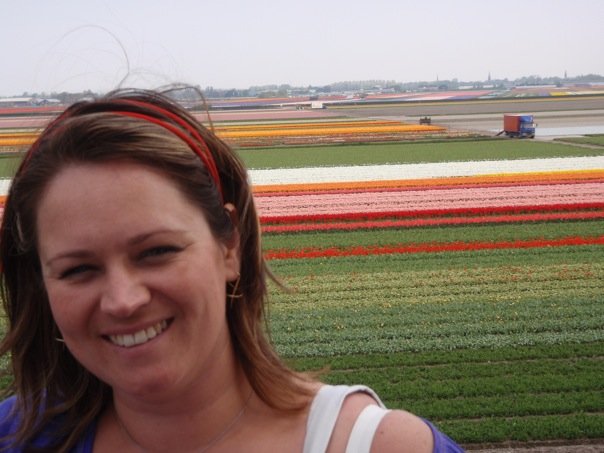
img: Nerissa Muijs at tulip fields outside Lisse, Netherlands.

If you enjoyed this post, we invite you to subscribe for email delivery of The Displaced Nation. That way, you won’t miss a single issue. SPECIAL OFFER: New subscribers receive a FREE copy of “A Royally Displaced Tea.”

Related posts:
Expats in Moscow satisfy a hunger to learn

Special announcement from TDN: ML Awanohara and Kate Allison will be live-tweeting the Royal Wedding from a displaced perspective. Join us from 5:00 a.m. EST, using the hash tag: #DNRW

I well remember my first foray into an American supermarket. Dozens of brands of orange juice, offset by a dearth of blackcurrant Ribena.  Cheese in aerosol cans, breakfast pizza bagels…  As for the meat — well, thank goodness everything came shrink-wrapped so I could smuggle it home and investigate its cooking requirements in privacy. Anything was better than revealing my ignorance of American cuts of beef to Stop & Shop’s rather intimidating butcher. It made me want to attend cooking classes – not because I couldn’t cook,  but because unfamiliar ingredients and lack of vital ones limited my usual repertoire. I had to eat what Americans did.

All this confusion took place in a country where the language was approximately the same as at home. How much more difficult must this experience be, then, in a country whose language is strange to you?

Borsch and blini

Victoria Agabalyan understands this problem well. She is the founder and chief executive of Taste of Russia, the first English-language culinary school in Moscow, whose students are primarily foreign tourists and expats.

In order to understand what Europeans expected of cooking classes, she, like American TV chef and one-time expat Julia Child before her, attended culinary school in France.  Consequently, Taste of Russia focuses on teaching traditional cuisine from Russia and the former Soviet Union in a cozy atmosphere. Student Bonnie van der Velde says:

“I cooked borshch and drankini with mushrooms for my mom and her colleagues in the Netherlands, and they liked it very much.”

Although Agabalyan teaches some of the classes herself, she also invites chefs to conduct culinary workshops while she or the school’s administrator translates. She plans to open more schools in other cities in Russia.

Hidden bonus for expats

Similar to my own dealings with strange supermarkets,  expats in Moscow have problems finding their way round the grocery shelves, and attendance at Taste of Russia helps them get over this difficulty. Another student, Angeline Sandmann, says that on her first shopping trip in Moscow she bought sour cream instead of the intended yogurt.

But it could have been worse. Try spraying cheese on top of your ice cream sundae.

Source:  The Moscow Times

If you enjoyed this post, we invite you to subscribe for email delivery of The Displaced Nation. That way, you won’t miss a single issue.

Burglars alarmed

Canine vigilantes were too much for two burglars who tried to break into expat Gerard Carroll’s house in Pruna, Spain.

When pinned to the ground by the homeowner’s specially trained guard dogs, the thieves had no option but to call the police to help them out of their predicament.

Gerard Carroll told The Olive Press that he had bought the dogs after his house was robbed a year ago. He considered the police action at the time to be less than satisfactory, and burglaries in the area had continued.

But taking the matter into his own hands seemed to have worked, he said.

At the time of the article in The Olive Press, one of the burglars was still receiving hospital treatment.

Source: The Olive Press


Mobile in America

Today we welcome Mandy Rogers to The Displaced Nation as a guest blogger. She wrote this post in response to Kate Allison’s “The Domestic Expat.”

I don’t always understand what people are saying. I’m temperamentally unsuited to the noise and lack of personal space. I don’t think I’ll ever completely fit in. What am I?

A Mississippian in Manhattan!

My husband, Kary, and I moved to New York City two-and-a-half years ago, when we were in our early thirties. Until then, we had spent our entire lives in Mississippi. We loved it and had a great community of friends, whom we still miss.

Making the move

What possessed us to pick up stakes and try out life somewhere else?

Kary and I met in the marching band at Mississippi State. I played the flute and he the trumpet. We both landed jobs at the university immediately upon graduation. But there was something in each of us, a kind of restlessness. We knew we couldn’t be content with staying in Starkville forever. Was it a passion for travel or a fear of growing too complacent? Perhaps a bit of both…

There was also a practical reason for making the move. I’d gone back to school in my late twenties to do a masters in landscape architecture. I discovered I really enjoyed doing projects involving public spaces, such as parks, gardens, and streetscapes. Public green space isn’t a priority in Mississippi, where most people have their own land.

During my graduate studies, I’d taken a road trip with Kary and my sister to New York City, visiting Central Park, Paley Park, and Bryant Park. The amount of green space was a surprise to me. It’s something my mother, another garden lover, noticed during her first visit to the city, too.

In the end, it all happened rather quickly. Kary was offered the first job in New York he applied for. He actually got it via Twitter!

We packed up our belongings in a rental car — our cocker spaniel, Callie, in her seat belt harness and our three cats in their carriers — and traveled over three days to our new home in the Big Apple, staying in pet-friendly hotels along the way. (We’d flown out to find an apartment just beforehand, signing a lease for one in Brooklyn, which several of our friends had recommended as a great place to live.)

When we first moved, I didn’t have a job so spent the time exploring gardens and parks in Brooklyn, the Bronx and Staten Island. Even now that I’m working for a landscape architecture firm in Manhattan, I escape to the Brooklyn Botanic Garden whenever I can to see what’s in bloom. My dad gave me a membership there just before he died. We had a complicated relationship so it’s a nice reminder of him and our common love of gardens.

The adjustment process

People still ask me: where are you from? They usually guess North Carolina or Georgia; no one has guessed Mississippi yet.

I’m still picking up new vocabulary and pronunciations. “House-ton” instead of “Hue-ston” Street; standing “on line” at the grocery store (in the South we say “in line”).

And I continue to be amazed that the number of people living in Brooklyn equals the entire population of Mississippi (2.5 million). No wonder one of our most difficult adjustments has been to the noise and (by our standards) overcrowding.

Still, there are lots of things we love in this part of the world, beginning with the climate. Thunder and tornadoes are much less frequent here. And believe it or not, even after this rough winter, we still can’t get enough of snow.

We’ve adjusted very quickly to living without a car. You can see and experience so much more on foot than behind the wheel. That said, I usually did most of my singing in the car, and I miss that! (I don’t sing around my apartment too much, as the neighbors could hear me.)

And, although the South is renowned for its hospitality, I am often surprised by how much nicer, friendlier, and helpful New Yorkers are than they are given credit for being.

Moving right along…

Despite these many “likes,” I don’t think we’ll ever be true New Yorkers. To this day, I always relish running into other Southerners. The past two years, Kary and I have attended the annual picnic held in Central Park for folks from Mississippi. There’s always a blues band and plenty of fried catfish, sweet tea, and other Southern delicacies.

Not all Mississippians have exactly the same values, but each of us knows what it was like growing up in that neck of the woods, and it gives us a powerful bond.

During the year, Kary and I congregate with fellow Mississippi State alumni at a local bar to watch our alma mater compete in football or basketball. We’ve made some new acquaintances that way, such as a native New Yorker who went to MSU in the 1970s to run track.

Like most expats, Kary and I debate about the right moment to move on and where to go next. Will we try the West Coast, or consider moving back south? Every time I visit Mississippi these days — I’ve been back three times since we left — I realize how much I’ve missed its hospitality, beautiful forests, and tranquility. Plus it’s been nice catching up with family and friends over hearty Southern meals.

Still, the hot, humid summer would take some getting used to again. And now that we’ve been bitten by the travel bug, we’re contemplating our wish list again. We visited San Francisco last year and liked what we saw.

Being mobile in America — it’s a trip, in more ways than one. Tell me, why do so many Americans seek adventure overseas when it’s perfectly possible to be an expat here?

Question: Can being an “expat” within your own borders be just as enriching as becoming one by crossing borders?

Mandy doesn’t have a blog but you can follow her on Twitter: @mandyluvsplants

img: Mandy (right) and a friend she ran into at a Central Park picnic for Mississippians in New York. Mandy’s comment: “My friend still lives in Mississippi but was here with her daughter, who was attending the picnic as part of her duties as Mississippi’s Miss Hospitality. My mom says I can’t go anywhere without running into someone I know — I guess she’s right!”

If you enjoyed this post, we invite you to subscribe for email delivery of The Displaced Nation. That way, you won’t miss a single issue.

A week in tartan

Scotland Flag from PhotoEverywhere.co.uk – CC license

It’s time to celebrate all things Scottish. Dunk Walker’s shortbread in your tea, deep-fry a Mars Bar, eat chicken tikka masala. Read Robert Burns, watch Billy Connolly.  Drop into conversation that your great-great-grandmother came from Dundee (actually, she did). Whatever you do, though, make sure you do it in tartan.

In 1982, New York City Mayor Ed Koch declared July 1 as Tartan Day, a one-off celebration of the 200th anniversary of the repeal of the Act of Proscription — the law forbidding Scots to wear tartan. Following this, Scottish-Americans lobbied the Senate for official recognition of Tartan Day, until eventually, in 2008, President George W. Bush signed a Presidential Proclamation making April 6th a day to

“celebrate the spirit and character of Scottish Americans and recognize their many contributions to our culture and our way of life.”

— which, naturally, entails a long parade through the streets of New York in an attempt to out-do the other Celts’ celebrations on March 17.

Not just New York, either. Tartan festivities are held throughout the rest of the USA, plus Canada, Australia, and New Zealand, although the last two stick to July 1 for their day of plaid fabric observance. Even Scotland joins in the fun.

However, do the U.S celebrations really “celebrate the spirit and character of Scottish Americans” as President Bush said? The key word in that phrase is, perhaps,  “Americans.”

As Scottish expat and travel writer/blogger Aefa Mulholland says in her interview with Scotland’s Daily Record:

“People [in America] have very different views of Scottishness from what most people in Scotland would have today. Scottish-Americans tend to remember and celebrate Scotland the way it was when they left it.”

But that’s simply the way of the expat world: homesick for a place which doesn’t quite exist any more — only in memory.

On another note — it’s strange that a law banning an item of clothing should have such far-reaching celebrations. Certain U.S. towns currently making the wearing of saggy pants a criminal offense should perhaps ponder this point, for the benefit of future generations.

Question: Which style of dress would you like to see commemorated every year?

image: Scotts_flag by www.photoeverywhere.co.uk
If you enjoyed this post, we invite you to subscribe for email delivery of The Displaced Nation. That way, you won’t miss a single issue.

How many years should an expat stay? The answer is blowin’ in the wind…

Most human beings feel disconcerted when they lose the self-validating “mirror” that tells them who they are. That’s what we hear from the relocation experts — as cited by Kate Allison in her article exploring how even people who move within the same country can have something akin to an expat experience.

But in my own experience of being displaced, first in England and then in Japan, trying to live in a country where you share a great deal — ethnically, culturally, linguistically — with the natives is easier to sustain for lengthy periods. Under those conditions, it’s possible to maintain the illusion of the mirror still being in place.

After all, quite a few Americans — comedians like Ruby Wax and Reginald D. Hunter, writers like Bill Buford and Bill Bryson — have made it in England. In Japan, by contrast, although foreigners can become talento, they will never achieve the same level of belonging.

Thus when I first learned the news that Junichi Kinoshita had won this year’s Taipei Literature Award, the first non-native writer to do so in 13 years, I thought, well, no wonder. On the face of it, Taiwan should be a relatively easy adjustment for a Japanese person.

But does Kinoshita actually feel that way? Yes and no. His first impression of the Taiwanese was how similar they looked to the Japanese, and though he found learning Mandarin a challenge, he eventually mastered it to the point where he was able to write his debut novel in Chinese, and at a level that garnered it a prestigious award.

On the other hand, life in Taiwan posed a considerable culture shock as people there tend to be much more hospitable than the Japanese. In Kinoshita’s book, the title of which can be roughly translated as Dandelion Floss, five Japanese expatriates in Taipei struggle to adjust to the local culture — and when they finally get the hang of it, must grapple with the question of when (and whether) to go home to Japan.

At the end of the novel, one of them says:

I think every expatriate is following some kind of mysterious calling from their heart. There is some predestined relationship between a person and a city. One leaves the city when the affinity ends, be it a few months or 10 years, it just happens.

Kinoshita intended his book as a swan song to his life in Taipei. After submitting it to the contest, he planned to return to Japan with his wife, who is also Japanese. Now, however, they are rethinking their next step: perhaps the prize is a signal that Kinoshita isn’t finished with the city yet? Besides, he has already decided on a theme for his next work of fiction, as well as a language: Chinese again.

If you enjoyed this post, we invite you to subscribe for email delivery of The Displaced Nation. That way, you won’t miss a single issue.

The domestic expat

A photograph on a Minnesota news website showing a street in Brooklyn, NY, has the caption:

A long line of Minnesota expats wait to enter the “Minnesota State Fair Affair.”

Meanwhile, on a classified ads website, someone from Wales is looking for other Welsh expats to meet in a pub – in Winchester, England.

While convention and Wikipedia define an expatriate as:

any person living in a different country from where he or she is a citizen

it seems that this definition is being gradually challenged, as shown by these two examples. You no longer need to cross borders to be an expat. You can be a domestic expat. A fish out of water in your own country.

Leaving aside the touchy debate of whether Wales and England are separate countries – for the purposes of passport control and this article, they both come under the umbrella of the United Kingdom – this challenge, upon consideration, is perfectly reasonable.

An intrinsic part of expat life is culture shock, which is, says the University of Northern Iowa College of Business Administration,

the trauma you experience when you move into a culture different from your home culture.

It has several stages:

Excitement/fascination – ignoring small problems; a sense of being on extended vacation;

Crisis period – when difficulties arise, the new country turns out to have feet of clay, and you realize you can’t go home;

Adjustment – a change from negative attitude to positive; rediscovery of sense of humor;

Acceptance/adaptation – a sense of belonging in, and adapting to the new culture;

Re-entry shock – upon return to the original country, when the whole process starts again.

In her 2002 article, What To Expect When You Relocate, Achievement Coach Nancy Morris says:

Surprisingly to many, culture shock can show up even when relocating from one region to another within our own country – we assume ‘culture shock’ only occurs when moving to a completely different country.

If you’ve ever moved from London to Newcastle, or from New York to Alabama, or from Toulouse to Paris, you’ll know she’s right. All the symptoms above can be yours, and you don’t need the inconvenience of an international flight to get them. A domestic flight will do it – or, in the case of our Welsh example, a short trip along the M4.

Nancy Morris goes on to say that

moving to a new cultural environment can turn from culture shock to “self-shock”.

During most of life’s transitions – changing jobs, divorce, bereavement – we have a tendency to question ourselves, and who we are. Surrounded by familiar family, friends, environment, we are usually able to make sense of this question and find an answer, even as we struggle to accept the change in our lives. When the change is cultural, however, acceptance is more difficult. As Morris puts it:

At home we have a mirror which helps to validate and re-affirm us. Within a new environment, the mirror no longer exists. So, at a time when you are seeking the answer to the “who am I” question, your surroundings are asking “who are you?”

Surrounding yourself with culturally familiar people – those with the same accent as you, those who feel as displaced as you; in other words, expat communities – is just one way of putting that mirror back in its place.

And it doesn’t matter you’re an Englishman in New York, or a Welshman in Winchester.

If you enjoyed this post, we invite you to subscribe for email delivery of The Displaced Nation. That way, you won’t miss a single issue.