The Displaced Nation

A home for international creatives

Category Archives: Cool Columns

TCK TALENT: Alaine Handa choreographs her way to festivals in Toronto and now Edinburgh (1/2)

AlaineHanda_pmToday we introduce a new monthly column by Elizabeth (Lisa) Liang. Remember that Guatemalan-American of Chinese-Spanish-Irish-French-German-English descent who was putting on a one woman show in LA about being a Third Culture Kid? You know, she “came out” as a TCK on stage, and lived to write a post about it? Lisa will be searching for other TCK talents to interview for the series. She debuts with a two-part conversation with fellow TCK performing artist Alaine Handa (pictured). Part 2 is here.

—ML Awanohara

Third Culture Kids (TCKs) are making headlines these days for their creative output. We see them being featured in established news outlets and online magazines, as well as on popular blogs. I suspect that the emergence of Barack Obama as national and global leader—he is an Adult TCK (ATCK)—has contributed to the phenomenon.

Still, ATCKs in the performing arts remain relatively rare, so as an ATCK actress-writer I’m always happy to learn of fellow ATCK performing artists like Alaine Handa, a second-generation TCK who works as a choreographer/dancer.

Alaine was born in Singapore. She spent her childhood in Jakarta and adolescence in Singapore. She went to college in Los Angeles, California, and then moved to New York, where she formed her own troupe in December 2007: A.H. Dance Company.

She has since moved back to Singapore, where she has lived for the last year.

In this, the first of a two-part interview, I ask Alaine to tell us about her company, her TCK background, and her first internationally touring show, Chameleon: The Experiences of Global Citizens. In Part Two of the interview, to be posted tomorrow, we’ll move on to talking about her production that is about to premiere (!) at the Edinburgh Fringe Festival.

* * *

Hi, Alaine. I’m curious: what led you to form your own dance company?
Ever since I was a young teenaged dancer, I aspired to have a professional dance company that toured the world performing in different venues, festivals and theaters. I think it was because I longed to have my own choreographic voice to create dance pieces that meant something to me. Still, the decision wasn’t easy to go from dancer/choreographer to choreographer first and dancer second. After moving to New York, I continued performing for other choreographers and project-based dance companies. I only decided at the end of 2009 to focus solely on choreography while performing occasionally. I guess you could say I never lost my determination to make that happen.


Can you tell us more about your background as a second-generation Third Culture Kid?
Both my parents are TCKs. My heritage is mostly Hakka Chinese (with a bit of mix in there somewhere along the lineage). My grandparents and great-grandparents were Chinese immigrants from somewhere in China who settled in Jakarta. My mom attended an English school until it was shut down due to political pressure. She then was sent to boarding schools in Hong Kong and Sydney, and she graduated from an Australian university outside of Sydney. Meanwhile, my Dad attended a Chinese school in Jakarta before it was shut down. He helped his parents for a couple of years and then was sent to Singapore to learn English. After a year, he went to London to attend university and then to Boston to obtain a doctoral degree in optometry.

Which culture do you most identify with?
I attended American international schools in Jakarta and Singapore so I’d say I’m culturally very American. I majored in dance through UCLA’s Department of World Arts & Cultures, which looked at dance and the arts in a sociological-anthropological way and as a community-building catalyst. And then I spent seven years performing, teaching, choreographing, living, creating, loving, and building a community of TCKs in New York.

ACT 1: Chameleon goes to the Toronto Fringe Festival


A couple of years ago, your company put on a show at the Toronto Fringe Festival entitled Chameleon: The Experiences of Global Citizens. I enjoyed watching the video clip of your performance. Please tell us more about it.
Chameleon, the Experiences of Global Citizens is a full dance production with a rotating cast of three to six dancers using film, spoken word, jewelry design, music, and photography, to support the personal stories of TCKs, Cross-Cultural Kids (CCKs), and Global Citizens. Each dancer performs a solo in the production in addition to dancing in the group sections.

The video excerpt is only one section of the production: my solo. (Thanks for watching!) I layered together three different poems for the sound:

  1. “Uniquely Me,” by Alex Graham James from Ruth Van Reken and David C. Pollock’s book, Third Culture Kids: Growing up Among Worlds.
  2. “De Främmande Länderna” by Edith Södergran (translated into English), a Swedish poet I studied while attending UCLA.
  3. Last but not least, “Eulogy to my multi-racial / Multi-cultural ancestors / Also known as the anti-eulogy / To my multi-racial / Multi-cultural ancestors,” by Leilani Chan, an Asian-American theatre director in LA.

It sounds as though you’ve rolled TCK and CCK art into one cohesive piece—much like a TCK or CCK individual is the sum of many seemingly disparate parts, creating a vivid, unique entity. What was the thought process that produced this art?
Hmmm…my thought process in creating Chameleon was a lengthy one as it is very personal to me. A little trip down memory lane is probably the best way to describe it.

I graduated high school in 2001 and then moved to Southern California to attend Pitzer College. 9/11 happened a couple of weeks in. Everyone in the States was in patriotic mode. I didn’t quite fit in. Many journal entries, tears, frustrations, and conversations later, I wrote about my experience as an outsider/insider and drafted a dance piece about my mixed up cultural identity that I wanted to choreograph for my senior project. I transferred to UCLA for my third and fourth year. I experienced bouts of severe depression and several anxiety attacks throughout my college years and began to see the “light” at the end of the dark tunnel my final year.

A friend told me about the Third Culture Kids book in 2003, and a life-changing epiphany happened. I returned to my journal entries and found my ideas to create a dance piece about my experience as a TCK for my senior project. I cast a multicultural group of dancers, interviewed TCKs I knew for my very first documentary film “I am a TCK,” and rented a theatre in L.A. for my senior project and titled the piece “Third Culture Kids.” The first part of the production was the half-hour documentary film followed by a 20-minute dance piece that was autobiographical in nature. This would become the very first draft of Chameleon.

After graduation from UCLA, I was burnt out and moved to New York to pursue a career in dance. I knew that my TCK dance piece needed to be re-created again at some point. I performed for a bunch of independent choreographers, dance companies, and was teaching dance in the public schools in Brooklyn. I formed A.H. Dance Company at the end of 2007 and we had two performing seasons before I decided the time was right to tackle the stories and experiences of TCKs again. I cast dancers that were cross-cultural or TCKs, a TCK actress, a TCK jewelry designer (who created our prop pieces that were an amalgamation of HER TCK experiences), and TCK/CCK/TCA photographers submitted their work to be used as backdrops for the dance sections. I also extended and re-edited the film “I am a TCK” by interviewing even more TCKs. We premiered the piece at University Settlement in New York as part of their Spring Season in 2010, after receiving some funding from Singapore International Foundation, which also funded the performance at the Toronto Fringe Festival.

ACT II: Chameleon travels widely and goes global

We toured the production to festivals and organizations with community programming. I even presented portions of the piece, including the rehearsal process, twice at the annual Families in Global Transitions (FIGT) conference, where I met Ruth Van Reken, Tina Quick, Apple Gidley, Jo Parfitt, Julia Simens, Judy Rickatson, and many more of the TCK researchers, expat writers/bloggers, international educators, and more.

I am very proud of this work and how it has traveled around the world. Currently, Chameleon has taken on a more educational approach. I’ve re-set portions of the piece for student TCK dancers from Singapore American School and they performed it in Kuala Lumpur as well as in Singapore. In January this year, I traveled to Guangzhou to re-set a simpler version on TCK students (a lot of them were non-dancers) at the Utahloy International School for a week-long residency that culminated in a performance. The rehearsal process of telling the personal stories of TCKs through movement and dance with spoken word was equally as rewarding as the student performance itself.

* * *

This just in from Alaine at the Edinburgh Festival: The preview performances of her latest production, Habitat, have been going well, and they’ve even received a recommendation from a local newspaper, behind famous greats like Carlos Acosta and the Bolshoi Ballet (which are actually playing in London). Kudos, Alaine!

Tomorrow we’ll talk to Alaine about how this production came about. Any questions for her, meantime?

STAY TUNED for Part 2 of Lisa Liang’s conversation with Alaine Handa.

If you enjoyed this post, we invite you to register for The Displaced Dispatch, a round up of weekly posts from The Displaced Nation, with seasonal recipes, book giveaways and other extras. Register for The Displaced Dispatch by clicking here!

Related posts:

img: Alaine Handa, by Anthony Schiavo, courtesy A.H. Dance Company.

LOCATION, LOCUTION: Booker Prize-nominated author AD Miller, on bringing a location to life through writing

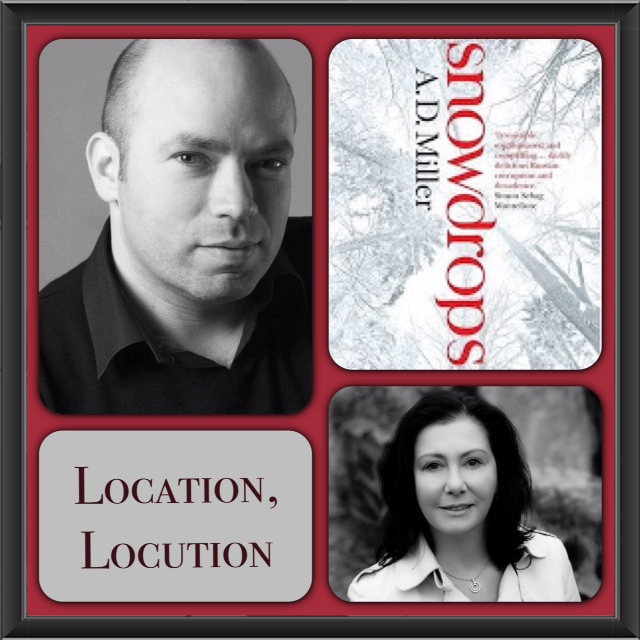
ADMillerIn the second of our series “Location, Locution”, expat crime writer JJ Marsh interviews AD Miller, the British author and journalist.

About AD Miller

AD Miller was born in London in 1974. He studied literature at Cambridge and Princeton, where he began his journalistic career writing travel pieces about America. Returning to London, he worked as a television producer before joining The Economist to write about British politics and culture. In 2004 he became The Economist’s correspondent in Moscow, travelling widely across Russia and the former Soviet Union. He is currently the magazine’s Writer at Large; he lives in London with his wife Emma, daughter Milly and son Jacob. He wrote a critically acclaimed non-fiction book, The Earl of Petticoat Lane, in 2006. His second novel, Snowdrops, was shortlisted for the 2011 Booker Prize.

About his novel, Snowdrops

A fast-paced drama that unfolds during a beautiful but lethally cold Russian winter. Ostensibly a story of naive foreigners and cynical natives, the novel becomes something richer and darker: a tale of erotic obsession, self-deception and moral freefall. It is set in a land of hedonism and desperation, corruption and kindness, magical hideaways and debauched nightclubs; a place where secrets, and corpses, come to light when the snows thaw.

Q&A on Location, Locution

JJ Marsh: Which comes first, story or location?  
AD Miller: Story. But locations can be suggestive of certain kinds of story. For example, Russia lends itself to tales of moral challenge and to philosophical inquiry.

JJM: How do you go about evoking the atmosphere of a place?
ADM: Take notes. Write down what people wear on the Metro and what the vendors on commuter trains are selling. You will recollect less than you think you will. For historical settings, read old newspapers and unpublished memoirs. Remember it is the inconsequential detail that is most important.

JJM: Which particular features create a sense of location? Landscape, culture, food?
ADM: Smell. Sounds. Language (especially slang and proverbs). Clothes. And weather: in Snowdrops, the Russian winter functions as a sort of ancillary sub-plot.

JJM: How well do you need to know the place before using it as a setting?
ADM: You need to know it, and then you need to unknow it. A novel isn’t a travelogue or an encyclopaedia; you enlist only those aspects or details of a place that serve the narrative.

JJM: Could you give a brief example from your work which you feel brings the location to life?
ADM: There’s a passage in Snowdrops in which Nick, the narrator, is taxiing at night alongside “the soupy Moscow River, not yet frozen and curling mysteriously through the wild city”, which is OK.

JJM: Which writers do you admire for the way they use location?
ADM: Isaac Babel and Giorgio Bassani (Odessa and Ferrara respectively).

* * *

Thanks, JJ, for that fabulous interview! Readers, any comments on what AD Miller had to say? Up next month in Location, Locution: Steven Conte, Australian author of The Zookeeper’s War.

JJ Marsh grew up in Wales, Africa and the Middle East, where her curiosity for culture took root and triggered an urge to write. After living in Hong Kong, Nigeria, Dubai, Portugal and France, JJ finally settled in Switzerland, where she is currently halfway through her European crime series, set in compelling locations all over the continent and featuring detective inspector Beatrice Stubbs.

STAY TUNED for tomorrow’s post, another installment in the life of our fictional expat heroine, Libby. (What, not keeping up with Libby? Read the first three episodes of her expat adventures.)

If you enjoyed this post, we invite you to register for The Displaced Dispatch, a round up of weekly posts from The Displaced Nation, with seasonal recipes, book giveaways and other extras. Register for The Displaced Dispatch by clicking here!

Related post:

GLOBAL FOOD GOSSIP: Pastry or pie dough? Whatever you call it, it’s child’s play.

JoannaJoanna Masters-Maggs, our resident Food Gossip, is back with her monthly column for like-minded food gossips.

This month, Joanna comes clean about the reasons for her dissatisfaction with the world today. Who knew that pastry (that’s pie dough to Americans) could be such a contentious subject?

* * *

You know how it is when you have known someone for a while.  Not long, but a while.  Things are so pleasant, and positive and fun, you can’t imagine ever getting irritated with them.  Then one day, you just are.  I’m afraid, my darlings, it is the day of revelation of a certain grumpiness in my personality.  A grumpiness that I usually do backbends to hide, but now I feel our relationship demands a little more honesty.

What on earth, you must be asking, could make Sunshine Lady feel less than, well, sunshiney?  Well, if you must know (and you know you must)  — it’s the sad state of the world’s flaky pastry.  We have come to a point in our culinary evolution where we have all but lost respect for the art of pastry making.  Supermarket shelves are heaving with the frozen stuff, and ready-made pie-crusts are to be found in abundance.  Marie-Antoine Carême, that French master of the art of the Mille Feuille  or thousand leaves of pastry, must be turning in his grave like a poorly controlled rotary whisk. That his peaceful rest is being tampered with can only make me feel justified in my fury.

Child’s play (doh)

Flaky pastry is a subject dear to my heart.  I first learned the rudiments of the art at the tender age of 12.  It was the pinnacle of a year’s pastry training.  We began with scones, worked up to shortcrust, then rough puff or cheat’s flaky, and then to flaky.  By the age of 15 or 16 we were all capable of producing a three course meal which included bread, a béchamel or similar sauce and pastry from scratch in a space of but 2 ½ hours.  Having survived this exam it’s difficult to be impressed by the stresses of Masterchef, or indeed the controlling of flight patterns at Heathrow. I may be exaggerating with the Air Traffic Controller bit, but I stand by my comments on Masterchef.  You see, flaky pastry wasn’t even the star of the show, it was just a skill to be demonstrated alongside the rest — in a very short space of time.

Nowadays, I like to make a day of my pastry making.  I download some good Radio 4 programmes to listen to.  In Our Time with Melvyn Bragg always hits the spot, and I take far longer than 2 ½ hours to make a large batch to use and freeze.  I find the rolling, addition of butter, folding and rolling, a therapeutic, meditational and endlessly gratifying process.  Best, is that the end, the product, homemade, without additives and addictively light, is without parallel.

I’ll repeat that. Homemade pastry is without equal — and I dare to write that, albeit behind locked shutters, in France.

A pastry protest

A few years ago I cancelled my subscription to BBC Good Food magazine.  It was in protest against their increasingly habitual calls for frozen pastry in their recipes.  Not “or you can buy some frozen pastry if pushed for time”, but brazenly, “2 sheets of good frozen pastry” as if it was the most reasonable thing in the world.  “Good frozen pastry” should be a shocker of an oxymoron to anyone who takes their food even halfway seriously.  For heaven’s sake, that their readers bought a magazine with the title “Good Food” suggests not only they have an interest in GOOD Food but that they might be open to the gentle suggestion they make their own pastry?  Indeed, BBC, it is possible that they expect to make their own pastry and require a recipe for it?

If I am wrong — and in this mood it’s hard to own the possibility — might I politely suggest the title is renamed BBC  OK, But Not Quite Good Enough FoodBBC Good Food is not the only transgressor, of course, but it is the only magazine for which I had a subscription and thus the opportunity to register my grievances.

French frozen pastry — it’s got to be better, right?

I can understand why you would buy pastries from a patissier here in France.  A qualified patissier is well-trained and takes a pride in being in the van of pastry production.  A patissier’s products are worlds away from frozen products mass-produced in some factory on the outskirts of Dijon. I believe the patissiers of France share my outrage at the frozen product of which I speak.  (Surely, surely they must?) 

In the spirit of fairness and a desire to appear reasonable, I decided to try a few samples of available frozen pastry here in France.  The stuff has taken over in the same depressing way the Nespresso machine has sidelined truly great coffee, and the world seems to be willing to accept mediocre as long as it is reliably so.

I tried to pick out the pure butter pastries or the ones that advertised themselves as Granny’s best, as if I were a BBC Good Food reader searching for two good sheets.  I took them home, baked them, carefully labeled them to avoid mix-ups and then herded my four kids into the kitchen for the taste test.   I had some misgivings about that last part.  They can be annoying at times, but they are my own, and by now, I had read the ingredients on the packets.  Despite the promises of “sans additives” and “pur buerre” I was perturbed by some of the contents. What flavourings do you need in a butter pastry other than butter itself ?  As for Granny, well — she evidently swapped the butter for palm and sunflower oil, and spent the savings on gin.  She certainly wasn’t sober when she made the thick and flabby batch I sampled, which cooked up into an oily mess.

Happily the kids survived, and the general consensus was that the pastry samples were all “OK” — just not very tasty.  Generally, the pastries rose into crisp puffs with an empty hollow where 947 leaves would have been expected. But OK, I take the point that not all of us have the time or inclination to spend a day listening to Melvyn in the kitchen, no matter how divine he might be.  If that is your case and pastry-making is a bother to you, I think it would be better to whip up a simple bowl of pasta or salad with some nice bread and forget about the quiches and tarts.

Homemade — it really is best.

Mass produced, marketed, and well-travelled frozen flaky pastry doesn’t have a hope in hell of bettering anything made at home. If you are going down the frozen route, just be sure to read the packets carefully.  Even some of the pure butter brands slip in various extras and a great deal of salt, if my raging thirst that night was anything to go by.

But stop!  Why issue advice on how to buy this stuff?   The top advice is to get into the kitchen and discover that most of the hours involved in making this kind of pastry are actually spent waiting for it to chill in the fridge between rollings.  An ideal time for a cup of tea or a glass of rose – and you’re still, technically, ‘working’.

It’s a win-win situation.

“If a  Bunch of 12 year Old Girls Can Do It, So Can You” Flaky Pastry Recipe

IMG_0091I can’t accept any credit for this recipe. It’s the first I learned.  Since then I have tried many other wonderful recipes and many methods of making flaky pastry, but this one is delicious and reliable.  The lard gives the pastry the short crispiness which one should demand in a flaky pastry, while the butter gives the flavor.  Lard is fat from the stomach of the pig.  It is clarified for use in much the same way as ghee is clarified.  If you are American, you might well be asking if Crisco is lard.  The short answer is “no”.  Crisco is vegetable based and lard is an animal fat.  Neither should be eaten in vast quantity, but at least lard is natural.  Use Crisco if you will, but use lard if you want excellence.

I should have mentioned that if you are worried about the fat content, you are in the wrong place.  It’s the fat that gives the flavour and texture.  If you are unhappy about it, go and buy a lettuce.

You will need:

  • 225 g plain flour pinch of salt
  • 80 g lard
  • 80 g butter      (blend both fats together and chill well)
  • Chilled water — about 120 mls
  • Dash of lemon juice

Rub a quarter of the fat into the flour and salt.  Then slowly add enough chilled water (about 120 mls) with a dash of lemon juice to bring the mixture together into a messy ball.  Now roll out into a rectangle shape about the size of a brownie pan.  Use a knife to score lines 1/3 and 2/3 down.  Use about a ¼ of the remaining butter to “dob” over the top two-thirds.  Fold up the bottom layer and down the top layer to form an envelope.  Turn the dough around to the vertical and repeat the process twice, but without butter.  Wrap in cling film and chill for 10 minutes.

Repeat the process until you have used up the remaining two quarters of fat. Wrap well and chill for at least an hour.

After the first few rollings you will find this pastry very easy to handle.  That’s the thing about flaky pastry, despite its reputation — it is very easy-going.

You can use this basic flaky for any recipe that calls for frozen pastry!  I love to make beef pies with it, but it is equally useful for sweet recipes.

Once you have mastered it, you can start to explore other methods.  This, though, is a good start..  Do try it and, please, never go back to frozen.   I hope that my work is done here.

Joanna was displaced from her native England 16 years ago, and has since attempted to re-place herself and blend into the USA, Holland, Brazil, Malaysia, Venezuela, Saudi Arabia, and now France. She describes herself as a “food gossip”, saying: “I’ve always enjoyed cooking and trying out new recipes. Overseas, I am curious as to what people buy and from where. What is in the baskets of my fellow shoppers? What do they eat when they go home at night?”

Fellow Food Gossips, share your own stories with us!

STAY TUNED for tomorrow’s post!

If you enjoyed this post, we invite you to register for The Displaced Dispatch, a round up of weekly posts from The Displaced Nation, with seasonal recipes, book giveaways and other extras. Register for The Displaced Dispatch by clicking here!

Related posts:

Images: Joanna’s daughter, Catherine, proving that even 11-year-olds can make flaky pastry


What’s it like to “come out” as a Third Culture Kid on stage? Elizabeth Liang tells all!

Liang Alien Citizen dancingAs reported here last month, Elizabeth Liang spent the month of May performing, at a venue in Los Angeles, a one-woman show about being a Third Culture Kid, or TCK. As some readers may recall, Liang is a self-described Guatemalan-American business brat of Chinese-Spanish-Irish-French-German-English descent. She was brought up by peripatetic parents in Central America, North Africa, the Middle East, and Connecticut. Many of us were curious about not only how she could pack all of that personal history into a solo stage performance, but also how the (mostly American) audiences would respond. Today is the day we get to find out. Take it away, Elizabeth!

—ML Awanohara

I had no idea what to expect from audiences when I opened my solo show, Alien Citizen, in Hollywood, California, on May 3rd (it closed June 1st).

Since the show is about my upbringing as a dual citizen of mixed heritage in six countries, I assumed it would appeal mainly to Adult Third Culture Kids (ATCKs) and people of mixed heritage—the people I wrote it for, since we rarely see our stories portrayed on stage or screen.

I wanted the show to be funny, but wasn’t sure if the humor would translate.

And I wanted people to be moved by the story.

Some pleasant surprises

As it turned out:
1) I was happily surprised by the composition of the audience. People of all backgrounds, ethnicities, and ages came to see my performance. Some were Americans who had never left their home state until college, others had moved domestically countless times as kids. By the same token, I was pleased that the audience did include ATCKs, global nomads, people of mixed heritage, expats, and immigrants.

2) Many of the houses were full. I had tentatively hoped the story would resonate with enough people to fill the house because the play is about identity, which everyone grapples with. That said, I didn’t expect everyone to empathize with my lifelong experience as an outsider of some kind and even feared that this experience would alienate some audience members… The full houses suggested that the show was actually resonating with most people. For this I must give credit to my director, Sofie Calderon, because she guided me to a brave and inclusive performance. I also take pride in the script, which I worked on for two years.

3) The audience laughed in the right places, mostly. I was astounded at the number of laughs I got in my preview performance. It was wonderful. This continued once the play got under way, although I did have a few quiet nights, when the audience was listening intently and smiling rather than laughing. (Then there was the night when a man in the front row fell asleep. This thickened my skin…after I considered quitting!)

4) The audiences were moved—not only at the end of the play where it was intended, but throughout the performance. People told me that they oscillated between tears and laughter for a large part of the performance—the highest praise I could have hoped for.

Nights to remember

The performance that stands out most for me was the first time my parents, brother, and aunt came to watch me. They had all traveled internationally or cross-country to see it.

My parents and brother are characters in the show, so I was unsure of how they might react. That night got some of the biggest laughs, and my family told me afterward that while they certainly laughed, they also wept throughout the performance because I was telling their story, too. The show brought back experiences they hadn’t thought of in years.

Opening and closing nights were wildly different and weirdly similar. I performed in abject terror on opening weekend, and while I kept it hidden from the audience, it was difficult to enjoy myself on stage. Through the run, I gained heaps of confidence, and was able to relax and “play” more.

However, the final show was reminiscent of opening night in that it wasn’t my best. An actor’s performance is like a speeding train with no seats—ideally, the actor makes a flying leap to catch it, hangs onto the rails, and rides it without falling. Sometimes, though, the actor has to sprint for some time to catch the train, using every skill s/he has—and then keeps slipping from the handrails and grabbing them again, never able to “coast” and enjoy the ride.

I was sorry that my closing night wasn’t a great ride for me, but the good thing about performing for different groups of people each night is that the audience has no idea of what to expect, yet the story remains the same. So closing night still managed to get a standing ovation, as had other nights.

Lessons learned from “coming out” on stage

Performing Alien Citizen was a “coming out” for me. Although I told the story as entertainingly as possible, the play explores the darker aspects of having a peripatetic childhood, being a child of color and mixed heritage in the socially segregated USA of my youth, and being a girl blooming into womanhood on the hostile sidewalks of North Africa and the cold campus of a women’s college in the States.

I had never told these stories publicly (and rarely in private) because I didn’t want to seem ungrateful for all of the wondrous experiences I’d had as a TCK (including life in North Africa and at college), but also because I’m accustomed to listeners failing to understand my point. Hearing negative stories, people tend to conclude that a peripatetic childhood is terrible, or that the country in question is not worth visiting. But that isn’t what I’m trying to say.

Alien Citizen was my attempt to pronounce that:

  1. Being a nomad, a kid of mixed heritage, and a girl can be hard.
  2. This doesn’t nullify the glorious experiences to be had from having any or all of these selves.
  3. The accompanying stories—positive and negative—have a right to be told. They are rarely told, they validate many people’s experiences, and they make a good yarn.

The overwhelmingly positive response of my audiences, night after night, taught me that my story is relatable and interesting, and that it’s a testament to my own strength as a human being, something I hadn’t known would be the case.

Doing the show also confirmed my belief that if a story is told with humor, people will listen to the darker side of it, and empathize.

I’ve been approached by universities in and out of state, as well as venues in Central America, to perform the show and teach workshops on how to create a solo show.

I hope to take the show all over the world.

I’m profoundly grateful that the world premiere of Alien Citizen has led to so many opportunities. I will also teach workshops in Los Angeles starting this fall.

* * *

Readers, I feel moved by this report even though I didn’t get to witness Elizabeth Liang’s deeply moving performance. (Elizabeth, please bring the show to New York so that I can see it!) How about you—any further questions for this brave and bold artist?

STAY TUNED for next week’s posts, featuring yet more international creatives as well as the latest episode in our fictional expat series, Libby’s Life.

If you enjoyed this post, we invite you to register for The Displaced Dispatch, a round up of weekly posts from The Displaced Nation, with seasonal recipes, book giveaways and other extras. Register for The Displaced Dispatch by clicking here!

Related posts:

img: Elizabeth Liang performing Alien Citizen in LA.

LOCATION, LOCUTION: Expat author JJ Marsh on bringing a location to life through writing

jill 3Today we welcome expat crime writer JJ Marsh to the Displaced Nation. JJ grew up in Wales, Africa and the Middle East, where her curiosity for culture took root and triggered an urge to write. Having at this point lived in Hong Kong, Nigeria, Dubai, Portugal and France—she finally settled in Switzerland—JJ certainly belongs in our midst! But what makes her even more special is that she has offered to impart her knowledge to other international creatives about the portrayal of “place” in one’s works.

Currently halfway through her European crime series, set in compelling locations all over the continent and featuring detective inspector Beatrice Stubbs (on loan from Interpol), today JJ begins a new series for us, entitled “Location, Locution.” In the opening post, she will answer the questions she plans to ask other displaced authors in future posts.

JJ, we are positively THRILLED (in more ways than one!) to have you as a new columnist. Welcome! And now to get to know you a little better…

Which comes first, story or location?
Story, always. Or at least the bare bones of the plot. Then I audition various places before beginning to write. I have to know the setting, even before populating the novel with characters. The place IS a character. For example, once I knew the victims would be corporate Fat Cats in Behind Closed Doors, the first in my Beatrice Stubbs series, I looked around for a financial centre with the right kind of atmosphere. Turns out my home town of Zürich fitted the bill and even gave me the title.

How do you go about evoking the atmosphere of a place?
I’d say by really looking at it and digging deep. Not only that, but try to look at it from the perspective of your reader. It’s no coincidence that in many European languages, one asks for a description using the word “How”.

Como é?
Wie war es?

Yet in English, we say “What is it like?” We want comparisons to what we know. I actively chose to use a foreigner arriving in a strange country/city, so as to look at it with new eyes.

Which particular features create a sense of location? Landscape, culture, food?
I start with the senses. We notice sights, sounds and smells first, and add to our impressions with tastes and textures, all the while comparing them to our expectations. Food and drink are essential, as they reveal something of the region but also much about the characters. Cultural differences have to be treated with great care in fiction. Lumpen great dumps of information are poison to pace. But subtle observations can be woven into the story, provided they are relevant. I’ve just abandoned a book set in Rome which was clumsily pasted chunks of guidebook against a sub-par Eat, Pray, Love plot. The reader wants to be immersed in the world of the book, not subjected to the author’s holiday snaps.

How well do you need to know the place before using it as a setting?
Speaking for myself, extremely well. I feel insecure describing an area I’ve never visited. But that’s not true for everyone. Stef Penney, who wrote The Tenderness of Wolves, created a beautiful story set against the backdrop of the frozen wastes of Canada. She’d never even been there.

While I am awed by that achievement, I don’t think I could do it. I need to ‘feel’ the place and also, to understand the people.

My nomadic past and interest in culture led me to study the work of Geert Hofstede and Fons Trompenaars. One of their models is to analyze culture like an onion. The outer layer is Symbols—what represents the country to outsiders/its own people? The next is Heroes—who do the people worship and venerate? Peel that away and explore its Rituals—on a national and personal level. At the centre of the Onion, you will find its values, the hardest part of a culture to access. But that’s where the heart is.

Could you give a brief example from your work which you feel brings the location to life?
The recent UK horsemeat scandal amused me, as it’s part of the average menu in Switzerland. Here my combative detectives, one Swiss, one British, have just finished lunch.

Beatrice patted her mouth with her napkin. “Herr Kälin, your recommendation was excellent. I thoroughly enjoyed that meal.”

“Good. Would you like coffee, or shall I get the bill?”

“I’ve taken up enough of your time. Let’s pay up and head for home.” Beatrice finished her wine.

Kälin hailed the waitress. “I wasn’t sure you’d like this kind of farmer’s food.”

“Farmer’s food is my favourite sort. Solid and unpretentious. Not the sort of fare they would serve in those crisp white tents at the polo park.”

Kälin let out a short laugh. Beatrice cocked her head in enquiry.

“It would definitely be inappropriate at the polo park, Frau Stubbs. We’ve just eaten Pferdefleisch. Horse steak.”

Which writers do you admire for the way they use location?
Val McDermid, particularly for A Place of Execution. Not only place but period done with impressive subtlety. Kate Atkinson, for making the environment vital to the plot in a book such as One Good Turn. Monique Roffey for bringing Trinidad to life in The White Woman on the Green Bicycle. Alexander McCall Smith enriches his stories with a wealth of local detail, be it Botswana or Edinburgh. And Kathy Reichs for making her dual identity an advantage. Donna Leon’s Venetian backdrop, Scotland according to Iain Banks in Complicity, and Peter Høeg’s Copenhagen in Smilla’s Sense of Snow.

There are many, many more.

* * *

Thank you, JJ! Readers, any further questions to JJ on her portrayal of “place”, or authors you’d like to see her interview in future posts? Please leave your suggestions in the comments. You may also enjoy checking out the first three books in JJ Marsh’s Beatrice Stubbs series:

  • Behind Closed Doors: Takes place in Zürich, where someone is bumping off bankers.
  • Raw Material: Takes place between London and Pembrokeshire. Here Beatrice is joined by wannabe sleuth, Adrian. Amateur detectives and professional criminals make a bad mix.
  • Tread Softly: Unfolds in the Basque Country of Northern Spain. Beatrice is supposedly on sabbatical, but soon finds herself up to her neck in corruption, murder and Rioja.

STAY TUNED for tomorrow’s interview with Lisa Egle, author of Magic Carpet Seduction, two copies of which we’ll be giving away!

If you enjoyed this post, we invite you to register for The Displaced Dispatch, a round up of weekly posts from The Displaced Nation, with seasonal recipes, book giveaways and other extras. Register for The Displaced Dispatch by clicking here!

Images: Typewriter from MorgueFile; picture of JJ Marsh and her book cover supplied by herself; map from MorgueFile

GLOBAL FOOD GOSSIP: Water, water, everywhere, Nor any drop to drink.

JoannaJoanna Masters-Maggs, our resident Food Gossip, is back with her monthly column for like-minded food gossips.

This month, Joanna addresses the issues facing a wine-loving girl who finds herself living in a dry country for two years.

* * *

“I don’t think I can do this,” I whined to my husband casting my eyes around the restaurant in something close to desperation.  “I think it must be time for repatriation, don’t you?”

My husband had taken me to a smart restaurant in Al-Khobar, Saudi Arabia, on our first night in The Kingdom.  It was such an attractive place: lovely china and glasses, a chic wooden floor, attentive waiters and delightful food. Yet it was all, so, so wrongIt wasn’t just that I was clad in a form-engulfing abaya, the sleeves of which kept getting in the way of everything.  It wasn’t that we had been ushered to the less well-appointed “Family Section” without views over the The Gulf.  Annoying as those facts were, they weren’t the only irritant.

“Look.” I held up my large balloon shaped wine glass for inspection. Full of San Pellegrino, it shimmered under the tasteful lighting. “What’s the point of all this wonderful food if you just wash it away with water?”

“It’s nice water. Italian,” encouraged David, whose heart must have already been sinking in the knowledge that he had two more years to live with a discontented missus.

“It’s. Not. Wine.” I enunciated my words carefully. “And I have beef.”

More to the point, I had a beef. Let me make this clear for anyone who has not had the Saudi experience: there is no alcohol to be had anywhere.  It is forbidden, interdit, prohibido, indeed, haram.  Occasionally a hapless supermarket manager might mistakenly stock chocolate liqueurs, but who wants those, with or without a good Chateaubriand?

Home-brewing, the expats’ hobby

I’m all for fitting into the lifestyles of the places where I wash up, but I like a bit of give and take. Several years without wine or bacon didn’t seem like give and take for a girl who is half English and half Irish. On that first night, I would have considered raiding a Church’s communion wine but, of course, there are no churches in Saudi either.

So started a two-year quest to find an acceptable alcoholic drink which would inject a little of the warmth wine offers to a dinner party, and a little of the naughty fun that oils the wheels of a party the rest of the world over.

Our starting point was the homemade wine with which most expats become acquainted.  I won’t bore you with the recipe; suffice to say it involves a water cooler bottle, gallons of red or white grape juice, lemon, lots of sugar, yeast and a handful of teabags – for the tannin, of  course.  This lot is heated up then transferred to the water bottle and bunged up with the special cork and an impressive-looking glass “curly wurly” tube.  After four or five weeks, when the smell of yeast has subsided, the wine can be bottled.

The resulting wines can vary surprisingly, but in one thing they are identical: each is truly appalling.  It doesn’t matter the method used, the care taken or the expensive ingredients experimented with — fresh blueberries in Saudi, anyone? — it is just dreadful.  We knew someone who actually made a batch from grapes he had trodden himself. Well, perhaps that never did sound promising.

Vimto — with a Tixylix chaser

During the weeks of waiting for our wine to ferment, I realized why even cough mixture was banned in The Kingdom.  A few dry company dinners complete with presentations and speeches convinced me that teetotalism is not advisable, at least not before retirement. If you must spend dinner with a bunch of people not entirely of your choosing, a slug of Tixylix would be welcome.

I began to view anything sold in bulk with grave suspicion.  Why, for example, would anyone wish to buy large quantities of Vimto, a cordial traditionally found in fish and chip shops in Northern England?  Could it be possible that it was the secret to a sloe gin sort of drink?  The adverts on massive billboards throughout the city suggested a sophistication more readily associated with champagne than a fruit squash. That observation led to an ill-advised attempt at a Vimto-based wine. Sadly, and perhaps predictably, the result was the cough mixture a million sleepless Saudi parents would have been grateful for. Never mind; undeterred, we continued our experiments with a dedication and wanton disregard for our health that the Curies would have admired.

Putting the fizz in compound life

Early in our stay in Saudi, I heard rumours of “The Champagne Lady” of another compound.  She had, so it was said, perfected a sort of sparkling wine which, if not exactly champagne, was a far more pleasant drink than Saudi Ordinaire.  My search for her was rewarded in time and she proved generous with her recipe.  The key requirements were a strong lemonade bottle with a wired cork, unsweetened white grape juice and just two grains of yeast. Even one grain over requirements could result in a nasty glass-shattering explosion.  One must resolve to keep the fledgling beverage in the fridge and not agitate it for two weeks — harder than it sounds in a household with four kids. After guarding the fridge door like an over-zealous Rottweiler for the required time, I could pull down the wire to cork the bottle then leave it in its comatose state for a further two weeks.  The  “pop” on opening was deeply gratifying; the flavor, surprisingly, “not so bad”. Rather like Appeltiser, it did not cause one’s face to reflexively contort while downing it.  Champagne it was not, but drinkable it was.

Add the Perrier and face the grapes of wrath

Two years of experimentation taught us two things.  Firstly, the only way to make a drink that approximated a bone fide drink one might find on sale elsewhere was not to serve our wine straight but to make a “Pimms” cocktail from it.  We would pour it over a glassful of ice and top up with lemonade.  After adding plenty of mint, cucumber and any other vegetation to hand, we could, at a stretch, imagine ourselves at Wimbledon.  Unlike the wine alone, it was vaguely similar to what we wished it was.  That alone justified the considerable number of Pimms parties we hosted in our time.

The second thing we learned, as a direct consequence of the first thing we learned, is that a wine snob is a wine snob whatever his situation.  Making our “cocktail” on occasion caused as much offence as if we had used a Grand Cru as the base, especially if mixed it with someone else’s wine.  The snorts of outrage could have been no stronger.  Indeed cutting someone else’s wine with anything from Perrier to club soda to ice, was to run the risk of causing deep and enduring offense.  There are certain people (and you know who you are) who should remember wine is meant to be fun.  You need every laugh you can get in certain circumstances, and a dodgy Saudi Red ought to be the perfect vehicle for hilarity.

Postscript

Oh, and in case you were wondering — why the popularity of Vimto? It turns out that it is the Saudi drink of choice during the Iftar breakfast enjoyed at sundown each day of Ramadan.  It addresses low blood sugar levels after a day of fasting and stands up well to the full flavoured food on offer – and it doesn’t make you screw up your face when you drink it.

Joanna was displaced from her native England 16 years ago, and has since attempted to re-place herself and blend into the USA, Holland, Brazil, Malaysia, Venezuela, Saudi Arabia, and now France. She describes herself as a “food gossip”, saying: “I’ve always enjoyed cooking and trying out new recipes. Overseas, I am curious as to what people buy and from where. What is in the baskets of my fellow shoppers? What do they eat when they go home at night?”

Fellow Food Gossips, share your own stories with us!

Image: Joanna in her abaya, celebrating an English goal during the World Cup

STAY TUNED for tomorrow’s post!

If you enjoyed this post, we invite you to register for The Displaced Dispatch, a round up of weekly posts from The Displaced Nation, with seasonal recipes, book giveaways and other extras. Register for The Displaced Dispatch by clicking here!

Related posts:

For travel & shutter bug Ildrim Valley, a picture says …

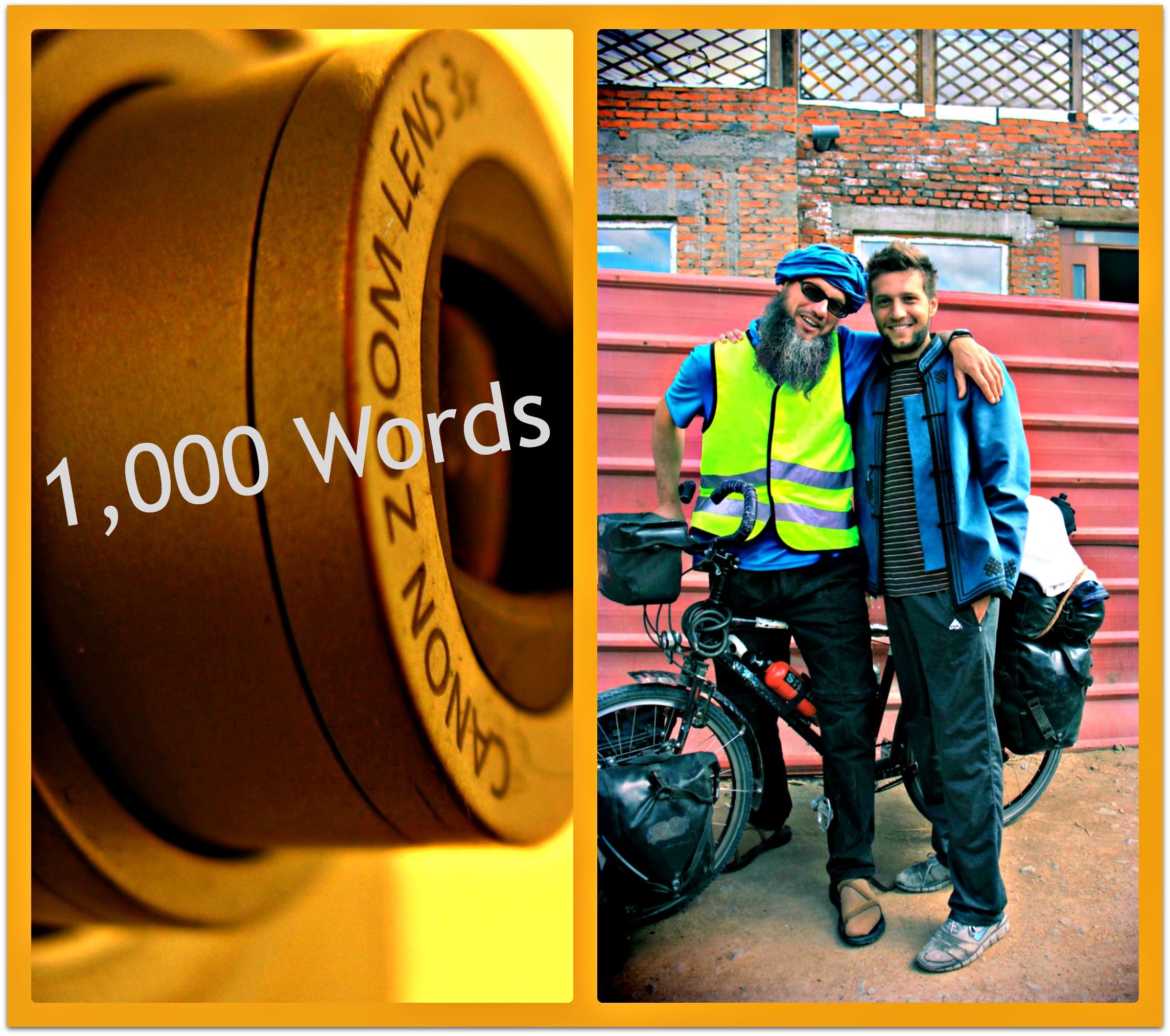
Collage_1000words_Ildrim_dssWelcome to our new series: “A picture says …”, featuring interviews with displaced creatives for whom a camera is a mode of artistic expression for the sights and people they encounter in their nomadic wanderings.

To kick off the series, I have the pleasure of conversing with Ildrim Valley, an intrepid adventurer who is also an economist(!) and travel photographer. It is, of course, this last point we’ll be focusing on, so to speak…

But first a few of Ildrim’s vital statistics:

Place of birth: Baku, Azerbaijan
Passports: Canada; Azerbaijan
Overseas history: From least to most recent: Azerbaijan (Baku); Switzerland (Geneva); Kenya (Nairobi); Canada (Vancouver, British Columbia); Hungary (Budapest); France (Toulouse)—2012 to present.
Occupations: Graduate student of economics; travel photographer; amateur snowboarder; adventurer!
Cyberspace coordinates: Curious Lines (photography blog)

Without further ado, let’s find out more about Ildrim and the way he uses photography as a creative outlet for his international adventures.

Peripatetic from an early age

Hello there, Ildrim. Welcome to the Displaced Nation. Let’s begin by having you tell us a bit about your travels. What inspired you to set off and what has motivated you to keep on going?
My first travel experiences come from traveling with my mom and brother. My mom is eager to change her surroundings, so thanks to her I was lucky to move around and travel early in life. At an early age I’ve been amazed at how life can be so different for people elsewhere than my hometown.

I think that this early fascination developed into a strong curiosity about lifestyles. Now that my mom no longer takes me on adventures (she gets herself into trouble without me!), I try to find my own means of traveling and satisfying my curiosity about places around the world.

You are a self-described adventurer. Do you prefer going and going, or do you sometimes settle in one place for a time?
As I travel more, I realize that it’s not just about seeing a new place that excites me the most. As fun as it is to keep going and going, simply being somewhere new isn’t always satisfying. Settling somewhere for a time gives me an opportunity to live through something different and possibly understand it.

I understand you recently moved to Toulouse, France?
Yes, I moved to Toulouse in September 2012 for graduate school. I felt like grad school would open a few doors to pursue some of my other interests, and it presented a fairly easy way to move to another country. So I set out to look for good schools around the world that fit my background as well as academic interests. At the time I was interested in southern Europe, and Toulouse offers the right kind of balance: it’s a great school with welcoming people and fine landscapes to be explored. Plus an opportunity to finally master French was very appealing—though I have to say I’m not doing a very satisfactory job so far.

On your photography blog, Curious Lines, you say:

Photography for me isn’t just an art form, it’s a way to share experiences.

When and why did you start using DSLR cameras?
I got my first DSLR in 2010, shortly before moving to Budapest. I got it in order to document the move.

Does the process itself of capturing a place or moment affect the relationship you have with that place? For example, does capturing a good set of photos increase the fondness you have for that place?
The process of capturing a moment does affect the way I experience a place, which in turn affects my relationship with it. But how I feel about a place has a lot to do with how I feel about the people from that place. So when I spend enough time in one spot, I get to meet people and build relationships. However, when the stays are short, the camera has a more significant role as it facilitates a connection with others. It helps me get a reaction, an emotional response—a smile or maybe a conversation.

But it’s important to point out that in some places around the world, carrying a camera can have a negative affect. People are fast to judge you on how you look. In Kenya, for example, I have a lighter skin tone, which results in the locals treating me differently, not necessarily in a positive way.

Likewise, having a large camera around your neck or in your hand will send a different signal and will be interpreted in a different way depending on where you are in the world.

I would just like to add that one way in which camera affects my experiences is that it taught me how to look at things differently without a lens. It helps me appreciate things differently and it’s important to know when to put the camera away and enjoy things with your own eyes. It’s easy for me to get sucked into continuous photo taking when I’m in a new place. Though I enjoy it, there are still other things to be enjoyed behind the lens, which is even more true when you’re traveling with someone else. But it doesn’t have to be one or the other; with time I’ve been learning how to balance the two.

For me, the camera has to be an extension of the adventure and not the purpose for it.

Looking back on all the places where you’ve taken photos, which have been your top three favorite places to shoot?
Although my opinion changes with time, my top spot for now is Mongolia. Last year I spent about a month there. The people and their lifestyles around the country fascinate me. The landscapes are pure and surreal. When you have such a keen interest and curiosity about your subject, shooting becomes that much more enjoyable. I’m actually redesigning my Website to present more content via other channels than a blog. One of the new sections will be about my experiences in Mongolia. The other two places that I love for photography are coastal British Columbia and Croatia.

An eye for the London Eye

On your blog you also say:

Once I started using a DSLR I’ve realized that scenes that come out on my computer screen don’t reflect the whole beauty of the moment. They don’t transmit the same type of emotion I felt standing behind the lens. So I tried and am still experimenting with different techniques to bring myself and others closer to how it actually was, at least in my mind. I don’t always try to achieve the most “realistic” looking photos, but rather try to transmit the feeling of the scene.
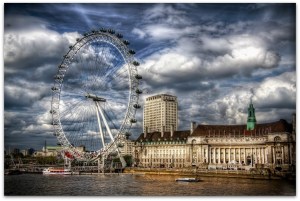
the-london-eye_dropshadowI notice that one of the techniques you’ve used is High Dynamic Range Imaging (HDR), an example of which can be seen in this striking image of my hometown London (original here)—by the way, you’ve now made me feel a little homesick! Tell me a little about HDR and how a novice photographer like myself can go about trying to achieve similar effects with a DSLR camera.
I have a very basic example of what High Dynamic Range (HDR) does in one of my blog posts. In a nutshell, cameras don’t capture the range of light the same way our eyes do. Our eyes adjust to both bright and dark spots in the same scene while for cameras it’s always a trade off.

HDR photography allows you to capture more light by taking multiple shots of different exposures. I take three: one normal, one overexposed bright photo, and one underexposed dark photo. By combining these three shots together you get a higher range of light information available to play with. Some people take five or even seven photos, but three is enough in most situations.

To achieve this HDR effect, I take my three shots bearing these points in mind:

  • The auto-bracketing option on modern-day cameras helps you take three photos with a single click.
  • Set the camera on Aperture priority mode (“AV” or “A” on most cameras) to have the same aperture and depth of field in all three shots.
  • Ensure that the three shots are as identical in composition as possible. A tripod could be useful. (The surroundings or simply holding your breath will do in many cases.)
  • Use software* to combine all three shots together and then let your imagination take charge.

*Some of the most popular softwares are Photomatix Pro, HDR EFEX PRO and HDR Darkroom. Then there are options like Luminance HDR, which is free (open source) but will take some time getting used to. Whichever software you choose, it will help you combine all this light information into one image. Then it’s almost always a good idea to take it into your preferred photo editing software and continue working as you would with any other photo.

People pix

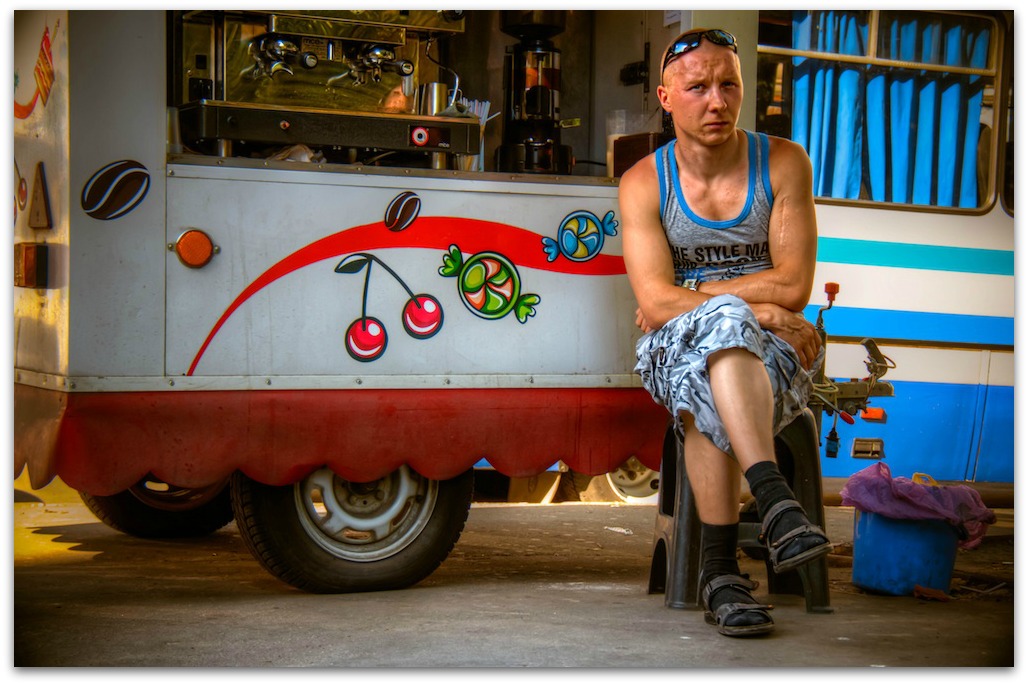
Streetvendor_drop shadowTell me about this recent photo you took of a street vendor in Kiev (original here). How did you find yourself in Kiev?
I was on a long earthbound trip in 2012 from Budapest to Hong Kong, which took me through Kiev.

How did you come across this street vendor? Did you converse with him before taking his photo?
There was no verbal communication. Rather, I nodded at the guy while moving the camera in my hand slowly, indicating that I wanted to take his photo. His face was blank in acceptance so I went ahead and snapped the photo.

Do you always try to try get permission from people when trying to take a photo?
I prefer to ask for permission, but sometimes it’s the spontaneity that makes the photo and asking would yield a different result when they prepare themselves for the photo. Either way, I make sure the subject knows I’m taking their photo.

Is it difficult to obtain permission when facing a language barrier?
It’s important to learn how to communicate with your facial expressions and your body as well as being able to read others. In my experience, regardless of whether your communications are verbal or non-verbal, the more confident and subtle you are, the more likely you are to get approval.

One thing about the street vendor picture that really stands out for me is the boldness of the colors. Can you tell me why and how you set up the shot like this?
Initially, I tried to achieve an effect that would provoke an emotional response akin to the one I had in that moment. A new environment can be emotionally overwhelming—a feeling that can be difficult to capture. First impressions are special. So when I first started editing it was the exaggeration of colors that made me feel the closest to “re-experiencing” the place. Although you can never really re-live the moment, you can come up with something that reminds you of it.

In a way it’s like when a friend tells you a “you really had to be there” story—and exaggerates the details to make the point. It’s not that the true story needs any exaggeration to be interesting, but you need to have the exaggeration to translate the feeling.

Many of these aspects of photography are, of course, a matter of experience and taste. Believe it or not, my earlier photos were even more color crazy. With more experience I’m leaning away from it and trying to express the moment in other ways. I really like black-and-white photography and the subtlety of its expression. I find it trickier and am experimenting with it more at the moment.

Parting shots…

When you take a look at the two photos mentioned above, what’s the first thing you remember?
The London photo reminds me of my host, a friend I haven’t seen in years.

The photo of the Ukrainian street vendor reminds me of a young violinist I met on the train and spent the day with. It also reminds me of how hot the day was and my craving for kvass (a fermented drink made from rye bread). Believe me, a hot day in Ukraine can make you crave kvass as a refreshment.

Are you hoping that these photos will evoke similar emotions in other viewers?
The intent is not always to prompt the same reaction I had. The same photo can prompt many different reactions. I like it when visitors to my site send messages expressing how my photos reminded them of their own experiences.

Finally, do you have any advice for wannabe photographers who are traveling or living abroad, on getting started?
I’d say to take photos for yourself first and not to think about what others would want to see or to try to meet their expectations. The first person your photos should move is yourself.

Thank you, Ildrim! Readers, what do you make of our first photographer post? Some wise words here, and who knew that autobracketing could be so useful? So, any further questions for Ildrim? Please leave them in the comments!

STAY TUNED for tomorrow’s post from expat author, Helena Halme, who is giving away THREE COPIES of her latest novel! 🙂

If you enjoyed this post, we invite you to register for The Displaced Dispatch, a round up of weekly posts from The Displaced Nation, with seasonal recipes, book giveaways and other extras. Register for The Displaced Dispatch by clicking here!

Related post:

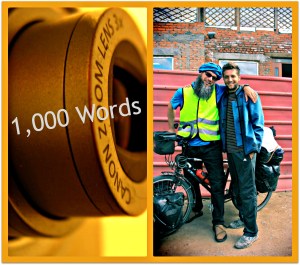
Images (from left): Camera lens from MorgueFile; Ildrim Valley (on right) with a traveler he met last summer in Ulaanbaatar in Mongolia. Says Ildrim: “He was originally from Slovenia but didn’t like being associated with any particular place. He’d been traveling on his bicycle for about four years at that point.”

GLOBAL FOOD GOSSIP: There’s no taste like home

global food gossipJoanna Masters-Maggs, our resident Food Gossip, is back with her monthly column for like-minded food gossips.

Today’s topic for discussion in the kitchen is something very dear to Joanna’s heart: English food.

Before I left the shores of England over 16 years ago, I never gave a thought to British recipes and ingredients as long as I had a supply of strong English teabags. And once I left England and adopted a “displaced” lifestyle, not being able to find ingredients for familiar English recipes simply meant an opportunity to try something new and wonderful, because I love cooking. I tasted and cooked my way around the world and lost touch with food from home.

Now, some people might be unkind enough to suggest that this was for the best, given England’s reputation for lacklustre food. How unfair! A difficult century of war and rationing, followed by the arrival of new convenience foods had an adverse affect on home cooking and restaurants alike. If I had to collect my rations for weeks in order to make a cake, I would probably lose interest within days. The new packets and tins must have seemed welcome relief from the effort of thinking about how to put a meal together. But that’s another story. For now, take it from me that properly cooked English food made with quality ingredients and which doesn’t substitute homemade for pre-packed, is a wonderful thing. It is a wonderful thing.

However. Back to me, living overseas: I felt it was important to learn to cook the local food, and I took this task very seriously. So seriously, in fact, that one day the realization hit me that, in eight years of motherhood, I couldn’t recall having made a single traditional English dish for my kids. Why on earth not? This was the culinary equivalent of refusing to speak to your child in your native tongue, and potentially just as psychologically damaging.

We had just arrived in Malaysia. Kuala Lumpur has a large expat population, and a certain supermarket, Hock Choon, caters to it shamelessly. During one expedition there, I picked up a distinctive green and gold tin of Golden Syrup.

“What’s that?” asked my kids, crowding around, eager to look at this strange foreign product.

Oh dear. What woeful ignorance of an iconic British product. My own children didn’t know that Golden Syrup is to foie gras what corn syrup is to Spam.

Clearly there was some cultural awareness to be taught.

A taste of home

On the drive home I began to feel a tingle of excitement. A quest had begun. A project is a good thing to have in the difficult first few months in a new country. It keeps you from mourning over your lost life elsewhere. I determined that I would cook English favourites for my kids and I would cook them well. No corner cutting, no packets, and certainly no shop bought pastry—one thing thankfully, that was conspicuous by its absence at Hock Choon.

That Sunday I produced my kids’ first-ever Sunday roast. It was simple stuff: just chicken, roast potatoes and green beans, but I just felt such a damn capable mother as I carried it to the dining table. Steamed syrup pudding came next, and custard too — the real deal, made with cream, eggs and a steady nerve.

My children stared with fixed intensity as I lifted the dish to reveal the pudding in its full golden glory. Accustomed to tarts and tortes, they were unsure what they were facing.

“Umm…what is it called?” asked six-year-old Isabel, as I poured custard on her serving.

Seconds later she discovered what everyone does when they try this delight of English baking. The name gives no hint of its tender lightness. It doesn’t swamp the vanilla delicacy of custard. Here was something that looked as though it could break storefronts for ram raiders, but which in reality was a frou-frou pussycat of buttery, light delight. With relief, I surveyed the smiles of my family. There would be no pudding mutiny that night.

Over the months that came, aided by the marvelously stocked Hock Choon, I mastered steak and kidney pie with homemade suet pastry, roast racks of lamb, and liver and onions. On the pudding side, Bakewell tart became a firm favourite and more than adequate British competition for a tarte au citron.

Bravely, I served English food for my children’s Korean and Japanese friends and found they delighted in the names of some of the dishes. I lost count of the number of children who couldn’t wait to tell their parents they had eaten “toads” and that they were delicious. Toad in the Hole, if the fat and oven are hot enough, is a glorious combination of light and golden batter, meaty sausages and sweet onion gravy. I remember one lovely Chinese mum being genuinely disappointed to learn that it was a pork dish and not a spin on frog legs.

Now, my children have favourites recipes from England and are fiercely defensive of their national dishes. Criticism is met with an invitation home for dinner and on those nights I cook with extra care. I am happy to report that we have enjoyed quite a lot of success. No longer are we bashful when our food or produce is knocked—we talk back. That’s important. Food forges a sense of belonging to somewhere.

One more thing before I go: Clotted Cream

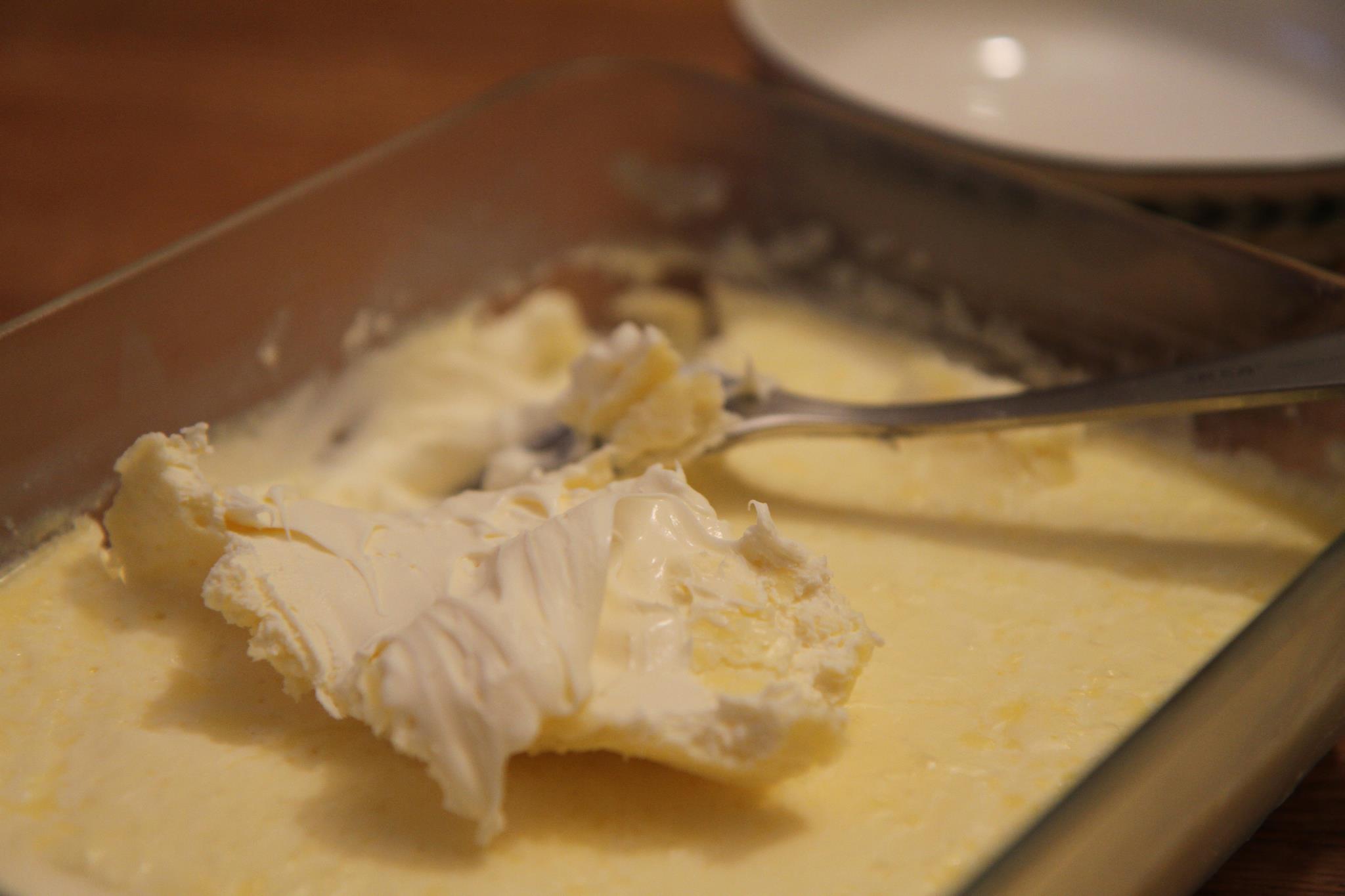
905482_10151362556866828_2018383220_oEngland is rightly famous for its dairy products, king of which is clotted cream. It hails from South West England, particularly Devon, but also Dorset and South Somerset. This is the stuff traditionally served with scones and for which ‘cream tea’ is named. I like to serve it with fruit tarts at dinner and — oh, let’s be frank, this is the cream that goes anywhere. Just don’t waste it in cooking.

It’s quite difficult to find outside Britain, but not to worry—you can make your own.

RECIPE FOR CLOTTED CREAM

You need “raw” cream. It can be called heavy, whipping, double or single cream, just as long as it isn’t UHT (ultra heat treated). UHT won’t separate, and you need to separate the cream from the milk.

Now put that cream in an ovenproof dish and cover. Place it in an oven preheated to 180°F or 80°C and leave for 8-12 hours—yes, you read that correctly.

When a thick, yellowish crust of mascarpone-like consistency has been achieved, remove the dish, wait for it to cool, then refrigerate for a minimum of 8 hours. Scoop it in to jars, cover and eat within a few days.

That should be the easiest part of all.

Joanna was displaced from her native England 16 years ago, and has since attempted to re-place herself and blend into the USA, Holland, Brazil, Malaysia, Venezuela, Saudi Arabia, and now France. She describes herself as a “food gossip”, saying: “I’ve always enjoyed cooking and trying out new recipes. Overseas, I am curious as to what people buy and from where. What is in the baskets of my fellow shoppers? What do they eat when they go home at night?”

Fellow Food Gossips, share your own stories with us!

STAY TUNED for tomorrow’s post!

If you enjoyed this post, we invite you to register for The Displaced Dispatch, a round up of weekly posts from The Displaced Nation, with seasonal recipes, book giveaways and other extras. Register for The Displaced Dispatch by clicking here!

Related posts:

Images: all photos by Joanna and used with her permission

Who is it that can tell me who I am? Third Culture Kid drama!

AlienCitizen_posterAt the height of my own repeat expat experience—when I had a foot in Asia (Japan), Europe (UK) and North America (United States)—I often thought of this line from Shakespeare’s King Lear:

Who is it that can tell me who I am?

—King Lear (Act I, Scene 4)

Prone to being somewhat melodramatic and hyperbolic (yes, I know I don’t have three feet!), I decided I’d peaked out too early. After all, Lear was an old man when he cast himself out and then had to grapple with what it feels like not to have a home or identity, whereas I was still a young woman.

It’s a good thing I was never a Third Culture Kid, or TCK—that’s all I can say, or else we’d be in for some MAJOR drama on this site. Instead we can leave that to someone much more suited: the actress Elizabeth Liang, who is the subject of today’s post. A self-described Guatemalan-American business brat of Chinese-Spanish-Irish-French-German-English descent, Liang was brought up by peripatetic parents in Central America, North Africa, the Middle East, and Connecticut.

Having faced the existential question of “Who are you when you’re from everywhere and nowhere?” practically from the moment of birth, Liang has channeled her thoughts into the creation of a one-woman show, Alien Citizen, which will have its world premiere in Los Angeles with performances this coming Friday and Saturday, May 3-4  (closing June 1). It’s being presented by Liang’s own company, HapaLis Productions, in association with the Multiracial Americans of Southern California.

Any TCKs reading this post (and/or their parents) should be happy to hear that Lliang’s play is not a tragedy. According to the press release, which she shared by email last night, Alien Citizen has both funny and poignant moments:

It weaves humorous stories about growing up as an Alien Citizen abroad with American commercial jingles providing [Elizabeth’s] soundtrack through first love, language confusion, culture shock, Clark Gable, and sandstorms.

Hmmm… Clark Gable?

Though Liang is busy preparing for Friday’s opening, she was kind enough to answer a couple of my questions. Naturally, I wanted to hear more about why she’d written the play and the audience she had in mind for it. Here’s what she told me:

I wrote Alien Citizen for my fellow global nomads and TCKs, because we rarely see our stories portrayed on stage or screen. I also wrote it because I kept being asked if I was from the Midwestern USA and I wanted to set the record straight: my story is unusual, and, I hope, interesting. The play is about identity, which everyone grapples with, but I especially hope that everyone who has lived a cross-cultural life—anyone who has felt like a bridge or an island or both—will relate to it.

Aha, I knew it! It’s for the likes of me as well! And probably you, too, reader, if you’re a Displaced Nation regular. We could use a little drama in our lives…

A few choice lines from the drama

I also asked Liang to share some lines from the play. She obliged with the following list:

  • “We’re Guatemalan when I’m little.”
  • “Nobody on TV looks like me…except maybe Spock on the Star Trek reruns.”
  • “Fairfield County, Connecticut. With four whole seasons, including winter! And the people are even colder than the winters.”
  • “Morocco is like the moon to us at first.”
  • “I love Egypt so much in that moment, it knocks the wind out of me. And I’m just this useless teenager from… Well, I’m not from here.”
  • “And I make friends! Because in the theatre, everybody’s weird.”
  • “I’m not from a place, I’m from people.”

I must say, I like that one about everyone in the theatre being weird. Maybe I should have tried my hand at acting after repatriating? (Except at this point I’d choose to be a Korean soap opera star—yes, I know I’m displaced!)

Show our TCK performer some love!

Readers, it’s time we showed Elizabeth some love for what she’s up to this month. If you live in the LA area, get your ticket half price through May 25th and after that at regular price.

If not, you can:

Questions for Elizabeth, calls for encores? (Should we invite her to submit a post on how the play was received?) Please leave them below. And on Friday evening LA time, let’s all shout out, from wherever we are in the world, “Break a leg, Elizabeth!”

STAY TUNED for tomorrow’s post, another installment in the life of our fictional expat heroine, Libby. (What, not keeping up with Libby? Read the first three episodes of her expat adventures.)

If you enjoyed this post, we invite you to register for The Displaced Dispatch, a round up of weekly posts from The Displaced Nation, with seasonal recipes, book giveaways and other extras. Register for The Displaced Dispatch by clicking here!

Related posts:

img: Promotional poster for world premiere of Alien Citizen

GLOBAL FOOD GOSSIP: Brigadeiros, the essential element of every Brazilian child’s party

Brazil, Brigadeiros, FoodToday we introduce Global Food Gossip: a new monthly food column by Joanna Masters-Maggs, who was our guest in October 2011 with a two-part post about her culinary observations in Provence.

Joanna was displaced from her native England 16 years ago, and has since attempted to re-place herself and blend into the USA, Holland, Brazil, Malaysia, Venezuela, Saudi Arabia, and now France. She describes herself as a “food gossip”, saying:

“I’ve always enjoyed cooking and trying out new recipes. Overseas, I am curious as to what people buy and from where. What is in the baskets of my fellow shoppers? What do they eat when they go home at night? What sort of kitchen appliances do they use — if any?”

Today, she takes us to Rio for her youngest son’s favourite dessert, Brigadeiros — a dish without which no Brazilian child’s party is complete.

The inner Carioca

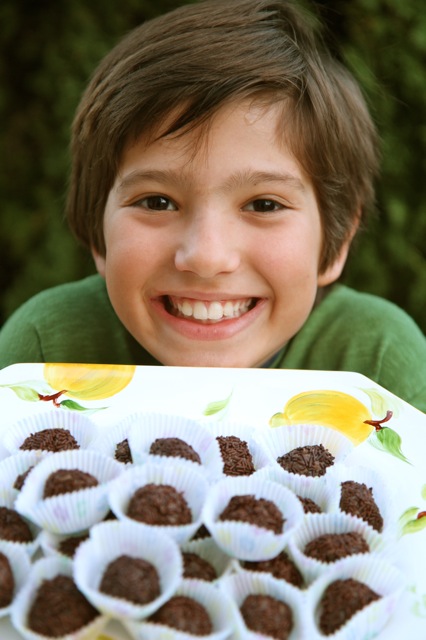
“Is there something you want to tell me about Sergio?” my husband teased, in reference to our Brazilian gardener. Our son Patrick [pictured] had just been born in Rio de Janeiro. Nine years later Patrickzinho  — little Patrick — can still pass as a Brazilian. Not only are his eyes as dark as his pupils and his skin the type that tans successfully, but he has the open friendliness typical of the people we came to know and love.

Patrick is a Carioca, the name given to those born in Rio. He wears the name with pride.

More than once have I had to dissuade his friends’ parents that Patrick is not half Brazilian, he just feels it. That feeling has curled itself in and around him like a particularly persistent Virginia creeper.

Patrick’s inner Carioca is why I have spent the morning in the kitchen, surrounded by empty cans of condensed milk, chocolate powder and mini-cake papers. I am making brigadeiros. Brigadeiros are simple truffle-like chocolates as integral to children’s parties as bikinis are to Copacabana Beach. Forgo the birthday clown if you must, but the brigadeiros cannot be skipped.

Perfecting the role of Brazilian mother

Tomorrow, Patrick’s school is throwing a farewell party for a friend who is returning to Japan. The children have been asked to bring a treat from their country of origin. Well, it’s a party, and Brazil is his country of origin, so what else is he to request from the Maggs kitchen?

Over the years I have played the role of Brazilian mother more than once. I have given school presentations on Brazil, sung Brazilian songs and made countless brigadeiros – all with varying degrees of success but always with great deal of enthusiasm.

The brigadeiro was so named for a chocolate loving army officer. Neither his army career nor his sweet tooth were successful enough for his actual name to be remembered. The brigadeiro, however, has gained iconic status.

I have been making these chocolate treats for years, but it is only recently I perfected the technique. Brazilians insist they are very easy to make, but mine always tended to be a little flat. Then, on moving to Saudi Arabia, I discovered my beautiful and charming neighbor, Yamara, was a Brazilian. An afternoon in the kitchen making a countless number of these sticky balls for yet another “My Country” presentation, and I’ve never looked back. The problem was that my consistency was too soft and I had to be braver about cooking the mixture a little longer. My little chocolate balls now have the correct mixture of stickiness and shape, but never a toffee-like chewiness.

So, it is Yamara’s instructions I am sharing with you. I hope you enjoy them as much as Patrick’s class did. Brigadeiro-making is a fun project for all ages and now that Patrick is making his own, I pass the wooden spoon on to you.

To make Brigadeiros you will need:

I can of condensed milk

3 tbsp of chocolate powder (I use Nesquik)

1 tsp of butter.

Put over a gentle flame and heat until the mixture begins to thicken. Don’t stop stirring. Brazilians say you must heat until “you can see the bottom of the pan”. This is when the heat gently lifts the mixture from the pan and you can make a wide “path” in the mixture with a wooden spoon. It takes about 5 minutes.

Let the mixture cool until you can handle it. You will see it will firm up a little, so avoid the temptation to cook too long. If it is too firm the chocolate strands will not stick. If you have got it right you can take small teaspoons of the cooled mixture and it roll into balls between your hands. Finish by rolling the balls in chocolate strands. Cheerful mini paper baking cases add the final touch. Well, let’s be honest, you need the paper cases for authenticity. Really.

Brazilians also like to make a softer version of the this mixture to make a decadent topping and filling for cakes. Just cook for a couple of minutes less so you achieve a rich pouring consistency. On a rich, soft chocolate cake and sprinkled with chocolate strands you have Brigadeiro Cake, another Brazilian staple. I defy anyone to eat two pieces and live to tell the tale.

Fellow Food Gossips, share your own stories with us!

.

STAY TUNED for tomorrow’s author interview and a new giveaway!

If you enjoyed this post, we invite you to register for The Displaced Dispatch, a round up of weekly posts from The Displaced Nation, with seasonal recipes, book giveaways and other extras. Register for The Displaced Dispatch by clicking here!

Related posts:

Image: Joanna’s son Patrick, with his Brigadeiros