The Displaced Nation

A home for international creatives

12 NOMADS OF CHRISTMAS: Brian Peter, Scottish expat in Brazil (3/12)

Current home: Rio das Ostras, RJ, Brazil
Past overseas location: Houston, Texas, USA
Cyberspace coordinates: A Kilt and a Camera | Travel tales, reviews, photos, interviews and crazy goings on. Because you never know what’s going to happen (blog) and @KiltandaCamera (Twitter handle)
Most recent post: Brazil — “Getting to know Aldeia Velha,” by Peg Peter [Brian’s American photographer wife] (December 19, 2011)

Where are you spending the holidays this year?
In Houston.

What will you do when you first arrive?
Peg will arrive three weeks before I do, so the first thing I want to do is hug my wife. After that I’ll put my feet up and relax after the long flight from Rio for a few hours. That night we will spend the evening with good friends we haven’t seen in way too long.

What do you most like doing during the holidays?
Relax. We are living in Brazil while I’m working as a manufacturing and production manager in the oil and gas field. The growth in the industry has been enormous. I’ve been working long hours, and long weeks, for too many months. I’m going to turn off my phone, keep my laptop shut and switch my mind off.

So you’ll be offline?
Pegs is the Internet junkie of the team so I trust she’ll let me know if anything important happens out in cyberworld.

Are you sending any cards?
Peg will send a few Christmas cards for us. As for a Christmas letter, we do too many things and go to too many places each year to write something brief. Our family and friends who want to know more about what we’re doing can take a look at our Web site.

What’s the thing you most look forward to eating?
A bloody decent whiskey, and a tin of haggis. If I can find a good smoked mackerel, I’ll eat that too. I really wish I could get my hands on an Orkney black pudding.

Can you recommend any good books other expats or “internationals” might enjoy?
Because of work I haven’t had time to read a single book all year, unless you count industrial engineering books as a good read. But Peg always has her nose in a book. Right now she says she’s really enjoying Barbara Kingsolver’s The Poisonwood Bible. The sense of stepping into another world is something any traveler or expat can relate to.

If you could travel anywhere for New Year’s Eve, where would it be?
I’d love to do an Old Year’s Night in Comrie, a small village in the Scottish highlands. As I remember, its Hogmanay ritual starts in the evening with the kids in a fancy-dress parade riding on the back of a lorrie — a kind of float. That goes on until nearly midnight, when the whole community gathers at the bridge on the side of town near Oban and throws three flambeaux (flaming torches) over it into the River Earn. Then there’s a procession through the village with a pipe band leading the way — the villagers in the middle, the float bringing up the rear. When they reach the bridge at the other end of town, they throw the remaining flambeaux into the river. The whole thing is a ritual to protect the village from evil spirits for the year. Back in the center of town the party, including a céilidh, will go on for hours.

My sister has lived there for the past twenty years. Someday I’ll take Peg back there to show her how my family of Scots does an old fashioned Old Year’s Night properly.

What’s been your most displaced celebration of the holidays?
My first Christmas in Houston. I spent the day in shorts, roasting by the pool. It just doesn’t feel like Christmas without freezing your b*******s off.

How about the least displaced — when you’ve felt the true joy of the season?
Even though we live in Brazil, we always go back to Houston to spend the holidays with Peg’s kids. I’ve enjoyed the last few holidays with them, among new family, but I still don’t feel at home as much as I did back in Scotland– especially since I’m so far away from my own adult sons.

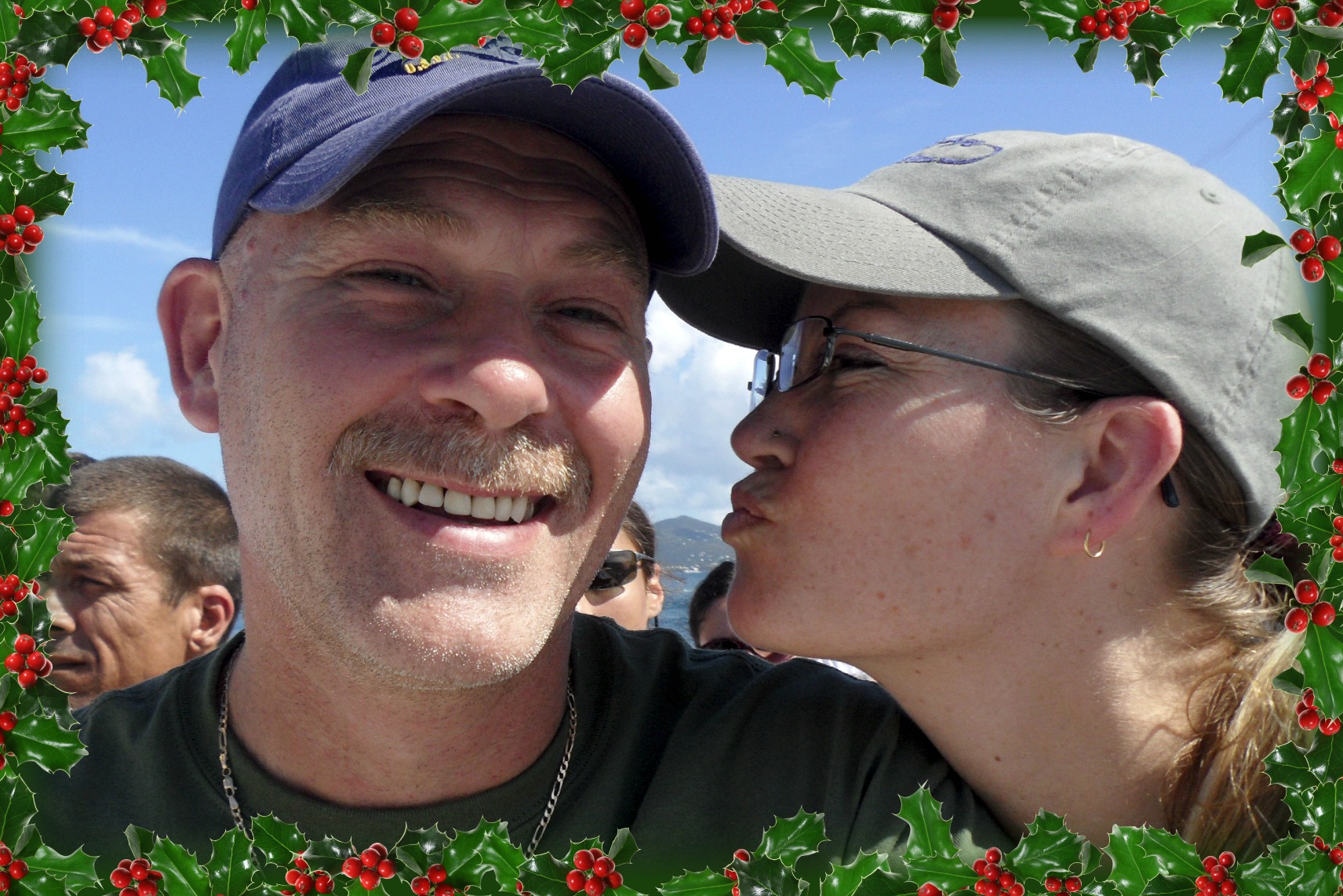
However, last year was a bit more exciting because Peg and I had a big secret plan between us. On Boxing Day we hopped on a plane and flew to the Caribbean. One long haul, three airports, three islands and one ferry later we arrived on St. John in the US Virgin Islands, where we eloped on the beach on December 28th. The photo above was taken of us on the ferry ride over to the courthouse in Charlotte Amalie to pick up our marriage license the day before. This year, of course, we’ll have our first anniversary!

How do you feel when the holidays are over?
It’s a bit anti-climactic. I start the new year with a long flight back to Brazil, which is a country we love living in, but it means back to work for a while. When my job is done there, we’ll have more time to travel when we please. In the meantime, we’ll enjoy as much of Brazil as we can. We both love to travel and look forward to the day when we can just keep going.

On the first day of Christmas, my true love said to me:
THREE DECENT WHISKIES,
TWO CANDY BOXES,
& AN IRISHMAN IN A PALM TREE!

STAY TUNED for tomorrow’s featured nomad (4/12) in our 12 Nomads of Christmas series.

If you enjoyed this post, we invite you to register for The Displaced Dispatch, a round up of weekly posts from The Displaced Nation, with seasonal recipes, book giveaways and other extras. Register for The Displaced Dispatch by clicking here!

Related posts:

12 NOMADS OF CHRISTMAS: Wendy Tokunaga, American Japanophile (2/12)

Current home: San Francisco Bay Area, USA
Past overseas location: Tokyo, Japan
Cyberspace coordinates: Wendy Nelson Tokunaga | Fiction writer and manuscript consultant (author site) and @Wendy_Tokunaga (Twitter handle)

Where are you spending the holidays this year?
At home, in the Bay Area.

What do you most like doing during the holidays?
Eating!

Will you be on or offline?
Good question. I spend so much time online (Twitter and Facebook mainly) networking with readers and other writers, but I do go offline when I’m on vacation. I’m thinking of foregoing social media between Christmas and New Year’s, even though I’ll be in town. We’ll see if I can hold out.

Are you sending any cards?
I used to love to send out Xmas cards and would give much thought each year as to which ones to choose. But now with keeping touch so much via social media, I’ve stopped sending cards and just exchange holiday greetings with people via Twitter, Facebook and email. My husband and I sometimes upload a holiday photo of the two of us. I have never in my life sent out the dreaded Xmas bragfest newsletter.

What’s the thing you most look forward to eating?
See’s Candies and my husband’s Xmas prime rib.

Can you recommend any good books other expats or “internationals” might enjoy?
I’m going to look so tacky here, but I’d like to plug my own e-book (blush), which is called Marriage in Translation: Foreign Wife, Japanese Husband. It consists of interviews with 14 Western women involved in cross-cultural relationships. It’s a fascinating (if I say so myself!) glimpse into these couples’ lives and will appeal to anyone interested in international marriage and culture shock.

If you could travel anywhere for the holidays, where would it be?
Maui!

What’s been your most favorite holiday experience — when you’ve felt the true joy of the season?
I don’t know about the true joy of the season, but I do have a fond memory of spending Xmas in Tokyo and having it be a regular workday, which I quite enjoyed. I sometimes get weary of the constant pressure and obligation in the U.S. to have a family-filled Xmas and be happy and spend money. In Tokyo there are plenty of Xmas trees and lights (my fave parts of Xmas), but it is just a regular day and that’s appealing.

How do you feel when the holidays are over?
I actually like it. There’s a new, fresh sense of energy in starting a new year and anticipating exciting things to come.

On the first day of Christmas, my true love said to me:
TWO CANDY BOXES,
& AN IRISHMAN IN A PALM TREE!

STAY TUNED for Monday’s featured nomad (3/12) in our 12 Nomads of Christmas series.

If you enjoyed this post, we invite you to register for The Displaced Dispatch, a round up of weekly posts from The Displaced Nation, with seasonal recipes, book giveaways and other extras. Register for The Displaced Dispatch by clicking here!

Related posts:

12 NOMADS OF CHRISTMAS: Robin Graham, Irish Expat in Spain (1/12)

Current home: Tarifa, Spain
Past overseas locations: UK, Netherlands, Israel, and a previous stay in Spain
Cyberspace coordinates: a lot of wind… (blog) and @robinjgraham (Twitter handle)
Most recent post: “Gran Bretaña” (December 21, 2011)

Where are you spending the holidays this year?
In Hampshire, England. My mother lives there now with her husband, as does my brother and his family.

What will you do when you first arrive?
Once all the greetings are out of the way I may well go for a walk. I’ll be in the town where I spent my adolescent years and there will be memories and perhaps one or two stories for my fiancée, who will be visiting for the first time.

What do you most like doing during the holidays?
TV off, lights off. Candles on, perhaps a fire. To sit in the near dark and talk; to feel connected to all the people who are doing that around the world and to those who have done it down through the centuries. I am not religious but something about gathering with loved ones in the depths of winter seems to run deep.

Will you be on or offline?
I will tell myself to be offline and will fail. Lessline? Halfline? Online Lite?

Are you sending any cards?
Don’t do cards as a result of a selfish and entirely misspent youth. Not going to start now.

What’s the thing you most look forward to eating?
Tricky. I don’t have much of a sweet tooth. If there’s goose I’ll be happy. Roast potatoes never hurt either.

Can you recommend any good books other expats or “internationals” might enjoy?
Ghosts of Spain (2008) is an account of a journalist’s (Giles Tremlett‘s) trips around the country in search of its hidden history, particularly with regard to the civil war and Franco era, and how the country has changed since that era ended with his death in the mid-seventies. It fills a gap that I would have thought was there for many expats in many countries; a chance to get under the skin of your adopted country in your own language.

Foreign Flavours is the second anthology from the online writers group Writers Abroad. The theme is food (and drink) as experienced by the expat, and the collection is nothing if not varied — from short stories to journalistic pieces to recipes; it’s a real kitchen companion. All of the proceeds from the book go to the Book Bus, a registered charity that aims to provide books to and increase literacy rates among children in the developing world.

If you could travel anywhere for Christmas, where would it be?
I was brought up on the premise that an ideal Christmas would involve snow and reindeer, so the notion of an isolated but cosy log cabin in the woods of Lapland has a distinct appeal. Family around me — great. Just my fiancée — better.

What famous person do you think it would be fun to spend some time time with over the holidays?
Richard Dawkins. We could pontificate on the merits of an atheist world view whilst getting tipsy on eggnog, pigging out on Advent chocolates and singing Christmas carols. I hear he does a mean rendition of “Silent Night,” and I’m sure he’d be good company.

What’s been your most displaced Christmas experience?
I spent one Christmas entirely alone in Holland. Broke. Cue violins — it was an episode in that misspent youth I mentioned. My least Christmassy Christmas.

How about the least displaced experience — when you’ve felt the true joy of the season?
When I was a child most Christmas cards, cookie tins and cake wrappers would, for some reason, feature images of snow-laden Bavarian countryside. Castles and cutesy villages with snowy candlelit windows in the darkness. So to find myself in Bavaria a few years ago with my fiancee’s folks, watching families sled down a nearby hill in the evening, attending midnight mass in a 14th century church with an exquisitely painted ceiling, sitting in the house with candles and glühwein and stollen; that would have to be the one that ticked all the boxes for me.

This Christmas coming will be special, too — a family gathering such as there hasn’t been for long time.

How do you feel when the holidays are over?
Honestly? Relieved, ready to get on with it!

On the first day of Christmas, my true love said to me:
AN IRISHMAN IN A PALM TREE!

STAY TUNED for tomorrow’s featured nomad (2/12) in our 12 Nomads of Christmas series.

If you enjoyed this post, we invite you to register for The Displaced Dispatch, a round up of weekly posts from The Displaced Nation, with seasonal recipes, book giveaways and other extras. Register for The Displaced Dispatch by clicking here!

Related posts:

Best of 2011: Books for, by and about expats

One of our Random Nomads in November, Aaron Ausland, had this to say about those of us who venture across borders:

Travel to a new place for three weeks and you can write a book, travel for three months and you can write an article, travel for three years and you’ll likely have nothing to say.

While that may be true, I’m afraid it hasn’t stopped many of us who’ve spent large chunks of our lives gallivanting around the globe trying out life in different countries, from taking up the pen.

As with any other group, some are born writers (and thrive on new surroundings), while others have become writers (attempting to make sense of their adventures), while still others have had writing thrust upon them (responding to invitations to share their experiences).

At the Displaced Nation, we revere people who publish books, fiction or non, that in some way assist those of us who are (or have been) engaged in overseas travel and residency. We feature — and do giveaways of — their works. And, for established writers with a global following, we’ve created a unique “category” called the Displaced Hall of Fame.

In this spirit — and in the December tradition of looking back at the past year’s highlights — I present the following (admittedly incomplete) list of books for, by, and about expats that were published in 2011, in these five sections (click on the title to go to each section):

  1. NOVELS ABOUT EXPATS
  2. NOVELS ABOUT “HOME”
  3. EXPAT MEMOIRS
  4. SELF-HELP, CROSS-CULTURAL & OTHER NONFICTION WORKS
  5. INSPIRATIONAL ANTHOLOGIES

A few more points to note:

  • Books in each category are arranged from most to least recent.
  • I’ve mixed indie books with those by conventional publishers (it suits our site’s somewhat irreverent tone).
  • To qualify for the list, authors must have been expats for at least six months at some point.

* * *

NOVELS ABOUT EXPATS

Three Questions: Because a quarter-life crisis needs answers (CreateSpace, October 2011)
Author: Meagan Adele Lopez
Genre: Women’s fiction
Synposis: A love story based loosely on the author’s own romance with a lad from Bristol, the action traverses continents through letters and features a quarter-life crisis, a road trip to Vegas, and two crazy BFFs.
Expat credentials: An American, Lopez lived as an expat in the UK for a while (she is now back in Chicago).
How we heard about it: Melissa of Smitten by Britain was a fan of Lopez’s blog (originally titled The Lady Who Lunches). The pair met her London in the summer of 2010, when Lopez was still living in England. Recently, Melissa has been supporting Lopez’s attempt to gain sponsorship for turning the novel into a screenplay.
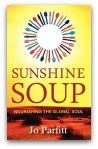
Sunshine Soup: Nourishing the Global Soul (Summertime, October 2011)
Author: Jo Parfitt
Genre: Women’s fiction
Synopsis: Six expat women from the UK, US, Thailand, Ireland, Norway and Holland converge in Dubai in 2008. The action centers on a Brit, who is on her first posting, and an American, who is on her 25th. The Brit learns the ropes and settles in, while the American woman’s world begins to crumble.
Expat credentials: A prolific author, publisher and pioneer in addressing the issues of accompanying spouses and aspiring expat writers worldwide, Parfitt has been an expat for nearly a quarter of a century. Born British, she now lives in the Hague.
How we heard about it: We noticed a couple of interviews with Parfitt — one by expat coach Meg Fitzgerald and another by Expat Women.

The Beautiful One Has Come: Stories (Wyatt-MacKenzie Publishing, July 2011)
Author: Suzanne Kamata
Genre: Cross-cultural romance
Synopsis: Twelve short stories reveal the pains and the pleasures experienced by expat women, most of whom live in Japan.
Expat credentials: Kamata is an American who has lived in Japan for 20 years.
How we heard about it: Kamata and her book were featured on Kristin Bair O’Keeffe’s Writerhead Wednesday in July of this year.

Hidden in Paris (Carpenter Hill Publishing, April 2011)
Author: Corine Gantz
Genre: Women’s fiction
Synopsis: Three strangers — all American women — have reached the point of terminal discomfort with their lives so run away to Paris to begin anew.
Expat credentials: Gantz is a French expat living near Los Angeles. She is getting her own back by writing about American expats in Paris.
How we heard about it: We are long-time fans of Gantz’s blog, Hidden in France — in fact, we promoted one of her posts (about falling into her swimming pool) with the launch of TDN in April. We also interviewed her about her first novel as part of our “gothic tales” theme this past May.

Exiled (Quartet Books, April 2011)
Author: Shireen Jilla
Genre: Psychological thriller
Synopsis: The wife of an ambitious British diplomat, whose first posting brings them to New York, looks forward to escaping from Kent and leading the high-profile life of a successful expat — only to find her world being threatened by dark psychological forces on a par with those depicted in Rosemary’s Baby.
Expat credentials: A Third Culture Kid (she is half English, half Persian, and grew up in Germany, Holland and England), Jilla has also been an expat in Paris, Rome, and New York.
How we heard about it: TDN writer ML Awanohara read a review of Jilla’s novel by Kate Saunders in the Sunday Times. She approached Jilla in May about having an exchange with our readers about the gothic themes in her novel, in line with our site’s own delvings into the gothic aspects of expat life. Our readers loved her!

NOVELS ABOUT “HOME”

Lady Luck (Colorado Mountain Series)
Author: Kristen Ashley
Genre: Romance
Synopsis: Ex-con hero, wrongly imprisoned, gets mixed up with unlucky heroine, who will stop at nothing to help him get revenge.
Expat credentials: Born in Gary, Indiana, Ashley grew up in Brownburg and then moved to Denver, where she lived for 12 years. She now lives with her husband in a small seaside town in Britain’s West Country, where she has produced more than twenty books featuring rock-chick, Rocky Mountain, and other all-American heroines.
How we heard about it: Ashley is the friend of an old schoolfriend of TDN writer Kate Allison, who invited her to do a guest post for us on Britain’s (lack of) Royal Wedding preparations  for our Royal Wedding coverage.

Queen by Right: A Novel (Touchstone, May 2011)
Author: Anne Easter Smith
Genre: Historical romance
Synopsis: This is the fictional story of Cecily of York, mother of two kings and said to be one of the most intelligent and courageous women in English history.
Expat credentials: The daughter of an English army colonel, Easter Smith spent her childhood in England, Germany and Egypt. She came to New York City at age 24, and as she puts it:

Many years, two marriages, two children and five cross-country moves later I’m very definitely a permanent resident of the U.S. — but my love for English history remains.

(She now lives in Plattsburgh, New York.)
How we heard about it: Easter Smith and her book were featured on Kristin Bair O’Keeffe’s Writerhead Wednesday in October.

Dance Lessons (Syracuse University Press, March 2011)
Author: Áine Greaney
Genre: Irish Studies, Women’s Fiction
Synopsis: The action centers on a woman of French-Canadian background who marries an Irish emigrant who is working illegally in a bar in Boston. After his death by drowning, she visits Ireland for the first time and finds out what a shattered man he actually was.
Expat credentials: She may be a resident of Boston’s North Shore, but Greaney continues to identify herself as an Irish writer (County Mayo).
How we heard about it: Greaney and her book were featured on Kristin Bair O’Keeffe’s Writerhead Wednesday in October.
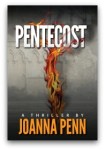
Pentecost: A Thriller (The Creative Penn, January 2011)
Author: Joanna Penn
Genre: Thriller
Synopsis: The Keepers of the stones from Jesus’s tomb — which enabled the Apostles to perform miracles — are being murdered. The stones have been stolen by those who would use them for evil in a world. An Oxford University psychologist spearheads a search for them in a race against time…
Expat credentials: English by birth, Penn grew up as a third-culture-kid and at the time of producing her first novel, was living in Australia.
How we heard about it: We are avid followers of Penn’s blog, The Creative Penn. Several months ago, TDN writer ML Awanohara deconstructed Penn’s post about what “home” means for writers for what it might teach expats and others who struggle with this issue as well. For Penn, home means some sort of spiritual kinship, which she has with two places: Oxford, where she went to university and near where her father now lives, and Jerusalem, which she’s visited at least ten times because she loves it there so much. Not surprisingly, she chose to set much of the action for her debut novel in these two cities.

EXPAT MEMOIRS
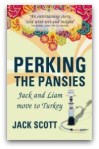
Perking the Pansies: Jack and Liam move to Turkey (Summertime Publishing, December 2011)
Author: Jack Scott
Synopsis: Dissatisfied with suburban life and middle management, Scott and his civil partner, Liam, abandon the sanctuary of liberal London for an uncertain future in Bodrum, Turkey. The book is based on Scott’s irreverent blog of the same name, which after its launch in 2010, quickly became one of the most popular English language blogs in Turkey.
How it came to our attention: Scott was featured as one of our Random Nomads in May of this year and since then, has done us the favor of commenting on and liking several of our posts. **Kate Allison will be reviewing his book for our site on Wednesday.**

Ramblings of a Deluded Soul (CreateSpace, September 2011)
Author: Jake Barton
Synopsis: In his inimitable style, the British-born Barton strings together snippets from new novels and try-outs with reminiscences and, for the first time, insight into his own remarkable experiences as a traveler and expat in Europe (he once owned a small French vineyard and had another job he’s not supposed to talk about). NOTE: Barton’s first novel, Burn, Baby, Burn, burned its way into the Top Ten of the Amazon All Books list.
How it came to our attention: Barton is an online acquaintance of TDN writer Kate Allison. We celebrated him in the early days of our blog for his insights on foreign-language learning in Spain.

A Tight Wide-open Space: Finding Love in a Muslim Land (Delridge Press, August 2011)
Author: Matt Krause
Synopsis: A Californian who is now a Seattle-ite recounts how he became an Istanbullu, all for the love of a beautiful Turkish woman he met on a airplane. The year is 2003, and he can still hear the echoes of 9/11 as well as being acutely conscious of America’s engagement in two wars in Muslim countries. Eventually, he comes to love his new home more deeply than he might have expected.
How we heard about it: Linda Janssen, who writes the blog Adventures in Expatland, interviewed Krause about his book in October.

Planting Dandelions: Field Notes from a Semi-Domesticated Life (Penguin, April 2011)
Author: Kyran Pittman
Synopsis: A native of Newfoundland (her father was a well-known Newfoundler poet), Pittman writes about co-parenting with her charming Southern U.S. hubbie (they have three rambunctious boys); keeping the fiscal wolf from the door of their home in Little Rock, Arkansas; and honoring her marriage vows despite her refusal to give up her party-girl persona.
How we heard about it: Pittman came to our notice when she was a guest on Kelly Ryan Keegan‘s Bibliochat in late September.

Big in China: My Unlikely Adventures Raising a Family, Playing the Blues, and Becoming a Star in Beijing (Harper, March 2011)
Author: Alan Paul
Synopsis: Paul tells the story of trailing his journalist-wife to China and unwittingly becoming a rock star. His Chinese American blues rock band, called Woodie Alan, even earned the title of Beijing’s best band.
How we heard about it: We were early fans of Alan Paul’s back in the days of his Wall Street Journal online column, “The Expat Life.” Also, Paul and his book were featured on Kristin Bair O’Keeffe’s Writerhead Wednesday this past April.

The Foremost Good Fortune (Knopf, February 2011)
Author: Susan Conley
Synopsis: Conley, her husband, and their two young sons say good-bye to their friends, family, and house in Maine for a two-year stint in a high-rise apartment in Beijing. All goes well until Conley learns she has cancer. She goes home to Boston for treatment and then returns to Beijing, again as a foreigner — to her own body as well.
How we heard about it: Conley and her book were featured on Kristin Bair O’Keeffe’s Writerhead Wednesday in early October.

SELF-HELP, CROSS-CULTURAL AND OTHER NONFICTION WORKS

The Globalisation of Love (Summertime, November 2011)
Author: Wendy Williams
Genre: Relationships, self-help, humor
Synopsis: Williams interviews multicultural, interfaith and biracial partners from all over the world on what it feels like to “marry out” of one’s culture, religion and/or race. She also talks to experts on the topic and coins a term for it: “GloLo.”
Expat credentials: From a British-Ukrainian-Canadian family, Williams has been married to an Austrian for 13 years and lives in Vienna.
How we heard about it: TDN writer ML Awanohara listened to Jo Parfitt’s interview with Williams on her Writers Abroad show (Women’s International Network) and was attracted to the ideas of a book that treats this topic with humor. **TDN writer Anthony Windram will review the book for our site tomorrow (Tuesday).**

Modern Arab Women — The New Generation of the United Arab Emirates (Molden Verlag, November 2011)
Author: Judith Hornok
Genre: Women’s studies
Synopsis: The book consists of 20 chapters, each a stand-alone interview with an Emirati woman from disciplines as varied as business, film, medicine and politics. The women talk to Hornok about their careers, philosophies of life and plans for the future. The book, which is published in German and English, aims to dispel some of the Western myths surrounding Arab women.
Expat credentials: While not quite an expat, Hornok has been moving between the UAE and her home in Vienna, Austria, for eight years.
How we heard about it: TDN writer ML Awanohara read an article on the book in The National (UAE English-language publication) and became intrigued.

Expat Women: Confessions — 50 Answers to Your Real-life Questions about Living Abroad (Expat Women Enterprises Pty Ltd ATF Expat Women Trust, May 2011)
Authors: Andrea Martins and Victoria Hepworth (foreword by Robin Pascoe)
Genre: Women’s self-help, family, relationships
Synopsis: Experienced expats share wisdom and tips on topics that most expat women face, such as the trauma of leaving family back home, the challenges of transitioning quickly, intercultural relationships, parenting bilingual children and work-life balance. They also tackle more difficult issues such as expat infidelity, divorce, alcoholism and reverse culture shock. The book is based on the “confessions” page of Expat Women, the largest global Web site helping women living overseas.
Expat credentials: Andrea Martins is the director and co-founder of Expat Women. An Australian who has spent many years abroad, she began dreaming of connecting expat women worldwide when an expat in Mexico City. Victoria Hepworth is a New Zealander who has lived in Japan, China, Russia, Sweden, India and is currently living in Dubai, UAE. She is a trained psychologist who specializes in expat issues.
How we heard about it: Andrea Martins announced the publication of the book to much fanfare on Twitter and in other social media venues. It has been widely reviewed on expat blogs.

Marriage in Translation: Foreign Wife, Japanese Husband (CultureWave Press, April 2011)
Author: Wendy Nelson Tokunaga
Genre: Relationships, self-help
Synopsis: Tokunaga conducts a series of candid conversations with 14 Western women about the challenges in making cross-cultural marriages work both inside and outside Japan. She quizzes them about the frustrations, as well as the joys, of adapting to a different culture within married life.
Expat credentials: Born in San Francisco, Tokunaga has spent numerous years studying, living, working and playing in Japan. She is the author of two Japan-related novels, published by St. Martins Griffin. Oh, and did we mention her Japanese “surfer-dude” husband?
How we heard about it: Sometimes one tweet is all it takes! (We follow Wendy Tokunaga on Twitter.)

A Modern Fairytale: William, Kate and Three Generations of Royal Love (Hyperion/ABC Video Book, April 2011)
Author: Jane Green
Genre: Romance, royalty
Synopsis: In this video book for ABC News, produced just in time for the Royal Wedding in March, best-selling chick-lit novelist Jane Green follows the stories of three generations of royal love from their meeting up to and after their respective wedding days. She concludes that Kate and William have a much better chance than William’s parents of enjoying a relationship on their own terms.
Expat credentials: Born in London, Green worked as a feature writer for The Daily Express before trying her hand at writing novels. She now lives in Westport, Connecticut, with her second husband and their blended family.
How we heard about it: One of us noticed that Jane Green had been tapped to provide coverage of the Royal Wedding for ABC News. We then invited her to talk about her e-book and engage with our readers in a debate on whether women should still aspire to be “princesses” in the 21st century — a post that received a record number of comments.

INSPIRATIONAL ANTHOLOGIES

Turning Points: 25 inspiring stories from women entrepreneurs who have turned their careers and their lives around (Summertime Publishing, November 2011)
Editor: Kate Cobb
Synopsis: In this collection of stories from women all over the world, the focus is on the moments, or short passages of time, when a woman was facing something challenging and came out the other side smiling.
Expat credentials: Cobb is a British woman living in France, and about a third of the contributors — including Jo Parfitt and Linda Janssen — are expats who now run their own businesses.
How we heard about it: Linda Janssen promoted the book on her blog, Adventures in Expatland.

Indie Chicks: 25 Women 25 Personal Stories (Still Waters Publishing, October 2011)
Compiler: Cheryl Shireman
Synopsis: 25 indie novelists share personal stories in hopes of inspiring other women to live the life they were meant to live. (All proceeds go to the Susan G. Komen Foundation for breast cancer research.)
Expat credentials: Close to half of these indie authors are expats or have done significant overseas travel. To take a few examples: After living in Portland, Oregon, for most of her life, Shéa MacLeod now makes her home in an Edwardian town house in London just a stone’s throw from the local cemetery. Linda Welch was born in a country cottage in England, but then married a dashing young American airman, left her homeland, raised a family, and now lives in the mountains of Utah. Julia Crane is from the United States but recently moved to Dubai with her huband and family (her personal story concerns the adjustment process).
How we heard about it: Again, sometimes all it takes it a tweet (we picked up one of Linda Welch’s).

* * *

Questions: Have you read any of the above works and if so, what did you think of them? And can you suggest other works to add to the list? My colleagues and I look forward to reading your comments below!

STAY TUNED for tomorrow’s post, a review of The Globalisation of Love, by Wendy Williams, and for Wednesday’s post, a review of Perking the Pansies, by Jack Scott.

If you enjoyed this post, we invite you to subscribe to The Displaced Dispatch, a weekly round up of posts from The Displaced Nation, plus some extras such as seasonal recipes and occasional book giveaways. Sign up for The Displaced Dispatch by clicking here!

Related posts:
RANDOM NOMAD: Turner Jansen, American Canine in Holland

Date & place of birth: November 2004, probably West Virginia*
Countries, states, cities lived in: West Virginia (Berkeley): 2004-05; Maryland (Knoxville): 2005-08; The Netherlands (Utrecht): 2008-11; (Amersfoort): 2011 – present.
Canine parentage: Boxer, Chinese Shar-Pei, Great Pyrenees, Retriever, Italian Spinone, English Springer Spaniel…any other guesses?!
Human parentage: Tiffany & Bram Jansen
Cyberspace coordinates: Clogs and Tulips | An American in Holland and @clogsandtulips (mother’s blog** and Twitter handle) ; @turnerinNL (my Twitter handle)
*I was dumped at a shelter when I was only a baby.
**She even has a post about me: “Expat’s Best Friend”

Tell us, how did you get the name Turner?
My brother and I were dropped off at the shelter in West Virginia together, and our two-legged caretakers named us Turner and Hooch after the Tom Hanks movie by the same name (for those who don’t know it, it’s a comedy!). Hooch was adopted before I was, so my mother, Tiffany, never got to meet him. She thought about changing my name, but in the end she decided that Turner was a unique name for a dog — and that it fit me somehow. /(^.^)\

What made you leave your homeland in the first place?
My dad is from the Netherlands, so after my parents got married, Mommy and I moved to be with him.

Describe for us the moment when you felt most displaced — when you asked yourself the question: what’s a nice dog like me doing in a place like this?
The first time I walked around the city of Utrecht. I came from the countryside in the US, and wasn’t used to all the people and cars. And there are so many bicycles here — bikes are scary!

Describe for us the moment when you felt least displaced — when you felt more at home in an adopted homeland than you had in the land of your birth.
We recently moved from an apartment in busy Utrecht to a house in quiet Amersfoort — with a backyard! Our house is a nice size — not too big, not too small. I love when we have friends or family over to visit, and I can show them my backyard and all my toys. Amersfoort is all the things I loved about living in Maryland plus all the things I loved about living in Utrecht.

You may bring one curiosity you’ve collected from each of your adopted countries into the Displaced Nation. What’s in your suitcase?
I have a squeaky toy that looks like the Dutch birthday cake tompouce that I love to play with. I would also bring my doggie musical chairs trophies from the US. They don’t have games like that for dogs here and I am very proud of the fact that I have so many of them!

The Displaced Nation will fix you a welcome meal. What would you like us to serve you?
I LOVE bread (croissants, krentenbollen, bagels, whole wheat bread) and French and Dutch cheeses. Here in the Netherlands, dishes where you boil and mash together vegetables with potatoes are very popular and I love them! The only one I can’t have is zuurkool stamppot (sauerkraut-and-potato mash with bacon) because sauerkraut makes dogs very very sick (my parents and I found that out the hard way!).

Have you learned any commands in other languages since going abroad, and if so can you give us an example?
Daddy talks to me in Dutch only if I’m being bad, so I don’t really care for the language. I have learned how to “shake” on both the English and Dutch commands of “paw” and “poot.” But for some reason, I only sit when given the command in English, even though the Dutch zit sounds almost the same. Mommy says I have a disease called Selective Hearing.

Have you made any new friends with canines or other creatures in your adopted land?
I don’t really play much with other dogs. I prefer being with humans and cats. I have seen my first hedgehogs since coming here and I love them! I just wish they weren’t so afraid of me. They always curl up so I can’t talk to them.

I see you’re already kitted out for the holidays. Where will you be celebrating?
I’m getting a (human) little sister in December, so we’re staying at home in the Netherlands.

That’s very exciting! I presume you’re looking forward to spending the holidays in your new home?
I love when friends and family come to visit, and I love getting presents and treats. We just now celebrated Sinterklaas, and I feasted on those special little ginger/spice cookies called pepernoten. My Dutch grandparents always get me my own bag! I also like seeing my Christmas stocking hung up next to Mommy’s and Daddy’s and listening to Christmas carols once Sinterklaas is over. And on Christmas morning, Mommy always makes waffles and even gives me a small waffle or two of my own mixed with milk and syrup! <:@)

Readers — yay or nay for letting Turner into The Displaced Nation? Tell us your reasons. (Note: It’s fine to vote “nay” as long as you couch your reasoning in terms we all — including Turner and his parents — find amusing.)

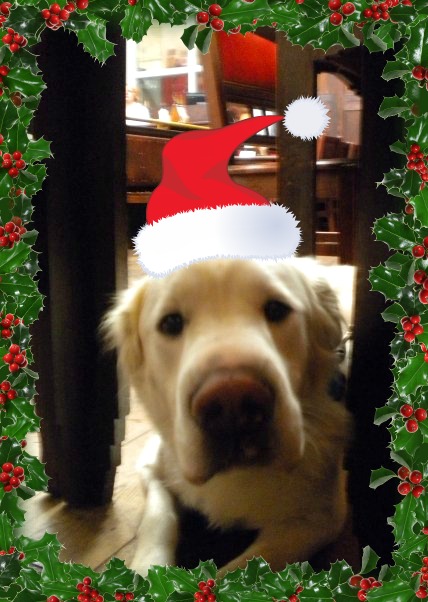
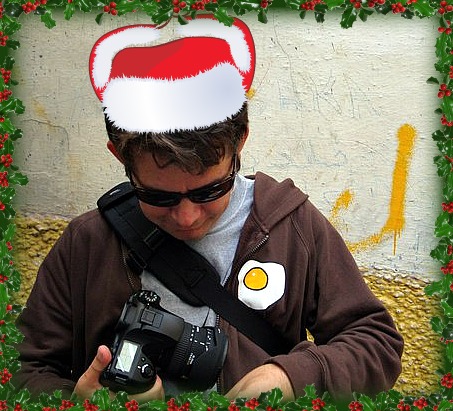
img: Turner Jansen under the table at Café Olivier Utrecht — taken in September 2009 but jazzed up for this post. (Turner’s comment: “Not sure I like this hat. Woof!”)

STAY TUNED for tomorrow’s installment from our displaced fictional heroine, Libby, who is still recovering from the shock of her mother-in-law’s body piercing. (What, not keeping up with Libby? Read the first three episodes of her expat adventures.)

If you enjoyed this post, we invite you to register for The Displaced Dispatch, a round up of weekly posts from The Displaced Nation, with seasonal recipes, book giveaways and other extras. Register for The Displaced Dispatch by clicking here!

Related posts:

RANDOM NOMAD: Aaron Ausland, NGO Research Director & Development Practitioner

Born in: Eugene, Oregon (but raised in Plains, Montana, a town of 1,200)
Passport: USA*
Countries, states, cities lived in: Washington (Yakima, Tacoma, Spokane): 1989-95; Alaska (Anchorage): 1995-97; Bolivia (Bañado de la Cruz & Santa Cruz): 1997; 1998 – 2002; Washington (Seattle): 2002-03; Massachusetts (Cambridge): 2003-05; Guatemala (Guatemala City): 2004; California (Duarte): 2006-10; Colombia (Bogotá): 2010 – present.
Cyberspace coordinates: Staying for Tea | Good Principles and Practice of Community-based International Development (blog); @AaronAusland (Twitter handle); Aaron Ausland at Huffington Post (column)
*My passport is only three years old, but multiple entries to about 40 countries filled it right up and I’ve had to add more pages. By the end of this year, I will have slept somewhere other than home about 190 of the 365 nights.

What made you leave your homeland in the first place?
My late first wife and I wanted to make a difference in the world and were particularly passionate about issues of justice, peace, and poverty. After graduating from university, we decided that maybe the best place to match our greatest gifts with the world’s greatest needs was in the public policy arena. We thought it would be good to represent a view on behalf of the marginalized — those uninvited to the table where policy decisions are made that nevertheless affect their lives in profound ways. In particular, we were thinking of illiterate poor persons living in underdeveloped countries ruled by bad or incompetent leaders and subjected to all the crap that comes with weak institutions of governance.

But we realized it would be pretty lame to run off to graduate school straight out of undergrad and then find some job in a policy think tank or as a Congressional aide in the hopes of working our way up to having a place at the table with a mind to represent these unrepresented views when we really hadn’t a clue what they were.

So we made a three-year commitment with the Mennonite Central Committee to go live and serve in a Bolivian village with people who fit this description.

We were young, hopeful, idealistic, earnest, and naïve. I can say that I’m not so young anymore.

Is anyone else in your family a “displaced” person?
I have a brother who served in Iraq for a couple of years, but he now lives about a hundred meters from our dad’s house in Yakima, Washington. I’m really the only one in my family who has chosen a lifestyle for which the question “Where are you from?” generates a confusing jumble of explanation rather than a simple city-state combo. 

Unless you count my son, Thiago. He’s six and is definitely more “displaced” than me. He literally speaks of living in two different “worlds.” In one “world” he speaks Spanish, has a home and school in Colombia, where his sister was born, and has family in Bolivia (his mother is Bolivian). In the other world” — where he says he is really from — he speaks English and has friends in California and a large family on my side including a whole set from my late first wife. Yesterday he told his mother: “My brain is confused, I don’t know where I should live. All my friends are in California, but my cousins are in Bolivia, and I go to school in Colombia and have friends there, too.” Poor little nomad.

Describe the moment when you felt most displaced.
For me the question was “How the hell did a small town boy from Montana end up here?” Physically, at that moment, “here” was a stainless steel operating table in a dark and empty hospital room in Santa Cruz, Bolivia. But more profoundly, “here” was a situation so far from my expectations, I was literally struggling to connect the dots and figure out how I had gotten myself there. I was 25 years old. Somewhere in a ravine a hundred miles away lay the broken body of my wife. A few hours earlier, the public bus in which we were riding had missed a turn on the narrow, winding road that passes through the Andean foothills and tumbled 1,000 feet into the dark.

She and I had gone to Bolivia with a long-term vision of our lives together, and now I was here, in a foreign land, alone, the slate of the future wiped clean. It was so profoundly disorientating, I just kept coming back to the question: “How did I get here?” Maybe it was a way to push off the searing emotional pain that would come with facing into my new reality, but the question wouldn’t go away. What sequence of events and decisions led me here? Did I make a mistake?

I remembered scenes from my idyllic boyhood in small-town Montana when my whole world was contained in a 100- mile radius and a handful of friends and family members. How had the world gotten so big, so uncertain, so complicated? And what was I doing wandering around in it like a lost child? How had I gotten here?

Much later, I would decide that I hadn’t made any mistakes. My first wife and I had made decisions based on a set of values that we held in earnest and I continue to hold. The fact that those decisions led to tragedy does not diminish the certainty of those values — it just means that those who hold them are not exempt from catastrophic loss that come to all who live.

I know you were probably hoping for a funny anecdote about crazy food or wacky cultural misunderstanding, but this is my one true displacement story.

Describe the moment when you felt least displaced.
Nowadays, I feel a sort of indifference about the whole location thing, to be honest. Whether I’m living in Cambridge attending the Kennedy School of Government, or setting up a new home in Colombia, or sitting where I am at this moment at an outdoor bar in a hotel in Bamako, Mali, I feel neither particularly at home nor particularly displaced. Feeling at home has a lot less to do with place than it used to, and it’s often unpredictable. I can feel more at home in Albania when I have a good macchiato and an Internet connection to video Skype with my children than I might in a hotel in Atlanta after a missed flight, with a dead computer battery. I can feel more at home when I’m sharing a beer with a fellow expat I’ve just met in rural Cambodia than I might sharing a beer with an old friend I grew up with who never left Montana.

I’ve experienced profound moments in my adopted homelands — from becoming a widower, to getting married, to rejoicing at the birth of my daughter, to undergoing major medical treatment. In each of these, it was the people who surrounded me that made me feel at home, and the uniqueness of the event that made me feel displaced. The location or culture has ceased to hold much power over my perception of self at particular moments.

You may bring one curiosity you’ve collected from each of your adopted countries into the Displaced Nation. What’s in your suitcase?
I’ll bring my wife from Bolivia, my son from the USA, and my daughter from Colombia. They are certainly a curious bunch, but I can’t live without them.

You’re invited to prepare one meal based on your travels for other Displaced Nation members. What’s on the menu?
Well, the cuisines of places like India, Thailand, Ethiopia, and Mexico are always worth sharing. The rich complexities that have come from centuries of experimentation with combinations of local flavors as well as some exotic additions from old trade routes are heritage gifts to the world. But, I’m sure someone will bring a few dishes from these parts into the Displaced Nation, so maybe I’ll bring some less likely ones such as the rich Malian sauce made in part from the boiled fruit of the baobab tree; the surprisingly filling chicken hearts strung on a kabob, flavored with soy sauce and charcoal smoke, sold on the streets of Bolivia; or maybe a lesser known dish from Mexico — the corn smut omelet made with cuitlacoche, a purplish fungus that grows on corn; or maybe I’ll just bring the beer…

You may add one word or expression from the countries you’ve lived in to The Displaced Nation argot. What will you loan us?
I think I’ll pass on this one. Pole sana (so sorry!) as we say in Swahili. Actually, maybe that’s a good one. Pole (pronounced POH-lay) doesn’t have an exact English equivalent — it’s used to say you empathize and understand someone’s problems, without the connotation of inferiority that “I pity you” might have.

This month we are looking into “philanthropic displacement” — when people travel or become expats on behalf of helping others less fortunate than themselves. Do you have a role model you look up to when engaged in this kind of travel — whose words of advice you cherish?
I’ve never really had a specific role model for philanthropic displacement. That said, I’ve always been impressed with people who make long-term commitments to live among the people they wish to serve and voluntarily forego access to comforts and safety they might otherwise enjoy.

There are some famous examples like Mother Theresa, but the ones that have had the biggest personal impact on me are unknowns — volunteers and professionals I’ve met and worked with along the way. Such people taught me how to live with a kitchen stocked with just 12 items — that’s counting the spices. They taught me how to bring my water up from the river in the morning and hang it in a tree from a bucket painted black so that the sun would heat the water throughout the day, in preparation for a warm evening bucket shower. I learned how to capture rain water, how to build dry latrines, how to trust local medicinal practices, how to enjoy silence, how to walk the equivalent of a marathon a day to visit local families, how to sit and unhurriedly share tea over conversations that circle around rather than cut to the chase, how to embrace simplicity as a virtue… I also forgot how to complain and remembered to be grateful in the midst of scarcity.

Most of my role models didn’t do anything spectacular — they didn’t invent microfinance or the treadle pump, they didn’t negotiate peace accords or write a best seller. But the way they displaced themselves so thoroughly, the way they embraced their local communities with such authenticity — this had a big impact on how the communities valued their presence and their contribution, and on me.

Voluntourism is said to be the fastest growing segment of the travel industry (itself one of the world’s fastest growing industries). Do you think this kind of travel can help the uninitiated understand the problems our planet is facing?
No, not really. It’s not that I think voluntourism is unequivocally a bad thing, but I just don’t think you can expect people to gain a very accurate understanding of complex problems under such circumstances. In fact, I think it’s more likely to leave them with a distorted understanding. There is a saying I picked up somewhere that goes something like this:

Travel to a new place for three weeks and you can write a book, travel for three months and you can write an article, travel for three years and you’ll likely have nothing to say.

There’s just something about a short and intense exposure that seems to set very strong ideas into the minds of those who’ve experienced it. But their ideas are biased by the specificity, narrowness, and brevity of that experience.

For example, someone who has had a high-impact experience volunteering in an orphanage for a week may feel they know more about the issue than people who haven’t had that experience. In fact, they may actually know less due to the biases they have picked up. It’s like believing you know something about the average person in a country from a single observation.

Sometimes, people know just enough to be dangerous; they mistake their shallow knowledge for an actual understanding of some enormously complex problem, and they act on it in ways that are ultimately irresponsible.

The truth is, the problems facing our planet are complex and we should all be grateful for the specialists who have dedicated their lives to understanding and addressing them. Doing something serious about addressing these problems will require professionals, not hobbyists; lifers, not tourists.

Again, it’s not necessarily a bad thing to pass through as a tourist, but with regards to your question here, we need to guard against self-deception. I’ve taken a few tours of a number of hydro-electric projects across the Western USA. I think they are really interesting. But, I know better than to believe I know the first thing about harnessing the power of water to generate electricity while balancing the ecological, economic, legal, social and political interests of farmers, consumers, industry, and the environment.

Likewise, you can’t take a two-day tour of an urban slum in Kenya and think you understand poverty, urban migration, economic development, or whatever other angle one might give such a tour.

For a broader scope of my thoughts on voluntourism, I encourage you to see my blog posts:

Readers — yay or nay for letting Aaron Ausland into The Displaced Nation? Tell us your reasons. (Note: It’s fine to vote “nay” as long as you couch your reasoning in terms we all — including Aaron — find amusing.)

img: Aaron Ausland in Mexico City (he’s the suit!). While on a lunch break from her work conducting a month-long operations audit of an NGO office, Aaron happened upon a lucha libre wrestling match putting on an outdoor show, and decided it would be amusing to pose with the star luchadore.

STAY TUNED for tomorrow’s installment from our displaced fictional heroine, Libby, when we get to find out whether she’s recovered from eating her mother-in-law’s undercooked Thanksgiving turkey. (Not keeping up with Libby? Read the first three episodes of her expat adventures.)

If you enjoyed this post, we invite you to register for The Displaced Dispatch, a round up of weekly posts from The Displaced Nation, with seasonal recipes, book giveaways and other extras. Register for The Displaced Dispatch by clicking here!

Related posts:
CLASSIC DISPLACED WRITING: Albert Schweitzer, early humanitarian & medic without borders

Fifty years ago, “Albert Schweitzer” was a household name. Nowadays it is hard to find anyone who knows who he is. But given our current theme of looking at those who’ve displaced themselves on behalf of humanitarian causes, today I would like to resurrect this great man for the purpose of honoring him with a membership in our Displaced Hall of Fame.

Were he still alive, Schweitzer, a brilliant theologian and musical genius who received the 1952 Nobel Peace Prize for his philosophy known as Reverence for Life, might not be all that flattered.

Then again, considering that he chose to spend much of his time living simply and without pretension in Africa, is it too far fetched to think he’d “get” what the Displaced Nation is all about? He might even have a good wheeze at learning of his elevated status among our citizenry…

A displaced early life

Schweitzer was born in 1875 in Alsace, which at that time belonged to the German Reich (it would change hands four times between France and Germany over the next 75 years).

According to Professor J. Rufus Fears who has lectured on Schweitzer for the Teaching Company:

Alsatians are their own people — neither French nor German, though they like to say they eat as much as the Germans and as well as the French.

Did being born an Alsatian give Schweitzer a head start on leading a displaced life? It’s tempting to think so. Curiously, although he spoke two languages — actually, three: Alsatian (a dialect of German), German and French — he professed not to believe that anyone was ever truly bilingual. He maintained that a person’s true native tongue could be discovered by asking:

What language do you count your change in when you give someone a dollar bill?

A displaced career

For our ceremony inducting Schweitzer into the Displaced Hall of Fame, we would do well to choose one of Bach’s organ works. While still in his twenties, Schweitzer distinguished himself not only in his chosen field of theology, but also as an organist and musicologist who specialized in Bach.

He wrote two early works that established his reputation in both of these fields: The Quest for the Historical Jesus (German, 1906; English translation, 1910), arguing that Jesus was human, not divine; and J.S. Bach (enlarged German edition 1908; English translation, 1911), a study of the life and art of Johann Sebastian Bach.

As if being an accomplished theologian and notable organist weren’t displaced enough, while still in his twenties, Schweitzer decided he would go out into the world and devote his life to humanity rather than remaining locked up in the cloisters of academe.

Upon turning 30, he shocked and horrified his parents and friends by declaring his intention to become a medical student in preparation for the life of a physician in French Equatorial Africa.

While studying medicine, he married Helene Bresslau, who although a scholar herself, became a trained nurse in order to share her husband’s life in Africa.

In 1913 the couple set sail from Bordeaux for what today is Lambaréné, Gabon.

The conditions the Schweitzers faced were desolate in the extreme. The climate — characterized by fiercely hot days, clammy nights and seasonal torrents of rain — was appalling. Besides the usual diseases, the natives were suffering from leprosy, dysentery, elephantiasis, sleeping sickness, malaria, yellow fever and animal wounds.

But the couple persisted through thick and thin (including a period of being interned during World War I), setting out to build a hospital on the grounds of the Lambaréné station of the Paris Missionary Society (they would later move the hospital to an even more remote spot).

Eventually, Schweitzer’s wife went back to Europe to raise their daughter, while Schweitzer himself carried on working in, and on behalf of, this remarkable medical facility until his own death in 1965. By then the compound had grown to more than 70 buildings, 350 beds and a leper village of 200, and the hospital was staffed by 3 unpaid physicians, 7 nurses and 13 volunteer helpers.

(It still exists today as the Albert Schweitzer Hospital, one of the leading research centers in sub-Saharan Africa training African doctors in the treatment of diseases such as HIV/AIDS, malaria and tuberculosis.)

Schweitzer, who passed away in the hospital itself, was buried next to the Ogooué River in a ceremony attended by hospital workers, lepers, cripples and other patients.

An epiphany of hippopotaman proportions

Schweitzer considered his work as a medical missionary in Africa to be a small recompense for the injustices committed by the African Continent’s European colonizers. In a sermon preached in 1905, he proclaimed:

Oh, this “noble” culture of ours! It speaks so piously of human dignity and human rights and then disregards this dignity and these rights of countless millions and treads them underfoot, only because they live overseas or because their skins are of different color or because they cannot help themselves.

By the time he dedicated his life to serving the natives of Africa, Schweitzer could no longer make the intellectual case for Jesus’s divinity. The French had recruited him to work in their mission as a physician not a pastor (somehow a Lutheran who didn’t believe in Christ was just a little too displaced!). Yet Schweitzer remained deeply spiritual. He wanted to find a philosophy that would persuade others to displace themselves to the most desolate places on earth, just as he had done — separate and apart from a proselytizing mission.

While on a boat trip on the Ogooué, Schweitzer noticed a herd of hippopotamuses swimming in the water, and thought to himself: what purpose does the hippo serve? He decided that the spirit of the universe had made this creature — and that this was reason enough to treat it with respect.

From that point on, he promoted the idea that man, in his quest for dominance, should never forget the need to show reverence and awe for all living creatures.

For Schweitzer, such a belief should suffice as motivation to reach out and help others who are less fortunate than oneself. You can almost sense his relief at discovering this philosophy from the epilogue he attached to his major autobiographical volume, Out of My Life and Thought:

Two observations have cast their shadows over my life. One is the realization that the world is inexplicably mysterious and full of suffering, the other that I have been born in a period of spiritual decline for mankind.

I myself found the basis and the direction for my life at the moment I discovered the principle of Reverence for Life, which contains life’s ethical affirmation.

His Reverence of Life philosophy further led him to warn against man destroying animals (what we know today as “animal rights”) as well as his environment — he was an early environmentalist, who predicted that man “will end by destroying the Earth” (Rachel Carson dedicated Silent Spring to him).

Schweitzer tried to put these principles in practice in all sorts of ways, but the two examples I like best are his refusal to teach his pet parrot how to talk (talking would lower its dignity), and his decline of an offer by a foundation to replace his dug-out canoe with a motorboat for fear it would pollute the Ogooué River.

Schweitzer’s relevance for today’s global nomads

In his lecture on Albert Schweitzer, Professor Fears insists that this early humanitarian still speaks to us. I agree and would add that he positively shouts to those of us who’ve chosen to live much of our lives abroad. For a start, we can find inspiration in his refusal to follow a conventional career path (a quality that, by the way, drove the bureaucrats in charge of French Equatorial Africa crazy).

But the really impressive thing about Schweitzer, of course, is his unconquerable spirit, his desire to do good. Despite living through two world wars, he carried on believing in mankind’s potential to treat life, in all its forms, with the reverence it deserves.

Even after World War II, when Albert Einstein called on him to speak out against the atom bomb, he did so despite his better instinct to get involved in politics (and suffered the fall-out of having funds withdrawn from his hospital when the FBI and CIA began persecuting him for his anti-nuclear-arms-race position).

The way I see it, we expats and “internationals” are perfectly positioned to understand where Schweitzer was coming from. Our travels have taught us that life, whether human or animal, deserves respect no matter where one is on the globe.

But how do we share this knowledge? What do we actually do with it?

As mentioned in my post on Richard Branson at the start of November, for some of us it’s challenge enough to cultivate our own gardens and hope that in doing so, some of our attitudes will rub off on others.

But Schweitzer, whom Fears calls a “living testimony to goodness,” clearly believed in the need to do more. And after a month of celebrating those who’ve done more — see our profiles of Adria Schmidt, Jennifer Lentfer, Matt Collin, and Vilma Ilic — I’m prepared to concede he is right.

To give the redoubtable Albert Schweitzer the final word:

I have always held firmly to the thought that each one of us can do a little to bring some portion of misery to an end.

STAY TUNED for Monday’s reflections on global philanthropy by third-culture-kid columnist Charlotte Day.

If you enjoyed this post, we invite you to subscribe to The Displaced Dispatch, a weekly round up of posts from The Displaced Nation, plus seasonal recipes, book giveaways and other extras. Sign up for The Displaced Dispatch by clicking here!

Related posts:


RANDOM NOMAD: Adria Schmidt, Career Consultant at Violence Intervention Program & Former Peace Corps Volunteer

Born in: Phoenixville, Pennsylvania USA
Passport: USA
Countries, states, cities lived in: Pennsylvania (Collegeville & Landenberg): 1985-87 & 1996 – 2004; Ohio (Cincinnati): 1987-96; Massachusetts (Boston): 2004-06, 2008-09; Argentina (Buenos Aires): 2007-08; Dominican Republic (Cambita Garabitos, San Cristóbal province): 2009-11; New York (New York): June 2011 – present.

What made you leave your homeland in the first place?
I guess you can say I left my homeland in search of a home. I never felt very “at home” as a teenager in Pennsylvania, so when the opportunity came to travel to Spain on a class trip I went eagerly. On this short trip I found that I felt more comfortable with some parts of the Spanish culture than with my own. The seed of wanderlust was planted.

When I went to school in Boston at Northeastern University, I decided to study the Spanish language, partly because of my interest in the language and the culture of Ibero-America, and partly because of my wish to study abroad.

Under Northeastern’s “Dialogue of Civilizations” program, I worked in Puebla, Mexico in a women’s prison, as well as in a small indigenous village in the mountains of Cuetzalan, where the people spoke only Nahuati. Both were amazing experiences.

And under Northeastern’s study abroad program, I lived in Argentina for nearly a year — during which I decided I wanted to help impoverished people in developing countries so would try joining the Peace Corps. Two years and one Master’s degree later, I was finally accepted and sent off to the Dominican Republic.

So did I ever find that “home” I was looking for? To be honest, my travels have only nurtured that original seed of restlessness. The more I travel the more I discover about myself and others — and the more I realize how much I still have to learn. For now, at least, home is wherever I want it to be.

Is anyone else in your family a “displaced” person?
As far as my immediate family goes, no one is or has ever been “displaced” — although I do like to think that my travels have inspired family members to explore other countries. My father was always one of those people who felt it would never be necessary to leave the United States as he had everything he wanted or needed right here. But when I went to Argentina, my parents decided to visit, and my dad absolutely fell in love with the country. To this day, he tells people that Argentina has the best pastries in the world. Now when I tell my parents I’m going overseas, they no longer respond by saying: “Why do you want to go there?” Instead it’s “When can we visit?”

Describe the moment when you felt most displaced.
One night in Cambita my host sister’s husband brought me a guayaba (guava). He was really excited for me to try one for the first time, and I didn’t have the heart to tell him I had eaten this fruit before in Mexico. After I ate it I started to feel nauseous and dizzy. Soon my lips began to swell and my whole face was itchy. I was having an allergic reaction to a chemical (a fertilizer or pesticide) that had been used on the fruit. I called the Peace Corps doctor, who told me to take two Benadryl and then a shower to wash the chemicals off.

When I got to the shower — an outdoor zinc and cement block latrine with a drain in the middle — I hung my towel on the cement blocks and poured cold water from a bucket over my head. It was already dark and I couldn’t see anything.

As soon as I finished, I wrapped the towel around myself and as I was heading back to the house, I felt a small sting on my stomach, then another one on my back, and another one on my chest. Soon my whole body was burning with these sharp little stings. Inside my towel was a colony of fire ants! I ran to my room, only to find it occupied. My host parents, Doña Romita and Don Rafael, were busy adjusting a new table the latter had constructed from an old cabinet. All I wanted to do was rip off my towel, but I could not get naked in front of my 70-year-old hosts!

By that time, the ants were all over my body. I was jumping up and down, shaking my towel and yelling for them to get out of the room. In all the commotion the oil lamp was knocked over and shattered on the floor. Doña Romita refused to let me in the room with the glass on the floor. Still unsure of what was wrong with me, she rushed me to her room. I quickly closed the door and whipped the towel off, slapping the ants off my body.

Just when I thought the nightmare was over I looked up and realized the shades were wide open and everyone outside the house had seen me naked and jumping around. At that moment, Doña Romita knocked on the door to tell me that my project partner and his wife were there to see me.

Describe the moment when you felt least displaced.
After being in the Dominican Republic for more than a year, I came back to the States to visit my friends and family. One night, while out with some friends all the girls couldn’t stop talking about their weight. They were commenting about how beautiful one of our friends was because they had never seen her so skinny before. All I could think of was how sickly she looked and how much I wanted to feed her. I couldn’t understand why being skinny was considered better while in the Dominican Republic being called “fat” or (my favorite) “fatty” was a compliment. My view of what was healthy and beautiful had been altered from my time in the Peace Corps.

You may bring one curiosity you’ve collected from each of your adopted countries into the Displaced Nation. What’s in your suitcase?
From Argentina: All the ingredients and utensils for brewing maté, a drink made from the leaves of the yerba maté plant, containing caffeine and related compounds. (This is sadly ironic since I accidentally left behind my maté in my apartment in Buenos Aires.) The yerba is packed into a hallowed-out gourd, which is then filled with boiling water. You drink the mixture directly from the gourd using a metallic straw with a filter at the bottom, called a bombilla. Some people walk around with a thermos of hot water and the gourd to drink maté whenever they have the urge. It has a very strong, bitter taste, but you can add liquid sugar.

From the Dominican Republic: Some large jugs of the tree bark, sticks and herbs that can be used for making the classic Dominican drink mamajuana. I assume the Displaced Nation has honey and rum we can add to it? After filling with rum and honey, you let the jug sit for a few days. You can also add cinnamon sticks soaked in red wine and honey, or raw squid and seafood soaked in rum. Men use the seafood mamajuana to boost their virility. Regular mamajuana supposedly cleans the blood, provides a tonic for liver and kidneys, relieves menstruation pains, and cures many other ailments (depending on who you talk to).

You’re invited to prepare one meal based on your travels for other Displaced Nation members. What’s on the menu?
I would make the meal I ate the most of in the Dominican Republic: rice, beans, plantains, and overcooked spaghetti with carnation milk, canned tomatoes, and corn. It’s the perfect carb overload — are any of you marathon runners?

You may add one word or expression from the countries you’ve lived in to The Displaced Nation argot. What will you loan us?
From Argentina: Che, boludo. Che is similar to the American word “dude.” I love che because it means that whenever I’m talking to someone and can’t remember their name, I can just call them che. Boludo technically means “jerk” (or worse), but it can also be used in an endearing way. My Argentinian friends and I always used to greet each other with a “Che, boludo!”
From the Dominican Republic: Vaina — though it technically means the pod around pigeon peas (gandules), everyone uses it to mean a thing or object. If I ever got stuck and couldn’t think of the Spanish word for something, I would just call it vaina while pointing to the object with my lips. It’s a great word for anyone learning Spanish.

This month we are looking into “philanthropic displacement” — when people travel or become expats on behalf of helping others less fortunate than themselves. Do you have a role model you look up to when engaged in this kind of travel — whose words of advice you cherish?
Strangely, I have never had a role model for this kind of travel. I was always drawn to it — but for some reason never felt the need to seek out others who had done it before me. My family were against my joining the Peace Corps because of fears for my health and safety. A psychic I met at a Renaissance fair right before leaving for Argentina told me I was going to do the Peace Corps. I don’t really believe in psychics but everything she told me that day has come true. So perhaps it was simply a matter of fate?

Voluntourism is said to be the fastest growing segment of the travel industry (itself one of the world’s fastest growing industries). Do you think this kind of travel can help the uninitiated understand the problems our planet is facing?
Voluntourism is a tricky subject for me personally. On one hand I feel that it is ridiculous to pay someone’s plane ticket, lodging, food, and transportation at a more luxurious level than any host country national has ever experienced to have them “volunteer” and do a job that a local person would probably be more than willing and capable of doing had all that money been spent on their salary. On the other hand, I do realize the value of cross-cultural communications for both parties and that, on the occasions when it’s done correctly, the volunteer might actually be able to transfer a valuable skill to the host country nationals. In short, it all depends on how the voluntourism is being executed.

While in the Dominican Republic, I observed many volunteers who were asked to do jobs that could have been, and in some cases even were once done by Dominicans. It wasn’t that the local population didn’t have the knowledge or training to do some of these jobs; it was that they didn’t have the money to pay a salaried person and wanted a “free” volunteer instead.

Luckily, most Peace Corps volunteers were successfully trained to avoid taking jobs away from Dominicans, and instead focus on areas where they and their community felt the need was greatest.

Readers — yay or nay for letting Adria Schmidt into The Displaced Nation? Tell us your reasons. (Note: It’s fine to vote “nay” as long as you couch your reasoning in terms we all — including Adria — find amusing.)

img: Hair washing ritual in Constanza, a mountainous area of the Dominican Republic, in spring of this year. Adria Schmidt is the one getting her hair washed — the one doing the washing is Rebecca, a fellow Peace Corps volunteer, and they are in the home of another Peace Corps volunteer, Malia (not pictured). Due to the primitive plumbing conditions, hair washing has to be done in the kitchen, by heating water up on the stove.

STAY TUNED for tomorrow’s installment from our displaced fictional heroine, Libby, who finds herself celebrating her first Thanksgiving under less-than-ideal circumstances. (What, not keeping up with Libby? Read the first three episodes of her expat adventures.)

If you enjoyed this post, we invite you to register for The Displaced Dispatch, a round up of weekly posts from The Displaced Nation, with seasonal recipes, book giveaways and other extras. Register for The Displaced Dispatch by clicking here!

Related posts:

RANDOM NOMAD: Jennifer Lentfer, International Aid Consultant, Writer & Blogger

Born in: Bruning, Nebraska USA
Passports: USA
Countries, states, cities lived in: Zimbabwe (Mutare & Harare): 1999 & 2002-04; Michigan (Detroit): 1999-2000; Pennsylvania (Pittsburgh): 2000-2002; Namibia (Windhoek): a few months in 2001; Malawi (Lilongwe): 2004-05; California (Santa Cruz): 2005-10; Washington, DC: two weeks ago-present.
Cyberspace coordinates: How Matters | Aid effectiveness is not what we do, but HOW we do it (blog); @intldogooder (Twitter handle)

What made you leave your homeland in the first place?
I grew up on a pig farm in Bruning, Nebraska, population 248. The graduating class of my secondary school had 16 people. Every time the phrase “it takes a village to raise a child” is uttered, I think “If only they really knew…” Thinking back, there were two very important teachers, one in high school, and another at university, who were extremely influential in shaping and expanding my world view. And my parents certainly raised me to cultivate a curiosity about life. This, along with my insatiable, youthful desire to get as far away from Nebraska as possible, was a combustible mix that shaped my career and life path.

Is anyone else in your family a “displaced” person?
I was the first person in my family to go or live abroad. I don’t think I even knew anyone who had been to Africa before my first trip abroad, at age 19.

Describe the moment when you felt most displaced.
On the bustling Nelson Mandela Avenue in Harare, Zimbabwe, in 2003. I always hated driving to city centre, but a colleague and I had to go to the immigration office to update our work permits. When we came out of the office, our car was blocked by another on the street. So we just got into the car and waited.

Eventually a man came up my driver’s side window and tapped on the glass. Not knowing him, I rolled the window down a couple of inches. This seemed to anger him and he walked away to talk to another man, a companion of his, who started yelling out to walkers-by that this white woman [me] would not roll down my window — I must think Africans are “stinky,” on and on… Luckily people didn’t engage him. There was a dynamic going on that I didn’t understand — apparently, I had parked in the man’s space, and he felt justified in scolding and harassing me for that.

After a few more minutes, the original man came back to my window, pulled out his wallet and his War Veterans identification card, placed it up against the glass and menacingly dragged it across. And then it made sense. The card, along with the man’s demeanor, indicated that he was probably one of the veterans of Zimbabwe’s war for independence, who’d been recruited by the Mugabe government for help in brutally suppressing opposition demonstrations, in murdering and torturing opposition leaders, and in seizing land on behalf of the government elite.

Eventually, the man had had enough with me. He motioned for the car behind me to move, and I backed out and drove away very quickly.

Obviously, my experience that day was nothing compared to the very real and severe political violence and torture experienced then and now by Zimbabwe’s opposition supporters. If I felt displaced, imagine how black and white Zimbabweans felt who were violently displaced from their lands on behalf of so-called fast-track land resettlement. And on another level, my experience was nothing compared to the everyday torments of living in a country where in a sense everyone (war veterans included) has been displaced from a state of personal dignity and safety, through subtle yet deliberate expressions of power.

Describe the moment when you felt least displaced.
Also in Zimbabwe — when talking with a group of local leaders in 2008. We were sharing stories about the issues women face in their struggles to raise families and improve their communities. One woman shared a brilliant story of triumph from being a physically and emotionally abused wife to now owning her own hairdressing business. She cried as she bravely told us about her life, and many others shared her tears.

Because I was there as a visitor, I was expected to respond (through a translator), and I took a chance in trying to break the tension and make the moment a bit lighter. I told her that I could tell she was a hairdresser because her plaits [braids] looked so perfect.

After the pause in which the translator shared what I had said, the room erupted in laughter. We were all reminded, no matter where we were from, of the sweetness of laughter through tears.

You may bring one curiosity you’ve collected from each of your adopted countries into the Displaced Nation. What’s in your suitcase?
I had quite the African basket collection going for a while until they were stolen from my storage unit in Santa Cruz. That’s all the thieves got since I was in the process of moving at the time. Their house probably looks really cool now.

You’re invited to prepare one meal based on your travels for other Displaced Nation members. What’s on the menu?
Peanut butter vegetable stew is what I crave — from Zimbabwe. Let me know which of these recipes you fancy:

You may add one word or expression from the countries you’ve lived in to The Displaced Nation argot. What will you loan us?
Zvakaoma. This is a phrase in Shona that means, “it’s tough” or “it’s difficult.” It also roughly translates to “shucks” in English or “c’est la vie” in French. It was a phrase I heard often in Zimbabwe because of the severe economic downturn and the unavailability of basic commodities and cash during my time there. To my ears, it was a very compassionate phrase. Zvakaoma — I lament with you; I feel your frustration and pain. Sometimes a well-timed zvakaoma can get you through your day.

This month we are looking into “philanthropic displacement” — when people travel or become expats on behalf of helping others less fortunate than themselves. Do you have a role model you look up to when engaged in this kind of travel — whose words of advice you remember when you find yourself in a difficult situation?
Great question — one that we aid workers should always be asking themselves as well, because how we go about developing our role or calling can have an impact on our effectiveness as helpers. Helping is hard. Unfortunately, there aren’t any simple solutions to aiding the poor.

Having worked in international aid and philanthropy for over a decade, I’ve come to admire the people who have managed not to totally lose their idealism and commitment to the work. So many aid workers become jaded and cynical — I can’t help but wonder if this hinders their effectiveness in the field.

In addition, I really look up to the leaders of local nonprofits and grassroots organizations in the countries where I’ve worked. I’ve had the privilege of working with over three hundred such groups in southern and eastern Africa during my career. Most were linked to local churches, schools, or clinics though some were also independent. They extend support and services into areas that are not reached sufficiently by government or international agencies.

The web of local initiatives in the developing world is still largely undocumented, unrecognized and under-resourced. WiserEarth.org conservatively estimates there well may be over a million such groups around the world! In my experience, these local leaders are there for kids, families and communities, whether funding or support from outsiders is available or not. Watching them and their persistence keeps me going.

Voluntourism is said to be the fastest growing segment of the travel industry (itself one of the world’s fastest growing industries). Do you think this kind of travel can help the uninitiated understand the problems our planet is facing?
Aid workers easily get frustrated when we see harm being done by well-meaning but naive tourists. Though if we are honest, that is how many of us got our start in this work. A great article by writer J.B. MacKinnon, entitled “The Dark Side of Volunteer Tourism,” provides a reality check. He wrote:

First, nothing is likely to stop the increase in person-to-person contact between people of the richer nations and people of the poorer. Second, there is much to be gained on both sides from this exchange. Third, those gains will be made through a series of small, personal, humbling errors.

To anyone considering voluntourism, I can recommend PEPY Tours in Cambodia. It’s doing voluntourism responsibly, thoughtfully, and respectfully — and has a great blog to follow, Lessons I Learned.

In general, I’d advise volun-tourists to ask critical questions of whatever project or trip in which they’re involved. Link the big issues to what you’re trying to do locally. It’s important to be curious about the root causes of poverty and vulnerability and what is needed for long-term change. Commit yourself to this learning process and never stop asking the deeper questions, whether it’s your first trip abroad or you’ve been working “in the field” for decades.

It’s also vital to recognize that every community has important non-monetary assets. When we come from a perspective of “we have so much, they have so little,” it’s easy to miss this. So the question becomes: “Who are the local leaders who are already doing great work who need the resources I have to offer?”

Finally, don’t let your good work become all about you. Place local people’s efforts before your own, in order to foster ownership and sustainability. Remember that whatever you do will always be secondary to the relationships you build.

Readers — yay or nay for letting Jennifer Lentfer into The Displaced Nation? Tell us your reasons. (Note: It’s fine to vote “nay” as long as you couch your reasoning in terms we all — including Jennifer — find amusing.)

img: From corn to cassava — Jennifer Lentfer talking with farmer and local leader Jones Pilo in Zomba, Malawi (2007).

STAY TUNED for tomorrow’s installment from our displaced fictional heroine, Libby, who is hoping that Oliver’s visit back to Milton Keynes doesn’t result in any surprise guests (Sandra, for instance!) at their first Thanksgiving. (What, not keeping up with Libby? Read the first three episodes of her expat adventures.)

If you enjoyed this post, we invite you to register for The Displaced Dispatch, a round up of weekly posts from The Displaced Nation, with seasonal recipes, book giveaways and other extras. Register for The Displaced Dispatch by clicking here!

Related posts:

RANDOM NOMAD: Matt Collin, Ph.D. Student in Development Economics, Researcher on Tanzania & Aid Blogger

Born in: Oxford, UK
Passports: USA & UK
Countries lived in: South Carolina, USA (Conway & Clemson): 1984-2001 & 2001-05; UK (Oxford): 2005-06, 2008-present; Malawi (Lilongwe): 2006-08.
Cyberspace coordinates: Aid Thoughts | Digesting the difficult decisions of development (currently on hiatus)

What made you leave your homeland in the first place?
I’m not sure I actually had much a homeland to begin with. Despite living in the American South for quite a long time, my parents — a well-traveled American father and an Anglo-American mother — kept me from completely identifying as a South Carolinian. Frequent trips to the United Kingdom to see my mother’s family made me very familiar with life there, although I don’t know that I managed to feel completely “normal” in either location.

This upbringing made it easier for me to leave the United States. While I felt very at home in South Carolina, it didn’t provide the best opportunities for the career I wanted to pursue, in development economics. Oxford did — plus it was familiar from previous visits.

Is anyone else in your immediate family “displaced”?
Both of my parents are “displaced.” My father spent a large hunk of his life in the Middle East and Europe. He ended up in England, where he met my mother. They returned to the US just after I was born. My mother, whose mother is English and father American, was born in the US but raised in the UK — the opposite of me.

Describe the moment when you felt most displaced.
My first few days in Malawi. I went there as a fellow with the Overseas Development Institute in the UK, which sends young economists off to developing countries on two-year stints to work as civil servants for the host government. (I’d been placed in Malawi’s Ministry of Finance.)

My connecting flight through Johannesburg was late, so I ended up tagging a long with an Asian Malawian man who got us onto a flight to Blantyre, Malawi’s commercial capital — which is reasonably far away from where I needed to be. I spent my first night in Malawi alone in a large, empty guest house, with a promise I’d be driven to Lilongwe the next day. I was young (22) and at that point possessed all the typical Western prejudices about African countries. Everything was unknown. What followed, though — a long, leisurely drive up the spine of the country — was an amazing and illuminating introduction.

Describe the moment when you felt least displaced.
It’s hard to pinpoint when you stop feeling displaced because you don’t really notice the absence of the feeling — you just feel comfortable.

The first time I started noticing how comfortable I felt in Malawi was during my first visit back to the UK. There was this sudden anxiety in realizing that there were things going on back in Malawi that I wouldn’t be around to observe. Your home is where you want to get back to, whether or not it is a physical place or a person, and I wanted to get back to Malawi, after having lived there for only eight months.

I suppose I felt least displaced after two years in Malawi, just as I was about to leave. I had never before felt sad about leaving a place, as my moves were always part of my personal trajectory — going to school, taking a new job, etc. Leaving Malawi was heart wrenching in a way I’d never experienced before.

You may bring one curiosity you’ve collected from each of your adopted countries into the Displaced Nation. What’s in your suitcase?
From the United Kingdom: British sweets — when I was young, I developed a major craving for fruit pastilles, wine gums and the like — and would horde them whenever my family visited the UK.
From South Carolina: Sand dollars and salt water taffy from Myrtle Beach, the beach town I used to live near. (The town is a little garish, but it’s incredibly relaxed in its tackiness.)
From Malawi: A small, simple scene constructed out of banana leaves, in a wooden frame. It’s of a small village in Malawi, with a striking blue sky — the sky takes up half the frame. I had it in my bedroom in Lilongwe, and it’s followed me wherever I’ve moved since. I think it does a good job of capturing the quiet, laid-back atmosphere of the country.

You’re invited to prepare one meal based on your travels for other Displaced Nation members. What’s on the menu?
This is difficult, as I’m not known for my cooking, but here we go:

For a starter, I’d serve an avocado and mango salad (both grown in Malawi).

For the main course, we’d have chambo curry (chambo is a fish from Lake Malawi, similar to tilapia) with nsima (ground maize meal) — preferably refried and spiced. Or if you’d prefer, I can replace the nsima with grits from South Carolina — they are practically the same thing. For good measure, let’s have fried okra from South Carolina on the side.

For drinks, I’d offer either iced tea (that South Carolina classic) or a bottle of Carlsberg Brown — technically Danish, but Malawi has had its own Carlsberg brewery for decades now, and it’s the only place that produces “Browns.”

For dessert, it’s hard to go wrong with apple crumble from the UK, a country that knows its desserts!

You may add one word or expression from the countries you’ve lived in to The Displaced Nation argot. What will you loan us?
From the US: Ain’t — it’s incredibly stereotypical, and I can’t say that I actually used it that often when I lived in South Carolina, but occasionally I’ve wanted to bust out with this in conversation in the UK, to enjoy the bewildered response it would inevitably elicit.
From the UK: Nip, or go quickly. I grew up using this, thanks to my parents. As it’s an extremely common expression in the UK, I always assumed it was known elsewhere. Halfway through my undergraduate degree, I announced I was nipping out to the toilet, when a friend leaned in and quietly said, “Matt, no one here knows what you are talking about.” It’s indicative of the slight difficulty of navigating two countries with a common language, but different vocabulary.
From Malawi: Zikomo (thank you!), short for zikomo kwanbiri (thank you very much). Very simple, very basic — yet it was the word I ended up using most often.

This month we are looking into “philanthropic displacement” — when people travel or become expats on behalf of helping others less fortunate than themselves. Do you have a role model you look up to when engaged in this kind of travel — whose words of advice you remember when you find yourself in a difficult situation?
“Philanthropic displacement” is a difficult concept — one I’m not wholly comfortable with. It’s very difficult to travel to a completely new place and effectively help. Assistance requires familiarity, knowledge, and humility, so I think the most successful philanthropists will be those who make this choice independent of their decision to become displaced.

That said, I think the kind of displacement that comes from actually living in a country is a necessary condition for effective assistance. Many Americans are paralyzed at the thought of going to live overseas, especially in “exotic” and distant, developing countries. In that sense, my father was my greatest inspiration. He felt that you needed to travel to understand the world — and that you need to understand the world before you can aim to make it a better place. This was in stark contrast to most of the people I encountered in South Carolina, who rarely considered leaving the state.

My father also instilled in me an interest in human development, and so I suppose if you combine the two — overseas travel and human development — you have a good motivation to get into a field like development economics, and go jetting off to Africa to see what life is like there.

Voluntourism is said to be the fastest growing segment of the travel industry (itself one of the world’s fastest growing industries). Do you think this kind of travel can help the uninitiated understand the problems our planet is facing?
The difficulty I have with voluntourism is that is supply, not demand, driven. Citizens of developed countries feel the need to go learn about and assist people in developing countries, but often they are doing very basic tasks, such as building schools, which could easily be performed by local people. A fundamental question we should ask ourselves for these small-scale voluntourism initiatives is: “If we gave the village the money that we spent on the project, would they still pay for our plane tickets over?”

What’s more, I suspect most Westerners could gain the same or similar insights from straight-up tourism. You can, for example, go on slum tours in Nairobi. And, while I find “slum tourism” to be a bit strange, it at least isn’t trying to justify itself. There are also plenty of longer-term volunteer opportunities that can yield more insights than a one-week visit to build a school can.

So I suppose my answer is: don’t be afraid to make visiting a developing country a regular vacation — tourism dollars also help, and you can stretch your boundaries a little bit more. By the same token, don’t be afraid to take a leap and go to one of these countries for six months — just as long as you don’t go under the presumption that in half a year, you’ll be able to improve things. This takes time.

Readers — yay or nay for letting Matt Collin into The Displaced Nation? Tell us your reasons. (Note: It’s fine to vote “nay” as long as you couch your reasoning in terms we all — including Matt — find amusing.)

img: Matt Collin on a rock near Domwe Island, Lake Malawi (New Year’s Eve, 2006).

STAY TUNED for tomorrow’s installment from our displaced fictional heroine, Libby, who, following a freak snowstorm in New England, has moved out of her house to avoid being turned into a popsicle. (What, not keeping up with Libby? Read the first three episodes of her expat adventures.)

If you enjoyed this post, we invite you to register for The Displaced Dispatch, a round up of weekly posts from The Displaced Nation. Includes seasonal recipes and book giveaways. Register for The Displaced Dispatch by clicking here!

Related posts: