The Displaced Nation

A home for international creatives

Tag Archives: UK

Tiffin: A displaced word of many meanings, but this one is sweetest

Special announcement from TDN: ML Awanohara and Kate Allison will be live-tweeting the Royal Wedding from a displaced perspective. Join us from 5:00 a.m. EST, using the hash tag: #DNRW Read more.

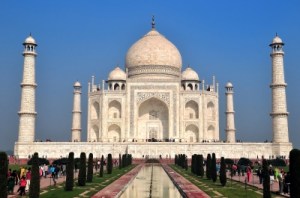
“Taj Mahal” by Arvind Balaraman / FreeDigitalPhotos.net

Tiffin – a word imported to England in the times of colonial British India, when, as well as being Queen of England, Victoria held the title of Empress of India.

Unlike other Anglo-Indian imports, such as gin and tonic or kedgeree, tiffin has shades of definitions – lunch, afternoon snack, or any light meal. My favorite definition, however, is the one given to me by my cookery teacher when I was twelve, which I’m sharing with you in honor of the wedding tomorrow.

It requires very little cooking, and if you start now, you will have enough time to make another batch to replace the one you intended to take to the street party but absent-mindedly ate instead.

One batch is never enough.

*

Tiffin

You will need:

100g / 4oz / 1/2 cup butter

50g / 2oz / 8 tablespoons desiccated (shredded) coconut – optional

50g / 2oz /1/3 cup seedless raisins

2 tablespoons golden syrup (see below if you’re unfamiliar with or can’t obtain this ingredient)

2 tablespoons powdered drinking chocolate (sweetened cocoa)

200g / 8oz / 2 cups broken digestive biscuits. If you can’t get digestive biscuits, graham crackers or crunchy oatmeal cookies would work.

100g / 4oz /2/3 cup plain (semi-sweet) or milk chocolate, as you prefer.

A 9″ x 9” cake tin, greased with butter. (Exact dimensions aren’t critical for the success of this recipe.)

Method:

1. In a small pan, melt the butter and golden syrup over low heat, then remove from heat.

2. Add coconut, raisins, drinking chocolate, and broken biscuits.

3. Mix well, then transfer to the greased tin. Pack down firmly with the back of a large spoon.

4. Put about an inch of water in a saucepan and bring the water to simmering point.

5. Break the chocolate into pieces and put in a heat-proof bowl (e.g., Pyrex). Fit the bowl over the pan of water, keeping the water simmering gently. Stir until the chocolate is melted.

6. Pour melted chocolate over the biscuit mixture in tin, and spread evenly.

7. Refrigerate for a few hours until chocolate is hard, then cut into small squares.

8. Serve with hot tea — of course.

*

Golden syrup

Golden syrup is a favorite in Britain and Australia. It’s thicker and sweeter than corn syrup, lighter in color than treacle (molasses), and  I knew it best for drizzling on my morning porridge before going to school.

In America it’s either unobtainable or very expensive, but according to an article on eHow, you can make your own.

You will need:

Heavy saucepan

1/2 cup white sugar

2 tsp. water

1 tsp apple cider vinegar

2/3 cup light corn syrup

Wooden spoon

Glass or plastic container

Method:

1. Pour the sugar in the saucepan, spread evenly over the bottom of the pan.

2. Mix water and vinegar, and sprinkle over the sugar.

3. Cook the mixture over low heat for five minutes. DO NOT STIR!

4. Turn the heat up to medium, and cook for a further five minutes, without stirring. Remove pan when mixture is a golden color.

5. Add light corn syrup and let mixture sit for 3 minutes. When the bubbling has stopped, stir well with wooden spoon.

6. Allow syrup to cool, then pour into a heatproof glass or plastic container, such as a mason jar. Seal, and store at room temperature. It will keep for two or three months.

(Thanks to my good friend and regular commenter on Displaced Nation, Joanna M-M, for sending me the link to this.)

*

Enjoy!

Img “Taj Mahal” by Image: Arvind Balaraman / FreeDigitalPhotos.net

If you enjoyed this post, we invite you to subscribe for email delivery of The Displaced Nation. That way, you won’t miss a single issue.
Displaced India Hicks throws in beach hat for Royal Wedding hat

Special announcement from TDN: ML Awanohara and Kate Allison will be live-tweeting the Royal Wedding from a displaced perspective. Join us from 5:00 a.m. EST, using the hash tag: #DNRW

On Sunday night I decided to indulge in nostalgia for my misspent youth in England. I watched a couple of TLC programs showing footage from the wedding of Charles and Diana on July 29, 1981.

I was there as a displaced American. Well, I wasn’t in London but at a street party in an East Anglian town.

To be honest, I have only the haziest recollection of how I spent the day: who attended the fete, what we talked about, what we ate. Part of the reason is my exceedingly poor memory.

But I think the lapse is also due to having been displaced so many times since then — to Japan, back to England, and now back to my native United States. England’s royal wedding no longer stands out in my memory compared to other landmark events I’ve observed, such as the marriage of Masako Iwada to Japan’s Crown Prince.

Always a bridesmaid, never a bride

I was therefore particularly taken with the TLC special Untold Stories of a Royal Bridesmaid, featuring model, interior design entrepreneur — and expat — India Hicks.

I kept wondering: does Hicks actually remember that hot day at the end of July 30 years ago? True, she was a bridesmaid for Princess Diana — but she was also only 13 at the time.

And, unlike many of the participants in that Royal Wedding, Hicks has moved on since, quite literally: she has put down roots on a three-mile-long fishing island in the Bahamas, where she lives with her family in a plantation-style oceanfront house.

Indeed, at 43, Hicks is living life on her own terms, a novel concept for a female who was born in the Royal Family orbit (Prince Charles is her second cousin and godfather, and she is 512th in line for the throne). As the New York Times pointed out in its profile of Hicks last month:

For many years, Ms. Hicks distanced herself from the royal circles that surrounded her childhood, focusing on developing her profession.

What’s more — and the Times didn’t point this out — she and her lifelong partner, David Flint Wood, have never bothered to marry, despite having had four children together.

Hicks may have been one of the two bridesmaids assigned to keep track of Diana’s 25-foot-long train, but she doesn’t appear to like weddings much, or else I assume she would have designed one for herself …

A most unroyal royal

I ask you, does this sound like something an heir to the British throne, however remote, would say:

I’d liked to have lived as Cleopatra. She didn’t take any crap from anyone, had lots of children out of wedlock, was intelligent and witty, known for her abilities and was a good stateswoman. I like most that she didn’t take any crap.

It’s what Hicks told the Wall Street Journal in an interview just a few days ago. You go, girl, as we say in the States…

So what’s in it for her besides money — and a higher profile for her brand, which is branching out next month to include jewelry? Not to mention her sense of duty (these are her people, after all).

British people are wont to say that the Royal Wedding provides a good excuse for a day off and a party. But for us displaced people, these affairs are a little different.

For Hicks as for many of the rest of us under equivalent circumstances, I suspect the wedding of Wills and Kate provides a good excuse to:

1) Indulge in a spot of nostalgia.

As Hicks remarks on her TLC special: “I think it will bring back memories that perhaps I’ve forgotten.”

As already mentioned, we displaced types can relate. The desire to recapture your youth intensifies if you are no longer living in your home (or adopted home) country.

2) Spend time in the home country.

As mentioned, Hicks has opted for the life of an expat, far from the madding crowds.

But, while retreating to a Caribbean island may sound like a dream come true, I imagine it has its dull moments, when one longs for a tad more intellectual and social stimulation.

Covering the Royal Wedding provides Hicks with the pretext for hanging out in her native land a little more and for introducing herself to such people as Diana’s wedding dress designer, David Emanuel. (The two haven’t met since 1981.)

3) Reconnect with family.

Living far away from one’s family is another penalty of the expat life, which tends to get steeper with time — especially for women who are close to their mothers.

By becoming a Royal Wedding pundit, Hicks has had the opportunity to reminisce about the good old days with her mother, Lady Pamela Hicks, for several of her TV specials.

A daughter of Lord Mountbatten, the last Viceroy of India (hence her daughter’s first name), Lady Hicks was herself a bridesmaid to Queen Elizabeth.

I particularly enjoyed the moment on the TLC special when mere and fille pull their respective bridesmaids’ dresses out of the boxes and compare them. Hicks thinks her mother’s looks more classical, while hers is dated — a product of the frilly 1980s.

* * *

On the “bridesmaid” special, the time that Hicks seems most enthused about revealing her stories is when she picks up the Halcyon Days china pot that Diana gave to all her bridesmaids, containing a silk worm that helped to produce The Dress. Hicks holds up the little white cocoon and gives it a rattle.

For that single instant, she looks as though she’s been transported back in her island home, having taken the road less (or more?) traveled by…and to which she will be jolly glad to return on April 30.

Question: In your experience as a displaced person, do events in one’s home (or adopted home) country — whether private or public — induce an overblown sense of nostalgia? I’d love to hear your stories.

If you enjoyed this post, we invite you to subscribe for email delivery of The Displaced Nation. That way, you won’t miss a single issue.

A displaced American writer, awash in sea of Royal Wedding apathy

Today we welcome Kristen Ashley to The Displaced Nation as a guest blogger. She wrote this post in response to Kate Allison’s “Jerry Seinfeld — the Royal Wedding’s Answer to Ricky Gervais.” Kristen is Kate’s opposite number: an American (originally from Indiana) who has been living in England: in a small seaside town in the West Country.

When I was asked to write an American’s perspective on Britain’s perspective on The Royal Wedding, at first I demurred. I did this because usually I have a lot to say on any subject but this one I didn’t.

This isn’t because I hold disdain for the upcoming nuptials. Indeed, back in the day when I was just thirteen, I, like many other Americans, woke up at an ungodly hour to watch Diana marry Charles. I did this with excitement akin to waking up Christmas morning. Well before their wedding day I was devoted follower of Diana and I still think she was a very stylish, kind and compassionate woman. And, living in England for eight years, I’ve come to respect Charles. And, lastly, it appears they raised two fine sons. In fact, the Royals as a whole seem okay in my book. I know they have their foibles but don’t we all?

Wedding — what wedding?

No, the reason I demurred from writing this piece was because no one here cares much about The Royal Wedding. In fact, William and Kate were engaged for days before I knew they’d made the announcement, and I only found out about it from seeing the Facebook statuses of my American brethren. Just yesterday, less than two weeks before the big event, I learned that Kate was given Diana’s ring, she wore blue during the announcement and did her own makeup. All this came from my sister who lives in Phoenix.

Therefore, considering the lack of interest was the piece, once I’d agreed to write it, I started to pay attention. By no means did I do any statistical research but I did make the effort to scan the magazines at the checkout counters, none of which, for weeks, had picture one of the happy couple and they still don’t.

A good day for a street party…or to mow the lawn

We get a bank holiday here for the wedding and that’s the only subject I’ve noted of any non-instigated chatter about The Wedding. Even so, no one I know is going to be sitting at home watching it. They’ll likely be in their gardens or on a jaunt to the seafront or some such British activity.

So, I brought up the subject, and not to talk about the bank holiday. When I suggested to a group of friends that we have a Royal Wedding party at my house, I received blank faces. The kind where someone is trying desperately to find a good lie where they can say they’re doing something important like grooming their cat and couldn’t possibly attend your party. The conversation died at that point and even when I told them I’d have plentiful Pimm’s and lemonade on hand there were no takers.

They did talk about the amusing anecdote of an article in the local newspaper describing how one small town was surprised that no one had applied to have a street party on the Big Day. Another indication that folks were taking the bank holiday not to celebrate the nuptials but to trim their rose bushes.

Time to load up on choccie biccies

I have noted, of late, that Clinton’s Cards has Union Jack decorations for sale should there be any takers but this display has only sprung up recently. And McVities has a commemorative tin of biscuits available — but it’s already on special offer and the event hasn’t even passed.

Other than that, it’s business as usual on this sceptred isle with everyone far more interested in what’s happening with Cheryl Cole and Katie Price than their future king claiming his bride.

As for me, I’m undecided. I’m curious about Ms. Middleton’s dress. That’s as far as I can build my interest. Perhaps it’s the lack of enthusiasm that surrounds me or perhaps the ugly, public and, in the end, literal death of the fairytale for William’s mother has soured me on the whole shebang.

I know this, if it’s sunny like it has been here for days, it’s unlikely I’ll be inside in front of a TV. This is England after all and you’re likely to be put to death if you sit inside when it’s sunny. I’m certain there will be plenty of photos on hand where I can examine the future queen’s wedding gown in detail.

But I’ll undoubtedly find them on American Web sites.

Question: How will you spend April 29th? And should the extra British holiday for the Royal Wedding be donated to a more enthusiastic audience?

Kristen Ashley is a novelist and the author of the Rock Chick Book Series. She offers downloadable chapters of her books, great recipes, and much more at www.kristenashley.net.

img: author photograph – Kristen Ashley

If you enjoyed this post, we invite you to subscribe for email delivery of The Displaced Nation. That way, you won’t miss a single issue.

What the concept of home means for expats

My mother was the kind of woman who knew she wanted to be a journalist from the age of 12. She never stopped moving. Maybe that’s why I remember so clearly the one ambitious sewing project that she managed to finish. It was a sampler that lay over one of the chairs in our family home embroidered with the words “Home is where the heart is.”

I’ve often pictured my mother’s needlework as I wandered the globe, first as an expat in England, then as an expat in Japan. Where was my heart, and therefore my home: with my mother, my husband, my husband’s family, or in some of the places I’d visited and connected with? Hadn’t I left a piece of my heart in each of those places?

Then when I finally returned to my native land, having spent as many years abroad as I’d consciously lived in the United States, I was no longer sure if this country could be my home any more, as it appeared to have changed so much.

Misery loves company, especially when it includes Joanna Penn

Oh, why does life have to be so complicated? Why can’t it be summed up on a sampler?

Still, I have taken much solace in knowing I’m not alone in grappling with such questions. Just last week, I was pleasantly surprised to discover that my expat-to-repat group now includes the extraordinary Joanna Penn, author, speaker, and business consultant.

I am a faithful subscriber to Joanna’s blog, The Creative Penn, which not for nothing has achieved the distinction of being one of the top ten blogs for writers. Recently, Joanna gave us the thrill of live-blogging the writing and self-publishing process for her very first novel, a fast-paced thriller called Pentacost.

Somehow, though, it hadn’t clicked with me that Joanna was an expat.

But then I read her 8 April 2011 post and watched the accompanying YouTube video, “What the Concept of Home Means for Writers.”

Joanna was prompted to talk about “home” because she’s repatriating to England after having spent the past 11 years in New Zealand and Australia. Not only that but it turns out that Joanna was a so-called third-culture kid. Her family moved all over the place when she was young, including to Africa for a while.

For Joanna, home is a spiritual bond

Joanna thinks outside the box when it comes to publishing, so I suppose I shouldn’t be too surprised that she thinks outside the box when it comes to being an expat. She seems to regard her displaced state as par for the course, as nothing particularly special. This is because she sees herself as a writer first and an expat second:

… for me the concept of home is not necessarily where I’m physically based at any one point but somewhere where I spiritually feel I belong…

We could say Joanna is out of the James Joyce mould, as described by Anthony Windram in his latest TDN article, “James Joyce’s Paris.”

This is not to say Joanna isn’t fond of the countries where she’s lived. She says she still has a soft spot for Malawi, where she went to school as a kid, and has enjoyed her more recent time Down Under.

That said, I sense she will be glad to see the back of Oz in some ways — judging by her response to one of the commenters on her “concept of home” post, that she is “looking forward to being without mosquitoes, huge spiders, sweltering heat and humidity.”

Joanna’s mention of the spiders gives her something in common with Robert Pickles, who has stirred up some controversy for his Daily Telegraph series on why he’s decided to ditch his dream of Australia and move back to Blighty — the “vast array of insects … with fizzing wings and frenzied little eyes” being at the top of his list of dislikes.

A tale of two cities that are now “home”

But that is where the similarity between Penn and Pickles ends. Unlike Robert Pickles, Joanna Penn never really thought of Australia as “home.” Right now she feels a spiritual kinship with two cities: Oxford, where she went to university and near where her father now lives, and Jerusalem, which she’s visited at least ten times because she loves it there so much.

What’s more, Joanna connects these two cities in her mind and has done so ever since reading the Thomas Hardy novel Jude the Obscure as a kid.

The novel’s tragic hero, Jude, is a working-class boy who tries to educate himself. He idealizes Oxford (known in the book as Christminster) as a “city of light,” where “the tree of knowledge grows.” Coming over a ridge and gazing at the city of his dreams for the first time, he refers to it as a “new Jerusalem.”

Joanna approves of Jude’s hypocatastasis. (“And did those feet in ancient time…” is now playing in my head.) Steeped in religious studies, she sees both Oxford and Jerusalem as holy cities, worthy of pilgrimages and therefore an intense romantic attachment.

Some parting spiritual reflections

In the week of Passover and Easter, I sometimes envy those people with strong spiritual ties, a pull that I’ve never especially felt.

In fact, the only time I’ve ever wanted to kiss the ground upon first discovering a place was when I landed in Taipei and my husband took me to a restaurant called Din Tai Fung. The dumplings were so delectable that I decided then and there that if ever I were told I had only a few days left to live, I’d demand to be transported to that restaurant for my final few hours.

Could a Taiwanese dumpling house really be my spiritual home? No doubt that explains why I’m writing about Jamie Oliver’s food revolution on this blog whereas Joanna Penn is working on her second in a series of religious thrillers set in Oxford and Jerusalem.

Still, fans of Ang Lee’s Eat Drink Man Woman should understand how I feel… My mother would understand it: she was an excellent cook, when she had time for it…

But I digress.

Question: What do you think of Joanna’s notion of a spiritual home? Is “home” for you a place that has captured your heart, your imagination and your spirit? Or is it a place where you live with your nearest and dearest?

If you enjoyed this post, we invite you to subscribe for email delivery of The Displaced Nation. That way, you won’t miss a single issue.

Jerry Seinfeld — the Royal Wedding’s answer to Ricky Gervais

“You’re from England, aren’t you?” asked the lady behind the supermarket checkout. “Will you be watching the Royal Wedding?”

I shrugged. “Probably not.”

“Well,” she said, “I will.”

Go figure.

Royal Wedding fever on this side of the pond has reached bemusing levels of hysteria. The happy couple’s faces smile from magazines at every checkout, and news channels fill their airtime with Royal Wedding stories. BBC America is running a program called “Royally Mad,” in which five Americans, chosen by the BBC for their worrying obsession with the Windsor family, are whisked to London for a few days of royal sycophancy and accumulation of Will-and-Kate souvenir teaspoons. In the interests of research for this post, I watched the first episode and, try as I might, couldn’t understand what made otherwise sane people turn on the waterworks at the sight of a ho-hum frock once worn by Princess Diana. Growing up in England, I was used to hearing the BBC speak of the Royals with hushed deference. This tearful swooning over recent Royal memorabilia was more suited for a US network channel documentary about a pilgrimage to Graceland.

In a very unscientific survey, I asked some of my English friends if they were looking forward to the wedding. The answers varied from a resounding “No!” to “Looking forward to the street party” to  “I love a good wedding.”  (So do I — when I personally know the parties involved.) Interestingly, the most enthusiastic responses came from expat friends in Singapore and Saudi Arabia. None, however, displayed the starstruck adulation of the Royal Family that I see  in America.

So why the American fixation with English Royalty? Americans had their most significant war while ridding themselves of the people whose descendants they now idolize. Legend has it they weren’t ready to give up the idea of a monarchy even then: a group of people wanted to crown George Washington as the first King of America, but he refused. Had his ego been bigger, Americans would now have their own King Paul.

But Washington’s decision prevailed, so another idol had to be found. The Kennedy dynasty is sometimes referred to as America’s Royalty, as are the President and First Lady. Presidents, though, must be elected — even when they are part of a political dynasty. True idols must have a birthright, be it a 1,000-year genealogy, a trust fund from the Hilton empire, or innate acting ability (especially when coupled with a last name of Redgrave, Barrymore, etc.)  In terms of public fawning and adoration, I feel it’s fair to compare English Royalty with Hollywood stars.

As I watch the hoopla surrounding this wedding, however, it seems the distinction between Beverly Hills and Buckingham Palace has blurred. Disney princesses are being confused with the real deal.  A few days ago on a BBC blog, an American commenter noted that she liked the way the Royal Family did their weddings openly. Hollywood stars, she said, held their weddings in secret now, and that was no fun.

Perhaps the Windsors could learn something from Hollywood.

One of the attractions of the Royal Family used to be its mystique.  Unfortunately, with the modern, out-of-control paparazzi and a gossip-hungry public denied the insight into Hollywood weddings, mystique is a thing of the past, and its disappearance was greatly aided by Prince Charles and Princess Diana separately airing their dirty laundry on TV in the mid-1990s.  It might be prudent for Royals either to stay out of the limelight or behave with a little decorum and sensitivity, as the Royal Matriarch has always done. Because when newspapers run stories about Prince Andrew spending taxpayers’ money on numerous helicopter rides to play golf, or Prince Harry turning up to fancy dress parties in Nazi uniforms, it’s hard for English Joe Public to go along with the notion that these people are privileged by divine right any more than Paris Hilton is.

I honestly am not being mean-spirited — I genuinely wish Prince William and Kate Middleton all the best for their life together, just as I would wish it for any couple about to get married. She seems a nice enough girl, and he understands the definition of ‘Love,’ unlike his father.  But the whole thing has been blown out of proportion, as Jerry Seinfeld controversially – or refreshingly, depending on your viewpoint – pointed out on Friday, when on a British TV show he called the wedding “a circus.”  “These are not special people,” he said.

The reaction from the show’s hosts (“How dare he!”) was not unlike that of the Washington Post  in response to Ricky Gervais’s comments at this year’s Golden Globes.

“Are we at war with England? If not, then why have we been subjected to two years of Ricky Gervais hosting the Golden Globe Awards?”

And yet despite the furor, Gervais is rumored to be returning to host the awards for a third time, proving that he did provide the shot of popularity that the Globes needed.

Windsors and BBC take note.  Judging by the number of positive comments from the British public about Jerry’s outburst, I am not the only Brit to feel nonplussed about the Wedding Of The Century.

For Harry’s wedding, book Jerry Seinfeld to do the commentary.

Adrian Chiles, host of the British TV show that featured Jerry Seinfeld, suggested that Seinfeld could end up doing his stand-up show on June 3 from the Tower of London.  Do you agree? If not, whom would you rather see in the Tower?

If you enjoyed this post, we invite you to subscribe for email delivery of The Displaced Nation. That way, you won’t miss a single issue.

Jamie Oliver, culinary expert — and now expat?

Try as I might, I can’t make out why Jamie Oliver has taken it upon himself to save my countrymen from themselves.

I understand he’s trying to start a food revolution. Not only that but I’m a supporter, having signed the online petition. After all, I lived in Japan for long enough to see that if a national diet is in essence health food, there are many fewer incidences of obesity, diabetes, and heart disease, and people live longer.

But why is Jamie Oliver, of all people, leading this campaign? That’s the part I haven’t been able to fathom. Before going to Japan, I lived in Britain, where Oliver was known as the “naked chef.” Call it a lack of imagination but somehow I never anticipated that the face of the Sainsbury’s grocery-store chain would someday transform himself into a food activist and arrive on my shores. What happened?

Don’t get me wrong, I’m glad Oliver has decided to export his food revolution. For me, his confrontation with the stony-faced lunch ladies at the school in Huntington, West Virginia — which has been called the unhealthiest city in America — goes down in the annals as reality TV at its finest.

(I’m still not convinced those ladies aren’t actors.)

And now that he’s back for a second season of his “food revolution” show, which premiered last night, I’m enjoying seeing him take on the members of the Los Angeles school board, next to whom the West Virginian women seem warm and welcoming. LA is the second-largest school district in the nation, serving over half a million processed meals every day.

I note that this time, Oliver brought his wife, Jools, and their four young children, to live with him in LA. Is he planning to become an expat? Stranger things have happened…

I can’t really explain why Oliver would choose to displace himself and his loved ones in the service of America’s overfed youth, but I can offer some half-baked ideas:

1) He doesn’t like being less well known than Gordon Ramsay.

Ramsay surpassed Oliver some time ago in terms of earnings and visibility. Indeed, last night’s show offered evidence of this in a scene involving Dino Perris, the owner of a fast-food drive through in Glassell Park, a working-class neighborhood in LA. Perris said he’d never heard of Jamie Oliver and thought he might be that “rude guy.”

The only thing wrong with this theory? Ramsay is best known for swearing a blue streak and Oliver for interacting with kids like the Pied Piper of Hamelin. Apples and oranges.

2) He is descended from missionary stock (hahaha).

In other words, it’s in his DNA to make converts beyond his own shores.

This theory, however, doesn’t hold water when you study Oliver’s family tree. Most of his people hailed from Cornwall and his great-great grandfather John Oliver was a Royal Navy seaman who did time in prison — not exactly the ingredients from which a food evangelist emerges.

3) He is escaping from Britain because his popularity is on the wane.

His fellow Brits have grown tired of seeing him running around in his green pea costume, so he is seeking a fresh audience.

At first this theory seems quite palatable. Most Americans probably don’t know this, but there was a backlash against Oliver’s “school dinners” program in the UK. It reached its peak when two mothers at a school in South Yorkshire started delivering junk food from local shops through the school fence, claiming that their youngsters didn’t want to eat the celebrity chef’s “overpriced lowfat rubbish.”

Still, I can’t believe that Oliver was ever put off by people who cooked up stunts that are, in effect, straight out of his manual. He loves nothing better than stirring the pot, and besides, he achieved what he wanted: the UK government established the School Food Trust, dedicated to improving the quality of food in the nation’s schools.

Okay, so I have no idea why he’s here. I might as well chime in with Jon Stewart, who, when Oliver appeared on his show last week, summed it up as follows:

You have come to this land you and you would like to help us become healthier, better people. Good luck with that.

And if Angelenos start throwing rotten tomatoes at him, I hope he has the good sense to move across the Pacific. Rumor has it that obesity rates among children in Asia are rising with the invasion of McDonalds, KFC, Pizza Hut, and so on.

If that doesn’t make him fed up, I don’t know what will.

Question: What do you think has made Jamie Oliver cross borders, and would you like to see him become an expat in the United States?

If you enjoyed this post, we invite you to subscribe for email delivery of The Displaced Nation. That way, you won’t miss a single issue.

“Over my ‘Ead,” by Jake Barton

Join The Displaced Nation in a glass of dry sherry and some delicious tapas in honor of our favorite displaced blog post of the week — “Over my ‘Ead” by Jake Barton.

Jake’s experience of language classes in another country reminds us that a common first language does not necessarily a friendship make:

“Who needed language classes? We decided we’d do as we’d done in France. Cultivate the society of locals, pick up the language in a natural manner, avoid red-faced expats wearing unsuitable clothing.”

Well said, sir.

Read Jake’s blog on writing and travel at http://jakebarton.com

If you enjoyed this post, we invite you to subscribe for email delivery of The Displaced Nation. That way, you won’t miss a single issue.

CLASSIC EXPAT WRITING: London and the English — Casanova

While inextricably linked in the imagination with his home city of Venice, Giacomo Casanova spent much of his life travelling and living in other parts of Europe. That ugly term “expat” which many of us, myself included, seem to cling onto as an identifier, was not in use in Casanova’s day, and to apply it to him retrospectively would seem to do him a great disservice. Casanova was a traveller and an observer, a man who seemed to treat Eighteenth Century Europe as a playground, a man whose life for the most part seemed permanently picaresque. Paris, St Petersburg, Dresden, Vienna, Warsaw, Prague, London: at some point all these cities played host to Casanova, and in his extensive memoir, Story of my Life he details his thoughts and observations about them all. While almost certainly someone we’ll return to at a later date, here are some choice extracts on his thoughts about London and the English. This is taken from the Arthur Machen translation of 1894.

On arriving in England:

The stranger who sets his foot on English soil has need of a good deal of patience. The custom-house officials made a minute, vexatious and even an impertinent perquisition; but as the duke and ambassador had to submit, I thought it best to follow his example; besides, resistance would be useless. The Englishman, who prides himself on his strict adherence to the law of the land, is curt and rude in his manner, and the English officials cannot be compared to the French, who know how to combine politeness with the exercise of their rights.

English is different in every respect from the rest of Europe; even the country has a different aspect, and the water of the Thames has a taste peculiar to itself. Everything has its own characteristics, and the fish, cattle, horses, men, and women are of a type not found in any other land. Their manner of living is wholly different from that of other countries, especially their cookery. The most striking feature in their character is their national pride; they exalt themselves above all other nations.

My attention was attracted by the universal cleanliness, the beauty of the country, the goodness of the roads, the reasonable charges for posting, the quickness of the horses, although they never go beyond a trot; and lastly, the construction of the towns on the Dover road; Canterbury and Rochester for instance, though large and populous, are like long passages; they are all length and no breadth…..

On whores and kings:

I visited the theatres of Covent Garden and Drury Lane, but I could not extract much enjoyment out of the performances as I did not know a word of English. I dined at all the taverns, high and low, to get some insight into the peculiar manners of the English. In the morning I went on ‘Change, where I made some friends. It was there that a merchant to whom I spoke got me a Negro servant who spoke English, French, and Italian with equal facility; and the same individual procured me a cook who spoke French. I also visited the bagnios where a rich man can sup, bathe, and sleep with a fashionable courtezan, of which species there are many in London. It makes a magnificent debauch and only costs six guineas. The expense may be reduced to a hundred francs, but economy in pleasure is not to my taste.

On Sunday I made an elegant toilette and went to Court about eleven, and met the Comte de Guerchi as we had arranged. He introduced me to George III., who spoke to me, but in such a low voice that I could not understand him and had to reply by a bow. The queen made up for the king, however, and I was delighted to observe that the proud ambassador from my beloved Venice was also present. When M. de Guerchi introduced me under the name of the Chevalier de Seingalt, Zuccato looked astonished, for Mr. Morosini had called me Casanova in his letter. The queen asked me from what part of France I came, and understanding from my answer that I was from Venice, she looked at the Venetian ambassador, who bowed as if to say that he had no objection to make. Her Majesty then asked me if I knew the ambassadors extraordinary, who had been sent to congratulate the king, and I replied that I had the pleasure of knowing them intimately, and that I had spent three days in their society at Lyons, where M. Morosini gave me letters for my Lord d’Egremont and M. Zuccato.

“M. Querini amused me extremely,” said the queen; “he called me a little devil.”

“He meant to say that your highness is as witty as an angel.”

I longed for the queen to ask me why I had not been presented by M. Zuccatto, for I had a reply on the tip of my tongue that would have deprived the ambassador of his sleep for a week, while I should have slept soundly, for vengeance is a divine pleasure, especially when it is taken on the proud and foolish; but the whole conversation was a compound of nothings, as is usual in courts.

After my interview was over I got into my sedan-chair and went to Soho Square. A man in court dress cannot walk the streets of London without being pelted with mud by the mob, while the gentleman look on and laugh. All customs must be respected; they are all at once worthy and absurd.

On matters of the stomach:

The Englishman is entirely carnivorous. He eats very little bread, and calls himself economical because he spares himself the expense of soup and dessert, which circumstance made me remark that an English dinner is like eternity: it has no beginning and no end. Soup is considered very extravagant, as the very servants refuse to eat the meat from which it has been made. They say it is only fit to give to dogs. The salt beef which they use is certainly excellent. I cannot say the same for their beer, which was so bitter that I could not drink it. However, I could not be expected to like beer after the excellent French wines with which the wine merchant supplied me, certainly at a very heavy cost.

On unruliness at the theatre:

After a long discussion on politics, national manners, literature, in which subjects Martinelli shone, we went to Drury Lane Theatre, where I had a specimen of the rough insular manners. By some accident or other the company could not give the piece that had been announced, and the audience were in a tumult. Garrick, the celebrated actor who was buried twenty years later in Westminster Abbey, came forward and tried in vain to restore order. He was obliged to retire behind the curtain. Then the king, the queen, and all the fashionables left the theatre, and in less than an hour the theatre was gutted, till nothing but the bare walls were left.

After this destruction, which went on without any authority interposing, the mad populace rushed to the taverns to consume gin and beer. In a fortnight the theatre was refitted and the piece announced again, and when Garrick appeared before the curtain to implore the indulgence of the house, a voice from the pit shouted, “On your knees.” A thousand voices took up the cry “On your knees,” and the English Roscius was obliged to kneel down and beg forgiveness. Then came a thunder of applause, and everything was over. Such are the English, and above all, the Londoners. They hoot the king and the royal family when they appear in public, and the consequence is, that they are never seen, save on great occasions, when order is kept by hundreds of constables.

If you enjoyed this post, we invite you to subscribe for email delivery of The Displaced Nation. That way, you won’t miss a single issue.

How many years should an expat stay? The answer is blowin’ in the wind…

Most human beings feel disconcerted when they lose the self-validating “mirror” that tells them who they are. That’s what we hear from the relocation experts — as cited by Kate Allison in her article exploring how even people who move within the same country can have something akin to an expat experience.

But in my own experience of being displaced, first in England and then in Japan, trying to live in a country where you share a great deal — ethnically, culturally, linguistically — with the natives is easier to sustain for lengthy periods. Under those conditions, it’s possible to maintain the illusion of the mirror still being in place.

After all, quite a few Americans — comedians like Ruby Wax and Reginald D. Hunter, writers like Bill Buford and Bill Bryson — have made it in England. In Japan, by contrast, although foreigners can become talento, they will never achieve the same level of belonging.

Thus when I first learned the news that Junichi Kinoshita had won this year’s Taipei Literature Award, the first non-native writer to do so in 13 years, I thought, well, no wonder. On the face of it, Taiwan should be a relatively easy adjustment for a Japanese person.

But does Kinoshita actually feel that way? Yes and no. His first impression of the Taiwanese was how similar they looked to the Japanese, and though he found learning Mandarin a challenge, he eventually mastered it to the point where he was able to write his debut novel in Chinese, and at a level that garnered it a prestigious award.

On the other hand, life in Taiwan posed a considerable culture shock as people there tend to be much more hospitable than the Japanese. In Kinoshita’s book, the title of which can be roughly translated as Dandelion Floss, five Japanese expatriates in Taipei struggle to adjust to the local culture — and when they finally get the hang of it, must grapple with the question of when (and whether) to go home to Japan.

At the end of the novel, one of them says:

I think every expatriate is following some kind of mysterious calling from their heart. There is some predestined relationship between a person and a city. One leaves the city when the affinity ends, be it a few months or 10 years, it just happens.

Kinoshita intended his book as a swan song to his life in Taipei. After submitting it to the contest, he planned to return to Japan with his wife, who is also Japanese. Now, however, they are rethinking their next step: perhaps the prize is a signal that Kinoshita isn’t finished with the city yet? Besides, he has already decided on a theme for his next work of fiction, as well as a language: Chinese again.

If you enjoyed this post, we invite you to subscribe for email delivery of The Displaced Nation. That way, you won’t miss a single issue.

The domestic expat

A photograph on a Minnesota news website showing a street in Brooklyn, NY, has the caption:

A long line of Minnesota expats wait to enter the “Minnesota State Fair Affair.”

Meanwhile, on a classified ads website, someone from Wales is looking for other Welsh expats to meet in a pub – in Winchester, England.

While convention and Wikipedia define an expatriate as:

any person living in a different country from where he or she is a citizen

it seems that this definition is being gradually challenged, as shown by these two examples. You no longer need to cross borders to be an expat. You can be a domestic expat. A fish out of water in your own country.

Leaving aside the touchy debate of whether Wales and England are separate countries – for the purposes of passport control and this article, they both come under the umbrella of the United Kingdom – this challenge, upon consideration, is perfectly reasonable.

An intrinsic part of expat life is culture shock, which is, says the University of Northern Iowa College of Business Administration,

the trauma you experience when you move into a culture different from your home culture.

It has several stages:

Excitement/fascination – ignoring small problems; a sense of being on extended vacation;

Crisis period – when difficulties arise, the new country turns out to have feet of clay, and you realize you can’t go home;

Adjustment – a change from negative attitude to positive; rediscovery of sense of humor;

Acceptance/adaptation – a sense of belonging in, and adapting to the new culture;

Re-entry shock – upon return to the original country, when the whole process starts again.

In her 2002 article, What To Expect When You Relocate, Achievement Coach Nancy Morris says:

Surprisingly to many, culture shock can show up even when relocating from one region to another within our own country – we assume ‘culture shock’ only occurs when moving to a completely different country.

If you’ve ever moved from London to Newcastle, or from New York to Alabama, or from Toulouse to Paris, you’ll know she’s right. All the symptoms above can be yours, and you don’t need the inconvenience of an international flight to get them. A domestic flight will do it – or, in the case of our Welsh example, a short trip along the M4.

Nancy Morris goes on to say that

moving to a new cultural environment can turn from culture shock to “self-shock”.

During most of life’s transitions – changing jobs, divorce, bereavement – we have a tendency to question ourselves, and who we are. Surrounded by familiar family, friends, environment, we are usually able to make sense of this question and find an answer, even as we struggle to accept the change in our lives. When the change is cultural, however, acceptance is more difficult. As Morris puts it:

At home we have a mirror which helps to validate and re-affirm us. Within a new environment, the mirror no longer exists. So, at a time when you are seeking the answer to the “who am I” question, your surroundings are asking “who are you?”

Surrounding yourself with culturally familiar people – those with the same accent as you, those who feel as displaced as you; in other words, expat communities – is just one way of putting that mirror back in its place.

And it doesn’t matter you’re an Englishman in New York, or a Welshman in Winchester.

If you enjoyed this post, we invite you to subscribe for email delivery of The Displaced Nation. That way, you won’t miss a single issue.