The Displaced Nation

A home for international creatives

Tag Archives: Third Culture Kid

Budding Slavophiles, welcome to my kitchen’s-eye view of Russia

As we learned from her Random Nomad interview with us in May, Charlotte Day is torn between three countries: Australia, USA, and England. As if this weren’t enough, it turns out she harbors an obsession with Russia, going back to when she discovered classical Russian novels in 8th grade. Here she spins a travel yarn about the her month-long sojourn in Saint Petersburg this summer, where she studied Russian language while living with a homestay family. So, did the real Russia live up to Charlotte’s expectations, or had her overactive imagination led her astray? Let’s find out…

Bolshoi Kazachiy Pereulok is not a notable St Petersburg street. It is a bent elbow between Zagorodniy Prospekt and the Fontanka embankment.

Emerging from Pushkinskaya metro station, one walks past a travel agency of sorts, a faded basketball court and Kazachiy Bani, a green-tiled 24-hour bathhouse from which emerge oiled men, rubbing their hair with threadbare towels. Peering through the open door, one can just about discern a gleaming ticket window, half plastered over with out-dated rate notices.

In the crook of the elbow stands Number 9, a magnificent turn-of-the-century apartment building, with geraniums tumbling over the serpentine-patterned grilling of occasional balconies. The building’s green façade, tinged as if by an eternal sunset, smiles mournfully over the street — watching as beer bottles clink and smash on the pavement, cats stalk along beneath decades-old cars, and the high gates open and shut in a kind of eternal song.

The plaque outside Number 7 reads: “In this building lived and worked Vladimir Ilich Lenin,” and on a rack beneath, three red carnations wilt.

I lived for a month at Number 5 — past the automated bell at the gate; through the courtyard, painted a warm, yet exhausted, yellow; up the shallow, concrete steps; and behind two locked doors — in the home of Nadezhda Skarinova, her husband, Kirill, and their son, Vladimir.

Striking up an acquaintance with the Skarinovas

While in theory I shared a home with entire family, the two male Skarinovs managed to be absent for the majority of my stay. Kirill, a chemical engineer, offered a smile — sometimes a privyet (hi) — whenever we met in the hallway.

But as he left for work as I was getting up, and had dinner immediately upon returning home at 6:30, we saw very little of each other.

Vladimir, or Vova, had been a source of much speculation before I set off — in the way that only unknown 21-year-old sons can be — among my well-meaning friends and relatives. (I am only sixteen.)

But he turned out to be largely taciturn, spending his days facing a computer screen (he was studying to become a programmer).

We had one two-sentence exchange — when he helped me down with my suitcase, on departure.

The only stories I can spin about my month in Petersburg involve minutiae. Such had been my idea of the perfect adventure before I left for Russia, in anticipation of what it would be like to be free from parental dictates for the first time.

Indeed, I did very little.

Not prone to escapades, I spent my evenings, after class, wandering along the Griboedov Canal Embankment (where I saw a drowned corpse—lying, swollen, neglected, and only haphazardly covered by a tarpaulin), or taking the metro into a far-flung, neglected suburb to spend ten minutes looking at an exquisite church.

But if my journey had less geographical displacement than those of most adventurers, my nightly dinner conversations with Mrs Skarinova made up for the lack by advancing me along the path of greater understanding of that strange thing — Russia.

A series of stove-side conversations

The first time I heard a bang on my bedroom door, and a gruff mozhno uzhinat? (roughly, “is it possible to have dinner?”) at 8:00 p.m., I hurried a nervous da, closed my book, and sidled into the kitchen.

The news was on, as it would be every subsequent evening — the twin anchors of channel Rossiya speaking too quickly for me to understand, their journalistic jargon blending into an unvarying mumble.

There sat Nadya, looking terribly bored, with large bags under her eyes. She poured me some tea from the eternal teapot. (Russians make tea by brewing a pot, which can keep, it would seem, for over a week—and then pouring a small amount, diluted with hot water, into your cup.)

Kuritsa — normalno? She presented me with a plate. As it was chicken, I nodded in assent.

Sitting down opposite me, shelling sunflower seeds — aimlessly, it seemed — she began to comment on the news.

Before I knew what had hit me, we were traipsing through the hardships of the 1990s — lining up outside an empty supermarket, clutching a prescription for baby formula. Mothers would rush from work during their lunch breaks, Nadya said, to secure a ration of bread for their family’s evening meal. And she’d had to bring up the infant Vova without the help of her mother — who died in her early sixties, from exhaustion.

And this was not the only thread Nadya spun over the course of our four weeks together. Another was the Orthodox Church. Her grandmother, who had lived through both world wars and the Russian Revolution of 1917 — and consequently wasn’t afraid of anything — spirited her granddaughter off to a church to be baptized, at a time when any hint of religion could make you a social pariah.

As a member of the Komsomol (“because everyone was in the Komsomol then”), Nadya hid her crucifix under her pillow. She told me that when religion resurfaced after the collapse of the Soviet Union, young couples longing for a church wedding were in a dilemma. How could they know if they had been baptized or not? Perhaps their grandmothers, like Nadya’s, had had it done in secret.

Nadya scowled as Patriarch Kirill appeared on the screen, leading a service in Kiev. His cardinal offense was the purchase of an expensive designer watch, several years back.

Many don’t like Patriarch Kirill so much… I’m an Orthodox person, but Patriarch Kirill… And he’s just one of the problems: for instance, why did they have to make Tsar Nikolai* a saint? What did he ever do? In his youth he was just a normal young man — women, alcohol, all that. What should I pray to him for? And his wife? Nothing wrong with her — German princess, worked in hospitals… And her little boy had that illness. But go to church and ask them for help? Yes, it was a tragedy, a crime — to kill all those children, too. Yes, the revolution oughtn’t to have happened. But Nikolai II a saint?

*With his family, Tsar Nicolas II, Russia’s last emperor, was recognized as a martyred saint and canonized as a passion bearer by the Russian Orthodox Church in 1981.

A samovar too big for the kitchen

On my last night in Petersburg, Mr Skarinova came into the kitchen bearing a large 1830s, wood-burning samovar — complete with chimney.

Nadya was not certain about this new addition to their lives.

It’s going to the dacha. No question about it. Wouldn’t fit in the kitchen anyway. And what am I going to do with a samovar like that? Put it in the bathhouse — na dachye. There’s no electricity in there.

The family had been to their dacha — a few hours south of the city — once while I had stayed at their apartment. They came back laden with berries: bitter and smelling of evergreen.

“All the men want to do there is drink,” Nadya told me one night. “I personally don’t drink — only wine. But Kirill…”

And another evening —

At least Kirill’s never come home drunk in the evenings. On holidays, yes — New Year’s… But the rest of the time — I don’t tolerate that sort of thing. What would have happened with Vova, a child, if dad kept coming home drunk? But it’s a common thing…

And judging by the beer bottles littering the street every morning when I walked to school, I doubt not that it is.

But this seems a catalogue of complaints — when my own experience of Russia was quite the reverse.

There was a moment when, crossing the Neva River on my last evening wander, I saw the spectral moon, blooming into fullness over the Winter Palace embankment.

And faced with that glut of unabashed beauty, I made an inarticulate noise — half of despair, half of exaltation — as people do in Russian novels. (It was only my English reserve keeping me from falling to my knees and weeping: the truly literary gesture.)

As it was, I left the next day feeling I would like to spend the rest of my life in Petersburg. But before I advance any further along that path, I must brave a winter without being killed by a falling snow drift. (“It happens,” says the Voice of Wisdom…)

But no matter how many tracks I beat in Russia, it is somewhat sobering to think of Nadya sitting, through endless reports of train crashes, patriarchal visits and state holidays, in that desperately uncomfortable chair, shelling sunflower seeds and passing the time.

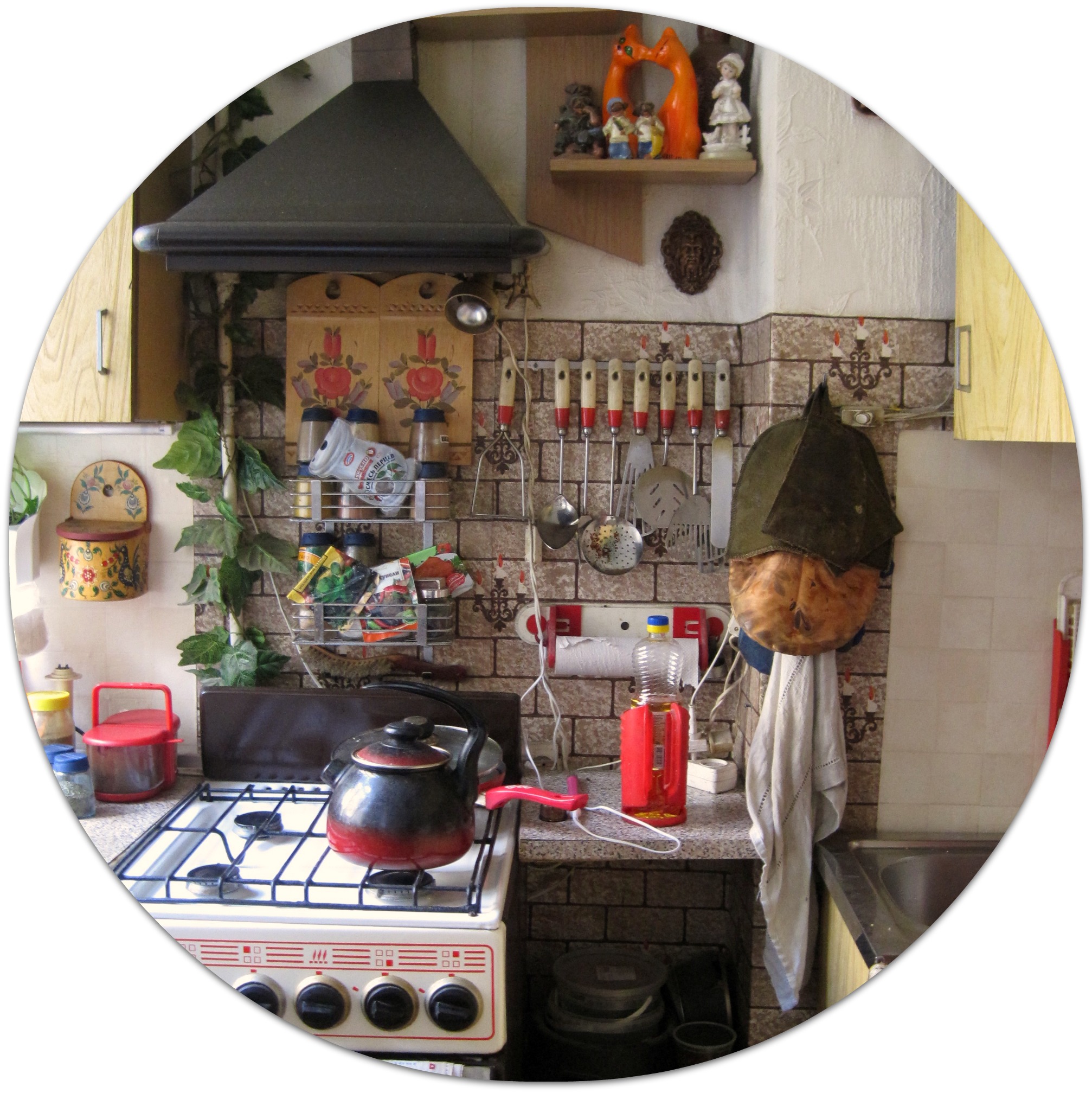
img: The Skarinova kitchen, where Charlotte’s nighttime chats with Nadya took place.

STAY TUNED for tomorrow’s post taking a parting glimpse at summer’s millinery enchantments, by our Alice awardee Sebastian Doggart.

If you enjoyed this post, we invite you to subscribe to The Displaced Dispatch, a weekly round up of posts from The Displaced Nation, with some fun extras such as seasonal recipes. Sign up for The Displaced Dispatch by clicking here!

Related posts:
RETURN TRIP: Random Nomad – Charlotte Day, High School Student (Sixth Former)

While our writers take off on what they hope will be enchanting August breaks, The Displaced Nation will occasionally be reissuing some posts that, for one reason or another, enchanted our readers. Enjoy these “return trips”!
As youngsters head back to school, we’re reissuing a Random Nomad interview ML Awanohara did with Charlotte Day, a displaced teenager in England. Charlotte spent a chunk of her summer taking a Russian-language course in St. Petersburg and living with a Russian family. She has produced a travel yarn on her adventures, which will appear on Monday.

Born in: Sydney, Australia
Passports: Australia, UK and US Green Card
Countries lived in: Australia (Sydney): 1994-2001; United States (New York, New York): 2001-2010; England (Sevenoaks, Kent): 2010-present

What made you leave your homeland in the first place?
My father is Australian and my mother English. They split up when I was two. When I was six, my mother met and married an Australian who had been living in New York for thirty years. I was rather disgruntled about moving to the United States and for two or three years, remained determined never to accept it as “home.” At that time, I was deeply patriotic to my native country — though this sentiment has dissipated since.

Is anyone else in your immediate family a “displaced” person?
My mother’s family, originally from England, has long been displaced. My mother herself was born in Kenya, in 1961. Following the Mau Mau Uprising, her parents were forced to relocate, and my grandfather, presented with a choice between Australia and Canada, chose the warmer of the two countries. My mother spent her childhood bouncing between schools in England and Australia. She eventually grew so fed up with packing and unpacking, she decided to leave school at the age of 16. Her father agreed to the plan provided she spend a final year at the school in Switzerland his own mother had attended as a girl. My mother moved on from Swiss finishing school to work in London, Paris and Sydney. But she appears to have made New York her last port of call. Indeed, we had a fairly solid life in the city until I decided to take myself off to boarding school in England.

Describe the moment when you felt most displaced over the course of your many displacements.
It must have been when I first arrived in New York as a six-year-old. I stepped out of the JFK arrivals terminal into a snowy March night. My stepfather was wearing a leather coat, the interior of his car smelled of leather — and the world outside the car window seemed an undulating stream of black and silver. Though it was the end of 2001’s warm winter, my Australian blood froze beneath my first-ever coat. And their apartment — that was all leather as well. It smelled of musk and cologne. Since that time, I have felt similar pangs of displacement, some of which lasted for considerable periods. But those first few moments in New York stand out as the most acute concentration of “displacedness” I have ever known.

Describe the moment when you felt least displaced.
For the last five or so years in New York, I have felt more at home than I ever did in Sydney. I ascribe this to growing up: at a certain age, one can take possession of a city, know its streets, bridges, tunnels and transportation system. I was too young when I lived in Sydney to reach that kind of comfort level. But when have I felt the most like a New Yorker? Perhaps it was the last time I came home for the holidays, and took the 4 train uptown for the first time in months. At that moment I realized how much this train had been a part of my life — conveying me home from school every day for two years. My old life would always be waiting for me on the subway, ready for me to pick it up again. That’s something only a New Yorker could say!

You may bring one curiosity you’ve collected from each of the countries where you’ve lived into the Displaced Nation. What’s in your suitcase?
From Australia: A miniature wooden wombat figurine — a gift from my grandfather. It conjures memories of a childhood spent beating about the bush (literally) and fishing for yabbies at the dam in the company of audacious dogs who stuck their heads down wombat holes, to no good end.
From New York: A pair of fake Harry Potter glasses. These defined my first six months in New York — I even wore them to my first day of school. I think it is telling that even at the age of six, I was unwilling to give all of my real self to this new home.
From England: My school tie — representative of the alternative universe I seem to have entered. At boarding school, the sense of removal from reality can be disconcerting — especially after having spent a decade in the city I regard as the world’s capital.

You’re invited to prepare one meal based on your travels for other Displaced Nation members. What’s on your menu?
I’d like to make you a Sydney breakfast: scrambled eggs, made with cream, salt and pepper and served on a bed of Turkish toast, with avocado and stewed tomato on the side (is this being greedy?). Our meal will be accompanied by a large “flat white”: what we call perfectly strong, milky coffee without excessive froth. I suggest we consume it overlooking a beach on a Sunday morning. At least, I assume The Displaced Nation has beaches?

You may add one word or expression from each of the countries you’ve lived in to The Displaced Nation argot. What words do you loan us?
From Australia: Daggy. I use this word all the time — and did not realize it was exclusively Australian until I was informed of the etymology. Apparently, it comes from trimming the soiled wool around a sheep’s bottom. Which part of this repugnant whole is actually the “dag,” I do not remember. (No, I’m not a proper Australian!) But as I understand it, “daggy” means sloppy in appearance or badly put together.
From New York: There are so many words, and most are second nature by now. However, I will choose grande-soy-chai-tea-latte because I still shudder to think of myself as the kind of person who can utter such a phrase, at great speed, with great insistence. In fact, I’m still in denial about my love for Starbucks: having known Sydney coffee, my standards should be higher.
From England: Banter. I still do not know the precise meaning of this word, but it seems to encapsulate everything that makes someone my age feel socially acceptable — and, of course, I have no banter whatsoever. I think it means the capacity for combining wit with meaningless conversation. But there are other components, too, which seem to me unfathomable.

Question: Readers, tell us what you think: should we welcome Charlotte Day to The Displaced Nation and if so, why? (Note: It’s fine to vote “no” as long as you couch your reasoning in terms you think we all — Charlotte included — will find amusing.)

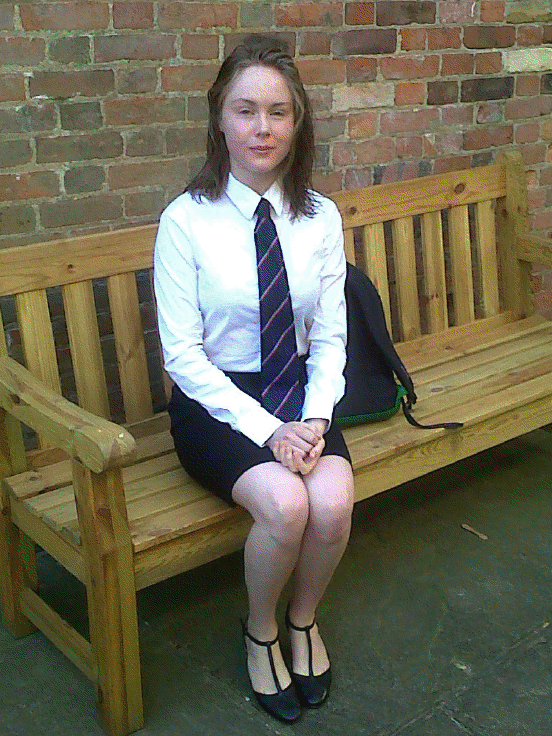
img: Charlotte Day at her boarding school in southeast England

If you enjoyed this post, we invite you to subscribe to The Displaced Dispatch, a weekly round up of posts from The Displaced Nation, plus some extras such as seasonal recipes and occasional book giveaways. Sign up for The Displaced Dispatch by clicking here!

Related posts:
RANDOM NOMAD: Vicki Jeffels, blogger, freelance writer & social media consultant

Vicki JeffelsBorn in: Auckland, New Zealand
Passport: New Zealand (only, and proud of it!)
Countries lived in: Fiji Islands (Vatukoula): 1973-77; Australia (Brisbane): 1996-98; England (Tadley, Hampshire): 2008-present
Cyberspace coordinates: Vegemite Vix | A Kiwi expat in the UK licking the Vegemite off life’s fingers (blog); Digital Discussions (start-up consultancy)

What made you leave your homeland in the first place?
I first became an expat at the tender age of 3.5, when my family moved to the Fijian Islands for my father’s work: he had a contract with the Emperor Gold Mines in Vatukoula. I have wonderful memories of expat life as a child. The days were honeyed with heat, we munched sugar cane off the back of the cane truck, and we swam with the tropical fish through the intricate coral reef. Of course, a child’s experience is so very different from an adult’s, and now I’m a parent, I’m more aware of the challenges my parents faced — which included being robbed, almost being airlifted out in civil unrest, and sheltering under the house during the monstrous Hurricane Bebe in 1972.

I moved overseas again — to Brisbane, Australia — with my first husband in 1996, with a two year old and two-week-old baby in tow. On reflection, that wasn’t brilliant timing. We struggled to make a home for ourselves particularly as my (then) husband was working in Perth, an eight-hour flight away — leaving me to cope on my own in a new country with two babies. I did it, though. I made friends through the children’s networks and found work for myself — until two years later, when my husband was suddenly made redundant and we limped back to New Zealand with our tails between our legs.

My most recent expat adventure started on a holiday in Paris in 2007 when I met a rather scrumptious Englishman. We chatted, we flirted, we kept in touch long after we’d returned home — and our long-distance relationship soon blossomed. A year later, I packed up my three kids (two teens and a tweenie), dog, cat and 20 boxes of books and moved to Hampshire to live with my Englishman. After a romantic engagement atop Mt Hellvellyan (yes, he made me climb a mountain to get the engagement ring!), we married in his village church in North Yorkshire in 2009.  I’ve written about our story on my blog and am currently writing it up as a memoir — hopefully coming to a bookstore near you, shortly.

Is anyone else in your immediate family displaced?
All of my immediate family currently live outside of New Zealand. My mother, father and sister all live in Australia, but I wouldn’t say they are “displaced.” They are all happy living there and hold Australian passports, and my mother is an Australian by birth.

Describe the moment when you felt most displaced over the course of your many displacements.
When I found myself standing in front of the judge at the Asylum and Immigration Tribunal in London three weeks after our wedding, having swapped my wedding bouquet for brickbats from the UK Border Agency, as they probed and prodded and demanded to find fault with our story. Standing there pleading to stay in the UK with my husband and kids — when everything in my body was screaming “Get me out of here!” and “Get me home!” — was one of the hardest things I’ve ever done. It was dissonant not only because we were newly married — and I longed to go home and celebrate with my friends and family but had been restricted from leaving the country — but also because I’m the archetypical “good girl” who has barely ever had a parking ticket. What was I doing standing in front of a judge being cross-examined by solicitors? It was scary stuff and deeply disturbing — as if the entire nation wanted me to just leave. It was the final straw after a year’s worth of feeling displaced — of saying the wrong thing and being laughed out of the room, and of breaking unwritten rules of conduct in the supermarket that resulted in an elderly woman throwing limes at me! Who knew there were rules about how and when you should put your shopping on the checkout counter?

Describe the moment when you felt least displaced.
This is a telling question, because although I’ve had some great times whilst living here in England, I can’t say that I’ve ever experienced feeling “at home.” My most recent trip Down Under highlighted for me how displaced I truly feel living in the UK, and how exhausting it can be spending one’s days trying to “fit in.” It was wonderful to have a break from explaining myself all day every day. It doesn’t help that I moved from an upmarket suburb of a large seaside multicultural city, to a parochial town in the English countryside. I wonder if I would feel more at home in London where there is a far more multicultural vibe? At times I wonder about moving again, perhaps to the US or Australia. (Is it itchy feet, or failure to fit in, that’s behind those feelings?)

You may bring one curiosity you’ve collected from each of the countries where you’ve lived into the Displaced Nation. What’s in your suitcase?
From Fiji: A frangipani flower. We used to make them into wreaths when I was a child. The smell reminds me of the South Pacific and makes me smile.
From New Zealand (which, though home, is now something of a foreign country): A pāua shell to remind me of the ocean and the beautiful Kiwi beaches.
From Australia: A boomerang because it will remind me that there is always a home behind me as well as in front of me.
From England:St George’s cross to remind me that I too can fight and defeat the dragons.

You’re invited to prepare one meal based on your travels for other Displaced Nation members. What’s on the menu?
I hope you like seafood! For starters I’ve prepared a Fijian raw fish meal called kokoda, which is “cooked” in coconut milk and lime juice. It’s divine. On the side there’s a dozen Bluff oysters from New Zealand. For mains we’ll have barbequed prawns, Moreton Bay bugs (Australia), and good quality pork sausages (British). We’d probably toast the meal with a New Zealand champenoise and down the sausages with a Margaret River Shiraz.

You may add one word or expression from each of the countries you’ve lived in to The Displaced Nation argot. What words do you loan us?
From Fiji: Bula — one of those indispensable words. It means “hello” and “thank you” and “How are you?” and “See you later” and “Good luck.” In fact, it’s a phonetic smile.
From New Zealand: Wopwops, meaning out in the bush away from everyone and everything else, preferably where there is no mobile signal and Internet. We all need to lose ourselves in the wopwops from time to time.
From Australia: Barbie — colloquial for barbecue, or BBQ. Particularly when eaten outside in the glorious fresh air and sunshine, with sand between your toes and the sound of the surf crashing on the beach, a barbie is one of the finest meals you can have.
From England: Bless — because the English have a way of saying it that sounds nice but is really derogatory. It’s so English to hear someone recount the story about how they did something stupid, and have the listener respond with “Bless” — really meaning “You moron!” I offer it to The Displaced Nation as a reminder of the need to master some of the local lingo, without which you’ll have a tough time understanding the folkgeist of the country you’re in.

It’s Alice in Wonderland month at The Displaced Nation. In closing, can you tell us your worst “Pool of Tears” moment, when you wondered, how did I end up in such a predicament and will I ever escape?
It, too, occurred during my struggles with the UK immigration authorities. Having moved to the UK to be with my Englishman, I was awaiting a valid work visa so was restricted from working. At the same time, my ex stopped paying child support. As we were struggling financially, I was stuck at home feeling terribly isolated. One day I received the news that I had been served with a deportation order and had 28 days to leave the country and return to NZ with my three children. I collapsed in tears, wondering how on earth I was ever going to afford going back to NZ where I no longer had property or anywhere to go. My savings had been eaten away by legal fees, and I had no income. I felt utterly dispossessed. In the end, we won the appeal against the deportation — my most displaced moment — and I was granted a valid visa, after which I regained the self-confidence I feared had been lost in transit.

Like Alice, did you encounter a Mouse who helped you ashore?
My Mouse would have to be the first friend I made in my English town after living here for almost two years. All that time I would cheerily smile hello at strangers — and they’d run away as if I were brandishing a knife. I was bitterly lonely and would live for Facebook chats with the many friends I’d left in New Zealand. Finally, on the school sports day I met an Englishwoman who had relatively recently returned from expat adventures in Canada. We bonded over our shared status as outsiders in a town where the majority of local people have family connections back through several generations. I refer to her as Strawberry Munchkin in my blog and am so very grateful for her friendship. I think of her as an honorary Kiwi.

QUESTION: Readers — yay or nay for letting Vicki Jeffels into The Displaced Nation? Tell us your reasons. (Note: It’s fine to vote “nay” as long as you couch your reasoning in terms we all — including Vicki — find amusing.)

img: Vicki Jeffels, taken in the UK for use on her blog.

STAY TUNED for tomorrow’s installment from our displaced fictional heroine, Libby.

If you enjoyed this post, we invite you to subscribe for email delivery of The Displaced Nation. That way, you won’t miss a single issue. SPECIAL OFFER: New subscribers receive a FREE copy of “A Royally Displaced Tea.”

Related posts:

RANDOM NOMAD: Helena Halme, Book Seller, Fashion Addict & Writer

Born in: Tampere, Finland
Passport: Finnish (only, and proud of it!)
Countries lived in: Sweden (Stockholm): 1971-74; Finland (Turku): 1975; Finland (Helsinki): 1975-84; England (Portsmouth): 1984-86, 1988; England (Plymouth): 1987; England (Wiltshire): 1989-2010; England (London): 2011-present
Cyberspace coordinates: Helena’s London Life | A Nordic view on style, fashion, art, literature, food and love in the city (blog)

What made you leave your homeland in the first place?
I left Finland for the first time as a 10-year-old with my family due to my father’s work, then moved back again for the same reason. And then I left Finland for good to marry my English husband. I’ve written 48 blog posts — soon to be a Kindle book called The Englishman — about how I came to be in England.

Is anyone else in your immediate family displaced?
My father is the only member of the family who still lives in Finland. My mother lives in Stockholm (she is remarried), and my sister lives also in Sweden (she married a Swedish man). Oh dear, that makes it sound as though we are are very man-dependent women, but I can assure you we’re strong and independent — really.

Describe the moment when you felt most displaced over the course of your many displacements.
I felt most displaced when I moved back to Finland at the age of 14. I didn’t want to leave Stockholm and felt completely alien in my home country. Since then I haven’t really felt at home anywhere. Although the two countries are divided only by the Baltic Sea, Finland was — and still is to a certain extent — a very different country to Sweden. The Finnish language is notoriously difficult, and in those days the culture was heavily influenced by Finland’s proximity to Russia (then the Soviet Union). Having lived in the very Western European city of Stockholm for three years, I saw my home country as being part of the Eastern bloc (even though it most certainly wasn’t). The radio played little pop music, and the TV was full of political broadcasts and dark plays about the struggle of the working classes. Western films took longer to arrive, and most people seemed dull and depressing. Nobody smiled and they all dressed in old-fashioned clothes. There seemed to be nothing you could buy in the shops. My sister and I would take the ferry across to Stockholm for many years afterwards — and wow our friends with the H&M clothes we brought back.

Describe the moment when you felt least displaced.
Once I had my children in the UK, I felt I belonged much more — although I took care to make sure they knew they were half-Finnish. To this day, we combine Finnish and English customs: have two Christmases, grow special grass for Easter called rairuoho, and so on… No particular moment stands out in my head where I’ve felt especially at home — yet! That said, the move to London last year has given me an even greater sense of belonging… Perhaps that’s it; perhaps it happened just this year, when we moved to Northwest London?

You may bring one curiosity you’ve collected from each of the countries where you’ve lived into the Displaced Nation. What’s in your suitcase?
From Finland (even though it’s my homeland, it remains somewhat foreign): A Finnish knife (puukko).
From Sweden: A slice of the traditional Swedish cake known as Prinsesstårta.
From England: BBC Radio 4.

You’re invited to prepare one meal based on your travels for other Displaced Nation members. What’s on the menu?
I love food and don’t think I’ve changed my tastes all that much since coming to the UK. Thus my menu for The Displaced Nation is mostly Scandinavian but with one concession to British tastes. (These days, of course, you can get almost any foodstuffs from Finland in London. Bless this multicultural city!)

You may add one word or expression from each of the countries you’ve lived in to The Displaced Nation argot. What words do you loan us?
From Sweden: Fy fan (bloody hell), because it just sounds right for a sense of frustration.
From Finland: Kippis (cheers) — it sounds like “get pissed” to an Englishman’s ears.
From the UK: That’s very interesting… The person who utters these words is usually dying of boredom. (A typical English white lie…)

A statement on your blog’s Home Page strikes us as being very Alice-like: “Rye bread not toast, pickled herring not fish & chips, cinnamon buns not Victoria sponge, ice-hockey not football, wander in a forest not walk in a park, silence not polite conversation.” Does the Alice-in-Wonderland story speak to the life you’ve led in the UK?
In England I’ve always felt as if I were the largest person in the room, particularly against the slight “English roses” — just as Alice did when she entered Wonderland. When I first arrived in this country, I’d often recall the words of the Queen of Hearts to Alice at the trial: “All persons more than a mile high must leave the court.”

QUESTION: Readers — yay or nay for letting Helena Halme into The Displaced Nation? Tell us your reasons. (Note: It’s fine to vote “nay” as long as you couch your reasoning in terms we all — including Helena — find amusing.)

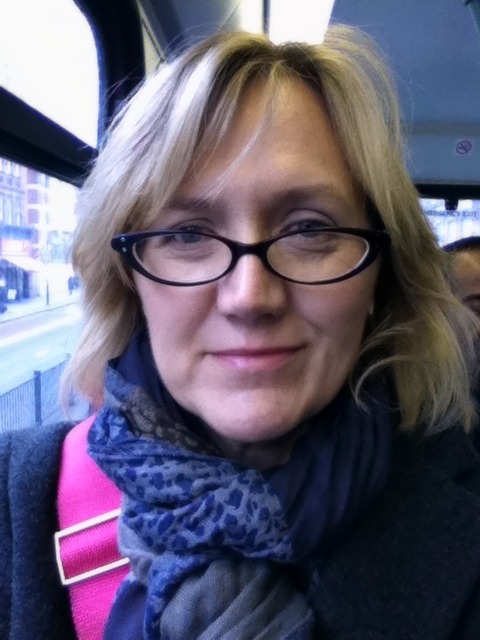
img: Helena Halme’s self-portrait on the number 13 bus. As Halme explained in a blog post last month, the No 13 featured in the British TV series On the Buses, which was broadcast on Finnish TV in the 1970s and was an early influence on her view of men in England. Also please note that Halme’s hair in this picture owes to her own efforts; she hadn’t yet discovered the Brazilian blow dry.

STAY TUNED for tomorrow’s installment from our displaced fictional heroine, Libby, who is debating whether Woodhaven, Massachusetts, is really the picture-perfect Wonderland it seemed at first sight. (She also meets a realtor who is most decidedly a Red Queen…)

If you enjoyed this post, we invite you to subscribe for email delivery of The Displaced Nation. That way, you won’t miss a single issue. SPECIAL OFFER: New subscribers receive a FREE copy of “A Royally Displaced Tea.”

Related posts:

RANDOM NOMAD: Balaka Basu, Ph.D. Student in English Literature

Born in: New York City, USA
Passport(s): USA
Countries lived in: India (New Delhi): 1981, 1987-89, 1991, 2003-04; Italy (Rome): 2002
Cyberspace coordinates: The Society of Friends of the Text (collaborative blog)

What made you leave your homeland in the first place?
I’ve inherited displacement from my parents, who moved (individually) to the United States from India for graduate studies and sort of never left. They made periodic attempts to pick up stakes and move back, taking me with them, but these never lasted for more than a year at a time. My childhood left me feeling like a person without a homeland, always living between worlds, never quite belonging anywhere.

Describe the moment when you felt most displaced over the course of your many displacements.
As a child, it used to be while saying — or rather, in my case, not saying — the Pledge of Allegiance at morning assemblies. Now, every so often, out of nowhere, I’ll have this weird sense of wanting to go “home” and smell the jasmine and the honeysuckle, and the smoky, pungent mustard oil, and have someone bring me a glass of freshly pressed pomegranate juice.

Describe the moment when you felt least displaced.
This is a difficult question because the land of my birth is sort of my adopted homeland. I was born in the United States — but was taken back to India when I was 28 days old. My first language is not English, but I can neither read nor write in Bengali. I’m pretty much always feeling displaced. However, I’ve got the subway map of New York tattooed on my heart, and it’s always been the place I’ve come back to. I love coming into the city early in the morning from points east and watching the rose-gold light of the sunrise reflecting back from the million glass windows. And one of the things I loved about Rome is that it felt a bit like Calcutta — a city also caught between two worlds, displaced all on its own.

You may bring one curiosity you’ve collected from the country where you’ve lived into the Displaced Nation. What’s in your suitcase?
From India: A beaten copper sculpture of a woman bathing, a gift from my father.
From New York: A poster of the New Yorker cover “View of the World from Ninth Avenue,” by the Romanian-born American cartoonist Saul Steinberg. It depicts the supposedly limited mental geography of Manhattanites.
From Rome: A copy of Bernini’s marble baby elephant.

You’re invited to prepare one meal based on your travels for other Displaced Nation members. What’s on the menu?
Llish (a fish only available in India/Bengal) in mustard and chili paste, which has been smoked in banana leaves; rice; green mangoes in oil; and for dessert, by way of Rome, blackberry gelato and an espresso.

You may add one word or expression from each of the countries you’ve lived in to the Displaced Nation argot. What words do you loan us?
From India: Arbit, short for arbitrary, used as slang in India. Whenever I hear Indian people say “arbit,” it reminds me that English is one of their national languages, too, and has evolved in a distinct and separate way.
From Italy: Prego: the indispensable word! How can you not like a word that means “if you please,” “you’re welcome,” “excuse me,” “would you mind if I walked in front of you,” and so on. You can say it any time, and it will almost never be wrong. How economical!
From New York (which I think is fair to include even though it’s my birthplace): I’ve got to go with the unprintable expletive here. When I go other places, it’s terribly difficult to remember that curse words aren’t universally accepted as terms of endearment.

This month The Displaced Nation is celebrating Alice in Wonderland as a literary analogue for disorientation and displacement. Upon entering Wonderland, Alice commits many social blunders, as when telling Mouse all about her cat, Dinah. Can you describe an instance where you inadvertently offended someone in one of your adopted lands?
Well, there was this one time when I met an astrologer in New Delhi, who apparently used to read the stars for a previous prime minister. I asked how anyone in the civilized world could take these things seriously. But I’m not sure that was exactly … inadvertent.

QUESTION: Readers — yay or nay for letting Balaka Basu into The Displaced Nation? Tell us your reasons. (Note: It’s fine to vote “nay” as long as you couch your reasoning in terms we all — including Balaka — find amusing.)

img: Balaka Basu by Edie Nugent, taken in Edie’s Manhattan apartment.

STAY TUNED for tomorrow’s installment from our displaced fictional heroine Libby — and see if you can spot the Alice references!

If you enjoyed this post, we invite you to subscribe for email delivery of The Displaced Nation. That way, you won’t miss a single issue. SPECIAL OFFER: New subscribers receive a FREE copy of “A Royally Displaced Tea.”

Related posts:

RANDOM NOMAD: Charlotte Day, High School Student (Sixth Former)

Born in: Sydney, Australia
Passports: Australia, UK and US Green Card
Countries lived in: Australia (Sydney): 1994-2001; United States (New York, New York): 2001-2010; England (Sevenoaks, Kent): 2010-present

What made you leave your homeland in the first place?
My father is Australian and my mother English. They split up when I was two. When I was six, my mother met and married an Australian who had been living in New York for thirty years. I was rather disgruntled about moving to the United States and for two or three years, remained determined never to accept it as “home.” At that time, I was deeply patriotic to my native country — though this sentiment has dissipated since.

Is anyone else in your immediate family a “displaced” person?
My mother’s family, originally from England, has long been displaced. My mother herself was born in Kenya, in 1961. Following the Mau Mau Uprising, her parents were forced to relocate, and my grandfather, presented with a choice between Australia and Canada, chose the warmer of the two countries. My mother spent her childhood bouncing between schools in England and Australia. She eventually grew so fed up with packing and unpacking, she decided to leave school at the age of 16. Her father agreed to the plan provided she spend a final year at the school in Switzerland his own mother had attended as a girl. My mother moved on from Swiss finishing school to work in London, Paris and Sydney. But she appears to have made New York her last port of call. Indeed, we had a fairly solid life in the city until I decided to take myself off to boarding school in England.

Describe the moment when you felt most displaced over the course of your many displacements.
It must have been when I first arrived in New York as a six-year-old. I stepped out of the JFK arrivals terminal into a snowy March night. My stepfather was wearing a leather coat, the interior of his car smelled of leather — and the world outside the car window seemed an undulating stream of black and silver. Though it was the end of 2001’s warm winter, my Australian blood froze beneath my first-ever coat. And their apartment — that was all leather as well. It smelled of musk and cologne. Since that time, I have felt similar pangs of displacement, some of which lasted for considerable periods. But those first few moments in New York stand out as the most acute concentration of “displacedness” I have ever known.

Describe the moment when you felt least displaced.
For the last five or so years in New York, I have felt more at home than I ever did in Sydney. I ascribe this to growing up: at a certain age, one can take possession of a city, know its streets, bridges, tunnels and transportation system. I was too young when I lived in Sydney to reach that kind of comfort level. But when have I felt the most like a New Yorker? Perhaps it was the last time I came home for the holidays, and took the 4 train uptown for the first time in months. At that moment I realized how much this train had been a part of my life — conveying me home from school every day for two years. My old life would always be waiting for me on the subway, ready for me to pick it up again. That’s something only a New Yorker could say!

You may bring one curiosity you’ve collected from each of the countries where you’ve lived into the Displaced Nation. What’s in your suitcase?
From Australia: A miniature wooden wombat figurine — a gift from my grandfather. It conjures memories of a childhood spent beating about the bush (literally) and fishing for yabbies at the dam in the company of audacious dogs who stuck their heads down wombat holes, to no good end.
From New York: A pair of fake Harry Potter glasses. These defined my first six months in New York — I even wore them to my first day of school. I think it is telling that even at the age of six, I was unwilling to give all of my real self to this new home.
From England: My school tie — representative of the alternative universe I seem to have entered. At boarding school, the sense of removal from reality can be disconcerting — especially after having spent a decade in the city I regard as the world’s capital.

You’re invited to prepare one meal based on your travels for other Displaced Nation members. What’s on your menu?
I’d like to make you a Sydney breakfast: scrambled eggs, made with cream, salt and pepper and served on a bed of Turkish toast, with avocado and stewed tomato on the side (is this being greedy?). Our meal will be accompanied by a large “flat white”: what we call perfectly strong, milky coffee without excessive froth. I suggest we consume it overlooking a beach on a Sunday morning. At least, I assume The Displaced Nation has beaches?

You may add one word or expression from each of the countries you’ve lived in to The Displaced Nation argot. What words do you loan us?
From Australia: Daggy. I use this word all the time — and did not realize it was exclusively Australian until I was informed of the etymology. Apparently, it comes from trimming the soiled wool around a sheep’s bottom. Which part of this repugnant whole is actually the “dag,” I do not remember. (No, I’m not a proper Australian!) But as I understand it, “daggy” means sloppy in appearance or badly put together.
From New York: There are so many words, and most are second nature by now. However, I will choose grande-soy-chai-tea-latte because I still shudder to think of myself as the kind of person who can utter such a phrase, at great speed, with great insistence. In fact, I’m still in denial about my love for Starbucks: having known Sydney coffee, my standards should be higher.
From England: Banter. I still do not know the precise meaning of this word, but it seems to encapsulate everything that makes someone my age feel socially acceptable — and, of course, I have no banter whatsoever. I think it means the capacity for combining wit with meaningless conversation. But there are other components, too, which seem to me unfathomable.

Question: Readers, tell us what you think: should we welcome Charlotte Day to The Displaced Nation and if so, why? (Note: It’s fine to vote “no” as long as you couch your reasoning in terms you think we all — Charlotte included — will find amusing.)

img: Charlotte Day at her boarding school in southeast England

If you enjoyed this post, we invite you to subscribe for email delivery of The Displaced Nation. That way, you won’t miss a single issue. SPECIAL OFFER: New subscribers receive a FREE copy of “A Royally Displaced Tea.”

Related posts:

Mia Wasikowska — a Third Culture Kid who is no Cinderella

Neatly coinciding with The Displaced Nation’s recent themes of the Royal Wedding and Gothic Tales, Maureen Dowd in her New York Times article “Who Married Up: The Women or the Men?” compares Cinderella with Kate Middleton and Charlotte Bronte’s Jane Eyre.

While the comparison with Kate Middleton is oft-cited, Bronte’s tale is less obvious: the story of a society misfit Plain Jane who suffers a series of gothic melodramas before finally claiming her maimed prince – but on her own terms. It’s possible that at some point during her ten-year waiting game in which Prince William apparently called all the shots, Kate Middleton may have sympathized with Jane Eyre’s wistful statement in the latest adaptation of Bronte’s novel:

“I wish a woman could have action in her life, like a man.”

A shooting star who needs no wishes

Mia Wasikowska, who stars in the title role of Cary Fukunaga’s “Jane Eyre,” needs no such wishful thinking. The 21-year-old Australian had her first US TV role at 17, was named the following year as one of  Variety magazine’s Top Ten Actors To Watch, and won the 2010 Hollywood Film Festival Award for Best Breakthrough Actress. Until “Jane Eyre” came along, she was best known for her portrayal of Tim Burton’s Alice in Wonderland.

While it is hard to imagine two female characters more different than Jane Eyre and Alice,  they do share some similarities:  Jane’s feeling of exile, of being shunned by society, is echoed in Burton’s Alice. In an interview with Australian Harper’s Bazaar, Wasikowska spoke of her interpretation of the role:

“Alice has a certain discomfort within herself, within society and among her peers. I feel similarly, or have definitely felt similarly, about all of those things, so I could really understand her not quite fitting in.”

Although Ms. Wasikowska  does not elaborate about her own feelings of displacement — and certainly most young women feel insecure at some time or other —  one can’t help wondering if she is referring to travel experiences in her childhood and teens.

A TCK in Tinseltown

The daughter of an Australian father and Polish-born mother, Wasikowska is a TCK (Third Culture Kid.) She was born and raised in Canberra, Australia, and when she was eight years old the family moved to Szczecin, Poland, for a year, during which time they also traveled in France, Germany and  Russia.  At 17, she was cast in the role of Sophie in HBO’s “In Treatment,” which necessitated a move to Los Angeles.

One could argue that anyone, of any nationality, who is flung into the Hollywood carnival at such a tender age could qualify for the label of TCK.

Ignore the naysayers

The US Department of State defines Third Culture Kids as:

“those who have spent some of their growing up years in a foreign country and experience a sense of not belonging to their passport country when they return to it…they are often considered an oddity [and] what third culture kids want most is to be accepted as the individuals they are.”

A most depressing definition, highlighting the bad and ignoring all the good. It says nothing of the inevitable expansion of horizons that enable a TCK to empathize with other ways of life, to walk in another’s shoes – and if you’re an actor, the ability to walk in another’s shoes is crucial.

It would be nice to think that, despite governmental gloom, TCK experiences played a part in Wasikowska’s professional development and rocketing career.

Home is where reality is

Canberra is still Wasikowska’s home, however, and she lives there with her family between film projects. When asked by PopEater if she was treated like a celebrity at home, she answered:

“I still take the rubbish out and empty the dishwasher. It’s good going back for that reason.”

Well, that’s OK. After all, Kate Middleton said she intended to cook dinner for Prince William when they married.

And I expect even Cinderella swept a few floors in her new castle.

Img: Tomdog/Wikimedia Commons

If you enjoyed this post, we invite you to subscribe for email delivery of The Displaced Nation. That way, you won’t miss a single issue.

Ho’ omaika’i ‘Ana to TCK writer Tony Roberts

Aloha, reader. We would love for you to join our celebration of writer Anthony H. [“Tony”] Roberts, who produced our favorite article of the week, “No Time for Goodbyes,” a gripping account of his family’s sudden departure from Iran in 1978, when he was just 17.

Tony wrote his piece for Denizen, the online magazine for Third Culture Kids — kids who grew up in a culture or cultures other than their own.

Tony now lives on the Big Island of Hawai’i, so our fete in his honor, which has just begun, consists of a min-luau with traditional foods, mai-tais, and a hula performance.

You will also have a chance to engage with Tony directly as he’s agreed to respond to your comments and questions. (Mahalo, Tony!)

In fact, the hula dance is about to begin. Watch the series of three dances telling us why Tony’s life is so special:

#1: TRAGEDY

From Tony, we can learn about what it is like to be displaced by circumstance rather than by choice. Tony spent five years of his childhood exploring deserts in Saudi Arabia and three years as a teenager running wild in the streets and hillsides of the ancient city of Tehran. Then suddenly the Islamic revolution occurred, and before he had a chance to click his heels even once, he, along with his mother and sister, were transported back to their small farm town in Kansas, where he’d been born but no longer thought of as home:

The greatest sadness of leaving Iran in 1978 was its speed. Our departures were so fast that there was no time for goodbyes. All of my closest high school friends scattered to the winds. Tens of thousands of Americans lived in Tehran when I was there, and by the end of 1979 there were only 52 left — the American hostages.

#2: TRIUMPH

Tony has done something many expats only dream of: he’s written up his experience in a work of historical fiction. His book, published in February of this year, is called Sons of the Great Satan. It tells the story of an American teenager forging a friendship with an Iranian teenager in the last golden hours before the Shah of Iran falls and the country is engulfed by a whirlwind of chaos. Go to YouTube trailer.

#3: MULTICULTURALISM

Tony and his family embody our ideal of global citizens. His wife is a Kiwi, his son a Cherokiwi, and they live in Hawai’i, a melting pot of cultures from around the world, with influences from China, the Philippines, Japan, Korea, Portugal and Puerto Rico, to name a few. And let’s not forget Ziggy, the family pet. He’s a Boxador, a cross between the Boxer and the Labrador Retriever. (Ziggy, assuming Fergus makes it to The Displaced Nation, we’re sure he would enjoy palling around with you.)

And now, it’s time to adorn Tony with leis and drink a toast to his honor. Okole maluna! Cheers, Tony!

If you enjoyed this post, we invite you to subscribe for email delivery of The Displaced Nation. That way, you won’t miss a single issue.

What the concept of home means for expats

My mother was the kind of woman who knew she wanted to be a journalist from the age of 12. She never stopped moving. Maybe that’s why I remember so clearly the one ambitious sewing project that she managed to finish. It was a sampler that lay over one of the chairs in our family home embroidered with the words “Home is where the heart is.”

I’ve often pictured my mother’s needlework as I wandered the globe, first as an expat in England, then as an expat in Japan. Where was my heart, and therefore my home: with my mother, my husband, my husband’s family, or in some of the places I’d visited and connected with? Hadn’t I left a piece of my heart in each of those places?

Then when I finally returned to my native land, having spent as many years abroad as I’d consciously lived in the United States, I was no longer sure if this country could be my home any more, as it appeared to have changed so much.

Misery loves company, especially when it includes Joanna Penn

Oh, why does life have to be so complicated? Why can’t it be summed up on a sampler?

Still, I have taken much solace in knowing I’m not alone in grappling with such questions. Just last week, I was pleasantly surprised to discover that my expat-to-repat group now includes the extraordinary Joanna Penn, author, speaker, and business consultant.

I am a faithful subscriber to Joanna’s blog, The Creative Penn, which not for nothing has achieved the distinction of being one of the top ten blogs for writers. Recently, Joanna gave us the thrill of live-blogging the writing and self-publishing process for her very first novel, a fast-paced thriller called Pentacost.

Somehow, though, it hadn’t clicked with me that Joanna was an expat.

But then I read her 8 April 2011 post and watched the accompanying YouTube video, “What the Concept of Home Means for Writers.”

Joanna was prompted to talk about “home” because she’s repatriating to England after having spent the past 11 years in New Zealand and Australia. Not only that but it turns out that Joanna was a so-called third-culture kid. Her family moved all over the place when she was young, including to Africa for a while.

For Joanna, home is a spiritual bond

Joanna thinks outside the box when it comes to publishing, so I suppose I shouldn’t be too surprised that she thinks outside the box when it comes to being an expat. She seems to regard her displaced state as par for the course, as nothing particularly special. This is because she sees herself as a writer first and an expat second:

… for me the concept of home is not necessarily where I’m physically based at any one point but somewhere where I spiritually feel I belong…

We could say Joanna is out of the James Joyce mould, as described by Anthony Windram in his latest TDN article, “James Joyce’s Paris.”

This is not to say Joanna isn’t fond of the countries where she’s lived. She says she still has a soft spot for Malawi, where she went to school as a kid, and has enjoyed her more recent time Down Under.

That said, I sense she will be glad to see the back of Oz in some ways — judging by her response to one of the commenters on her “concept of home” post, that she is “looking forward to being without mosquitoes, huge spiders, sweltering heat and humidity.”

Joanna’s mention of the spiders gives her something in common with Robert Pickles, who has stirred up some controversy for his Daily Telegraph series on why he’s decided to ditch his dream of Australia and move back to Blighty — the “vast array of insects … with fizzing wings and frenzied little eyes” being at the top of his list of dislikes.

A tale of two cities that are now “home”

But that is where the similarity between Penn and Pickles ends. Unlike Robert Pickles, Joanna Penn never really thought of Australia as “home.” Right now she feels a spiritual kinship with two cities: Oxford, where she went to university and near where her father now lives, and Jerusalem, which she’s visited at least ten times because she loves it there so much.

What’s more, Joanna connects these two cities in her mind and has done so ever since reading the Thomas Hardy novel Jude the Obscure as a kid.

The novel’s tragic hero, Jude, is a working-class boy who tries to educate himself. He idealizes Oxford (known in the book as Christminster) as a “city of light,” where “the tree of knowledge grows.” Coming over a ridge and gazing at the city of his dreams for the first time, he refers to it as a “new Jerusalem.”

Joanna approves of Jude’s hypocatastasis. (“And did those feet in ancient time…” is now playing in my head.) Steeped in religious studies, she sees both Oxford and Jerusalem as holy cities, worthy of pilgrimages and therefore an intense romantic attachment.

Some parting spiritual reflections

In the week of Passover and Easter, I sometimes envy those people with strong spiritual ties, a pull that I’ve never especially felt.

In fact, the only time I’ve ever wanted to kiss the ground upon first discovering a place was when I landed in Taipei and my husband took me to a restaurant called Din Tai Fung. The dumplings were so delectable that I decided then and there that if ever I were told I had only a few days left to live, I’d demand to be transported to that restaurant for my final few hours.

Could a Taiwanese dumpling house really be my spiritual home? No doubt that explains why I’m writing about Jamie Oliver’s food revolution on this blog whereas Joanna Penn is working on her second in a series of religious thrillers set in Oxford and Jerusalem.

Still, fans of Ang Lee’s Eat Drink Man Woman should understand how I feel… My mother would understand it: she was an excellent cook, when she had time for it…

But I digress.

Question: What do you think of Joanna’s notion of a spiritual home? Is “home” for you a place that has captured your heart, your imagination and your spirit? Or is it a place where you live with your nearest and dearest?

If you enjoyed this post, we invite you to subscribe for email delivery of The Displaced Nation. That way, you won’t miss a single issue.