The Displaced Nation

A home for international creatives

Tag Archives: Memoir | Travel | Food Writers

THE DISPLACED Q: What’s your most memorable birthday abroad?

Hi everyone!

Now, since it’s our one-year birthday here at the Displaced Nation — okay, let’s hear some crazy party horns <|8-P~ <|8-P~ — I thought I’d ask you about your most memorable birthday experiences whilst traveling. Crazy drunken escapades? Chance meetings with exotic strangers?

Everyone has a tale inside them, so it’s said.

Here’s mine… 🙂

It is better to wear out than to rust out.
Bishop Richard Cumberland

It was cold. Chillingly, bone-achingly cold — and wet. Rain drenched the outside of me, remorselessly overpowering every chink in my defenses. Neckline, accidentally exposed cuffs — all were soaking wet in spite of my otherwise impenetrable Gore-Tex-clad outline.

My fingers and toes were freezing. My feet were blistered. The bag on my back was so heavy I could barely breathe beneath its crushing weight, and the effort of carrying it was causing me to sweat profusely. It was very nearly as moist inside my clothes as it was outside them.

It was my birthday, and I was utterly, utterly miserable.

Now, spending a birthday hiking through the vast Australian wilderness can sound like a dream to some — whereas other people, more sensible than I, might think of it as more of a nightmare.

I was torn between the two. On the one hand, I was out there, achieving something awesome with the people I loved most in the world — my girlfriend and my sister. On the other hand…well, did I mention the rain?

It hadn’t stopped for two weeks straight.

So far the three of us had hiked over 150 miles in it, and to be honest my enthusiasm was getting a little damp.

I remember wondering what kind of idiot hikes nearly twenty miles in the filthiest weather known to man, with his only goal being to reach a three-sided wooden shelter where he could collapse exhausted? I would then go to sleep — on a bed made of planks — only to wake up the next morning and do it all over again!

Apparently, I am just that kind of idiot.

But extremes of hardship give you more than a feeling of triumph just for surviving; they also make you appreciate the little things.

On that particular evening, as I stripped off my sopping trousers and unrolled my sleeping bag, I had all but forgotten about my birthday. Back home I might have hoped for a novel the size of a house-brick or some awesome piece of electronic gadgetry; here, with no power, the light failing rapidly and a rucksack already verging on the spine-snapping, all I wanted was sleep.

But my girlfriend, Roo, was determined to celebrate. And she was nothing if not resourceful. It had been three days since we’d seen another human soul (unless you count my sister; I usually don’t) — yet somehow Roo had acquired and carefully preserved my present until now.

She unveiled it with a flourish: a marshmallow!

Unbeknownst to me, she’d carried it all the way from home unsquashed, in some hidden corner of her bag. In the top she stuck a tiny candle which she must have begged off the last group of hikers we met. The plan had been to use a match in lieu of a candle, she said, until by pure chance she’d met an old lady who’d been carrying this. Amazing!

I blew it out and made a wish. Actually I made two. “Please, God,” I thought, “let me be in a better place this time next year. Or, ideally, tomorrow morning. And more than anything, tonight, let me sleep…”

The marshmallow I would save for breakfast.

I slept remarkably well that night.

In the morning I woke up in the same place — but the sun was shining, a phenomenon I’d started to think I’d never see again! I stood outside in my underwear and luxuriated in the warmth, safe in the knowledge that no one would see me. Something was going right for a change, and that by itself was a minor miracle.

A pity the same couldn’t be said for my marshmallow.

I’d placed it next to my tiny travel pillow as I slept; mere inches from my nostrils (which were the only part of me that dared protrude from the sleeping bag).

Now, the bright sunlight revealed the damage; my marshmallow was half eaten, having been thoroughly enjoyed in the middle of the night by some kind of rodent. I could only be grateful that the tip of my nose hadn’t shared the same fate.

Did I eat the rest of it though? That’s what you really want to know, isn’t it?

Well, you know what? There are some things better left unsaid…

“I’ll do better next year,” Roo promised as we shouldered our rucksacks for the hike ahead.

“Ipad?” I asked.

“Hm. We’ll work up to that. Next year you can have two marshmallows…”

I’ve had birthdays on four different continents, but this one has always stood out for me. So what I’d like to know from you kind folks is this:

What is YOUR most memorable birthday abroad?

Tell me about ’em in the comments!

I’m looking forward to reading… <l:0

STAY TUNED for Wednesday’s post, a virtual celebration with all of our Random Nomads of the past year!

If you enjoyed this post, we invite you to register for The Displaced Dispatch, a round up of weekly posts from The Displaced Nation, with seasonal recipes, book giveaways and other extras. Register for The Displaced Dispatch by clicking here!

Related post:

An Italian with a passion: How to live the Dolce Vita, with Barbara Conelli

Barbara Conelli is a woman on a mission — a mission to bring, as she puts it on her website, “Fantastic Fearless Feminine Fun into women’s lives.”

A prolific writer, with one book already published (Chique Secrets of Dolce Vita, a journey through Italy), another coming out in May, and other writing credits galore, Barb “invites women to explore Italy from the comfort of their home with elegance, grace and style, encouraging them to live their own Dolce Vita no matter where they are in the world.”

While many of you will be familiar with her writing and blog, others will know Barb from her popular Chique Show at Blog Talk Radio, where she interviews authors and talks about life in and her passion for Italy.

Today, though, it’s Barb’s turn to be interviewed.

Thank you, Barb, for agreeing to be interviewed! Can you tell us a bit about your background — where you were born, where you grew up, where you studied?
I was born in London to an Austrian mother and an Italian father. My background was incredibly multicultural and the fact that I had relatives in different countries who spoke different languages encouraged me to start learning the languages they spoke, and when I did, I realized some of the relatives were much nicer when I didn’t understand them. But it was too late; at that time I was already speaking eight languages and traveling around the globe, a passion that turned out to be totally incurable. I tried hard to be a homebody but it never worked.

A chronic gatherer of knowledge, I studied at several universities in Spain, Portugal, Italy and the US, and when I got my second PhD I realized the academic career was totally killing my creativity and my soul. (As you can see, realizing important stuff too late was a pattern in my 20s.)

Although I’ve had many homes away from home, Italy has always been my real home. Grandma Lily, my paternal grandmother, made sure I grew up to be a real Italian – food-loving, high-spirited, untameable, capricious and addicted to shoes. I frequently visited my cousins in Italy already when I was a kid, and when I got my heart-broken by an Italian at the age of sixteen, I knew there was no turning back. I was an Italian. Until today I’m not sure whether it’s a blessing or a curse. (Thanks, Grandma Lily!)

You split your time between New York and Milan, correct? When did you move to Milan, and why there in particular?
That’s right! Grandma Lily was born in Milan. She left the city and the country with her parents when she was a little girl and she never went back. However, the city stayed in her heart. I visited Milan many, many times, but I decided to actually get a place there and make it my home when I started to think about writing a book about the city. I wanted to really live it, breathe it, be it. I couldn’t live in Tuscany and write about Milan. That would have made me a tourist, not a Milanese. And I wanted to be one with the city and become familiar with its many faces.

Your first book, Chique Secrets of Dolce Vita, was published last year, and your second, Chique Secrets of Dolce Amore, is due to be published in May. Can you tell us a little about your new book?
Yes, I’d love to! I’m so excited because my editor has just sent me the final version of the manuscript, and I’m totally in love with the book! In Chique Secrets of Dolce Amore, I share my unexpected encounters with the capricious, unpredictable and extravagant city of Milan, its glamorous feminine secrets, the everyday magic of its dreamy streets, the passionate romance of its elegant hideaways, and the sweet Italian art of delightfully falling in love with your life wherever you go. This book is very informative and contains lots of factual information about the city, but at the same time it’s very poetic, lyrical and romantic. It shows that Milan is the perfect city to have a love affair with.

And what happens after Dolce Amore? Another book? Can you give us any hints?
There are several exciting projects I’m working on. Later this year, I’m planning to publish a collection of selected articles and essays I’ve written about Milan and published in magazines and on my blog. I’m also putting together a travel anthology that’s going to be released in the fall, with travel essays and short stories written by sixteen amazing, wonderful authors.

As far as my Chique Book series is concerned, with Chique Secrets of Dolce Amore I’m leaving Milan and venturing into Rome. The next book is titled Chique Secrets of Dolce Far Niente, and in this book I’m going to reveal the hidden face of Rome and share with my readers the Roman art of pleasant, carefree idleness.

My books always have a deeper message and I love using the city I write about as “the stage of life”, a creative space where we can learn, grow and get to know ourselves. Milan is about loving your life and finding beauty in simple, everyday things. Rome is about being fully present in your life instead of exhaustingly focusing on doing, doing, doing.

Something that comes across loud and clear in the reviews of Dolce Vita is your talent for writing descriptive prose and storytelling. What made you decide to write non-fiction rather than a novel?
A good question! I’ll be honest with you: I am working on a novel (okay, looks like I’ve just come out of the closet and admitted I’m a shadow novelist). However, I find writing fiction much less appealing. I love exploring the real world, I love talking to people, I enjoy discovering their stories, understanding what makes them tick. I’m incredibly curious and inquisitive, and I always look deeper, beyond the obvious, the visible. My readers often say that when they read my book, they feel they’re actually there with me, experiencing the same things, tasting the food, submerging themselves in the atmosphere. My books are like a magic carpet that takes you to beautiful places enabling you to live a beautiful adventure sitting in an armchair and wearing your jammies. I truly believe that being able to give this to the reader through the pages of my book is a miracle, and it makes me endlessly happy.

What audience did you have in mind for Dolce Vita when you first wrote it, and did you end up attracting those sorts of readers?
It’s an interesting question. I write primarily for women and I wanted my book to appeal to experienced, avid travelers as well as to those who dream of Italy and desire to explore this beautiful country. I definitely succeeded in connecting with my audience and I’m very grateful for my fabulous readers and fans from all around the world who give me lots of love, support, encouragement and wonderful feedback. However, I was very surprised to see that my book attracted also many male readers who totally enjoyed my writing. I just love that.

To which aspects of your writing have readers responded the most?
When you read the reviews, there seems to be one strong common denominator: “I felt I was really there with the author.” I’ve been so touched by this, and I feel very blessed because it means I’ve been able to get my message across and bring Italian beauty, charm and grace into the lives of many women. This is my definition of success – doing what you love and touching other people’s hearts by sharing your passion with them.

Have you written anything else?
I have two previously published books on relationships and self-love, based on my coaching career. I have also written screenplays for TV shows and scripts for TV talk shows. And I’m a movie translator – I have translated and subtitled over 800 feature films, shows and documentaries for major movie studios, TV channels and distribution companies. I have also translated several fiction and poetry books. Yes, I’m a typical “slasher” – a multi-talented person with many careers. But if you ask me who I truly am, my answer is I’m a writer and traveler. That’s my soul’s calling.

I first heard you — and heard of you! — on your blog talk radio show, the Chique Show. How long has the Chique Show been running?
Chique Show has been broadcasting for about a year. It has gained incredible momentum and today, just 12 months later, we have over 5,500 listeners, recently adding more than one hundred new listeners every week.

Is a radio talk show something you have always wanted to do?
When it all started, it really wasn’t my goal or dream to be a radio hostess, although I had always found this medium fascinating. Chique Show was meant to be just another platform to promote my new book but I immediately fell in love with it, and today it’s much bigger than I ever imagined. Chique Show is a great connector, a wonderful opportunity to meet new people, and my way of giving back and bringing authors closer to their readers.

How would you like to see it evolve?
I would love Chique Show to become a featured, branded show that would broadcast every day on a variety of topics. You know, one of my mottos is the words of Donald Trump: “If you’re going to think anyway, think big.” And Eleanor Roosevelt’s: “You must do the thing you think you cannot do.” I’m a visionary, and there’s not just a branded radio show on my vision board, but also a magazine and TV channel. I love challenging myself and pushing my own boundaries. My mum says I decided I was going to be a success story already as a toddler. I’ve always been stubbornly creative and free-spirited.

You’ve had a lot of guests on the show. Have there been any particularly memorable moments?
You know, I really love those moments when my guest and I totally click. When we find a topic we’re both fascinated about, we chat, we laugh. There’s a fantastic vibe and irresistible energy that totally fill the radio waves, and our listeners can feel it. We are just wonderfully connected.

I’ve also had deeply moving moments on the show when my guests opened up and talked about their life experiences, their struggles, their pain, and how they managed to overcome adversity and follow their dreams.

One of my favorite shows is the interview with author Lyn Fuchs that you featured here on Displaced Nation a couple of months ago. I love smart, talented, open-minded and humble people who are not afraid to do their thing and stand out from the crowd. Lyn is one of those people and having him on the show has been a real pleasure.

Is there anyone you would *love* to interview on your show — a “fantasy” interviewee, as it were, be they alive or dead?
Leonardo da Vinci: the most fantastic “slasher” in history. I wrote about his years in Milan in Chique Secrets of Dolce Vita, and I find him fascinating. I believe his genius is still undervalued. Madeleine Albright, a lady who epitomizes feminine power and wisdom. And Grandma Lily — the sage of my family.

With March being Fashion Month, many of our recent posts have been fashion- and style-related. Now, if you’ve actually read any of those posts, you’ll have realized that three of us anyway are the last people on earth who should be advising on fashion. I poke fun at haute couture, Anthony’s fashion advice begins and ends with chinos and a shirt, and Tony’s staple apparel is shorts and T-shirts. As someone who has made her home in two of the world’s fashion capitals, can you give us any tips about where a couture-challenged person can start?
Okay, my fantasy’s running wild here. Chinos make me think of Indiana Jones (a.k.a. Harrison Ford at his best). And shorts and a t-shirt? Matthew McConaughey. Hot, sexy, juicy! (May I join your team like right now?)

I love fashion because to me it’s yet another expression of creativity and art. It’s also one of the easiest ways to say who you are. You can use fashion to make a statement and I’m totally non-judgmental when it comes to people’s choices.

The best piece of advice is, be yourself. You don’t need to choose one style or color palette and stick with it forever. Fashion is a game and it’s meant to be played and enjoyed. Fashion is not created by designers, it’s created by you, every single morning.

In my closet, you’d find little black dresses and faded jeans, pantsuits and colorful skirts, white shirts and t-shirts with wild patterns. Lots of scarves and hats and other accessories. My wardrobe has as many faces as I do because I may be different every day but I always insist on being myself.

To sum it up, stop flipping through fashion magazines and show the world how beautifully unique you are!

OK, so we’re following your advice and doing a bit of retail therapy in two continents. Where would you suggest as first stop for shopping in Milan?
I suggest you leave your Lonely Planet Guidebook in your bag and start exploring. I love Milanese vintage stores, visiting them is a real adventure. I can recommend “Cavalli e Nastri” in Via Brera, or Oplà in Via Vigevano. For original jewelry, Vigano in Galleria Vittorio Emanuelle. And a Borsalino hat is a must!

And then we take a transatlantic flight and go shopping in New York…where’s our first stop there?
Tiffany & Co., of course! Okay, just kidding. The Tiffany store in both Milan and New York plays a very important role in the last chapter of Chique Secrets of Dolce Amore where it turns into a spicy matchmaker. Plus, I love Breakfast at Tiffany’s.

I almost never shop for clothes in New York but I love New York bookstores. I live on Broadway and I’m addicted to the Strand Book Store at the corner of Broadway and 12th Street.

And on Saturdays, I love going to the Greenmarket at Union Square, the most wonderful outdoor market in New York whose atmosphere reminds me of Italy.

Splitting your time between two countries as you do, do you find it difficult to settle into the ways of one country after a length of time in the other?
Actually, it’s funny because when I come to Milan, my friends usually tell me: “Stop being so American!” It takes me a few days to slow down and return to the spirit of la dolce vita. It always reminds me how fast we actually live in the States, and how we allow life to just pass us by.

When I return to New York, it takes me about a week or two to get used to the bustle of the city. I love New York, it’s an incredibly vibrant city, but it can truly wear you down. You need to manage your energy really well and set your boundaries. Although New York is said to be the city that never sleeps, a New Yorker needs to get some sleep at least every now and then.

What aspect of Italy would you like to transplant to New York life — and why?
The art of taking the time to actually live. Experiencing life with gratitude and a sense of awe. The sweetness of human experience. Achieving great things is wonderful, but your life needs to be balanced, and that’s what New York sometimes misses. We need to stop and smell the roses more often.

What about vice versa? Any aspect of New York life you would like to transplant to Italy?
The glitz, the flashiness and the flamboyance. New York is a self-confident brat and it would be fun to see more of that in the easy-going, laid-back Italian way of life.

You’ve traveled extensively — have you discovered any other places where you’d like to live for a while?
After living in Middle East, Africa, in the Australian outback, in stunning European cities and wonderful metropolises of this world, I would like to create one more home-away-from home in French Polynesia. Sleep, eat, dance, swim in the ocean and write books. My idea of writer’s heaven.

Your suggestion about joining the TDN team? Yes — on condition we can all descend upon your new home in French Polynesia… Heaven indeed. Thanks, Barb, for talking so honestly to us!

We will hear more about Barbara Conelli in a few weeks, when we review her new book, Chique Secrets of Dolce Amore, and subscribers to the Displaced Dispatch can look forward to another exciting giveaway!
If you enjoyed this post, we invite you to subscribe for email delivery of The Displaced Dispatch, a round up of the week’s posts from The Displaced Nation. Sign up for The Displaced Dispatch by clicking here!

Related posts:

Image: Barbara Conelli

Why you can’t help being jealous of new author and Parisian style guru Jennifer Scott

Before getting started, I have to say something, something rather catty — which is that Jennifer Scott makes me jealous.

I’m jealous in part because she has self-published a book, Lessons from Madame Chic: The Top 20 Things I Learned While Living in Paris, that is doing very well for itself. Nearing the top of Amazon’s Paris Top 10 list, it has just been reviewed by The New York Times (Thursday Styles) and featured in The Daily Mail.

But a much bigger part of the reason for my jealousy of Scott is that she’s such a quick study.

Let me explain. As an American woman who lived in England and Japan for many years, I could identify with many of the lessons Scott picked up from immersing herself in the everyday life of a fine French family: that there are other — more stylish and more sensible — ways to cook and eat, keep house, entertain, wear clothes and put on make-up than those we’ve been taught in our native land.

But just how long was Scott in Paris? Six months! C’est incroyable!

It took her just six months to pick up so many life lessons? At first I wondered: can it be because the French are such good teachers? Scott after all benefited from exposure not only to her host family, whom she calls Famille Chic, but to her boyfriend’s host family, Famille Bohemienne.

But then I decided that, no, the French aren’t so much great teachers as Scott is an avid learner. You see, there is something else she gets right, exquisitely right, with this book — she captures the moment when an expat goes from feeling uncomfortably displaced to deciding she can take something of value away from the experience. Scott may be ignorant, but she isn’t arrogant — an observation that does not by any means apply across the board to newbie expats. (Dare I say, the combination of ignorance and arrogance is an American speciality, especially when we venture abroad!)

There is an incident at the heart of the book that conveys this evolution in Scott’s thinking — I speak of the moment when Madame Chic (the redoubtable matriarch of Famille Chic) turns to her American charge and says: “That sweater does not look good on you.” Stunned by her host mother’s frankness, all Scott can think of to say, in English, is:

Really? But it’s a silk and cashmere blend.

But it’s not the quality Mme Chic has in mind but the color:

It does not suit you at all. It washes you out. You look…sallow.

For Scott, this is the beginning of an epiphany. She feels wounded but then has to concede that Mme Chic could be right — she’s never liked the sweater (it was a gift) but more importantly, why is she bothering to wear colors that don’t suit her?

For the past four years — initially through her blog, The Daily Connoisseur, and now through her new book — the precocious Scott has been making the case for rejecting the typical American life of mindless consumerism. As she learned at the well-manicured feet of Mme Chic, it’s important to make sure the clothes you wear, the food you put into your body, and the items you bring into your home are things you love and that actually suit you. What’s more, living a well-edited life frees up our time for other — artistic, cultural, intellectual, philanthropic — pursuits.

Such sage advice — and from one so young! But enough of my giving vent to the green-eyed monster. It’s time I introduced you to its object — or shall I say, bête noire? — the très très charmante Jennifer Scott. She graciously agreed to answer some of my fashion- and style-related questions, along with a few that relate to the concerns of the Displaced Nation’s “citizens.” The following are some highlights from our exchange. Enjoy — and see if you don’t end up with a case of Scott envy as bad as mine!

The decision to write a book on refined and elegant living

Thank you so much, Jennifer, for agreeing to this chat and also for generously offering to provide two signed copies of your book as a giveaway to Displaced Dispatch subscribers. Let’s start by having you talk a little about your background — where you were born, what you studied and why you went to Paris.
I grew up in the Inland Empire of Southern California, studied theatre and French at the University of Southern California and currently reside in Santa Monica. My junior year of college I studied abroad in Paris, which was a life changing experience and prompted me to write my memoir/lifestyle book, Lessons from Madame Chic.

What made you decide on the format of a how-to book — which as you say is also something of a memoir on your semester abroad?
Since 2008 I’ve been keeping a blog called The Daily Connoisseur, where I explore all facets of how to live well. I did a series on my blog, “The Top 20 Things I Learned While Living in Paris,” where I examined the lessons I learned in Europe and shared how I translated those lessons to my California lifestyle. The series was so popular, I realized there was a strong interest in the application of these lessons — not just in the lessons themselves — so I decided to record my observations in a book.

What audience did you have in mind for the book?
The audience I had in mind was anyone who wanted to live a more refined and elegant lifestyle. I know this sounds broad and general but it’s true. Sure, different parts of the book appeal to different people and age groups, but overall the message is that life should be lived beautifully and passionately and I think that is a universal message.

What portion of the book — the fashion and beauty tips, the lifestyle advice, the memoir — have readers responded to the most?
Most readers say the last third of the book, the section on how to live well, inspires them the most. But I get a lot of great feedback on the beauty, fashion and diet portions of the book, too.

Capsule wardrobes, clothing collections, colors & other tips

I really liked your advice about the capsule wardrobe of 10 core items, based on how Madame Chic and her family dressed. But many of us who’ve been expats in other countries eventually find ourselves drawn to native fashions — sometimes to the point where we start building collections. Last week, for instance, long-time expat Anastasia Ashman told of her collection of silk kebayas (long, fitted jackets) from Malaysia. Are fashion collections a no-no?
I think the idea of a fashion collection is very cool. I don’t personally have one but if you have traveled, or if you live abroad and find yourself drawn to a cultural fashion piece, I say, why not? My only advice would be to make sure your collection is not verging on becoming clutter. Still keep a discerning eye.

Another famous displaced American woman, of course, was Jackie O. What about her habit of buying ten sweaters in different colors — thus saving time and/or disappointment when the style is discontinued, or in the case of international travelers, for fear that you’ll never get to that part of the world again?
This mentality can be tricky and I say that from firsthand experience! A few years ago I realized I was buying everything in threes. If I liked something, I would buy it in three colors for fear I would never find something like it again. I found that the multiple purchases just became clutter in my wardrobe and oftentimes I would change my mind down the line and decide I didn’t actually like the pieces that much after all! I would suggest practicing restraint here as well.

I enjoyed the passage of the book where you recalled Mme Chic criticizing you for wearing the wrong color. When I had my “colors done” in Japan, I was told in no uncertain terms never to wear fuchsia! At the same time, though, I can relate to another remark made by Anastasia last week. She said that because color choice reflects the place where ones live, people like her, who’ve gone back and forth between very different cultures, find themselves varying their palettes rather widely.
I do agree that color choice can be influenced by geography, but I believe one should always go with their passion rather than trying to conform too much. If you love color, by all means you should wear it, even if everyone around you is in a sea of black. Style is about being happy and comfortable with what you are wearing, if you are trying too hard to fit into your surroundings, it doesn’t come off as natural.

Skincare and diet

Moving on to skincare, in your book you mention how careful you are to apply SPF to your face, neck and décolletage — but is that a habit picked up in the U.S. or in France? I was under the impression that French women liked their suntans!
Applying sunscreen is a habit I picked up in the United States but I do believe French women protect themselves on a daily basis with sunscreen as well — they perhaps aren’t so zealous about it as we are. Although everyone is different. I remember when I spent six weeks in Cannes, I loved to observe this French woman (a local) who went to the beach everyday to sunbathe. She was a deep bronze color and her skin was quite leathery so she clearly wasn’t concerned about wearing SPF!

I also identified with the part of your book where you say that French people stay thinner than Americans do by not snacking in between meals. Likewise, I learned to snack less when living in both England and Japan — I lost weight in both countries! That said, I also got into the habit of taking afternoon tea breaks, sometimes with a biscuit (cookie). In your view, is teatime permissible? (Please say yes as it’s a founding principle of The Displaced Nation!)
I adore tea time! I actually spend a good part of every year in England, as my husband is English, and we have tea and some sort of cake or biscuit every day during this charming ritual. Tea time is enjoyable and if you relish it and take it in moderation (only one slice of cake and not two) there is nothing wrong with it. Maintaining a healthy attitude towards eating and not beating yourself up over small pleasures is key. The French equivalent of tea time would be the goûter, which is taken at 4:00 p.m. and can consist of anything from a cup of tea and a slice of cake, to a hot chocolate and a biscuit. Delightful.

The impact of repatriation

Like me, despite your love of foreign countries, you’ve chosen to live in the United States. Have you changed your mind about any of the fashion principles you learned in France since coming back here, or do they still hold fast?
I still utilize the fashion tips I picked up in France through the years — especially the French concept that comfortable doesn’t have to equal frumpiness.

For me, one of the biggest changes I’ve made since coming back to the U.S. concerns shoes. Though I never lived in France, I had somehow imbibed the French preference for ballet shoes or low-heeled pumps, instead of athletic shoes. I don’t think I owned a single pair of sneakers when I first arrived back here! In the past couple of years, though, foot pain and aging have made me concede that athletic shoes are much healthier for the foot, especially when one travels and does a lot of walking…
By necessity, I have to wear an orthotic most days. I still wear chic day shoes like ballet flats and driving loafers, but buy them in bigger sizes so my orthotic fits. Voilà! Comfort and practicality meet style. I love being comfortable but for me it’s about being creative and going about it with style. There are so many comfortable yet stylish alternatives to traditionally comfortable things like sneakers, sweat suits and yoga pants.

So are there any fashion or beauty ideas that American women get right?
American women have great style and get a lot of things right! I think where we go wrong is in editing our wardrobe. We have too many things in our closets and sometimes that clouds our fashion identity a bit.

Cross-cultural marriage and the California life

Moving on to another topic of interest to many “citizens” of The Displaced Nation: cross-cultural marriage. You’ve chosen to marry an “eccentric” Englishman, as you call him in the book. What do you think is the biggest challenge about marrying someone of another culture?
The biggest challenge, for me, is food! My husband and I have very different tastes in food. He loves traditional English food like roasts, fish and chips, shepherd’s pies and other hearty dishes. I tend to like lighter fare. I also adore Mexican cuisine as it plays a big part in California culture and he is not so into it. So when we cook dinner at home, it is always a compromise.

One more question from an expat perspective: have you completely readjusted to living in the United States, or do you still pine for Europe?
I have definitely adjusted back to American culture. I love my Californian lifestyle — which is why I’ve chosen Santa Monica as my main place to live. It’s been over a decade since I’ve lived in France but I still travel to Europe every year. I enjoy taking the best lessons I learn from these travels and incorporating them into my life back home. This is really what my book is about. And doing so has helped me to lead a very rich existence, indeed.

Next is a mystery…?!

Finally, what’s next on the writing front — are you currently working on another book?
My next book is a mystery called Divina Wright and the Case of the Missing Rubies. It is a stylish, vintage take on a modern mystery.

Thank you so much, Jennifer Scott, for engaging in this tête-à-tête! Readers, do you have your own questions for youthful connoisseur? Hurry up, before she gets invited to host her own style series on Cable TV. (Reeooow. Hisssss… I can feel another crise de jalousie coming on!)

STAY TUNED for Wednesday’s interview with another displaced style maven (but providing an Italian perspective!), Barbara Conelli.

If you enjoyed this post, we invite you to register for The Displaced Dispatch, a round up of weekly posts from The Displaced Nation, with seasonal recipes, book giveaways and other extras. Register for The Displaced Dispatch by clicking here!

Related posts:

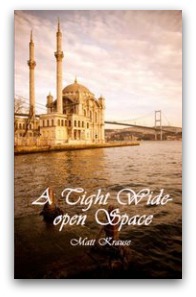
BOOK REVIEW: “A Tight Wide-open Space,” by Matt Krause

Subscribers to the Displaced Dispatch already know that our next free giveaway is a signed copy of today’s featured book! If you would like to enter the draw for this great prize, sign up for the Displaced Dispatch before Friday by clicking here!

TITLE: A Tight Wide-open Space: Finding love in a Muslim land
AUTHOR: Matt Krause
PUBLICATION DATE: August 2011
FORMAT: Ebook for Kindle and Nook; paperback; PDF (from author’s Web site)
GENRE: Travel memoir (Middle East)
SOURCE: PDF file from author’s website

Summary:

In 2003, when the shockwaves of 9/11 still echoed through the US and the country was fighting two wars in Muslim countries, Matt Krause met a beautiful Turkish woman on an airplane and decided to follow her to Turkey. This is the story of what happened there.

Matt figured adjusting to life in Turkey would entail some challenges, and he certainly wasn’t disappointed. He survived bomb attacks, lost his cool around beggar kids, drove a jewelry business into the ground, and got into fistfights over parking. Along the way though, he saw beauty in ruins older than the Roman Empire, was wowed by tales of Bulgarian freedom fighters, tried not to hit cows in the road, and drank plenty of peach-flavored Lipton iced tea.

…A Tight Wide-open Space is the story of falling in love not only with a woman, but with a city and a country. (Amazon.com)

Review:

Matt Krause met and wooed his Turkish wife-to-be in a way seldom seen outside Hollywood scripts. A chance meeting on a flight from San Francisco to Hong Kong; Matt’s sixth sense inkling that this woman was The One; his Google search for her name upon his return (“I sent her an email and tried not to sound too much like a stalker”); his impulsive decision, a few short months later, to rent out his Seattle home and follow her back to Turkey (“I thought about the situation for about 10 seconds and then I said ‘Well, I’ll come with you.'”) — yes, there’s a Valentine’s tale there, all right.

The book is a stimulating mix of the anecdotal and informational: first-hand accounts of the (excellent) Turkish health care and (not so excellent) law enforcement combine with Turkish History 101 and swift lessons on the Ottoman Empire. Running like a silver thread through these yarns is the deeply personal and affectionate — the reason for Matt’s presence in Turkey. The love story.

For all that this is a love story, however, Matt pulls no punches in the telling of it. The introduction chapter, a description of the slaughter of a ram for Kurban Bayram (Feast of the Sacrifice) is vivid — lurid, even. Yet it gets the point across as little else could: that a guy who has spent thirty-three years in the haven of America’s West Coast is now a long distance outside his comfort zone.

For me, the biggest charm of A Tight Wide-open Space is the author’s honesty. Matt doesn’t try to put himself in a better light just because a few thousand people are reading about his overreaction to a persistent little boy who wants to shine his shoes :

What on earth had possessed me to act like that? I had just blown up at a little kid on the street in broad daylight. I had just threatened to snuff the life out of a little boy barely tall enough to reach my belt. I hadn’t even been in Turkey for three months yet. What was I becoming?

In the face of this engaging frankness, it’s impossible not to get drawn into Matt’s story. His frankness extends to accounts of his wedding, a trip to hospital, an almighty row with his new wife. A book — appropriately enough, for Valentine’s Day — written from the heart.

As I have no plans for a subheading called “Spoiler Alerts”, I will say no more — except that the book’s twists and turns along the way only remind us that, yes, this is indeed real life.

Not Hollywood.

Words of wisdom:

One thing I learned early on about Turks is that you can never go wrong with a big smile and an enthusiastic introduction.

When we meet someone else, someone from another religion, or another country, or even another profession or another social class, it is our duty to that other person to remember that our understanding of that person is probably incorrect. And it is our duty to ourselves to overcome that incorrectness.

Home is not a place. Home is not Seattle, California, Texas, Ohio, or Kathmandu. Home is the people we love.

Verdict:

At around 190 pages, this is an easy read, but by no means a shallow one. Whatever Matt’s plans might be for the future, I hope they include more writing.

STAY TUNED for Wednesday’s Random Nomad post.

If you enjoyed this post, we invite you to register for The Displaced Dispatch, a round up of weekly posts from The Displaced Nation, with seasonal recipes, book giveaways and other extras. Register for The Displaced Dispatch by clicking here!

Related posts:

In honor of Valentine’s Day, top 10 travel and expat posts on finding love abroad

My mother used to disapprove of Valentine’s Day. Although she would indulge our need to cut out elaborate paper valentines and bake heart cookies, she always made sure my sisters and I knew what she thought — that it was a fabricated consumer holiday for boosting sales during the winter doldrums.

Despite her remonstrations, I always used to look forward to February 14 — even (especially!) when living outside the United States.

For a start, they have much better chocolate abroad. Plus you get to try new foods that other cultures find seductive — see Kate Allison’s scrumptious post of a couple of days ago.

And your idea of what constitutes romantic adventure changes, too, as you expand your visual repertoire to include the world’s most stunning settings. Indeed, why not pop the question as the sun sets over the City Palace and Lake Pichola in India’s Land of the Kings? (For this and nine other exotic locations for marriage proposals, see Annie Fitzsimmons’ recent article for Forbes.)

In that connection, I was distressed to learn that couples who are thinking of heading to Venice, that magical city of watery landscapes, for a Valentine’s escape may need tips from Guardian Travel on how to avoid feeling ripped off. From the sound of things, it may be safer, and perhaps a good deal more enjoyable, to stay at home and watch The Tourist

But let’s leave the film discussion for later in the month, when we’ll be doing a series of posts in honor of the Oscars. Right now we’re honoring Valentine’s Day, and I’m urging you all to get into the Valentine’s spirit. To aid you in that aim,  I’ve compiled a list of 10 online articles that address the specific needs of those who are looking for romance abroad. As usual, and as befits our blog’s slightly irreverent tone, they’re from a mix of indie and conventional publications.

Click on any or all categories that apply:

Stories of love on the road

In addition to the story told by TDN’s own Tony James Slater of his own love affair — which sparked off no end of wonderful romantic tales in the comments — I enjoyed these two posts:

1) Modern Love — A Place to Lay My Heart (8 January 2012)
Author: Elisabeth Eaves (@ElisabethEaves)
Publication: New York Times, Sunday Style section (@nytimes)
Synopsis: Two single journalists in their 30s meet up in Mexico to write about tequila. At first, romance seems off the table. Both are commitment phobes: they see travel as their first love and like nothing better than plunging into a foreign culture. But then…something happens, and for the first time, instead of opting for a distance relationship, they take the leap. (Tequila will be served at the wedding.)

2) 10 Reasons Why You Should Marry a Foreigner (Like I Did) (Archived: 10 November 2010)
Author: Corey Heller (@MultiLingLiving)
Publication: Multilingual Living blog
Synopsis: Chances are, if you spend a lot of time abroad, you may end up marrying, God forbid, a foreigner! Hey, it’s not the worst thing that can happen. Some of us have done it multiple times and lived to tell the story. Still others, such as this week’s Random Nomad, Toni Hargis, fell for a foreigner in their home countries and followed him/her abroad. Heller, who met her husband in Ireland (he trailed her back to the US), lists her own ten reasons for committing such a foolhardy act — everything from his “glorious accent” to her enjoyment of a challenge to the fact that he is her true love (now fancy that!). Actually, the one that sticks with me is #3: being a German (no, he’s not Irish), he craves good chocolate just as much as she does! (But perhaps that says more about me than it does about them?)

The practicalities of dating abroad

If you do decide to make someone you meet in another culture the object of your affections, there may still be some practical concerns. These four posts should help you finesse these sometimes awkward moments:

3) Dating expectations worldwide: Who pays? (4 February 2011)
Author: C. Noah Pelletier (@flyingknuckle)
Publication: Matador Network (@matadornetwork)
Synopsis: From Pelletier’s unofficial survey of dating etiquette across nine cultures, we learn that German men excel at subtle flirting whereas Turks are much more direct; French don’t really “date”; Mexican men wear clean suits; and Japanese are into group dating. But on the all-important question of “who pays,” all nations are in agreement: THE MAN!!!

4) Don’t pull out the chair — but do hold open the door! (Archived: 26 October 2011)
Author: Tanja from Germany
Publication: InterNations blog (@InterNationsorg)
Synopsis: Notably, one of Tanja’s top concerns is:

Who pays for the meal? Does one split the bill, or does he expect to pay — or even worse, must I pay?!

Too bad Noah Pelletier’s post for the Matador Network wasn’t yet available for Tanja’s perusal (see #3 above), or she needn’t have fretted — especially as it’s Mexico, where men have been known to TAKE OFFENSE if a woman offers to pay. Also, she might not have been surprised when she received more flowers on first dates in Mexico than in her entire life in Germany. Still, Tanja’s story (which ends very happily) is a tribute to the power of persistence and the efficacy of muddling one’s way through. Just one thing I’m still not clear on: do Mexican men expect you to open the door for them, rather like Japanese men expecting you to let them exit the elevator first? (See her post title.)

5) Ten Foreign Words for a Romantic Valentine’s Day (9 February 2012)
Author: Justine Ickes (@justineickes)
Publication: Culture Every Day blog
Synopsis: So as not to be totally culturally clueless, it’s important to master a few other romantic terms/concepts. In Japan, for instance, if you hear someone say bakushan as they look you in the face, then they’re probably not a romantic prospect. The expression is used when you think someone looks cuter from behind! (If, on the other hand, you hear the word kawaii, things may be looking up!)

6) Sex when traveling: location, location, location (29 January 2012)
Author: Laurence Norah (@lozula)
Publication: Finding the universe blog
Synopsis: Norah illustrates (literally — yet tastefully, I hasten to add) various options that travelers have for “getting jiggy on the road”: dorm rooms, tents, showers, beaches, backs of camper vans, and (best of all!) private rooms.

Lonely hearts in foreign lands

When all the world is going gaga for romantic love, it can be lonely if you’re not doing so well in that department, particularly if you’re already feeling isolated because of being so far away from your homeland. The following four posts should help with that predicament:

7) 8 Empowering Ways a Traveling Single Female Should Celebrate Valentines Day (Archived: 13 February 2011)
Author: Lainie Liberti (@ilainie)
Publication: Raising Miro blog
Synopsis: From LA, Laine has been traveling with her son, Miro, since 2009 in search of a simpler life. When still in the States, spending Valentine’s Day on her own was no big deal:

it was easy to ignore the day all together or grab a group of my amazing single girl friends and have an AbFab marathon complete with bottomless cosmos.

But what about now that she’s on the road? Though the post is a year old, her suggestions — some aimed at those who enjoy solitude (movies, nature, dinner-in for one), and others, at those who would prefer being with people (volunteering, meet-ups) — won’t go out of style any time soon, and are good for any day of the year.

8) Help! Nobody Wants to Date Me! (Archived: 15 December 2011)
Author: Chris Laub (@Travel_rtw)
Publication: Backpacker Savings blog
Synopsis: Chris claims he’s “undateable” because of his need to spend almost half of the year traveling. He’s not proud of that fact:

The truth is I want to be in relationship, but my deeper desire to travel and have fun makes it seemingly impossible.

Still, the travel addict’s life does have its compensations. He’s moving to Brazil for the 2014 World Cup, leaving him free to hook up with a Brazilian woman. As he sees it:

…running around chasing women in exotic countries and enjoying no-strings-attached travel romances isn’t a bad alternative

— though methinks he doth protest too much!

9) Offbeat Traveler: Unromantic places around the world (6 February 2012)
Author: Jason La
Publication: Los Angeles Times travel section (@latimestravel)
Synopsis: Kissing a well-kissed stone in Ireland, encountering the venomous Komodo dragon in Indonesia, peering into the Gates of Hell in northern Turkmenistan — after such experiences, being wounded by Cupid’s arrow may seem like light relief. (In addition to his seven unromantic suggestions, La thoughtfully provides a link to the LA Times‘s post on 10 romantic cities, in case you get lucky at some point! Chris — see #8 above — may be in with a chance: Rio is on the list. Venice, however, doesn’t make it — not even as a “dishonorable mention.”)

10) Valentine’s Day — the perfect holiday for one (4 February 2012)
Author: Amy Chavez (@JapanLite)
Publication: The Japan Times (@japantimes)
Synopsis: On Valentine’s Day in Japan, the custom is for men to get showered in chocolates by women — women have to hold out for “White Day” when men allegedly return to the favor. But as Chavez points out in her Japan Times column, Japanese women tend to buy just as much chocolate for themselves as they do for the guys, while also indulging themselves with a Hello Kitty trinket or two. I believe that Chavez intends the title of her column — “the perfect holiday for one” — to sound ironic as she finds the Japanese interpretation of Valentine’s Day a little twisted. Perhaps I lived in Japan too long, but I don’t agree. Or maybe it is twisted, but I can hardly blame the Japanese for that. (The other day I noticed that an Asian publication was carrying a story about how the Bronx Zoo encourages people to pay money to give their sweetheart’s name to one of its Madagascar hissing cockroaches, in time for Valentine’s day. After being bombarded with information like this, is it any wonder that Asian women would prefer to buy their own Valentine’s gifts?) What’s more, all women (and not just those who are single) stand to learn a lot from our Japanese sisters: 1) if you can’t rely on the men, then eat chocolate; and 2) never mind diamonds, Hello Kitty charms are a girl’s best friend!

Bonus feature: “Valentine’s Day and the displaced life”

Living abroad can have other benefits besides finding your perfect mate. It can also help you adopt a more expansive vision of life’s rich tapestry and where “love” fits in. To take but one example, the Sufi notion of love entails falling in love with ideal attributes rather than particular people — which, as Turkish writer Mustafa Akyol points out in his article “The Shariah of Love”, leads to a great deal less heartache than Western “romantic love.” (Hmmm…the idea that love shouldn’t hurt — how novel!)

Another potential benefit of the displaced life is the joy in discovering what it feels like to love an actual place, as was the case for British journalist Jane Alexander when she visited Jerusalem. Despite not being religious, she fell smack dab in love with the city and all it stands for:

Love. Total overwhelming Love. Unconditional love that sweeps away all prejudice, all difference, all wanting, all needing, all sense of I, of ego.

Sounds pretty cool, doesn’t it? And no need to worry if it’s unrequited…

What’s more, travel can also open your mind to rebooting Valentine’s Day itself. This year Causes.com is on a mission to rename it as Generosity Day, and I noticed just now that one of the causes we featured on this blog during Global Philanthropy Month, Free the Children, is asking for donations to empower Kenyan women in bee-keeping businesses. “Bee my Valentine!” sounds a great deal less corny when you know it’s for the sake of others on the globe whose lives are less fortunate…

Come to think of it, could my mother have been right about Valentine’s Day being overly commercial? Best to make that up to her on Mother’s Day — except she doesn’t believe in that either! 😦

* * *

Question: Can you suggest any other posts that should have made the list?

STAY TUNED for Monday’s post, when Tony James Slater, who is rapidly becoming our in-house expert on searching for love in foreign lands, takes up the timely topic of transcending language barriers with potential partners.

If you enjoyed this post, we invite you to register for The Displaced Dispatch, a round up of weekly posts from The Displaced Nation, with seasonal recipes, book giveaways and other extras. Register for The Displaced Dispatch by clicking here!

Related posts:

THE DISPLACED Q: Where did you meet your honey abroad?

It can be hard to make new friends abroad — let alone find a significant other. Thus it’s always inspiring to hear from nomads who’ve found that special someone hiding under a shamrock drinking green beer, or in other such fanciful locales. One such lucky fellow is Tony James Slater, the newest addition to the TDN team. Here is his story — can’t wait to hear yours!

There’s always a great story behind a travel romance, I find, often running the full gamut of emotions, from anguish to bliss. From experiencing a breathless holiday whirlwind romance to finding a soul mate in a distant land, nothing beats a tale of love — true and requited, tragically unrequited or trapped agonizingly somewhere in between.

And today I would very much like to hear yours!

Because our February theme is LOVE — and because it’s rapidly approaching That Day, when you should have bought something a bit special for your other half — I would like to invite EVERYONE to share their tale of passion and/or romance abroad!

Now, I can’t ask you folks to do something I wouldn’t do myself — so here’s an interesting tale of my own…

Once upon a time, in a faraway land…

I first met my wife in America. I know, right? Fascinating! But wait, I’m English — and the young lady in question, Krista, is from Australia, as evidenced by her nickname: Roo.

Roo had been working for Camp America, which supports summer work adventures in the United States. She was teaching kids how to ride horses at a summer school in Maine. And, as fate would have it, that was where she met…my sister!

My sis, whose name is Gillian, was doing Camp America at the same time, and was the only other staff member who wasn’t scared of horses!

Roo and Gill got to know each other quite well — so much so that the pair of them went traveling around the US after the job finished, which is where they met…Richie! An awesome, Kung-Fu kicking dude, muscle-bound and handsome, Roo fell for him immediately and the two became an item.

Which could have turned out rather differently for me, except this unexpected romance kept the couple in America for much longer than expected. You see, at the time some of this was happening, I was in Ecuador volunteering at an animal shelter. On my way home to the UK, I called in to the States to visit my sister, when I also met Roo and Richie. We traveled together for a couple of weeks and had a lot of fun.

Then Richie left, Roo left, and I followed my sister back to the UK, where, as explained in a previous post, I grew bored and dissatisfied with my hollow, consumer-led lifestyle.

(In other words, I was broke.)

Twists and turns worthy of Shakespearean comedy

So Gill remained close friends with Roo, inviting her over to England the following summer. She arrived just in time to be part of my farewell party — I’d finally scraped together enough cash to go to Thailand, where I planned to volunteer at an animal clinic and learn to dive. I would be gone for three months — exactly the same length of time that Roo would be in England.

Which was a pity, as she’s recently broken up with Richie and I rather liked her.

Gill and Roo explored every corner of my native country together, and Roo went back to Australia having elicited a promise from my sister that she would travel to Oz as soon as she could afford it.

I, meanwhile, had missed my flight home. It was accidentally on purpose — my subconscious clearly didn’t want me to leave Thailand just then. My regular conscious didn’t want me to leave either, being rather more aware of my income — or at least, the lack.

Volunteering for a living is notoriously unprofitable, and I couldn’t earn money from diving until I could afford to get qualified. A bit of a Catch 22!

But then — we came into some money. Both my sister and I profited from the sale of a house we’d helped renovate since getting back from America. I used the money to become a Divemaster (and for just a little bit of partying!), while Gillian, rather more sensibly, used hers to buy a ticket to Australia. She stopped off in Thailand on her way through, found me drunk in a bar and gave me such a talking to that I promised to come to Australia just to get her off my back. She was determined to save me from myself, which was probably for the best (I had very little intention of saving myself!).

I dallied for another three months while Gill met up with Roo in Oz and started to explore. They bought a beat-up old van between them and called it Rusty because, well, it was. Seriously — you could see daylight through bits of it.

To the ends of the earth — well, the Great Southern Land

That’s when I showed up. Penniless again, I arrived in Perth airport without the price of a cup of coffee to my name. I’d been living in Thailand for a year by this point, and all I owned was a bulging bag full of dive gear. It was winter in Australia and I didn’t even own a pair of shoes, or anything at all with sleeves.

Not in the least bit phased by me looking like a homeless person, Roo found me work with a local temp agency and within a few weeks I had enough money to travel.

The three of us piled into that crumbling van and set off for horizons unknown…and somewhere along the line, Roo and I fell in love.

Which thrilled my sister of course, as we were all sharing a tent. (But don’t worry — we got our own tent before long!)

Poor Gill left us, in disgust, in Sydney. She’d always hated being around couples in love — romance just wasn’t her thing. I still feel a little guilty for this…well, almost. But not quite!

Epi(c)logue

Since then, Roo and I have visited more than a dozen countries together. We married last July — in England because only Roo’s immediate family is in Oz. (She’s of Dutch descent, so all her rellies from Holland came over — including some she’s never met before! Her Aussie family — all four of them — flew over to the UK for the ceremony. ) And we now live in Perth — for a while in Roo’s family home but we now have a flat of our own. People always ask where we met — out of politeness more than interest, I feel — but it usually surprises them when we both say “America!”.

And as for Gill…well, she lingered in Sydney long after Roo and I left. Then she grew bored and flew to New Zealand, to a job in the ski fields, where she met a short blonde ski technician from Hampshire, UK, called Chris. They hit it off rather well as it happens — Gill had always liked short men — and four years later, the pair of them were married, a month before us and less than fifty miles away.

Roo got to be my sister’s Maid of Honor!

And because I’d been out of the country for so long that I’d lost touch with all my male friends, Gill — poor, suffering Gill — had to be my Best Man!

* * *

Your turn!

So. Let me hear it! Tales of love in far-flung and exotic locations: the triumphs, the failures and the ones that got away! We want to hear them all — post them in the comments section please, so everyone can read ’em and weep! (They don’t have to be as long and waffley as mine — I’ve been told I can be verbose.)

Oh, and keep it clean — some of these expat love stories lasted long enough to have children, and even grandchildren.

Love,
Tony xo

TONY JAMES SLATER is a self-confessed adventureholic. For the last six years he’s been traveling nonstop around the world, working at a variety of jobs including yacht deliverer in the Mediterranean, professional diver in Thailand and snow boarder in New Zealand. Last year, Slater published his first book, That Bear Ate My Pants!, an account of his misadventures while volunteering at the animal refuge in Ecuador. (The book was featured in The Displaced Nation’s list of 2011 expat books.) He is currently working on a second book set in Thailand, while exploring his new home in Perth, Australia.

STAY TUNED for Tuesday’s post, on 7 of the world’s most seductive foods — for seducing that valentine of yours.

If you enjoyed this post, we invite you to register for The Displaced Dispatch, a round up of weekly posts from The Displaced Nation, with seasonal recipes, book giveaways and other extras. Register for The Displaced Dispatch by clicking here!

Related posts:

Image: Tony Slater and Krista (Roo) participating in the traditional European ceremony of handfasting where the couple’s hands are tied together (in their case, with a garland of flowers), at their medieval-themed wedding last summer.

Lyn Fuchs, American expat in Mexico: A raider of the lost art of philosophizing

As January comes to its close, our theme of Spiritual Enlightenment Through Travel would not be complete without a reference to Lyn Fuchs, author of Sacred Ground and Holy Water, and publisher of Sacred Ground Travel Magazine.

Lyn, of course, was our 5th Nomad of Christmas, where he stated his Most Displaced Christmas Moment was:

On December 24th 2008, [when] I was displaced from the palace of an elegant and voluptuous Saudi princess, after I attempted to demonstrate a “traditional Christmas goose.” I still fantasize about returning and showing her how to do a “traditional Christmas stuffing.”

From this, we can gather that the Political Correctness Movement is something that doesn’t bother Lyn a whole lot. Probably that’s the reason I fell in love with his first book, Sacred Ground & Holy Water, and will be buying his second, Fresh Wind and Strange Fire, when it is published.

If your only knowledge of Lyn is via his Christmas Nomad answers, it would be easy to assume that this un-PC, flippant personality is who he is. You may be wondering why someone with the nickname of Lyndiana Jones is the subject of a post about spiritual enlightenment.

To answer this, let me refer you to the Chique Show on Blog Talk Radio, where author Barbara Conelli interviewed Lyn this month.

In forty-five minutes, Lyn talks about his books, his writing, his philosophy on life – and how they came to be that way.

As the saying goes, never judge a book by its cover.

Or a deep thinker by his Christmas Nomad answers.

Here are some highlights from the interview:

On Mexico:

Lyn has lived in Mexico for a total of six years, and is currently Professor at the University of Papaloapan.

Mexico is probably the best place on earth to learn how to practice nirvana. India invented the theory of nirvana but Mexicans…invented the practice of it.

Mexicans are some of the happiest people in the world…You learn a lot here about how to live in the moment…Sometimes you really start living when you lose your fear of dying.

I would say that one of the things about Mexico I love the most is that philosophically they’ve taught me to be happy.

On writing:

Writing really started for me about ten years ago… I was in a remote valley [in Canada] for several months and basically I had nothing to do but exercise, cook, pray, listen to the wolves howl, and watch the snow fall…

I went from being a person that talked all the time to a person that actually had something to say.

So I grabbed a pen and I started reflecting on my life, and my life stories turned into magazine articles. Sometimes your destiny discovers you.

On travel and spirituality:

Travel brings you in contact with global spirituality, and whatever your religious label, if you travel, you begin to discover the spirituality of the universe…if that doesn’t sound too cheesy.

Deeper than just the [physical] movement from this place to that place is really what’s happening to our spirit when we travel.

On academia:

Books alone do not make a human experience.

Intelligence is what God did for you; the real question is “What did you do in return?”

On people’s fixation with politically correct vocabulary when the facts of the big picture are more important:

Sometimes North American hypersensitivity isn’t very sensitive. My books are for people who want to see a part of the world that is beyond their comfort zone.

On his own blunt writing style:

I think I have a responsibility to report the world as I experience it. I may not be right, but at least I’m telling you what I think I saw.

My writing blends spirituality and sexuality which often offends pretty much everybody, but writing honest books helps me sleep at night.

Click here to listen to the full interview on the Chique Show

If you enjoyed this post, we invite you to register for The Displaced Dispatch, a round up of weekly posts from The Displaced Nation, with seasonal recipes, book giveaways and other extras. Register for The Displaced Dispatch by clicking here!

Related posts:

Talking with author Dave Prager about his — deliriously unspiritual — expat experience in India

Reading like the work of a hipster Bill Bryson, Delirious Delhi is an account of Dave Prager and his wife Jenny’s move from New York to Delhi — the largest city in India by area and second largest by population — as they become what they term “New Delhi Yankees.” On arrival in their new home they, like so many expats, started a blog: Our Delhi Struggle. Detailing ther occasional bewilderment and occasional delight as two thirtysomethings acclimatizing to life in Delhi, their online musings quickly became popular.

Dave set about expanding Our Delhi Struggle into a book, and Delirious Delhi was the result. Those eagle-eyed among our readers may recall the book being featured under “expat memoirs” in one of the lists ML Awanohara compiled of 2011 books for, by, and about expats.

Earlier this month I spoke with author Dave Prager to discuss his book and his thoughts on Delhi — including the extent to which the expat life he and his wife led in India fits the Displaced Nation’s January theme of spiritual reawakenings.

How did you end up in Delhi and then later on Singapore?
I volunteered. My company needed a copywriter in Delhi. A week later I found myself in the city for the first time. We left Delhi for Singapore because we weren’t ready to return home to the US just yet, but we knew that if we didn’t force ourselves to leave India, then we’d never experience living anywhere else in Asia. So we quit our jobs in the middle of the recession, left Delhi, and flew to Singapore where we were both lucky enough to find work.

What made you decide to write a book telling the story of your transition to living in Delhi?
We had so many growing pains when we first moved to Delhi that we started our blog to share our lessons with everyone who would come after us. It became very popular — not just with expats, as we expected, but with Indians. As we were getting ready to leave, someone suggested we write a book. So I did. Ninety percent of the book is fresh content, never before seen until now. It’s very different from the blog. The blog posts are 500-word essays, where this is a single, 100,000-word narrative.

Delirious Delhi is your second book. Any plans for another one?
I’ve had some ideas I’ve been noodling away at. I have an idea about an American who finds himself living in rural India and doesn’t have a clue what’s going on. Which is how I felt every time we went out to the villages.

No plans to write about your time in Singapore?
There’s no plans for anything about Singapore. Don’t get me wrong, I enjoyed my time there, but it didn’t get my creative juices flowing in the way Delhi did. It didn’t inspire me like India inspired me.

What audience did you have in mind for the book?
When I was writing, I knew exactly who my intended audience was and I pictured them in my head as I wrote. It was two people that I know. The first was an American friend who was back in the US and was curious about India and my experiences; the other was an Indian co-worker who was always fascinated with how I — as an American — found life in his country.

I noticed you did a brief book tour in Delhi. Did you experience any negativity to your views?
Generally the response has been really good. There’s a minority who takes exception to a Westerner writing critically about India. But the book is not a criticism of India, it’s a recollection of the experiences — the good ones and the bad ones. Every country has good and bad, including the US. It’s disingenuous to focus on one and not the other — in both extremes.

This month’s theme for the Displaced Nation is the quest for spiritual enlightenment. At the beginning of the book, you say you would never describe India as “spiritual” as many do. What do you think of writers like Elizabeth Gilbert who present India as the ideal place for spiritual tourism?
It’s not that I wouldn’t describe India as spiritual — it’s that I never found it to be spiritual. Maybe because that wasn’t what I was looking for. In many ways, India is a blank slate, and travelers paint it with the colors they want to see. If you go looking for poverty, you’ll find it. If you go looking for wealth and globalization, you’ll find it. If you want spirituality, you’ll find it. India is the perfect place to find whatever it is you seek. The question is, what else do you have to ignore in order to see only one aspect of the country?

One of the most powerful parts of the book for me was the part where you detailed your wife Jenny’s work for a school that lifts girls out of poverty, and how shocked you were by the poverty. Did you find that after your time in Delhi you more politicized than when you first arrived?
Good question. I certainly arrived in India with a very liberal Western outlook of the world. My approach to the world was one of moral relativism — that everyone can to a certain extent be justified in their views. But the longer I stayed in South Asia, the more I began to believe that they are moral absolutes and that there can be certain aspects of a culture that are simply morally wrong — the treatment of rural girls in India being a case in point. So that really is how I changed politically over those 18 months. I moved from moral relativism to moral absolutism, in certain circumstances.

In the book Delhi reads like the main character in a novel  — with an ever-changing personality that is hard to truly get to know. Is that how you saw it?
One of main points with Delhi is how little you can understand it. It really is what you make it to be. New York, by comparison, is easier to understand. With New York you can find a narrative. Every New Yorker thinks that they are the star of the city, and the city aligns itself around them. Delhi has no overarching narrative; you’re more rooted to your neighborhood rather than the city as a whole and so everyone in Delhi is having different experiences and coming to different conclusions. I don’t think there’s a shared Delhi experience like there is a shared New York experience.

Now that you are back in the US, how do you see Delhi?
I have a sense of wasted opportunity. I think about all the things that we didn’t do when we were there, all those Saturdays when we went to the mall rather than explored different parts of the city. That I didn’t attend a cricket match or that I didn’t travel to a village outside of Delhi that’s famous for its Indian wrestling. And now thinking back on it all, I sometimes have an overwhelming sense of missing Delhi.

And how have you found it as a “repat” in the US? Any reverse culture shock?
What’s struck me is that the US just seems so empty. It’s not that India is always intensely crowded; rather, it’s that India you’re never completely alone. There’s always someone to be seen walking or selling something or cooking chai. Outside of a few select cities in the US, it’s not like that here. We now live in Denver and some mornings I find myself wandering around the middle of the city and I have moments when I stop and notice that I’m alone. I look around me and I just wonder where everyone is. All these tall buildings and nobody around.

Delirious Delhi can be purchased here.

STAY TUNED for Wednesday’s post, an interview with Chicago acupuncturist Jennifer Dubowsky, who believes the West can benefit from importing Eastern concepts of natural healing as an alternative to more invasive medical treatments.

If you enjoyed this post, we invite you to register for The Displaced Dispatch, a round up of weekly posts from The Displaced Nation, with seasonal recipes, book giveaways and other extras. Register for The Displaced Dispatch by clicking here!

Related posts:

Images: Used with kind permission of Dave Prager

Yak-skin footware & the youthful quest for spiritual wisdom

We welcome back Lawrence Hunt to the Displaced Nation, who wrote a popular post for us in November about why the UK’s educated youth seems so preoccupied with voluntourism. Today he broadens this theme to include the quest for spiritual enlightenment.

At a comedy night I went to last year, the comedian’s most popular jokes were aimed at a student who’d made the mistake of sitting in the front row in sandals:

“He spent so long trying to find himself that he lost his shoes!”

As the number of people taking time off to travel has rocketed over the years, so, too, have the numbers of those in my age category (late teens, early twenties) who come back claiming to have achieved their ultimate epiphanies of self-actualization, forcing the fact of their higher spiritual consciousness onto the rest of us in the form of yak-skin footwear.

Meanwhile, companies like STA Travel make millions every year capitalizing on the appeal of the youthful spiritual quest — have a look at the description of one of their most popular holidays, the India Spiritual Trek:

Come face-to-face with a spirituality far removed from the shallow complexity (my emphasis) of the Western world, as you interact with some particularly special people in some truly unique places.

A recurrent theme in pop culture

One of Wes Anderson’s most financially successful films so far, The Darjeeling Limited, is about three rich brothers who board a train from Darjeeling to rediscover their lost kinship with each other.

So begins a strict itinerary of traditional rituals and indulgence in the simplicity of the local lifestyle, as Owen Wilson’s character throws out the odd patronizing comment: “These people are beautiful!”

My mother’s response on finishing watching Darjeeling with me was to promptly drop her jaw and say, in a low voice: “We have to go to India and see those mountain temples, Lawrence.” (My mother has talked for a while now of taking her own gap year, much to my concern — the men in Darjeeling have a mother who joins an Indian monastery and refuses to come home.) Fortunately, she is also able to laugh at Mitchell and Webb’s “gap year backpacking idiots” sketch.

And let’s not forget teen dance queen Alanis Morissette‘s hit single ‘Thank You,” which she released after taking time out from non-stop touring to travel in Cuba and India. At one point, she sings: “Thank you, India.” Did she actually imagine a billion voices chiming out as one from the subcontinent: “Any time, Alanis — we’re here to help”?

A recurrent theme in history

The idea of self-improvement through travel has existed for hundreds of years in such romantic idealizations as the Wild West, Darkest Africa and the Orient. It arises out of a conviction that as our civilization develops, we lose touch with our true selves, what life is all about. And if civilization is to blame, then it is elsewhere, in uncivilized cultures, esoteric religions or even ancient history where we find “reality.”

Jean-Jacques Rousseau believed that in the large European states, man had become alienated from the authentic self and preoccupied with meaningless duties, such as the duplicitous regard for manners that hid an underlying ruthlessness in bourgeois society. Primitive man — the so-called the “noble savage” — had been happier and more self-sufficient.

These trends coalesced in the hippie movement of the 1950s and 60s, which directed criticism towards almost every aspect of modern society: its dull consumerism, the system of capitalism itself, our susceptibility to totalitarian “brainwashing” and the war technology which had lain waste to the entire world during World War II and subsequent wars. What was demanded was not reform, but in fact a wholesale replacement of Western culture and ways of thinking.

Probably the most crippling flaw of the sixties counterculture was the total inability of its adherents to agree on a dominant theory of what should actually be replacing Western culture and politics. In fact, one of the defining values of this movement was that one should be free to choose one’s own alternative lifestyle. Everyone was encouraged to practice their own form of escapism.

Some rebels escaped through the fantasy literature of J.R.R. Tolkien, yearning for an enchanted world that existed in a time before the “rule of men” had begun. Others experimented with drugs, hoping to reach new planes of existence mentally. Some even tried to live the life that Rousseau had idealized, living primitively off the land in communes.

And still more looked for escape through non-Western cultures, where magical practices still proliferated, repressive Western structures were not in control, and religion was more spiritual, in touch with the flow of the universe. The Book of the Dead and the I Ching became new Bibles, and a huge amount of longing was directed vaguely in the direction of the undeveloped, non-Western world.

Eastern religions and their mystique

This last form of escapism received a fillip in the early 1980s with the publication of Duane Elgin’s book on voluntary simplicity — which spawned a movement that continues to this day.

On the recent BBC programme How to Live a Simple Life, Peter Owen-Jones pointed to Elgin’s chart comparing the “Voluntary Simplicity World View” with the “Industrial World View.” The latter sees material acquisition as a primary life objective and determinant of social position, while the former seeks a balance between material and spiritual needs, concentrating on conservation and frugality as mediated through self-sufficient communities and a process of “inner growth.”

Interestingly, in Elgin’s survey of “inner growth” processes, only 20 percent of those questioned cited traditional Western religions, while 55 percent claimed to use techniques like Zen or Transcendental Meditation.

What is it these religions offer that Western faiths don’t? According to Elgin, traditional churches are hierarchical institutions of mass society, something he resolutely opposes. By contrast, Eastern religions like Buddhism, Hinduism and Taoism are religions of liberation, in that they aim to alter our consciousness through self-reflection.

Let’s get real

These opposing views of East and West are widely taken for granted in our culture, but how far do they reflect the reality?

In my own, admittedly rather limited travel experience — I was a gap-year student in China for six months — the perception of the East as a place where spirituality is generally prized above materialism is pure fairytale, the world of Beat literature and Kung Fu movies.

I remember my first day off the train in Beijing. It was April 2008, and Wángfǔjǐng, the shopping district in the city centre, was buzzing with the anticipation of hosting the largest Olympic Games in world history. The atmosphere of national pride was tangible, present in every colorful corner of the street. Buildings were plastered with billboards from companies proudly claiming to be sponsors of the games. Most of them featured the smiling face of Chinese national treasure Jackie Chan — Jackie Chan water, Jackie Chan ice cream, Jackie Chan baby wipes. I found myself wandering through a dazzling labyrinth of colorful street vendors and market stalls, heckled constantly by cries of “You want to buy souvenir? You want to buy hat? Come see!”

Some vendors refused to take my bewildered, negatory smiles for an answer and grabbed me by the hand, trying to hold me in place. “Buy everything” I read on a sign above my head in yellow lettering in English and Chinese. Presumably a poor translation of “We sell everything,” but I didn’t take long to be convinced. That said, I’m not sure they were selling any yak-skin footwear!

A banquet to write home about

Something which I noticed when staying with some Chinese friends was the pride they show in wasting food, something that’s anathema to my Western upbringing. My host, when taking me out to a restaurant, ordered an extravagant number of dishes — including shark fin soup, which they paid a huge amount for but no one touched for the entire meal. Out of politeness, I had a small bowlful — it was unbearably bitter, and the family laughed cheerfully as I struggled with it.

The dish had been ordered merely because it was expensive and they had wanted to impress me. It struck me that by contrast, my parents would never have allowed us to order anything they didn’t fully intend to finish. If anything, the attitude at home towards consumption is marked by its lack of brazen excess.

At the risk of becoming the thing I’ve set out to ridicule, let me offer some closing words:

True happiness flows from the possession of wisdom and virtue and not from the possession of external goods.

Who said that? Why, Aristotle, a philosopher whose ideas gave birth to the so-called shallow complexity of the Western world.

Readers, what do you think of Lawrence Hunt’s thesis? Are Eastern cultures more spiritual than ours, or are we too easily swept up in the allure of the exotic?

STAY TUNED for Monday’s post, a travel yarn on spiritual escapes by a guest blogger.

If you enjoyed this post, we invite you to register for The Displaced Dispatch, a round up of weekly posts from The Displaced Nation, with seasonal recipes, book giveaways and other extras. Register for The Displaced Dispatch by clicking here!

Related posts:

The Displaced Q: Can travel and the expat life lead to a healthier diet?

Part of the formula for feeling better about oneself — TDN’s theme this month — is eating a healthier diet. Today Tony James Slater, the newest addition to our team, poses a Displaced Q on the eating habits of travelers and expats.

I’m not sure what qualifies me to pose a question about food, since my idea of healthy eating is using low-fat mayonnaise on a full English breakfast — but hey, I’d love to hear your side of the story…

I think I have what you might consider to be a rather controversial point of view, which is that traveling and leading an expat lifestyle can lead to a healthier diet — but for the most part do not.

WAIT! Before you hit the comments with that vitriolic reply — hear me out. I may be wrong (my past wrongness is legendary), but I believe I have a point. Tell you what — I’ll lay out my opinion (which I’ve put a lot of thought into), and then you can tell me if I’m talking out of my asparagus.

Chopping veggies: too much like hard work?

Plenty of people see travel as a way to reinvent themselves. I should know, I did exactly that, as explained in my last post about volunteering in Ecuador.

But reinventing your lifestyle is one thing — your diet is something else. I think statistically speaking (and I’m no expert) 99.9% of us have struggled with our diet at some point or other.

It’s not a change like deciding to make more “me time,” or adding the beach into your daily itinerary. We struggle because changing our diet requires that dreaded thing: commitment.

And the enemy of commitment is convenience.

Ah, convenience…the single biggest factor driving the fast-food phenomenon worldwide. Is it easier to swing past KFC on your way home from work than it is to get home and start chopping vegetables?

You bet it is.

What’s more, this instant gratification factor appeals not just to the terminally lazy — like me — but to an awful lot of people in a world where free time is increasingly under pressure.

The food you know…

So you’re in a new country. You tour the neighborhood. What’s the first thing you’ll recognize — whether in Cairo, Bangkok, Buenos Aires or Paris? Chances are it’ll be a fast-food joint. It’s just so easy. Nothing new to challenge you — either your palette or your linguistic skills. Just point and grunt, to be rewarded with something you could have bought within five minute’s drive of the last place you lived.

Don’t get me wrong. As I travel I make an effort to eat everything — including, on occasion, things I shouldn’t. (Apparently, the wings stay on the locust, even if they have got most of the soy sauce on them — who knew?)

Still, there is the part of me that, after a few days dining from street vendors, really craves a burger. Or a pizza. Something Western, that tastes of home.

As British writer George Miller once remarked:

The trouble with eating Italian food is that five or six days later you’re hungry again.

Asia — the exception?

There are certain countries with a deserved reputation as a mecca for healthy eating — yes, I’m talking about Japan here. In fact, most Asian countries are considered to have a healthy yet appealing diet, with an emphasis on seafood and simplicity.

For the better part of a year in Thailand I lived like a king. Fresh fruit for breakfast every morning, compared with jam on toast, bacon and sausage back home — score one for healthier eating!

Simple meals of chicken and rice, or noodles from street vendors were my staples. They were as cheap as they were delicious!

And yet… It was all fried. The rice was fried. The chicken was fried. The noodles… Is it possible to overdose on MSG?

I had no control over how my food was cooked and no kitchen to prepare it myself. Back home I fry things occasionally, but I’m a path-of-least-resistance kinda guy. My food isn’t always healthy (burgers, schnitzels, chips) — but I’d stick it in the oven or grill it. So the score…is tricky to say on this one.

And then there’s the booze…

Thailand is famous — at least amongst the 18-35 age group — less for its culinary marvels than for its parties. Score one (a large ONE) + a whisky chaser for the unhealthy diet.

Do you drink more when you travel? Cocktail by the pool? Glass of wine or two in the evening, because why not — you feel so free? Yeah, you do. Don’t worry — so does everyone else. But that’s another nail in the coffin of a healthier diet…

(And yes, I know all about anti-oxidants. That’s how I justify red wine too.)

* * *

In my experience, to eat anything decent, you have to work for it. The easier food is to find, and the more recognizable, the less healthy it tends to be.

If you’re prepared to experiment with different recipes and ingredients, different cooking apparatus and utensils, to learn a few words in the local language and risk using them in the market — then you can manage it.

But if you’re prepared to do all that for the sake of eating healthy, chances are you do it at home too, in which case you’ll eat healthily wherever you are. And probably outlive me by at least a decade.

So, as I said at the beginning: can travel encourage one to adopt a healthier diet? Well, I think it can…but doesn’t.

Am I full of carp? Am I talking sushi? What do you think?

TONY JAMES SLATER is a self-confessed adventureholic. For the last six years he’s been traveling nonstop around the world, working at a variety of jobs including yacht deliverer in the Mediterranean, professional diver in Thailand and snow boarder in New Zealand. He even deprived the world of sandalwood one tree at a time in Australia (though he still maintains it was an accident). Last year, Slater published his first book, That Bear Ate My Pants!, an account of his misadventures while volunteering at the animal refuge in Ecuador. (The book was featured in The Displaced Nation’s list of 2011 expat books.) He is currently working on a second book set in Thailand, while exploring his new home in Perth, Australia.

STAY TUNED for Wednesday’s post, an opinion piece by Lawrence Hunt on what drives today’s young people to seek spiritual enlightenment abroad.

If you enjoyed this post, we invite you to register for The Displaced Dispatch, a round up of weekly posts from The Displaced Nation, with seasonal recipes, book giveaways and other extras. Register for The Displaced Dispatch by clicking here!

Related posts:

Image: Tony Slater with his girlfriend (now wife), Krista, in an open shack-style cafe in Kuta Beach, Bali, Indonesia. Krista is eating nasi goreng, a Balinese veggie curry (over fried rice), whereas Tony has ordered a burger (but will it be too Asianized for his tastes?).