The Displaced Nation

A home for international creatives

Tag Archives: London

For this peripatetic Argentine, now an expat in Queensland, a picture says…

Canon zoom lens; photo credit: Morguefiles. Belu in Buddha Truth Relic Temple, Singapore; photo credit: Belu.

Canon zoom lens; photo credit: Morguefiles. Belu in Buddha Truth Relic Temple, Singapore; photo credit: Belu.

Welcome back to our series “A picture says…”, created to celebrate expats and other global residents for whom photography is a creative outlet. The new series host is English expat, blogger, writer, world traveler and photography enthusiast James King, who blogs at Jamoroki and truly believes a camera is a mirror with memory…

Greetings, Displaced Nation-ers. My guest today is the 35-year-old Argentine Belu: an expat, blogger, world traveller and photography enthusiast. Belu studied industrial design at university in Argentina and then moved to Europe. Not long ago, she relocated to Australia, where she sells her designs at street markets and travels as much as her finances allow.

Belu brings her experiences and unique view of the world to her photography blog, BeluChi, and to the travel blog, Travel Tips and Pictures, where she is the main travel writer.

I have followed Belu for a short while and love the simple, down-to-earth way she brings her pictures and the stories behind them to life through her writings.

* * *

South American but with deep European roots

Hi, Belu. Thanks for agreeing to this interview. Can we begin by having you tell us: where did you live in Argentina, and when did you spread your wings, leave the nest and start your world travels?
I was born in Mar del Plata, a pretty big town located 500km south of Buenos Aires. I lived there until I was 25, and it was about that time that I became curious about travel and ended up moving to Europe.

So you got the travel bug. I can relate to that—but what really inspired you to travel?
Travelling for me is a way to get connected with people and to nature. I so love meeting people, and I knew travelling would give me that opportunity better than anything else. I love it when people tell me about their lives, their cultures and traditions, stories and dreams. I learn so much from my travels.

I know exactly what you mean. It’s quite addictive and I can see you are a compulsive globe-trotter. Tell me what countries have you visited so far?
Aside from Argentina and southern Brazil, I’ve travelled mostly around Europe: Portugal, Spain, France, Italy, Monaco, Belgium, England, Scotland and Ireland. And now, because I live in Australia, I’m starting to be more in touch with Oceania and Asia—Indonesia and Singapore, for example. I’m planning a trip to China next year, and in 2015 I hope to travel to India and some countries in Africa.

Wow, that’s quite a package! Tell us, how did you end up in Australia, and what is life like for you your new home?
I met my partner when travelling in Australia over two years ago, when living in Barcelona. So, after going back and forth several times, we decided to live together here in beautiful Cairns, a city in the far north of Queensland. So far, so good. I believe that how you feel in a different place and culture depends mostly on how you connect and interact with the people in your new environment, at least in my case. Weather is also important to me because I’m a “sunlight” lover.

Pizza San Marco, Venice Italy. Photo credit: Belu

Piazza San Marco, Venice, Italy. Photo credit: Belu

You offered this photo—of you and all the pigeons in the Piazza San Marco in Venice—as one of your favorite shots that captures cherished memories. Thank you for sharing it. Can you tell us more about why it’s so special?
This photo brings me back to the first time my parents came to Barcelona to visit me. We went to Venice and Rome—spectacular!—and then to Lettopalena, a tiny little village up on the top of a mountain in Chieti Province, around 200km from Rome. It was the place where my grandmother was born. I met my Italian family, who are still living there. That trip was exiting because of the contrasts.

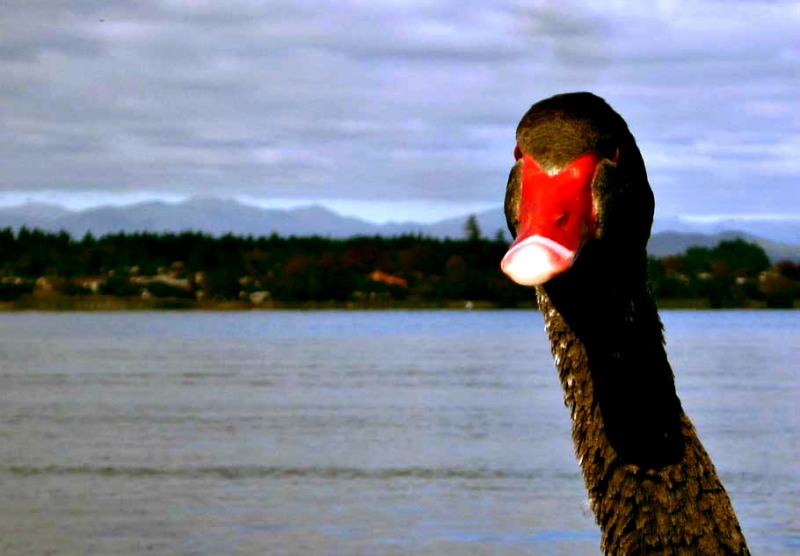
Taupo Lake, Taupo, New Zealand. Photo credit: Belu.

Black swan on Lake Taupo, New Zealand. Photo credit: Belu.

Solo travel and staying with locals

That must be a very personal piece of your life. Now moving on to your photo of a beautiful black swan on Lake Taupo in Taupo, New Zealand.
Lake Taupo is in the centre of the North Island. My trip to New Zealand was unforgettable because of the natural beauty. It was also solo-travel, so I could be more in contact with locals and travellers from everywhere. I love this kind of travel. I usually have a “tentative plan” that I hardly ever follow. I love the freedom of changing and re-organising my itinerary according to my feelings.

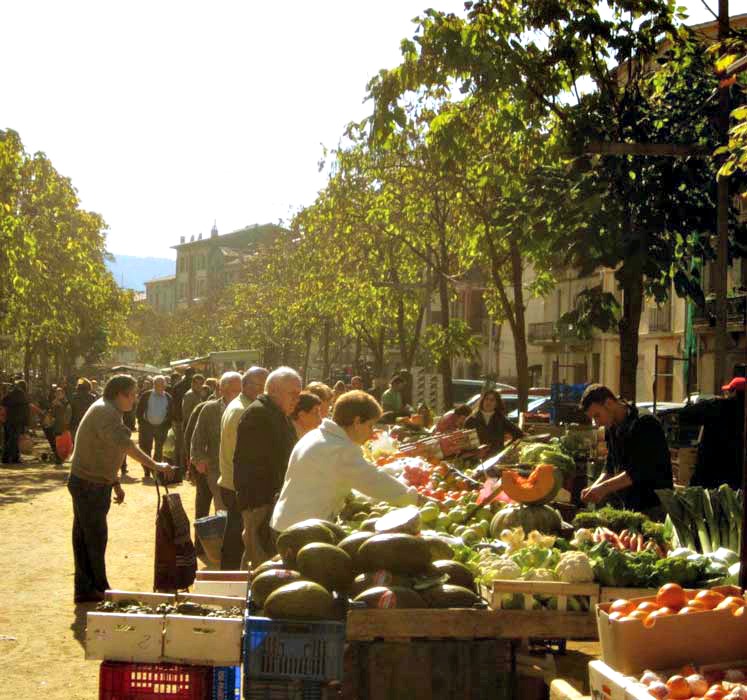
Oh! I know the feeling well. No one to nag you. Free as a bird (so to speak). Okay, so now for a photo of the everyday scene—a street market in Ripoll, Girona (one of the four provinces comprising Catalonia), Spain. My favourite country!

Street market in Ripoll, Spain. Photo credit: Belu.

Street market in Ripoll, Spain. Photo credit: Belu.

I spent a Saturday morning strolling around the heart of Catalonia, in southeastern Spain. I had the honour of staying at my friend’s parents’ home, always with locals… that made this travel special. I did visit popular tourist spots in that area, but when you are with local inhabitants, it makes the place so much more interesting and you learn so much more about their culture. They told me folk tales and stories that you’ll never find in any guidebook.

I seem to be agreeing with everything you say, but it’s difficult to argue with that. So many people travel but never really integrate with the local people. They miss so much. But we must move on now. Where were or are your favourite spots to take photographs?
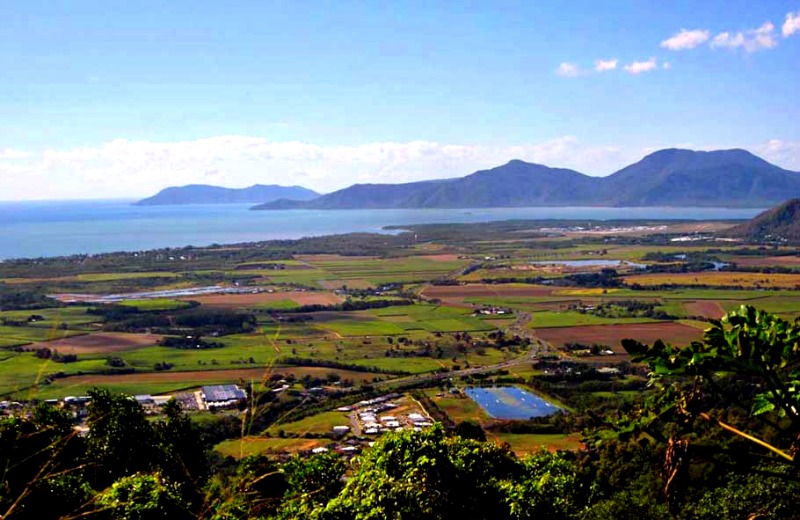
My favourite spots are high viewpoints and streets.From high viewpoints you get to admire the whole picture, almost like aerial photography. I find that very exhilarating. And when I am in the streets I am close to the people and can really feel the ambiance and capture the essence of the place.

High vs low, scenery vs people

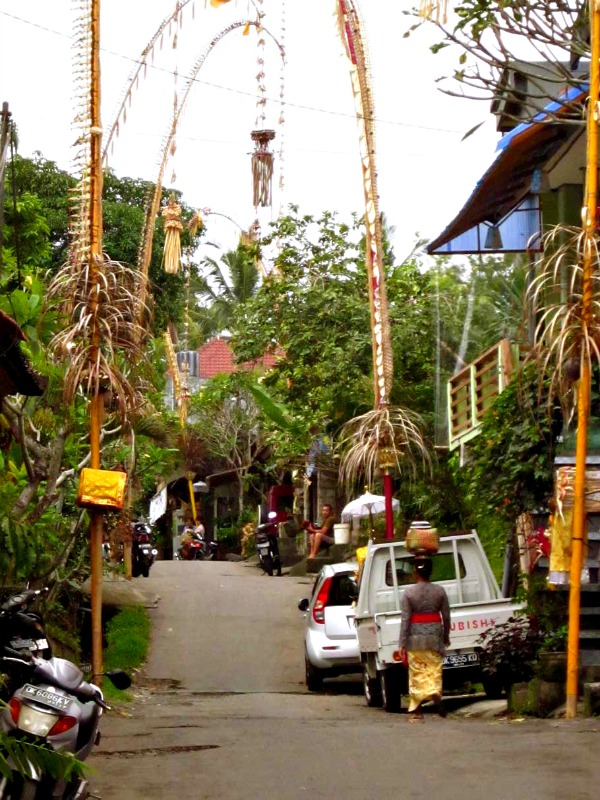
The last three photos you’ve chosen illustrate the difference between high (looking down) and low (streets at ground level) admirably:

Cairns, Queensland, Australia. Photo credit: Belu.

Cairns, Queensland, Australia. Photo credit: Belu.

Back street, Bali, Indonesia. Photo credit: Belu.

Back street, Bali, Indonesia. Photo credit: Belu.

London (near St. Paul's), England. Photo credit: Belu.

London (near St. Paul’s), England. Photo credit: Belu.

The photo of Bali is so typical of a Southeast Asian back street. And the one of London, showing a tramp walking between a dust cart and a City businessman with St. Paul’s Cathedral as the backdrop, is an absolute gem. Actually, this photo leads to my next question: do you ever feel reserved about snapping photos of people, particularly when they are conscious that you are doing so? And do you ask permission before taking people’s photographs? How do you get around any problem of language?
It usually depends on the situation and the local culture. I sometimes ask permission by words or sign language, especially if I feel the person is uncomfortable because of the camera. Fortunately, I have never had any problem about that. Most of the time people say “yes”.

That must make it easier to take natural shots; so would you say that photography and the ability to be able to capture something unique which will never be seen again is a powerful force for you?
For me the answer to that is “most definitely, yes!” When I left Argentina I, maybe unconsciously, realised what a powerful force pictures are. To be able to produce something that can never be repeated exactly is quite amazing.

Let’s get technical

Now for the technical stuff which I am not very good at. What kind of camera and lenses do you use?
I have a Canon Ixus 107 called “Anastasia”. She is always in my bag. It isn’t a professional camera but it works as it were! A useful camera for me must be compact and not too expensive, because I don’t want to be too worried about it when travelling.

Finally, do you have any advice for wannabe photographers (like me) who are travelling or living abroad?
Well, the Internet has plenty of information, videos, etc, for those in search of photography tips. But I can tell you what I do: stay curious, learn from others, and meet people.

* * *

Readers, what do you make of Belu’s experiences and her photography advice? And do you have any questions for her on her photos and/or travels? Please leave them in the comments! 

Once again, if you want to read more of Belu, don’t forget to visit her sites (see links above). You can also contact her via aquibeluchi@gmail.com.

(If you are a photographer and would like to be interviewed by James for this series, please send your information to ml@thedisplacednation.com.)

STAY TUNED for next week’s fab posts, including an interview with this month’s featured author!

If you enjoyed this post, we invite you to register for The Displaced Dispatch, a round up of weekly posts from The Displaced Nation, with seasonal recipes, book giveaways and other extras. Register for The Displaced Dispatch by clicking here!

Related posts:

Notes and fears on living an expat life in the digital age

imageSome loose thoughts on expat life in the digital life, partly inspired by a Frank Bruni article in The New York Times:

Note 1: The late night scribblings on a post-it note of a random neurosis

That being away from my home country for a prolonged period only serves to make me an oddity there, and that as time moves forward the image that I have of home is from when I emigrated. Everyone and everything else has moved on. Me: obsolete, anachronistic, no longer conversant in the local idiom, a visitor from 2007. I’m still operating Britain iOS 6 when everyone else have updated to Britain iOS 7.

Note 2: Recent Article I read

“Traveling Without Seeing” by Frank Bruni. Published in The New York Times on September 2, 2013. In it Bruni laments the digital world we live in, how it alters our ability to experience travel in a foreign country.  What does this say about expat living? What is it to be an expat in a digital world? How dangerous can the “cocoon” Bruni writes about be?

“Before I left New York, I downloaded a season of “The Wire,” in case I wanted to binge, in case I needed the comfort. It’s on my iPad with a slew of books I’m sure to find gripping, a bunch of the music I like best, issues of favorite magazines: a portable trove of the tried and true, guaranteed to insulate me from the strange and new.

I force myself to quit “The Wire” after about 20 minutes and I venture into the streets, because Baltimore’s drug dealers will wait and Shanghai’s soup dumplings won’t. But I’m haunted by how tempting it was to stay put, by how easily a person these days can travel the globe, and travel through life, in a thoroughly customized cocoon. . .

I’m talking about our hard drives, our wired ways, “the cloud” and all of that. I’m talking about our unprecedented ability to tote around and dwell in a snugly tailored reality of our own creation, a monochromatic gallery of our own curation.”

Note 3: Availability of media: finding the Test score

Bruni downloads The Wire. Expat living need not be terrifying in the digital world, you need not let go. My apartment and digital habit is a curation of my own making, one that ties me to a notion of Britishness that I wouldn’t, other than a PBS viewing habit, have been able to maintain with as much ease twenty years ago. With only a cursory knowledge of technology it is possible to keep watching British television. British newspapers are easily available. In The Lady Vanishes there is a running joke about a buffoonish double-act on a train across Europe who in vain try to find out what the Test Match score is. I watch highlights on YouTube. If I don’t let go, am I actually an expat?  Am I no better than those British expats that sit in the Spanish sun drinking McEwans and eating eggs and chips? My media diet remains resolutely British in a way that wouldn’t formerly have been possible.

Note 4: Recollection of a joke heard on a podcast

The current England football manager, Roy Hodgson, has had a long (and varied) career managing abroad. When he returned to the UK to manage in the Premiership I remember a joke being made on Football Weekly, a Guardian newspaper podcast that is a regular feature in my digital cocoon, that Hodgson’s voice was that of an old cockney gent, the sort of voice you never encounter in London anymore but that was ubiquitous in the 50s and 60s. The inference was that the UK had moved on and in returning Hodgson was like a time traveller coming from Britain’s recent past. Is that the lot of the expat? You move somewhere exotic, but also find yourself stuck in aspic at that moment you left? Does that digital “cocoon” help or does it make it worse? This is that random neurosis again (see Note 1).

Note 5: Breakfast, Southern California, August 2013

Staying in a hotel in LA. Pleasant chat with some British tourists over the hotel’s breakfast buffet. Alarmingly they don’t believe me when I say I’m British, too. I’ve never had this before. They mention some pop culture references I do not get and talk about the Olympics. Realize they are talking about a shared experience I didn’t share in. Maybe they were right to be disbelieving about my nationality. After all, I’ve politely engaged tourists in conversation – how un-British can you get?  Digital cocoon breaking?

Note 6: 30,000 feet above Greenland, September 2013

Embarking on what will be the first trip home in nearly three years. Wonder if anyone else, like the tourists, will not think me British.

Note 7: Passport control, Heathrow, September 2013

I carry my baby daughter through passport control. I hand over her UK passport.

Note 8: Kings Cross, September 2013

imageFirst trip “home” in nearly three years. Struggling with suitcases into lift (writing that rather than elevator feels more a grumpy affectation than a reflex now) at King’s Cross. Press button for . . . “mezzanine level”. Mezzanine level? King’s Cross has a mezzanine now? Walk out of lift onto this mezzanine. wanting to discover more This is not my grimy King’s Cross. All that digital curation and this passed me by. The station has been poncified.. Wonder where the prostitutes  hang out now.

Note 9: Gregg’s

When did all the Gregg’s bakeries appear? There seems to be one on every street corner now. I know they’ve been around a while, but they seem to have been multiplying like rabbits.

Note 10: Coffee shop, London, September 14, 2013

I’m waiting for my order to be taken. It’s one of those moments where the term “inordinate” seems to be appropriate. An actual look at my phone (one of those devices that allows my curation and that had been tricking me into thinking I was still au fait with home) reveals that it’s only been three minutes, but that feels inordinate when you’re at the counter, the only customer, waiting to be served and two servers chat amongst themselves and do other tasks rather than make eye contact and acknowledge me. Not even a “sorry about the wait, we’ll be with you in a moment.” This is that British customer service foreigners used to tell me about and I thought they were exaggerating about. God, I’ve never felt so American as at this moment.

Note 11: Rhythm is a dancer . . . you can feel it everywhere

You notice that you are out-of-step, not in line with the rhythm of your home. You’re off the pace, don’t know the right moves. Of course, that would come in time. This is a dance you can relearn, but, for the moment, does it make you feel foreign.

Note 12: Living without seeing

Bruni’s piece (Note 2) is concerned with the traveler – “traveling without seeing”. My worry is living without seeing. A willful effort to cocoon myself away from the culture I find myself in, and attempting to curate that which I’m from. It leaves me an outsider to both.

Note 13: Passport control, SFO, September 2013

I carry my baby daughter through passport control. I hand over her US passport.


img:awindram

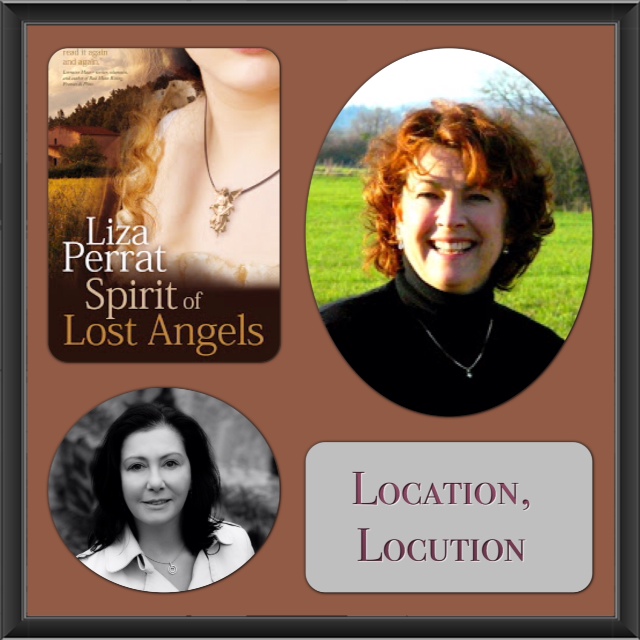
LOCATION, LOCUTION: Liza Perrat on writing a location to life

Liza Perrat visualIn this month’s “Location, Locution”, expat crime writer JJ Marsh interviews  Liza Perrat, author of Spirit of Lost Angels.

Liza grew up in Wollongong, Australia, where she worked as a general nurse and midwife for fifteen years. When she met her French husband on a Bangkok bus, she moved to France, where she has been living with her husband and three children for twenty years. She works part-time as a French-English medical translator.

Spirit of Lost Angels tells the story of Victoire Charpentier and her courage in facing injustice and abuse in revolutionary France. Wolfsangel (due out in November 2013) follows Victoire’s descendant, Celeste, who finds that under Nazi occupation, the personal is political.

*  *  *

Which comes first, story or location?
So far, for me, it has been location. I’m enthused, enthralled or nostalgic about a place, and want to use it as a backdrop around a story. In the case of my current novels, the location has become as much a character as the real-life ones.

How do you go about evoking the atmosphere of a place?
My novels are set in the French rural area in which I live, which makes it much easier to evoke atmosphere. I take loads of photos of the countryside, the people and the buildings, during each different season. The local historical association has lots of sketches and documents on what it looked like through the ages. As I walk the dog, I jot down descriptions of sunrises, sunsets, stormy light, fruit on the trees, snow on the hills, flowers in spring and the icy river in winter.

Which particular features create a sense of location? Landscape, culture, food?
Landscape, culture and food, certainly. But most of all, for me, it is the people who create a sense of location. Often, the people are the place. Also language, especially expressions, plays a part. Architecture too, gives a feel for a place. Smells also, create a sense of location.

How well do you need to know the place before using it as a setting?
Intimately well. I’d have trouble creating a believable atmosphere if I’d not been to a place, or at least read widely on it.

Could you give a brief example from your work which you feel brings the location to life?
Many reviewers of Spirit of Lost Angels commented positively on the atmosphere created of La Salpêtrière asylum in Paris, during the late 1700s:

… I found the scenes of cruelty in the Salpêtrière Asylum painful to read – not because of the way in which they were written, but simply to have been shown such unpalatable truths …

… the section of the novel concerning Victoire’s stay in La Salpêtrière vividly illustrates what a horrible experience it must have been…

… part of the reason I waved to savour this book so much was because of the scenery and the settings…

The book vividly depicts the violent and inhumane methods doctors used to “treat” mental illness at Salpêtrière. To me, this was perhaps the most fascinating portion of the story- descriptions of the appalling conditions under which the women were kept, the rivalries that developed among cell mates, the rules one had to learn in order to survive this prison. The narrative was stark and believable and, believe it or not, educational. Since I’ve finished the book, I’ve been looking up the history of the Salpêtrière Hospital, intrigued at how low mental health care and the care of women had deteriorated at that time. Introducing an urge to learn more, dear readers, is the mark of excellent historical fiction.

Which writers do you admire for the way they use location?
Ones that come to mind:

  • Stef Penney’s The Tenderness of Wolves. Even more amazing as, apparently, she’s never been to the wilderness snowscapes of Canada.
  • Joanne Harris’s Chocolat evokes the small French village.
  • Nikki Gemmell’s Cleave and Kate Grenville’s The Idea of Perfection, describe so well the desolate landscape of central Australia.
  • Jennifer Worth’s Call the Midwife brings to life 1950s East End London.
  • Emma Donoghue’s Room brilliantly portrays an entire existence in a single, small room.

Thank you, Liza!

Next month, my guest on Location, Locution will be Paulo Coelho, author of The Alchemist, The Devil and Miss Prym and Eleven Minutes

* * *

JJ Marsh grew up in Wales, Africa and the Middle East, where her curiosity for culture took root and triggered an urge to write. After living in Hong Kong, Nigeria, Dubai, Portugal and France, JJ finally settled in Switzerland, where she is currently halfway through her European crime series, set in compelling locations all over the continent and featuring detective inspector Beatrice Stubbs.

STAY TUNED for next week’s posts!

If you enjoyed this post, we invite you to register for The Displaced Dispatch, a round up of weekly posts from The Displaced Nation, with seasonal recipes, book giveaways and other extras. Register for The Displaced Dispatch by clicking here!

Related posts:

For travel addict & photography lover Milda Ratkelyte, a picture says …

Milda M CollageWelcome to the second installment of “A picture says,” a series that sheds light on the people who move through our planet with a camera in hand, registering the look, character, and ambiance of people and places that capture their fancy.

Our guest today is Milda Ratkelyte, a camera-happy Lithuanian whose wanderings have taken her to the UK, America and now Asia.

Here are Milda’s vital travel statistics:
Place of birth: Lithuania
Passport: Lithuanian
Overseas history: From least to most recent: United Kingdom (London): 2005-2008; China (Wuhan, Shanghai, Beijing): 2008-2009; United States (California, Colorado, New York): 2009-2010; United Kingdom (London): 2010-2011; Singapore: 2011-present.
Occupations: Travel Community Manager at AsiaRooms.com and owner of Milda Ratkelyte Photography
Social media coordinates:
Twitter: @MildaRatkelyte
Facebook: Milda Ratkelyte Travel
Instagram: @milda_ratkelyte
Google+: Milda Ratkelyte

And now let’s meet Milda and find out: which came first, the photography obsession or the peripatetic life?

Kenyan curiosity

Hi, Milda. Let’s talk a bit about your travels. You are originally from Lithuania but have spent a considerable amount of time in other countries and now live in Singapore. Tell me about how that came about, and what inspired your moves.
I had the most amazing childhood in Lithuania. I was very lucky, because my dad was a true travel fanatic. Back then it was not easy for us Lithuanians to go traveling to remote destinations outside of Europe, but my dad found a way to get us to Kenya for a summer. From that time on, I was addicted to travel, and have been wandering the world ever since. “Explore, discover and get to know different cultures and people around the world”that’s become my mantra.

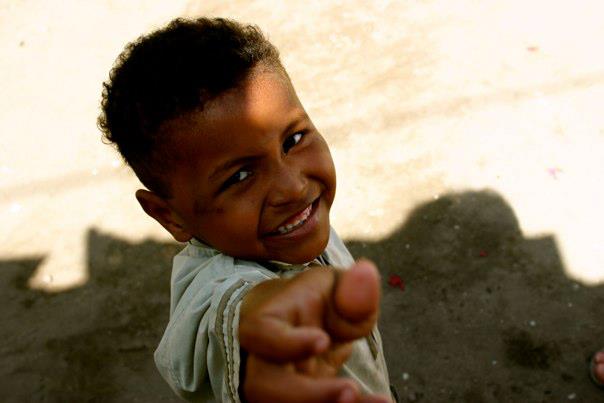
Boy reaching for candyKenya sounds amazing. Can you share with us one of the photos from that trip?
I like this shot of a boy reaching for what he hoped would be candy. It’s from the early days of my camera experience, but I love it because it’s just so natural. There was no set up, no preparation. I was wandering the streets of the Watamu village, looking for the school where I was volunteering, when a group of kids ran towards me asking for candies. I didn’t have any on me, but I had a pack of pencils that I was carrying to the school, so I gave them out and decided to take a photo of the group. As I was setting up the shot, this boy ran from the end of the street. Noticing something was being given away, he squeezed through other kids and jumped right in front of the camera.

Asia calls!

How did you end up in my native land, the UK?
When I graduated from high school, I knew that I want to do something travel related. I enrolled in an International Tourism Management course at the University of Bedfordshire in the UK. For my work placement, I was sent to work in China for the Shangri-La Hotels and Resorts, which gave me the chance to explore some other Asian destinations such as Hong Kong and Singapore. I fell in love with Hong Kong and told myself that once I graduated, I would definitely be coming back. However, when that moment occurred, reality kicked in: I could not get a visa for Hong Kong. I’d decided to stay in London when an opportunity to work for a major events company in Singapore suddenly landed on my doorstep. I had my bags packed in a few days and was on the 14-hour flight to Singapore.

How do you like Singapore?
I’ve been in Singapore for two-and-a-half years already and absolutely love it. Mostly, because it’s the most convenient spot in Asia travel wise. In just two hours I can be in Bali, Hong Kong, or Thailand. And Malaysia is just an hour’s bus drive away.

Luck strikes again

On your blog you say you were “one lucky girl” in finding your current position as a Community Manager for AsiaRooms, a site for booking hotels throughout Asia. Tell us how that opportunity came about and how it fits into your life ideals and love of travel.
When I moved to Singapore, I was working for an events company in the oil and gas industry. While I loved the thrill of closing huge deals, I had no life. The hours were long, with weekends in the office and sales calls at all times of the night. After about half a year, I missed having time to travel, take photos, explore and discover! I started looking around for something in the travel industry, and that was when I got introduced to my current boss, who mentioned that AsiaRooms.com were looking to hire a Community Manager. It was a dream come true. Today I can definitely say I love my job! I have been working on the launch of AsiaRooms.com Community site together with an amazing team, and we’ve already achieved some incredible results. I have also gotten a chance to study and have completed MatadorU’s Travel Writing and Photography courses. But most importantly, I’m getting to work with some amazing and talented photographers, filmmakers, writers and musicians in Asia and across the world while traveling a lot! This year I will finally tick off all the places on my bucket list for Asia.

Passionate about photographybut not equipment

On your blog you say that you love photography “and being able to freeze a particular moment in time, so when things in life change you have the one thing, one memory that never will.” What are the shots that capture some of your favorite memories? And what made them so special?
It is hard to say which ones are my favorites since there are just so many of them, and every trip I make is special. But if I had to choose, I’d pick the photos from the trip to Kenya such as the one above. That was the first time I got exposed to a truly different environment. It was also the first time I experimented with my DLSR, which was a present from my dad. My dad passed away unexpectedly last year, and I feel sad that I’ll never get to travel with him again. But having those photos reminds me of him and of the reason I started traveling.

What kind of camera and lenses do you use?
I have a Canon 300D with two Canon lenses: 18-55mm and 70-300mm. When I was doing a short weekend photography course, my tutor joked: “This girl is truly passionate about photography and not equipment.” My camera was so old it did not have half of the functions they were using during the course!

But although the camera has huge sentimental value, I think I will need to invest in a new one soon, since I have started MatadorU’s Travel Filmmaking course and will need a camera that can capture video.

A “no holds barred” approach to people as subjects

Where have been your favorite places to take photographs? Any particular shots stick out as being amongst your favorites?
My two favorite spots are Myanmar and Japan: Myanmar, for its amazing people, who are always smiling, and the colors of its markets, nature and city life, as well as incredible sunsets and sunrises over the ancient city of Bagan; Japan for its nature, culture and architecture. The old streets of Kyoto, the underground cafes and restaurants in Tokyo, hip people in the Harajuku district, lush greenery and deer in Nara, and bamboo groves in ArashiyamaJapan is just naturally photogenic.

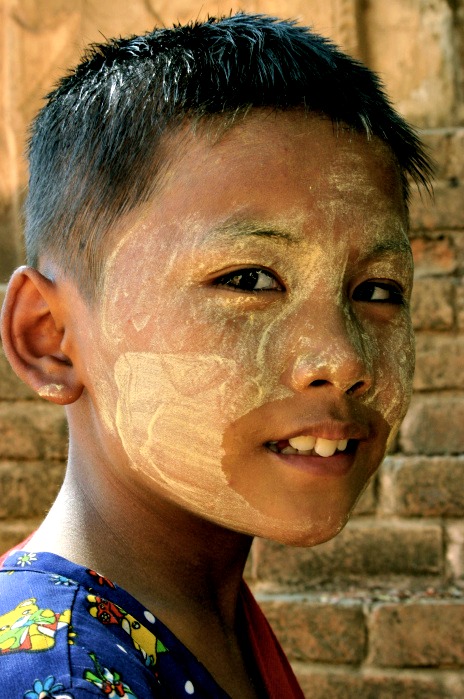
ThanakaBoy_mmIn your shots of Myanmar, I noticed one of a young child. Tell me about how that shot came about and what exactly is going on!
It was taken in Bagan, Myanmar, which is full of the remains of temples and pagodas. That particular morning we’d grabbed our bikes and were exploring the terrain, when I was approached by this young kid trying to sell me his drawings for a dollar. They were crayon drawings of the temples, neatly packed in plastic bags. The boy spoke almost no English, but soon he became my little tour guide, showing me around all the ruins. After our little tour we sat on the old dusty stairs at one of the temples, and while he was trying to tell me more about the place, this perfect photo opportunity appeared. I just love the look in his eyes.

I often feel very reserved about taking photos of people, particularly when they are conscious that I am doing so. Are you the same?
I used to be very reserved about it, but at the same time I knew that this was a major obstacle if I want to progress with my travel photography. I think I came to realize that after traveling around with my boyfriend, who is also a photographer and who has never had hang-ups about this! He doesn’t find it difficult to go straight to someone and ask them to take a photo. At the beginning I used to stay back and watch him, but when I saw how his shots turned out, I realized I needed to overcome this barrier.

Do you ask permission before taking people’s photographs?
It was hard at the beginning, because the truth is you will get a lot of people who will just tell you NO, but at the same time you will get the few that will be very nice to you. I guess my main advice would be to definitely ask them first, and if they don’t agree, leave it! If they do agree, have a little chit chat with them to ease the atmosphere and, once you take the shot, show them how the photo looks, I’ve noticed a lot of people appreciate that!

But how do you get around the inevitable problem of language barriers?
Well, I always try to learn at least few words in the local language before I visit country, like “please,” “thank you”, “hello”, etc. As for the rest, I just point to the camera, then at the person, and smile 🙂 Usually this works—and trust me, the results will be worth the effort.

Parting shots…

Finally, do you have any advice for wannabe photographers (like me) who are traveling or living abroad?
1. Never leave your camera at home. The truth is, some of the most amazing photos are from the moments that come out the blue. It doesn’t have to be an incredible place, it might just be the street you walk down every day. Even if it’s just your iPhone camera, have something at hand.
2. Don’t let rejections stop you from achieving your dreams. I must admit, I have been trying to pitch different publications, blogs, magazines, etc for over a year and all I got were either unpaid opportunities or rejections. And it’s hard to keep motivated, when someone says that your photos are not good enough. But I’ve carried on pursuing my dream and finally, a year later, I am getting paid assignments and, what’s even more important, people are finally starting to look for me and not me for them. As a Community Manager at AsiaRooms.com, I source the photo and video content myself, so I get about 30 pitches a day from very talented people. The roles are reversed: I am the one who is telling someone that we will not be publishing their work. However, in most cases, it’s not because their photos are not good, it’s because the industry is so competitive and businesses like ours can choose only the very best. Knowing this helps me to deal with my own rejections.

Thank you, Milda! Readers, what do you make of Milda’s advice on shooting people? And do you have any further questions for her on her photography, travels, or anything else? Please leave them in the comments!

STAY TUNED for next week’s fab posts!

If you enjoyed this post, we invite you to register for The Displaced Dispatch, a round up of weekly posts from The Displaced Nation, with seasonal recipes, book giveaways and other extras. Register for The Displaced Dispatch by clicking here!

Related posts:

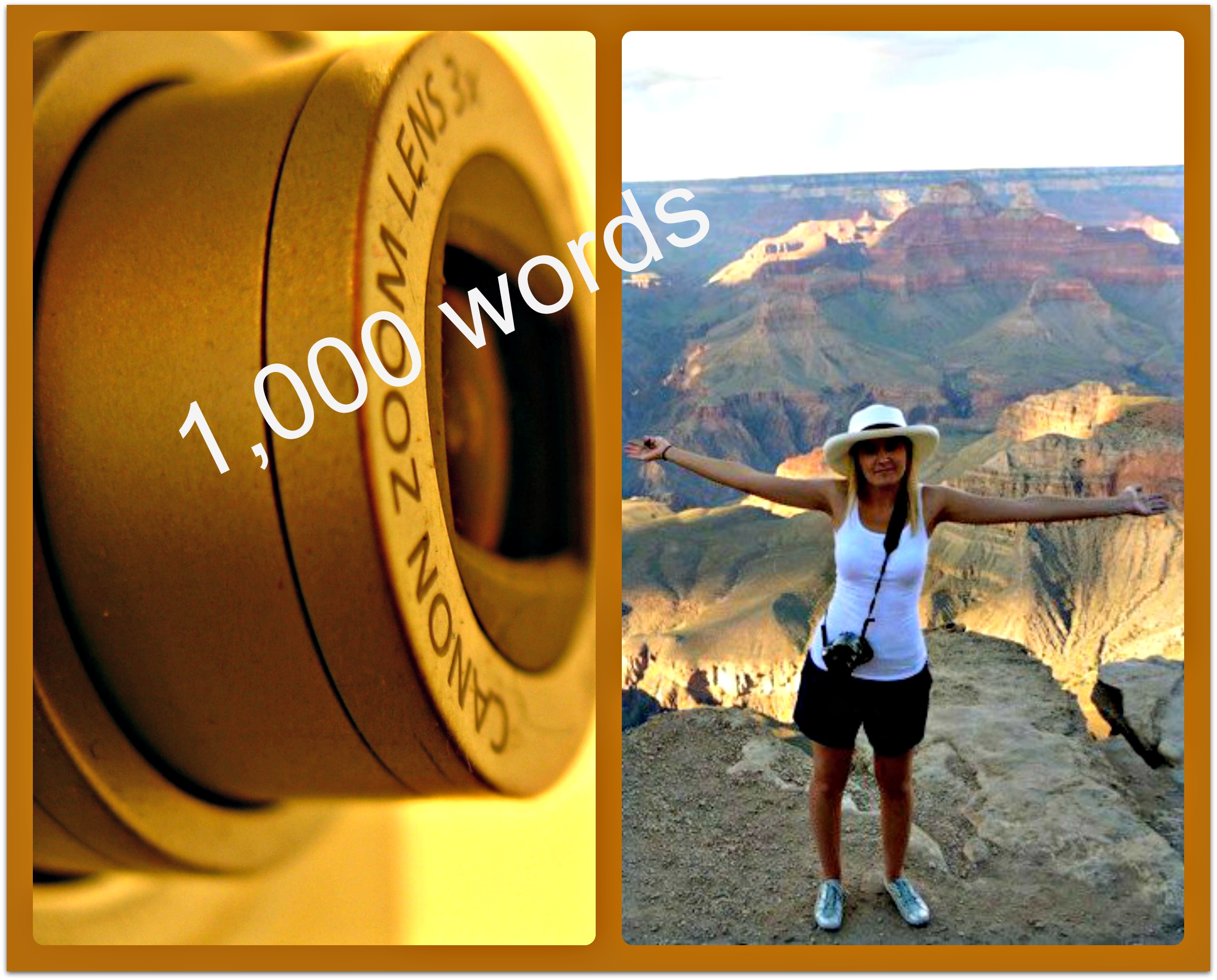
Images (from left): Camera lens from Morguefile; Milda Ratkelyte reveling in her Grand Canyon moment. All other photos by Milda Ratkelyte

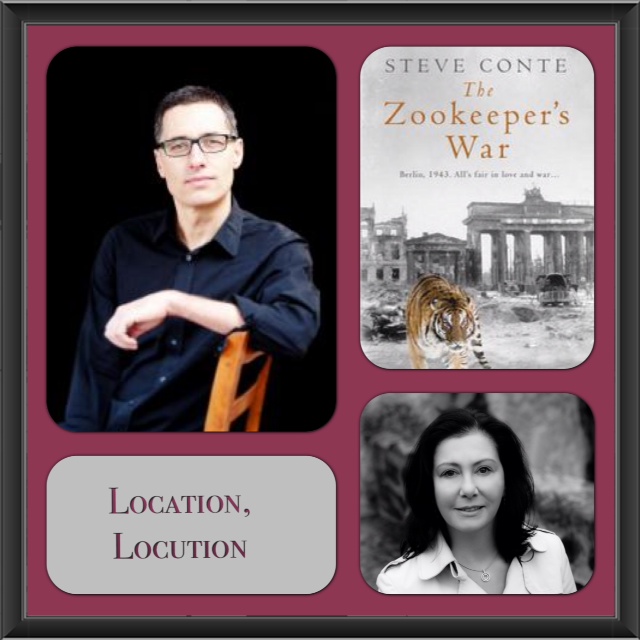
LOCATION, LOCUTION: Award-winning author Steven Conte, bringing location to life through writing

steven conte visualIn this month’s “Location, Locution”, expat crime writer JJ Marsh interviews  Steven Conte, the Melbourne-based author of The Zookeeper’s War. The setting is the Berlin Zoo, 1943. An Australian woman, Vera, and her German husband, Axel, the zoo’s director, struggle to look after the animals through the air raids and food shortages.

In 2008, The Zookeeper’s War won the inaugural Australian Prime Minister’s Award for Fiction, then worth A$100,000. The Zookeeper’s War has been published in Britain and Ireland and translated into Spanish and Portuguese. Barman, life model, taxi driver, public servant, book reviewer and university tutor are some of the jobs with which Steven has supported his writing.

*  *  *

Which comes first, story or location?
For me this depends on the project. The city of Berlin was definitely the initial inspiration for The Zookeeper’s War, in particular the atmosphere of enclosure and entrapment which I sensed there three years before the Berlin Wall came down. While I chose to set my novel in the Berlin of WWII, the Cold War tensions I had witnessed there in 1986 helped me to imagine what it might have felt like to live through the twelve terrifying years of the Third Reich. It was only after the novel was published that I realised I had chosen a setting which has powerful, indeed mythic, associations for many readers (some other examples being New York, Paris, London and, in the east, Hong Kong and Shanghai).

How do you go about evoking the atmosphere of a place?
Stimulating the reader’s senses is the most reliable way, though in a realist narrative a character needs psychologically plausible reasons to notice his or her environment, a difficult ask if focal characters are already familiar with their surroundings. Selecting a focal character who is a newcomer to the setting is one way to emphasise place. Another is to take the focal character on a journey. In The Zookeeper’s War I chose a setting which aerial bombing destroys day by day, compelling the characters to keep on noticing their surroundings.

Which particular features create a sense of location? Landscape, culture, food?
All of the above, provided that accounts of them belong in the story and ring true to the narrative voice. Ideally, descriptive detail reveals as much about the focal character or narrator as it does about setting. In contrast, “unanchored” description can sound like passages of travel writing or anthropology.

How well do you need to know the place before using it as a setting?
With skill, only moderately well, though it’s probably wise to minimise the difference between your characters’ supposed knowledge of a setting and your own. This aside, the best fiction implies more than it states (Hemingway’s iceberg principle), and a few vivid details can be enough to evoke an entire town or city or region. I’d recommend not writing about famous landmarks, since locations such as the Brooklyn Bridge, the Eiffel Tower and the Brandenburg Gate will remain clichés of place however brilliantly they might be described.

Could you give a brief example from your work which you feel brings the location to life?
In the following passage from The Zookeeper’s War the heroine, Vera, walks through Berlin the morning after an air raid:

In the Mitte, the old city, bombs had caved in the skyline, dropping telegraph poles, power lines and tram cables onto burnt-out lorries and trams. Shops were destroyed or boarded up, and glass, chunks of plaster and shrapnel paved the streets. Field kitchens had sprouted at the major intersections, and in alleys off Alexanderplatz girls were already soliciting. Outside one bombed-out tenement Vera read the chalked inscription, Everyone in this shelter has been saved. Around the corner: My angel where are you? Leave a message for your Sigi. In a house without walls on Unter den Linden, a man played Bach on a grand piano, and below him, in a lake fed by a burst water main, a fur stole clung to a hatstand. Half the people on the streets wore a uniform: police, air-raid wardens, women postal workers. Soldiers moved in squads and the only vehicles were staff cars and Wehrmacht lorries, as if the army had conquered Berlin and deployed clerks and shop assistants to the front in a fleet of private cars.

Which writers do you admire for the way they use location?
Cormac McCarthy for the poetry and grandeur of his descriptions, in Blood Meridian and The Border Trilogy, of the border regions of Mexico and the United States. Colm Tóibín for his evocation of the eroding coastline of County Wexford in his early novel The Heather Blazing. William Styron for the magnificent range of settings in Sophie’s Choice, from post-war New York, New England and North Carolina to Warsaw under German occupation and the netherworld of Auschwitz.

* * *

Readers, what did you think of Steven’s suggestions on evoking place? Next month, my guest will be Liza Perrat, author of Spirit of Lost Angels.

JJ Marsh grew up in Wales, Africa and the Middle East, where her curiosity for culture took root and triggered an urge to write. After living in Hong Kong, Nigeria, Dubai, Portugal and France, JJ finally settled in Switzerland, where she is currently halfway through her European crime series, set in compelling locations all over the continent and featuring detective inspector Beatrice Stubbs.

STAY TUNED for Tuesday’s, another installment in the life of our fictional expat heroine, Libby. (What, not keeping up with Libby? Read the first three episodes of her expat adventures.)

If you enjoyed this post, we invite you to register for The Displaced Dispatch, a round up of weekly posts from The Displaced Nation, with seasonal recipes, book giveaways and other extras. Register for The Displaced Dispatch by clicking here!

Related posts:

“Unenthusiastic about enthusiasm”: On Sarah Lyall, the relief of being a returning expat, and never getting over the feeling of cultural discombobulation

CulturallyDiscombobulatedFor today’s post ML Awanohara (doyenne of this particular piece of the interweb) suggested that Sarah Lyall‘s recent piece in The New York Times (“Ta-Ta, London. Hello, Awesome”) might provide me with a suitable topic to chisel out a post for the Displaced Nation.

I’ll be honest and admit (though I never articulated this to ML) that I was rather resistant and a tad unenthusiastic to the idea. I’d previously skim-read Sarah Lyall’s book, The Anglo Files: A Field Guide to the British, and found myself irritated by her observations about her life as an American transplant to London.

In short, I didn’t enjoy it. I was left uncharmed and felt it had about it an omnipresent smug tone.

Bill Bryson did it best

Recently, I’ve had a similar reaction with British academic Terry Eagleton‘s new book, Across The Pond (goodness, even the title sounds like another sub-Bryson knock-off), about his thoughts on living in America.

So I’m an equal-opportunity offender on this matter.

Perhaps foreigner-writing-about-their-adopted-home is a sub-genre that is not for me, which is unfortunate considering that’s the very subject of my personal blog, Culturally Discombobulated (now that I think of it, it sounds like a sub-Bryson knock-off, too). Having read Lyall’s article, I suppose she would call this attitude typically English: at once self-loathing and arrogant.

So I decided I would ignore ML’s suggestion and instead write another Capital Ideas post. As I was about to start writing it (well, start thinking about writing it, if I’m going to be entirely honest), I noticed in my inbox an email from my wife telling me to read this article.  Like Sarah Lyall, Mrs W is an American who has spent time living in London before returning to the US.

Putting my initial reservations to one side, I decided to see just what I was missing.

I must admit, Sarah’s right about L.G.

First, a little bit of background: Sarah Lyall has been The New York Times London correspondent for 18 years. Her article this week was about her repatriation to her home country.

I’ll be honest. Unlike when I read her book, The Anglo Files, I found myself more charmed by her writing and observations. This could be the result of the shorter form of a newspaper article, my mellowing, or far more likely our common enemy that is Loyd Grossman—Sarah’s wish on first moving to the UK was that she wouldn’t end up sounding like her more famous compatriot.

Readers who have not spent any considerable time in the UK are probably oblivious to L.G.’s existence. A television presenter (who was host of the original MasterChef, which other than name bears scant resemblance to Fox’s Gordon Ramsey vehicle) as well as a range of pasta sauces (I’ve no idea why, given that he’s not a chef), Loyd Grossman is in possession of the oddest transatlantic accent. It’s preppy New Englander meets Sloane Square yuppie, and just hearing it makes you want to declare class war.

For all of us in clear and present danger of one day developing a transatlantic accent, Loyd Grossman is a stark and terrifying cautionary tale.

…and about us?

Sometimes when I am reading a foreigner’s perspective on the British, I am struck by how awful we sound—a complete bunch of miserable bastards that have developed a carapace of irony and delight in popping positivity like it were a balloon at a child’s birthday party.

Is it any wonder Sarah got a bit fed up with our lack of enthusiasm:

…Britons are not automatically impressed by what I always thought were attractive American qualities—straightforwardness, openness, can-doism, for starters—and they suspect that our surface friendly optimism might possibly be fake. (I suspect that sometimes they might possibly be right.)

Once, in an experiment designed to illustrate Britons’ unease with the way Americans introduce themselves in social situations (in Britain, you’re supposed to wait for the host to do it), I got a friend at a party we were having to go up to a man he had never met. “Hi, I’m Stephen Bayley,” my friend said, sticking out his hand.

“Is that supposed to be some sort of joke?” the man responded.

The pursuit of happiness may be too garish a goal, it turns out, in the land of the pursuit of not-miserableness. After enough Britons respond with “I can’t complain” when you ask them how they are, you begin to feel nostalgic about all those psyched Americans you left behind.

After reading this piece, my wife said that she’d forgotten that so much of my personality was cultural. “I thought,” she said, “that it might be time for you to have some therapy, but then I realized you’re just British—no amount of therapy can fix that.”

* * *

I’ve not experienced what it is like to repatriate yourself back home. I do know, however, that many of you have. Do let me know in the comments below what struck you about moving back and what you missed about the adopted country you left.

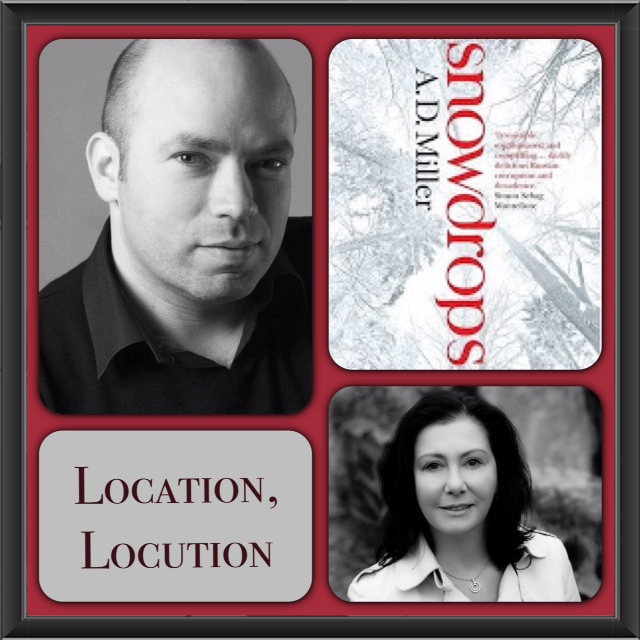
LOCATION, LOCUTION: Booker Prize-nominated author AD Miller, on bringing a location to life through writing

ADMillerIn the second of our series “Location, Locution”, expat crime writer JJ Marsh interviews AD Miller, the British author and journalist.

About AD Miller

AD Miller was born in London in 1974. He studied literature at Cambridge and Princeton, where he began his journalistic career writing travel pieces about America. Returning to London, he worked as a television producer before joining The Economist to write about British politics and culture. In 2004 he became The Economist’s correspondent in Moscow, travelling widely across Russia and the former Soviet Union. He is currently the magazine’s Writer at Large; he lives in London with his wife Emma, daughter Milly and son Jacob. He wrote a critically acclaimed non-fiction book, The Earl of Petticoat Lane, in 2006. His second novel, Snowdrops, was shortlisted for the 2011 Booker Prize.

About his novel, Snowdrops

A fast-paced drama that unfolds during a beautiful but lethally cold Russian winter. Ostensibly a story of naive foreigners and cynical natives, the novel becomes something richer and darker: a tale of erotic obsession, self-deception and moral freefall. It is set in a land of hedonism and desperation, corruption and kindness, magical hideaways and debauched nightclubs; a place where secrets, and corpses, come to light when the snows thaw.

Q&A on Location, Locution

JJ Marsh: Which comes first, story or location?  
AD Miller: Story. But locations can be suggestive of certain kinds of story. For example, Russia lends itself to tales of moral challenge and to philosophical inquiry.

JJM: How do you go about evoking the atmosphere of a place?
ADM: Take notes. Write down what people wear on the Metro and what the vendors on commuter trains are selling. You will recollect less than you think you will. For historical settings, read old newspapers and unpublished memoirs. Remember it is the inconsequential detail that is most important.

JJM: Which particular features create a sense of location? Landscape, culture, food?
ADM: Smell. Sounds. Language (especially slang and proverbs). Clothes. And weather: in Snowdrops, the Russian winter functions as a sort of ancillary sub-plot.

JJM: How well do you need to know the place before using it as a setting?
ADM: You need to know it, and then you need to unknow it. A novel isn’t a travelogue or an encyclopaedia; you enlist only those aspects or details of a place that serve the narrative.

JJM: Could you give a brief example from your work which you feel brings the location to life?
ADM: There’s a passage in Snowdrops in which Nick, the narrator, is taxiing at night alongside “the soupy Moscow River, not yet frozen and curling mysteriously through the wild city”, which is OK.

JJM: Which writers do you admire for the way they use location?
ADM: Isaac Babel and Giorgio Bassani (Odessa and Ferrara respectively).

* * *

Thanks, JJ, for that fabulous interview! Readers, any comments on what AD Miller had to say? Up next month in Location, Locution: Steven Conte, Australian author of The Zookeeper’s War.

JJ Marsh grew up in Wales, Africa and the Middle East, where her curiosity for culture took root and triggered an urge to write. After living in Hong Kong, Nigeria, Dubai, Portugal and France, JJ finally settled in Switzerland, where she is currently halfway through her European crime series, set in compelling locations all over the continent and featuring detective inspector Beatrice Stubbs.

STAY TUNED for tomorrow’s post, another installment in the life of our fictional expat heroine, Libby. (What, not keeping up with Libby? Read the first three episodes of her expat adventures.)

If you enjoyed this post, we invite you to register for The Displaced Dispatch, a round up of weekly posts from The Displaced Nation, with seasonal recipes, book giveaways and other extras. Register for The Displaced Dispatch by clicking here!

Related post:

Meet author Rosie Whitehouse, who trailed her spouse into a war zone (and enter to win her book!)

Rosie Whitehouse CollageOne of the expressions I picked up from living in England for many years is “Keep the home fires burning.” For some reason, that expression, along with the WWI song from which it comes, is running through my head as I contemplate talking to today’s featured author, Rosie Whitehouse (click here to hear it being sung):

Keep the Home Fires Burning,
While your hearts are yearning.
Though your lads are far away
They dream of home.
There’s a silver lining
Through the dark clouds shining,
Turn the dark cloud inside out
Till the boys come home.

For me, Rosie is an up-to-date version of what the songwriters had in mind. Educated at the University at London, with a career as a BBC journalist, she chose to stay at home with her children and keep the house warm and welcoming, and the family’s spirits up, while her husband, the journalist Tim Judah, went off to report on various wars for The Economist and other newspapers.

Rosie even went the further step of moving the family home to be closer to Tim for a time. Ironically, she kept the home fires burning in the very place where World War I began, the Balkans. She flew out to a crumbling Bucharest—it had been knocked down by the notorious Ceaușescu, whose secret police killed hundreds during Romania’s 1989 revolution—with one child in tow and another one on the way.

Then, when it seemed possible that her own home could go up in flames as war spread across the former Yugoslavia, Rosie did not give up. She stayed for a total of five years before returning to London, by which time “keeping the home fires burning” was second nature both for her and the couple’s five kids (Tim carried on covering wars in Iraq, Afghanistan, and the Congo).

Having revived her career as a freelance journalist, she decided to write her first book: Are We There Yet? Travels with my Frontline Family—a copy of which we’ll be giving away! (See details below). The book is a tribute to families who have been “burners of the home fires,” whose emotional pain tends to go unheralded. It is also, in her words, “quite funny.” (Hey, growing up in Bucharest, Belgrade, Croatia and Bosnia can be fun!)

By now you must be as curious as I am to meet the intrepid Rosie Whitehouse and learn more about what motivated her to seek out such an unusually displaced (at least by most of our standards!) life. I note that she has an Irish mother—perhaps that explains it?! (I’m thinking Queen Boudicea…)

* * *
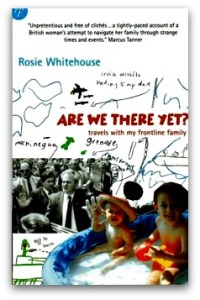
AreWeThereYet_cover_dropshadowHi, Rosie. In your book you say that your husband’s journalist colleagues in Romania, all of whom were single, were shocked to hear he had a two-year-old son and another child on the way. Did people often tell you you were crazy?
Yes, lots of people thought I was crazy.

As a former journalist with a background in Russian studies, do you think you felt a tinge of envy for Tim’s opportunities—which made you want to be on the scene?
Not really, as I would not have been able to cope with going to morgues and so on.

I know you’re going to challenge our definition of “displacement,” but I’ll go ahead and ask: what was your most displaced moment during your stay in the Balkans—when you had to explain Daddy’s muddy boots (he’d been walking in a mass grave), when you visited empty supermarkets, or when you heard the first shots of the conflict in Bosnia while strolling around Sarajevo with the kids?
Those things were reality so in that one doesn’t feel displacement. Quite the opposite in fact. I was intimately plugged into life and death at those moments.

How did you keep yourself sane?
I coped with stressful moments by bunkering down. I wouldn’t send the kids to school and cuddled up with them instead. As long as I shut my front door, where ever I am and whatever is going on, and it is just us, I am able to feel at home.

But getting back to your question about displacement: My best moment in a foreign country was when I saw my mother drive off in a taxi in Bucharest and realizing that apart from my two year old son I didn’t know a soul in the country (my husband was away in Albania for weeks). Wow, at last no one to tell me what to do! Freedom!

More seriously, most displacements do not happen by choice, and my most displaced moments have been as a result of this. I recount a story in the book when I took the kids to Berlin ten years ago. My mother-in-law was born there but fled in 1933 as she was Jewish. The family settled in Paris. As a result I have half French children who speak fluent French and we don’t speak a word of German.

It was a rather stressful visit as we searched for old family homes, one of which the family were still trying to reclaim. My daughter Esti got a headache. I pointed to the department store and suggested that we go in to buy an aspirin. It was Wertheims. My mother in law’s mother was a Wertheim and was murdered in Aushwitz. Esti said:

What, first they give me a headache by stealing the department store and murdering my great granny–and now I am expected to go in and buy an aspirin to make it better? You have to be kidding!

That’s displacement.

Child-rearing on the frontlines

What was the biggest challenge about having children with you on the frontlines?
The biggest challenge was often the simplest thing such as getting them something to eat and getting hold of baby milk.

Did anything surprise you?
Life never ceases to surprise me where ever I am and what ever is going on. The terrible things and the good things always amaze me.

What do you think the kids got out of the experience?
The kids learnt a lot. My eldest son, Ben, would ask about why there was no food in Romania. For me it was a matter of telling simple tales of communism and 1917. For him it began a life-long interest in Russia. He is following in his father’s footsteps.

My eldest daughter, Esti, would like to work for an NGO like Human Rights Watch.

For all of us, it drew us closer together. We are a tight-knit family.

I’ve heard of war reporters feeling bored when they come back to “reality” in their home countries. Did your family experience any of that after five years in the Balkans? What was it like to go “home” again?
Going home is just as difficult as moving to a new country. By the way, the wars didn’t stop either after we got back. My husband has since covered lots of wars and famines including Afghanistan, Iraq and the Congo.

Writing a book, but from the backlines

After you left the Balkans, it took quite a few years before you decided to write the book. What was the catalyst?
It was during the invasion of Iraq in 2003. I was standing in the supermarket and they had just installed a TV with a live feed from Iraq by the checkout. Some soldiers were running across a street in Basra, where some of the heaviest fighting took place, followed by a reporter and camera man. All of their faces were clearly visible. My husband was in Baghdad covering the story for The Economist. I had actually popped out for five minutes of fresh air before the bombers took off from the UK and the countdown to the blitz on Baghdad began.

I realized, to my horror, you could be buying a packet of frozen peas and watch your husband killed in front of your eyes. I know this thought had never entered the mind of the supermarket manager who had simply installed the TV to attract customers.

That evening I found my ten-year-old glued to a grainy grey screen showing an image of Baghdad as the cruise missiles were expected. What do you say? I had to make dinner and she had to do her homework. The UK had a huge debate about the war and the way it was covered, and I felt nobody knew what it was really like to be part of it and a kid to boot.

I also found that very quickly after the Berlin Wall came down that people forgot in Western Europe just how hard life had been under communism, especially in Romania and Albania. No surprise in that, really, as since 1945 most people in Western Europe just forgot the East existed.

I also found people in the UK quick to judge and condemn people in Southeastern Europe as being violent and prone to war. I wanted them to realize we are no different. That is why I’ve also included a chapter on Ireland in the book.

And I wanted to describe the multicultural experience of bringing up half-French, half-Jewish, part-Irish children in various countries, something I found fascinating.

Was it also part of your mission to show others what it is like to be married to, the child of, a war reporter?
Yes, not just to a war reporter but also those who are married to soldiers—especially those who are part-time soldiers and live in the community.

Did you have any personal motives in writing the book, to help you process what you’d been through and to provide your children with a record of where they’d lived?
No, not really. I didn’t write it for us but to make people think about what was going on. I am sure that the kids will appreciate it when they are older.

What was the most difficult part of the book-writing process?
Getting time to do it. I often wrote with my computer on the kitchen side as I was cooking dinner, which was good as I could hear kids talking; and as I was writing about them, it helped to have them there doing their thing.

Did you find it easy to find a publisher for the book?
No it was hard. publishing is a tough business. I started my own publishing company, Reportage Press, which closed a few years ago. Are We There Yet? is on Amazon as a self-published download these days. We also have a number of journalist friends who are taking the self-publishing route quite successfully.

What audience did you intend for the book? Did you think it would also appeal to other kinds of expats, who don’t go to war-torn countries?
Yes, there is a large expat element to the readership, and I know the book has touched the hearts of women feeling lonely and bewildered in a new country. I have been hugged and kissed by quite a few of them. One lady said reading the book had saved her marriage. I’m not sure it was me, but I hope I helped her realize it wasn’t so bad being lonely in London. It is hard being in a strange country with children. It is you who have to interpret it for them and as you are far from the family support group and friends, it is inevitably all up to you to be their world. It’s a tough job. That said, the book is far from serious. It’s actually quite funny.

Can you give us some examples of humorous moments in the book?
The kids are a laugh a minute, so whatever was going on they would often say or do something funny. For example:

For me the market in Piaţă Amzei is the focal point of life in the city centre [of Bucharest]…

“Let’s see the old ladies with the cheese. Come on!” shouts Ben as he darts out of the pushchair and into a smelly covered hall, where they sell heaps of yellowy looking curds, which are akin to feta.They are covered in flies.

The old women with their long black skirts and headscarves beckon him over and offer him little crumbs. He watches their lips and toothy grins with fascination. They look unnerving, like witches with crunched up dirty teeth, but he doesn’t run away. He has come deliberately to stare at them. He studies an old lady’s face carefully as she says something he can’t possibly understand. He is like his father, never frightened of anything and intrigued by the smallest thing. He loves the bizarre and the quirky.

* * *

“Where’s Mr Parking? Why doesn’t he find us a space?” asks Ben as we drive up and down the street outside our flat. Ben loves Mr Parking. I can’t see him anywhere.

Mr Parking is the man who organises the parking lots outside Belgrade town hall. It’s an elegant 1880s building that was once the royal palace and is right next to our block of flats. For a tip, he lets us park in the lots reserved for local officials. I haven’t seen him for weeks and have to be careful where I put the car, or we’ll be towed.

“I think he has gone back to Bosnia to fight, Ben.”

“What!” Ben is horrified.

“Why? I want to park the car. Doesn’t he want to stay here?”

“No, I expect he wanted to go home and defend his village.”

“Where is his village?”

“He’s from eastern Bosnia, the bit between here and Sarajevo [Bosnia’s capital city]. He told Dad he comes from Kamenica. It’s in one of the last bits there that’s still under Muslim control.” It’s a village close to the town of Srebrenica [the town where a massacre took place in 1995, said to be a crime of genocide].

“What! He’s a Muslim?” Ben is amazed: “But he looks like everyone else!”

“Of course, he does! You don’t look different if you’re Muslim. Bosnians look the same whether they are Muslims or not.” My mother has just sent him a book about the Crusades.

“I thought Muslims looked like Arabs.”

Are you working on any other ambitious writing projects?
I would like to write an expat guide to Britain. I spend a lot of time explaining Britain to people as I live in an expat world in the UK to a certain extent as my children have been or go to the French Lycée, and we have a lot of foreign friends who live in London.

Ten Questions for Rosie Whitehouse

Finally, I’d like to ask a series of questions that I’ve asked some of our other featured authors, about your reading and writing habits:
1. Last truly great book you read: Malaparte is on my mind as I am driving to Ukraine. His book on the 1941 invasion of Russia is unforgettable.
2. Favorite literary genre: Novels
3. Reading habits on a plane: Nothing. I am too tense on a plane as I hate flying. If I am calm enough I love to look out of the window.
4. The one book you’d require President Obama to read, and why: My son Ben’s book on Russia: Fragile Empire: How Russia fell in and out of love with Vladimir Putin. It’s a great portrait of contemporary Russia. I am his mum—what else am I supposed to say to this one?
5. Favorite books as a child: I loved Little House on the Prairie but above all I loved the stories my dad used to tell me.
6. Favorite heroine: She doesn’t have a name. She is one of the millions of women who have struggled to keep their families together against the odds. These are the mums who keep the world turning.
7. The writer, alive or dead, you’d most like to meet: I always wanted to meet William Shirer. He must have had an extraordinary experience living in Berlin at the start of World War II. Perhaps the ultimate expat experience! I suggested an interview programme with him to BBC World Service in the 80s but they didn’t have the cash to send me to America to do it. A pity as he died after that.
8. Your reading habits: I read a lot. If you want to write you have to read. I also have to read a lot for work.
9. The book you’d most like to see made as a film: None, really. If you love a book, the last thing you want is for it to become a film as you have the pictures in your head and they are your pictures not someone else’s.
10. The book you plan to read next: Vasily Grossman‘s An Armenian Sketchbook is in my suitcase. I love Grossman. He is a fantastic writer. If you haven’t read Life and Fate, you have really missed out.

* * *

Thanks so much, Rosie! Personally, I found your story very moving and think we should confer on you a “home fires” medal for all you’ve achieved!

Readers, it’s time for you to ENTER OUR DRAW TO WIN A FREE COPY of Rosie Whitehouse’s book. Rosie is giving away ONE COPY and will favor comments that tell her why you’d like to read the book.

Extra points, as always, if you’re a Displaced Dispatch subscriber!

The winner will be announced in our Displaced Dispatch on August 2, 2013.

Rosie Whitehouse is a parenting journalist and mother of five. She is one of the UK’s leading experts on family travel. She has written widely on family matters and traveling with children for The Sunday Telegraph, The Independent, The Guardian, The Daily Mail, Sunday Express, Family Circle, The Economist, and others, as well as for the Web sites B4Baby.com and Raisingkids.co.uk. She has also spoken at events and on television and radio on parenting matters, promoting her travel books and her autobiography, Are We There Yet? Travels with my Frontline Family. You can follow her latest adventures at http://www.rosiewhitehouse.co.uk/.

STAY TUNED for tomorrow’s post in our Olde vs New World series, by guest blogger Claire Bolden.

If you enjoyed this post, we invite you to register for The Displaced Dispatch, a round up of weekly posts from The Displaced Nation, with seasonal recipes, book giveaways and other extras. Register for The Displaced Dispatch by clicking here!

Related posts:

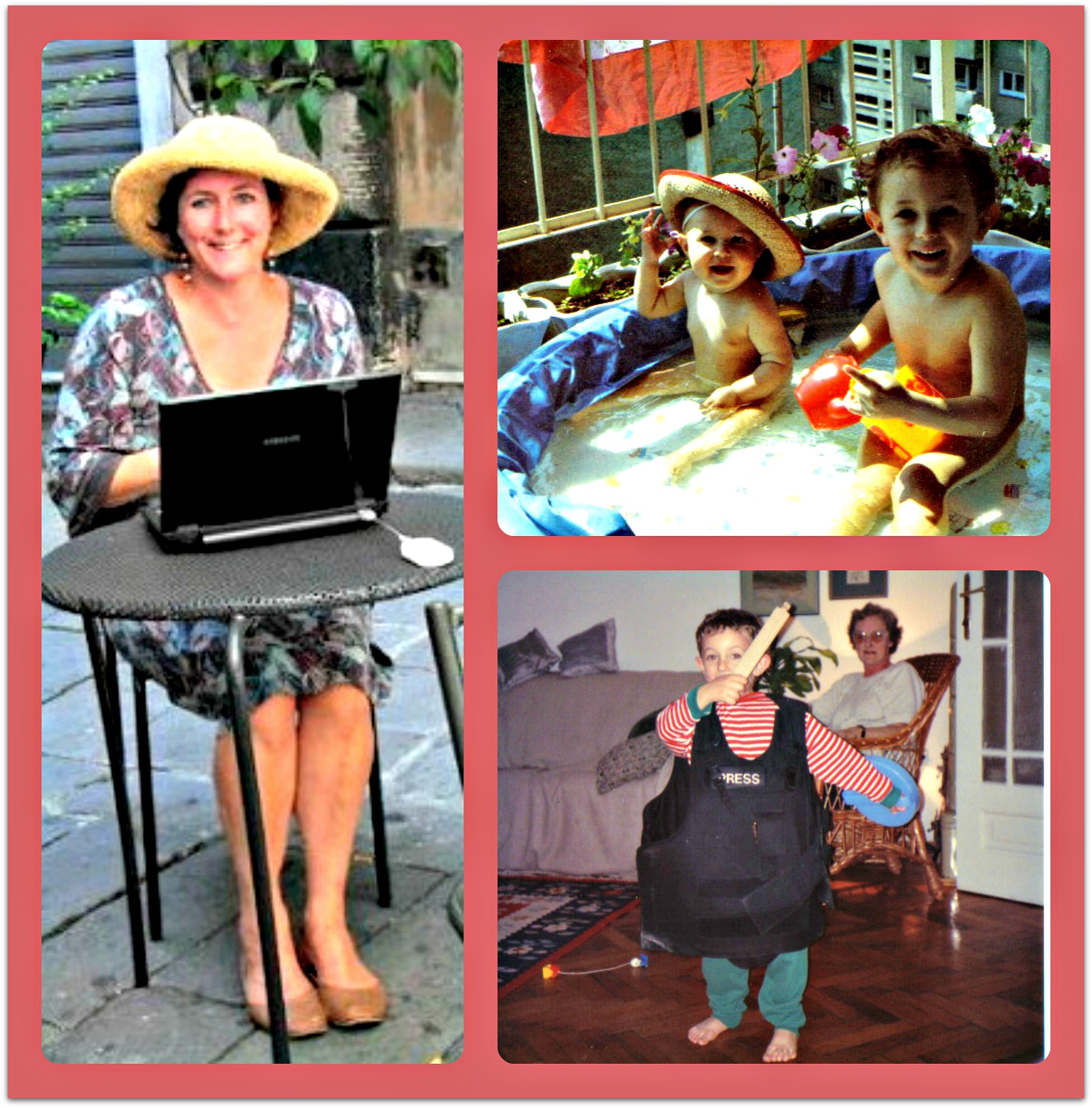
Images (clockwise from left): Rosie Whitehouse at “home” in London; Ben and his baby sister, Esti, living it up on the balcony in Bucharest (July 1991); Ben trying on his dad’s new bulletproof jacket, with Rosie’s mother in background (Belgrade, May 1992).

Are Brit international creatives better than their Yankee counterparts?

NYC_Awindram_pmWhen Chariots of Fire screenwriter Colin Welland won his Oscar in 1981, his acceptance speech began with him somewhat obnoxiously and ungraciously proclaiming: “The British are coming!”

Unlike Paul Revere, this wasn’t intended as a dire warning to fellow Americans, but was rather a British boast about perceived creative superiority over the transatlantic cousins.

Ultimately, the renaissance of British cinema that Welland envisaged did not materialize, but though that particular “British invasion” did not in the end occur, the US has since . . . oh, let’s say since 1812 . . . endured a number of British invasions: from Dickens’s arrival in Boston in 1842, to Oscar Wilde’s statement to a US customs officer that he had nothing to declare but his genius (which I would certainly not advise anyone that they should try to use that line in JFK), to the Beatles’ first performance on the Ed Sullivan Show in 1964 (considered the beginning of the British Invasion in music).

If David Carr’s recent column in the New York Times, entitled “British Invasion Reshuffles U.S. Media,” is correct, then we may be in the grip of another one. The genesis for this piece has been John Oliver‘s recent, perfectly competent portrayal of a bamboozled substitute teacher on The Daily Show.

Carr’s contention is that at the moment “everywhere you look in the United States media landscape, you find people from [Britain]”:

Piers Morgan came from Britain to take over for Larry King, the Wall Street Journal is edited by Gerard Baker, a British newspaper veteran, and the chief executive of the New York Times is Mark Thompson, who spent his career at the BBC. Anna Wintour has edited Vogue for more than two decades and, more recently, Joanna Coles took over Cosmopolitan, which defines a certain version of American womanhood.

NBC News recently looked to the mother country for leadership and found Deborah Turness, the former editor of Britain’s ITV News. ABC’s entertainment group is headed by Paul Lee, also formerly of the BBC, and Colin Myler, a Fleet Street alum, edits the New York Daily News.

The list goes on, but the point is made: when it comes to choosing someone to steer prominent American media properties, the answer is often delivered in a proper British accent.

But, as the title of this post asks, the British better at being international creatives than their American counterparts? Are we more fearless?

The examples that Carr puts forward are compelling, even if we may have to suspend our imagination and hope our stomachs do not turn too much in allowing Piers Morgan to be considered a “creative.”

However, I am unconvinced in a post-Leveson world that there is inherently anything better or more attractive about British media operators when set alongside their American counterparts.

Of course, that does not alter that it is inarguable that New York media finds itself with a number of prominent Brits.

Carr hits on one of the main reasons for this — London:

“Los Angeles, New York and Washington all have their domains, while in Britain, there is only London, a place where entertainment, politics and news media all live in the same petri dish.”

In an increasingly international world, a world in which the super elite can be found in a select number of super cities, it is only to be expected that large New York media empires would be selecting from a fairly small pool. They’ll look to New York and London — the two major English-speaking super cities.

It is perhaps a complete misconception that for the purposes of this question we think in terms of America and Britain, as if to make out an otherness between each party, when they share status as super city elites.

The true “other” would be the newspaper man from Minnesota or the TV station manager from Louisville. I know from my own anecdotal experience of MBA grads from top US business schools that the majority that I know are in New York or London. This is just the new normal — it is hardly surprising that it is reflected in New York’s media executives.

It is also noticeable to anyone who has spent any time in the UK that while a struggling, gasping industry, print media is more alive in the UK at present than it is in the US.

The result of this is that they are a large number of British candidates that would be attractive to US companies in the position to headhunt a new executive.

A final factor is the attraction of “success” in the US for Brits. I don’t say this lightly, but take a look at Piers Morgan’s twitter account . . . I know, I know . . . awful, isn’t it? However, a quick look through a random selection of Morgan’s twitter will soon reveal a man who enjoys boasting — or if I’m being more generous, teasing — other British celebrities who have no profile in the US.

Success in the US seems greater, somehow. There is a pull there that is irresistible. There is romance to it. “If I can make it there, I can make it anywhere.” What do all the many American CEOs heading boardrooms in London get to sing to themselves?

STAY TUNED for tomorrow’s post, an interview with our featured author of the month, Rosie Whitehouse.

If you enjoyed this post, we invite you to register for The Displaced Dispatch, a round up of weekly posts from The Displaced Nation, with seasonal recipes, book giveaways and other extras. Register for The Displaced Dispatch by clicking here!

img: awindram

NEW VS OLDE WORLDS: Would you rather chat about weather with a rugged Aussie or a whingeing Brit?

Libby Collage New&OldRegular readers of the Displaced Nation are treated every other week to a new episode in the life of fictional expat Libby Patrick, a 30-something British woman who has relocated with her spouse to a town outside Boston. Her diary, Libby’s Life, by Kate Allison, is replete with observations about life in New England vs. England. In the weeks when Libby isn’t published, we are featuring posts by writers who are sensitive to the subtle yet powerful differences between new and “olde” worlds. Today we hear from an occasional contributor, Kym Hamer, whose thoughts on the topic immediately drifted to the ten winters she has spent in her adopted home of London. Hmm…is that because her native Melbourne now has highs of 8°C, or 46°F (and overnight lows of -1°C, or 30°F)?

—ML Awanohara

Kym Outdoor Entertaining Australia Day 2008As an Australian who moved to the UK in 2004 and who continues to make London her home almost ten years on, I can’t really afford to have any quarrel with the weather.

It is one of the quintessential British-isms, this obsession with weather, and it is the question I find myself in the midst of most debate aboutalways at the first meeting and often well into several years of cross-cultural friendship.

The stereotype of Australia’s big blue skies, fresh-faced outdoorsy-ness and neighbourly games of cul-de-sac cricket prevails so strongly in the British psyche, that any suggestion that all is not what it appears Down Under comes across as churlish, un-conversational and bordering on arrogant ungraciousness.

It’s not worth arguing: the Brits like to be right about this.

But what has struck me most about these conversations is that they usually occur in overheated pubs, lounge-rooms, Tube carriages and lifts with the protagonists sitting or standing around in their shirtsleeves complaining about the cold.

I have never met a nation so unwilling to put a jumper on.

(Which reminds me of a rather bad joke: what do you get when you cross a kangaroo and a sheep? A woolly jumper!)

Wrap up warm, but not too warm

I’ve been caught out myself, rugging up [putting on lots of clothes in anticipation of going somewhere bl**dy freezing] upon leaving the house on a chilly morning. Silently congratulating myself on my toasty (sometimes even thermal) attire, I find myself wishing I could dispense with three quarters of it half an hour later.

And let me tell you, it’s a royal pain to carry around a heavy winter coat and quite embarrassing to sit sweating profusely in a job interview because everything you could have possibly taken offand still remain decent, let alone remotely “put together”has been shed.

So I’ve learnt to avoid the thermal underwear and to dress in layers. More or less like a pass the parcel parcel.

Tuning into the daily weather forecast on the radio as I open one sleepy eye each morning, I’ve learnt that it pays to double check that the light spring coat hanging at the ready should not be replaced by something more…or less.

Accessorize!

But the biggest lesson I’ve learnt is this: it’s the extremities that matter and the right hat, scarf and gloves can make all the difference.

As the temperature and wind chill factor pas de deux through London during any given month, the right “weight” of this essential triumvirate can have me either swanning about in a state of slightly disheveled fabulous-ness or looking as though I’ve been dragged through a damp hedge backwards.

As such I have acquired:

  • several right “hats”
  • a range of pashminas—from warm woolly to just to keep the chill off on a “summer” evening
  • many suitable scarves (they are defined by being more slender in shape than a pashmina)
  • not one but two perfect pairs of gloves—a heavy-duty, super-warm pair and a lightweight purple leather set.

Which reminds me how hacked off I was to lose one of the heavy duty duo in January—and must make a note to myself to buy the perfect replacement pair. I’ve learnt that’s harder than it sounds. Who knew such things would become so important to me?

And then there’s the bag. My handbag grew exponentially into a “tote” during my first few years in London, becoming big enough to stuff in one or any combination of this trio as I climbed up/down Tube escalators, entered offices and interview rooms, got on and off buses and hugged friends in the doorways of their toasty digs.

Thank goodness other essentialsphones, umbrellas, (e)bookshave gotten smaller.

“Bring something warm—if it’s dry we’ll be sitting outside!”

But when I am at home and the climate is just my own again, slippers and cozy throws abound, whether I’m curled up on the couch in the lounge room, cooking up a frenzy in the kitchen or tucked under the duvet in my bedroom. The heating does get turned on but only when a jumper just isn’t enough.

I am famous (or infamous?) for invitations tagged with “bring something warmif it’s dry we’ll be sitting outside.” Guests laugh knowingly and remark about taking the girl out of Australia and all of that.

But baby, when it’s cold outside, quite frankly you should already know the drill:

Put a bl**dy jumper on!

* * *

Thanks, Kym, for that impassioned account of what it’s like for an Aussie to live in the midst of limeys who’d prefer to moan about the cold instead of taking practical measures. And speaking of whingeing limeys, you’ve given us Yanks yet another reason to feel pleased that we declared our independence from Britain on this day 237 years ago!

Born and raised in Melbourne, Kym Hamer has worked in London in sales and marketing for nearly ten years. She writes the popular blog Gidday from the UK. Also follow Kym on Twitter: @giddayfromtheuk.

STAY TUNED for next week’s series of posts—and a Happy 4th of July Weekend, meanwhile, to US-based readers!

If you enjoyed this post, we invite you to register for The Displaced Dispatch, a round up of weekly posts from The Displaced Nation, with seasonal recipes, book giveaways and other extras. Register for The Displaced Dispatch by clicking here!

Related posts:

Img: Photo of Kym Hamer entertaining outdoors, glass of wine in hand, in honor of Australia Day (January 26).

Portrait of woman from MorgueFile; Lighthouse (R) from MorgueFile; Lighthouse (L) from MorgueFile