The Displaced Nation

A home for international creatives

Tag Archives: Italy

10 expat books ripe for movie adaptations

Those who have been following this blog for some time are probably all too aware of my unhealthy preoccupation as to what constitutes an expat or travel book.

Is it, as often seems the case when I browse the expat blogosphere, that expat books must occupy themselves with the oh-so-amusing hi-jinks of expat life? The result almost invariably of such approach is that we are depressingly left with another third-rate knock-off of Bill Bryson for us to throw on the bonfire.

So when considering which expat books are ripe for movie adaptations, my first thought is that the film world, not to mention the world in general — at least, the one I want to live in — really doesn’t need any more travesties such as Under the Tuscan Sun, A Good Year or — most horrifying of all — Eat, Pray, Love. So with that in mind I will nominate the following 10 expat books as being ripe for interesting adaptations.

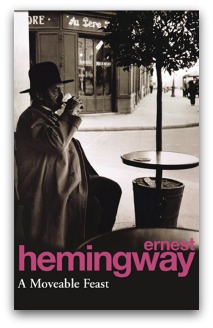
10. A Moveable Feast (1964, revised 2009)

Author: Ernest Hemingway
Synopsis: Hemingway’s posthumously published memoir detailing his years as a young American expat in Paris socializing with the likes of F. Scott Fitzgerald, Gertrude Stein and Ezra Pound.
Film pitch: Perhaps now is the perfect time for an adaptation of A Moveable Feast. The surprising success of Woody Allen‘s Midnight in Paris will perhaps have whetted Hollywood’s appetite for a more serious take on the same subject matter.

9. One Fat Englishman (1963)

Author: Kingsley Amis
Synopsis: Inspired by a year Amis spent teaching at Princeton, One Fat Englishman follows the badly behaved Roger Micheldene with Amis’s typical brio. An English gentleman who is affronted by everything on the American scene, Roger fails to see how his presence might adversely affect Anglo-American relations.
Film pitch: Cast Timothy Spall as Roger and watch the fireworks.

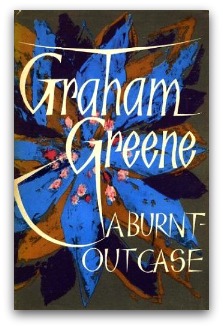
8. A Burnt Out Case (1960)

Author: Graham Greene
Synopsis: A man named Querry arrives at a leper colony in the Congo. He assists the colony’s doctor, who diagnoses him as suffering depression. It is revealed that Querry is in fact a world-famous architect, though he is hiding other secrets, too.
Film pitch: Perhaps Greene’s bleakest work — which may explain why it hasn’t been filmed previously despite being optioned twice by Otto Preminger (Greene was said to be thankful that it was never made). I would argue, however, that it has all the material for a fascinating film.

7. Travels through France and Italy (1766)

Author: Tobias Smollett
Synopsis: After the sad death of his daughter, Tobias Smollett and his wife left England for a tour of France and Italy. Detailing the quarrels Smollett has on his journey with those pesky Continentals, this is a very funny book.
Film pitch: Yes, I am suggesting that someone should make a movie based on an 18th-century travelogue. If Robbie Coltrane and John Sessions can turn Boswell and Johnson’s tour of the Hebrides into a delightful TV movie then I think the same could be done with this.

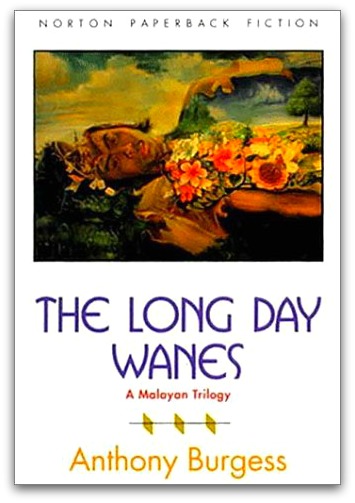
6. The Long Day Wanes: A Malayan Trilogy (1956-59)

Author: Anthony Burgess
Synopsis: Burgess’s first three novels are concerned with the character of Victor Crabbe, a teacher in a village in Malaya (now Malaysia). Based upon Burgess’s own experiences as a British civil servant in Malaya, the three novels that make up The Long Day Wanes detail the death of Empire and the birth pains of a newly independent nation.
Film pitch: Other than A Clockwork Orange, whose adaptation Burgess had strong misgivings over, Burgess’s work often seems overlooked for movie adaptations. It really shouldn’t be.

5. The Thousand Autumns of Jacob de Zoet (2010)

Author: David Mitchell
Synopsis: Until Commodore Perry in 1853 anchored four warships off the Japanese coast and so opened up Japan to western trade, Japan had been a “locked country” (sakoku) where it was illegal for a foreigner to enter Japan and for a Japanese subject to leave. The exception to this was at Dejima, in Nagasaki, where trade with some select foreign powers was allowed. This fascinating piece of history is the basis for David Mitchell’s latest novels. Set in 1799, The Thousand Autumns of Jacob de Zoet details a young Dutch trader who has come to Dejima to make his fortune though he discovers a lot more.
Film pitch: The book has all the makings of a wonderful historical epic.

4. Up Above the World (1966)

Author: Paul Bowles
Synopsis: Dr and Mrs Slade are an American couple touring Central America. A chance encounter with an elderly woman leads to a tense and gripping chain of events.
Film pitch:A disturbing and intense work typical of Bowles, it would make for a deeply compelling thriller.

3. Burmese Days (1934)

Author: George Orwell
Synopsis: Similar to Burgess’s The Long Day Wanes, this novel is concerned with the dying days of Empire. Orwell, who was himself an officer in the Indian Imperial Police Force in Burma, paints a depressing picture of expatriate life that is based around the stultifying social hub of the European club.
Film pitch: Orwell’s first novel and while certainly not his best work, even a bad Orwell novel is still worthy of consideration.

2. Henderson the Rain King (1959)

Author: Saul Bellow
Synopsis: Eugene Henderson is a rich American with an unfulfilled desire. Not knowing quite what it is, he hopes he will discover it by going to Africa. Through a series of misadventures Eugene Henderson finds himself away from his original group and in the village of Wariri in Africa. After performing a feat of strength, Eugene is adopted by the villagers as the Wariri Rain King.
Film pitch: Bellow’s funniest book, Henderson the Rain King could be pitched as an intellectual Joe Versus the Volcano (or maybe not — that’s a terrible pitch).

1. Turkish Embassy Letters (1763)

Author: Lady Mary Wortley Montagu
Synopsis: An important writer in her own right, Lady Mary Wortley Montagu was the wife of Edward Wortley Montagu, who was appointed as the ambassador at Constantinople. Accompanying her husband just after recovering from contracting smallpox marring her famed beauty, Lady Wortley Montagu wrote about her observations in numerous letters. These letters form a fascinating look at the Ottoman Empire — from how they inoculated against smallpox to the zenanas, special areas of the house reserved for women — as observed by an aristocratic English woman of the time.
Film pitch: Just think what a great biopic you could make about her.

Note: If you click on the book titles in the above list, you’ll be taken to Amazon, where the books can be purchased — except in the case of Tobias Smollett’s travelogue, which goes to Gutenberg, where he can be read FOR FREE!!

STAY TUNED for tomorrow’s post, an interview with first-time novelist Meagan Adele Lopez, and her plans for turning the book into a film.

If you enjoyed this post, we invite you to register for The Displaced Dispatch, a round up of weekly posts from The Displaced Nation, with seasonal recipes, book giveaways and other extras. Register for The Displaced Dispatch by clicking here!

Related posts:

In honor of Valentine’s Day, top 10 travel and expat posts on finding love abroad

My mother used to disapprove of Valentine’s Day. Although she would indulge our need to cut out elaborate paper valentines and bake heart cookies, she always made sure my sisters and I knew what she thought — that it was a fabricated consumer holiday for boosting sales during the winter doldrums.

Despite her remonstrations, I always used to look forward to February 14 — even (especially!) when living outside the United States.

For a start, they have much better chocolate abroad. Plus you get to try new foods that other cultures find seductive — see Kate Allison’s scrumptious post of a couple of days ago.

And your idea of what constitutes romantic adventure changes, too, as you expand your visual repertoire to include the world’s most stunning settings. Indeed, why not pop the question as the sun sets over the City Palace and Lake Pichola in India’s Land of the Kings? (For this and nine other exotic locations for marriage proposals, see Annie Fitzsimmons’ recent article for Forbes.)

In that connection, I was distressed to learn that couples who are thinking of heading to Venice, that magical city of watery landscapes, for a Valentine’s escape may need tips from Guardian Travel on how to avoid feeling ripped off. From the sound of things, it may be safer, and perhaps a good deal more enjoyable, to stay at home and watch The Tourist

But let’s leave the film discussion for later in the month, when we’ll be doing a series of posts in honor of the Oscars. Right now we’re honoring Valentine’s Day, and I’m urging you all to get into the Valentine’s spirit. To aid you in that aim,  I’ve compiled a list of 10 online articles that address the specific needs of those who are looking for romance abroad. As usual, and as befits our blog’s slightly irreverent tone, they’re from a mix of indie and conventional publications.

Click on any or all categories that apply:

Stories of love on the road

In addition to the story told by TDN’s own Tony James Slater of his own love affair — which sparked off no end of wonderful romantic tales in the comments — I enjoyed these two posts:

1) Modern Love — A Place to Lay My Heart (8 January 2012)
Author: Elisabeth Eaves (@ElisabethEaves)
Publication: New York Times, Sunday Style section (@nytimes)
Synopsis: Two single journalists in their 30s meet up in Mexico to write about tequila. At first, romance seems off the table. Both are commitment phobes: they see travel as their first love and like nothing better than plunging into a foreign culture. But then…something happens, and for the first time, instead of opting for a distance relationship, they take the leap. (Tequila will be served at the wedding.)

2) 10 Reasons Why You Should Marry a Foreigner (Like I Did) (Archived: 10 November 2010)
Author: Corey Heller (@MultiLingLiving)
Publication: Multilingual Living blog
Synopsis: Chances are, if you spend a lot of time abroad, you may end up marrying, God forbid, a foreigner! Hey, it’s not the worst thing that can happen. Some of us have done it multiple times and lived to tell the story. Still others, such as this week’s Random Nomad, Toni Hargis, fell for a foreigner in their home countries and followed him/her abroad. Heller, who met her husband in Ireland (he trailed her back to the US), lists her own ten reasons for committing such a foolhardy act — everything from his “glorious accent” to her enjoyment of a challenge to the fact that he is her true love (now fancy that!). Actually, the one that sticks with me is #3: being a German (no, he’s not Irish), he craves good chocolate just as much as she does! (But perhaps that says more about me than it does about them?)

The practicalities of dating abroad

If you do decide to make someone you meet in another culture the object of your affections, there may still be some practical concerns. These four posts should help you finesse these sometimes awkward moments:

3) Dating expectations worldwide: Who pays? (4 February 2011)
Author: C. Noah Pelletier (@flyingknuckle)
Publication: Matador Network (@matadornetwork)
Synopsis: From Pelletier’s unofficial survey of dating etiquette across nine cultures, we learn that German men excel at subtle flirting whereas Turks are much more direct; French don’t really “date”; Mexican men wear clean suits; and Japanese are into group dating. But on the all-important question of “who pays,” all nations are in agreement: THE MAN!!!

4) Don’t pull out the chair — but do hold open the door! (Archived: 26 October 2011)
Author: Tanja from Germany
Publication: InterNations blog (@InterNationsorg)
Synopsis: Notably, one of Tanja’s top concerns is:

Who pays for the meal? Does one split the bill, or does he expect to pay — or even worse, must I pay?!

Too bad Noah Pelletier’s post for the Matador Network wasn’t yet available for Tanja’s perusal (see #3 above), or she needn’t have fretted — especially as it’s Mexico, where men have been known to TAKE OFFENSE if a woman offers to pay. Also, she might not have been surprised when she received more flowers on first dates in Mexico than in her entire life in Germany. Still, Tanja’s story (which ends very happily) is a tribute to the power of persistence and the efficacy of muddling one’s way through. Just one thing I’m still not clear on: do Mexican men expect you to open the door for them, rather like Japanese men expecting you to let them exit the elevator first? (See her post title.)

5) Ten Foreign Words for a Romantic Valentine’s Day (9 February 2012)
Author: Justine Ickes (@justineickes)
Publication: Culture Every Day blog
Synopsis: So as not to be totally culturally clueless, it’s important to master a few other romantic terms/concepts. In Japan, for instance, if you hear someone say bakushan as they look you in the face, then they’re probably not a romantic prospect. The expression is used when you think someone looks cuter from behind! (If, on the other hand, you hear the word kawaii, things may be looking up!)

6) Sex when traveling: location, location, location (29 January 2012)
Author: Laurence Norah (@lozula)
Publication: Finding the universe blog
Synopsis: Norah illustrates (literally — yet tastefully, I hasten to add) various options that travelers have for “getting jiggy on the road”: dorm rooms, tents, showers, beaches, backs of camper vans, and (best of all!) private rooms.

Lonely hearts in foreign lands

When all the world is going gaga for romantic love, it can be lonely if you’re not doing so well in that department, particularly if you’re already feeling isolated because of being so far away from your homeland. The following four posts should help with that predicament:

7) 8 Empowering Ways a Traveling Single Female Should Celebrate Valentines Day (Archived: 13 February 2011)
Author: Lainie Liberti (@ilainie)
Publication: Raising Miro blog
Synopsis: From LA, Laine has been traveling with her son, Miro, since 2009 in search of a simpler life. When still in the States, spending Valentine’s Day on her own was no big deal:

it was easy to ignore the day all together or grab a group of my amazing single girl friends and have an AbFab marathon complete with bottomless cosmos.

But what about now that she’s on the road? Though the post is a year old, her suggestions — some aimed at those who enjoy solitude (movies, nature, dinner-in for one), and others, at those who would prefer being with people (volunteering, meet-ups) — won’t go out of style any time soon, and are good for any day of the year.

8) Help! Nobody Wants to Date Me! (Archived: 15 December 2011)
Author: Chris Laub (@Travel_rtw)
Publication: Backpacker Savings blog
Synopsis: Chris claims he’s “undateable” because of his need to spend almost half of the year traveling. He’s not proud of that fact:

The truth is I want to be in relationship, but my deeper desire to travel and have fun makes it seemingly impossible.

Still, the travel addict’s life does have its compensations. He’s moving to Brazil for the 2014 World Cup, leaving him free to hook up with a Brazilian woman. As he sees it:

…running around chasing women in exotic countries and enjoying no-strings-attached travel romances isn’t a bad alternative

— though methinks he doth protest too much!

9) Offbeat Traveler: Unromantic places around the world (6 February 2012)
Author: Jason La
Publication: Los Angeles Times travel section (@latimestravel)
Synopsis: Kissing a well-kissed stone in Ireland, encountering the venomous Komodo dragon in Indonesia, peering into the Gates of Hell in northern Turkmenistan — after such experiences, being wounded by Cupid’s arrow may seem like light relief. (In addition to his seven unromantic suggestions, La thoughtfully provides a link to the LA Times‘s post on 10 romantic cities, in case you get lucky at some point! Chris — see #8 above — may be in with a chance: Rio is on the list. Venice, however, doesn’t make it — not even as a “dishonorable mention.”)

10) Valentine’s Day — the perfect holiday for one (4 February 2012)
Author: Amy Chavez (@JapanLite)
Publication: The Japan Times (@japantimes)
Synopsis: On Valentine’s Day in Japan, the custom is for men to get showered in chocolates by women — women have to hold out for “White Day” when men allegedly return to the favor. But as Chavez points out in her Japan Times column, Japanese women tend to buy just as much chocolate for themselves as they do for the guys, while also indulging themselves with a Hello Kitty trinket or two. I believe that Chavez intends the title of her column — “the perfect holiday for one” — to sound ironic as she finds the Japanese interpretation of Valentine’s Day a little twisted. Perhaps I lived in Japan too long, but I don’t agree. Or maybe it is twisted, but I can hardly blame the Japanese for that. (The other day I noticed that an Asian publication was carrying a story about how the Bronx Zoo encourages people to pay money to give their sweetheart’s name to one of its Madagascar hissing cockroaches, in time for Valentine’s day. After being bombarded with information like this, is it any wonder that Asian women would prefer to buy their own Valentine’s gifts?) What’s more, all women (and not just those who are single) stand to learn a lot from our Japanese sisters: 1) if you can’t rely on the men, then eat chocolate; and 2) never mind diamonds, Hello Kitty charms are a girl’s best friend!

Bonus feature: “Valentine’s Day and the displaced life”

Living abroad can have other benefits besides finding your perfect mate. It can also help you adopt a more expansive vision of life’s rich tapestry and where “love” fits in. To take but one example, the Sufi notion of love entails falling in love with ideal attributes rather than particular people — which, as Turkish writer Mustafa Akyol points out in his article “The Shariah of Love”, leads to a great deal less heartache than Western “romantic love.” (Hmmm…the idea that love shouldn’t hurt — how novel!)

Another potential benefit of the displaced life is the joy in discovering what it feels like to love an actual place, as was the case for British journalist Jane Alexander when she visited Jerusalem. Despite not being religious, she fell smack dab in love with the city and all it stands for:

Love. Total overwhelming Love. Unconditional love that sweeps away all prejudice, all difference, all wanting, all needing, all sense of I, of ego.

Sounds pretty cool, doesn’t it? And no need to worry if it’s unrequited…

What’s more, travel can also open your mind to rebooting Valentine’s Day itself. This year Causes.com is on a mission to rename it as Generosity Day, and I noticed just now that one of the causes we featured on this blog during Global Philanthropy Month, Free the Children, is asking for donations to empower Kenyan women in bee-keeping businesses. “Bee my Valentine!” sounds a great deal less corny when you know it’s for the sake of others on the globe whose lives are less fortunate…

Come to think of it, could my mother have been right about Valentine’s Day being overly commercial? Best to make that up to her on Mother’s Day — except she doesn’t believe in that either! 😦

* * *

Question: Can you suggest any other posts that should have made the list?

STAY TUNED for Monday’s post, when Tony James Slater, who is rapidly becoming our in-house expert on searching for love in foreign lands, takes up the timely topic of transcending language barriers with potential partners.

If you enjoyed this post, we invite you to register for The Displaced Dispatch, a round up of weekly posts from The Displaced Nation, with seasonal recipes, book giveaways and other extras. Register for The Displaced Dispatch by clicking here!

Related posts:

12 NOMADS OF CHRISTMAS: David Hagerman, American expat in Malaysia (11/12)

Current home: Penang, Malaysia
Past overseas locations: Vietnam (Ho Chi Minh City), Thailand (Bangkok), Malaysia once before (Kuala Lumpur), Hong Kong, China (Shanghai, Chengdu), Philippines (Los Baños)
Cyberspace coordinates: David Hagerman Photography (business site), SkyBlueSky (blog) and @DaveHagerman (Twitter handle)
Recent posts: “My Date with the Bachelorette” (December 17, 2011); “Day Dreaming” [includes a work-in-progress: “The Ferry Boats of Istanbul”] (November 29, 2011)

Where are you spending the holidays this year?
Chiang Mai, on assignment.

What will you do when you first arrive?
I’ll be scoping out shots as soon as I drop my bags.

What do you most like doing during the holidays?
Eating. My wife, Robyn Eckhardt, is a great cook and she always makes something a bit special, if not necessarily traditional, around Christmas and New Year. (She writes about food and food culture, and has a food blog, EatingAsia, for which I take the photos.) For example, she might make devil’s curry, or curry debal, which is part of the Eurasian Kristang cuisine of Singapore and Malaysia, and is often served during Christmas.

Will you be on or offline?
This year I will be working during the holidays. I’m shooting a hotel in Penang and a travel story in northern Thailand with edits in between. I’ll need to be online for most of that time to send images and file the story.

Are you sending any cards?
I’ll admit that I’m terrible about mailers, promotional and personal. Getting better about doing that is a New Year’s resolution.

Can you recommend any good films or books other expats or “internationals” might enjoy?
The BBC mini-series Michael Palin: Himalaya. Palin has a wonderful way of having fun with a place without making fun of a place. I like it when an actor or a writer can transport you to a place and have you meet the people while not making themselves the center of attention in the narrative.

If you could travel anywhere for the holidays, where would it be?
Turkey. I’ve been three times in the past 18 months and it’s become a bit of an obsession.

What famous person do you think it would be fun to spend the holidays with?
The Ventures‘ guitarist, Nokie Edwards. His version of “Frosty the Snowman” is a reason to listen to Christmas music, and if I could talk him into playing “Telstar” as the ball drops on New Year’s Eve then I’d be a pretty happy guy.

What’s been your most displaced holiday experience?
Christmas in Southeast Asia always feels wrong to me. Too much heat, too much sun, too much Christmas for the sake of nothing but shopping. Except for the Philippines. Filipinos know how to do Christmas better than any people I know.

How about the least displaced experience — when you’ve felt the true joy of the season?
In rural northern Italy, where I’ve spent three Christmases, the holiday felt just as it should: a time for eating and drinking and being together with family and friends. The consumerist frenzy was minimal, and everyone was in a great mood, showing kindness to each other and to me. Even on Christmas Eve, when everyone was out food shopping, there was no pushing, no rudeness, no impatience. I’d like to be in Italy again for the holidays.

How do you feel when the holidays are over?
Robyn and I don’t make a big deal of Christmas or New Year’s, so January 2nd feels pretty much like any other day.

On the first day of Christmas, my true love said to me:
ELEVEN CAMERAS CLICKING,
TEN SPROUTS A-BRUSSELING,
NINE CELLPHONES DANCING,
EIGHT WHOOPHIS WHOOPING,
SEVEN SKIERS A-PARTYING,
SIX SPOUSES TRAILING,
FIVE GOOOOOOOFY EXPATS.
FOUR ENGLISH CHEESES,
THREE DECENT WHISKIES,
TWO CANDY BOXES,
& AN IRISHMAN IN A PALM TREE!

STAY TUNED for tomorrow’s featured nomad, the last (12/12) in our 12 Nomads of Christmas series.

If you enjoyed this post, we invite you to register for The Displaced Dispatch, a round up of weekly posts from The Displaced Nation, with seasonal recipes, book giveaways and other extras. Register for The Displaced Dispatch by clicking here!

Related posts:

My Grand Tour through Italy on an art history student’s budget

Today Monika Frise — the daughter of one of our Random Nomads, Helena Halme — joins us as a guest blogger. Monika is an art history student in the UK. Here she tells of her trip to Italy last month with another art history student friend — a travel yarn that makes a welcome change from all the French foodie posts we’ve been doing of late. (That said, Monika does start out by talking about food — it’s Italy, after all!)

At the end of my first year at the University of Birmingham, facing a stressful exam period, I decided to book a holiday to Italy with a friend of mine, Liz. We planned to go in early September, after the summer crowds had ebbed and the weather would be somewhat cooler. We organized to visit five cities: Verona, Venice, Pisa, Florence, Siena and finally, Rome.

Both Liz and I are studying art history. Neither of us is specializing in Renaissance art — I’m studying Eastern European architecture/art and 19th-century French art this year (concentrating on the period just before the impressionists). However, we both loved the idea of making a Grand Tour through Italy to see the Grand Masters’ works, following in the footsteps of European aristocrats of centuries past — we just wished we had their riches to finance our journey!

The trip came around sooner than expected and I for one felt a little apprehensive about what it would be like moving to a different location every couple of days, on a student budget.

Buon appetito

Italians are famously passionate about their food, and despite having to watch our expenses, we were determined not to miss out — even if it meant eating a lot of pizza.

We made a determined effort to avoid restaurants close to large monuments and museums and seek out local eateries instead. We were somewhat taken aback at the prices of food, though — especially in Rome, where we had to search for a long time in order to find a cheap restaurant that also looked good.

Our first night in Verona, the plump, friendly hostel owner recommended a restaurant, Bella Napoli, for “having the best pizza in town.”

She also told us to “touch the left breast” of Juliet’s statue for good fortune in life.

We took her advice on both counts and weren’t sorry. At Bella Napoli, we shared the house specialty, pizza al metro (pizza by the meter), which arrived on its very own table on wheels.

Venice, however, posed more of a challenge. But, on our first night, after walking somewhat aimlessly through the narrow streets for some time, we chanced upon a small osteria offering home-cooked food at great value. For a change, we didn’t have pizza. I ordered gnocchi with tomato sauce: delicious.

The service, however, left a little to be desired — our waitress dumped our change on the table without even a smile. Likewise in Rome, service was rather hit or miss. We had excellent service at a pizzeria where they roll the dough right in front of you, but at a café close to Termini station we waited for our bill for such a long time we could have walked away without paying (yes, the thought did seriously cross our minds!).

Another affordable yet delectable treat is the famed gelato. The best we tasted — and we tasted a lot — was at a place called Rivareno just around the corner of our hostel in Rome . They soften the gelato with a palette knife before spooning it into the cup. There were so many different flavors on offer, but my favorite was probably caramelized fig and ricotta.

“Roughing” it

We students will walk miles to save money, but in a country like Italy that’s not such a bad thing. As Liz and I soon discovered, going everywhere on foot was the best way to take in the local color (not to mention work off all that pizza, pasta and gelato!).

In the small winding streets of Siena, we encountered a small boy playing the drums in little side street whilst a group of old men and women chatted nearby, seemingly oblivious to the racket he was making.

In Verona one night, we happened upon Juliet’s balcony (which we’d seen the day before in the daylight). The bronze statue of Juliet in the courtyard looked completely different when illuminated. Gazing through the gates at her peaceful shape summed up this city for me: bright and vibrant yet calm.

Walking was also a way of avoiding unwanted curiosities in the hostels where we stayed. The hostel in Venice, for instance, had a very bad case of bedbugs — so much so that we spent our second night sleeping on the dusty floor, with only a sheet beneath us. But even that didn’t stop the little blighters. At one point one of the other girls woke up with one of them on her cheek. Unfortunately, despite the beauty of Venetian art and architecture, it’s the bedbugs that made the most lasting impression, rather literally!

That said, walking also exposed us to some humans who behave like pests. More than once did we have to hurry away from some overeager men who were making kissing noises at us, and outside the Arena in Verona, the city of love, a “Roman gladiator” gave Liz a pat on the bum!

Art coming out of our ears

Tourism in Italy involves an endless parade in and out of churches. I reckon we saw about three in every city, apart from Siena where we saw only one, the Duomo di Siena.

We ended up appreciating the cathedral in Siena far more than the Basilica san Marco in Venice, which overwhelmed us with its abundance of Gold Romanesque mosaics and small adjoining rooms replete with countless treasures. Our guidebook had advised us to make several visits, but for me, a single visit was more than enough. Both interior and exterior reminded me of an over-sweet, over-decorated cake.

Since we are both interested in Renaissance art, Florence had a great deal to offer. My wise mother had advised that we pre-order tickets for both the Uffizi Gallery and the Accademia Gallery — the latter of course being the home of Michelangelo’s David.

After smugly walking past the long queue for the Accademia, Liz and I took a seat on a bench close to the David and watched as people circled around it, discussing its various aspects. (We even managed to sneak a picture of the statue whilst the guards weren’t looking, saving us a few extra cents on a postcard.)

At the Uffizi Gallery I particularly loved seeing Flora by Titian — so much better seeing it in a photo for appreciating the colors and brush strokes.

By the time we reached Rome, our enthusiasm for the Grand Tour had flagged somewhat. The Sistine Chapel, where everyone was herded around like sheep, especially disappointed us.

The best part of Rome was our trip to the Pantheon — fantastic! As we wandered around this circular building, I couldn’t take my eyes off the ceiling. I was transfixed.

First of many tours?

I would definitely like to return to Italy one day soon, and perhaps even try living there for a while.

Of the five cities we visited, I could really see myself in Siena even though it wasn’t my favorite place. It’s just that the atmosphere made me feel at home, I think because there were fewer tourists. (I particularly enjoyed my trip to the local supermarket, full of hustle and bustle and the smell of freshly baked bread.)

My Italian, which was very basic, got better as our trip progressed. However I would have to take a lot of classes if I were ever to brave living there!

NOTE: You can read Monika Frise’s art reviews on her new blog, Post Raphaelite, and/or follow her on twitter: @Shmonn.

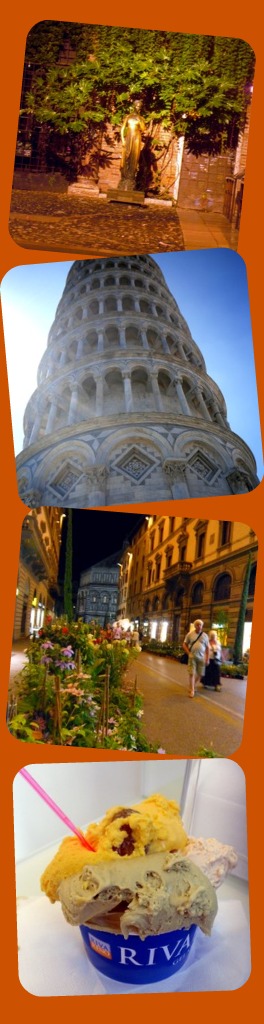
Images: Juliet’s statue in Verona by night; from the foot of the leaning Tower of Pisa; flower sellers in streets of Florence, near the Duomo; three flavors of Roman gelato: pistachio, caramelized fig and ricotta, and crema mediterranea (a Rivareno speciality).

STAY TUNED for Monday’s post, when founding contributing Anthony Windram reports on his attempt to make a Parisian lunch in California, following the recipes of Elizabeth Bard (see also ML Awanohara’s attempt).

If you enjoyed this post, we invite you to subscribe to The Displaced Dispatch, a weekly round up of posts from The Displaced Nation, with seasonal recipes and occasional book giveaways. Sign up for The Displaced Dispatch by clicking here!

Related posts:

When a Julia Child-like curiosity about French cuisine leads to a displaced life — bienvenue au October theme

The first time I was introduced to the Slow Food movement was in the land of its birth, Italy. My husband and I were in Florence for the wedding of his niece, and we ended up befriending and dining out with a couple of the other guests: a Chinese-American brother and sister from California who were serious gourmets and would only go to Slow-Food restaurants.

Ever since then, I’ve been puzzled.

Not by the concept of Slow Food itself. I get the idea of savoring a meal that is cooked from fresh, locally-sourced ingredients and that has not been prepared in advance — we’re talking the anti-Fast Food.

What’s more, I had enormous fun in Florence peering at all the restaurant doorways to see if they had a snail symbol. “No snail? Well then we’re not eating there,” I would declare to my husband.

No, what I find confounding is that the movement started in Italy, not in France.

For me, Italian food, with its pizzas, anti-pastas and gelatos, comes fairly close to being the fast food of Europe.

That could never be true, of course, of French cooking. (And what better symbol of French cooking than a snail, btw?)

I feel certain Julia Child would agree with me. An expat in Paris for many years, Julia belongs in the Displaced Nation’s Hall of Fame because of her refusal to be satisfied with her native country’s Anglo-derived plain food consisting of meat and potatoes and two veggies — let alone the fast-food version: meat (as it were), bun, French (quel insult!) fries, no veg.

Addressing just one of these nefarious ingredients, Julia once said:

How can a nation be called great if its bread tastes like Kleenex?

For Julia, France was a spiritual as well as culinary homeland. As she wrote in her memoir, My Life in France:

I fell in love with French food — the tastes, the processes, the history, the endless variations, the rigorous discipline, the creativity, the wonderful people, the equipment, the rituals.

A date with destiny

Julia’s first forays into foreign cuisine occurred when she worked for the Office of Strategic Services (the precursor to the CIA) during World War II.

She was posted first to Kandy, Ceylon (now Sri Lanka), and then to Kunming, China. Along the way, she met, and fell in love with, Paul Child, an early example of a foodie. At Paul’s initiative, they entertained themselves by exploring Ceylonese and Chinese cuisine and culture.

The pair married the year after the war ended, and Paul went to work for the American Embassy in Paris — a move that proved fortuitous in the extreme for his wife’s career.

For their first meal on French soil, Paul ordered sole meunière. For Julia, it was an epiphany — “the most exciting meal of my life.” The scales fell not just from the fish but from her eyes. She could see what American WASPs like herself were missing out on: sauces made with fresh herbs, butter, wine, and so forth.

The rest is history.

Bon appétit — say what?

Well, not quite. To be honest, I don’t think Julia’s approach to French cooking ever really took hold here in the U.S. We pretended that it did because we loved Julia so much. We loved her for her jolly-jape sense of humor and melodious voice.

But half the time, we didn’t understand what she was wittering on about.

Now, Julia knew that her fellow citizens were mostly flimsies (her word for people who aren’t serious about food). But she thought that the key to converting us was to provide a step-by-step outline of the centuries-old techniques that the French learn like a language: how to make foundation sauces, how to do a roux, how to lay in flavor, how to be patient.

The blogger Julie Powell tried to cook all 524 recipes in Child’s encyclopedic Mastering the Art of French Cooking, in a single year. Some say it was a gimmick, but I say, hey, she deserves the fame — including the honor of having Amy Adams play her in the ensuing Nora Ephron film, Julie & Julia.

‘Fess up: when was the last time you cracked open Julia Child’s magnum opus and gave her recipes a try?

Food writer Regina Schrambling wrote in a post for Slate just after the film’s release, analyzing the problem:

Consider the boeuf bourguignon depicted so romantically in the movie… The ingredients and instructions for its recipe span three pages, and that is before you hit the fine print: The beef stock, braised pearl onions, and sautéed mushrooms all require separate procedures. Step 1 involves making lardons and simmering them for 10 minutes in a precise amount of water; seven steps later, the fat is finally skimmed off the sauce, which is either boiled down to thicken or adjusted with liquid if it’s too thick.

And this is considered an entry-level recipe….Even simple sautéed veal scallops with mushrooms involve 18 ingredients and implements and two pages of instruction.

TDN’s October theme

Still, if expat blogs are anything to go by, a Julia Child-like curiosity with France and French cuisine has continued unabated since Julia’s own time. There is no shortage of Americans (also some Canadians and South Americans) who have relocated to France and intend to stay for as long as it takes to learn the art of French cooking at some level.

Partly out of curiosity, partly out of jealousy, The Displaced Nation will peer into the lives — and kitchens — of several of these expats during October.

What is it actually like to make the Ultimate Slow Food your focus? It any less daunting because of living in France and adopting the French lifestyle? And like Displaced Hall of Famer Julia Child, do today’s expats have (or hope to have) a spoon in the soup back here: are they planning to stir things up and convert us?

Readers, do you have any questions you’d like us to explore on this theme? Vas-y! Let us know!

If you enjoyed this post, we invite you to subscribe to The Displaced Dispatch, a weekly round up of posts from The Displaced Nation, plus some extras such as seasonal recipes and occasional book giveaways. Sign up for The Displaced Dispatch by clicking here!

Image: MorgueFile

The light-hearted answer to Robert Pirsig — travel author Allie Sommerville

I know what you’re thinking. They can’t seriously be planning to feature Allie Sommerville in a month where they’re celebrating the joys of the open road?

For those who haven’t heard the news yet, Sommerville is the author of Uneasy Rider: Confessions of a Reluctant Traveller, and we’re doing an interview with her today, as well as an e-book giveaway (for DISPLACED DISPATCH subscribers only — sign up NOW!).

But before we proceed, allow me to say a few words in Sommerville’s — and our — defense.

As much as Sommerville may moan about her travel misadventures, as one of her Amazon reviewers puts it: “Methinks she doth protest too much.”

I would concur. In my own interactions with Sommerville, I’ve come to think of her as a gentler, more light-hearted version of Robert Pirsig, who penned the brilliant, if opaque, Zen and the Art of Motorcycle Maintenance, on which we’ve based many of our posts this month.

The two have much more in common than it may at first seem. Like Pirsig, Sommerville has faced the reality of sustained travel on the open road and the many challenges it entails — particularly if your vehicle of choice is a motorcycle or campervan.

Also like him, she has concluded that for a road trip to be a success, you must have a yin and a yang.

The main difference is that for Sommerville, these concepts are physical, not metaphysical — as in two people, herself and her Other Half, Harry.

She is the yin — the dancer, the poet, the writer — to poor Harry’s yang. He is the driver of the couple’s broken down but beloved RV, in charge of all repairs. And when things go awry, as they very often do, Sommerville injects a philosophical sense of humor for some perspective on the situation — a technique on a par with Pirsig’s philosophical musings.

Take, for instance, the very first road trip the couple made in this rickety vehicle, to Spain — all because Sommerville had developed an obsession with British poet Laurie Lee‘s memoir about tramping through Spain.

So far so predictable: Sommerville as driving force behind the adventure, her Other Half as driver. But then what happens when the campervan proves too wide for a Spanish street? He sweats it while she searches for an entertaining story in their predicament:

There was no room for manoeuvre. … With both sides of the van threatening to add a new dimension to the walls of the houses, it was nigh on impossible for either of us even to climb out…

By now we were becoming aware that we’d attracted the interest of several ancient and well-oiled patrons of a bar just up ahead, and our little drama turned into a full-scale pantomime as they began gesticulating and beckoning us on.

“Sí! Sí!…Se puede!” they exclaimed excitedly and at the same time doing what could only be described as some sort of grotesque ritual dance.

This was a good time to remember the meaning of those words in my favourite scene from the language video.

Se puede! They seem to think we can do it!” I translated helpfully.

So, without further ado, I give you the light-hearted Robert Pirsig: Allie Sommerville.

Tell me a little more about your background.
I was born in Croydon, which was in the county of Surrey at the time — now though, notoriously part of Greater London — and my husband is from London. After setting up home in Croydon for a few years, we moved to the Isle of Wight in 1976 to build our own house and give our two young children a better area to grow up in.

We are both, even after all this time, what Islanders call “overners” (an abbreviated form of “overlanders”). Only people actually born here qualify as “caulkheads.”

Uneasy Rider, which was published in 2009, was my first book. I’ve just published my second, a memoir about my childhood, on Kindle. It’s called To set my feet a-dancing and takes a light-hearted look at a time when children were allowed play in the park until dark, clothes were home made and owning a car meant you were rich. I draw a lot upon my time as a young amateur dancer, telling about my appearances with my older sister in shows arranged by our rather eccentric dancing teacher. I also look at schooldays, Christmases past and seaside holidays in an age of innocence.

I began this project after researching my family history for many years. It occurred to me that our children have no idea about how my generation lived as children in late 1950s England. Life has changed beyond anything we could imagine.

I conclude the book with the life stories of my grandparents and their predecessors — things I have gleaned from censuses, birth and marriage certificates, old photographs and conversations with my late mother. These are the lives of ordinary families: people whose lives are not in the history books.

I’m also in the process of writing about a trip my husband and I made around mainland Great Britain in the same old camper van, from the South (i.e., Isle of Wight) to the North (i.e., Scotland). The provisional title is: Miss Potter and the Mathematicians Rabbit — Allie Goes Oop North. The main title is taken from an experience we had in the Lake District.

Moving on to Uneasy Rider: How many road trips have you and your husband made together over the years?
We made six road trips in the converted Leyland Daf campervan of the book, from 1999 to 2004, though our very first trip in a motor caravan was in 1991, with our two teenagers on board.

Do you ever travel by other means?
Of course! We’ve traveled many times by car in France and Switzerland, staying in gîtes, chalets and apartments. My favorite “trip” of all though was on the Cunarder, Queen Mary 2, to New York. Much nicer than “roughing it” in a camper van! I absolutely loved New York and the glamour of the six-day Atlantic crossing, despite sailing through a force 11 gale.

So what made you decide to write a book about your campervan excursions?
During our trips, we had so many events that each time I said, “There’s a book in this!” Before we took off on our first trip (to Spain), I hadn’t found any similar book on the subject of campervanning or caravanning, apart from site-finder guides; it seemed there was a gap in the market.

Whom did you see as the primary audience?
I had in mind other campervanners who would identify with the joys, trials and tribulations of this type of independent travel. I didn’t want it to be one of those “everything is fantastic about travel” books. I hope I tell it like it REALLY is — the ups and downs, the good and the bad. Some campervan “purists” don’t appreciate hearing about the downside of their preferred method of holidaying though. They appear to have gotten together to leave negative reviews on Amazon. But I’m not too sure, by some of the comments, that they’ve actually read it…

Bill Bryson is the master of modern travel writing as far as I’m concerned, and it’s his light-hearted touch that I hope in some way to emulate. A tough act to follow!

Many people take road trips when they are young, to find out more about life and themselves. Does the purpose change once you become middle aged?
Middle aged? I still feel about 17!

As you’ve already mentioned, the purpose of our first trip (to Spain) was to follow in the footsteps of my literary hero, Laurie Lee. In As I Walked Out One Midsummer Morning, he tells of his walk across Spain on the cusp of the Civil War in the early 1930s. This book, for some reason, holds a big fascination for me.

That trip was meant to be a one-off. But afterwards we weren’t able to sell the van, so instead of letting it sit in the drive, I seized the opportunity to see as much of the art and architecture of Italy and France as I could. I suppose you could say my purpose was educational!

Which was your favorite place of all those you visited?
Florence has it all. I could never tire of it. We visited this amazing city three times. I was studying Art History at the time, specialist subject “The Early Renaissance.” The Italian people are fantastic, too!

Which was your least favorite?
Spain, especially the Costas (various coastlines), which were full of half-finished blocks of flats. Whether we were unlucky I don’t know, but it was not a friendly country — apart from a few honorable exceptions which I mention in the book: the helpful policeman in Seville who strode into and held up four lanes of speeding traffic for us, the patient shop assistant in the flamenco boutique. I have the feeling that relatively recent history may have altered the Spanish character: George Orwell in Homage to Catalonia found the Spanish people cheerful and friendly.

Robert Pirsig says “It’s a little better to travel than to arrive.” I’m guessing you might not agree with him?
Err…not really. Like Dorothy, my mantra is: there’s no place like home! Having the campervan, however, was almost like taking your home round with you. My best moments during these trips were when we found pleasant campsites to put down temporary roots.

Pirsig claimed there are two types of people: “classical” — practical, DIY fixers, boy-scout prepared types; and “romantic” — those who thrive on surface appearances, don’t want to get involved with the nitty-gritty, and thrive on gestalts.
As you noted in your introduction, I’m definitely “romantic,” and my husband is certainly “classical” — which probably explains why we work as a couple. He drives and sorts out problems, I look forward to seeing the Da Vincis.

Each chapter of your book is a stand-alone story, describing a particular incident. Do you have a favorite?
“The Parable of the Parador” is my stand-out favorite. As I said, it is typical that I get these romantic ideas — and my other half goes along with them, most of the time. That particular chapter though, sees a bit of role reversal, when we get “stuck” on the road into Arcos de la Frontera, to reach the parador (state-run hotel). For once he thinks it’s all hopeless, and I have to be the optimist. When he feels like this about a situation, I know we are REALLY in trouble.

Pirsig advocates traveling on a motorcycle because it puts you there, in the moment, without the barrier of a windscreen. What do you think of his philosophy?
To travel on a motorbike would be my nightmare! I just would feel too exposed. I like to be safe — hence the theme of Uneasy Rider.

Many of the Displaced Nation’s readers are expats. Can you imagine living anywhere besides the Isle of Wight?
We’ve often thought we should have relocated to France some years ago. I’d love to live in a place where you can walk to a baker’s every day for fresh baguettes and croissants. Now, the only place I’d move to is Central London: the London National Gallery and Covent Garden Royal Opera House are big draws.

How well do you fit back into the Isle of Wight after your journeys? Do you suffer from any counter culture shock?
The flippant answer is that being a “townie,” I suffer counter culture shock on the Island every day anyway… even after all this time. However, the main feeling after being in the ‘van for four weeks, though, was that our house did seem HUGE for the first few days .

So what’s next for your travels?
Next year I am fulfilling my long-time ambition of visiting St. Petersburg — on a cruise ship rather than by road. Russia and especially its Tsarist past, fascinates me. Hopefully there will be a book in this, though for all the right reasons!

Readers, do you have any questions for the Amazing Allie? Ask away, before she takes off again!

Images: Allie Sommerville’s author photo and book cover.

STAY TUNED for tomorrow’s installment from our displaced fictional heroine, Libby, as she prepares to welcome the pitter-patter of little feet. Clawed, furry feet, that is: Fergus is now a canine expat! What, not keeping up with Libby? Read the first three episodes of her expat adventures.

If you enjoyed this post, we invite you to subscribe to The Displaced Dispatch, a weekly round up of posts from The Displaced Nation, plus some extras such as seasonal recipes and occasional book giveaways. Sign up for The Displaced Dispatch by clicking here!

Related posts:
RETURN TRIP: Seven deadly dishes — global grub to die for

While our writers take off on what they hope will be enchanting August breaks, The Displaced Nation will occasionally be reissuing some posts that, for one reason or another, enchanted our readers. Enjoy these “return trips”!
Some months ago, The Displaced Nation explored the theme of Gothic tales — the idea that many of us return from our world travels with some horrific stories to tell. That’s assuming we return at all, of course. Displaced Nation writer Kate Allison contributed this piece on deadly dishes as part of our “It’s Food!” category. It’s one of our most popular posts to date.

A Briton abroad spends a surprising amount of time defending his native national cuisine. I remember going to a steak house in Connecticut where the waitress, upon taking our order and hearing our accents, said brightly, “From England, huh? I hear you don’t get anything good to eat over there. ” When she brought the filet mignon to the table, she did so with the pitying smile of one delivering alms to the starving.

British super-chefs like Gordon Ramsay and Jamie Oliver may be taking the US by storm, but still this delusion of bad food persists. To which I say: whatever the perceived faults of English cuisine, at least no one has to take out extra life insurance before eating Yorkshire pudding.

Yet there are quite a few delicacies from countries without this dismal food reputation, where a top-up premium might be useful before you take that first bite.

In ascending order of danger or toxicity:

7. Snake wine – Vietnam, Southeast Asian, Southern China.

An assortment of herbs, small snakes, and a large venomous snake are steeped for many months in a glass jar of rice wine, then consumed in small shots for medicinal purposes. Fortunately, the ethanol renders snake venom harmless.

6. Surströmming – Sweden.

Fermented Baltic herring. Stored in cans, where the fermentation continues, causing the cans to bulge. In 2006, Air France and British Airways banned surstromming from their flights because they said the cans were potentially explosive. According to a Japanese study, the smell of this Scandinavian rotten fish is the most putrid food smell in the world.

5. Fried tarantula – Cambodia.

Tarantulas, tossed in MSG, sugar, and salt, are fried with garlic until their legs are stiff and the abdomen contents less liquid. The flesh tastes a little like chicken or white fish, and the body is gooey inside. Certain breeds of tarantula have urticating hairs on their abdomen, which they use for self-defense. If the spiders are not prepared properly – i.e., if the offending hairs are not removed with a blow torch or similar – these hairs can cause pharyngeal irritation in the consumer.

4. Sannakji – Korea.

Small, live, wriggling octopus, seasoned with sesame and sesame oil. The suction cups are still active, so bits of tentacle may stick to your throat as you swallow, especially if you’ve had one too many drinks before dinner. The trick is to chew thoroughly so no piece is big enough to take hold of your tonsils. Some veteran sannakji eaters, however, enjoy the feel of longer pieces of writhing arm and are prepared to take the risk.

3. Stinkhead – Alaska

Heads of salmon, left to ferment in a hole in the ground for a few weeks. Traditionally, the fish was wrapped in long grasses and fermented in cool temperatures, but then someone discovered Baggies and plastic buckets, which increase the speed of the process. Unfortunately, they also increase the number of botulism cases.

2. Casu Marzu – Sardinia

Made by introducing the eggs of the cheese fly to whole Pecorino cheese (hard cheese made from sheep’s milk) and letting the cheese ferment to a stage of terminal decomposition. Locally, the cheese is considered dangerous to eat when the maggots are dead, so you eat them live and squirming. As the larvae can jump six inches in the air, it is advisable to cover your cheese sandwich with your hand while eating to prevent being smacked in the face by grubs. An alternative is to put the cheese in a paper bag to suffocate the maggots, then eat it straight away. The maggots will jump around in the bag for a while, making a sound, I imagine, not unlike that of popcorn in the microwave. Although the European Union outlawed this food for a while, it has since been classified as a “traditional” food and therefore exempt from EU food hygiene regulations.

1. Fugu (Puffer fish) – Japan

Considered to be the second most toxic vertebrate in the world, puffer fish is a delicacy in Japan, but preparation of the food is strictly controlled, with only specially trained chefs in licensed restaurants permitted to deal with the fish. Fugu contains tetrodotoxin, a poison about 1200 times stronger than cyanide, which is most highly concentrated in the fish’s liver — the tastiest part. Sadly, for gourmets who like to live life on the edge, fugu liver in restaurants was banned in Japan in 1984.

Question: What is the most adventurous dish you’ve ever eaten?

If you enjoyed this post, we invite you to subscribe for email delivery of The Displaced Dispatch, a round up of the week’s posts from The Displaced Nation. Sign up for The Displaced Dispatch by clicking here!

Enchanting European escapes at the hands of Woody Allen, BBC & Jersey Shore(!)

I could easily have gotten in a crabby mood this summer while watching everyone (who’s anyone) escape the heat of New York City while I stayed put.

But what saved me, in addition to cocktails, were all the enchanting images of Europe on the big and small screen.

I could live vicariously through the works of film directors and TV producers who have packed up casts and crew and moved to foreign locales — all for my viewing pleasure.

So what if their works weren’t exactly exploring the kinds of themes that citizens of the displaced nation care about? We’re talking escape and enchantment here, and that means pleasant scenery, surely?

Woody Allen’s postcard Paris

Take, for instance, the new Woody Allen film, Midnight in Paris. I haven’t seen it yet but the trailer already has me in love with the idea of an escape within an escape, particularly as it involves Paris.

Woody’s hero, Gil, a disenchanted Hollywood screenwriter played by Owen Wilson, gets to escape to Paris — pretty nice even if he’s going as the guest of his pushy fiancée and her frightful parents. Especially as he gets to escape from them by traveling back in time to the sizzling city of the 1920s.

There he hobnobs with the brilliant expat crowd of that era, including on the American side, F. Scott and Zelda Fitzgerald, Ernest Hemingway, Gertrude Stein, and Cole Porter, and on the European side, Picasso, Salvador Dalí and T. S. Eliot.

In the course of this time-travel adventure, Gil picks up writing advice from Papa Hemingway and even has an affair with Picasso’s fictional mistress, played by the enchanting French actress Marion Cotillard.

But let’s get back to the scenery, which, to be honest, sounds like the real star of the film — or as one film critic put it:

What an enchanting movie — almost as enchanting as its location.

And indeed, the City of Light has never looked more glorious, from the opening montage of narrow streets, the Eiffel Tower and the Arc de Triomphe, to the vistas unfolding before Gil on his warm spring evening strolls.

Yes, it’s a mostly touristic view of the city, but that’s precisely what I’m after while living through a spell of hot, humid weather in New York City.

And speaking of New York, I’m further inspired that a kid from Brooklyn — someone who has always struck me as NOT being displaced — can abandon his hometown so completely in his twilight years. Woody Allen now seems to favor photogenic foreign locales for his films — e.g., London in Match Point and Barcelona in Vicky Cristina Barcelona.

Rumor has it that this is because New York has become too expensive and he’s found some European investors.

But even if Allen wasn’t yearning for it, he certainly seems to have been stimulated by his change of surroundings. I for one am still chuckling over Penélope Cruz’s constant defiance to speak English in front of her ex’s (American) girlfriend in VCB. Has Allen elicited that level of comic performance in an actress since Diane Keaton in Annie Hall? I personally don’t think so, and Oscar agrees with me!

The BBC’s postcard Rome


This summer PBS’s Masterpiece Mystery! carried a new crime series, Zen, produced for the BBC by Left Bank Films. The title refers to the hero, a Venetian-born Roman police detective by the name of Aurelio Zen (“Zen” is a Venetian way of shortening the surname “Zeno”).

Originally the creation of British crime writer Michael Dibdin, Zen attempts to bring justice to modern-day Italy whether the authorities — politicians, the Church, the Mafia — want it or not. (They don’t — and to make matters worse for poor Zen, his bosses, too, side with the outlaws.)

Now, Dibdin was as English as they come but he led a peripatetic life and wrote the Zen books after being an expat in Italy for four years, where he taught at a university in Perugia.

So we have him to thank for the chance to see some of Britain’s handsomest actors wearing sharp suits, talking sexy, and frolicking about in the Roman sunshine. I kept waiting for Rufus Sewell, who plays Zen, to wink at me as if to say, aren’t I lucky to be on this Roman holiday instead of making yet another London-based crime drama?

He even gets a dishy Italian girlfriend, played by the Italian actress Caterina Murino (see above clip).

As New York Times TV critic Gina Bellefonte observes,

The [Zen] films deploy a light comic sensibility and graphics that suggest a ‘60s caper. They situate us in a Rome where the weather always seems heavenly, blouses are always unbuttoned suggestively, and no lunch transpires without multiple courses and repeated instances of sexual innuendo. Risotto is eaten; cigarettes are smoked; espresso is consumed; public displays of lust are evident. There is little resistance to cliché in all this, but the cliché is so visually appealing that you’ll feel like a spoiled child if you complain.

Not to worry, Gina, I’m not complaining! A 1960s caper is exactly the kind of enchantment I’ve been so desperately seeking this summer.

Jersey Shore’s postcard Florence


Okay, I know I’m stretching the picture-perfect postcard idea here, but the fact is that MTV’s hit reality series — about eight housemates who spend their summers in a summer share on the Jersey shore — has opened its fourth season in Florence, Italy. It premiered on August 4.

And that’s a lot more enchanting than Seaside Heights, NJ, or Miami (where Season 2 took place) — I say that having never been to Seaside Heights or Miami, but still…

Ostensibly, Snooki, Vinny, and the rest are in Florence to find their Italian roots.

They certainly aren’t there to meet the natives, try the food, or tour the Uffizi or the Duomo. As New York Times TV critic Alessandra Stanley has it:

The road signs point to Florence but they should read “Welcome to the Jersey Shoro.” … Even in Florence, the producers are determined not to let anything under the Tuscan sun melt the parochial insularity of “Jersey Shore.”

But that doesn’t mean the rest of us can’t enjoy the setting, does it? Call me a snobbo, but watching Snooki, Sammi, Deena and Jenni negotiate the cobblestone streets of Florence in their six-inch leopard skin stilettos makes me appreciate the city’s quaint beauty even more.

And MTV has already announced that in the fifth season, the gang (many of the whom in fact hail from Staten Island or other outer NYC boroughs) will return to Seaside Heights. So for now, viva Italia — that’s what I say!

QUESTION: Can you recommend any more TV series or films that can serve as eye candy for the travel-starved this summer?

YouTube clips: Midnight in Paris trailer 2011, by MoviePediaTrailers; Rufus Sewell — Zen — Vendetta (2011) — Drinks, PrairieGirl1000; and Jersey shore season 4 sneak peek, by TheAdam419.

STAY TUNED for tomorrow’s post, a reprise of our popular post about seven deadly dishes — apparently, we didn’t kill enough of you off the first time around! 🙂

If you enjoyed this post, we invite you to subscribe to The Displaced Dispatch, a weekly round up of posts from The Displaced Nation, plus some extras such as seasonal recipes and occasional book giveaways. Sign up for The Displaced Dispatch by clicking here!

Related posts:

Some enchanted drinking: Summer cocktails that send you round the world

After spending many a summer in England (summer, what summer?) and Japan (beyond brutal!), I now live in New York City, where summers can best be described as a hot mess.

As the dog days set in, I’ve been known to sing out: “Drinks, glorious drinks! Don’t care what they look like!”

Actually, that’s not quite true.

Well, the part about my singing aloud is true — we’re all barking mad in this city, especially around mid-August.

And the part about drinks being glorious is also true —  what could be more glorious than an icy cold drink that cuts through the moisture-laden air, offering the possibility that this steam bath may end one day.

(I’m talking about alcoholic drinks, of course — anyone of a puritanical frame of mind can slake their thirst at one of the city’s fancy new portable water fountains, connected to fire hydrants.)

But the part about not caring what my drinks look like — that’s simply not true. For me, the ultimate summer refreshment is a well-made, well-presented cocktail.

As Penelope Wisner writes in her introduction to Summer Cocktails: 50 Tantalizing Recipes,

Everything matters: the taste of the spirit, the taste of the ice, the temperature of the drink, and the look of the drink.

My drinking history, in brief

During my expat years, I would happily down a half pint of lager in the pub with my English friends, or drink Kirin beer and sake on outings with my Japanese office mates.

That all changed when I moved back to my homeland.

Maybe it’s in my cultural DNA. The cocktail — a mixed drink with two or more ingredients, one of which must be a spirit — is one of America’s more inspired culinary accomplishments.

Or could it be my actual DNA — one of my earliest memories is of asking my father if I could chew on the lemon peel he put in his night-time martini.

In any case, not long after I became a resident of New York City — home of speakeasies and the only city I know of with a cocktail to its name — I was driven to drinking…cocktails. Particularly during summers.

You see, I’ve never been one of the lucky ones who can escape to the Hamptons or the Jersey shore.

Instead of the sea, sun, sand, and sky, I’ve had to grapple with sweat, smog, dirt, and skyscrapers.

Now, I could have gone the conventional route and drowned my sorrows in a beer. But why do that when a cocktail is so much pleasanter, and can transport you to places you’d rather be in — places much more exotic than an overcrowded beach?

Cocktails are a trip

My hunt for the transcendent cocktail experience has yielded several noteworthy finds, among them:

1) The mojito at Victor’s Cafe on West 52nd St. A single sip transported me to 1950s Havana, where I found myself salsa dancing with a Ricky Ricardo-look-alike. (And that was before I’d sampled the roast suckling pig!)

2) The vodka martini in the Russian Vodka Room, also on West 52nd St. I thought I was in Moscow from the moment I entered this swanky establishment, greeted by the sight of a curved bar at which many natives are downing shots, and behind which are these enormous jars of flavor-infused vodkas. Once I’d tasted my martini, I was well on my way to an enriching cultural experience. Oh, so that’s how they get through daily life in Russia. It all comes down to homemade vodka and to music — sublime combination! (Misha Tsiganov, a prize-winning jazz pianist who studied in St. Petersburg, is the bar’s official piano player.)

3) The classic martini at Angel’s Share, a tiny gem of a bar in the East Village. This drink made me feel I was in Tokyo again, even though I wasn’t really a cocktail person there. The Japanese bartenders had the mix, shake and stir down to an art form — which is soooo Japanese. And no one is allowed to stand at the bar — ditto. But by the time I’d polished off my divinely-inspired drink, I’d left Japan far behind for heaven itself — an effect enhanced by a ceiling mural that appears to have been inspired by Botticelli’s playful cherubs.

4) The Negroni at The Smith on 3rd Avenue. The Negroni — one part gin, one part sweet vermouth and one part Campari — is said to have originated in Florence in 1919, the invention of one Count Camillo Negroni. The first time I sampled one at the bar at The Smith, I fancied I’d become E.M. Forster’s Lucy Honeychurch at the very moment when she witnesses a murder on the Florentine streets, and is about to faint. (Where is George Emerson when you need him?) You see, the Smith version is anything but aristocratic: it packs quite a punch.

Next up? I hope it will be the Mexican martini, which I read about it in the New York Times last month. Basically, it’s a margarita served in a martini glass, with olives on a spear.

The drink is said to have been introduced from Matamoros, Mexico, just across from Brownsville, Texas, when a bartender from Austin visited there and was served a margarita in a martini glass.

It has since become Austin’s signature drink. Being Texan, it’s twice as large as a regular drink, so customers are given the cocktail shaker and urged to pour the drink themselves.

I haven’t been to Austin — and would love to go (though preferably not in the summer). I reckon a Mexican martini may be just the ticket…

The only issue is, the drink hasn’t really made it out of Austin yet.

So if you happen to hear of any Austin expats working behind Manhattan bars (yes, that’s how they’d refer to themselves), be sure to inform me.

For now though would you kindly join me in a refrain of “Drinks, glorious drinks, wonderful drinks!”

QUESTION: Can you recommend some summer cocktails you think have the makings of a mini-escape?

If you enjoyed this post, we invite you to subscribe to The Displaced Dispatch, a weekly round up of posts from The Displaced Nation, plus some extras such as seasonal recipes and occasional book giveaways. Sign up for The Displaced Dispatch by clicking here!

Related posts:
RANDOM NOMAD: Balaka Basu, Ph.D. Student in English Literature

Born in: New York City, USA
Passport(s): USA
Countries lived in: India (New Delhi): 1981, 1987-89, 1991, 2003-04; Italy (Rome): 2002
Cyberspace coordinates: The Society of Friends of the Text (collaborative blog)

What made you leave your homeland in the first place?
I’ve inherited displacement from my parents, who moved (individually) to the United States from India for graduate studies and sort of never left. They made periodic attempts to pick up stakes and move back, taking me with them, but these never lasted for more than a year at a time. My childhood left me feeling like a person without a homeland, always living between worlds, never quite belonging anywhere.

Describe the moment when you felt most displaced over the course of your many displacements.
As a child, it used to be while saying — or rather, in my case, not saying — the Pledge of Allegiance at morning assemblies. Now, every so often, out of nowhere, I’ll have this weird sense of wanting to go “home” and smell the jasmine and the honeysuckle, and the smoky, pungent mustard oil, and have someone bring me a glass of freshly pressed pomegranate juice.

Describe the moment when you felt least displaced.
This is a difficult question because the land of my birth is sort of my adopted homeland. I was born in the United States — but was taken back to India when I was 28 days old. My first language is not English, but I can neither read nor write in Bengali. I’m pretty much always feeling displaced. However, I’ve got the subway map of New York tattooed on my heart, and it’s always been the place I’ve come back to. I love coming into the city early in the morning from points east and watching the rose-gold light of the sunrise reflecting back from the million glass windows. And one of the things I loved about Rome is that it felt a bit like Calcutta — a city also caught between two worlds, displaced all on its own.

You may bring one curiosity you’ve collected from the country where you’ve lived into the Displaced Nation. What’s in your suitcase?
From India: A beaten copper sculpture of a woman bathing, a gift from my father.
From New York: A poster of the New Yorker cover “View of the World from Ninth Avenue,” by the Romanian-born American cartoonist Saul Steinberg. It depicts the supposedly limited mental geography of Manhattanites.
From Rome: A copy of Bernini’s marble baby elephant.

You’re invited to prepare one meal based on your travels for other Displaced Nation members. What’s on the menu?
Llish (a fish only available in India/Bengal) in mustard and chili paste, which has been smoked in banana leaves; rice; green mangoes in oil; and for dessert, by way of Rome, blackberry gelato and an espresso.

You may add one word or expression from each of the countries you’ve lived in to the Displaced Nation argot. What words do you loan us?
From India: Arbit, short for arbitrary, used as slang in India. Whenever I hear Indian people say “arbit,” it reminds me that English is one of their national languages, too, and has evolved in a distinct and separate way.
From Italy: Prego: the indispensable word! How can you not like a word that means “if you please,” “you’re welcome,” “excuse me,” “would you mind if I walked in front of you,” and so on. You can say it any time, and it will almost never be wrong. How economical!
From New York (which I think is fair to include even though it’s my birthplace): I’ve got to go with the unprintable expletive here. When I go other places, it’s terribly difficult to remember that curse words aren’t universally accepted as terms of endearment.

This month The Displaced Nation is celebrating Alice in Wonderland as a literary analogue for disorientation and displacement. Upon entering Wonderland, Alice commits many social blunders, as when telling Mouse all about her cat, Dinah. Can you describe an instance where you inadvertently offended someone in one of your adopted lands?
Well, there was this one time when I met an astrologer in New Delhi, who apparently used to read the stars for a previous prime minister. I asked how anyone in the civilized world could take these things seriously. But I’m not sure that was exactly … inadvertent.

QUESTION: Readers — yay or nay for letting Balaka Basu into The Displaced Nation? Tell us your reasons. (Note: It’s fine to vote “nay” as long as you couch your reasoning in terms we all — including Balaka — find amusing.)

img: Balaka Basu by Edie Nugent, taken in Edie’s Manhattan apartment.

STAY TUNED for tomorrow’s installment from our displaced fictional heroine Libby — and see if you can spot the Alice references!

If you enjoyed this post, we invite you to subscribe for email delivery of The Displaced Nation. That way, you won’t miss a single issue. SPECIAL OFFER: New subscribers receive a FREE copy of “A Royally Displaced Tea.”

Related posts: