The Displaced Nation

A home for international creatives

Tag Archives: Fiction Writers

CLASSIC EXPAT WRITING: Nabokov — Pnin

Few characters in literature deal with discombobulation to quite the extent as Vladimir Nabokov’s Timofey Pnin. Pnin, a Russian-born professor at the “somewhat provincial institution” of Waindell College, is a somewhat absent-minded and culturally confused man. Nabokov begins the novel with Pnin catching the wrong train, thus missing an important lecture he was due to give.

Despite such a farcical beginning, Pnin is not a campus farce. Yes, it is deeply comic, but it is also a novel that plays on Nabokov’s own experiences as a Russian émigré marooned in American academia. There is a phrase I like a lot — I like it so much I named my own blog after it. It is the term “culturally discombobulated.” I think this is something that Pnin struggled under the weight of. For all his intelligence, Pnin struggles with English — “If his Russian was music, his English was murder,” writes Nabokov — and who constantly seems out of step with the society he is living in.

The extract I want to highlight this week comes from early in the novel. Pnin has boarded a train for his lecture, but oblivious to him he has boarded the wrong train — a fact he won’t discover for a number of hours. As Pnin sits in the  train, the novel’s narrator allows us a closer look at Pnin’s history and some of his shortcomings.

Pnin, despite his many shortcomings, had about him a disarming old-fashioned charm, which Dr. Hagen, his staunch protector, insisted before morose trustees was a delicate imported article worth paying in domestic cash. Whereas the degree in sociology and political economy that Pnin had obtained with some point at the University of Prague around 1925 had become by mid-century a doctorate in desuetude, he was not altogether miscast as a teacher of Russian. He was beloved not for any essential ability but for those unforgettable digressions of his, when he would remove his glasses to beam at the past while massaging the lenses of the present. Nostalgic excursions in broken English. Autobiographical tidbits. How Pnin came to the Soedinyonnie Shtati (the United States). “Examination on ship before landing. Very well! ‘Nothing to declare?’ ‘Nothing.’ Very well! Then political questions. He asks: ‘Are you anarchist?’ I answer” — time out on the part of the narrator for a spell of cozy mute mirth — “‘First what do you understand under “anarchism”? Anarchism practical, metaphysical, theoretical, mystical, abstractical, individual, social? When I was young,’ I say, ‘all this had for me signification.’ So we had a very interesting discussion, in consequence of which I passed two whole weeks on Ellis Island” — abdomen beginning to heave; heaving; narrator convulsed …

… And he still did not know that he was on the wrong train.

A special danger in Pnin’s case was the English language. Except for such not very helpful odds and ends as “the rest is silence,” “nevermore,” “weekend,” “who’s who,” and a few ordinary words like “eat,” “street,” “fountain pen,” “gangster,” “Charleston,” “marginal utility,” he had no English at all at the time he left France for the States. Stubbornly he sat down to the task of learning the language of Fenimore Cooper, Edgar Poe, Edison, and thirty-one Presidents. In 1941, at the end of one year of study, he was proficient enough to use glibly terms like “wishful thinking” and “okey-dokey.” By 1942 he was able to interrupt his narration with the phrase, “To make a long story short.” By the time Truman entered his second term, Pnin could handle practically any topic, but otherwise progress seemed to have stopped despite his efforts, and by 1950 his English was still full of flaws.

If you enjoyed this post, we invite you to subscribe for email delivery of The Displaced Nation. That way, you won’t miss a single issue. SPECIAL OFFER: New subscribers receive a FREE copy of “A Royally Displaced Tea.”

Related posts:

Even in Paris, expats can’t escape former lives: A celebration of displaced novelist Corine Gantz

SPECIAL ANNOUNCEMENT: Ever wanted to escape to Paris in the springtime? Today you can do so, as it were, in the company of the très très charmante Corine Gantz. Originally from the City of Light but now living near the City of Angels, Mme Gantz has just released her debut novel about a group of American women who try to start afresh in Paris. She has kindly agreed to respond to our questions and comments. 

The Displaced Nation has been examining the “gothic” side of expat life over the past couple of weeks. Thus it may seem odd that today we have chosen to celebrate a book that takes place in La Ville-Lumière (“The City of Light” or “The Illuminated City”) by an author who lives near the City of Angels.

Hidden in Paris coverBut looks can be deceiving — and the cover of Corine Gantz’s debut novel, Hidden in Paris, is quite a cunning ruse. It shows a Parisian balcony with French doors reflecting the Eiffel Tower, and a flower box bursting with hot-pink geraniums. What could possible be amiss within such a picture-perfect setting, you may wonder? Plenty, it turns out.

But before we get into that, let’s begin our fête in honor of Mme Gantz and her book. To put ourselves in the proper mood, we have prepared a special cocktail, a French 75. We’ve also gone all out with our canapés. There’s a savory gougère, brie en croûte, duck rillettes, chilled asparagus with mustard sauce, a Puy lentil salad — and, in honor of Mme Gantz, her family favorite, taramasalata on toast (see her father’s recipe below).

Okay, seats, please! Our honored guest has agreed to kick off the festivities by answering a few questions from The Displaced Nation team. After that, the floor is yours, dear reader.
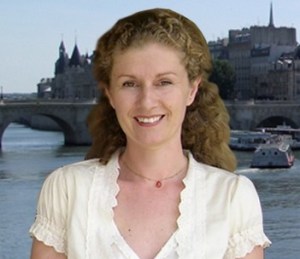
Corine GantzYour new novel, Hidden in Paris, may not tell a gothic tale per se, but we think it relates to our theme because it centers on three women who are running away from their lives. Is that a fair assessment?
People who say they love to be scared amuse me. They have a fascination with horror flicks, they read vampire books, they ride roller coasters. Yet they might be the same people who walk great circles around a pile of bills or make every effort to avoid a difficult phone call. What can be scarier than real life?

I think there is a limit to what we can handle, and at some point the tendency is to want to run way, literally or figuratively. In Hidden in Paris three strangers — all American women — have reached the point of terminal discomfort, when tackling real issues feels more terrifying than running away abroad.

Lola is running away from her husband, Althea from an eating disorder, and Annie, although she pretends to be the most high functioning member of the group, is hiding the biggest secret of all. (Just to add some spice, there is also a male character, Lucas, who is hiding his love for Annie.)

People often fantasize that “elsewhere” — particularly Paris because of the attached notion of romance — will solve their problems, or at least make the problems go away for a while. Well, we long-term expats know better. Moving to another country brings great logistical changes to one’s life, which can distract you into thinking you’ve left your pathos behind, when, in fact, you’ve brought it along in your suitcase. Wherever you go, you bring your own personal gothic tale with you.

In the case of these three female characters, the disruptions to their routines, along with new encounters, bring them to the tipping point toward change.

The thing is, as in real life, my characters fight the change they need kicking and screaming, which makes for fun story telling.

Food is another obsession of ours at The Displaced Nation. We detect from reading an excerpt from Hidden in Paris that it also plays a big role in your book.
You detect correctly. For me, writing a novel is a barely disguised way for me to talk about food — the novel being a vehicle for food just as grilled toast is a vehicle for foie gras.

I grew up in France on my mother’s terrific cooking. But she is the type of cook who wants no help in the kitchen, so at age 23 I arrived in the United States never having cooked an egg. I was terribly homesick and depressed and needed to “taste home” again — so had no choice but to teach myself how to cook. The saving grace was that I had a copy of a recipe book filled with my mother’s recipes, so I proceeded to recreate the food, and jolly myself out of my depression. Cooking gave my life a purpose: it became my creative outlet.

I think the preparation of food can be extremely healing, meaningful and joyful. Food is, after all, the soul and spirit of a home. I enjoy cooking as much as I enjoy eating, and when I’m not doing one or the other I’m telling stories where food turns out to be one of the principal characters.

You are a Française who has been “displaced” to the Los Angeles area for a couple of decades, where you live with your American husband and two sons. Does your novel echo that experience?
Had I landed on an alien planet I doubt I would have been any more confused and out of place.  I understood none of the codes, none of the cultural references, of Los Angeles. I could not understand people or express myself — and I resented them for that.

Writing sprouted from this: the frustrated need for self-expression and communication. Like my protagonist, Annie, I had to figure out how to function, and I would be lying to say I functioned well. Also like Annie, I resisted my country of adoption for years. I did not have both feet in it. A part of me felt in limbo: I was standing by for my eventual return to my home country.

Twenty years later I don’t even feel French anymore, but no one here lets me forget I’m not American either. Americans seem fascinated with my Frenchness, as though it defines me. For example, it’s often about how I say things rather than what I say. Yesterday I was saying to a friend: “On the envelope my husband gave me for mother’s day there was a…” She interrupted and said: “Could you repeat that?” I repeated and she fell into peals of laughter: “I just love how you said the word ‘envelope’!”

In Hidden in Paris, I wanted to transpose my experience and reverse it. I wanted to bring American women to France and see how well they coped with that set of codes and cultural idiosyncrasies. That’s only fair, don’t you think? I’m a little miffed to report that they are a more adaptable than I was.

You have a popular blog, Hidden in France, where you’ve been entertaining Francophiles and others with stories of the writing life, décor, food, family, travel and all things French. In fact, The Displaced Nation has featured one of your posts — about the time you fell into your swimming pool when the first day of spring brought heavy rains to the LA area. Tell us, has your blog had an influence on your writing? Also, why have you chosen the trope “hidden in”?
The blog has everything to do with my writing. Before the blog, I was a closet writer, ashamed that my English was too imperfect. The blog gave me a sense of just how forgiving and supportive readers were. I have readers now, and I have fans! Had I based my self-worth as a writer on agent rejections, I would have changed my hobby to fly-fishing. Readers are what make someone a writer.

The word “hidden” is significant only in the sense that I was hiding for years behind an alias as a blogger, and I just recently came out as writer for the world to see (speaking of fear…).

When it came time to settle on a title for the book, it felt natural to give it the same title as the blog — but I decided against it because there was already a memoir by that name. So Hidden in France became Hidden in Paris.

Finally, The Displaced Nation supports a fictional character, Libby, who is about to move from London to Boston with her husband. Do you have any advice for her?
Well, how about if I let my own fictional character, Annie — who moved from Boston to Paris to follow her own husband twelve years ago — speak to Libby directly:

Don’t do it, Libby! Kidding! Well I would suggest you have more babies, some siblings for your son, Jack, and fast. They will keep you busy and busy is the name of the game: no time to think! And if you decide against having more babies, then take on a hobby (such as cooking and eating) to keep your sanity without demanding that your husband become your everything for companionship, friendship and intellectual stimulation.

Don’t be like me in other words. Don’t forget that the man has a job and he is tired at the end of the day and nobody needs a needy wife. (Sorry for the harsh words, Libby, but this is the truth.)

You could also take a run-down house and remodel it. I did. You will have no skin left on your fingers but lifting bags of concrete makes for pretty shapely biceps. The remodeling might bring you to financial ruin but if that becomes the case, you will always have eating, which you can become very good at.

Without further ado, let’s pour the champagne for a toast to Corine Gantz. Tchin-tchin! And now, patient reader, it’s your turn. Questions, please, for this très gentille debut novelist… If you want to check out her book a little more, go to her author’s site, and to buy it, go to her Amazon page.

Taramasalata on toast — Corine Gantz’s family recipe
You will need:

  • one packet of smoked cod roe (seriously, can you even find this in the US?)
  • 8 tablespoons safflower oil
  • 2 tablespoons lemon juice.

Mix fish roe and lemon juice, then slowly beat with a fork and add the oil as you would do to make mayonnaise.Spread thinly on toasts and serve with very good champagne, et voilà! Très festif.

Images: Hidden in Paris cover, artwork by Robin Pickens; author’s photo.

If you enjoyed this post, we invite you to subscribe for email delivery of The Displaced Nation. That way, you won’t miss a single issue. SPECIAL OFFER: New subscribers receive a FREE copy of “A Royally Displaced Tea.”

Related posts:

Expat life as psychological thriller? An unholy appreciation of novelist Shireen Jilla

SPECIAL TDN ANNOUNCEMENT: Dear readers, we have some thrills and chills in store for you: a chance to engage with expat writer Shireen Lilla. She has kindly agreed to respond to our comments and questions on her new novel, Exiled.

Please accept this candle. You’ll need it to light your way to the faux coffin where we’re serving Victorianesque nibbles and “finger” foods in honor of the novelist Shireen Jilla.

Be sure to try our house speciality: fried tartantula. Such an exquisite dish! Or how about some maggoty cheese, imported straight from Sardinia for the occasion? It makes an excellent pairing with our special punch. (Go on, have a sip! It’s only bubbling because we added dry ice to the bowl.)

Our honored guest looks lovely, doesn’t she, in her long black cape with the red-satin collar? But don’t be fooled. Looks are extremely deceiving in her case. Jilla harbors no illusions about the dark side of expat life — and she isn’t afraid to grasp you by the hand and seduce you into entering that netherworld for an adventure.

Many an expat veteran has advised that being stationed overseas isn’t necessarily the life of Riley. But how many of them have ever warned us of the dangers lurking on the other side: everything from psychological breakdown to murder most foul?

Slyvia Plath, the American poet who’d been living in a bucolic a part of the English countryside, put her head in the oven upon returning to London. Nancy Kissel, who was living in an exclusive Parkview high-rise apartment complex in Hong Kong, allegedly killed her husband with a blunt instrument and rolled up his body in an Oriental rug.

But why dwell on real-life cases when Jilla’s imagination can provide us with all the macabre details we need?

Deliciously “exiled”

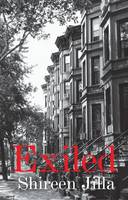
Shireen Jilla
Let us raise our goblets to Jilla’s debut novel, Exiled, a dark, dysfunctional psychodrama set in New York City.

The novel tells the story of Anna, who is so in love with her husband, Jessie, an ambitious British diplomat, that she can’t wait to start a new chapter of their life together in New York. Jessie is the ticket (quite literally!) for Anna to leave her old life in rural Kent far behind.

At first, New York lives up to its promise. The couple find a brownstone on the Upper West Side and fall into the rhythm of New York life. But then disaster strikes, again and again.

As Anna herself puts it in her Foreword to the story:

I couldn’t imagine that my romantic dream would turn into a dark battle for everything I loved.

In our current gothic mood, we laud the idea of this book (unfortunately, we’ve only read excerpts as it’s not yet available in the U.S.) for:

1) Defying stereotypes: Many outsiders who write about New York are tempted to extol the city’s glitz and glamor a la Sex and the City. Not Jilla. As one critic put it, she gives us a New York that is “a teeming pit of hissing vipers, only just covered with a finely buffed veneer of sophistication.”

Exiled2) Pushing the envelope: Jilla, a Third Culture Kid (she is half English, half Persian, and grew up in Germany, Holland and England) who has also been an expat — in Paris, Rome, and New York — hasn’t simply replicated her experience but has dug deeper to reveal psychological truths about the people she has observed. Anna’s step-mother-in-law is a powerful socialite and philanthropist of precisely the sort seen on The Real Housewives of New York City. In Jilla’s rendering, though, she is further revealed as calculating, manipulative — and evil. As one reader-reviewer on Amazon says:

Imagine the stark terror of Rosemary’s Baby firmly grounded in reality. Shireen Jilla has created the sharp thrill of horror in a world of utterly true and compelling characters.

3) Presenting a heroine who could almost be Libby’s alter-ego: Now who is Libby, you might ask? She is the Displaced Nation’s fictional about-to-be expat wife. Her diary entries appear every Friday on this blog. After hearing about Anna, we can’t help but wonder: will Libby’s life take a sinister turn once she reaches Boston? No, Boston isn’t New York — but how long before Libby encounters a Boston Brahmin…or two?!

Time to break the spell?

Before we blow out our candles, it’s your turn, dear reader:

Has Shireen Jilla also illuminated something for you by exploring the gothic side of our displaced lives? Does she speak to your own experience — to the times when you’ve been face to face with people who seemed evil, or with nefarious doings?

And do you have any questions for Jilla about what motivated her to write such a gloriously dark book?

img: New York Skyline, by plastAnka.

If you enjoyed this post, we invite you to subscribe for email delivery of The Displaced Nation. That way, you won’t miss a single issue. SPECIAL OFFER: New subscribers receive a FREE copy of “A Royally Displaced Tea.”

Related posts:
A toast to two displaced writers with passionate views of royal passion

Special notice: The writers we are celebrating in today’s post — best-selling novelist Jane Green and expat blogger Karen Van Drie — have kindly agreed to “come in” and respond to your comments and questions on the topic of the hour: yesterday’s royal wedding. Don’t be shy!

A cheery hello to you all. We have a special treat in store for Displaced Nation readers: a royal wedding-themed party in honor of two expat writers — one an acclaimed author, the other an acclaimed blogger — who take very different views of yesterday’s “wedding of the century.”

Jane Green is the author of a dozen novels dealing with real women, real life, and all the things life throws at them. She is also an expat. Born in London — she spent her early career as a writer of women’s features for the Daily Express — she now lives in Connecticut with her husband, six children, and assorted pets.

Karen Van Drie is an American who decided to travel the world after her youngest daughter left for college. Based in Istanbul and Prague, she travels extensively and records her observations in her award-winning blog, Empty Nest Expat. The blog was called out last year in the Wall Street Journal as a “fun read for anyone looking for reassurance that change can be a wonderful thing.”

No in-betweens, even (especially?) among expats

Vogue magazine editor Alexandra Shulman observed that Britain’s “wedding of the century” divided the British nation into lovers and loathers — so was a “perfect Marmite moment.”

Well, she could have been talking about the Displaced Nation just as well as the British nation. Over the past few weeks, we English-speaking expats and repats have divided into two opposing camps.

If anything, we tend to be even more passionate about our views because of the distance factor.

GREEN: “A modern fairytale”

As explained in an April 13 blog post on her newly released e-book for ABC News* on three generations of royal love stories, Jane Green knew little about Kate and William before starting her research but came away impressed:

I loved discovering just how unusual William and Kate are: grounded, humble, and thoroughly modern, eschewing much of the pomp and circumstance that surrounded the wedding of Charles and Diana.

Her book, which blends text, video, still images and interactive features, celebrates Kate for achieving the seemingly impossible feat of bringing an age-old fairytale up to date.

VAN DRIE: “If princesses didn’t exist…”

In the overheated countdown to the Big Day, Karen Van Drie resurrected a post she had written in February about the evolution of her personal views on royals, especially princesses.

Van Drie was prompted to write on this topic during a week-long visit to Sweden, where she noticed that the Swedish Royal Palace gift shop was packed out with tourists snapping up merchandise related to last year’s wedding between Princess Victoria and her personal trainer, Daniel Westling.

Somewhat to her surprise, Van Drie could not get into the spirit. This apathy marked a change from her twenties when she’d fallen head over heels for the fairy tale of Prince Charles and Lady Diana and studied every detail of their royal wedding. When she got married herself, she asked the florist to reproduce Diana’s bouquet exactly.

What’s more, after reading an article about the Swedish Republican Association, Van Drie decided they were thought leaders on the subject of monarchy elimination. She wondered aloud on her blog:

If princesses didn’t exist, what would young women dream of being? Could it likely be a healthier idea for humanity and relationships? A more realistic idea? Can you imagine people of the future laughing at us for even allowing the idea of undemocratic monarchies to exist? For needing the “idea” of princesses?

Where do you stand?

Dear readers, it’s your turn now. While we put out the bunting, pour glasses of Pimms, make pots of tea, and prepare plates of crustless cucumber sandwiches, scones, and Tiffin, for our feast in honor of Green and Van Drie, we’re hoping you will tell us: what do you see when you look at the relationship between William and Kate close up? Do you share Green’s picture of a modern fairytale, or are you more inclined to Van Drie’s notion of a gothic horror story?

* A Modern Fairytale is ABC’s first e-book and Green’s first-ever work of nonfiction. It is available through top etailers — Apple’s iBookstore, Kindle, Nook, etc. — and through the new ABC Video Bookstore app.

If you enjoyed this post, we invite you to subscribe for email delivery of The Displaced Nation. That way, you won’t miss a single issue.

Related posts:

A displaced American writer, awash in sea of Royal Wedding apathy

Today we welcome Kristen Ashley to The Displaced Nation as a guest blogger. She wrote this post in response to Kate Allison’s “Jerry Seinfeld — the Royal Wedding’s Answer to Ricky Gervais.” Kristen is Kate’s opposite number: an American (originally from Indiana) who has been living in England: in a small seaside town in the West Country.

When I was asked to write an American’s perspective on Britain’s perspective on The Royal Wedding, at first I demurred. I did this because usually I have a lot to say on any subject but this one I didn’t.

This isn’t because I hold disdain for the upcoming nuptials. Indeed, back in the day when I was just thirteen, I, like many other Americans, woke up at an ungodly hour to watch Diana marry Charles. I did this with excitement akin to waking up Christmas morning. Well before their wedding day I was devoted follower of Diana and I still think she was a very stylish, kind and compassionate woman. And, living in England for eight years, I’ve come to respect Charles. And, lastly, it appears they raised two fine sons. In fact, the Royals as a whole seem okay in my book. I know they have their foibles but don’t we all?

Wedding — what wedding?

No, the reason I demurred from writing this piece was because no one here cares much about The Royal Wedding. In fact, William and Kate were engaged for days before I knew they’d made the announcement, and I only found out about it from seeing the Facebook statuses of my American brethren. Just yesterday, less than two weeks before the big event, I learned that Kate was given Diana’s ring, she wore blue during the announcement and did her own makeup. All this came from my sister who lives in Phoenix.

Therefore, considering the lack of interest was the piece, once I’d agreed to write it, I started to pay attention. By no means did I do any statistical research but I did make the effort to scan the magazines at the checkout counters, none of which, for weeks, had picture one of the happy couple and they still don’t.

A good day for a street party…or to mow the lawn

We get a bank holiday here for the wedding and that’s the only subject I’ve noted of any non-instigated chatter about The Wedding. Even so, no one I know is going to be sitting at home watching it. They’ll likely be in their gardens or on a jaunt to the seafront or some such British activity.

So, I brought up the subject, and not to talk about the bank holiday. When I suggested to a group of friends that we have a Royal Wedding party at my house, I received blank faces. The kind where someone is trying desperately to find a good lie where they can say they’re doing something important like grooming their cat and couldn’t possibly attend your party. The conversation died at that point and even when I told them I’d have plentiful Pimm’s and lemonade on hand there were no takers.

They did talk about the amusing anecdote of an article in the local newspaper describing how one small town was surprised that no one had applied to have a street party on the Big Day. Another indication that folks were taking the bank holiday not to celebrate the nuptials but to trim their rose bushes.

Time to load up on choccie biccies

I have noted, of late, that Clinton’s Cards has Union Jack decorations for sale should there be any takers but this display has only sprung up recently. And McVities has a commemorative tin of biscuits available — but it’s already on special offer and the event hasn’t even passed.

Other than that, it’s business as usual on this sceptred isle with everyone far more interested in what’s happening with Cheryl Cole and Katie Price than their future king claiming his bride.

As for me, I’m undecided. I’m curious about Ms. Middleton’s dress. That’s as far as I can build my interest. Perhaps it’s the lack of enthusiasm that surrounds me or perhaps the ugly, public and, in the end, literal death of the fairytale for William’s mother has soured me on the whole shebang.

I know this, if it’s sunny like it has been here for days, it’s unlikely I’ll be inside in front of a TV. This is England after all and you’re likely to be put to death if you sit inside when it’s sunny. I’m certain there will be plenty of photos on hand where I can examine the future queen’s wedding gown in detail.

But I’ll undoubtedly find them on American Web sites.

Question: How will you spend April 29th? And should the extra British holiday for the Royal Wedding be donated to a more enthusiastic audience?

Kristen Ashley is a novelist and the author of the Rock Chick Book Series. She offers downloadable chapters of her books, great recipes, and much more at www.kristenashley.net.

img: author photograph – Kristen Ashley

If you enjoyed this post, we invite you to subscribe for email delivery of The Displaced Nation. That way, you won’t miss a single issue.

Ho’ omaika’i ‘Ana to TCK writer Tony Roberts

Aloha, reader. We would love for you to join our celebration of writer Anthony H. [“Tony”] Roberts, who produced our favorite article of the week, “No Time for Goodbyes,” a gripping account of his family’s sudden departure from Iran in 1978, when he was just 17.

Tony wrote his piece for Denizen, the online magazine for Third Culture Kids — kids who grew up in a culture or cultures other than their own.

Tony now lives on the Big Island of Hawai’i, so our fete in his honor, which has just begun, consists of a min-luau with traditional foods, mai-tais, and a hula performance.

You will also have a chance to engage with Tony directly as he’s agreed to respond to your comments and questions. (Mahalo, Tony!)

In fact, the hula dance is about to begin. Watch the series of three dances telling us why Tony’s life is so special:

#1: TRAGEDY

From Tony, we can learn about what it is like to be displaced by circumstance rather than by choice. Tony spent five years of his childhood exploring deserts in Saudi Arabia and three years as a teenager running wild in the streets and hillsides of the ancient city of Tehran. Then suddenly the Islamic revolution occurred, and before he had a chance to click his heels even once, he, along with his mother and sister, were transported back to their small farm town in Kansas, where he’d been born but no longer thought of as home:

The greatest sadness of leaving Iran in 1978 was its speed. Our departures were so fast that there was no time for goodbyes. All of my closest high school friends scattered to the winds. Tens of thousands of Americans lived in Tehran when I was there, and by the end of 1979 there were only 52 left — the American hostages.

#2: TRIUMPH

Tony has done something many expats only dream of: he’s written up his experience in a work of historical fiction. His book, published in February of this year, is called Sons of the Great Satan. It tells the story of an American teenager forging a friendship with an Iranian teenager in the last golden hours before the Shah of Iran falls and the country is engulfed by a whirlwind of chaos. Go to YouTube trailer.

#3: MULTICULTURALISM

Tony and his family embody our ideal of global citizens. His wife is a Kiwi, his son a Cherokiwi, and they live in Hawai’i, a melting pot of cultures from around the world, with influences from China, the Philippines, Japan, Korea, Portugal and Puerto Rico, to name a few. And let’s not forget Ziggy, the family pet. He’s a Boxador, a cross between the Boxer and the Labrador Retriever. (Ziggy, assuming Fergus makes it to The Displaced Nation, we’re sure he would enjoy palling around with you.)

And now, it’s time to adorn Tony with leis and drink a toast to his honor. Okole maluna! Cheers, Tony!

If you enjoyed this post, we invite you to subscribe for email delivery of The Displaced Nation. That way, you won’t miss a single issue.

What the concept of home means for expats

My mother was the kind of woman who knew she wanted to be a journalist from the age of 12. She never stopped moving. Maybe that’s why I remember so clearly the one ambitious sewing project that she managed to finish. It was a sampler that lay over one of the chairs in our family home embroidered with the words “Home is where the heart is.”

I’ve often pictured my mother’s needlework as I wandered the globe, first as an expat in England, then as an expat in Japan. Where was my heart, and therefore my home: with my mother, my husband, my husband’s family, or in some of the places I’d visited and connected with? Hadn’t I left a piece of my heart in each of those places?

Then when I finally returned to my native land, having spent as many years abroad as I’d consciously lived in the United States, I was no longer sure if this country could be my home any more, as it appeared to have changed so much.

Misery loves company, especially when it includes Joanna Penn

Oh, why does life have to be so complicated? Why can’t it be summed up on a sampler?

Still, I have taken much solace in knowing I’m not alone in grappling with such questions. Just last week, I was pleasantly surprised to discover that my expat-to-repat group now includes the extraordinary Joanna Penn, author, speaker, and business consultant.

I am a faithful subscriber to Joanna’s blog, The Creative Penn, which not for nothing has achieved the distinction of being one of the top ten blogs for writers. Recently, Joanna gave us the thrill of live-blogging the writing and self-publishing process for her very first novel, a fast-paced thriller called Pentacost.

Somehow, though, it hadn’t clicked with me that Joanna was an expat.

But then I read her 8 April 2011 post and watched the accompanying YouTube video, “What the Concept of Home Means for Writers.”

Joanna was prompted to talk about “home” because she’s repatriating to England after having spent the past 11 years in New Zealand and Australia. Not only that but it turns out that Joanna was a so-called third-culture kid. Her family moved all over the place when she was young, including to Africa for a while.

For Joanna, home is a spiritual bond

Joanna thinks outside the box when it comes to publishing, so I suppose I shouldn’t be too surprised that she thinks outside the box when it comes to being an expat. She seems to regard her displaced state as par for the course, as nothing particularly special. This is because she sees herself as a writer first and an expat second:

… for me the concept of home is not necessarily where I’m physically based at any one point but somewhere where I spiritually feel I belong…

We could say Joanna is out of the James Joyce mould, as described by Anthony Windram in his latest TDN article, “James Joyce’s Paris.”

This is not to say Joanna isn’t fond of the countries where she’s lived. She says she still has a soft spot for Malawi, where she went to school as a kid, and has enjoyed her more recent time Down Under.

That said, I sense she will be glad to see the back of Oz in some ways — judging by her response to one of the commenters on her “concept of home” post, that she is “looking forward to being without mosquitoes, huge spiders, sweltering heat and humidity.”

Joanna’s mention of the spiders gives her something in common with Robert Pickles, who has stirred up some controversy for his Daily Telegraph series on why he’s decided to ditch his dream of Australia and move back to Blighty — the “vast array of insects … with fizzing wings and frenzied little eyes” being at the top of his list of dislikes.

A tale of two cities that are now “home”

But that is where the similarity between Penn and Pickles ends. Unlike Robert Pickles, Joanna Penn never really thought of Australia as “home.” Right now she feels a spiritual kinship with two cities: Oxford, where she went to university and near where her father now lives, and Jerusalem, which she’s visited at least ten times because she loves it there so much.

What’s more, Joanna connects these two cities in her mind and has done so ever since reading the Thomas Hardy novel Jude the Obscure as a kid.

The novel’s tragic hero, Jude, is a working-class boy who tries to educate himself. He idealizes Oxford (known in the book as Christminster) as a “city of light,” where “the tree of knowledge grows.” Coming over a ridge and gazing at the city of his dreams for the first time, he refers to it as a “new Jerusalem.”

Joanna approves of Jude’s hypocatastasis. (“And did those feet in ancient time…” is now playing in my head.) Steeped in religious studies, she sees both Oxford and Jerusalem as holy cities, worthy of pilgrimages and therefore an intense romantic attachment.

Some parting spiritual reflections

In the week of Passover and Easter, I sometimes envy those people with strong spiritual ties, a pull that I’ve never especially felt.

In fact, the only time I’ve ever wanted to kiss the ground upon first discovering a place was when I landed in Taipei and my husband took me to a restaurant called Din Tai Fung. The dumplings were so delectable that I decided then and there that if ever I were told I had only a few days left to live, I’d demand to be transported to that restaurant for my final few hours.

Could a Taiwanese dumpling house really be my spiritual home? No doubt that explains why I’m writing about Jamie Oliver’s food revolution on this blog whereas Joanna Penn is working on her second in a series of religious thrillers set in Oxford and Jerusalem.

Still, fans of Ang Lee’s Eat Drink Man Woman should understand how I feel… My mother would understand it: she was an excellent cook, when she had time for it…

But I digress.

Question: What do you think of Joanna’s notion of a spiritual home? Is “home” for you a place that has captured your heart, your imagination and your spirit? Or is it a place where you live with your nearest and dearest?

If you enjoyed this post, we invite you to subscribe for email delivery of The Displaced Nation. That way, you won’t miss a single issue.

CLASSIC EXPAT WRITING: James Joyce’s Paris

Statue of the Republic, Paris, c. 1890, from Wikimedia Commons (Public domain)

In producing this small, slightly piffling series of blog posts dedicated to expat writing, or members of the literati that we might class as expats, one thing that keeps holding me back somewhat and that is that I frankly dislike the term “expat writer”.

Expat writer: say it quietly to yourself and no doubt it conjures up thoughts about Peter Mayle and his numerous imitators, and do we really want to be conjuring up thoughts about Peter Mayle and his numerous imitators? If it’s not careful, expat writing can seem to be  mostly about a rather self-satisfied soul who is a little too pleased with himself and a little too enchanted with his surrounding. And if, like me, you’re one of those fusty souls who thinks that any writer worth their salt is more concerned with internalising thoughts and emotions, poor expat writers, who seem interested purely in the external, can drive you mad.

I was reminded a little about what this expat writer conundrum when on Twitter I stumbled across a discussion led by some of this parish about whether James Joyce should be considered an expat writer or not. Of course, it seems simple. Joyce spent most of his adult life living in continental Europe. It logically follows that we can lay claim to the title of expat writer for Joyce on account of him being both an expat and a writer. But it seems others would argue that Joyce is not an expat writer. And it is true, I grant you, that he certainly not in the Peter Mayle mould of expat writer. Paris, on the surface, does not seem to have inspired him. It never nourished, on the surface, his work in the way that Dublin did. But we could argue that Joyce needed the intellectual climate of France in the 20s and 30s to feed his own modernist work. If we were to be glib we might say that Finnegans Wake was conceived in Dublin, but Paris was its midwife.

With this in mind, for this week I’m drawing attention to an interesting essay from the New York Times first published in 1982 which takes a closer look at Joyce’s Paris and its effect on his work. An extract follows, but the full article can be found here at the New York Times Website.

N o. 7, Rue Edmond Valentin. A six-story facade, heavy ornamental moldings, a wrought-iron grille door, the Eiffel Tower in sight down the street: the heartland of upper-bourgeois Paris. Poodleland. Beneath the city’s winter overcast, these arrondissements – the 7th, the 8th, the 16th, the 17th -are an endless yellow-gray undercast: bland and impermeable. They are a chilly mask: and for the later James Joyce, who cloaked his turbulence with formality, they made an oddly appropriate residence.

Joyce spent 20 years in Paris – almost as long as in Dublin – but that is like counting the time we sleep. In 1922, two years after he arrived from Zurich, he immersed himself in the elusive dream that took him 16 years to finish: ”Finnegans Wake.”

In ”Ulysses,” the tangible presence of Dublin is memorialized: paving-stone and brick wall, legend and grilled kidneys, gab and gossip. ”Finnegans Wake” is a sleeping packrat dragging the world in, bit by bit. There are slivers of Paris in the pack but they are transmuted, as a dream transmutes the sound of a passing car into an army in flight.

So how is the pilgrim to find Joyce in Paris? There is, of course, his biographical presence, which will be attended to in a moment. But mostly what we look for in a literary pilgrimage is the cafe the characters drank in, not the one where the author did. Not, that is, unless the author is materially incorporated in the characters. We follow the characters Stephen and Bloom in and about Dublin; and we follow Joyce too, because he gave them his meanderings. In Paris, Joyce’s work and his life diverge d. How do you follow the sleeping Hum- phrey Chimpden Earwicker, whose dream is ”Finnegans Wake”? Strictly speaking: by eating an indigestible dinner, falling asleep, and letting the toots and stirrings outside and an uneasy memory infiltrate your dreams.

By the time Joyce got to Paris he was approaching middle age and near-blindness. He was not inactive, but he did not throw himself into the life of the city in order to find himself or his subjects or his art. He had them already. He used Paris for its quiet, its elegance and the congenial atmosphere it offered a writer.

He had company and diversion. He had the material support of Harriet Weaver, who sent him astonishing sums from London, and of Sylvia Beach and Adrienne Monnier, who got ”Ulysses” into print when nobody else dared to. He had a reasonable amount of lionizing; but he also had the privacy and aloofness that Paris allows to its lions, because it possesses so many of them.

Mostly, except for brief visits in 1902 and 1903, Joyce’s Paris geography is a series of respectable apartments, such as the one on Edmond Valentin, where he sat and wrote. They were havens of a sort, but invaded more and more by shadows. Literal ones: He had at least 10 eye operations, and at times could barely see to write. Correcting proofs, he would lay his head sideways on the page to achieve the only odd angle at which he still had some vision.

There were other troubles. The lion grew moth-eaten, as his Herculean labors on ”Finnegans Wake” were rewarded by puzzlement and distress on the part of many of his admirers. Even the American poet Ezra Pound, not exactly a clear-running stream, wrote him: ”I will have another go at it, but up to present I make nothing of it whatever … I don’t see what which has to do with where …”

Question: I’d be fascinated to know your own thoughts on what constitutes an expat writer. Do you need to focus your work on the expat life to be one?

“Over my ‘Ead,” by Jake Barton

Join The Displaced Nation in a glass of dry sherry and some delicious tapas in honor of our favorite displaced blog post of the week — “Over my ‘Ead” by Jake Barton.

Jake’s experience of language classes in another country reminds us that a common first language does not necessarily a friendship make:

“Who needed language classes? We decided we’d do as we’d done in France. Cultivate the society of locals, pick up the language in a natural manner, avoid red-faced expats wearing unsuitable clothing.”

Well said, sir.

Read Jake’s blog on writing and travel at http://jakebarton.com

If you enjoyed this post, we invite you to subscribe for email delivery of The Displaced Nation. That way, you won’t miss a single issue.

CONTEMPORARY DISPLACED WRITING: Fury — Salman Rushdie

Continuing with our look at writing concerned with expat experiences, when I first moved to the US, spending my time in New York and Philadelphia, I found myself often thinking about the following extract from Salman Rushdie‘s novel, Fury.

There’s just something about this piece that sits absolutely right with me. It conveys so well the Gulliver-esque excitement and fear that I felt when first having to navigate New York; and how, when listening to the locals talking, their inflections and pronunciations sounded to my ears so utterly confusing, and thrilling, and also…oddly bovine.

When he left the apartment nowadays he felt like an ancient sleeper, rising. Outside, in America, everything was too bright, too loud, too strange. The city had come out in a rash of painfully punning cows. At Lincoln Center Solanka ran into Moozart and Moodama Butterfly. Outside the Beacon Theatre a trio of horned and uddered divas had taken up residence: Whitney Mooston, Mooriah Carey and Bette Midler (the Bovine Miss M). Bewildered by this infestation of paronomasticating livestock, Professor Solanka suddenly felt like a visitor from Lilliput-Blefuscu or the moon, or to be straightforward, London. He was alienated, too, by the postage stamps, by the monthly, rather than quarterly, payment of gas, electricity and telephone bills, by the unknown brands of candy in the stores (Twinkies, Ho Hos, Ring Pops), by the words “candy” and “stores”, by the armed policemen on the streets, by the anonymous faces in magazines, faces that all Americans somehow recognized at once, by the indecipherable words of popular songs which American ears could make out without strain, by the end-loaded pronunciation of names like Farrar, Harrell, Candell, by the broadly spoken e’s that turned expression into axpression, I’ll get to the check into I’ll gat that chack; by, in short, the sheer immensity of his ignorance of the engulfing melee of ordinary American life….

If you enjoyed this post, we invite you to subscribe for email delivery of The Displaced Nation. That way, you won’t miss a single issue.