The Displaced Nation

A home for international creatives

Tag Archives: Fiction Writers

LIBBY’S LIFE #38 – The battle of the tigers

Two weeks with Jack at home all the time, and I’m climbing the walls. I’d got used to three hours of freedom a couple of times a week while he was at nursery, and this makes me even more apprehensive about how I will cope when the twins come. Maggie said she will help, and I’m grateful, but there’s only so much I can ask of her.

My due date is getting ever nearer, I need reinforcements – so this afternoon Jack and I are going out.

In other words, I’m braving the coffee morning posse again.

Today, though, it’s not a coffee morning but a pot luck lunch at Anita’s place. I’m going armed with a big plate of egg mayonnaise sandwiches and some Lays Salt and Vinegar, and with a bit of luck, Caroline and her devil child won’t be there. The lunch coincides with Patsy’s nursery school schedule. I can relax, and Jack can let off steam with other children and make a mess in someone else’s house.

If only it was Caroline’s house he was making a mess in.

* * *

I don’t know why I didn’t like these women before. They’re actually quite nice, once you get to know them and find you have things in common, like a love of American Idol and complete bewilderment at the rules of the game that Americans call football.

For total bonding, of course, there’s nothing like having a good bitch about an absent member of the coffee morning posse while leaning against the kitchen counters. The kitchen is always the best place for a cozy chat.

And it seemed I wasn’t the only one who wasn’t keen on Caroline or young Dominic.

“Isn’t it lovely and peaceful without them both?” Anita said. “Last time they came here, that child decided to cut open the beanbag in our basement. Polystyrene beads all over the place, sticking to everything. I had to empty the vacuum cleaner five times, and I’m still finding those sodding beads. So when it came to my turn to host again, I announced a pot luck lunch instead of coffee morning. While Dominic is at school, Caroline has serious me-me-me time, and the promise of chips and brownies won’t tempt her away from her weekly massage.”

“And she won’t do a thing to discipline Dominic,” Charlie said. “When we were at Julia’s house once, he clobbered Julia’s little girl, Sadie, with a Barbie doll. Really hard, too. Poor Sadie.”

“On Sadie’s head, mind. She had a big lump for quite a few days.” Julia, the tiger-mum who had given me a lift to my first coffee morning back in July, joined the conversation. I was surprised, having always assumed she and Caroline were friends. “And Caroline didn’t say anything to Dominic, apart from asking him if he thought he’d made a ‘good choice’.”

“That sounds familiar,” I said. “He picks on Jack at school, and it’s got to the stage where Jack won’t go any more. So I’m paying for his place, because Patsy Traynor has this rule about giving two months’ notice, and it’s a total waste of money.”

Julia and Charlie exchanged glances.

“And let me guess – Patsy Traynor is turning a blind eye because Caroline has given her a big backhander?” asked Julia.

I almost choked on my egg sandwich.

“How do you know? Does Patsy make a habit of this?”

“I couldn’t tell you about Patsy,” Anita said, “but Caroline thinks money will get her out of any situation. Dominic had a bad habit of biting at one time. Well, OK, a lot of kids do, but Dominic would draw blood. And instead of putting him in time out–”

“Or biting the little bugger back,” Charlie murmured.

“— on one occasion, when he did it to some poor child at playgroup, she offered the mum fifty dollars.”

“Why?” I asked, confounded.

Julia shrugged. “The only apology she knows how to make?”

Anita snorted. “That’s too charitable. It was hush money. Except that it didn’t stay hush. The mother made a real hullabaloo and told Caroline she didn’t care if she was the boss’s wife or not, it didn’t give her brat an excuse to take chunks out of other kids, and she could keep her stinking money, and she’d see Caroline in court.”

“And did she?”

“She might have done – she watched an awful lot of Judge Judy – but instead that woman and her husband and two kids were on the plane back to Milton Keynes two weeks later.”

I was silent.

“It could have been coincidence, of course,” Julia said, “but if so, it was a very convenient one. So, Libby. I don’t know what you’re intending to do – but let me suggest that whatever it is, you do it carefully. Unless you actually want Oliver to be a victim of the next round of redundancies, of course.”

I shuddered. “We can’t afford that,” I admitted. “Not with this on the way.” I patted my stomach.

“Do you know what it is yet?” Charlie asked. “Do you want a boy to keep Jack company, or a girl to even the numbers up?”

Oliver had been very good at keeping this news quiet, I thought. Or maybe men just didn’t talk about stuff like that at work. Perhaps the men he worked with didn’t know I was pregnant at all.

No matter. Time to drop the bombshell myself.

“It’s the best of both worlds, I suppose,” I said. “We’re having one of each. A Megan and a Sam.”

It wouldn’t stay secret for long now. Want to spread news or a rumour in expat mum world? Dish the dirt at coffee morning. Or pot luck lunch.

The reaction was gratifying. Everyone gathered into the kitchen as Anita and Charlie shrieked the news, and women I’d never met before offered congratulations. Suddenly, there I was: a local celebrity, a major fish in our little paddling pool.

“If you need anything at all…” they all kept saying. “It’s tough, being far away from your family. You’ve only got to ask, if you need help. Just say the word. Just shout.”

Julia nodded. “Honestly, we mean it. We all pitch in and help when anyone here has a baby. You know – organise a meal delivery rota, that sort of thing. You’ll need more help than anyone has before. No one else has had twins over here.”

I felt quite teary. Hormones, no doubt – but I hadn’t expected this level of affection and camaraderie. I hugged Julie, feeling guilty that I’d disliked her so much when I first met her.

“Group hug? That isn’t usually on the pot luck menu.”

Caroline’s crystal tones cut across the estrogen-fuelled scene. Or whatever hormone was rampaging around me right now.

“The masseuse was ill, so I thought I’d come here for half an hour, and call in at the jeweler’s to have a look at the earrings Terry said he’d get me when the baby’s born. Only three weeks to go, girls! But what’s all the fuss about? What have I missed?”

Julia shot her a sideways smirk. “We’re celebrating. Libby’s just told us she’s having twins.”

Caroline had been spray-tanned quite recently. Very subtly, so as not to look like a Jersey Shore cast member, but perhaps it was a bit too subtle. It didn’t hide the way her face turned pale green at this piece of information.

“Twins?” she said, as if she’d heard the word before but couldn’t quite remember what it meant.

“Yes, twins.” Anita turned to me. “Isn’t it funny? Caroline thought she might be having twins at one time, but of course, she isn’t. And you are instead.”

“I suppose Terry won’t be coughing up for the big earrings anymore, will he?” Julia asked, with a huge false smile of sympathy.

I’d been watching them all talk, my head swiveling back and forth, not quite understanding what was going on – until Julia mentioned the earrings. Then I remembered the coffee morning back in July. The one-upmanship competition. Caroline had said her OB/GYN thought it might be twins, and in that case she, Caroline, was going to look for some four-carat rocks.

Caroline coughed. “Probably not. I expect Oscar will buy them for Libby instead.”

“Oliver,” I corrected. “But no. He won’t. He has this funny way of thinking that a baby or two is gift enough for both of us.”

Well, it might be what he thought.

“And he’s quite right.” Charlie put her arm round my shoulders. “You’ve got family, friends, love – why would you need anything else?”

Actually, I’d love a pair of earrings or something like that, but it wouldn’t occur to Oliver, and it seemed a bit shallow to suggest it to him. So for now I could take the high ground. And what was wrong with a nice bunch of flowers anyway?

Caroline had a bright smile sort of stapled to her face. “Well, Terry sees things a little differently, so I still have to pick something out at the jeweler’s. Call it a memento of the occasion.”

“Memento?” Anita echoed. “What the bloody hell do you need a memento for? You’ll have a nine pound boy – isn’t that and a few stitches reminder enough of your two days in hospital?”

Julia said, absentmindedly, “Libby’s having a boy and a girl. Sam and Megan. Pretty name, Megan, isn’t it?”

Caroline pressed her lips together and hoisted her Coach bag higher on her shoulder. “Must be off,” she said – and left.

Everyone was silent until the front door had banged shut.

“Bad Julia,” said Julia. “Bad, bad, bad. Stay behind after school and write five hundred times, I must not torture Caroline. She wanted a girl,” she explained to me. “She’s always wanted a girl. That’s why Dom’s hair is so long still. She treats him like a girl, poor child. I’m all for not imposing stereotypes, but really – buying him a Snow White costume for Halloween? She should be arrested for child abuse.”

“You look tired, Libs,” Charlie said. “Why don’t you go home and have a sleep, and one of us will drive Jack to you in a couple of hours?”

“I’ll do it,” Julia offered. “I’d be glad to, even if you hadn’t just made my day. I’ve been waiting for that woman to get taken down a couple of pegs ever since we arrived in Woodhaven.”

“Thank you,” I said. “I think I will. I’m really grateful, Julia.”

And don’t get me wrong – I was.

But I was also a little troubled. If I’d taken on one new role as expat mum celebrity, it seemed I’d also taken on another – that of human shield in the battle of the tiger-mums.

Yes – I was troubled, all right.

.

Next post:LIBBY’S LIFE #39: Sugar and spice, and all things lice

Previous post: LIBBY’S LIFE #37 – Plots (and waistlines) thickening

Click here to read Libby’s Life from the first episode

STAY TUNED for a round up of top Valentine posts!.

If you enjoyed this post, we invite you to subscribe for email delivery of The Displaced Dispatch, a round up of the week’s posts from The Displaced Nation. Sign up for The Displaced Dispatch by clicking here!

Image: Travel – Map of the World by Salvatore Vuono / FreeDigit

LIBBY’S LIFE #37 – Plots (and waistlines) thickening

Having uncovered corruption in the most unlikely of places, Libby is seeking advice from those around her.

As always when in need of advice, encouragement, and a bit of vindictive support, I went to see Maggie.

I tried to get advice and support from Oliver, but he’s a bloke. Nursery school dirty politics don’t interest him. He was concerned that someone else’s brat was picking on our son, however, so he took Jack aside for some man-to-man words of wisdom. The gist was that if Dominic caused any more grief, Jack was to beat him to a pulp, and Dominic wouldn’t do it again. Then I informed Oliver that Dominic was the son of Caroline, and Oliver turned a little pale and told Jack that Daddy was only joking, because violence is never the answer.

Caroline is the wife of Oliver’s boss, you see.

So, slightly disgusted with my turncoat husband, off I went to visit Maggie. No double standards from her.

When Jack and I arrived at her house, a strange car was parked outside, and I hesitated for a moment. Maggie doesn’t normally have guests, and I didn’t want to interrupt, but while I stood on her porch deliberating whether or not to knock, the front door opened.

“Hi, Mag—” I started to say, before realising it wasn’t Maggie who had opened the door, but the exotic woman I’d met in the Maxwell Plum at the Christmas party.

“How wonderful to see you again!” Anna Gianni exclaimed. “Come in and sit down –  we just made coffee.”

So Jack and I sat on Maggie’s squashy blue velvet sofa and watched two squirrels playing tag around the trunk of the maple tree outside the window, while Anna and Maggie crashed around in the kitchen. Call me possessive and silly, but I felt my role of Maggie’s adopted daughter had just been usurped. Crashing around in the kitchen with Maggie was my job.

Anna carried a tray into the living room and set it on the wicker trunk Maggie used as a coffee table.

“I’ve been meaning to call you ever since New Year’s,” she said, handing me a white china cup with violets hand-painted on it. “But the restaurant’s been really busy, and Frankie’s mother hasn’t been well. I always try to follow through with my promises, but sometimes life gets in the way. Know what I mean?”

I thought about my own January, the news from the ultrasound, and the problems I was having with Patsy Traynor.

“I know what you mean.”

Maggie emerged from the kitchen with a plate of brownies, and Jack looked up hopefully. She sat down in her rocking chair and beckoned him over.

“No school today, Jack?” she asked, handing him a brownie.

Jack crammed half the brownie into his face and shook his head, chewing. Then he crammed the other half in. Brownie juice ran out of the sides of his mouth.

“Gross, Jack.” I patted my pockets for clean tissues but found only a Snickers wrapper. Anna got up from her armchair and headed for the kitchen. “We’ve got a  little B-U-L-L-Y-I-N-G problem at the moment, I’m afraid,” I said. “By another child, I mean.”

“This is at Patsy’s school?” Anna called from the kitchen.

I nodded.

“And what is dear Patsy doing about this little problem?” asked Maggie.

Anna returned with a pile of paper napkins, and used one to scrub the chocolate from Jack’s face.

“That depends on who the child is, doesn’t it?” she said. “The fact that Jack is at home suggests to me that Patsy has done nothing. The troublemaker is still at school, and therefore the mother of the troublemaker is someone Patsy feels she must suck up to.”

I stared at her. “How do you know all that?” I asked at last.

“Patsy might have got rid of the teenage zits, my dear, but she never changed her spots.” Maggie held her arms out to Jack, and he climbed on her lap. “Anna knows her of old.”

“She used to be best friends with your landlady,” Anna said. “Patsy is still the same suck-up as when she was sixteen. Anyone rich, influential, slightly different, and she was all over them, hoping for a piece of reflected power or glory. At one time you might have qualified because you’ve got a British accent, but the town is overrun with Brits now. You need to either win the lottery or do something out of the ordinary.”

I said that since I was “ordinary” personified and we’d never bought a lottery ticket, that probably meant I should start looking around for a new nursery school for Jack.

“Unless I can make it known that she takes bribes. Would Wikileaks be interested? Could I write an anonymous letter to the Woodhaven Observer?”

“You can write it by all means,” Maggie said, “but they won’t print it. The chief editor is Patsy’s uncle. And he co-owns the nursery school.”

I was shocked. “Does this kind of thing go on a lot round here?”

“All the time,” Anna said. “Woodhaven is simply a microcosm of every government in the world, with bribes and abuse of power running riot. You think this is bad? You should have been here twenty-five years ago.”

“What happened then?” I asked.

Anna hesitated. “I think that’s Maggie’s story to tell.”

Maggie looked down into her lap, and I knew this was another piece of Woodhaven’s history that I wouldn’t hear just yet.

“The only way to get by in this town,” said Anna, “is to beat them at their own game.”

I thought. “I’m not sure how I would do that.”

“You have to make your presence at Patsy’s school more desirable than this other woman’s. What’s her name?”

“Caroline. And she’s Oliver’s boss’s wife,” I added.

Anna and Maggie both sucked in their breath. “Tricky,” they agreed.

“Patsy’s a germ-phobe.” Maggie nodded at Anna. “Always was. I don’t know if we can do anything with that.” I wondered what she had in mind. A vial of anthrax? Smallpox? Typhoid? “Remember the boy with impetigo a few years ago? Banned him from the school for weeks, and when the mother finally brought him back, Patsy had given his place to someone else.”

I wondered how Patsy reconciled her germophobia with her dust-laden office, then decided that you didn’t have to be rational to be phobic about anything.

“I heard about that. And the replacement mother was expecting twins. Patsy’s husband is an identical twin,” Anna told me. “When they were first dating, he had to study for some midterm exams, so he sent his brother to take Patsy out for dinner. She never noticed the difference, she says. I often wonder about that date. Bet her husband does, too.”

“I feel that’s taking sibling devotion too far, don’t you?” Maggie murmured.

“At least ours won’t have that problem,” I said. “Not with one of each.”

Anna stared. “You’re having twins?”

“Didn’t Maggie tell you?”

“It’s not my news to broadcast, Libby.”

“Because,” Anna said with enthusiasm, “you could use this to your advantage. Patsy loves having twins at her nursery school. She gets her uncle in from the newspaper, and they do a big feature on how many sets of twins there are in one year. Local nauseating news kind of thing. And then they call in Local Fox News, and they do a piece on it, and Patsy gets a shitload of publicity and gets booked up for the next three years and can charge what she likes.” She paused to reach over for another brownie. “But you see, the thing is, there are more schools in Woodhaven now. The twins are diluted, and Patsy can’t charge what she likes any more.”

“So she just takes bribes instead,” Maggie chimed in. “But it doesn’t really help Libby. The other child, this Dominic, he has to go. Tell me, Libs, does he have impetigo? Recurring conjunctivitis? Feet covered in verrucae? She hates those in summer, when all the children run around in the wading pool.”

I shook my head sadly. “None of those, as far as I know. He’s quite lovely to look at, actually, a Little Lord Fauntleroy. He even has the blond curls. I guess she can’t bear to get his hair cut yet.”

I remembered when I finally had to take Jack for his first haircut, and all his little baby curls fell to the floor. He looked like a shorn sheep, and I cried all the way home. So I couldn’t blame Caroline for wanting to keep those curls for a while longer.

“Shame.” Anna checked her watch, then jumped out of her chair. “Jesus H Christ, I told Frankie I’d be home a half hour ago.” She bent down and pecked Maggie on the cheek.

“I’ll give you a call, Libby. Really. I promise. Don’t let Patsy Traynor get you down, OK?”

I started to say No, I wouldn’t, but she had already gone.

“You don’t often hear people curse like she does in this town, do you?” I said.

Maggie laughed. “You’d never guess her father was a Pastor in Woodhaven at one time.”

“No! What’s the story there?”

But Maggie just smiled and said nothing.

Another piece of Woodhaven history I would have to figure out myself.

.

To be continued next week

.

Next: LIBBY’S LIFE #38 – The battle of the tigers

Previous: LIBBY’S LIFE #36 – Filthy cash, dirty deeds

Click here to read Libby’s Life from the first episode

STAY TUNED for Mary-Sue Wallace’s advice on matters of the heart.

If you enjoyed this post, we invite you to subscribe for email delivery of The Displaced Dispatch, a round up of the week’s posts from The Displaced Nation. Sign up for The Displaced Dispatch by clicking here!

Image: Travel – Map of the World by Salvatore Vuono / FreeDigit

LIBBY’S LIFE #36 – Filthy cash, dirty deeds

Having discovered that another child is making her son Jack’s life a misery at nursery school, Libby has decided to consult Patsy, the nursery school owner. She realises, though, that this Consultation will actually be more a Confrontation.

“Have a seat,” Patsy says, waving at the hard wooden chair on the other side of her desk.

I’ve been in Patsy’s office only once before, when I enrolled Jack at the nursery school. It’s a small room with a big smeary window and dinosaur print curtains drawn back, offering no shade against the afternoon sun that dazzles the occupant of the chair opposite Patsy.

On the wall to the right, nestling among framed finger-paintings by star students, hang assorted certificates from universities and the Commonwealth of Massachusetts – proof, presumably, that Patsy and her staff are competent to impart knowledge to our offspring. A cork board on the other wall is littered with coloured posters advertising local events and fundraisers. Many posters are several months out of date, the paper sun-faded and curling at the corners.

It’s a pretty depressing chamber, with its stegosaurus curtains and floating dust motes. Sitting here, opposite Patsy in her Chair of Power behind the coffee-ringed desk, reminds me of squirming in the office of my old GCSE English teacher, trying to explain why I hadn’t done my homework. Though my English teacher had better dress sense. She would never have come to school in Patsy’s red sweatshirt, home-decorated in acrylic paints with a spotchy picture of what looks like a psychedelic T-rex, but isn’t. “Happy 2012 – Chinese Year Of The Dragon!” trumpet the clarifying words under the T-rex.

Patsy forfeits dress sense for seasonal attire in a big way, I’ve noticed over the last couple of months.

“Is Jack sick?” she asks. “I noticed he wasn’t here today.”

I drag my eyes away from the Chinese T-rex, wondering uncomfortably if Patsy thinks I’ve been sizing up her boobs.

“He’s not sick, no. He didn’t want to come,” I say, and pause for a second. “I think he’s being bullied. By Dominic,” I add, and wait for her reaction. This is going to be a difficult conversation.

You see, Patsy doesn’t — or won’t — believe that three- and four-year olds are capable of bullying each other. This much I learned last week from overhearing her dialogue with Dominic’s mother. The child had been chucked out of a rival nursery school, allegedly for harassing his little classmates. Patsy had been sympathetic toward Caroline, the tiger-mum mother, and I’d heard her opining that bullying didn’t exist among toddlers – it was all the fault of overprotective parents’ imaginations.

I know I am not overprotective, that there is nothing wrong with my imagination, and Dominic’s ex-pre-school probably had a point. When my three-year-old refuses to get in the car to go to a place he’d previously enjoyed attending – coincidentally, before Dominic’s arrival – I know something is wrong.

Patsy, as I had anticipated, is in denial that something unpleasant should happen in her Lilliputian Utopia, and shakes her head at me patronisingly. I just bet she’s been to see that film with Meryl Streep as Margaret Thatcher.

“Oh no,” she says. “No. No, no, no. We don’t have bullying in our school. Some children are more confident than others, of course, and the, er, more sensitive souls such as Jack sometimes feel a little intimidated by the confident ones. We try to work with children like Jack, to raise their self-esteem—”

“It’s got nothing at all to do with Jack’s self-esteem!” I splutter. “He’s got plenty of self-esteem! He’s just not very keen on spending time in a place where undisciplined little sods ram toy strollers at his legs for the hell of it and the people supposedly in charge stand around and waffle on about self-esteem.”

Patsy winces. Whether it’s at my accusations or at the word “Hell” (a very bad word in Woodhaven, I’ve discovered) I don’t know. It won’t be the word “Sods” because she won’t know what that means. It’s what Oliver calls “High-frequency swearing” along with other choice British words that make their way past the censors on TV. Kind of funny really – they’ll bleep out most of Gordon Ramsay’s vocabulary, but the word “Wanker” is allowed to remain because it’s foreign and unknown.

She draws in a breath and folds her hands carefully on the desk, making a steeple out of her index fingers. Definitely Maggie Thatcher.

“As I said. At this age, we do not have a bullying problem. Bullying in pre-school years is entirely in the eyes of the beholder. But rest assured, I will monitor any bad behavioural choices by Jack’s classmates.”

My mother used to monitor my own bad behavioural choices with a couple of slaps on the leg, but I doubt this is what Patsy intends. Sometimes I long for the dark ages of the 1980s.

“And how do you intend to deal with any ‘bad behavioural choices’?” I ask. “Punish the child by not calling them ‘Honey’ at the end of a sentence?”

Pointless to use irony or sarcasm on Patsy. She’s spent too many years with small children, and interprets everything literally.

“Yes. We will speak kindly but firmly with the child – whichever child it turns out to be who Jack is distressed by.”

” ‘By whom’,” I mutter. You can’t pretend to be Maggie Thatcher if you don’t know the difference between Who and Whom.

I put my hand on the seat of the chair and carefully lever myself into a more assertive standing position.

“If I can persuade Jack to come next time, then of course I will. But frankly, Patsy, I’m not reassured by your plan of action. If this child is causing Jack distress, I’m sure he will be causing distress to someone else as well, and I don’t understand why you’re willing to put up with it.”

I hold my hand out to shake Patsy’s, and as I turn slightly, I catch sight of the cork board and its faded posters. One of them is for a fundraiser dear to Patsy’s heart – the Nursery Improvements Fund, currently raising cash for a new jungle gym in the playground. Patsy sends home requests for donations every week. They always go in the recycling bin at home – in my view, what Patsy charges every month should be enough to pay for a new jungle gym, heated swimming pool, and an indoor ski slope – but I know some other mothers donate regularly, holding bake sales and coffee mornings and what have you. Mothers with cash to throw around. Mothers driving Porsche Cayennes. Mothers wearing big diamonds in their earlobes…

“It’s the money, isn’t it?” I say softly, releasing her hand. “You’ve taken this child on for more motives than just out of the goodness of your heart. Getting near the total you need for the new swing set, are you?”

Patsy’s face goes a little pink.

“No, you’re quite wrong if you think I’d—”

“Am I? Am I? I bet if Jack was displaying ‘bad behaviour choices’ you’d be chewing my ear off about it before I could say ‘Supernanny.’ How big a donation would I have to make to your Nursery Improvements Fund before you’d overlook the fact that Jack was making another child’s life a misery?”

Patsy’s silent.

I nod.

“Thought so. Goodbye, Patsy.”

I walk out of the room.

The dust was making my eyes water anyway.

.

To be continued next week

.

Next: LIBBY’S LIFE #37: Plots (and waistlines) thickening

Previous: LIBBY’S LIFE #35: A big piranha in a small pond

Click here to read Libby’s Life from the first episode

STAY TUNED for Friday’s post from Charlotte Day — where is the ultimate spiritual destination for a TCK?

If you enjoyed this post, we invite you to subscribe for email delivery of The Displaced Dispatch, a round up of the week’s posts from The Displaced Nation. Sign up for The Displaced Dispatch by clicking here!

Image: Travel – Map of the World by Salvatore Vuono / FreeDigit

LIBBY’S LIFE #34 – Shadows on a screen

After a Christmas far away from her family, Libby is wondering if she is ready to face the new year without her loved ones. The foods she has been forced to abandon, that is.

Happy New Year!

A bit late, I know. It takes me a few days to get into the ‘Happy’ part. Until then, it’s just another month of winter, minus whatever food or beverage I’ve resolved to give up.

This year was different because I’d given up every nice food or beverage already, hijacked as I am by this alien growing in my midriff. Brie, prawns, coffee, every type of alcohol – you name it, and I have sacrificed it at the altar of pregnancy, although I’m thrilled to report that my taste for tea has unexpectedly returned. But give up chocolate for New Year? I think not. Not with Pinot Noir off the menu for another five months or more. Pass the Cadbury’s – lots of it, and now.

So, here we are in 2012, the year of our second child’s birth. I will be so happy to be rid of this bump. Have heard that babies get bigger the more you have of them, but I always imagined the increments would be more gentle. This one already has the proportions of a fully grown Oompa-Loompa. Still, twenty-two weeks down, eighteen to go, assuming this baby gets out of bed on time, unlike its brother who would have been happy to stay there until his peers were taking A-levels.

In a couple of hours, though, I will be able to stop calling it “it” or “this baby” because it will have a gender and proper name. (More on the dilemma of name choices later. I’m convinced it’s a girl, who is therefore going to be called Megan. Oliver is only contemplating a boy called Sam.) Oliver and I – obviously I, but we’re taking joint ownership of this pregnancy seriously – are going for our first ultrasound scan. I was supposed to go a few weeks ago, but what with Thanksgiving and Christmas and falling off ladders while decorating fir trees, I didn’t quite get round to it.

Such is the cavalier attitude of a second-time mum. Dr. Gallagher’s receptionist was horrified to find I’d only seen a doctor twice in half a pregnancy. I don’t know why. The baby is still there, isn’t it? It’s not as if I’ve put it down somewhere and forgotten it. Although I did that once with Jack when he was a few weeks old in his car seat. I went to Sainsbury’s cafe with Mum, put Jack on the floor next to the table, drank coffee, got up to clear the trays away, and…left.

But the important thing is I came back. The lady wiping the tables down was all set to ring social services, or so she said. Mum tipped her ten quid, and she shut up, but I always went to Morrison’s cafe after that, just in case she wanted another ten quid.

Oops. Time to leave for our appointment.

* * *

Tapping at a computer keyboard with her left hand and staring intently at the monitor’s mass of swirling, indecipherable grey shapes, the technician runs the gelled transducer over my bulging middle. She’s warmed the gel, so the pressure is not an unpleasant sensation, although the baby doesn’t agree and I feel a gentle kick of protest from within. It’s still very gentle, not much more than a flutter really, but it’s there all right.

The technician mutters to herself and types in numbers as she measures and remeasures the distance between various blobs.

“They’re very thorough over here, aren’t they?” I say in a low voice to Oliver, who is also concentrating on the picture on the screen. “I swear Jack’s ultrasound didn’t take this long.”

Oliver looks at me, a little cleft appearing between his eyebrows. “You’re right. It didn’t.” He clears his throat and raises his voice. “Is everything – you know, all right?” he asks.

The technician stops tapping the keyboard and moving the transducer. She smiles at Oliver and then briefly at me. She doesn’t look me in the eye.

“It looks…fine. So far,” she says carefully.

I don’t like her tone. She’s hiding something.

A couple of seconds later, she snatches up a handful of tissue paper, scrubs some gel off my abdomen, and covers me up with a sheet, which after two seconds feels cold on my skin, gooey from the residual gel.

“I’ll be back in a few minutes. I just need to speak with the doctor.” She pauses. “You say you’ve only had two checkups with your doctor so far in this pregnancy?”

I nod, not trusting myself to speak because of the lump of fear swelling inside my throat.

As she shuts the door behind her, I turn to Oliver and whisper, “What does she mean, she needs to speak with the doctor? Does that mean there’s something wrong?” Thoughts of my unknown sister, who survived only four hours, rush around my brain.

I’m willing Oliver to say something reassuring in his usual bluff way – “Don’t be silly, Libs, of course there’s nothing wrong! She said so!” – but he doesn’t.

He looks at me, then at the screen with the frozen picture of what I assume is a part our baby’s anatomy – a leg? A heart? Healthy? Not? – and says, “I don’t know.”

Neither do I. So much for a mother’s instinct.

And here’s the thing.

Despite all my brave declarations that nothing would change my feelings toward this child if it turned out to have a disability like my sister did, I find myself praying and bargaining with a god I don’t believe in.

Please let my baby be OK. Please let my baby be OK. I’ll be nice to Sandra. I’ll stop shouting at Fergus. I’ll even be nicer to Melissa if you let –

The door to the exam room opens and the technician walks back in, her white shoes making squelchy noises on the grey tiled floor. Behind her, in a white coat, is a tall, athletic man who looks as if he should be playing basketball rather than messing around with medical Photoshop. “Dr Holden,” his white coat says above the breast pocket, in blue italic embroidery.

The two medics go into a huddle in front of the computer monitor, checking numbers and flicking between images. I can’t make out what they are saying, let alone understand it.

I gaze at Oliver, then squeeze my eyes shut as he reaches for my hand and we lace fingers, as if by doing so we can weave a magic spell that will make everything all right, the same as everything was two hours ago.

“Mrs Patrick?”

I open my eyes in surprise. The doctor’s voice is high and reedy for someone of his build, and in another situation I would have laughed.

He looks from me to Oliver, and I see he understands what we’ve been thinking.

“There’s nothing to worry about,” he says. “Really. Nothing is wrong.”

I close my eyes again, this time in relief, and feel two tears slide down either side of my face toward my ears.

“But all the same,” his voice goes on, “this news may take a little time to get used to.”

* * *

I collapse onto our sofa. “Tea,” I say in the weak quaver of someone demanding water in the Sahara.

Oliver, like the well brought up English husband he is, heads to the kitchen to turn on the kettle.

A perfunctory knock at the front door is followed by Maggie bursting into the house with Jack, who rushes at me for a hug.

Murmurs and a little cry of surprise from the kitchen as Oliver tells Maggie our news.

Maggie brings in my mug of tea and sits beside me on the sofa. With difficulty, I lift Jack off my lap and sit him on my other side.

“Darling,” says Maggie. “Oliver’s told me all about it. What a shock.”

I nod.

“But in a few days, it won’t be.”

I start to sob, because “shock” doesn’t begin to describe my feelings, and I try to double over – but my bump is in the way. No wonder.

“I could have coped with anything but this! Three thousand miles from my mother, and Oliver keeps going on business trips…and that bloody dog…”

“Shush,” says Maggie. “I’m here. You have me.”

I sniff.

“And on the bright side,” Maggie says softly, “your mother-in-law is not here.”

I sniff again, and this time it’s more like a snort of laughter.

“And it is a cause for celebration, of course,” she persists.

I fumble in my pocket for a tissue, wipe my eyes, and noisily blow my nose. “Yes.”

“A toast, then?” Maggie gestures at the wine rack.“Just one?”

I look longingly at the bottles of Pinot, but pick up my mug of tea instead.

“No. I feel as if I’ve cheated Fate once today. Wine might be pushing my luck.”

Besides, I’ve read about these American pregnant women who get labelled as child abusers just because they ordered half a Bud Lite in a bar.

Oliver comes in with mugs for Maggie and himself, and a sippy cup for Jack.

Maggie raises her mug. “A toast, then! To…do we have any names?”

I glance at Oliver and smirk. “Sam.”

He clicks his Batman mug against my Toy Story one. “And Megan.”

“Sam and Megan,” we chorus, and sip tea politely.

I sigh. Typhoo it might be, but Pinot it is not.

“Somebody pass me the Cadbury’s,” I say. “Lots of it, and now.”

.

Next: LIBBY’S LIFE #35: A big piranha in a small pond

Previous:LIBBY’S LIFE #33: Fairytale of New England

Click here to read Libby’s Life from the first episode

STAY TUNED for Friday’s post – a summary of tweets on this month’s theme!

If you enjoyed this post, we invite you to subscribe for email delivery of The Displaced Dispatch, a round up of the week’s posts from The Displaced Nation. Sign up for The Displaced Dispatch by clicking here!

Image: Travel – Map of the World by Salvatore Vuono / FreeDigit

12 NOMADS OF CHRISTMAS: Matthew Chozick, American expat in Japan (9/12)

Current home: Tokyo, Japan
Cyberspace coordinates: Matthew Chozick, Tokyo-based American writer and translator (writer site) and @mashu_desu (Twitter handle)
Recent article: “Thanksgiving: food, family, but hold the ‘chong chew’ turkey,” in the Japan Times (29 November 2011)

Where are you spending the holidays this year?
I’ll fly out of Tokyo to be in New England with family and loved ones. On the way back to Japan I’ll stop off in Israel to cheer on a Japanese contemporary dancer friend, as she’s doing a six-hour performance art piece. We will then take a quick trip to Jordan to see the ancient Nabataean capital Petra.

What will you do when you first arrive in New England?
I’ll check my email! I must do the final round of design checks on Tokyo Verb Studio, a contemporary art and literary anthology I’m editing with Keisuke Tsubono and Midori Ohmuro. The anthology, published by Awai Books, will be released early in the new year.

What do you most like doing during the holidays?
For the past several years I’ve spent New Years in Japan, where I like to eat my share of rice cakes (mochi) and sweetened black beans (kuromame). I also usually watch the first sunrise of the year at a Shinto shrine and help a friend or two wash off their ancestral gravestones (known as hakamairi).

Are you sending any cards?
In Japan it is customary to send New Year’s cards (nengajō), timed to arrive on the first of January. For traditionalist non-tech savvy acquaintances I’ll hand-write nengajō in Japanese with a calligraphy marker, but for younger friends I will send cellphone messages with the cutest animation I can find, likely containing kittens and balloons.

What’s the thing you most look forward to eating?
An ocean of hummus in Tel Aviv! I’ve never been to Israel, and though I’m not much of a foodie, I hear it’s a gastronomical paradise.

Can you recommend any good books other expats or “internationals” might enjoy?
I loved the novel I Am a Japanese Writer, by Dany Laferrière. While it’s about a Montreal-based Haitian writer who becomes big in Japan, the plot doesn’t matter as much as its digressions and keen observations. There are few authors with as much wit, humor, and enthusiasm for parsing the ball of contradictions we call the human condition.

This year I also really enjoyed Chuck Klosterman’s novel The Visible Man, as well as all the new issues of the magazine N+1, Simon Montefiore’s Jerusalem: The Biography, a book touching on the Fukushima nuclear disaster by Hideo Furukawa (only in Japanese), and M.A. Aldrich’s The Search for a Vanishing Beijing: A Guide to China’s Capital Through the Ages.

How do you feel when the holidays are over?
Bloated.

On the first day of Christmas, my true love said to me:
NINE CELLPHONES DANCING,
EIGHT WHOOPHIS WHOOPING,
SEVEN SKIERS A-PARTYING,
SIX SPOUSES TRAILING,
FIVE GOOOOOOOFY EXPATS.
FOUR ENGLISH CHEESES,
THREE DECENT WHISKIES,
TWO CANDY BOXES,
& AN IRISHMAN IN A PALM TREE!

STAY TUNED for tomorrow’s featured nomad (10/12) in our 12 Nomads of Christmas series.

If you enjoyed this post, we invite you to register for The Displaced Dispatch, a round up of weekly posts from The Displaced Nation, with seasonal recipes, book giveaways and other extras. Register for The Displaced Dispatch by clicking here!

Related posts:

12 NOMADS OF CHRISTMAS: Karen van der Zee, Dutch/American expat in Moldova (8/12)

Current home: Chișinău, Moldova
Past overseas locations: Kenya, Ghana, Indonesia, Palestine, Ghana (again), Armenia, Moldova. (For years I was also an expat in the USA, my husband’s home country, and have dual — Dutch and American — citizenship.)
Cyberspace coordinates: Life in the Expat Lane — Foreign Fun in Exotic Places (blog) and @missfootloose (Twitter handle)
Recent posts: “Life Abroad: Of Red Undies, Sugary Pigs, and Freezing Waters” (December 31, 2011); “Expat Foodie: What to Do with Goose Fat?” (December 27, 2011); “Expat Life: Holiday Greetings from Afar” (December 26, 2011)

Where are you spending the holidays this year?
In Moldova. It will be the first time ever that my husband and I will not be spending it with the rest of our family.

What do you most like doing during the holidays?
Besides spending time with family, I enjoy decorating and cooking. This year I will cook dinner for expat friends who are also not going home. We can cry on each other’s shoulders, or perhaps just have a good time.

Will you be on or offline?
The computer will be on. We may be able to Skype.

Are you sending any cards?
I send only a few snailmail paper cards. Mostly I write short personal emails, using in part a few paragraphs of prepared text, but no newsletters. Newsletters never seem to quite fit for everybody the same way.

What’s the thing you most look forward to eating?
I wish I had something exotic to tell you about here, but actually, I just love having a good Christmas dinner and some decadent dessert. Normally I don’t eat much sugary food.

Can you recommend any good books other expats or “internationals” might enjoy?
Two works of nonfiction:

1) The Last Resort: A Memoir of Mischief and Mayhem on a Family Farm in Africa, by Douglas Rogers (Crown, 2009): A tragic-comic account of the author’s (white) parents’ life in Zimbabwe in the last 15 years and the trials and tribulations of running and holding on to their resort while all around them farms of white owners are being stolen and the country is falling apart. Great read.

2) Almost French: Love and a New Life in Paris, by Sarah Turnbull (Gotham, 2003): An Australian journalist falls in love with a Frenchman, moves to Paris, and culture shock ensues. I always enjoy culture shock stories, and Paris is a great setting for culture shock.

And one novel:

Finding Nouf, by Zoë Ferraris (Houghton Mifflin Harcourt, 2008): A murder mystery set in Jeddah, Saudi Arabia, with Saudi Arabian characters. I love this book because it offers an intimate look into the culture and lives of men and women in the very closed society of the Kingdom. Fascinating.

If you could travel anywhere for the holidays, where would it be?
I must be a terrible bore, but spending the holidays anonymously with strangers in some exotic place doesn’t appeal to me. However, I would love to live in the highlands of Bali!

What famous person do you think it would be fun to spend New Year’s Eve with?
What a fun question! Let me think. How about New Year’s Eve with Whoopi Goldberg? Why? Well, she’s unconventional, creative, fun, and loves to hang loose. What else do you need in a person to have some fun?

What’s been your most displaced holiday experience?
When we lived in Indonesia with our two young daughters. It was difficult to create a Christmas atmosphere in the sweltering tropics because we were used to a cold Christmas in the northern hemisphere. The year after that, while still living in Indonesia, we visited friends in Australia over the holidays. It was better, but still, it was summer there. It just wasn’t quite right!

How about the least displaced experience — when you’ve felt the true joy of the season?
I honestly cannot pick just one. I’ve had so many Christmasses and they’ve always been good one way or another.

How do you feel when the holidays are over?
Usually it’s a bit of a drag to take down the tree and pack up all the decorations and the house looks so bare and boring, but then I get busy and get on with life. I do not go into a major funk or depression, fortunately.

In the past, we would be returning from the US to wherever we were living, in the tropics or elsewhere, and that sort of took care of the transition to normal life.

On the first day of Christmas, my true love said to me:
EIGHT WHOOPHIS WHOOPING,
SEVEN SKIERS A-PARTYING,
SIX SPOUSES TRAILING,
FIVE GOOOOOOOFY EXPATS.
FOUR ENGLISH CHEESES,
THREE DECENT WHISKIES,
TWO CANDY BOXES,
& AN IRISHMAN IN A PALM TREE!

STAY TUNED for tomorrow’s featured nomad (9/12) in our 12 Nomads of Christmas series.

If you enjoyed this post, we invite you to register for The Displaced Dispatch, a round up of weekly posts from The Displaced Nation, with seasonal recipes, book giveaways and other extras. Register for The Displaced Dispatch by clicking here!

Related posts:

12 NOMADS OF CHRISTMAS: Wendy Tokunaga, American Japanophile (2/12)

Current home: San Francisco Bay Area, USA
Past overseas location: Tokyo, Japan
Cyberspace coordinates: Wendy Nelson Tokunaga | Fiction writer and manuscript consultant (author site) and @Wendy_Tokunaga (Twitter handle)

Where are you spending the holidays this year?
At home, in the Bay Area.

What do you most like doing during the holidays?
Eating!

Will you be on or offline?
Good question. I spend so much time online (Twitter and Facebook mainly) networking with readers and other writers, but I do go offline when I’m on vacation. I’m thinking of foregoing social media between Christmas and New Year’s, even though I’ll be in town. We’ll see if I can hold out.

Are you sending any cards?
I used to love to send out Xmas cards and would give much thought each year as to which ones to choose. But now with keeping touch so much via social media, I’ve stopped sending cards and just exchange holiday greetings with people via Twitter, Facebook and email. My husband and I sometimes upload a holiday photo of the two of us. I have never in my life sent out the dreaded Xmas bragfest newsletter.

What’s the thing you most look forward to eating?
See’s Candies and my husband’s Xmas prime rib.

Can you recommend any good books other expats or “internationals” might enjoy?
I’m going to look so tacky here, but I’d like to plug my own e-book (blush), which is called Marriage in Translation: Foreign Wife, Japanese Husband. It consists of interviews with 14 Western women involved in cross-cultural relationships. It’s a fascinating (if I say so myself!) glimpse into these couples’ lives and will appeal to anyone interested in international marriage and culture shock.

If you could travel anywhere for the holidays, where would it be?
Maui!

What’s been your most favorite holiday experience — when you’ve felt the true joy of the season?
I don’t know about the true joy of the season, but I do have a fond memory of spending Xmas in Tokyo and having it be a regular workday, which I quite enjoyed. I sometimes get weary of the constant pressure and obligation in the U.S. to have a family-filled Xmas and be happy and spend money. In Tokyo there are plenty of Xmas trees and lights (my fave parts of Xmas), but it is just a regular day and that’s appealing.

How do you feel when the holidays are over?
I actually like it. There’s a new, fresh sense of energy in starting a new year and anticipating exciting things to come.

On the first day of Christmas, my true love said to me:
TWO CANDY BOXES,
& AN IRISHMAN IN A PALM TREE!

STAY TUNED for Monday’s featured nomad (3/12) in our 12 Nomads of Christmas series.

If you enjoyed this post, we invite you to register for The Displaced Dispatch, a round up of weekly posts from The Displaced Nation, with seasonal recipes, book giveaways and other extras. Register for The Displaced Dispatch by clicking here!

Related posts:

CLASSIC DISPLACED WRITING: Dickens — A Christmas Carol


As no points are being handed out for originality (at least, I hope not) this particular edition of Classic Displaced Writing will be yuletide-themed and our text of choice is going to be Dickens’s A Christmas Carol.

I know what a surprise, right?

I am working on the assumption that I needn’t relay to you the basic plot of A Christmas Carol. We’re all familiar with it. Even those who have never picked up the book (and shame on you if you’ve never read it — no matter how good The Muppet Christmas Carol is) will be familiar with the story beats of A Christmas Carol. It has been retold, inverted, and reemphasized since its original publication (168 years ago yesterday, if you are interested). It resonates beyond the Victorian canon, becoming more like a modern myth or fairy tale.

But other than reminding us all of the yuletide season, why feature A Christmas Carol on what is after all an expat-focused blog? Ebenezer Scrooge is most certainly not a character from expat literature, he doesn’t head off to Tuscany to harvest lemons / grow olives / farm terrapins. There’s no cultural misunderstandings with the locals as Scrooge enjoys his year in Provence. Indeed, other than a brief excursion into the English countryside with the Ghost of Christmas Past, this is tale that is contained in the City of London, not venturing beyond the square mile.

So is it just the mulled wine talking or do I have one eye on SEO that leads me to featuring A Christmas Carol in this irregular series? Well, while I may be guilty on both counts there, in the case of Ebenezer Scrooge we have a man who is displaced. Not geographically, but emotionally. The story of his redemption is the story of his realignment with humanity. This is the man we are first introduced to at the beginning of the novella. A man whom beggars, and children, and dogs avoid. He is presented not as a man but as an elemental force, a malevolent wind that blows through Cornhill.

Oh! But he was a tight-fisted hand at the grind-stone, Scrooge! a squeezing, wrenching, grasping, scraping, clutching, covetous, old sinner! Hard and sharp as flint, from which no steel had ever struck out generous fire; secret, and self-contained, and solitary as an oyster. The cold within him froze his old features, nipped his pointed nose, shrivelled his cheek, stiffened his gait; made his eyes red, his thin lips blue; and spoke out shrewdly in his grating voice. A frosty rime was on his head, and on his eyebrows, and his wiry chin. He carried his own low temperature always about with him; he iced his office in the dog-days; and didn’t thaw it one degree at Christmas.

External heat and cold had little influence on Scrooge. No warmth could warm, no wintry weather chill him. No wind that blew was bitterer than he, no falling snow was more intent upon its purpose, no pelting rain less open to entreaty. Foul weather didn’t know where to have him. The heaviest rain, and snow, and hail, and sleet, could boast of the advantage over him in only one respect. They often “came down” handsomely, and Scrooge never did.

Nobody ever stopped him in the street to say, with gladsome looks, “My dear Scrooge, how are you? When will you come to see me?” No beggars implored him to bestow a trifle, no children asked him what it was o’clock, no man or woman ever once in all his life inquired the way to such and such a place, of Scrooge. Even the blind men’s dogs appeared to know him; and when they saw him coming on, would tug their owners into doorways and up courts; and then would their tails as though they said, “No eye at all is better than an evil eye, dark master!”

But what did Scrooge care! It was the very thing he liked. To edge his way along the crowded paths of life, warning all human sympathy to keep its distance, was what the knowing ones call “nuts” to Scrooge.

By contrast, at the end of A Christmas Carol we have the iconic scene of the reformed miser who with a new-found joie de vivre leaps out of his bed, throws open his window and commands of a passing boy to tell him what day it is. One of the most noticeable aspects of the reformed Scrooge is his ability to now joke with others and find humor in life. It is with laughter and good humor that we show that we are not displaced but are integrated with others. “There is nothing in the world,” writes Dickens, “so irresistibly contagious as laughter and good-humor.”

To return to the scene of the reformed Scrooge awakening on Christmas morning, Alistair Sim with his portrayal of Scrooge in the 1951 film adaptation does an excellent job of depicting the delirious glee and humor of the reformed Scrooge. Therefore, it should come as no surprise that the last action we see of Scrooge is him playing a practical joke on Bob Cratchit.

But he was early at the office next morning. Oh, he was early there. If he could only be there first, and catch Bob Cratchit coming late! That was the thing he had set his heart upon.

And he did it; yes, he did! The clock struck nine. No Bob. A quarter past. No Bob. He was full eighteen minutes and a half behind his time. Scrooge sat with his door wide open, that he see him come into the Tank.

His hat was off, before he opened the door; his comforter too. He was on his stool in a jiffy; driving away with his pen, as if he were trying to overtake nine o’clock.

“Hallo!” growled Scrooge, in his accustomed voice, as near as he could feign it. “What do you mean by coming here at this time of day?”

“I am very sorry, sir,” said Bob. “I am behind my time.”

“You are?” repeated Scrooge. “Yes. I think you are. Step this way, sir, if you please.”

“It’s only once a year, sir,” pleaded Bob, appearing from the Tank. “It shall not be repeated. I was making rather merry yesterday, sir.”

“Now, I’ll tell you what, my friend,” said Scrooge, “I am not going to stand this sort of thing any longer. And therefore,” he continued, leaping from his stool, and giving Bob such a dig in the waistcoat that he staggered back into the Tank again; “and therefore I am about to raise your salary!”

Bob trembled, and got a little nearer to the ruler. He had a momentary idea of knocking Scrooge down with it, holding him, and calling to the people in the court for help and a strait-waistcoat.

“A merry Christmas, Bob!” said Scrooge, with an earnestness that could not be mistaken, as he clapped him on the back. “A merrier Christmas, Bob, my good fellow, than I have given you, for many a year! I’ll raise your salary, and endeavour to assist your struggling family, and we will discuss your affairs this very afternoon, over a Christmas bowl of smoking bishop, Bob! Make up the fires, and buy another coal-scuttle before you dot another i, Bob Cratchit!”

STAY TUNED for tomorrow’s post by our monthly third-culture kid columnist, Charlotte Day.

If you enjoyed this post, we invite you to subscribe to The Displaced Dispatch, a weekly round up of posts from The Displaced Nation, plus some extras such as seasonal recipes and occasional book giveaways. Sign up for The Displaced Dispatch by clicking here!

Related posts:

Best of 2011: Books for, by and about expats

One of our Random Nomads in November, Aaron Ausland, had this to say about those of us who venture across borders:

Travel to a new place for three weeks and you can write a book, travel for three months and you can write an article, travel for three years and you’ll likely have nothing to say.

While that may be true, I’m afraid it hasn’t stopped many of us who’ve spent large chunks of our lives gallivanting around the globe trying out life in different countries, from taking up the pen.

As with any other group, some are born writers (and thrive on new surroundings), while others have become writers (attempting to make sense of their adventures), while still others have had writing thrust upon them (responding to invitations to share their experiences).

At the Displaced Nation, we revere people who publish books, fiction or non, that in some way assist those of us who are (or have been) engaged in overseas travel and residency. We feature — and do giveaways of — their works. And, for established writers with a global following, we’ve created a unique “category” called the Displaced Hall of Fame.

In this spirit — and in the December tradition of looking back at the past year’s highlights — I present the following (admittedly incomplete) list of books for, by, and about expats that were published in 2011, in these five sections (click on the title to go to each section):

  1. NOVELS ABOUT EXPATS
  2. NOVELS ABOUT “HOME”
  3. EXPAT MEMOIRS
  4. SELF-HELP, CROSS-CULTURAL & OTHER NONFICTION WORKS
  5. INSPIRATIONAL ANTHOLOGIES

A few more points to note:

  • Books in each category are arranged from most to least recent.
  • I’ve mixed indie books with those by conventional publishers (it suits our site’s somewhat irreverent tone).
  • To qualify for the list, authors must have been expats for at least six months at some point.

* * *

NOVELS ABOUT EXPATS

Three Questions: Because a quarter-life crisis needs answers (CreateSpace, October 2011)
Author: Meagan Adele Lopez
Genre: Women’s fiction
Synposis: A love story based loosely on the author’s own romance with a lad from Bristol, the action traverses continents through letters and features a quarter-life crisis, a road trip to Vegas, and two crazy BFFs.
Expat credentials: An American, Lopez lived as an expat in the UK for a while (she is now back in Chicago).
How we heard about it: Melissa of Smitten by Britain was a fan of Lopez’s blog (originally titled The Lady Who Lunches). The pair met her London in the summer of 2010, when Lopez was still living in England. Recently, Melissa has been supporting Lopez’s attempt to gain sponsorship for turning the novel into a screenplay.

Sunshine Soup: Nourishing the Global Soul (Summertime, October 2011)
Author: Jo Parfitt
Genre: Women’s fiction
Synopsis: Six expat women from the UK, US, Thailand, Ireland, Norway and Holland converge in Dubai in 2008. The action centers on a Brit, who is on her first posting, and an American, who is on her 25th. The Brit learns the ropes and settles in, while the American woman’s world begins to crumble.
Expat credentials: A prolific author, publisher and pioneer in addressing the issues of accompanying spouses and aspiring expat writers worldwide, Parfitt has been an expat for nearly a quarter of a century. Born British, she now lives in the Hague.
How we heard about it: We noticed a couple of interviews with Parfitt — one by expat coach Meg Fitzgerald and another by Expat Women.

The Beautiful One Has Come: Stories (Wyatt-MacKenzie Publishing, July 2011)
Author: Suzanne Kamata
Genre: Cross-cultural romance
Synopsis: Twelve short stories reveal the pains and the pleasures experienced by expat women, most of whom live in Japan.
Expat credentials: Kamata is an American who has lived in Japan for 20 years.
How we heard about it: Kamata and her book were featured on Kristin Bair O’Keeffe’s Writerhead Wednesday in July of this year.

Hidden in Paris (Carpenter Hill Publishing, April 2011)
Author: Corine Gantz
Genre: Women’s fiction
Synopsis: Three strangers — all American women — have reached the point of terminal discomfort with their lives so run away to Paris to begin anew.
Expat credentials: Gantz is a French expat living near Los Angeles. She is getting her own back by writing about American expats in Paris.
How we heard about it: We are long-time fans of Gantz’s blog, Hidden in France — in fact, we promoted one of her posts (about falling into her swimming pool) with the launch of TDN in April. We also interviewed her about her first novel as part of our “gothic tales” theme this past May.

Exiled (Quartet Books, April 2011)
Author: Shireen Jilla
Genre: Psychological thriller
Synopsis: The wife of an ambitious British diplomat, whose first posting brings them to New York, looks forward to escaping from Kent and leading the high-profile life of a successful expat — only to find her world being threatened by dark psychological forces on a par with those depicted in Rosemary’s Baby.
Expat credentials: A Third Culture Kid (she is half English, half Persian, and grew up in Germany, Holland and England), Jilla has also been an expat in Paris, Rome, and New York.
How we heard about it: TDN writer ML Awanohara read a review of Jilla’s novel by Kate Saunders in the Sunday Times. She approached Jilla in May about having an exchange with our readers about the gothic themes in her novel, in line with our site’s own delvings into the gothic aspects of expat life. Our readers loved her!

NOVELS ABOUT “HOME”

Lady Luck (Colorado Mountain Series)
Author: Kristen Ashley
Genre: Romance
Synopsis: Ex-con hero, wrongly imprisoned, gets mixed up with unlucky heroine, who will stop at nothing to help him get revenge.
Expat credentials: Born in Gary, Indiana, Ashley grew up in Brownburg and then moved to Denver, where she lived for 12 years. She now lives with her husband in a small seaside town in Britain’s West Country, where she has produced more than twenty books featuring rock-chick, Rocky Mountain, and other all-American heroines.
How we heard about it: Ashley is the friend of an old schoolfriend of TDN writer Kate Allison, who invited her to do a guest post for us on Britain’s (lack of) Royal Wedding preparations  for our Royal Wedding coverage.

Queen by Right: A Novel (Touchstone, May 2011)
Author: Anne Easter Smith
Genre: Historical romance
Synopsis: This is the fictional story of Cecily of York, mother of two kings and said to be one of the most intelligent and courageous women in English history.
Expat credentials: The daughter of an English army colonel, Easter Smith spent her childhood in England, Germany and Egypt. She came to New York City at age 24, and as she puts it:

Many years, two marriages, two children and five cross-country moves later I’m very definitely a permanent resident of the U.S. — but my love for English history remains.

(She now lives in Plattsburgh, New York.)
How we heard about it: Easter Smith and her book were featured on Kristin Bair O’Keeffe’s Writerhead Wednesday in October.

Dance Lessons (Syracuse University Press, March 2011)
Author: Áine Greaney
Genre: Irish Studies, Women’s Fiction
Synopsis: The action centers on a woman of French-Canadian background who marries an Irish emigrant who is working illegally in a bar in Boston. After his death by drowning, she visits Ireland for the first time and finds out what a shattered man he actually was.
Expat credentials: She may be a resident of Boston’s North Shore, but Greaney continues to identify herself as an Irish writer (County Mayo).
How we heard about it: Greaney and her book were featured on Kristin Bair O’Keeffe’s Writerhead Wednesday in October.

Pentecost: A Thriller (The Creative Penn, January 2011)
Author: Joanna Penn
Genre: Thriller
Synopsis: The Keepers of the stones from Jesus’s tomb — which enabled the Apostles to perform miracles — are being murdered. The stones have been stolen by those who would use them for evil in a world. An Oxford University psychologist spearheads a search for them in a race against time…
Expat credentials: English by birth, Penn grew up as a third-culture-kid and at the time of producing her first novel, was living in Australia.
How we heard about it: We are avid followers of Penn’s blog, The Creative Penn. Several months ago, TDN writer ML Awanohara deconstructed Penn’s post about what “home” means for writers for what it might teach expats and others who struggle with this issue as well. For Penn, home means some sort of spiritual kinship, which she has with two places: Oxford, where she went to university and near where her father now lives, and Jerusalem, which she’s visited at least ten times because she loves it there so much. Not surprisingly, she chose to set much of the action for her debut novel in these two cities.

EXPAT MEMOIRS

Perking the Pansies: Jack and Liam move to Turkey (Summertime Publishing, December 2011)
Author: Jack Scott
Synopsis: Dissatisfied with suburban life and middle management, Scott and his civil partner, Liam, abandon the sanctuary of liberal London for an uncertain future in Bodrum, Turkey. The book is based on Scott’s irreverent blog of the same name, which after its launch in 2010, quickly became one of the most popular English language blogs in Turkey.
How it came to our attention: Scott was featured as one of our Random Nomads in May of this year and since then, has done us the favor of commenting on and liking several of our posts. **Kate Allison will be reviewing his book for our site on Wednesday.**

Ramblings of a Deluded Soul (CreateSpace, September 2011)
Author: Jake Barton
Synopsis: In his inimitable style, the British-born Barton strings together snippets from new novels and try-outs with reminiscences and, for the first time, insight into his own remarkable experiences as a traveler and expat in Europe (he once owned a small French vineyard and had another job he’s not supposed to talk about). NOTE: Barton’s first novel, Burn, Baby, Burn, burned its way into the Top Ten of the Amazon All Books list.
How it came to our attention: Barton is an online acquaintance of TDN writer Kate Allison. We celebrated him in the early days of our blog for his insights on foreign-language learning in Spain.

A Tight Wide-open Space: Finding Love in a Muslim Land (Delridge Press, August 2011)
Author: Matt Krause
Synopsis: A Californian who is now a Seattle-ite recounts how he became an Istanbullu, all for the love of a beautiful Turkish woman he met on a airplane. The year is 2003, and he can still hear the echoes of 9/11 as well as being acutely conscious of America’s engagement in two wars in Muslim countries. Eventually, he comes to love his new home more deeply than he might have expected.
How we heard about it: Linda Janssen, who writes the blog Adventures in Expatland, interviewed Krause about his book in October.

Planting Dandelions: Field Notes from a Semi-Domesticated Life (Penguin, April 2011)
Author: Kyran Pittman
Synopsis: A native of Newfoundland (her father was a well-known Newfoundler poet), Pittman writes about co-parenting with her charming Southern U.S. hubbie (they have three rambunctious boys); keeping the fiscal wolf from the door of their home in Little Rock, Arkansas; and honoring her marriage vows despite her refusal to give up her party-girl persona.
How we heard about it: Pittman came to our notice when she was a guest on Kelly Ryan Keegan‘s Bibliochat in late September.

Big in China: My Unlikely Adventures Raising a Family, Playing the Blues, and Becoming a Star in Beijing (Harper, March 2011)
Author: Alan Paul
Synopsis: Paul tells the story of trailing his journalist-wife to China and unwittingly becoming a rock star. His Chinese American blues rock band, called Woodie Alan, even earned the title of Beijing’s best band.
How we heard about it: We were early fans of Alan Paul’s back in the days of his Wall Street Journal online column, “The Expat Life.” Also, Paul and his book were featured on Kristin Bair O’Keeffe’s Writerhead Wednesday this past April.

The Foremost Good Fortune (Knopf, February 2011)
Author: Susan Conley
Synopsis: Conley, her husband, and their two young sons say good-bye to their friends, family, and house in Maine for a two-year stint in a high-rise apartment in Beijing. All goes well until Conley learns she has cancer. She goes home to Boston for treatment and then returns to Beijing, again as a foreigner — to her own body as well.
How we heard about it: Conley and her book were featured on Kristin Bair O’Keeffe’s Writerhead Wednesday in early October.

SELF-HELP, CROSS-CULTURAL AND OTHER NONFICTION WORKS

The Globalisation of Love (Summertime, November 2011)
Author: Wendy Williams
Genre: Relationships, self-help, humor
Synopsis: Williams interviews multicultural, interfaith and biracial partners from all over the world on what it feels like to “marry out” of one’s culture, religion and/or race. She also talks to experts on the topic and coins a term for it: “GloLo.”
Expat credentials: From a British-Ukrainian-Canadian family, Williams has been married to an Austrian for 13 years and lives in Vienna.
How we heard about it: TDN writer ML Awanohara listened to Jo Parfitt’s interview with Williams on her Writers Abroad show (Women’s International Network) and was attracted to the ideas of a book that treats this topic with humor. **TDN writer Anthony Windram will review the book for our site tomorrow (Tuesday).**

Modern Arab Women — The New Generation of the United Arab Emirates (Molden Verlag, November 2011)
Author: Judith Hornok
Genre: Women’s studies
Synopsis: The book consists of 20 chapters, each a stand-alone interview with an Emirati woman from disciplines as varied as business, film, medicine and politics. The women talk to Hornok about their careers, philosophies of life and plans for the future. The book, which is published in German and English, aims to dispel some of the Western myths surrounding Arab women.
Expat credentials: While not quite an expat, Hornok has been moving between the UAE and her home in Vienna, Austria, for eight years.
How we heard about it: TDN writer ML Awanohara read an article on the book in The National (UAE English-language publication) and became intrigued.

Expat Women: Confessions — 50 Answers to Your Real-life Questions about Living Abroad (Expat Women Enterprises Pty Ltd ATF Expat Women Trust, May 2011)
Authors: Andrea Martins and Victoria Hepworth (foreword by Robin Pascoe)
Genre: Women’s self-help, family, relationships
Synopsis: Experienced expats share wisdom and tips on topics that most expat women face, such as the trauma of leaving family back home, the challenges of transitioning quickly, intercultural relationships, parenting bilingual children and work-life balance. They also tackle more difficult issues such as expat infidelity, divorce, alcoholism and reverse culture shock. The book is based on the “confessions” page of Expat Women, the largest global Web site helping women living overseas.
Expat credentials: Andrea Martins is the director and co-founder of Expat Women. An Australian who has spent many years abroad, she began dreaming of connecting expat women worldwide when an expat in Mexico City. Victoria Hepworth is a New Zealander who has lived in Japan, China, Russia, Sweden, India and is currently living in Dubai, UAE. She is a trained psychologist who specializes in expat issues.
How we heard about it: Andrea Martins announced the publication of the book to much fanfare on Twitter and in other social media venues. It has been widely reviewed on expat blogs.

Marriage in Translation: Foreign Wife, Japanese Husband (CultureWave Press, April 2011)
Author: Wendy Nelson Tokunaga
Genre: Relationships, self-help
Synopsis: Tokunaga conducts a series of candid conversations with 14 Western women about the challenges in making cross-cultural marriages work both inside and outside Japan. She quizzes them about the frustrations, as well as the joys, of adapting to a different culture within married life.
Expat credentials: Born in San Francisco, Tokunaga has spent numerous years studying, living, working and playing in Japan. She is the author of two Japan-related novels, published by St. Martins Griffin. Oh, and did we mention her Japanese “surfer-dude” husband?
How we heard about it: Sometimes one tweet is all it takes! (We follow Wendy Tokunaga on Twitter.)

A Modern Fairytale: William, Kate and Three Generations of Royal Love (Hyperion/ABC Video Book, April 2011)
Author: Jane Green
Genre: Romance, royalty
Synopsis: In this video book for ABC News, produced just in time for the Royal Wedding in March, best-selling chick-lit novelist Jane Green follows the stories of three generations of royal love from their meeting up to and after their respective wedding days. She concludes that Kate and William have a much better chance than William’s parents of enjoying a relationship on their own terms.
Expat credentials: Born in London, Green worked as a feature writer for The Daily Express before trying her hand at writing novels. She now lives in Westport, Connecticut, with her second husband and their blended family.
How we heard about it: One of us noticed that Jane Green had been tapped to provide coverage of the Royal Wedding for ABC News. We then invited her to talk about her e-book and engage with our readers in a debate on whether women should still aspire to be “princesses” in the 21st century — a post that received a record number of comments.

INSPIRATIONAL ANTHOLOGIES

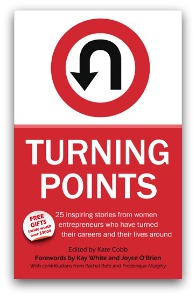
Turning Points: 25 inspiring stories from women entrepreneurs who have turned their careers and their lives around (Summertime Publishing, November 2011)
Editor: Kate Cobb
Synopsis: In this collection of stories from women all over the world, the focus is on the moments, or short passages of time, when a woman was facing something challenging and came out the other side smiling.
Expat credentials: Cobb is a British woman living in France, and about a third of the contributors — including Jo Parfitt and Linda Janssen — are expats who now run their own businesses.
How we heard about it: Linda Janssen promoted the book on her blog, Adventures in Expatland.

Indie Chicks: 25 Women 25 Personal Stories (Still Waters Publishing, October 2011)
Compiler: Cheryl Shireman
Synopsis: 25 indie novelists share personal stories in hopes of inspiring other women to live the life they were meant to live. (All proceeds go to the Susan G. Komen Foundation for breast cancer research.)
Expat credentials: Close to half of these indie authors are expats or have done significant overseas travel. To take a few examples: After living in Portland, Oregon, for most of her life, Shéa MacLeod now makes her home in an Edwardian town house in London just a stone’s throw from the local cemetery. Linda Welch was born in a country cottage in England, but then married a dashing young American airman, left her homeland, raised a family, and now lives in the mountains of Utah. Julia Crane is from the United States but recently moved to Dubai with her huband and family (her personal story concerns the adjustment process).
How we heard about it: Again, sometimes all it takes it a tweet (we picked up one of Linda Welch’s).

* * *

Questions: Have you read any of the above works and if so, what did you think of them? And can you suggest other works to add to the list? My colleagues and I look forward to reading your comments below!

STAY TUNED for tomorrow’s post, a review of The Globalisation of Love, by Wendy Williams, and for Wednesday’s post, a review of Perking the Pansies, by Jack Scott.

If you enjoyed this post, we invite you to subscribe to The Displaced Dispatch, a weekly round up of posts from The Displaced Nation, plus some extras such as seasonal recipes and occasional book giveaways. Sign up for The Displaced Dispatch by clicking here!

Related posts:

LIBBY’S LIFE #27.5 — A Halloween rehash

Greetings, Libby fans! If you’ve been following The Displaced Nation this week, you’ll know that we hashed our Halloween post because the writer — Libby’s creator, Kate Allison — went mysteriously missing. Thankfully, she hasn’t done an Agatha Christie, as Libby had feared, but is the victim of a freak snowstorm that left her without power. In a short communication of yesterday (from a McDonald’s near her house), Kate requested that we rehash Libby Life #9 because of the rather garish outfit sported by Libby’s mother-in-law. She thought it might compensate in some way for the post she was meant to do on “Halloween costumes for expats.” And perhaps it will also be a good chance for new Libby fans to catch up with what her life was like before she reached Woodhaven, and for her older fans, to indulge in some nostalgia?

The story so far: The Patrick family — Libby, Oliver, and their three-year-old, Jack — are in the process of moving from England to Massachusetts. Libby is now looking forward to the move but Oliver has developed cold feet, although he hasn’t been brave enough to tell his employer’s HR department — at least, not yet. Meanwhile, Libby has horrible suspicions that her nutty mother-in-law, Sandra, is about to move into their neighbour’s house. If Libby needs to pull out the stops to persuade Oliver that a transatlantic move is a good idea, now might be a good time.

To Sandra’s for tea.

We do this regularly. I don’t mean afternoon tea with fairy cakes, or mid-morning tea with a biscuit, but tea as in beans on toast, or egg and chips if she’s feeling ambitious. Oliver likes going to his mother’s for tea, even though I’m quite capable of rustling up beans on toast, but apparently there’s something about his mother’s cooking that I can’t compete with. I don’t know what it is. Maybe I don’t buy the same cheapo brand of baked beans, or maybe it’s because I’m left-handed and open the tin the wrong way. It’s a kitchen mystery that not even Miss Marple or Gordon Ramsay could solve.

Still haven’t voiced my suspicions to Oliver about his mother’s impending move to number sixteen. Although it’s my nightmare, I have a horrible feeling Oliver would like the idea and we’d be forced round there four times a week for school lunch.

The good thing is that he hasn’t said anything to his employer about his own doubts over our own move. I suppose if he comes out and says he doesn’t want to go, he will appear to lack company commitment, and look like a big wuss into the bargain, so for the moment, everything’s going ahead, even though Oliver is regretting his initial gung-ho spirit and fresh-lobster-worship .

So, off we went to Sandra’s. We took Boris The Spider with us, his little glass cage sealed in two black dustbin bags in case he escaped into the car boot. He’s been living behind the sofa where I can’t see him, and now I need to Hoover behind it because Jack’s been sprinkling squashed digestive biscuits all over the spider tank, so it’s time for Sandra to repossess him. Oliver started to object, saying it would hurt Sandra’s feelings, but stopped when I said that if the arachnid stayed, I’d see to it that he ended his days Cambodian-style, deep-fried, in the local Chinese takeaway that keeps getting prosecuted for dodgy hygiene standards. So Boris came along, without a murmur from Oliver.

It was all so easy that I’m considering making similar threats about Fergus.

When we arrived at Sandra’s house, the whole street was shaking. Not from an earthquake, but from Sandra’s hi-fi. She plays it loud. Sometimes it’s Mahler, sometimes it’s the Rolling Stones, sometimes it’s the Grateful Dead.

Today it was Lady Gaga, and Sandra was dressed to match.

If you’ve never seen your mother-in-law frying eggs while she’s dressed in hooker heels, Marks and Spencer’s bikini, and makeup that’s less Lady Gaga than Alice Cooper — think yourself very, very fortunate.

No wonder she’s moving house. Her present neighbours must have clubbed together for the deposit.

Oliver raised his eyebrows, but carefully avoided looking at me. Jack gawped at his granny, then buried his face in my neck and refused to let me put him down.

“Are you going to get dressed, Mum?” Oliver asked. “It’s probably not a good idea to fry eggs if you’re only wearing a swimming costume.” He gestured at his own midriff. “Hot oil splashes round there – it might sting a bit. The weather’s cooling off outside, too.”

Oliver’s a big noise in Customer Relations at his company, and I can see why. You don’t live thirty-four years with Sandra for a mother without learning something about tact.

Sandra beamed at him and pinched his cheek, then Jack’s, who had lifted his head to see if the apparition in streaky eyeliner was still there.

“I’ll just pop upstairs. Back in a minute.”

Oliver crossed the kitchen to the cooker and removed the frying pan from the heat.

“Do you think she’s…?” He jerked his head in the direction toward the stairs, where Sandra had gone. “You know. Going prematurely senile?”

I’m not in Customer Relations, and never could be. “She’s always been like that, Oliver. There’s no ‘going’ about it.”

He chewed the inside of his cheek. He does that when he’s worried. Bless him. I know I moan, but he only wants the best for everyone.

“I worry about what will happen to her when we go to America. I keep thinking I agreed to this move without thinking about it.”

Like mother, like son.

“You’re not your mother’s keeper, love,” I said, trying to find the right words. “She’s a grown woman, more capable than you think. And there are worse things than us moving to Boston for two years, you know.”

“Such as what?” Oliver asked, but was interrupted by Sandra coming back to the kitchen wearing a denim mini skirt and a T-shirt from French Connection that said FCUK on the front.

“What that say?” Jack demanded, pointing at Granny’s chest.

I’ve been teaching Jack his letters. He likes copying words around the house, like “Sony” from the TV, or “Dell” from the computer. Quite often he gets the letters mixed up, but he likes to treasure his masterpieces and show them to Carol Hunter at playgroup.

I rummaged in the drawer where Sandra keeps her tea towels and aprons, and handed her a PVC Union Jack apron. “You don’t want to get oil splashes on your nice T-shirt, either,” I said.

*

“We brought Boris The Spider back,” Oliver said over our egg and chips. “Jack’s allergic to him.”

Jack’s nothing of the sort, of course, but Sandra can’t dispute it one way or the other. All children have allergies now. It’s the law.

Sandra waved her hand dismissively. “I’ll give him back to Petra. Not to worry. I’ve got bigger things to think about.”

Oliver and I exchanged glances. Normally she’d have had a meltdown at this point and we’d have to reassure her that our rejection of her gift was not a rejection of herself.

“Is this the surprise you were talking about the other day?” he asked.

Sandra leaned toward us over the kitchen table.

“I’ve been trying to keep it a surprise until everything’s signed and sealed, but you know me. Can’t keep good news to myself.” She paused. “You know that house near you? Number sixteen? I’ve bought it.”

Silence from Oliver. Silence from me, as I wondered what Oliver would say. Squelchings from Jack as he picked up a cold chip and squashed it.

“Really?” said Oliver. “Wow. I mean, wow. That’s terrific news. Only…” He stared at the FCUK T-shirt, again on display, and at Sandra’s makeup. “Only I wish we’d known earlier. You see, we’ve got some news of our own. We’re moving too.”

*

Later, much later than we had planned, we left Sandra’s house to go home and put Jack to bed. We’d already put Sandra to bed, with some hot milk and Valium.

“We are doing the right thing, aren’t we?” Oliver asked for the fourth time.

“Oliver,” I said, barely holding on to my patience or elation. “I said there were worse things than moving to Boston. Your mother moving to Acacia Drive is one of them. Of course we’re doing the right thing. In fact, ” I said, turning around to adjust the blanket over a sleeping Jack, “I’ve never been so sure of anything in my life.”

If you enjoyed this post, we invite you to subscribe for email delivery of The Displaced Dispatch, a round up of the week’s posts from The Displaced Nation. Sign up for The Displaced Dispatch by clicking here!

Related posts:

Image: Travel – Map of the World by Salvatore Vuono / FreeDigitalPhotos.net