The Displaced Nation

A home for international creatives

Tag Archives: Fiction Writers

LIBBY’S LIFE #54 – Opening the cocoon

There’s probably a word for it in the Complete Oxford English Dictionary. An obscure word that only makes an appearance on Radio 4 intellectual game shows. Something like:

Tri-gami-matri-taci-filial (noun, Old English) — the silence of a son regarding his mother’s marriage to a serial bigamist after the father’s third marriage.

Then people like Stephen Fry and Paul Merton would make clever, rude jokes about this word, and you’d wonder why the English language possessed such an item, because such a situation was unlikely to exist.

Except the situation does exist, and consequently I’d like to know the word that has this definition:

“The pissed-off feeling after realising that your husband of nearly seven years has accidentally-on-purpose forgotten to tell you that his estranged father was a serial bigamist and didn’t run off with a local librarian like he and your mother-in-law had always led you to believe.”

I mean, it’s not as if it would have mattered, is it? If Oliver had told me on our second date, “Oh, by the way, Libs, I didn’t grow up with a father because my mum found out that he was married to a couple of other women at the same time” — I would hardly have stomped out of the restaurant before he could ask me out on a third date.

Did he really think I would have said, “God, Oliver, I’m glad you came clean with me now because obviously, there is no way I could marry the spawn of such pond slime”?

I know what you’re thinking. If it wouldn’t have been such a big deal on our second date, why am I making a fuss now?

Because it’s gone past the point of being an unfortunate fact about Oliver’s ancestry. Ten years ago, before our engagement, I could have processed the knowledge and said, “Poor Oliver. Your poor mum. What a terrible thing to happen.”

Now, although I still think that way, pity has been overtaken by hurt that Oliver couldn’t see fit to tell me.

I am being treated like the criminal, but why? The real criminal is Oliver. He has known about this all along, and in the ten years we have known each other, has never told me this story, although it’s obvious that he knew. Why did he not feel he could tell me, his girlfriend, his fiancé, his wife, his soulmate? Has he so little faith in me? I feel bereft, my faith in Oliver plundered.

But self-pity inevitably mutates into anger.

Today, I am angry, and everyone knows it.

Well, nearly everyone. Jack knows it, George knows it, and Beth knows it. The only person who is oblivious is Oliver himself, the object of my anger, and as usual he’s out, avoiding the issue. Avoiding me.

Meanwhile, rage swirls around my head and seeps out through my ears, filling the house with noxious atmosphere.

I’ve been passive too long.

I gather up the twins and strap them into the double stroller. Jack peeps cautiously at me from behind the sofa where he is quietly playing with Lego bricks.

“Put your sneakers on,” I say. “We’re going out.”

*  *  *

It’s a long time since we’ve been out.  Nursery school has finished for the summer. After the first couple of weeks when the Coffee Morning Posse delivered freezer casserole after freezer casserole, no one has been to visit — not even Maggie. I suppose they think I’ve got enough to do without catering to visitors. Even my mother has been quiet, phoning only once since she got back home. For the last few weeks, I’ve holed myself up in the house, seeing no one, ordering groceries online, too depressed and timid to put a foot outside.

But today is a beautiful, sunny day, my anger is invigorating, and I’m tired of being a hermit. I make Jack hold the handle of the stroller, loop Fergus’s leash round my wrist, and off we set, along Juniper Close.  We are walking to Main Street, to a place of busy-ness, to be with other people who will only coo at my babies and won’t see the rage and hurt in the back story.

Fergus, however, has other ideas. He crosses the street docilely enough, but as we turn right towards the road that leads to Main Street, however, he lags behind and his leash pulls on my wrist. He wants to go the other way.

I tug on the leash. He sits. I tug again. He lies down.

It’s an impasse. Fergus and I stare at each other. He usually wins these stare-down contests, but I’m in no mood for defeat. Today, I’m determined to win, so I don’t break my gaze, not even when I hear footsteps on the sidewalk behind me. Whoever it is can step onto the road and walk around us.

The footsteps slow, then stop.

“We first met,” I hear Maggie say, “when there was another drama going on between you and this dog. I haven’t seen you out with these children for weeks. Were you coming to see me?”

I continue to stare at Fergus so I don’t have to meet Maggie’s eyes. She’s right. I haven’t seen her since the twins were a couple of weeks old. How time flies when you’re having fun.

“If I hadn’t seen you today,” she goes on, “I’d have come to visit. I don’t like to intrude, but…”

“It’s been difficult,” I mutter. “The twins — they’re a lot of work.”

“I’m sure they are,” she says. “And from what I hear, so is your husband.”

She has my attention now.

“How do you know?” I demand. “What do you know?”

Maggie places a hand on my forearm and takes Fergus’s leash from my wrist. She gives the leash a gentle shake, and he gets up to stand by her, as docile as you please.

“Your mother and I became pretty good friends while she was here, you know. We made an agreement. I would be there for her daughter in America, and if the need ever arises, she will be there for mine in England.”

Mums’ Army. The Maternal Foreign Legion.

“Come on, Jack,” Maggie says, taking his hand. “Back to Granny Maggie’s house.”

With difficulty, I turn the wide stroller around to face the other direction.

“‘Granny Maggie’?” I ask. “Does that make you my mother, then?”

Maggie smiles, just a little.

“The next best thing on this side of the ocean,” she says.

.

Next post: LIBBY’S LIFE # 55 – Dark secrets

Previous post: LIBBY’S LIFE #53 – Preserved on tape 

Need the 411 on characters in Libby’s Life? Click here for  Kate’s page  of Who’s Who in Woodhaven.

Click here to read Libby’s Life from the first episode.


STAY TUNED for Monday’s post — a Dolce Vita Slideshow!

If you enjoyed this post, we invite you to subscribe for email delivery of The Displaced Dispatch, a round up of the week’s posts from The Displaced Nation. Sign up for The Displaced Dispatch by clicking here!

Image: Travel – Map of the World by Salvatore Vuono / FreeDigit

LIBBY’S LIFE #53 – Preserved on tape

I stare at the dark computer screen, wondering if my overactive imagination is misleading me.

Only one way to find out. An imagination doesn’t mislead twice. Not in the face of hard facts from a digital camera.

I hit “Play” on the screen again, and scroll through our unedited wedding footage until the time elapsed says 1 hour, 25 minutes.

Act 1:

The evening party at our wedding. To the left of the stage where the band is playing a particularly sickly version of  Stevie Wonder’s “I just called to say I love you” (look, my dad booked the band, OK?) a large clock on the wall shows the time to be 9:40.

At 9:40pm on our wedding day, Oliver and I were on the other side of London, in the bar at the Heathrow Hilton, ready for our flight to Ibiza the next morning.

This is all the stuff that happened after we left our party. It’s fascinating and morbid at the same time. Like watching your own funeral.

No one appreciates the band’s rendition of Stevie Wonder, and the only person on the dance floor is a little girl in a pink frothy frock — the daughter of Mum’s cousin. Yasmin, her name is. She  twirls around in circles, round and round and round again, until she is dizzy and falls down, laughing up at the camera. The camera zooms out, and to the right of the dance floor reveals a cluster of small, circular tables, covered with empty glasses and plates of half-eaten vol-au-vents. We were supposed to have had wait staff all night at the reception, but apparently they disappeared as soon as the Adorable Couple had left the bash.

At one of the small tables, on her own and nursing a glass of what looks like water but is most likely vodka, sits Sandra. She hunches to one side, leaning against the wall, a morose expression on her face as she swigs from the glass. She’s not happy that her little boy has another woman in his life.

The camera swings down in a jerky movement and drops its gaze to the floor. A man’s foot in a  scuffed black shoe — the videographer’s. (I’m guessing he’s had quite a bit of party bubbly and is merely filming for his own amusement, since the day’s main attractions are now propping up a different bar in a Hilton forty miles away.) Then up again, focusing on the little girl in the pink dress, who is dancing a ballet routine to the band playing a different song — a slow one by Journey, I think. A few feet behind the little girl, my mother comes into view. The mother of the bride is resplendent in a fuchsia pink wedding suit that would have been more at home at a wedding in 1987. She’s heading towards Sandra.

At the little table, Mum sits down and pushes some vol-au-vents aside. She smiles brightly at Sandra; they are related now, bonded by marriage and the mutual loss of their only offspring. Mum, though, is not as heartbroken as her counterpart, because she has not really lost a daughter. Daughters are never lost; they are merely loaned to their husbands.

Sandra, however is inconsolable. Her loss is total, and she is utterly bereft. Emotion runs deep in her veins. So does the vodka.

She says something to Mum which is inaudible above the strains of the Steve Perry wannabe. She waves her glass around, and speaks some more. I know that if I could hear her, the words would be slurred.

A look of concern crosses my mother’s face.

I recognise this look. It’s the look I used to see when I came home from school, slamming my book bag on the kitchen table and muttering dire, cryptic threats against whoever had happened to piss me off that day. A quick, sideways glance, sizing up the gravity of the situation: “Is Libby really going to slash that teacher’s tyres? Do I intervene or keep saying ‘Yes, dear’?”

Mum starts to speak, and Sandra’s face crumples. Mum takes her hand and squeezes it.

I want to know more about this little scene, but the videographer is intent upon capturing Second Cousin Yasmin  and her ballet routine whose tempo is too fast for this last-smooch-at-the-disco song.

The camera zooms in on the little dancing feet in their pink sparkly Mary Jane shoes, and the unfolding drama between my mother and Sandra is lost.

Act 2

I nearly missed this part, so intent was I upon the visual aspect of the film. My mother and Sandra do not appear on the whole of the DVD again, even though there is still another forty minutes of footage to go. My goodness, but we got our money’s worth from that videographer.

A tantrum on the dance floor.

Second Cousin Yasmin has exhausted her repertoire of dance routines but, undeterred, has dragged a chair to the middle of the floor so she can show off her barre exercises.

Battements tendus — un, deux, trois. To the side — un, deux, trois.

Pleasing, perhaps, to the eyes of fond mothers at ballet school, when set to the strains of Saint-Saens and Faure, but not so pleasing to the occupants of the dance floor who are trying to boogie to the band’s version of “Love Shack.” They keep tripping over the chair and Yasmin’s outstretched limbs.

Yasmin’s father, my mother’s cousin Ted, strides onto the wooden floor. He picks up the chair in one hand, and grabs onto TwinkleToes herself with his other.

“Bang bang, on the door baby,” sings the female vocalist in little more than a whisper.

The lull in the song is Yasmin’s cue to yell, very loudly. She calls her father a name that six-year-olds are not supposed to know, let alone use in the formal setting of a wedding reception. Uncle Ted is not impressed, and tries to haul her away. It’s well past her bedtime, anyway.

Yasmin, though, doesn’t agree with this sentiment, and sits down on the floor very suddenly, knocking her father off balance. He drops the chair, trips over his daughter’s leg, and sprawls in a most ungainly manner on the floor.

The videographer, who has been professionally quiet behind the camera until this point, lets out a huge snort of amusement and backs away, towards the cluster of tables, get a better view. The band has stopped playing; I can see them conferring on stage, wondering whether to ignore the little scene, or to play a noisy song to drown it out.

In the hush, close behind the camera, a voice.

Sandra’s voice, perfectly recorded for posterity.

“I was his third. If it hadn’t been for that car accident, when Oliver and I met his other wives in the hospital, we might still all be one big happy family.”

.

Next post: LIBBY’S LIFE #54 – Opening the cocoon

Previous post: LIBBY’S LIFE #52 – Life: A series of hellos and goodbyes

Click here to read Libby’s Life from the first episode

STAY TUNED for Friday’s post — another Displaced Q from Tony James Slater.

If you enjoyed this post, we invite you to subscribe for email delivery of The Displaced Dispatch, a round up of the week’s posts from The Displaced Nation. Sign up for The Displaced Dispatch by clicking here!

Image: Travel – Map of the World by Salvatore Vuono / FreeDigit

For expat novelist Laura Graham, even a dark Tuscan alley has La Dolce Vita to spare

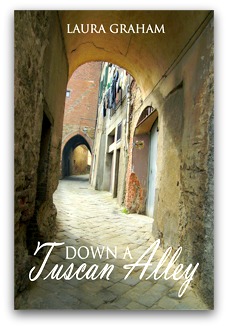
“Down a Tuscan Alley” — when I first heard the title of Laura Graham’s debut novel about an Englishwoman in Tuscany, I assumed it would be a thriller or mystery. Something nefarious would happen down a Tuscan alley, and the protagonist, whose name is Lorri, would find herself enmeshed in events beyond her comprehension, fearful of getting caught in the crossfire between rival Mafia gangs…

The book is no such thing, I’m happy to report (I’m not a fan of Mafia thrillers). Strange things do happen in the dark alley outside of the tiny flat where Lorri lives in the Centro Storico (village on a hill) of the Tuscan town of Sinalunga — but nothing worse than a peeping Tom. And at one point there’s a shady-looking man following Lorri — but he turns out to be (relatively speaking) harmless.

No, the book’s real mystery has to do with why Lorri is living in a tiny Tuscan village on her own. Well, she’s not on her own but has two cats. The last time she was in Sinalunga, it was with her husband, Richard. They had bought the flat together and Richard fixed it up. But now their marriage is over because of Richard’s infidelity. Or Lorri thinks it is over — Richard is having second thoughts.

Lorri, however, is determined. She has come to Italy to get lost in the culture and start her life again. But is she doing the right thing? Her Italian neighbors treat her with some suspicion: what’s a woman doing living on her own, with no visible means of support? (She has decided to do B&B in her little flat, but since it has only one bedroom, when the guests come, she has to sleep on the sitting room floor.)

And she also has to persuade herself to trust her gut instincts. As she says toward the start of the novel:

Am I crazy to come here? Hardly any grasp of the language, forty-seven, alone and with virtually no money? Many would think so…

Lest you think we’re venturing into Under the Tuscan Sun territory, rest assured, we’re not. Lorri does not take life, let alone her midlife predicament, too seriously. This is a flat overlooking an alley we’re talking about, not a 250-year-old villa. And so what if she ends up seizing an opportunity to get involved with the handsome young builder Ronaldo? Isn’t La Dolce Amore the quickest way to obtain La Dolce Vita?

But before I get too carried away with the story, let me turn the conversation over to Laura Graham, who has graciously agreed to answer a few questions about both her book and her life story — which, as she freely admits, the novel is based on.

The decision to write an autobiographical novel

Thank you so much, Laura, for agreeing to this chat. Your story — both in the book and in real life — neatly combines the two themes we’ve been talking about on The Displaced Nation this month: the quest for La Dolce Vita and the need for taking a “midlife gap year,” which sometimes heralds an even bigger life change. But let’s start by having you talk a little about your background — where you were born, what you studied and why you went to live in Italy.
I was born and brought up on the Isle of Tiree on the West Coast of Scotland for the first six years of my life. I then came to London and entered a convent school.

Later, as an adult, I won a scholarship to study drama at the London Academy of Music and Dramatic Art for two years. I received the prize for being the most promising student and immediately got a job understudying Helen Mirren in The Balcony at the Aldwych Theatre in London. I had a long and successful acting career at the Royal Shakespeare Company and the Young Vic, also on television.

When my long relationship ended with my former partner, I felt the need to turn my life around and decided to begin again in Italy. About ten years before, I’d invested £6,000 in a tiny hilltop village apartment in Tuscany, never thinking that one day it would become my permanent home. I still live in the village, but in a house, with my partner Rosalbo, a property restorer and an artist (he paints cats!). Besides writing, I run my own holiday agency, called “Laura’s Houses.”

Down the Tuscan Alley is your first novel. Have you written anything else?
I have also written a book for children called A Tale of Two Tuscan Cats, which was published last October. It has recently come out in Italian. Rosalbo did the illustrations.

What made you decide to write a novel about a middle-aged woman who is determined to change her life by moving abroad?
Because I’ve experienced it and thought it would make a good story — and might help others so inclined.

Why a novel and not a memoir?
I wrote my story in a novel form to protect the people I wrote about — I’ve changed their names, although some of them are now dead.

What audience did you have in mind when writing the book?
Women like myself, who want more from life than just settling into middle age with nothing but memories. Life is to be lived!

One of your Amazon reviewers wrote: “Brava! Brava! Brava! I loved reading Down a Tuscan Alley. The comic cast of characters brought me to the heart of bellisima Italia.” Other readers, however, said they were grateful that the book isn’t just about how beautiful Italy is. To which parts of the story have most readers responded?
The parts that are thought-provoking — about losing oneself in another culture in order to find oneself — and the humor are what people seem to enjoy.

Getting to the heart of La Dolce Vita…

From the time she arrives Italy, Lorri seems to be in touch with the little things that make her Tuscan alley so different from the Devonshire alley where she was living with friends, just before she left: the old stone steps, the steeple of the magnificent ochre-colored church she can see from her window, the birdsong… Is there something special about Italy that awakens the five senses?
In my opinion it is the light that awakens the senses. The light in Tuscany touches something in you, brings you to life — it’s like a medicine, a tonic.

Since you’re a former actress, would you say that daily life in Italy is more theatrical?
Living in Italy is certainly more theatrical than living in the UK. The people here are open and spontaneous.

And Lorri immediately becomes part of that drama. As her elderly English-speaking neighbor in Sinalunga, Lionello Torossi, says: “The people are delighted to see you…You are their portable theater.” But doesn’t some of the charm of a place have to do with its novelty value? Wouldn’t an Italian feel charmed by a Devonshire alley?
I think the Italians would be fascinated by a Devonshire back alley, if only to think — how is it possible to live there?

…and La Dolce Amore

At one point, Lorri is contemplating her affair with Ronaldo and says to herself: “How can you speak with your heart when you don’t know the words?” Call me a skeptic, but couldn’t their relationship change for the worse once their verbal communications improve?
No, I think Lorri would still find Ronaldo enchanting once she’s able to understand more of the language. But perhaps also more infuriating at times!

Lorri also says, with reference to Ronaldo: “These torrid passions are what happens to English women in hot countries.” Is romance so very different in Italy as compared to the UK?
Torrid passions indeed! The Italian art of seduction is very different from the UK. An Italian makes a woman feel every inch a woman and delights in her beauty and femininity no matter what her age.

Many of The Displaced Nation’s readers are in cross-cultural relationships. What do you find to be the biggest challenge about getting together with someone of another culture?
I cannot pretend it’s easy getting together for a long time with someone of a different culture — although it’s not the culture so much as the mentality. There are many things to learn, mainly about one’s self — and that’s always a challenge. Here in Italy, it’s the language I find most difficult and the humor, which is somewhat different from ours. Of the two, language is the bigger difficulty. Communicating is the key to success when living in another country. Otherwise, you can’t offer as much as yourself as you would like to.

The challenge of exporting La Dolce Vita

After living in a small Italian community for so long, do you think you could ever fit back into living in Britain?
No, I can’t imagine myself living again in the UK even though I go back twice a year and enjoy it. But if I had to I would adjust simply because I’m English. But the biggest culture shock — apart from the food — would be the people. I’ve grown so used to the warmth of the Italians.

Could you bottle the formula you’ve developed for La Dolce Vita in Tuscany and bring it back with you?
The only way to bottle the formula of the Tuscan Dolce Vita is to carry it inside my heart — and take it with me wherever I go.

Coming soon!

Please tell me that you’re working on another book. By the time I finished Down a Tuscan Alley, I’d grown fond of Lorri, Ronaldo and the various neighbors — and felt bereft!
I am on the last chapter of my next book: The Story of Kelly McCloud. This is also set in Italy and is about a young woman who takes a job as a housesitter in an Italian villa. Amongst an eccentric English family, a fallen angel and a dragon, she discovers how to use the whole of her brain and realizes the potentiality of the human race.

Assolutamente favoloso! Thanks so much, Laura!

Readers, you can purchase Down a Tuscan Alley on Amazon. You can also read more about Laura Graham at her author site. And, should you now feel tempted into trying out La Dolce Vita for yourself, then consider renting one of her two houses in the Centro Storico of Sinalunga. What are you waiting for?!

STAY TUNED for tomorrow’s episode in the life of our fictional expat heroine, Libby, who has traded her Boston Red Sox cap for a Sherlock Holmes deerstalker in her quest to uncover her husband’s roots. (What, not keeping up with Libby? Read the first three episodes of her expat adventures.)

If you enjoyed this post, we invite you to register for The Displaced Dispatch, a round up of weekly posts from The Displaced Nation, with seasonal recipes, book giveaways and other extras. Register for The Displaced Dispatch by clicking here!

Related posts:

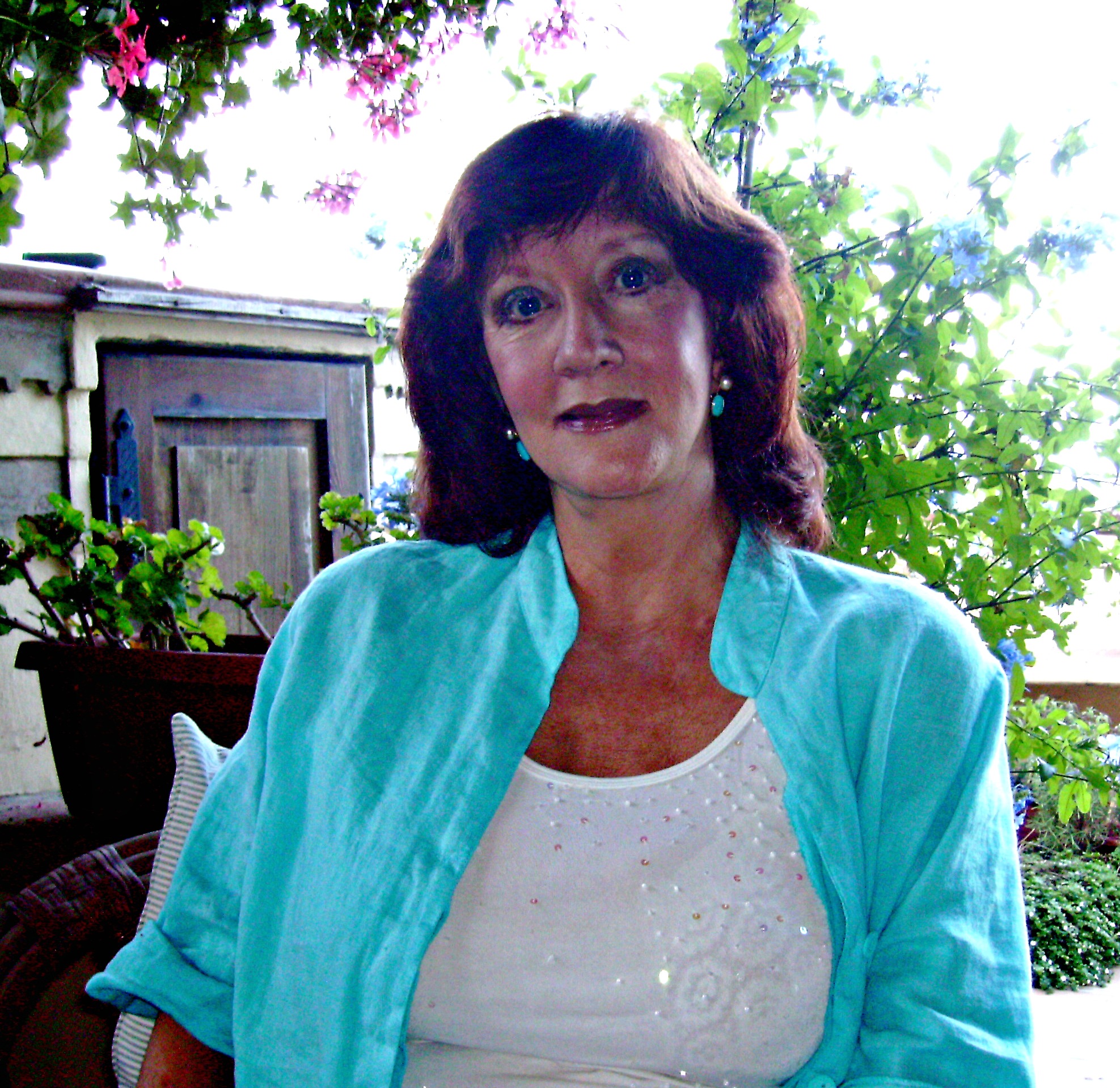
img: Laura Graham, on the terrace outside her house in Tuscany.

LIBBY’S LIFE #52 – Life: A series of hellos and goodbyes

Mum kisses me. “I love you,” she says.

She’s done that quite a few times in the last couple of weeks, which is funny because she’s not really a kissy or “I love you” kind of person. When I was growing up, she displayed her affection via a surprise addition of homemade cake in my school lunch box, a Ladybird book from a trip to WH Smith, or a poster of Take That sneaked into the weekly shopping trolley.

But kisses and “I love you”s?

Never. “Show, don’t tell” was Mum’s philosophy. Walk the walk, don’t talk the talk.

So either her six weeks in America has rubbed off more vigorously than anyone could have anticipated — they’re very big on saying “I love you” at every opportunity here — or she’s unbearably worried.

When I was fourteen, I fell off my bike and hit my head on the tarmac. I was out cold, in hospital — for twenty-four hours, I’m told, although from my point of view it could have been anywhere between five seconds and an eternity. In the moments or hours before my eyelids fluttered open and Mum’s voice proclaimed “She’s awake!” I heard her saying the same thing, over and again. “Don’t go, Libby. Please don’t go. I love you. Please stay here, Libs. I love you.”

It had puzzled me at the time. I was in bed; of that much I was aware in my semi-conscious fog, so where could I go? Later, of course, I realised that Mum was speaking of a more permanent one-way trip, so I didn’t mention I’d overheard her bedside soliloquy. Saying “I love you” out loud like that was slightly embarrassing; like not being able to reach the bathroom on time, or having other bodily emissions erupt against our will.

It must be a British thing. We acquired our reputation of stiff upper lip and British reserve for a reason, I guess. The preschoolers’ moms here drop their children off at nursery with a chorus of “Mommy loves you, honey!”, while the kids run into school without a backward glance. I wonder how many of them grow up thinking that “Mommy loves you” is just another form of “Goodbye”, rendered less valuable by its daily usage.

You see, when my mum says it, I know it’s from the heart and not merely a salutation.

“I love you too,” I say, and kiss her cheek.

She could be saying it because she’s about to get in the Lincoln Town Car that takes her to Logan Airport for her flight back to Heathrow, but even lovey-dovey goodbyes aren’t Mum’s scene. A laconic “Well, I suppose I won’t be seeing you for a long time” would have been more her style.

No. She’s worried. I’m sure of it.

She’s worried that I’m descending into a pit of depression, which because of its timing could conveniently be classified as “post-natal” but in reality has been brought on by my husband’s ever-increasing distance from me, and his preoccupation with…what? I don’t know what. He’s got something on his mind, something to do with his father, but apparently his own wife is not allowed to be privy to those inner thoughts.

She never has been, I know now.

“All set?” the driver asks her.

Mum nods. She gets into the back seat of the long, black car, shuts the door, and winds down the window.

“Sandra,” she mouths. “Don’t forget.”

The car backs down our driveway, reverses onto Juniper Drive.

Mum waves. I wave back. So does Jack.

Oliver, naturally, is absent from the family scene.

I go inside, and for once, Oliver’s absence is a blessing. What I’m about to do wouldn’t be a good idea while he’s around.

This week I have learned from Mum that, at our wedding, after Oliver and I had left for our first night in a hotel as a married couple, my mother-in-law got falling-down drunk but unfortunately not speechlessly so, and started telling my own mother a few family secrets. Mum tried to shut her up but not before Sandra had released a collection of dead ancestors’ remains from a large cupboard — information which, I inferred, was relevant to the present situation. My mother had kept this information to herself for six years, but even now, she delicately skirted round the details of what Sandra had told her.

“It’s not my information to give,” she insisted. “You’ll have to get it from the horse’s mouth.”

Tantalising and unhelpful, albeit highly satisfying to hear my mother-in-law referred to as a horse.

And then, just this morning while I was helping Mum finish her packing, I remembered. Tucked away in a box in the basement is a box of our English DVDs. We don’t get them out because they’re in the wrong format for the DVD player here, but they will play on my laptop. The particular one I want, though, I’ve never actually played before.

With a flashlight in my hand, I descend the wooden stairs into the basement. It’s dark down here, and with the humidity rising as summer approaches, there’s a smell of musty damp in the air. A rustling noise, a scurry of rodent feet makes me jump — I’ve disturbed something the pest control people missed on their last visit — but even the threat of mouse attack doesn’t deter me.

I find the box of DVDs and, shining the flashlight on them, flick through until I see the one I’m looking for.

I double-check the label.

Yes. This is it.

“Libby and Oliver. Wedding footage (not in official video).”

.

Next post: LIBBY’S LIFE #53 – Preserved on tape

Previous post: LIBBY’S LIFE #51-On a cliff edge

Click here to read Libby’s Life from the first episode

STAY TUNED for Friday’s post — another Displaced Q from Tony James Slater.

If you enjoyed this post, we invite you to subscribe for email delivery of The Displaced Dispatch, a round up of the week’s posts from The Displaced Nation. Sign up for The Displaced Dispatch by clicking here!

Image: Travel – Map of the World by Salvatore Vuono / FreeDigit

Me and my shadow: LIBBY’S LIFE #50 – Home again

Oh, thank the lord and all his angels. I am on my way back to England, after an extended stay with the Patricks.

How extended, exactly? Two weeks, two months, two years? Who knows?

Time expands to encompass the drama available.

~

Never have I wanted to be somewhere else so badly as on the evening that Tania Patrick appeared on Libby’s doorstep and refused to leave. She wanted to meet her big brother, come what may — and never mind the collateral damage to his family.

The awkwardness, the embarrassment, the toe-curling please-God-get-me-out-of-here-ness of that meeting. The sister seemed oblivious to our shuffling feet, the nervous coughs, and our collective intake of breath as we heard Oliver’s car pull onto the driveway.

“Oliver!” Tania Patrick cooed, as she elbowed Libby out of the way, opened the front door, and and leaned in to kiss him on the cheek.

While she’s not unattractive, she’s never going to feature in a Pirelli calendar either, and Oliver’s not the touchy-feely type without a good reason for being so.

“Do I know you?” he asked, leaning back to avoid her embrace.

Libby, meanwhile, watching the scene as intently as her husband would watch a penalty shootout between Arsenal and Spurs, couldn’t bear the suspense. It occurred to me afterwards that she could have exonerated herself by blaming the sister for tracking Oliver down, but, guileless as she is, she blurted out her version of the truth.

“Oliver, this is Tania. She’s your sister. We met online after I emailed her.”

I couldn’t help but cover my face with my hands, shaking my head. Libby would not only have shaken hands with her executioner but apologised for treading on his foot on the way across the scaffold.

Oliver sidled through the front door into the house, pressing himself against the walls so he didn’t have to touch the visitor.

“And you didn’t think to tell me at the time?” he asked Libby.

“Well…” She floundered. “I mean, I didn’t tell her where we lived or anything, so I didn’t think she’d come here.”

“Took a bit of detective work to find you!” Tania’s voice was raspy. A recently ex-smoker’s cough. “Dad never talks about you, but my grandma told me once I had a brother somewhere.”

“Did she.” Oliver’s question dropped at the end to become a statement. “I bet he doesn’t know you’re here now.”

For the first time, Tania seemed unsure of herself.

“He doesn’t, no.”

Oliver nodded.

“Keep it that way,” he said, opening the front door wide, and indicating to his newly-discovered and quickly-abandoned sister that this particular game of Happy Families was over.

~

I wasn’t sure what happened between Libby and Oliver after that. They disappeared into their room with the twins, and every now and then I heard the sound of raised voices, followed by one of the twins’ wailing.

Jane and I put Jack to bed, and had a whispered conversation while his bath was running.

“It will blow over,” Jane said, sounding more certain than she looked. “It has to. She meant no harm.”

“Things will look better in the morning,” I said.

~

They didn’t, of course.

They looked worse.

And the morning after that, too. Every day was worse than the last.

Libby put on a brave face and bright smiles during the day — while Oliver was out — and for minutes at a time we would forget anything was wrong. The babies always knew something was wrong, though, and cried alternately with hunger and colic. On Day Three, Libby abandoned her principles and gave them formula milk.

When Oliver came home in the evenings, the atmosphere changed in the house. Jane and I would scurry for cover in the basement, pretending that we were keeping Jack entertained and out of the way.

Bad enough to bear were the frozen silences whenever Libby and Oliver were in the same room together. When Jane and I prepared dinner in the kitchen, we whispered, as if by whispering we could dissipate the cloud of anger and resentment that billowed forth from Oliver.

Worst of all, though were the nights. When everyone was in bed, we could hear — although we pretended not to — the increasing volume of Oliver’s voice, as the same argument was rehashed again and again.

“You had no right! None of your business!”

An inaudible murmur from Libby. More raging from Oliver.

“How would you like it if I invited a whole bunch of your long lost, naff relatives to barge into our life and turn it upside down? You wouldn’t, would you?”

Another murmur from Libby, this time louder so the quaver in her voice is detectable.

“I don’t care how good your intentions were. I’ve spent my entire life trying to forget that bastard ever existed, and now I have to deal with him and a TOWIE half-sister, thanks to your good intentions. If those are your good intentions, God help us all when you have bad ones.”

And so on. Every night. Libby looked shattered — a normal look for a mother with new twins, but this was exhaustion on a different plane.

~

Sunday arrived, and I had to leave. I wished I could take Libby as well.

She had refused to talk about what had happened. Perhaps she felt that ignoring the problem would make it go away.

“I’ll be all right,” she said, as she said goodbye to me. “Mum’s still here, at least.”

Jane had stepped up her game in the last few days. If she previously thought Libby was confident, and felt inadequate around her, this was no longer the case. A mother is always a mother, no matter how old her children are.

“You’ve got to talk to someone, Libs,” I said. “You can’t bottle it up like this.”

She shook her head. “Can’t,” she said, pressing her lips together in a thin line. “You have no idea what a Pandora’s Box I’ve opened.”

I had an idea. “Then write. Get it out of your system that way.”

She nodded slightly. “I’ll think about it.”

“I can’t do your blog next week,” I said. Actually, I could, but this would be good therapy for Libs.

“I’ll think about it,” she repeated. She sniffed, straightened up, and put her shoulders back. “You’d better go. The traffic will be awful if you leave it any later. The Red Sox are playing at home today.”

I sat in the car, put it in reverse, and backed out of the driveway. As I stopped at the end of Juniper Drive, I looked in the rearview mirror. Libby was standing by her mailbox, still waving.

Even from this distance, I could see she was crying.

.

Next: LIBBY’S LIFE #51 – On a cliff edge

Previous: LIBBY’S LIFE #49- An unwelcome blast from the past

Stay tuned for Friday’s Displaced Q testing your ability in another aspect of La Dolce Vita!

If you enjoyed this post, we invite you to subscribe for email delivery of The Displaced Dispatch, a round up of the week’s posts from The Displaced Nation. Sign up for The Displaced Dispatch by clicking here!

Img: Map of the World – Salvatore Vuono

Me and my shadow: LIBBY’S LIFE #49 – An unwelcome blast from the past

Well, here I am again. Kate, that is, not Libby.

Not sure when Libby will have enough free time to write her journal herself, so you’ll have to put up with me this week, and possibly next week as well. After that, who knows? Maybe Libs can persuade Maggie to fire off a bulletin for you. Or perhaps her mother could do it…now that would be interesting.

~ ~ ~

Having changed my flight,  I’m going home rather later than I intended, so am now snugly ensconced Chez Patrick where I have agreed to stay for the next two weeks.

A somewhat rash decision, in retrospect. Might have been wiser to stay in the local Motel 6 and commute to my temporary job as Mother’s Help.

It’s not that Libby’s accommodation isn’t wonderful. I’m sleeping on a big sofa-bed in Oliver’s home office. It’s warm, cosy, and has free wifi with a strong signal. Being here means that Oliver can’t use his office much, because the contents of my suitcase are draped all over his swivel chair, but that doesn’t matter. He spends most of his time ten miles away at his workplace.

Yes, Oliver is back at work already. No paid paternity leave for him, but I suspect that is merely an excuse for his absence.

The real problem, for both Oliver and me, is his mother-in-law.

Oliver and Jane aren’t a good mix. We’re not talking chalk and cheese or even oil and water here. Think chemistry class, think sodium and water, think fiery explosions on calm water, and you’re on the right track.

“I thought you said they used to get on well together?” I said to Libby on Oliver’s first day back at work, when the twins were barely a week old. He had stomped out of the house before seven a.m. while Jane tagged after him, swiping ineffectually at his back with a clothes brush. This morning, just before he slammed the door on his way out to the garage, Jane asked him if he’d got a clean hankie in his pocket.

“They did,” she replied, wriggling around on the couch, a baby in each arm. “When I first started going out with Oliver, she pandered to him the way she panders to my father, and he lapped it up. Every argument we ever had, his trump card was ‘Your mother would never say that to your dad.'”

“So what’s his problem now?”

“Ah, well, everything’s got a flip side, hasn’t it? The reason she panders is because she thinks men are useless in the home. According to her, Oliver’s totally incompetent and shouldn’t be allowed near one newborn, let alone two.”

“Ah.”

“I don’t blame her in the case of my Dad. I mean — he is useless, although I sometimes wonder if she makes him that way. Self-fulfilling prophecy and all that. But Oliver’s quite capable of rustling up some bottles of formula and cooking dinner.”

“Not that you need to do any cooking for weeks.” The freezer was chock full of homemade, ready-to-reheat meals, courtesy of the Coffee Morning Posse. Every day, Charlie, Anita or Julia would turn up with more Tupperware boxes, labelled “Chicken a la King” or “Chilli Con Carne” or “Swedish Meatballs”. I’d got to the point where I was considering another pregnancy myself, just for the Meals-On-Wheels benefits.

“Just as well, isn’t it, if I had to rely on my Mum to feed me? She claims Oliver’s incompetent, but then she can’t get past the American-English differences. The other week she decided to make some scones, but couldn’t find the plain flour. It’s called all-purpose flour over here, right, but the leap of imagination to translate was beyond her. All I heard was, Ooh, it’s not the same as what I get in Sainsbury’s.”

“Did you get your scones?”

“Are you kidding? She walked to the gas station up the road and bought some Twinkies. Jack ate four, and he was awake until midnight. I used to take the mick out of Sandra because she once gave Jack some Red Bull, but this was actually worse.”

One of the twins started to cry, so I took the non-crying one from Libby. I think it was Beth. Or maybe it was George. Both twins wore green footie pyjamas, so I couldn’t tell which was which from the outside.

I rested Tweedledum over my left shoulder, absent-mindedly patting its back. Libby handed me an old towel, and I tucked it underneath the baby’s chin.

“I didn’t bring any babyproof clothes with me,” I said. “Mostly business work clothes, and I’m running out of things to wear.”

I’d forgotten the trick of keeping an old cloth on your shoulder when burping babies, and all day yesterday I had the sensation that a piece of ripe Camembert was following me everywhere, until Jane pointed out the trail of curdled milk on the back of my favourite white shirt. The local dry cleaners’ profits would skyrocket when I got home.

“Raid my closet,” Libby suggested. “Take some home with you. I’ll never fit into half of my clothes ever again.”

She’s sweet, but — no. Even at ten days postpartum, she’s thinner than I am now.

If I didn’t like her so much, I’d hate her.

“Or you could go to the mall for some more things,” Libby went on. “Take Jack and Mum with you, and I’ll have some quiet time with the twins.”

That didn’t seem like a bad idea. I’d take Jane, tire Jack out on the little indoor playground there, and when they got home they’d both be ready for bed.

“It’s got possibilities,” I said, and went in search of Libby’s mother and first-born.

*  *  *

Once you get Jane out of the house, she’s different. She even opened up a little to me.

“It’s not that I don’t want to help,” she confessed. “It’s just that I feel very inadequate around Libby, as if I’m going to get everything wrong no matter how hard I try. She’s not the same person who went away a year ago. She’s so much more…confident.”

“She’s not expecting you to be Superwoman,” I said. “Just her mum. And by that I don’t mean Oliver’s mum as well. He can work out himself if he needs a clean hankie or not.”

She had the grace to look a bit ashamed.

As well as going clothes shopping for me, I dragged her and Jack into a supermarket and a craft store. It’s Jack’s fourth birthday in just over a week, and I’m pretty sure Libby won’t have got her act together enough to do anything really special. Between the three of us, we picked out birthday napkins, party favours, and all the stuff Jane needed to make a 3D Lightning McQueen cake.

“I do hope Libby won’t mind me doing this,” she kept saying. “I don’t want to end up being more of a hindrance than a help.”

I told her that she had a long way to go before she attained Oliver’s mum’s standards  of “helping” and that her birthday cake was unlikely to put Libby and Jack into hospital.

She seemed mull this over, and by the time we got in the car to drive home, was the perkiest I’d seen her all week.

When we arrived at the house, a strange car was parked in the driveway.

“Another food delivery from Libby’s friends, I expect,” I said to Jane as we hauled the shopping bags into the hallway.

“Libs?” I called. “We’re home. We’ve got everything sorted out for Jack’s bir–Libs? Are you OK?”

Libby walked unsteadily towards us from the living room. Her face was pale. Following behind her was a woman: tall, fair-skinned, with sparse, sandy-coloured hair. Another of the Coffee Morning Posse, I presumed.

“I’m fine,” Libby said, giving me a too-bright smile that pronounced her a fibber. “Did you get what you need?”

“Yes,” I said, holding up a Macy’s bag in one hand and a Stop and Shop carrier in the other. “Your mum’s going to make Jack’s birthday cake.”

The woman behind Libby spoke to Jack who, at the sight of the stranger, had hidden himself behind his Granny Jane.

“It’s your birthday soon? When’s your birthday, darlin’?”

An English accent. Definitely one of the Coffee Morning Posse.

“Thirteenth of May.”  Libby replied for him after a pause.

“Aww. He’s shy.” The woman put her head on one side. “Just like our Damian.”

Silence from Libby as she looked down at her bare feet. The silence grew until it filled the two-storey room.

“Is Damian a friend of Jack’s?” I asked.

The woman laughed.

“I hope he will be,” she said.

In the living room, one of the twins began to whimper. Normally this would have Libby running to see what the fuss was about, but she didn’t look up from studying her toes.

“This is my mother Jane and my friend Kate,” she said sideways, in the general direction of the stranger. “They’re both staying here, so you can see that it’s not really feasible for you to stay as well.”

“No problem at all. You’ve got your hands full, I can see that. But I’d love to stay and see Oliver.”

“Well, as I explained, Oliver’s on a business trip for three weeks, and that’s why these two wonderful ladies are helping me out–”

Oliver? Business trip? First I’d heard of it, but Libby must have a good reason for telling such a whopper, so I went along with it.

“That’s right.” I nodded, and looked across at Jane to make sure she was going along with whatever plan Libby was hatching.

She wasn’t.

“But –” she said, in a tone of bewilderment. “But Oliver left this morning and said nothing about being away for three weeks. In fact, I heard him say he’d be home in time to cook dinner.”

The woman called Tania folded her arms. “You know, I thought something didn’t sound right. What kind of man leaves his wife on her own with newborn twins, for heavens’ sake?”

She shot a look of triumph at Libby.

“Not my brother, that’s for sure.” She held her hand out to me.

“Tania Patrick,” she said. “Oliver’s long-lost sister. Pleased to meet you.”

Next: LIBBY’S LIFE #50 – Home again

Previous: Me and my shadow: LIBBY’S LIFE #48 – Hospital visiting hours 

Stay tuned for Friday’s Displaced Q!

If you enjoyed this post, we invite you to subscribe for email delivery of The Displaced Dispatch, a round up of the week’s posts from The Displaced Nation. Sign up for The Displaced Dispatch by clicking here!

Img: Map of the World – Salvatore Vuono
Me and my shadow: LIBBY’S LIFE #48 – Hospital visiting hours

Kate here. Sorry. No journal entry from Libby today, so I’m writing it for her — but I think you’ll agree she has a good excuse.

Three days ago on Monday, April 23rd, at 2:02pm and 2:11pm, Libby’s twins entered the world.

Understandably, Libby has been a little preoccupied  since then.

~ ~ ~

It’s a little over a year since I first met Libby. We were both browsing in Waterstones last March — or rather, I was browsing and she was buying self-help books by the truckload, desperately trying to make the best of her enforced expatriation. Over a couple of Danish pastries, I gave her the idea of writing this blog, and I’ve been surprised by her doggedness in the endeavour.

Admittedly, I’ve also been taken aback by her candid accounts of life in small town America. Presumably her landlady and husband don’t read the blog. Not to mention her mother-in-law.

As it happened, I’ve been in Albany on business this month, crossing my fingers that my time here would coincide with the birth of Libby’s twins. When I got a text from her on Tuesday, announcing their arrival the previous day, I was thrilled. She’d beaten the system and had the twins before her scheduled C-section.

“Twins r here! Overjoyed! Visit us!” her first text said, exuding that post-birth hormonal high. I remembered it well.

The next text, twelve hours later, was less high. It said: “Pls bring Boston Cremes and decaf iced coffee. Or normal coffee but don’t tell nurse at desk.”

I duly arrived at the maternity ward — “Family Birth Center” — clutching a box of the requested doughnuts and clandestine joe, and was given lots of suspicious looks by a nurse who appeared to have been trained by the TSA.  When I’d convinced her that I was here to see a friend and her new babies, that I wasn’t going to abduct said babies, that I hadn’t imported TB from Europe, and hinted that it was none of her damned business if I intended to stuff six Boston Cremes down my throat in front of my friend, she grudgingly allowed me to knock on Libby’s door.

The rooms in American hospitals compared with English hospital wards are…Well. Think “Waldorf Astoria.” Then think “Youth hostel.”

Libby’s room contained two beds, and she sat on one with her back to me, chatting on the phone. She seemed to be the only occupant, which is just as well because the spare half of the room was taken up with a flock of helium balloons and the contents of the local garden centre. I felt rather silly with my modest pot of one pink and one blue hyacinth, but took consolation at the sight of an empty Dunkin Donuts cup by the wastepaper basket, which indicated my food offering would be more welcome.

She heard me enter and turned around. “Just a minute,” she mouthed at me before plastering a fake smile on her face.

“No, Mum,” I heard her say. “You put maple syrup on pancakes, and peanut butter on toast. No, not the other way round. Yes, I’m sure. Marmite is fine on American bread, Jack will eat that too — he didn’t? That’s unusual…Oh. Well, I suppose Marmite doesn’t taste too good on cinnamon toast, so — look, just give him a banana now, and Oliver will sort him out later. Mmm-hmm. Mmm-hmm. I’ll be home tomorrow. Hang in there, OK?”

Libby clicked the Off button on the phone. The fake smile disappeared.

“Jesus wept!” she shouted. “I leave the house at 9:30 on Monday morning to give birth to twins five hours later — without an epidural, I’ll have you know — and she can’t even cope with the correct topping for cinnamon toast?”

She breathed in deeply, then let it out slowly. Five times she did this. She’d obviously had lots of practice at this quite recently — whether in labour or while trying to cope with her mother, I couldn’t tell.

“Anyway,” she said eventually, this time with a genuine smile. “You came to see us! That’s lovely.”

“I brought these.” I set the flowers and coffee on one of the bedside tables, and fished around in my tote bag. “Baby clothes. M&S.”

“How cute is that!” She’d adopted some of the American vernacular since our last meeting, I noticed. “They’ll look very sweet in these little vests, won’t you, my babies?” she cooed in the direction of the balloons.

I glanced around the room, peering into the depths of the flowers and balloons for evidence of cribs and newborns.

“Libs? Where are the babies?”

She looked alarmed for a moment, then relaxed. “Oh! That’s right, they’re not here. They’re in the nursery. The nurses keep running off with them when they haven’t got enough to do, which is quite often. There’s only me and two other women in the unit at the moment. Quite surprising, when you consider the circumstances of the conception. Then again, I suppose I was early.”

I was confused for a moment, then remembered. Hurricane Irene. Not much else in the way of entertainment when the electricity is out for a week. In a couple of weeks, this place would be a lot fuller.

“And how are Sam and Megan doing?” I asked.

She tilted her head on one side. “Who?”

I frowned, wondering if the old saying about losing your brain cells in the maternity ward was doubly applicable when you had twins.

“The bay-bies?” I said, enunciating slowly.

Libby laughed.

“Didn’t I tell you? They’re not Sam and Megan any more. They’re George and Elizabeth. They were born on Saint George’s Day,” she explained, “so Oliver and I thought that something more English, more regal, might be in order. And of course Elizabeth is my real name, but we’re going to call her Beth — Oh, look! Here they are!”

Two nurses wheeled two trolleys topped with clear plastic cribs. In each little crib — bassinet, I think they call them here — lay a tightly wrapped bundle with a stripy hat perched on one end.

One pink hat, one blue.

Libby sighed. “They’re hungry again. Especially George. George is always hungry.”

She shuffled around on the bed, twiddling with controls that raised the head into a backrest. One of the nurses propped a couple of pillows in front of her and handed her a baby. Libby tucked it under her left arm, and then tucked the other baby under her right. She nodded at the two nurses, and they left the room.

The babies fed, their eyes closed. One of them  — the pink hat; Beth, I assumed — worked a fist loose from the swaddling and waved it around. The fist bashed the owner’s face, and she stopped feeding and howled at the unprovoked attack by a strange flying object.

“Silly baby,” Libby murmured affectionately.

Beth twisted her head from side to side, looking for the food source again. Libby helped her find it.

“You’re very pro at this already,” I said, impressed. Feeding two babies at once; one had seemed complicated enough, as I remembered. But Libby seemed a different person from the uncertain little mouse I’d met a year ago. This Libby was confident, efficient…

I’d spoken too soon.

Libby’s eyes filled with tears, which ran down her cheeks unchecked because both her hands were occupied, holding the twins.

I stood up, plucked a tissue from the box by the bed, and wiped her face.

“Did I say something wrong?” I asked.

She shook her head and sniffed.

“It’s nothing. The baby blues — remember those?”

I nodded. They’re not easily forgotten, those third-day blues.

“Remember wondering how you’re going to cope at home on your own?”

I pondered. As I recalled, I was overjoyed to leave the noisy NHS hospital, where six mothers in the same ward insisted on “rooming in” with their squawking babes.

“I was glad to get home for some sleep.”

“But it’s different here! They wait on you, hand, foot and finger! I don’t have to do a thing — not even change nappies! And tomorrow I’m going to go home, and my mother will want nursemaiding because she doesn’t understand how the shower works or something, and I’m going to be all…alone!”

She wailed, and one of the babies — Blue Hat — lifted its head and wailed in sympathy. Pink Hat followed suit. All three Patricks wailed together.

“Can’t you stay?” she pleaded.

“I thought I’d stay a couple of hours — ”

“No. I mean, stay with me. At our house. Just for a few days. My mother is useless, and I’ve asked too much of Maggie already, and Oliver means well, but… We have internet, you could work from Oliver’s den. It would mean so much to me, just to have someone sane and female around the house until I get my act together.”

I thought. I only had one more meeting tomorrow morning, and would be working at home in Milton Keynes after that for a week. It would make no difference to anyone else if Home was MK or Woodhaven.

“I can probably change my flight,” I said, although it did occur to me that perhaps Oliver might not be overjoyed at this arrangement.

Libby leaned back against the headrest, and sighed shakily.

“Thank you so much.”

Then she sat up again.

“And guess what! You can write my blog again next week!”

.

Next: LIBBY’S LIFE #49: An unwelcome blast from the past

Previous: LIBBY’S LIFE #47 – Showered with affection

Stay tuned for Friday’s celebration of Obscura Day!

If you enjoyed this post, we invite you to subscribe for email delivery of The Displaced Dispatch, a round up of the week’s posts from The Displaced Nation. Sign up for The Displaced Dispatch by clicking here!

Img: Map of the World – Salvatore Vuono
RANDOM NOMAD: Suzanne Kamata, American Expat in Japan

Place of birth: Grand Haven, Michigan, a charming tourist town on the shores of Lake Michigan.
Passport: USA
Overseas history: France (Avignon): 1985; Japan (various towns + now Aizumi, Tokushima Prefecture, Shikoku Island): 1988 – present.
Occupation: Author* and TEFL teacher
Cyberspace coordinates: Suzanne Kamata (author site); @shikokusue (Twitter handle)
*Suzanne Kamata is the author of a novel, Losing Kei; a short story anthology, The Beautiful One Has Come (listed on The Displaced Nation’s top books for, by and about expats in 2011); and a picture book, Playing for Papa — all of which concern bicultural relationships and/or families. She is the editor of several anthologies — the most recent being Call Me Okaasan: Adventures in Multicultural Mothering.

What made you leave your homeland in the first place?
A sense of adventure! I wanted to see the world, which I’d glimpsed through reading novels set in other countries, and I wanted to gather up interesting, exotic experiences for the stories and books I would one day write.

Toward the end of my college career, I planned on going into the Peace Corps to teach English in Cameroon. As a fallback, my brother suggested a new program he’d read about in the newspaper. The Japanese government had set up the Japan Exchange and Teaching (JET) Programme to get native English speakers into public schools. I’d studied Asian history in college, and had an interest in Japan (especially the Heian Age, when nobles communicated via poetry), so I applied. After rigorous interviews for both, I was accepted into both the Peace Corps and the JET Program. I decided to go to Japan first, because the JET Program was a one-year program. I figured I’d do a two-year stint in the Peace Corps later, but then I wound up meeting a Japanese guy…

Is anyone else in your immediate family “displaced”?
My brother spent a year in Germany as an exchange student during high school. I think I was influenced a bit by his experience.

You’ve lived in Japan for a long time. Does any one moment stand out as your “most displaced”?
When I was about to give birth to my twins via C-section. My mother and father were on the other side of the world, and my husband was out in the waiting room. I was surrounded by Japanese-speaking strangers. I wondered if I would be able to remember how to speak Japanese during the operation. I think entering motherhood is like going into another country for everyone, but it’s especially surreal in a foreign hospital.

Is there any particular moment that stands out as your “least displaced”?
No one moment but all the moments when I’m with my children. Whenever I spend time with them, I feel completely at home. My children have never lived in my native country, and they have Japanese passports. When I’m away from them I feel a little bit lost.

Do your kids ever go to the United States for visits?
My kids have been to the States numerous times. Most recently, my son went on a school trip to Hawaii, where, for once in his life, he blended in perfectly. There are many mixed race kids in Hawaii. I think my kids feel pretty comfortable in the States, but being on vacation is different from actually living there.

You may bring one curiosity you’ve collected from your adopted country into The Displaced Nation. What’s in your suitcase?
A furoshiki — a Japanese wrapping cloth — dyed with locally grown indigo. It will be easy to tuck into my suitcase, and I’m sure I’ll find ways to use it during my stay at The Displaced Nation. In Japan, I use wrapping cloths to carry books, covered dishes, and oddly shaped parcels. They’re durable and more attractive and ecological than paper or plastic bags. The color will remind me of the area where I’ve lived for over twenty years. The name of the town where I now live is Aizumi, which means “indigo dwelling place.”

You are invited to prepare one meal based on your travels for other members of The Displaced Nation. What’s on your menu?

Starter: A few slices of sea bream sashimi from the straits of Naruto, with a squeeze of sudachi and soy sauce mixed with wasabi on the side for dipping.
Main course: Cubes of grilled Kobe beef strewn with fresh herbs (julienned shiso leaves, coriander, parsley, slivers of ginger root), steamed barley and rice, and miso soup made with fresh wakame — served with a nice Côtes du Rhône wine.
Dessert: Sudachi pie (my own creation: it’s Key lime pie made with sudachi juice instead of lime), served with espresso. I’d also put a plate of sliced Asian pears on the table.

And now you may add a word or expression from the country where you live in to The Displaced Nation argot. What will you loan us?
I like the Japanese word natsukashii, which refers to nostalgia or a longing for things of the past. I don’t think there’s a perfect equivalent in English. At any rate, Americans don’t go around saying “I’m feeling nostalgic!” whereas natsukashii is frequently used in Japan. If someone brings up a memory from the past, another person, filled with nostalgia, might say, “Natsukashii!”

Today, appropriately enough, is “East Meets West Day.” can you tell us about any parties or celebrations you’ve held since you becoming displaced from your native land, that in some way illustrate this theme?
In Japan, only children’s birthdays are celebrated, usually with a store-bought cake. In our family, everyone, including the adults, gets a birthday party. Typically, we have a meal with celebratory dishes such as rice with red beans, or everybody’s favorite sushi, with a homemade birthday cake for dessert. We sing “Happy Birthday to You” in English, and the birthday person makes a wish before blowing out the candles on the cake. (The Japanese have adopted the custom of candles on a child’s birthday cake, but not the making of wishes.)

The Displaced Nation has just turned one year old. Can you give us some advice on themes to cover in our second year — anything you think should be on our radar?
You might consider interviewing Edward Sumoto, who runs a variety of events for Mixed Race/Third Culture individuals in Japan, and the filmmakers/photograhers/writers involved in the Hafu Project. I believe their long-awaited documentary will debut this year.

Readers — yay or nay for letting Suzanne Kamata into The Displaced Nation? Tell us your reasons. (Note: It’s fine to vote “nay” as long as you couch your reasoning in terms we all — including Suzanne — find amusing!)

STAY TUNED for a diversion from the usual updates from life in Woodhaven. In tomorrow’s post, Kate Allison will be reporting on her latest meeting with Libby. (What, not keeping up with Libby? Read the first three episodes of her expat adventures.)

If you enjoyed this post, we invite you to register for The Displaced Dispatch, a round up of weekly posts from The Displaced Nation, with seasonal recipes, book giveaways and other extras. Register for The Displaced Dispatch by clicking here!

Related posts:

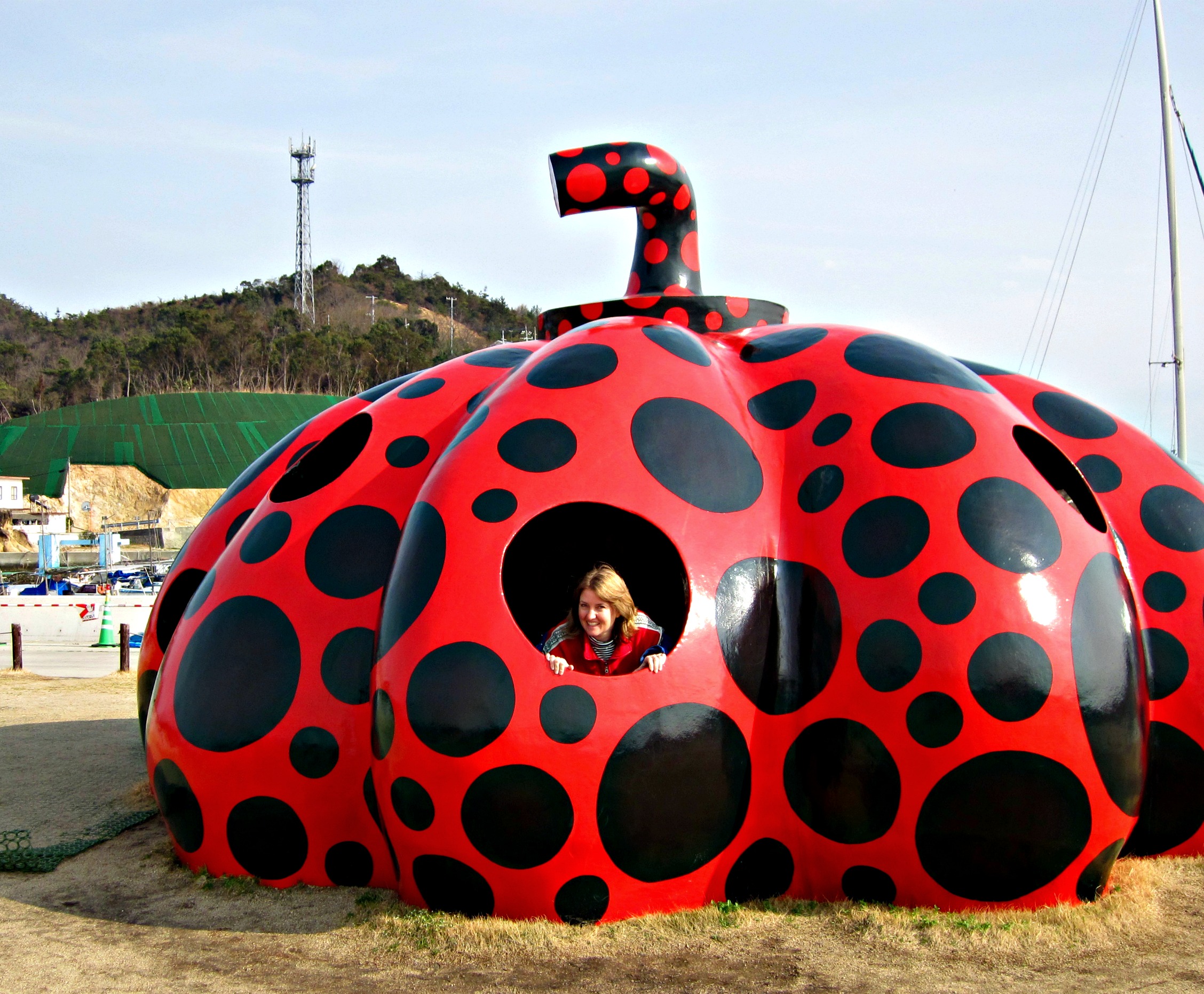
img: Suzanne Kamata standing inside a pumpkin sculpture on the Japanese island of Naoshima (March 2011). The sculpture was created by the well-known artist Yayoi Kusama, who was herself an expat for awhile. (She lived in New York City in the 1960s.)

LIBBY’S LIFE #47 – Showered with affection

Maggie opened her front door, and I handed her a screwdriver set.

“Oliver said you needed this urgently,” I said. “He says there should be one in there that fits, but let him know if there isn’t.”

I tried not to sound irritable, but really — did Maggie require this so urgently that I had to interrupt a nap and traipse here? The last thing on my wish list right now was another needy middle-aged woman. My mother already occupied that job slot, and it seemed that my beloved Maggie was picking up her bad habits. They’d spent a lot of time together over the last few days; in fact, today, Mum had been at Maggie’s house since before lunchtime.

But why stop at blaming middle-aged women? Oliver could have brought it to Maggie himself before his after-work shower, but no: “You take it to her, Libs. I’m shattered.”

And I’m not, of course.

Maggie took the screwdrivers from me. “Come in,” she said, opening the door a little wider.

“No, it’s OK.” I turned to leave. “I have to get back. Jack needs his dinner.”

Maggie reached out and grasped me by the elbow, drawing me back. “Jack will be fine with Oliver for a few minutes. Come on,” she urged. “Your mother just put the kettle on.”

I didn’t want tea. I wanted to give Jack his dinner, put him to bed, and then I wanted to go to bed myself.

“All right,” I said with a sigh, and stepped into the wood-panelled hallway.

“Go and make yourself comfortable,” Maggie said. “I’ll be with you in a moment.” She trotted off towards the back of the house.

Wearily, I turned left, into the living room.

I felt my jaw drop.

* * *

“It’s usual not to have a shower for a second baby,” Maggie said behind me, as I gazed at all the people congregated in the living room. Mum. Charlie, Anita, Julia. A few moms from Jack’s new nursery school. Even Caroline. “But you’re a special case.”

Pink and blue bunting criss-crossed the room. Pastel-wrapped boxes lay piled in one corner. Pink- and blue-iced cupcakes nestled together on a three-tier stand.

Welcome, Twins! said a big banner over the fireplace.

I felt my eyes prickling. “Thank you,” I whispered, looking round at everyone. I hugged Maggie, not quite able to believe that I was the centrepiece of my own surprise baby shower. “Thank you so much.”

Anna appeared from the kitchen and handed me a glass of something that looked like champagne. “Sparkling grape juice,” she said, before I could object. “Although you might want the real thing before the evening’s over,” she murmured, her eyes darting in the direction of my mother, who sat in Maggie’s rocking chair talking earnestly to Charlie.

“Delivery rooms aren’t my scene,” she was saying. “But Libby would like me to be there, I think.”

“No way!” I mouthed at Charlie, any rush of sentiment for my mum receding rapidly.

Charlie’s lips twitched. “Of course, with it being a C-section delivery, they probably won’t let you in.”

Mum took a deep, huffy breath. “That’s not what I’ve seen on A Baby Story. It’s a real family occasion for all those women.”

Heaven preserve us. Mum started channel surfing four days ago, and all her “I didn’t come to America to do this, that and the other” arguments vanished.

Apparently, her raison d’être in America is to watch The Learning Channel all day. If I’ve seen one woman give birth on these dreadful programmes since Sunday, I’ve seen thirty, and believe me, it’s not a good idea when your own birth experience has been scheduled for seven days hence, and your mother has decided that an impromptu family party in the operating theatre would be fun.

Yes. The twins will be extracted from me on April 26th at 9am. My slightly elevated blood pressure was still causing Dr. Gallagher some concern, so he booked me into his busy timetable for next Thursday.

I’m not happy about it, or even convinced that it’s necessary, but what can you do?

Oliver says: Look on the bright side. At least there will be no getting out of bed at three in the morning because your waters have burst and the bed’s a swamp.

Always has a way with words, does my Oliver.

So, as I was saying — what can I do?

Sod it. Enjoy the party. That’s what.

“Cheers, everyone,” I said, raising my glass of grape juice.

* * *

Charlie fetched her car — everyone had parked their cars in the next street so I didn’t get suspicious — and packed all the gifts in the trunk to deliver them to our house. I felt so lucky, so loved. You remember all those things I had returned to the baby shop because they’d cost so much? Maggie had taken note of the items, and now most of them were once again on their way to the babies’ room.

I felt overwhelmed with the generosity, the camaraderie, the shower of affection. No wonder these parties are known as showers.  I felt — far more than I had ever felt in my hometown of Milton Keynes — that I belonged. Belonged to something good.

* * *

“I just wish it didn’t have to be this way,” I said to Maggie as I put my outdoor shoes on, waiting for Anna to bring her car round to drive me the short distance home. “I’ve always dreaded the idea of being sliced open, but I don’t have much option if Dr. Gallagher thinks it’s too risky to let me go on any longer…”

Maggie snorted disbelievingly. “If I know dear Gerry, he’ll have a golf tournament lined up in a couple of weeks that he doesn’t want to miss. Take my word for it, your hospitalization is less to do with your safety, and more to do with keeping his handicap.”

“No!” I was shocked. “He wouldn’t do that — would he?”

“He’ll take very good care of you, don’t worry. Better to do it his way than to have a complete stranger delivering those twins, don’t you think? Imagine — you could end up with that frightful witch, Elspeth Wojcik.”

I shuddered. One visit to that particular obstetrician, whom I’d nicknamed Doctor Death, had been enough. The possibility that in Dr. Gallagher’s absence she could deliver our twins was horrifying. But I still balked at the idea of having my midsection cut open, no matter how unnoticeable the scar would be afterward.

“You need some alone time with Oliver. That’s what you need,” Maggie said.

“But we went out for dinner only last Saturday,” I protested.

“Ribs and fries aren’t going to bring on labour, are they?”

“What?” Maggie’s twists of conversation confused me sometimes. Quite a lot, actually, these days.

“Alone time at home, is what I meant,” she said. “Not alone time at Ruby Tuesday’s.”

The penny dropped.

“Oh!” I’d forgotten about that little trick to bring about labour. And it sure beat swigging castor oil.

Maggie nodded. “Send Jack and your mother round here every lunchtime for the next few days, and see if you and Oliver can spoil Gerry Gallagher’s plans.”

The gravel on Maggie’s driveway crackled as Anna’s Mustang drew up outside.

“You’re on,” I said.

* * *

A Massachusetts spring heatwave. Sun pouring in through our bedroom windows. A chickadee chirping close by.

Oliver feeds me another strawberry. “I should get back to work,” he says. “But I think I’ll call in and say you’re not well.”

“Again? Will they believe you?”

“Don’t care if they do or not.”

“You could always work at home,” I suggest.

“Or do something else at home. Does this old wives’ tale really work? Technically, you’ve still got four weeks to go. ”

“It’s supposed to work. So they say.”

I lie on my side and gaze out of the window, at the slight breeze moving through the tall oak trees at the end of our garden, and I listen to the silence of Woodhaven.

The babies have been very quiet for a couple of days; they’re still, sleeping a lot, getting ready for a big day. Their peace makes me woozy, detached, and I feel myself mentally withdrawing from the world just as they prepare to meet it.

No. It won’t be long. I know it.

.

Next post: LIBBY’S LIFE #48 – Hospital visiting hours

Previous post: LIBBY’S LIFE #46 -A tale of two mothers

Click here to read Libby’s Life from the first episode

STAY TUNED for Friday’s post, when Anthony Windram debates the view that, this Sunday, expats should be the last people celebrating Earth Day.

If you enjoyed this post, we invite you to subscribe for email delivery of The Displaced Dispatch, a round up of the week’s posts from The Displaced Nation. Sign up for The Displaced Dispatch by clicking here!

Image: Travel – Map of the World by Salvatore Vuono / FreeDigit

For the displaced writer Martin Crosbie, a life between two cultures is the stuff of literary fiction

Readers who’ve been paying attention will know that a couple of days ago, in honor of The Displaced Nation’s first birthday, we fleshed out a prospectus for a literary festival for authors who’ve been expats, third culture kids and/or global nomads.

Should this litfest ever happen, this month’s featured author, Martin Crosbie, would make an exciting addition to the line-up.

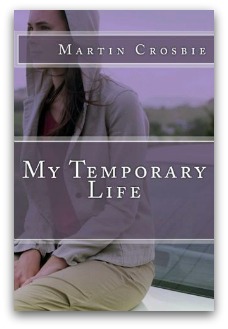
Last year he published a sensitive, partly autobiographical first novel, My Temporary Life, telling the story of Malcolm, a young half-Scot half-Canadian. As Malcolm informs us towards the start of the book:

I live with a father [in Scotland], who didn’t intend to have a son with no wife, or I spend my summers in Canada, with a mother who forgets that I’m there.

Eventually, circumstances make it impossible for Malcolm to continue this peripatetic life, and he heads to Canada to finish up his schooling. Even then, he feels unsettled:

It really does feel like everything is going to be okay, or at least it might be for a little while. Nothing in my life has ever been forever anyways. Everything is always just temporary, always temporary.

The novel has taken the Amazon charts by storm, garnered rave reviews and turned Crosbie into an overnight publishing sensation.

In fact, I recommend you become part of the storm by reading the book RIGHT NOW — or as soon as you’ve finished this post.

Here’s a link to the book on Amazon: My Temporary Life.

Alternatively, you can sign up for our DISPLACED DISPATCH — and cross your fingers that you’ll be one of this month’s two lucky winners!

And now for some highlights from my exchange with Martin Crosbie…

Is Malcolm Martin?

Hi there, Martin!
Hi, Tony!

Can you tell me a bit about your upbringing — where you were born and how you ended up in Vancouver?
I was born in Aberdeen in Scotland but I was adopted and transplanted to Kilmarnock when I was still an infant. I lived there until I was ten and my family moved us to the west coast of Canada. Other than a few years in Toronto and in Ontario when I was in my twenties, I have always lived here, just outside of Vancouver, British Columbia.

I’ve read your book My Temporary Life, and I loved it. I was particularly impressed by the way your writing flows, which is the mark of a very accomplished writer.
Thanks for saying that, I really appreciate it. This is my first novel and I think one of the reasons that it’s done well is that it went through so many re-writes and revisions. The novel that is out there today is very unlike the first few drafts.

You’ve lived in both Scotland and Canada, the two locations in the book. You also share the main character’s love of running… So I have to ask — how much of this character is autobiographical?
I had a writing teacher who would say “What is truth, in fiction? Write something down!”

Then, he’d sit down and wouldn’t answer any questions until the class had all written something, anything.

Once we shared what we’d written, he’d talk about the fact that when you read something and it “rings true” — in that you get lost in the scene — the reason is that the emotions the writer has conveyed are coming from a true place.

So, I appreciate your question because it means that my story probably worked when you read it.

But did the events in the book really happen — the boy with two parents from two cultures (Malcolm), his best friend whose parents beat him up (Hardly), and his dream woman, who, too, has had an abusive childhood (Heather)?
A lot of the incidents did in fact happen — but to different people at different times. The book is most definitely fictional.

But it is true?
Without wanting to become the next James Frey, yes, on some level it is. I had the daughter of a friend read the novel and really enjoy it, and she asked me if I was Malcolm. I told her that some days I feel like Malcolm and some days I feel like Hardly — lol.

The ups and downs of self-publishing

Quite a few authors in The Displaced Nation’s circle have self-published their works, myself included. Can you tell us what was behind your decision to self-publish My Temporary Life?
I self-published My Temporary Life because I was turned down over one hundred times by agents and publishers. The strange thing, though, was I’d pass my work to readers and they enjoyed it — very few of them didn’t. Oh, there were changes that I made along the way because of readers’ input, but the feedback was almost always decent. And they all wanted to know the same thing: “When’s the next book?”

So I self-published through Amazon, and it’s been an incredible ride. In less than three months 85,000 copies of my book are out there. I say that number and it absolutely astounds me that so many people have taken the time to give My Temporary Life a chance.

Is there a particular group of readers who’ve found particular resonance with your story?
One of the challenges with my novel has been that it doesn’t fit any specific genre, and when that happens you don’t know where to market your work. This has been good and bad. Not knowing whether to call it a coming-of-age story, a romance, or a thriller has been challenging. But not knowing exactly to whom it might appeal has also been a good thing, because I now have women and men readers of all ages.

I guess Malcolm is a reluctant, flawed hero and we can all kind of relate to that.

Self-publishing , as I know from my own experience, can be time consuming, however rewarding it is. Have you found it that way?
Without self-publishing, my story would not have reached anyone. It’s as simple as that. Having said that, the downside is that it’s a lot of work — and I mean, a lot of work. I promote my book anywhere that I can online where I think folks might be interested. Unfortunately, this takes me away from writing my next book, and that’s what I really want to be doing these days.

The positive of self-publishing is that I enjoy interacting with folks who’ve read or are reading My Temporary Life. I’m very accessible. I answer every email. I am on chat loops, Facebook groups, Yahoo groups — anywhere that somebody wants to talk about self-publishing or writing or my work. And, in doing that, I’ve formed some incredible friendships.

You know when you meet someone, whether it’s virtually or in person, and you just know that they’re going to be in your life for a long time? Well, I have met friends like that because of my book.

In the past week, I’ve had instant messages, tweets and emails from all kinds of people. One lady was ribbing me because she had to call in sick after being up all night reading my book. Another woman sent me a barbecued salmon recipe — she’d liked the recipe in my book but thought hers was better. And a gentleman sent me a message who is a huge fan of the book. He said that he’d told his wife that if she didn’t read it, she had to pack her bags, lol.

And, the readers that I am “meeting” are from all over: Taiwan, Luxembourg, lots in Australia, the UK of course, and the US.

It’s an amazing world that we live in that I’m able to experience that, and it’s all because I self-published my book.

Cross-cultural relationships

Malcolm gets involved with Heather, who’s a born-and-bred Canadian from a secluded little town in Northern Ontario. Heather says to Malcolm when they first meet: “You have this Scottish look to you, like you just got off the boat and are still lost; it’s very cute.” What’s your view on cross-cultural relationships? Do you see them as particularly challenging? (Many Displaced Nation readers are in them, which is why I ask…)
It’s funny that you bring that up as I’m trying to address it in my work in progress. I don’t really know if I’m properly qualified to comment… I live in an area of Vancouver where I have friends from pretty much every culture you can imagine. I’m lucky in that respect, and of course because of that, I get to eat lots and lots of different foods. Food is very very important to me, Tony, I do love to eat.

The importance of being Scottish

You’ve lived in Canada a long time. But does Scotland still exert some kind of pull?
Scotland calls me back every few years. Right now it’s been three years since I was there and it’s whispering in my ear again, so I’ll be back there soon.

You see, when you’re a Scot, you’re always a Scot. There are third and fourth generation Scots who live in Canada who still call themselves Scottish.

Well, I was born and bred there and have been back many times, and even though I am a Canadian citizen now, you can’t not be a Scot. It’s more than just being born there. It’s much more than that.

When I arrive at Glasgow airport and present my European passport (yes, I have a Canadian and European one), and the customs agent sees my birthplace and says, “Welcome home, Mr Crosbie,” I always get a tear in my eye.

And, there are many many things that I miss about Scotland.

I miss the passion that they have for football, real football. I miss big sour pickled onions. I miss the way the rain can be lashing in your face and somebody will say to you that it’s a “grand” day. I miss the way that Scottish history is real history, real old history.

The dream of partial repatriation

Would you ever go back to live in Scotland?
I’m fortunate that I can go back from time to time, and in the movie of my life that plays in my head, I do live there part time too. One day I hope to make it happen. I already have the city picked out in Scotland where I’d like to live…

But wouldn’t you have to make some adjustments?
During the months when I’m living in Scotland, I expect I’d miss the mountains that we have here on the Vancouver coast — but I’d sure like to try it for a little while.

If my next book is as successful as My Temporary Life, I might just find a way to fulfill my dream and live part time in both countries.

A Temporary Life — The Sequel

Rumor has it you’ll be doing a sequel following the life of Malcolm’s Scottish friend, Hardly. What can you tell us about this work in progress?
I can tell you that I’ve seldom been as excited about anything as much as I’m excited about my next novel. Yes, it is the story of Hardly. I’m having so much fun writing it.

Just what the final product will look like I don’t really know, so at this point I’ll just say that it’s like the first novel in the sense that it’s an in-depth character study of a man and his motivations, and in terms of how the novel reads, well, I do love plot twists, Tony, and I can absolutely guarantee you that this book will have them.

Sounds fantastic! Thanks so much for your time, Martin.
Thanks for doing this Tony, and of course now I’m going to be dreaming tonight about the wee chip shop in Stewarton, and the farm house that my cousins live in in Inverness, and a multitude of other Scottish things.

* * *

Anyone who’d like to know more about Martin’s life and his work, you can check out his author site and follow his escapades on Twitter: @martinthewriter

And if you have any questions for Martin, please feel free to ask them in the comments!

And don’t forget to sign up for our Dispatch to be eligible for the giveaway of Martin’s book!

STAY TUNED for tomorrow’s installment in the life of our fictional expat heroine, Libby, which will be another party-themed post — this time, of course, it’s a baby shower! (What, not keeping up with Libby? Read the first three episodes of her expat adventures.)

If you enjoyed this post, we invite you to register for The Displaced Dispatch, a round up of weekly posts from The Displaced Nation, with seasonal recipes, book giveaways and other extras. Register for The Displaced Dispatch by clicking here!

Related posts: