The Displaced Nation

A home for international creatives

Tag Archives: Crosscultural

Dear Mary-Sue: A brimful of ashram and other travel-related spiritual quests

Mary-Sue Wallace, The Displaced Nation’s agony aunt, is back. Her thoughtful advice eases and soothes any cross-cultural quandary or travel-related confusion you may have. Submit your questions and comments here, or else by emailing her at thedisplacednation@gmail.com.

And here’s to a happy 2012 to all of my peeps out there! I hope you all had a wonderful Christmas — I know mine most certainly was. It’s always non-stop craziness in the ol’ Wallace homestead and Christmas 2011 was no exception — let me tell you! “Light of my life” (Ha! You should see me rolling my eyes as I type this) Jake went a little crazy with the Christmas lights this year. You’d have thought Rand Street, Tulsa, was in fact Vegas such was the amount of illumination we had going on. As I mentioned in my last column, New Year was spent unwinding and destressing in Iceland, but Christmas itself was all about Tulsa and the family. Of course, I was missing all my peeps. (I don’t like to think of you as mere readers, you’re all more than that, you’re buddies, you’re my peeps. Am I right? ‘course I am!) Well, anyway as I spent the yuletide period honey glazing my ham and making just the sweetest gingerbread men Rand Street ever did bite their teeth into, I was happiest knowing that 2012 would see me tackling all of your problems and sorting out your travel-related messes.

___________________________________________

Dear Mary-Sue,

I got a new Kindle for Xmas and downloaded a book I’ve always wanted to read, Eat, Pray, Love by Elizabeth Gilbert.

I get the eating and the love parts, but am not so sure about praying — especially if it entails spending time at an ashram in India. Do you think that could be good for me?

Sharon, Cut and Shooot, Texas

Dear Sharon,

A Kindle!! How exciting! What a great present. At the risk of not being my usual super-modest self, you should check out some of my stuff on there. My new historical novel The Sigh of the Bosom is available to buy on there. It’s about a young orphan called Molly growing up in Colonial America. Don’t want to spoil too much of it for you, but little plain Molly gets quite the surprise when she discovers she isn’t in fact an orphan at all, but the true heir to the King of England. It’s gripping stuff, Sharon.

As for going to an ASH-ram, well as a committed non-smoker I am not sure that you should be doing that! Ha! Just a little bit of Mary-Sue Wallace humor there. More seriously, should you go to an ashram? Well, ol’ Mary-Sue Wallace mentioned this to her pastor, Rick. Rick, who might I add plays a mean guitar, is my go-to guy for all things spiritual — as well as for chilli (Rick makes a mean chilli). Anyhoo, Rick told me that spirituality isn’t about flying half-way across the world. Prayer isn’t dependent on location. While it might be nice to seek solitude, and who among us doesn’t crave that at times, what is important is the act of thinking, of contemplation.

I see you live in Texas. Why not go for a hike, take up watercolors, just do something that connects you to your local nature. If you just want to escape and have a change of scenery for a little while then sure, why not go all the way to India and visit an ashram. But if it’s about trying to reconnect with yourself, then I don’t think the answer lies in a plane ticket to India. Things just ain’t that easy.

Mary-Sue

——————————————————————————————————————

Dear Mary-Sue,

I’m headed to India next week to try connecting with my inner spirituality. What do you think I should wear? Or should I buy an outfit once I get there?

Roseanne, Spunky Puddle, Ohio

Dear Roseanne,

A little fashionista birdie tells me Daisy Duke-style denim shorts are THE thing to wear in India in 2012.

Blessings,

Mary-Sue

——————————————————————————————————————

Dear Mary-Sue,

I’m thinking about taking a gap year next year and, because I’m so fed up with the rampant consumerism of the West, I’d like to go somewhere that could put me in touch with life’s spiritual aspects. Can you recommend anywhere — apart from India, that is, as I’m afraid of getting sick on the food?

Chad, Cheddar, South Carolina

Dear Chad,

Be a trendsetter and think outside the box. You sound like the sort of young guy who shouldn’t be following in the footsteps of others, you should be forging your own path. You know what you don’t hear people say very often? “I’m going on a pilgrimage to Maine,” that’s what. You can start that trend. This site seems to be a great place to start: http://www.visitmaine.com

Mary-Sue

——————————————————————————————————————

Anyhoo, that’s all from me readers. I’m so keen to hear about your cultural issues and all your juicy problems. Do drop me a line with any problems you have, or if you want to share your fave meatloaf recipe with me (yum! yum!). As they say in Italy, “ciao!”

Mary-Sue is a retired travel agent who lives in Tulsa with her husband Jake. She has taken a credited course in therapy from Tulsa Community College and is the best-selling author of Traveling Made Easy, Low-Fat Chicken Soup for the Traveler’s Soul, The Art of War: The Authorized Biography of Samantha Brown, and William Shatner’s TekWar: An Unofficial Guide. If you have any questions that you would like Mary-Sue to answer, you can contact her at thedisplacednation@gmail.com, or by adding to the comments below.

STAY TUNED for Wednesday’s post — a firsthand account of how travel can lead to a simpler life.

If you enjoyed this post, we invite you to subscribe to The Displaced Dispatch, a weekly round up of posts from The Displaced Nation, plus some extras such as seasonal recipes and occasional book giveaways. Sign up for The Displaced Dispatch by clicking here!

Related posts:

Best of 2011: Books for, by and about expats

One of our Random Nomads in November, Aaron Ausland, had this to say about those of us who venture across borders:

Travel to a new place for three weeks and you can write a book, travel for three months and you can write an article, travel for three years and you’ll likely have nothing to say.

While that may be true, I’m afraid it hasn’t stopped many of us who’ve spent large chunks of our lives gallivanting around the globe trying out life in different countries, from taking up the pen.

As with any other group, some are born writers (and thrive on new surroundings), while others have become writers (attempting to make sense of their adventures), while still others have had writing thrust upon them (responding to invitations to share their experiences).

At the Displaced Nation, we revere people who publish books, fiction or non, that in some way assist those of us who are (or have been) engaged in overseas travel and residency. We feature — and do giveaways of — their works. And, for established writers with a global following, we’ve created a unique “category” called the Displaced Hall of Fame.

In this spirit — and in the December tradition of looking back at the past year’s highlights — I present the following (admittedly incomplete) list of books for, by, and about expats that were published in 2011, in these five sections (click on the title to go to each section):

  1. NOVELS ABOUT EXPATS
  2. NOVELS ABOUT “HOME”
  3. EXPAT MEMOIRS
  4. SELF-HELP, CROSS-CULTURAL & OTHER NONFICTION WORKS
  5. INSPIRATIONAL ANTHOLOGIES

A few more points to note:

  • Books in each category are arranged from most to least recent.
  • I’ve mixed indie books with those by conventional publishers (it suits our site’s somewhat irreverent tone).
  • To qualify for the list, authors must have been expats for at least six months at some point.

* * *

NOVELS ABOUT EXPATS

Three Questions: Because a quarter-life crisis needs answers (CreateSpace, October 2011)
Author: Meagan Adele Lopez
Genre: Women’s fiction
Synposis: A love story based loosely on the author’s own romance with a lad from Bristol, the action traverses continents through letters and features a quarter-life crisis, a road trip to Vegas, and two crazy BFFs.
Expat credentials: An American, Lopez lived as an expat in the UK for a while (she is now back in Chicago).
How we heard about it: Melissa of Smitten by Britain was a fan of Lopez’s blog (originally titled The Lady Who Lunches). The pair met her London in the summer of 2010, when Lopez was still living in England. Recently, Melissa has been supporting Lopez’s attempt to gain sponsorship for turning the novel into a screenplay.
Sunshine Soup: Nourishing the Global Soul (Summertime, October 2011)
Author: Jo Parfitt
Genre: Women’s fiction
Synopsis: Six expat women from the UK, US, Thailand, Ireland, Norway and Holland converge in Dubai in 2008. The action centers on a Brit, who is on her first posting, and an American, who is on her 25th. The Brit learns the ropes and settles in, while the American woman’s world begins to crumble.
Expat credentials: A prolific author, publisher and pioneer in addressing the issues of accompanying spouses and aspiring expat writers worldwide, Parfitt has been an expat for nearly a quarter of a century. Born British, she now lives in the Hague.
How we heard about it: We noticed a couple of interviews with Parfitt — one by expat coach Meg Fitzgerald and another by Expat Women.

The Beautiful One Has Come: Stories (Wyatt-MacKenzie Publishing, July 2011)
Author: Suzanne Kamata
Genre: Cross-cultural romance
Synopsis: Twelve short stories reveal the pains and the pleasures experienced by expat women, most of whom live in Japan.
Expat credentials: Kamata is an American who has lived in Japan for 20 years.
How we heard about it: Kamata and her book were featured on Kristin Bair O’Keeffe’s Writerhead Wednesday in July of this year.

Hidden in Paris (Carpenter Hill Publishing, April 2011)
Author: Corine Gantz
Genre: Women’s fiction
Synopsis: Three strangers — all American women — have reached the point of terminal discomfort with their lives so run away to Paris to begin anew.
Expat credentials: Gantz is a French expat living near Los Angeles. She is getting her own back by writing about American expats in Paris.
How we heard about it: We are long-time fans of Gantz’s blog, Hidden in France — in fact, we promoted one of her posts (about falling into her swimming pool) with the launch of TDN in April. We also interviewed her about her first novel as part of our “gothic tales” theme this past May.

Exiled (Quartet Books, April 2011)
Author: Shireen Jilla
Genre: Psychological thriller
Synopsis: The wife of an ambitious British diplomat, whose first posting brings them to New York, looks forward to escaping from Kent and leading the high-profile life of a successful expat — only to find her world being threatened by dark psychological forces on a par with those depicted in Rosemary’s Baby.
Expat credentials: A Third Culture Kid (she is half English, half Persian, and grew up in Germany, Holland and England), Jilla has also been an expat in Paris, Rome, and New York.
How we heard about it: TDN writer ML Awanohara read a review of Jilla’s novel by Kate Saunders in the Sunday Times. She approached Jilla in May about having an exchange with our readers about the gothic themes in her novel, in line with our site’s own delvings into the gothic aspects of expat life. Our readers loved her!

NOVELS ABOUT “HOME”

Lady Luck (Colorado Mountain Series)
Author: Kristen Ashley
Genre: Romance
Synopsis: Ex-con hero, wrongly imprisoned, gets mixed up with unlucky heroine, who will stop at nothing to help him get revenge.
Expat credentials: Born in Gary, Indiana, Ashley grew up in Brownburg and then moved to Denver, where she lived for 12 years. She now lives with her husband in a small seaside town in Britain’s West Country, where she has produced more than twenty books featuring rock-chick, Rocky Mountain, and other all-American heroines.
How we heard about it: Ashley is the friend of an old schoolfriend of TDN writer Kate Allison, who invited her to do a guest post for us on Britain’s (lack of) Royal Wedding preparations  for our Royal Wedding coverage.

Queen by Right: A Novel (Touchstone, May 2011)
Author: Anne Easter Smith
Genre: Historical romance
Synopsis: This is the fictional story of Cecily of York, mother of two kings and said to be one of the most intelligent and courageous women in English history.
Expat credentials: The daughter of an English army colonel, Easter Smith spent her childhood in England, Germany and Egypt. She came to New York City at age 24, and as she puts it:

Many years, two marriages, two children and five cross-country moves later I’m very definitely a permanent resident of the U.S. — but my love for English history remains.

(She now lives in Plattsburgh, New York.)
How we heard about it: Easter Smith and her book were featured on Kristin Bair O’Keeffe’s Writerhead Wednesday in October.

Dance Lessons (Syracuse University Press, March 2011)
Author: Áine Greaney
Genre: Irish Studies, Women’s Fiction
Synopsis: The action centers on a woman of French-Canadian background who marries an Irish emigrant who is working illegally in a bar in Boston. After his death by drowning, she visits Ireland for the first time and finds out what a shattered man he actually was.
Expat credentials: She may be a resident of Boston’s North Shore, but Greaney continues to identify herself as an Irish writer (County Mayo).
How we heard about it: Greaney and her book were featured on Kristin Bair O’Keeffe’s Writerhead Wednesday in October.
Pentecost: A Thriller (The Creative Penn, January 2011)
Author: Joanna Penn
Genre: Thriller
Synopsis: The Keepers of the stones from Jesus’s tomb — which enabled the Apostles to perform miracles — are being murdered. The stones have been stolen by those who would use them for evil in a world. An Oxford University psychologist spearheads a search for them in a race against time…
Expat credentials: English by birth, Penn grew up as a third-culture-kid and at the time of producing her first novel, was living in Australia.
How we heard about it: We are avid followers of Penn’s blog, The Creative Penn. Several months ago, TDN writer ML Awanohara deconstructed Penn’s post about what “home” means for writers for what it might teach expats and others who struggle with this issue as well. For Penn, home means some sort of spiritual kinship, which she has with two places: Oxford, where she went to university and near where her father now lives, and Jerusalem, which she’s visited at least ten times because she loves it there so much. Not surprisingly, she chose to set much of the action for her debut novel in these two cities.

EXPAT MEMOIRS
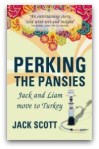
Perking the Pansies: Jack and Liam move to Turkey (Summertime Publishing, December 2011)
Author: Jack Scott
Synopsis: Dissatisfied with suburban life and middle management, Scott and his civil partner, Liam, abandon the sanctuary of liberal London for an uncertain future in Bodrum, Turkey. The book is based on Scott’s irreverent blog of the same name, which after its launch in 2010, quickly became one of the most popular English language blogs in Turkey.
How it came to our attention: Scott was featured as one of our Random Nomads in May of this year and since then, has done us the favor of commenting on and liking several of our posts. **Kate Allison will be reviewing his book for our site on Wednesday.**

Ramblings of a Deluded Soul (CreateSpace, September 2011)
Author: Jake Barton
Synopsis: In his inimitable style, the British-born Barton strings together snippets from new novels and try-outs with reminiscences and, for the first time, insight into his own remarkable experiences as a traveler and expat in Europe (he once owned a small French vineyard and had another job he’s not supposed to talk about). NOTE: Barton’s first novel, Burn, Baby, Burn, burned its way into the Top Ten of the Amazon All Books list.
How it came to our attention: Barton is an online acquaintance of TDN writer Kate Allison. We celebrated him in the early days of our blog for his insights on foreign-language learning in Spain.

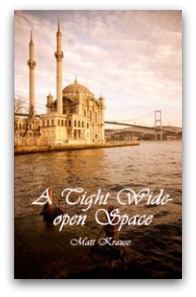
A Tight Wide-open Space: Finding Love in a Muslim Land (Delridge Press, August 2011)
Author: Matt Krause
Synopsis: A Californian who is now a Seattle-ite recounts how he became an Istanbullu, all for the love of a beautiful Turkish woman he met on a airplane. The year is 2003, and he can still hear the echoes of 9/11 as well as being acutely conscious of America’s engagement in two wars in Muslim countries. Eventually, he comes to love his new home more deeply than he might have expected.
How we heard about it: Linda Janssen, who writes the blog Adventures in Expatland, interviewed Krause about his book in October.

Planting Dandelions: Field Notes from a Semi-Domesticated Life (Penguin, April 2011)
Author: Kyran Pittman
Synopsis: A native of Newfoundland (her father was a well-known Newfoundler poet), Pittman writes about co-parenting with her charming Southern U.S. hubbie (they have three rambunctious boys); keeping the fiscal wolf from the door of their home in Little Rock, Arkansas; and honoring her marriage vows despite her refusal to give up her party-girl persona.
How we heard about it: Pittman came to our notice when she was a guest on Kelly Ryan Keegan‘s Bibliochat in late September.

Big in China: My Unlikely Adventures Raising a Family, Playing the Blues, and Becoming a Star in Beijing (Harper, March 2011)
Author: Alan Paul
Synopsis: Paul tells the story of trailing his journalist-wife to China and unwittingly becoming a rock star. His Chinese American blues rock band, called Woodie Alan, even earned the title of Beijing’s best band.
How we heard about it: We were early fans of Alan Paul’s back in the days of his Wall Street Journal online column, “The Expat Life.” Also, Paul and his book were featured on Kristin Bair O’Keeffe’s Writerhead Wednesday this past April.

The Foremost Good Fortune (Knopf, February 2011)
Author: Susan Conley
Synopsis: Conley, her husband, and their two young sons say good-bye to their friends, family, and house in Maine for a two-year stint in a high-rise apartment in Beijing. All goes well until Conley learns she has cancer. She goes home to Boston for treatment and then returns to Beijing, again as a foreigner — to her own body as well.
How we heard about it: Conley and her book were featured on Kristin Bair O’Keeffe’s Writerhead Wednesday in early October.

SELF-HELP, CROSS-CULTURAL AND OTHER NONFICTION WORKS

The Globalisation of Love (Summertime, November 2011)
Author: Wendy Williams
Genre: Relationships, self-help, humor
Synopsis: Williams interviews multicultural, interfaith and biracial partners from all over the world on what it feels like to “marry out” of one’s culture, religion and/or race. She also talks to experts on the topic and coins a term for it: “GloLo.”
Expat credentials: From a British-Ukrainian-Canadian family, Williams has been married to an Austrian for 13 years and lives in Vienna.
How we heard about it: TDN writer ML Awanohara listened to Jo Parfitt’s interview with Williams on her Writers Abroad show (Women’s International Network) and was attracted to the ideas of a book that treats this topic with humor. **TDN writer Anthony Windram will review the book for our site tomorrow (Tuesday).**

Modern Arab Women — The New Generation of the United Arab Emirates (Molden Verlag, November 2011)
Author: Judith Hornok
Genre: Women’s studies
Synopsis: The book consists of 20 chapters, each a stand-alone interview with an Emirati woman from disciplines as varied as business, film, medicine and politics. The women talk to Hornok about their careers, philosophies of life and plans for the future. The book, which is published in German and English, aims to dispel some of the Western myths surrounding Arab women.
Expat credentials: While not quite an expat, Hornok has been moving between the UAE and her home in Vienna, Austria, for eight years.
How we heard about it: TDN writer ML Awanohara read an article on the book in The National (UAE English-language publication) and became intrigued.

Expat Women: Confessions — 50 Answers to Your Real-life Questions about Living Abroad (Expat Women Enterprises Pty Ltd ATF Expat Women Trust, May 2011)
Authors: Andrea Martins and Victoria Hepworth (foreword by Robin Pascoe)
Genre: Women’s self-help, family, relationships
Synopsis: Experienced expats share wisdom and tips on topics that most expat women face, such as the trauma of leaving family back home, the challenges of transitioning quickly, intercultural relationships, parenting bilingual children and work-life balance. They also tackle more difficult issues such as expat infidelity, divorce, alcoholism and reverse culture shock. The book is based on the “confessions” page of Expat Women, the largest global Web site helping women living overseas.
Expat credentials: Andrea Martins is the director and co-founder of Expat Women. An Australian who has spent many years abroad, she began dreaming of connecting expat women worldwide when an expat in Mexico City. Victoria Hepworth is a New Zealander who has lived in Japan, China, Russia, Sweden, India and is currently living in Dubai, UAE. She is a trained psychologist who specializes in expat issues.
How we heard about it: Andrea Martins announced the publication of the book to much fanfare on Twitter and in other social media venues. It has been widely reviewed on expat blogs.

Marriage in Translation: Foreign Wife, Japanese Husband (CultureWave Press, April 2011)
Author: Wendy Nelson Tokunaga
Genre: Relationships, self-help
Synopsis: Tokunaga conducts a series of candid conversations with 14 Western women about the challenges in making cross-cultural marriages work both inside and outside Japan. She quizzes them about the frustrations, as well as the joys, of adapting to a different culture within married life.
Expat credentials: Born in San Francisco, Tokunaga has spent numerous years studying, living, working and playing in Japan. She is the author of two Japan-related novels, published by St. Martins Griffin. Oh, and did we mention her Japanese “surfer-dude” husband?
How we heard about it: Sometimes one tweet is all it takes! (We follow Wendy Tokunaga on Twitter.)

A Modern Fairytale: William, Kate and Three Generations of Royal Love (Hyperion/ABC Video Book, April 2011)
Author: Jane Green
Genre: Romance, royalty
Synopsis: In this video book for ABC News, produced just in time for the Royal Wedding in March, best-selling chick-lit novelist Jane Green follows the stories of three generations of royal love from their meeting up to and after their respective wedding days. She concludes that Kate and William have a much better chance than William’s parents of enjoying a relationship on their own terms.
Expat credentials: Born in London, Green worked as a feature writer for The Daily Express before trying her hand at writing novels. She now lives in Westport, Connecticut, with her second husband and their blended family.
How we heard about it: One of us noticed that Jane Green had been tapped to provide coverage of the Royal Wedding for ABC News. We then invited her to talk about her e-book and engage with our readers in a debate on whether women should still aspire to be “princesses” in the 21st century — a post that received a record number of comments.

INSPIRATIONAL ANTHOLOGIES

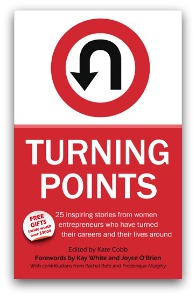
Turning Points: 25 inspiring stories from women entrepreneurs who have turned their careers and their lives around (Summertime Publishing, November 2011)
Editor: Kate Cobb
Synopsis: In this collection of stories from women all over the world, the focus is on the moments, or short passages of time, when a woman was facing something challenging and came out the other side smiling.
Expat credentials: Cobb is a British woman living in France, and about a third of the contributors — including Jo Parfitt and Linda Janssen — are expats who now run their own businesses.
How we heard about it: Linda Janssen promoted the book on her blog, Adventures in Expatland.

Indie Chicks: 25 Women 25 Personal Stories (Still Waters Publishing, October 2011)
Compiler: Cheryl Shireman
Synopsis: 25 indie novelists share personal stories in hopes of inspiring other women to live the life they were meant to live. (All proceeds go to the Susan G. Komen Foundation for breast cancer research.)
Expat credentials: Close to half of these indie authors are expats or have done significant overseas travel. To take a few examples: After living in Portland, Oregon, for most of her life, Shéa MacLeod now makes her home in an Edwardian town house in London just a stone’s throw from the local cemetery. Linda Welch was born in a country cottage in England, but then married a dashing young American airman, left her homeland, raised a family, and now lives in the mountains of Utah. Julia Crane is from the United States but recently moved to Dubai with her huband and family (her personal story concerns the adjustment process).
How we heard about it: Again, sometimes all it takes it a tweet (we picked up one of Linda Welch’s).

* * *

Questions: Have you read any of the above works and if so, what did you think of them? And can you suggest other works to add to the list? My colleagues and I look forward to reading your comments below!

STAY TUNED for tomorrow’s post, a review of The Globalisation of Love, by Wendy Williams, and for Wednesday’s post, a review of Perking the Pansies, by Jack Scott.

If you enjoyed this post, we invite you to subscribe to The Displaced Dispatch, a weekly round up of posts from The Displaced Nation, plus some extras such as seasonal recipes and occasional book giveaways. Sign up for The Displaced Dispatch by clicking here!

Related posts:

All hail Sir Richard Branson, along with global nomads who delve into global misery — and welcome to November

The catalog for Heifer International has just landed in my mailbox, encouraging me to donate a sheep in honor of my nearest and dearest, to a family in need in Nepal, Romania, or Brazil. That family will in turn give away the sheep’s female offspring to other families in need, and so on — a benevolent pyramid scheme known as Passing on the Gift.

I get it. What’s more, as it’s All Saints’ Day, I sense I would feel considerably more beatific if I gifted a sheep on behalf of my loved ones than if I bought them yet another pair of Merino wool gloves they don’t really need. (Hey, but it wouldn’t have been any old gloves but a touchscreen pair from Muji, for using one’s iPhone in the dead of winter…)

Yet for some reason, the Heifer appeal doesn’t. Call me a hard-hearted skeptic, but I’ve always had trouble with the kind of philanthropy that poses simple solutions to complex, deep-seated problems — alleviating world hunger and poverty being at the top of the list.

A candid — or do I mean Candide? — appraisal

When it comes to philanthropy, I always wonder — is this more about you (and your need to assuage your guilt about having so much) or about them? And how much do you actually know about them?

That is probably why, when I went to live abroad, I didn’t go as an aid worker or a Peace Corps volunteer. In the UK I was a postgraduate student; in Japan, a trailing spouse.

That said, my expat life was never just about exotic travel. On the contrary, I aimed to broaden my horizons and educate myself about other cultures by becoming immersed in the everyday life. I got to know the “natives” — and even married a couple of them (in not-very-rapid succession). Ultimately, I tried to become more of an informed citizen — of the world as well as of my country (assuming I eventually returned — I did).

But saving the world? That wasn’t in my plan. Like Voltaire’s young man, Candide, I would start by cultivating my own garden and branch out (so to speak) from there.

The importance of being earnest

I suppose you could say I’ve never been that earnest.

Earnest people have a calling. They don’t have time for frivolity.

I always have time for frivolity. What’s more, I’m genetically predisposed toward light-hearted nonsense. (Despite what the Heifer International Catalog says, my mother is not the sort to enjoy having me donate a sheep to someone she’s never met. She’d rather I gave it to her as a pet!)

From my expat days in the UK, I remember a joke sometimes told of Princess Diana, that when she would arrive on one of her unannounced visits to a hospital, patients would hide beneath their beds, not wanting to be the next “victim” of her need for making the Grand Philanthropic Gesture.

I find that image amusing to this day.

Do you really want to make me cry?

But lest this post become all about me and my peculiar hang-ups, let’s move on to Richard Branson and TDN’s November theme.

Cue in 1980s Culture Club music. Rockstar businessman Sir Richard Branson has just now touched down on the shores of The Displaced Nation in his hot-air balloon, the Virgin Atlantic Flyer.

As the leading exemplar of a fun-loving philanthropist, he is about to disprove my theory that these two qualities, earnestness and fun, can’t be combined in one individual.

As anyone who’s had the privilege of traveling on Virgin Atlantic in upper class (as I did when I was a spoiled expat in Tokyo) will be aware, here is man who knows how to throw a good party.

But if letting the good times roll is a huge part of Sir Richard’s appeal, it’s not his whole story. As one of the world’s wealthiest people, Branson also believes in giving back:

Ridiculous yachts and private planes and big limousines won’t make people enjoy life more, and it sends out terrible messages to the people who work for [such people]. It would be so much better if that money was spent in Africa — and it’s about getting a balance.

Branson, of course, has spent has spent much of his adult life displaced in ways most of us can’t even imagine — in private jets, on a private island in the Caribbean, in boats and balloons in pursuit of daredevil adventure.

But then some years ago, with his 60th birthday approaching, he began diverting some of his formidable energy and funding resources to countries in need — particularly in Africa. He left behind rock bands to form a band of Elders — consisting of, among others, British rock musician and human-rights activist Peter Gabriel, Nelson Mandela, Jimmy Carter and Mary Robinson — to work on the African continent’s intractable problems.

At Ulusaba, the private game reserve that Branson now owns in South Africa, visitors are encouraged to get involved with the initiatives he has launched to help local villages that have been ravaged by unemployment, HIV and drought. As Branson told a Daily Mail reporter:

To come to Africa and not see Africans is just wrong. A lot of the game reserves don’t really allow you into the villages but I think it’s important.

In addition, Branson is using his business knowhow to incubate and seed promising business proposals from aspiring South African entrepreneurs.

Now, Sir Richard would have earned the right of entry to our Displaced Hall of Fame by virtue of his derring-do alone — have you heard of Virgin Galactic? (It’s not too late to book a seat on the first sub-orbital space flight.) But we’ve chosen this moment to honor him as we plan to spend November looking at the kind of global nomads with the courage and the fortitude to delve into global misery.

Such travelers have displaced themselves, often to far-flung corners of the globe, not for the sake of good times or narrow personal goals but for the sake of helping others — many of whom have been displaced from their homelands through tragic circumstances beyond their control.

Not the final word

The announcement of this month’s theme is not, however, tantamount to imposing a ban on skepticism — we skeptics still have a place at The Displaced Nation’s table. What’s more, our ranks will soon swell to include some of the very people who belong to the volunteer and aid communities. They, too, can have their doubts about the effectiveness of their work — and of the involvement of celebrities in global problems.

But for now, let’s save such issues for future posts.

Which means I can now go back to cultivating my little patch of grass. Hmmm… I wonder if it could use a sheep or two, after all?

STAY TUNED for Wednesday’s post, featuring the first of our philanthropic Random Nomads.

If you enjoyed this post, we invite you to subscribe to The Displaced Dispatch, a weekly round up of posts from The Displaced Nation, plus some extras such as seasonal recipes and occasional book giveaways. Sign up for The Displaced Dispatch by clicking here!

Related posts:

Dear Mary-Sue: Things to do in Paris

Mary-Sue Wallace is back and she’s dishing out advice to the helpless like it were soup, soup from a big tureen of common sense in the soup kitchen we call the blogosphere … or something like that. If you are looking for solace, then you need Mary-Sue Wallace. Submit your questions and comments here, or if you are a shy bunny requesting anonymity then you can email Mary-Sue directly at thedisplacednation@gmail.com.

Dear Mary-Sue,

Growing up here in Japan as a big-time Francophile, all my life I’ve wanted to visit Paris. This fall I finally have a chance to go visit it for myself. I am so happy at the thought. I will get to stroll the streets and eat plenty of good food. Being such a travel expert could you give me a list of the top things you think I should do when visiting Paris?

— PA, Kyoto

Dear PA,

Ol’ Coley Porter put it best when he wrote that lovely classic of his, I love Paris. “I love Paris in the springtime / I love Paris in the fall / I love Paris in the winter when it drizzles / I love Paris in the summer when it sizzles.” And that sums up so perfectly and so succinctly my own thoughts about this darlin’ city. No matter the time of year, I fall in love with it. Whenever I arrive in Paris, I always make sure on that first night that I go for a stroll along the Seine. Ah, bliss. And when that’s over I go to a little cafe that I adore that is called…

….wait a moment….

….hmm….

….I’m sorry about this, PA, but I just noticed that you wrote that you’re from Japan. In that case, forget Paris. It’s overrated. Have you thought of visiting Malmo? I hear there’s also an interesting cement works in Frankfurt, you could go there. I’m sure it’s fascinating. And people keep telling me Swansea is the Paris of south Wales…

…Aw, shoot. As a loyal Mary-Sue-ite, you deserve a fuller explanation from me, PA. A Japanese Francophile finally visiting Paris after a lifetime of waiting? Aw, honey, sounds like you could be a prime candidate for Paris syndrome. Certain places just seem to have a strange effect on people. Believe me, I know this only too well. It’s why I’m never going back to Jerusalem. Went on a cruise there with my hubby Jake a few years back. Darn it if he didn’t come over all Messianic on me – thought he could walk on water. Well, the fine people at Cunard weren’t too impressed when he went overboard when trying to be all Matthew 14.

And Paris syndrome ‘aint no picnic either, honey. You can end up psychologically destabilized, suffering anxiety, hallucinations, feelings of persecution. Many Japanese visitors to Paris go there with such a romanticized image of the city and its occupants, that it’s a place of sophistication and politeness, that when they finally get there and see for themself the surly, rude reality of Paris they simply can’t cope. 

So PA, I ask again, have you thought about going to Frankfurt? 

— Mary-Sue

Anyhoo, that’s all from me readers. I’m so keen to hear about your cultural issues and all your juicy problems. Do drop me a line with any problems you have.

Mary-Sue is a retired travel agent who lives in Tulsa with her husband Jake. She has taken a credited course in therapy from Tulsa Community College and is the best-selling author of Traveling Made Easy, Low-Fat Chicken Soup for the Traveler’s Soul The Art of War: The Authorized Biography of Samantha Brown, and William Shatner’s TekWar: An Unofficial Guide. If you have any questions that you would like Mary-Sue to answer, you can contact her at thedisplacednation@gmail.com, or by adding to the comments below.

img: Close, by Corina Sanchez.

STAY TUNED for Monday’s post.

If you enjoyed this post, we invite you to subscribe to The Displaced Dispatch, a weekly round up of posts from The Displaced Nation, plus some extras such as seasonal recipes and occasional book giveaways. Sign up for The Displaced Dispatch by clicking here!

Related post:

“My country, ’tis of thee” applies to my expat mum but not to me

We take a break from road trips today with this guest post from Lawrence Hunt, a recent graduate of Warwick University (UK). Followers of The Displaced Nation may recall that we interviewed two cross-cultural married couples last summer. Hunt is the product of a cross-cultural union between an American mother and an English father. Let’s listen to what he has to say regarding the oft-perplexing matter of cultural identity. NOTE: This post has not been edited for British spelling or punctuation.

One of the things that expats like to tell themselves is that home is a state of mind.

But for me, the child of an English father and an American mother, home stands for a physical place: the one where I was born and grew up, England.

For years my mother has sipped her morning coffee from the same extravagantly large mug, Stars and Stripes boldly printed around the outside. She picked it up at an airport in Washington DC where we were visiting her sister. It’s curvaceous and welcoming, a daily caffeinated hit of homeland comfort. I’ve started drinking from it, too — but more as an ironic gesture.

Mum grew up reciting the Pledge of Allegiance in class, but in ultra-PC Britain, patriotism has to be decidedly lower key. It seems commonplace to see flags hoisted outside American homes, but over here the very act of being seen with a St George’s flag in any context other than sporting events or royal weddings is infrequent enough to draw stares. People see you with it and instantly wonder what fanatical scheme for national purification you’re plotting behind closed doors.

Now, I don’t fault my mum for being proud of her cultural upbringing. I think in some ways her extended absence makes her all the more keen to assert her identity and share it with us.

She did some family history research recently that confirmed we’re the distant descendants of Charles Carroll of Carrollton, the only Catholic and longest surviving signatory of the Declaration of Independence. That’s my strongest claim to fame, and I’m holding onto it.

Chocolate — the way to an English child’s heart

That said, America has never played much of a role in our regular family rituals. For one thing, traditions like the Fourth of July and Labour Day just aren’t compatible with the British calendar.

I do remember Mum hosted a wonderful Thanksgiving dinner once with some other American expats when I was little. Without having the next day off to recuperate, however, everyone left early and I think she found the mountain of washing up too colossal to repeat the effort.

The one institution she has passed down to us (and this is something I cannot thank her enough for) was the American Easter basket hunt. The concept, as I explain it to my friends, is simple but ingenious – essentially, it’s what all kids in England do but with two key differences: 1) More chocolate, and 2) Baskets.

While other English kids were being handed single Cadbury creme eggs in flimsy cardboard boxes, my brothers and I were racing around the garden looking for mighty hoards of chocolate hidden among the shrubbery by a miraculously literate bunny that knew how to spell our names on post-it notes.

As American as everyone else in Britain?

Basket cases aside, it’s difficult to say exactly how ‘Americanized’ I am as a result of my mother, and how much of it is just living in a country where America’s influence pervades almost every cultural platform.

The most differentiating feature of mum’s background has always been her accent. I can do a pretty convincing American accent on a good day, and I used to mimic my mother so often when I was a child that I still lapse into it sometimes without realising.

But even my mother, having lived here for almost thirty years, isn’t really that American any more in her diction. I think the few Americanisms I sometimes find myself using, like ‘movie’ rather than ‘film’, or ‘take-out’ rather than ‘takeaway’, are more because I hear them in American movies and prefer them than because I’ve picked them up from her.

I certainly feel something for the States — a fondness and a familiarity, I suppose. I’ve been lucky enough to go with her on visits to her family almost every other year since I was a baby. Some of my favourite memories have come from spending summers at lake houses in North Carolina, climbing the mountains of West Virginia and walking down endless blocks of New York.

When I was seventeen I took a position teaching at a French camp in the woods in Minnesota, and made friends who I still keep in contact with.

America as distant entity

But America lives for me, as it does for many Brits, more in fiction than in reality. From the moment I read JD Salinger, I was hooked, and I’ve probably read more American writers than British ones: Steinbeck, Fitzgerald and Kerouac, right through to more recent contemporaries like Bret Easton Ellis, David Foster Wallace and Jonathan Franzen.

They all essentially seem to be commenting on the same thing: the tragic failure of American life to live up to its promises. Paradoxically though, in the richness of the characters and landscapes they describe, they evoke a utopia in my mind that’s been hard to shake.

In my final year at university I enrolled in a contemporary American Literature module — ‘States of Damage — US Writing and Culture in the Post 9/11 Context’. I didn’t know what I was getting myself into. It was a step-by-step dissection of everything wrong with free market America, from George Trow’s attack on media culture in ‘Within the Context of No Context’ to Naomi Klein’s The Shock Doctrine, an expose on America’s foreign policy over the past 40 years.

The critique seemed appallingly one-sided to me, and an hour a week for an entire year I felt compelled to fight America’s corner against the scathing intellects of my fellow students. Truth be told, I just like a good debate, and this was a difficult one. There’s a lot about American politics that we find objectionable in British culture — even though we’re implicated in most of the same hypocrisies ourselves.

To be fair, however, my fellow students showed a very different side on Obama’s inauguration night. The Students Union had been decked out in American flags and YESWECAN posters, and multitudes of students were queuing up to buy hotdogs and other American staples. I voted in that election, and it was a night when I felt nothing but pride to be half American.

My mum’s sweet land of liberty

I sometimes think it would be nice to use my dual citizenship and live on the other side of the Atlantic for a while, preferably near the coast. Mum believes that on the whole, Americans are more open, friendlier (at least on the outside) and more honest than British people. She’s even been known to point out these qualities in my brothers and me, when they appear, as our ‘American side’.

I’m sceptical that you can generalise about such vast groups of people in any meaningful way, especially as the world becomes increasingly mixed.

Ultimately, I think when you spend very little time in a place, and you miss it greatly, you begin to feel connected to a idealised version of it, one that’s perhaps better than the reality. When I ask about America, the memories my mother recalls from behind the vapours of her star-spangled mug are those of the pioneering Midwest. She tells me she always wanted to be one of the pioneers in Little House on the Prairie, struggling against the elements and striking out on her own.

That adventurousness is, ironically, probably part of what made her leave America for pastures new in the first place.

I can see the real things she’s had to give up in establishing her new life here — the family, the friends, the holiday traditions, a million different flavours and details that in some cases are only slightly different here from what she grew up with. Those are also the things I take for granted about my own life in Britain.

I was born here, and that counts for a great deal more than where my mother was born.

img: Lawrence Hunt with his mum’s stars-and-stripes mug, at home in Chorley Wood

STAY TUNED for Monday’s post, in which Matthew Cashmore, aka The London Biker, relays his personal “Zen” of this rather risky, albeit exhilarating, mode of travel.

If you enjoyed this post, we invite you to subscribe to The Displaced Dispatch, a weekly round up of posts from The Displaced Nation, plus some extras such as seasonal recipes and occasional book giveaways. Sign up for The Displaced Dispatch by clicking here!

Related posts:

Dear Mary-Sue: Tempted to make invidious cross-cultural comparisons

Mary-Sue Wallace, The Displaced Nation’s agony aunt is back. Her thoughtful advice eases and soothes any cross-cultural quandary or travel-related confusion you may have. Submit your questions and comments here, or else by emailing her at thedisplacednation@gmail.com.

Dear Wallace-sensei,
As a Japanese expat living in New York, I’m finding myself becoming increasingly unsympathetic to my adopted city. Don’t get me wrong, Wallace-sama, I love it here. It’s just that I’ve found the hysteria surrounding first the earthquake and then Hurricane Irene a little hard to take considering the natural disasters Japan has had to deal with this year. Any advice for how I could stop these uncharitable thoughts that I am having?
— SY, New York City (originally Tokyo)

Dear SY-san,

Let me tell you a little story. There was once an attractive, physically fit young girl. She wasn’t from anywhere exciting, just a small town girl from West Virginia. Her father was a police officer in the town. When this young girl was 10, her father was shot and killed when apprehending a robbery. The girl was sent to Montana to live with her uncle. She didn’t like it in Montana, certainly not on the sheep farm her uncle owned. She tried to run away, to where she didn’t know, she just knew she wanted to be anywhere but Montana. But as she ran she witnessed something awful, the lambs from her uncle’s farm being slaughtered for market. She heard their cries, she still does, SY. She still does — when she dreams. It didn’t stop her running, though — she kept running this small girl.

The girl spent the rest of her childhood in a Lutheran orphanage. It was okay, though she still dreamt of the lambs. The girl was smart, though: she had gumption, she had tenacity and she was able to enroll into the University of Virginia on a full scholarship. When she left college, she applied to the FBI’s training academy. It was the late 70s, it wasn’t easy being one of the only women in the academy. But this girl got on with it. She was uncomplaining, and she was the best, she knew that. None of that sexist bull sticks when you know that.

On completing the training, this girl, now a young woman, joined the Behavioral Science Unit. She was part of a team that traced down serial killers — tried to get in their heads, think like they think. She was sent to a Baltimore asylum for her first interview, to meet with a serial killer who just might be able to help her with the case she had been assigned…

…Sorry, I digress, but the point, SY-san, is that that young girl was, in fact, little ol’ me. Yes, hard to believe, I know. I wasn’t always an agony aunt. Anyhoo, the point is some serious s**t went down. Some really creepy, really heavy stuff. So when I get invited round to Valerie Johnson’s for our book club meeting (second Tuesday of the month — we’re reading The Help at the moment; FABULOUS, you MUST read it), and Valerie starts recounting how she thought there was a robber in her garden the other day and she feared she was going to die — even though it just turned out to be Miguel, her 60-year-old Hispanic gardener — I just bite my tongue. Of course, I want to tell Valerie that she doesn’t know fear until she’s been trapped in a house with a serial killer knowing only one of you is going to get out of there alive. No, that would be rude. So I just sip my raspberry lemonade and nod politely as Valerie talks. New York, dear SY, is your Valerie Johnson. Tolerate her, SY, no matter how much you’d like to wring her neck.
— Mary-Sue

Anyhoo, that’s all from me readers. I’m so keen to hear about your cultural issues and all your juicy problems. Do drop me a line with any problems you have, or if you want to share your fave meatloaf recipe with me (yum! yum!). As they say in Italy, “ciao!” — or, as my (still!) unmarried youngest son (he’s nearly thirty, I despair of him, I really do) might say: “See you on the flip.”

Mary-Sue is a retired travel agent who lives in Tulsa with her husband Jake. She has taken a credited course in therapy from Tulsa Community College and is the best-selling author of Traveling Made Easy, Low-Fat Chicken Soup for the Traveler’s Soul The Art of War: The Authorized Biography of Samantha Brown, and William Shatner’s TekWar: An Unofficial Guide. If you have any questions that you would like Mary-Sue to answer, you can contact her at thedisplacednation@gmail.com, or by adding to the comments below.

img: Close, by Corina Sanchez.

STAY TUNED for Monday’s post, on the wide variety of vehicles that have been used for road trips.

If you enjoyed this post, we invite you to subscribe to The Displaced Dispatch, a weekly round up of posts from The Displaced Nation, plus some extras such as seasonal recipes and occasional book giveaways. Sign up for The Displaced Dispatch by clicking here!

Related post: